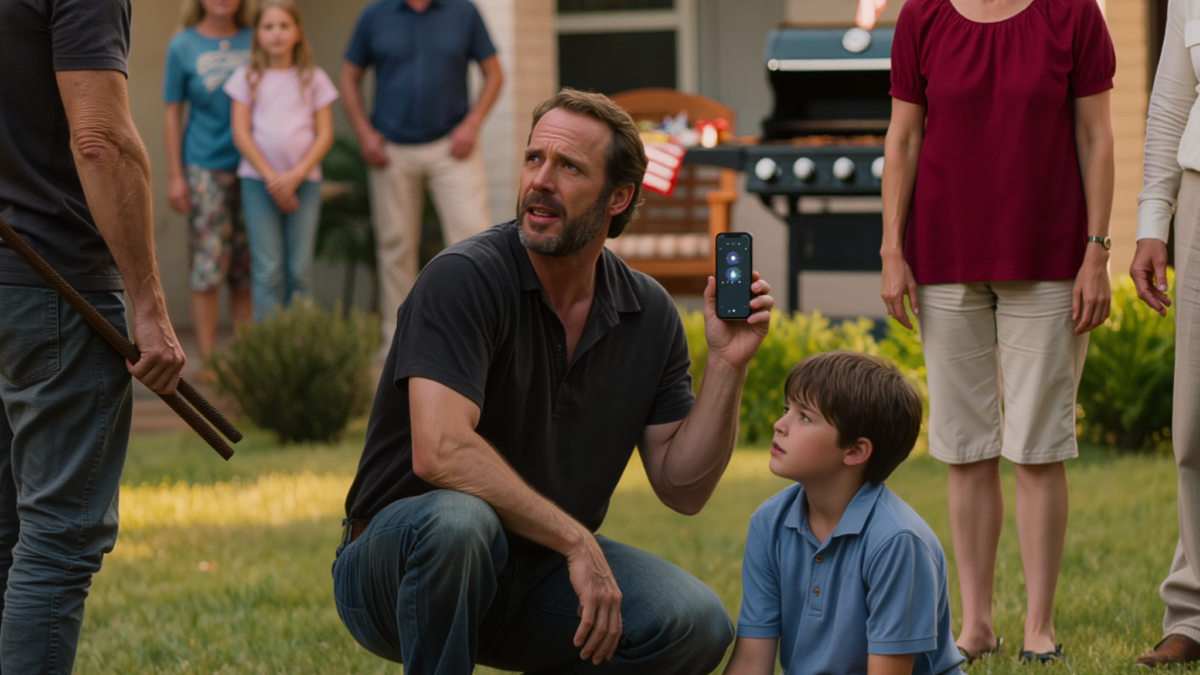
At my father’s 60th birthday, my brother shattered my 9-year-old son’s leg with a steel rod in front of 30 relatives. While Lucas screamed on the grass, my mother looked at him and said, “He deserved it,” and my father begged me not to call the police. I stopped fighting them, pulled out my phone, and calmly began recording exactly what my family had just done.
It was supposed to be a celebration.
My father, Robert, was turning 60, and my parents had filled their backyard in Austin, Texas, with relatives, neighbors, food, cold drinks, and everything else they believed a successful family gathering was supposed to have. Appearances had always mattered to them. If the lawn was full, the barbecue was going, and everyone smiled at the right moments, then whatever was happening underneath could be ignored.
I arrived with my son, Lucas.
He was nine years old and carrying a wrapped birthday gift for his grandfather. Lucas was the kind of kid who held doors open for strangers and tried to save spiders instead of squashing them. Watching him walk into that yard in his little polo shirt, I felt the familiar mixture of pride and anxiety I always carried when I went back to my parents’ house.
My parents were standing near the grill.
“James, you made it,” my father said, barely looking up from the brisket.
Then he asked where my brother was.
Derek was 38, four years older than me, and had been the golden child for as long as I could remember. I had become a corporate litigation attorney at Henderson and Associates. I followed rules, built a career, and learned to solve problems carefully.
Derek owned a construction company that I suspected was barely solvent.
None of that mattered to my parents. Derek could always be explained away.
When he finally arrived, the entire mood changed.
He looked disheveled, his eyes bloodshot, and smelled faintly of whiskey and expensive cologne. His wife, Vanessa, was with him, and he was pulling her by the arm. She looked pale and frightened.
Behind them came Vanessa’s mother, Mrs. Carmen.
Mrs. Carmen helped Vanessa care for her twin daughters. She was quiet and respectful, the kind of person who tried not to inconvenience anyone.
Derek was already angry before he reached the patio.
He told Vanessa he had not wanted Mrs. Carmen there. Then he turned toward the older woman and started complaining about supporting “useless mouths.”
The music stopped.
Conversations died around us.
About 30 people were standing there listening.
“Derek, please,” Vanessa said. “It’s your father’s birthday. Let’s not do this.”
He told her not to tell him what to do.
Then he turned back toward Mrs. Carmen and continued. He called her a leech and accused her of turning his daughters against him.
I started forward.
Conflict was part of my job, and I knew I needed to intervene before the situation got worse.
Lucas got there first.
“That’s not nice, Uncle Derek.”
My nine-year-old son had stepped between Derek and Mrs. Carmen.
He looked small standing in front of my brother, but he stayed there.
“Mrs. Carmen is nice. She helps Vanessa with the twins all the time. You shouldn’t say bad words to her.”
For a moment, I was overwhelmed with pride.
Lucas was doing exactly what I had always taught him to do. He saw someone vulnerable being mistreated and spoke up.
Derek saw something completely different.
To him, Lucas had challenged his authority.
“You little punk.”
His face changed.
He demanded to know why Lucas thought he could talk back to him and mocked him for having a “fancy lawyer” for a father.
“Derek, stop,” I said.
I began closing the distance between us.
“He’s a child. Back off.”
Derek shouted that Lucas needed to learn his place.
Near the back fence was a pile of construction material. Derek had been redoing my father’s patio, and there were bags of concrete, steel rods, and pieces of rebar nearby.
He reached down and grabbed a rusted piece of steel rebar about two feet long.
Everything seemed to slow down.
I saw the metal in his hand.
I saw his arm tighten.
My brain still refused to believe he would actually use it against a child.
“Lucas, move!”
I ran toward them.
I was too far away.
Derek swung.
The steel struck Lucas in his right shin.
Lucas collapsed onto the grass.
For a second, he looked confused. Then the pain hit him, and he began screaming for me.
I dropped beside him.
His leg was badly injured, and I was terrified that moving him would make things worse.
Then I looked up at Derek.
He was still holding the steel rod.
“That’ll teach you respect,” he said.
I stood up.
Every thought I had about being a lawyer, acting rationally, or worrying about consequences disappeared. I started toward him.
Hands grabbed me before I reached him.
They belonged to my parents.
Not Derek.
My parents were holding me back.
“James, calm down,” my father shouted.
Then he said something I could barely process.
“Don’t make a scene.”
“He just broke Lucas’s leg. Look at him.”
My mother, Patricia, walked toward Lucas.
She did not kneel down.
She did not try to comfort him.
She looked at my injured son, then turned toward me.
“You’ve always been too soft on that boy, James,” she said. “That’s why he’s so nosy. He needs to learn not to interfere in adult business.”
Then she said the words that permanently changed the way I saw her.
“He deserved it.”
I stared at her.
My father was nodding.
He told me Derek had only lost his temper. He called what happened “just a tap.” He said Lucas had provoked him and told me not to call the police.
“We can handle this as a family.”
My son was lying injured on the grass.
Something inside me went cold.
The anger did not disappear, but it stopped controlling me.
I pulled out my phone.
Derek sneered.
“What are you doing? Going to call the cops on your own brother?”
I did not answer.
I photographed Lucas’s injury. I photographed Derek holding the steel. I photographed the people who had witnessed what happened.
Then I opened the voice recorder.
“My name is James Mitchell,” I said clearly. “I am 34 years old. I am a senior corporate litigation attorney at Henderson and Associates. It is 2:14 p.m. My brother, Derek Mitchell, has just committed aggravated assault with a deadly weapon against a minor. My parents are currently obstructing my access to my injured child and attempting to dissuade me from seeking medical and legal aid.”
I looked directly at my father.
“Let go of me or I will add unlawful restraint to the list of felonies I am about to file.”
His hands came off me immediately.
I picked Lucas up.
He was drifting in and out from the shock as I carried him toward the car.
“Daddy, it hurts,” he whispered.
Then he asked a question that cut through everything else.
“Why is Grandma mad at me?”
“She’s not mad, buddy,” I told him.
I knew it was not true.
“She’s just wrong. I’ve got you.”
I drove him to the emergency room.
As I left, I looked into the rearview mirror.
My parents were comforting Derek.
The drive was a blur. Every bump hurt Lucas, and every sound he made tightened something inside me.
When we reached the emergency room, the staff took over immediately. They cut away his jeans and rushed him into treatment.
I was left in a plastic waiting-room chair with my shirt stained from carrying him.
For four hours, surgeons worked on my son.
Once the adrenaline faded, I could not stop shaking.
To keep my mind from collapsing, I forced myself to think.
That was what I did for a living. I found facts. I reconstructed events. I looked for the point where something had gone wrong.
And I remembered being 12 years old.
Derek had been 16.
We had been playing a video game upstairs in our old house. I beat him, and he grabbed the back of my shirt and threw me down the stairs.
I broke my wrist and dislocated my shoulder.
The pain was bad.
What stayed with me longer was what happened afterward.
My mother stood over me at the bottom of the stairs and told me what I was going to say.
“You tripped, James.”
We had a family vacation planned for the next week. She said that if I told my father Derek had pushed me, he might cancel the trip.
“Do you want to ruin the vacation for everyone?”
So I lied.
I told the doctor I had slipped while running in socks.
I protected Derek.
I protected the family image.
Sitting in that hospital waiting room 22 years later, I understood what my silence had helped teach them.
My pain had not mattered.
Derek’s behavior could be covered up.
And now Lucas was paying for the same pattern.
A surgeon finally came out.
He told me Lucas was stable, but the injury was severe. Both his tibia and fibula had been shattered. They had inserted a titanium rod into the tibia, secured it with six screws, and used two plates to stabilize the damaged area.
The doctor said Lucas would probably need at least three additional surgeries as he grew.
There was concern about his growth plate.
He might need physical therapy for at least a year.
There was also a significant possibility that he would walk with a limp for the rest of his life.
Then the doctor told me the initial estimate for the surgery and first week of recovery was around $200,000.
“I have insurance,” I said. “Do whatever you need to do.”
The doctor also made something else clear.
The injury did not look accidental.
The amount and direction of force suggested intentional trauma from a blunt object.
“My brother did it with a steel rod,” I said.
He told me the police were already on their way and that his medical report would reflect what he had found.
When I finally entered the recovery room, Lucas looked impossibly small in the hospital bed.
His leg was elevated, monitors surrounding him. His eyes opened slowly through the anesthesia.
“Daddy.”
“I’m here, buddy.”
His first question was about Mrs. Carmen.
“Is Mrs. Carmen okay? Did Uncle Derek hit her, too?”
That was when I broke down.
My son had just been through surgery, and he was still worried about the woman he had tried to protect.
“She’s okay,” I told him. “You saved her. You were so brave.”
His eyes started closing again.
“Grandma said I was bad,” he murmured. “She said I deserved it.”
The anger returned, but it was different now.
It was focused.
I called Jim, the senior partner at my firm.
I asked for a partial leave of absence. I needed access to the firm’s resources, but I did not want client cases for a few weeks.
When Jim asked what happened, I told him Derek had put Lucas in the hospital and my parents were covering for him.
There was a long silence.
“Whatever you need,” Jim said.
I told him I wanted the contact information for the best private investigator our firm used for corporate fraud cases.
I also needed Elena, my best friend and one of the toughest family-law attorneys I knew.
Jim contacted her.
I called Elena from the hospital.
She told me she was on her way with paperwork for a temporary restraining order.
She assumed the order would be against Derek.
“Who else?” she asked.
“Everyone,” I said.
Derek. Vanessa, until I understood whose side she was on. Robert and Patricia Mitchell.
Elena understood what that meant.
Going after my parents as well as my brother was not something I could easily undo.
I looked at Lucas asleep in the bed.
I remembered my mother saying he deserved it.
“They aren’t my parents anymore,” I said. “They are co-conspirators.”
The next morning, my phone started ringing.
My father.
For most of my life, seeing “Dad” on my screen had meant authority. It meant I needed to answer, explain myself, or seek approval.
I let it ring.
Then it rang again.
Eventually, I answered, put it on speaker, and started recording the conversation.
My father did not begin by asking about Lucas.
He demanded to know where I was.
He told me Derek was a wreck and was terrified about what I might do.
“I’m at the hospital, Robert.”
I could not bring myself to call him Dad.
I told him Lucas had six screws in his leg and might never walk normally again.
My mother joined the conversation from the background.
She accused me of being dramatic.
She said boys broke bones all the time and reminded me that Derek had once broken his arm falling from a tree.
“He wasn’t beaten with a steel rod by a grown man,” I said.
“He provoked him,” she replied.
She insisted Lucas had been disrespectful and described what Derek had done as discipline.
Then my father lowered his voice.
He reminded me that we were family.
He told me not to air our dirty laundry.
He told me to think about my inheritance and my future.
They still believed money and approval would make me fall back into line.
“You think I care about your money?” I asked. “You think I care about being part of a family that thinks crippling a 9-year-old is discipline?”
“If you press charges,” my father said, “you are dead to us.”
Then he went further.
He said they would testify that Lucas had attacked Derek first.
They would claim Lucas had a weapon.
“Who are they going to believe? Three adults or one hysterical father?”
I felt cold.
They were not trying to protect the family from embarrassment.
They were preparing to frame my son.
“Thank you, Robert.”
He stopped.
“You just gave me everything I needed.”
He asked what I meant.
“I’m recording this call.”
For the first time, his confidence disappeared.
I ended the conversation.
Two hours later, Elena arrived with paperwork.
The temporary restraining order had been granted. Derek, Vanessa, and my parents were barred from coming within 500 feet of Lucas or me.
The judge had seen the photographs.
Around the same time, Derek sent me a text threatening me and claiming he had connections in the police department.
I showed it to Elena.
Then Detective Martinez arrived.
He had already spoken with the medical staff and reviewed the photographs.
My parents were telling police the incident had been an accident. There was also talk of self-defense.
Martinez dismissed the idea.
The medical evidence did not support a grown man defending himself from a 60-pound child. The angle of impact and the nature of the injury told a different story.
He told me a warrant would be issued for Derek that afternoon.
I handed him a flash drive containing the recording of my parents trying to pressure me into dropping the case and threatening to lie.
“I want them charged with obstruction of justice.”
Martinez raised an eyebrow.
“You don’t pull any punches, do you?”
“Not anymore.”
While Lucas recovered, I began looking into another part of Derek’s life.
Mitchell Development Group.
Derek lived like a successful businessman. He drove an expensive truck, owned a boat, and took regular vacations to Cabo.
But I knew enough about him to question how healthy the company really was.
I began searching public records.
There were several small-claims cases involving homeowners who complained about cracked foundations. The cases had been settled.
Then I found transfers from an account belonging to my parents into Mitchell Development Group.
$50,000 here.
$20,000 there.
Over five years, Robert and Patricia had transferred nearly $400,000 to Derek.
I checked the property records.
The house my parents constantly bragged was fully paid off had a second mortgage taken out three years earlier.
They had not merely been emotionally supporting Derek.
They had been financing him.
The inheritance my father had used as leverage during our phone call was disappearing into Derek’s business.
I contacted Tom, the private investigator.
I wanted him to investigate Mitchell Development Group, including the building inspector who had signed off on the Oakwood project and the workers Derek employed.
The following week was divided between caring for Lucas and working late on the case.
Our home had to change to accommodate him. I installed ramps and carried him when he could not move around on his own.
Meanwhile, Tom investigated Derek.
We eventually met at a diner away from my office.
Tom slid a manila folder across the table.
“It’s worse than you thought, James.”
His investigation indicated that Derek had been cutting corners on construction projects.
A building inspector named Thomas Garza had been signing off on foundations that did not meet code. According to what Tom had gathered, Derek had been using less rebar than required and altering the concrete mixture to save money.
Tom had also located one of Derek’s workers, Miguel.
Miguel was willing to talk.
According to him, Derek had underpaid undocumented workers in cash and threatened to report them if they complained. Miguel said Derek owed him three months of wages.
The company’s finances looked even worse.
Tom described Derek’s business model as essentially a Ponzi scheme. Deposits from new projects were being used to pay for materials on older projects.
The gap kept growing.
That explained why Derek needed my parents.
Tom showed me financial records indicating that my parents had cashed out their 401(k)s and poured the money into Derek’s business.
The money had not saved the company.
Tom also found that Derek had lost about $150,000 gambling during the previous two years.
The same parents who had criticized me for buying organic groceries had burned through their retirement trying to preserve Derek’s image as a successful businessman.
“Does Vanessa know?” I asked.
Tom did not think she knew about the financial fraud.
He did believe she knew about Derek’s abusive behavior.
Neighbors had heard shouting, and police had responded twice to noise complaints, although no charges had resulted.
I remembered Vanessa’s face at the birthday party.
She had not looked like Derek’s partner.
She had looked afraid of him.
I told Tom I wanted the building commission, the IRS, and the labor board to know what we had found.
He warned me about the consequences.
If the company collapsed, my parents could lose their investment.
Their house had been pledged as collateral on a business loan.
If Mitchell Development Group failed, the bank could take it.
I thought about Lucas in the grass.
I thought about my mother saying he deserved it.
“Burn it down.”
I spent the next three nights assembling what I had.
I submitted a formal complaint to the city attorney, the IRS Criminal Investigation Division, and the state licensing board. I included photographs of cracked foundations, Miguel’s affidavit, and records showing funds moving between personal and business accounts.
Then I focused on Derek’s criminal trial.
The district attorney charged him with aggravated assault with a deadly weapon and injury to a child.
Derek hired a defense attorney named Rick “the Shark” Southern.
Southern’s strategy was obvious.
Attack Lucas.
His filings claimed Lucas had a history of aggressive behavior and suggested he had behavioral problems. The defense wanted to portray a nine-year-old child as threatening enough to justify Derek’s actions.
I had to prepare Lucas to testify.
“They are going to ask you mean questions,” I told him one night. “They are going to try to make you mad like Uncle Derek.”
He looked at me.
“You just tell the truth. Can you do that?”
“I can do it.”
The pain had made him seem older than nine.
The night before the trial, someone knocked on my door.
It was raining.
I checked the security camera and saw a woman in a hoodie.
It was Vanessa.
She was soaked and trembling. A bruise on her cheek had been partly covered with makeup.
“James,” she whispered. “I can’t do it anymore.”
I brought her inside.
She told me Derek had hit her after she questioned him about the money.
He blamed her for my legal action and threatened to take their daughters if she left him.
“You need to leave him,” I said.
“I know. But I’m scared.”
I told her I would represent her pro bono and help her seek full custody.
“But you have to help me,” I said. “You have to tell the truth about what happened that day.”
Vanessa reached into her purse and took out a USB drive.
Derek had cameras inside their house.
He had forgotten that Vanessa also had access to the app connected to them.
She had saved recordings.
I plugged the drive into my laptop.
One file was from the night of the birthday party.
On the video, Derek was pacing in his living room and drinking directly from a bottle.
My parents were there with him.
The audio changed everything.
Derek talked about seeing Lucas’s leg break. He said he had warned the boy not to challenge him.
My mother warned him that I would become a problem.
My father told them to stick to a story.
They would say Lucas had rushed Derek with a rock and Derek had pushed him away.
Then Derek said he should have hit Lucas harder.
I stared at the screen.
It was not merely evidence of what happened in the backyard.
It was evidence that my parents had helped construct a false version afterward.
“This ends everything,” I told Vanessa.
“I know,” she said. “I’m ready.”
The courtroom was packed.
My parents sat behind the defense table looking like respectable churchgoers. My mother wore her Sunday best and dabbed her eyes with a handkerchief.
Derek sat beside Southern in a suit, trying to look like a misunderstood businessman.
I sat in the gallery as Lucas’s father and as a witness.
I could not prosecute the case, but the assistant district attorney had the evidence.
Then Lucas was called.
Watching my son make his way to the witness stand on crutches was almost unbearable.
His cast was covered with signatures from his classmates.
The prosecutor kept the questions simple.
Lucas explained that Derek hit him with a metal stick because he had asked him to stop yelling at Mrs. Carmen.
Then Southern stood.
He tried to suggest Lucas liked to play rough.
He asked whether Lucas had picked up a rock and threatened Derek.
“No.”
He asked if Lucas hated his uncle because Derek was strict.
“I don’t hate him. I just wanted him to stop being mean.”
Then Southern brought up an incident at school.
Lucas explained that he had pushed a bully because the other boy was kicking a dog.
“I didn’t hit him with a metal bar.”
The jury reacted.
Southern kept trying to unsettle him.
Lucas kept answering.
Then my father testified for the defense.
He said I had always been jealous of Derek.
He claimed I had coached Lucas to lie.
He described what happened as a tragic accident and insisted Derek had been defending himself.
I watched the man who had taught me to ride a bike and take me fishing commit perjury to protect one son by sacrificing his grandson.
Then the state called Vanessa Mitchell.
Derek looked up sharply.
My parents looked confused.
They had thought Vanessa was at home with the children.
She walked to the witness stand without looking at Derek.
Vanessa testified that Derek had been drunk and angry because she brought her mother to the party.
She said Lucas tried to help.
Then she said Derek had told her afterward that he was glad he had done it.
Derek shouted at her from the defense table.
The judge stopped him.
The prosecutor then introduced the video Vanessa had provided.
It played on the courtroom screens.
Derek’s own voice filled the room.
“I told him I’d break him.”
Then my father’s voice.
“We just stick to the story. The kid rushed you with a rock.”
My parents went pale.
Derek slumped in his chair.
The jurors were no longer looking at Lucas as if they needed to decide whether he might have caused the situation.
They were looking at Derek.
The evidence was overwhelming.
After closing arguments, the jury deliberated for 90 minutes.
They found Derek guilty of aggravated assault with a deadly weapon.
Guilty of injury to a child.
My mother began crying.
The judge revoked Derek’s bail and ordered him into custody until sentencing.
As the bailiff approached, Derek turned toward me.
For the first time since the birthday party, he looked afraid.
“James,” he mouthed.
“Help me.”
I turned away.
I walked to Lucas and hugged him.
“We got him, buddy.”
The sentencing hearing came the following week.
Because of the video and Derek’s lack of remorse, the judge sentenced him to 45 years.
He was 38.
Under the terms described in court, he would have to serve at least half before becoming eligible for parole.
The criminal case was only one part of what followed.
I pursued a civil lawsuit against Derek for $7 million in damages.
I also sued my parents for negligent entrustment and intentional infliction of emotional distress.
Meanwhile, the investigation into Mitchell Development Group accelerated.
The city shut down Derek’s work sites.
The IRS raided his office.
The financial penalties and the loans my parents had backed created a collapse they could no longer stop.
The bank foreclosed on their house.
The house where Derek and I had grown up.
The house they had been so proud to own.
On the day of the auction, I drove by.
My father was loading boxes into a rented U-Haul.
He seemed 20 years older.
My mother sat in the passenger seat of an old sedan staring at the dashboard.
Their retirement was gone.
Their home was gone.
Friends from the country club had distanced themselves after my mother’s “he deserved it” comment became public during the trial.
I pulled up but stayed inside my truck.
My father saw me and slowly walked over.
“James.”
His voice was weak.
“We have nowhere to go. The apartment complex requires a deposit we don’t have. Can we stay in your guest house just for a few weeks?”
I looked at him.
This was the man who had helped create a story designed to frame my son.
This was the man who had chosen Derek over decency again and again.
“Where is Derek staying?” I asked.
“He’s in prison, James. You know that.”
“Exactly. You invested everything in him. You chose him. You protected him. You should go ask him for help.”
“He’s your brother,” my father pleaded. “We are your parents.”
“No.”
My family was at home.
Lucas was learning to walk again.
Vanessa was rebuilding her life, and I was helping her get a degree.
My parents had made their choice.
Now I was making mine.
My father began crying.
“We’re old. We have nothing.”
“You have exactly what you earned.”
I rolled up the window and drove away.
Five years passed.
Time behaved differently after the crisis ended.
For months, the memory of the steel striking Lucas played in my head. Slowly, life moved forward.
One Saturday, I sat in the bleachers at Austin High School stadium watching the freshman soccer team play the district finals.
Lucas was 14 now.
Tall.
Lanky.
His hair still refused to stay combed.
If you watched carefully when he walked, there was a slight hitch in his step. It was the remaining physical reminder of the titanium rod supporting his right tibia.
He was the goalkeeper.
An opposing striker broke through the defense and charged toward him.
Every protective instinct in my body returned.
I wanted to jump down and shield him.
I stayed seated.
Lucas did not flinch.
He dove across the grass, blocked the shot with his chest, scrambled back to his feet, and started shouting instructions to his defenders.
The crowd erupted.
So did I.
Beside me, Vanessa was cheering for her nephew.
After the trial, her divorce had been finalized.
She did more than survive.
She enrolled in a paralegal program and eventually began working at my firm. She became one of the strongest researchers I had and used what she had lived through to help other women escape abusive marriages.
Mrs. Carmen sat beside us with a cooler of orange slices.
She had grown older and moved more slowly, but she still smiled constantly.
She lived in the guest house on my property.
The same guest house my father had once asked me to let him use.
Mrs. Carmen filled it with warmth, baking cookies and teaching Lucas Spanish.
That was my family now.
I had not spoken to Robert or Patricia in five years.
I blocked their numbers and returned their letters unopened.
Through other people, I heard that they were living in a run-down apartment complex on the outskirts of the city, surviving on Social Security and food assistance.
Then, three weeks before that soccer game, I received a phone call from a number I did not recognize.
It was the warden from the Huntsville unit.
He was calling about inmate number 023489.
Derek Mitchell.
There had been an altercation in the prison yard involving a gambling debt.
Derek suffered severe head trauma.
He was taken to the infirmary but did not survive.
He died at 9:42.
I waited for grief.
Nothing came.
What I felt instead was a quiet sense of relief.
Derek could never hurt Lucas, Vanessa, Mrs. Carmen, or anyone in our family again.
The warden told me my parents had been contacted first.
They said they could not afford to claim Derek’s body.
They had listed me as next of kin for financial responsibility.
Of course they had.
Even in death, Derek had become another expense they expected someone else to absorb.
“I’ll handle the cremation,” I said. “No service. Just the cremation.”
Three days later, I went to the funeral home to sign the paperwork.
I did not tell Lucas.
He was studying for a history exam, and I decided that mattered more.
When I entered the lobby, I saw Robert and Patricia.
Five years had changed them dramatically.
My father, once proud and commanding, leaned on a cane. His clothes hung loosely on him.
My mother looked frail.
When they saw me, I recognized the same expectation that had existed my entire life.
James would fix it.
James would pay.
James would make the consequences disappear.
“James,” my mother whispered. “You came.”
“I came to sign the papers. I’m paying for the cremation. That’s it.”
“He’s your brother,” my father said.
He wanted a burial plot and a headstone.
He said people needed a place to pay their respects.
“What people?” I asked. “The people he scammed? The workers he stole from? The family he destroyed?”
My mother began crying.
She said they had lost everything.
Their house.
Their retirement.
Now their son.
And I was standing in front of them wearing an expensive suit.
I looked at her.
“You didn’t lose everything. You gave it away. You bet everything on a bad man because he was your favorite. You sacrificed me. You tried to sacrifice Lucas.”
I reminded her of the birthday party.
“You looked at my son screaming in the grass with a broken leg and you said he deserved it.”
“I was upset,” she said. “I didn’t mean it.”
“You meant it. And that sentence cost you your family.”
My father finally admitted how bad things had become.
They could not afford the next month’s rent.
Their landlord was threatening eviction.
“Please,” he said. “You have so much. Just help us get a small place for your mother.”
I had imagined that moment many times.
Part of the old version of me still wanted to fix the problem.
Writing a check would have been easy.
Then I thought about Lucas.
The nightmares that had lasted for two years.
The slight limp he would probably carry for the rest of his life.
“I can’t help you.”
“Won’t,” my father corrected. “You won’t help us.”
“I won’t.”
Every dollar I gave them would feel like a betrayal of my son.
“You aren’t my parents. You are strangers who share my DNA. Figure it out.”
I signed the cremation papers and instructed the funeral director to give Derek’s ashes to them.
I did not want them.
When I walked outside into the Texas afternoon, my mother was still crying behind me.
I did not turn around.
I got into my car and checked my phone.
There was a message from Lucas.
Dad, Mrs. Carmen made enchiladas. Hurry home.
I started the engine.
For the first time in my life, I knew exactly where home was.
That evening, after dinner and after the kitchen had been cleaned, I sat on the back porch with a glass of iced tea.
The sky was turning violet and orange.
Lucas came outside and sat beside me.
He was 14, old enough that he did not cuddle with his father anymore, but he sat close enough that our shoulders touched.
“You okay, Dad?” he asked. “You seemed quiet at dinner.”
“I saw your grandparents today.”
Lucas became still.
“Uncle Derek died.”
He looked down at his hands and traced the scar on his shin through his jeans, something he often did when Derek’s name came up.
“Are you sad?”
“No.”
“Is that bad?”
“No,” Lucas said. “He was a bad person. He hurt people. He hurt me.”
“He did. And he can’t hurt you anymore.”
Then Lucas asked about Robert and Patricia.
I told him they were struggling and had asked me for money.
“What did you say?”
“I said no.”
Lucas nodded.
“Good.”
That single word affected me more than I expected.
Lucas was still the kindest person I knew.
He had once put himself between an angry adult and an elderly woman because he thought someone needed to protect her.
His response was not cruelty.
He understood boundaries better at 14 than I had for most of my life.
“You know why I said no, right?” I asked. “Not just because I’m angry.”
“Because if you help them, you’re saying what they did was okay.”
Then he told me Mrs. Carmen had explained something similar to him.
Forgiving someone who had never been sorry, she said, could become another way of allowing them to keep hurting you.
I squeezed his shoulder.
“Mrs. Carmen is a wise woman.”
“She says you’re a hero.”
“I’m not a hero. I’m just a dad.”
We sat together while the stars came out.
I thought about everything that would have happened if I had made a different decision in that backyard.
If I had accepted my parents’ demand to keep things inside the family.
If I had not recorded them.
If I had not investigated Derek.
If I had bowed to the same pressure I had accepted when I was 12.
Lucas might have learned the same lesson I had learned as a child: that his pain mattered less than protecting the person who hurt him.
Instead, the pattern stopped.
Most of the settlement from the civil case was eventually donated to a charity helping victims of domestic violence.
The money was never the point.
Neither was revenge.
For me, the important part was that the abuse stopped with my generation.
The next morning, I went into my office and opened the safe built into the wall.
Inside was a small box.
It contained the USB drive Vanessa had given me, photographs from the day Lucas was injured, and the recording of my parents.
I took everything out.
The case was over.
The verdict had been delivered.
The evidence had done its job.
I destroyed the photographs.
I smashed the USB drive with a hammer.
I no longer wanted to keep physical reminders of the worst day of Lucas’s life locked inside my office.
Then I sat at my desk and wrote a letter to him.
Not for the 14-year-old Lucas.
For the man he would become one day.
Maybe for the father he might eventually become.
I wrote about the difference between being nice and being good.
My parents had always wanted me to be nice.
Be polite.
Stay quiet.
Do not embarrass the family.
Do not challenge the person causing the problem.
Lucas had shown me something different.
Being good sometimes meant standing up for someone even when doing so carried a cost.
“Lucas, never let anyone tell you that family gives them a free pass to hurt you. Love is an action, not a title. Respect is earned, not inherited.”
I told him he was the best thing that had ever happened to me, not simply because he was my son, but because he had taught me how to become the kind of man I should have been years earlier.
I sealed the letter and put it back inside the safe.
Then my phone buzzed.
The firm had a new client.
She was a young woman whose family had turned against her after she reported her uncle’s fraud. She was frightened, broke, and alone.
“Send her in,” I told my assistant.
She walked into my office carrying the same fear I had once seen on Vanessa’s face.
I knew what I wanted her to hear first.
“Sit down,” I said. “You’re safe here, and we are going to make them pay.”








