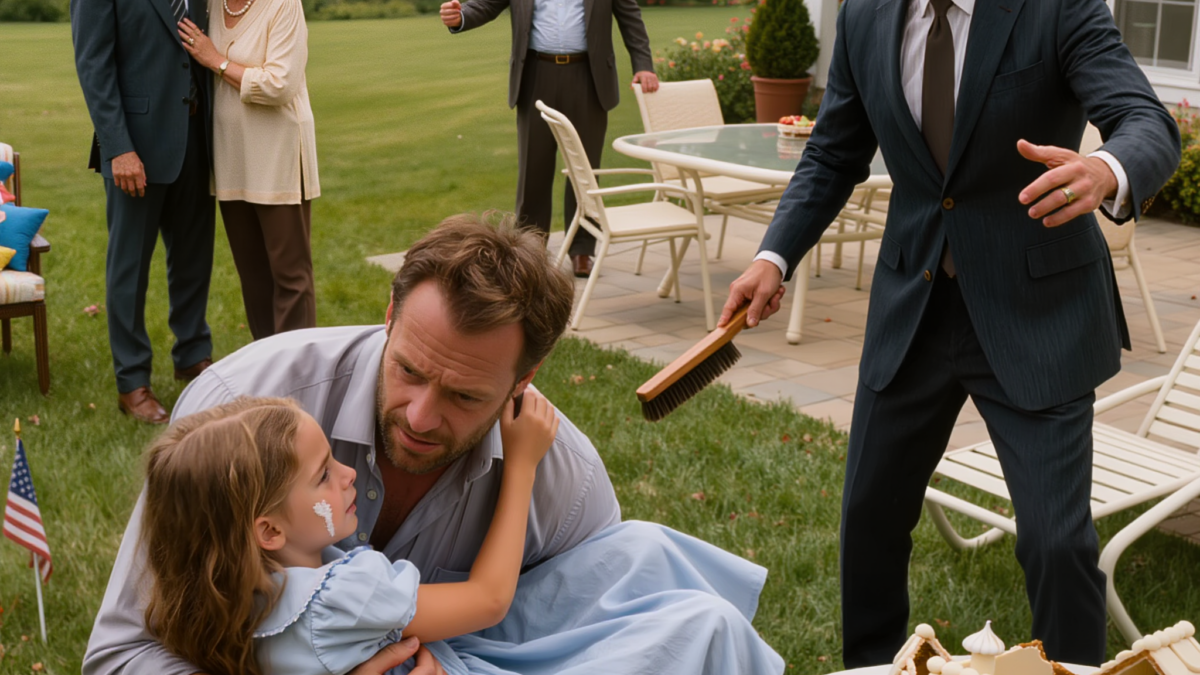
At my daughter’s 10th birthday party, my older brother shoved her face into the fairy-tale cake I’d spent three nights making. She screamed as broken sugar decorations scratched her cheek, but my parents rushed to defend him. “Get on your knees and apologize to your brother,” Dad ordered. I picked up my crying daughter and walked out. Then my brother sent a message threatening to take away my inheritance…
My name is Owen. I’m 34 years old, and the moment my brother shoved my 10-year-old daughter’s face into her birthday cake was the moment I lost my entire family.
But that afternoon was only the beginning.
It was Mia’s tenth birthday. For a single dad, reaching double digits is a massive milestone. Since my wife passed away three years ago, Mia has been my entire universe. She’s the reason I drag myself out of bed at 5:00 a.m. every morning. She’s the reason I work 60-hour weeks at a dusty construction site, hauling drywall and mixing cement just to keep a roof over our heads.
Mia has a soul made of art and magic, just like her mother. She’s obsessed with fairy tales, those stories where the good guys always win and the bad guys get what they deserve. So, for her tenth birthday, I decided to do something special.
I couldn’t afford those fancy custom cakes from a boutique bakery, but I have steady hands and a background in architecture that I never got to use professionally.
I stayed up for three nights straight. I baked a vanilla bean sponge from scratch and whipped up strawberry buttercream that smelled like summer. But the decoration was where I poured my heart into it.
I hand-sculpted tiny mushrooms out of meringue. I spun sugar into glass-like windows. I built a literal fairy cottage out of white chocolate in the center of the cake.
When I finished, it wasn’t just dessert. It was a promise. It was me telling her, “I know Mom isn’t here, but I will build magic for you with my bare hands.”
The party was at my parents’ house. My mother, Susan, had reluctantly agreed to let us use the backyard. She always complained that my apartment was too cramped and smelled like poverty, though she’d never say it that directly. She just wanted to control the optics.
Mia was wearing a pale blue dress, looking like a little angel. She kept circling the cake table, her eyes wide.
“Daddy, this is the most beautiful thing in the world. I don’t even want to eat it.”
I smoothed her hair back.
“Cakes are made to be eaten, sweetheart. But we have to wait for Uncle Julian and Grandpa.”
And that was where the trouble started.
Julian, my older brother, the golden child, arrived two hours late. He’s 38, drives a sports car my dad pays the lease on, and wears Italian suits he didn’t earn.
Julian has always been the protagonist of our family movie, while I was just an extra in the background. He’s bankrupted two startups, yet my parents treat him like he’s Elon Musk, funding his lifestyle out of their retirement savings.
When Julian finally strutted into the backyard, the smell of expensive cologne couldn’t hide the stale whiskey on his breath. He was stumbling, a glass of scotch already in his hand.
“Sorry, sorry,” he laughed, his voice too loud for the quiet gathering. “Busy people can’t be tied to a clock, right? Happy birthday, kiddo.”
He didn’t even use her name.
My dad, Robert, sat at the head of the patio table. He waved his hand dismissively.
“It’s fine, son. You’re here now. Sit down, Julian. You work too hard.”
I gripped the edge of the table until my knuckles turned white.
Work? Julian hadn’t worked a real day in his life.
But I stayed quiet. For Mia.
“Okay,” I said, forcing a smile. “Time for candles. Make a wish, Mia.”
Mia closed her eyes. Her small hands clasped against her chest. The candlelight danced on her innocent face.
I knew exactly what she was wishing for. She was wishing her mom could see this.
Just as Mia took a deep breath to blow out the candles, Julian stood up. He swayed dangerously, looming over the table. He stared at the fairy cottage I had spent hours constructing.
“What the hell is this?” Julian slurred, pointing a shaking finger at the chocolate house. “You make this, Owen? God, it looks so girly. Real men build real houses. They don’t play with candy.”
“Julian, shut up,” I said, my voice low. “Let her blow out the candles.”
“Oh, lighten up. I’m just joking.”
Julian sneered. He looked at Mia, then at the cake. A cruel, intrusive thought seemed to cross his mind, and his eyes glazed over with malice.
Before I could even process what was happening, Julian swung his hand.
“Here, have a bite, princess.”
He grabbed the back of Mia’s neck and shoved her face down into the cake.
The sound still haunts my nightmares.
It wasn’t soft. The structural chocolate shattered. The sugar decorations snapped. Mia’s face hit the dense sponge cake with a sickening thud.
She screamed.
It wasn’t a laugh. It was a shriek of terror and pain.
Mia flailed backward, lifting her head. Her beautiful face was covered in smashed cream and crumbs. A sharp piece of sugar decoration had scratched her cheek, and buttercream was in her eyes.
She was coughing, choking on cake.
“Daddy, my eyes! It burns!”
Julian threw his head back and laughed.
“Look at her! She looks like a clown! Happy birthday!”
In that second, I wasn’t the submissive younger brother.
I was a father.
I launched myself across the table and shoved Julian hard in the chest.
“Are you out of your mind?”
Julian, drunk and off balance, tripped over a lawn chair and fell onto the grass. His scotch glass went flying.
Immediately, my mother shrieked.
“Julian! Oh my God, are you okay?”
She ran past her crying, injured granddaughter to help the 38-year-old man up from the grass. She started brushing dirt off his suit jacket.
No one, not even my grandmother, looked at Mia.
I was on my knees, frantically using napkins to wipe the frosting out of Mia’s eyes, my heart breaking as she sobbed into my shoulder.
“Dad.”
I turned to look at my father, Robert. I needed him to step in. I needed him to be the patriarch and do what was right.
Robert stood up slowly.
He looked at Julian, who was groaning on the ground. He looked at the ruined cake, the symbol of my love, destroyed on the table.
And then he looked at me.
His eyes were cold.
He took off his heavy gold signet ring, the family ring he was so proud of, and slammed it onto the glass patio table.
Bang.
The backyard went silent. The only sound was Mia’s whimpering.
My father pointed a trembling finger at me.
I thought, finally, he was going to defend us.
“You dare,” he roared. “You dare put your hands on your brother over a stupid piece of cake?”
I froze. My brain couldn’t process the words.
“Dad, he shoved Mia’s face into it. She’s bleeding. There was sugar glass. She’s hurt!”
“It was a joke!” my father bellowed, his face turning purple. “It was a man’s joke! You have always been this way, Owen. Too sensitive, too soft. Julian is the eldest. He was toughening her up. And you respond with violence against your own flesh and blood!”
My mother chimed in, her voice shrill.
“Exactly, Owen. Look at Julian’s suit. It’s grass-stained. That cake was nothing. You can just bake another one. Stop making a scene and ruining the party.”
I looked at them. I really looked at them.
These people were strangers.
They didn’t care about Mia. They never had.
“You call that a joke?” I asked, my voice shaking with a rage I had suppressed for three decades. “Mia is ten. She is terrified. And you’re worried about his dry cleaning?”
“If you don’t know how to behave in this family,” my father stated, his voice dropping to a terrifyingly calm register, “then get out. I don’t have a son who is petty, jealous, and disrespectful. Walk out that gate and don’t come back until you are ready to get on your knees and apologize to your brother.”
I looked down at Mia.
She was gripping my shirt so tightly her knuckles were white. One eye was swollen shut from the sugar irritation.
“Let’s go, Daddy,” she whispered. “Please, I want to go home.”
I scooped Mia into my arms.
I didn’t say another word. I didn’t look back at my parents. I didn’t look at the smirk creeping back onto Julian’s face as he dusted off his pants.
I walked straight out the gate into the gray, drizzling afternoon.
I lost my family that day.
But that wasn’t the end.
It was the beginning of everything that came afterward.
The drive away from my parents’ wealthy neighborhood was a blur of rain and tears. My old pickup truck rattled as we hit potholes, the wipers fighting a losing battle against the storm.
Mia sat in the passenger seat, curled into a tight ball. I had used a water bottle to clean the rest of the sticky cream off her face, but the smell of strawberry and vanilla, a smell that should have been happy, now filled the cab with the memory of humiliation.
“Daddy?”
Mia’s voice was small, barely audible over the engine.
“Is it my fault? Did I do something bad? Is that why Uncle Julian did that?”
That question felt like a physical blow to my gut. It took the air right out of my lungs.
“No, Mia,” I said, gripping the steering wheel so hard the leather creaked. “No, baby. You did nothing wrong. Uncle Julian is a bully. And Grandpa and Grandma were wrong, too.”
“But Grandpa told you to leave,” she sniffled. “He never yells at Uncle Julian. Even when Uncle Julian broke the vase last Christmas.”
I bit my lip.
She noticed. Of course she noticed.
Kids see everything.
The unfairness wasn’t new. It was the foundation our family was built on.
I was driving away, but my mind was dragged back to the past.
I remembered being twelve years old. Julian, sixteen at the time, had been throwing a baseball in the house despite Mom’s strict rule. He missed a catch, and the ball went straight through the antique glass cabinet.
When Dad got home, Julian didn’t even blink. He pointed at me.
“Owen did it.”
I tried to defend myself. I begged them to believe me, but Dad took off his belt. He punished me for supposedly lying and blaming my brother.
Julian stood at the top of the stairs, watching me take the punishment, grinning like a shark.
I was the scapegoat.
He was the golden child.
That was the unwritten contract.
As I got older, the stakes got higher. It wasn’t just broken glass anymore. It was my future.
I was always the academic one. I graduated high school with honors and got accepted into a prestigious architecture program.
I had dreams. I wanted to build skyscrapers. I wanted to leave a mark on the skyline.
But the week before tuition was due, my parents sat me down at the kitchen table.
“Owen,” Dad said, not looking me in the eye. “We need to talk about your college fund.”
“I know,” I said eagerly. “I have the deposit ready from my summer job. I just need the check for the tuition.”
“The money isn’t there,” Mom interrupted, buttering her toast as if she were discussing the weather.
“What?”
“Julian needed capital for his business venture,” Dad said, his voice firm, daring me to challenge him. “He has an entrepreneurial spirit, Owen. He’s going to make this family millions. We transferred your fund to his account. He needs it more right now.”
He continued.
“You’re good with your hands. You should go to trade school. Be a mechanic or a builder. It’s honest work, and it’s cheaper.”
They stole my future to fund Julian’s first failed business, a high-end gym that closed in six months because he spent the budget on marketing parties and forgot to buy equipment.
They clipped my wings so he could pretend to fly.
And now they were trying to do the same thing to my daughter.
They were teaching her that her dignity didn’t matter as much as Julian’s ego.
I looked over at Mia. She had fallen asleep, exhausted by what had happened. Her cheek was puffy where the sugar decoration had scratched her.
Never again.
I pulled the truck over to the side of the road.
My hands were shaking, but my mind was clear.
I pulled out my phone.
Fifteen missed calls from Mom.
Three texts from Julian.
I opened Julian’s message thread.
“You’re such a coward. Dad is furious. You better turn that truck around and apologize to him and me right now, or you can kiss your inheritance goodbye. Don’t be an idiot, Owen.”
Inheritance.
Money.
That was the leash they always used to yank me back. They thought the promise of some future payout would make me swallow my pride forever.
I typed one response.
“Keep your money. I have something more valuable in the passenger seat. We are done.”
I hit send.
Then I went to my contacts.
Blocked Mom.
Blocked Dad.
Blocked Julian.
Blocked every aunt and cousin who stood there silently watching my daughter suffer.
I threw the phone onto the dashboard.
We had nowhere to go but our tiny, damp apartment. I didn’t know how I was going to explain this to Mia when she woke up. I didn’t know if my construction wages would be enough to get her braces or pay for college one day.
But as I merged back onto the highway, I felt something I hadn’t felt in 34 years.
Lighter.
The weight of their expectations, their cruelty, their gaslighting, was gone.
I was poor. I was alone.
But I was free.
And I was going to build a life so strong that they could never knock it down again.
The months that followed were, quite frankly, hell on earth.
Mia and I were living in a basement apartment on the edge of the city. It smelled like mildew, and the heater rattled like a dying engine.
But it was ours.
To cover the rent and start rebuilding a savings account for Mia’s future, I worked like a machine.
My days started at 5:00 a.m. at the construction site. I hauled concrete, hung drywall, and breathed in dust until my lungs burned. My body ached constantly, but I couldn’t stop.
At 5:00 p.m., I’d clock out, rush to pick Mia up from her after-school program, feed her dinner, help her with homework, and tuck her in.
Then, at 8:00 p.m., a neighbor would come sit with her while I went to my second job.
I was a dishwasher at Elena’s, the most upscale bakery in the city.
I was the invisible man there.
I stood at the back sink, scrubbing burnt caramel off pans and scraping dough out of mixing bowls until my hands were raw and blistered.
But my eyes were always watching.
I watched the pastry chefs mix batter. I watched them temper chocolate.
And mostly, I watched them fail at structure.
The head pastry chef, a guy named Marco, was a flavor genius but an architectural disaster. He tried to build towering wedding cakes, but he didn’t understand physics. He didn’t understand load-bearing walls or centers of gravity.
I’d see him stacking tiers that were clearly unstable, using dowels that were too thin.
Gravity doesn’t work like that, I’d think to myself as I scrubbed a pot.
But who was going to listen to the dishwasher?
Until one Saturday.
It was the biggest order of the year.
The mayor’s daughter was getting married, and she had ordered a five-foot-tall replica of the Eiffel Tower made entirely of chocolate and cake.
It was a five-figure contract.
Disaster struck at 9:00 a.m.
Marco slipped on a wet floor and broke his wrist. He was rushed to the hospital.
Chaos erupted in the kitchen.
The sous-chefs were panicking. They tried to assemble the tower based on Marco’s sketch, but it kept leaning. The chocolate girders were snapping under the weight of the sponge cake.
Elena, the owner, a fierce, intimidating Italian woman who rarely smiled, was pacing the floor, looking like she was about to have a heart attack.
“We are ruined,” she muttered, wringing her hands. “The delivery van is here in three hours. We cannot send this pile of garbage to the mayor.”
The kitchen was silent, filled only with the smell of panic and melting chocolate.
I was at the sink, elbows deep in soapy water.
I looked at the leaning tower.
I knew exactly why it was failing.
The base wasn’t reinforced. The load distribution was all wrong.
I wiped my hands on my dirty apron and took a step forward.
“Mrs. Elena,” I said.
My voice was raspy from lack of use.
Everyone turned to look at me.
One of the sous-chefs scoffed.
“Get back to the sink, Owen. We don’t need clean dishes right now. We need a miracle.”
“I can fix it,” I said, ignoring him.
I looked straight at Elena.
“You?” Elena looked at me with skepticism. She looked at my construction boots, my calloused hands.
“I used to study architecture,” I said firmly. “And I know construction. Your problem isn’t the chocolate. It’s the physics. The internal supports are placed wrong. The torque is snapping the beams.”
I pointed toward the leaning structure.
“Give me two hours. I can re-engineer the frame using hard candy supports and redistribute the weight.”
Maybe it was desperation. Maybe she saw the determination in my eyes.
Elena hesitated, then nodded.
“If you ruin it, you’re fired. But since we are already dead, go ahead.”
I stepped up to the prep table and took a deep breath.
Suddenly, the kitchen wasn’t a kitchen anymore.
It was a job site.
The chocolate wasn’t food. It was concrete.
The sugar was glass.
I worked with a focus I hadn’t felt in years.
I melted down hard candy to create rigid I-beams. I used tempered chocolate as welding material. I calculated the angles. I shaved millimeters off the cake layers to adjust the center of mass.
My hands, rough from carrying bricks, moved with a delicacy and precision that surprised even me.
Two hours later, the Eiffel Tower stood on the table.
Five feet tall.
Perfectly straight.
Structurally sound.
I had even brushed it with gold luster dust so it caught the light like the real thing at sunset








