At my brother’s wedding, Mom told me, “Just go stand near the wall,” so I wouldn’t ruin the family photos. His fiancée’s cousin’s plus-one had taken my seat at the family table. I took back my $1,500 gift and told a groomsman, “I will stay out of the frame forever.” Carter chased me into the parking lot. Back at the hotel, I opened the $200,000 business loan I’d guaranteed for him—and found a $40,000 transfer to the vineyard.
My name is Julian Reynolds, and I’m thirty-two years old. Two years ago, I walked out of my younger brother’s wedding before the vows were even exchanged. I had saved $1,500 to give him and his new wife as a wedding gift. Instead, I ended up standing in a reception hall full of nearly 200 wealthy guests while my own mother told me to move out of the family photographs.
She adjusted her expensive corsage, looked me directly in the eye, and explained that I didn’t fit the aesthetic of the wedding. My reserved seat had been given to a stranger, and I was expected to stand near the back wall like someone who had wandered into the wrong celebration.
What nobody in that room seemed to consider was that I had personally guaranteed the $200,000 commercial business loan supporting my brother’s supposed millionaire lifestyle. They had grown so accustomed to my financial help that they seemed to believe it would continue regardless of how they treated me.
The events that followed would expose much more than an ugly family argument over a wedding seat.
The wedding took place on a Saturday afternoon in early September at an expensive vineyard estate. The kind of place where golden sunlight makes every photograph look carefully edited before anyone even touches a camera.
Inside the reception hall, the air smelled of white roses and imported eucalyptus. Elaborate floral arrangements hung above polished hardwood floors. A live string quartet played classical versions of modern songs while servers moved between tables carrying crystal champagne flutes.
My younger brother, Carter, and his fiancée, Khloe, had spent eighteen months planning every detail. Their wedding wasn’t simply meant to celebrate their marriage. They wanted an event that would make them look like wealthy socialites to the thousands of people following their lives online.
I had purchased an $800 tailored navy suit specifically for the occasion. I wanted to look respectable and honor my brother on one of the most important days of his life.
By the time I stood near the entrance to the reception hall, however, I had already discovered that my presence wasn’t welcome in the way I had imagined.
The wedding planner had informed me that there was no seat assigned to me. Not at the family table, not at an overflow table, and not even near the kitchen.
My mother had confirmed it.
I was expected to remain near a stack of folding chairs by the west wall, safely outside the background of the professional wedding photographs.
For a long moment, I couldn’t fully process what that meant.
I had spent most of my life believing that if I worked hard enough, helped enough, and caused as little trouble as possible, my parents would eventually appreciate me.
Standing in that reception hall, I began to understand that my usefulness and my place in the family were two very different things.
Across the room, beneath a spotlight beside the enormous five-tier wedding cake, stood the gift table.
It was covered in pristine white linen and surrounded by beautifully wrapped pastel-colored presents. Near the center of the pile was a matte silver envelope with Carter and Khloe’s names written in my handwriting.
Inside was the $1,500 check I had saved from my salary as a back-end software engineer.
I had intended that money to help my brother begin his marriage on solid financial ground.
Now I could barely look at the envelope without thinking about how easily he and our parents had dismissed me.
I crossed the polished floor toward the table. A few guests glanced up as my shoes clicked against the hardwood.
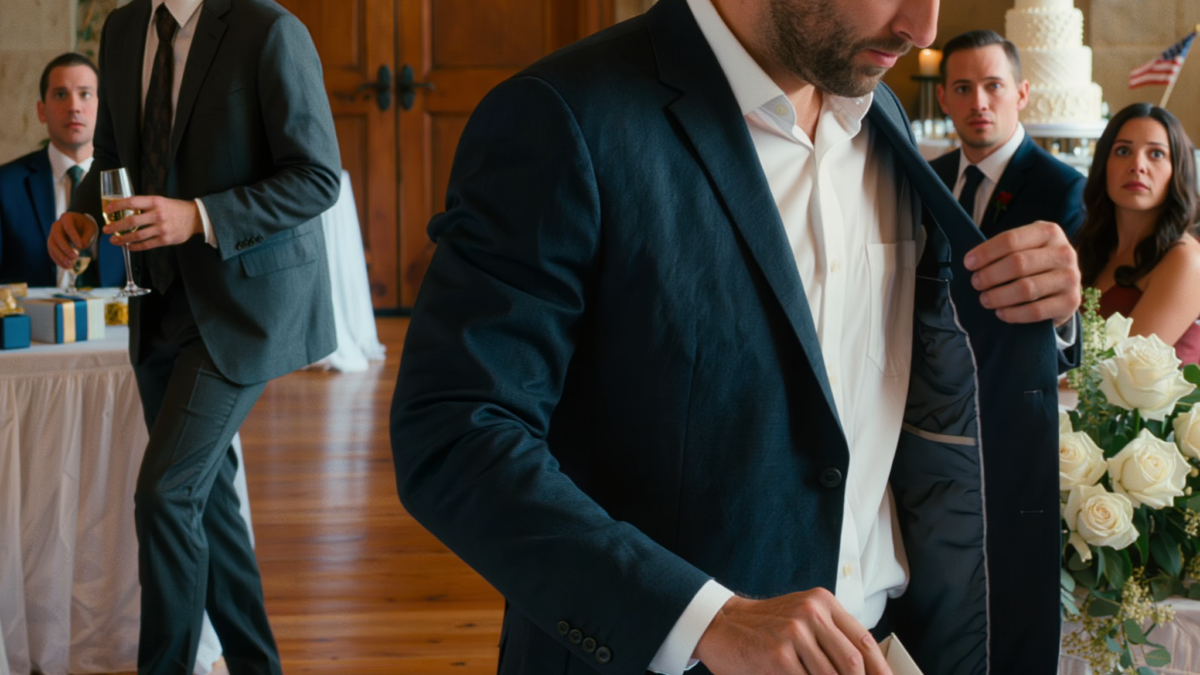
I reached for the silver envelope, picked it up, and slid it into the inside breast pocket of my suit jacket.
I didn’t make an announcement. I didn’t knock anything over. I simply reclaimed the gift I had brought for someone who apparently didn’t want me at his wedding.
Unfortunately, one of Carter’s groomsmen noticed.
His name was Liam, and he had spent much of the weekend making jokes about my career and my lack of a substantial social media following.
Liam stepped away from the bar carrying a half-empty champagne glass.
“Hey man, what exactly do you think you are doing?” he asked loudly enough for several nearby guests to hear.
Then he added, “You can’t just take a wedding gift back. That is pathetic.”
I turned toward him.
Strangely, I wasn’t embarrassed anymore. I could feel my heartbeat, but the uncertainty that had followed me around all afternoon was disappearing.
“Do not worry about it, Liam,” I told him. “I will stay out of the frame forever.”
Then I turned and walked toward the heavy oak doors leading to the parking lot.
The cool evening air felt almost refreshing after the suffocating atmosphere inside.
I had barely reached my car when I heard someone calling my name.
“Julian, wait!”
Carter was jogging across the gravel toward me, his expensive tuxedo jacket flapping open as he ran.
He had abandoned his pre-ceremony photographs to follow me outside.
For a moment, I wondered whether he had finally realized how much he had hurt me.
But the expression on his face suggested something else.
He was worried about the scene I had created, not the reason I was leaving.
To understand why that distinction mattered so much, you have to understand the family Carter and I grew up in.
Our parents, Eleanor and Richard Reynolds, raised us in an upper-middle-class suburban neighborhood governed by a notoriously strict homeowners association.
Keeping up appearances was practically a competitive sport.
My parents cared about what the neighbors drove, how their lawns looked, which schools their children attended, and what people said about the family at social gatherings.
I was always the quieter son.
I liked computers, mathematics, logic, and the satisfaction of building systems that worked properly.
I studied hard, earned straight A’s, received an academic scholarship, and eventually became a back-end software developer for a major technology company.
By my mid-twenties, I was earning a six-figure salary.
I never felt the need to advertise it.
I drove a dependable sedan, contributed aggressively to my 401(k), invested in index funds, and tried to build a secure, peaceful life.
After turning eighteen, I never asked my parents for money.
For years, I assumed that independence would make them proud.
Carter was born two years after me, and his personality couldn’t have been more different.
He was loud, charming, socially confident, and exceptionally good at getting people to give him what he wanted.
Our parents adored those qualities.
They treated him like the center of the family, while my accomplishments were often acknowledged briefly before attention returned to whatever Carter happened to be doing.
When our grandfather died, he left us a small inheritance intended to help cover college tuition.
The money was divided equally. Each of us received enough to pay for approximately two years at a state university.
I treated mine carefully.
Carter spent his portion during his first three semesters on fraternity parties, spring break trips, and a semester in Europe that somehow earned him no academic credits.
When he ran out of money, our parents used their savings to cover his remaining tuition expenses.
They expected me to understand.
“He just has a bigger personality, Julian,” Dad would explain during Thanksgiving dinners.
“He needs more room to grow and experience the world. You have always been so self-sufficient. You do not need our help like he does.”
Sometimes he said those things immediately after I had shared news about a promotion.
I tried not to let it bother me.
Carter eventually dropped out of college and entered commercial real estate.
He liked the image of the profession much more than the actual work.
His social media accounts were filled with motivational quotes, photographs outside expensive properties, and carefully staged pictures suggesting that he regularly closed enormous deals.
The reality was considerably less impressive.
He leased a Porsche he struggled to afford. He purchased designer watches on credit. He cultivated relationships with people who valued the appearance of success.
Our parents enthusiastically supported the image he was building.
They spoke proudly about his ambition, his confidence, and his supposed future in high-end real estate.
Then, approximately eighteen months before the wedding, Carter called me in a panic.
It was an ordinary Tuesday evening, but his voice sounded frightened.
His real estate income wasn’t covering his expenses. He had decided to start a luxury mattress import business, hoping it would generate enough income to support his lifestyle.
He needed warehouse space and financing.
Unfortunately, years of missed payments and unpaid credit card balances had damaged his credit so badly that reputable banks weren’t willing to approve his application.
The following morning, Mom called.
She was crying.
She said Carter’s future depended on getting the business started and that our family couldn’t abandon him when he needed help.
Eventually, she used the phrase that had persuaded me to overlook so many things throughout my childhood.
“Family protects family.”
I knew the risks.
I understood that guaranteeing someone else’s commercial debt could endanger the financial stability I had spent years building.
But there was still a part of me that wanted to be valued by my parents and needed by my younger brother.
I agreed to meet Carter at the bank.
Sitting across from a loan officer, I signed the paperwork making me the sole guarantor of a $200,000 commercial business loan.
The loan helped him secure the warehouse needed for his proposed mattress operation.
I told myself I was investing in my brother’s future.
Deep down, I hoped that making such an enormous commitment would finally earn me a permanent place in the family.
Instead, it made me even more convenient.
Shortly after the financing was approved, Carter met Khloe.
She was a micro-influencer who viewed almost every aspect of life through the lens of social media.
Her world revolved around neutral colors, luxury branding, perfectly curated photographs, and the impression that everything in her life was effortlessly beautiful.
Carter fit naturally into that world.
I didn’t.
I didn’t wear expensive clothing covered in designer logos. I didn’t photograph every meal or advertise my salary. I didn’t have thousands of followers.
At first, the exclusion seemed relatively minor.
When Carter and Khloe announced their wedding party during a lavish family dinner, Carter selected Liam as his best man.
Liam was someone he had met at a networking event only six months earlier, but Liam had a substantial online following.
I wasn’t asked to be a groomsman.
I wasn’t even asked to be an usher.
I told myself that it was Carter’s wedding and he was entitled to make those choices.
Then the bachelor party was organized.
The group spent several days in Miami, drinking expensive champagne and taking photographs aboard a private yacht.
I wasn’t invited.
I learned about the trip when photographs appeared online.
Yet one week before the celebration, Carter had sent me a message explaining that the group was short on the yacht rental deposit.
Despite not being included, I transferred $2,000 from my savings.
His entire response was a thumbs-up emoji.
There was no call, no real conversation, and no sincere acknowledgment of what I had done.
I still convinced myself that supporting him was the right thing.
At the formal engagement dinner, held at a five-star restaurant, Liam stood to make a toast in front of approximately fifty guests.
He joked that I was the person who fixed their Wi-Fi routers while Carter closed million-dollar commercial real estate deals.
The room laughed.
My parents laughed with everyone else.
Carter sat there smirking.
I gripped my water glass and listened, painfully aware that I had quietly helped cover the expensive meal they were enjoying.
Even then, I made excuses.
I told myself wedding planning was stressful and that things would return to normal after the ceremony.
I wanted to believe my brother cared about me, even if he wasn’t particularly good at showing it.
That belief survived until the morning of his wedding.
I woke in an overpriced minimalist hotel room with a heavy feeling in my stomach.
I tried to dismiss it as ordinary nerves.
After showering, I put on my new navy suit, adjusted my appearance in the mirror, and drove through the scenic roads toward the vineyard.
Professional photographers and videographers were already working across the manicured grounds when I arrived.
Lighting equipment and cameras were being moved into position. Staff members hurried between the reception hall and outdoor ceremony area.
Inside, an ornate golden easel covered with fresh ivy displayed a carefully prepared seating chart.
I approached it and looked for the Reynolds family.
The names were arranged alphabetically.
Reynolds, Carter.
Reynolds, Eleanor.
Reynolds, Richard.
I searched again.
Julian Reynolds wasn’t listed.
At first, I assumed there had been a printing error.
I was reaching for my phone to contact Carter when I noticed the wedding planner nearby.
Serena was holding an iPad and supervising the staff with obvious impatience.
I approached her politely.
“Excuse me, Serena,” I said. “I think there has been a minor mistake on the seating chart printing. I cannot seem to find my name anywhere. Julian Reynolds. I am the groom’s older brother.”
She barely looked up.
“Julian, right? Khloe explicitly mentioned you.”
Her dismissive tone surprised me.
She sighed and began moving papers around on the clipboard tucked under her arm.
As she did, a folded sheet slipped free and fell onto the floor.
I bent down to pick it up for her.
Before handing it back, I saw the heading.
“Guest visual assessment and placement.”
I looked at the document.
It contained a list of family members along with grades assessing how suitable they were for the professional photographs and social media posts.
Then I found my own name.
Julian Reynolds.
Beside it was a C-minus circled in bright red ink.
Next to the grade was a handwritten instruction in Khloe’s distinctive handwriting.
“Keep out of main reception shots. Hide near the west wall near the speakers. Clashes with the modern aesthetic. Too plain.”
I stared at the words.
There was something uniquely humiliating about discovering that people had formally evaluated your appearance and decided you were unworthy of appearing in their photographs.
I had spent years helping Carter financially, and his wedding preparations apparently included a document explaining how to hide me from the cameras.
I stood and handed the paper to Serena.
She snatched it from my hand, clearly embarrassed that I had seen it.
But she didn’t apologize.
Instead, she pointed toward the back corner of the hall.
“We had to make some very last-minute critical adjustments for Khloe’s influencer friends who flew in,” she said.
“There is an open standing room area by the west wall. You can watch the speeches and the dances from back there.”
I didn’t respond immediately.
I walked into the dining area to see the seating arrangements for myself.
The main family table stood beside the sweetheart table, positioned prominently for the photographs.
My parents’ elegant place cards rested on gold-rimmed plates.
In the place where I expected my own card, I found one identifying Khloe’s cousin’s plus-one.
It belonged to Brad, a man who had reportedly been dating Khloe’s distant cousin for only three weeks.
Someone who barely knew my brother had been given a place at the family table.
I had no place at all.
As I continued through the room, I saw something that made the situation even worse.
Grandma Rose was sitting alone at a cramped table near the far corner of the hall.
She was eighty-two, physically frail, and used a medical wheelchair.
The table had been positioned behind an enormous floral privacy screen approximately eight feet tall.
From her seat, she couldn’t see the dance floor.
She couldn’t see the family table.
She couldn’t even see the wedding cake.
My grandmother had effectively been hidden behind an artificial wall of flowers because her wheelchair didn’t suit the wedding’s carefully arranged appearance.
That realization hurt more than the insult directed at me.
I found Mom near the catering entrance, talking and laughing with one of Khloe’s aunts.
I walked toward her and asked why I wasn’t on the seating chart.
Then I asked why Grandma Rose had been placed behind a floral screen where she couldn’t see anything.
Mom immediately looked around, apparently worried that someone important might overhear us.
“Julian, please keep your voice down. Do not start drama today of all days.”
I reminded her that I didn’t have a chair and that Brad, a virtual stranger, was sitting with her at the family table.
She avoided my eyes.
Then she explained that several of Khloe’s friends had traveled from Los Angeles and had significant social media followings.
Their presence, she said, was important to Carter’s real estate image.
The photographs needed to look professional.
“You are family, Julian,” she told me.
“Family is supposed to sacrifice for the greater good. Just go stand near the wall by the speakers. You are going to ruin the aesthetic of the family photos if you sit near the front.”
I stood there looking at her.
This was the same woman who had sat on my couch crying, begging me to risk my financial future to save Carter’s business.
She had asked me to make an enormous sacrifice because I was his brother.
Now she was telling me that being his brother meant I should disappear from his wedding photographs.
“I see,” I whispered.
I suddenly understood that my contributions had never guaranteed me respect.
I could pay, help, solve problems, and protect the family’s reputation.
But when my presence threatened the image Carter and Khloe wanted to present, I became disposable.
That was when I turned away from Mom and walked to the gift table.
I reclaimed the silver envelope, answered Liam’s accusation, and headed outside.
Which brings me back to Carter running toward my car.
He reached me just as I was preparing to leave.
“What is your actual problem?” he demanded.
He glanced toward the venue doors, apparently checking whether his new wife or her influencer friends could see us.
“People inside saw you take that envelope off the table. You are making a massive embarrassing scene.”
I told him I was leaving, going back to my hotel, and returning home.
He reacted as though I had committed an outrageous offense.
“Are you seriously throwing a massive tantrum over a folding chair?”
Then he explained the seating arrangement.
Khloe’s cousin’s new boyfriend needed a place at the main table so that the couples would look symmetrical in the wide-angle drone photographs.
“Grow up, Julian,” Carter said. “The world does not revolve around you. It is not always about you.”
I looked at my younger brother.
Behind him stood the gleaming Porsche he had leased despite struggling to afford the payments.
His custom-tailored clothing had been purchased on credit.
The business he advertised as a success was being supported by a loan carrying my legal guarantee.
I remembered sitting in the bank and signing the papers because I believed family loyalty meant something.
“You are entirely right,” I said quietly. “It is not about me. It never was. Have a beautiful, aesthetically pleasing life, Carter.”
I opened my car door and got into the driver’s seat.
Carter stepped closer and slapped the roof with his open palm.
“If you drive away right now, if you leave this wedding, you are dead to me!” he shouted.
“Do you hear me? Dead to me.”
I started driving.
He remained standing in the gravel parking lot while I headed back toward the hotel.
For the entire journey, I left the radio off.
I didn’t listen to music or podcasts.
I just watched the road and tried to understand how long I had allowed myself to believe that financial sacrifices could earn affection from people who didn’t seem interested in giving it.
Strangely, beneath the hurt, I also felt relief.
For once, I had made a decision based on what I could live with rather than what would keep everyone else comfortable.
The hotel lobby was quiet when I returned.
Dave, the night receptionist, looked up from his computer.
He was in his late fifties and had a gentle manner. I imagined he might be working weekends to help put his children through community college.
He looked at my formal suit and my expression.
“Checking out early, sir?” he asked.
“Yes, Dave,” I replied. “I really need to go home tonight.”
Upstairs, I packed my suitcase in less than ten minutes.
Then I sat on the edge of the mattress and removed the silver envelope from my jacket.
I stared at the names written across the front.
Carter and Khloe.
I opened it, removed the $1,500 check, and slowly tore the paper into small pieces.
I dropped them into the trash beside the desk.
A moment later, my phone vibrated.
Khloe had sent me a message.
“You are an incredibly selfish, toxic person. You really ruined everything today by storming out. Do not even bother showing up for the post-wedding brunch tomorrow morning. We do not want your negative energy dragging down our success.”
I read the message twice.
It seemed astonishing that she could consider my quiet departure a greater offense than what had happened inside the reception hall.
They apparently expected me to disappear without complaint and continue supporting Carter whenever he needed help.
I opened my laptop and connected to the hotel’s Wi-Fi.
Because I was the primary guarantor of Carter’s commercial loan, I had administrative access to the associated banking account.
I signed into the secure portal using two-factor authentication and began reviewing the transaction history.
I wanted to understand the current balance and the extent of the financial responsibility I still carried.
At first, the records looked ordinary.
There were warehouse leasing expenses and other business-related transactions.
Then I noticed a large payment that didn’t belong among them.
Two weeks before the wedding, $40,000 had been transferred out of the commercial loan account.
The recipient was the vineyard venue.
I checked the details again.
The money had gone directly toward the location where Carter and Khloe had just held their expensive wedding celebration.
The same wedding where I had been told I wasn’t suitable to sit with the family had been partly funded through business financing I had personally guaranteed.
I stared at the transaction.
Carter had previously described the loan as essential to his mattress import business.
He had needed warehouse space and working capital.
Now I was looking at what appeared to be a substantial personal wedding expense paid from that commercial account.
I understood enough about the agreement to recognize that this could be a serious problem.
And because my name was attached to the loan, the consequences might extend to me.
I thought about the credit I had protected for years, the retirement savings I had accumulated, and the house I had worked to afford.
All of it felt vulnerable because I had trusted someone who had just demonstrated how little he respected me.
I knew I needed professional legal advice.
The clock beside the bed read 2:14 a.m.
I scrolled past missed calls from Mom and angry messages from Carter until I found Marcus in my contacts.
Marcus and I had attended the same state university.
While I studied software development, he studied law. He eventually became a senior partner at a successful corporate litigation firm.
I knew he understood complicated commercial disputes far better than I did.
Despite the late hour, I sent him a message.
“Emergency. Carter committed wire fraud on the commercial loan I guaranteed. He siphoned funds to pay for his wedding venue. I need to freeze the accounts and withdraw my name immediately to protect my own assets from a lawsuit. Call me the absolute second you wake up.”
He called four minutes later.
His voice was thick with sleep, but he immediately began asking questions.
I explained the wedding, the seating chart, Serena’s document, my mother’s remarks, and the $1,500 check I had reclaimed.
Then I walked him through the commercial account and the $40,000 transfer.
Marcus didn’t tell me to be the bigger person.
He didn’t dismiss the situation as ordinary family conflict.
He focused on the loan agreement, the transaction records, and the steps he believed were necessary to protect my financial interests.
We spent the next two hours preparing notifications and breach-of-contract documents.
According to Marcus, using funds from the business loan for Carter’s personal wedding expenses could constitute a serious violation of the loan’s terms.
He advised me to formally notify the bank’s fraud department and take the available steps to withdraw my guarantee and prevent further use of the credit.
I followed his instructions.
While Carter and Khloe were celebrating their wedding, I attached the electronic forms, included the bank’s executive fraud department, and sent the notification.
When I clicked Send, I felt the significance of what I had done.
I had finally stopped treating my financial stability as something my brother could use without considering the consequences.
Eventually, I managed a few hours of restless sleep.
The following morning, I returned to the airport, turned in the rental car, and boarded a commercial flight home.
I paid for in-flight Wi-Fi and opened my laptop on the tray table.
I knew Carter would eventually learn that the bank had been notified.
I just didn’t know exactly when.
At approximately one in the afternoon, my phone began vibrating.
The caller ID showed Carter.
I let the first call go to voicemail.
He called again.
And again.
On the fourth attempt, I answered.
Before I could speak, he shouted my name.
“Julian!”
His voice echoed as though he were standing in a large hotel lobby.
In the background, I could hear what sounded like a tense conversation with hotel staff.
“What the hell did you do? My platinum corporate card was just declined at the front desk in front of everyone. They are asking for a new form of payment for a $12,000 hold. Julian, $12,000!”
I looked through the airplane window at the clouds outside.
“It is a beautiful day for flying, Carter,” I said.
Then I asked how his honeymoon was going and whether Khloe had found a room with suitable natural lighting for her social media photographs.
He wasn’t amused.
He said he had logged into the commercial banking portal and discovered that the accounts were frozen.
The available credit lines had been locked.
He had received an automated notice explaining that the bank was reviewing the account for unauthorized personal use.
He demanded that I call the bank and tell them it was a mistake.
“Fix it?” I asked.
I reminded him about the $40,000 transferred from the commercial loan to the wedding venue.
I explained that the loan carried my legal responsibility and that he had placed my credit and savings at risk to finance a celebration where I wasn’t even allowed a chair.
He went quiet.
Then his tone changed.
“Julian, come on, man,” he said.
He claimed the money was only a temporary bridge loan.
He insisted he intended to repay it the following month when a new shipment of luxury mattresses arrived.
Then he asked me to tell the bank I had authorized the transfer as a corporate networking expense.
He explained that if the bank demanded immediate repayment of the full $200,000 balance, he wouldn’t have the cash.
“I don’t have anything,” he admitted.
It was the first time I had heard him acknowledge how unstable his finances really were.
I told him he should have considered his lack of liquid assets before leasing a Porsche and spending borrowed money on an extravagant wedding.
He was married now. He needed to take responsibility for his decisions.
There would be no more financial safety net from me.
“You are doing this over a folding chair!” he shouted.
He accused me of destroying his business and marriage over a seating chart.
I told him the chair was only the final incident in a lifelong pattern.
The problem was the disrespect, the manipulation, and the expectation that I would keep paying whenever he needed rescuing.
He had allowed me to be humiliated in front of hundreds of guests while benefiting from a loan I had guaranteed.
I wasn’t willing to pretend that was acceptable anymore.
His anger quickly turned into pleading.
He said Khloe was crying in the hotel lobby and that people were staring at them.
The hotel manager was waiting for another payment method.
He begged me to unlock the card for the weekend so they could check in.
“Please, I am begging you as your brother.”
I remembered Mom standing beside the catering entrance.
“Family is supposed to make sacrifices for the greater good, Carter,” I reminded him.
“Isn’t that exactly what Mom told me when she banished me to the wall? I suggest you and Khloe start sacrificing. Maybe try a cheaper hotel.”
Then I ended the call.
I blocked his number.
By the time my flight landed, the conflict had spread through the extended family.
The family group chat was filled with arguments and accusations.
Mom had left six increasingly frantic voicemails, accusing me of ruining Carter’s honeymoon out of jealousy.
She insisted I resented his successful career, his beautiful new wife, and his social life.
I didn’t answer.
I deleted the messages and drove home.
The following evening, I was eating dinner in my living room when another family member called.
This time, it was Uncle Bob.
Bob was Dad’s older brother, a retired middle manager who liked to present himself as the authority on family responsibilities and finances.
He regularly offered advice at family gatherings despite having made questionable financial decisions of his own.
I answered because I already suspected what he wanted.
“Julian, what on earth are you doing to your own brother?” he demanded.
He said Mom had called him crying and claimed I had maliciously cut off Carter’s business funding while he was overseas on his honeymoon.
According to Bob, I had done it because I was unhappy about a wedding seat.
He called my behavior petty, childish, and vindictive.
I calmly explained that the dispute wasn’t about a chair.
Carter had transferred $40,000 from a commercial business loan to pay for his wedding venue, and I had withdrawn my financial support after discovering the transaction.
Bob scoffed.
“Fraud? Do not be so dramatic, Julian. It is a family business. Money moves around all the time. That is how the real world works.”
He reminded me that I had a large technology salary and contributed to my retirement account every year.
In his opinion, that meant I could afford to cover Carter’s problems.
As the older brother, I supposedly had a duty to protect the family name.
He ordered me to call the bank, apologize, and repair the situation.
He even warned that Carter might sue me.
I told him Carter was a thirty-year-old adult responsible for his own choices.
The family had already created a serious rift when they treated me like someone who didn’t deserve a place at his brother’s wedding.
Bob became furious.
He threatened to have me excluded from future family inheritance discussions.
Then he warned that I would end up alone.
“I would much rather be alone than be an unpaid ATM for a group of people who fundamentally hate me,” I replied.
“Keep your inheritance, Bob. I earn my own money.”
I ended the call and blocked his number.
Ten minutes later, my phone rang again.
It was my cousin Maya.
Maya worked as an emergency room nurse and had always been less impressed by Carter’s flashy lifestyle than most of our relatives.
She generally avoided confronting him at family gatherings because she didn’t want unnecessary arguments.
But this time, she sounded almost relieved to speak with me.
“Please tell me you actually had the guts to walk out of that ridiculous staged circus on Saturday,” she said.
I told her I had.
“Good for you, Julian.”
Then she explained that I hadn’t been the only family member treated badly.
Maya and her husband had been placed at a tiny, unstable table beside a broken portable heater in the overflow tent outside.
They couldn’t hear the music properly.
Aunt Clara had been told she couldn’t appear in extended family photographs because her floral dress clashed with the neutral color palette Khloe wanted.
Maya said numerous blood relatives had been pushed to the margins while Khloe’s influencer friends received prominent places.
According to Maya, anyone older than forty, anyone considered insufficiently attractive by social media standards, or anyone without recognizable designer clothing risked being hidden from important photographs.
Listening to her, I realized the document Serena had dropped wasn’t an isolated insult.
The seating arrangements appeared to be part of a larger effort to control how the family looked on camera.
The wedding had treated relatives less like loved ones and more like background decorations.
Maya told me Aunt Clara was organizing a small dinner for relatives who had felt sidelined.
There would be no dress code, no cameras, and no concern about whether anyone matched a photograph.
Just food and family.
She invited me.
For the first time in weeks, I looked forward to attending a family gathering.
The next important call came on Tuesday morning.
I didn’t recognize the number.
When I answered, a deep voice introduced himself.
“This is Arthur Sterling, Khloe’s father.”
Mr. Sterling was a wealthy commercial real estate investor.
Unlike Carter, who loved to display the image of wealth, Arthur had built a substantial business and understood financial operations.
He said Khloe had called him from the honeymoon hotel, extremely upset.
She claimed I had frozen Carter’s business accounts out of spite, leaving them stranded without access to funds.
But Mr. Sterling didn’t sound convinced.
He explained that banks generally didn’t freeze major commercial credit lines simply because relatives were arguing.
In his experience, such actions usually involved serious legal or financial concerns.
“What exactly did my son-in-law do?” he asked.
I appreciated that he wanted an explanation rather than demanding blind loyalty.
I told him that I was the sole guarantor of Carter’s commercial loan because Carter’s damaged credit had prevented him from qualifying independently.
Then I described the $40,000 transfer from the business account to the wedding venue.
I explained that Marcus had advised me to notify the bank and protect my assets because the payment appeared inconsistent with the loan’s business purpose.
Mr. Sterling went silent.
Then he repeated the information slowly.
“He used commercial debt to pay for the wedding venue.”
He explained that Carter had looked him directly in the eye and claimed his supposedly successful real estate business was paying for the entire wedding in cash.
I confirmed what the banking records showed.
I also told him I could provide digital statements if necessary.
Mr. Sterling thanked me for my honesty.
Then he said there was a serious problem he would need to address when the couple returned from their trip.
He ended the call.
I could only imagine how Carter would react when his father-in-law began asking questions about the wealth he had been pretending to possess.
The following weekend, I attended Aunt Clara’s dinner.
Her dining room was modest, cozy, and brightly decorated.
Maya was there with several cousins.
Grandma Rose sat at the head of the table in her wheelchair.
Nobody questioned whether her medical equipment matched the furniture.
Nobody worried that Aunt Clara’s dress might interfere with the photographs.
There were no professional photographers, no social media requirements, and no elaborate seating chart.
We ate homemade food, laughed, and talked about the ridiculous events at Carter’s wedding.
Maya described the broken heater in the overflow tent.
Other relatives shared similar experiences.
Aunt Clara raised a glass of inexpensive wine and toasted my decision to walk out and reclaim my wedding gift.
Looking around that table, I realized how different family gatherings could feel when the people attending were genuinely happy to see one another.
For years, I had tried to earn that kind of belonging from my parents and brother.
Now I was experiencing it with relatives I had too often overlooked.
The peace lasted until the following day.
Mom called again.
This time she wasn’t shouting.
She sounded exhausted and frightened.
She asked me to come to Carter’s leased McMansion that evening for a mandatory family meeting.
Mr. Sterling would be there, she said.
Things were getting out of control.
I wasn’t eager to spend another evening listening to accusations, but I wanted closure.
I agreed.
When I arrived at Carter’s large, aggressively modern rental house, the atmosphere was tense.
The living room was spacious and expensive-looking, with white leather furniture and a modern gas fireplace.
Carter looked nothing like the confident man who had chased me through the vineyard parking lot.
His expensive shirt was wrinkled.
Dark circles surrounded his eyes.
He seemed exhausted, and the polished confidence he usually projected was gone.
Khloe sat stiffly on the edge of the white leather sofa, her arms crossed as she glared at me.
Mom and Dad sat together on a love seat.
They looked frightened and unusually subdued.
Arthur Sterling stood beside the fireplace holding a thick manila folder.
He wasted no time.
“Let’s get straight to the point and stop wasting time,” he said.
He placed the folder on the glass coffee table with enough force to make Carter flinch.
Then he explained that after speaking with me, he had instructed his personal accountants to examine Carter’s business structure and financial history.
What they found contradicted almost everything Carter had told him.
Arthur turned toward his son-in-law.
He reminded Carter that he had claimed to be a successful commercial real estate agent and owner of a profitable luxury mattress import business.
Then he pointed to the documents.
They showed that Carter didn’t own any real estate.
The massive house was leased.
The expensive Porsche was leased.
The mattress business had no revenue.
According to Arthur, the operation existed because I had agreed to guarantee the commercial loan supporting it.
Carter had been presenting borrowed money and leased possessions as evidence of personal wealth.
Khloe turned toward her husband.
Her face went pale.
“You told me you paid for this entire wedding in cash,” she said. “You told me you were a millionaire.”
Arthur explained that the wedding venue had been paid using money from the commercial loan.
He said I had taken steps to protect myself after discovering the transaction.
Then he delivered the news Carter had been desperately trying to avoid.
The bank was demanding immediate repayment of the full $200,000 loan balance.
Carter didn’t have the money.
Arthur called him bankrupt and accused him of lying about his finances.
Carter buried his face in his hands and began crying.
For a moment, I wondered whether Mom would finally acknowledge what had happened.
Instead, she immediately began defending him.
“Arthur, please,” she pleaded.
She insisted it was only a small financial mistake and that I could repair everything.
She reminded everyone that I had a good salary and money in my accounts.
Then she turned toward me.
“Julian, please. I am begging you as your mother. You have to call the bank and reinstate the loan. Do it for the family.”
She said I couldn’t allow my brother to lose everything merely because I was upset about a wedding seat.
I looked at her.
After everything we had learned about Carter’s finances, she still viewed my refusal to rescue him as the central problem.
“Mom,” I said, “I was not just upset about a folding chair.”
I told her about the guest assessment document.
I explained that Khloe had given me a C-minus and instructed Serena to hide me near the speakers because my appearance didn’t suit the photographs.
Mom waved a hand dismissively.
“I know, Julian. I know all about the list.”
I stared at her.
She continued.
Khloe had shown her the seating arrangements weeks before the wedding.
Mom knew family members had been assessed according to their appearance.
She knew I was being deliberately excluded from the prominent photographs.
She had approved the arrangements because she wanted the wedding pictures to look perfect for bridal magazines and Carter’s online brand.
She insisted it wasn’t personal.
I simply didn’t fit the aesthetic.
Then she asked why I couldn’t set aside my ego and help Carter survive the financial crisis.
The room became quiet.
Even Arthur Sterling appeared shocked by the admission.
I looked at my father.
He stared at the floor and said nothing.
I looked at Carter.
He was still hiding his face in his hands.
Then I looked back at Mom.
All those years, I had assumed she didn’t fully understand how I was being treated.
I had convinced myself that if she recognized the extent of the unfairness, she would intervene.
But here she was admitting that she had known about the wedding arrangements in advance.
She hadn’t been deceived.
She had agreed to them.
The realization was painful, but it also removed the last excuse I had been making for her.
“I am not putting my ego aside, Mom,” I told her.
“And I am not fixing his miserable life ever again.”
I reminded her that she had chosen a perfect aesthetic over treating her own son with dignity.
Now she would have to live with the reality of that choice.
Then I turned and walked out.
Before the front door closed behind me, I heard Khloe shouting at Carter.
Their carefully constructed image of a successful marriage was already collapsing under the weight of his financial problems.
It has been six months since that confrontation in Carter’s rented living room.
The consequences of the loan dispute were severe.
Without my financial backing, the bank called the outstanding commercial loan due in full.
Carter had no substantial liquid assets or savings available to repay it.
He defaulted.
His mattress business was liquidated.
The bank seized the remaining warehouse inventory and office equipment.
Two weeks later, the leasing company repossessed the Porsche he had proudly displayed in so many photographs.
Carter also had to break the lease on his large rental house, damaging his already poor credit.
He now lives in the unfinished basement of our parents’ suburban home.
The lifestyle he had presented online disappeared.
Khloe reacted badly to the financial collapse.
She filed for divorce, and the separation became public and contentious.
She posted an emotional video online describing how she had been misled about Carter’s financial situation.
In the video, she accused him of financial manipulation and dishonesty.
She didn’t acknowledge the way their wedding had treated family members whose appearance didn’t suit her plans.
The divorce dispute even extended to the expensive designer dog they had purchased together.
Khloe threatened to fight for full custody and demanded financial support from Carter, who had begun working part-time at a retail store.
Meanwhile, my parents spent months trying to contact me.
For the first three months, Mom and Dad called and sent messages repeatedly.
Sometimes they begged me to help pay Carter’s divorce lawyers.
Other times they accused me of betraying the family.
They alternated between asking for financial support and calling me selfish, cruel, or ungrateful.
I didn’t respond.
Eventually, I changed my phone number through my mobile carrier and blocked their email addresses.
I knew that continuing to argue wouldn’t change their expectations.
They wanted the version of me who accepted every insult and paid whenever Carter needed help.
I couldn’t return to that role.
Cutting contact wasn’t painless.
I missed family gatherings.
I sometimes worried about how I would handle future events, including funerals, where seeing my parents might be unavoidable.
But the quiet that followed was worth protecting.
Last week, I checked my mailbox and discovered a thick handwritten envelope.
I recognized Carter’s handwriting.
For a moment, I considered leaving it unopened.
Then I went inside and read the letter.
The opening paragraphs sounded like an apology.
Carter wrote that he regretted what had happened at the wedding.
He claimed he finally understood the value of my support and wanted to rebuild our relationship.
He described how much he missed having me in his life.
I read through the letter carefully.
Then I reached the final section.
Carter wanted to meet for coffee.
He had another promising real estate business idea.
According to him, he only needed a very small temporary seed investment from my savings to get started.
After everything that had happened, he was asking me for money again.
I didn’t feel the explosive anger I might once have expected.
I wasn’t even particularly surprised.
I was tired.
The pattern was so familiar that I could almost predict the words before reading them.
There was regret, a promise of change, and then another request for financial help.
I carried the letter into my home office.
I turned on my heavy-duty paper shredder and fed the pages through it.
I watched the handwriting disappear into thin strips of paper.
Then I went back to my life.
That life looks very different now.
Without the constant financial demands and emotional arguments, I have been able to devote more time to my career.
I received a major promotion and became a division lead at my company.
The salary increase helped me purchase a beautiful home with a large green backyard in a quiet neighborhood.
On weekends, I host barbecues for Aunt Clara, Maya, and other relatives who care more about spending time together than impressing strangers online.
Those gatherings aren’t particularly elegant.
People laugh loudly, children and adults move freely between rooms, and nobody worries about whether the decorations match a carefully selected color palette.
The food matters more than the photographs.
Grandma Rose comes over every Sunday.
Whenever she visits, I make sure her wheelchair is positioned in the middle of the living room, where she can see everyone and join every conversation.
Nobody hides her behind a screen.
Nobody treats her presence as an inconvenience.
For a long time, I believed family love was something I had to earn through sacrifice.
I thought that if I offered enough money, enough patience, and enough help, the people closest to me would finally recognize my value.
Walking out of Carter’s vineyard wedding forced me to confront how wrong that belief had been.
It was one of the most painful decisions of my life.
But it also gave me the opportunity to build relationships based on something other than obligation.
I learned that financial support cannot purchase genuine respect.
And unconditional love cannot exist only when one person is willing to pay the bills.
I am no longer the background brother.
I am no longer the family ATM.
I am the architect of my own life.
And this time, I am staying firmly and unapologetically in the center of the frame.








