At dinner, my mother told 11 relatives my adopted kids were being cut from the family trust “to keep it in the real bloodline”—then said my sister would “raise them right” if I objected. I set my fork down, put my phone on speaker, called my grandmother’s longtime attorney, and asked him to read exactly who the trust names. My mother recognized his voice before he finished the first sentence.
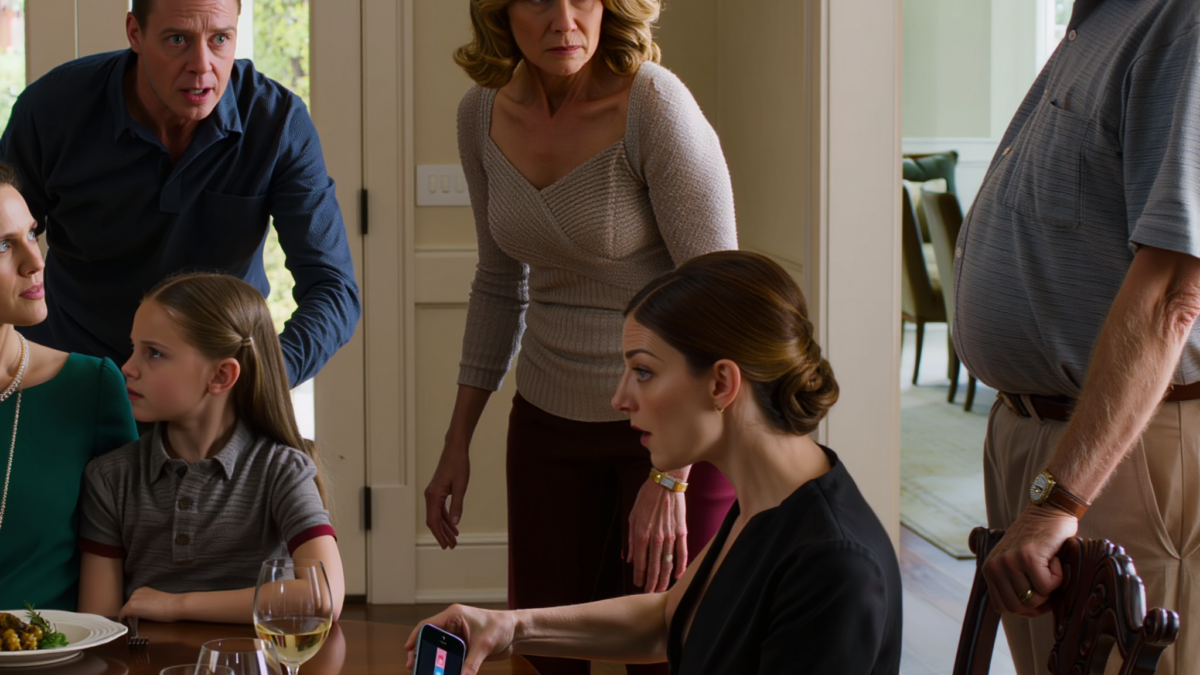
“We’re removing your kids from the trust to keep it in the real bloodline.”
My mother said it over the roast as casually as if she were passing the salt.
Eleven people at that table heard her. My two adopted children heard her. And she was smiling when she said it, as if she had been waiting all year for the chance.
Then she said my older sister, Renee, would “raise them right” if I made a problem of it.
As if my children were furniture being moved to a better room.
As if I weren’t sitting three feet away.
I didn’t get up. I set down my fork, picked up my phone, and dialed a number I had kept saved for two years.
What my mother didn’t know was that the trust she was so certain she controlled had a name on it that wasn’t hers.
Six weeks later, she would be sitting in a lawyer’s office signing papers before she was allowed to leave. But that night, she still thought she had won.
So I placed my phone in the center of the table, face up, turned on the speaker, and waited for it to ring.
The man who answered knew exactly who I was.
He also knew exactly what my mother had just done.
My name is Carolyn Maddox. I was 38 years old, and what my mother said over that roast was not the cruelest thing she had ever done to my children.
It was simply the first time she did it out loud in front of witnesses.
My kids are Theo and Posie. Theo was nine. Posie was seven.
We adopted them three years earlier, in the spring of 2023, after a foster placement that was supposed to last only a weekend and somehow never ended.
From the moment they walked into my house, they were mine and I was theirs.
I was their mother.
Not their foster mother. Not their “adoptive” mother with invisible quotation marks around the word.
Their mother.
The papers were signed. The judge shook my hand. It was done.
My mother, Patricia Maddox, had never once said Theo’s or Posie’s name without a tiny pause before it. It was almost too small to notice unless you knew her well. A little hesitation, as if she were deciding whether they counted before allowing herself to say their names.
We grew up in Crest Haven, an old leafy suburb outside Hartford where the houses had names, families had history, and people seemed to know exactly how much their grandmother’s silver was worth.
My mother married into that world.
She never got over the fact that she married into it instead of being born into it, and she spent the next 40 years overcompensating.
My grandmother, my father’s mother, Eleanor Maddox, was the real thing.
Old Crest Haven.
Money that had been quiet for three generations.
She created the Maddox family trust herself in the 1980s, using her own attorney and her own terms. My father was her only child.
When he died of a heart attack at 51, my mother decided the trust was effectively hers by marriage.
It wasn’t.
But she believed it was.
And belief is a powerful thing in my family.
There had always been two tiers in our house.
Renee was the first tier.
I was the second.
Renee had my mother’s coloring, my mother’s certainty, and my mother’s talent for making cruelty sound like concern.
Renee got the wedding at the country club.
I got the backyard.
She got the down payment.
I got, “You’ve always been so independent, Caroline.”
It was never meant as a compliment.
It was a way of closing the account.
I learned early not to ask for things out loud in that house. If you asked, you risked being told no in front of people, and sometimes the public no was the entire point.
So when I adopted Theo and Posie, I didn’t ask my mother for anything.
I brought them to Sunday dinner one week and said, “This is Theo. This is Posie. They’re mine now.”
My mother looked at them for a long moment.
Then she looked at me.
“Well, aren’t you brave?”
That was my family.
Warmth with a blade inside it.
For three years, I told myself it was fine. I told myself Theo and Posie were too young to notice the temperature change whenever they walked into Grandma Patricia’s house.
I was wrong.
Children notice everything.
Posie started asking why Aunt Renee’s children got the bigger presents.
Theo stopped wanting to go.
Then came the Sunday when my mother called what she described as a family meeting about the future of the trust.
She announced it casually, like a change in the holiday schedule.
What she didn’t know was that two years earlier, I had received a phone call that changed everything I thought I understood about that trust.
A few months after the adoption became final, a man named Walter Brennan called me.
Walter had been my grandmother Eleanor’s attorney. He was the lawyer who helped her create the trust back in the 1980s.
He was old, careful, and extremely precise.
“Mrs. Maddox left instructions that if you ever became a parent, I was to contact you,” he told me.
He wouldn’t say much more over the phone.
The rest, he said, required a meeting.
Then he gave me his direct number.
“Keep it,” he told me.
So I did.
My grandmother had seen something coming. She had put something in place and made sure I would have a way to contact the one man who knew what it was.
I had never used Walter’s number.
Not until the roast.
The dinner was at my mother’s house, the large colonial on Lynen Court that my grandmother had actually paid for, although no one would have guessed that from the way Patricia talked about “her home.”
It was a Sunday in early June.
Eleven of us sat around the table.
My mother was at the head.
Renee sat with her husband, Greg, and their two children. My uncle Philip, my father’s younger brother, was there with his wife, Diane. My cousin Marcus came with his fiance.
Theo sat on one side of me.
Posie sat on the other.
The food was good. The wine was already open.
My mother waited until the roast had been carved and everyone had a full plate.
She always preferred an audience that couldn’t leave politely.
She tapped her glass.
Not hard.
Just enough.
“I want to talk about the trust,” she said. “While we’re all together.”
Renee already knew.
I could tell because she did not look up.
She kept cutting her meat into small, even pieces.
Greg reached over and squeezed her hand.
They had rehearsed this.
“Your grandmother’s trust has been the foundation of this family for 40 years,” my mother said. “And it’s my responsibility to protect it, to keep it intact, for the people it was meant for.”
Uncle Philip put down his glass.
“Patricia, this seems like a—”
“Let me finish.”
He did.
People always let my mother finish.
“I’ve spoken with the family attorney,” she continued, “and we’ve decided that the trust will be restructured to reflect the real bloodline of this family.”
Then she paused.
And looked at my children.
“Going forward, Theodore and Posie will not be beneficiaries.”
The entire table went quiet.
It was the kind of quiet my mother liked.
Theo looked at me.
He was nine. He didn’t know exactly what a beneficiary was, but he understood the sound of being removed from something while he was sitting at the table eating dinner with the people doing the removing.
“They’re not really Maddoxes,” my mother said gently, as though speaking softly made it kinder. “I have to think about the future.”
Then she went further.
“Renee has agreed that if you object, if you make this difficult, she’ll take over raising them properly in a real family with real history.”
That was the line.
The one she had been building toward all night.
In front of 11 people, my mother had effectively offered to hand my children to my sister.
I looked down at my plate.
My hands were beneath the table.
I slowly unclenched them, one finger at a time.
And that was when I understood what she had planned.
She never intended to let me say no.
She expected me to say nothing.
For most of my life, that strategy had worked.
When my mother pushed hard enough, I usually left the room and allowed her version of events to become the official one.
That night, I picked up my phone.
She saw me.
Her mouth tightened.
“Carolyn, put that away. This is a family conversation.”
“It is,” I said. “That’s why I’m making a call.”
I put the phone in the middle of the table, face up.
I selected Walter Brennan’s number.
Then I tapped speaker.
The phone rang twice.
Walter answered.
His voice came through the speaker calm, dry, and unmistakably old.
I watched my mother’s face change.
She knew that voice.
Of course she did.
“Mr. Brennan,” I said, “it’s Carolyn Maddox. I’m at a family dinner. I have you on speaker. My mother has just announced that she’s removing my children from my grandmother’s trust to keep it in the ‘real bloodline.’ I’d like you to read who the trust actually names out loud to everyone here.”
There was a pause.
“Carolyn,” Walter said quietly, “are you sure you want me to do this in front of your mother?”
“Yes. Patricia is in the room at the head of the table.”
I heard him take a breath.
Then came the faint sound of paper moving.
“All right,” he said. “Then let’s start with what your grandmother named the trust, because the rest follows from that.”
My mother stood.
“This is absurd. Carolyn, hang up the phone.”
I didn’t move.
Neither did the phone.
And on the other end of the line, my grandmother’s attorney began to read.
“The instrument is the Eleanor Maddox Irrevocable Family Trust,” Walter said, “executed in 1986.”
Then he explained one word.
Irrevocable.
It meant that no living person could simply rewrite it.
Not Patricia.
Not me.
Not Walter.
Eleanor had written it that way on purpose.
My mother remained standing, but she had gone very still.
“Patricia,” Walter said, “I’m going to read your role in the trust. Since you’ve evidently described it to your family, you are an income beneficiary. That means you receive a stream of income from the trust during your lifetime at the trustee’s discretion.”
He paused.
“You are not a trustee. You have never been a trustee. You have no authority to add or remove beneficiaries. None.”
“That’s a lie,” my mother said. “I’ve been managing that trust for years.”
“You’ve been receiving from it,” Walter replied. “That is not the same thing.”
For the first time that evening, Renee looked up.
She looked directly at our mother.
Something appeared on her face that I had almost never seen there when Patricia was speaking.
Doubt.
“Mr. Brennan,” I said, “who is the trustee?”
I heard papers moving again.
“Eleanor named herself trustee during her life,” Walter said. “Upon her death, the trust names a successor trustee. The successor trustee is identified in Article 9.”
“Read Article 9.”
My mother said my name.
“Carolyn.”
It was quieter now.
Almost a warning.
Walter continued.
“Upon the death or incapacity of the grantor, the successor trustee shall be the grantor’s granddaughter, Carolyn Anne Maddox, who shall serve with full and sole discretion over all distributions and all administration of the trust.”
Nobody made a sound.
Uncle Philip turned toward me as if he were seeing me for the first time.
“That can’t be right,” my mother said.
Her voice had lost its edge.
“Eleanor would never have made Carolyn—”
“Eleanor signed it in front of two witnesses and a notary in 1986,” Walter said. “Carolyn was an infant. Your grandmother chose her before she could walk.”
Then he added something else.
“Patricia, she left a letter explaining why. I’ll read that part later if Carolyn wants. But first I think everyone at the table should understand what this means.”
“What does it mean?” Uncle Philip asked.
Walter answered plainly.
“It means Carolyn is the only person on earth with the legal authority to add or remove a beneficiary from this trust. And it means that whatever Patricia just told you over dinner, she had no power to do it.”
My mother sat down.
Not gracefully.
She seemed to fold back into the chair.
I looked across the roast, the wine, and my two children at the woman who had spent most of my life speaking as if her certainty were the same thing as authority.
For the first time, somebody had read the difference out loud.
But the trust itself was only the beginning.
After dinner, nobody applauded.
This wasn’t a movie.
People became uncomfortable, then polite, which in my family was usually the same thing as fleeing.
Uncle Philip helped me get the children’s coats.
“Lo, I didn’t know any of that about the trustee,” he said.
Then he paused.
“Your father would have.”
I looked at him.
“My father knew?”
“Your father set it up with Eleanor,” Philip said. “Before he died, he told me once she’d made sure Caroline would never have to ask Patricia for permission to protect her own. I didn’t understand it then. I do now.”
Before I could leave, Renee caught my arm in the front hall.
The kids were already wearing their coats.
She had never touched me quite like that before.
Gently.
Almost as if she wasn’t sure she had the right.
“Did you know?” she whispered. “About being trustee. Did you know all along?”
“No. I found out tonight, same as you.”
She studied my face.
For years, our mother had taught Renee to expect something dishonest or unstable from me whenever I contradicted Patricia.
That night, she didn’t find it.
“She told me you planned this,” Renee said. “She said you’d been scheming for years to cut us out.”
She gave one humorless laugh.
“Twenty minutes ago, I believed her.”
Then she looked back toward the dining room, where our mother was still sitting at the head of a table in a house she had always called hers.
“Now I don’t know what I believe,” Renee said. “But I don’t think it’s her anymore.”
It was the first crack in 30 years of my sister and me standing on opposite sides of a line our mother had drawn.
I didn’t trust it yet.
But I noticed it.
I drove home with Theo and Posie in the back seat.
Theo stayed quiet for a long time.
Then he asked, “Mom, are we still in the family?”
I looked at him in the rearview mirror.
“You’re not in the family,” I said. “You are the family. That’s different.”
He didn’t fully understand what I meant.
But he stopped asking.
He fell asleep before we reached the highway.
The next morning, Walter called.
“We need to meet,” he said.
There were things, he explained, that he had deliberately not read aloud at the dinner table.
They were not his to expose in front of everyone.
They were mine to decide what to do with.
Then he said something I could not stop thinking about.
“Caroline, the reason your mother wanted those children out of the trust isn’t sentiment. It’s arithmetic. And once you see the arithmetic, you’re going to have a decision to make that I can’t make for you.”
I drove to Walter’s office that afternoon.
It was in an old downtown building with frosted glass doors and the smell of paper embedded in the walls.
A thick folder sat on his desk.
My grandmother’s handwriting was on the tab.
“Before we open this,” Walter said, “I want you to understand something. Your grandmother didn’t make you trustee because she loved you more than Renee. She made you trustee because she watched Patricia for years.”
He looked at me carefully.
“She did not believe Patricia would ever protect a child who wasn’t, in her words, useful to her.”
I asked the question I had been carrying since dinner.
“Why didn’t you tell me sooner? You’ve known I was the trustee for years.”
“Because Eleanor’s instructions were specific,” Walter said. “I was to contact you only when you became a parent, and only then to give you my number, not the file.”
“Why?”
“She believed that until you had a child to protect, you wouldn’t have the spine to use any of this. She thought Patricia would talk you out of it.”
Walter paused.
“She wasn’t wrong, was she? Two years ago, would you have done what you did at that dinner?”
I thought about it.
Two years earlier, I probably would have left the table.
“No,” I said.
“That’s why she waited. Your grandmother understood you better than you understood yourself. She knew the day you’d be ready would be the day someone came for your children.”
Then he opened the folder.
“Let me show you what your mother has been doing with money she had no right to touch.”
The folder contained an accounting.
Walter had been maintaining it quietly for years because Eleanor had arranged and paid for an annual review of the trust whether anyone requested one or not.
“The trust holds about $4.1 million,” Walter said. “Real estate, a portfolio, and the house on Lynen Court.”
I stared at him.
“The house?”
“The trust owns it. Not your mother.”
Patricia had lived there at the trust’s discretion.
For 20 years, she had told people the house was hers.
It wasn’t.
Walter turned a page.
“As an income beneficiary, your mother may receive income from the trust. Interest. Dividends. Rent. All at the trustee’s discretion.”
Then he pointed to the problem.
There had effectively been no acting successor trustee after Eleanor died because the person Eleanor had appointed had never been told.
Me.
My grandmother died when I was 22.
A notification letter should have been sent to me explaining that I had become successor trustee and outlining my duties.
Walter removed his glasses.
“Your mother intercepted it.”
I stared at him.
“How do you know?”
“Because it came back to this office 16 years ago marked ‘Return to sender. No longer at this address.’”
He pushed a photocopy across the desk.
“You had just moved. Patricia knew your new address.”
I looked at the handwriting.
I recognized it immediately.
The careful looping P.
The crossed sevens.
A habit my mother had adopted because she thought it looked refined.
“She knew.”
“She has known for 16 years that you were the trustee,” Walter said. “And she spent 16 years making sure you never found out, because the moment you found out, her access ended.”
He turned another page.
“Now we get to the arithmetic.”
Over those years, my mother had taken distributions that she classified as income.
Some distributions could have been legitimate.
But she had not stopped with income.
Walter pointed to a transaction from 2019.
“She sold a piece of trust property. A parcel near the lake. Four hundred thousand dollars.”
“That’s principal,” he said. “Not income. She had no authority to sell trust principal without a trustee.”
There had been no trustee approval.
Yet the sale had gone through.
“How?”
“She used a trustee signature.”
“Whose?”
Walter looked directly at me.
“Yours.”
For a moment, I simply sat there.
My mother had signed my name to sell my grandmother’s land.
“What happened to the $400,000?”
Walter checked the accounting.
“Three hundred thousand went toward the down payment on a house.”
“Whose house?”
He paused.
“Renee’s.”
The colonial on Ashford Lane.
The house with the pool.
The house where I had spent two Thanksgivings complimenting the kitchen while Renee talked about how hard she and Greg had worked to get there.
“And the rest?”
“Distributions to Patricia. A car. Renovations on the Lynen Court house, which, again, the trust owns.”
My mother had renovated a house she did not own using money taken from a trust she did not control.
Walter turned several more pages.
The lake property had not been an isolated event.
A trust brokerage account had been quietly losing money through withdrawals labeled maintenance and family support.
No valid trustee had authorized them.
There was also a $50,000 line of credit opened against trust property in 2021 that had never been repaid.
“How did she do this for so long?” I asked. “Banks ask questions.”
“They ask the trustee,” Walter said. “And as far as the institutions were concerned, the trustee had approved the transactions.”
He tapped the folder.
“Your name appears on a dozen documents in here, Caroline. You’ve never seen any of them.”
I stared at signatures that were supposed to be mine.
A whole second version of me had existed on paper.
A version who signed whatever my mother needed while the real me spent decades being told I was too scattered to be trusted with anything.
“She made a version of me that did whatever she wanted,” I said.
“Yes,” Walter replied quietly.
Then his expression changed.
“Here’s the part you need to understand. As successor trustee, you have a fiduciary duty. Now that you know about the forgery and the misappropriation, you’re required to act.”
“What does acting mean?”
“At minimum, compelling a full accounting and recovering the misappropriated funds.”
“And at maximum?”
He paused.
“Forgery of a trust signature to convey real property can be criminal. Potentially a felony. Possibly grand larceny depending on the circumstances.”
I thought about my mother saying “real bloodline” over dinner.
I thought about Theo asking whether he was still in the family.
“I want to do this right,” I said. “Not loud. Right.”
“Then we do it the way Eleanor designed it to be done,” Walter said. “On paper. In order. With everyone in the room.”
Before I left, he reached into the folder and removed one more envelope.
It was sealed.
My name was written across the front in my grandmother’s handwriting.
“She left this for the day you found out,” Walter said. “She told me not to read it. Only you.”
I put it in my bag.
I didn’t open it in Walter’s office.
Some things do not belong under fluorescent lights in a lawyer’s conference room.
That night, after Theo and Posie were asleep, I sat at my kitchen table with a cup of tea going cold beside me and opened my grandmother’s letter.
Some of it was personal enough that I have never repeated it.
But the part that mattered was clear.
Eleanor wrote that she had watched my mother for years.
She had watched Patricia rank her own daughters when we were still children.
Renee first.
Me a distant second.
She wrote that she chose me as trustee precisely because I was the child everyone underestimated.
“The one they overlook is the one who learns what fairness costs,” she wrote. “I’m betting on the overlooked child. I usually do.”
Then came the line I have never forgotten.
“You will be tempted to believe that being chosen by me makes up for not being chosen by her. It doesn’t, and it shouldn’t. Don’t spend your life waiting to be chosen by people who keep a ledger. Choose your own. Make sure no one can ever put your children on the wrong side of a line. That’s all the trust was ever for.”
I put the letter down.
I had kept myself together at the dinner.
I had kept myself together in Walter’s office.
At my own kitchen table, with my children asleep down the hall, I finally cried.
I wasn’t sure whether I was crying for the girl who always came second or the 38-year-old woman who had finally been told, in her grandmother’s handwriting, that someone had chosen her before she could even walk.
Maybe they were the same person.
Maybe they had both been waiting 38 years.
When I was finished, I wiped my face and called Walter.
“Set the meeting.”
We did not ambush my mother.
I had just learned what an ambush felt like from the inside. I had no interest in becoming Patricia in order to defeat Patricia.
Walter sent formal letters to Patricia and Renee.
The letters stated that the successor trustee had assumed her duties effective immediately, that a complete accounting of the trust was underway, and that all beneficiaries were invited to a meeting at Walter’s office in three weeks to review the trust and address irregularities in prior distributions.
In those three weeks, three important things happened.
First, my mother called me 11 times.
I let every call go to voicemail.
Her messages moved through a predictable sequence.
Cold.
Furious.
Wounded.
Then sweet.
The last one said, “Carolyn, honey, I think there’s been a terrible misunderstanding, and I’d hate for the family to be torn apart over a clerical thing.”
A clerical thing.
A forged signature.
My grandmother’s land.
My sister’s house.
I saved every voicemail.
I had learned one lesson from the trust.
Keep the record.
Patricia also started calling relatives.
Uncle Philip received a call.
So did Cousin Marcus.
Her story was the same story she had told about me for most of my life, only scaled up.
Caroline was sensitive.
Caroline was unstable.
Carolyn had always resented Renee.
Now Caroline had found a lawyer willing to convince her that she owned everything and was going to destroy the family over it.
Philip called me after hearing the performance.
“She’s not even good at it anymore,” he said. “She used to be better.”
He paused.
“I think she’s scared.”
The second development was quieter.
Work.
I spent two evenings in Walter’s office with a forensic accountant named Susan Vogle.
Susan was patient, exact, and slightly intimidating in the way people can be when they have spent 30 years finding money that someone intentionally tried to hide.
She spread the trust records across a conference table and walked me through them.
“People think forgery is difficult to prove,” she said. “Usually the problem is that forgers become repetitive. They reuse the same habits.”
She placed samples of my mother’s handwriting next to the signature on the 2019 lake deed.
“Your mother crosses her sevens,” Susan said. “She makes her capital C in two strokes with a hook at the bottom. You make yours in one.”
She pointed to the deed.
“She did it here.”
Then she looked at me.
“She has probably been signing your name for years because she never expected anyone to compare the writing side by side.”
We gathered everything I had a legal right to access.
My verified signatures.
My driver’s license.
My home deed.
The adoption decree.
My own bank records showing I had never received the proceeds from the lake property.
Through Walter, I requested the trust’s full banking history, something I could legally obtain as trustee.
I did not break into anything.
I did not snoop.
I did not access records I was not entitled to see.
My mother had spent 16 years operating inside a fog she had created.
Learning that I was the trustee simply turned on the lights.
On the second evening, Susan packed her binder and looked at me.
“You’re very calm about this.”
“I’ve had 38 years of practice being calm in that family,” I said.
The third development surprised me most.
Renee came to my house.
It was a Tuesday while the kids were at school.
She stood on my porch without the certainty she normally wore around me.
“Can I come in?”
I let her inside and made coffee.
We sat in my small kitchen, the one no trust had ever paid for.
“Mom says you’re trying to take the house from her,” Renee said.
“The Lynen Court house belongs to the trust. It always has. Mom has been living there and calling it hers.”
Renee was quiet.
“Then she says you forged something to make yourself trustee.”
“No. She forged something.”
I watched my sister carefully.
“She forged my signature to sell the lake parcel. Four hundred thousand dollars.”
Renee’s face changed.
“Three hundred thousand of it went toward your house on Ashford Lane.”
She set down her coffee.
For a long time, she simply stared at the table.
Then she said something I did not expect.
“I think I knew.”
I waited.
“I think I always knew the money was wrong. I just didn’t want to know whose it was.”
For most of my life, I had treated Renee as the enemy.
The golden child.
The daughter who got the country club wedding and the financial help.
But sitting in my kitchen, I began to understand something different.
Renee had been used too.
Not in the same way.
But used.
The house on Ashford Lane had not been a simple gift.
It had helped my mother turn stolen trust principal into something that looked like generosity toward the daughter she could control.
“She told me it was an early inheritance,” Renee said. “She said Grandma would have wanted me to have it.”
Then she looked at me.
“She said you didn’t need it because you were so independent.”
There was that word again.
Independent.
The closing of the account.
“She uses that word on you too,” Renee said slowly.
“My whole life.”
“She used a different one on me.”
“What?”
“Responsible.”
She sat back.
“You’re the independent one. I’m the responsible one. And the funny thing is, we both spent 30 years trying to earn something she was never going to give either of us.”
We sat with that for a while.
I won’t pretend one cup of coffee repaired our relationship.
It didn’t.
There were 30 years of country club weddings and backyard birthdays between us.
But something shifted.
My mother had spent decades maintaining a line between her daughters because two daughters comparing notes would have been dangerous.
At my kitchen table, that line finally cracked.
Before Renee left, she asked, “What are you going to do at the meeting?”
“I’m going to give everyone a chance to tell the truth.”
“And if they don’t?”
“Then I’m going to tell it for them.”
She hesitated.
“And the forgery?”
I had thought about little else.
“That depends on her.”
The meeting took place on a Thursday morning at the end of June in Walter Brennan’s conference room.
There were eight of us.
Walter.
Me.
My mother.
Renee.
Uncle Philip, who turned out to be a remainder beneficiary of the trust and had every right to attend.
Susan Vogle, the forensic accountant.
A court reporter, because I wanted everything on the record.
And my mother’s new attorney, Daniel Frost.
Within ten minutes, I could tell Daniel had not been told the complete story.
My mother walked into the room the same way she had entered dinner.
Pearls.
Certainty.
She had decided to frame everything as a family misunderstanding that could still be smoothed over with the right tone.
“I think this has all gotten very out of hand,” she said before Walter could begin. “Caroline has always been sensitive. We can resolve this quietly as a family without all of this.”
She waved toward the court reporter.
“Mrs. Maddox,” Walter said, “please let me lay out the trust’s position. Then your attorney can respond.”
She sat down.
Walter explained the structure of the trust.
It was irrevocable.
Patricia was an income beneficiary.
I was the sole successor trustee named in 1986.
Daniel Frost responded first.
“My client’s position is that she acted in good faith as the de facto manager of the trust for many years in the absence of any other party stepping forward.”
That was the opening lie.
“In the absence of any other party stepping forward,” I repeated.
Then I slid the first document across the table.
“This is the notification letter Walter’s office sent in 2010 informing me that I was the successor trustee.”
Daniel picked it up.
He read the front.
Then he turned it over.
On the back were the words written in my mother’s handwriting.
“No longer at this address. Return to sender.”
“That’s not my client’s handwriting,” Daniel said.
But he said it more slowly than his first sentence.
“Susan,” Walter said.
Susan opened her binder.
“I retained a certified handwriting examiner. The writing on the returned envelope was compared with 11 samples of Patricia Maddox’s known handwriting, including signed documents and personal checks.”
She turned to a page in the packet.
“The examiner concluded that the writing matched to a reasonable degree of professional certainty.”
My mother’s smile remained in place.
But something behind it moved.
“That proves nothing,” she said. “Mail gets returned all the time.”
“It would prove nothing if it were the only thing,” I said.
I nodded toward Walter.
He placed the deed for the lake parcel on the table.
The 2019 sale.
$400,000.
“Mrs. Maddox,” Walter said, “this document conveyed trust property. Selling trust principal requires trustee authority. You were not the trustee.”
He rotated the deed.
“But this sale contains a trustee signature.”
The signature line read Carolyn Anne Maddox, Trustee.
“Whose signature is that?” Walter asked.
My mother looked at it.
“That’s Caroline’s signature.”
“It isn’t,” I said. “I had never signed a trust document in my life. I didn’t even know I was trustee until three weeks ago.”
“You’re confused,” my mother said.
There it was.
The familiar weapon.
“You signed it. You just don’t remember. You were always scattered, Carolyn.”
Sensitive.
Scattered.
The girl who imagined things.
She had used that version of me for 38 years because there had never been an official record of the conversation before.
Now a court reporter was typing every word.
“Susan,” I said.
Susan reopened the binder.
“The handwriting examiner also compared the signature on the 2019 deed with Carolyn Maddox’s verified signatures, including her driver’s license, home deed, and adoption documents.”
She paused.
“It is not a match to Carolyn.”
My mother said nothing.
“It is, however, consistent with Patricia Maddox’s known handwriting, particularly the formation of the capital C.”
Walter looked across the table.
“Patricia, you forged your daughter’s signature to sell your mother-in-law’s land, and you used the proceeds toward the purchase of your other daughter’s house.”
Then the wire transfer went onto the table.
$300,000.
Patricia Maddox to the title company handling escrow on the Ashford Lane property.
Renee made a small sound.
She had already admitted to me that some part of her suspected the money had not been clean.
But suspicion was different from seeing the transfer on paper.
The room became very still.
Daniel Frost carefully set down his pen.
He had not known.
You could see the moment he understood that his own client had not been honest with him either.
He requested a recess.
Walter agreed.
Through the frosted glass, I could see Daniel speaking to my mother in the hallway.
His sentences were low and fast.
My mother did what she always did.
Chin up.
Hands moving.
Explaining.
Even then, with her own lawyer confronting her, she was still explaining.
When they returned, Daniel looked older.
“My client maintains her position,” he said.
But no one in the room believed that he believed it anymore.
While Susan reorganized her binder, Uncle Philip leaned toward me.
“Your grandmother told me something once.”
I looked at him.
“The Thanksgiving before she died, she said, ‘Philip, when it all comes apart, watch Carolyn. She’s the only one who will do it right.’”
He shook his head.
“I thought she was being sentimental.”
He looked across the table.
“She wasn’t. She was telling me what to expect.”
I added that memory to the letter.
To the overlooked child.
To the growing collection of proof that someone had been watching me long before I knew I needed to be watched.
Then my mother made the decision that settled everything.
She kept talking.
“Everything I did,” she said, her voice low and tight, “I did to protect this family from being diluted.”
Daniel looked toward her.
“Patricia—”
She continued.
“Eleanor’s money was meant for blood. Real blood, not for charity cases Carolyn brought home from the state. I was keeping it where it belonged.”
The court reporter began typing again.
Daniel tried to stop her.
She did not stop.
“Those children are not Maddoxes. They never will be. I will not apologize for protecting 40 years of this family from a woman too soft to understand what bloodline means.”
That was it.
Not simply because of the cruelty of what she said.
Because she said it on the record.
In front of her attorney.
A court reporter.
A forensic accountant.
My uncle.
Both of her daughters.
She had stated her motive in her own words.
Uncle Philip stood.
“That’s enough, Patricia.”
His voice shook.
“Those are my brother’s grandchildren. He’d be ashamed of you. I’m ashamed of you, and I’ve spent 40 years making excuses for you.”
My mother stared at him.
Philip had always been one of the people who let her finish.
Not this time.
Walter waited until the room settled.
Then he spoke.
“Patricia, here is where we are.”
His voice had lost its earlier gentleness.
“The forensic file is complete. Carolyn has a fiduciary duty as successor trustee to recover misappropriated trust funds. That is not optional.”
He paused.
“The forged conveyance may also be referred for criminal review.”
Then he looked at me.
“What happens with that referral is Carolyn’s decision.”
Everyone turned toward me.
My mother looked at me too.
For the first time in my life, I saw something on her face that was not irritation, contempt, or certainty.
Fear.
She had spent 38 years believing she knew exactly how I would react.
Now she didn’t.
I had thought about this moment for three weeks.
I had thought about my grandmother’s letter.
I had thought about Theo in the back seat asking whether he still belonged to the family.
“Here’s what’s going to happen,” I said.
“The trust recovers everything.”
I looked at my mother.
“The lake parcel money comes back. Four hundred thousand dollars, with interest, from your assets.”
Then I moved to the house.
“The Lynen Court house has always belonged to the trust. You will vacate it. The trust will sell it, and the proceeds will remain in the trust.”
“You can’t put me out of my home,” my mother said.
“It was never your home.”
She stared at me.
“That was the whole problem. You spent 40 years living in a house you didn’t own and calling everything in it yours, including the people.”
Then I turned to Renee.
“Your home on Ashford Lane was purchased with $300,000 of trust principal. The trust has a claim against it.”
Her face tightened.
“But you didn’t steal the money. She did. And she lied to you about where it came from.”
I told her the choice I had already discussed with Walter.
She could buy out the trust’s interest over time on terms she could reasonably afford and keep her house.
Or the property could be sold.
Her choice.
Either way, I was not going to punish her children for what our mother had done.
Renee’s eyes filled.
“Why would you do that for me?”
“Because Grandma’s letter said to choose my own family.”
I looked at her.
“And I’m choosing. You’re in it. She isn’t.”
Then I turned back to my mother.
“As for the forgery, you want to know whether I’m going to send the file for criminal review.”
For once, Patricia had nothing to say.
“I’m not deciding that today.”
Then I explained what I was deciding.
She would sign a confession of judgment for the full amount owed to the trust, including interest.
She would permanently resign any claim to a role in the trust.
And she would agree to have no contact with my children after stating, on the record, that she considered them less than family.
“You sign all of that today,” I said. “And I’ll hold the criminal referral.”
My mother looked at me.
“Hold it?”
“Not destroy it. Hold it. It stays in Walter’s safe.”
I leaned forward.
“If you contact my children, contest these terms, or begin calling relatives again to tell them how sensitive or scattered Carolyn has always been, the file goes forward.”
The room stayed quiet.
“That’s not mercy,” I said. “Don’t mistake it for mercy. It’s a boundary.”
My mother turned toward Daniel Frost.
Daniel looked at the forensic reports.
The court reporter.
The wire transfer.
Then he looked at his client.
“Patricia,” he said quietly, “sign it. This is the best outcome you’re going to get.”
Before she did, my mother tried one last time to appeal to the room.
Not to me.
To everyone else.
“You’re all going to let her do this?”
Nobody answered.
“After everything I’ve done for this family? I held it together for 40 years. I kept the name. I kept the house. I raised two daughters, and one of them is sitting here destroying me over a piece of land.”
Still, nobody answered.
That was the new thing.
For 40 years, somebody had always stepped in.
Defended her.
Softened the moment.
Explained what she really meant.
Let her finish.
Philip looked at the table.
Renee looked at her hands.
The silence was not cruelty.
It was simply the absence of the support my mother had always expected.
“Patricia,” Daniel said again. “Sign the papers.”
She signed.
Page after page.
The same hand that crossed its sevens.
The same hand connected to the signature that had appeared on my grandmother’s land documents.
When she finished, she stood.
For one second, I thought she might say it.
The apology.
The words I had spent most of my life waiting to hear.
Her mouth opened.
Then closed.
She picked up her purse and left without saying anything.
In August, my mother moved out of the house on Lynen Court.
The trust sold it.
The proceeds went back into the trust.
The $400,000 was recovered with interest.
My mother moved into a rented condo across town.
I heard that she told her new neighbors she had “simplified.”
I never corrected the story.
For 38 years, she had lived rent-free in my head almost as comfortably as she had lived in that house.
I was learning not to give her either space anymore.
That fall, I sat with Walter for my first full accounting as trustee.
We went through everything line by line.
The trust was whole again.
And for the first time in 16 years, the signature on the trustee line was actually mine.
I signed slowly.
One clean stroke.
The capital C the way I actually make it.
The real one.
“Your grandmother would have liked this,” Walter said as he capped his pen.
I looked at him.
“She used to worry the money would rot the family,” he said. “She told me the only way to keep it clean was to give it to the one person who never wanted it for herself.”
He looked over his glasses.
“She found her.”
That afternoon, I added Theo and Posie as beneficiaries.
I wrote both names in my own hand.
Walter notarized the change.
I watched their names become part of the same trust my grandmother had signed before I could even walk.
For the first time, I understood what she had built.
Not a prize.
Not a crown.
A safeguard.
A way to make sure that one day, the child everyone overlooked could protect two children someone else might try to overlook too.
Renee eventually bought out the trust’s interest in her house.
We handled it on paper.
Fairly.
Walter guided both of us through the process.
She kept her home.
She kept her children out of our mother’s financial mess.
And eventually, she started coming to my house on Sundays.
Real Sundays.
Her children and mine ran through the sprinkler in a backyard no trust had ever paid for.
Nobody ranked them.
There was only one tier there.
It wasn’t a fairy tale between Renee and me.
Some Sundays were uncomfortable.
Sometimes one of us said something and both of us heard our mother’s voice inside the sentence.
Then we had to stop and start again.
Thirty years does not disappear in one summer.
But one afternoon, Renee brought a box to my house.
Inside were old family photographs she had taken when Patricia cleared out the Lynen Court house.
Most were exactly what I expected.
Renee’s birthday parties.
Renee’s recital.
Renee centered in the frame.
The wall of Renee.
Near the bottom were three small photographs of me.
In each one, I was somewhere at the edge of another person’s event.
Renee had circled my face in pencil.
On the back she had written, “She was always there. We just weren’t looking.”
“I want my kids to know you were there,” she told me. “The whole time. I’m tired of the version where you weren’t.”
I framed one.
It sits on my mantel now beside photos of Theo and Posie, our adoption picture, and a photograph of the lake.
It is the only picture from my childhood I own where someone deliberately went looking for me.
Uncle Philip began calling every few weeks.
Sometimes he still apologized for the decades when he let my mother finish.
I always told him the same thing.
“You stood up when it counted.”
A month after the meeting, Philip drove me to the lake parcel.
The land my mother had sold using my name.
The buyer had never built on it.
It was still open ground, pine and rock along the shoreline, almost exactly as it had been when my grandmother took my father there as a boy.
The trust was able to buy it back.
I did it at the first opportunity.
Philip and I stood near the water.
Then he told me something I had never known.
“Your grandmother used to bring you here too.”
“I was here?”
“You were maybe two.”
He smiled.
“She’d sit you on a blanket and tell your father, ‘This one’s watching everything. Mark my words.’”
He looked across the water.
“She always said you were the watcher. The one who’d remember.”
I thought about windows.
About spending most of my life feeling as if I were on the wrong side of one.
Seen.
Measured.
Found second.
My grandmother had apparently seen something else before I even had words for it.
I placed my palm against the cold rock near the shoreline.
“Thank you,” I said.
Philip did not interrupt.
He simply stood beside me and let me say it.
The criminal file remains in Walter’s safe.
My mother has never contacted my children.
Not once.
I think leverage may have been the only language she ever fully understood.
For the first time in my life, I was the person holding it.
I didn’t enjoy that as much as I once imagined I might.
Mostly, it was quiet.
The boundary held because she understood what crossing it would cost.
People have asked whether I forgave her.
I came to believe forgiveness and reconciliation are two different things, even though people often try to make you pay for one with the other.
I made peace for my own sake.
That did not mean reopening the door.
A few weeks ago, Posie asked me about the trust.
She was seven and had heard adults use the word enough times to decide it must be important.
“Am I in it?” she asked.
I told her the truth.
I told her that a long time ago, before I could even walk, my grandmother had written my name on a piece of paper and decided that I would be the person responsible for keeping something safe.
Then I told her that I had written her name and Theo’s name on that same trust in my own hand.
Where nobody could simply cross them out.
“So we’re in it?” Posie asked.
“You’re in it,” I said. “And more than that, you’re the reason there’s anything to be in.”
She considered that for about a second.
Then she ran back outside to the sprinkler.
Because she was seven.
And the sprinkler mattered more than the trust.
Honestly, she was right.
I stood at the window and watched her.
The same kind of window that had seemed to separate me from so much of my own family when I was young.
This time, someone was on the right side of the glass.
It was me.








