At Christmas, My Parents Turned Away My 11-Year-Old Son At The Door.
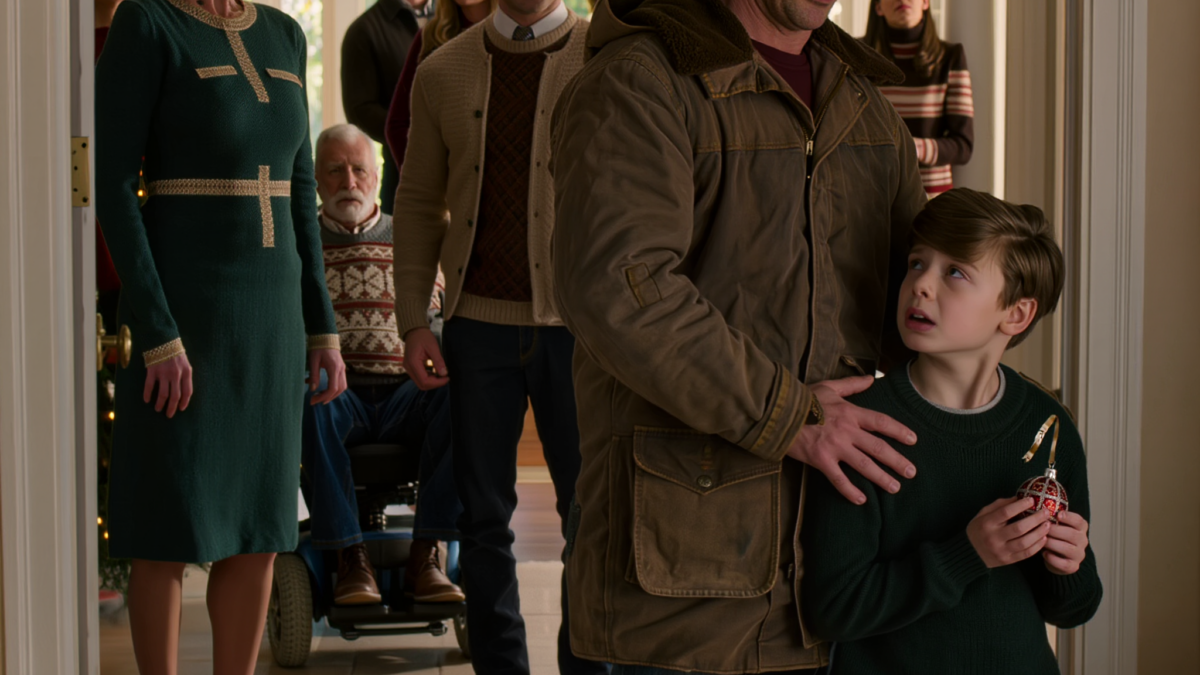
My name is Matthew Donovan. I am thirty-two years old. Last Christmas, my own parents turned my eleven-year-old son away at their front door, leaving him to walk home alone in the freezing winter night. While I was working a grueling fourteen-hour holiday shift to keep a roof over our heads, my mother and father looked my little boy dead in the eye, told him there simply was no room for him at their luxurious holiday table, and shut the heavy oak door right in his face. They laughed with my golden child brother in the warmth of a multimillion-dollar home while my son sat in our freezing empty rental house, crying and trying to cook a holiday meal for himself out of sheer desperation.
But there is one massive thing they did not know. They had forgotten one crucial fact: the sprawling estate where they were hosting their exclusive party—and the wealth they constantly flaunted to the neighborhood—belonged to a living trust controlled by the one man who loved my son more than life itself. Within weeks, my parents would find themselves in a run-down roadside motel, their finances in ruins, facing legal consequences and begging for a second chance they would never receive. To understand how it all unraveled, I have to go back to the exact moment the nightmare began.
I pulled my beat-up sedan into the cracked driveway of my small rental home at exactly 11:30 p.m. on Christmas night. The heater in my car had started acting up three miles earlier, and the biting December wind had chilled me down to the bone. The snow was falling in heavy, wet clumps, illuminated only by the flickering yellow street lamp at the corner of my street. I was physically and mentally exhausted. I had picked up a brutal double shift at the regional logistics center because the holiday overtime pay was the only way I could afford the final installments on my son’s braces and hopefully put a little extra into his college fund.
Every single box I lifted, every pallet I moved that night, I did it thinking about him. I expected the house to be completely dark and totally silent. My son Lucas was supposed to be at my parents’ sprawling colonial estate across town. They always hosted a huge catered Christmas dinner. The cousins, the aunts, the uncles, the business associates. It was the social event of their year. Lucas had been talking about the legendary cousins’ sleepover for a month straight.
He had spent weeks doing extra chores around our neighborhood, shoveling driveways and raking late autumn leaves just to save up enough money to buy everyone in the family a present. He had wrapped them himself, carefully tying ribbons around each one.
I turned the key in the stiff lock, pushed the front door open, and stomped the snow off my boots. The first thing that hit me was not the silence. It was the smell. It was the acrid, sharp, unmistakable scent of smoke and burnt sugar. It was not the casual smell of a piece of toast left in the toaster a few seconds too long. It was the thick, heavy smell of a genuine, desperate attempt to cook something significant that had gone badly wrong.
My heart hammered against my ribs, sending a spike of pure adrenaline through my exhausted veins. I dropped my keys on the console table, not even bothering to take off my heavy work coat, and hurried down the narrow, dimly lit hallway toward the kitchen. The harsh fluorescent overhead light was buzzing slightly, casting a sickly pale glow over the room. There, on the cheap laminate countertop, sat a blackened frying pan, still radiating heat. A trail of spilled flour and burnt sugar coated the linoleum floor.
And then I looked to my left. Lined up neatly against the baseboard by the coat rack were Lucas’s winter boots, soaked through with melting snow. His heavy winter coat was hanging awkwardly on the hook, dripping water onto the floor. And right beneath the coat rack, perfectly aligned like little soldiers standing at attention, were five brightly wrapped gift bags. The tags he had painstakingly written in his best cursive handwriting were still attached.
The tissue paper was still perfectly fluffed. They hadn’t even been touched.
I stepped fully into the kitchen, my breath catching in my throat. My eleven-year-old son was sitting at the small, wobbly dining table in the corner. He was wearing the exact same beige khakis and dark green sweater I had carefully ironed for him that morning. His shoulders were hunched forward, drawn in tight as if he was trying to make himself physically smaller, trying to take up as little space as possible in his own home. He was staring blankly at a cracked ceramic plate holding a piece of heavily charred, unrecognizable meat and a spoonful of cold instant mashed potatoes. “Lucas,” I said, my voice cracking, barely above a whisper.
He jumped slightly, his head snapping up. His eyes were completely dry, but they were hollow. The light in them was just gone. “Hey, Dad,” he said, his voice terrifyingly flat. I walked over and knelt on the hard floor beside his chair. I reached out and touched his arm. He felt freezing cold through the thick wool of his sweater. “Buddy, what is going on? You’re supposed to be at Grandma and Grandpa’s house. I dropped you off at four, right at the end of their driveway. Why are you here? How did you get back?”
He looked down at his lap, his small fingers picking nervously at the hem of his sweater. His voice was entirely devoid of the bright bouncing energy he usually possessed. “They turned me away, Dad.”
My brain completely stalled. It refused to process the words. It felt like I was trying to read a foreign language. “Turned you away, Lucas? What do you mean they turned you away?”
His fingers gripped the edge of the cheap wooden table until his knuckles turned stark white. “I walked up the driveway just like you told me. I had all the bags. Grandma opened the door. She looked at me like she’d forgotten I was coming. Like I was a stranger delivering a package, Dad. Then Uncle Tyler came up behind her in the hallway. He was holding a drink. He pointed at my bags and laughed. He told Grandma my sweater looked like a cheap curtain.”
A hot, searing spike of rage shot through my chest. Tyler, my thirty-five-year-old brother, mocking a child. “What did Grandma say?” I asked, forcing my voice to remain calm, afraid of frightening him further. “Grandma sighed really loud,” Lucas continued, his chin trembling slightly. “She said it was a full house. She said all of Uncle Tyler’s friends were over. She told me there wasn’t enough space for me. I tried to hand her the ornament I painted for her—the one with the little reindeer. She didn’t even look at it.”
She just pushed my hand back and said, “Not now, Lucas. We are busy.” I stared at him, the blood in my veins turning to absolute ice water. “Space? Space for what?”
“For me to sit,” Lucas whispered. “They said there weren’t enough chairs at the big table. I told them my phone battery had died while I was walking up the driveway. I asked Grandma if I could step inside and use the house phone to call you. Grandpa William came to the door, looked at me, and said no. He said calling you at work would start unnecessary drama and ruin their evening. He told me to walk home because it wasn’t that far.”
Not that far. I felt physically sick. It was a two-mile walk in twenty-degree weather through winding, affluent suburban streets with no sidewalks and minimal street lights. My eleven-year-old son had walked two miles in the freezing, unforgiving dark, carrying five heavy gift bags that dug mercilessly into his small hands, passing by dozens of brightly lit windows, showing happy, warm families opening presents around glowing trees. I looked back at the stove, at smoke still drifting toward the ceiling.
Then at the sad, burnt food on his plate. “And this? You tried to cook a whole dinner?”
A deep, dark red flush crept up Lucas’s neck. He looked profoundly ashamed, as if he had committed an unforgivable mistake by trying to feed himself. “I got hungry, Dad. The walk made me cold and hungry, and I just… I wanted it to feel like Christmas. I didn’t want to sit here in the dark. I tried to follow a cooking video on the iPad. I messed it all up. I burned the meat. I’m sorry, Dad. I ruined everything. I ruined Christmas.”
That hit me harder than a physical blow to the stomach. The soul-crushing heartbreak of my son apologizing to me for trying to create a tiny sliver of holiday joy in a freezing empty house after being discarded as though he meant nothing by his own flesh and blood. I did not scream. I did not throw the burnt pan against the wall. I did not pick up my phone to start a screaming match with my parents.
Erupting in blind anger would only make Lucas feel like he was the center of a chaotic, terrifying war. He needed a father right now, not a hurricane. I pulled out the rickety chair next to him, sat down, and wrapped my arms tightly around his small shoulders. I pulled him firmly into my chest. He stiffened for a fraction of a second, and then the dam broke. He buried his face in my heavy, cold work jacket, his small frame shaking violently with silent, heavy sobs. “You didn’t ruin anything,” I said, keeping my voice steady. “Do you hear me, Lucas? You did absolutely nothing wrong. You’re a good boy with a big heart. They’re the ones responsible. They’re the ones who ruined this, not you. Never you.”
I held him there in the buzzing fluorescent light until his breathing finally slowed down. In the quiet of that kitchen, as I stared at the perfectly wrapped gifts they had refused to accept, something permanent shifted inside me. The long-standing sense of obligation and guilt I felt toward my parents finally began to fall apart. I was not going to play the role of the disappointed, long-suffering, silent son anymore. I was going to dismantle their entire reality brick by arrogant brick.
To truly understand the sheer magnitude of my parents’ cruelty that night, you have to understand the toxic, suffocating dynamic of the Donovan family. I wish I could sit here and say my parents woke up one morning infected with some temporary virus of entitlement and malice. I wish I could say turning their own grandson away in the freezing cold was a shocking, isolated incident, wildly out of character. But the brutal, ugly truth is it was just the grand finale of a lifetime of calculated narcissistic behavior.
Growing up in that house, there was a very clear, unspoken hierarchy. At the absolute top of the pyramid sat my older brother, Tyler. Tyler was the textbook golden child. He was louder, more demanding, incredibly manipulative, and exceptionally adept at telling my parents exactly what they wanted to hear to get his way. I was the quiet one. I was the kid who showed up a few years later. A surprise pregnancy that my mother, Eleanor, openly treated like an unexpected, massive tax bill that ruined her social calendar.
I learned very early on that love, attention, and resources were not distributed equally. They were transactional.
When Tyler graduated high school with remarkably average grades and a string of disciplinary issues, my parents threw a massive catered party at the country club. The grand finale of the night was my father handing Tyler the keys to a brand new jet black Porsche. They proudly told all the neighbors and business partners. It was a reward for his untapped potential.
When I graduated three years later in the top 10% of my class with honors, there was no party. My father handed me a $50 gift card to a local grocery store and told me I needed to figure out how to pay for my own college tuition immediately because the family college fund had been entirely depleted to pay for Tyler’s out-of-state fraternity fees and his lavish lifestyle. I did not complain. Complaining only brought endless exhausting lectures about how ungrateful and selfish I was. So, I put my head down and went to work.
I took out massive student loans, worked graveyard night shifts at a local warehouse, and scraped my way through a business degree.
When I became a single father at twenty-one, the division between us became an unbridgeable chasm. The mother of my child, overwhelmed by the responsibility, left the picture entirely after a brief and ugly custody battle, leaving me holding a newborn son and a mountain of debt. I never asked my parents for a single dime. I never asked them to babysit so I could sleep. I knew better than to expose my vulnerability to them, but they treated my very existence as an embarrassing stain on their pristine reputation.
My mother would stand at her neighborhood HOA meetings, sipping expensive wine, and loudly lament to her friends that I had thrown my life away and become a burden.
The only beacon of light, the only source of pure unconditional love in my entire life was my grandfather, Thomas Grayson. Thomas was a living legend in our family, though my parents only respected the staggering numbers in his bank accounts. He was a self-made man, sharp as a tack even in his nineties, who had built a massive portfolio of commercial real estate and aggressive investments over fifty years. But you would never know it by looking at him. He lived in a modest two-bedroom apartment on the edge of town.
He drove a ten-year-old sedan until his eyesight failed him. He utterly despised flashy displays of wealth and country club elitism. He valued hard work, quiet integrity, and personal dignity above all else.
When Lucas was born, Thomas was the only family member who showed up at the hospital. He did not bring lectures or judgment. He brought a massive box of diapers, a warm blanket, and a savings bond to start a college fund for his new great-grandson. Over the years, as my parents actively pushed me away, Thomas pulled us closer. I spent my rare weekends off driving him to his doctor appointments, sitting with him on his small apartment balcony, drinking bitter black coffee, and listening to his incredible stories of how his family survived the Great Depression and how he built his business from nothing.
I learned more about what it meant to be a real man from Thomas in one afternoon than I learned from my father in three decades.
About five years ago, Thomas’s mobility began to rapidly decline. He developed severe arthritis and needed a heavy-duty wheelchair for longer distances. Suddenly, smelling an opportunity, my parents, William and Eleanor, swooped in, playing the roles of the desperately devoted, concerned children. They started visiting him constantly, bringing him cheap store-bought casseroles and loudly broadcasting their fake sacrifices on social media to farm sympathy. I knew exactly what they were doing, and Thomas, with his razor-sharp mind, knew it, too.
At the time, Thomas owned a sprawling, magnificent colonial estate sitting on 3 acres of prime real estate in the wealthiest zip code in the county. It had been an investment property he leased out. My parents, who had severely mismanaged their own finances to keep funding Tyler’s lavish lifestyle and a series of failed business ventures, convinced Thomas to let them live there. They promised him they desperately needed the space to host family gatherings, to take care of him in his old age, and to create a grand central hub for the Grayson legacy. Thomas, perhaps in a rare moment of hoping for family unity, allowed them to move in, and the moment they got the keys and the alarm codes, they changed the locks on their hearts.
The weekly visits to his small apartment vanished entirely. The phone calls dwindled to rushed 5-minute obligatory check-ins on major holidays. They began acting, speaking, and operating like the multi-million dollar house was theirs by divine right. They hosted lavish Thanksgiving dinners, massive cocktail parties and charity events, showing off the grand mahogany staircases, the custom marble countertops, and the perfectly manicured gardens. And they always, without fail, made sure I knew exactly what my place was when I was obligated to attend.
I was seated at the far edge of the table near the kitchen door. Lucas was constantly shooed away from the expensive Persian rugs and told not to touch anything. Tyler, who lived in the massive guest house on the property, completely rent-free, treated me like the hired catering help, snapping his fingers at me to fetch him a fresh drink.
Thomas saw every single bit of it. He sat in his wheelchair in the corner of those loud, obnoxious parties, a blanket draped over his legs, his sharp blue eyes taking in every slight, every subtle insult, every sickening piece of entitlement. He never aid much during those events. But his silence was never empty. It was calculating. He was building a ledger in his mind.
And that brings us right back to the freezing reality of Christmas night. After I finally got Lucas to stop crying in the kitchen, I made him a massive mug of hot chocolate, putting a ridiculous amount of extra marshmallows on top to try and salvage some tiny fraction of holiday cheer. We were sitting at the table just listening to the wind howl aggressively outside the thin windows when my cell phone vibrated violently against the cheap countertop.
I glanced at the cracked screen. It was a FaceTime call from Thomas. I quickly wiped my face, swiped to answer, and propped the phone against a sugar bowl so he could see both of us. Thomas’s face filled the screen. He was sitting in his usual worn leather recliner, a heavy plaid blanket draped over his legs. Even at ninety years old, his gaze was piercing, missing absolutely nothing. “Merry Christmas, Matthew,” Thomas said, his voice gravelly, deep, and strong.
He shifted his gaze, peering through the camera. “And merry Christmas to my favorite great-grandson. Come a little closer so I can see you, Lucas.”
Lucas slid his chair over, trying desperately to force a brave smile for his great-grandfather. “Merry Christmas, Great-Grandpa.”
Thomas paused. He leaned much closer to the screen of his tablet. I saw his eyes narrow. He didn’t miss a thing. He saw the red, puffy rings around Lucas’s eyes. He saw the harsh fluorescent lighting. He saw the burnt pan soaking in the sink in the background. He saw the immaculate gift bags sitting completely untouched by the front door. “What happened?” Thomas asked, the casual, warm holiday greeting vanished instantly, replaced by a tone of absolute chilling authority. Lucas looked at me, sheer panic flashing in his eyes. He didn’t want to cause trouble. He had been conditioned to believe that speaking up only brought anger. I placed my hand firmly on his shoulder and nodded at him, giving him silent, absolute permission to speak the undeniable truth.
Lucas swallowed hard, taking a shaky breath. “I went to Grandma and Grandpa’s house, but they wouldn’t let me in. They said there wasn’t enough space for me. Uncle Tyler laughed at my clothes, and Grandpa told me to walk home.”
The silence that followed through the phone speaker was terrifying. It was heavy and thick. Thomas did not gasp in shock. He did not ask if it was a simple misunderstanding. He did not try to rationalize their behavior. He just stared at the screen, his jaw locking so tight I could visibly see the muscles feathering beneath his aged skin. “You walked home?” Thomas asked, his voice dropping with restrained anger. “In the dark? In the snow?”
“Yes, sir,” Lucas whispered, looking down. Thomas closed his eyes for three long seconds. When he finally opened them, his blue irises looked like glacial ice. He looked directly into the camera, speaking straight to Lucas. “Lucas, listen to me very carefully. Look at me,” Thomas said gently but firmly. Lucas looked up. “You are a good boy. You have a good heart, just like your father. You did nothing wrong tonight. The people in that house behaved shamefully, and their choices will have consequences.”
Thomas shifted his piercing gaze to me. “Matthew.”
“Yes, Grandpa,” I said, my voice tight. “I let them live in that beautiful house on one clear condition: it was to be a place for family,” Thomas said, each word measured. “They used the space I provided to humiliate my family. I am going to undo it. All of it.”
Before I could even process what legal mechanics he meant, before I could ask a single question, he nodded once, a sharp, definitive movement and ended the call. The screen went black. A confrontation had begun that none of us could undo. I sat motionless at the kitchen table, staring blankly at the black screen of my phone. I am going to undo it. His words echoed in my head, bouncing around my exhausted mind. I didn’t know the exact legal mechanics of what Thomas was planning.
I knew he had a sprawling empire, but I didn’t know how it was structured. But I knew my grandfather better than anyone. When Thomas Grayson made a promise, it was an ironclad guarantee. It was a contract written in stone.
I ushered Lucas out of the cold kitchen and into the small living room. I turned on a classic cheesy Christmas movie, wrapped him in a heavy fleece blanket on the sofa, and sat with him until his exhausted eyes finally grew heavy. The sheer physical toll of the two-mile walk in the freezing snow, combined with the brutal emotional trauma of rejection, finally dragged him into a deep, dreamless sleep. I carefully carried him to his small bedroom, gently pulled the covers up to his chin and stood in his doorway for a long time, just watching his chest rise and fall, vowing silently to protect him from them forever.
At 1:15 a.m., the shrill vibration of my phone shattered the quiet of the house. The bright screen illuminated the dark hallway. The caller ID flashed aggressively. Mom—Eleanor. I stepped backward, pulling Lucas’s door tightly shut so the noise wouldn’t wake him. I walked to the far opposite end of the kitchen near the back door before finally pressing accept. I didn’t say hello. I didn’t offer a holiday greeting. I just pressed the cold phone to my ear and waited in absolute silence. “What on earth did you do?” My mother’s voice shrieked through the speaker so loud I had to pull the phone an inch away from my ear. There was no background noise of a sophisticated holiday party anymore. No clinking crystal glasses or soft jazz music. Just the shrill, frantic, unhinged panic of a woman feeling her grip on power slipping. “I don’t know what you’re talking about, Eleanor,” I said, keeping my voice dangerously low, perfectly level, and strikingly controlled. “Don’t you dare play stupid with me, Matthew!” she screamed, her voice cracking. “Your grandfather called your father and woke us up. He was furious about the house, saying he was going to make us leave. You put him up to this. You’ve been circling him for years, trying to get your hands on his inheritance. Now you’re using your son to manipulate an old man.”
My grip on the phone tightened until the cheap plastic casing creaked under the pressure. The audacity to attack my son again was blinding. “My son,” I said, with controlled anger, “came home tonight with ice-cold fingers and a broken heart because you locked him out of a house you don’t even own. You left a child in the snow.”
“We didn’t have enough chairs,” she countered. “Tyler had important business friends over. We couldn’t rearrange the formal dining room for a kid who wasn’t even scheduled to stay for dinner. You’re impossible to deal with.”
“He brought you gifts. He spent his own money to buy you presents,” I said, my voice turning cold. “Oh, please. Cheap crafts and dollar-store junk.”
She scoffed, her cruelty disturbingly casual. “You’re blowing this way out of proportion to play the victim, just like you always do. Listen carefully, Matthew. Call that old man back and fix this. Tell him Lucas lied. Tell him it was a misunderstanding. Otherwise, we’ll hire the toughest lawyer in the state. We have rights. We’ll claim he’s mentally unfit. We’ll go to court and try to take control of his estate. We might even seek custody of Lucas, since you clearly can’t provide a stable home working those night shifts.”
She wasn’t just cruel. She was completely terrifyingly delusional. She actually thought she held the ultimate cards. She thought her threats of lawyers and custody battles would make me fold, just like they always did when I was a teenager. “Do whatever you think you need to do,” I said, surprised by the calmness in my own voice. “But hear me now: do not ever contact my son again. Do not approach him. You will not be part of our lives again.”
“You ungrateful little fool! After everything we—” I ended the call.
I went into her contact settings and permanently blocked her number. I stood in the dark kitchen, the adrenaline pulsing heavily through my veins, making my hands shake slightly. The war had officially started, and I was absolutely not going to fight it on defense.
The next morning, the sky was a bruised, heavy, unforgiving gray. I woke up at six a.m. after barely two hours of restless, nightmare-filled sleep. I made a pot of strong black coffee, poured it into a dented travel mug, and pulled up my contacts to call Thomas. I desperately wanted to check on him to make sure the immense stress of the confrontation and his anger hadn’t affected his fragile heart. I called his landline.
It rang five times, echoed hollowly, and went straight to the answering machine. I frowned, staring at the phone. Thomas was an early riser. He was always up by five a.m. sitting by his window reading his printed financial newspapers.
I called his cell phone. It went straight to voicemail without a single ring. A cold heavy knot formed rapidly in the pit of my stomach. I told myself he was probably just in the shower or had absent-mindedly left his phone in the bedroom to charge. I paced the small living room, waited an agonizing thirty minutes, and tried again. Both numbers still nothing. The knot in my stomach twisted into genuine freezing panic.
I suddenly remembered my mother’s unhinged threat from the night before. “We will claim he is mentally unfit. We will take control of his estate.”
I rushed into Lucas’s room, gently shook him awake and told him to throw his heavy coat on immediately. We didn’t have time for breakfast. We got into my freezing car. I drove as quickly as the icy roads allowed, crossing town to Thomas’s apartment complex. The parking lot was mostly empty, dusted with fresh snow. I ran up the exterior concrete stairs to the second floor, taking them two at a time, Lucas trailing closely behind me, his eyes wide with confusion.
I pounded aggressively on Thomas’s door. “Grandpa, it’s Matthew. Are you in there? Grandpa?” Absolute silence from inside. I pulled out my keychain and fumbled for the spare key he had given me three years ago for medical emergencies. My hands were shaking so badly I scratched the brass deadbolt trying to get the key in. I finally twisted the lock, pushed the heavy door open, and stepped cautiously inside. “Grandpa?”
I called out, my voice echoing in the small space. The apartment was freezing cold. The thermostat had been turned completely off. I walked rapidly into the living room. It was totally empty. I checked the bedroom, throwing open the closet doors, then the bathroom, then the small galley kitchen. Nothing. But it wasn’t just that Thomas was physically gone. It was what was missing that made my blood run cold. His folding wheelchair, the one he relied on whenever he left the apartment, was missing from its usual spot in the corner by the window.
His large daily medication organizer, which always sat prominently next to the coffee maker, was gone. “Dad,” Lucas said, his voice trembling as he stood frozen in the entryway, pointing at the floor. “Look.”
I walked over. There on the cheap linoleum by the front door were deep, muddy scuff marks, the kind made by heavy winter boots dragging a dead weight. And right next to the scuff marks, pushed against the baseboard, lay Thomas’s favorite tortoise shell reading glasses. They were snapped cleanly in half, the thick lenses shattered into sharp shards. My heart completely stopped in my chest. They hadn’t just come over to talk to him.
They hadn’t just tried to persuade him. They had taken him. I spun around, grabbed Lucas’s hand, sprinted out the front door, and hammered my fist frantically against the door of the apartment directly across the hall.
David Mercer, a retired postal worker who had lived next door to Thomas for a decade and considered him a close friend, opened the door, holding a steaming mug of tea, looking alarmed. “David, have you seen Thomas?” I demanded, my voice cracking with panic. David’s eyes widened in recognition, then immediately filled with dread. “Matthew, thank God you’re here. I was just about to call the police. I saw it this morning around five-thirty, right before the sun came up.”
“Saw what? David, tell me exactly what you saw. Every detail.”
“It was your father, William, and your uncle Travis,” David said, his voice hushed, looking nervously down the hallway as if they might suddenly come back. “They had a large black SUV parked at the bottom of the stairs, illegally blocking the walkway. They were rushing Thomas out of the apartment. He was shouting at them to take their hands off him. Your uncle Travis kept saying he should calm down and cooperate for his own good. They pushed him into the back seat, then folded his manual wheelchair and put it in the trunk. They drove away fast, with the tires spinning in the snow.”
Travis Montgomery was my father’s younger half brother and the family’s self-appointed peacemaker. In reality, he could be deeply manipulative. He ran a failing corporate consulting business and was constantly asking my parents for massive loans to stay afloat. If Travis was physically involved, this was not a spur-of-the-moment argument. This was a highly coordinated extraction. They were taking Thomas somewhere private to isolate him, likely to a dirty notary or a shady lawyer they had on retainer to force him to sign over power of attorney before he could enact his threat to kick them out. “Thank you, David. Lock your door,” I said, already pulling my phone from my pocket and dialing.
I desperately needed backup. I needed someone who understood the complex family dynamics, but had the mobility and resources to help me track them down fast.
I called my cousin Trevor Sullivan. Trevor was Travis’s son, but he had always played the role of the sympathetic, understanding cousin who hated the family drama as much as I did. He had even texted me just yesterday, warmly wishing Lucas a merry Christmas. Trevor picked up on the third ring, sounding groggy. “Hey, man. Merry Christmas. What’s going on so early?”
“Trevor, listen to me very carefully. Your dad and my father just took Grandpa Thomas from his apartment against his will. They dragged him out, took his chair, and forced him into an SUV. I need to know where they would take him. Do they have a lawyer friend who works weekends? A cabin upstate? An office building? Anything?”
There was a heavy, calculated pause on the line. “Whoa, Matthew, slow down, man. Abducted? That’s a serious word. Are you sure they didn’t just take him to an early breakfast to talk things out?”
“They broke his glasses dragging him out the door, Trevor. He was screaming for help. Where would they go?”
“I—I don’t know, man,” Trevor stammered, sounding convincingly confused. “Let me make some calls. Let me check the family group chats. I’ll put some clothes on and drive around the business district. Maybe I’ll see Dad’s SUV parked near a law office. You stay at the apartment. I’ll call you back in ten minutes.” “Thanks, Trevor,” I said, hanging up, feeling a microscopic sliver of relief. I stood in the freezing parking lot trying to formulate a rational plan. Call the police immediately. Yes, absolutely. But I needed an exact location first so they wouldn’t just write it off as a civil family dispute and take their time investigating.
As I was pacing circles in the snow, my phone violently buzzed with an incoming call. It was Nathan Brooks, my coworker at the logistics center. Nathan was a solid, dependable guy, a former military police officer who had traded shifts with me on multiple occasions so I could attend Lucas’s school plays. “Hey, Nate, I really can’t talk right now. I have a family emergency,” I said quickly. “Matthew, please listen to me right now,” Nathan said, his voice quiet and urgent. “I’m sitting inside the Starbucks on Fourth and Elm downtown. Your cousin Trevor is two tables away from me.” “Yeah, I just talked to him. He’s heading out to help me look for my grandfather.”
“No, Matthew, he’s absolutely not,” Nathan interrupted, his voice full of disgust. “He’s sitting here drinking a caramel macchiato, laughing. His phone is on the table on speakerphone, and I can hear your father’s voice. Trevor just told him, ‘The idiot called me in a panic. He’s running around the apartment playing detective. I told him to stay put and wait for me so you would have time to get the paperwork signed. He has no idea you took the old man back to your house.'” The freezing winter air rushed completely out of my lungs. The world tilted slightly on its axis.
Trevor wasn’t helping me. He was the scout. He was the inside man running interference for the kidnappers. The rot in this family went so much deeper than I ever could have possibly imagined. They were all in on it. Every single one of them. They were all desperately circling the massive inheritance, ready to rip Thomas apart for the scraps to fund their pathetic fake lives. “Nate,” I said, my voice dropping into a calm that scared even me. “Thank you. You may have just saved my grandfather’s life.”
“You need me to come down there and back you up?” Nate asked. “No,” I said, staring at the shattered remains of Thomas’s glasses in my hand. “I know exactly what I need to do.”
I didn’t yell into the winter air. I didn’t smash my fist in blind rage into the frozen side of my car. The shocking betrayal from Trevor, the violent kidnapping orchestrated by my own father and uncle, the sheer calculated cruelty of my mother from the night before. It all rapidly coalesced into a sharp diamond-hard focus in my mind. Uncontrolled emotion was a severe liability right now. I needed pure tactical execution to end this nightmare permanently.
“Get in the car right now, Lucas,” I said, my tone leaving no room for argument. “Where are we going, Dad? Are we going to the police?” he asked, buckling his seat belt with trembling hands, his eyes wide with fear. “We’re going to get Great-Grandpa. And then we’re going to make sure this can never happen again,” I said, shifting into gear.
I pulled out of the apartment complex, my tires spinning momentarily in the slush, and drove straight toward the affluent, highly secured gated community where my parents lived. The drive usually took twenty minutes on a good day, but it felt like three agonizing hours. My mind was racing at a million miles an hour, carefully cataloging every single piece of evidence I had. Every threat my mother had screamed on the phone, the broken glasses lying on the floor, the terrified testimony of David, the neighbor, and the damning intel from Nate at the coffee shop. When I reached the sprawling entrance of their neighborhood, I didn’t bother pulling into their massive circular brick driveway.
I parked my beat-up, rusting sedan aggressively on the street, near their massive wrought-iron front gates, where I could watch the driveway. I turned off the engine, turned in my seat to face Lucas, and looked him dead in the eye, projecting all the calm strength I possessed. “Lucas, stay in this car. Keep the doors locked and the engine running so the heat stays on. Do not unlock these doors or roll down the windows for anyone. Not Grandma, not Grandpa, not Uncle Tyler. The only person you open the door for is me or a police officer in uniform. Do you understand?”
He swallowed hard, wiping a stray tear, and nodded bravely. “I understand, Dad. I’ll lock it.” I heard the heavy clunk of the central locking system as I stepped out into the freezing wind. The massive pristine white colonial house loomed at the end of the long manicured driveway, its towering columns mocking me with their facade of respectability.
I marched up the long paved walkway, my heavy work boots echoing loudly against the stone. I didn’t bother pressing the polite chiming doorbell. I raised my gloved fist and hammered on the heavy custom oak door with enough brute force to rattle the brass hinges. Heavy urgent footsteps approached rapidly from inside. The door was yanked violently open. My mother, Eleanor, stood there, clutching a luxurious silk robe around her neck, a frantic, cornered expression contorting her heavily Botoxed face.
Her eyes instantly darted past me, scanning the street to check if anyone was with me. Behind her, standing safely in the grand sweeping foyer, was my brother Tyler. He was holding a cup of espresso, wearing expensive designer sweatpants, looking incredibly annoyed that his morning was being interrupted. “What in God’s name are you doing here?” Eleanor hissed, stepping forward into the doorway to physically block my path with her body. “I told you last night never to—”
“Where is he?” I cut her off, my voice booming over her shrill whisper. “Who?” Tyler chimed in lazily, leaning against the polished mahogany banister with a sickening, smug grin. “Looking for a handout, little brother? You should have brought the kid back. We could have given you some leftover Christmas ham.”
I ignored Tyler entirely. He was a pawn. I kept my eyes locked furiously on my mother. “You took Thomas from his apartment at five-thirty this morning. His glasses were broken on the floor. His wheelchair is gone. You brought him here against his will. Bring him out to this porch right now, or I am calling the police.”
“You are completely out of your mind,” my mother scoffed, her voice pitching up nervously, her hand trembling on the door frame. “Thomas is an old, confused man. He got disoriented this morning and called your father crying for a ride. We brought him here to rest somewhere safe. He’s sleeping peacefully in the guest room. He doesn’t want to see you. He realized last night how manipulative you’ve been about his money.”
At that exact moment, Uncle Travis stepped smoothly out from the formal dining room, confirming Nate’s intel. Travis was wearing a tailored suit, looking every bit the slimy corporate shark he was. He was holding a thick manila folder clutched tightly to his chest. He smiled his signature fake smile, holding his hands up in a placating peaceful gesture. “Matthew, my boy, let’s just calm down,” Travis said smoothly, expertly playing the diplomat. “Let’s not make a massive scene and embarrass the family in front of the neighbors. Your grandfather is just having a rough, emotional morning. We’ve brought over a private notary to help him finalize some necessary health care directives. Just standard family business to make sure his medical wishes are protected in his advanced age. Why don’t you head home, cool off, and we’ll call you when he’s feeling up to visitors?”
A notary. Health-care directives. Power of attorney. They were trying to force a ninety-year-old man to sign away his entire legal autonomy and his estate before the banks or courthouses even opened for the day. “I am not leaving this porch without seeing him,” I said, planting my feet firmly. “You are trespassing on private property,” my mother yelled, her diplomatic facade cracking entirely, revealing the viciousness underneath. “Tyler, get him off this porch right now.”
Tyler stood up straight, puffing out his chest, setting his espresso cup down, and took a menacing step toward me. I didn’t flinch. I didn’t even blink.
I slowly reached into my heavy coat pocket, pulled out my smartphone, and dialed 911 right in front of their faces. I put it on speaker phone, and held it up between us like a shield. “911, what is your emergency?” The dispatcher’s calm, professional voice crackled through the cold morning air, freezing everyone in the doorway. My mother’s face went completely pale. Tyler stopped dead in his tracks, his false bravado vanishing instantly. “Yes,” I said loudly, articulating every single syllable clearly, keeping my eyes locked on Travis’s suddenly terrified face.
“I need officers sent to 4520 Oakwood Drive. My ninety-year-old grandfather was taken from his home against his will. My parents are holding him inside and trying to pressure him into signing legal documents. He has limited mobility, and they refuse to let me confirm he’s safe.” “Are you serious right now? Hang that up,” Travis hissed, lunging forward, desperately to grab the phone from my hand.
I stepped backwards smoothly, easily dodging his soft, manicured hands. “Officers are in the area and are on their way to your location, sir. Please stay on the line and do not escalate the situation,” the dispatcher instructed. “I’ll be waiting out front by the gates,” I said, never breaking eye contact with the three of them. I turned my back on them, walked steadily backward down the steps, retreated to the end of the long driveway, and stood next to my car.
Inside, I could see Lucas watching with wide, terrified eyes. I gave him a small, reassuring nod, mouthing the words, “It’s going to be okay.”
For the next eight agonizing minutes, it was pure, unadulterated chaos inside the massive house. I could see frantic shadows moving rapidly behind the sheer curtains of the massive front windows. I saw Tyler run out the side door, jump into his beloved black Porsche, and speed off down a rear service road. The golden child had fled the scene the moment legal consequences appeared at his doorstep. Then the glorious whale of sirens pierced the quiet, wealthy neighborhood.
Two marked police cruisers turned the corner aggressively, their red and blue lights flashing brilliantly against the manicured snow-covered lawns. They pulled up violently onto the curb, effectively boxing my car in and sealing the perimeter. Three officers stepped out of the vehicles, their hands resting cautiously on their duty belts, instantly assessing the scene. The lead officer, a tall, broad-shouldered man whose silver name tag read Marcus Warren, approached me with long, purposeful strides. “Are you the caller?” Officer Warren asked, his tone strictly business, his eyes scanning me for weapons. “I am. My name is Matthew Donovan. My grandfather, Thomas Grayson, is inside that house. They took him from his apartment at five-thirty a.m. against his will. His neighbor witnessed it. They broke his glasses. They have a private notary inside trying to force him to sign away his estate. They refused to let me see him.”
Marcus narrowed his eyes, processing the rapid flow of information. He looked up at the massive imposing colonial house. “Who legally owns the property, sir?”
“My grandfather does,” I said without hesitation. “Through a living trust. They are just guests.”
Marcus nodded sharply to his partners. “Let’s go knock.” We walked up the long walkway to the front door. Before Marcus could even raise his fist to knock, the door swung open. My father, William, stood there, fully dressed now in a tailored sweater, trying desperately to project an air of wealthy, inconvenienced indignation. “Officers, good morning. There has been a terrible, embarrassing misunderstanding,” my father said smoothly, his voice dripping with fake upper class politeness.
“My son has a documented history of emotional instability and making false accusations,” William continued. “He is causing a disturbance on my property. My father-in-law is perfectly fine, resting comfortably inside.” Officer Warren didn’t smile. He didn’t relax his posture. He stepped right up to the threshold, his heavy black boots practically touching my father’s expensive leather loafers. “Sir, we received a 911 report that an elderly man may be here against his will,” Officer Warren said. “We need to see Thomas Grayson and speak with him privately to confirm his safety. Please step aside.” “I don’t believe you have a warrant,” my uncle Travis began, appearing from the hallway. “We have a credible report of a possible emergency involving an elderly resident,” Warren replied firmly. “Do not interfere with our safety check. Step aside and keep your hands where we can see them.”
My father’s jaw clenched so tight I thought his teeth would shatter, but he knew he couldn’t physically fight three armed police officers on his own front porch. Sweating profusely, he slowly stepped aside.
We followed the officers into the house. The grand foyer smelled like expensive espresso and nervous sweat. We bypassed the hallway and walked directly into the massive sunken formal living room. There, sitting in his manual wheelchair in the center of the room, looking like a furious captive king on a throne, was Thomas Grayson. In the corner, a sweaty man in a cheap, ill-fitting suit—the notary—was frantically packing stacks of legal documents into a leather briefcase, trying to make himself invisible.
Thomas looked up. He saw the police officers. Then his eyes found me standing behind them. The visible tension in his frail shoulders dropped instantly, but the fury in his eyes ignited into a roaring, uncontrollable fire. Officer Marcus crouched down to eye level with Thomas, his voice softening considerably. “Mr. Grayson, I’m Officer Warren with the local police department. Are you okay, sir? Are you here of your own free will?” Thomas Grayson placed his weathered, shaking hands firmly on the armrests of his wheelchair.
He leaned forward, summoning every ounce of strength he had left in his ninety-year-old body, and delivered a sentence that would permanently, irrevocably alter the course of our family history forever. “Officer,” Thomas said, his voice clear in the cavernous room, “I was dragged from my home in the dark. I am being held here against my will. Get me out of this house immediately, and do not let anyone stop me from leaving.”
The silence that blanketed the grand formal living room after my grandfather spoke was absolute. It was the kind of heavy, suffocating silence that occurs right before a massive storm breaks. Officer Marcus Warren did not hesitate for a single fraction of a second. He stood up to his full height, his hand resting firmly on his heavy utility belt, and turned to face my father. “Sir, you are going to step away from the wheelchair right now,” Officer Marcus said.
His voice was not a polite request. It was a strict command backed by the full weight of the law, cutting through the pretentious atmosphere of the room. My father, William, looked completely bewildered. He was a man who had spent his entire life believing that his wealth, his tailored Italian suits, and his exclusive zip code made him immune to the consequences of his actions. He actually tried to laugh. It was a dry, nervous sound that echoed poorly against the high ceilings and the expensive artwork hanging on the walls. “Officer, this is ridiculous. This is a private family matter,” my father said smoothly, trying to sound like a reasonable man dealing with an overzealous public servant. “My father-in-law is ninety years old. He’s clearly experiencing cognitive problems. We’re simply trying to protect his real estate holdings and his inheritance from people who would take advantage of him. Namely, my son Matthew, standing right there.” “I’m not going to ask you a second time,” Officer Warren said, taking a deliberate step forward.
The other two officers instantly mirrored his movement, closing the distance and cutting off any potential escape routes. “Back away from the chair. Keep your hands where I can see them.”
My uncle Travis, the mastermind behind this entire morning extraction, finally realized the extreme severity of the situation. He recognized that his silver tongue, was not going to talk them out of a potential felony charge. He grabbed my father’s arm and pulled him back forcefully. The notary, a sleazy looking man wearing a cheap suit and a terrified expression, was already trying to slide along the wall toward the front door. He clutched his leather briefcase to his chest, desperate to escape before anyone asked for his official credentials or his name.
I walked past my father. I did not even look at him. I knelt beside Thomas’s wheelchair. He was breathing heavily. I noticed a faint, angry red mark on his left wrist where someone had grabbed him violently earlier that morning. The sight of it made the blood pound in my ears, but I forced myself to remain perfectly calm. I needed to be the anchor. “Are you ready to go, Grandpa?” I asked softly, keeping my voice steady. “Get me out of this absolute circus,” Thomas said, his voice laced with pure disgust. I released the brakes on his manual wheelchair and slowly turned him around. As I began pushing him toward the arched entryway of the foyer, my mother suddenly lunged forward. Her face was a mask of sheer panic, fury, and ugly desperation. “You cannot do this, Matthew!” she screamed, pointing a trembling, manicured finger at my face. “You cannot just walk into my house and take him away. We are his primary caregivers. We have a care arrangement in place. We will file a lawsuit against you so fast it will make your head spin. You are committing kidnapping right in front of the police.”
I stopped pushing the chair for a moment. I looked my mother dead in the eye. I wanted to sear this exact moment into my memory. I wanted to remember the raw desperation in her shrill voice because for the first thirty-two years of my life, I was the desperate one. I was the child begging for a scrap of validation, a modicum of warmth. “You do not have custody of a grown man, Eleanor,” I said, my voice steady. “And you are certainly not acting like caregivers. You used the home you were given to turn my son out into the freezing cold because he was an inconvenience. This morning you dragged a ninety-year-old man from his home because you wanted his money. I suggest you hire that lawyer you keep threatening me with. You are going to need legal advice before this is over.”
I pushed the wheelchair out the front door and carefully down the wooden ramp they had built purely for outward optics. Officer Marcus walked right beside us, his hand hovering near his radio, ensuring my parents did not try to follow us onto the driveway. When we reached my battered sedan parked on the street, Lucas was sitting in the back seat. His face was pressed against the cold glass. The moment he saw Thomas emerge from the house, a genuine smile broke across his face.
I helped Thomas transition from his wheelchair into the front passenger seat. It took a few moments and I could tell his joints were incredibly stiff from the cold morning air. But the sheer determination radiating from his eyes gave him the strength he needed to pull himself up. I folded the heavy wheelchair and lifted it into the trunk, slamming it shut with a satisfying thud. Officer Marcus walked up to my driver’s-side window just as I got in.
“Mr. Donovan, my partners and I are going to file a detailed incident report regarding the suspected mistreatment of your grandfather and his removal from his apartment. I suggest you take him somewhere safe and contact your attorney. Do not bring him back here.” “Thank you, Officer,” I said, meeting his eyes. “You helped us today. I won’t forget it.” “Just doing my job, sir,” he replied with a firm nod. “Take care of him. He’s a tough old bird.”
I put the car in drive and pulled away from the curb. Leaving the massive colonial house in the rearview mirror, I glanced back one last time and saw my father standing on the grand front porch, furiously typing on his cell phone. He was probably calling his high-priced lawyers, frantically trying to figure out a strategy for damage control. He still believed he had the upper hand. He still firmly believed that because he held the keys to that grand house, he held all the power in our family dynamic.
He was completely trapped in his own complacency. “Where to, Grandpa?” I asked, turning the heater up full blast to warm up the freezing cabin of the car. “Downtown,” Thomas said, staring straight ahead through the windshield, his jaw set like stone. “We are going directly to see Alexander Vaughn.”
Alexander Vaughn was a name I instantly recognized. He was one of the most respected estate attorneys in the city. He did not handle petty family squabbles or basic traffic tickets. He handled corporate trusts, complex commercial real estate acquisitions, and high-net-worth inheritance structures. “I need to call him first to ensure he is in the office,” Thomas added. Reaching into the inner pocket of his thick winter coat, he pulled out his cell phone, which miraculously had not been broken or confiscated during the struggle at his apartment, he dialed a number from memory, not even needing to look at the screen. “Alexander, it is Thomas Grayson,” he said into the phone, his voice steady and commanding. “I need an emergency meeting right now. Clear your morning schedule. My daughter and her husband just attempted to force me to sign a durable power of attorney at their residence. We need to execute the contingency plan we discussed last year.”
There was a brief pause as the lawyer spoke on the other end of the line. “Yes, I am in the car with my grandson Matthew and my great-grandson. We will be at your office building in twenty minutes. Have the documents printed and ready for my signature.”
Thomas ended the call abruptly and slipped the phone back into his pocket. We drove in heavy silence for the next few miles. The morning traffic was starting to pick up. A sea of anxious commuters was heading into the financial district. I looked over at Thomas. He looked physically exhausted. The events of the morning were clearly taking a toll on his frail body, but there was a fierce protective energy radiating from him that I had never seen before. “Grandpa, are you absolutely sure you are up for this today?” I asked gently, keeping my eyes on the road. “We can go back to my place first. You can rest on the couch. We can handle the lawyers and the paperwork tomorrow, when you’re feeling better.”
Thomas slowly turned his head and looked at me. “Matthew, I am ninety years old. I do not have the luxury of time to wait for tomorrow. Yesterday, those people you call parents proved they have no boundaries. They turned your boy away in the dark. They laughed at him while he carried gifts they did not deserve. And today, they proved they are willing to use force against me to get what they want. If I die tomorrow, they will drag you and Lucas through probate court. They will fight over the accounts, they will try to sell the properties, and they will leave you with nothing. I will not allow that to happen on my watch.”
He reached across the center console and placed his weathered, calloused hand on my shoulder. His grip was surprisingly strong. “I built my wealth through decades of hard work and honest dealings. Matthew, I wanted to leave a lasting legacy. But a legacy is not about the money in a bank account. It is about character. Your parents have no character. Your brother Tyler is a spoiled, arrogant brat who will blow through a million dollars in a single year on cars and vacations. You are the only one in this entire family who ever cared about me as a human being. You are the only one who ever brought me a cup of coffee without a hidden agenda or an ulterior motive. Today, we are putting an end to their imaginary kingdom.”
We pulled up to a towering, imposing glass skyscraper situated right in the heart of the bustling financial district. I helped Thomas navigate out of the car and into his wheelchair, and Lucas walked right beside him, gripping his hand tightly as we navigated the pristine marble lobby. We rode the express elevator all the way up to the forty-fifth floor. The silver doors slid open to reveal the prestigious law firm of Vaughn and Associates. The entire floor screamed generational money and quiet power.
There were dark mahogany paneled walls, sweeping panoramic views of the city skyline, and an atmosphere of intimidating silence. A sharply dressed receptionist was already waiting for us near the elevator banks. She immediately stood up, offered a polite smile, and guided us directly into a massive corner conference room. Sitting at the head of a long polished glass table was Alexander Vaughn. He was a man in his late fifties, wearing a bespoke navy suit with sharp, highly intelligent eyes that seemed to analyze everything in the room simultaneously.
He had a thick stack of legal documents arranged in precise piles in front of him. “Thomas,” Alexander said, immediately standing up and walking briskly around the table to shake my grandfather’s hand. “I am incredibly sorry to hear about the distressing events of this morning. Are you entirely unharmed? Do we need to contact a medical professional?”
“My pride is badly bruised and my reading glasses are broken. Other than that, my mind is sharp and my hand is perfectly fine to sign my name,” Thomas said, expertly maneuvering his manual wheelchair up to the edge of the glass table. “This is my grandson, Matthew, and my great-grandson, Lucas.”
Alexander extended his hand and shook mine firmly. “It is a genuine pleasure to meet you both. I have heard excellent things. Please have a seat.”
I sat down in one of the plush leather chairs next to Thomas. Lucas sat quietly on a luxurious leather sofa pushed against the far wall, his wide eyes taking in the massive room and the sprawling view of the city below.
Alexander returned to his seat at the head of the table. He folded his hands precisely in front of him and looked directly into my eyes. “Matthew, your grandfather and I have been preparing for a situation like this for several years,” Alexander began. “Thomas is a careful, observant man. He knew his daughter and son-in-law might try to take advantage of him. He hoped he was wrong, but last night—and especially this morning—removed any doubt.” “I don’t completely understand the legal side of this,” I said, leaning forward. “My parents constantly talk about the house, the estate, their inherent rights. They act like they own everything already. They treat that property like it is their personal kingdom.”
Alexander offered a cold, highly predatory smile. It was the smile of a man who had navigated more than one legal battle before lunch. “That is the ultimate trap of complacency, Matthew. They firmly believe they hold all the cards simply because they possess the physical space. They think possession is nine-tenths of the law, but they fundamentally do not understand the complex legal structure of Thomas’s assets. Let me clarify exactly how little power they have.”
He reached forward and pulled a heavy, intimidating document bound in dark blue leather toward the center of the table. “This legal instrument is the Grayson Revocable Living Trust,” Alexander explained, tapping the cover. “Every significant asset your grandfather owns—the apartment building where he lives, his investment portfolios, the commercial buildings downtown, and especially the colonial house on Oakwood Drive—is held by this trust. Thomas is the sole uncontested trustee. This means he has complete and absolute control over every single asset while he is alive. The house is not in William and Eleanor’s names. It never was.”
My mind started racing rapidly putting the pieces together. “So my parents don’t actually own the house they live in?”
“They do not own a single brick of that house,” Thomas interjected, his voice dripping with immense satisfaction. “They are merely named as beneficiaries. I allowed them to live there rent-free under a verbal agreement. They pay the monthly utility bills and walk around the country club like lords of the manor, bragging about their real estate acumen, but their names are nowhere on the deed. The trust owns the property. I control the trust.”
“Exactly,” Alexander continued smoothly. “As beneficiaries, they once stood to inherit the property upon Thomas’s passing. But the key word here is revocable. While Thomas remains capable of making his own decisions, he can amend the trust without their permission.”
Alexander pushed a newly printed, perfectly crisp document across the glass table toward Thomas. It was thick with dense legal jargon, but the bold capitalized heading at the top of the first page was crystal clear. FIRST AMENDMENT AND RESTATEMENT OF THE GRAYSON REVOCABLE LIVING TRUST. “What your parents desperately tried to do this morning,” Alexander stated, his voice devoid of warmth, “was force Thomas to sign a durable power of attorney under duress and intimidation. If they had managed to secure authority through that document, they could have attempted to control his accounts, make decisions about his real estate, and place him in care that he never chose, while enjoying the benefits themselves. But because you intervened, Matthew, they failed catastrophically. And now we are executing the fatal blow to their plans.”
Thomas picked up a heavy engraved silver pen from the table. He looked at the document with a steely gaze. “By signing this amendment,” Alexander explained, “you are removing William, Eleanor, and Tyler Donovan as beneficiaries of the trust. You are updating the corresponding provisions of your will, and you are directing us to begin the lawful process of ending their occupancy at 4520 Oakwood Drive. You are naming Matthew Donovan as the new primary beneficiary and successor trustee. Furthermore, we are establishing a protected college fund for Lucas Donovan, with distributions governed by the trust terms until he reaches his eighteenth birthday.” I stopped breathing. The room seemed to spin slightly. The magnitude of what was happening crashed over me like a tidal wave. I looked at Thomas, my heart pounding in my chest. “Grandpa, you don’t have to do this,” I stammered, feeling completely overwhelmed. “I didn’t do this for money. I just wanted to make sure you were safe. I don’t need the house or the wealth. I just want you to be okay.”
“Matthew,” Thomas interrupted, his tone incredibly gentle, but completely firm. “I am not doing this as a financial reward. I am not paying you for rescuing me. I am doing this because it is the morally right thing to do. You have spent your entire adult life working yourself to the bone, raising a wonderful son completely alone. While your own family treated you like dirt on their shoes, they used the house I provided them to turn my great-grandson away in the freezing snow. They have forfeited their right to my legacy.”
Without another word of hesitation, Thomas pressed the silver pen to the paper. He signed his name with a bold, steady, unwavering hand. He flipped the page and signed the next one. And the next. Alexander’s senior paralegal entered the room discreetly to witness the signatures and complete the required notarizations, stamping the documents with official seals. In a matter of fifteen minutes, the entire process was done. The vast wealth my parents had built their entire arrogant, condescending identities around evaporated into thin air.
They were completely and permanently disinherited. “Now,” Thomas said, dropping the silver pen onto the glass table, “we handle the immediate problem. I want those people out of my house as soon as the law allows.”
Alexander nodded. “Without a written lease, their right to stay must still be ended under state law,” he explained. “I will prepare formal notice and a demand that they surrender possession. We cannot force them out today without following the legal process, but I can offer a written agreement for them to leave voluntarily. Considering what happened to Thomas this morning, their attorney may urge them to take it. I have a process server waiting downstairs, and we can request a police presence to keep the peace during any agreed move-out.”
Two hours later, I was sitting in the passenger seat of Alexander Vaughn’s black SUV with heavily tinted windows, parked discreetly down the street from the massive colonial house. An unmarked police cruiser was parked directly behind us, serving as backup. A towering man wearing a plain gray suit, the private process server, walked briskly up the long paved driveway. I watched the entire scene unfold through the tinted window. The process server rang the ornate doorbell.
My father opened it quickly, looking annoyed and impatient. He probably assumed it was a food delivery driver or a package. The server handed him a thick sealed manila envelope, spoke a few brief words establishing legal service, and walked away without looking back. I watched my father tear open the envelope. I watched him unfold the thick stack of legal documents. Even from thirty yards away, I saw the exact precise moment his entire reality completely collapsed.
His broad shoulders slumped forward. He staggered backwards slightly, catching himself heavily on the doorframe to avoid falling. My mother appeared in the doorway behind him. She peered over his shoulder to read the papers. She let out a scream so loud, so piercing that I could clearly hear it through the closed soundproof windows of the SUV. It was not a scream of anger or frustration. It was a scream of sheer, unadulterated terror.
The grand illusion was shattered into a million pieces. The massive bank accounts they thought were guaranteed were permanently gone. The sprawling house they flaunted to their country club friends was lost. The officers approached the driveway to keep the peace while Alexander spoke with my parents and their lawyer. By the end of that tense exchange, William and Eleanor had signed an agreement to surrender the property voluntarily that day rather than contest the demand.
Under the written agreement, they had four hours to collect their clothes and personal belongings, load their vehicles, and leave. Their decision was theirs to make, but it was also the moment they admitted that the house did not belong to them.
The fallout from losing the house was immediate and humiliating. When you build your entire life, your entire social standing, and your entire identity on a foundation of unearned entitlement and someone else’s money, the eventual collapse is spectacular to witness. Tyler, the golden child, was the very first casualty of the new reality. He had been living completely off a massive monthly allowance provided secretly by my father, assuming the endless gravy train of cash would never dry up. The day after they moved out, Tyler attempted to use his platinum credit card to buy expensive custom rims for his Porsche.
The card was instantly declined. My parents had frantically frozen everything in a blind panic, trying to assess their suddenly dire financial situation. Three weeks later, a heavy-duty repo truck backed up to the cheap, run-down motel where my parents were temporarily staying and towed the pristine Porsche away in the middle of the cold night. Tyler was left standing in the poorly lit parking lot in his silk pajamas, shouting angrily at the tow truck driver as his prized possession vanished down the highway.
But my parents were not going to go down without a vicious fight. They were far too proud, too arrogant, and too deeply entrenched in their own delusions to simply accept defeat and move on. They desperately scrambled to find a lawyer willing to take their questionable case on contingency since they no longer had the liquid cash to pay a retainer. They eventually found a sleazy, aggressive attorney known for dragging out frivolous litigation and filed a sprawling lawsuit against both me and Thomas. They formally claimed undue influence.
They claimed Thomas was not of sound mind when he signed the trust amendment in Alexander Vaughn’s office. They aggressively demanded a court-ordered capacity evaluation and a reversal of the trust amendment and the reinstatement of their beneficiary interests. They truly thought they were being highly strategic. They thought they could bully us in court until we offered them a massive financial settlement just to make them go away. They had absolutely no idea they had just stepped directly onto a financial landmine that Thomas had meticulously planted twenty-five years ago.
We sat in a sterile, brightly lit mediation room at the downtown courthouse. On one side of the long wooden table sat my parents, looking haggard, exhausted, and furiously bitter. My mother’s hair was unkempt, a stark contrast to her usual salon blowouts. My father’s suit looked wrinkled and slightly oversized, as if he had lost weight from the stress. Tyler wasn’t even there to support them. He had abandoned them the moment the money stopped flowing, moving out of state to crash on a friend’s couch.
On our side of the table sat me, Thomas in his wheelchair, looking calm and composed, and Alexander Vaughn, looking like a shark ready to feed. Their sleazy lawyer slammed his hand on the table to start the session and launched into a loud theatrical monologue. He talked extensively about family rights, about my alleged long-term manipulation of an elderly man, about how Thomas was clearly suffering from cognitive decline. He loudly demanded the immediate reinstatement of William and Eleanor Donovan to the Grayson Trust, plus significant punitive damages for the emotional distress caused by the sudden loss of the property.
Alexander Vaughn let the man finish his entire speech. He did not interrupt. He did not raise his voice. He did not even change his facial expression. He simply opened his leather briefcase with a quiet click and pulled out a single yellowed piece of paper that looked like it belonged in a museum. “Are you quite finished, counsel?” Alexander asked politely, adjusting his cuffs. The opposing lawyer sneered confidently. “We are ready to take this to trial, Mr. Vaughn. We will drag your clients through years of costly litigation and depositions if we have to. We are not backing down.”
“You will not be taking this case anywhere,” Alexander said smoothly, sliding the yellowed paper across the smooth surface of the table. “I highly suggest you read the original funding documents for the private retirement trusts Thomas established for William and Eleanor Donovan.”
My father frowned deeply, leaning forward to look at the paper. “What is this? What does my retirement have to do with the trust?”
“Thirty years ago,” Alexander explained, his voice clear in the quiet room, “Thomas Grayson created private retirement investment trusts for both of you. He funded them from his own assets to give you a financial safety net. Those assets stayed in the trusts, and your right to receive distributions came with conditions. Thomas included a specific forfeiture provision in the agreements—a clause sometimes called a poison pill.”
My mother’s face instantly drained of all color. She looked like she was going to be sick. “A what? A poison pill?”
“A poison pill,” Alexander repeated slowly. “The provision says that if either of you brings a legal challenge against Thomas or contests his estate arrangements, you may forfeit your interests in those privately held funds, including the investment growth. Under the trust agreements, those assets would return to the Grayson trust.” The mediation room fell silent. All I could hear was the fluorescent lighting overhead. “You filed your lawsuit yesterday,” Alexander continued, glancing at the document. “The trustee has suspended distributions and begun the required legal review. The action you filed could cost you the safety net Thomas established for you. That is what you have put at risk.”
My father grabbed his chest, gasping for air as if he had been physically punched. My mother burst into hysterical, ugly, uncontrollable tears, burying her face in her hands. Their lawyer stared at the document, realizing instantly that his clients were completely broke and he was never going to get paid his contingency fee. He stood up, asked for a brief recess, and left to reconsider his clients’ position. “You can’t do this,” my mother wailed, reaching her trembling hands out across the table toward Thomas. “Dad, please. You have to stop the transfer. We have nothing left. No house, no savings, no retirement. How are we going to survive?”
Thomas looked at the woman he had raised. He looked at the man who had physically dragged him out of his home and tried to steal his freedom. His face showed absolutely zero pity, zero remorse. “You should have thought about the consequences before you turned my great-grandson away in the freezing snow,” Thomas said, his voice cold and unwavering. “You should have thought about that before you tried to treat me like a prisoner in my own home. You are adults. You will have to get jobs. You will have to learn how to survive on a modest salary, just like Matthew did his entire life while you mocked him. This mediation is over.”
I stood up, pulling Thomas’s wheelchair back from the table. As we turned to leave the room, my father called out my name. His voice was broken, pathetic, completely stripped of its usual arrogance. “Matthew, son, please talk to him. We are family.”
I stopped at the heavy wooden door. I looked back at the people who had made my life a misery for three decades. I felt incredibly light. The heavy suffocating burden of seeking their approval, of trying to be a good enough son was completely gone. “Family is about protection,” I said quietly, ensuring they heard every word. “You never protected me, and you definitely didn’t protect my son. Have a nice life, William.”
I walked out of the room, and I never spoke to them again. I changed my phone number that afternoon. I blocked them on every social media platform. I severed the toxic root completely, leaving them to rot in the soil they had poisoned.
Almost a year later, on Christmas Eve, snow is falling gently outside the massive front windows of the colonial house on Oakwood Drive, blanketing the manicured lawn in pristine white. But inside, everything is completely, fundamentally different.
The house does not feel like a sterile museum meant for showing off to country club friends anymore. It feels like a real, lived-in home. We spent the entire summer remodeling the first floor. We widened the doorways, installed a state-of-the-art residential elevator, and built a beautiful, fully accessible master suite for Thomas on the ground floor. He moves around the house with total freedom, reigning over the living room from his favorite worn-in leather recliner.
The smell in the kitchen is not burnt sugar and quiet desperation. It is the rich, warm smell of roasting turkey, fresh pine needles, and cinnamon. Lucas is running through the wide hallways with his two best friends from school. They are laughing loudly, tracking a little bit of snow onto the expensive hardwood floors, and I do not care. I am not shooing them away. I am not telling them to be quiet or be careful not to touch things.
They are allowed to take up space here. They are allowed to be joyful, loud children.
I am standing by the roaring stone fireplace, holding a warm mug of black coffee, watching my son carefully hang ornaments on a massive twelve-foot Christmas tree. He reaches into a cardboard box and pulls out a small hand-painted wooden ornament. It is the exact same ornament he tried to give my mother last year, the one she callously refused to touch. Lucas walks over to Thomas’s wheelchair. “Great-Grandpa, where should we put this one?”
Thomas smiles, his eyes crinkling warmly at the corners. He points a finger to the highest, most prominent branch he can reach on the front of the tree. “Right there in the center, Lucas, where everyone who walks into this house can see it.”
Lucas carefully hangs the ornament, adjusting it so it hangs perfectly straight. He steps back, beaming with absolute pride.
I watch them and a profound, overwhelming sense of peace settles over my heart. The massive promotion I recently received at work. The extensive commercial real estate portfolio I now manage for the trust. The secure, fully funded college fund that guarantees Lucas will never have to struggle the way I did. All of it is wonderful. The financial security is a blessing. But the true ultimate victory is the peace that fills this room.
Healing from deep-rooted family trauma is a brutal, exhausting, agonizing journey. For years, I carried the incredibly heavy weight of their unrealistic expectations. I honestly thought if I just worked a little harder, if I was just a little quieter, if I just accommodated their demands a little more, they would eventually love me. I thought the problem was me. I thought I was fundamentally flawed, but it wasn’t me. It was never me. Sometimes the people who share your blood, the people who are supposed to protect you are the most toxic, destructive forces in your life.
We are conditioned by society to believe that family is a permanent unbreakable bond. We are constantly told to forgive, to forget, to keep the peace, to turn the other cheek. But you cannot keep the peace with people who are actively waging a psychological war against your soul. You cannot negotiate with people who view your very existence as an inconvenience or a tool to be used. Setting a permanent unyielding boundary was the hardest and most absolutely necessary thing I have ever done.
Walking away from my parents and my brother meant walking away from the illusion of a family I had chased my entire life. But in doing so, I created the necessary space to build a real one. It was a family based on mutual respect, unconditional love, and genuine protection. Lucas is no longer the quiet, anxious kid sitting in a dark kitchen apologizing for trying to make Christmas special. He is thriving. He is confident. He speaks his mind.
He knows without a shadow of a doubt that his father and his great-grandfather will move heaven and earth to keep him safe from harm. And Thomas is living his final years surrounded by laughter, deep respect, and warmth. He isn’t a pawn in a real estate game anymore. He is the beloved patriarch of a home that actually deserves his presence.
As for my parents and Tyler, I don’t know exactly where they are, and I honestly truly do not care. I heard through the grapevine of old family friends that they officially filed for bankruptcy six months ago. I heard they are renting a tiny cramped apartment across town and working minimum wage jobs just to survive. They lost their friends, they lost their status, and they lost their family. They got exactly the life they earned.
When you stand up to bullies, especially the ones living in your own family, the immediate fallout is terrifying. The guilt they try to lay on you is heavy. But the absolute freedom waiting on the other side is entirely worth the fight. You do not owe your abusers loyalty. You do not owe your tormentors a seat at your dinner table. You have the fundamental right to close the door, lock it tight, and build a beautiful, peaceful life inside without them.
Have you ever faced something similar with your own family? Have you ever had to draw a hard, unforgiving line in the sand to protect your own peace, your mental health, or your children from toxic relatives? Share your story in the comments below. Your voice matters, and your story might be exactly what someone else needs to hear today to find the courage to finally walk away from their own toxic situation. Stay strong, protect your peace, and always remember your own worth.








