At 38, my mother moved me to the kids’ table so my 34-year-old sister could take “the grown-up seat she earned.” She called it “keeping the peace.” I carried my plate to the folding table without a word. Then my aunt—silent at family dinners for nine years—picked up her own chair, sat beside me, and started naming the pattern she’d watched all along.
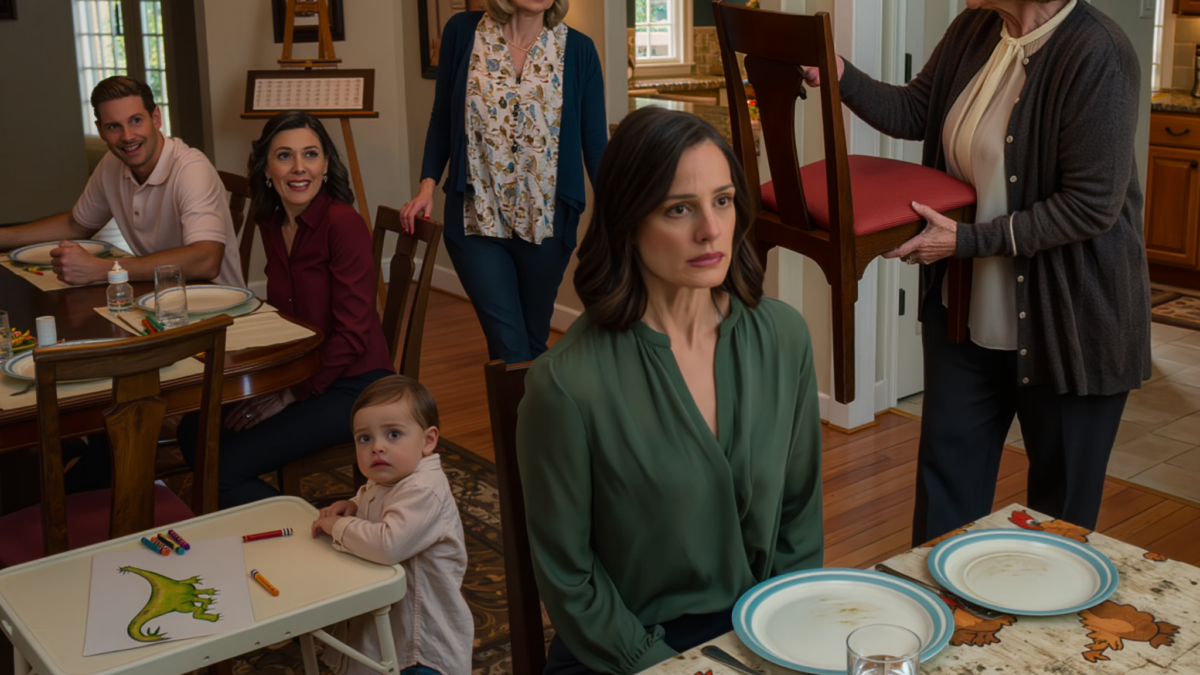
“Go sit at the kids’ table, Odette. Your sister earned the grown-up seat.”
My mother said it across a table of fourteen adults while buttering a roll.
I was thirty-eight. My sister was thirty-four.
There had been an empty chair beside my mother with my name card on it. She had already moved that card to the folding table by the kitchen, where her grandchildren were eating off paper plates.
She called it keeping the peace. According to her, my being there stirred things up.
Everyone watched. Nobody said a word.
I picked up my plate, my water glass, and my real fork. Then I carried them across the room and sat down in a chair built for a six-year-old.
I didn’t argue. I didn’t leave.
Six weeks later, my mother would be the one nobody at that table would defend. But that night, she still thought she had won.
What none of them knew was that the quietest person in that house, the woman they had talked over for nine years, had finally decided to open her mouth.
The kids’ table sounds almost harmless when you call it that.
It wasn’t.
It was a folding card table with a wobbly leg, pushed into the doorway between the dining room and kitchen so anyone carrying dishes had to step around it. The tablecloth was an old vinyl one covered with cartoon turkeys, left over from a Thanksgiving years before.
There were two booster seats, a sippy cup, and a pile of crayons.
My niece Posie was nine. My nephew Theo was six. They were lovely children, and neither of them understood why their adult aunt had suddenly been seated between them with a wine glass.
Theo looked at me.
“Are you in trouble?”
“No, sweetheart,” I said. “I’m just sitting with the cool people.”
He liked that answer.
He showed me a drawing of a dinosaur eating a smaller dinosaur. I told him it was the best dinosaur I had ever seen.
Behind me, in the warm yellow light of the adult table, my family laughed at something my sister said.
The sound went straight through the back of my chair.
My mother had been planning that dinner for two months. It was June 2026, and she had combined her seventieth birthday with her thirty-eighth wedding anniversary to my father. The party was at their house in the suburbs of Hartford.
She had hired a caterer. She had ordered a cake decorated with gold leaf. She had made a formal seating chart on heavy card stock and placed it on an easel near the front door like we were attending a wedding.
My name had been on that chart when I arrived.
Odette, seated between my mother and my aunt Margarite.
For one stupid second, I thought maybe this year would be different.
I had even driven up the night before and stayed at a hotel by the highway so I could arrive early and help set up. I had lain awake in that hotel bed at thirty-eight years old, rehearsing things I might say at dinner.
Light things. Funny things.
The kind of stories that might make my mother look at me the way she looked at Sabine.
I had one ready about a difficult client at work. I had polished it in my head until I thought it might land just right, so that for once the laughter at the table might be aimed at me because I was funny instead of because I was the joke.
I never got to tell it.
You don’t tell your client story from the kids’ table. The crayons ruin the timing.
Sabine arrived twenty minutes after I did, and my mother started moving name cards.
I want to be fair to my mother because the truth matters more than turning her into a cartoon villain.
Corali grew up with very little. She was the oldest of six children in a cold house, and she clawed her way into a life with a paid-off mortgage and matching dishes.
Somewhere along the way, she decided the family she built had to look perfect or none of it counted.
Sabine was proof that it had worked.
Sabine was the pretty daughter. She married a man with a boat. Her children wore monogrammed sweaters.
I was the proof that something had gone wrong.
Divorced at thirty-three. No children. A job my mother could never quite explain to her friends.
Whenever there was friction, I was the part she sanded down.
That may explain some of what she did.
It does not excuse it.
The name card marked “Odette” moved to the turkey table. The card marked “Sabine” moved into the warm light between my mother and Aunt Margarite.
Into the seat that had been mine.
“It’s just easier this way,” my mother said when I caught her doing it.
She didn’t lower her voice.
“You and your sister together is a lot of energy. Let’s keep tonight nice.”
“I haven’t said a single word to Sabine.”
“And let’s keep it that way.”
The way she did it mattered almost more than the fact that she did it.
I had arrived early because I always arrived early. It was a habit I had developed over years, as if getting somewhere before everyone else could prevent me from being told I was late.
I had brought flowers, peonies, her favorite, along with a card I had actually sat down and written something meaningful in.
I helped the caterers find serving spoons.
For one warm hour before the other guests arrived, I had been useful and pleasant and almost like a daughter who belonged in the house.
My mother had even kissed my cheek when I came through the door.
“You look nice, Odette.”
I held on to that sentence because she gave compliments like that maybe twice a year.
Then the doorbell rang.
Sabine arrived late, glowing, carrying a gift bag from a store my mother liked to brag about.
I watched my mother’s entire body reorient toward her like a plant turning toward a window.
Within ninety seconds, the peonies I had brought were moved to the kitchen counter to make room for Sabine’s store-bought arrangement on the dining table.
Within five minutes, my mother was standing at the easel, and I watched my name travel across the seating chart like a chess piece being taken off the board.
That is the part I need to explain.
It wasn’t rage.
It wasn’t exactly coldness either.
It was reflex.
The favored daughter walked in, and the spare was reshelved.
My mother did it as automatically as breathing, without any visible awareness that it might be cruel to do that to her thirty-eight-year-old daughter in front of fourteen adults.
So I carried my plate across the room.
Only one person at the big table followed me with her eyes the entire way.
Aunt Margarite.
She was my father’s sister, sixty-six years old and widowed. Everyone called her difficult because she did not laugh at things she did not find funny.
She had attended family dinners for nine years and said almost nothing.
I had always assumed she didn’t care.
I was about to learn how wrong I was.
The seating thing was not new.
That was the part people outside the family could never see.
To them, it would have looked like one awkward decision at one birthday dinner.
To me, it was a thirty-year pattern finally made visible.
When I was eleven, my parents took us to a steakhouse for Sabine’s first communion. There were enough seats in the good booth for everyone except me.
I ate at the bar with a babysitter we had brought along, close enough to see my family through the railing.
My mother told the waitress I preferred sitting there.
No one had asked me.
When I was nineteen, I got into a state school with a partial scholarship.
That same spring, fifteen-year-old Sabine was struggling academically. She needed a tutor, then a better tutor, then private school.
The college fund that had once had my name on the envelope quietly became the family education fund.
Most of it went to her.
I worked two jobs and graduated anyway.
At my graduation, my parents left during the lunch break because Sabine had a dance recital that afternoon.
I have a photograph of myself in my cap and gown, holding my diploma at arm’s length so I could fit both my face and the diploma into the frame.
I was alone.
For years, I had been told the same three things.
Don’t be dramatic, Odette.
Why does everything have to be about you?
Your sister needs more right now.
I heard those sentences so often that they carved a groove into me.
I learned to make myself smaller before anyone had to ask.
By thirty-eight, I could enter a room and identify my own worst seat before the host pointed to it.
And that was the wound beneath everything.
It was never really about a chair.
I had spent my entire life believing I was the family’s spare.
The person seated last.
Funded last.
Defended never.
I did not want the good seat because the chair itself mattered.
I wanted to be someone who got the good seat without having to fight for it.
I wanted to be wanted first.
By that June, I had mostly stopped believing I ever would be.
What I didn’t know was that someone else had been counting the same seats.
There had been one period when I almost escaped the pattern.
After my divorce, I moved ninety miles away to Providence and became quiet for two years.
Not dramatically.
I simply stopped driving up for every birthday and every family event. I missed two Easters. I told myself I was building a life.
I had a small apartment, a job managing accounts for a medical supply company, and a couple of real friends.
But the truth underneath all of that was simpler.
It hurt less from far away.
My mother’s version of those two years, the version she told her sisters, was that I had abandoned the family and made my divorce everyone else’s problem.
That always got to me.
I had gone quiet precisely because I did not want my problems to become everyone else’s.
But silence in my family was just another thing they could narrate however they wanted when I was not there to correct them.
The person who pulled me back into the family orbit was my father.
Not because he called me.
Because he got sick.
It was a heart problem, frightening for about a week and then managed.
I came back for him.
Once I was back in the rotation, the old gravity took hold again.
Sunday phone calls. Holiday invitations with conditions. Slow re-entry into a family that had a fixed idea of which seat belonged to me.
I told myself things would be different because I was older.
I had my own life.
I could visit on my own terms.
Then my mother put an easel in her foyer, wrote my name into the warm light of the adult table, and moved it to the turkey table in front of everyone I had spent my life trying to please.
So there I was, cutting catered chicken with a real fork on a paper plate while Theo worked on his dinosaur.
Over the next hour, the pattern that had always been invisible began becoming visible to the entire room.
I wasn’t the person making it visible.
At first, I was just sitting there trying to keep two children entertained so they would stop asking why I had been moved.
The first thing was my father’s toast.
He stood and lifted his glass to my mother.
My father was a quiet man, a man who had spent forty years choosing the path of least resistance.
In our family, that path usually ran directly through me.
“Seventy years of grace,” he said, “and thirty-eight of putting up with me.”
Everyone laughed warmly.
Then he raised his glass again.
“And to our family. All of us together.”
His arm swept around the big table.
Only the big table.
The card table in the doorway did not fall inside the gesture.
His eyes never came to me.
I lifted my glass anyway from my six-year-old-sized chair and drank to a family that had just toasted around me.
There were sixteen people in that house.
My father said “all of us,” then drew a circle with his glass that left out two people.
Me and an elderly great-aunt dozing in a corner whom everyone else seemed to have forgotten.
My father was not a cruel man.
That was what made it worse.
I genuinely believe he thought he had toasted his whole family.
The members of his family eating from paper plates in the doorway had simply become furniture to him.
You don’t toast the furniture.
You barely notice it.
Theo tugged on my sleeve.
“Why didn’t Grandpa point at us?”
I had no answer that wouldn’t make a six-year-old question the adults he loved.
So I told him Grandpa was excited.
Theo accepted that.
Children are good at accepting the explanations adults give them to preserve the people they love.
I had been doing the same thing since I was younger than Theo.
Then came Sabine.
She had had two glasses of wine, and Sabine had always been the kind of person who became generously cruel after drinking.
She could say something unforgivable in a sweet voice and call it honesty.
She turned around in my old chair and looked at me with a soft, almost pitying smile.
“You doing okay back there, Daddy?” she called.
Then she added, “You always did like sitting with the kids. You’re better with them than with grown-ups anyway.”
A couple of people chuckled.
My mother said, “Sabine,” but she was smiling when she said it.
That smile encouraged her.
“Honestly, it’s perfect,” Sabine said, lifting her glass toward me. “You never wanted kids of your own, so this way you get the experience without the commitment. A trial run.”
She laughed at herself.
Then she pushed further.
“Maybe if you’d figured out the husband thing, you’d have your own table by now.”
The husband thing.
My divorce.
Reduced to a joke across a room full of relatives at our mother’s birthday dinner.
I kept my face still.
That was the skill I had.
Keep my face still.
I cut a piece of chicken I had no intention of eating and told Theo his dinosaur drawing needed a volcano.
He immediately started drawing one.
That small task was the only thing keeping me in my chair instead of sending me to my car.
Being the designated target in a family rarely looks like one dramatic act.
It arrives in small pieces.
Each one deniable.
Each one followed by “I was only joking” or “You’re too sensitive.”
No single cut seems large enough to count.
After enough years, everyone can honestly claim nothing happened because they refuse to add the pieces together.
I had been living that way for most of my life.
I had simply become very good at not showing what it cost me.
Then Posie changed the room.
She was nine years old, with her mother’s coloring and, as it turned out, none of her mother’s instincts.
She looked at me.
Then she looked toward the adult table.
“Why isn’t Aunt Odette allowed at the real table?”
The room went quiet for half a second.
My mother laughed.
“Everyone’s at the real table, sweetheart. There’s just not enough room.”
There were two empty chairs at the big table.
Everyone could see them.
Posie certainly could.
She looked at those chairs.
Then she looked at her grandmother.
She opened her mouth as if she were about to point out the obvious.
That was when Aunt Margarite put down her napkin.
I had spent nine years believing Margarite did not like me.
Her husband, Walter, had died around the time I began attending these dinners as an adult. After his funeral, she became very quiet.
At family gatherings, she sat at the end of the table. She ate carefully. She answered direct questions with short answers.
Mostly, she watched.
My mother called her a wet blanket.
Sabine called her Scary Aunt Margie.
I had placed her in the category of relatives who did not care for me and left her alone.
That night, when she put down her napkin, she did not stand dramatically.
What she did was quieter.
And much more deliberate.
She slid her chair back from the adult table.
Then she picked it up by the backrest.
She carried it across the room.
Past my father.
Past Sabine.
Past the easel with the seating chart.
She brought the chair all the way to the card table and placed it beside mine.
Then she sat down.
A sixty-six-year-old woman, knees almost too high because the adult chair was the wrong height for that little table, seated beside cartoon turkeys and crayons.
My mother stared.
“Aunt Margie, what on earth are you doing?”
“Sitting with my niece,” Margarite said. “Pass the rolls, would you, Theo?”
Theo, delighted, passed her a roll.
She buttered it with great ceremony.
The room did not know what to do.
Fourteen adults were trying to decide whether this was a joke or a problem.
Then, in the most ordinary voice imaginable, my aunt began talking.
Not to me.
To the table.
To all of them.
“You know,” she said, “I’ve been coming to these dinners for nine years since Walter died. And I’ve never said much because Walter always told me my problem was that I said exactly what I thought and people didn’t thank me for it.”
She gave a small, dry laugh.
“But I’m seventy in two years myself, and I’ve decided I don’t have the time left to keep being polite about this.”
She took a bite of her roll.
Chewed.
Swallowed.
Everyone waited.
“I’ve been keeping a kind of list,” she said. “In my head. Of the seats.”
My mother’s smile froze.
“Margarite, this is not the—”
“Coral, you put your daughter at a children’s table on your seventieth birthday.”
Margarite never raised her voice.
That was what made everyone listen.
“In front of everyone, with her name on a card, you moved her. And I have watched you do a smaller version of that exact thing at every single gathering for nine years.”
She looked toward Posie.
“And tonight, I watched a nine-year-old child see it more clearly than fourteen adults. So I think it’s time somebody said it out loud.”
Then she turned toward me.
Her voice lowered.
“I’m sorry it took me this long.”
I sat there with my fork halfway to my mouth.
For the first time, I understood that I had never actually been alone at those tables.
There had been a witness.
I simply hadn’t known she was keeping count.
Margarite did not have legal documents or dramatic evidence.
This was not that kind of reckoning.
She had something worse for my mother.
Memory.
Specific, dated, eyewitness memory.
She laid it out one piece at a time.
“Let me tell you what I’ve watched,” she said.
She started with Easter three years earlier.
“Odette drove up from Providence with a ham she made herself. Coraly, you served Sabine’s store-bought one and put Odette’s in the garage refrigerator. When Odette asked about it, you said hers didn’t match the table.”
She looked around the room.
“I was standing right there. I helped her carry it back to her car at the end of the night, still wrapped.”
My mother tried to interrupt.
“That is not how that—”
“Christmas two years ago,” Margarite continued.
“You gave Sabine’s children college bonds in their stockings. You gave Odette a regifted candle.”
People shifted in their seats.
“I know it was regifted because it was the candle I gave you the year before. I recognized the chip on the lid.”
Sabine stopped smiling.
My father stared down at his plate.
“This past Thanksgiving,” Margarite continued, “Odette offered to host so you wouldn’t have to do everything again. You told her it wouldn’t feel like a real holiday at her apartment.”
Margarite paused.
“Her apartment. As though the woman doesn’t have a home.”
Then she moved to the family reunion at the lake.
“You assigned bedrooms. Sabine and her family got the master bedroom with the lake view. Odette got the pullout couch in the laundry room beside a water heater that turned on every twenty minutes all night.”
My father finally looked up.
“There were two empty guest rooms upstairs,” Margarite said. “I checked.”
That detail seemed to hit him harder.
“I went upstairs and opened both doors myself because I couldn’t believe it. Both rooms were empty. Fresh sheets. Made beds. Waiting for nobody.”
She turned to my mother.
“You put your daughter next to a water heater when there were two empty beds upstairs.”
Then came the photographs.
Margarite’s voice did not get louder.
It got slower.
“Coraly, you have a wall in your hallway. Sixty, maybe seventy framed pictures.”
She had counted them.
“Sabine is in fifty-one. Odette is in four.”
No one moved.
“Two of those four show her as a child in group photos where she’s half cut off at the edge. One is her wedding picture, and you can tell from the frame that it was a gift Odette gave you, not something you chose yourself.”
She paused.
“The fourth is a baby picture where, honestly, I’m not entirely sure it’s Odette and not Sabine.”
The refrigerator hummed in the kitchen.
“A stranger could walk down your hallway and not know you had a second daughter.”
Then Margarite said something I have never forgotten.
“I’m not guessing at how you feel, Coral. I’m reading the wall you built.”
Nobody answered.
Margarite reached into the pocket of her cardigan.
She pulled out a small spiral notebook.
Not dramatically.
She simply had it.
She placed it on the turkey table beside Theo’s dinosaur drawing and tapped the cover once.
“I’ve got nine years in here,” she said.
She explained that every time something happened, she wrote it down afterward so she could reassure herself that she had not imagined it.
“Turns out I was keeping it for tonight.”
The room was silent.
Even the children had stopped moving.
For thirty-eight years, I had been told that I exaggerated things.
That I imagined slights.
That I made everything about myself.
And now a quiet, careful person was sitting beside me saying, in effect: No. You saw it correctly. It happened. I wrote it down.
“Margarite,” my mother said.
Her voice cracked.
“You have no idea what it’s like to raise two daughters who are nothing alike.”
“You’re right,” Margarite said.
“I couldn’t have children, so I paid very close attention to other people’s.”
Then she looked directly at my mother.
“You didn’t raise two daughters who were nothing alike. You raised one daughter, and you kept a spare in case the first one didn’t take.”
I put down my fork.
A spare.
I had never heard another human being name the wound so accurately.
That was the moment the night began to turn.
It started with Posie.
She slid down from her booster seat, walked over to her grandmother and said, “Grandma, that’s mean. You should say sorry to Odette.”
My mother’s voice sharpened.
“Posie, go sit down.”
Then Sabine made the mistake that exposed the rule underneath everything.
She grabbed her daughter’s arm.
“Don’t take her side. We don’t take her side in this family.”
She said it loudly enough that everyone heard.
We don’t take her side in this family.
The sentence hung over the catered chicken.
It wasn’t just an insult.
It sounded like a constitution.
The unwritten rule of my childhood had accidentally been spoken aloud.
Sabine wasn’t merely defending our mother.
She was teaching the rule to her own daughter.
Posie pulled her arm free.
“Why not? She’s nice to me. You’re being mean, and Grandma’s being mean, and I don’t want to be on the mean side.”
Sabine opened her mouth.
Nothing came out.
There was no answer.
The rule only worked when no one asked why.
A nine-year-old had just asked.
Then another chair moved.
My cousin Bram pushed his chair away from the adult table.
He was about Sabine’s age, someone I had barely spoken to in years. I had always assumed he belonged firmly on the popular side of the family.
He picked up his chair and carried it across the room.
He placed it on the other side of me and sat down.
“I always wondered why you stopped coming around,” he said quietly. “Now I’m embarrassed. I had to wonder.”
Then Uncle Dell, my father’s younger brother, stood.
He didn’t move his chair.
He simply put one hand on the back of it, looked at my mother, and said, “Corally, I’ve eaten at your table a long time. I don’t think I’ve got the stomach for the way you said it.”
Then he walked across the room and stood behind me with a hand on my shoulder.
It happened one person at a time.
That mattered.
It wasn’t a mob.
Margarite had not ordered anyone to move.
She had simply said what she had seen.
One person chose.
Then another.
And each person who crossed the room made it easier for the next.
My mother watched her party rearrange itself one chair at a time.
What none of us understood yet was that she still believed she could fix it.
I need to explain Bram because moving that chair cost him something.
He was the golden grandchild on another branch of the family. His mother, my father’s middle sister, had always been the relative my mother wanted to impress.
She had the lake house. She had the approval my mother had chased for decades.
Bram was also being quietly positioned to inherit a piece of a family business in which my father had a stake.
That was not glamorous.
But in our family, those relationships were the map of power.
Who owed whom.
Whose good side you stayed on.
Whose dinner you did not walk out of.
By moving his chair, Bram had chosen the wrong side of a wall my mother had spent decades building.
She made sure he understood.
“Bram,” she said, even while the party was falling apart, “your mother is going to hear about this. You understand that? You’re embarrassing your whole family.”
Bram laughed.
Not cruelly.
It sounded relieved.
“Aunt Coraly, my whole life I’ve watched this family decide who’s in and who’s out at the dinner table. And my whole life I’ve been on the inside.”
He looked at her.
“I’ve been quiet about it because being on the inside is comfortable.”
Then he shrugged.
“You want to tell my mother I sat with Odette? Tell her. Tell her I finally figured out that the price of my good seat was somebody else’s bad one.”
He turned toward me.
“I should have figured it out years ago. I’m sorry it took your mother humiliating you in front of children for me to move my chair.”
Then he told me something I had forgotten.
When we were kids, I used to sneak him extra dessert when my mother rationed it as punishment.
“You don’t remember, do you?”
I didn’t.
“You always took the smaller piece so I could have a normal-sized one. You were maybe twelve. I think about it more than you’d believe.”
I had no memory of doing it.
I had spent so many years thinking of myself as the spare that I had never noticed I had also been the person making sure the younger children around me got fed.
Margarite had kept count of how people treated me.
Other people, it turned out, had quietly kept a different count.
The small kindnesses I had forgotten because I had been taught that nothing I did mattered.
Bram had not crossed the room only because of a folding table.
He was paying back a debt I had never known existed.
My mother watched people from the inside choose the outside.
Then she reached for the tool that had always worked best for her.
The story.
For thirty-eight years, my mother had controlled what relatives believed by controlling the version of events they heard when I wasn’t around.
Now she reached for that tool as if grabbing a railing in the dark.
“You’re all being ridiculous,” she said.
She stood and found her hostess voice again. Bright. Managing.
“This is a birthday. My birthday. And one person has somehow turned my seventieth into a courtroom.”
She did not say my name.
She gestured toward me.
“This is exactly what she does. This is exactly why you seat her at the children’s table.”
Margarite barely looked up.
“Yes, we know. Go on.”
My mother stared at her.
“Tell us the rest,” Margarite said. “Tell us how she’s dramatic. Tell us how she makes everything about herself. I’ve heard you say it forty times.”
Then she looked around the room.
“I want everyone here to hear you say it once while she’s sitting right there so they can decide for themselves whether it’s true.”
My mother opened her mouth.
I knew the speech.
She’s dramatic.
She’s difficult.
She makes everything about herself.
But before saying it, my mother did what she had always done.
She looked around for the nods.
The agreement.
The familiar faces assuring her that her version was the official one.
The nods were gone.
Margarite watched her steadily.
Bram watched her.
Uncle Dell still had a hand on my shoulder.
Posie looked at her grandmother with the disappointed expression of a child who had learned something uncomfortable about an adult she loved.
Even my father was looking at his wife differently.
Not with agreement.
Something closer to shame.
My mother had spent years building a room that agreed with her.
Now she was watching the room stop.
She changed tactics.
Her shoulders dropped.
Her eyes became wet.
Her voice trembled.
“I don’t understand what’s happening to me.”
It was a good performance.
Thirty-eight years of watching had made me something of a connoisseur.
“It’s my birthday. I’m seventy years old, and my own family is attacking me at my own party over a chair.”
She put a hand against her chest.
“Is this how you want to remember my seventieth? Is this what you’ll think about when I’m gone? You’re going to feel terrible about this. You’ll see. When I’m gone, you’ll wish—”
“Coraly.”
Margarite’s tone was almost gentle.
“We’re not attacking you. Nobody has raised a voice except you. We’re just not agreeing with you anymore.”
My mother stared.
“I know that feels the same to you,” Margarite continued. “I’ve known you sixty years. To you, the moment a room stops agreeing with you, it feels like the room is attacking you.”
She paused.
“But it isn’t.”
Then she said, “The word is consequence, Corali. It just doesn’t feel like the others did because this is the first one that ever reached you.”
My mother lowered her hand.
No one moved to comfort her.
For the first time all evening, she seemed to realize that the performance had nowhere to land.
Her face changed.
Not anger.
Not sadness.
Blankness.
The expression of someone discovering that the floor beneath her had always been held up by other people and those people had just stopped doing it.
Finally she said, “I think everyone should sit back down and we should finish dinner.”
Nobody moved back.
Half the adults were now crowded around a card table covered with cartoon turkeys.
The adult table sat under the warm dining-room lights with empty chairs around it.
I thought that was the end.
I thought my mother had run out of moves.
I was wrong.
She sat back down at her bright, mostly empty table, with Sabine still near her.
Then she looked directly at me.
Her voice went low.
“You want to do this here?”
I knew immediately that something had changed.
“Fine. Let’s do it here.”
Then she said, “Let’s tell everyone the truth about why you really left for two years, Odette.”
I felt the blood drain from my face.
“Let’s tell them about Providence.”
There was something about my divorce that I had never told the rest of the family.
Something I was ashamed of.
Something that had nothing to do with them and that I had carried privately because I never wanted it turned into family currency.
During the worst year of my marriage ending, I had fallen apart.
Quietly.
Ninety miles away.
There were months when I could not work.
I missed rent.
More than once, I called a hotline at two in the morning because I did not know what else to do.
I eventually clawed my way back without telling most people.
It was the most fragile thing I owned.
My mother knew one small piece of it.
She had called me during that period and caught me in a bad state.
And she had filed the information away.
That was what she did.
She filed things away.
“You want to talk about who’s dramatic?” she said, looking toward the relatives who had just moved their chairs.
Her confidence was returning because she could feel an opening.
“Your saintly Aunt Margie wasn’t there at two in the morning when this one was completely falling apart and calling me sobbing and couldn’t even hold down a career—”
“Don’t,” I said.
“Stop it,” Margarite snapped.
It was the first time her voice had risen all night.
But my mother’s tactic was working.
I could feel it.
The room had just condemned her for being cold toward me.
Now she was telling them that I was unstable.
Fragile.
Someone who fell apart.
For half a second, even people who had crossed the room toward me had to wonder whether maybe this explained something.
Maybe Odette really was difficult.
Maybe there was a reason people tried to manage her.
It was the oldest trick in my family.
And she had used the most private wound I had.
Thirty-eight years of training pulled at me.
Make yourself smaller.
Don’t make it worse.
She owns the story.
She always owns the story.
My mother kept going because she sensed the soft spot.
“She didn’t tell any of you about that, did she?”
She looked around.
“Of course she didn’t. She comes up here twice a year and plays the wounded saint and never once mentions there was a year she couldn’t get out of bed, couldn’t pay her rent, couldn’t function.”
Her voice grew stronger.
“You think I’m the unstable one in this family? I held this family together. I made the hard calls.”
Then she said, “You don’t seat someone like that in the middle of a celebration. You protect her. You protect everyone from—”
“Stop.”
My voice sounded small.
I hated that.
“Please, Mom. Not in front of the kids.”
The moment I said please, I knew I had given her what she wanted.
A flinch.
Her eyes changed.
“See?” she said softly.
She looked around the table.
“Look at her. Look how fast she falls apart. This is what I’ve been managing for thirty-eight years.”
The card table went silent.
Bram looked at me with concern.
And beneath the concern, I saw the beginning of doubt.
In three sentences, my mother had taken the room back using something true.
That was what made it so effective.
I really had fallen apart.
I really had called her.
She had taken a true and painful fact about me and turned it into evidence for everything she had ever said.
For one sick moment, I believed she had done it again.
Then she pressed harder.
“You all want to make me the villain. You don’t know what it’s been like. You don’t know the calls, the drama, the middle-of-the-night collapses.”
She looked almost relieved now.
“I have protected this family from how bad she gets. Seating her apart isn’t cruelty. It’s caution. You don’t put the fragile one in the middle of everything.”
I watched the certainty around the little table begin to wobble.
No one stood up and moved back.
But Bram looked away.
A flicker of reconsideration passed through the group.
For most of my life, that would have been enough.
I would have shrunk.
Apologized.
Gone quiet.
Confirmed my mother’s story simply by behaving the way she had trained me to behave.
But Margarite moved first.
She did not defend me.
That surprised me.
Instead, she looked at my mother and asked one question.
“Cory, when Odette was at her lowest, two in the morning, sobbing on the phone, falling apart like you said…”
She paused.
“What did you do?”
My mother blinked.
“I was there for her. I—”
“No,” Margarite said.
“I was there.”
Then she explained.
Not at two in the morning. She had not known about the hotline calls because I had been too proud to tell her.
But Walter had recently died, and Margarite had been struggling to sleep herself.
One night, Bram’s mother mentioned that I had sounded strange in a voicemail.
So Margarite got in her car.
“I drove the ninety miles to Providence at three in the morning.”
I stared at her.
“I sat in that woman’s apartment for four days. I made her eat. I called her work and told them she had pneumonia so she wouldn’t lose the job.”
Then Margarite looked at my mother.
“I was there, Cory.”
She turned toward everyone else.
“Ask me how many times her mother visited during those two years.”
Nobody spoke.
“Go on. Ask me.”
The room was completely still.
“None,” Margarite said.
“Not once.”
My mother knew I was in trouble.
She had just admitted it.
And yet she had never driven to Providence.
Margarite had.
“So when she stands here and tells you she’s been protecting this family from how bad Odette gets,” Margarite said, “what she means is she’s been collecting how bad Odette gets like coupons to spend on a night exactly like this one.”
The doubt around the table disappeared.
Margarite had not argued that I was strong.
She had not denied that I had broken down.
She simply asked who had shown up.
There was no version of “I knew my daughter was falling apart and never visited her” that allowed my mother to remain the hero.
For the first time in my life, I watched her reach for the story that had always saved her and find nothing there.
The kitchen had gone silent.
Even the caterers had stopped moving.
Theo climbed onto my lap and put his thumb in his mouth.
I found myself holding him without remembering when I had picked him up.
Then I did something I had never done in thirty-eight years.
I spoke.
Not loudly.
Margarite had taught me something during those twenty minutes.
You did not have to shout.
You only had to stay.
“I want to say something,” I said.
Everyone turned toward me.
“And then I’m going to go because it’s late and the kids are tired.”
I looked at my mother.
“You didn’t make me sit at the kids’ table because I’m dramatic.”
She started to answer.
I kept going.
“You did it because I’m easy. Because for my whole life, I’ve been the one who carries her own plate across the room without a word.”
My voice was shaking, but I let it shake.
“And you knew I’d do it again. You picked me to humiliate tonight because you were sure I’d let you.”
She stared at me.
“That’s not caution, Mom. That’s just knowing which kid won’t fight back.”
She tried to interrupt again.
I didn’t let her.
“And the thing about Providence…”
My voice cracked.
This time, I did not hide it.
“You’re right. I fell apart. I fell apart so badly I called a hotline at two in the morning more than once.”
The room stayed quiet.
“It’s the most private, shameful thing I own.”
I looked directly at her.
“And you just spent it in front of my niece to win a seating argument.”
I had to stop and breathe.
“You took the worst night of my life and used it as a centerpiece.”
Then I finally said what had always been underneath the chair, the college money, the photographs, all of it.
“I never wanted the good seat.”
My mother’s face changed slightly.
“I never cared about the chair. I just wanted one time, just once, to be the daughter you reached for first.”
I swallowed.
“Not the spare. The one you’d drive ninety miles for.”
She said nothing.
“And you never did.”
I looked at Margarite.
“Aunt Margarite did. A woman I thought hated me drove through the night for me.”
Then I looked back at my mother.
“And my own mother held my worst moment in her pocket like change.”
Theo’s small hand rested against my collarbone.
Posie had moved close enough to press herself against my side.
“So I’m not going to argue about the table anymore,” I said.
“I’m just done sitting at it.”
My mother did not go quietly.
People with mothers like mine know they rarely do.
She stood and pointed at me across what remained of her birthday party.
“I gave you everything. Food. Clothes. A roof. College.”
“You gave Sabine my college,” I said.
“A roof over your head for eighteen years, and this is the thanks? You ungrateful. Cold.”
“Cold?”
Something in me finally broke loose.
“You want to know where I learned cold, Mom?”
My voice was louder now.
“I learned it in a steakhouse when I was eleven, eating at the bar while all of you sat in the booth.”
No one moved.
“I learned it at my college graduation, looking at two empty chairs.”
I thought about the candle.
“I learned it from the regifted candle. Do you know what it does to a person to open a Christmas present and realize it’s the same thing she watched you receive the year before?”
My mother looked away.
“You taught me cold.”
Then I remembered Bram’s story.
“I was a warm kid. I gave Bram my dessert. I made you a ham. I drove ninety miles with peonies.”
I shook my head.
“You taught me one moved chair at a time that being warm in this family was a way to get hurt.”
The room had gone completely still.
“So if I’m cold now, Mom, I’m cold the way a house is cold when someone stops paying for the heat.”
I looked at her.
“You stopped paying a long time ago.”
Posie had begun crying quietly.
Bram pulled her onto his lap.
“That’s not fair,” my mother whispered.
Of all the things she could have said, she chose the phrase she had used against me my entire life.
That’s not fair.
“No,” I said.
“It’s not.”
I looked around the room.
“None of it ever was.”
Then I looked back at her.
“You finally found the right word.”
My father stood.
The man who had toasted around me an hour earlier walked slowly around the adult table.
His eyes were wet.
“I should have set a different table,” he said.
He looked older than he had at the beginning of dinner.
“Forty years. I let her seat you wherever was easiest because it was easier for me, too.”
He swallowed.
“I’m your father. I’m sorry.”
Then he shook his head.
“That’s not enough. I know that’s not enough.”
“It’s not,” I said gently.
“But it’s the first true thing you’ve said to me in years, so I’ll take it.”
His chin trembled.
Then he told me something that hurt more than I expected.
“At your graduation, I wanted to stay.”
I stared at him.
“I want you to know I wanted to stay.”
His eyes dropped.
“And I left anyway because staying meant a fight in the car with your mother all the way home. I was a coward who would rather hurt the daughter who wouldn’t fight back than the wife who would.”
He wiped his face with the back of his hand.
“I picked the fight I wouldn’t have over the daughter I’d lose. Every single time.”
He looked at me.
“I’m just now old enough to be ashamed of it instead of comfortable with it.”
I reached out and took my father’s hand.
It was the first time I had touched him on purpose in years.
“Okay, Dad.”
That was all.
Some things do not get repaired at a dinner table.
Sometimes they simply get named truthfully for the first time.
There were no folders of documents.
No dramatic legal evidence.
There was only a room slowly turning, one person at a time.
That turned out to be enough.
Uncle Dell went first.
“I want it on the record, for whatever a family record is worth, that I’m ashamed I’ve been quiet about this for years.”
He looked at me.
“Odette, you always had a seat with me. I just never said so.”
He shook his head.
“And saying nothing is the same as taking the other side. I’m sorry.”
Then Bram spoke.
“I came over here twenty minutes ago because of a chair. I’m staying because of everything I just heard.”
He looked toward me.
“I’m in, cousin. Whatever this is now, I’m on this side of the room.”
Then my great-aunt Vivienne, eighty years old, who had been so quiet in the corner that everyone assumed she had fallen asleep, lifted her cane.
She struck the floor once.
“I changed Coral’s diapers, and I’ll tell you what I’ve thought for thirty years.”
Her voice sounded like gravel.
“She has always loved the easy child and starved the loyal one.”
She struck the floor again.
“I’m glad I lived long enough to hear somebody say it.”
Then someone outside the family stepped forward.
Francis, the lead caterer, had been quietly working in the kitchen all evening.
She had no emotional stake in any of us.
She stood partly in the doorway with a dish towel in her hands.
“I don’t mean to speak out of turn.”
Everyone looked at her.
“But when I was hired, I was told there would be a separate setup for the children.”
She looked toward the little table.
“I set out the paper plates by the doorway because the lady of the house instructed me to this afternoon, before any of you arrived.”
Then she looked directly at my mother.
“You told me there would be one adult at the children’s table who wouldn’t mind.”
No one breathed.
“You planned it this afternoon, ma’am.”
My mother’s face changed.
“It wasn’t a last-minute thing about energy.”
Francis continued before anyone could interrupt.
“You decided where she’d sit before she walked in.”
That was the lie cracking.
My mother had said moving me was a spontaneous solution to tension between Sabine and me.
There had been no tension yet.
According to Francis, the children’s table had been prepared for one adult before I ever arrived.
My mother had decided in advance that her thirty-eight-year-old daughter would eat from a paper plate at her seventieth birthday.
“That’s not—she’s misunderstanding,” my mother said.
But there was no strength under the words.
“I wrote it on the seating instructions,” Francis said simply.
Then she returned to the kitchen.
She had cake to plate.
The rest of it was not her family.
One person after another added a memory.
A fact.
A small confession of having stayed silent.
My mother remained at the adult table under the warm birthday lights while almost everyone else had reorganized themselves around a card table with cartoon turkeys.
There was no audience left for her version.
Then the person I least expected to speak stood at the far end of the dining room.
My mother’s own sister, Aunt Ranata.
She was the youngest of the six children my mother had grown up with.
I had always believed she worshiped her older sister.
If anyone was going to defend my mother until the end, I thought it would be Ranata.
Instead, she stood slowly.
She had tears on her face, but her voice was steady.
“Coraly, I have to say something, and then I have to go because I can’t sit at this table either.”
My mother looked at her.
“You did to Odette exactly what Mama did to me.”
The room seemed to become even quieter.
“Do you remember?”
Ranata looked at her older sister.
“You were the oldest. You were the one Mama loved.”
She took a breath.
“And I was the one who ate in the kitchen.”
My mother stared at her.
“You watched it happen for eighteen years. You never once moved your chair for me.”
Ranata wiped her cheek.
“I forgave you for that because you were a child too.”
Then her expression hardened.
“But you grew up, and you built the same house.”
My mother looked as if she had been struck.
“You took the thing that was done to you, and instead of breaking the chain, you became the next link.”
Ranata picked up her purse.
“You’re not even original in your cruelty, Cory.”
She looked around at the matching dishes, the elaborate party, the carefully arranged table.
“You’re just Mama with better dishes.”
Then she walked out the front door.
That was what finally broke something in my mother.
Not Posie.
Not Bram.
Not Margarite’s notebook.
Her own younger sister telling her that she had become the very thing that had hurt both of them.
The silence afterward lasted longer than any other silence that night.
My mother looked at the empty chairs around her.
Sabine had slipped outside to the porch at some point, unable to watch the rest.
Then my mother looked toward the crowded card table by the kitchen.
For one moment, I think she understood exactly what she had built.
And what it had cost.
Not a daughter.
In some ways, she had lost that years ago without noticing.
What she lost that night was the room.
The audience.
The thing she had spent seventy years arranging so that it would always face her.
“I think I’d like everyone to go home now,” she said quietly.
So we did.
Before leaving, Margarite picked up her small spiral notebook from beside the cartoon turkeys.
She walked it over to my mother.
Then she placed it gently in front of her.
“You can have it.”
My mother looked down at the notebook.
“I don’t need it anymore.”
Margarite glanced toward me.
“She knows we saw it now.”
Then she added, “That’s all it was ever for.”
The dinner did not lead to a perfect reconciliation.
My mother never apologized.
Weeks later, she sent me one text.
I can’t give a more exact timeline because I’m telling this not long after it happened.
Her message said, “I hope you’re happy. You ruined my birthday.”
That was all.
No acknowledgment of the table.
No acknowledgment of Providence.
No mention of the years in Margarite’s notebook.
I read the message twice.
Then I did not answer.
For once, not responding did not feel like revenge.
It felt like putting down something heavy I had been carrying uphill my entire life.
Sabine called once.
She sounded different.
Sober.
Smaller.
She did not exactly apologize either.
But she said, “I didn’t know about Providence. I didn’t know she never went.”
Then her voice softened.
“Posie won’t stop asking about you.”
I told her Posie could call me anytime.
I meant it.
The children had not built this family system.
I was not going to make them pay for it.
Sabine and I talked longer than we had talked in a decade.
Near the end, she said something I still think about.
“You think I had it easy?”
I didn’t answer.
“The favorite.”
Her voice sounded tired.
“Do you know what it’s like to be loved for being a thing instead of a person?”
She continued before I could respond.
“She loved me for being shiny.”
Then she said, “The day I stop being shiny, I’m going to find out I had a card table too.”
I still do not know whether that was an apology, a warning, or simply the first honest thing she had said to me as an adult.
Maybe it was all three.
I told her I hoped she never had to find out.
I half meant it.
That was as generous as I could be.
I am not going to pretend otherwise.
Sabine and I are not close.
I do not know whether we ever will be.
But for the first time, we spoke as two people who had survived the same house instead of as the winner and the spare.
That was not reconciliation.
It was simply the truth, finally shared.
Sometimes that is all a family can offer.
Two weeks later, Bram texted me a photograph.
His mother had heard about the dinner.
Predictably, she was furious.
Predictably, that anger faded as soon as she understood that the rest of the family had turned too.
The photograph showed an empty chair at Bram’s kitchen table.
A sticky note was attached to it.
“Od.”
Under the picture, he had written:
Standing invitation. No card table ever.
I have not cried over many text messages.
I cried over that one.
Great-Aunt Vivien sent me a handwritten card.
Her handwriting was shaky at eighty.
It said:
“Came over to your side of the room about forty years too late. Glad I made it before I’m gone. Bang the cane sometimes, girl. It’s the only thing they hear.”
I keep it on my refrigerator.
I read it on bad days.
My father and I talk now.
Sunday phone calls.
Short ones.
Careful ones.
He is a man learning very late how to be a father to the daughter he always seated last.
It is not much.
But it is real.
I will take real.
On our third call, he asked whether he could send me something.
A week later, a package arrived.
Inside was a framed photograph.
My college graduation picture.
The one of me in my cap and gown, holding my diploma at arm’s length.
Alone.
I had hated that photograph for years because to me it was the picture of nobody coming.
But this copy was cropped differently.
Somewhere in his house, my father had found the original.
At the far edge of the frame, slightly blurred, was a man’s hand reaching toward the camera.
His hand.
My father had been there.
For a moment.
At the very end.
After leaving during the lunch break, he had circled back alone, taken one photograph, and left again before my mother noticed.
Then they drove home.
On the back of the frame, he had written:
“I came back. I should have stayed. But I want you to know I came back even if you never saw me.”
I still do not know exactly what to do with that.
It does not repair the graduation.
It does not erase the empty chairs.
But I have stopped hating the photograph.
I never expected a photograph to be able to give me that.
Three weeks after the dinner, Aunt Margarite invited me to her house.
It was a small place with too many books.
There was a chair near a window that had belonged to Walter.
She made tea.
Then she pulled out another chair at her kitchen table.
The good chair.
The one near the window where the light came in.
“This one’s yours,” she said.
I looked at her.
“It’s yours every time.”
Then she added, “You don’t have to earn it, and I won’t move it.”
I sat down.
And I cried.
Not politely.
Not privately.
I cried in front of another person in a way I had not allowed myself to do in twenty years.
Margarite let me.
She did not tell me I was dramatic.
Eventually, I asked the question I had been carrying since the birthday dinner.
“Why did you wait nine years?”
She looked down at her tea.
“If you saw all of it,” I said, “if you wrote it down, why did you let me sit at the bad end of the table for almost a decade before saying anything?”
Margarite stayed quiet for a long time.
Then she answered.
“Because for nine years, I told myself it wasn’t my place.”
She turned her teacup slowly between her hands.
“I told myself you were a grown woman. That it was your family. That you’d speak up if you wanted it to stop.”
She looked toward the window.
“I told myself my silence was respect.”
Then she shook her head.
“But that’s a lie people like me tell.”
She looked back at me.
“The truth is, I was a coward in a quieter key than your father.”
My chest tightened.
“He stayed silent because it kept his marriage easy.”
Her fingers tightened around the cup.
“I stayed silent because I’d lost Walter, and I didn’t have it in me to start a war.”
Then she glanced toward where her notebook might once have been.
“So I kept a notebook instead of opening my mouth. I called it bearing witness.”
She gave a tired little smile.
“When really it was just bookkeeping for a debt I was too tired to collect.”
I asked her what changed.
She answered immediately.
“Your niece.”
Posie.
“When that child asked why you weren’t allowed at the real table, I understood that my silence wasn’t protecting anybody.”
Her voice remained calm.
“It was teaching the next one.”
I said nothing.
“It was making me part of the thing.”
She took a breath.
“And I decided I’d rather make a scene at seventy than die having taught a nine-year-old that this is what family looks like.”
I told her she did not owe me an apology.
She looked at me.
“I know I don’t.”
Then she said, “That’s exactly why I’m giving you one.”
I frowned.
“The people who owe you never will,” she said.
“So somebody who doesn’t owe you has to, or you’ll go your whole life thinking apologies only come with a bill attached.”
Then she refilled my tea.
After that, we talked about her tomato plants.
It was the most ordinary afternoon.
And one of the most extraordinary of my adult life.
For thirty-eight years, I thought I wanted the good seat.
I didn’t.
I wanted to be someone whose seat nobody would move.
That was never something my mother could give me.
It came instead from a woman I had misread for nine years, a woman who had been quietly keeping count in a spiral notebook until the night she finally decided to move her chair.
Or, more accurately, to sit down beside me and say:
I saw it.
You were never the spare.
Come sit by me.
I’m not the spare.
I never was.
I was simply sitting at the wrong table, surrounded by people who had taught me to call it mine.
I have a seat now by the window, in the light.
And nobody is ever going to move it.








