At 17, my adopted sister accused me of getting her pregnant. My family disowned me, my girlfriend left, and I vanished. 10 years later, the truth came out, and they showed up crying at my door. I didn’t answer.
I am Zachary, twenty-seven years old, and ten years ago, my life ended without me actually dying. To understand why I eventually refused to open the door when my parents came crying, you have to understand the night they threw me out. Văn bản đã dán (1)
I was seventeen. It was a Saturday, and in the Miller household, Saturdays were practically a religion.
My parents, Robert and Linda, were obsessed with appearances. We were not simply a family. We were a carefully staged performance for the neighborhood.
Dad was the provider, the stoic pillar of the community who loved talking about his salary and investments. Mom was the glue, the perfect hostess who could bake a pie and gossip about the neighbors in the same breath.
Then there was Jake, my older brother, who was essentially a younger version of my father without the spine.
Finally, there was Anne, my adopted sister. My parents had brought her home when she was eight because their perfect family portrait needed a daughter to complete it. She was sixteen that night.
For years, I had been the one who helped Anne with her math homework. I was the one who scared away the kids who bullied her for being adopted.
I was the good one.
I was the safe one.
Or so I thought.
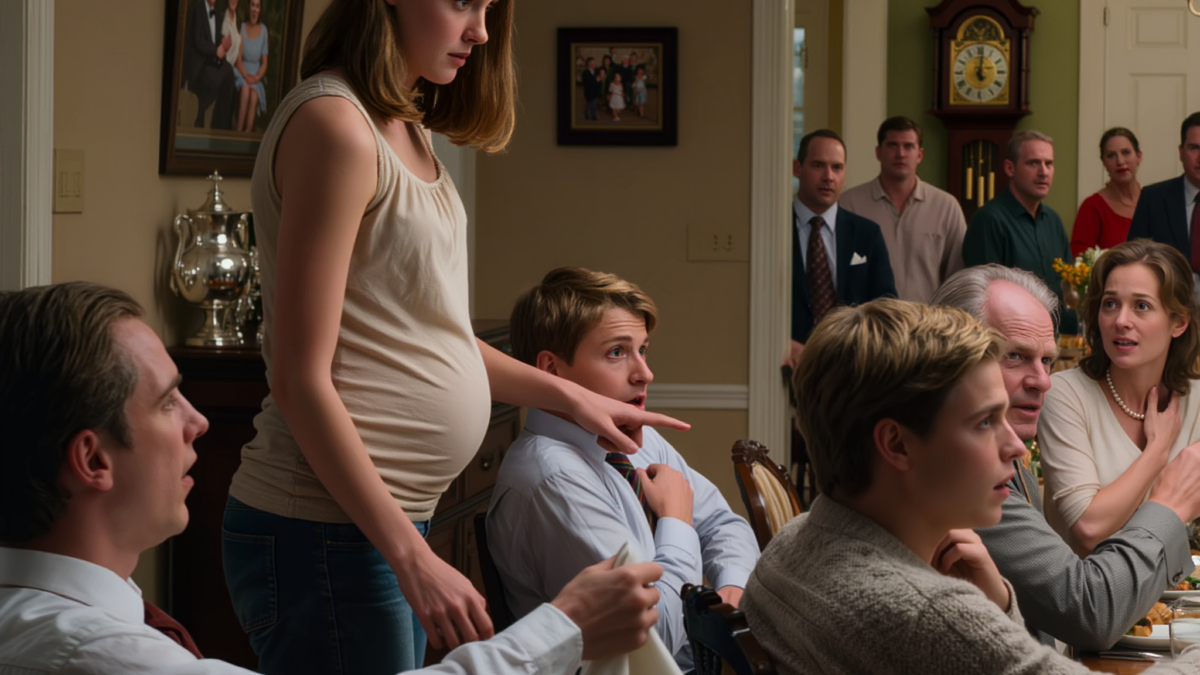
That Saturday was supposed to be a celebration of my parents’ wedding anniversary. The house was packed with aunts, uncles, grandparents, church friends, and the local pastor. Everyone who mattered in our small, suffocating town seemed to be there.
The air smelled of expensive roast beef and my mother’s overpowering perfume. I was in the kitchen refilling the ice bucket, feeling more hopeful about my future than I had in a long time.
I had decent grades, a girlfriend named Emma whom I believed was the love of my life, and a college fund that was finally large enough to get me out of town.
When I returned to the dining room and placed the ice bucket on the sideboard, I noticed Anne sitting at the children’s end of the massive table.
She was not eating.
She was vibrating. That was the only way I could describe it.
Her hands gripped the tablecloth so tightly that her knuckles had turned white. Her face looked pale and clammy.
“Anne,” I whispered, leaning toward her. “Are you okay?”
She flinched as though I had burned her.
Her eyes lifted to mine. They were wide and filled with a kind of terror I did not understand.
“I have to,” she stammered.
Her voice carried through a sudden lull in the conversation.
My father stood at the head of the table holding a glass of wine.
“Anne, sweetheart, what is it?” he asked. “Do you want to make a toast?”
The room went silent. Nearly thirty pairs of eyes turned toward the sixteen-year-old girl trembling in her chair.
Anne stood.
She looked at Mom. She looked at Dad.
Then she looked at me.
In that split second, I saw something change in her face. It was no longer simple fear.
It was calculation.
It was survival.
“I need to tell you all something,” she said, her voice cracking perfectly.
“Go ahead, honey,” Mom cooed. “We’re all family here.”
“I’m pregnant,” Anne whispered.
The silence that followed was instantaneous and suffocating. The grandfather clock ticked in the hallway. My father’s smile froze, and my mother’s hand rose to the pearls around her neck.
“Pregnant?” Dad repeated, his voice dropping. “Who did this?”
Anne began to cry.
Not ordinary tears. She sobbed violently, her shoulders heaving as she buried her face in her hands.
“He forced me,” she wailed. “I told him no. I said we shouldn’t, but he forced me.”
The room erupted in gasps. One of my uncles pushed back his chair.
“Who, Anne?” he demanded. “Give us a name.”
She raised one shaking hand.
She did not point toward the door or name a mysterious boyfriend no one had met.
She pointed directly at me.
“Zachary,” she choked out. “It was Zachary.”
I stood beside the sideboard holding a white dinner napkin. My mind seemed to short-circuit. It was as if Anne had spoken in a language I did not understand.
“What?” I said. “What are you talking about? That’s sick.”
I looked at Dad, expecting him to laugh at the absurdity of it. I expected him to tell her not to be ridiculous because I was her brother.
He did not laugh.
His face turned a shade of purple I had never seen before. The veins in his neck swelled as he stared at me.
There was no recognition in his expression.
Only hatred.
“Dad, she’s lying,” I said. “I never touched her. I swear to God, I never—”
I did not finish the sentence.
My father crossed the room in two strides and swung his fist. It connected with my jaw with a sickening impact.
White light flashed across my vision as my head snapped back. I crashed into the sideboard, knocking the ice bucket and several crystal glasses onto the hardwood floor.
Glass shattered around me. I tasted blood, hot and metallic, flooding my mouth.
“You animal!” Dad roared, standing over me. “You sick, twisted animal!”
“Robert, stop!” my aunt screamed.
She did not rush to help me. She hurried to cover Anne’s eyes.
I scrambled backward across the floor, spitting blood.
“Dad, stop. I didn’t do it. Listen to me.”
“Don’t call me that,” he spat. “You don’t have a father. Not anymore.”
I turned toward my mother.
She had Anne pressed against her chest and was rocking her back and forth while Anne wailed.
“Mom, please,” I begged. “You know me. You know I wouldn’t do this.”
Mom looked at me.
Her eyes were cold and lifeless.
“Get him out of my sight,” she hissed. “Call the police. Get that monster out of my house.”
Jake stepped forward.
He looked down at me, bleeding on the floor amid the broken glass. He did not offer his hand.
Instead, he spat on my shoe.
“You don’t deserve to breathe the same air as us,” he said.
Minutes later, police officers arrived. They dragged me out of the house in handcuffs while neighbors gathered on their lawns to watch.
I saw the judgment on every face.
In less than ten minutes, I had gone from the boy with decent grades, a college fund, and a promising future to the town’s newest monster.
They took me to the station and put me in a cold interrogation room with a mirror I knew was two-way. I sat there for hours with my jaw throbbing and my shirt stained with dried blood.
The detective who entered did not look aggressive. He looked exhausted.
He sat across from me and studied my face with a mixture of pity and disgust.
“She’s sixteen,” he said. “Do you understand how much prison time you could be facing?”
“I didn’t do it.”
By then, I was crying. The shock had begun to wear off, replaced by a terrifying understanding of what Anne’s accusation could do to the rest of my life.
“Test the baby,” I pleaded. “Do a DNA test. Check the dates. I was at soccer camp three months ago. Just investigate.”
“She gave a detailed statement,” the detective said.
“She’s lying. She’s afraid of someone else, and she’s using me.”
They kept me overnight.
But accusations without physical evidence were not enough to hold me forever. Anne’s timeline was shaky, and the forensic examination found no evidence supporting her claim of a recent assault.
By morning, the police released me pending further investigation.
I walked out of the station into the blinding morning sun. My lip was swollen, and my shirt was stiff with dried blood.
The police had kept my phone as evidence. I had no cash in my pockets.
Somehow, I still believed the worst was over.
I thought everyone only needed time to calm down. I believed that once I returned home and explained myself, my parents would listen.
I was a naïve child who had no idea that my life as Zachary Miller was already over.
I walked five miles back to the house. Every passing car felt like another accusation, so I kept my head lowered and prayed no one would recognize me.
When I finally turned onto my street, I stopped.
Everything I owned was lying on the front lawn.
Nothing had been packed carefully into boxes. My belongings had been thrown across the wet grass like garbage—clothes, textbooks, trophies, blankets, and childhood photographs.
My laptop was smashed beside a sprinkler head, its screen shattered.
The front door opened.
My father stepped onto the porch wearing jeans and a flannel shirt. He held a baseball bat in one hand and looked at me as though I were a stray animal trespassing on his property.
“I told you that you aren’t welcome here,” he said.
His voice was no longer loud.
That made it worse.
“Dad, I just want my keys and my wallet.”
“You don’t have keys anymore.”
“Please. Where am I supposed to go?”
“Hell, for all I care.”
I stared at him.
He rested the bat against his shoulder.
“I spoke to the lawyer this morning,” he continued. “You are out of the will. Your inheritance is gone, and the college fund has been frozen. You are not a Miller. I am going to erase you from every document that connects you to this family.”
“Mom!” I shouted past him. “Mom, please!”
The curtain in the living room moved.
For one second, I saw my mother’s pale, tear-streaked face through the window.
Our eyes met.
Then she let the curtain fall and turned away.
She chose Anne’s lie over her son.
“Get your trash and get off my property,” Dad said, tightening his grip on the bat. “If you are not gone in five minutes, I’ll call the police and tell them you’re trespassing and threatening us.”
I gathered whatever I could carry. I found my backpack and shoved clothes into it. My wallet was lying in the mud.
There were two hundred dollars inside.
That was my entire net worth.
I ran to my old Honda Civic, a car I had purchased with money from summer jobs. The keys had been left in the ignition.
I started the engine and backed out of the driveway.
My father watched from the porch like a guard protecting a castle from a disease.
I kept driving until the house disappeared from the rearview mirror. Then the neighborhood vanished, followed by the town itself.
Two towns away, I pulled into a gas-station parking lot. My hands shook so badly that I could barely hold the steering wheel.
I needed one friendly voice.
I needed Emma.
Because the police still had my phone, I used the pay phone outside the gas station. I knew Emma’s number by heart.
It rang twice.
“Hello?”
Her voice sounded thick, as if she had been crying.
“Emma,” I breathed. “It’s me. It’s Zach.”
“Oh my God. Where are you?”
“I don’t know. I’m at a gas station. Emma, you have to believe me. Anne is lying. I never touched her.”
“I know,” she whispered.
My heart stopped.
“You know?”
“I know you, Zach,” she said, sobbing now. “You’re the guy who cries during movies. You’re the guy who carries spiders outside instead of killing them. I know you didn’t do it.”
“Thank God.”
I pressed my forehead against the cold metal surrounding the pay phone.
“Okay, listen. I need help. Can I come to your house for one night?”
Silence.
“Emma?”
“My parents know about the arrest,” she said. “The whole town knows. It’s all over Facebook. People are calling you a predator.”
“But you know I’m not.”
“My dad said that if I speak to you again, he’ll cut me off. He’ll stop paying my tuition. He said he’ll call the police if you come near our house.”
A cold emptiness opened inside my stomach.
“What are you saying?”
“I can’t lose my family, Zach.”
She was crying hard now.
“I can’t. I’m sorry. Please don’t call again.”
The line went dead.
I listened to the dial tone humming in my ear.
My family had disowned me. My girlfriend had abandoned me. My name had become something people whispered with disgust.
I climbed back into the car and screamed until my throat burned. I pounded the steering wheel until my knuckles bruised.
Then I cried for the boy who had awakened that morning thinking about college applications.
That boy was gone.
I started driving west.
I had no map and no destination. I drove until the sun disappeared and the fuel light began blinking red.
For the next week, I lived in that car.
I parked in Walmart lots and slept with one eye open, terrified that a flashlight would strike the window. I washed my face in gas-station bathrooms using harsh brown paper towels.
A loaf of bread and a jar of peanut butter lasted three days, but the two hundred dollars disappeared quickly. Gas was expensive, even when food was not an option.
On the seventh day, I reached a town called Maplewood, three states from home.
I was starving—not the ordinary hunger that comes from missing lunch, but a deep, cramping pain that made my head feel light.
My clothes smelled of sweat and old upholstery.
The Honda sputtered and died as I rolled into the parking lot of a rundown diner called Andy’s Grill.
I sat in the car for almost an hour watching customers enter and leave. Through the window, I saw people eating hamburgers and fries. I could practically taste the grease.
When I looked in the rearview mirror, I barely recognized myself. My hair was matted, patchy stubble covered my jaw, and my eyes had sunk into my face.
“You have to do something,” I whispered to my reflection. “Or you’re going to die in this car.”
I climbed out and walked toward the diner on trembling legs.
A handwritten sign was taped to the glass door.
HELP WANTED. DISHWASHER. CASH PAY.
I pushed the door open. A bell jingled overhead, and the smell of bacon struck me with almost physical force.
A large bald man stood behind the counter. He had a gray beard and forearms that looked as thick as fence posts.
He examined my filthy clothes, shaking hands, and bruised jaw.
“We ain’t a shelter, kid,” he said. “Buy something or get out.”
“I saw the sign,” I rasped. After days of speaking to no one, my voice sounded broken. “The dishwasher job.”
He stopped wiping the counter.
“You ever washed a dish in your life?”
“Yes, sir,” I lied. “I work hard. I just need a job.”
His eyes dropped to the expensive sneakers that were now caked with mud.
“Run away?”
It did not sound like an accusation. It sounded like an observation.
“I need a job,” I repeated. “Please.”
He stared at me for a long, uncomfortable moment. Then he reached beneath the counter and pulled out a hamburger and basket of fries, probably an order someone had sent back.
He slid them toward me.
“Eat,” he said. “Then you wash. If you break anything, I break you.”
I did not wait for a fork. I ate with my hands, shoving food into my mouth while grease ran down my chin.
It was the best meal of my life.
That was how I met Andy.
It was also the day Zachary Miller truly disappeared.
The kitchen at Andy’s Grill was hot, wet, deafening, and almost unbearably cramped.
I loved it.
For twelve hours a day, my hands stayed submerged in scalding water as I scrubbed grease from plates that looked as though they had been dirty since the 1980s.
My back ached. My fingers cracked and bled.
But for those twelve hours, I did not have to think about Anne’s accusation or my father’s fist.
At the end of my first shift, Andy tossed me a set of keys and pointed toward a narrow staircase behind the pantry.
“Attic,” he grunted. “There’s a cot. Don’t smoke, don’t bring girls up there, and don’t steal.”
The attic was barely more than a storage room. It had a small window, a thin mattress on the floor, and a stack of old tires in the corner.
To me, it looked like a luxury hotel.
I locked the door, curled up on the mattress, and slept for fourteen straight hours.
For the next two weeks, my life followed the same pattern: wake up, wash dishes, eat leftovers, sleep.
Andy did not ask many questions. He paid me cash at the end of each week. The wages were small, but they were enough for soap, toothpaste, and clean clothes.
For the first time since leaving home, I began to feel almost safe.
Then the bubble burst.
It happened during a Tuesday lunch rush. The dining room was crowded, and I was carrying a bus tub of dirty dishes toward the kitchen when I saw a truck driver sitting at the counter with a newspaper.
A grainy high-school yearbook photograph appeared on the back page facing me.
My photograph.
The headline said that a teenager was wanted for questioning in connection with a family assault.
My blood turned to ice.
My hands shook so violently that the silverware rattled inside the tub. The truck driver looked up at the sound.
His eyes moved from me to the newspaper, then back to me.
They widened.
“Hey,” he said, pointing a french fry in my direction. “You look like—”
I dropped the tub.
Plates shattered across the floor as I turned and ran for the back door.
“Hey, kid!” Andy’s voice boomed over the noise.
I fumbled with the latch, blinded by panic.
They had found me. I was going to be dragged back and sent to prison.
A massive hand caught the back of my shirt and slammed me against the wall.
Andy stared into my face.
“Where’s the fire, boy?”
“Let me go!” I screamed, fighting his grip. “I didn’t do it. I swear!”
The truck driver appeared in the kitchen doorway holding the newspaper.
“That’s him, Andy. That’s the kid in the paper. It says he attacked his sister.”
Andy took the newspaper.
He looked at the headline, the photograph, and then at me. I was trembling against the wall with tears streaming down my face.
“I didn’t touch her,” I sobbed. “She lied. Please don’t call them.”
The kitchen became silent. Even the cook stopped moving.
Andy studied the paper for another second.
Then he crushed it into a ball and threw it into the trash.
“Don’t look like him to me,” he said.
The truck driver blinked.
“What? Andy, that’s clearly—”
Andy stepped toward him and crossed his arms.
“It doesn’t look like him. My dishwasher’s name is Zach. He’s been here two weeks, he works hard, and he keeps his mouth shut.”
He held the trucker’s stare.
“You want to finish your burger, Earl, or do you want to play detective?”
The man looked from Andy to me, then shrugged.
“Whatever you say. Just looked like him.”
He returned to the counter.
I slid down the wall, gasping for air.
“Get up,” Andy ordered.
“Why?” I whispered. “Why didn’t you turn me in?”
Andy scratched his beard.
“Kid, I’ve been around long enough to recognize the look of a guilty man. You’ve got the look of a scared rabbit.”
He glanced toward the dining room.
“Besides, everybody has a story. Some are true, and some aren’t. As long as you scrub those plates clean, I don’t care what your last name is.”
He pointed toward the sink.
“Get back to work, and stop breaking my damn dishes.”
That was the moment Andy became more of a father to me than Robert Miller had ever been.
Over the following months, he began teaching me practical skills. When the diner’s walk-in freezer malfunctioned, he did not call a repairman.
He brought me to the compressor.
“You see this coil?” he asked. “It’s frozen. Why?”
“Bad airflow?”
“Smart kid. Fix it.”
I started reading repair manuals. Soon I was fixing the air-conditioning units, the fryer, and the ice machine.
I discovered that I understood machines.
Machines did not lie. If a machine was broken, there was a reason. If you followed the logic, you could usually repair it.
People were more complicated.
One night after closing, Andy slid a brochure across the counter. It advertised an HVAC certification program at a nearby trade school.
“I can’t do this,” I said. “I don’t have a high-school diploma. I don’t even have identification I can safely use.”
“You can get a GED. I know somebody on the school board.”
Then Andy placed an envelope on the counter.
“This is your salary from the last six months. I’ve been setting some extra aside. Use it to hire a lawyer, change your name, or get whatever documents you need.”
I opened the envelope. It was filled with cash.
“Why are you doing this?”
Andy looked away.
“My son would have been about your age if he had made different choices. Don’t waste this.”
I did not.
I studied for my GED at night in the attic and worked double shifts during the day. I earned my HVAC certification and rebuilt my life one piece at a time.
The past never completely disappeared, but five years passed.
I was no longer a dishwasher. I had become the lead technician for a local heating-and-air company.
I rented a small apartment with a lock on the door and my name on the lease.
It was not my old name.
I had legally changed it to Zachary Sterling. Sterling was my grandmother’s maiden name. Before she died, she had been the only member of the Miller family who loved me without conditions.
Zachary Miller had died during those nights in the Honda Civic.
Zachary Sterling was stable, employed, and safe.
But he was still haunted.
Once a year, on my birthday, I visited an internet café and searched for my old family. I never used my home computer. Paranoia was a difficult habit to break.
It was a form of self-punishment, but I needed to know what had happened to them.
That year, I found Anne’s public Facebook profile.
There were photographs of a birthday party. In the center of several pictures, Anne held a little girl who looked about four years old.
The caption identified the child as Lily and called her Anne’s little miracle. It praised her supportive family.
My parents were in the photographs.
Dad wore a genuine smile I had not seen in years. Mom held the birthday cake. Jake had left a comment calling Lily the best niece in the world and saying he was glad the family had “kept the circle tight.”
The math was undeniable.
Anne had accused me when she was sixteen. Lily was four now.
Anne had kept the baby.
My parents were helping raise the child while living as though I had never existed. They celebrated birthdays and holidays without any visible guilt.
“Kept the circle tight” sounded like family code for protecting the lie.
I logged out, walked into the rain, and made a promise to myself.
I would never allow them to hurt me again.
I would become so successful and untouchable that their opinion of me would no longer matter.
I threw myself into work. I volunteered for overtime and took the crawl-space jobs no one else wanted.
One summer, I was assigned to work with a new technician named Derek. He was young and clumsy, but he worked hard and wanted to improve.
We were servicing the HVAC system in an expensive mansion. As we packed our equipment, the homeowner rushed from the kitchen screaming.
“My ring! I left my diamond ring on the counter, and it’s gone.”
She pointed directly at Derek.
“You stole it.”
Derek went pale.
“Ma’am, I didn’t. I was in the basement the whole time.”
“You’re a thief. I’m calling the police and your boss.”
I recognized the look in Derek’s eyes.
It was the same look I had worn at seventeen—the realization that truth might not matter when the other person had more power.
I stepped between them.
“Ma’am, nobody is calling anyone yet.”
“Excuse me?”
“We’ll empty our pockets if necessary, but first I’m going to check the return vent in your kitchen.”
“Why?”
“You have a high-velocity system. If you leave a light object beside the return vent when the fan starts, the airflow can pull it in.”
I removed the vent cover and reached into the ductwork. My fingers moved through dust and debris until they touched something cold.
I pulled out the diamond ring.
“Is this what you’re looking for?”
The woman fell silent, snatched it from my hand, and muttered for us to leave.
She did not apologize.
Derek shook all the way back to the truck.
“You saved my life,” he said. “I have a record from some stupid things I did when I was younger. If the police had come, they would have blamed me.”
“I know,” I said. “I know exactly how that feels.”
That incident became a turning point.
I realized I did not want to spend my entire life working for someone else. I needed to build my own fortress.
I used my savings, took out a loan, and opened Sterling Heating and Air.
It began with one van. Then I bought a second, followed by a third and a fifth.
I was relentless about quality. I hired technicians like Derek—people who needed a second chance but knew how to work with their hands.
We arrived when we promised, did honest work, and refused to overcharge customers.
In a town full of dishonest contractors, integrity became our greatest advantage.
By the time I was twenty-seven, I had ten trucks, a receptionist, loyal employees, and a strong reputation. I earned more than my father ever had.
I purchased a real house with a yard for my dog, Buster.
I had accomplished what I had promised myself I would accomplish.
But victory could be lonely.
I dated several women and pushed each one away when the relationship became serious. The moment someone asked about my family, I shut down.
I could not risk trusting another Emma.
I believed the wall I had built was high enough to keep the past away.
Walls do not stop phone calls.
It was a Tuesday in early November. I remember the day because I had just signed the largest contract in the history of Sterling Heating and Air.
We had won the bid for a massive commercial complex downtown. It was the kind of deal that turned financial security from a goal into a reality.
I sat alone in my office, looking at the signed contract. The ink was barely dry.
I should have opened champagne. Instead, I listened to the hum of a server in the corner and felt the familiar emptiness in my chest.
Success was strange when there was no one to share it with. I had built a castle, but after locking every gate to keep people out, it sometimes felt like an expensive prison.
My receptionist, Sarah, spoke through the intercom.
“Zack?”
Her voice was hesitant. She knew not to interrupt me during budget hours unless the building was on fire.
“This had better be important.”
“There’s a woman on the phone. She says her name is Emma, and she has information about your family. She sounds like she’s crying.”
The pen in my hand snapped. Black ink spilled over my thumb.
Emma.
For ten years, I had trained myself not to say that name. I had tried to forget the sound of her laugh and the way she smelled like vanilla.
Most of all, I had tried to forget her whispering that she could not lose her family before leaving me alone in a parking lot.
“Tell her to get lost,” I said. “If she calls again, block the number.”
“Zack, wait. She said the police are involved. She said Anne is in handcuffs.”
The world seemed to stop.
The office phones, the technicians laughing in the break room, and the traffic outside all disappeared. I heard only the fluorescent light buzzing overhead and my heartbeat pounding in my ears.
Handcuffs.
The telephone line blinked red, offering a connection to the past I had buried under years of concrete, work, and money.
I picked it up.
My hand was perfectly steady.
That frightened me more than shaking would have.
“This is Sterling.”
“Zack?”
Hearing Emma’s voice felt like touching a live wire. She sounded older and more tired, but there was no mistaking her.
“You have thirty seconds,” I said. “Start talking.”
“I didn’t think you would answer. I’m sorry. I know I have no right to call, and I know you hate me.”
“Twenty seconds.”
“It’s Anne. She’s been arrested. The lies are over. Everything has come out.”
I leaned back in my chair and stared at the ceiling.
“What did she do? Shoplifting?”
“No. She did it again.”
I sat forward.
“She accused someone else,” Emma continued.
“Who?”
“A man named David Kenderson. He’s an older, wealthy property developer. Anne was working as his assistant. Last week, she went to human resources and then to the police. She accused him of forcing himself on her in his office. She also claimed she was pregnant.”
Nausea rolled through me.
It was the same performance—the tears, the accusation, and the pregnancy.
Anne had written the script ten years earlier, and I had been its first victim.
“Let me guess,” I said. “David’s life is ruined. His wife left him, and now he’s sleeping in his car.”
“No,” Emma said. “That’s the difference. David wasn’t you. He was ready.”
She explained that Anne had spent months pressuring him for a promotion and a raise. David had become concerned by her behavior and consulted a lawyer.
When Anne finally accused him, he did not panic.
He had cameras in his office and audio recordings of their conversations.
The recordings showed Anne making advances toward him, David rejecting her, and Anne threatening to ruin him if he did not pay her.
In one recording, she said she would destroy him the same way she had destroyed her brother.
“She mentioned me?”
“Yes,” Emma whispered. “The police played the recording for her, and she broke. She confessed to framing David. Then the detectives reopened your file and questioned her about the similarities.”
My throat tightened.
“What did she tell them?”
“She admitted everything. She told them about the anniversary dinner. She admitted you never touched her and that Lily isn’t your daughter.”
I closed my eyes.
“Who was the father?”
“A man named Vernon. He was a nineteen-year-old drug dealer she met behind the school bleachers. When she told him she was pregnant, he laughed at her. He threatened to kill her if she gave anyone his name, then left town the next day.”
I pictured a frightened sixteen-year-old girl, a dangerous boyfriend, and a pregnancy she could not explain.
Then I pictured myself—the brother who had helped with homework and protected her from bullies.
The safest target in the family.
“I was a shield,” I said. “I wasn’t a monster. I was a human shield for her mistakes.”
“She chose you because she knew everyone would believe her,” Emma said. “She chose you because you were good. She weaponized your kindness against you.”
The truth was finally out, but it did not feel like victory.
It felt like an amputation.
I looked at the HVAC certification framed on my wall—the one Andy had made possible. Then I looked at my hands, roughened by a decade of work.
“Zack?” Emma asked. “Are you still there?”
“Why are you calling me? Why now? Why not five years ago? Why not the day I left?”
“I needed you to know. And I needed to apologize.”
She began crying again.
“I was a coward. My parents threatened to stop paying my tuition. I chose money and comfort over you. I have to live with that every day.”
“Yes,” I said. “You do.”
I did not forgive her or tell her everything was all right.
It was not all right.
“Thank you for the information, Emma. Don’t call this number again.”
I hung up before she could say goodbye.
For a long time, I remained in the chair while sunlight moved across the office floor and the shadows lengthened.
I had spent ten years holding my breath. Now that I had finally exhaled, my lungs seemed to have forgotten how to draw another one.
My computer chimed with an email notification. Then another arrived.
My phone began vibrating with messages.
It had started.
A local news website had published Anne’s mug shot beneath a headline announcing her arrest for extortion and her confession to two false accusations.
She looked older than twenty-six. Without carefully applied makeup or the wide-eyed innocence that had once fooled an entire town, her face appeared hard and exhausted.
The comments accumulated rapidly.
People who had once avoided me now claimed they had always questioned her story. Former classmates wrote that I had been a good person. Others condemned my family for destroying my life.
I laughed once, a dry sound without humor.
Suddenly, everyone had always known.
Where had they been when I slept in a Honda Civic? Where had they been when I washed dishes for leftover food?
They were the same people who had crossed the street to avoid me.
My office door opened, and Kevin, one of my senior technicians, stepped inside holding his phone.
“Boss, have you seen this? It’s about you.”
“I’ve seen it.”
“Is it true? You were innocent the whole time?”
“Yes.”
Kevin looked at me differently—not simply with respect for his employer, but with something deeper.
“I don’t know how you’re standing here. If my family had done that to me, I’d want to burn the world down.”
“Fire doesn’t fix anything,” I said, picking up my keys. “It leaves you with ashes to clean up, and I’m finished cleaning up other people’s messes.”
I walked past Sarah’s desk and climbed into my truck.
I had imagined that vindication would feel triumphant. I thought I would want to return to my parents’ house and scream that I had been right.
Instead, I felt exhausted in a way sleep could not repair.
My phone vibrated with a voicemail from an unfamiliar number.
“Mr. Sterling, this is David Kenderson. I believe we have a mutual enemy. My attorney says your testimony could be decisive. I intend to pursue every legal remedy available and ask the court to review the arrangements involving Anne’s child. I want to make certain she never destroys another person this way. Call me.”
I stared at the phone.
I had reached a crossroads.
I could stay in my quiet life as Zachary Sterling and let the police handle everything.
Or I could walk back into the fire—not as a victim this time, but as a witness.
I looked at my reflection in the rearview mirror. The terrified seventeen-year-old was gone.
A grown man with scars on his hands stared back.
I started the truck.
I was finished hiding.
In the weeks following Anne’s confession, the Miller family collapsed.
Small towns could be merciless. The people who had once shunned me turned their attention toward my parents.
They asked how Robert and Linda could have accepted Anne’s accusation without question. They wondered what kind of parents could throw out their own child without waiting for evidence.
My father lost his job. His employer did not want the negative attention associated with a man who had helped destroy his innocent son.
Rumors also spread that Jake’s marriage was failing because his wife no longer wanted to live with a man she considered a coward.
I watched from a distance.
Then my mother appeared at my warehouse.
I was supervising the unloading of new air-conditioning units when the security guard radioed me.
“Mr. Sterling, there’s an older woman at the gate. She says she’s your mother.”
My grip tightened around the clipboard.
“Let her in, but escort her.”
A sedan pulled into the loading area several minutes later.
Mom climbed out holding a plastic food container. She looked smaller than I remembered. Her hair had begun turning gray, and her back was slightly bent.
The commanding woman who once ruled our dinner table had disappeared.
“Zachary,” she breathed.
I stood in my work boots and Sterling Heating and Air polo shirt with my arms folded.
“It’s Zachary Sterling now.”
She flinched.
“Yes. I heard.”
She raised the container.
“I made your favorite chicken casserole. I thought you might be hungry.”
I looked at it.
The absurdity nearly made me laugh.
Ten years of homelessness, nightmares, and silence—and she had brought a casserole.
“I’m not hungry. What do you want?”
“I want to apologize,” she said, beginning to cry. “We didn’t know, Zach. Anne lied to us, too. She was so convincing. We were victims.”
“Victims?”
I stepped closer.
“You watched Dad hit me. You watched me bleed on the floor. You never asked me a single question. You threw my belongings into the mud.”
“Your father was so angry. I was frightened.”
“You weren’t frightened. You were relieved. The lie was cleaner. It was easier to sacrifice me than admit that your perfect daughter had made a terrible choice.”
She reached toward my hand.
“We miss you. The house is empty. Your father isn’t doing well. We want you to come home.”
“I am home.”
I gestured toward the warehouse, the trucks, and the employees working around us.
“This is my home.”
“Zack, please.”
“Take your casserole and leave. If you return, I’ll seek a restraining order.”
Mom stared at me as though no one had ever told her no.
She placed the container on a shipping crate and walked away, sobbing into her hands.
I threw the casserole into the dumpster.
Two days later, Dad arrived.
He did not bring food or tears.
He brought his old sense of entitlement.
He pushed past Sarah and entered the reception area. When I heard the commotion, I opened my office door.
Robert Miller stood there looking older and thinner, though the arrogance in his expression remained familiar.
“Sir, you can’t go back there,” Sarah protested.
“It’s all right,” I said. “Let him in.”
Dad entered my office and inspected the mahogany desk, the awards on the wall, and the lot filled with company vehicles.
“You’ve done well,” he said.
There was no greeting and no apology, only an appraisal.
“State your business.”
“Don’t speak to me that way.”
The old reflex appeared before he caught himself and sighed.
“Look, son, things are complicated. Kenderson’s lawsuit could bankrupt us. Between the legal costs and damages, we could lose the house.”
“That sounds like your problem.”
“We need you to speak to him. He considers you an ally, doesn’t he? Tell him to back off. Tell him we’ve suffered enough. We lost our daughter to prison.”
“You didn’t lose her. You enabled her.”
“We made a mistake.”
Dad slammed his hand onto my desk.
“We’re human, but we’re still family. Blood is thicker than water, Zachary.”
“I’m not a Miller. You said so yourself. You erased me.”
“I was angry.”
“And now I’m indifferent.”
I pressed the intercom button.
“Security, there is a trespasser in the executive office. Please remove him.”
Dad’s mouth fell open.
“You’re calling security on your own father?”
“You aren’t my father. My father is a man named Andy who ran a diner and taught me how to become a man. You’re simply someone who owes me a childhood.”
Two security guards appeared at the door.
“Sir, you need to leave.”
Dad’s face turned the same dark color it had at the anniversary dinner, but he did not strike me this time.
He had no power in that room.
“You’re a cold bastard,” he spat as the guards escorted him away.
“I learned from the best.”
One week later, a box arrived without a return address.
Inside were dozens of unopened letters.
They were the letters I had mailed during the first month after I disappeared—the ones in which I had begged my parents to believe me and told them I was hungry and cold.
They had kept every envelope.
They had never opened a single one.
Perhaps Mom sent them because she wanted me to know she had saved them. It did not matter.
I carried the box to the warehouse floor and threw it into the incinerator we used for certain waste.
Flames curled around the envelopes. I watched the desperate words of my teenage self turn to ash.
I thought that was the end.
Three months after Anne’s arrest, a plain white envelope arrived in my mailbox. The stamp was crooked, and the return address had been printed in red ink.
Maple Ridge Correctional Facility.
I stood outside with the wind cutting across my face, holding the envelope as though it were an explosive device.
Inside was one sheet of lined yellow paper. The handwriting was shaky but still recognizable as the neat script Anne once used in birthday cards.
Zachary,
I don’t expect you to come. I don’t deserve it, but the lawyers say I’m going away for a long time. There are things you don’t know—things about the family and things about Lily. Please give me one hour. That is all I ask.
I read it twice, crushed it in my fist, and threw it away.
Then I went inside, fed Buster, and turned on the television.
I could not concentrate.
Lily’s name kept returning to me. I remembered the little girl in the photographs—the innocent child being raised in a house built upon lies.
Curiosity was a curse.
So was silence.
If I refused to go, I knew I would spend the rest of my life wondering what Anne had intended to tell me.
One week later, I took a day off and told no one where I was going.
I drove two hours north through a rural landscape of empty fields. The prison was a collection of gray concrete walls and razor wire rising beside a dead cornfield.
Inside, I surrendered my phone, wallet, and keys. A guard searched me before directing me to Booth Four.
The visitation room was cold. A row of plexiglass partitions separated the free from the imprisoned.
I sat in a plastic chair bolted to the floor.
A door buzzed open on the other side.
Anne entered.
I barely recognized her.
Her blond hair was dull and pulled into a severe bun. Her face, once round and youthful, had become gaunt. She looked twenty years older than twenty-six.
She sat without meeting my eyes and picked up the telephone receiver.
I lifted mine.
“You came,” she said.
Her voice sounded small through the phone.
“I had a free afternoon.”
It was a lie.
“You said you had information. Talk.”
She finally looked up. Her eyes were red.
“You look good, Zach. You look strong.”
“I look like a man who survived. Don’t try to flatter me. We aren’t siblings, and we aren’t friends. You are the person who stole ten years of my life. Why am I here?”
Anne twisted a loose thread on her orange uniform.
“I wanted to say I’m sorry. I know it means nothing now, but being here has stripped everything away. I can finally see what I did.”
“Why?”
The question had burned inside me for a decade.
“I helped you with your homework. I defended you from bullies. I was the only person in that family who truly treated you like blood. Why did you choose me to destroy?”
She drew a shuddering breath.
“Because you were safe.”
I stared at her.
“Safe?”
“Vernon was dangerous. He had a gun. He said that if I named him, he would hurt me and the baby.”
Her eyes pleaded for understanding.
“But you were Zach. You were gentle. You were the good son. I thought you would deny it and Mom and Dad would handle everything quietly. I thought they might send me away for a while or arrange an abortion. I didn’t think—”
“You didn’t think they would throw me away like garbage?”
“I panicked. Once I told the lie, everyone believed it so quickly. Dad became furious, and Mom made everything dramatic. I couldn’t take it back. If I admitted the truth, they would have hated me, too.”
“You were afraid of being alone, so you made certain I was the one left alone. You traded my life for your comfort. That wasn’t panic, Anne. It was evil.”
She nodded while tears moved down her hollow cheeks.
“I know. I deserve to be here.”
“Is that all? Did you bring me here to explain your cowardice?”
“No.”
She pressed one hand against the glass.
“It’s about Lily.”
I froze.
“What about her?”
“She’s ten now. She’s smart, and she asks questions about her father.”
My stomach tightened.
“And Mom and Dad never told her the truth. Even after my arrest.”
“What did they tell her?”
Anne looked terrified.
“They told Lily that you are her father.”
The receiver felt suddenly heavy in my hand.
“They told her you were a bad man who hurt me and ran away. They showed her your high-school photograph. She hates you, Zach. She believes you abandoned her.”
All warmth drained from my body.
My hands closed into fists so tightly that my fingernails pressed into my palms.
“They did what?”
“They didn’t want to admit they were wrong. It was easier to keep the lie alive than explain to a child that her mother lied and her grandparents enabled it. They poisoned her against you to protect themselves.”
I stood so abruptly that the chair scraped against the floor.
That was their final cruelty.
They had not merely erased me from the family. They had transformed me into a monster inside an innocent child’s mind to conceal their own shame.
“You tell them this,” I said. “If they do not tell that child the complete truth, I will sue them for defamation until they have nothing left. I will make certain everyone in the county knows what they did.”
“I can’t make them listen,” Anne cried. “I’m in here. They don’t listen to me anymore.”
“That is your problem. You built this house of cards. Now watch it fall.”
I looked at her for the last time.
I did not see a sister or a victim. I saw a stranger who had consumed everyone around her to protect herself.
“I hope those ten years of comfort were worth it.”
“Zack, please,” she screamed as I turned away. “Don’t leave me. You’re the only one who knows the truth.”
I did not look back.
I walked through the heavy steel doors and into the gray afternoon.
In my truck, I sat without screaming or crying. A cold resolve formed inside me.
They had used a child.
That was the line they should never have crossed.
I took out my phone and called the number David Kenderson had left.
“It’s Zach,” I said when he answered. “I’m ready.”
The civil trial was not a battle. David had assembled a team of aggressive attorneys who had documented every part of Anne’s scheme.
I was not the plaintiff, but I became the central witness.
For the first time, people were legally required to sit quietly and listen to my story.
I told the jury about the anniversary dinner, the police station, the wet lawn, the nights in my car, and the chance Andy gave me.
My parents sat in the gallery.
Dad had lost so much weight that his suit hung loosely from his body. Mom kept her eyes on the floor and refused to look at me.
The verdict came quickly. Anne was found liable for damages that would take several lifetimes to repay.
David’s legal team continued investigating. They uncovered financial misconduct involving my parents, who had moved money between accounts, concealed assets, and used funds they should not have touched to cover Anne’s legal expenses.
The inheritance my father had once threatened to take away from me disappeared beneath debts and legal claims. Liens were placed on the house.
The life they had protected by sacrificing me was stripped away.
The most important consequence arrived quietly.
David’s attorneys triggered a child-protection investigation into Lily’s living arrangements. Professionals determined that raising a child inside a home sustained by years of deliberate lies was not safe.
Custody was awarded to a distant relative of Vernon’s who had been found capable of caring for her.
Lily would finally be told the truth—not by me or my parents, but by trained professionals who could help her understand what had happened without causing further harm.
On the final day of the proceedings, I walked out of the courthouse into bright sunlight.
The air seemed cleaner.
David shook my hand on the steps.
“We did it, Zach.”
“You did it. I only told the truth.”
“The truth is a weapon,” he said. “You used it well.”
Life moved forward.
About six months later, I met Rachel, a graphic designer I hired to rebrand the company’s fleet.
When I entered the conference room, she was arranging logo samples across the table. She looked up, tucked a strand of dark hair behind her ear, and smiled.
“You must be the man who built the empire.”
“I’m just the man who fixes the air conditioning.”
We had dinner that night.
I did not plan to tell her everything, but Rachel knew how to listen. Her silence never felt judgmental, and I found myself filling it with pieces of my past.
I told her about the prison visit, the trial, and Andy.
She did not pity me.
She reached across the table and took my hand.
“You aren’t broken, Zach,” she said. “You were forged like steel. That made you stronger.”
Two years passed.
Rachel and I moved in together and became engaged.
Andy retired, although he complained constantly about his arthritis. I moved him into the guest cottage on our property so I could look after him.
I had a thriving company, a woman who loved me, a father figure who respected me, and a dog that believed I was the center of the universe.
Then came the final test.
It was a Tuesday night, almost midnight. Rachel was asleep beside me when my phone vibrated on the nightstand.
The number was unfamiliar.
Somehow, I knew.
I slipped out of bed and stepped onto the balcony. The night air was cool.
I answered without speaking.
“Zachary.”
It was my father.
His voice sounded weak, rough, and wet.
“It’s Robert,” he said.
He could no longer bring himself to call himself Dad.
“I don’t have much time. The doctors say it’s stage-four pancreatic cancer. It moved quickly.”
I listened to his breathing. It rattled like a broken ventilation system.
“I’m scared, Zach,” he whispered.
The arrogance and anger were gone. All that remained was an old man terrified of the dark.
“I don’t want to die knowing you hate me. I don’t want to leave this world with this distance between us. Please come for five minutes. I need to hear you say you forgive me. I need it for my soul.”
I looked over the backyard.
Moonlight reflected from the swimming pool. A light glowed in the guest cottage where Andy slept safely.
I remembered the seventeen-year-old boy spitting blood onto the dining-room floor. I remembered the freezing nights in the Honda Civic and Lily being taught to hate a man she had never met.
Movies tell us forgiveness is necessary for healing. They say forgiveness is something we do for ourselves rather than for the person who hurt us.
Sometimes that is true.
Sometimes forgiveness only gives someone permission to feel better about destroying you.
Robert wanted absolution. He wanted me to clean his conscience so he could face death believing everything had been settled.
He wanted to use me one final time.
“Zachary?” he wheezed. “Are you there? Please, son.”
“Robert,” I said calmly. “My father is sleeping in the guest cottage. You have the wrong number.”
“No. Wait. Don’t—”
I ended the call.
Then I blocked his number.
I blocked Mom’s number, too.
I stood on the balcony waiting for guilt or regret to arrive.
Neither came.
Instead, I felt light.
I returned to the bedroom. Rachel stirred and opened one eye.
“Who was that?”
“Wrong number,” I whispered as I climbed into bed and pulled her close. “Just a spam caller.”
She rested her head against my chest.
“Love you.”
“Love you, too.”
The following week, I read Robert Miller’s obituary in the newspaper. He was sixty-two years old, and the funeral would be private.
I did not attend or send flowers.
Instead, I took the day off and brought Andy and Rachel to a baseball game.
We ate hot dogs, shouted at the umpire, and laughed until our sides hurt.
I watched Andy wipe mustard from his beard while Rachel cheered after a home run, and I finally understood something I had spent years trying to learn.
Biology is an accident.
Family is a choice.
The Millers tried to erase me. They tried to reduce me to a ghost, but they failed.
I am not a ghost.
I am a man who built a new world from the ashes of the one they destroyed. In this world, I choose the people who stay. I choose the people who tell the truth.
That is where the story of Zachary Miller ends.
For Zachary Sterling, it is only the beginning of a life that finally belongs to me.
Family trauma is a heavy burden, but no one has to carry it forever.
You have the power to put it down.
You have the power to say no.








