Arthur’s brother blocked him from entering the Grand Azure, mocking his “hotel job” in front of guests. Ten years after leaving his family’s accounting firm to build a hospitality empire, Arthur returned to his father’s 60th birthday party at the luxury hotel he owned—and his security chief revealed the truth.
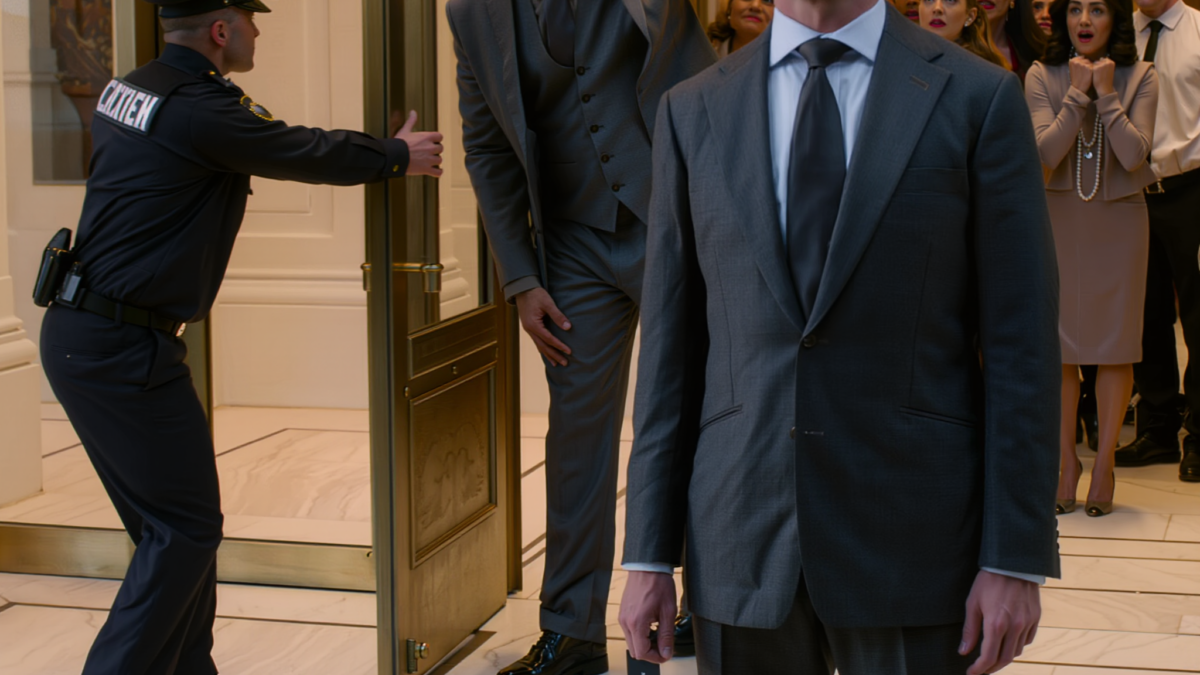
My name is Arthur Thompson. I am thirty-two years old. Ten years ago, my family threw me away like expired milk because I refused to spend the rest of my life rotting away in their cramped, suffocating accounting firm. They told me I was a disgrace. They told me I was destined to be a complete failure, a nobody who would spend his life scrubbing floors. And tonight, as I stood on the pristine, sweeping marble steps of the most exclusive luxury hotel in the entire city, my own brother physically blocked the heavy glass doors, laughing right in my face, telling me I couldn’t afford to step foot inside.
“You can’t seriously think you’re coming in,” Julian sneered, his voice dripping with that familiar, condescending poison that I had known since childhood.
My mother, Beatrice, stood right behind him, her cold eyes scanning my attire with pure, unadulterated disgust as she whispered,
“Don’t embarrass us, Arthur. The people inside actually matter. You do not belong here.”
They laughed at me in front of the valet, the doorman, and the wealthy guests passing by. They treated me like a stray dog begging for scraps at a banquet. But there was one massive life-altering detail they didn’t know. The grand towering structure behind them. The crystal chandeliers casting golden light onto the street. The Michelin-starred restaurant. The very imported Italian marble they were standing on. I owned it all. I owned the entire building. And right as my brother told me to get lost and go back to my pathetic life, my massive head of security was already walking up to the door to greet me. They were about to learn in the most humiliating way possible that family blindness costs dearly. To understand how things reached that moment, I have to go back to where it all began.
The air that evening was perfectly crisp, carrying the faint, salty scent of the ocean, mixed with the expensive custom-blended white jasmine fragrance I had personally selected for the hotel’s ventilation system. It was a detail most people would miss, but it was those invisible details that made the Grand Azure the crown jewel of the Los Angeles skyline. I stood on the sprawling front terrace, feeling the smooth custom matte-black key card burning a hole in my pocket. The blood rushed to my fingertips, making them tingle with a mixture of anticipation and deep, unresolved grief. I had designed this exact entrance.
I had chosen the exact shade of azure blue for the grand lobby that stretched out endlessly behind the massive glass doors. I had flown to Italy to handpick the marble slabs beneath my feet. Yet there I was, standing outside in the evening breeze like an unwanted solicitor, while my brother Julian physically blocked the entrance.
Julian, the family’s golden child. He was wearing a suit that looked expensive to the untrained eye, but I knew the hospitality and luxury industry inside out. I knew fabrics. I knew tailoring. His suit was off-the-rack, heavily tailored to look bespoke—a desperate attempt to project wealth he didn’t actually possess. He was a vice president at a regional bank, a bank that, ironically enough, was drowning in bad debt and desperately seeking access to my corporate capital. He planted his leather shoes firmly in the doorway, crossing his arms over his chest like a bouncer at a cheap nightclub.
“This is the Grand Azure, Arthur,” Julian said, dropping his voice to that condescending, pitying whisper he had perfected since we were teenagers.
“The tasting menu alone costs more than you make in an entire month. You don’t even have a reservation. You can’t just walk in here.” If he only knew that I had personally spent three grueling weeks in Paris working side by side with our executive chef to create that exact tasting menu. I kept my face entirely neutral. I didn’t flinch. I didn’t raise my voice. I had spent 10 years mastering my emotions in high-stakes boardrooms. Julian’s petty insults were nothing compared to a hostile corporate takeover. I just looked at him, feeling the weight of the heavy Italian leather envelope inside the breast pocket of my jacket.
Inside that envelope was the deed to a stunning vacation villa in Tuscany, one of my company’s most exclusive and sought-after properties. It was fully paid off. It was meant to be a sixtieth-birthday gift for our father. It was a peace offering, a final attempt to bridge the gap.
“He’s my father, too, Julian,” I said, my voice remarkably steady, betraying none of the storm raging inside my chest.
Before Julian could fire back another toxic insult, a sharp familiar voice sliced through the evening air, cutting over the smooth jazz music drifting from the lobby. Arthur, my mother, Beatrice, appeared from the shadows of the vestibule, stepping up right behind Julian. She was wearing a heavy pearl necklace she had purchased immediately after my grandfather’s funeral, using a chunk of the inheritance she had fiercely and ruthlessly guarded from the rest of the extended family. She stepped up beside Julian, her eyes immediately darting up and down my attire, doing the mental calculus she always did to determine someone’s worth.
I was wearing a custom-tailored charcoal suit hand-stitched by a master tailor in Milan. Cost more than her entire jewelry collection combined. But because it didn’t have a gaudy recognizable designer logo plastered across the chest or the belt buckle, her snobbish brain immediately categorized it as a cheap knockoff from a discount department store.
“What in the world are you doing here?” she hissed, looking around nervously at the other guests as if my mere presence would somehow infect the wealthy patrons walking past us with poverty.
“We discussed this. I texted you explicitly.”
Yes, she had. That very morning, my phone had buzzed with a message that I had stared at for a full five minutes. The words burned themselves into my memory: “Don’t come to Dad’s birthday. It’s at the Grand Azure. You can’t afford it. Don’t embarrass us.”
“I brought a gift,” I said quietly, tapping the inside of my jacket, offering them one last chance to act like a real family. Julian let out a loud, barking laugh that turned the heads of several arriving guests.
“What is it? A gift card to a fast-food joint? Or did you scrape together enough tips from whatever roadside diner you’re managing to buy him a cheap tie?”
My mother sighed, a heavy, dramatic, exasperated sound she usually reserved for HOA meetings when a neighbor painted their fence a shade of beige she disapproved of.
“Whatever it is, I’m sure your brother’s gift is much more appropriate,” she said, her tone laced with absolute crushing finality.
“Julian just secured a massive promotion at his bank. You know, he’s handling major real estate portfolios now. He is a success.”
I knew exactly what Julian’s bank was doing. I knew because my corporate financial division had sent me their quarterly reports just yesterday. They were struggling. They were bleeding cash, desperate for an injection of capital, drowning in toxic loans. Julian’s promotion was just a desperate reshuffling of deck chairs on a sinking ship.
“Well, at least you’re trying to show up, I suppose,” she added, giving me a pitying, sickeningly sweet look.
“But you absolutely cannot come in. We reserved the entire VIP floor. It’s for family and distinguished guests only. People who have actually made something of their lives.”
The VIP floor. My VIP floor. The one I had completely remodeled six months ago, personally selecting the artwork, the crystal fixtures, and the exact thread count of the velvet lounge chairs. The irony was so thick it was physically suffocating.
Just 24 hours ago, I had sat in a glass-walled boardroom and signed off on a $100 million expansion for the Azure chain. I employed over 4,000 people globally. My personal salary and dividends would make Julian choke on his overpriced cocktail. And yet to them, I was still the runaway, the disappointment, the permanent failure. I looked past them through the spotless glass into the lobby I had built from the ground up. I saw the art I had curated, the staff I had personally trained. For a fleeting, agonizing second, the little boy inside me wanted to turn around, get back in my car, and walk away into the night to let them have their grand illusion to disappear forever.
But then, out of the corner of my eye, I saw the heavy brass doors of the security office swing open. Owen, my head of security, stepped out into the lobby. He was a towering ex-Marine who had been with me since I bought my very first run-down motel. He spotted me through the glass. He saw Julian blocking my path. His jaw tightened and he started walking briskly toward the entrance, his radio buzzing on his shoulder. The moment of truth was barreling toward us. But as I watched
Owen’s reflection in the glass, my mind didn’t focus on the impending victory, it snapped backward. I was pulled violently back into the past, into the dark, suffocating memories of the exact moment this deep, festering wound in my family had been sliced open. Ten years ago, the world looked very different, and I was a very different person. I was 22, fresh out of college, and trapped in a life that felt like a slow, agonizing prison sentence.
My father, Richard, owned a midsize accounting firm. It wasn’t glamorous by any stretch of the imagination, but it paid the bills, funded my mother’s endless country club memberships, and most importantly, it gave my father absolute tyrannical control over our lives. In his rigid mind, numbers were the only truth in the universe. If you weren’t an accountant, a lawyer, or a doctor, you were essentially a peasant. You were the help.
Julian had fallen into line perfectly like a good little soldier. He went to school for finance, came back, and immediately became my father’s right-hand man, kissing up to the partners and sneering at the administrative staff. I, on the other hand, hated every single second of it. I hated the sterile office, the endless spreadsheets, the soul crushing monotony of tax season. I spent my college years working grueling night shifts at high-end hotels, completely fascinated by the intricate ballet of hospitality. I loved the energy, the complex operations, the intense challenge of creating an environment where people felt completely taken care of. I wanted to build spaces that made people feel alive, not bury them in paperwork.
The absolute breaking point happened on a sweltering, humid Tuesday in July. I had just formally turned down an offer to take over the firm’s junior tax division. Instead, I walked into my father’s office and told him I was taking a job as an assistant manager at a boutique hotel downtown.
I can still smell the stale, bitter coffee in his office. I can still see the veins bulging violently in his neck as his face turned a dangerous shade of crimson.
“You are throwing away your life!” my father roared, slamming his heavy fist onto his mahogany desk so hard the pens rattled in their holder.
“A hotel? You want to carry bags and fetch ice for a living? I didn’t drain your college fund so you could become a glorified waiter.”
“It’s hospitality management, Dad,” I tried to explain, my voice shaking, but my spine entirely resolute.
“It’s a multibillion-dollar industry. I have a solid plan. I want to learn the operations from the ground up and eventually open my own properties.”
“A plan to be a servant,” he spat, pointing a trembling finger at my chest.
“Julian is securing our family’s legacy. He is building real wealth. You are an absolute humiliation. If you walk out that door to be a bellboy, do not expect a single dime from me. Do not expect my help when you inevitably fail and come crawling back. Your mother and I are done funding your delusions. You are completely on your own.”
He thought the threat of financial ruin would break me. He thought cutting me off would force me to drop to my knees and beg for my desk back. He was wrong. I looked him dead in the eye, turned around, and walked out.
I packed my bags that very night, taking only what fit in my beat-up sedan. My mother didn’t even come out of her bedroom to say goodbye. She just locked the door. Aunt Clara, my mother’s sister, was the only one in the hallway as I carried my boxes out. She patted my arm, her eyes wide with fake, sugary sympathy.
“Oh, Arthur, you’re making such a terrible, terrible mistake. It breaks my heart to see you do this to your parents. But don’t worry, I’ll pray for you.”
I didn’t know it then, but Aunt Clara was the family’s chief informant and poison peddler. She thrived on misery like a parasite. Over the next few years, she would actively seek out any minor struggle I had and magnify it a hundred times over, feeding it back to my mother like delicious gossip at Sunday dinners. If my car broke down and I had to take the bus for a week, Clara told my mother I was facing a massive lawsuit for unpaid debts. if I moved to a smaller, cheaper apartment to save money for my business ideas.
Clara told them I was facing eviction and living on the streets. She meticulously built a narrative that I was drowning, that my life was a disaster, and my family loved every second of it because it proved them right. They needed me to fail to validate their own miserable choices.
The first 3 years on my own were absolutely brutal. I worked 80-hour weeks. I barely slept. I lived on cheap instant ramen, black coffee, and the leftover dinner rolls from the hotel kitchen. My feet were covered in blisters from standing in the lobby for 14 hours a day. But I learned everything. I became a sponge. I learned about global supply chains, complex real estate valuations, high-net-worth customer psychology, and crisis management.
By year four, I had saved a decent chunk of money, found a few small angel investors who believed in my vision, and drafted a carefully researched 300-page business plan to buy a bankrupt historic property on the edge of the city and turn it into a luxury wellness retreat. It was brilliant. It was my golden ticket out of the grind. And that’s exactly when the first real knife was driven directly into my back.
His name was Liam. We had been roommates in college and he was the only person from my old life I still trusted. He was a junior real estate broker, hungry and ambitious. I brought him in to help me negotiate the purchase of the property.
We spent 6 months sitting at my cramped, sticky kitchen table, drinking cheap beer until 3:00 a.m. mapping out the massive renovations, projecting the revenue streams, and securing the zoning permits. I trusted him like a brother. Hell, I trusted him more than my actual brother.
One week before I was supposed to sit down and sign the final papers to acquire the property, the owner stopped returning my calls. His broker stopped answering emails. Two agonizing days later, I saw a press release in the local business journal. The historic property had been bought in an all-cash expedited deal by Victor Vance, a ruthless, sleazy local real estate developer known for flipping beautiful properties into cheap, high-density, soulless apartment complexes. Panicked, I thought there had been a leak. I called Liam repeatedly, leaving dozens of voicemails. His phone was disconnected. His apartment was empty.
Took me three frantic days to track him down. I finally found him at a high-end, ridiculously overpriced steakhouse downtown. I walked in, and there he was, wearing a brand new gleaming Rolex watch, laughing over expensive scotch with Victor Vance himself. I didn’t yell. I didn’t cause a scene or flip the table. I just walked up to their leather booth, my heart pounding so hard and so violently against my ribs, I thought they would crack. Liam looked up and all the color instantly drained from his smug face.
“Arthur,” he stammered, gripping his glass.
“Listen, man. Don’t make this weird. It’s just business. You know how this industry is.”
He had sold my entire life’s work. He had taken my proprietary business plan, my deeply researched financial models, and my entire renovation strategy, and sold it to Victor for a $50,000 finder fee. He sold my entire future, my escape route, for the price of a midsize sedan.
“You knew this was everything I had,” I said, my voice dangerously low, vibrating with a rage I didn’t know I was capable of.
“You sat in my house and ate my food while you were planning to ruin me.”
Victor Vance just smirked, casually cutting into his rare steak, juices collecting on the white porcelain plate.
“Kid, you didn’t have the capital to pull it off anyway. You were a dreamer. I’m a closer. Go back to carrying luggage and leave the real estate to the adults.”
I walked out of that restaurant completely hollowed out. I had $32 left in my checking account. I had maxed out every single credit card I owned to pay for the initial legal fees and surveys. I was facing the possibility of total, inescapable bankruptcy.
That night, sitting on the cold linoleum floor of my empty, dark apartment, listening to the rain hit the window, I finally hit absolute rock bottom. I thought about giving up. I thought about calling my father. I actually held the cracked phone in my hand, dialing the first three digits of his number. I could hear his smug, victorious voice in my head. I told you so. Come home. Take a desk in the back and admit you’re a failure. Admit I was right. I threw the phone across the room. It shattered into pieces against the drywall.
I didn’t cry. Something inside me. Some soft, hopeful, naive part of Arthur died on that apartment floor. I realized in that dark room that the world doesn’t care about your passion, your feelings, or your hard work. The world respects leverage. The world respects undeniable, overwhelming power. And I decided right then and there that I was going to acquire so much power, so much undeniable wealth that no one, not my father, not Julian, not Liam, and certainly not Victor Vance, could ever look down on me again. I didn’t just need to succeed. I needed to build a fortress. I needed to build an empire.
I thought the worst of my betrayals was over. I thought nothing could hurt more than a best friend selling you out for a watch. I was so incredibly wrong. The real pain, the insidious creeping poison, was what my own blood family was planning to do to me next.
The climb back up from that rock bottom was vicious, relentless, and entirely consuming. I didn’t sleep a full night for a year. I took a job managing a failing, completely run-down boutique hotel on the bad side of town. The place was plagued by mold, awful staff, and terrible reviews. I offered the desperate owner a deal. I would work for a base salary that was practically minimum wage, but in exchange, I demanded 30% of the profits if I turned the property around within 12 months. He thought I was a desperate, stupid kid. He laughed and took the deal.
That’s where I met Chef Marcus. Marcus was an absolute genius in the kitchen, a culinary savant, but he had a fiery temper that had gotten him pushed out of nearly every fine-dining establishment in the city. We were two broken outcasts with absolutely nothing left to lose. I gave him complete, unquestioned control of the menu and the kitchen budget. He gave me his fierce, unyielding loyalty.
Together, we worked 20-hour days. We fired the lazy staff. We scrubbed the floors ourselves. We transformed that run-down, forgotten hotel into the hardest, most exclusive dinner reservation to get in the entire state. Within 18 months, the profit skyrocketed, and I took my 30% and bought out the owner entirely. That was the quiet, gritty birth of Azure Hospitality.
From there, I moved with the cold surgical precision of a machine. I acquired a second property, then a third, targeting undervalued hotels and transforming them into luxury havens. I didn’t buy fancy clothes. I didn’t buy a sports car. I didn’t buy a mansion. I lived in a modest apartment and reinvested every single penny back into commercial real estate. I built a corporate team of absolute sharks, lawyers, accountants, and operations managers who were the best in the business. I found Owen, my head of security, during a brutal union dispute at my third hotel. He handled a violent situation with such calm. Terrifying authority that I hired him away on the spot, doubling his salary.
By my late 20s, I was a multi-millionaire. By 30, I was a billionaire, but I kept my name entirely out of the press. Azure Hospitality was owned by a holding company which was owned by an offshore trust which was managed by a labyrinth of legal entities. I was a ghost. I wanted it exactly that way. I wanted to build the fortress so high and so thick that by the time anyone realized who was inside, it would be entirely impenetrable.
During all this time, my family remained completely blissfully oblivious. Why? Because they never once asked. They never cared enough to inquire about my life. If we had a mandated Thanksgiving dinner, they spent the entire agonizing evening talking about Julian’s new leased car or Julian’s mortgage or my father’s golf handicap. When they inevitably turned their condescending gaze to me and asked what I was doing, I would vaguely say, “Still working in the hotel business.” They would roll their eyes, sigh heavily, change the subject immediately, and Aunt Clara would shoot a pitiful, mocking look across the table.
They assumed I was a midlevel shift manager, struggling to pay rent, drowning in debt. And I let them believe it because the longer they believed I was beneath them, the more their true ugly colors showed.
The major turning point, the exact moment I realized I couldn’t just avoid them anymore, but had to actively forcefully teach them a lesson they would never forget, happened exactly 6 months ago.
I was sitting in my sprawling penthouse office overlooking the city, reviewing quarterly earnings, when my property manager for our European luxury division called my private line.
“Sir, we have a rather delicate situation with the Tuscany villa,” he said, sounding stressed. The Tuscany Villa was our absolute crown jewel. A flawlessly restored 16th century estate with private vineyards, a staff of 10, and a helipad. It rented for $40,000 a week strictly to A-list celebrities and royalty.
“What’s the issue?” I asked, barely looking up from a custody agreement for one of my loyal employees, whose legal fees I was quietly covering to protect her from an abusive ex-husband.
“A new client applied to rent it for a full month this summer. As per protocol, we ran his financials to ensure he meets the liquidity requirements. Sir, he doesn’t even come close. He’s heavily leveraged. Multiple mortgages, maxed-out credit lines, zero liquid assets. When we formally denied the application, he threw a massive fit. He’s threatening a lawsuit, claiming discrimination, and he’s currently criticizing our brand on social media and tagging travel blogs.”
“What’s his name?” I asked, annoyed.
“Julian Thompson, sir.”
I stopped writing. The pen froze in my hand. I stared at the phone. My brother Julian was trying to rent my most expensive villa, likely to impress his bank’s board of directors or his shallow fiance. and my automated financial system had rejected him because he was practically speaking broke. He was a paper tiger living on credit.
“Sir, should I have the legal department send a cease-and-desist letter?”
I leaned back in my leather executive chair, a slow, dark, dangerous smile spreading across my face. The sheer audacity, the absolute hypocrisy.
“No,” I said softly, staring out at the city skyline.
“Send him a very polite, standard corporate email stating that the property is unavailable under our financial eligibility criteria. Do not, under any circumstances, mention my name.”
Later that week, I forced myself to attend a mandatory family dinner at my parents house. It was excruciating. Julian spent 20 minutes complaining loudly and aggressively about the arrogant snobs at Azure Hospitality who wouldn’t rent him a villa, claiming their system was broken.
“It’s absolutely outrageous,” my mother chimed in, aggressively passing the mashed potatoes.
“Julian has a massive salary. He is a vice president. Those people don’t know who they’re dealing with. They are missing out on incredible business.”
I took a slow, deliberate sip of my ice water.
“Maybe they just have incredibly strict financial standards, Julian. Luxury properties usually require proof of liquid assets, not just a job title.”
He glared at me, his face flushing red.
“What would you know about luxury standards, Arthur? You change bedsheets and unclog toilets for a living. Stick to what you know.”
I didn’t react. I didn’t defend myself. I just let the silence hang there in the dining room, heavy and thick, absorbing their contempt.
Then came the final insult, the catalyst for tonight’s confrontation. My father’s 60th birthday was approaching. It was supposed to be a massive, monumental milestone. I knew my parents were planning a huge, lavish event to show off to their country club friends and business associates. Deep down, a small part of me was actually debating whether to just write them a massive check, pay off the remaining mortgage on their house, and finally reveal the truth over dinner. Maybe, just maybe, at 60 years old, my father would be ready to let go of his pride and we could start over.
Then yesterday morning, my phone buzzed on my nightstand. It was a text from my mother, “Arthur, about Dad’s birthday tomorrow. We’ve decided to host it at the Grand Azure. It’s an incredibly exclusive, high-end venue. To be brutally honest, we don’t think you should come. It’s a strict black-tie event, and you simply can’t afford the attire or the tasting menu. We are inviting very important clients of Julian’s bank and your father’s firm. Don’t come to Dad’s birthday. Don’t embarrass us in front of people who matter. We will get lunch next week at a diner or something.”
I read the text four times.
I read it until the letters blurred. You can’t afford it. Don’t embarrass us. They were hosting a vanity party to impress their snobbish friends at my flagship hotel and actively banning me from the premises because they genuinely believed my poverty was a contagious disease that would ruin their image. I didn’t reply. I didn’t throw my phone this time. I calmly walked over to my mahogany desk, picked up my intercom, and called my executive assistant.
“Cancel all my afternoon meetings,” I said, my voice completely devoid of any emotion, cold as ice.
“I need the deed to the Tuscany property drafted into a gift trust immediately, and get me the real estate acquisitions team on the line. I want a full update on the commercial building on Fifth and Main.”
The building on Fifth and Main was the exact building that housed my father’s accounting firm. The storm wasn’t just coming anymore. I was going to bring it directly to their front door, and they were going to drown in it.
The morning of the party, I woke up hours before the sun even crested the horizon. My penthouse was dead silent, save for the faint, rhythmic hum of the city traffic 50 stories below. I stood by the massive floor-to-ceiling windows in my kitchen, drinking black coffee, looking out over the sprawling skyline as the city slowly woke up. I owned five of the commercial skyscrapers I could see from this very window. I had built a legacy out of the ashes of their rejection. Today was not about anger. Anger is sloppy. Anger makes you raise your voice, lose your composure, and make mistakes. Today was about surgical precision. It was about holding up a mirror so large, so terrifyingly clear that my family would have absolutely no choice but to look at their own grotesque, hypocritical reflection.
At precisely 9:00 a.m., my lead acquisitions attorney, Thomas, arrived at my apartment. He was a sharp, brilliant lawyer who had navigated my most complex deals. He placed a thick leather-bound binder on my glass dining table and opened it.
“The final paperwork for the commercial block on Fifth and Main is ready for your signature, Arthur,” Thomas said, clicking his expensive pen and pointing to the highlighted sections.
I opened the folder. There it was, the master lease agreements for every single tenant in the building. I flipped slowly to page four. Thompson and Associates accounting, my father’s firm. I read the financial disclosures attached to the lease. They were barely making rent. They were two months behind on maintenance fees. The previous building owner had been desperately trying to offload the failing property for months to avoid a loss, and I had swooped in through a quiet shell company and bought the entire city block in cash. I picked up the pen and signed my name on the dotted line. With one swift stroke of black ink, I officially became my father’s landlord. If his lease permitted it and the required legal notices were served, I could begin the process of removing his firm.
“I’m filing this with the city immediately,” Thomas said, respectfully packing up his briefcase.
“Oh, and the deed transfer documents for the Tuscany villa are in this envelope. It’s fully transferred into the trust as you requested.”
He handed me a small, heavy cream-colored envelope. The paper was thick, textured, and screamed old money. I slipped it into the inside pocket of my suit jacket, feeling its weight against my chest.
I spent the rest of the day in a state of absolute calm. I worked out. I read reports. I didn’t think about my mother or Julian. At 6:00 p.m., I went down to my private climate-controlled garage. I didn’t take the company SUV or employ my usual driver. I wanted to be alone. I walked past the row of luxury vehicles and pressed the fob for the Porsche 911 Turbo S. The engine roared to life in the concrete bunker. A deep, guttural, aggressive sound that vibrated right in the center of my chest.
Driving through the city at dusk, shifting gears smoothly as the street lights began to flicker on, I felt a strange, overwhelming sense of peace. The crippling anxiety that usually plagued me for days before any mandatory family event was completely gone. I wasn’t the scared, desperate 22-year-old kid begging for his father’s approval anymore. I was a titan. I was the architect of my own reality.
I pulled up to the grand entrance of the Grand Azure just as the sky turned a deep, bruised purple. The valet, a bright, hard-working college kid named Marcos, whose tuition I was anonymously paying through a private company scholarship fund, rushed forward immediately to open the door of the Porsche.
“Good evening, Mr. Thompson,” Marcos said, his eyes wide with genuine respect and gratitude, not fear.
“Evening, Marcos. Keep it close. I might not be long,” I said, handing him the heavy keys. I smoothed the lapels of my jacket. I felt the envelope resting securely against my ribs. I walked slowly up the sweeping marble steps, hearing the faint, elegant sound of a live jazz band drifting from the main lobby.
And that brings us right back to this exact explosive moment in time.
Right back to my brother Julian’s smug, arrogant face, standing in the doorway, physically blocking my path into my own building. Right back to my mother’s pearl-clutching horror at my mere presence, treating me like a disease.
“What would people think if they knew Dad’s failure of a son was serving their drinks?” Julian had mocked, clearly pleased with his own cruel wit, looking around to see if anyone was impressed. I had looked at them. I really truly looked at them for the first time in 10 years. They looked so incredibly small, so petty, trapped in their desperate, fragile little world of fake status and appearances, completely oblivious to the massive ocean of power I commanded just out of their sight.
“Actually,” I said quietly, my voice slicing effortlessly through their arrogant laughter, cold and sharp as a scalpel.
“I think I’ll stay.”
Before my mother could open her mouth to yell, before Julian could puff up his chest and try to push me down the stairs, the heavy brass doors of the hotel swung open with a resounding thud. Owen, my head of security, stepped out onto the terrace. He didn’t look at my mother. He didn’t even acknowledge Julian’s existence. He marched straight past them and stopped squarely in front of me. His massive frame was rigid with practiced precision, his voice booming loud enough for every single guest, valet, and staff member on the terrace to hear clearly.
“Is everything all right here, Mr. CEO? Your private elevator to the VIP floor is waiting.”
The silence that fell over the grand entrance was absolute. It was deafening. It was the sound of a ten-year lie being vaporized in a single second.
I looked at Julian. The smug, mocking smile on his face didn’t just fade. It shattered into a million pieces. My mother physically staggered backward as if she had been struck. Her hand flew to her throat as she gripped her pearls, her mouth opening and closing like a fish out of water. But I wasn’t done. The real reckoning, the absolute dismantling of their entire reality, hadn’t even begun.
“Is everything all right here, Mr. CEO? Your private elevator to the VIP floor is waiting.”
Those words, delivered with the unmistakable authority of my head of security, hung in the crisp evening air. They echoed off the massive imported Italian marble columns that framed the grand entrance of the Grand Azure. For a full 10 seconds, the world completely stopped turning. The ambient noise of the city traffic, the smooth, elegant jazz spilling out from the lobby, the low chatter of arriving wealthy guests, it all faded into a thick, suffocating vacuum of absolute silence.
I kept my eyes entirely locked on my older brother, Julian. I watched with a deep, cold, and profoundly satisfying fascination as his brain desperately tried to process a reality that completely shattered his entire worldview. The smug, arrogant smirk that had been plastered across his face for as long as I could remember didn’t just fade, it disintegrated. His jaw went slack, dropping open in a display of pure, unadulterated shock. The color drained from his cheeks so fast he looked as though he were about to faint right there on the front steps of my property.
“What did you just call him?” Julian stammered, his voice cracking, completely devoid of the booming, condescending authority he had wielded just moments before. He looked at Owen, then at me, then back at Owen, his eyes darting frantically like a trapped animal looking for an exit that didn’t exist.
“There has to be a mistake. This is Arthur. He is my brother. He manages a cheap roadside diner. He is a nobody. He doesn’t even have a real salary or a retirement fund. Look at him.”
Owen, my massive ex-marine head of security, didn’t even blink. He didn’t offer a polite customer service smile. He stepped slightly closer to Julian, his towering frame casting a long dark shadow over my brother’s cheap off-the-rack suit.
“There is absolutely no mistake, sir,” Owen said. His voice was a low, firm rumble that commanded immediate attention. “Mr. Arthur Thompson is the founder, sole owner, and chief executive officer of Azure Hospitality Group. He owns this hotel. He owns the land it sits on. He signs my paychecks, and he dictates exactly who is legally allowed on these premises. Now, I strongly suggest you step aside and clear the entrance for the owner of this building before I have you escorted off the property.”
My mother, Beatrice, let out a sound that was half gasp, half choke. Her hand was gripped so tightly around her expensive pearl necklace that I genuinely thought the string was going to snap and send the pearls scattering across the concrete driveway. She stared at me, her eyes wide with a frantic, terrifying kind of horror. She looked at my custom-tailored Milanese suit again, but this time the snobbish, judgmental filter in her brain had been violently ripped away. Suddenly, she didn’t see a cheap knockoff from a discount store. She saw the bespoke stitching. She saw the quiet, unmistakable signs of immense wealth that didn’t need a flashy logo to announce itself.
“Arthur,” she whispered, her voice trembling, sounding fragile and incredibly old.
“You own the Grand Azure? This entire building?”
I didn’t answer her. I didn’t need to justify my existence or my net worth to her anymore. The time for explanations had passed a decade ago. I simply adjusted my cuffs, gave Owen a brief, appreciative nod, and walked right past them. I didn’t shove Julian. I didn’t even brush his shoulder. I just walked forward with absolute purpose. And he instinctively stumbled backward out of my way, his legs practically giving out beneath him. He looked like a man who had just realized he was completely outmatched.
The moment I crossed the threshold through the heavy glass doors and stepped into the grand sweeping lobby, the atmosphere shifted entirely. It was as if I had crossed an invisible boundary from my miserable, heavily criticized past directly into my undeniably powerful present.
The lobby of the Grand Azure was a masterpiece of modern luxury. Massive crystal chandeliers hung from the vaulted ceilings, casting a warm golden glow over the imported azure blue marble floors. The air smelled of that signature white jasmine mixed with the faint rich aroma of the Michelin-starred cuisine being prepared in the kitchens. Every single detail from the height of the floral arrangements to the acoustic paneling hidden in the ceiling had been meticulously approved by me.
As I walked across the floor, the staff—my staff—reacted instantly, their training and genuine respect kicking in.
“Good evening, Mr. Thompson,” Rachel, my brilliant front desk manager, called out from behind the mahogany reception desk, offering a deep, respectful nod. I had personally authorized a massive bonus for her last year when she handled a difficult celebrity client with total grace and discretion.
“The executive suite is fully prepared for your family’s event, sir,” a senior concierge added, stepping out from behind his podium to greet me.
“Chef Marcus has personally overseen the tasting menu as requested.”
Every single employee I passed stood a little taller, greeted me by name, and showed the kind of genuine earned respect that you simply cannot buy with fear. It was the respect forged through years of hands-on leadership, fair salary negotiations, aggressive corporate promotions from within, and a corporate culture that treated its workers like human beings rather than disposable assets.
Behind me, I could hear the slow, hesitant, shuffling footsteps of my mother and brother. They were following me in a state of absolute paralyzed shock. They were looking around the lobby as if they were seeing it for the very first time. They were looking at the intricate museum-quality artwork I had curated, the lavish floral arrangements I had approved, and the sheer breathtaking scale of the wealth on full display.
We reached the private elevator bank tucked away in the back of the lobby. This elevator didn’t have buttons for the general public. It required a specialized biometric key card and a fingerprint scan. I pulled the matte black card from my pocket, tapped it against the glowing scanner, and pressed my thumb to the glass. The heavy brushed-steel doors slid open silently, revealing a cabin lined with dark walnut and soft ambient lighting.
“Coming?” I asked, looking over my shoulder at my family. My voice was entirely flat, betraying absolutely no emotion. They stepped into the elevator, pressing themselves against the back wall as if I were somehow radioactive. Julian was breathing heavily, his eyes darting frantically around the small space. My mother was clutching her purse so hard her knuckles were completely white.
The ride up to the VIP floor was agonizingly silent. The only sound was the soft mechanical hum of the elevator motors pulling us higher and higher into the sky. I kept my eyes fixed on the digital floor indicator, watching the numbers climb. 50, 55, 60. With every single floor we passed, I could feel the power dynamic of our entire family history shifting permanently. For ten years, they had controlled the narrative. They had painted me as the reckless, foolish son who threw away a stable career in accounting for a pipe dream. They had used my supposed poverty to elevate their own achievements. That narrative was currently burning to the ground.
When the doors finally parted on the penthouse level, the sounds of a lavish high-society party washed over us. The VIP floor was breathtaking. Floor-to-ceiling glass windows offered a panoramic 360-degree view of the glittering city skyline. Waiters in crisp white tuxedos circulated smoothly through the crowd with silver trays of vintage champagne and beluga caviar. A professional string quartet played softly in the corner, providing a sophisticated backdrop to the wealthy chatter. The room was packed with the city’s elite, wealthy commercial real estate developers, high-powered corporate attorneys, local politicians, and senior banking executives. These were the people my parents had invited to validate their own fragile egos. These were the people my mother claimed I was too poor and embarrassing to be around.
At the far end of the room, sitting at the head of a massive, heavily decorated banquet table, was my father, Richard. He was holding a heavy crystal glass of single malt scotch, laughing loudly at a joke someone had just told. He was completely in his element, basking in the illusion of his own immense success. He looked like a man who believed he was the absolute king of the world, entirely untouchable. I took a deep, steadying breath, feeling the heavy cream-colored envelope resting securely inside my jacket pocket. The trap of their own complacency had been perfectly set. The audience was in place, and I was about to spring it wide open.
I stepped out of the elevator and began walking slowly, purposefully across the plush, handwoven carpets toward the head table. My mother and Julian trailed a few feet behind me like frightened ghosts, completely speechless, their eyes darting nervously around the room as they realized the sheer magnitude of the situation. As I moved through the crowded room, heads began to turn. Conversations trailed off in mid-sentence. The clinking of crystal glasses slowly faded into a tense, expectant silence.
It wasn’t because I was crashing the party in dirty clothes. It was because these people, the titans of industry in this city, knew exactly who I was. In the public eye, I kept a low profile. But among the elite circles of commercial real estate and high-stakes finance, Arthur Thompson was a name that commanded absolute terrifying authority. I was the man who bought city blocks in cash. I was the man who could make or break a development deal with a single phone call.
I reached the head table just as my father took a self-satisfied sip of his scotch. He lowered his glass, his eyes scanning the room before finally landing on me. For a split second, his face contorted into a mask of pure, unadulterated fury. He saw the son he had banished. He saw the failure who had refused to join the family firm. He opened his mouth, no doubt, preparing to scream at me, to demand that security drag me out by my collar for ruining his perfect expensive night.
“Arthur!” my father snarled, his voice low, vicious, and dripping with contempt.
“What are you doing here? Your mother told you explicitly that you were not welcome. You can’t just barge in here in your fake suit and ruin my evening. I will have you removed.”
“Arthur Thompson!” A booming, incredibly jovial voice interrupted, cutting my father off completely before he could finish his threat.
A man pushed his way through the crowd standing near my father’s table. It was Mr. Sterling, the billionaire CEO of the regional bank where Julian worked. Sterling was a titan of finance, a ruthless businessman whom Julian practically worshipped and feared in equal measure. Julian had spent the last five Thanksgivings bragging about how close he was to Mr. Sterling, a claim that was clearly entirely fabricated. Sterling marched right up to me, a massive, eager smile on his face, and aggressively shook my hand, pumping it up and down like we were old friends.
“My God, Arthur, I had absolutely no idea you were coming tonight. I have been trying to get your acquisitions team on the phone for three weeks regarding that corporate bailout loan my bank is desperately seeking from your holding company. It is an absolute honor to finally catch you in person outside of a boardroom.”
My father’s mouth snapped shut. His jaw practically hit the table. The expensive scotch in his glass sloshed over the crystal rim and spilled onto his polished shoes. He stared at Sterling, then at me, his brain completely unable to bridge the massive cognitive dissonance.
Before my father could formulate a single word, Thomas, my lead corporate lawyer and one of the most feared attorneys in the state, stepped out from the crowd. He was attending as a guest of one of the law firms my father did business with.
“Arthur, good to see you,” Thomas said smoothly, nodding at me with deep professional respect. He turned to my father, who looked like he was on the verge of a medical emergency.
“Richard, you kept this incredibly quiet. I had absolutely no idea your son was the mysterious founder and CEO of Azure Hospitality. You must be unbelievably proud. Your son is practically buying up the entire Eastern Seaboard. His real estate portfolio is untouchable.”
The silence in the room was now absolute. It was so thick and heavy that you could hear a pin drop on the carpet.
I looked at Julian. He was staring at Mr. Sterling, his boss, the man who held his entire career, his salary, and his future promotions in his hands. And that powerful man was currently treating me like absolute royalty, begging me for financial mercy. Julian looked like he was going to vomit right there on the floor.
“Azure Hospitality?” my father finally managed, his voice a raw, raspy whisper. He looked at me, his eyes wide, pleading for someone to tell him this was an elaborate, cruel, practical joke.
“You own this?”
“Yes. I own the Grand Azure,” I said, my voice calm, steady, and projecting loud enough for the surrounding tables to hear every single word.
“I own all forty-two properties globally. I own the land. I own the brand, and I own the holding company.”
My mother finally found her voice. She pushed past Julian, her hands shaking violently, tears of sheer panic welling in her eyes.
“But how? All this time, we thought you were just a glorified waiter struggling to pay rent. Why didn’t you tell us? Why would you lie to your own family?”
“I never lied, Beatrice,” I said coldly, using her first name, severing the maternal tie right then and there.
“You never asked. You didn’t believe in me ten years ago when you kicked me out with nothing but a suitcase and a used car. Why would I share my success with people who only measure a person’s worth by the size of their bank account? You banished me to protect your precious reputation. You spent ten years mocking me. You didn’t deserve to know.”
I turned my attention back to my father. He had sunk back into his chair, looking suddenly very small, frail, and entirely defeated.
“But I didn’t come here tonight just to enjoy the catering, Richard,” I continued, stepping closer to the table.
I reached into my jacket and pulled out the heavy cream-colored envelope. I tossed it onto the table. It landed with a soft, decisive thud right next to his elaborate birthday cake.
“What is that?” my father asked, staring at the envelope like it was a live grenade about to detonate.
“That is the deed to a historic, fully staffed vacation villa in Tuscany,” I said. Julian let out a sharp, pathetic gasp behind me.
“The villa I tried to rent?”
“Exactly,” I said, locking eyes with my brother, watching him squirm.
“The one you became furious about when my automated system rejected your application because you couldn’t afford the deposit. The property manager forwarded me your angry, demanding emails. It is my personal property, and I was going to give it to Dad tonight for his sixtieth birthday, free and clear. A total transfer of ownership.”
My father reached out with a trembling hand, his fingers brushing the edge of the envelope.
“Arthur, son, I—”
“Don’t call me that,” I snapped, my voice finally cracking with a decade of suppressed anger, silencing him instantly.
“You lost the right to call me your son the night you told me I was a failure for having a dream. But the villa isn’t the only piece of real estate we need to discuss tonight.”
I leaned over the table, placing both hands firmly on the pristine white tablecloth, moving close enough for my father to hear every word.
“Yesterday morning, my legal team finalized the purchase of the commercial block on Fifth and Main,” I said, my voice dropping to a low lethal register.
“I own the building, Richard, which means I now control the lease for Thompson and Associates Accounting. I am your landlord, and according to the financial records, you are two months behind on your maintenance fees. You are barely making rent.”
My father went completely white. He looked like he had been physically shot in the chest.
“And Julian,” I said, standing up straight and turning to my brother.
“Your promotion is entirely meaningless. Your bank is drowning in toxic debt, which is exactly why Mr. Sterling here has been asking my investment firm for a massive bailout loan. A loan I haven’t decided whether I’m going to approve yet.”
I looked around the room. The incredibly important, distinguished guests my parents had invited to impress were now looking at them with a mixture of pity and absolute disgust. In the world of high-society, nothing is more embarrassing than being exposed as a fraud.
“You banned me from my own hotel tonight because you thought I couldn’t afford a meal,” I said, my voice echoing in the silent room.
“You were afraid I would embarrass you in front of your friends. Well, I hope you enjoy the party. Everything tonight is on the house. Consider it a parting gift.”
I turned my back on them and walked away. I didn’t look back. I didn’t need to. The explosion had already leveled everything behind me. The silence in that room was the loudest victory I had ever achieved. The immediate aftermath of that revelation was a masterclass in the brutal unforgiving nature of social climbing and high-society politics.
By the time I reached the massive double doors leading out to the private penthouse terrace, the entire dynamic of the room had fundamentally shifted, collapsing entirely in on my family. The wealthy guests, the lawyers, the bankers, the exact people my parents had spent decades desperately trying to impress in court for business abandoned them instantly. They smelled the blood in the water. Within seconds of my speech, Mr. Sterling completely turned his back on Julian, pretending my brother no longer existed, and began aggressively cornering my acquisitions attorney. Thomas, desperate to salvage his bank’s bailout loan. Julian was left standing alone in the middle of the room, looking like a lost, terrified child.
I stepped out onto the expansive private terrace. The cold, crisp night air hit my face, bringing a sudden, sharp clarity. Below me, the city lights stretched out like a glittering ocean of diamonds. I walked to the edge of the reinforced glass railing, gripping it with both hands, taking a deep, shuddering breath. ten years, ten long, grueling years of grinding, bleeding, sacrificing, and building, all leading to this exact 5 minutes of vindication.
I heard the heavy glass door slide open behind me. I didn’t turn around. I knew exactly who it was.
“Arthur.” It was my father. His voice was completely stripped of its usual booming arrogance. That toxic bravado he wore like an iron suit of armor. It was small. It was shaking. It was the voice of a broken, defeated man who had just watched his entire carefully constructed universe collapse into dust. I slowly turned around. Richard stood a few feet away, clutching his chest slightly, looking 10 years older than he had just an hour ago.
“Arthur, please,” he started, taking a hesitant, trembling step forward.
“We need to talk. I didn’t know. If I had known what you were building, if I had known you were running Azure, things would have been different. I would have supported you. I would have helped you.”
“You would have what, Richard?” I interrupted, my voice devoid of any warmth, sharp and unforgiving as a scalpel.
“You would have respected me? You would have loved me?” He nodded eagerly, completely missing the point, still trapped in his own transactional mindset.
“Yes, exactly. I always knew you had potential. I pushed you hard because I wanted you to be great. I practiced tough love. And look at you now. You are a billionaire. You are a titan of industry. I am so incredibly proud of you, son. Please, you have to forgive us. We are family. We share the same blood.”
I stared at him. I stared at the man who shared my DNA. The man whose approval I had once desperately craved, and I felt absolutely nothing but a deep hollow pity. He genuinely didn’t understand what he had done wrong. He wasn’t apologizing for breaking my heart. He was apologizing for underestimating my bank account.
“You didn’t push me to be great,” I said softly. The truth was finally, undeniably out in the open.
“You discarded me. You threw me away because I didn’t fit into your rigid, narrow little spreadsheet of a life. You only respect success after it has been proven, neatly packaged, and deposited in a bank. You don’t respect the struggle. You don’t respect the person. You don’t respect me.”
“That is not true,” he pleaded, tears welling in his eyes, his hands shaking.
“You are my boy. I love you.”
“If I had walked into that room tonight as an assistant manager making $40,000 a year, you would have let Julian and security escort me out into the street,” I stated, staring right through him.
“You would have laughed with your friends about the failure of a son who couldn’t even afford a suit. Forgiveness isn’t the issue here, Richard. Respect is, and you have none. Not for me, and clearly not for yourself.”
I walked past him, stopping just for a second by his shoulder.
“I won’t evict your firm,” I said quietly.
“Keep paying your rent and you can keep your office. I am a businessman, not a monster. But this is the last time we will ever speak. Enjoy the view.” I walked back inside, leaving him alone in the cold.
As I crossed the VIP room toward the private elevator, I caught one last glimpse of the absolute destruction. Julian’s elegant, high-society fiance, a woman who only cared about status, was pressing her expensive engagement ring back into his chest, screaming at him about lying about his finances.
“You told me you were making mid-six figures!” she shrieked, entirely unbothered by the audience.
“You told me we were buying a house in the hills. You don’t even have savings set aside for our future. And your bank is begging your brother for money. We are done. Do not call me or my lawyer.” It was the fastest broken engagement I had ever witnessed. Julian was hyperventilating, holding his head in his hands, watching his career and his relationship evaporate simultaneously. My mother was sitting entirely alone at a massive table, crying hysterically, desperately trying to explain to an empty chair that she had always upported my dreams. It was a funeral. A funeral for a family dynamic built entirely on lies, judgment, and toxic pride. I stepped into the elevator, pressed the button for the ground floor, and as the doors slid shut, separating me from them forever, I felt a massive, invisible weight lift off my shoulders.
6 months later, the fallout from that night was absolute, sweeping, and irreversible. Julian’s bank underwent a massive corporate restructuring. I ultimately denied the bailout loan, citing unstable management and poor real estate forecasting. Mr. Sterling fired Julian a week later to cut costs and distance himself from the embarrassment. My brother, with no income and a mountain of credit card debt, was forced to sell his leased luxury cars and downsized to a tiny cramped apartment in the suburbs, drowning in the financial ruin he had accumulated trying to look rich. My parents became complete social pariahs in their country club circle. In that world, nobody wants to associate with parents who were publicly exposed for abandoning a billionaire son. Their invitations dried up overnight.
I was sitting in my corporate office reviewing a massive new resort acquisition in the Caribbean when my assistant buzzed my intercom.
“Mr. Thompson, your aunt Clara is here in the lobby. She doesn’t have an appointment, but she insists it is an absolute family emergency.”
I leaned back in my chair, a small knowing smile playing on my lips. Aunt Clara, the snake in the grass. The woman who had poisoned my mother’s ear with exaggerated lies about my struggles for a decade, feeding the flames of our estrangement.
“Send her up,” I said.
Aunt Clara practically floated into my office, carrying a large woven basket of expensive imported muffins. She looked around at the rich mahogany walls, the original artwork, and the breathtaking floor-to-ceiling views of the city, her eyes wide with greedy amazement and calculation.
“Oh, Arthur, my sweet, brilliant nephew,” she cooed, rushing forward to place the basket on my massive desk.
“I always knew it. I always told your mother, Beatrice, that boy is a genius. You just watch. I defended you for years, Arthur. It was so incredibly hard watching them treat you so terribly. We should catch up. Let’s talk about your investments.”
I didn’t offer her a seat. I just opened my bottom drawer, pulled out a thick manila folder, and dropped it onto the desk right next to her muffins.
“What is this?” she asked, her fake, sugary smile faltering slightly as she looked at the heavy file.
“That is a heavily documented timeline,” I said casually, leaning forward and resting my elbows on the desk. “It details every single lie, every exaggerated rumor, and every piece of toxic gossip you fed my mother over the last ten years regarding my financial status and personal life. You didn’t defend me, Clara. You weaponized my struggle for your own entertainment. You thrived on the drama. You were the architect of our division.”
Her face went pale, her mouth opening and closing silently like a fish out of water.
“You are permanently banned from every single Azure Hospitality property worldwide,” I said, my voice completely flat and devoid of any emotion.
“If you continue contacting or harassing me or anyone in my corporate organization, my legal team will pursue the appropriate remedies. Take your muffins and get out of my building.”
She grabbed the basket, her hands trembling violently, and practically ran out of the office, the heavy door clicking shut behind her.
That afternoon, I decided I had worked enough. I left the office early, took the private elevator down to the garage, got into my Porsche, and drove out of the city. I drove up the winding, scenic highway that hugged the coastline. I rolled the windows down, letting the salty, rushing ocean breeze whip through my hair, listening to the deep, satisfying roar of the engine as I followed the sweeping curves of the coastal highway.
The sun began to set over the vast Pacific, painting the sky in violent, beautiful streaks of orange, pink, and deep purple. I pulled the car over at a scenic overlook, got out, and leaned against the warm hood, watching the massive waves crash against the jagged rocks below. For the very first time in my entire life, I felt completely, utterly free. I wasn’t running away from anything anymore, and I certainly wasn’t trying to prove myself to ghosts from my past. The desperate need for validation that had driven me for a decade was gone, replaced by a deep, quiet peace.
I realized then that family isn’t just about shared blood or a common last name. Blood doesn’t make you family. Loyalty, respect, and unconditional support make you family. My real family was Chef Marcus, who had screamed at produce vendors to secure the best ingredients when we were dead broke. My real family was Owen, who stood like an immovable wall between me and anyone who tried to tear me down. My real family were the thousands of dedicated employees who built this empire alongside me day in and day out. I had lost a toxic conditional family.
But I had built a real one. And I had built a legacy that no one could ever take away from me. I had finally found my peace. Not in their forgiveness, but in my own strength. The boy who had been told he was a failure was finally in the past. The man who owned the building remained.








