20. At family dinner, I saw my mom spike my drink, so I smiled and gave it to my brother. He drank what was meant for me.
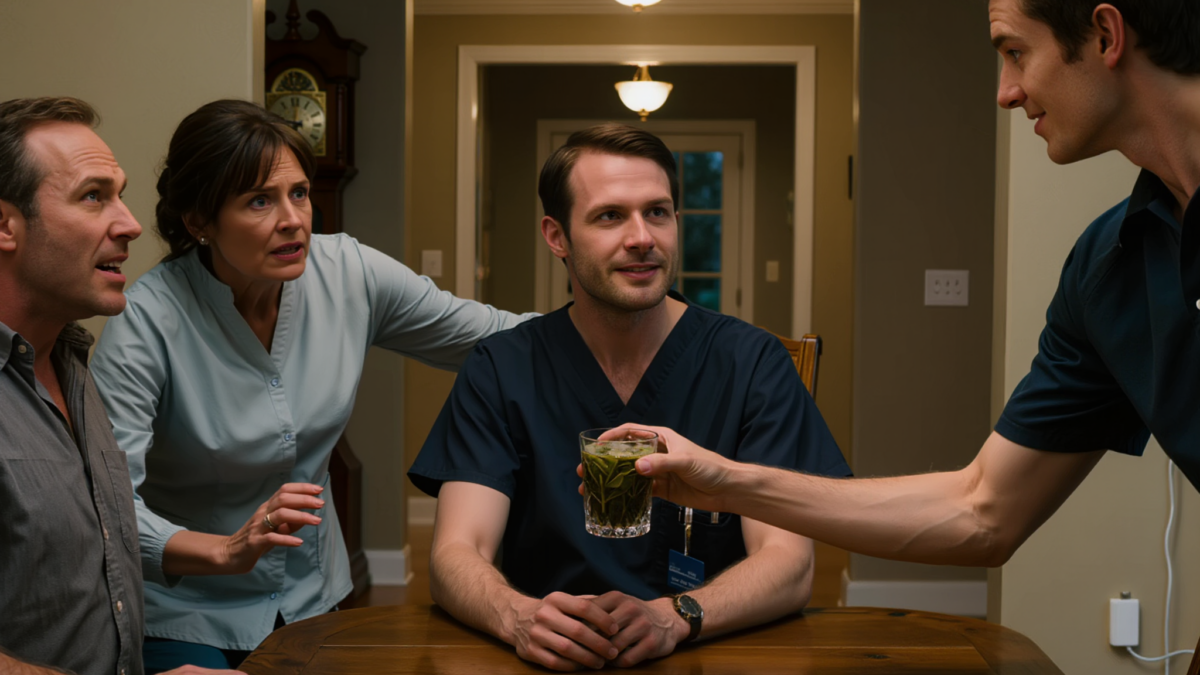
I’m Julian Vance, thirty-one years old, and ten minutes ago I watched my own mother crush a dangerous amount of prescription heart medication into the drink she intended to serve me at dinner.
I had spent years working punishing twelve-hour night shifts at the county hospital trauma center, often handing over most of my paycheck just to keep the bank from foreclosing on my parents’ suburban home. Yet whenever anyone questioned the arrangement, my parents repeated the same line.
“Julian owes this family his paycheck,” they would say. “Preston deserves the entire world.”
At every Thanksgiving dinner, surrounded by twenty-five relatives, they joked that I was the family workhorse—the dependable son who knew how to repair a leaking pipe, cover an overdue bill, and clean up everyone else’s mistakes, but apparently lacked the imagination to become a “real businessman” like my younger brother.
What they did not know was that I had installed a hidden camera inside an ordinary USB wall charger overlooking the kitchen.
They also did not know that the deed to the house they were sitting in was legally registered in my name.
And they certainly did not imagine that, before the night was over, the evidence recorded inside that house would place both of them in county custody, begging me to help them.
To understand how my brother ended up reaching across the dining table for the drink meant for me, you have to understand the family that raised us.
Condensation chilled my fingertips as I held the heavy crystal glass. I sat at the head of the oak dining table—the same table I had paid to have professionally refinished after Preston left permanent white rings across its surface with his beer cans.
My mother, Eleanor, sat across from me with her hands folded in her lap. She wore the pale blue blouse she usually saved for Sunday services, homeowners’ association luncheons, and any occasion when she wanted to look like the gentle suburban matriarch who spent her afternoons baking rhubarb pies and praying for the neighborhood.
“Drink up, Julian, sweetheart,” she said.
Her voice carried the thick, artificial sweetness she used whenever she was preparing to ask for money.
“It’s a special ginseng tonic. I bought it at that organic market downtown. It’s supposed to help with stress. You’ve been working so many exhausting hours at the hospital.”
She slid the dark green drink across the polished wood.
I did not blink.
Years of emergency-room training had taught me how to remain still when everything around me was falling apart. When a critical patient came through the trauma doors, panic was useless. You checked the monitor, controlled the bleeding, called for the appropriate medication, and documented every second.
That night, I was staring at a family emergency disguised as maternal concern.
My mother did not know that, ten minutes earlier, I had been sitting inside my parked car beneath a weeping willow two blocks away, watching a live encrypted feed on my phone.
I had seen her pull an amber prescription bottle from her woven leather handbag. I had watched her place a dangerous quantity of her late mother’s heart medication into a granite mortar and grind it into powder. Then she had stirred it into the thick green tonic now sitting in front of me.
The medication was digoxin, a powerful prescription drug used in carefully controlled doses for certain heart conditions. In the amount she had prepared, it could trigger a severe medical crisis.
She needed the proceeds from a two-million-dollar insurance policy taken out in my name.
My father, Richard, had promised an underground bookmaker that money was coming. Preston had accumulated a five-hundred-thousand-dollar gambling debt, and the men collecting it had given my father a deadline.
By nine o’clock the next morning, they wanted to be paid.
I lowered my gaze to the glass. The earthy smell of the ginseng masked anything unusual.
Then I looked to my left.
Preston was twenty-six, five years younger than me, and had been the center of our household from the day my parents brought him home from the maternity ward. He wore a spotless three-hundred-dollar designer polo I had indirectly purchased when I covered our mother’s overdrawn checking account the month before.
His bright blue eyes were fixed on my drink.
Preston possessed the emotional maturity of a territorial child. In his mind, anything expensive, exclusive, or placed in front of someone else naturally belonged to him.
I let a quiet smile appear.
Then I lifted the glass by the stem and swirled the tonic beneath the chandelier.
“Wow, Mom,” I said, making sure my voice carried across the table. “You finally bought the expensive stuff for me.”
Preston’s jaw tightened.
His manicured fingers twitched against his white linen napkin.
While he sat there resenting the idea that I had received a twenty-dollar health drink he had not been offered, I thought about the invisible caste system that had governed our family for as long as I could remember.
Every toxic household seemed to assign roles. In ours, there was the ornament and the foundation.
Preston was the ornament.
From childhood, he had been treated like a priceless porcelain piece that belonged behind glass. He was handsome and charming in a reckless, manipulative way, and he seemed entirely exempt from accountability.
When he failed his freshman college courses, my parents blamed his professors for not recognizing his potential.
When he totaled the used Honda Civic I had spent two summers saving to buy for him, my father took him out for a rib-eye dinner and blamed the city for failing to maintain the road.
At neighborhood block parties and Fourth of July barbecues, my parents introduced him as a future real-estate developer. His professional portfolio, in reality, consisted of sleeping until noon and losing borrowed money on crypto platforms and sports-betting apps.
I was the foundation.
Nobody praises the concrete beneath a house. They simply expect it to carry the entire structure without cracking.
I was the son who repaired the rusted plumbing in the downstairs bathroom because Richard had spent the maintenance budget at an off-track betting parlor. I was the one who logged into online banking to pay the credit cards Eleanor maxed out during what she called essential self-care trips to Cabo San Lucas.
For nearly thirty-one years, I had suffered from what I privately called good-son syndrome.
I believed that if I worked enough overtime, solved enough emergencies, and transferred enough of my biweekly pay into their accounts, my parents would eventually look at me with the same warmth they gave Preston.
I had confused being needed with being loved.
It is one of the most damaging traps a responsible child can fall into. You give, sacrifice, and erase your own boundaries until your entire identity disappears inside the work you perform for other people.
My parents interpreted my compliance as weakness. They believed I remained in their suffocating split-level home because I was desperate for their approval.
They treated me like a twenty-four-hour ATM that happened to hold a nursing license.
What Richard and Eleanor failed to understand was that while I paid their bills, I also saved every record.
Working in emergency medicine teaches you to document everything. I maintained an encrypted folder containing each bank transfer, cleared utility payment, mortgage contribution, and property-tax assessment I had covered since I turned twenty-two.
The blindfold did not gradually slip from my eyes. It was torn away sixty days earlier, on a freezing Tuesday evening that smelled of burnt hospital coffee and approaching snow.
That was the night I stopped seeing myself as their obedient son.
Two months before the dinner, I dragged my exhausted body up our cracked concrete driveway after another brutal twelve-hour shift at the county medical center. My feet felt like lead inside my white nursing clogs.
I had spent the last four hours helping resuscitate a cardiac-arrest patient while enduring a stream of criticism from Dr. Sterling, the hospital’s arrogant chief of cardiology. Earlier that day, he had denied me a senior triage promotion I had earned because he preferred agreeable administrators over nurses who challenged unsafe decisions.
All I wanted was a hot shower and six uninterrupted hours of sleep.
Then I reached the front porch and saw a neon-yellow legal notice taped over the brass peephole.
It was a formal foreclosure and sheriff’s-sale notice.
I stood in the biting evening wind, reading the dense legal language twice before I trusted myself to understand it.
According to the county clerk’s records, my father had failed to make the mortgage payment for six consecutive months. The property was forty-eight hours from being scheduled for public auction.
In two days, sheriff’s deputies could arrive and remove my childhood bed, my medical textbooks, and my mother’s antique display cabinets while the neighbors watched from their windows.
I pushed open the front door.
The atmosphere inside was frantic, suffocating, and theatrical.
Eleanor sat at the marble kitchen island, sobbing into a wad of paper towels. At first, I assumed she was grieving the possibility of losing our home.
Then I heard what she was saying.
“Where am I supposed to arrange the imported hydrangeas, Richard?”
Her voice cracked with dramatic despair.
“The garden club luncheon is next Tuesday. The ladies from the gated community will talk about this until Thanksgiving. We’ll be social outcasts. Our family name will be ruined.”
Richard paced across the Persian rug, his graying hair disheveled and his Oxford collar unbuttoned.
When he heard my nursing clogs on the hardwood, he did not apologize. He did not express shame for gambling away the mortgage or hiding the notices.
He stopped, pointed a trembling finger at my chest, and issued an order.
“Fix it, Julian.”
His tone was not that of a desperate father asking his son for help. It was the bark of a supervisor addressing an employee he considered replaceable.
“You’ve been hoarding your salary in that high-yield savings account for three years,” he continued. “I know you have the money. Wire the arrears to the bank’s legal department tomorrow morning.”
I stood motionless in the entryway.
The exhaustion disappeared from my body, replaced by a cold clarity.
For the first time in my adult life, I did not see Richard as a towering patriarch whose authority had to be respected. I saw a reckless, frightened man who would empty my life savings and then complain that I had not thanked him for the privilege.
“Do you have any idea what six months of missed payments, interest, and legal fees add up to?” I asked.
My voice sounded flatter than I expected.
“It’s fifty thousand dollars. That is my entire emergency fund. It’s the money I spent four years saving so I could enroll in a nurse-practitioner program.”
“Graduate school?” Richard scoffed.
He waved a hand at me.
“You already earn an adequate salary cleaning up bodily fluids. Your mother’s standing in this neighborhood is at risk. This household comes first. You owe us for the groceries you ate, the health insurance we provided, and the roof we put over your head.”
Eleanor briefly stopped crying and looked at me through mascara-stained lashes, waiting for my resistance to collapse.
Then I looked into the living room.
Preston was stretched across the sectional sofa, scrolling through dance videos on his new iPhone, apparently unconcerned that the bank was about to take the house around him.
“I’ll settle the account,” I said.
Richard released a heavy sigh and immediately resumed his familiar posture of superiority.
“Excellent. Put the wire confirmation on my desk by noon.”
“On one legal condition.”
His relief vanished.
“The three of us will meet Mrs. Higgins at her downtown notary office tomorrow at two. I’ll bring a certified cashier’s check for fifty thousand dollars. At the same time, both of you will sign an irrevocable quitclaim deed transferring one hundred percent of the property into my name.”
The living room became so quiet that I could hear the grandfather clock ticking in the hall.
Richard’s face darkened.
“Have you lost your mind?” he shouted. “You want to use a temporary cash-flow problem to steal our family home?”
“I’m purchasing the property, Richard.”
It was the first time I had deliberately denied him the title of Dad.
“The bank is about to seize it. You have a simple choice. Sign the deed, keep your dignity, and allow Eleanor to host her garden luncheon. Or start packing tonight. I’ll keep my fifty thousand dollars and use it as a down payment on a condo while the county takes possession of this house.”
They raged for nearly an hour.
Eleanor staged a breathless episode worthy of afternoon television. Richard accused me of betrayal, extortion, and elder abuse, though neither of them was elderly.
By one forty-five the following afternoon, both of them were sitting across from Mrs. Higgins.
She was an eighty-year-old notary with sharp eyes and a downtown office that smelled of peppermint lozenges, old paper, and binding glue.
My parents signed the transfer documents with shaking hands.
They signed because eviction was close.
More importantly, they signed because their arrogance convinced them the deed was only paper. They believed that because they still controlled the obedient version of Julian, they still controlled the property.
They assumed they could guilt me into transferring it back once the crisis passed.
Mrs. Higgins pressed her brass seal into the document and slid the finalized deed across the desk.
She held my gaze for a long moment.
That woman had spent half a century watching divorces, custody disputes, business collapses, and bitter probate battles. She did not need to speak. Her expression said everything.
Watch your back. These people are dangerous.
The notarized deed was the first barrier I placed between my family and my future.
The next one arrived two weeks later with the loud entrance of my father’s older sister.
Aunt Patricia was the family’s self-appointed enforcer. She wore heavy costume jewelry, applied lipstick in unforgiving shades of red, and left a trail of synthetic lavender perfume through every room she entered.
She swept into the kitchen without knocking and wrapped Preston in an embrace.
“I just know your new investment venture will be a success, honey,” she announced loudly enough for me to hear from the dining room. “You have the natural Vance entrepreneurial vision. Not everyone is equipped to be an innovator. Some people are simply meant to be worker bees.”
I was seated at the table, repairing the separated leather sole of my work boot with a curved surgical needle and thick nylon thread.
Patricia turned toward me.
“I heard about the legal stunt you pulled on your poor parents.”
She marched across the room and stood over my chair.
“Forcing your own flesh and blood to sign over their home because of one temporary financial problem is reprehensible. In a traditional American family, the eldest son honors his parents. He provides for their retirement. He doesn’t act like a greedy landlord.”
I kept my attention on the needle.
“If I hadn’t used my savings, your brother and sister-in-law would be living in your spare room. Are you offering to cover the property taxes, maintenance, mortgage, and utilities?”
Patricia’s mouth opened, then closed.
“That is beside the point. The issue is family loyalty. You have a cold, transactional heart, Julian. No wonder Chloe canceled the wedding.”
My hand froze.
Hearing Chloe’s name inside that house felt like a rusted blade turning beneath my ribs.
Two years earlier, Chloe and I had been ninety days from our wedding. We had reserved a small lakeside venue in upstate New York. I loved her with a quiet, protective devotion I had never known how to express properly.
One Sunday evening, I returned from the hospital and found her engagement ring on the kitchen counter beside a tear-stained letter.
She did not leave because our love had faded.
She left because she had discovered what marrying into the Vance family would cost her.
Without my knowledge, Richard had tracked her to the regional credit union where she worked as a senior commercial-loan underwriter.
He appeared in the lobby in tears and told her I was facing criminal prosecution over an old student debt. He claimed I needed twenty thousand dollars immediately to avoid jail.
Then he begged her not to tell me because I was supposedly too ashamed.
Chloe believed she was protecting me. She took out a high-interest personal loan and gave him the money.
It took her three months to discover that Richard had lost every dollar in illegal high-stakes poker games and that I knew nothing about the loan.
When she confronted him in our driveway, he laughed and told her that once she married into the Vance family, her paycheck would belong to the household.
Chloe looked at the reality of becoming my wife—a life in which my father felt entitled to lie to her, borrow against her future, and use my loyalty as leverage—and chose self-preservation.
I never blamed her.
When I confronted Richard for destroying my engagement, he shrugged, tossed peanuts into his mouth, and said, “If she was frightened by a little family financial sharing, she wasn’t strong enough to be a Vance wife. You saved yourself the cost of a divorce.”
Now, sitting at the dining table with Aunt Patricia sneering down at me, I noticed the contrast around us.
Preston lounged on the sectional, flipping the keys to a leased BMW my mother had cosigned for him. On his feet were three-hundred-dollar sneakers that had never touched hospital disinfectant, winter salt, or city grime.
I was a trained medical professional sewing my work shoe back together so fluids from the ICU floor would not soak through my sock.
I did not defend Chloe to Patricia. There was no point explaining decency to someone who treated empathy as weakness.
I cut the nylon thread with my medical shears, stood, and looked my aunt in the eye.
“You’re right about one thing, Patricia,” I said. “I am colder than I used to be. Remember that the next time your brother calls you for a financial bailout.”
I picked up my repaired boots and left the room.
The pain of losing Chloe did not disappear. It hardened into resolve.
I was finished serving as the family’s sacrifice.
At the time, I believed accepting that my parents were financial parasites was the lowest point I could reach.
I was wrong.
Two weeks later, the fragile truce in the house shattered.
It was a clear Friday evening. I entered the living room carrying a black leather portfolio containing the finalized deed, closing documents, and property-tax records.
Eleanor lowered her glossy interior-design magazine. Richard muted the postgame broadcast. Preston was in the kitchen searching the refrigerator.
“I have an announcement,” I said.
My voice carried across the open floor plan.
“I’ve closed on a two-bedroom condominium on the north side. The movers arrive on the first of next month. I am resigning as this household’s unpaid contractor, financial underwriter, and emergency service department.”
Richard’s hand stopped above a bowl of pretzels.
“What are you talking about? You own this house now. You can’t abandon your own investment.”
“I’m not abandoning it. I’m exercising my rights as the legal owner. I’ve hired a regional property-management company. Beginning on the first, this house will operate under a standard residential lease.”
I looked from one face to the next.
“If the three of you want to remain here, you’ll sign a twelve-month agreement and pay a total market rent of twenty-five hundred dollars per month through the management portal.”
Preston slammed a glass jar of mayonnaise onto the island and stormed into the living room.
“You’re going to charge your own family rent to live in our home?”
“It stopped being your home when I paid the bank and you signed the deed.”
“Where am I supposed to get twenty-five hundred dollars every month? My tech startup is entering a critical seed-funding round.”
“Apply at the Walmart distribution center down the highway,” I said. “They’re hiring evening cashiers and stock associates at sixteen dollars an hour. A forty-hour schedule will cover your portion of the rent and leave enough for your protein supplements.”
“Richard, do something,” Eleanor gasped, clutching her pearls. “He’s treating us like strangers after everything we sacrificed to put him through nursing school.”
Richard rose from his leather recliner.
His face settled into the intimidating expression he had used on me since childhood. He crossed the Persian rug and stood close, relying on his height to make me step back.
That tactic had worked when I was twelve.
It had less effect on a nurse accustomed to managing frightened, combative patients in a crowded emergency room.
“You ungrateful traitor,” he growled. “You think you can dismantle this family and walk away from your obligations? I am your father.”
“You were my financial dependent for nine years, Richard. There is a legal difference. That dependency ends in fourteen days.”
I turned toward the hallway.
My mother did not follow me. She did not cry over losing her eldest son. She did not ask whether my new condo had room for Thanksgiving or whether I would still come home for Christmas.
I heard the crisp rustle of her magazine reopening.
Then she asked, in a voice as detached as winter steel, “Who is going to pay the property tax next month?”
I stopped with my hand inches from the light switch.
A numb calm moved through me.
Any remaining sense of guilt dissolved.
To Eleanor, my departure was not the loss of a son. It was the breakdown of an appliance. A furnace that had stopped heating. A dishwasher that no longer drained. A bank account that refused to transfer funds.
I gave her no answer.
I stepped into the dark hallway feeling like someone who had finally found the exit from a locked building.
At two o’clock that night, the house was silent.
I needed a postage stamp for the change-of-address documents I planned to send to the state nursing board. Richard kept office supplies in the top drawer of his mahogany desk, so I crossed the hallway and entered his study.
The room smelled of stale cigar smoke, old ledgers, and leather conditioner.
I switched on a small medical penlight and eased open the drawer.
There were no stamps.
Instead, on top of a rubber-banded stack of delinquent credit-card statements, I found a heavy manila folder marked with a red insurance tab.
The contents changed the meaning of my entire life.
I opened the folder beneath the narrow beam of the penlight.
Inside was a life insurance policy with accidental-death coverage. The insured person was Julian Vance.
The total benefit was two million dollars.
I stood motionless in the stale darkness and searched the paperwork for the beneficiary.
A notarized amendment had been filed three weeks earlier.
The original beneficiary designation connected to my estate had been removed. Eleanor Vance was now listed to receive one hundred percent of the proceeds.
My hands trembled—not from panic, but from revulsion.
At the bottom of the authorization page was my name, written in blue ink.
The signature was not mine.
Years of reviewing surgical consent forms and clinical charts had trained my eye to notice inconsistencies in handwriting. The loops were too uniform. The pressure never changed. There was none of the natural acceleration or hesitation of a real signature.
It had been traced.
I moved the penlight closer and studied the capital J and the unfinished tail of the final e.
Then I recognized it.
The signature came from a hospital document I had signed when I was sixteen.
I had been lying in a preoperative bay at a children’s hospital, frightened and medicated, waiting for an emergency appendectomy. My mother had preserved the yellowing carbon copy of that consent form inside her fireproof safe for fifteen years.
I once assumed she kept it because it reminded her of a night she had nearly lost her son.
Now I understood.
She had preserved it because it gave her access to a clean sample of my teenage signature.
She had used a record of my childhood medical emergency as the key to a two-million-dollar policy on my adult life.
I held the crisp paper in the darkness and understood the arithmetic.
Alive, I was worth roughly eighty thousand dollars a year to my family through labor, bills, repairs, and financial rescue.
Dead, I was worth two million dollars at once.
My usefulness as a living provider had apparently reached its limit.
A different man might have kicked open his parents’ bedroom door and confronted them immediately.
I did not.
Emergency medicine had trained me to think differently. When you discover an aggressive disease, you do not disturb it without a plan. You determine its boundaries, gather the necessary information, and prepare for a clean removal.
If I confronted Richard and Eleanor, they would invent a story. They would call the policy an innocent investment, blame a paperwork error, hire an expensive attorney, and destroy the evidence.
A forged signature established fraud.
It did not yet establish that they intended to harm me.
I needed proof of intent.
I closed the folder and returned it to the exact position in which I had found it. Then I turned off the penlight and left the office.
At eight the next morning, I drove downtown to the apartment of my colleague Marcus.
Marcus was an attending emergency physician at the county medical center—a brilliant, blunt trauma doctor who had spent three years watching me arrive for shifts in worn scrubs after sleepless nights at home.
I sat across from him at his kitchen island and described the mortgage, the deed, the insurance policy, and the traced signature.
Marcus listened without interrupting.
When I finished, he went to a cabinet, poured two fingers of American bourbon into a tumbler, slid it toward me, and picked up his tablet.
“We don’t go to the police yet,” he said.
I stared at him.
“You’re telling me to wait?”
“I’m telling you what a defense attorney will say. Right now, you have a suspicious policy and a forged signature. That becomes a white-collar fraud case, and fraud cases move slowly. If you believe they intend to hurt you, you need evidence of preparation and delivery.”
He tapped the tablet.
“You need to document exactly what they do.”
Together, we drove to a surveillance-equipment store in a strip mall two districts away.
I did not buy an obvious home-security camera.
I purchased a forty-dollar USB wall charger that looked like an ordinary white charging block. Hidden above the port was a tiny wide-angle camera with audio and an encrypted cloud feed.
The following afternoon, while Eleanor was grocery shopping, I unplugged the toaster and placed the charger in the kitchen outlet overlooking the island.
When she returned with her shopping bags, I pointed toward it.
“Don’t unplug that charger. I’m using it for a backup hospital device.”
She barely glanced at the outlet.
To her, it was one more piece of electronic clutter installed by the household maintenance worker she happened to have given birth to.
I expected the camera to capture a conversation about the policy.
I hoped for enough evidence to prove fraud.
I had no idea that the little white charger would record a conspiracy involving an underground gambling debt, a planned insurance claim, and the moral collapse of both my parents.
Two hours before Eleanor served the green tonic, I was parked beneath the willow tree, watching the live feed.
The first thing I heard was the frantic rhythm of Richard’s shoes across the kitchen floor.
He paced beside the marble island with his phone on speaker.
The voice coming through the device was not that of a bank employee or collections agent. It was low, calm, and controlled.
“Monday morning, Richard,” the man said.
There was no office noise behind him. Only the slow clink of ice in a glass.
“Nine sharp. We receive five hundred thousand dollars in cleared funds, or the conversation ends and our people come to the house.”
Richard’s face lost its color.
He braced both hands against the island.
“Victor, listen to me. I need seventy-two more hours. I have assets. A two-million-dollar insurance claim will be submitted by Tuesday morning.”
“No more extensions.”
Victor’s tone did not change.
“Your son Preston ran up five hundred thousand on our private sports ledgers. He guaranteed the debt, and you cosigned it. You told us the Vance real-estate portfolio was liquid. Either the money is available by nine Monday morning, or your favorite son disappears. The choice is yours.”
The call ended.
I sat in my car gripping the steering wheel until my knuckles whitened.
Everything became clear at once.
The foreclosure had not come from inflation, a weak housing market, or a bad investment.
Preston—the family’s supposed entrepreneur—had accumulated a half-million-dollar gambling debt with dangerous people.
Rather than allow his favorite son to face the consequences, Richard had assumed the liability.
Then he had decided to sacrifice me.
He planned to exchange my life for Preston’s debt.
On the live feed, Richard set down the phone and turned toward Eleanor, who stood beside the pantry.
“We have to do it tonight,” he whispered. “Victor is serious. If we don’t have Julian’s death certificate and the insurance paperwork started by morning, they’ll come for Preston.”
Eleanor did not recoil.
She did not cry out or ask how her husband could suggest harming their firstborn son.
She reached into her woven handbag, removed the amber prescription bottle, and walked toward the granite mortar on the island.
I watched her remove the cap.
I watched her pour out the medication.
Then she began crushing it.
The microphone inside the charger was sensitive enough to capture the scrape of stone against stone.
What disturbed me most was not Eleanor’s action.
It was Richard’s response.
He walked out of the kitchen and lowered himself into his leather recliner in the adjoining living room. The wide-angle camera kept him visible in the corner of the frame.
As the grinding continued behind him, he picked up the television remote.
He did not turn around.
He did not tell her to stop.
He raised the volume of a daytime game show until canned applause and electronic bells drowned out the sound from the kitchen.
He was building a private excuse.
If he did not touch the medication, he could tell himself he had done nothing. If his hands did not prepare the drink, perhaps he could pretend he was only sitting in his chair while Eleanor solved the family’s problem.
But silence can be a decision.
His refusal to intervene was his signature on the plan.
I watched Eleanor mix the crushed medication into the ginseng tonic and pour it into my favorite crystal glass. Then she carefully wiped the rim with a clean paper towel.
I closed the surveillance application.
The phone screen went dark, leaving only my reflection inside the quiet car.
For five minutes, I listened to willow branches brush against the windshield.
I could have driven straight to police headquarters and handed detectives the recording.
But I understood what a skilled defense attorney might argue. Eleanor could claim the medication was hers. She could say the drink was intended for her. She could suggest confusion, stress, or declining memory.
Without proof that she served it to me and instructed me to drink it, the recording left room for doubt.
I needed the final act of delivery.
That decision was not brave. It was clinical.
I turned the ignition, drove back to the house, and parked in my usual space.
Before entering, I removed a black leather briefcase from the trunk and carried it inside. It contained five hundred thousand dollars in certified cashier’s checks drawn from corporate accounts my family knew nothing about.
Despite everything, I had arrived prepared to settle Preston’s debt and remove my parents from danger—provided they gave me one reason to believe there was still something human left in them.
I set the briefcase beside the brick fireplace.
Then I walked into the kitchen, kissed Eleanor’s powdered cheek, patted Richard on the shoulder, and sat at the head of the dining table.
That brought me back to the cold glass in my hand.
The dark green tonic moved slowly beneath the chandelier. Richard’s left leg bounced under the table. Every few seconds, his eyes shifted toward the grandfather clock in the hallway.
Nine hours remained until Victor’s deadline.
Nine hours until Richard either submitted the insurance claim or faced the people collecting Preston’s debt.
I raised the crystal glass toward my lips.
The room went silent.
Eleanor froze with her fork halfway to her mouth.
“Wow, Mom,” I said, closing my eyes as though savoring the aroma. “You finally bought the expensive stuff for me.”
As expected, Preston reached across the centerpiece.
I pulled the glass against my chest.
“Keep your hands off it,” I said sharply. “Mom bought this for my stress. You have an entire bottle of imported wine beside you. Drink your own.”
If I had offered him the tonic willingly, Preston might have become suspicious.
By protecting it, I transformed it into something he had to possess.
In the mind of an entitled child, a boundary is not a request for respect. It is a challenge that must be defeated.
Preston shoved back his chair. The legs scraped across the hardwood.
“You are such an arrogant jerk, Julian.”
He leaned over the centerpiece.
“You sit there acting like you own the air because your paycheck covered a few bills. Mom pays for everything in this house. Technically, that tonic belongs to the family. That means it belongs to me too.”
“Preston, sit down,” Eleanor said.
Her voice cracked.
She dropped her fork. It struck the porcelain plate with a sharp clatter.
Then she looked at Richard.
“Stop him.”
Richard did not move.
His eyes traveled from Eleanor’s terrified face to Preston’s outstretched hand, then settled on the grandfather clock.
I could almost see the calculation taking place behind his forehead.
If he knocked the glass away, the conspiracy would collapse. I would know the drink was dangerous. I would leave, secure the evidence, and terminate all financial support.
Morning would arrive.
Victor’s men would come.
Richard needed an insurance claim, and he had decided that any loss inside the family was preferable to his own.
I watched my father conclude that his safety mattered more than the life of the son he had spent twenty-six years calling his golden child.
“Let your brother have a sip,” Richard said.
His voice was flat.
“Don’t be selfish, Julian.”
Eleanor stared at him.
“Richard, what are you saying?”
For the first time, she appeared to understand the truth about the man beside her.
There was no loyalty among people who valued everyone according to usefulness.
I turned back to Preston.
He smiled with the smug satisfaction of someone who believed he had won another small family battle. He thought he was forcing his older brother back into his assigned place.
He had no idea what he was fighting to take.
“Fine,” I said.
I opened my hand around the stem.
“If you want it that badly, take it.”
Preston snatched the glass off the table and pulled it against his chest.
“Mine,” he said.
Eleanor lunged across the plates.
“Preston, no. Don’t drink that.”
Before she could strike the glass from his hand, Richard reached beneath the tablecloth and locked his fingers around her wrist.
Eleanor stopped.
Her eyes met his.
An entire conversation passed between them without words.
If she knocked the drink away, Julian would survive. The insurance claim would fail. Victor would still arrive in the morning.
Richard tightened his grip and forced her arm down.
A small, broken sound escaped her.
Then she sank into her chair, tears moving silently through her makeup.
Preston misread everything.
He assumed Eleanor was staging one of her familiar scenes over an expensive grocery item.
“You people are unbelievable,” he said. “It’s an organic health drink.”
He lifted the glass.
Then, while looking directly at me with a triumphant smile, he swallowed a long mouthful.
I watched the green liquid disappear.
There was a cruel irony in it.
Preston was not in danger because of one impulsive choice at one dinner. He was in danger because my parents had trained him from childhood to take whatever he wanted.
They had taught him that ownership did not apply to him, that boundaries were insults, and that my protests were background noise.
Richard and Eleanor had spent twenty-six years constructing the behavior that placed the glass in his hand.
I had only allowed their creation to move on its own.
Preston set the glass down and wiped his mouth.
“That is incredibly bitter,” he complained. “I don’t know why you were hoarding it. It tastes awful.”
“It’s an acquired taste,” I said.
I picked up my knife and returned to my roasted vegetables.
The next twenty-two minutes passed with unnatural slowness.
The brass pendulum in the hall swung back and forth.
Tick.
Tock.
Silverware scraped against porcelain.
Richard ate his roasted chicken too quickly, as if chewing faster might outrun the consequences.
Eleanor did not take another bite. She sat rigid, staring at Preston and flinching whenever he moved.
I controlled my breathing and waited.
Exactly twenty-two minutes after he drank the tonic, Preston’s hand slipped from the edge of the table.
His fork struck his plate.
He blinked several times and rubbed his eyes.
“That’s strange,” he murmured.
His speech had begun to thicken.
He squinted at the chandelier.
“Why do the lights have yellow halos?”
My clinical mind recognized the warning immediately.
Visual disturbance. Altered perception. A dangerous reaction consistent with digoxin toxicity.
Richard forced a smile.
“It’s nothing, Preston. You’ve been staring at your phone all day. Eat your dinner.”
Preston shook his head.
His breathing grew shallow.
“No. I feel—”
He did not finish.
His body folded forward. He became violently ill across the tablecloth, then slid from the chair and collapsed onto the hardwood.
His designer sneakers twitched against the edge of the Persian rug before his body went frighteningly still.
Eleanor knocked over her chair and dropped beside him.
“Preston!”
She grabbed his pale hand and pressed it against her blouse.
“Richard, call 911. He’s dying.”
Richard pulled out his phone. His hands shook so badly that he nearly dropped it.
Even while dialing, he kept looking at me.
He was not watching his critically ill son. He was watching the only medically trained witness in the room.
When the dispatcher answered, Richard gave our address and immediately began building a false story.
“My youngest son is having a severe reaction,” he said in an exaggerated panic. “He must have eaten contaminated food. It’s food poisoning. He’s vomiting and losing consciousness. Send an ambulance.”
I remained seated, watching him.
After he ended the call, I spoke.
“Food poisoning, Richard?”
Eleanor’s sobbing quieted enough for him to hear me clearly.
“That is the medical history you just gave the dispatcher?”
“It must be food poisoning,” he stammered. “He was out eating with associates this afternoon.”
I stood and placed both hands on the table.
“If the paramedics treat this as a routine foodborne illness, they’ll begin with fluids and medication for nausea. They’ll lose critical time. Preston’s heart does not have time to spare.”
Eleanor rocked over him.
“Oh God, Julian. Help him. You’re a nurse. Do something.”
“Tell the paramedics what he actually took.”
I looked at Richard.
“Tell them the truth the moment they enter this house.”
“I don’t know what you’re talking about,” he shouted.
His voice was too loud and too fast.
Admitting the truth meant admitting there was a dangerous prescription drug inside the house. It meant questions, searches, investigators, and criminal charges.
Whatever fear Victor had placed inside Richard outweighed even his instinct to save Preston.
I walked around the table and stood over my brother.
His lips had begun to lose their color.
“His heart rate is falling,” I said. “You have only minutes before a lack of oxygen causes permanent damage.”
I looked directly at Eleanor.
“What prescription medication did he ingest?”
“Nothing,” she screamed. “He didn’t take anything.”
“Stop lying.”
My voice struck the room with enough authority to silence everyone.
I reached into my pocket, unlocked my phone, and opened the video.
Then I held the screen inches from Eleanor’s face.
The footage was clear.
The marble island.
The amber bottle.
The granite mortar.
Her hands crushing the pills.
The powder disappearing into the dark green tonic.
And, in the corner of the frame, Richard sitting in his recliner and raising the television volume to drown out the sound.
Eleanor’s eyes widened.
Richard staggered backward into the archway.
“You recorded us?” he whispered.
“I recorded the preparation,” I said. “I also recorded you restraining Eleanor while Preston took the drink.”
Outside, sirens grew louder along our quiet suburban street. Red and blue light began moving across the front windows.
“The emergency team will be through that door in less than two minutes,” I said. “You have two choices.”
I angled the phone so Richard could see his own image on the screen.
“Option one: you maintain the food-poisoning story. Preston’s condition continues to deteriorate while I hand this unedited recording to homicide detectives. You will be explaining attempted murder, insurance fraud, forgery, and conspiracy.”
I waited.
“Option two: you tell the paramedics exactly what he took. They administer the correct antidote immediately. Preston has a chance to survive, and the two of you answer for what you did.”
Eleanor looked down at Preston’s shallow breathing.
Then she looked at the video and finally at Richard.
His expression silently ordered her to remain quiet.
Think about Victor. Think about the money. Think about the claim.
But something inside Eleanor cracked.
For thirty years she had valued appearances, status, and money over almost everything else. Now she was watching her favorite child turn gray beneath her hands.
“It was digoxin,” she screamed.
Her voice broke.
“It was my mother’s heart medication. Please, Julian. Save him.”
The front door flew open.
A team of paramedics rushed through the entryway carrying monitors, oxygen, and emergency equipment. Two uniformed police officers followed close behind.
“He’s here,” Eleanor cried, waving them toward the dining room. “He ingested prescription heart medication. He needs the antidote.”
I stepped back into the archway and allowed the room to become an emergency treatment space.
Boots moved across the hardwood.
Clipped medical commands replaced the family’s shouting.
An IV line was established. Oxygen was applied. A portable cardiac monitor began reporting the truth in sharp electronic tones.
Once the team stabilized Preston enough to move him toward the ambulance, I approached the senior police officer in the entryway.
“I’m the reporting witness,” I said.
I placed a high-capacity USB drive in his hand.
“This contains the original surveillance footage. Pay particular attention to the section where my father restrains my mother to prevent her from stopping the ingestion.”
The officer’s expression changed.
He closed his hand around the drive and looked at Richard.
The police did not waste time with polite questions.
They separated my parents and issued firm commands.
Richard and Eleanor were turned toward the dining table. Steel handcuffs closed around their wrists.
As the officers escorted them toward the front door, Richard abandoned his frightened performance and returned to rage.
He dug his heels into the floor, twisted toward me, and shouted, “You cold-blooded, ungrateful landlord. You set us up. You ruined this family. You owe us for your education. You owe us your salary. You owe us this house.”
I did not defend myself.
I stood beneath the chandelier and watched his authority collapse against a set of handcuffs.
Then the front door opened again.
Arthur Pendleton stepped into the foyer, followed by his executive assistant.
Arthur wore an immaculate charcoal suit and carried himself with the quiet certainty of a man accustomed to entering boardrooms where everyone already knew his name.
He was a billionaire investor, real-estate developer, and regional business figure whom my family believed was merely one of the demanding executives connected to my medical work.
The officers paused when they recognized him.
Richard stared in confusion.
Arthur looked first at the handcuffs, then at my father.
“Julian Vance is not a minor employee in one of my companies,” he said.
His voice was smooth and restrained.
“He is the cofounder, majority shareholder, and managing director of Pendleton Concierge Medical Services. He designed the private medical network that serves many of this region’s senior executives.”
Richard’s mouth fell open.
My family had never asked about the long hours I spent outside the hospital. They assumed every late meeting, business call, and tailored suit belonged to someone more important than me.
I had continued working frontline shifts because I believed a medical company should be led by someone who still understood what happened inside an emergency room at three in the morning.
I had also learned long ago that discussing success inside the Vance household only invited new demands.
Arthur’s gaze shifted to the black leather briefcase beside the fireplace.
“That briefcase does not contain nursing charts,” he continued. “It contains five hundred thousand dollars in certified cashier’s checks drawn from Julian’s corporate accounts.”
Richard’s face changed.
“Julian brought those funds here tonight to satisfy Preston’s gambling debt before tomorrow’s deadline. He intended the payment as a final act of generosity toward the parents who raised him.”
Arthur paused.
Then he looked at Richard with open disgust.
“You attempted to destroy the one person who had already prepared to save all of you.”
The color drained from Richard’s face.
His knees weakened, and the officer holding his arm had to steady him.
He had not merely lost the house.
He had not merely placed himself in legal jeopardy.
He had thrown away a multimillion-dollar source of support sitting ten feet from his favorite recliner.
“Julian,” he whispered. “Son, please. Call your lawyer. Help us.”
I looked at the officers.
“Please remove them from my property.”
Richard and Eleanor were taken across the porch and placed in separate patrol cars.
The oak front door closed behind them.
Three weeks later, I entered the intensive care unit at the regional medical center and walked into room 412.
The air was cold and sterile, carrying the familiar scent of rubbing alcohol, floor cleaner, and filtered oxygen.
Preston lay in the mechanical hospital bed.
He had survived the acute toxic reaction, but the physicians had been blunt about how close he came to permanent heart damage. A delay of another minute might have changed the outcome.
He had spent fourteen days in a medically induced coma on a ventilator.
The man who woke was not the same brother who had leaned across the dinner table.
His skin was pale without the expensive tanning products he normally used. His hands were bruised from repeated IV access. His frame looked smaller, stripped of the athletic posture he used to dominate a room.
I pulled a vinyl chair beside the bed.
I did not ask how he felt.
I unlocked my tablet, opened the original surveillance file, and placed it on his lap.
Preston watched in silence.
He saw Eleanor empty the prescription bottle into the mortar.
He watched her prepare the tonic.
Then the recording reached the dinner table.
His hollow blue eyes widened as he saw our mother lunge to knock the glass away—and our father seize her wrist beneath the tablecloth.
He studied Richard’s face.
He understood the decision written there.
Let him drink it. We still need the insurance money.
Tears filled Preston’s eyes and moved down his cheeks into the collar of his hospital gown.
The crown of the golden child shattered in room 412.
For the first time in twenty-six years, Preston understood that he had never been protected because of who he was.
He had been displayed.
He had been praised because his appearance and confidence made our parents feel successful. The moment his gambling debt threatened their comfort, even he became disposable.
Preston lifted one trembling hand and paused the video on the frame showing Richard’s white knuckles around Eleanor’s wrist.
“Julian,” he whispered.
His voice contained none of its old arrogance.
“Do you remember Buster?”
My heart gave an involuntary jolt.
Buster had been a golden retriever puppy I bought during my sophomore year of nursing school. He was loyal, affectionate, and unusually intelligent. He slept at the foot of my bed while I highlighted anatomy textbooks and prepared for clinical exams.
When Buster was three, I returned from a forty-eight-hour weekend rotation and found his crate empty.
Eleanor cried as she told me he had suffered a sudden congenital heart problem in the backyard. She claimed animal control had already removed him.
I grieved for that dog with a depth my family mocked.
“What do you know about Buster?” I asked.
My voice had gone still.
Preston wiped his eyes with his forearm.
“Mom lied.”
He struggled to continue.
“It happened during one of her garden-club luncheons. Buster was locked in the laundry room, and he kept barking at the mail carrier through the window. The noise was interrupting her tea.”
Preston closed his eyes.
“I was twelve. I was sitting on the staircase landing. I watched her take Grandma’s heart medication from the cabinet and lace a piece of meat with it.”
His breath caught.
“She gave it to Buster. He collapsed in the laundry room and never recovered. I stayed quiet because Mom bought me a new PlayStation the next morning.”
I sat motionless, staring at the white hospital wall.
Eleanor had not suddenly crossed a line two months earlier.
She had crossed it years ago.
She had treated another living creature’s heartbeat as an inconvenience to be managed because a barking dog threatened the image of a perfect suburban luncheon.
The revelation did not break my resolve.
It sealed it.
“The state prosecutors are offering you immunity regarding parts of the gambling investigation,” I said. “In exchange, you’ll give a sworn deposition and testify against Richard and Eleanor.”
Preston looked at me.
“You’ll describe the debt, the dinner, the recording, and what happened to Buster.”
He nodded without hesitation.
“I’ll testify. I’ll tell them everything.”
It was the first accountable decision I had ever seen my brother make.
Three months later, the criminal trial began in Superior Court.
The lead prosecutor, Sarah Jenkins, rejected every attempt by the defense to frame the case as a misunderstanding, a confused family arrangement, or a moment of diminished judgment.
The recording established preparation.
The forged insurance documents established motive.
The dinner footage established delivery and Richard’s decision to prevent Eleanor from intervening.
Preston’s testimony connected the gambling debt to the plan and revealed the older pattern of cruelty.
By the time he described Buster from the witness stand, whatever sympathy remained in the courtroom disappeared.
Richard and Eleanor Vance were convicted on every major count.
The judge sentenced each of them to twenty-five years in state prison without the possibility of parole.
When the gavel struck, I felt no triumph.
Only release.
As the sole registered owner of the suburban property, I had the legal right to keep the house, renovate it, or rent it.
I chose none of those things.
I could not imagine breathing inside rooms that still carried their voices.
The next morning, a professional demolition and environmental-cleanout crew arrived on the cracked concrete driveway.
Workers removed the refinished dining table where the drink had been served. They dismantled the mahogany desk that had concealed the forged insurance policy. They stripped walls, cabinets, carpets, and fixtures until the split-level structure stood open to its framing.
Then an excavator moved toward the white fence around Eleanor’s front garden.
For decades, she had leaned against that fence and waved to neighbors, presenting herself as the gracious heart of an ideal American family.
The hydraulic claw closed around the painted slats.
The fence came down.
The imported hydrangeas disappeared beneath the cleanup equipment.
That same afternoon, I listed the cleared parcel below market value. I wanted no prolonged negotiation and no sentimental attachment to the dirt.
The sale closed in seventy-two hours.
Not long afterward, I sat in the international business-class lounge at JFK’s Terminal 4.
The lounge was quiet compared with the crowded concourses below. The air smelled of roasted espresso and leather upholstery.
From a wingback chair overlooking Gate 14, I watched passenger jets accelerate along the runway and rise toward destinations chosen by the people onboard.
I opened the mobile banking application on my phone.
The real-estate proceeds had cleared. Combined with quarterly distributions from Pendleton Concierge Medical Services, they pushed my liquid reserves beyond the multimillion-dollar threshold.
For the first time, I could look at the balance without mentally subtracting a parent’s overdue mortgage, a brother’s damaged car, a maxed-out credit card, or a utility bill no one had bothered to pay.
I had enough capital to establish a new concierge medical facility in any city I chose.
I closed the banking application and opened my contacts.
Richard Vance appeared first.
I did not review old messages or listen to saved voice mails.
I pressed Delete Contact.
His name disappeared.
I scrolled to Eleanor Vance.
Delete Contact.
Then I reached Preston.
My thumb paused above the screen.
I did not delete him.
I also did not call.
I swiped left and selected Archive Contact, removing him from my active list and placing his information in a separate folder.
That small digital action represented the boundary I intended to maintain.
I could forgive Preston for participating in the family system that shaped us without inviting him back into my finances, my home, or the center of my life.
If he rebuilt himself through honest work, accepted the consequences of his gambling, and learned to live without someone rescuing him, I would be glad from a distance.
But my bank accounts, emotional reserves, and front door were closed.
I locked the phone and slipped it into the breast pocket of my jacket.
Then I looked at the worn black band of my smartwatch—the same device I had used in the car to watch Eleanor prepare the drink.
I unfastened it from my wrist, crossed the lounge, and dropped it into a stainless-steel trash receptacle.
It landed against the liner with a soft, final sound.
Julian Vance, the family utility, had ceased to exist.
For years, people around me had repeated the same romantic idea: blood was thicker than water, family came first, and a good son absorbed every financial mistake and emotional injury without complaint.
Relatives like Aunt Patricia dressed exploitation in the language of loyalty. They called boundaries selfish. They called receipts insulting. They treated independence as betrayal.
I finally understood that none of it was sacred.
I could not choose the people who brought me home from the hospital as an infant, but I could choose whether they were permitted to consume the rest of my life.
I had the right to demand records.
I had the right to protect the roof I paid for.
I had the right to walk away from people who viewed my compassion as an unlimited financial resource.
The most decisive act of self-preservation did not require shouting across a suburban living room. It did not require revenge or another dramatic confrontation.
Sometimes it was nothing more than pushing back a dining chair, standing at full height, walking through the front door, and refusing to take one more sip of what a toxic family kept trying to pour into your life.
They could keep their appearances, their excuses, and their empty garden-club reputation.
I had a flight to catch.
And I would never again apologize for protecting my own existence.








