My mother emptied the $41,000 account Grandma had guarded for me and handed it to my half-brother for his failing restaurant. “His business is drowning. Your little savings can wait,” she said while my stepfather nodded. I stayed quiet. Three weeks later, Grandma’s executor gathered us around the same kitchen table, stopped Mom’s settlement papers, opened an older folder, and read the first line aloud.
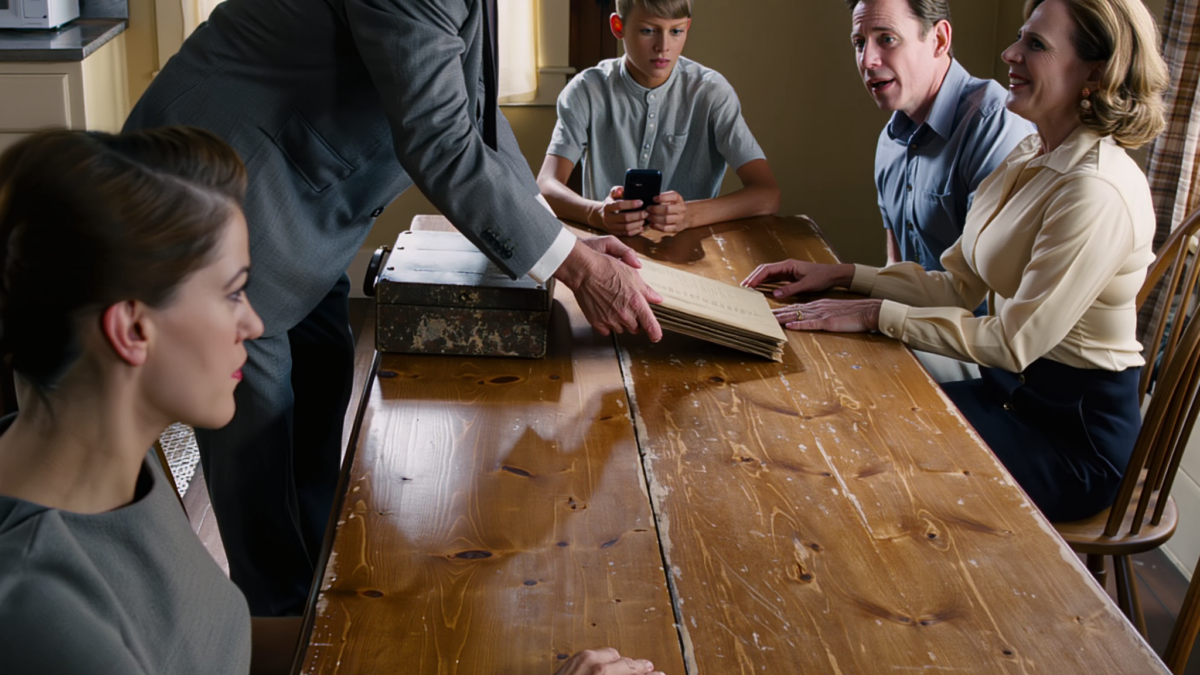
Ten minutes into clearing out my grandmother’s house, my mother pressed a check for $41,000 into my brother’s hand.
My money. The account Grandma had left in my name.
“His business is drowning,” she said. “Your little savings can wait.”
My stepfather, Gary, nodded along, his pen still warm from the paperwork spread across the kitchen table.
I stood thirty feet away holding a box of Grandma’s things. I didn’t argue. I didn’t beg. I simply closed the box.
Near the end of her life, my grandmother had told me something quietly and carefully, meant only for me.
And I knew this was far from finished.
Three weeks later, her executor gathered all of us around that same kitchen table. My mother walked in smiling, certain she knew how the afternoon would end.
Then he opened a folder and began to read.
My name is Thea Linfist. I’m 34, and I’ve spent eleven years as an ICU nurse. My job taught me how to keep my face still while everything inside me was moving too fast.
My mother had mistaken that stillness for weakness my entire life.
Standing in Grandma’s front room that afternoon, watching my half-brother Cody fold the check into his back pocket, I let her keep believing it.
Because the quietest thing in that house wasn’t me.
It was the promise my grandmother had already put in motion.
The morning Grandma died was a Tuesday in June.
I was nearing the end of a twelve-hour shift when the call came, and I knew before I answered. You develop a sense for certain calls in my line of work.
My grandmother, Ruth Linfist, was 81. She had held on four days longer than her doctors expected, stubborn right down to the end.
I think she was waiting for me.
I drove straight from the hospital in my scrubs. I didn’t change or stop anywhere.
When I reached hospice, the nurse on duty met me in the hallway and gave me the kind of small nod nurses give each other when there is nothing useful left to say.
I had made it in time, but barely.
Grandma’s room smelled like the lavender lotion she had used for as long as I could remember.
Her hand was paper-thin and cool when I took it, but her eyes were still sharp.
“There’s my girl,” she said.
Her voice was barely a thread.
“There’s my Thea.”
I sat on the edge of the bed and held her hand. I told her I was there and wasn’t going anywhere. I told her she could rest.
Those are the things you learn to say.
She shook her head slowly.
“Not yet,” she whispered. “Listen to me first.”
I leaned closer.
What she said next didn’t make sense to me then. I thought maybe it was the medication or the fog that can come near the end.
It wasn’t.
Every word had been deliberate.
She had been carrying them for years, waiting for the right moment, and this was the last moment she had.
Then she pressed something into my palm and closed my fingers around it.
Before I explain what it was, you need to understand the family she was leaving me with.
My father, Daniel Linfist, died when I was six.
Grandma Ruth was his mother.
I have exactly four clear memories of him.
His laugh, which seemed to come from somewhere deep in his chest.
The scratch of his weekend beard against my cheek.
The way he would lift me onto his shoulders so I could touch the top of a doorway.
And the lake.
A green, still lake where he would hold me above the water and pretend to drop me. I would shriek, cling to him, and immediately beg him to do it again.
Four memories for an entire father.
He died in December 1998 on an icy highway while driving home from a job two counties away.
He was 32.
I was in first grade.
I remember my mother screaming in a way I had never heard an adult scream.
Then, very quickly, I remember her stopping.
My mother’s name is Rhonda.
If there is one thing to understand about her, it is that she does not linger in grief.
She reorganizes around it.
Within two years, she met Gary Marsh at the insurance office where she had taken a job.
Within three, she married him.
And within about a week of their wedding, every photograph of my father disappeared from the walls of our house.
I was eight.
I remember standing in the hallway staring at the pale rectangles left behind on the paint where his photographs had hung.
I asked where they had gone.
Mom told me the pictures had been put somewhere safe. Then she told me Gary was my father now and that it wasn’t kind to make him feel like a stranger in his own home.
I never saw those photographs in our house again.
When Cody was born, the erasing felt complete.
They were the Marsh family: Rhonda, Gary, and Cody.
And then there was me, Thea Linfist, the girl with the different last name, the leftover from a story nobody wanted to tell anymore.
I wish I could say my mother was simply cruel. That would make everything easier to explain.
What she actually did was decide very early which of her children represented the future and which represented the past.
She never really hid the distinction.
Cody got a new bike.
I got Cody’s old one repainted.
Cody got braces.
I was told my teeth were fine.
“Honey, don’t be vain.”
Cody got a college fund.
I got a folder of loan applications and a speech about how nurses could always find work.
I’m not saying that for pity.
I’m saying it because you need to understand the arithmetic I grew up inside.
In my mother’s math, I was always the number that could be subtracted.
Grandma’s house was the one place where that math didn’t apply.
Ruth never let go of me the way my mother had let go of Daniel.
Every other Sunday through most of my childhood, Grandma would pull up in her old sedan and take me to her house for the afternoon.
Her home smelled like lavender and fresh cookies.
And her walls were covered in the photographs my mother had removed from ours.
That was where I watched my father grow up.
Daniel as a boy.
Daniel graduating.
Daniel holding me the day I was born.
Daniel with me on his shoulders at that green lake.
“Don’t you let them tell you he wasn’t real,” Grandma would say, tapping one of the frames. “He was the best thing I ever made. And you’re the best thing he ever made. Don’t you forget it.”
I never did.
Which brings me back to the object she pressed into my hand in hospice.
A small, cool weight.
The funeral was that Friday.
Mom organized everything in two days, which should have warned me.
Rhonda is rarely that efficient unless she believes efficiency benefits her.
She wore navy instead of black and stood near the front of the chapel accepting condolences with a soft, brave smile.
She told the pastor Ruth had been like a second mother to her.
I nearly laughed from the pew.
Grandma and my mother had barely tolerated each other for decades.
Cody arrived forty minutes late in a wrinkled dress shirt, smelling faintly like the night before.
He was 25 by then.
Two years earlier, Gary had co-signed a lease and a stack of loans so Cody could open a gastropub downtown called Copperline Kitchen.
The restaurant had beautiful social media photos.
From everything I had heard, it also lost money constantly.
At the funeral reception in the church basement, I watched my family the same way I watch monitors beside a hospital bed.
Looking for the thing about to go wrong.
Gary said it first.
He was standing near the coffee urn and apparently thought I couldn’t hear him.
“So the estate,” he murmured to Mom. “How long does that take to shake loose?”
My mother didn’t even lower her voice.
“There’s the house and whatever she was sitting on in the bank.”
She paused.
“Ruth always claimed she had something set aside for the girl. We’ll see about that.”
The girl.
I was 34 and standing fifteen feet away.
I put down my coffee without saying anything.
In my pocket, I could feel the small object Grandma had pressed into my palm.
You have no idea what she set aside, I thought.
Neither did I.
That night I finally examined the object carefully.
It was a key.
Small, old, brass, and worn smooth around the edges.
A faded blue ribbon had been tied through it, the kind of ribbon someone might once have worn in her hair.
It wasn’t a house key or a car key.
It was smaller and more specific.
I sat at my kitchen table and turned it under the light. Numbers had been stamped into the head, though they were almost rubbed away.
Then I heard Grandma’s hospice-room whisper again.
“Everything your father tried to do for you is still there, Thea. She never got to it. I made sure. When the time is right, the man will tell you the rest.”
“The man?” I had asked. “What man?”
But she had already been drifting.
Those were among the last clear words she ever said to me.
I barely slept.
The next morning, the key sat on my nightstand catching the light.
It felt as though Grandma had handed me one corner of something enormous and left me to find the rest in the dark.
The day after the funeral, Mom announced a family workday to clear out Grandma’s house.
I should have understood immediately what that meant.
I arrived at nine on Saturday morning.
Mom’s SUV was already in the driveway with the hatch open. Gary’s truck was behind it. Cody’s leased sports car, which Copperline Kitchen could not possibly afford comfortably, was parked crooked across the lawn.
Inside, they were not packing.
They were harvesting.
Mom carried a legal pad from room to room assigning things.
The good china to herself.
The dining set to Cody’s restaurant.
“It’s basically vintage,” she said. “It’ll photograph great.”
Gary was already disconnecting Grandma’s television.
Then I saw my father’s wall.
Bare.
The frames had been stacked face down inside a cardboard box near the door like trash waiting for collection.
I went to the box first.
The top photograph showed Dad at about twelve years old, gap-toothed and proudly holding up a fish.
I must have stared too long.
“Oh, don’t get sentimental,” Mom said as she passed. “We’re not keeping all that. It’s just clutter, Thea.”
Clutter.
Every photograph of her dead husband.
My dead father.
Clutter.
Then I noticed the paperwork spread across Grandma’s kitchen table.
Bank statements.
Her checkbook.
A printed transfer form, partly completed.
That was when I understood what the workday really was.
Before I could say anything, Mom walked to the counter, picked up a check she had already prepared, and pressed it into Cody’s hand.
$41,000.
“His business is drowning,” she said. “Your little savings can wait.”
Gary nodded.
Cody took the check.
I closed the box of photographs.
Then I walked outside.
I sat in my car with both hands on the steering wheel and didn’t start the engine for a long time.
I wasn’t thinking only about the money.
I was thinking about the brass key tied to a faded blue ribbon.
About an account nobody had ever properly explained to me.
About Grandma’s words.
She never got to it.
I made sure.
Mom had just handed away $41,000.
But Grandma had said everything your father tried to do for you was still there.
Forty-one thousand dollars didn’t feel like everything.
It felt like one piece.
So instead of driving home, I drove toward the only person left who might understand what Grandma had been protecting.
My aunt Rosemary was my father’s older sister.
She was 63, had never married, and lived ninety minutes north in a house filled with books and rescued cats.
She was also my only remaining blood relative on Dad’s side.
Rosemary and Mom despised each other with impressive consistency.
That was exactly why Mom hadn’t invited her to the family workday.
I called Rosemary from the road.
She answered on the first ring.
“Thea, I’ve been thinking about you all week.”
I told her where I was.
Then I told her about the check.
The $41,000.
Mom calling it my little savings.
The line went quiet.
Then Rosemary asked a question that made me pull onto the shoulder.
“Thea, is that account still in your grandmother’s name, or did your father’s money finally get moved?”
I gripped the phone.
“My father’s money?”
I heard my own voice slow down.
“What money?”
There was another silence.
“Oh, honey,” Rosemary said. “Sit down. You don’t know, do you? She never told you.”
I told her I was already sitting.
Then I asked her to please just talk.
Rosemary, like Grandma, was careful.
She didn’t dump the whole story on me.
Instead, she asked one question.
“Did she give you anything before the end? Did Mom give you something to keep?”
My hand went toward the key in my pocket.
“A key,” I said. “On the blue ribbon. I don’t know what it opens.”
Rosemary exhaled slowly.
“Then she did it.”
“What?”
“She actually did it. That woman, even dying, she was three moves ahead of them.”
“Ahead of who? Rosemary, please.”
“I can’t tell you the whole thing over the phone. I promised her I wouldn’t be the one. She wanted it to come from the paper, in front of them. She was very specific about that.”
She paused.
“But I’ll tell you this much so you can breathe. That account your mother just raided was never really your grandmother’s money to begin with. And it was never your mother’s to touch.”
I didn’t understand.
Not yet.
Then Rosemary told me about the safe deposit box.
Grandma had maintained it for twenty-eight years.
The key I was holding opened it.
“Everything’s in there,” Rosemary said. “Everything he left you. The proof of what it is, where it came from, and who it was always meant for.”
Twenty-eight years.
My father had died twenty-eight years earlier.
“Why didn’t she just give it to me?” I asked.
For the first time, my voice cracked.
“All these years. Why keep it locked away?”
Rosemary’s answer made the whole thing begin to make sense.
“Because if she’d handed you cash at eighteen or twenty-five, your mother would have found a way to get her hands on it inside a month. You know she would. Ruth knew it too.”
She paused.
“She didn’t hold it to keep it from you, sweetheart. She held it to keep it safe until you were strong enough to hold it yourself. And until there was a piece of paper your mother couldn’t argue with.”
Then Rosemary gave me a name.
Howard Pratt.
Grandma’s attorney and executor.
“When he calls a meeting, you go,” Rosemary said. “You sit down, and you let him read.”
When I ended that call, I didn’t feel triumphant.
I felt six years old.
I felt like the child standing in a hallway staring at pale rectangles where her father’s photographs used to hang.
I remembered being told he was part of a past everyone else had already replaced.
I remembered every frame lying face down in that cardboard box.
And underneath all of that, for the first time in twenty-eight years, I felt something else.
My father.
Reaching across almost three decades through his mother’s careful hands to leave me something my mother could not subtract.
I drove home and placed the key in a small dish on my nightstand.
Then I waited for Howard Pratt to call.
He called on a Wednesday.
“Miss Linfist, this is Howard Pratt. I was your grandmother’s attorney.”
His voice was older, dry, and exact, the voice of someone accustomed to reading documents carefully.
He explained that he was executor of Ruth’s estate and that there would be a formal reading.
He still handled certain families in person, he said.
He scheduled it three weeks later at Grandma’s house.
In the kitchen.
Two in the afternoon.
Then his voice changed slightly.
“Miss Linfist, your grandmother left specific instructions with me. Some concern you directly, and some are time-sensitive.”
I sat straighter.
“Before that meeting, I’d like you to retrieve the contents of a safe deposit box she held at First Cascade Bank. She indicated you would have the key.”
My hand went automatically toward the dish on the nightstand.
“I have it.”
“Good.”
I heard paper move at his end.
“Then I suggest you go soon. And Miss Linfist, when you see what’s there, you may have questions. Write them down.”
He paused.
“Don’t call your mother about any of it.”
Another pause.
“I think you understand why.”
I told him I did.
After the call, I sat on the edge of my bed holding the brass key and thinking about a box that had apparently been waiting twenty-eight years for me.
I didn’t go the next morning.
I was scared.
Not of the box itself.
Of what opening it might require from me.
I already sensed that whatever was inside would ask me to stop being the quiet girl who accepted whatever her family decided to subtract.
So I went to work instead.
I took extra shifts.
I put the fear where I put most of my fear, inside twelve hours of keeping other people’s parents alive.
While I delayed, Mom moved.
Her first text came on a Sunday.
Thea. Honey, we need you to sign the estate paperwork so we can settle Ruth’s house. Nothing complicated, just formalities. Gary’s cousin can notarize.
I read it three times.
Nothing complicated.
Just formalities.
I answered with one question.
What paperwork exactly?
Her response arrived almost immediately.
Just a family agreement on how everything divides. We all sign. It goes smooth. No lawyers taking a cut. You know how these things get ugly. Let’s not let it get ugly.
I didn’t answer.
An hour later, her tone changed.
I hope you’re not going to be difficult about this, Thea. Your grandmother would be heartbroken to see you tear this family apart over money. That’s not how I raised you.
I set my phone face down.
That’s not how I raised you.
As though I hadn’t raised myself in many of the spaces she left empty.
One thing I had learned from a lifetime with my mother was that anger rarely frightened her.
Anger could be labeled dramatic, unstable, selfish, ungrateful.
Silence was harder for her because silence meant she didn’t know what I was doing.
So I gave her silence.
And finally, I drove to First Cascade Bank.
It was a squat brick building with a lobby that smelled like carpet cleaner and old paper.
I gave the woman at the desk Grandma’s name and the box number stamped into my key.
She checked my identification against a signature card.
That was when I learned Grandma had added me as an authorized holder years earlier, when I was 26.
I had never known.
Another move she had made quietly long before I understood why.
The vault was cool and almost completely silent.
The clerk used her key.
I used mine.
She slid a long steel drawer out of the wall, placed it on a table in a small private room, and left me alone.
For a full minute I couldn’t open it.
Then I lifted the lid.
The first thing inside was a photograph.
Not a copy.
The original.
My father stood waist-deep in a green lake, young and sunburned and laughing.
A five-year-old girl sat on his shoulders.
Her hands were buried in his hair.
He held her ankles.
The girl was me.
The lake was real.
The memory was real.
He was real.
Grandma had kept that photograph in a bank vault for twenty-eight years where no one could put it face down in a cardboard box.
I cried in that little room.
Not quietly.
Not neatly.
When I could breathe again, I looked beneath the photograph.
There was an old business-sized envelope, yellowed around the edges.
Two words were written on the front in my father’s handwriting.
I recognized it from the only birthday card of his I still owned.
For Thea.
Inside was a letter.
My father had written it in the fall of 1998, only weeks before the highway accident that killed him.
A coworker around his age had recently died, and apparently it had made Dad think about what would happen if he didn’t have as much time as he expected.
He wrote that he had taken out a life insurance policy.
If the worst happened, he wanted the payout to go to one person.
Me.
Not the household.
Not my mother’s future.
Me.
He had deliberately named Grandma as the beneficiary because he trusted her to hold the money for his daughter.
Even at 32, he had worried it might not otherwise reach me.
One part of the letter stayed with me more than anything else.
“If you’re reading this, then I didn’t get to be there and I’m so sorry, sweetheart. But I found a way to be there anyway. This is me showing up. This is your dad still trying.”
This is your dad still trying.
Under the letter was a folder.
That folder was not for my heart.
It was for the paper trail.
Inside was the life insurance policy itself.
The payout had been $41,000.
It had been paid to Ruth Linfist as beneficiary in the spring of 1999.
Then came the original bank records.
Grandma had taken that exact amount and opened a dedicated account.
She never added her own money to it.
She never spent from it.
For twenty-seven years, she saved the statements.
Every one.
She had labeled the account in her own handwriting as Daniel’s insurance for Thea.
On top of the documents was another letter.
Grandma had written it eight months before she died, after receiving her diagnosis.
It was addressed to Howard Pratt, with a copy for me.
It was witnessed and notarized.
The part that mattered most was painfully clear.
“To be clear, for anyone who needs it in writing, the funds in the account labeled for Thea were never mine. They are the proceeds of my son Daniel’s life insurance left by him for his daughter, held by me in trust and in love until she was ready. I never spent a cent of it and I never will. It was never mine to give, and it was never anyone else’s to take. If it has been touched, Howard, you know what to do. Bring it back to her and read this out loud so they all hear whose it was.”
It was never mine to give.
And it was never anyone else’s to take.
Sitting in that vault, I finally understood what Grandma had done.
She hadn’t simply kept money for me.
She had kept proof.
Dad’s words.
Her words.
The insurance policy.
The bank records.
A paper trail stretching across almost three decades.
All of it aimed at an afternoon three weeks away, when Howard Pratt would sit at Grandma’s kitchen table and read.
Mom had believed she was taking Grandma’s leftover savings.
Instead, she had transferred the last financial gift my father ever tried to leave his daughter.
And she had no idea I now knew.
I copied the documents and left the originals where Grandma had kept them.
Then I called Howard from the parking lot.
I told him what I had found.
Finally, I asked the question that mattered.
“Can we get it back? She already gave it to my brother. He’s already spending it.”
Howard was silent for a moment.
Then he said, “Miss Linfist, let me explain something about the law and about your grandmother, who understood it better than many attorneys I’ve met.”
He explained two things.
First, according to the documentation, Grandma had kept the funds separate, funded only by Dad’s insurance, labeled for me for decades, and supported by written statements from both Dad and Grandma.
Howard said it would not simply be treated as ordinary money in Grandma’s estate.
He described it as a trust in substance, even if it had not been created with elaborate formal paperwork.
The money had one intended owner.
Me.
Then he explained Mom’s access to Grandma’s bank account.
Two years earlier, as Grandma’s eyesight worsened, she had allowed Mom to help with her online banking and bills.
Howard described that authority as effectively a limited power of attorney.
Then he explained what happened to that authority when Grandma died.
It ended.
Immediately.
The transfer had happened nine days after Grandma’s death.
“So what happens now?” I asked.
“Now,” Howard said, “you come to the reading. You sit down. You say nothing until it’s time, and you let me do the thing your grandmother hired me to do.”
For the first time since Grandma died, I felt the ground beneath me become solid.
The three weeks before the reading were strange because outwardly almost nothing changed.
Mom kept texting.
Her tone became warmer.
I don’t want us to be at odds, sweetheart. Family is all we have. Come to dinner Thursday? Just us.
I didn’t go.
I didn’t fight with her either.
I simply stayed quiet.
Meanwhile, Cody posted a celebratory video from Copperline Kitchen.
A ladder.
Two workers.
A gleaming new sign in brushed copper letters going up over the restaurant.
New chapter. Grateful for family who believe in the dream.
Mom commented almost immediately.
So proud of you, baby. This is what family does.
I stood in my kitchen staring at the screen.
My father’s $41,000 was turning into copper letters over a restaurant that was already struggling.
His last attempt to provide for me had become the backdrop for Cody’s promotional video.
I could have called Mom immediately.
I could have confronted Cody.
I could have posted under his video and told everyone where the money came from.
I didn’t.
Grandma had spent twenty-eight years being careful.
Howard had told me to wait.
So I waited.
I called Rosemary and asked her to stay with me during the week of the reading.
“I wondered if you’d ask,” she said. “I already have a bag packed.”
She arrived that Monday carrying a duffel and a cardboard box.
The box was full of Dad.
Photographs Grandma had quietly given Rosemary over the years.
His high school yearbook.
Even an old cassette recording of him singing badly in a car in 1991.
Rosemary and I sat on my living room floor for three hours while I met pieces of my father I had never been allowed to know.
“She’d be glad you’re getting these now,” Rosemary said, holding a photograph of Daniel at nineteen.
Then she said something that named a wound I had never been able to describe.
“She always said the cruelest thing your mother did wasn’t taking the pictures down. It was making you think you’d imagined him.”
Making me think I had imagined him.
That was exactly it.
I told Rosemary what I had found in the box.
The photograph.
Dad’s letter.
The insurance policy.
Grandma’s declaration.
“For Thea,” Rosemary repeated when I described the envelope.
Her hand went over her mouth.
“In his handwriting.”
Then she told me something I had never known.
Mom had tried to get the money once before.
About eleven years earlier, when finances were tight in the Marsh household, Mom had approached Grandma and asked if Ruth might help “the family” with whatever she had set aside.
Grandma had looked her directly in the eye.
“That money is not yours.”
Mom had smiled and backed away.
She never asked again.
But apparently, she had not forgotten.
The $41,000 transfer after Grandma’s death no longer looked like a sudden decision made in grief.
Mom had known for years that Ruth considered that money mine.
She had simply waited until Ruth was no longer there to stop her.
During the second week, Mom changed tactics.
She appeared at my apartment one Wednesday evening without warning.
She was carrying a casserole.
The whole scene looked almost absurdly normal.
Rosemary happened to be out at the store.
I let Mom inside.
She put the casserole on my counter and looked around my apartment with the familiar expression she always wore in spaces that belonged to me.
Part pity.
Part satisfaction.
Then she sat at my kitchen table and folded her hands.
“Thea, the reading’s next week. Howard Pratt.”
She said his name carefully.
“I want us on the same page before we walk in there as a family.”
“What page is that?”
“Your grandmother was old. She was sentimental. She said a lot of things over the years about setting money aside for you, and honey, that was sweet, but you and I both know she wasn’t exactly rolling in it.”
She gave a soft laugh.
“Whatever’s left after that house, it needs to go where it does the most good. Cody’s business is at a real turning point. If it goes under, Gary and I are on the hook for the loans. We could lose everything.”
There it was.
Gary had co-signed Cody’s debt.
If Cody’s restaurant failed, the consequences would land on Mom and Gary too.
Mom continued.
“So when Pratt reads whatever he reads, I need you not to make it complicated. Don’t go grabbing at every little thing with a sob story about your father. We agree. We sign. We keep it in the family. That’s all I’m asking.”
I felt the brass key in my pocket.
Then I said the only thing I could say without revealing what I knew.
“You already spent it, Mom. The account. You gave it to Cody two weeks ago.”
Something flickered across her face.
Then it disappeared.
“That was Grandma’s spare savings,” she said. “Family money. It was never really yours, Thea. You need to stop acting like it was.”
It was never really yours.
She had said versions of that sentence to me my entire life.
About money.
About Dad.
About my place in her family.
I didn’t correct her.
I didn’t tell her that in one week, in Grandma’s kitchen, a lawyer would read a document addressing that exact question.
“I’ll be at the reading,” I said. “I’ll sit down and we’ll all find out together what Grandma actually left.”
For one second, Mom went still.
She looked at me in a different way.
Then she smiled, stood, and reminded me to heat the casserole at 350.
I threw it away after she left.
Two days later, Grandma’s next-door neighbor called.
Mrs. Alvarez was 80 and had lived beside Ruth for thirty years.
“Thea, honey, I saw them at the house again. Your mother had a man in a suit walking through the rooms with a clipboard.”
She paused.
“A realtor, I think. Measuring.”
Grandma’s estate hadn’t even been settled.
But that wasn’t the real reason Mrs. Alvarez had called.
“Two weeks before your grandmother passed, she came to my kitchen on her cane. She made me promise something.”
Her voice became quieter.
“She said, ‘If anything happens fast, you tell Thea to go to the bank. Tell her to use the key. Don’t let Rhonda get to her first.’”
Mrs. Alvarez had been sick and hadn’t called earlier.
“Did you go?” she asked. “Did you use the key?”
“I went.”
My eyes stung.
“She got there first anyway, Mrs. Alvarez. But Grandma got there before both of us.”
Cody called me a few days later.
My half-brother almost never called.
“Hey,” he said. “So, uh, Mom said you’re being weird about the estate stuff.”
He paused.
“I just wanted to say the loan thing is real. Like, if Copperline closes, I don’t know what happens to me. I put everything into it.”
I asked one question.
“Do you know where the $41,000 came from?”
“Grandma’s account. Mom said. Why?”
He didn’t know.
That complicated things.
Mom hadn’t even told her favorite child what he was spending.
She had handed him Dad’s insurance money and called it family money.
Cody had taken it without asking questions because, in our family, Cody had never needed to ask many questions about where help came from.
For a moment, I almost felt sorry for him.
He was 25, his business was drowning, and he genuinely believed his family had stepped in to save his dream.
He didn’t know what the money represented.
“Cody,” I said, “whatever happens next week, I need you to remember I gave you a chance to ask questions and you didn’t take it.”
He gave a nervous laugh.
“Okay, that’s kind of ominous, Thea.”
“Yeah,” I said. “It kind of is.”
I hung up.
That week, work gave me something I hadn’t realized I needed.
I had a patient I’ll call Mr. Okonquo, with enough details changed that no one could identify him.
He was 84, near the end of his life, without an advance directive. His daughter lived three states away and had not spoken to him in nine years.
We called when his condition worsened.
She said she would think about coming.
She arrived at four in the morning on his final night.
By then, he could no longer speak to her.
I found her standing frozen in the doorway.
I had seen that look before.
I took her gently by the elbow and walked her into the room.
“He can still hear you,” I told her. “It’s the last thing to go. Say what you came to say.”
She held his hand and talked for two hours.
A fishing trip.
An argument about a car.
Years lost to anger.
All the times she had told herself there would be more time.
He died a little after six with her voice beside him.
I drove home in the gray morning and sat in my car thinking about Dad’s letter.
This is your dad still trying.
He had been 32.
Some part of him had realized there might not always be more time.
So he found a way to show up anyway.
Across twenty-eight years.
Through his mother.
I wasn’t going to let his last effort disappear under a restaurant sign and be called clutter.
As the reading approached, Mom started contacting the extended family.
I learned about it when my cousin Denise forwarded me a group message I hadn’t received.
Mom had written to aunts, cousins, Gary’s relatives, people I had barely seen in years.
Just a heads up that Thea has decided to make Ruth’s passing about money and is threatening to bring lawyers into what should be private family grief. I’m heartbroken. Please keep our family in your prayers. And if you speak to her, remind her what really matters.
Within an hour, relatives started contacting me.
An aunt said I should be ashamed.
A cousin asked if I was suing Cody.
Gary’s sister told me real families did not behave this way.
Mom had reached everyone first.
She had positioned me as the greedy daughter turning grief into a financial fight.
Years earlier, I would have typed long explanations to every person.
I would have needed them to believe me.
This time I didn’t answer.
I didn’t need forty relatives to understand.
I needed Howard.
The folder.
And the kitchen table.
Then Gary sent a message directly to me.
Thea, I’ve spoken to someone about the estate. You have no legal standing to hold up the settlement, and if you keep obstructing, we’ll have no choice but to protect our family’s interests. Sign the agreement. This is your last friendly heads up.
I read it twice.
He didn’t know about the safe deposit box.
He didn’t know about Dad’s letter.
Or Grandma’s notarized declaration.
I answered with one line.
See you Saturday.
Two days before the reading, I returned to the bank.
I sat in the small private room and removed Dad’s letter, the photograph from the green lake, and Grandma’s notarized declaration.
Howard already had the necessary legal records.
These were the pieces I wanted with me.
I slid the photograph into a plain envelope and put it in my bag.
I had decided that when Howard finally read Grandma’s words aloud, I would do one thing.
I would put Dad back on the table.
The night before the reading, I barely slept.
At two in the morning, Rosemary found me by the kitchen window and made tea.
Then she told me one final detail.
“Do you know why she chose the kitchen?”
I shook my head.
“Not Howard’s office. Her kitchen.”
Rosemary looked at me.
“Because that’s where your mother handed Cody the check.”
Then she explained that Grandma had learned a withdrawal was already being set in motion before her death, but she had been too weak to stop what was happening herself.
So Ruth had planned the next thing she could control.
She wanted the truth read in the exact room where the money had been taken.
At the same table.
With Rhonda sitting there.
I looked out the window into the dark street.
Grandma had been 81, sick and barely strong enough to hold a teacup, yet she had still been arranging one last act of protection.
“She loved you like her own,” Rosemary said. “Because you were the only piece of Daniel she had left, and she wasn’t going to let them erase him twice.”
The next morning I dressed carefully.
Not for battle.
For dignity.
I wore a plain gray dress.
Dad’s photograph was inside my bag.
The brass key, still tied to the faded blue ribbon, was wrapped around my wrist like a bracelet.
Rosemary drove.
I wish I could say I was completely calm.
I wasn’t.
On the way there, old fear came back.
The six-year-old girl in the hallway.
What if the documents weren’t enough?
What if Mom had already spent the money and there was no way to recover it?
What if I sat down at that table and somehow became exactly what she had spent years telling people I was?
Difficult.
Greedy.
Stuck in the past.
I made myself breathe.
Four counts in.
Four counts out.
The same technique I teach frightened families in the ICU.
Then I touched the brass key at my wrist.
Everything your father tried to do for you is still there.
The fear didn’t disappear.
It simply made room for something else.
Grandma’s house looked wrong from the street.
Weeks of clearing it out had hollowed it.
The porch chairs were gone.
The curtains were gone.
Through the window, I could see pale rectangles on the living room walls where photographs had once hung.
Dad’s wall was bare again.
Three vehicles were in the driveway.
Mom’s SUV.
Gary’s truck.
A silver sedan I didn’t recognize.
“Whose is that?” Rosemary asked.
I didn’t know.
We entered through the kitchen door, as family always had.
The kitchen was the only room still fully furnished.
Mom had left the long oak table.
The same table where Grandma once taught me gin rummy.
The same table where I had eaten countless cookies as a child.
The same table where a $41,000 check had changed hands.
Everyone was already seated.
Mom sat at the head of the table in Grandma’s chair.
Gary sat beside her with his arms crossed.
Cody sat at the other end scrolling through his phone.
Across from Mom was a thin, nervous-looking man in his fifties with a leather folio.
A notary stamp sat in front of him.
“Thea.”
Mom smiled warmly.
“And Rosemary. I didn’t realize you were coming.”
“I’m sure you didn’t,” Rosemary said.
She sat anyway.
Mom gestured toward the stranger.
“This is Dale. Gary’s cousin. He’s a notary. I thought since we’re all here, and Howard Pratt is apparently running late, we could get a head start. Make things easy on everybody.”
She slid a stapled document across the oak table.
I looked at it without touching it.
Family Settlement Agreement.
My name had already been typed beneath one of the signature lines.
Thea R. Linfist.
“It’s simple,” Mom said. “We all agree the estate divides fairly. We don’t drag lawyers and courts into a grieving family. We each sign. Dale notarizes. By the time Howard gets here, it’s done, and we can all move on with our lives.”
She smiled.
“Your grandmother wouldn’t have wanted us fighting.”
I started reading.
The document stated that the estate consisted of the residence and personal belongings.
There was no mention of any account.
Then I reached paragraph four.
Each signer would waive and release any claim to any other asset, account, or fund connected to Ruth, known or unknown.
Known or unknown.
If I had never gone to the bank, I might have signed.
If I had remained the daughter who assumed everyone else knew more than she did, I could have signed away my claim to an account I hadn’t even known existed.
Gary uncrossed his arms.
“Just sign it, Thea.”
His voice was flat.
“You’ve been dragging your feet for three weeks, and frankly, it’s insulting to your mother. This family has bent over backwards for you your whole life. The least you can do is not blow up Cody’s shot at something because you’re bitter about a bike from twenty years ago.”
I looked at the pen Mom had placed beside the document.
Then at my name.
I didn’t pick it up.
The silence stretched.
Mom’s smile tightened.
“Thea.”
Her voice had lost some of its warmth.
“Pick up the pen.”
“I think we should wait for Mr. Pratt.”
“Mr. Pratt is not family.”
“No,” I said. “He isn’t. Which is exactly why I’d like him here before anyone signs anything.”
The kitchen door opened.
Howard Pratt walked inside.
He was in his seventies, wearing a gray suit and carrying a scuffed briefcase.
He looked at Dale.
Then the settlement agreement.
Then at Mom sitting in Ruth’s chair.
“Well,” he said, setting his briefcase on the counter. “It seems I’m just in time.”
Mom recovered immediately.
“Howard, we were just getting organized. Dale here is a notary, so I thought—”
“Yes,” Howard said. “I can see what you thought.”
He pulled out the chair at the foot of the table and sat.
Then he picked up the settlement agreement.
He read the first paragraph.
Then the fourth.
Something in his expression changed.
He set the document down.
With one finger, he pushed it back toward Mom.
“Mrs. Marsh, as the appointed executor of Ruth Linfist’s estate, I’m going to give you one piece of free legal advice, and then we’re going to do this properly.”
He paused.
“Put this away.”
Nobody spoke.
“And do not, under any circumstances, ask anyone at this table to sign it before I finish reading what I came here to read.”
Another pause.
“For your own sake.”
Mom didn’t seem to understand the warning.
I did.
I felt the key against my wrist.
Howard opened his briefcase and removed a slim leather folder.
He placed it squarely on the table.
“Ruth Linfist retained me for twenty-two years. In that time, she gave me very few instructions, and every one of them was precise.”
He folded his hands over the folder.
“Her final instruction was that this be read aloud in this house, at this table, with all of you present.”
He looked around.
“So that is what we’ll do.”
Mom leaned back into Grandma’s chair.
Some confidence returned to her face.
Whatever trouble the settlement agreement had caused was apparently over in her mind.
Now came the ordinary estate reading she expected.
Howard opened the folder.
“We’ll begin with the residence.”
He read the legal description.
The lot.
The address.
Then Grandma’s instructions.
“I leave my home and the land it sits on to my granddaughter Thea Linfist and my daughter Rosemary Linfist jointly, to do with as they see fit. It is Daniel’s family’s house. I want it to stay that way.”
The kitchen went quiet.
Mom’s smile remained, but something behind it changed.
Gary shifted.
“That house is worth what, two-forty? And it just goes to them?”
“It goes to them,” Howard said without looking up. “As written.”
Mom put one hand on Gary’s arm.
“Let it go.”
I understood her immediately.
The house wasn’t the thing she cared most about.
She had already taken the liquid cash.
Or so she believed.
Howard continued.
“Personal effects.”
Grandma had been specific.
Her wedding ring and her mother’s ring went to me.
“A woman should have something old that was only ever given in love.”
Her recipe box went to me.
Then Howard reached the photographs.
“The photographs of my son Daniel. All of them, every frame, to my granddaughter Thea, because she is the only person in this family who never once let them tell her that her father wasn’t real.”
Beside me, Rosemary inhaled sharply.
Mom lifted her chin.
But she said nothing.
Then Howard read what Grandma had left to Rhonda.
“To Rhonda, I leave the framed photograph of Daniel that used to hang beside my front door. I have kept it safe for you for twenty years. It is time you let yourself look at him again.”
Mom opened her mouth.
Then closed it.
It might have been the most painful kindness Grandma could have chosen.
Not an accusation.
An invitation.
“That’s very thoughtful,” Mom eventually said.
Her voice sounded less steady than before.
“She was a thoughtful woman,” Howard replied.
At the far end of the table, Cody had finally stopped scrolling.
His attention was on Howard now.
Mom cleared her throat.
“Is that everything?”
There it was.
The question she had been waiting to ask.
“I mean, is that the whole estate? Because I know Ruth had some savings, and I just think we should be clear about how—”
“There is one final matter,” Howard said.
He closed the first folder.
Then he reached back into his briefcase and pulled out another.
This one was thicker and older, its edges softened with age.
He placed it on the oak table.
Mom sat straighter.
Then she smiled.
A real smile this time.
Because she believed they had finally reached the money.
“This concerns a specific bank account,” Howard said.
He read the account number ending in 4208 at First Cascade Bank.
I knew the number.
Mom did too.
It was the account she had emptied.
Her smile widened.
“Go ahead, Howard,” she said. “We’re all family here.”
Howard looked down at the page.
“Your grandmother left explicit written instructions that the origin of this account be read aloud in full before any other discussion of it takes place.”
Then he read the first line.
“The funds in this account are not mine and never were. They are the proceeds of a life insurance policy taken out by my son Daniel Linfist before his death in 1998, designated by him for one person only, his daughter Thea.”
The refrigerator hummed behind us.
Mom’s smile stayed on her face for one second after the words landed.
Then it disappeared.
“No,” she said. “That’s not right. That was Ruth’s account. That was her savings.”
“It was not,” Howard said.
He continued reading.
“When Daniel died, he had named me, his mother, as beneficiary. He did this deliberately because he did not trust that the money would reach his daughter otherwise. I received $41,000 in the spring of 1999. I opened this account with it and only it, and I have never added a single dollar of my own, nor spent a single dollar of his. Every statement is labeled. Every year is accounted for. I have held it in trust, in love, for twenty-seven years, waiting for the day my granddaughter would be ready to receive what her father left her.”
Mom had gone pale.
Howard kept reading.
“It was never mine to give, and it was never anyone else’s to take. If, when this is read, the account has been touched by anyone, I want it stated plainly in front of this family whose money it truly was.”
Howard looked down at the page.
“It is Daniel’s. It is Thea’s. It was always only Thea’s.”
He set the paper down.
“No.”
Mom’s voice cracked.
“No. She was confused. She was old and sick. Howard, she didn’t know what she was signing.”
“She signed it eight months before she died,” Howard said. “It was witnessed and notarized. I was present. She was entirely lucid, Mrs. Marsh.”
He paused.
“The medical and legal record is very clear. This will not be a productive avenue for you.”
Gary leaned forward.
“Okay, but say it is the girl’s money. Fine. It was in Ruth’s name. When Ruth died, it goes to the estate and the estate divides, so—”
“No.”
Howard stopped him.
“That is not how this works.”
Gary went silent.
Howard folded his hands over the older folder.
“Let me explain the situation as it actually stands, legally, so there is no confusion in this room.”
He explained that the account had been funded only with Daniel’s life insurance, kept separate, labeled for me for decades, and supported by written declarations.
According to Howard, it was not part of Grandma’s ordinary divisible estate.
It had one rightful owner.
Me.
Then he turned directly toward Mom.
“Mrs. Marsh, Ruth added you to her online banking two years ago as a convenience to help pay bills as her eyesight failed.”
Howard explained again that her authority had ended when Grandma died.
Then he gave the date of the transfer.
Nine days after Ruth’s death.
“You transferred $41,000 out of that account after your authority had ended, from an account containing funds that belong to your daughter.”
Mom’s face tightened.
Howard told her that the money would have to be recovered and that the transfer created potential civil consequences and, depending on how the matter was handled, possibly more serious legal concerns.
Cody’s phone struck the table.
“Wait.”
His voice sounded younger than it had a moment before.
“What money?”
He looked at Mom.
“The forty-one grand? You said that was Grandma’s savings. You said it was family money.”
Mom didn’t answer.
“Mom.”
Cody stared at her.
“You told me it was Grandma’s savings.”
His eyes moved from Mom to Howard.
Then to me.
“Whose money did I spend?”
For one moment, I felt genuine sympathy for him.
For all his entitlement and all the years when help had simply arrived for Cody, he hadn’t known this part.
Mom had given him Dad’s final gift to me and called it family money.
She had allowed him to build his dream on it without telling him what it was.
For one second, I saw that Mom had used both of us inside her own calculation.
She had simply called Cody the future and me the past.
Then Mom stood.
“This is unbelievable.”
Both hands came down on Grandma’s table.
“This is exactly what she wanted, isn’t it? To turn my own children against me from the grave.”
She turned toward me.
“You did this. You went crawling to that old woman and you cooked this up, the two of you, to humiliate me in my own—”
“It’s not your house, Rhonda,” Rosemary said quietly.
Mom turned.
“It’s ours now. He just read you the paper.”
Mom barely seemed to hear her.
“After everything I did for you,” she said to me.
Her voice shook.
It was a voice I knew well, the voice that could turn one of her choices into my betrayal.
“I raised you. I fed you. I clothed you. I kept a roof over your head after your father left us with nothing.”
“He didn’t leave us with nothing,” I said.
I didn’t stand.
I didn’t raise my voice.
“He left me $41,000.”
Mom stared at me.
“You just told everyone he left us with nothing, and you were sitting on his life insurance the whole time while his money paid for Copperline’s sign.”
I reached into my bag.
Then I took out the plain envelope.
I removed the photograph.
Dad in the green lake.
Five-year-old me on his shoulders.
I placed it face up in the middle of Grandma’s oak table.
“That’s him,” I said. “That’s my father.”
Nobody touched the photograph.
“You took every picture of him off two different walls. Grandma kept this one in a vault for twenty-eight years.”
Mom stared at it.
“That’s the man whose money paid for Cody’s sign.”
Then I told her the sentence I had been carrying since the morning she handed Cody the check.
“All these years you kept telling me it was never really mine. The money. The account. My place at this table.”
I stood slowly and picked up the photograph.
“You were right about one thing. It was never really mine.”
I held the photograph against my chest.
“It was his.”
The kitchen stayed quiet until Howard cleared his throat.
Then he returned the conversation to the practical issue.
“The $41,000 must be returned to Miss Linfist in full. I’ll be sending a formal demand within the week.”
He explained that if it wasn’t returned voluntarily, he was obligated under Grandma’s instructions to pursue recovery.
He looked toward Cody.
“That would involve you, Mr. Marsh, and your mother. I would strongly suggest that you each speak to an attorney and that the money be returned voluntarily.”
Cody stared at him.
“It’s spent.”
He swallowed.
“Most of it. The sign. The renovation. I paid down the loan.”
“Then it will have to be found,” Howard said. “That is not Miss Linfist’s problem to solve.”
That was when Gary turned on Mom.
Twenty-five years of his controlled stepfather manner disappeared.
“You told me it was clean, Rhonda.”
His voice was low.
“You sat in my truck and told me Ruth left that money to the family. You told me the girl had no claim. I co-signed everything on Cody’s place because you swore that money was coming to cover it.”
“It was ours,” Mom snapped. “It was in Ruth’s name.”
Gary stared at her.
“He just said there’s a letter from 1998 in Daniel’s handwriting.”
His face had gone gray.
“You knew Ruth called it Thea’s. You told me yourself years ago that Ruth wouldn’t let go of Daniel’s money.”
He paused.
“You knew, Rhonda.”
The room heard him.
So did Cody.
“Mom.”
Cody looked exhausted now.
“If I have to pay back forty-one grand, Copperline’s done. The loan, the buildout, I’m underwater already.”
He looked at the photograph in my hands.
“You said Grandma wanted to help me.”
His voice broke.
“Whose money did I spend?”
Nobody needed to answer anymore.
Mom looked around the room.
“This is Ruth,” she said. “This is that woman reaching out of her grave to punish me for moving on. She never forgave me for remarrying. She poisoned Thea against me for thirty years, and now she’s blown up this family.”
“Rhonda,” Rosemary said.
Her voice was flat.
“Ruth didn’t blow up anything. She caught you. There’s a difference.”
Dale, Gary’s cousin, was already gathering his notary stamp and folio.
He muttered that he probably should not be there and edged toward the door.
No one stopped him.
The settlement agreement he had been prepared to notarize remained abandoned on the table beside Dad’s photograph.
Gary put his face in his hands.
Cody sat pale and silent, apparently doing calculations in his head that did not work.
Then Mom tried one final approach.
She sat again.
Her voice softened.
“Thea, honey.”
She reached across the table.
“We’re family. Are you really going to take your own mother to court over money? Your grandmother wouldn’t have wanted that. She’d be heartbroken to see us like this.”
I wish I could say her words had no effect on me.
They did.
For a second, I was six again.
Part of me still wanted my mother to become a different person.
I let myself feel that.
Then I answered.
“Grandma spent the last eight months of her life making sure this exact conversation would happen.”
I looked around her kitchen.
“In this exact room.”
Mom stared at me.
“She’s not heartbroken, Mom. She’s finally finished.”
I picked up the box of photographs and the small envelope containing the rings.
The brass key rested against my wrist.
“I’m not taking you to court. Mr. Pratt is going to recover my father’s money because that’s his job and because Grandma told him to.”
Then I looked at Mom, Gary, and Cody.
At the bare walls where Dad’s photographs had once hung.
“What I’m doing is much simpler than a lawsuit.”
I lifted the box.
“I’m leaving.”
Nobody spoke.
“You spent my whole life telling me I wasn’t really part of this family. I’m finally going to believe you.”
I walked toward the door carrying Dad’s photographs.
No longer clutter.
No longer anyone else’s to put away.
Howard stood as I passed him.
Quietly, so only I could hear, he said, “She’d be proud of you. She told me you’d be the calm one. She was right.”
I couldn’t answer without losing control of my voice.
I nodded.
At the doorway, I looked one last time at the living room wall.
The pale rectangles.
The empty spaces my mother had created twice in two different houses across twenty-eight years.
Then I stepped outside with Dad’s photographs beneath my arm and Rosemary’s hand against my back.
I didn’t look at Mom again.
Behind the closed kitchen door, the shouting started.
Gary at Rhonda.
Cody at both of them.
I closed the door gently.
The money came back four months later.
Faced with Howard’s formal demand, the possibility of a civil case, and the risk that the matter could become more serious, Mom and Gary refinanced their own home and repaid the $41,000 rather than take the dispute before a judge.
Copperline Kitchen closed that fall.
The brushed copper letters eventually came down.
I learned most of that secondhand from my cousin Denise.
I didn’t feel happy about it.
I didn’t need to.
The money coming back was not the part that mattered most anymore.
I never spoke to Mom again.
She sent me one letter.
Three pages.
Her sacrifices.
My betrayal.
Family.
Family.
Family.
I read half the first page and set it down.
Going no-contact wasn’t revenge.
It was simply the first time I stopped arguing with her version of where I belonged and chose to build a life outside of it.
Cody contacted me months later.
His message was short.
I didn’t know. Sorry.
I believed him.
I wrote back.
I know. Take care of yourself.
That was all I had for him.
Maybe there will be more someday.
Maybe there won’t.
I’ve made peace with not knowing.
Rosemary and I kept Grandma’s house.
Daniel’s family’s house, just as Ruth wanted.
One weekend, we rehung the photographs on the living room wall.
Dad at twelve, holding up a fish.
Dad graduating.
Dad holding me the day I was born.
And in the center, inside a new frame, the photograph from the green lake.
Dad waist-deep in the water.
Me on his shoulders.
My hands buried in his hair.
I didn’t spend all of his money on myself.
Part of it became a down payment on a small house.
The deed carried my name.
Only my name.
It was the first thing I had ever owned that nobody alive could tell me was never really mine.
I put the rest into an account and labeled it carefully, the way Grandma had labeled hers.
I still have the brass key on its faded blue ribbon.
It sits in a dish on my nightstand where I see it every morning.
The safe deposit box it once opened is empty now.
I kept the key anyway.
For twenty-eight years, Grandma protected a photograph, a letter, a paper trail, and a promise long enough for my father to find his way back to me.
And after spending most of my life being told what did and did not belong to me, I finally had his words in my own hands.
This is your dad still trying.








