After six years abroad, I came home to the Ohio house I bought for my parents—and found my sister wearing Mom’s anniversary pearls while Mom slept in the basement. “The upstairs rooms are for people who pay,” she said, then told me Mom paid $500 a month. I smiled, set down my suitcase, and by 9 p.m., two men were knocking at the front door.
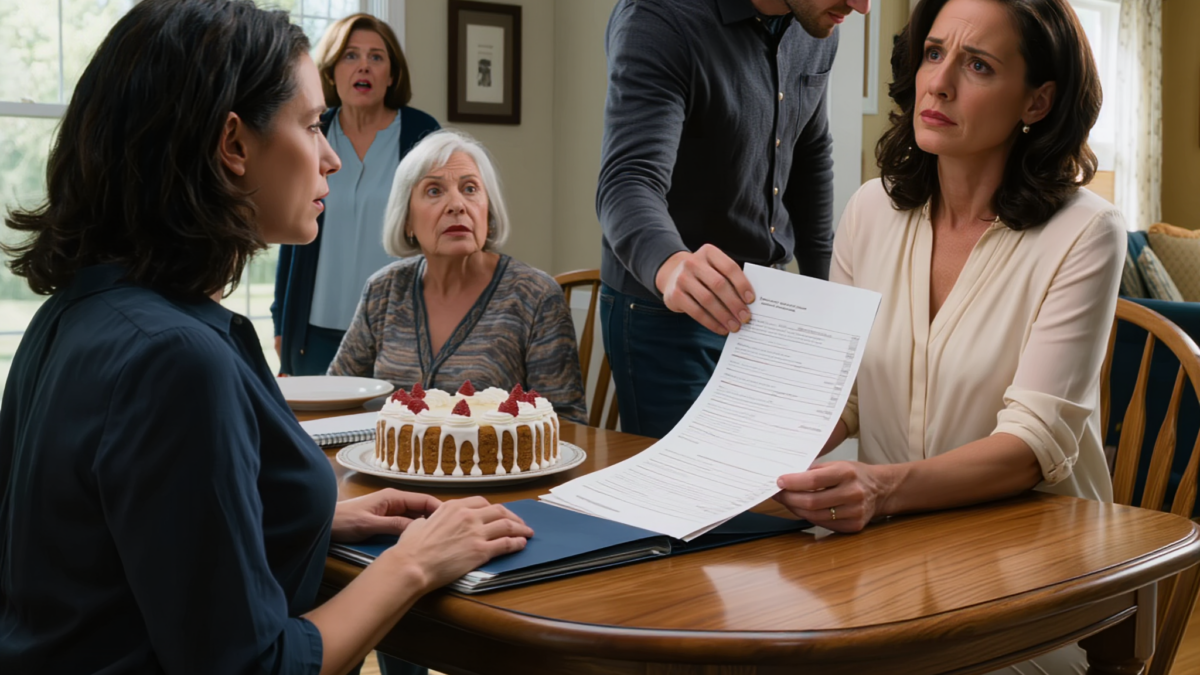
My sister opened the door of the house I had bought for my parents wearing Mom’s anniversary pearls.
“Oh, you’re back.”
I asked where Mom was.
Vanessa pointed toward the basement stairs and smiled. It was the kind of smile you give someone you believe has already lost.
“That’s where she sleeps now. The upstairs rooms are for people who pay.”
Then she added, almost casually, “Even Mom pays $500 a month. Keeps her from thinking she still belongs up here.”
I looked at the pearls. Then I looked past her at the stranger’s shoes on the stairs I had carpeted for my mother’s knees.
And I smiled back.
“You just made this very easy.”
By 9:00 p.m., two men were knocking on the front door.
Vanessa answered as if the house belonged to her.
She had no idea whose name had been on it the entire time.
My name is Isabella Bird. I’m 35 years old, and to explain how I ended up standing in that doorway after six years away, I have to go back to December 2019.
That was when I bought a house at 6 to 12 Margold Court in Westerville, Ohio.
It had three bedrooms upstairs, one downstairs, a kitchen with an east-facing window, and a maple tree in the front yard that the seller apologized for as if shade were a defect.
The house cost $214,000.
I put $60,000 down.
That money represented seven years of working cruise ship kitchens. Seven years of no rent, no car, no vacations. Just galley shifts and a savings account.
The rest was a mortgage in my name, $1,180 a month.
I didn’t buy the house for myself.
I bought it for my parents, who had rented their entire lives.
My dad, Edward Bird, had run a lathe for 39 years. My mom, Carol, was a seamstress, the kind of woman whose hems outlived some of the marriages of the brides she sewed for.
They had raised two daughters in rented duplexes with landlords who painted over mold, and they never once complained where we could hear them.
On Christmas morning, I handed them a key tied with a red ribbon.
Dad held it in his palm as if it might go off.
“Bella,” he said, “people like us don’t own things like this.”
“We do now, Dad.”
There is one thing I need to be clear about because the rest of this story depends on it.
I signed the papers alone.
The deed was in my name. The mortgage was in my name. I never sat my family down and gave them a lecture about ownership because, to me, my parents needed a home, not paperwork explained to them.
Mom cried at the kitchen counter.
Dad walked the fence line twice as if he were checking a machine for tolerances.
That was enough for me.
Before they moved in, I did two things.
I painted the large east bedroom soft yellow because Mom drank her tea at sunrise, and I had the main staircase covered in thick carpet because her knees were already bothering her. I had watched her wince on bare wood stairs for years.
I put her Singer sewing machine beside the east window.
“A seamstress needs real light,” I told her.
She touched the machine like it was a person.
Three months later, in March 2020, I accepted a job as a sous chef at Fernhill Lodge in Queenstown, New Zealand.
It was the kind of offer you get once.
Before I flew out, I put everything on autopay. Mortgage. Property taxes through escrow. Insurance. Gas. Electric. Water.
Every bill came from my account every month.
I canceled my American cell number, the old 614 number, because paying for a dead line felt wasteful. I got a New Zealand number and moved family life onto video calls.
Every bill paid automatically, every month, without fail.
I mistook that for presence.
It would take me six years to understand the difference.
The night before my flight, Dad called.
We talked about the tomato bed he was planning. Then, just before we hung up, he said something I filed away as a father being a father.
“Keep an eye on your sister, Bella. Vanessa counts other people’s plates.”
I laughed.
I actually laughed.
I never saw him again.
In August 2021, my father bent over that tomato bed, put a hand on his chest, and was gone before the ambulance turned onto Marold Court.
He was 67.
New Zealand’s borders were sealed shut that year. You couldn’t get a quarantine slot for love or money, and grief doesn’t issue visas.
So I buried my father through a 13-inch laptop screen at four in the morning, Queenstown time, alone in a staff apartment that smelled like other people’s cooking.
The connection dropped twice during the eulogy.
I never got those minutes back.
On that little screen, I watched Vanessa stand beside my mother at the graveside, one hand on Mom’s shoulder, steady as a fence post.
God help me, I was grateful to her.
I remember thinking, At least Vanessa is there. At least Mom isn’t alone.
Vanessa was 34 then, newly divorced from Keith Dowling that spring and working the front desk at a dental office.
In September 2021, one week after the memorial dinner, she rolled two suitcases into the house on Marold Court.
“Just temporary,” she told me over the phone. “So Mom’s not rattling around alone.”
I exhaled for the first time in a month.
I sent extra money home that Christmas.
Whenever I talked about flying back, Vanessa talked me out of it gently and reasonably.
“Don’t waste two grand on a flight, Bella. Mom’s fine. She’d rather you save it.”
I believed her because believing her was convenient for both of us.
I didn’t come home in 2021.
Or 2022.
Or 2023, 2024, or 2025.
Every year came with a reason that sounded responsible. A promotion to executive chef. A contract clause. A busy season.
And during every video call, Mom sat in the same corner of the kitchen.
Beige wall behind her. Mug of tea in her hands.
She told me she was fine. She told me not to spend the money. She told me she was proud of me.
The same corner, every call, for four years.
I thought it was her favorite spot.
By April 2026, my contract at Fernhill had ended, and I decided I was done announcing my visits.
I wanted to knock on that door and watch my mother’s face do what it had done on Christmas morning in 2019.
I packed a length of blue silk for her birthday.
You give a seamstress fabric, not flowers.
I also packed the old key with the red ribbon, the one I had carried across the world and back for six years like a promise.
Twenty-six hours.
Queenstown to Auckland.
Auckland to San Francisco.
San Francisco to Columbus.
I landed at John Glenn just after two on Thursday afternoon, April 16, and took a rideshare about 25 minutes north.
The plan was simple.
Knock on the door. Watch Mom’s face. Cook her dinner in her own kitchen.
The first thing I noticed was the cars.
Three of them, parked in the driveway and along the curb.
None was Mom’s old Buick.
None was familiar.
The second thing I noticed was a piece of metal on the side door where there had never been metal before.
A keypad.
It chirped as I walked up the path, one weak low-battery chirp every 30 seconds like a smoke alarm begging for attention.
I slid my old key into the front door.
It didn’t turn.
I stood on my own porch holding a key to a lock that no longer existed, listening to that keypad chirp, and rang the doorbell of the house I had been paying for, on time, for 76 consecutive months.
I heard heels on hardwood.
The door opened.
Vanessa stood there.
She was 39 now. Hair done. Lipstick done.
And in her ears were my mother’s pearls.
Dad had given Mom those anniversary pearls for their 30th in 2014. I had never seen Mom without them on a holiday.
“Oh,” Vanessa said. “You’re back.”
No hug.
No question about the flight.
She looked at my suitcase the way you look at weather.
“How long are you staying?”
“Where’s Mom?”
She pointed down the hallway toward the basement door.
Then she smiled.
“That’s where she sleeps now. The upstairs rooms are for people who pay.”
She gave a small shrug, the pearls moving with her.
“Even Mom pays. $500 a month keeps her from thinking she still belongs up here.”
There are moments when your entire body goes quiet.
Chefs know them.
It’s the second when a fryer catches before anyone moves.
I stood in that moment and looked at the pearls.
Then I looked beyond Vanessa at the staircase I had carpeted for Mom’s knees.
A pair of unfamiliar work boots sat on the third step.
I smiled back.
“You just made this very easy.”
“Made what easy?”
She laughed.
It was the same kind of laugh I had given Dad six years earlier when he warned me about her.
“You’ll see.”
Vanessa checked her phone, said she had a dinner thing, told me not to rearrange anything, and walked away to get ready.
Just like that.
Six years, and she left me standing in the entryway like a delivery.
I set down my suitcase and walked through my house.
A chef reads a kitchen the way a mother reads a cough.
This kitchen had been feeding strangers for years.
On the refrigerator, where Mom’s church calendar used to hang, there was now a laminated schedule.
Kitchen hours.
Quiet hours.
Laundry days.
Rules written for guests.
On the console table beside the front door was a stack of envelopes held together with a rubber band, labeled in Vanessa’s handwriting.
Front, April.
Blue, April.
Office, April.
Every upstairs bedroom door had a keypad lock.
The large east bedroom I had painted yellow, the one with the best light, had a man’s coat hanging over the door and smelled faintly of drugstore aftershave.
The blue bedroom had kitchen clogs near the entrance and the unmistakable trace of fryer oil.
I know that smell the way sailors know rain.
Dad’s old office had a stethoscope hanging from the doorknob and hospital scrubs folded over a chair.
The family photographs that once marched up the stairwell wall were gone.
I found them stacked on a hallway shelf.
My parents’ wedding photograph was lying face down.
In the kitchen, Dad’s cast iron skillet still hung on its hook above the stove, exactly where I had left it in 2020.
Bone dry.
Dull with dust.
Nobody had cooked in it since the man who seasoned it died.
Then I heard something through the floor.
The faint whir of a sewing machine.
Three seconds.
Then silence.
The basement door had a barrel bolt mounted on the outside.
New brass against old paint.
I slid it back and went downstairs.
Those basement stairs were the only stairs in the house I had never carpeted because nobody was ever supposed to live down there.
Bare wood.
Then bare concrete.
A light bulb on a string.
In the back corner beneath the slope of the staircase was a folding cot.
It had been made neatly with hospital corners and covered with a patchwork quilt I recognized immediately.
My mother’s stitching.
Beside the cot were a space heater, a lamp, and cardboard boxes labeled in careful block letters.
Carol kitchen books.
Carol winter.
In the darkest corner, facing the wall, was her Singer sewing machine.
Mom sat on the edge of the cot with her hands in her lap.
She was 65.
Her hair had gone completely silver.
When she saw me, she made a sound I had never heard from her before or since.
And the first thing she did, before hello, before tears, was stand up and begin apologizing.
“Bella. Oh no, honey. It’s a mess down here. I wasn’t… let me just…”
She started moving boxes and straightening the quilt.
Her knees buckled slightly when she stood, and she caught the stair rail.
My mother was apologizing to me for the basement in my house.
I crossed the concrete floor and held her.
She felt smaller than I remembered.
Over her shoulder, on a plastic shelf, I noticed a spiral notebook with a ballpoint pen clipped to the cover.
Mom followed my eyes.
Very casually, the way someone might shift to block a draft, she moved until her body stood between me and the notebook.
I didn’t ask.
Not yet.
In a kitchen, you taste everything before you season anything.
I brought her upstairs.
I took Dad’s skillet off its hook, scrubbed six years of dust from it, and cooked my mother dinner.
Nothing fancy.
Eggs, potatoes, and the good butter.
The first meal that pan had made since 2021.
Mom ate as if she were in a restaurant.
She told me about the neighbors’ grandchildren.
She glowed.
Then, without seeming to think about it, she stood and began cleaning.
Not clearing the table.
Cleaning.
She wiped the counter once.
Then twice.
Then a third time.
She leaned to one side and checked the stovetop for a grease shadow.
“Vanessa likes it spotless for the guests,” she said.
Guests.
In my mother’s mouth, the word sounded like furniture, like something that had simply always been there.
Later, Mom said she needed a sweater and went back downstairs.
I waited a few minutes, then followed quietly.
Halfway down, I stopped.
She was sitting on the cot in the lamplight with the spiral notebook open across her knee.
Her pen moved carefully, like a bookkeeper’s.
It was April 16.
Whatever she was recording, she was recording it two weeks early.
I went the rest of the way down and sat beside her.
I asked as gently as I knew how what she was writing.
She hesitated.
Then she did the bravest small thing.
She handed me the notebook.
There were 48 entries.
One per line.
Each dated the first of the month, beginning in May 2022.
Each entry was the same.
$500.
House.
The words were written in the upright, even handwriting of a seamstress who had never in her life allowed a debt to go past due.
Mom had been penciling in the next entry, May 1, 2026, in advance.
“So I’m never short for anyone,” she said.
Forty-eight entries.
$24,000.
Vanessa had told me at the front door that Mom paid.
She had said it as if it were a joke, or a house rule.
What she hadn’t said was that my mother had kept a written record of every payment for four years.
“Mom,” I said, keeping my voice even. “Contributing to what, exactly?”
She explained it the way you explain something you’ve repeated so many times you’ve stopped questioning it.
The house still had a loan on it.
I could only cover part of the costs from overseas.
Vanessa carried the rest.
The renters upstairs helped carry the rest.
So Mom’s $500 was the least she could do.
“It used to be $400,” she explained, “but it went up in 2024 when the property taxes went up.”
The property taxes came from my escrow.
I had paid them automatically every month since January 2020.
“Mom, who told you the house still has a loan I can’t cover?”
“Well, Vanessa handles all that, honey.”
There it was.
All the paperwork.
Every fact my mother believed about her own home had come through one person.
And every one of those facts fit together perfectly.
The way only manufactured things do.
I had my banking app open in my pocket.
Seventy-six mortgage payments.
My name on every one.
I could have shown her immediately.
My thumb was already on the screen.
Then I locked the phone.
Because sitting on that cot, I understood something.
If I detonated the truth that night, the person buried under the rubble would be my mother.
She had organized four years of her life around this story.
You don’t rip a story like that out of a 65-year-old woman at nine at night and call it a rescue.
I needed to know how deep it went first.
So instead, I asked about her routine.
On the first of every month, Mom walked to the bank branch on Shrock Road.
If the first landed on a Sunday, she went the Friday before so she would never be late.
She withdrew $500 in cash.
Then she walked home.
She handed the money to Vanessa at the kitchen table.
The table I had bought.
Vanessa said, “Thank you, Mom,” and put the cash into an envelope.
Four years.
“And I was never late once,” Mom told me.
She said it with pride.
That was the part that broke something in me.
Not the money.
The pride.
Someone had taken my mother’s best quality, the fact that she paid what she owed to the day and to the dollar, and turned it into a leash.
I asked about the people upstairs.
Mom spoke kindly about every one of them.
Douglas in the front room was “a gentleman.”
“He fixed the stair rail for me two winters ago. Wouldn’t take a thing for it.”
Cole in the blue room was a cook.
“A cook like you, honey. Works too hard.”
Dana occupied Dad’s old office.
“She does nights at the emergency room. I keep the kettle quiet in the mornings.”
Mom made them breakfast on weekends.
Vanessa called it part of the service.
My mother spoke kindly about every stranger sleeping above her head.
Not one bitter word.
“What do they think you are, Mom, in this house?”
She went quiet.
Her thumb turned her wedding ring around and around.
She didn’t know.
It had never occurred to her that Vanessa might have explained her to them.
By then, it was almost nine.
Mom went back downstairs to sleep.
I watched her take the bare steps one at a time, her hand tight on the rail Douglas had repaired.
Then I sat alone at the kitchen table with the spiral notebook and a rage that had stopped being hot hours earlier.
Cold rage is more useful.
It measures things.
Down the hallway, Vanessa was doing her makeup with the bedroom door open, dressed for a late dinner.
The side-door keypad chirped again.
Then someone knocked on the front door.
Two shapes stood behind the frosted glass.
One broad and middle-aged.
One younger and narrower.
Even through a closed door, I could have sworn I smelled fryer oil.
The knock was polite and tired.
Vanessa clicked past me and opened the door like the house was hers.
“Keypad batteries dead again. Sorry, guys. I’ll swap it tomorrow. Come in. Come in.”
She waved them inside, grabbed her bag, announced that she would be home late, and left.
Her taillights disappeared down Maragold Court.
She had just welcomed her tenants into my house.
Then she left me alone with two men who had spent years paying rent to a woman who didn’t own a single brick of it.
The older man stopped when he saw me at the table.
He looked to be in his fifties, with machine-shop hands and tired eyes that did the math quickly.
“Ma’am, didn’t know anyone was… Sorry. We usually come through the side.”
“You’re fine,” I said. “I’m Isabella Bird. Carol’s daughter.”
Everything in his face changed.
“The daughter from overseas,” he started.
Then he stopped himself.
“Sir, finish the sentence.”
He looked at the younger man beside him.
Cole, the cook, still wearing his kitchen clogs.
Then the older man sat when I gestured toward a chair, carefully, as though the chair might be a trick.
His name was Douglas Reiner.
He ran a CNC machine across town and worked from noon until 8:30.
He had rented the front bedroom for four years, longer than anyone else.
And then he finished his sentence.
Vanessa had told the tenants that her mother had dementia.
That Carol wandered at night.
That the basement was for her own safety, close to the ground and away from the upstairs rooms.
And that Carol’s other daughter, me, lived somewhere overseas and sent what she could when she remembered.
There was too much to be angry about all at once.
Sometimes the body simply goes quiet.
“My mother does not have dementia,” I said.
“She could hem a suit for a funeral in an afternoon and remember every measurement without writing one down.”
Then I asked Douglas a question.
“How do you pay your rent?”
He took out his phone.
Venmo.
Fifty-one payments.
The second of every month.
$950 each.
Every payment went to the same account.
Vbird.
Front room.
I stared at that neat green column for a long time.
Then I told them the only things I was willing to say that night.
“I’m Carol’s daughter. My mother’s mind is a clean, sharp room. And some things about this house are going to be clarified within the week.”
I asked both men to keep our conversation at that table.
Douglas studied me the way a machinist studies a part against a specification.
Then he nodded once.
Vanessa came home at 10:30.
She found her younger sister sitting at the kitchen table with two of her tenants and a closed spiral notebook.
“What is this dinner conversation?”
“You should change the keypad battery,” I said. “People had to use the front door for once.”
Something flickered behind her eyes.
Then the smile returned.
She wished both men good night by name, warmly, like a concierge.
Then she went to bed.
Through the wall later that night, I heard her on the phone.
Her voice was low and flat.
I caught one sentence.
“Then let her dig. There’s nothing to dig.”
She was right about one thing.
I wasn’t going to dig.
Digging is loud.
I was going to do what you do in a kitchen when a sauce is lying to you.
Taste.
Confirm.
Taste again.
Say nothing until you’re sure.
The next morning, Friday, I crossed the street carrying a plate of banana bread for Rosemary Ellert, who had lived opposite the house for 30 years and watered her hostas through every hour of the last four.
Rosemary hugged me, scolded me for being skinny, then, three minutes into our conversation, handed me a knife she didn’t know was a knife.
“Your sister’s done a wonderful job with the house. Young woman like that, a homeowner running the whole thing herself. Your parents raised her right.”
A homeowner running the whole thing herself.
I kept my face pleasant and let Rosemary talk.
Rosemary talks.
She remembered exactly when the bed had gone down to the basement.
April 2022.
Vanessa had asked Rosemary’s late husband to help carry it.
Vanessa told him a doctor had said Carol needed to avoid stairs.
I looked down toward the little basement window near our feet.
The only stairs Mom had climbed every day for four years were the steep, bare basement steps.
The stairs that supposed medical advice had sent her down.
That was the thing about Vanessa’s stories.
They weren’t sloppy.
Each audience received a custom version.
The tenants got dementia.
The neighbors got doctor’s orders.
Mom got a mortgage that supposedly needed her money.
I got one beige corner of a kitchen on video calls.
Four years running.
Then Rosemary added one more detail, cheerfully.
“And good for her, you know. I hear the house goes to her eventually for all the caretaking.”
“You hear that from?”
“Oh, everybody’s heard that, dear. Everybody’s heard that.”
Vanessa hadn’t simply moved into a house.
She had moved into a story.
And for four years, she had been renovating that story.
The final room in it was the deed itself.
That afternoon, I took Mom to the bank.
I told her we should check her retirement account, which was even true.
We printed statements.
There it was in gray and white.
A $500 cash withdrawal on the first of every month, or the Friday before when the first landed on a weekend.
Forty-eight withdrawals.
Each one matched her notebook line for line.
Month for month.
Not one missing.
Of course it matched.
My mother’s whole life balances to the penny.
That was exactly what Vanessa had been counting on.
The account showed something else too.
Four years of erosion.
And one line I still could not forgive.
The previous November, when Mom’s knee had gotten worse, there was no pharmacy charge for the $70 prescription anti-inflammatory her doctor had recommended.
She had skipped it.
“The renters were late that month,” Mom told me in the car, apologizing even as she said it. “Vanessa said the house was tight.”
The house was tight.
That same week, Vanessa had posted photos from a girls’ weekend in Nashville.
As we drove along Shrock Road, I asked Mom the question that had been sitting in my chest since the basement.
“Mom, in 2022, why did you stop texting me? Even the little things. You could have used any number, any app. Why did you go quiet?”
Her hands tightened around the strap of her purse.
Her knuckles went white.
She looked out the window.
“I didn’t want to be a bother, honey.”
That Saturday night, after dinner, Mom came to me while I was making my bed on the living-room couch.
Yes, the couch.
There were four bedrooms in that house, and the owner’s daughter was sleeping on the couch.
I had chosen it because I wasn’t taking a bed until Mom had hers back.
She sat beside me and folded her hands.
“I’m not angry with you, Bella. I want you to know that.”
I looked at her.
“I understood. You were right. I shouldn’t be something you have to carry.”
The room seemed to tilt.
“Right about what, Mom? When did I ever say that?”
Mom opened her purse.
She took out a piece of paper folded into quarters.
The creases had been opened and closed so many times over four years that they had gone soft as cloth.
She had been carrying her heartbreak in her wallet since 2022.
I unfolded it.
It was a printout of a text conversation.
Gray bubbles.
Blue bubbles.
A screenshot printed on ordinary paper.
At the top was a phone number I knew better than my own birthday.
My old 614 number.
The messages were dated July 2022.
And in a blue bubble, the sender was supposedly me, writing to Vanessa.
I’m exhausted, Ness.
I can’t carry Mom, too.
Please don’t tell her I said that.
Mom watched my face.
“Vanessa didn’t want to show me,” she said softly. “I made her. I kept asking why you didn’t want me to visit.”
She swallowed.
“And finally she said you’d made her promise not to tell me. She only showed me so I’d stop pushing to fly over and bother you.”
Then came a small, terrible smile.
“She protected you, honey. Don’t be mad at her for that. She protected you.”
I sat there with that piece of paper in my hands and did the hardest cooking of my life.
I kept my face at a simmer while everything underneath was a grease fire.
Because Mom wasn’t watching the paper.
She was watching me.
Measuring how bad this was going to become.
And if I exploded, she would spend the next decade managing my feelings instead of having her own.
“Mom,” I said, “look at the number.”
“That’s your number, sweetheart.”
“It was.”
I had canceled it in March 2020 before flying out.
It hadn’t existed for years.
I pulled up my email, scrolled back to 2020, and turned the screen toward her.
The carrier’s goodbye notice.
Account closed.
March 2020.
“This conversation is dated July 2022.”
Mom stared at the screen.
“That number had been dead for two years and three months before this message was supposedly sent from it. I have never written you, or her, or anyone a word of this. Not one word.”
She read the email three times.
Then she read the printout again as if it might behave differently under supervision.
Finally, my mother, the sharpest woman I know, asked the question with no soft answer.
“Then why didn’t you come home, Bella?”
So I told her the truth without polishing it.
The borders came first.
That part was real.
I could not have gotten home for Dad’s funeral if I had sold everything I owned.
But after that?
That part was on me.
Sending money was easier than calling.
Calling was easier than flying.
I had built a machine that loved my family automatically so I wouldn’t have to do it in person.
And every year the machine kept running, I got to feel finished.
“I paid every bill on this house for 76 months, Mom. And I wasn’t here. Both of those things are true. I’m not going to pretend the second one away.”
Then Mom did something that leveled me.
She confessed too.
“I told you not to come,” she said. “Every call. Don’t waste the money. Don’t use your vacation.”
Her voice caught as she looked at the paper in her lap.
“I said it because I believed this. I thought if I kept you away, I was helping you.”
We sat there, two women who had spent four years protecting each other from a danger one person in our family had manufactured.
We were both guilty of distance.
Only one person had built it.
After a while, Mom said quietly, almost to herself, “July 2022. That’s when she gave me the new phone.”
“What new phone?”
That summer, Vanessa had given Mom a new smartphone.
She had set it up herself.
Transferred everything.
Except, Mom realized now, my New Zealand number had never made it into the new contacts.
Every video call since then had come through Vanessa’s phone first.
“Bella’s calling. Mom, here.”
Then the phone was handed to Mom in the kitchen.
Same beige corner.
Every call I had made home for four years had passed through my sister’s hands before it reached my mother.
I thought I had been talking to Mom.
I had been talking to a stage-managed version of her.
One camera angle.
No wide shots.
Then headlights swept across the window.
Vanessa was home early.
And I watched four years of conditioning happen in two seconds.
Mom folded the printout, slipped it back into her purse, and composed her face before the key reached the door.
Vanessa came in sweet that night.
That was how I knew she had been thinking.
She poured wine. Told childhood stories. Laughed in all the right places.
Then she laid out her plan.
Sunday was Mom’s birthday.
Sixty-six.
Vanessa wanted to do it big.
“Family only. And Bella, stay through it at least. I’ll have Dana shift some things around. You can have the office room after the weekend.”
Generous hostess to the end.
Family only.
I agreed.
For once, Vanessa and I wanted exactly the same guest list.
Later, through the screen door, I heard her talking on the porch with our aunt Judith, Mom’s younger sister.
Judith had been between places and had occupied one of the upstairs rooms since the previous August.
Vanessa’s voice was low.
“And honestly, at the birthday, I want to finally sit Mom down about the paperwork.”
“She’s 66, Ness,” Judith said. “It’s time the house stuff was in order.”
The paperwork.
Vanessa was going to make her move on the deed at my mother’s birthday dinner.
Good.
I had paperwork too.
Sunday was two days away.
Saturday morning, I went to the Westerville Public Library and used the 10-cent-a-page printer.
I printed the deed to 6 to 12 Maragold Court.
December 2019.
One name on it.
I printed 76 consecutive mortgage statements from January 2020 through April 2026.
Autopay.
My account.
My name.
Including August 2021, the month we buried Dad, because grief doesn’t pause a bank.
I printed the carrier email from March 2020.
I added a photograph of Mom’s bank statements beside her notebook.
Everything went into a navy blue folder.
No lawyers.
No court.
Just 76 statements and a 10-cent printer.
The truth is cheap.
Lies are what cost this family a fortune.
I printed a second copy of everything.
That afternoon, I met Douglas Reiner at a coffee place near his machine shop.
I placed the deed on the table and turned it toward him.
He read it the way I imagined he read a blueprint, twice, corner to corner.
Then he sat back and rubbed his jaw.
“Four years,” he said. “I paid rent to a woman standing in someone else’s doorway.”
He looked up.
“And the mother? The dementia?”
“Sharp as your best tool. She hemmed a wedding dress in March.”
Douglas sat quietly for a moment.
When he spoke again, his voice had gravel in it.
“She fixed my collar once. Saw a button hanging by a thread when I was headed out and just fixed it.”
He shook his head.
“Woman living on a cot fixed my collar.”
Then, more quietly, “I should have knocked on that basement door two years ago.”
“You’re going to get your chance.”
He looked at me.
“Sunday. One o’clock. Come to the front door. Bring your phone with the payment history. You don’t have to perform anything. If somebody asks you a question, tell the truth in front of everyone.”
“That’s all?”
“That’s everything, Douglas. She’s never had to tell her lies in a room where all the audiences could hear one another.”
I folded my hands.
“Sunday, the audiences meet.”
He nodded once.
Machinist final.
“One o’clock.”
There was a third piece.
It wasn’t mine to arrange.
Saturday evening, I sat beside Mom in the basement near the Singer.
I didn’t script her.
I didn’t coach her.
The entire point was that nobody got to hold my mother’s pen anymore.
I simply asked what she wanted the next day to be.
She could sit through the birthday and let me handle everything privately afterward.
No one would blame her.
Or she could choose something else.
Mom looked at her notebook for a long time.
Then she said, “I have one question I’d like to ask your sister myself. Just one.”
“Then it’s yours, Mom. You’ve paid for it 48 times.”
She didn’t tell me the question.
I didn’t ask.
Some debts you let people collect in person.
That night, I baked Mom’s birthday cake from scratch in Dad’s skillet.
A chef’s ritual.
Hands busy the night before service.
Vanessa drifted through the kitchen carrying a wine glass and wrinkled her nose at the batter.
“I’m ordering from the bakery tomorrow, you know. It should look like a party.”
“People will remember this party for a long time,” I said. “Don’t worry.”
For once in four years, I told my sister the complete truth.
Sunday, April 19, was my mother’s 66th birthday.
Vanessa produced the party like a woman running for office.
Bakery cake.
White frosting.
A three-generations photograph on the porch that was really two generations.
Around the dining table sat Aunt Judith, Vanessa, Vanessa’s boyfriend Shane Corbin, Rosemary from across the street, Mom, and me.
Shane was a big, friendly guy who sold car insurance and clearly adored Vanessa.
Rosemary, I suspected, had been invited because parties photographed better with elders in them.
Mom sat at the side of the table.
Not at the head.
Vanessa had made the head seat hers.
I noticed.
Vanessa raised her glass.
“Five years,” she said, her voice catching in exactly the right place. “I’ve kept this roof over Mom’s head.”
She turned toward Carol.
“Happy birthday, Mama. You’ll never be alone as long as I’m here.”
Under the table, Mom’s hand found mine.
Then Vanessa lowered her glass and pivoted smoothly.
“And actually, since it’s all of us, Mom, you’re 66 now, and I think it’s time we finally got the house paperwork in order.”
She reached for papers.
“I picked up the forms for a transfer on death. It’s very simple. We can…”
I tapped my spoon against my glass.
A quiet ting.
“Before the paperwork,” I said, “I have a birthday present for Mom.”
Everyone looked at me.
“It’s also paperwork.”
I turned toward Vanessa.
“But first, Ness, remind me. What’s the payment on this house? Monthly. You handle all of it, right?”
There was a beat.
A flicker.
Then she smoothed it away.
“Around $2,000 with everything. Why?”
Around $2,000.
The real number was $1,180.
It had been since January 2020.
Vanessa didn’t know that because she had never seen a mortgage statement for the house.
Every statement came to me.
I didn’t correct her yet.
Instead, I reached into my bag and placed Mom’s spiral notebook on the tablecloth beside the bakery cake.
“Then help me with the math. Mom’s $500 a month. Forty-eight months. It’s all in here in her handwriting.”
The table went still.
Judith’s eyes landed on the notebook.
They stayed there a half-second too long for someone supposedly seeing it for the first time.
Vanessa lifted her chin.
“Mom insists on contributing. It makes her feel useful.”
Then she looked toward Carol.
“Tell them, Mom.”
Everyone turned toward my mother.
Mom looked at the notebook.
Forty-eight entries in her own hand.
She said nothing.
Silence from Carol Bird was an answer.
Vanessa heard it.
Something beneath her composure shifted.
“Okay, what is this, Bella? You disappear for six years and fly home to audit me?”
She looked around the table, recruiting.
“I’m the one who stayed. Does anyone here understand what five years of caretaking means?”
I opened the navy folder.
I placed the first stack beside Mom’s notebook.
Seventy-six pages.
Mortgage statements.
Every month from January 2020 through April 2026.
Autopay.
I turned the first page so it faced everyone.
“Read the account holder’s name out loud, Ness.”
She didn’t.
Shane did.
He leaned forward, brow furrowing.
“Isabella Bird.”
Every payment.
Seventy-six of them.
Including August 2021.
The month we buried Dad.
I let that month sit on the table where everyone could see it.
“There is no ‘around $2,000.’ There is no loan Mom needed to help carry. There was never a rest of it, Vanessa.”
Rosemary’s hand went to her mouth.
Judith went the color of the frosting.
“There was never anything for anyone to carry except Mom down those basement stairs.”
That was when my sister showed me that she was never stupid.
Cruel is different from stupid.
Vanessa stood.
She planted her fingertips on the table and made the best argument she had.
“Fine. You paid with a bank transfer from paradise.”
Her voice didn’t crack.
It hardened.
“You know what I paid with? Five years of my life. Who drove Mom to every appointment? Who was standing in this house the day Dad died on the lawn? Who stayed?”
Then she looked directly at me.
“You bought a house and disappeared. Bella, you’re a landlord. You were never family.”
The room stayed quiet.
“So yes. The renters. Mom’s contribution. All of it. Call it rent, call it whatever helps you sleep on your couch.”
She leaned closer.
“I earned every dollar.”
For three seconds, nobody breathed.
Because the worst lies are often wrapped around a splinter of truth.
And the splinter was mine.
I had disappeared.
That part was real.
Everyone at the table knew it.
Vanessa watched me absorb it.
The beginning of a comeback smile appeared on her face.
I didn’t argue.
Instead, I took a piece of paper from the folder.
Folded into quarters.
Soft at the creases.
I opened it and laid it in front of her.
“Then explain this, Ness, since you earned everything.”
I let everyone see it.
“This is a text conversation between you and me. July 2022. I supposedly tell you I’m exhausted and can’t carry Mom too, and I supposedly beg you not to tell her.”
Shane’s fork stopped moving.
“Mom has carried this in her purse for four years. It’s why she stopped asking to visit me. It’s why she moved onto a cot without a fight. So she wouldn’t be a burden to the daughter who supposedly said this.”
Vanessa’s eyes flicked across the page.
“You did send that. I showed her because she wouldn’t stop pushing.”
“The number, Vanessa.”
I put the carrier email beside the printout.
“That phone number was disconnected in March 2020. Here’s the closure notice.”
Her eyes moved to the email.
“The conversation you printed is dated 27 months after the number stopped existing.”
Vanessa stared at both pages.
“You built it from the old contact card in your phone. You never checked.”
I leaned back.
“That’s the whole story of you in this house if you think about it. You never checked anything.”
She opened her mouth.
“Explain the miracle, Vanessa. The room is listening.”
Her gaze went from the printout to the carrier email and back again.
What came out was not an explanation.
“Someone must have… phones get… this is insane.”
For the first time in four years, my sister stood in front of an audience with no prepared version.
And at exactly 1:00, someone knocked on the front door.
Vanessa flinched as though it were thunder.
I stood and opened it.
Douglas Reiner stepped inside, ball cap in his hands.
The first thing he did was look at my mother.
“Happy birthday, Mrs. Bird.”
Only then did he come to the table.
He placed two things in front of everyone.
His room key.
And his phone, screen facing up.
A green column of transactions glowed on it.
Fifty-one payments.
Vbird, front room.
“Four years I’ve rented upstairs,” Douglas said, plain as a work order. “$950 a month to her.”
He nodded toward Vanessa.
“She told me and the others that her mother had dementia. That the basement was for the lady’s own safety.”
Then he turned toward Carol.
His voice went rough.
“Ma’am, I’m sorry. I should have knocked on that door two years ago.”
Mom watched him.
“There’s nothing wrong with your mind, and there never was. You fixed my collar.”
Rosemary’s voice cut across the table.
“She told my Gerald the doctor said no stairs.”
She looked at Vanessa.
“She told me she owned this house. She told half the street the house was coming to her.”
That was the sound of the walls coming down.
Not one document.
Not one dramatic gotcha.
Every audience was simply hearing every other audience’s version for the first time.
The tenants’ story met the neighbor’s story.
The neighbor’s story met Mom’s story.
Mom’s story met the bank statements.
None of them matched.
And the only person every story had in common was standing at the head of the table she had assigned herself, gripping the back of her chair.
“You’re all…” Vanessa began.
She looked around for a face on her side.
Shane was staring at her like a man rereading a contract.
Judith studied her plate.
Then my mother stood.
She didn’t cry.
She didn’t shake.
She smoothed the front of her blouse the way she always did before pinning a hem.
Then she looked at her firstborn.
And she asked the one question she had paid for.
“Vanessa, did your sister ever, even once in six years, say I was a burden to her?”
She paused.
“Yes or no?”
Vanessa opened her mouth.
Looked for a door.
There was no door.
The silence stretched.
Finally she said, “No.”
Mom nodded once, like a measurement had been confirmed.
“Then everything else you have to say, I’ve already heard for four years.”
She held out one hand.
Palm up.
She didn’t say what she wanted.
She simply looked at the pearls.
Vanessa’s hands rose to her ears.
It took her a moment.
Her fingers weren’t steady.
She removed Dad’s 30th-anniversary pearls and placed them in Mom’s open palm.
Mom closed her fingers around them.
“I’d like you to pack a bag tonight.”
Vanessa stared at her.
“You can arrange the rest with your sister. Get your things out of your father’s…”
Mom stopped.
Then she corrected herself in front of everyone.
“Out of my daughter’s house.”
My daughter’s house.
The first time she had ever said it aloud.
She said it like a woman signing her own name.
Vanessa left that night with two suitcases.
Shane drove.
He carried her boxes to the car wearing the expression of a man doing inventory on two years of his own memories.
At the door, Vanessa turned around.
After everything that had happened, what she chose to say was, “You’ll regret humiliating me in front of people.”
“Nobody humiliated you, Ness,” I said.
“We just introduced your stories to each other.”
The door closed.
And in the quiet afterward, I noticed the tail end of something I had been half watching all afternoon.
Our aunt Judith, 63 years old, eight months into living in a free room upstairs, was washing dishes with tremendous concentration.
The kind of concentration people use when they hope a moment will pass over them like weather.
It didn’t.
On Monday, a locksmith changed every lock in the house.
After Vanessa left, everything else happened by appointment.
Her remaining boxes were scheduled for pickup before the end of the month.
Quiet justice still gets done correctly.
When Vanessa returned Wednesday for another load, I stood on the porch while she packed her car.
Her glove compartment fell open.
Something small rolled against the door and caught the light.
A single pearl earring.
The mate to a pair Mom thought she had lost years ago.
It had been riding around in my sister’s glove compartment like loose change.
I didn’t say anything.
I simply held out my hand the way Mom had at the birthday table.
Vanessa dropped the earring into my palm.
She didn’t meet my eyes.
That left Judith.
Thursday evening, Judith made tea for Mom and me.
That should have been my first clue because Judith makes tea the way other people draft opening statements.
She said she had been sick about everything.
Just sick.
She had no idea how bad things were.
And with the room situation changing, she just needed a little time to find somewhere else.
Family helps family.
She had always felt terrible seeing Carol down there.
Then she reached for credibility and grabbed a live wire instead.
“I saw the notebook back in February when I was folding the wash for you, honey. And my heart just broke.”
She stopped.
Some sentences only need to start.
February.
Judith had seen the notebook in February.
She had held evidence of 48 payments from her own sister in her hands.
She understood exactly what they were.
Then she put the notebook back, returned upstairs to her free room, and said nothing for another two months.
I remembered something else.
Years of Christmas calls.
Judith sweetly asking me every December how things were overseas.
When I might visit.
Whether I was doing all right.
And this week, Rosemary had told me Judith had been repeating at church that poor Carol’s youngest daughter had run off overseas and left her.
I opened my mouth.
Mom placed one hand on my arm.
This one belonged to her.
She set down her tea.
She looked at her younger sister for a long, level moment.
The look she gave a seam someone else had tried to hide bad work inside.
Then she gave her verdict.
It was better than anything I would have said because it had mercy in it.
And the mercy had edges.
“You’ll stay until the end of May. Six weeks. I don’t put 63-year-old women on the street. That’s the difference between me and what’s been done in this house.”
Judith started to speak.
Mom raised one finger.
Seamstress stern.
The room obeyed.
“From this week, you’ll pay for that room. The going rate. To Bella, since it’s her house. Or you’ll find your place sooner.”
Judith sat still.
“And Judith, this Sunday at church, you’re going to correct the story about my daughter. To every person you told it to. By name.”
Judith’s teacup touched the saucer with a small clink.
“Carol…”
“You watched me carry it, June Bug.”
The old childhood nickname landed like a slap and an embrace at once.
“For two months, you knew. And you watched.”
Mom held her gaze.
“Silence has a rent too. Yours just came due.”
On Sunday, April 26, at Grace Methodist, my aunt stood during coffee hour and corrected the record person by person.
Rosemary, who was there, reported the whole thing to me later over the fence with deep satisfaction.
“She teared up doing it,” Rosemary said.
Then she added, “Some of it was even real.”
That same week, the smaller and better story began.
The one nobody claps for.
The one that was actually the point.
Because the people upstairs had been lied to too.
Dana, the ER tech renting Dad’s old office, heard the full account on Monday.
She sat with it through a night shift and came downstairs Tuesday morning still wearing her scrubs.
She and Douglas signed simple month-to-month agreements with the actual owner of the house.
Everything on paper.
Everything in daylight.
Rent went into an account with my name on it.
Part of it was set aside for repairs, with Mom involved in decisions because, whatever the deed said, it was her home.
Cole, the line cook, got something different.
The restaurant I was about to join needed hands.
And a cook who had done four years of 6:00 a.m. prep without complaint was a cook I would always find room for.
That Tuesday evening, Mom walked to the bottom of the front staircase.
The carpeted one.
She put one hand on the banister Douglas had repaired two winters earlier.
Then she looked up toward the yellow room.
“I think I’d like my room back now.”
She said it in the tone of a woman ordering in a restaurant she could easily afford.
Dana had the room emptied by nightfall.
She moved herself down the hall without being asked.
As she carried her last box out, she looked around the yellow room and shrugged.
“This one never suited me anyway. Too much sun in the morning.”
Too much sun in the morning.
I laughed until my eyes stung.
We moved Mom upstairs on the last Saturday of April.
The three of us, me, Douglas, and Cole, carried four years of a diminished life back into the light.
The cot stayed in the basement.
Some furniture doesn’t deserve a second act.
The boxes marked Carol kitchen went back into the kitchen.
Her mixing bowls returned to their old shelf.
Her church calendar went back on the refrigerator nail where the laminated guest schedule had hung.
I put that schedule in the recycling myself.
It felt like plating the final dish of a very long service.
We carried the Singer up last.
We placed it beside the east window, exactly where it had stood in 2019.
Mom touched the machine.
“A seamstress needs real light.”
My own words from seven years earlier came back to me.
She ran one hand over the Singer and stood in the yellow room in the afternoon sun.
Neither of us said anything for a while.
That same afternoon, at the bottom of one of her book boxes, I found an envelope.
My name was written across it.
Bella.
The handwriting was one I had not seen in five years.
My father’s blocky machinist print.
All capitals.
The handwriting of a man who labeled things so they would be found.
He had written the letter at Christmas in 2019.
Being Edward Bird, he had apparently never gotten around to sending a letter to someone he could simply call.
It was short.
He thanked me for the house in six embarrassed lines.
He said the maple tree needed trimming and that he would handle it in spring.
Then, at the bottom, underlined once, were two sentences.
Look after your mother.
Not with money, Bella. She’s never once in her life been impressed by money.
I read those lines standing in the yellow room, in the real light.
And for the first time in this entire story, the person crying was me.
It took my father seven years and one unsent letter to teach me the only lesson in it that mattered.
He had seen the counting of plates.
He had understood the limits of a wire transfer.
He had said it in two sentences and mailed it into the future.
There was one debt left on the books.
I transferred $24,000 into my mother’s retirement account.
We had our only fight of the spring over it.
She refused.
“I gave that willingly, Bella. I don’t take money back.”
I let her finish.
Then I used her own arithmetic against her, which is the only argument that has ever worked on Carol Bird.
“Mom, you’ve never owed anyone a dollar in your life.”
She narrowed her eyes.
“Don’t make me the first person who owes you $24,000 and never pays it back.”
She glared at me.
Then she laughed.
The real laugh.
The one from before.
And she let the money stay.
Afterward, I asked for her notebook.
She brought it downstairs.
I turned past 48 entries in her handwriting.
On the next line, in mine, I wrote entry number 49.
Paid in full.
You never owed anyone anything.
Mom read it twice.
Then she closed the notebook, carried it upstairs, and put it in the deep drawer of the Singer where she kept her best patterns.
Things worth keeping.
Never worth repeating.
On Sunday, May 3, Mom and I visited Dad.
It was the first time we had stood side by side at his grave.
Mom wore the pearls.
Both of them cleaned and rehung.
The runaway earring was back with its mate.
She talked to him the same way she paid her bills.
Thoroughly.
Honestly.
Leaving nothing out.
She told him about the renters.
The cot.
The notebook.
The birthday.
Everything.
Carol Bird does not launder a story, even for the dead.
She told Dad that Judith had found a one-bedroom place in a senior community and was moving on the eighth.
She told him Vanessa had texted twice.
Once angry.
Once not.
And that she had not decided anything yet.
Then Mom straightened.
“And I decide when I see her now, Ed. Where and for how long.”
She paused.
“Me.”
Me.
One syllable.
Sixty-six years in the making.
As for me, I took an executive chef position at the Larks in Columbus, about 20 minutes from Marold Court.
I worked my first service on May 8 with Cole on my line, calling back orders as if he had been born there.
I sleep in the small blue bedroom now.
By choice.
It turns out I like being down the hall.
And I have a standing engagement that outranks every reservation in that restaurant.
Sunday dinner at my mother’s table.
Not a wire transfer.
A chair.
Every week.
That is the fix for what was actually broken.
It took me six years and one basement to find it.
So take this for free.
Presence cannot be set to autopay.
Which brings me to the second Sunday of May.
Mother’s Day.
May 10, 2026.
I let myself in early with my new key.
Mom had tied the old red ribbon onto it herself, so it knew whose it was.
I took Dad’s skillet down and started breakfast.
Eggs.
Potatoes.
The good butter.
Morning sunlight came through the east window upstairs.
Before I saw Mom, I heard the Singer.
Running steadily.
A long seam.
Confident.
Then came footsteps on the carpeted stairs.
Unhurried.
A hand light on the rail.
My mother came downstairs from her room.
Her upstairs room.
She wore her robe, her hair pinned up, and walked to the head of the table.
Her chair.
Nobody assigned it.
Nobody had to.
“Something smells wonderful,” she said.
“Everything, Mom.”
I looked at her.
“Everything does now.”
She had brought her sewing downstairs.
The blue silk I had carried across the world was half transformed.
She held it toward the window to check the seam in the morning light.
Then I saw what she was making.
A chef’s apron.
Heavy-duty.
Double-stitched.
Built by a professional for a professional.
On the chest pocket, she was embroidering two white letters.
The second was still unfinished.
My sister once stood in the doorway of that house and told me the upstairs rooms were for people who pay.
She was wrong about that the same way she was wrong about everything.
Not by a mile.
By one word.
And that one word was the whole world.
The upstairs rooms were never for people who pay.
They’re for people who belong.








