Dad humiliated me in front of 80 guests: “Briana inherits the $230 million company. You’re lucky I still let you use the name.” Mom laughed before anyone else did. I walked out. At 9 a.m. the next morning, an estate lawyer handed me a 35-year-old hospital bracelet labeled “Baby Girl Callaway”—my mother’s maiden name. Then he said, “My client was at the hospital before your father was.”
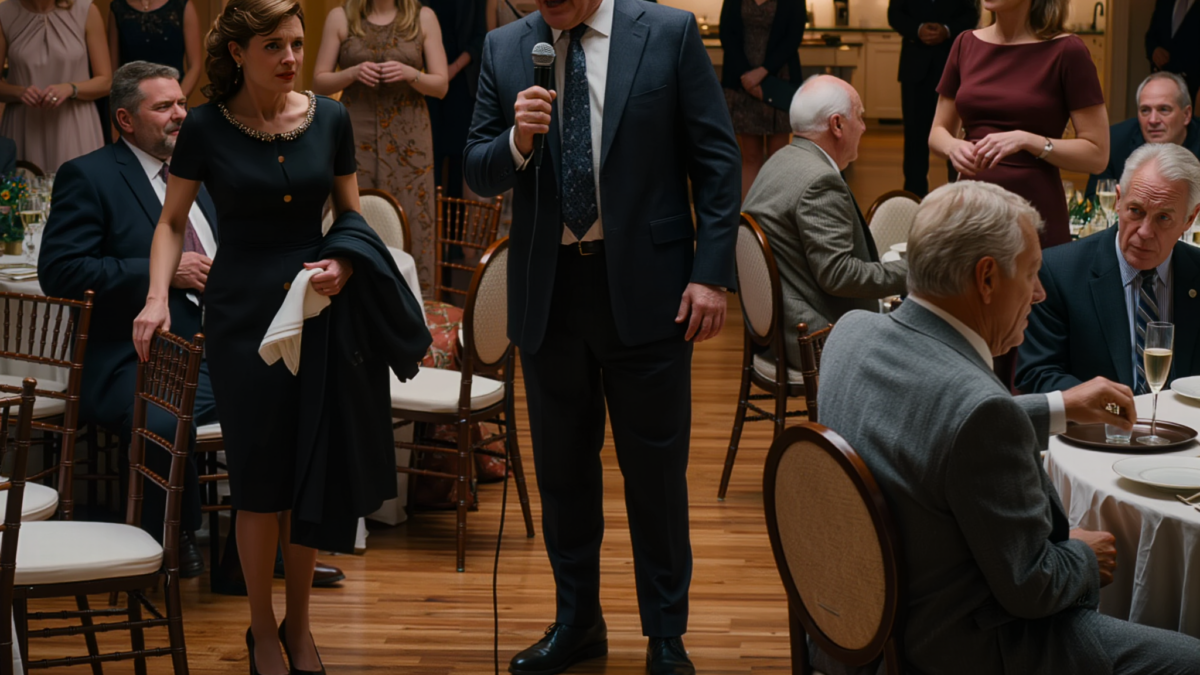
My father raised his glass in front of 80 guests and tapped it against the microphone.
“My daughter Briana inherits the company. Two hundred thirty million.”
Then he looked straight at me.
“Chloe, you’re lucky I still let you use the name. Most men would have cut it years ago.”
My mother laughed.
Not a small laugh. A bright, practiced laugh that carried across the room as though she had waited 35 years to finally make that sound.
I didn’t speak. I set my glass down, took my coat, and walked out while 80 people watched the unloved daughter leave her own family’s table.
The next morning, a lawyer stood at my door with a 35-year-old hospital bracelet sealed in plastic.
My name wasn’t on it.
He said only one sentence.
“That’s why we’re here.”
My family thought the night before had erased me.
They had no idea what that little band was about to erase instead.
My name is Chloe Owen. I’m 35 years old.
The story really began 25 years earlier with a report card on a refrigerator.
I was ten. It was a Tuesday because Tuesdays were when Mrs. Pel sent report cards home in sealed brown envelopes. I carried mine through the entire bus ride as if it were made of glass.
Straight A’s. Every column.
I remember practicing in my head how I would hand it to my father casually, like it was nothing. In our house, wanting praise was almost worse than failing.
Briana got to the kitchen first. She was seven and had a B+ in something. My father held her report card up to the light like it was a stock certificate. He read every teacher comment aloud. He said the word “effort” three times.
Then he took mine.
He glanced down the column of A’s the way you glance at a receipt you already know is correct and set it on the counter beside the mail.
“Don’t fish for praise, Chloe,” he said without looking up. “It’s unbecoming.”
That night, Briana’s report card went on the refrigerator under a lighthouse-shaped magnet.
Mine went into the drawer with the takeout menus.
My mother stood in the kitchen doorway the whole time. She saw all of it. She dried her hands on a dish towel and said nothing, which I would eventually understand was her native language.
It would be easy to tell my childhood as a list of wounds, but that isn’t the point.
The point is what that kitchen taught me.
It taught me that in the Owen house, love was a display item and somebody else’s name was always on the shelf. It taught me to stop handing people things I couldn’t afford to have ignored.
And it taught me something that took 35 years to unlearn: if I was useful enough, careful enough, excellent enough, maybe one day there would be room for me on that refrigerator.
There never was.
But the training turned out to be useful.
I became a senior claims adjuster. Large loss. Thirteen years at Hartwell Mutual in Columbus.
When a house burns down or a pipe turns the first floor into a pond, I’m the person who walks through the wreckage with a clipboard and figures out what actually happened.
People think the job is about money.
It isn’t.
It’s about stories.
Everyone who files a claim tells you one, and my job is to find the place where the story and the evidence stop matching.
I photograph everything twice. I keep copies of copies.
My friend Tessa, who had the desk beside mine, once told me, “You read people like water damage. You always find where it started.”
I used to think I learned that in training.
I didn’t.
I learned it in a house where the official story rarely matched the room I was standing in.
When I was eighteen, the college fund my grandmother had helped start for me quietly disappeared.
My father called it a restructuring.
The money had been reallocated toward Briana’s future because, according to him, she was at a critical age.
I was starting at Ohio State that fall. I took out loans and worked 25 hours a week at a coffee shop.
During the fall of my sophomore year, I came up $4,800 short on tuition. I sat in a stairwell doing the math over and over, as if arithmetic might blink first.
Two weeks later, the bursar’s office told me my balance had been paid by something called the Buckeye Futures Hardship Fund.
I had never applied for it.
I never found an application.
I wrote a thank-you letter anyway.
Dear benefactor.
I didn’t know a name, so I mailed it to the PO box on the receipt.
Nobody ever wrote back.
I decided it was one of those small anonymous mercies the world occasionally hands you, and I put it away in the drawer of my memory where I kept things that didn’t fit the story.
That drawer was fuller than I realized.
There was a man in it, for one thing.
My father’s business partner.
Everyone called him Uncle Neil, though he wasn’t anyone’s uncle.
Neil Harmon was the other half of Harmon Owen Builders. He was the quiet half, the one who checked the math while my father shook hands.
When I was eight, at a company picnic, he taught me how to cast a fishing line off a dock while the other adults played horseshoes.
He crouched behind me, steadied my wrist, and said, “Some things you measure twice, kiddo. People included.”
When I was twelve, he gave me a real engineer’s calculator, the kind with functions I wouldn’t understand for years, and told me I’d grow into it.
Then, around the time I turned eighteen, he simply stopped being anywhere.
No falling-out that I ever heard about. No goodbye.
He was still my father’s partner. His name was still on the trucks.
But he vanished from barbecues, Christmas parties, graduations.
There was a photo from the last picnic I looked at hundreds of times later. Everyone was mugging for the camera. Neil was half out of frame at the edge, and he was the only person looking directly into the lens as if he were the one taking a picture of us.
I never asked why he disappeared.
In my family, you learned not to ask about people who went missing from photographs.
For most of my adult life, none of this felt like a mystery.
It felt like weather.
Then, last November, the weather changed.
Word came down that Crestline National Group, one of those companies that buys regional builders the way other people buy groceries, wanted Harmon Owen.
The number being whispered at every holiday gathering I wasn’t invited to was $230 million.
That number wasn’t cash sitting in a vault. It was the valuation of the whole company: equipment, contracts, land, name.
And the company wasn’t entirely my father’s.
My father owned 52 percent.
Neil Harmon owned 40.
The remaining 8 percent had been split years earlier among three employees who had been there since the beginning, back when the whole operation was two men, one truck, and a contract nobody else wanted.
My father liked to round all of that off and call it “my company.”
He had been rounding things off his entire life.
Briana had been inside the building since 2019. Director of business development. An office with her name on the door. A company card in her wallet.
She was 31 and talked about the transition the way other people talked about a wedding.
That winter, the phrase I kept hearing secondhand was that Dad needed to settle succession before signing.
I didn’t think much about what that meant for me.
I already knew what I was in that family.
I was the drawer with the takeout menus.
In March, a heavy cream envelope arrived at my apartment.
Embossed lettering.
Harmon Owen Builders celebrating 42 years.
Cocktails at the Fbrook Country Club.
I turned the invitation over twice looking for a handwritten note.
There wasn’t one.
My 35th birthday came nine days before the party.
Nobody called.
Not my mother.
Not my father.
Not Briana.
I ate takeout at my kitchen counter and told myself 35 was too old to still be counting who remembered.
The night before the party, my phone rang.
Mom.
She didn’t say happy belated birthday. She didn’t ask how I was.
There was a strange, careful quality to her voice, like someone reading from a card in bad light.
“Wear something quiet,” she said. “Please don’t make him angry tomorrow.”
“Mom, it’s a cocktail party. What is there to be angry about?”
A pause, half a second too long.
“Just quiet, Chloe. Please.”
She hung up first.
I stood in my kitchen holding the phone.
I knew every register of my mother’s voice. The performing one. The smoothing-over one. The one she used on my father like a hand on a spooked horse.
This wasn’t any of those.
This one was afraid.
I had no idea yet that she wasn’t afraid for herself.
The Fbrook Country Club did a certain kind of evening very well. Low amber light. A jazz trio nobody listened to. Enough polished walnut to make bad news sound official.
By seven, the ballroom held 80 people, and I could map every one of them.
That isn’t a figure of speech.
It’s the job.
I walked into the room and did what I do at a loss site.
I read it.
Near the bar stood the field guys and their wives, wearing ties they hated and laughing too loudly because open bars make loyal men nervous.
By the windows, subcontractors and suppliers worked the room in slow circles.
There were two tables of church friends my mother had collected over 30 years, including the women who ran the spring rummage sale like a military campaign.
A cluster from the bank.
A city councilman.
Gus Weaver, my father’s foreman for two decades, stood with his back to the wall the way men do when they would rather be on a job site.
Family sat at table one up front.
I was at table eleven by the kitchen doors, between a supplier’s wife and an empty chair.
I noticed that with a strange calm.
The way you notice a policy exclusion.
Placement is information.
And at table three, close to the front, sat a man I hadn’t seen in almost 17 years.
Neil Harmon had gotten old the way lean men do, dried out rather than heavy. His hair had gone completely white.
He wore a gray suit and sat very still amid the noise.
A waiter had poured him champagne for the toast. The glass sat untouched in front of him, bubbles going flat.
I remember thinking, without any particular weight, that he still didn’t drink at these things.
Then Briana appeared at my shoulder in a wine-colored dress, smelling like the perfume counter at Saks.
“Dad has a big announcement,” she said, squeezing my arm one degree too hard. “Try to smile for once.”
She was gone before I could answer, gliding toward table one.
I watched her lean down and whisper something to my father.
He nodded.
Some old instrument in my chest, the one calibrated in that kitchen 25 years earlier, began quietly registering pressure.
The trio stopped.
My father took the microphone at the front of the room.
He was 69 and still built like the doorway of a barn. He had the easy command of a man who had been the biggest voice in every room for four decades.
He talked about 1984.
Two men. One truck. A contract on a strip mall nobody else would touch.
He got his laughs.
He thanked the bank, the city, the wives.
He said the word “legacy” four times.
I counted.
Then his voice shifted into a lower gear, the one he used for firing people.
He said a company’s real product wasn’t buildings.
It was succession.
A man spends his whole life finding out which of his investments mature.
The microphone gave a short squeal of feedback.
During the half second of wincing and laughter that followed, I saw my mother’s hand flatten against the tablecloth.
“My daughter Briana inherits the company,” my father said. “Two hundred thirty million.”
Then he found me at table eleven.
Eighty faces turned with his.
“Chloe, you’re lucky I still let you use the name. Most men would have cut it years ago.”
My mother laughed.
That bright, carrying, practiced laugh.
Here is the detail I wouldn’t understand for another five weeks.
She laughed early.
Half a beat before the room could decide whether it was a joke.
Like a soloist coming in ahead of the orchestra because she had rehearsed the piece so many times she no longer needed the conductor.
The room did not react as one animal.
Rooms never do.
A few of the bank people chuckled uncertainly, glancing sideways to check the ruling.
The church table became rigidly interested in the centerpieces.
One supplier’s wife whispered, “Is this a joke?”
Her husband murmured, “Ray doesn’t joke,” and reached for his water.
Somewhere behind me, a phone rose above the crowd for three seconds and came back down.
Gus Weaver stared at my father with his jaw working. The color drained from his face from the collar upward. He set his glass on a tray with exaggerated care, as if the alternative were throwing it.
And at table three, a chair scraped.
Neil Harmon was halfway out of his seat.
His knuckles were bloodless against the chair back.
His mouth opened around a word that never arrived.
For one long second, I thought he was having some kind of attack.
Then he lowered himself slowly, like a man easing into freezing water, and stared at the tablecloth.
I registered all of it the way I register a burn pattern automatically for later.
Because in that moment, there was no later.
There was only the microphone in my father’s hand, my mother’s laugh still hanging in the air, and 80 people waiting to see what the unloved daughter would do.
My pulse was somewhere in my ears.
My hands on the table were perfectly steady.
Both things were true.
Only one was visible.
I did what I do.
Document.
Preserve.
Exit.
I stood, laid my napkin on the chair, and walked to the coat check.
The girl behind the counter saw my face and handed me my coat without waiting for the ticket.
I walked the length of the ballroom at exactly the pace I use when walking through a house after a fire.
Past the church table.
Past the bank.
Past table three, where a white-haired man looked at everything in the world except me while his hands shook against the wood.
My slice of cake was still sitting at my place when I left.
White frosting.
The company logo piped in gold.
I saw it later in a photograph someone posted.
Untouched.
It’s strange which details survive.
At the valet stand, a kid around twenty took my ticket, number 112, and ran into the cold.
When he returned with my car, he held the door.
“You okay, ma’am?”
“Long party.”
He nodded like that explained everything.
In his experience, it probably did.
I don’t remember driving home.
I remember sitting on the edge of my bed in my apartment with my coat still on, doing what I had done since I was ten.
Itemizing.
What was said.
Who saw.
What it changed.
The math kept coming out the same.
Nothing was different, really.
They had simply held a public reading of a document I had been carrying my entire life.
At 11:40 p.m., my phone lit up.
A number I didn’t recognize.
Local area code.
One ring.
Not even a full ring. More like the front edge of one.
Then nothing.
No voicemail.
No text.
I stared at the screen until it went dark.
Wrong number, I told myself.
At 11:40 on the worst night of my life, somebody’s thumb had slipped.
I was an evidence person telling herself a story.
Like most stories in my family, it didn’t survive the morning.
The knock came at nine on Sunday.
Two knocks, evenly spaced.
The knock of a man billing by the hour.
Through the peephole I saw silver hair combed with an actual part, a charcoal overcoat, and a leather briefcase old enough to have a history.
Not a process server.
Not one of my father’s litigation guys.
I opened the door on the chain.
“Yes?”
“Ms. Owen. My name is Martin Hail. I’m an attorney.”
He held his card level with my eyes and waited while I read.
Hail and Croft.
Attorneys at law.
Estates, trusts, and succession planning.
“I apologize for the hour and for the day.”
“If my father sent you…”
“He didn’t. I’m not here about last night, Miss Owen.”
A beat.
“I’m here about a night 35 years ago.”
Some sentences rearrange the furniture of your head.
I looked at the card again.
Estates.
Trusts.
Not a fixer.
Not a threat, at least not the kind of threat I knew.
I closed the door, removed the chain, opened it again, and said, “Give me one minute.”
Then I left him in the hallway while I looked him up on the state bar’s website.
Martin R. Hail.
Licensed in 1993.
No disciplinary history.
Photograph matched.
When I opened the door again, something in his expression suggested he had expected the pause and approved of it.
At my kitchen table, he declined coffee and placed the briefcase flat in front of him.
Then he removed a single item.
A clear plastic sleeve, sealed along one edge.
The kind I use for fire-scene evidence.
Inside was a hospital bracelet.
It wasn’t white anymore.
Thirty-five years had turned it the color of weak tea. It had a typed insert beneath a plastic window, the way hospital bands did before barcodes.
I didn’t touch it.
I leaned closer.
Baby Girl Callaway.
A small stamped number sat in the corner.
March 12, 1991 was my birthday.
Callaway was not my name.
It was my mother’s maiden name.
A name she had supposedly stopped using two years before I was born.
I sat with that the way you sit with a claim where the dates don’t work.
Then the second thing landed.
The bracelet was too big.
An infant band is a little loop you could wear around a finger.
This was sized for an adult wrist.
I had handled enough patient records and injury files to understand what I was looking at.
Hospitals in those days used matching numbered bands. One for the mother. One for the baby. One for a support person or family member allowed through the nursery doors.
The numbers had to match.
Somebody had worn this.
On the night I was born, somebody had stood inside that hospital with a band matching mine.
I looked up.
Hail watched me do the math.
When he saw me arrive at the conclusion, he nodded once.
Almost gently.
“That’s why we’re here.”
I made him repeat everything twice.
He never varied a word.
His client had kept that bracelet for 35 years.
His client wanted to meet me.
For the moment, Hail was not authorized to tell me his client’s name.
“Then we’re done,” I said. “I don’t take meetings with anonymous men about my own birth.”
“That’s a reasonable position.”
He didn’t move.
“I’d hold it, too. So I’ll tell you the one thing I am authorized to say.”
He placed his hand beside the sleeve without touching it.
“My client was at the hospital before your father was.”
The refrigerator hummed.
Somewhere below us, a neighbor’s television murmured a game show.
“That’s not possible. I was born three hours from here. My mother went into labor early while visiting my grandmother in West Virginia. My father drove through the night. That’s the story.”
“That’s the story,” Hail agreed.
The way he said it did something terrible to the word.
I asked why now.
Why this morning out of more than 12,000 mornings?
He glanced at his watch.
Old habit rather than impatience.
“Because last night, Ms. Owen, my client ran out of reasons to wait.”
Last night.
The party.
The missed call at 11:40.
I kept my face still and my voice flat, the voice I used in depositions.
I told him I would verify everything independently before agreeing to anything, and if any part of this was a maneuver connected to my father’s company, I would find the seam.
Finding seams was my profession.
For the first time, something close to a smile crossed his face.
“My client said you’d say approximately that.”
He stood and buttoned his coat.
He left the sealed sleeve on my kitchen table.
“It’s yours. It always was, in a sense.”
At the door, he added one more thing.
“A birth certificate won’t help you. Under the law, a married woman’s husband is presumed the father and goes on the record automatically. The system fills in the story it’s handed.”
He paused.
“Paper is only as honest as the people feeding it, Miss Owen. I suspect you knew that before I did.”
Then he left.
I was alone with a piece of plastic older than my memory.
I didn’t call the number he gave me.
I did what I do.
I took out a manila folder, wrote “co origin” on the tab, and started a file on myself.
By noon, I knew Camden Valley Medical Center in Parkerburg, West Virginia, had closed in 2011 and transferred its records into county custody.
Retrieval in person.
Government ID.
Business hours.
Fine.
I had pulled records from courthouse basements in four states.
Then I called my mother.
I kept it light.
Sunday-call light.
Two minutes into the conversation, I asked as if the thought had just floated into my mind.
“Hey, what hospital was I actually born in? Somebody at work was doing one of those ancestry things.”
She paused for two seconds.
I know because I counted.
And because two seconds is an eternity in a conversation between a mother and daughter about a simple fact.
“Camden Valley.”
Then the rest came fast and smooth.
A recitation.
Early labor.
Grandma Lorraine recently widowed and poorly.
My father driving all night.
Snow in the mountains.
Every corner sanded and polished.
Then, without transition, she said, “Your father expects an apology, Chloe. That’s the only paperwork this family needs.”
She hung up before I could decide which lie to answer.
At 9:52 that night, my phone buzzed.
Briana.
Whatever you’re digging for, stop embarrassing the family.
I read it four times.
I had told no one.
Not Tessa.
Not anyone.
I had made exactly one phone call to my mother about a hospital.
Somewhere between my mother’s kitchen and my sister’s thumbs, a wire ran that I couldn’t see.
I put the phone face down and looked at the tea-colored band on my table.
I was no longer investigating a bracelet.
I was investigating my family.
And they already knew.
I took Thursday and Friday off.
Thirteen years without using sick days buys you an unquestioned long weekend.
The drive to Parkerburg took three hours. Interstate first, then the hills of the river valley closing in low and green.
I had made that drive as a child to visit Grandma Lorraine.
I remembered the bridge over the Ohio.
The smell of her porch.
What I had never thought about was the drive itself.
Three hours.
My mother, nine months pregnant, three hours from her husband, her doctor, her house.
Women don’t drift that far from home in their final month by accident.
They go there.
The county records office occupied an annex behind the courthouse, a long room of metal shelving and the particular silence of paper nobody has asked for in decades.
The clerk was a woman around sixty with reading glasses on a beaded chain.
When I told her what I needed, she brightened the way archivists do when somebody finally wants the thing they have been keeping.
“Camden Valley. Lord, yes. When they shut the doors in 2011, everything came here on pallets. Nobody sorted it. No budget. It’s all in the boxes the hospital packed.”
She led me through the stacks.
“You’re lucky it’s a birth. Births they kept forever.”
It took two hours and a microfilm reel to find March 1991.
The reader cast that pale green light they all cast.
I turned the crank slowly, watching other people’s emergencies slide past until my own history appeared in smudged typescript.
Patient: Callaway, Janet.
Admitted March 11, 1991.
6:20 p.m.
My mother had used her maiden name two years into her marriage.
The address was her mother’s house on Beachwood Street, not the house in Columbus where she actually lived.
Then I found the line that stopped me for a reason few people outside my profession would notice.
Payment: self-paid in full.
No insurance.
My father’s company had group coverage.
I knew because years earlier I had seen old plan documents in a claims archive, back when Harmon Owen was a client file and not a wound.
A married woman with insurance had paid cash to deliver a baby three hours from home under a name she no longer used.
Thirteen years in claims teaches you something.
Cash where insurance should be is rarely meaningless.
Insurance creates records.
Claims.
Statements.
Envelopes sent to an insured address.
Cash creates much less.
My mother hadn’t gone to West Virginia simply to nurse her mother.
She had gone there to make my birth less visible.
I sat back from the reader and made myself breathe on count the way I do when a claimant starts yelling.
Then I turned the crank again.
Emergency contact.
L. Callaway.
Mother.
Not Raymond Owen.
Not her husband.
On the form where a frightened woman writes the one person to call if everything goes wrong, my father’s name appeared nowhere.
“There’s more in the box,” the clerk said behind me.
I jumped.
She had brought over a gray archive carton with old hospital tape still attached.
“Admissions kept visitor logs by month. Nobody ever wants those. You want those?”
I wanted those.
The March 1991 log was a tall ledger with a cracked spine.
Columns in fading blue.
Date.
Visitor.
Patient.
Relation.
Band number.
Time in.
Time out.
I ran my finger down March 11.
Nothing.
Then March 12.
The day I was born.
Halfway down the page, written in a slanted, pressing hand:
N. Harmon.
Family.
Band 014.
In 9:14 p.m.
The time-out column was blank.
The band number matched the number stamped on the bracelet in my kitchen.
Family.
Nine fourteen at night.
A hospital three hours from Columbus.
The night I was born.
While my father, according to family legend, was racing through mountain snow and arriving heroically late.
N. Harmon.
Neil.
My body understood before I let my mind form the word.
My hands went cold against the ledger.
My heart turned loud and uneven.
A voice in my head sounded like me at eight years old on a dock with a steadying hand around my wrist.
Some things you measure twice, kiddo.
The clerk photocopied the visitor log and admission sheet and stamped both with the county seal.
As she squared the copies, she glanced at the line.
“Whoever he was, honey, he signed in at 9:14 and never signed out.”
I made it to the parking lot before my legs became unreliable.
I sat in the car with the records on the passenger seat and the river gray in the distance.
Then I called Martin Hail.
He answered on the second ring.
“Ms. Owen.”
“Tell your client I know his name.”
Silence.
Long enough for me to hear him set something down.
A pen, maybe.
When he spoke again, the professional lacquer on his voice had thinned.
“Then he’d like you to come to the lake.”
Senica Lake was 90 minutes east of Columbus.
I drove there the next morning with the folder on the passenger seat like a shield.
Ninety minutes is a long time to reshelve a life.
The calculator when I was twelve.
Grow into it.
The fishing dock.
Neil disappearing when I turned eighteen.
My college fund being “restructured” the same year.
The Buckeye Futures Hardship Fund, which had no application and no other visible recipients.
The man at table three halfway out of his chair, knuckles white.
The untouched champagne.
The one-ring call at 11:40.
Every one of those facts had lived in my head for years under miscellaneous.
Now they were reorganizing themselves into one column.
And the column had a name.
I was furious in a way I didn’t yet know how to shape.
Furious at him.
Furious for him.
I couldn’t have told you the ratio.
Somewhere near the county line, I decided what I would not do.
I would not arrive as a lost girl.
I would not collapse in his doorway.
I had spent 13 years interviewing liars.
I could survive one more table.
I would ask questions in order.
I would verify the answers.
Whatever this man was to me, he would earn every inch of it on the record.
The house was a low brown cabin with a green metal roof, tucked among pines above the water.
Wood smoke.
A dock below, gray with age.
I knocked.
Footsteps came from inside, slower than I remembered.
The door opened.
Neil Harmon stood there in a flannel shirt.
Older.
Thinner.
And clearly, in some way I didn’t want to see yet, unwell.
None of that was what took the air out of me.
It was his eyes.
Or mine.
The exact same gray green.
The same tilt at the outer corner.
Thirty-five years of mirrors, and I had never once let myself see it.
“Hi, kiddo,” he said, barely above a whisper.
I had prepared a careful, ordered first question.
What came out was, “How long have you known?”
He stepped back.
“Since before you did,” he said. “Which is the whole problem.”
He didn’t take me inside.
He led me around the house to a deck overlooking the lake.
Two Adirondack chairs faced the water.
One was weathered gray, its armrests worn smooth by years of hands.
The other looked almost new.
Same build.
Same age.
Barely touched.
As if it had spent its life waiting for somebody.
I stood between them.
I didn’t sit.
Neil lowered himself into the worn chair with the careful negotiation of a man whose body had become a committee.
He tried to begin twice.
Both times the words backed up.
This was a man who had negotiated contracts for forty years, unable to speak on his own deck.
So I did what I do when a witness stalls.
I gave him a starting point.
“Start with June 1990. I’ll tell you when to stop.”
He looked at me for a long moment.
There was something like pride in his face.
I resented it and stored it away.
Then he nodded.
“Your mother will never forgive me for what I’m about to do.”
And he did it anyway.
In the spring of 1990, Harmon Owen Builders was struggling.
To help keep it alive, my father took an eleven-month project-management contract in Anchorage.
Good money.
Brutal distance.
He left in April.
Neil stayed in Columbus to run the company, which in a small business also meant becoming the person my mother called when a gutter failed or the truck wouldn’t start.
My parents’ marriage had already been in trouble.
Alaska simply gave the trouble more room.
“It was one night,” Neil said, looking toward the lake instead of me. “Middle of June. We were two lonely people being careless with each other, and we knew it by morning. We ended it before it was a thing that could be ended. I’m not going to dress it up for you. You deserve the actual size of it.”
The actual size of it was me.
My mother told him she was pregnant in the fall.
In the same breath, she told him the dates were survivable.
Raymond had been home for ten days in July.
The math could belong to her husband if everybody held still.
So everybody held still.
That was the plan.
Hold still forever.
In February, my mother moved to her mother’s house in Parkerburg.
The official explanation was that Grandma Lorraine needed help.
The truth, Neil said, was that my mother wanted three hours and a maiden name between her pregnancy and her regular life.
On March 11, labor began early.
Lorraine was too frail to drive.
My mother sat in a farmhouse kitchen with a telephone in her hand and one number she could call.
“She called me,” Neil said.
“Not because I was anything. Because I was the only person who already knew, and she knew I’d come without asking questions.”
He rubbed his wrist in a slow circle, an unconscious motion.
“I drove three hours in the dark. Got there after nine. Told the desk I was family, which was not entirely a lie.”
They gave him a numbered wristband.
Matched to mine.
“No band, you don’t hold the baby. That’s how it worked then.”
Wind moved across the lake.
I finally sat on the very edge of the newer chair.
“You held me?”
“For six minutes.”
He said it the way other men might say the name of a battle they had survived.
“Your mother was asleep. The nurse had somewhere to be. There was a window, and it was snowing past the parking lot lights. You had a grip on my finger like you were planning to keep it.”
His voice stayed level.
The levelness was the loudest thing I had ever heard.
Six minutes.
“Then they needed you back. At the nursery door, they cut the band off because that was the rule.”
He looked at me.
“I asked the nurse if I could keep it.”
A second passed.
“It’s the only thing of yours I was ever allowed to hold.”
I had sat with people on some of the worst days of their lives.
I had kept my voice steady while families handed me photographs of what fire left behind.
I did not stay steady on that deck.
I didn’t perform.
Something simply came loose behind my sternum, quietly, the way a wall gives when water has been inside it for years.
When I could speak, I asked the only question that mattered.
“Why did you stay away?”
Neil was quiet.
Then he said, “I didn’t.”
He went inside.
When he returned, he carried a shallow wooden tray and placed it on the arm of my chair like a man submitting exhibits.
Two tickets.
Ohio State commencement.
June 2013.
One stub torn crookedly.
One intact.
“I bought two,” he said. “Old habit of hope. I sat in the last row of the upper deck and left before the recessional so nobody would have to explain me.”
Next came a bank statement folded to a highlighted line.
Buckeye Futures Hardship Fund.
Fall 2010.
$4,800.
“There is no fund,” he said. “There’s a PO box and a lawyer’s letterhead. There was only ever one recipient.”
Then an envelope.
Soft at the corners from years of handling.
Addressed in my own twenty-year-old handwriting.
Dear benefactor.
My thank-you letter.
He had kept it for sixteen years.
“You wrote a thank-you letter to the fund,” he said. “I’ve read it more times than any contract I ever signed.”
The anger came back.
I let it.
Sixteen years he had sat in that chair reading my letter.
Seventeen years since he had disappeared from my life.
Thirty-five birthdays.
“What possible arithmetic made watching from an upper deck better than one phone call?” I asked.
My voice finally cracked.
“What kind of love files itself away in a drawer?”
“The kind that made a promise,” he said.
Then he added, “There’s more, Chloe. But your mother made me swear.”
He stopped.
Not for effect.
His hand went to his chest.
His breathing shortened into a rhythm I didn’t like.
On the table beside him, I finally saw what I had been refusing to notice.
An amber pill bottle.
Behind it, a plastic organizer marked with the days of the week.
The episode passed.
It took three minutes.
I timed it because timing things is how I stay inside my body.
“Congestive heart failure,” he said when he could speak.
Matter-of-fact.
Like he was reading somebody else’s file.
“Two years now. The doctors give me my numbers every month like a weather report. Chance of rain rising.”
He almost smiled.
“I wasn’t going to tell you today, but you’d have pulled the records anyway.”
I didn’t laugh.
It was the closest I had come all day.
We made an agreement on that deck in the last light over the water.
We would go slowly.
We would go truthfully.
He would answer anything I asked at whatever pace his heart allowed.
I would not perform forgiveness I didn’t yet have.
Neither of us would pretend the clock wasn’t running.
He asked one thing.
Don’t take this to my father.
Not yet.
“I’ve watched you square up to things your whole life,” he said. “So hear me. This isn’t me protecting Ray. It’s not for him. It’s for you. You deserve the whole truth before the war.”
He looked directly at me.
“Walk in with half of it and he’ll spend the other half against you.”
My father.
The word still wouldn’t attach to Neil.
It hovered near him like a band that didn’t fit.
One question remained.
“What did you swear to her?”
The lake had turned slate gray.
He stared at it for a long time.
“Come back Saturday,” he said. “Bring your questions. I’ll bring the rest.”
That Saturday, April 4, he was waiting on the dock with two fishing rods.
Beside a bait cooler sat a green metal tackle box with a strip of masking tape across the lid.
One word had been written on the tape in faded marker.
Chloe.
“You labeled it when you were eight,” Neil said. “So Briana couldn’t claim it. You were a very procedural child.”
That box had sat in his boathouse for 27 years.
I didn’t say anything about it.
The box said enough.
We fished.
Neil talked more easily with a rod in his hands.
I understood then that the dock all those years earlier hadn’t been a casual kindness.
It had been the only place he was ever allowed to be whatever he was to me.
He told me about my mother at 25, funny and quick before the performing set in.
He told me about my father in 1984, when Ray Owen was all appetite and nerve and Neil joined him because somebody had to count what Ray was promising.
Neil was generous to both of them.
I noticed that.
Generous witnesses are usually the ones who aren’t building a case.
Midmorning, staring at his line, he said, “I fixed my paperwork this week. All of it.”
I turned toward him.
“If anything happens, you listen to Hail before you listen to anyone named Owen.”
“Neil…”
“Cast,” he said, nodding toward the water. “You’re letting it drift.”
Then, more quietly, “You cast like your grandmother. Callaways never trusted still water.”
His phone lit up on the cooler.
Raymond.
Neil looked at it the way you look at a dog that once bit you and turned it face down.
“He’s called every day since the party,” he said. “The deal needs my forty percent. Suddenly I’m his brother again.”
Neil watched the water.
“Every day, Chloe. And not once to apologize to you.”
That was my opening.
“What did you swear to her?”
He reeled in slowly, set the rod down, and told me about the card.
In 1996, for my fifth birthday, he broke the plan for the first and only time.
A drugstore birthday card.
Cartoon fish on the front.
Five dollars inside.
Signed, Your friend Neil.
He mailed it to our house.
Three days later, my mother appeared in his office carrying the card.
She had intercepted it before anyone else saw.
“She wasn’t cruel about it,” Neil said. “That’s what I need you to understand.”
His jaw tightened.
“She was terrified. And terror in your mother comes out organized.”
She put the card on his desk and gave him a choice.
He remembered the words exactly.
“You can watch her grow up from a distance, or you can read about her in Christmas letters. Choose.”
He chose distance.
He promised no contact.
No cards.
No claims.
Nothing that could tug at the thread holding the family story together.
In exchange, my mother would not build the wall so high that he couldn’t see over it.
Company picnics.
Graduations from the upper deck.
A company where my last name would always be half his.
“So I kept the oath,” he said. “And I kept writing cards. One every birthday. I just stopped mailing them.”
He looked across the lake.
“There are 34 more cards, Chloe. You’ll get them when…”
He stopped.
His hand made a small motion, brushing the sentence away.
Then he picked up his fishing rod.
I let him.
We had an agreement about pace.
And because I believed, far too easily, that we still had time.
I would always have to live with that.
We arranged to meet again Sunday the 12th.
His idea.
“Come early. Bring donuts. The kind with the maple. I’ll have the rest of the paperwork story for you.”
He smiled.
“The folder and donuts, kiddo. Fair trade.”
I typed it into my phone in the parking area while he waved from the porch.
Lake. Bring folder and donuts.
On Saturday, April 11, at four in the afternoon, my phone rang.
Carol Jennings.
Neil’s office manager for thirty years.
A woman I had met exactly twice.
I knew before she said the words.
You always know from the first syllable.
Neil had been sitting on the deck in his gray chair, facing the water.
His heart had simply finished.
“He was facing the water, honey,” Carol said, her voice folding in the middle. “He always said that chair got the best light at the end of the day.”
I had known him, really known him, for 14 days.
I sat on my kitchen floor for a while.
There is no other way to tell that part.
The reminder stayed on my phone.
Lake. Bring folder and donuts.
I couldn’t delete it.
I still haven’t.
Within an hour, Briana posted a tribute.
Uncle Neil, dad’s brother and everything. Gone too soon.
She attached an old family photograph from a Fourth of July years earlier.
It took me a moment to see what was wrong.
The frame ended at my shoulder.
I had been cropped out.
Not even for this.
Especially for this.
The funeral was the following Thursday, in a church Neil had never attended, filled with people from the company he had half built and a family that had spent seventeen years pretending he was furniture.
Carol sat with the office staff and cried without apology.
Gus Weaver stood in the back wearing a suit older than his truck.
My father delivered the eulogy.
He stood over the casket of the man whose calls he had been making every day because he needed that man’s 40 percent.
He called Neil “my brother.”
“My conscience.”
“Half of everything I built.”
The room murmured its warm approval.
I sat in the last row on the left.
Then I realized something that turned my stomach cold.
It was the same kind of seat Neil had chosen at my graduation.
Far corner.
Easy exit.
Close enough to witness.
Far enough to deny.
I inherited his seat before I inherited anything else.
Halfway through my father’s eulogy, his eyes moved across the church.
They reached the back row.
They stopped on me.
Half a second.
A small hitch in the cadence.
Then he found his place and continued talking about brotherhood.
Half a second is nothing.
Juries acquit on nothing.
But I had spent 13 years watching people’s rhythm break at the precise moment they saw the person who knew.
After the service, the family formed a receiving line without me.
Carol found me on the church steps.
She pressed my hand and leaned close.
What she said was not a condolence.
“He kept a photograph in his wallet. Ask Mr. Hail to show you which one.”
The following Tuesday, I sat in Martin Hail’s office.
Walnut shelves.
Green-shaded lamp.
A room where nothing had been redecorated since the first time someone got it right.
A folder sat squared in front of him.
A small wooden box rested beside it.
Hail began by dismantling the scene I had been bracing for.
“There will be no dramatic reading, Miss Owen. That’s the movies. Mr. Harmon left what he left through a living trust.”
His shares.
The lake house.
Everything.
“It transfers directly. It does not pass through probate court, which means no waiting period, no public file…”
He looked over his glasses.
“No family audience.”
Then he said, “He didn’t leave anything to chance.”
For one part, Hail stood.
Old-school habit, apparently.
Neil had asked him to read the operative language aloud.
The trust conveyed Neil’s 40 percent of Harmon Owen Builders, the house on Senica Lake, and the modest remainder of his life, including the truck, the boat, and the tackle, to one beneficiary.
Chloe Callaway Owen.
My daughter.
I heard the shares.
I understood the shares.
Some cold, professional part of my brain was already turning them over, calculating what they meant.
But the shares weren’t what broke my composure.
My daughter.
Read aloud at eleven in the morning by a man standing because Neil had asked him to.
Thirty-five years.
The first time in my life I had been claimed out loud.
Hail gave me exactly as much time as I needed.
Then he sat and became a lawyer again.
What he showed me next made it clear Neil had understood exactly what kind of family he was leaving me to face.
“He anticipated challenges,” Hail said. “Incapacity. Undue influence. The usual attacks on a dying man’s decisions.”
First, Hail’s call log showed that Neil had contacted his office on the morning of March 23 to begin amending his estate plan.
Two days before Hail and I ever met.
Second, there was a letter from Neil’s cardiologist dated the day of signing confirming his capacity.
Third, the April 2 signing had been recorded on video before witnesses.
Then Hail slid an older document across the desk.
A draft from 2014.
Unsigned.
Same beneficiary.
Same intention.
“He carried this for twelve years,” Hail said. “He just couldn’t lift the pen until now.”
He straightened the folder.
“He was very thorough.”
Then he gave me a look.
“You of all people would appreciate thorough.”
Finally, he pushed the wooden box toward me.
“He intended to give you this himself on the 12th.”
Inside was a wallet-sized photograph worn soft at the corners.
A newborn.
Dark hair.
Furious expression.
Wrapped in a hospital blanket.
On the back, in pencil, two words.
6 minutes.
There was a commencement program from June 2013 with one graduate’s name underlined.
Mine.
My Dear benefactor letter.
And beneath all of it, filling the box, birthday cards held in bundles by cracked rubber bands.
Sealed.
Stamped.
Addressed to a house on Mapler Crest Drive.
The handwriting aged as the stack rose.
Thirty-five cards.
When I eased the first rubber band free, it snapped.
Thirty years of waiting had dried it brittle.
That tiny crack in Hail’s quiet office undid me more than the trust.
I opened one card there.
The first.
A cartoon duck holding a balloon.
Inside, in younger, stronger handwriting:
You are one today. I stood across the street from the party with a gift I couldn’t bring in. You wore a yellow dress and you hated your shoes. Whoever you turn out to be, I already like her. N.
Thirty-four more remained sealed.
At the bottom was the last one.
Dated March 12, 2026.
The ink was barely two months old.
I ran my thumb along the edge.
I didn’t open it.
Not there.
Some envelopes you have to earn a room for.
That night, at 11:41, my phone recorded a voicemail from my father.
One minute later on the clock than the call that had started everything.
His first words to me since the microphone.
No hello.
“I don’t know what that old man told you or what you think it makes you.”
His voice carried the low, pleasant evenness he used immediately before he stopped being pleasant.
“The company has lawyers, Chloe. Papers are coming. You will sign what we send you, and this stays a family matter.”
Then:
“Don’t make this ugly. You’ve always known how to be invisible. It’s the one thing you’re good at.”
I played the message twice.
Saved it.
Emailed a copy to myself.
Then sent one to Hail.
Document.
Preserve.
The next voicemail came the following morning.
Briana.
Her voice was warm syrup.
“Chloe. God, it’s been a minute. Coffee? Just us girls?”
Us girls.
We had never once been us girls.
Which is exactly why I went.
She chose a cafe near her office and arrived eleven minutes late wearing white.
She air-kissed the space beside my ear.
For ten minutes, she performed sisterhood.
My hair.
Her stress.
The wedding of somebody I had never met.
I gave her almost nothing.
Enough nods to keep the conversation moving.
And I do mean tape.
My phone sat face down between us.
Recording.
Ohio is a one-party consent state, and I had recorded contested claim interviews for thirteen years.
You might call that cold.
In my family, cold was climate.
I had simply learned to dress for it.
She finally reached the real subject over her second oat-milk latte.
“So, Uncle Neil.”
A sad tilt of the head.
“Dad’s devastated. Obviously. And look, everyone understands he got confused at the end. Sick people fixate. It’s actually really common.”
She rotated her cup by the handle.
“The family wants to honor his memory without a circus. So Dad’s prepared to be incredibly generous.”
Then she named the price.
“Two million, Chloe. For a signature and some discretion. That’s life-changing money for someone like you.”
Someone like you.
I let the phrase sit between us.
“And if I don’t sign?”
The sisterhood drained from her face.
Slowly, then all at once.
She leaned forward and lowered her voice into a register I had never heard from her.
Flat.
Managerial.
“Then let me be honest, since nobody else in this family ever is. You were a rounding error in this family. A rounding error with good grades. Don’t become a complication.”
She sat back.
Recomposed.
Checked her phone.
Signaled for the check.
Paid with the company card.
At the door, she turned and delivered the line she had probably rehearsed in the car.
“Dad’s lawyers say a will from a dying man is easy to break.”
I thought about Hail’s call log.
The cardiologist’s letter.
The video.
The twelve-year-old draft.
“Tell them to try,” I said.
They didn’t begin with the courts.
They began with the family.
Within days, a version of me circulated among the Owen relatives like a chain letter.
Chloe, the estranged one.
Always so cold.
She had gotten her hooks into poor, sick Neil and manipulated him out of his fortune.
A great-aunt’s daughter stopped answering me.
A cousin’s husband viewed my messages and said nothing.
An aunt I had seen twice in a decade texted me a paragraph that ended:
Whatever you think you found, Neil was sick. Sick men imagine things.
The first Sunday in May, my cousin Dana had a baby shower.
I knew because the Owen family group chat spent two days coordinating casseroles.
I watched the messages scroll.
A diaper cake.
A parking question.
Then the thread disappeared.
In its place was one line of gray system text.
You were removed from Owen family.
Group admin: Briana Owen.
Of course.
Erasing me had always been the one family project she managed personally.
I sat with my thumb over the dead thread.
Being removed from a group chat is a small thing.
But when your family has already removed you from a toast, a photograph, and a will’s worth of love, it isn’t small at all.
Then a text arrived from a number I hadn’t seen in years.
Doris Callaway.
Grandma Lorraine’s younger sister.
Eighty-one.
Sharp as a tax audit.
The only relative who had reliably sent me cards in college.
Call me. Your grandma Lorraine’s funeral. There’s something you need to hear about a neighbor and a hospital.
I called before I finished reading.
Doris didn’t do preamble.
“They’re telling stories about you, so I’m going to tell you a true one.”
She took me back to 2009.
Grandma Lorraine’s funeral.
The reception afterward at the house on Beachwood.
I had been eighteen, handing out coffee.
Doris remembered a neighbor.
Edith something.
A woman who had lived across from Lorraine for forty years.
“She walked right up to your father in the living room,” Doris said. “I was standing close enough to spill my punch.”
The woman took my father’s hand and said something she had apparently meant to tell him for years.
That partner of yours, the night Janet had her baby, drove like a crazy man to get her to that hospital. Sat there all night. What a good man.
The phone turned slippery in my hand.
“Your father didn’t say a word,” Doris continued. “But I watched his face go gray as that casket. Chloe gray.”
Then my mother appeared, took the neighbor by the arm, and guided her toward the dessert table.
“They left twenty minutes later.”
Doris paused.
“He didn’t speak the whole drive to the motel. Your mother stared out the window like the glass owed her money.”
I laid the date against my file.
Everything lit up.
That fall was when my college fund had been restructured toward Briana.
It was also when Neil stopped appearing anywhere my father controlled.
I had spent my adult life reading those two facts as coincidence and thrift.
They weren’t.
They were a verdict handed down the week of my grandmother’s funeral by a judge who never told the accused there had been a trial.
“One more thing,” Doris said, quieter now. “Whatever happened back then, your mother and father have been living inside that silence together for seventeen years.”
Both knew.
Neither spoke.
“What do you think that does to a house?”
I went to find out.
I drove to my parents’ house on a Sunday afternoon when I knew my father would be at the club.
My mother answered with a laundry basket against her hip.
When she saw my face and the small plastic sleeve in my hand, she stepped backward and let me inside without a word.
That was its own confession.
She folded laundry during the entire conversation.
I want that on the record.
Her husband’s shirts at the dining-room table.
Her hands moving in exact squares while her life came down around her.
Collar.
Sleeves.
Fold.
Stack.
The pile grew into a tower.
I placed the bracelet on the table.
Baby Girl Callaway facing upward.
She stared at it for three seconds.
Then she picked up another shirt.
“I wondered which of you it would be,” she said. “Him or you.”
She kept folding.
“I’ve been waiting thirty-five years for this conversation, Chloe. You could at least sit down for it.”
I remained standing.
Of everything I could have asked first, I asked about the laugh.
The one at the party.
Bright.
Early.
In front of 80 people.
Her hands paused on a collar.
“If I hadn’t laughed, I’d have screamed.”
She looked at the shirt.
“Twenty people were watching my face when he said it. The wives always watch my face. They’ve watched it for forty years.”
She smoothed the fabric flat.
“That’s my job in this family.”
Then she said, “I’ve been performing so long, I don’t know which face is underneath it anymore.”
Her eyes stayed on the laundry.
“You think that laugh was about you? Nothing in that room was about you, sweetheart. It was about keeping the roof on.”
She confirmed the card.
Cartoon fish.
Your friend Neil.
She had intercepted it and spent one sleepless night deciding what to do.
Then she went to Neil’s office and gave him the ultimatum.
“You’ll hate me for it,” she said, still not looking up. “But you had a home. A name. A family that worked from the outside. I traded him for that.”
Neil got to watch.
That was the arrangement.
“It was the best deal available in 1996. And I would know. I’ve spent my entire life negotiating with your father.”
Then I closed the last open circuit.
“That first Sunday, when I called you about the hospital, Briana knew by nine that night that I was digging.”
The folding stopped.
“That was you.”
My mother put down the shirt.
“I called her the minute you hung up. I told her to keep an eye on you.”
A tired breath.
“I told myself I was protecting you from him.”
She looked away.
“I’m not sure that was ever fully true.”
I asked her to come with me.
That was all I said.
“Come with me.”
I didn’t completely know what I meant.
Away.
Out of the room.
Out of the tower of perfect shirts.
Out of the performance.
She shook her head before I finished.
“You don’t leave a man like your father after forty years, Chloe.”
Then she said something I would remember.
“You don’t understand what you’re threatening. It isn’t the money. The money will survive anything.”
Her hands settled on the table.
“It isn’t even love. It’s the story.”
Ray had built himself out of a story.
Self-made man.
Loyal partner.
Strong family.
“Men like your father would burn the house down to keep the story,” she said. “I’ve watched him do it in small ways your whole life.”
“My whole life?”
I heard the words before I understood them.
“You mean me. I’m the small ways.”
She didn’t answer.
Answering was the one performance she couldn’t manage.
I picked up the bracelet.
I reached the door.
My hand was on the knob when she spoke again.
Quieter.
The voice underneath all the other voices.
“He knew before 2009, Chloe.”
I turned.
She was staring at the tower of shirts.
“He counted the day you were born.”
She told me she had watched him from the hospital window.
My father stood in the snowy parking lot.
He counted the months on his fingers.
Twice.
Then he put his hands in his pockets, walked inside, shook Neil’s hand, and called him a lifesaver.
Thirty-five years.
That count had been running for thirty-five years.
Every refrigerator.
Every drawer.
Every restructured fund.
Every silence at every dinner.
Not random coldness.
Arithmetic.
He had spent my entire life punishing a child for being evidence of a question he would not ask his wife out loud.
At the party he had said:
You’re lucky I still let you use the name.
Most men would have cut it years ago.
He hadn’t been posturing.
He had been telling the literal truth.
He had been cutting me for years.
The toast was just the paperwork.
I don’t remember driving home.
I remember sitting in my parked car outside my building.
What I felt wasn’t the rage I had budgeted for.
It was clarity.
Cold, load-bearing clarity.
The kind that arrives when the last unknown in a file resolves and you finally understand what happened inside the house.
The following week was preparation.
Hail confirmed what my father’s challenge letter was worth.
Bluster.
Boilerplate.
It died quietly against the call log, the doctor’s letter, the signing video, and the twelve-year-old draft.
Hail never even had to use my recording of Briana’s coffee performance.
He merely noted that it existed, the way you note the location of a fire extinguisher.
On April 29, two representatives from Crestline asked to meet me.
The buyer wanted to take the measure of the surprise shareholder.
They arrived expecting, I think, a grieving amateur.
They got forty minutes of questions about deal structure, employee retention, and what happened to valuation when the founding story of a company turned out to be load-bearing fiction.
Afterward, the senior representative, a silver-bobbed woman named Marsh, shook my hand a second time.
The kind of second handshake that means somebody is recalculating.
A shareholders meeting was scheduled for Friday, May 8.
Every holder.
Counsel for both companies.
One room.
Hail and I spent two evenings preparing.
When I finally told him what I intended to do, he sat back in his office beneath the green lamp.
He removed his glasses.
Studied me for a moment.
Then pulled a yellow legal pad toward him.
He wrote three words.
Underlined them twice.
Turned the pad around.
Let them talk.
The Harmon Owen boardroom held a long walnut table.
On the far wall was a framed photograph from 1984.
Two young men in hard hats standing in front of a half-poured foundation.
My father’s arm around Neil’s shoulders.
Both of them squinting into a future they believed they had agreed on.
On the morning of May 8, twenty-five people sat beneath that photograph.
The Crestline team occupied one side.
Marsh sat near the center.
Company counsel.
The three employee shareholders, working men in their best jackets, holding their 8 percent as carefully as hats in their laps.
Gus Weaver stood near the door.
Department heads filled the remaining chairs.
Briana sat in white at my father’s right hand.
My mother sat slightly apart.
I learned later that my father had ordered her to attend for the optics of family unity.
I sat at the far end beside Hail.
A manila folder lay in front of me.
The clear sleeve with the tea-colored bracelet rested on top.
My father opened the meeting the way he opened everything.
By assigning it a size.
“Before we get to real business,” he said, “a housekeeping matter.”
He explained that his late partner’s shares were “in dispute” pending family questions.
“To keep the closing on schedule, we’re asking Ms. Owen to sign a simple proxy this morning so the adults can proceed.”
Ms. Owen.
The adults.
Twenty-five people looked at me.
Many of them had also looked at me in the country-club ballroom.
I could see them bracing for tears.
Or a scene.
I stood.
I didn’t raise my voice.
I never needed to.
I placed the plastic sleeve in the middle of the walnut table.
The small tea-colored band was visible inside.
“Before anyone signs anything,” I said, “the room should understand what is actually in dispute.”
Then I did what I do.
I read the file aloud.
Flat.
Dated.
Sourced.
A woman admitted to Camden Valley Medical Center on March 11, 1991 under her maiden name.
Three hours from home.
Cash payment where insurance existed.
An emergency contact line that did not list her husband.
A county-stamped visitor log showing that at 9:14 p.m. on March 12, a man signed in as family wearing a support band matched to the newborn.
The band itself.
Kept for 35 years.
On the table.
The visitor’s name.
Neil Harmon.
Nobody moved.
The three employee shareholders became very still.
Marsh watched my father.
My father laughed.
One hard syllable aimed toward Crestline.
“This is what I’m managing, gentlemen. The sick fantasies of a dying man dressed up with a piece of plastic.”
Hail stood.
Unhurried.
He walked around the table like a clerk of court, placing one page in front of every person.
“Then let’s be precise about the dying man.”
He explained that the page was Neil’s affidavit, executed April 2 before a notary and witnesses.
The cardiologist’s capacity letter was attached.
The signing had been preserved on video.
Then Hail placed the final copy in front of my father.
“This exact sentence, Mr. Owen. Page one, paragraph three.”
Twenty-five pages turned almost at once.
The sound was like dry wind moving along the table.
I watched people read Neil’s plain, notarized account of June 1990 and March 1991.
The field men.
Counsel.
Marsh.
Briana’s eyes moved down the page.
Stopped.
Her lips parted.
Nothing came out.
Then a chair pushed backward.
It wasn’t my father’s.
My mother stood.
She had dressed for optics.
Pearls.
Navy suit.
Her hands folded at her waist like she was waiting to speak at a recital.
But the voice that came out was one I had never heard from her in public.
The under-voice.
The one from the laundry table.
No performance left.
“Ray, enough.”
She did not look at him.
She stared at the bracelet in the center of the table.
“I called Neil that night because you didn’t come home. Everything on that page is true.”
Then she sat.
Spine straight.
Hands flat on the table.
Finished.
Forty years of managing every face in every room.
Her retirement from the profession took only a few words.
Briana stared at our mother as if one of the building’s walls had stood up and walked away.
My father turned toward his wife.
I watched four decades of arithmetic reach its total inside him.
What came out wasn’t a question.
It wasn’t denial.
It came out like water from a broken main.
“I knew it.”
His fist struck the table.
“Thirty-five years. I counted the months. I watched her face at that hospital. I watched the two of you at every company picnic. I knew. I have always…”
He stopped.
Not because he was finished.
Because the room had changed around him.
Even a man in full eruption could feel it.
In seconds, he had told twenty-five people, his buyer, his lawyers, his employees, and both daughters that he had known.
Not merely suspected.
Known.
He had counted.
Every year of my childhood.
Every drawer.
Every restructuring.
Every syllable of the country-club toast.
All of it had been administered by a man who believed he had the right to punish a child in place of confronting his wife.
Neil’s affidavit had made Raymond Owen look like a wronged husband.
His own mouth changed that.
And everyone in the room heard him do it.
Gus Weaver stood.
For twenty years, Gus had run my father’s crews.
He looked at Raymond the way you look at a load-bearing wall after discovering rot inside it.
Then he walked out.
No speech.
The soft click of the door was louder than the fist had been.
The three employee shareholders studied the table.
One department head covered her mouth with one hand.
On the wall, the blow to the table had knocked the 1984 photograph crooked.
Two young men in hard hats now tilted inside the frame.
My father sat down slowly.
He suddenly looked 69.
Then older.
A man who had spent 35 years guarding a story with everything he had, only to become the person who finally destroyed it.
Every eye in the room turned toward me.
This was the moment every version of this kind of story assigns to the daughter.
The speech.
The tears.
The triumph.
I opened my folder.
There was one page inside.
“I’m not here to relitigate my childhood,” I said. “I’m here as the holder of forty percent of this company, and I’m prepared to sign today on the following terms.”
I read them the same way I closed a claim.
First, my shares would sell at the same market price as every other shareholder’s.
“No discount for family, since we’ve established I’m not entitled to one.”
Nobody laughed.
Correct response.
Second, the 8 percent held by Mr. Alvarez, Mr. Kowalsski, and Mr. Brandt would receive full valuation, and every current employee’s job would be guaranteed for 36 months in writing in the purchase agreement.
“Neil built this company with them, not over them.”
Third, the name Harmon Owen would remain on the entity and on the trucks.
Fourth, a trade-school scholarship fund would be created in Neil Harmon’s name, funded from my proceeds, for students who needed $4,800 and had nobody offering it.
Then I looked up.
“Five. Mr. Owen retires at closing.”
The silence that followed was different from every silence before it.
Marsh looked at her colleague.
Then at my father’s counsel.
Then she nodded.
Slowly at first.
Then decisively.
The buyer had just watched the founder detonate his own legend in front of the workforce.
By then, the retirement clause wasn’t revenge.
It was due diligence.
My father looked at me from the opposite end of his table.
His building.
His crooked photograph above him.
For the first time in 35 years, he had nothing left to withhold from me.
And nothing I needed.
I signed where Hail indicated.
Then, on the signature line, for the first time on any document in my life, I wrote my whole name.
Chloe Callaway Owen.
I capped the pen.
Placed the bracelet back into my bag.
Then I allowed myself one sentence.
The only thing in my folder that wasn’t business.
“You told eighty people I was lucky to use your name.”
I looked at him the way he had looked at me across the ballroom.
“You were right about one thing that night. It was never mine.”
I left the boardroom.
Walked through the outer office.
People stood very still at their cubicles, trying not to watch.
I had almost reached the elevator when someone called my name behind me.
A voice cracked straight through the middle.
Stripped of syrup.
Stripped of everything.
It wasn’t my father.
It was Briana.
I didn’t turn around.
Not out of cruelty.
Some conversations need more space than an elevator lobby.
And for once, the person who owed the waiting wasn’t me.
The sale closed on May 28.
On my terms.
Every clause intact.
The three employee shareholders received full value.
The job guarantees went into the purchase agreement in black and white.
Gus Weaver, who had quietly told Crestline that he would remain only if the crews were protected, signed a new contract that same week.
The trucks still say Harmon Owen.
They always will.
It is in the paperwork now.
And paper, I had learned from both sides, often outlives everyone’s version of events.
My father was paid in full for his 52 percent.
This is not a story where he ended up in a courtroom or without money.
He ended up wealthy and retired.
That had always been the plan.
What he lost was something else.
The thing my mother had named over the folded shirts.
The story.
Within a month, everyone who had been at the country-club party had heard some version of what happened in the boardroom.
The field crews told subcontractors.
Subcontractors told their wives.
The wives told the church table.
Nobody confronted my father directly.
That wasn’t how our world worked.
They simply recalculated him.
Quietly.
Permanently.
He could feel it at the club.
At the hardware store.
Everywhere his name used to enter the room before he did.
He had spent thirty-five years and one daughter protecting the image of the self-made man, the loyal partner, the strong family.
He kept the money.
The story died in that boardroom by his own hand, in front of witnesses.
Briana texted me two days after the meeting.
Three words.
I didn’t know.
I believed her.
Mostly.
She had not known about Neil.
Not 1991.
Not the counting.
What she had known was everything else.
How to benefit from favoritism without asking where it came from.
How to crop a sister out of a photograph.
How to put a two-million-dollar price on a human being over lattes.
I didn’t answer.
I didn’t block her.
The message remains delivered and unanswered.
For now, that is the most honest reply I can give.
The crack she heard in her own voice outside that elevator is hers to investigate.
She had a 31-year head start on certainty.
She could spend a little while being the one who waited.
A week after closing, an envelope arrived in the mail.
My address.
My mother’s handwriting.
Inside was a faded birthday card.
A cartoon fish on the front.
Card stock softened by age.
The five-year-old card from 1996.
Signed:
Your friend Neil.
My mother had told me she pulled it from the mailbox.
She had never told me she kept it.
Thirty years.
That card had lived at the bottom of her jewelry box beneath the pearls she wore to perform.
Evidence hidden in the same drawer as the costume.
A note card was tucked beside it in her careful handwriting.
You should have had this. I’m not asking to be forgiven. Mom.
I met her the following week at a coffee shop that belonged to neither of our lives.
Out of context, she looked smaller.
Older.
She didn’t perform.
I was beginning to understand that this was the only gift she had left that I wanted.
I explained where things stood.
Plainly.
“The door isn’t closed, Mom. It’s cracked.”
She watched me.
“What comes through it now is up to you. And it starts with the truth every time. First time it doesn’t, the door does.”
She nodded slowly.
Turned her cup.
Didn’t ask for more.
That told me she understood the price of asking.
We sat for a while in something that wasn’t comfort.
But it was at least unarmed.
As I gathered my coat, she looked out the window.
Then she gave me the final piece.
The one she had held back at the laundry table.
The one nobody had left to force out of her.
“He held you first, you know.”
I stopped.
“Before any of us. Before me, even. They were still stitching me up.”
Her voice remained level.
That was how I knew what it cost.
“Six minutes by the window. Snow coming down past the lights.”
Then she looked at me.
“I pretended to be asleep, Chloe. The whole time.”
I said nothing.
“It was the only privacy I could ever give him.”
All those years, I had carried the picture Neil gave me.
A sleeping mother.
A secret held alone.
But she had been awake during all six minutes.
Lying still in a hospital bed.
Watching the man she could never choose hold the daughter he could never claim.
Filing that moment where she filed everything else.
In the car, I opened my wallet.
I slid the 1996 card into the sleeve behind my driver’s license.
Beside a valet ticket, number 112, that I had never managed to throw away.
Two pieces of paper.
Two nights.
Thirty years apart.
The night the truth was intercepted.
And the night it finally came looking for me.
One envelope remained.
On the last Saturday of May, I drove to the lake early with coffee and a box of maple donuts.
The house was mine now.
It still felt less like ownership than being trusted with something.
On the mantel, I had placed the bracelet inside a small frame beside Neil’s wallet photograph of the furious newborn.
Six minutes.
My new business cards had arrived that week.
A box sat on the counter.
Chloe Callaway Owen.
I kept opening the box just to look at them.
The way you check a healed thing.
I carried everything outside.
The water was doing its morning routine.
Gray turning gold.
I placed the donuts on the arm of the weathered chair.
His chair.
His side of the trade.
Then I sat on the deck steps holding the final envelope.
The thick one.
Dated March 12 of that year.
I opened it.
A birthday card.
Of course.
A small painted boat floated across still water on the front.
Inside, in the careful slanted handwriting I now knew from an old hospital ledger, Neil had written five lines.
You’re 35 today, and if you’re reading this, Hail did his job, and I ran out of time to do mine in person. I’m sorry for that. You asked why I stayed away. Wrong question, kiddo. I never left. Dad.
Thirty-five cards.
Thirty-four signed N, or Your friend Neil, or nothing at all.
The last one was the only card signed Dad.
I sat there for a long time.
Then I stood and did the thing I had been circling for a month without letting myself look at it directly.
I sat in the second chair.
The one with the finish barely worn.
The one that had stood beside his season after season, facing the water, kept ready for a guest who didn’t know she had been invited.
It didn’t feel new.
It felt like a held seat.
Like walking into a full room after a lifetime of folding chairs beside the kitchen door and discovering that somebody had put your name on the good chair and defended it for 35 years.
The sun cleared the pines.
The coffee warmed my hands.
Somewhere out on the water, a fish rose and rippled the light.
I laughed.
A small, unpracticed laugh.
The kind that comes on time.
Some inheritances are money.
Mine was six minutes, 35 cards, and a chair that had been waiting for me the whole time.








