While I was away, my parents sold the cottage my late husband built and poured the money into my sister’s $520,000 dream home. Dad told me, “You’re a widow. Stop clinging to the past.” My sister called it a useless little shack. I laughed and said, “I was just wondering who’d be dumb enough to buy it.” Then I marked her February 25 closing on my calendar.
My name is Scarlet Dale. I’m 34 years old.
While I was away for four months, my parents sold the little house my late husband had built with his own hands and gave the money to my sister for her dream home.
At the first dinner after I flew back, my father raised his glass and said, “You’re a widow. Stop clinging to the past like a child who never grew up.”
My sister, Camille, smiled.
“At least his useless little shack finally did something good for the family.”
I set down my fork and laughed.
Her smile disappeared.
“What’s so funny?”
I looked straight at her and my father.
“I was just wondering who’d be dumb enough to buy it.”
They thought I was bitter.
I wasn’t.
I was counting the days until Camille’s closing because I already knew exactly what kind of house someone had just paid cash for.
And I had decided I wasn’t going to say a word to stop what came next.
To understand why, you have to go back before that dinner, back to when I still believed a house belonged to you simply because your name was on the deed.
I appraise houses for a living.
That matters.
My job is to walk into a place someone loves and tell them what it is actually worth, whether they want to hear the number or not. I’ve stood in kitchens while homeowners explained why an addition they built themselves should have doubled the value, only to write down a number that said it didn’t.
I’ve watched widows run their hands over banisters their husbands sanded by hand, then had to price the house as though that memory added nothing to the market value.
Because the market does not pay for love.
It pays for what holds.
I learned years ago that a house will tell you the truth if you are patient enough to listen.
A floor dipping toward one corner. A door that won’t latch in August. A hairline crack above a window. Those things mean one thing to a decorator and something entirely different to someone holding a flashlight in a crawl space.
People lie about houses.
Houses don’t.
They keep records quietly until somebody finally reads them.
Wesley taught me that.
He was my husband.
He built houses. I priced them.
When we were dating, he once took me through a fixer-upper. He moved slowly through the rooms, touching the walls, checking corners.
Then he said, “She’s telling me she’s got water in the basement, but nobody’s been listening.”
I fell a little more in love with him right then.
I had spent most of my life around people who talked over inconvenient truths. Wesley was the kind of man who stopped long enough to hear one.
We used to joke that between the two of us, we could take a house from a hole in the ground all the way to closing without leaving the family. He would frame a wall, and I would tell him how much value it added.
He was never loud.
He was the kind of man who fixed a neighbor’s gate without being asked and never mentioned it afterward.
In 2016, the year before we married, Wesley built a cottage in Hartwell.
He bought the lot cheaply.
I should have understood immediately that a man who knew houses the way Wesley did did not get land cheaply by accident.
The ground was bad.
Heavy clay swelled when it rained and shrank when it dried. Underneath it was old fill that had been dumped there decades earlier and never properly compacted.
Builders in the county had looked at the parcel and walked away.
Wesley looked at the price, the tree line, and the evening light across the field and decided he could make it work.
He poured deeper footings than the plans required.
He spent extra money on drainage nobody would ever see.
He did dozens of invisible things that made the house more expensive to build while leaving it looking exactly like any other modest cottage.
He was building against a problem he understood and most people couldn’t see.
For a while, he won.
The house held.
We lived there for years, and I didn’t realize I was living inside an argument my husband was quietly having with the earth beneath us.
We were married for six years.
We never had children. Not because we didn’t want them. We just kept saying next year, the way people do when they assume they have plenty of next years left.
Instead, we had the cottage.
We had the porch light Wesley wired himself, which came on every evening at dusk.
We had ferns by the front door that I watered while he pretended not to care about them.
Then one summer I forgot them for a week and discovered he had been sneaking outside at night to water them himself.
It wasn’t a grand life.
It was ours.
And it was enough.
I did not understand then that “enough” could be taken from me by people who shared my last name.
In November 2023, Wesley fell from scaffolding at a job site.
He was 36.
I don’t say much more about that day. There is nothing in the details that makes what happened easier.
That morning, I had a husband who had left half a cup of coffee on the counter because he was running late.
By afternoon, I had a house full of his handwriting and no one alive who could explain any of it to me.
The cottage passed to me by right of survivorship.
There was no probate fight. The mortgage had been paid off two years earlier. My name became the only name on the deed.
I recorded the survivorship affidavit myself at the county office because I knew how.
Paperwork was one of the few things I still knew how to do.
Grief was different.
I tried living in the cottage after Wesley died.
I lasted eleven days.
I kept setting out two coffee cups in the morning. I kept hearing the specific creak of the third stair and turning toward it.
Eventually, I rented a small apartment near my office.
I still drove to the cottage on weekends. I checked the pipes. I watered the ferns. I made sure the place was secure.
I told myself I was keeping it.
I believed that.
To understand what happened next, you also need to understand my family.
My father is Curtis. My mother is Loretta. Camille is three years younger than I am.
Growing up, there was one sentence I heard more than almost any other.
“You’ve always been the strong one, honey. Camille just needs it more.”
My mother said it when I gave Camille the larger bedroom because she was crying.
She said it when I got a job at fifteen and money went toward Camille’s dance classes.
She always said it softly, as though she were pinning a medal on my chest instead of removing something from my hands.
I believed “strong” was a compliment for about thirty years.
Eventually, I understood it was a job description.
The strong one is the child who can go without.
The strong one is the child nobody has to worry about.
And once everyone decides you are that child, they slowly stop seeing what anything costs you.
Camille wasn’t a cruel child.
She simply grew up in a world that had always caught her.
By adulthood, she had two children and a husband named Trent, who worked hard but did not earn enough to provide the kind of house Camille believed their family deserved.
My parents agreed with her.
They usually did.
So when a company called me in September 2025 and offered me a four-month appraisal contract on the Gulf Coast, I accepted almost immediately.
The work involved inspecting hundreds of storm-damaged homes for insurance claims.
I told everyone I was going for the money.
The money was good.
But I wanted the distance, too.
Before I left for the airport, I stopped at my parents’ house and handed Dad one key to the cottage.
“Just water the ferns,” I told him, “and forward anything that looks like a bill.”
“I’ll be back by the end of January.”
Dad turned the key over in his hand.
“Don’t you worry about a thing out here.”
I heard reassurance.
Apparently, he heard permission.
Almost eight weeks later, my neighbor Colleen Pierce called me.
Colleen lived beside the cottage. She was 68 and had known Wesley since he was a young builder working on that first stubborn footing.
She had fed our birds when we traveled. After Wesley died, she occasionally left soup on my porch without ringing the bell because she understood that grief and company do not always want to meet.
When she called, I was standing inside the gutted living room of a storm-damaged house in Florida.
“Honey,” she said carefully, “there’s a truck at Wesley’s place, and there’s a sign in the yard.”
“What kind of sign?”
“The kind with a phone number.”
She paused.
“It says sold.”
For a moment, I thought there had to be a mistake.
A person cannot simply sell a house she does not own.
And I owned that house.
My name was on the deed.
I had filed the paperwork myself.
Colleen told me a man had come through the property the previous week. He had spent maybe ten minutes walking through the rooms before getting back into his truck.
Then she added something that changed the way I heard everything else.
“He never went out back.”
I asked the question immediately.
“Did he open the crawl space?”
He had not.
I thanked her, hung up, and stood in that damaged Florida house doing the math.
Someone had spent less than ten minutes deciding to buy the cottage Wesley had spent years building and maintaining.
He had never looked underneath it.
That was when I laughed.
Not because I was happy.
Not because any of it was funny.
I laughed because I suddenly knew something the buyer did not.
I knew that ground.
I knew the crawl space.
And I knew the man who had bought the cottage had bought a problem Wesley had spent years learning how to manage.
I couldn’t simply leave Florida.
I had a signed contract and dozens of families waiting for inspections so their insurance claims could move forward.
So I stayed.
I finished the job.
But every night in that motel, I thought about the cottage.
The west footing.
The crawl-space hatch.
The kitchen drawer that always stuck.
And the person who had paid cash for the place without bothering to look underneath it.
I flew home during the last week of January 2026.
I didn’t go to my apartment first.
I drove straight to Hartwell.
The first thing I noticed was not the real-estate sign.
It was the ferns.
Both were dead.
Brown. Curled. Dry.
My father had been given one simple job.
Water the ferns.
He had not even done that.
Then I noticed the porch light was dark.
Wesley had wired that light himself. For nine years, it had switched on at dusk whether anyone was home or not.
Now it was gone.
There was a lockbox on the door and a sold rider beneath a realtor’s sign I didn’t recognize.
I stood on my own porch with a key in my pocket that no longer opened my own door.
So I did what I knew how to do.
I sat on the cold step and pulled up the listing on my phone.
“Charming fixer with vintage character.”
“Original craftsmanship throughout.”
Then I saw two words that mattered.
“As-is.”
In real estate, those two words can carry a lot of weight.
I scrolled through photographs of my own life staged for strangers.
Someone had removed enough of our belongings to make the rooms marketable and pushed the rest out of frame.
Then I reached a photograph of the kitchen.
The drawer beside the stove was slightly open.
That drawer always stuck.
Inside it, catching the light, was the corner of a cheap spiral notebook.
Wesley’s notebook.
I had seen it hundreds of times.
I had never opened it because I thought it contained measurements, lists, and the ordinary records of a man who built and repaired things.
The people who sold the cottage had apparently never opened it either.
My parents invited me to dinner that Sunday.
Mom called it a welcome-home dinner.
I went because I wanted to hear them explain the sale out loud.
The house where I grew up smelled the way it always had, like pot roast and lemon furniture polish.
Camille was already there.
A glossy brochure was spread across the coffee table.
“Scar, you have to see this.”
She held it up before I had even taken off my coat.
It was a new construction home in a development north of the city.
Five bedrooms.
Three-car garage.
A kitchen island she said was bigger than my entire apartment.
“We close on the 25th.”
Trent gave me a small nod from the end of the couch, then looked back down at his hands.
He did not look like a man celebrating.
The children were elsewhere in the house. I could hear six-year-old Piper directing three-year-old Beckett through some game.
Nobody mentioned the cottage.
They were waiting for me to do it.
So I did.
“Whose house did you sell to pay for it?”
The room changed.
Mom found a reason to go into the kitchen.
Dad slowly set down his glass.
“Now, Scarlet.”
He used the calm, reasonable voice he always used when he had already decided the matter for everyone else.
“That cottage was sitting empty, gathering dust and property taxes and doing nobody any good. You weren’t using it. You couldn’t even walk through the front door without falling apart.”
He spread his hands.
“You’re a widow now. It’s time. Stop clinging to the past like a child who never grew up.”
I looked at Camille.
She wasn’t embarrassed.
She looked proud.
“Oh, come on, Scar. Don’t make it a whole thing, okay? It’s done.”
Then she shrugged.
“At least his useless little shack finally did something good for the family.”
His shack.
Nine years of Wesley’s hands.
The deeper footings.
The drainage nobody could see.
The porch light.
The ferns he had secretly watered.
I set down my fork.
And I laughed.
Camille’s smile vanished.
“What’s so funny?”
I looked at both of them.
“I was just wondering who’d be dumb enough to buy it.”
They thought grief had made me cruel.
They never asked why I was so calm.
I ate dinner.
On the drive back to my apartment, I opened the calendar on my phone.
February 25.
Camille’s closing.
I marked the date.
At that point, I did not have some elaborate plan.
I knew only a few things.
The ground was bad.
The buyer had not inspected the crawl space.
And my family had sold property they knew almost nothing about.
The morning after dinner, I called Dad.
“I want the paperwork.”
Not the listing.
The actual closing documents.
I wanted to know what the cottage had sold for, where the money had gone, and exactly what authority he believed allowed him to sign the transaction.
He resisted.
Mom got on the phone and told me I was upsetting everyone.
I told her I would keep upsetting everyone until I saw the settlement statement.
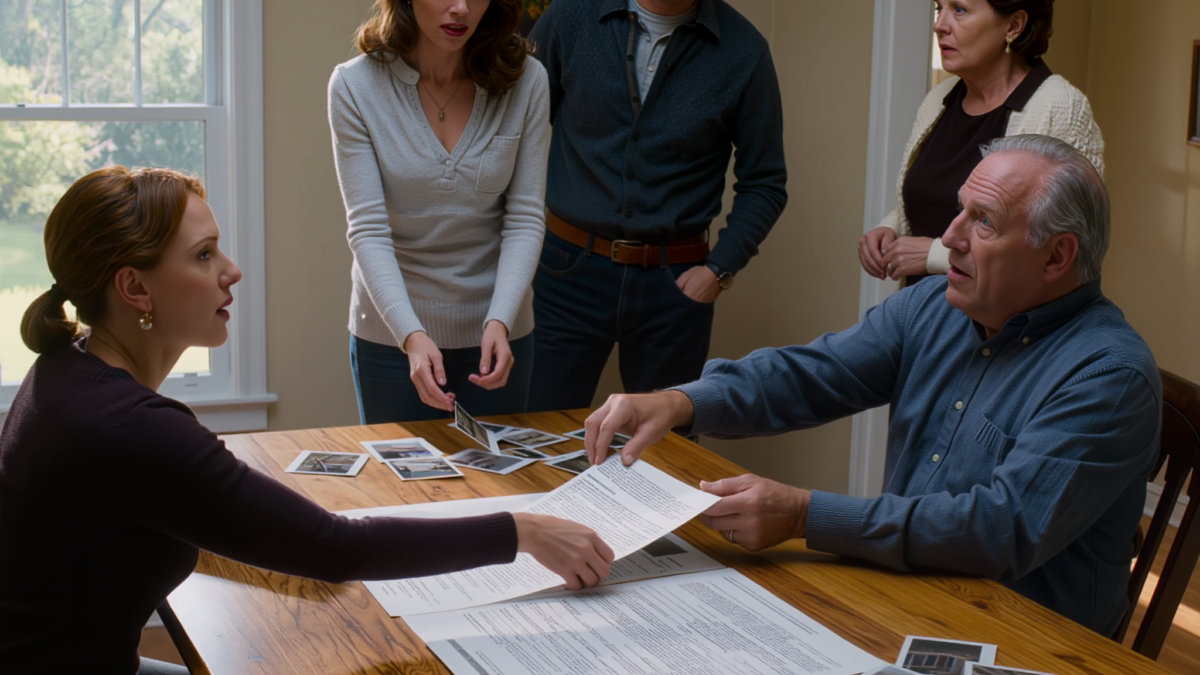
Two days later, a folder was waiting on their kitchen table.
I read it standing up.
The cottage had sold for $182,000.
Cash.
As-is.
Three-week closing.
I knew that house down to its framing.
If the ground had been stable and the foundation sound, the cottage and its acre would have been worth close to $280,000.
Dad had let it go for nearly $100,000 less.
“You didn’t sell it, Dad. You dumped it.”
“Your sister had a deadline on her house.”
The buyer had offered cash and no contingencies.
Dad considered that clean.
Fast.
In my business, speed can be very expensive.
I kept reading.
There was a gift letter in the paperwork connected to Camille’s $520,000 home.
The sale had netted roughly $170,000 after closing expenses.
A large portion had gone into Camille’s down payment. More had gone toward closing costs, reserves, and things already purchased for the new house.
They had kept almost nothing back.
That was the moment I understood how tightly the two houses had been connected.
My parents had taken the proceeds from Wesley’s cottage and poured them into Camille’s new one.
“It’s family money,” Dad said.
He believed that.
That was almost worse.
In my father’s mind, anything any of us owned eventually became family money if he decided another member of the family needed it more.
My marriage.
My grief.
Wesley’s work.
My house.
All of it could be rearranged by the person who believed he knew what was best.
Then I found the seller’s signature section on the transfer paperwork.
Dad’s name appeared there.
Beside it were four words.
As attorney in fact for Scarlet Dale.
I looked up.
“You signed as me.”
Dad appeared almost relieved that I had finally reached the explanation he considered decisive.
“You gave me power of attorney.”
I had signed a one-page form the week before flying to Florida.
The purpose, as I understood it, was practical. If the water heater failed, if a property-tax bill arrived, if something needed handling while I was a thousand miles away, Dad could take care of it.
“Handle the property,” he said. “That’s what it says.”
Then came the sentence that told me exactly how far apart our understanding of permission had become.
“Selling is handling the property.”
I folded the papers.
Before I left, I asked one more question.
“Camille’s closing. Still the 25th?”
Mom nodded quickly.
Everything was ready, she said.
The loan.
The inspection.
Everything.
“Good to know.”
That week, I called Colleen.
I asked whether the buyer had changed the locks.
He hadn’t.
There was still a spare key beneath the fern pot where Wesley had always kept one.
The house was no longer mine on paper at that moment, but many of our belongings were still inside, boxed up in the garage after the staging crew cleared the rooms.
I wanted those things.
But I especially wanted what I had seen in the kitchen photograph.
Wesley’s notebook.
On a gray Tuesday afternoon, I drove out to the cottage.
The spare key was exactly where Colleen said it would be.
I entered the house Wesley had built and my father had sold.
The rooms looked wrong.
Half-staged.
Half-empty.
Pieces of our life had been moved around by strangers so the house would photograph better.
The kitchen drawer still stuck.
I lifted and pulled the way Wesley used to.
It opened.
The notebook was inside.
Cheap spiral binding. Soft cardboard cover. Worn from years in that drawer.
I sat at the kitchen table and opened it.
I expected lists.
Measurements.
Hardware.
Instead, I found the ground.
The earliest entries were from 2020.
A hairline crack at the west footing.
Wesley had drawn it and dated it.
Then came years of measurements.
The same crack tracked over time.
“March. Crack at west footing widened 1/8 inch. Not yet. Save more first.”
Another entry.
“No change. Good winter.”
Then another.
“Spring seepage at south corner after thaw. It’s the fill. Always the fill.”
Small Polaroids were taped to some of the pages.
A level held against concrete.
A ruler beside a crack.
Water where water should not have been.
Wesley had been monitoring the cottage quietly for years.
Then, folded between the pages, I found a structural engineer’s preliminary assessment dated 2021.
Differential settlement at the west and south footings.
Expansive soils.
Historic fill.
Full underpinning recommended to prevent progressive structural failure.
Estimated cost: about $70,000, rising with delay.
Behind that letter was an envelope.
Wesley had written one word across it in block letters.
FOUNDATION.
Inside were savings receipts.
Deposits of a few hundred dollars at a time.
I added them.
$18,000.
He had been saving toward the repair.
Quietly.
Job after job.
Dollar after dollar.
And then I reached the last page he had written on.
One sentence was pressed so hard into the paper that the pencil had left grooves.
“Fix it right before I let anyone else in. She deserves a house that holds.”
That was when I finally cried.
Not because of the market value.
Not because my parents had sold it.
I cried because my family had spent two years calling Wesley’s cottage a burden, a shack, and a widow’s refusal to move on.
But the notebook told a different story.
Wesley had spent years watching a problem beneath our home and putting money away so one day he could fix it properly.
What my family had dismissed as worthless was a record of the way he had loved me.
The buyer had paid cash for a house sitting on a problem Wesley had documented for years.
And he had bought it without looking underneath.
Around the same time, something else became clear to me.
This was not the first time my family had moved something meant for me toward Camille.
Years earlier, when our grandmother’s small estate was divided, my share had been adjusted after Camille had her first baby.
Mom had explained it gently.
“You didn’t need it, sweetheart. You’ve always landed on your feet.”
I had let it go.
Because I was the strong one.
That was what the strong one did.
Soon the pressure started again.
Mom called one Tuesday night.
She talked about Camille’s children and how they deserved a proper home.
She reminded me I had a nice apartment.
Then she said I had memories.
As if memories were a kind of wealth that made giving away actual property easier.
“Be fair to Camille. That’s all I’m asking.”
I stopped arguing.
Arguing kept me inside a negotiation I had never agreed to.
“I hear you, Mom.”
Then I ended the call.
Dad texted the next day.
Wesley is gone. Holding on to that house won’t bring him back. It’s time to let your sister have her future.
He was right that the house would not bring Wesley back.
That had never been why I kept it.
Then an aunt called.
Apparently, “everyone in the family” agreed the sale was best.
That same day, I discovered a family group chat I had not known existed.
Weeks of messages celebrated my parents’ generosity toward Camille.
Heart reactions.
Congratulations.
People I loved had discussed the use of my husband’s house without me.
Then they added me only when they needed me to cooperate.
My mother came to my apartment one Thursday carrying coffee cake.
For once, she didn’t begin with Camille.
She talked about her own childhood.
About growing up poor.
About a winter when the heat was shut off.
About her mother counting coins before deciding which bread they could afford.
“I never wanted either of you girls to lie awake over money the way I did.”
Her eyes were wet.
I believed those tears were real.
“I just wanted to know that at least one of my daughters was safe, had a real house, something that couldn’t be taken.”
For a few seconds, I understood her completely.
I saw the frightened girl she had once been.
And I felt the familiar urge to make things easier for her.
Then I reminded myself of something I should have learned years earlier.
Understanding someone is not the same thing as obeying them.
Mom saw me hesitate.
“If you loved this family,” she said softly, “you wouldn’t make us beg you like this.”
Then she reached for the oldest lever she had.
“You’ve always been the strong one, Scarlet. Don’t stop being the strong one now when your sister needs you most.”
There it was.
The job I had been doing since childhood.
I put the kettle on.
“I’ll think about it.”
Mom left believing that meant she had won.
Two weeks before Camille’s closing, Colleen called.
This time, there were three trucks at the cottage.
A man was standing in the driveway, shouting into his phone about the foundation.
By then, I knew the buyer’s name.
Gavin Brandt.
He ran a small house-flipping business called Copperline Homes.
His business model was simple. Buy cheaply. Renovate quickly. Resell.
To begin renovating the cottage, his crew finally opened the crawl space.
They found water pooling beneath the west footing.
They found the settlement Wesley had tracked for years.
Gavin hired a structural engineer.
Her name was Dana Kesler.
Her assessment echoed the one Wesley had saved years earlier.
Severe differential settlement.
Full underpinning required.
Estimated repair: $72,000.
And there was another problem.
Her report stated that the property should not have transferred without disclosure of the known defect.
Gavin had paid $182,000 in cash.
He had apparently expected to spend relatively little improving the house and then resell it closer to its full market value.
Instead, he owned a property that needed roughly $72,000 of structural work before a future buyer’s inspector would ever be comfortable with it.
He had bought as-is and without contingencies.
But his attorney found another issue.
My father had completed the sale using the power of attorney I had signed.
The authority I believed allowed him to handle routine property matters.
Not sell the house.
Gavin wanted out.
A certified letter eventually arrived at my parents’ house.
Dad called me almost immediately.
For the first time in my life, I heard real fear in his voice.
“Scarlet, there’s a lawyer’s letter here. It’s about the sale. The cottage.”
He stumbled over his words.
“This is a mess. This is a real mess. And I need you to fix it.”
The mess he had created had somehow become mine to solve.
Again.
I told him I would call back.
I did not call back that day.
Soon the problem reached Camille’s mortgage.
Her lender did not like the fact that a major portion of her down payment came from proceeds connected to a disputed real-estate transaction.
Underwriting stopped.
The February 25 closing remained on the calendar.
Trent called me privately on a Sunday evening.
“The bank’s holding the loan. They want the down-payment money cleared of any claim before they’ll fund.”
Dad could not replace the money easily.
It was already committed.
“The closing’s Wednesday, Scarlet. We’ve got three days.”
He paused.
“The kids already picked their rooms.”
Piper wanted the yellow one.
My family immediately turned back toward me.
Dad called first.
“There’s a way to fix all of this.”
His voice had returned to its controlled, reasonable tone.
“You ratify the sale. You just sign a document confirming it was authorized all along. Then the sale’s clean, and if the sale’s clean, the money’s clean.”
If I signed, Camille could still close.
He proposed another possibility involving borrowing against the cottage.
“One signature, Scarlet.”
One signature.
That was all they needed.
One signature to turn the sale into something I had approved.
One signature to make the money usable again.
Camille called that night.
Her voice sounded different from the woman who had laughed about Wesley’s shack.
“I know I was cruel,” she said. “The shack thing at dinner. I know.”
Then she started talking about Piper.
“She picked the yellow room, Scar. She told her whole class at school. She’s been drawing pictures of it.”
Her breathing broke.
“Please. You’re the only one who can fix this.”
For most of my life, I had wanted to feel needed by my sister.
Now she needed me desperately.
For a dangerous moment, that felt almost like love.
I printed the ratification document Dad had emailed.
I put it on my kitchen table.
I picked up a pen.
Then I moved Wesley’s notebook aside to make room.
It opened near the last page.
My pen touched the signature line and left a tiny blue mark.
My eyes fell on Wesley’s final sentence.
She deserves a house that holds.
My hand stopped.
The choice in front of me suddenly looked different.
It was not simply about whether I would save Camille’s house purchase.
It was about whether I would once again use something belonging to me to absorb the cost of someone else’s decision.
I did not sign.
Not that night.
I told my family I needed one more day.
Dad responded by arranging a family meeting at his house.
Sunday afternoon.
Everyone would be there.
He wanted to “settle this together as a family.”
I knew what that meant.
He wanted a room full of people reminding me to be reasonable.
Be fair.
Be strong.
So the next morning, I made one call.
Wendell Fry was a real-estate attorney I had worked with on appraisal disputes for years.
I gave him the facts.
The deed.
The power of attorney.
The engineer’s report.
The numbers.
When I finished, he was quiet for a moment.
“Scarlet, I think you’ve been bracing for a fight you don’t actually have to have.”
I waited.
“You own that house. You never left it.”
He explained that, in his view, the sale had been completed using authority the power of attorney did not grant.
“You don’t have to sue anybody. You just have to stop signing things.”
Then he pointed out something else.
Gavin wanted out of the transaction.
So did I.
We were not actually opposing each other.
We wanted the same result.
Undo the deal.
“Do nothing and win,” Wendell said.
I wrote those three words on a sticky note and put it on my kitchen cabinet.
But I knew refusing to sign would not prevent my family from rewriting the story afterward.
I would become the selfish daughter.
The bitter widow.
The aunt who cost children their bedrooms.
I couldn’t control how they described me.
I could make sure they heard the facts first.
So I photocopied Wesley’s notebook.
I placed Dana Kesler’s recent engineer report beside the preliminary report Wesley had saved in 2021.
Same footings.
Same cause.
Almost the same repair figure.
Five years apart.
I put Wesley’s original notebook into his old canvas tool bag.
Then I drove to my parents’ house.
Mom had placed two fresh ferns beside the front door for the family gathering.
Healthy.
Green.
Perfect.
I looked at them and thought about the dead ferns at Wesley’s cottage.
Dad had held a key to one house and never watered the plants.
Now fresh plants had appeared for a meeting where appearances mattered.
I carried the canvas bag inside.
Everyone was already seated around the dining table.
Dad sat at the head.
Mom beside him.
Camille and Trent farther down.
My aunt.
Two cousins.
Nine people including me.
In the center of the table sat the ratification document.
A pen rested across it.
“Sit down, Scarlet,” Dad said.
His voice was warm.
“We’re all here for one reason. To help your sister. You sign that, we put this whole ugly business behind us, and we go back to being a family.”
He slid the pen toward me.
I sat.
I did not touch it.
Mom put her hand over mine.
“Do this,” she said quietly. “And everything goes back to the way it was.”
Her eyes filled.
“You’ll be my daughter again. Not the difficult one. Not the one who made it all so hard right when the family needed her. Just my girl. My strong, good girl.”
Then she said the thing I had wanted to hear my entire life.
“Please, Scarlet. Come home to us.”
For a moment, I understood what they were offering.
Not money.
Not property.
Belonging.
All I had to do was sign.
I looked at Mom’s hand over mine.
At Dad waiting confidently at the head of the table.
At Camille staring down.
Then I reached into Wesley’s canvas bag and pulled out his notebook.
I placed it beside the document.
“Before I sign anything, I want to read you something. It’ll take one minute.”
Dad’s expression tightened.
“Scarlet, this really isn’t the—”
“It’s Wesley’s handwriting.”
He stopped.
I opened the notebook.
I read plainly.
“March 2020. Crack at the west footing widened 1/8 of an inch. Not yet. Save more first.”
I turned the page.
“2021. Called an engineer out. Full underpinning. 70,000 and rising.”
Then the Polaroids slipped onto the table.
Small square photographs showing the work underneath the house.
Wesley in the dirt.
A level against concrete.
Measurements.
“He wrote all this so no one would ever get hurt in that house,” I said. “And he saved $18,000, a few hundred at a time, out of every job he took, to fix the ground the right way before he let another person move in.”
Nobody interrupted.
I slid Dana Kesler’s report into the middle of the table.
“And this is from the buyer’s engineer two weeks ago. Same footings. Same cause. Same repair. $72,000.”
Camille stared at the photographs.
“He bought it as-is, cash, after spending less than ten minutes looking at it. Now he knows what Wesley knew for years, and he wants his $182,000 back.”
I looked directly at Dad.
“The $182,000 that is sitting underneath Camille’s down payment.”
Nobody moved.
“You didn’t sell a shack, Dad. You sold a house you didn’t own with a problem you didn’t know was there to a man who never looked.”
Camille’s hand moved slowly toward one of the photographs.
Then stopped.
“I didn’t know he…”
Her voice was small.
“I thought it was just an old house.”
“I know.”
Dad recovered first.
“This changes nothing.”
He straightened the ratification document in front of me.
“The sale can still be ratified. You can still fix all of this. If you love this family, if you love your sister—”
“You’re right about one thing, Dad.”
I closed Wesley’s notebook.
“I’m done clinging to the past.”
For half a second, Dad’s face lifted.
He thought I had agreed.
“So I’m going to keep the house instead of the story you told about it.”
I picked up the pen.
Put the cap back on.
Set it on top of the document.
Then I pushed both across the table toward him.
I did not sign.
Nobody spoke.
Mom’s hand remained on the spot where mine had been.
Dad looked at me as though he were searching for the next argument and couldn’t find one.
For thirty-four years, he had believed that eventually I would choose their approval over my own boundary.
That afternoon, I didn’t.
Then Trent stood.
That surprised everyone.
He picked up Camille’s coat and held it toward her.
“Cam. Come on.”
She looked up.
“We’ll find another house. A real one. One we can actually afford.”
He glanced at the papers and photographs.
“We are not building our kids’ home on top of this. I won’t do it.”
Then he looked around the room.
“I’m sorry. Thank you for trying to help, but we’re done here.”
Camille stared at him, then at me.
There was no apology on her face yet.
But there was something that might one day become one.
I did not need it.
I gathered Wesley’s photographs back into the notebook and placed it inside the canvas bag.
Then I stood.
“Water your own ferns, Dad.”
I walked out.
I closed the door quietly behind me.
Sitting in my car afterward, I did not feel triumphant.
I felt lighter and lonelier at the same time.
For years, I thought setting down the role my family had given me would feel like winning.
Instead, it felt like finally recognizing something I had lost long ago.
I had spent decades believing that being “the strong one” was how I belonged.
That afternoon, I stopped paying the membership fee.
The legal side moved quickly after that.
Wendell had been right.
Gavin wanted out of a house with a major foundation problem.
I wanted the cottage back.
We signed a mutual rescission.
His $182,000 purchase was unwound, and the deed returned to my name, where Wendell maintained it legally should have remained.
Gavin lost the inspection and engineering costs he should have spent before buying.
I never spoke to him directly.
Not once.
My parents, however, had to return money they no longer had.
The sale proceeds had already been committed to Camille’s house, closing expenses, and other purchases.
Eventually, Mom and Dad took out a loan against their own home to cover the shortfall.
Dad left me one voicemail.
“After everything we did for you…”
I still have it.
I never called him back.
It was the last time I heard his voice.
Camille’s February 25 closing did not happen.
She lost roughly $10,000 in earnest money.
The yellow bedroom disappeared with the house.
She and Trent remained in their rental.
Later, I heard that Piper eventually stopped asking about the yellow room.
I never called Camille’s lender.
I never contacted her seller.
I never called Gavin to create trouble for him.
I did not make her house purchase collapse.
I simply refused to use my property to rescue a transaction I had never authorized.
A few weeks later, Trent called.
“She’s not ready to say it,” he told me. “I don’t know if she ever will be.”
He paused.
“But I wanted you to hear it from someone. We were wrong. All the way down to the ground.”
Then he said, “I’m sorry, Scarlet.”
Camille still has not said those words herself.
Maybe she will someday.
Maybe she won’t.
I stopped waiting.
Trent brings the children to the cottage sometimes on Saturdays.
Piper likes the porch.
She likes the light.
And she has never once called the place a shack.
In April, I hired a crew to do what Wesley had spent years preparing to do.
“Start at the west footing,” I told the foreman.
I placed Wesley’s open notebook on the kitchen windowsill.
“He already wrote down where it hurts. Just do what the man says.”
They underpinned the foundation properly.
The slow way.
The expensive way.
The way Wesley had researched and planned.
I used the $18,000 he had saved in the envelope marked FOUNDATION and paid the rest from my own savings.
When the work was finished, the crack at the west footing stopped growing.
The house held.
I changed the locks.
There is one key now.
I keep it with me.
I moved back into the cottage in May.
The third stair still creaks.
I no longer turn toward it expecting Wesley.
I know now that sometimes a house makes a sound because someone is coming home.
And sometimes it is simply settling for the night.
My mother still calls occasionally.
Sometimes I answer.
Often I let it go to voicemail.
The guilt does not arrive the way it used to.
On my first evening back in the cottage, I bought a new fern.
I placed it beside the front door where the old one had died while Dad held my key.
I filled a watering can at the kitchen sink and watered it myself.
Then I stood on the porch while evening settled over the field.
At dusk, the porch light came on.
The same light Wesley had wired with his own hands.
Steady.
Warm.
Still working.
Camille once said his useless little shack had finally done something good for the family.
In a strange way, she was right.
It forced all of us to look at what had been underneath everything.
The bad ground.
The paperwork.
The money.
The way my family had learned to call taking from me “being strong.”
And the notebook my husband had left inside a stuck kitchen drawer.
For years, everyone told me I was clinging to the past.
That little house taught me there is a difference between clinging to something and being held up by it.
Between a burden you carry and a foundation you stand on.
I stopped being the strong one.
That was never really a job.
It was simply the name my family gave the person they expected to need the least.
Now I am the person who decides what I give.
I water the ferns myself.








