On my first night in the beach house I bought with 11 years of savings, Mom said, “Pack the master bedroom. Your sister has a real family.” Dad called four bedrooms “selfish,” and Kristen said her moving truck would arrive at 10. I answered, “10 is perfect.” At 9:55, their truck turned onto my street—while the county worker scheduled to inspect my home was already standing in my living room.
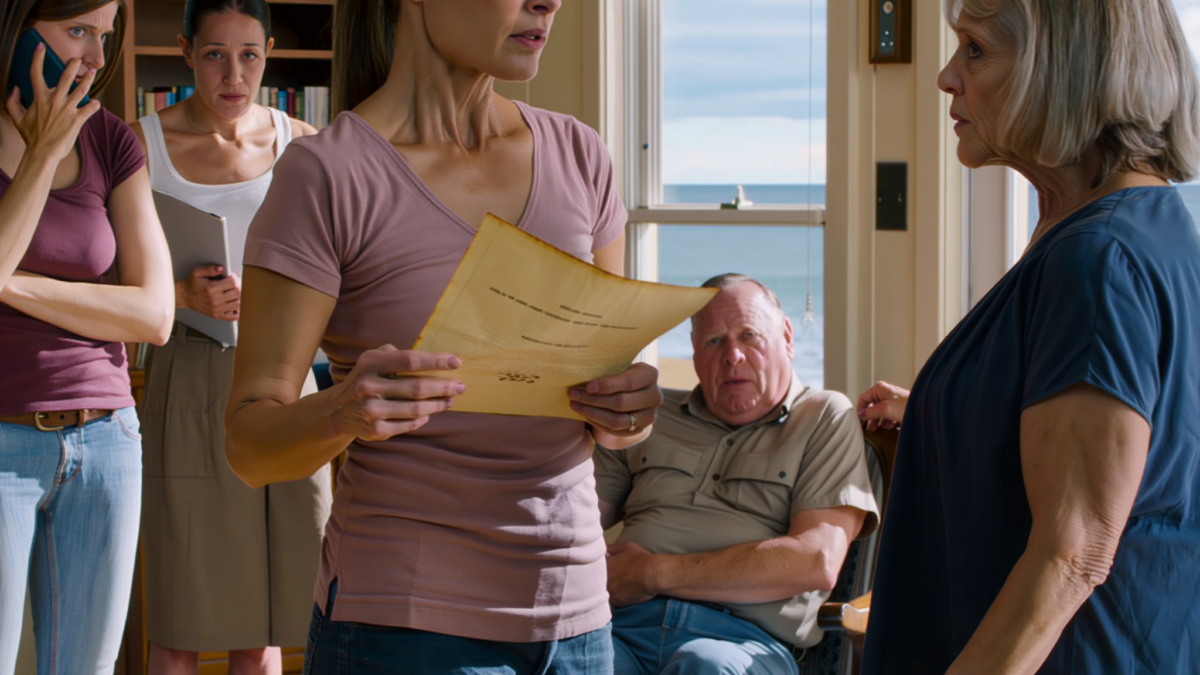
The phone was still warm in my hand when I set it facedown on the kitchen island of a house my family was already dividing up in their heads.
I didn’t slam anything. I didn’t call anyone back.
I stood there in a kitchen that still smelled like fresh paint and listened to the ocean through the open window. The tide was coming in. When everything else is quiet in that house, you can hear it.
People think calm means you didn’t feel something. Sometimes calm is just what is left after you have felt the same thing so many times that it stops surprising you.
My mother telling me my sister deserved my bedroom did not surprise me.
My father deciding that a woman without children was taking up too much room in the world did not surprise me either.
What surprised me was how good it felt to type, “10 is perfect,” and mean it completely.
I played my mother’s voicemail again.
“Pack the master bedroom, Vicky. Your sister has a real family. You don’t.”
She had a gift for saying the cruelest thing in the calmest voice. If you ever repeated it later, she could look wounded and insist she would never say something like that.
Apparently, I had been mishearing her my entire life.
Then there was Kristen’s text, sent thirty seconds after my father hung up.
Truck at 10. Don’t make this awkward. Just clear out.
No hello. No question mark.
My sister did not ask questions when she had already decided what the answer should be.
I walked through the house.
I checked the back door. I checked the windows. I ran my thumb over the new deadbolt I had installed the week I closed because some part of me already understood that my family treated a lock as a suggestion.
At the end of the hall were two closed doors.
I put my hand on one knob but did not open it.
“Not yet,” I told myself.
I had lived through different versions of that night for thirty years. The version where I begged them to understand me. The version where I gave in because giving in seemed easier. The version where I finally lost my temper and gave them exactly what they needed to call me unreasonable.
None of those versions had ever worked.
You cannot win an argument with people who own the scoreboard.
So I was not going to have an argument.
I was going to have a morning.
And that morning was already scheduled.
I went back to the kitchen, made coffee I would not drink until the next day, and set out two mugs.
Then I opened the calendar on my phone.
At 10:00 a.m., one appointment had already been sitting there for a week.
Home visit. D. Prescott. 10:00 a.m.
To understand why that mattered, you have to understand the house.
I am a pediatric nurse practitioner. I have spent most of my adult life caring for sick children.
For several years in my early thirties, I worked travel contracts, moving from one short-staffed hospital to another. During the years when hospitals were desperate for experienced people who could walk into a pediatric unit and function under pressure, the pay was unusually high.
I treated every extra dollar like something I was not allowed to touch.
I lived in furnished rentals with other people’s art on the walls. I ate plenty of dinners from gas stations in hospital parking lots. I missed trips, weddings, weekends away, and things other people my age seemed to assume they would always have time for.
Almost everything went into savings.
I did not originally save for a beach house.
For a long time, I did not know what I was saving for.
I only knew I never wanted the shape of my life to depend on somebody in my family deciding whether I deserved help.
I had learned that lesson early.
Eleven years of long shifts, holiday differentials, careful spending, and saying no eventually turned into enough money for me to buy a house in Emerald Isle.
The purchase price was $625,000.
I put down $190,000.
The house had four bedrooms, two and a half bathrooms, and sat second row from the water. It was close enough to smell the salt but far enough back that the flood insurance did not destroy my budget.
On the coast, insurance can feel like a second mortgage. Wind coverage, flood coverage, and everything else added up quickly.
My total monthly cost was close to $3,800.
I carried it alone on one salary.
Nobody stood behind me if a month went wrong.
I did not inherit that house.
I earned it one shift at a time.
The only thing my family ever really gave me was a reason to become financially independent.
In their version of our relationship, however, I still owed them.
Not a specific amount.
It was a permanent family debt that never became smaller no matter how much I contributed.
Eight years earlier, Kristen got into trouble with a car she could not afford.
My mother called me while I was working a contract in another state. She did not ask whether I could help.
She told me I would cover the difference so Kristen would not lose the car and embarrass the family.
It was $9,000.
I sent it.
I told myself it was a loan, although everyone involved understood that it was not.
Nobody mentioned the money again until a family holiday, when my mother told a cousin how wonderful she and Dad had been for helping Kristen keep her car during a difficult period.
My money.
Their generosity.
My name erased entirely.
That was the system.
I put money and effort in one end, and out the other came a story about everything the family had done for Kristen.
For years, I believed that if I gave enough, eventually I would earn a place at the center of the family.
It took me a long time to understand that keeping me on the edge was part of how the system worked.
Their sense of ownership over my beach house had another history too.
Years earlier, my parents went through a rough patch. I let them stay in a condo I was renting while I was away on a contract.
I gave them a key.
That was the mistake.
Not letting them stay.
The key.
In my family, once you gave someone a key, apparently you had handed them a permanent share of everything you would ever own.
They stayed four months.
They rearranged my furniture.
They gave the spare key to Kristen “just in case.”
When I came home and asked for the keys back, Mom acted as if I had accused her of a crime.
“We’re family, Vicky. Why are you being like this about a key?”
I never gave any of them a key to the beach house.
I changed the locks the week I moved in.
But you cannot change the lock on a belief.
In their minds, my spaces had always been common property.
The deed did not matter.
They trusted something more than paperwork.
They trusted thirty years of me giving in.
There was another person at the center of all of this, although she had been gone for years.
My grandmother Ruth.
She was my mother’s mother.
When Ruth died in 2019, she left me a small amount of money. It mattered, but it did not buy the house.
What mattered more were the things without resale value.
A tide clock.
A recipe box written in her handwriting.
And a worn children’s book with a lighthouse on the cover.
The corners had become soft from years of use.
When I was small and the house became loud with everyone arranging themselves around Kristen, Ruth sometimes took me into a back bedroom where it was quiet.
She read me that lighthouse story.
It was about a little lighthouse that believed it was too small to matter.
I did not understand then why she kept choosing that book for me.
I understand now.
She was trying to tell a girl who was always standing at the edge of the family picture that being easy to overlook was not the same thing as being worth less.
I carried that book through eleven moves in eleven years.
It was the one thing I never put into storage.
My mother had never forgiven me for Ruth’s will, but the money was only part of it.
What she really resented was that near the end of Ruth’s life, Ruth stopped pretending not to notice what was happening.
She would say things openly at dinner.
“Vicky’s the one who calls me.”
“Vicky’s the one who comes.”
In our family, trust was a kind of currency.
Ruth spent hers on me instead of on her own daughter.
My mother carried that like an unpaid invoice.
“Mom always favored you,” she texted the week I closed on the beach house. “The least you can do is share what she gave you.”
That sentence explained nearly everything.
Anything good that came to me was treated as if it had been taken from the family.
Therefore, the family deserved a refund.
The house was never really mine in their minds.
It was a family asset that I happened to be holding.
And Kristen had what Mom called a real family.
I did not.
So their arithmetic was simple.
Give the childless woman’s extra space to the woman with children.
To them, it probably did not even feel cruel.
It felt logical.
You also need to understand Kristen.
It would be easy to make her the villain of the story, but that would be too simple.
Kristen was thirty-six, four years younger than me. She had a husband named Todd, a son, and a daughter.
She had spent her entire life being taught that she did not need to ask whether she deserved something before taking it.
When she wanted to attend college out of state, my parents found the money.
When her first apartment arrangement fell apart, they covered the gap.
When she and Todd bought their first house, Dad co-signed the loan and Mom furnished half of it with things she “found deals on.”
That was family language for purchases no one was supposed to discuss afterward.
Kristen’s wants became emergencies.
Mine were luxuries.
I was “the strong one.”
It sounds like praise until you understand that it is actually a job.
The strong one is the person nobody has to worry about.
Then the person nobody worries about.
Then the person who gets nothing because she can obviously manage.
And I could manage.
That was the trap.
Every time I survived something alone, they treated my survival as proof that I had never needed anyone in the first place.
There was a photograph from my parents’ thirtieth anniversary that I kept for years without understanding why it bothered me.
Everyone was arranged on the couch.
Kristen, Todd, and their children were in the center.
My parents stood behind them with their hands resting on Kristen’s shoulders.
I was at the far edge, half out of the frame.
I had been the one who offered to take the picture.
Then someone said, “Just get in quick.”
The shutter went off before I had fully found a place.
That photograph was my childhood.
Everyone else arranged in the center.
Me holding things together from the edge and stepping into view only at the last second.
The explanation for why I was single and did not have children changed depending on who my family was talking to.
To relatives, I was married to my career.
To friends, I was too picky.
Too independent.
A shame, really.
To my face, on the worst days, Mom called me cold.
Kristen once told me, “It’s different when you have kids, Vic.”
She was not even trying to be cruel.
That was what made it worse.
She genuinely believed I belonged to a smaller category of person.
My home was emptier.
My needs were lighter.
My objections mattered less.
In my family’s private accounting system, I had failed to do the one thing that made a woman’s life count.
I never corrected them.
The truth about why I did not have children was not a truth they had earned.
In 2011, I lost a pregnancy.
It was early and quiet. I told almost no one.
The absence of it settled somewhere inside me and stayed there.
My family folded that loss into their preferred story that I had simply chosen a life without children.
A choice was easier for them to understand than grief.
Nobody sat with me.
Nobody asked much.
During those same months, my aunt Carol died.
Carol was my mother’s sister.
She had married someone the family disapproved of, moved away, struggled financially, and gradually became another person who did not fit the picture.
“We don’t talk about that side of the family,” Dad would say, reaching for the television remote.
Carol had a daughter.
Amanda.
I was one of the only people who kept saying her name.
When Carol died, Amanda was fifteen and needed somewhere to go.
I was twenty-six.
I wanted to take her in.
Not in some abstract way.
I met with the county caseworker.
I was a blood relative. I had steady work. I had a spare bedroom.
I prepared the room.
I painted it.
I bought a bed and a lamp.
I left a stuffed animal on the pillow because I had no idea what a fifteen-year-old girl would actually want.
I had prepared a home for a child once before, twelve years before I would do it again.
Almost no one knew.
Then my parents became involved.
My mother told the caseworker I was grieving and unstable.
She said it in the same reasonable voice she used whenever she wanted something cruel to sound responsible.
A teenager needed stability, she said.
Amanda should stay near family.
A single woman going through something difficult was not the right choice.
The family would handle Amanda themselves.
It sounded responsible.
That was the problem.
The statement was built around enough truth to protect the lie underneath it.
The family had no intention of taking responsibility for Amanda.
For years, I only knew something had happened behind my back.
I could feel it in the way conversations stopped when I walked into rooms.
After Ruth died, I began pulling on loose threads in my own history.
I learned that I could request old records.
So I did.
Weeks later, a thin envelope arrived in the mail.
I opened it standing at the kitchen counter of my condo.
Inside was my mother’s statement.
The paper had been folded into quarters and had yellowed along the creases.
“My daughter is grieving and unstable. She cannot raise a child right now. We will handle it ourselves.”
I read it three times.
Then I sat at the counter for a long time.
For more than a decade, part of me had tried to treat the entire thing as a misunderstanding.
Maybe Mom had been overwhelmed.
Maybe she had said the wrong thing.
Maybe everyone had been trying to help.
The paper took that possibility away.
It had been a decision.
A written one.
Signed.
My mother had taken the worst year of my life and used it as evidence against me.
I folded the page back along the old creases and kept it.
Not because I had a plan.
Because it was the first physical proof I had ever held that the thing I remembered had actually happened.
My parents did not “handle” Amanda.
Once I stepped back, exhausted and grieving and no match that year for my mother’s certainty, Amanda entered foster care.
Then the family returned to its life and stopped saying her name.
They would later try to take rooms away from children I loved.
But years earlier, they had already helped take a child out of my life.
Amanda aged out of foster care at eighteen.
I found her when I could.
It was not easy.
Young people who age out without family support often move frequently, and Amanda did.
Every so often I tracked her down.
We would have coffee.
I would help when I could without making it feel like charity.
Once, when she was in her early twenties, we sat in a diner and she asked whether I remembered reading to her when she was little.
I did.
I had read her Ruth’s lighthouse book.
The same book Ruth had read to me.
“I still think about the lighthouse,” Amanda said.
She stirred her coffee and did not look up.
“The little one. The one that thought it was too small to matter.”
Then she said, “If I ever have kids, I want them to have stuff like that. Steady stuff.”
I told her they would.
I believed it.
Amanda eventually had two children, a daughter and a son.
In the fall of 2025, on a wet road at night, Amanda died in a car accident.
She was twenty-eight years old.
I found out on a Tuesday.
A cousin I barely spoke to called me.
It was the kind of call you know is bad before you answer because that person never calls.
Amanda had been in an accident.
It had happened quickly.
There would be a small service.
I was still in my scrubs when I got the news.
I sat in my car in the hospital parking lot and did not start the engine.
Twenty-eight.
I kept thinking about the diner.
The lighthouse.
The promise of steady things.
My parents heard too.
News travels through families even when those families pretend certain people do not exist.
Mom later mentioned Dad’s reaction almost casually.
“That’s not really our problem, is it?”
I attended Amanda’s service.
It was held in a rented room with folding chairs.
Maybe a dozen people came.
My parents were not there.
Kristen was not there.
There were flowers from people who had known the adult Amanda my family had never bothered to meet.
A photograph stood on an easel.
I had never seen it before.
Amanda had tired eyes and a real smile. She was holding two small children.
I did not yet know those children were about to become the center of my life.
Amanda’s daughter and son entered foster care.
Nobody on that side of the family stepped forward.
Nobody on our side even asked their names.
So I stopped asking my family for anything.
And quietly, without telling them, I began preparing myself for whatever might come next.
The children found me before I found them.
It happened during a night shift in January.
A five-year-old boy was brought to my unit in respiratory distress from an asthma flare.
I did my job.
I helped get his breathing under control, got the medication working, and tried to get some of the fear out of the room.
Afterward, I sat with him.
He watched me with serious eyes for a while.
Then he asked, “Are you staying till my sister comes back?”
I looked at his wristband.
Reed, Owen.
I had read thousands of wristbands during my career.
I read that one three times.
Reed.
Owen.
Five years old.
A sister somewhere in the building.
I did exactly what I was supposed to do.
The moment I realized a patient might be related to me, I told the charge nurse and the unit social worker.
Then I stepped away from being his direct provider.
There could never be a question later about whether I had crossed a professional line.
That disclosure turned out to matter enormously because it placed me on the record as a relative before I ever asked the county for anything.
During a break, I walked past the family waiting room.
A girl sat alone in a vinyl chair with her feet not quite touching the floor.
She was eight.
A library book rested in her lap, held tightly with both hands.
A tired caseworker sat nearby.
Two siblings temporarily split between a hospital room and supervision by strangers.
Later, I saw the name in the record.
Mother: deceased.
Amanda Reed.
Those children were Amanda’s.
Carol’s grandchildren.
Ruth’s great-grandchildren.
The last living part of the branch my family had spent years pretending did not exist.
The charge nurse found me in the break room around four in the morning.
She put a cup of terrible unit coffee in front of me and waited.
I told her only enough.
The boy in bed six was my cousin’s son.
My cousin was dead.
Nobody in my family had even asked the children’s names.
After a moment, she asked, “So what are you going to do?”
Not what should you do.
What are you going to do?
“I don’t know yet,” I said.
But I did.
I think I had known since the second time I read Owen’s wristband.
I was forty.
I had good income.
No debt.
Eleven years of savings.
And suddenly that money had a purpose.
At the time, I was living in a rented condo with one spare room.
I had no idea how to fit two children into that life.
Before my break ended, I had opened a real estate app on my phone.
I started looking at houses near the coast with more than one bedroom, decent schools, clean air, and enough space for a boy with bad lungs to sleep somewhere that sounded like the ocean instead of a highway.
I did not sleep after my shift.
I sat at my kitchen table with cold coffee and made a list.
What the county would ask for.
What the children would need.
What I would have to prove on paper before I could become it in their lives.
When the caseworker’s office opened, I called.
“I’m a relative,” I said, “and I want to be considered.”
The woman explained that relative placements were preferred but that the process would be thorough.
“I’m counting on thorough,” I told her.
Thorough had protected me from my own family once the truth was written down.
Now it might protect Amanda’s children too.
Stepping forward was not as simple as saying I wanted them.
I was not their parent.
I was not their sibling or grandparent.
I was a cousin once removed by the kind of distance my family had spent years creating.
To a child welfare system trained to be cautious, a relative who appears suddenly is a question, not an answer.
I had to prove a relationship I had been raised to hide.
I gathered old family records.
I found a photograph of Ruth holding Amanda and me when we were children.
I explained the years I had spent trying to maintain contact with Amanda.
I disclosed again that I had been the pediatric provider who recognized Owen and that I stepped away immediately.
I did everything by the book.
The rules were not an obstacle to me.
They were protection.
A few weeks later, once the paperwork allowed it, I met Lily and Owen properly at a supervised visit in a family services office.
The room smelled like carpet cleaner and old crayons.
I had been warned not to expect much.
Children who have lost a parent and moved between placements do not hand strangers their trust.
They should not.
Owen remembered me from the hospital.
He warmed up quickly because, in his mind, I was the person who had fixed the breathing.
Lily was different.
Eight years old.
Watching every exit.
Answering questions with the fewest possible words.
I recognized what she was doing within minutes.
She had become the strong one.
Since the night her mother did not come home, she had been holding things together for herself and her little brother.
Somebody had made her that way just as somebody had made me that way.
I wanted to reach across the table and tell her she could put that weight down.
I did not.
It would not have been true yet.
The first crack in the wall came from Ruth’s lighthouse book.
I had brought it almost without thinking.
When Owen became restless, I opened it and began reading.
I was not trying to perform.
I simply read.
About a page in, Lily went still.
Not relaxed.
Listening.
When I finished, she looked at me.
“Our mom had one kind of like that.”
“I know,” I said.
I gave her the book.
Her expression changed in a way I could not fully read.
The caseworker made a note.
It was a beginning.
More visits followed.
Each one became a little longer and a little less supervised.
During the third, we went to a park near the water while the caseworker stayed at a polite distance.
Owen ran too hard and started wheezing.
I saw Lily’s entire body brace.
She had clearly handled moments like that before.
Too many times.
Alone.
I crouched to Owen’s level, worked through his breathing with him, and had him settled quickly.
When I looked up, Lily was staring at me.
It was not that I had helped him.
It was that she had not needed to.
For a few seconds, I watched some of the weight leave an eight-year-old’s shoulders.
That was the moment hope turned into a decision.
Whatever it cost me, I wanted to build a life where Lily did not have to be the strong one every minute.
I bought the beach house in April.
I closed in the middle of the month.
The realtor probably thought I was unusual.
A single woman looking at four-bedroom houses, checking stair safety, sight lines, school information, and the distance to pediatric care.
Then I walked into this one.
It was not the largest house.
It was not the newest.
But two bedrooms at the end of one hallway caught beautiful light.
And from an upstairs window, past the second row of houses, I could just see the lighthouse on the point.
That was when I stopped pretending I was still shopping.
After closing, I spent nearly every day off with a paint roller in my hand.
One room got a star lamp for the little boy who had been afraid in a hospital at night.
The other got a window seat for the girl who was always watching exits so she could have somewhere to watch the water instead.
I made two small wooden signs.
Lily.
Owen.
At first, I placed them on a shelf instead of hanging them on the doors.
I had once prepared a room for a child and watched that future disappear.
I was not ready to hang hope on another door until the county gave me permission.
My family discovered the house through relatives.
That was how they learned nearly everything.
The news that I had bought a four-bedroom place near the water landed with Mom like a personal provocation.
Her first message was almost pleasant.
“We heard the wonderful news. We should all come see it.”
I knew what that meant.
An inspection.
Mom walking through the rooms and deciding what portion of my good fortune belonged to everyone else.
Then Kristen called.
“Mom says you got a four-bedroom.”
She sounded genuinely confused.
“That’s insane for one person, Vic. You know Todd and I have been looking for a bigger place. And the kids need the beach. It’s good for them.”
She spoke as if she were reminding me about an agreement I had forgotten.
“The house isn’t available,” I said.
She laughed.
“Available? It’s family, Vic. Don’t be weird about it.”
Don’t be weird about it.
The same logic my mother had once used about the condo key.
In my family, a boundary was not a boundary.
It was a personality defect.
Three days later, Kristen showed up at the property without telling me.
I was not home. I was visiting the children.
A neighbor later mentioned seeing a woman walking around outside my house, looking through windows and pacing around the yard as if measuring rooms.
I called Kristen.
She did not deny it.
“I was just seeing what we’re working with.”
We.
She was already thinking in we.
I could have ended everything there.
I had the locks.
I had the deed.
I could have stopped answering the phone.
I could have made one call and refused to let any of them near the property.
I thought about it constantly.
One night at work, I talked it through with the charge nurse.
“Just tell them no and hang up,” she said. “You don’t owe them a scene.”
“If I say no,” I told her, “they hear a negotiation.”
They had been hearing my no as an opening bid my entire life.
I knew what would happen if I simply cut them off.
Mom would call relatives.
By evening, I would become the cold daughter who had abandoned her parents and kept the family out of a house that “should” have been shared.
And months later, while I was still trying to finalize a placement for Lily and Owen, there might be another version of me circulating through the family.
Unstable.
Cruel.
Difficult.
My mother had written that version down once before.
The nurse was quiet.
Then she said, “So you don’t want to win the argument.”
“No,” I said. “I want it to be over.”
That required something different.
For once, the behavior had to happen all the way through in front of somebody my parents could not talk around afterward.
I was not going to lure them into anything.
I simply was not going to stop them from showing exactly what they believed they were entitled to do.
The right witness already existed.
Diane Prescott was the county worker handling the kinship placement.
She had done this work for years and had the manner of somebody who had heard nearly every possible version of a family story.
She had visited my condo.
She had reviewed bank statements and references.
She had asked about my health, childhood, finances, and support system.
She had asked difficult questions.
The real question underneath all of them was simple.
Was I a safe choice for two children who had already lost almost everything?
At one meeting she asked why, if I had wanted children so badly, I had not pursued adoption earlier.
I needed a moment before answering.
I told her I had once tried to take in a family member and that it had not worked out.
I told her I would carry that with me for the rest of my life.
Diane wrote something down.
I knew eventually the process might uncover the old record.
Somewhere in a county file was a document saying Vicky Williams was unstable and could not raise a child.
My mother’s signature was at the bottom.
If Diane discovered that document without context, it would mean something very different from what it meant if I handed it to her first.
So during one of our last meetings before the final home visit, Diane asked whether anyone in my family might interfere with the placement.
I did not hedge.
I took out the folded paper from 2012.
My mother’s handwriting had faded slightly. The creases were yellow.
“You should know who my parents are,” I said. “And you should know what they did the last time I tried to take in a child from the same family.”
Diane read the statement twice.
“If they show up while you’re here,” I continued, “I want you to see exactly who they are. I’m done hiding it.”
She asked whether she could keep a copy for the file.
I said yes.
That decision would matter more than I realized.
The meeting was on a Wednesday.
The following week, on the night I moved into the beach house for real, my mother left the voicemail.
My father took the phone and talked about a childless woman wasting four bedrooms.
Then Kristen sent the text.
Truck at 10.
What none of them knew was that the final home visit was already scheduled for that exact hour.
It was the last major box Diane needed to check before the county could approve placing Lily and Owen with me.
Two groups wanted opposite things from the same four bedrooms.
My family wanted to move Kristen in.
The county wanted to determine whether the house was ready for Amanda’s children.
I said, “10 is perfect.”
That night, while unpacking, I opened an envelope from Ruth that I had been avoiding.
Inside was a short letter in her careful, shaky handwriting.
Most of it was ordinary grandmother advice.
Be well.
Eat something.
Call your old grandmother.
Near the end, one sentence had been lightly underlined.
“A house isn’t for the loudest child. It’s for the one who comes back.”
She wrote that years before I knew who I would be coming back for.
I read it three times.
Then I walked down the hallway.
I hung the two wooden signs.
Lily on the left.
Owen on the right.
On Owen’s door, I taped up a crayon drawing he had made during one of our visits.
A house with four windows.
Two stick children outside.
And a woman drawn much too tall for the scale, standing in the doorway with a line for a smile.
Then I went to bed.
Two different groups were coming to claim something in that house the next morning.
Strangely, I slept.
At 9:45, Diane pulled into the driveway.
At 9:55, the moving truck arrived.
Diane had come early, just as she promised.
I had made a pot of coffee and set out two mugs.
We walked through the house room by room.
She checked the smoke detectors.
The water temperature.
The cabinet where I stored cleaning supplies.
When we reached Lily’s and Owen’s rooms, she paused at the wooden signs and Owen’s drawing.
She did not say anything.
Diane rarely needed to.
We were back in the living room when I heard a diesel engine downshift on the street.
I walked to the window.
The truck was white with green lettering.
Piedmont Moving and Storage.
My father’s sedan followed behind it.
They had driven about 155 miles from Raleigh, close to three hours, leaving before dawn to arrive by the time Kristen had announced.
It was 9:55.
They were early.
My family had always been early when they thought they were taking something.
I set my mug on the windowsill.
“They’re here.”
Diane looked at me, then toward the window.
She did not ask a question.
She stepped toward the bookshelf, outside the direct line of sight from the front door, and opened her folder to a clean page.
She had told me she preferred to observe unless intervention became necessary.
There were no children in the house that morning.
For that, I was grateful.
Whatever happened would happen in front of an adult whose job was to watch carefully and record what she saw.
My mother did not knock.
Of course she did not.
You do not knock on a door you have already decided belongs to you.
She walked into the living room as if returning to a house she had left the day before.
Dad came behind her, already scanning for somewhere to sit.
Kristen was looking at her phone.
Todd followed with a folded moving blanket over one arm. He looked like a man who had lost an argument during the drive.
Behind him came two movers in company polo shirts with hand trucks and flattened boxes.
Mom looked around at my furniture and the art I had hung.
She did not greet me.
She spoke directly to the movers.
“The big bedrooms at the end of the hall. Start there. Everything in it goes out to the garage. My daughter’s bringing her family in this weekend, and she’ll want that room set up first.”
She did not ask who Diane was.
Diane could have been a friend, neighbor, realtor, or stranger.
Mom did not care.
She only noticed people when she needed to manage them.
For a few seconds, her plan actually began happening.
Dad lowered himself into my armchair and picked up the remote from the side table as if he had sat there a hundred times.
Mom walked to the front windows and adjusted my blinds.
One mover rolled his hand truck toward the hallway.
There was a real truck in the driveway.
The ramp was already down.
Real movers had been paid to carry my belongings out so Kristen could have the rooms.
Nobody was joking.
Nobody thought this was a negotiation.
They had driven three hours in the dark expecting to do it.
One mover glanced at me and slowed down.
People who move furniture for a living probably learn quickly how to read a room.
I was standing calmly in the center of mine, and I clearly was not acting like someone who had agreed to be moved out.
“Ma’am?” he said to me.
Before I could answer, Kristen walked past him.
She headed down the hall toward the two rooms with the signs.
She had been inside my house for less than two minutes.
She stopped at Owen’s door.
She saw the wooden sign.
The crayon drawing.
The star lamp glowing faintly through the gap.
Her face tightened.
“What is all this?”
Then she looked over her shoulder toward the movers.
“Whatever this is, it goes. Toss it in the garage.”
She reached toward Owen’s drawing.
I crossed the room.
I did not run.
I moved quickly and exactly.
“Take your hand off my children’s door.”
Everything stopped.
Kristen pulled her hand back.
Dad froze halfway through settling into the chair.
The movers stopped.
For one second, the only sound was the ocean through the open window.
Then Mom laughed.
Not loudly.
Just a small, disbelieving sound from someone convinced she had caught me saying something ridiculous.
“Your children? Vicky, you don’t have children. That’s the whole point. That’s why we’re here.”
I let the sentence sit there.
“Their mother was Amanda,” I said. “Carol’s Amanda. The one you erased.”
Dad changed first.
His face dropped.
Kristen looked between me and our parents.
She had been young enough when the family stopped talking about Amanda that I was not sure how much she even remembered.
“That’s not our problem,” Kristen started.
The words sounded almost automatic.
It was the same thing Dad had said when Amanda died.
I looked at her.
“He already said that. In October. When their mother died on a wet road and left two children with no one. Nobody in this family even asked their names.”
Then I looked at Mom.
“I asked.”
Mom recovered quickly.
“This is very sad,” she said in the calm, reasonable voice she used when she wanted cruelty to sound responsible. “But it has nothing to do with this house. You can’t just take on two strange children on a whim. You’re not…”
She paused.
“You’re not in a position for that.”
There it was.
The old sentence wearing new clothes.
I walked to the folder on the side table beside the coffee.
I took out the paper from 2012.
I unfolded it along the old creases.
“You told a caseworker I was unstable,” I said. “When I tried to take Amanda in, you decided you would rather see her go to strangers than watch me connect myself to Carol’s side of the family.”
Mom looked at the paper.
“You wrote it down. You signed it. You said the family would handle it.”
Nobody interrupted.
“And then you didn’t. Amanda aged out alone. Now she’s dead, and her children are in the system.”
I looked toward the hallway.
“And you drove three hours this morning to take the rooms I made for them.”
For once, Mom had nothing ready.
Dad was standing now.
One hand gripped the back of the chair.
He stared at the document as if enough concentration could alter what was written on it.
Then Mom found her next move.
“You could have told us,” she said. “You let us drive all the way out here. You planned this. That’s a cruel thing to do to your parents, Vicky. That’s not the daughter I raised.”
“You’re right,” I said. “It isn’t. The daughter you raised would have packed the master bedroom.”
Her expression changed.
Then she tried money.
Money was how my family converted wrongs into transactions.
“Fine,” she said. “If the house means that much to you, we’ll talk about what’s fair. Your father and I put a lot into this family over the years. There are ways to make everyone whole.”
Then she glanced toward Diane.
“We don’t have to do this in front of a stranger.”
“There’s no hole to make whole,” I said. “You didn’t put anything into this house. You drove three hours to take it.”
I looked at Diane.
“And she’s not a stranger.”
Kristen had become very quiet.
She stared down the hallway at the two little doors.
“You really have kids coming?” she asked.
Her voice had changed.
“Amanda’s kids?”
For a second, she was not the sister who had reached for the drawing.
She was a mother doing the arithmetic of two children with no one.
Something landed in her expression that had not reached our parents yet.
Then Diane spoke for the first time.
Her voice was calm.
“I have a copy of that statement in Ms. Williams’s file. It’s part of her record.”
Mom turned toward her.
Really looked at her for the first time.
“And who exactly are you?”
“I’m Ms. Prescott,” Diane said. “I’m here for Vicky’s home study.”
She glanced around the room.
“I’ve seen everything I need to.”
There is a particular kind of silence that happens when people who are used to controlling a room suddenly realize the room no longer belongs to them.
Mom’s authority had always depended on one thing.
Nobody outside the family saw her managing.
In public, she was reasonable.
In private, she controlled the story.
Now the private version existed in a county file.
It existed in Diane’s notes.
It was standing near my bookshelf with a pen.
Mom understood, in real time, that my “10 is perfect” had not been surrender.
I had allowed them to come because someone they could not talk around would already be there.
Ruth’s letter was still in the folder.
I took it out too.
“Your mother left me some money when she died,” I told Mom. “Not much. You’ve thrown it in my face for years like I stole it from you. But she left me something else.”
I unfolded the letter.
“A house isn’t for the loudest child,” I read. “It’s for the one who comes back.”
I laid Ruth’s letter beside Mom’s old statement.
Two pieces of handwriting from two women in the same family.
Two completely different ideas about what family was supposed to mean.
“She knew which one of us that would be,” I said. “She was right.”
Dad made a small sound.
Not a word.
An exhale.
He had been the one who always said, “We don’t talk about that side of the family.”
Carol.
Amanda.
He had been the one reaching for the remote whenever uncomfortable names appeared.
Now his own mother-in-law’s handwriting sat on the table in front of him.
“Joyce,” he said quietly.
It was not a defense.
It was a request for Mom to stop.
For the first time, he had seen the size of what they had done and could not keep pretending not to see it.
Mom did not stop easily.
But Dad had.
That mattered because for decades he had been the person who let her keep going.
Then Todd put down the boxes.
I had almost forgotten he was standing near the door.
He set the flattened cardboard on the floor.
“I’m not carrying one more thing out of a kid’s room,” he said.
He was not speaking to me.
He was speaking to Kristen.
“I told you this was wrong in the car. Kristen, I’ll be outside.”
He walked out.
A moment later, I heard a car door shut.
Kristen’s face changed more at that sound than it had at anything I said.
I was the outsider she had been trained to discount.
Todd was the person she considered her real family.
And Todd had just left her standing in a hallway she had no right to claim.
The movers were already backing away from the situation.
They murmured that they did not get involved in family disputes and began folding their hand trucks.
One of them said on his way out, “We don’t move anybody out of their own house.”
Then they were gone.
The truck my family had hired to empty my rooms had nothing to carry.
Mom tried once more.
“We’re your family, Vicky. You’ll regret cutting us off.”
I walked to the front door and opened it.
It was the most polite way I knew to end the conversation.
“You cut her off first,” I said. “In 2012. I’m just the last one still standing where you left her.”
Kristen left without speaking.
Her phone was finally dark in her hand.
Dad was last.
He stopped in the doorway.
For a second, I thought he might say something that mattered.
He did not.
Then they were gone.
The sedan pulled away first.
The empty moving truck followed.
The diesel sound faded until the ocean was the loudest thing again.
A neighbor two doors down had stopped watering her yard.
She had watched a moving truck arrive and leave without moving anything.
She had watched four people enter my house confidently and come out quiet.
She caught my eye and gave me a small look.
I raised one hand.
She raised hers.
Small towns notice what happens on a street at ten in the morning.
Diane closed her folder.
“I’ll write this up today,” she said. “For the record, nothing this morning hurt your case. If anything, it clarified it.”
At the door, her professional expression softened slightly.
“You built a good home here.”
Then she left too.
For a few minutes, I stood alone in the living room.
The two coffee mugs were still full and cold.
I put Ruth’s letter and Mom’s statement back into the folder.
Side by side.
Then I walked down the hall.
This time, I opened both doors.
The star lamp.
The window seat.
Everything waiting.
Nobody had taken anything.
The house was still standing exactly as I had built it.
That was when the morning finally reached me.
Not as victory.
As a fact.
My family had come to empty my house.
And my house was full.
The moving truck left tire marks in the sand along the edge of my driveway.
They stayed for two days until rain washed them away.
My phone began lighting up before the truck had reached the highway.
Not my parents.
Relatives.
Word traveled fast through a family that had spent thirty years pretending certain things never happened.
My parents had apparently spent the drive to Emerald Isle preparing their version in advance.
According to them, they were helping poor, lonely Vicky downsize into a life more appropriate for a single woman with too much house.
Generous parents.
Ungrateful daughter.
Four wasteful bedrooms.
The problem with preparing the story before the event is that reality can refuse to cooperate.
An aunt called first.
Then a cousin.
The version reaching them was not the one my parents had planned.
Movers talk.
Todd talks.
And a county worker standing in the living room is the kind of detail that makes a family rumor difficult to reshape.
By evening, the basic story was circulating.
Joyce and Dennis had driven three hours with a moving truck to empty their daughter’s house so Kristen could move in.
The daughter they kept calling childless was in the middle of preparing a home for two children from the part of the family everyone else had abandoned.
And the county worker handling the placement had been standing there when they tried to take the rooms.
Mom could not manage that story.
I did not gloat.
I also did not stop people from learning what happened.
When an aunt called crying and asked why nobody had told her about Amanda’s children, I answered plainly.
Nobody had told her because nobody wanted her to know.
Not knowing had a cost.
Two children had spent months in the system while a family that talked constantly about family refused to say their names.
I was not trying to punish her.
I was tired of protecting everyone from true sentences.
Things changed quietly after that.
My parents had spent decades at the center of family gatherings.
They hosted.
They decided.
Everyone deferred to them.
That type of authority depends heavily on reputation.
Their reputation changed.
There was no formal family meeting.
Nobody made a declaration.
Relatives simply started calling me instead.
They asked about Lily and Owen by name.
Mom went from being the person everyone consulted to the person everyone discussed.
For someone who had spent her life managing the family narrative, becoming the subject of it was something she did not know how to control.
My parents were not exposed in some dramatic public reckoning.
They simply stopped being automatically believed.
For them, that may have been worse.
Kristen sent me one message two weeks later.
It was not an apology.
“I didn’t know about the kids. Mom didn’t tell me the whole thing.”
I sat on my porch with the ocean beyond the houses and read it more than once.
My sister had spent her whole life taking things without needing the whole story first.
I did not answer that night.
I am still not sure whether I ever will.
Some doors stay closed not because you are trying to punish somebody, but because you finally understand they were never truly open.
Dad came back three days after the confrontation.
Alone.
He did not call first.
I saw him standing beside his car in the driveway one afternoon, looking uncertain whether he was allowed to approach the house.
I went outside.
I did not invite him in.
We stood on the front walk.
He was holding something.
When he opened his hand, I saw Owen’s crayon drawing.
The one Kristen had reached for.
It must have come loose during the morning and somehow ended up with Dad.
Maybe he drove three hours just to return it.
Maybe he needed a reason to come.
I never decided which explanation was true.
It did not matter.
“I should have let you take her,” he said.
He stared at the drawing instead of me.
“In 2012. I should have let you take Amanda.”
There are apologies that ask you to make the person giving them feel better.
This one did not.
That was the only reason I could listen.
I did not rush to comfort him.
I had spent thirty years making everyone else comfortable.
“Yes,” I said. “You should have.”
He nodded slowly.
Then he placed Owen’s drawing on the hood of his car and smoothed it with one careful hand.
He got into the car and drove away.
Understanding the truth twelve years late was still twelve years late.
I had two children to think about, and I could not afford to let my forgiveness cost them anything.
After Dad left, I picked up the drawing.
The tape had lost its grip.
I found a fresh piece in the kitchen and put it back on Owen’s door.
That was the fallout.
No courtroom.
No arrests.
No spectacular public destruction.
I heard later that Todd had gotten his own place and that he and Kristen were “figuring things out,” which is often what people say when much of the figuring has already happened.
The larger consequence was quieter.
For thirty years, my parents had been able to define me.
In one morning, in front of someone they could not manage, that stopped.
They lost the telling of my life.
That night, I deleted the old family group chat.
Not in anger.
It simply no longer felt like a place where I lived.
Then I created a new one with two names in it.
Lily.
Owen.
Neither child had a phone.
They would not for years.
I just wanted to see their names together on a screen.
Two weeks later, Diane called.
“The county approved the placement,” she said. “Nothing that morning hurt your case. It made it stronger. You can bring them home whenever you’re ready.”
I stood in my kitchen holding the phone.
This was not the end of the official process.
Adoption was slow.
There would be more visits, more months, a court date, a judge, and eventually a final decree.
But this was the part I had built the house for.
The part where they came home.
“I’m ready,” I told Diane. “I’ve been ready since January.”
At our next visit, I told the kids.
Lily sat on one side of the low table with Owen leaning toward her.
I had rehearsed a dozen versions of the conversation.
In the end, I said it plainly.
The county had said yes.
They were going to live with me in the house by the water.
They had rooms with their names on the doors.
This was not another visit.
It was for keeps.
Owen understood the exciting part first.
“Is the star lamp really mine?”
Lily did not move.
She watched me with the careful expression of a child who had learned not to assume that good news was permanent.
Then she asked the only question that mattered.
“For how long?”
There was no excitement in it.
She was trying to calculate how much of herself it was safe to unpack.
“For the rest of it,” I said. “For as long as there’s a me. Those are your rooms now. Nobody’s taking them. I promise you that. And I don’t make promises I can’t keep.”
She did not cry.
She did not hug me.
I did not ask her to.
She nodded once.
The kind of nod someone gives when deciding whether to risk believing something.
Then she reached over and straightened Owen’s collar.
Still taking care of him.
Still the strong one.
Later, the caseworker told me that that night Lily asked whether she could bring her library book to the new house.
She also wanted to know whether there would be a shelf for it.
She was already beginning, quietly, to imagine staying.
They moved in on a Saturday near the end of May.
There was no moving truck.
Two small backpacks.
A garbage bag of clothes that hurt to look at.
A library book that would eventually have to be returned.
And two children standing in my driveway, staring up at a house that was about to become theirs but not yet sure whether they were allowed to want it.
Lily held Owen’s hand.
I would learn she had been doing that since the night their mother did not come home.
Eight years old.
Already the strong one.
“Is this it?” she asked.
Careful.
Not assuming.
“This is it,” I said.
I opened the door.
They walked into the house my family had called too large for a woman with no one.
That first night, the house was fuller than it had ever been and quieter than I expected.
Two pairs of small shoes sat by the door.
The smell of fresh paint had finally disappeared.
I made grilled cheese because it was the only dinner I felt sure both children would eat.
Owen ate carefully.
Lily watched me through most of the meal, still tracking the room the way she always did.
Gradually, over the course of the evening, she stopped checking every door.
When bedtime came, I walked them down the hall.
Lily on the left.
Owen on the right.
Owen stood in the doorway of his room and stared at the star lamp, the bed, and the crayon house taped back where it belonged.
He did not say anything.
For Owen, that was practically a speech.
Then Lily asked, “Does somebody read a book before bed here?”
She hesitated.
“Our mom used to.”
I went to the shelf where I had placed Ruth’s things.
I took down the lighthouse book.
The corners were still soft.
I sat on the edge of Owen’s bed.
Lily sat on the other side, close but not touching.
Owen put one finger on the lighthouse on the cover.
“Did somebody read this to you?”
“My grandmother did,” I said. “When I was small.”
I opened the book.
“I read it to your mom when she was about Lily’s age. She loved the lighthouse.”
Lily looked up.
“You knew our mom?”
“I did. She was my cousin. I loved her very much.”
I looked at both children.
“And I looked for you two for a long time before I found you.”
I do not know how much of the story they understood that night.
They did not need the old records.
The argument.
The moving truck.
The years of adults deciding who counted as family.
Children do not need every detail at once.
They need something true they can hold.
The truth was simple.
Someone in their family had always been trying to reach them.
And finally, I had.
I read them the lighthouse story.
It was a simple book about a small lighthouse that believed it was too insignificant to matter.
It kept its light burning through a storm for boats it might never meet.
By morning, it understood that the size of the lighthouse had never been the point.
The light was.
Ruth read that story to me in a house where there never seemed to be enough room for the girl at the edge of the photograph.
I read it to Amanda before the family let her disappear.
Now I was reading it to Amanda’s children in a house I bought with eleven years of my own money, in a bedroom my mother had tried to give away.
Outside, beyond the second row of houses, the real lighthouse swept its beam over the water.
For the first time, the light caught the corner of Owen’s window.
He pointed.
“There’s a real one.”
His voice dropped almost to a whisper, as if he had discovered a secret.
“There is,” I said. “You can see it from your bed.”
They fell asleep before the storm in the book was over.
Both children ended up curled into Owen’s little bed.
Lily still had one hand loosely around her brother’s wrist.
Even asleep, she was taking care of him.
I stayed longer than I needed to.
Then I turned off the star lamp and went to the door.
The first weeks were not a fairy tale.
I would never pretend they were.
Lily tested me the way someone tests a bridge before trusting it with their weight.
Sometimes she asked for something and immediately braced for the cost.
She had learned that adults could say yes and then make a child pay emotionally for wanting anything.
For a while, she stopped asking altogether.
Three weeks after they moved in, she stood in the kitchen doorway.
“Can I have the blue cup? The one with the boat?”
It was just a cup.
But she had chosen something.
She had wanted something.
And she had let herself say it out loud in my house.
I turned toward the sink for a second before answering.
Then I gave her the blue cup.
She used it every day after that.
It is still the only cup she wants.
Owen slept with the star lamp on for a month.
Then one morning, I realized he had switched it off himself before bed.
He had slept through the whole night.
He had not come to find me at three in the morning to make sure the house was still there.
There were other small things.
A parent-teacher meeting where Owen’s kindergarten teacher told me he had drawn a picture of his house with four windows and carefully explained to the class which window belonged to whom.
One evening, Lily laughed at something on television.
Really laughed.
The unguarded kind.
Then she looked surprised by the sound, as though she had forgotten she was allowed to make it.
I collected moments like those quietly.
The way I had once collected paychecks in an account I refused to touch.
The difference was that now I knew what I had been saving for.
Our mornings have a shape now.
Owen wakes first.
He finds me in the kitchen, and we stand at the window while the tide moves out.
Ruth’s tide clock hangs on the wall, and he watches the little hand track water he can already see.
Lily sleeps later than she used to.
Her therapist says that is a good sign.
A body finally deciding it is safe enough to rest.
There is a school calendar on the counter with two names on it.
The house sounds different now.
For most of my life, the doors in my family stayed closed.
Rooms I was not invited into.
Names we were not supposed to say.
A family photograph where I stood at the edge after everyone else had already been arranged.
My childhood taught me which doors were closed to the strong one who could obviously manage without anyone.
I leave these two open.
Lily on the left.
Owen on the right.
Down the hall, the ocean keeps its slow rhythm.
The lighthouse turns over the water.
They called me childless for years.
They used the word like a verdict.
Like proof that I belonged to a smaller category of person.
Like a reason my life could be handed to somebody with a “real family.”
They were so certain childless meant empty.
They were just early.
I never needed to close those doors.








