On Christmas Eve, my ex-wife threw me and our two kids out into the snow with $12 to my name. Two hours later, I walked into a nearly empty bank and handed over the faded debit card my late father had told me to use only when I had nothing left. The banker went pale, looked around the lobby, and whispered, “I need you to come with me right now. Please bring your children.”
I’m Declan Bennett, and I was thirty-five when my life collapsed on Christmas Eve.
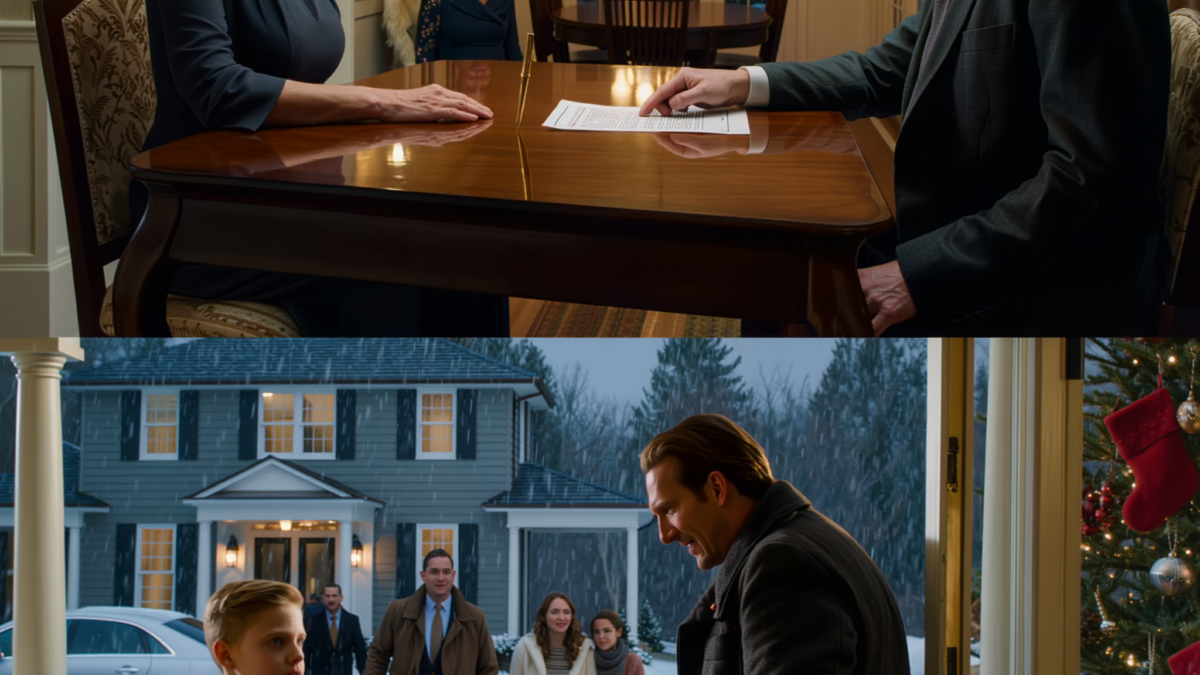
My ex-wife threw me and our two young children out into the freezing snow with almost nothing. I had begged for one more night so Mia and Noah could wake up in their own beds on Christmas morning. Cassandra refused.
Her parents stood in the driveway while the moving crew waited. Felix, her twenty-six-year-old boyfriend, was already carrying expensive luggage toward the house I had maintained for a decade.
Richard, Cassandra’s father, looked at me with open contempt.
“You should have thought about that before you wasted fifteen years being a useless stay-at-home loser.”
What none of them knew was that I still had one thing left.
At the bottom of my wallet was an old, faded debit card my late father had given me years earlier.
Two hours later, that card would take my children and me into a private office at a bank and open a part of my father’s life I had never understood.
But that night, I knew none of that.
I only knew I had twelve dollars.
At 7:45 p.m., I stood at a bank counter while the polished marble floor seemed to send cold straight through the thin soles of my worn shoes.
Mia, nine years old, gripped my left hand so tightly that her knuckles had gone white. Noah, six, had both arms wrapped around my right leg, his face buried in my winter coat.
Most families were home.
They were eating Christmas Eve dinner, drinking hot chocolate, arranging presents beneath glowing trees, and telling their children it was almost time for bed.
We were standing inside a nearly empty bank lobby with nowhere to go.
I searched my wallet again even though I already knew what was inside.
Twelve dollars in cash.
That was it.
Six months earlier, Cassandra and I had finalized our divorce. Two hours earlier, I had still had a roof over my head. The children’s stockings had been hanging near the fireplace. The living room smelled like pine.
Then Cassandra had arrived with Felix and demanded that we leave immediately.
Now the shelters I had called were full, the temperature outside was falling below freezing, and every safety net I thought I had was gone.
I looked down at Mia.
She didn’t ask me what we were going to do.
She simply looked up at me as though she believed I would find an answer.
That trust hurt more than anything Cassandra had said.
I kept searching my wallet until my fingers touched something hard in the hidden back compartment.
I pulled it out.
It was an old debit card. The edges were worn and peeling. The magnetic strip was scratched from years of sitting unused.
My father, Elias, had given it to me six years earlier, shortly before he died from a sudden, aggressive heart condition.
I still remembered the afternoon.
His hospital room smelled of disinfectant and medicine. Machines beeped steadily beside his bed. My father had always been careful with money, a retired accountant who lived modestly, saved aggressively, and never felt the need to show anyone what he had.
He reached into the bedside drawer and took out the card.
Then he pressed it into my palm.
“Declan,” he said.
His voice was weak, but his eyes were clear.
“Do not use this card unless you absolutely have to. Only swipe it when you have nothing left. Do you understand me? When you have absolutely nothing left.”
I asked what it was.
A savings account?
Something for the children?
An emergency fund?
He shook his head.
“You’ll know when the time comes. Keep it safe. Keep it hidden from her.”
He died three weeks later.
The funeral passed in a blur. Cassandra complained about the cost of the casket and how much time the memorial was taking from her schedule. Between grieving my father and trying to hold together a marriage that was already breaking apart, I put the card away and eventually stopped thinking about it.
I assumed there might be a few thousand dollars attached to it.
Enough for an emergency.
Standing in that bank with two frightened children clinging to me, I decided my father’s definition of “nothing left” had finally arrived.
I approached the counter.
The banker behind the security glass was an older man whose gold name tag read Mr. Caldwell. He wore thick glasses and had already begun shutting down his terminal for Christmas Eve.
“Excuse me,” I said. “I need to check the balance on this card, or see if it even works anymore. It’s been inactive for years.”
I slid the card toward him.
My hand shook hard enough that the plastic clicked against the counter.
Mr. Caldwell gave me a sympathetic smile.
“Let me take a look, sir. Just give me one moment.”
He studied the card.
His forehead creased when he saw the old bank logo.
Then he swiped it.
I held my breath.
I wasn’t imagining wealth. I wasn’t thinking about houses, investments, or some grand rescue.
I wanted enough for a motel room and food.
Fifty dollars would have helped.
A hundred would have felt like a miracle.
Mr. Caldwell stared at the monitor.
His fingers stopped above the keyboard.
Then he leaned closer.
He typed several commands and read the screen again.
The change in his face frightened me.
All the color seemed to disappear from it.
“Is there a problem?” I asked.
He didn’t answer.
“Is the account empty?”
Mr. Caldwell finally looked at me, then glanced toward the security guard near the entrance and the other teller across the lobby.
“Sir,” he said quietly, “I need you to come with me right now. Please bring your children and step into my private office immediately.”
I pulled Mia closer.
“What did you find? Is the card stolen?”
“Please, sir. Trust me. We cannot discuss this out here.”
He left the teller station and led us down a carpeted hallway to a heavy oak door marked Branch Manager.
As it closed behind us, my mind filled with possibilities I didn’t want to consider.
Had my father been involved in something illegal?
Had the account been flagged?
Had I somehow walked into another disaster?
I thought Cassandra throwing us out had been the lowest point of my life.
I was wrong.
To understand how I had reached that bank, you have to understand how my marriage began.
Fifteen years earlier, I was twenty years old and studying architecture at a prestigious university. I had a full academic scholarship, a portfolio filled with residential designs, and a clear plan to join a major architecture firm after graduation.
Then I met Cassandra.
She was twenty-one, studying business, ambitious in a way I found magnetic.
We met at a university networking event.
I was standing off to the side sketching structural columns when she walked over and looked at my drawings.
“You’re going to build empires one day,” she told me. “And I’m going to sell them.”
No one had ever spoken about my future with that kind of confidence.
We fell in love quickly.
Two years later, we married in a small ceremony. Her wealthy parents, Richard and Martha, refused to help pay for it because they thought I was beneath their daughter.
Cassandra took a junior role at a major commercial real estate brokerage. I started interning at a respected local architecture firm.
Then Cassandra received a major promotion.
The new position required constant travel, long evenings with clients, and weeks that could stretch toward eighty hours.
At almost the same time, we learned she was pregnant with Mia.
One rainy Tuesday evening, Cassandra sat across from me at our scratched kitchen table.
“One of us has to step back,” she said.
She explained it logically. Her earning potential was much higher than mine at that moment. We couldn’t afford the kind of nanny she wanted, and her parents had no intention of helping us raise a child.
“If you take a few years off and raise the baby, I can build our wealth,” she said. “Once things stabilize, you can go back to architecture. You can start your own firm.”
I loved her.
And I wanted our child to have a parent at home.
So I agreed.
I boxed up my drafting tools and stored them in the attic.
I became a stay-at-home father.
Blueprints gave way to bottles, diapers, pediatric appointments, and playdates.
At the time, I didn’t see it as giving up my future.
I thought Cassandra and I were building one together.
Her career grew rapidly.
We eventually moved into a large custom-built house in a gated community. Cassandra drove an expensive SUV. I drove a practical minivan filled with groceries, sports equipment, and whatever Mia needed that week.
Three years later, Noah was born.
By then, my temporary break from architecture had become permanent.
I cooked the meals, handled the yard, managed the household budget, organized carpools, attended school events, and dealt with the endless details that kept our family functioning.
I worked from morning until midnight.
But because no corporate paycheck arrived with my name on it, Cassandra slowly stopped treating what I did as work.
Her attitude changed gradually at first.
Then the change became impossible to ignore.
She criticized my clothes, my hobbies, and what she called my lack of ambition.
Richard and Martha were worse.
They had never liked me, but once Cassandra became the sole breadwinner, they stopped pretending to be polite.
At one Thanksgiving dinner, Richard tapped his wineglass to get everyone’s attention.
The table was filled with their wealthy friends.
“So, Declan,” he said, “still playing house? Have you thought about getting a real job yet? Or is living off my daughter’s salary your long-term retirement plan?”
The room went quiet.
I looked at Cassandra.
I expected my wife to say something.
She lifted her wineglass and took a sip.
That silence changed something in me.
Over time, I became a ghost in my own home.
I had no retirement account of my own. No meaningful savings under my control. No authority over the children’s college funds. No financial independence.
I was entirely dependent on a woman who increasingly seemed to resent me for the arrangement she had once asked me to accept.
Six months before that Christmas Eve, Cassandra came home on a Tuesday and dropped a thick manila envelope onto the kitchen island.
She was filing for divorce.
There was no conversation about counseling.
No attempt to repair anything.
Her lawyer was Victor Thorne, an aggressive attorney with an expensive wardrobe and a reputation for hard cases.
In court, Cassandra claimed that her real estate business had suffered severe losses from market conditions.
Her legal team produced financial records showing large debts and a company supposedly struggling to stay afloat.
My attorney could not match the resources Cassandra brought into the courtroom.
Victor Thorne portrayed me as a dependent who had contributed nothing financially to the marriage.
“Mr. Bennett has no salary, no investments, and no marketable skills,” he argued.
The court awarded Cassandra the primary business assets because she supposedly needed them to recover from the company’s debts.
I was denied alimony after Thorne argued that leaving the workforce had been my choice rather than a marital sacrifice.
I received a minimal cash settlement and joint custody of Mia and Noah.
Cassandra retained the house.
The one concession was that I could remain in the guest room until early January while I found work and somewhere else to live.
I walked out of court with a fifteen-year gap in my resume and almost nothing in my own name.
My father had seen trouble coming long before I did.
During the last year of his life, visits to our house became tense.
Elias noticed the way Cassandra spoke to me. He noticed how carefully she guarded her phone. He noticed the designer bags, shoes, expensive trips, and constant purchases while Cassandra insisted our household finances were under pressure.
One afternoon, he asked me to meet him at a small diner.
He leaned across the table.
“Something is wrong with her numbers,” he said. “I’ve worked with numbers all my life. The lifestyle she’s living doesn’t match the financial stress she claims to have.”
I immediately defended her.
I said he didn’t understand commercial real estate.
I told him the expensive things were client gifts and the trips were business expenses.
“You need to protect yourself,” he said. “You need access to the business accounts. She’s hiding something.”
I refused to believe him.
Accepting that he might be right would have meant admitting that the sacrifice I had made for my family had been built on a lie.
Back inside Mr. Caldwell’s office, those old conversations came rushing back.
The banker moved behind his desk and opened a hidden floor safe.
From it, he pulled a reinforced steel lockbox.
My father had known.
Somehow, long before my marriage finally collapsed, he had prepared for the possibility that I would one day need help.
But before I understood exactly what he had left behind, my mind returned to the scene two hours earlier.
It was 5:30 p.m. on Christmas Eve.
Snow was falling heavily outside.
I was sitting on the living room floor wrapping inexpensive toys for Mia and Noah.
I was trying to give them a normal Christmas.
According to the divorce agreement, I had until January 5 to leave the house.
I had already scheduled an interview at a local hardware store for the second week of January. I had also found a small two-bedroom apartment in a rougher part of town that I hoped I could afford with what remained of my settlement.
Then bright headlights crossed the living room window.
A black Porsche Cayenne pulled into the driveway.
I froze.
Cassandra had testified during the divorce that she could not afford expenses like that.
She stepped out wearing a pristine fur-lined coat.
Felix emerged from the passenger side in a tailored Italian suit.
He was twenty-six and worked as a junior broker at Cassandra’s firm.
For more than a year, I had suspected there was something between them. Every time I raised the subject, Cassandra accused me of being insecure and paranoid.
Now Felix was standing in my driveway with overnight luggage.
A commercial moving truck pulled in behind them.
Then Richard and Martha arrived in their silver Mercedes.
I opened the front door just as Cassandra reached it.
“What is going on?” I asked. “You’re not supposed to be here until next week. We have a signed agreement.”
Cassandra pushed a stamped document against my chest.
“Plans changed, Declan. Victor found a clause in the final divorce decree.”
She told me that because I had failed to pay the entire gas bill by the fifteenth, I had breached the temporary occupancy agreement.
The bill was fifty dollars short.
I had used that money to buy winter boots and groceries for the children.
“I told you I would pay the rest on Monday.”
Richard walked onto the porch.
“Always full of excuses, aren’t you, Declan?”
He looked past me toward the house.
“Step aside. Felix needs to get his furniture into the master bedroom before the snow gets worse.”
Felix put an arm around Cassandra’s waist.
“Sorry, man,” he said. “It’s time for the real man of the house to take over. Why don’t you go pack your little bags?”
I gripped the doorframe.
“You cannot do this tonight. It’s Christmas Eve. The kids’ presents are under the tree. Their stockings are hanging up. We have nowhere to go.”
The shouting brought Mia and Noah downstairs.
Noah’s face brightened when he saw his mother.
“Mommy, are you here for Christmas? Are you going to open presents with us?”
Cassandra looked at him.
“No, Noah. I’m moving back in tonight with Felix. Your father needs to pack your things. You’re leaving.”
“Leaving?” Mia asked.
Her voice trembled as she backed away.
Not long afterward, we were walking through the snow with our belongings.
My children cried quietly.
With every step, I felt as though I had failed them.
Back in Mr. Caldwell’s office, the contents of my father’s lockbox began to explain why Elias had been so insistent that I keep the card hidden.
Mr. Caldwell turned to another document.
“And I’m afraid that’s not all,” he said.
He showed me a clear photograph of Cassandra and Victor Thorne sitting together in an expensive restaurant.
Next to the photograph was a wire transfer receipt.
My father had hired an investigator before his death.
The records indicated that Cassandra had transferred $75,000 to Victor Thorne.
I stared at the documents as tears ran down my face.
For years, I had been told that I was financially useless, that I didn’t understand money, and that Cassandra’s business troubles were beyond my comprehension.
Now my father’s files suggested a very different story.
The day after Christmas, Chicago was locked under a layer of gray snow and bitter cold.
Mia, Noah, and I had spent the night in the spare room of Mrs. Gallagher, an elderly woman who had given us somewhere warm to sleep.
The pullout couch was lumpy. The wallpaper was peeling. The radiator clanged through the night.
It felt like a luxury hotel.
My children were safe.
That morning, Mia and Noah sat wrapped in knitted blankets watching holiday cartoons while bacon cooked in the tiny kitchen.
I stood in front of the bathroom mirror and barely recognized myself.
Months of stress had left my face thin and tired.
I put on the only decent suit I owned, a dark navy two-piece that hung loosely on me.
Then I kissed my children on the forehead and thanked Mrs. Gallagher.
She patted my cheek.
“Go do what a father needs to do.”
I carried my father’s metal box in a battered leather briefcase and took a cab downtown.
My destination was Harrington and Vance Litigation, a prestigious law firm high inside a glass-and-steel skyscraper.
Walking into the office made me feel as if I had crossed into a world Cassandra had spent years convincing me I didn’t belong in.
The marble floors shone under recessed lighting. The reception area smelled faintly of leather and espresso. Everyone seemed polished, prepared, and expensive.
For years, I had believed my place was in the kitchen, the laundry room, and the elementary-school pickup line.
That morning, I walked across the lobby as a client.
Eleanor Harrington met me in her corner office.
She was in her late sixties, with silver hair cut into a sharp bob and a charcoal suit that matched her direct manner.
When she saw me, she studied my face.
“Declan,” she said. “You have your father’s eyes.”
She told me she had worked with Elias decades earlier on complex corporate audits.
“He was brilliant, meticulous, and deeply honorable. He knew this day might come.”
She gestured toward the chair opposite her desk.
“Sit down. We have a great deal of work to do.”
I opened the briefcase.
We spread my father’s documents across her desk.
There were offshore bank statements, international wire transfers, photographs, and a long investigative dossier compiled by Desmond, a former FBI forensic accountant my father had hired.
For forty-five minutes, Eleanor barely spoke.
She read.
She made notes on a yellow legal pad.
She compared statements and transfer records.
I watched her expression, waiting for disbelief.
Instead, she eventually leaned back.
“This is an extraordinary case of financial fraud, Declan.”
She pointed to a Cayman Islands ledger.
According to the records, Cassandra had moved more than $8.2 million through dummy LLCs and offshore holding companies.
The structure made her reported income and business assets appear far smaller during the divorce proceedings.
Eleanor picked up another document.
“And this is especially serious.”
It was the record of the $75,000 payment to Victor Thorne.
The investigative file alleged that Thorne had then used part of the money to influence a court-appointed appraiser, who undervalued the marital assets.
There were also records indicating that marital funds had been used to purchase luxury real estate under Felix’s name.
“Can we actually use this?” I asked. “The divorce is already finalized.”
Eleanor removed her glasses.
“Fraud can invalidate an agreement obtained through intentional deception. We are not treating the original settlement as untouchable.”
She cautioned me that we could not alert Cassandra too soon.
If Cassandra learned what we had, she might attempt to move the offshore money again.
Eleanor’s team wanted an emergency federal injunction capable of freezing the accounts before Cassandra received warning.
Preparing it would take about a week.
Until then, I had one job.
Do nothing that would make Cassandra suspicious.
So I stayed quiet.
Through mutual acquaintances and messages from my former neighbor Sarah, I heard about Cassandra’s week between Christmas and New Year’s Eve.
She threw an elaborate holiday party at the house.
The same house I had cleaned, maintained, repaired, and decorated for ten years.
She hired caterers and a string quartet. She invited clients, country-club friends, Richard, Martha, and others from her professional circle.
Felix was introduced as the new senior vice president of her brokerage firm.
Cassandra told guests that her lazy ex-husband had finally left after refusing to find a real job.
She presented herself as the generous former wife who had tolerated me for far too long.
While she celebrated, I sat with forensic accountants and attorneys as they traced the money described in my father’s files.
On New Year’s Eve, I stayed with Mia and Noah in Mrs. Gallagher’s kitchen.
We drank sparkling apple cider from plastic cups, ate leftover cookies, and played board games.
At midnight, distant fireworks flashed beyond the window.
I looked at my children.
They didn’t ask for the mansion.
They didn’t ask about Cassandra’s expensive car.
They wanted peace.
I promised myself that whatever happened next, I would give them that.
On January 2 at 9:00 a.m., I sat in Eleanor Harrington’s office watching the wall clock.
A closed hearing had concluded at the federal courthouse.
Eleanor’s team had spent the holiday preparing the complaints and submitting my father’s financial evidence.
The judge signed emergency freezing orders.
At 9:05, the orders began taking effect.
Cassandra’s primary checking and savings accounts were frozen.
Her corporate accounts were restricted.
The Cayman accounts identified in the investigation were flagged.
The accounts connected to Felix’s dummy LLCs were also frozen pending investigation.
At 9:30, my phone rang.
Cassandra.
Eleanor placed a digital recorder on the table and pressed the record button. She told me to remain calm and let Cassandra talk.
I answered.
“Hello, Cassandra.”
Her voice came through at full volume.
“What did you do?”
I moved the phone slightly away from my ear.
“My credit cards are declining,” she said. “My accountant says federal agents are at my brokerage. What did you tell them?”
“I don’t know what you’re talking about, Cassandra.”
“Do not play stupid with me. There’s a federal freeze on my accounts connected to our divorce settlement. You went to the police, didn’t you?”
I followed Eleanor’s instructions and stayed measured.
“I didn’t make up a story. I handed over documentation.”
Then I told her what the investigation had identified.
The $8.2 million in offshore transfers.
The $75,000 payment to Victor Thorne.
Silence.
When Cassandra finally spoke, her confidence was gone.
“That’s impossible.”
Then she said something even more important.
“Nobody knows about that money. Those servers were encrypted. Felix set up those shell accounts himself.”
Eleanor’s eyes sharpened.
Cassandra kept talking.
She insisted I could never have afforded lawyers capable of finding the accounts.
“My father knew,” I told her. “He spent the last years of his life having the money tracked.”
I also told her that Elias had left me a multimillion-dollar trust fund that she had never known existed.
Cassandra began to panic.
Then she implicated her parents.
“My parents set up the Cayman route,” she said. “Richard told me how to structure the LLCs. He hired the overseas broker. If you take this to a judge, you’re going to destroy my parents.”
Eleanor pointed at the recorder.
Cassandra had just linked Richard and Martha directly to the offshore transfers.
I ended the call.
Two hours later, Eleanor received an urgent email from Victor Thorne.
The attorney who had humiliated me in court suddenly wanted a private meeting.
He offered to provide communications showing that Cassandra had planned the financial deception well before the divorce.
In exchange, he wanted his name removed from the federal bribery complaint.
Eleanor did not accept the offer.
She printed the email, attached the record of the $75,000 transfer, and forwarded the material to the state bar ethics committee and the district attorney’s office.
Later that afternoon, Sarah texted me a video from across the street from my former home.
Felix was carrying three large designer suitcases out the front door.
Cassandra stood on the lawn in her pajamas, begging him to stay.
Felix loaded the luggage into an Uber and left.
His expensive car remained in the driveway, the keys on the hood.
The moment the money disappeared, so did he.
Two months later, winter began giving way to early spring.
I walked through the wooden doors of the same courthouse where I had lost almost everything eight months earlier.
This time, Eleanor Harrington sat beside me.
On our table were thick binders of financial records and investigative material.
Cassandra sat across the aisle.
The change in her was startling.
The expensive coats and jewelry were gone. Her hair was tied back carelessly, and she wore a plain blouse.
Victor Thorne had been disbarred and was facing his own criminal charges.
Because Cassandra’s assets remained frozen, she was represented by an overworked public defender.
Richard and Martha sat behind her in the gallery.
The IRS had searched their estate three weeks earlier after investigators reviewed the recording in which Cassandra implicated them.
Documents and computers had been removed.
Their accounts were frozen, and their country-club memberships had been revoked.
Judge Montgomery presided over the hearing.
She had spent the previous weekend reviewing the offshore transfers, emails, investigator reports, and recordings.
When she entered, the room fell silent.
She looked directly at Cassandra.
“Mrs. Bennett, in twenty-five years on the bench, I have rarely seen a case involving such calculated and comprehensive marital fraud.”
She said Cassandra had not only deceived her husband but also misled the court.
The records, the judge said, showed that she had fabricated business debt, concealed more than $8 million offshore, and participated in the payment involving Victor Thorne.
Cassandra stared at the defense table.
Judge Montgomery continued.
“You presented yourself as a struggling businesswoman burdened by a dependent spouse while funds were being concealed and used elsewhere.”
She also addressed the role attributed to Richard and Martha.
“The court was manipulated. I will not allow the original judgment to stand.”
Cassandra’s attorney rose and attempted to argue for leniency, citing professional stress and poor judgment.
Judge Montgomery stopped him.
Then she picked up her pen.
“I am voiding the original divorce settlement in its entirety, retroactive to the date of filing.”
She ordered court-supervised liquidation of Cassandra’s commercial real estate portfolio.
Then she turned to me.
“Mr. Bennett, based on the true valuation of the marital estate, you are awarded $5.2 million in direct restitution.”
The amount included my share of the concealed marital assets, damages, and reimbursement of legal fees.
Cassandra lowered her face into her hands.
The judge was not finished.
She cited Cassandra’s financial instability, criminal exposure, and the Christmas Eve eviction of the children.
Full physical and legal custody of Mia and Noah was awarded to me.
Cassandra was limited to supervised visitation pending the outcome of her federal case.
For the first time in years, I felt as though I could breathe fully.
I didn’t celebrate in the courtroom.
I didn’t turn toward Richard and Martha.
I closed my eyes for a moment and thought about my father.
When the hearing ended, Cassandra looked at me.
Once, that expression might have made me rush to comfort her.
I didn’t.
I packed my father’s papers into my briefcase, shook Eleanor’s hand, and walked outside into the spring sunlight.
A year later, the consequences had settled.
Cassandra was sentenced to four years in a federal minimum-security prison for tax evasion, wire fraud, and perjury.
Her real estate brokerage collapsed during the investigations.
Richard and Martha avoided prison after liquidating much of their estate, selling their luxury vehicles, and paying millions in federal penalties.
They moved into a rented two-bedroom condo and lived on a fixed income.
Many of the social friends they had valued disappeared after the scandal became public.
My own life changed too, but not in the way Cassandra would have expected.
I did not buy a mansion.
I did not buy a flashy luxury car.
I purchased a warm four-bedroom Craftsman-style home in a quiet, tree-lined neighborhood with strong public schools.
Mia painted her bedroom purple.
Noah covered his walls with space posters and dinosaur decals.
I fully funded their college accounts and made sure the money was protected.
Then I opened the boxes containing my old architecture work.
For years, Cassandra had treated that part of me like a hobby I had failed to outgrow.
I decided to return to it.
With Eleanor’s legal guidance, I established a small residential architecture firm.
I rented a modest, sunlit office downtown and hired two junior draftsmen.
At first, we accepted small projects.
Then clients began referring other clients.
Within six months, the business was growing through word of mouth.
I was designing again.
On a warm Sunday afternoon in late September, I put Mia and Noah in the SUV and drove to the cemetery where my father was buried.
We carried white lilies, his favorite flowers.
The children ran ahead through the grass.
Their laughter carried across the quiet grounds.
They were happy.
Not temporarily distracted.
Not carefully watching the moods of adults around them.
Happy.
I stood in front of Elias Bennett’s headstone and brushed a few autumn leaves away from his name.
I remembered his funeral six years earlier.
Cassandra had complained about the rain, the flowers, and how long the service was taking.
Now I understood how much my father had been trying to protect me even then.
“We did it, Dad,” I said quietly.
The wind moved through the oak trees.
“You were right. I finally listened.”
That evening, after I read to the kids and tucked them into bed, I went into my home office.
Behind my drafting desk was a floor safe.
Inside, next to the legal documents, was a small square package wrapped in faded blue paper.
My father had left it in the bank vault with written instructions that it should be opened only after the conflict was over.
I had waited.
That night, I finally unwrapped it.
Inside a worn velvet case was my grandfather’s vintage gold pocket watch.
It had been passed through our family for generations.
Behind the silk lining was a handwritten note.
I recognized my father’s handwriting immediately.
“Declan,
“Time is the only currency that truly matters in this brief life. You spent fifteen years giving your time to someone who did not value what you gave.
“Now the rest of your time belongs to you.
“You are a brilliant architect, a fierce protector, and a wonderful father. Never let anyone else design your life for you again.
“You are my greatest legacy.
“Now go build something beautiful.”
I held the watch in my palm and felt it ticking against my skin.
For years, I had measured my worth by what Cassandra and her family thought of me.
A paycheck.
A title.
A house.
A courtroom judgment.
By thirty-six, I finally understood that none of those things had ever defined the part of my life that mattered most.
I had lost a marriage, a lifestyle, and a sense of security I once believed was permanent.
But I had my children.
I had my work again.
And for the first time in a very long time, the future in front of me felt like my own.








