After my rich wife threw me out with $0, I walked into First National Hawthorne Bank in mud-caked work boots. A security guard called me a vagrant and tried to drag me outside. Then I placed the black metal card my late mother’s lawyer had given me on the counter—and the bank’s CEO came down, looked at me, and bowed.
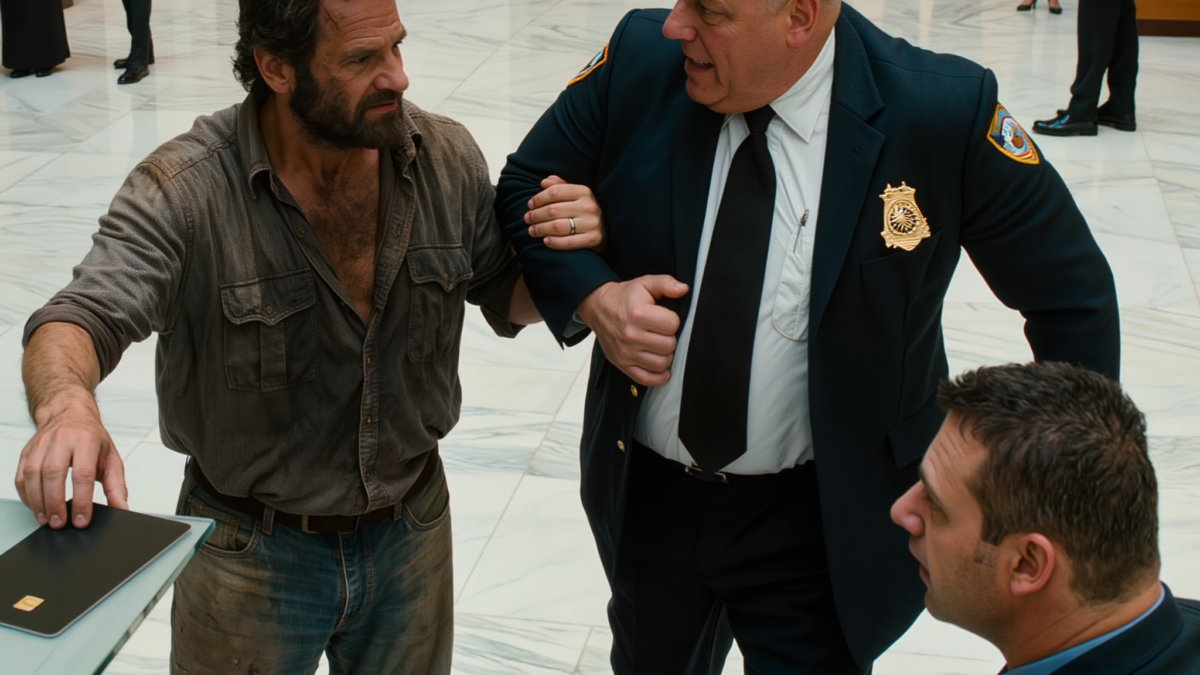
“Get those boots off my Italian marble floor and get out of this building before I call the police. We do not serve day laborers here, and we certainly do not hand out charity to vagrants who wander in off the street.”
Those were the words the security guard threw at me as he stood in the middle of the soaring lobby of First National Hawthorne Bank, one hand resting on his utility belt.
I stood directly in front of him wearing denim work jeans caked with dried concrete, a faded flannel shirt soaked through after a fourteen-hour shift, and work boots that had seen better days. My knuckles were scraped from the job, and every muscle in my body felt like it had been run through a cement mixer.
Around us, men in tailored charcoal suits and women carrying designer handbags stopped their conversations to stare.
I did not look like someone who belonged in that lobby.
At least, not to them.
My name is Asa. I was thirty-five years old, and exactly one month earlier, my wealthy wife of ten years had thrown me out of the home I had helped build for her.
By the time I walked into that bank, Fallon had drained our joint accounts, canceled my health insurance, replaced me with a younger financial consultant, and left me with almost nothing.
She thought my life was over.
What she did not know was that I had recently learned something about my own family that I had never been told.
And in my callused hand was the only physical proof I had been given: a heavy matte-black metal card with no account number, no expiration date, no bank logo, and no phone number printed on the back.
The security guard’s name tag read Garrison.
He stepped closer and reached for my shoulder.
I did not move.
Instead, I walked to the teller counter and placed the black card on the thick glass in front of a young teller named Farley.
The metal landed with a heavy thud.
Farley looked from the card to my clothes and back again.
There was no magnetic strip. No printed account number. Just a gold data chip in the center and an engraved silver signature near the bottom.
“Run it,” I said.
She sighed as if I were wasting her time.
Then she picked up the card between two fingers and inserted it into the chip reader.
Ten seconds passed.
Nothing happened.
Garrison grabbed my upper arm.
“Listen, buddy. You’re done.”
Then Farley’s monitor went black.
A second later, the screen flashed red.
A low electronic chime sounded through the bank, not from the little machine on the counter, but from somewhere inside the building itself.
Farley pushed her chair back.
“What did you do?”
Someone behind me said I must have hacked the system.
Garrison tightened his grip and started pulling me toward the revolving doors.
Then another sound cut through the lobby.
A soft chime.
At the far end of the room, the private executive elevator opened.
Three men stepped out.
Two were security personnel in dark suits. Between them walked Augustus Hawthorne, chief executive officer of Hawthorne Banking Group.
Even I knew who he was.
Augustus controlled enormous financial interests and rarely appeared in the public lobby. Yet there he was, walking across the marble floor toward a construction worker everyone else had been trying to throw outside.
Garrison immediately released my arm.
Farley went still behind the counter.
Augustus ignored them both.
He stopped about three feet from me and looked down at my mud-caked boots, then at the dried concrete on my jeans, then at my face.
Garrison tried to explain.
“Sir, I was just removing this trespasser. He was causing a disturbance and trying to use a fake piece of metal.”
Augustus never looked away from me.
“Step away from him.”
His voice was quiet.
Garrison backed off.
Then Augustus did something that stunned the entire lobby.
He placed his hands at his sides and bowed deeply.
When he straightened, his eyes were shining.
“Welcome home, Mr. Hawthorne,” he said. “We have been faithfully holding your seat at the head of the table for a very long time.”
For a moment, I could not speak.
The whispers around me disappeared.
The same people who had looked at my clothes with disgust were now watching Augustus Hawthorne treat me with a level of respect I did not understand.
My body began to shake.
Not from fear.
Not from cold.
From the weight of everything that had happened during the previous month.
My mind went back to the Tuesday morning when Fallon ended our marriage.
It was seven o’clock, and I was standing in our kitchen with a chipped coffee mug in my hand, trying to wake up before another long shift at the Riverview construction site.
A stack of legal documents sat on the granite island.
At the top were the words Petition for Dissolution of Marriage.
Fallon stood across from me wearing a silk blouse and tailored skirt. Her arms were crossed.
“Sign the documents, Asa.”
Her voice was flat.
“Do not make this harder than it needs to be. We both knew this day was coming.”
I set my coffee down.
My hand was shaking enough that a few drops spilled onto the white stone.
Fallon looked at the coffee with more irritation than she had shown about the end of our marriage.
“Did we know this was coming?” I asked. “Ten years, Fallon.”
I reminded her of everything I had put into our life together.
I had given up an architectural apprenticeship to help manage her father’s struggling development properties because Benson convinced me it was best for the family business.
I had used my retirement savings to help cover a legal settlement after her brother caused property damage.
I had renovated nearly every part of the house.
I built the back deck.
I laid the hardwood flooring.
I installed the bay windows.
Before Fallon could answer, her father stepped into the kitchen.
Benson had made his fortune in residential development, and he had never hidden the fact that he considered manual labor beneath him, even though people like me built the properties that made him rich.
He was smoking a cigar in my kitchen.
“You were a reliable laborer, Asa,” he said. “And you were compensated for it. You lived in a house you never could have afforded on your own. You drove a company truck. But let’s be honest. You were always temporary.”
I looked at Fallon.
I expected her to tell him he had gone too far.
Instead, she nodded.
“I need to move forward, Asa. You’re holding me back.”
Then she explained that the prenuptial agreement protected her family’s assets.
No alimony.
No real estate division.
No settlement.
She said I could keep my personal tools and my old truck.
I almost laughed.
“The truck is in my name. And I bought those tools five years before I met you.”
Before she could respond, someone walked into the kitchen from the direction of our bedroom.
Dalton.
He was thirty, polished, ambitious, and recently hired as a financial consultant for Fallon’s company.
He was wearing my bathrobe.
That was when all the unexplained weekend business trips and late-night meetings suddenly made sense.
Dalton poured himself coffee from my pot and looked at me over the rim.
“Your time is up, buddy. Security is outside. You have ten minutes to pack your work clothes and leave before the locks are changed.”
Every instinct in me wanted to react.
But I knew exactly what Benson was waiting for.
One angry move from me and he would turn the situation into a legal weapon.
So I turned around.
I went to the bedroom, pulled a canvas duffel bag from the closet, and packed jeans, flannel shirts, and work boots.
Then I took the framed photograph of my mother, Delaney.
That was all.
I walked out into the cold rain, climbed into my ten-year-old Ford truck, and drove away.
An hour later, I parked in a Walmart lot and opened my banking app.
Available balance: $0.
Fallon had drained our joint checking and savings accounts the day before serving me the papers.
Money I had saved.
Bonuses I had earned.
Money we had once talked about using for future children.
Gone.
My credit cards had been deactivated too.
I had twenty dollars in my wallet, half a tank of gas, and nowhere to sleep.
That night, I slept in the cab of my truck wrapped in an old moving blanket.
The cold came through the windows and settled into my bones.
But the worst part was not the temperature.
It was the realization that I had lost my home, my marriage, my savings, and most of the identity I had built over the previous decade in a single morning.
The next day, I stopped at a roadside diner.
I bought a black coffee and a stale donut.
The total was $3.12.
I folded the receipt and put it in my wallet.
I wanted to remember what rock bottom cost.
For the next three weeks, I stood outside Home Depot before sunrise with other day laborers waiting for contractors who needed an extra pair of hands.
I hauled concrete blocks.
I dug trenches in the rain.
I took cash jobs that barely paid enough for food and gasoline.
At night, I slept in my truck and ran the heater only when I could afford the fuel.
I refused to call my older brother, Beckett.
He was a plumber with a wife, three children, and a mortgage of his own.
I did not want my disaster landing on his kitchen table.
On the twenty-first day, his rusty plumbing van pulled into the Home Depot parking lot.
Beckett got out in the rain.
He looked at my muddy clothes and hollow face.
He did not ask what happened.
He walked to my truck, grabbed my duffel bag, threw it into his van, and pointed at the passenger seat.
“You do not sleep in a frozen parking lot while I have a roof over my head. Get in the van.”
He drove me home.
His wife, Hadley, put a large bowl of homemade stew in front of me at their small kitchen table.
Their house was cramped.
They did not have much extra money.
They still gave me their couch without hesitation.
As I ate my first real home-cooked meal in weeks, something inside me steadied.
I was tired of thinking of myself as a man who had been discarded.
I needed a way forward.
That opportunity arrived on a rainy Tuesday afternoon.
I was lying under a client’s kitchen sink helping Beckett replace a leaking PVC drain pipe when my phone buzzed.
Unknown number.
I almost ignored it.
Then I answered.
“Asa?”
The voice belonged to an older man.
“Speaking.”
“My name is Harrison Fletcher. I was your late mother’s personal legal counsel. I need you and your brother Beckett to come to my office immediately. It concerns an inheritance matter.”
I nearly dropped the wrench.
“You have the wrong person. My mother cleaned houses. She died three years ago. She barely had enough saved for her funeral. There is no inheritance.”
“I assure you, I have the correct number.”
Fletcher told me my mother had left specific instructions.
He was required to wait until three full years had passed after her death and until I had experienced a significant personal hardship.
He had seen the public divorce filing.
Both conditions had now been satisfied.
“Be at my office in one hour.”
Beckett and I drove downtown in silence.
Fletcher’s office was not inside one of the modern glass towers where Fallon’s attorneys worked.
It was in an older suite above a bakery.
Fletcher wore a tweed suit and sat behind a heavy oak desk crowded with paper files and law books.
After we sat down, he reached into a locked drawer and placed a polished mahogany box between us.
“Gentlemen,” he said, “you knew your mother as Delaney, a woman who worked hard to keep food on your table. But she kept a secret from both of you.”
He told us our father had not simply been a mechanic.
His legal name was Silas Hawthorne.
Beckett gave a nervous laugh.
“Hawthorne? As in the banking group?”
“Exactly.”
Fletcher explained that Silas had been the rightful heir to the Hawthorne fortune.
He fell in love with our mother while she was working as a maid at the family’s summer estate.
The family patriarch gave him a choice.
Keep the fortune and marry someone the family approved of, or choose Delaney and walk away.
Silas chose our mother.
He abandoned billions, changed his name, and started over.
After he died in a car accident while Beckett and I were still toddlers, the Hawthorne family tried to gain control of us.
Delaney fought them.
Eventually, Fletcher said, she negotiated an agreement.
She would raise us without access to the family fortune.
In exchange, Silas’s rightful inheritance would be placed into a protected blind trust, invested for decades, and released only under the conditions she established.
Fletcher opened the mahogany box.
Inside, resting on dark red velvet, was a black metal card.
The same card that would later bring Augustus Hawthorne down to the bank lobby.
“Take this directly to First National Hawthorne Bank,” Fletcher said. “Ask for Augustus Hawthorne.”
That was how I ended up standing in the bank in dirty work clothes while one of the most powerful men in the financial district bowed to me.
Augustus personally escorted Beckett and me to the executive floor.
His office was larger than the house I had built for Fallon.
Floor-to-ceiling windows looked out across the city.
Augustus opened a wall safe and removed a thick leather binder.
He set it on the glass coffee table.
“Your mother was one of the most stubborn and brilliant people I ever met,” he said.
He told us he had tried to send Delaney cashier’s checks over the years.
She tore them up and mailed the pieces back.
“She believed iron had to go through fire before it became steel.”
He opened the binder to the financial summary.
I looked at the first number.
Then I looked again.
$142 million in liquid assets.
Below it was another line.
A 15 percent controlling equity stake in Hawthorne Banking Group.
Beckett went pale.
I put a hand on his shoulder, partly to steady him and partly because I needed something solid to hold onto myself.
We had grown up watching every dollar.
Now we were looking at generational wealth.
“Half belongs to Beckett,” I said.
Augustus nodded.
“Done.”
Then I walked to the window.
In the distance, I could see cranes rising over the Riverview luxury condo project.
Benson’s crown jewel.
The project Fallon was depending on to raise her profile.
The same project where I had spent years solving problems while her family treated me like hired muscle.
“I need a cashier’s check for exactly $50,000,” I said. “And I need a company created. Delaney Holdings. My name stays out of it.”
Beckett stared at me.
“Asa, there’s more than a hundred million dollars sitting here. Why do you only want fifty thousand?”
“Thirty thousand pays off your mortgage today. The rest covers food, gas, and supplies.”
I turned back toward the cranes outside.
“Tomorrow morning, I’m going back to Riverview.”
Augustus raised an eyebrow.
“You want to buy them out?”
“No.”
I had spent years inside Benson’s operation. I knew the crews, the vendors, the shortcuts, and the weaknesses.
“I want to see what they’re doing from the ground.”
The next morning, before sunrise, I drove my old Ford back to Riverview.
I avoided the air-conditioned management trailers and walked straight to the foreman’s office.
Bram looked up from his blueprints.
He had always treated me fairly.
“Asa? I heard about the divorce. What are you doing here? If Benson or Dalton sees you, they’ll have you removed.”
“I need work.”
“What kind?”
“Anything. Give me a shovel. Put me on the concrete crew.”
He hesitated.
Then he handed me a scratched yellow hard hat.
For the next week, I worked as if I had never held a management position.
I mixed concrete.
I moved materials.
I listened.
And from ground level, I began noticing things the executives either missed or did not want anyone to notice.
Delivery trucks arrived with codes I did not recognize.
The rebar being brought onto the site was Grade B, not the Grade A steel required for the high-rise foundation.
The cheaper material was brittle and inappropriate for the structure we were building.
I checked manifests.
Then invoices.
The pattern was not an isolated mistake.
Benson and Dalton had been buying cheaper material while the accounting records reflected the more expensive product.
The difference was disappearing.
I began photographing shipping manifests with a separate phone.
After crews left, I recovered discarded invoices from the management dumpsters.
Each night, I sent the records to Augustus.
Delaney Holdings was building its case.
One Thursday afternoon, I was shoveling sand near the main access road when the sound of an expensive engine cut through the construction noise.
A lime-green Lamborghini rolled onto the site.
Dalton stepped out in a light linen suit.
Fallon climbed out of the passenger side wearing oversized sunglasses and carrying a small dog in her purse.
They were there for a public walkthrough.
Then Fallon saw me.
Her mouth curved into a smile.
She touched Dalton’s arm and pointed.
They changed direction and came straight toward the concrete mixer.
I kept working.
“Well, well,” Fallon called loudly enough for the nearby crew to hear. “Look how far the mighty project manager has fallen.”
Dalton laughed.
“I always told you he’d end up digging ditches for minimum wage.”
Several workers stopped what they were doing.
I rested both hands on the shovel handle.
Behind Fallon and Dalton, cheap Grade B steel protruded from the foundation.
“Honest work is honest work, Fallon,” I said. “But I’d be careful in those expensive shoes.”
She narrowed her eyes.
“The foundation around here looks unstable.”
Fallon laughed.
“You’re pathetic. You’re jealous because Dalton actually knows how to run a profitable business.”
Then she opened her purse, pulled out a five-dollar bill, and dropped it into the mud beside my boots.
“Buy yourself a coffee. You look tired.”
They walked away laughing.
I left the bill where it landed.
Later that afternoon, I crouched behind a stack of shipping crates and photographed another manifest showing a Grade B delivery.
A boot scraped across the gravel behind me.
I turned.
Cashin, a mid-level supervisor I had once trusted, stood there holding up his phone.
The red recording light was on.
Beside him stood Ellery, a younger laborer known around the site for doing Dalton’s dirty work.
“I knew something was wrong with you coming back,” Cashin said. “Bram told everybody you were broke. But you’re snooping through manifests.”
Ellery stepped forward with a pipe wrench in his hand.
“Give me the phone.”
I slipped the burner phone into my front pocket.
Then I looked at Cashin.
I knew his situation because I had managed the site long enough to know everyone’s paperwork.
“You have a four-bedroom house in the suburbs,” I said. “Two kids in private school. Your wife thinks you’re an honest man.”
His expression changed.
“What are you talking about? Are you threatening my family?”
“No. I’m stating facts.”
Then I told him what I knew.
He had been approving false safety inspections for Dalton.
He had been receiving a 10 percent cash kickback.
And when the building eventually failed an audit because of the cheaper steel, Dalton would need someone below him to blame.
Cashin’s confidence faded.
“You’re bluffing. You’re a broke ditch digger.”
“Then send Dalton the video.”
I held his stare.
“Or turn around, walk away, and decide whether you want your name attached to everything he’s doing.”
Ellery looked at Cashin.
“What do we do?”
Cashin lowered his phone.
“We didn’t see anything.”
He grabbed Ellery by the shoulder and walked away.
I pulled out the burner phone and sent the final set of documents to Augustus.
After that, Delaney Holdings moved.
Using its capital, Augustus began acquiring the debt attached to Benson’s development company.
Benson had heavily leveraged Riverview.
He owed three regional banks and several private lenders.
Within forty-eight hours, Delaney Holdings had purchased 95 percent of his outstanding corporate and personal debt.
That included loans against the Riverview project, his corporate headquarters, and even debt tied to his personal estate.
Then Delaney Holdings called the loans.
Benson was summoned to Hawthorne Banking Group for an emergency meeting.
I was not in the conference room.
I listened through a secure phone connection from Beckett’s living room.
Benson walked into the meeting expecting to negotiate an extension.
Instead, the attorneys informed him that his debt was in default.
Delaney Holdings demanded $25 million in liquid repayment by the end of the business day.
If he could not pay, the creditor would move against Riverview and the other assets securing the debt.
Benson did not have $25 million.
According to the records Augustus had reviewed, he had barely $2 million in liquid capital left after Dalton’s investment decisions and the consulting fees disappearing from the company.
For the first time since I had known him, Benson sounded frightened.
He asked for a month.
Then a week.
Then the weekend.
He offered higher interest.
Then equity.
Anything for time.
That was when Augustus presented another option.
The anonymous chairman of Delaney Holdings would acquire the Riverview project and assume the debt.
In exchange, Benson had to sign over full ownership of his development company and surrender his executive position.
He signed.
He believed he was unloading a failing company onto a faceless investment firm.
He did not know the person behind Delaney Holdings was the same son-in-law he had dismissed as a laborer one month earlier.
The next morning, a companywide notice went to employees, contractors, and vendors.
The firm was under new management.
Riverview was immediately closed for an independent structural and safety review.
I drove to the site wearing my usual work jeans and steel-toed boots.
The chain-link gates were locked.
A sign read:
“Property under exclusive ownership of Delaney Holdings. Unauthorized personnel will be prosecuted to the fullest extent of the law.”
Dalton was already outside.
He was shouting at the new security guard.
“Do you have any idea who I am? I’m the senior project director. I run this operation.”
The guard remained calm.
“Your corporate access badge has been permanently deactivated, sir. You no longer have legal authority on this property.”
I walked up eating a green apple.
“Hey, Dalton. Locked out?”
He spun toward me.
“This is a clerical mistake. Some vulture firm bought the debt while Benson was asleep at the wheel. We’ll have this fixed by noon.”
“Benson isn’t answering his phone?”
Dalton’s face tightened.
I tossed the apple core into a trash can.
“I heard he’s meeting with defense attorneys. Something about the Grade B steel and missing company money.”
Dalton stared at me.
“How do you know about the steel?”
“Word travels fast when you talk to the men doing the work.”
My burner phone buzzed.
A message from Augustus confirmed the takeover had been completed and formally filed.
The reopening gala would be held Friday night at the Ritz-Carlton.
The new owner of Delaney Holdings would finally appear publicly.
I looked at Dalton.
“You going to the gala?”
He straightened his tie.
“Of course I am. Once I explain my vision to the new owner, he’ll beg me to stay. I’m indispensable.”
Then he added, “I know where all the bodies are buried.”
“I’m sure you do.”
In the days leading up to the gala, I moved from the concrete crew to Augustus’s private office.
My first decisions as the anonymous owner of Delaney Holdings were not about revenge.
They were about fixing the company.
The upper management team Dalton had installed was dismissed after the records showed documented negligence.
Bram was rehired and promoted to senior site director.
The hourly wages of the ground crew were doubled.
I ordered all of the Grade B rebar removed from the foundation.
Replacing it cost nearly $3 million from my own accounts.
I did not care.
I would not put my mother’s name on a building I did not trust.
The project would be rebuilt correctly.
For the crew on the ground, Delaney Holdings became the company that finally listened.
For Benson, Fallon, and Dalton, it remained a name with no face.
With the business stabilized, I visited an appointment-only tailor.
I ordered a midnight-blue tuxedo.
Beckett came with me, uncomfortable in the elegant showroom but amused by the entire situation.
I bought him a black suit.
The morning of the gala, I washed my old Ford.
Then I drove it to a luxury dealership.
Inside the showroom sat a black Porsche Panamera.
“I want that one.”
The salesman looked at my jeans, flannel shirt, and scuffed boots.
“Are you looking at financing options, sir? We have programs that might work with a co-signer.”
“Cash.”
I placed the Hawthorne card on his desk.
“Run it.”
An hour later, I drove away in the Porsche.
But I kept the Ford.
I had it transported to the new four-bedroom colonial house I had quietly purchased for Beckett, Hadley, and their children.
The Porsche went into the garage.
The rusted Ford went beside it.
I wanted the truck where I could see it.
It reminded me of the night I slept in a parking lot with twenty dollars in my wallet.
That evening, I dressed for the gala in Beckett’s guest room.
I slid the black metal card into the inside pocket of my tuxedo.
The Ritz-Carlton ballroom was filled with investors, politicians, bankers, socialites, and business executives.
Crystal chandeliers hung overhead.
An orchestra played in the corner.
Rumors about Delaney Holdings moved through the room.
No one seemed to know who had taken Benson’s company.
I arrived with Augustus and Beckett through a private entrance and waited behind the main stage.
From a security monitor, I watched the guests arrive.
Benson came first.
He looked smaller than I remembered.
His tuxedo seemed loose, and he spent several uncomfortable minutes trying to greet people who suddenly found reasons to look elsewhere.
Then Fallon and Dalton arrived.
Fallon wore a bright red designer gown.
Dalton stayed close beside her, talking rapidly to anyone who would listen.
The three of them approached the VIP desk.
“Name?” the attendant asked.
“Benson, plus two executive guests.”
She checked the tablet.
“I’m sorry, Mr. Benson. You are not on the VIP list. You and your guests will need to use the general admission area near the back.”
Benson stared at her.
“What are you talking about? I built this project. This is my gala.”
“Not anymore, sir.”
Security stepped closer.
Benson had no choice but to move.
On the monitor, I watched Fallon’s expression as she realized people were watching them being redirected away from the investors’ tables.
Augustus checked his watch.
“Are you ready, Mr. Hawthorne?”
I adjusted my cufflinks.
“I’ve been ready for a month.”
Augustus walked onto the stage.
The ballroom quieted.
“Ladies and gentlemen, thank you for joining us to celebrate a new era for the Riverview project.”
He acknowledged the problems under the former management.
He told the room that the structural issues were being corrected.
He told them workers would be paid properly.
Then he raised a hand.
“Many of you have asked who is behind Delaney Holdings.”
The room became completely still.
“It is my honor to introduce its chairman, a man who knows the value of hard work because he has built foundations with his own hands.”
The curtains opened.
“Ladies and gentlemen, my nephew, Mr. Asa Hawthorne.”
I stepped into the light.
For several seconds, nobody reacted.
Then the whispers started.
I walked to the podium.
Across the room, near the back doors, I found Benson, Fallon, and Dalton.
Benson dropped his wineglass.
Red wine splashed across Fallon’s shoes, but she did not look down.
She was staring at me.
Dalton backed into the wall, shaking his head.
I leaned toward the microphone.
“Good evening.”
The room quieted again.
“Some of you know me as Asa, the project manager who solved problems on your construction sites. Some of you saw me mixing concrete at Riverview last week.”
I paused.
“My mother knew me as the son of Silas Hawthorne.”
A murmur moved through the ballroom.
“She taught me that a building is only as strong as its foundation.”
I looked toward Benson.
“And recently, I found a foundation that was rotten from the inside. Cheap Grade B material. False records. Workers treated as disposable while people above them took the profits.”
I let the room absorb it.
“So I used my family’s capital. I bought the structure. And now I’m fixing it.”
Fallon raised a hand to her mouth.
“Delaney Holdings is named after my mother,” I continued. “She cleaned other people’s homes to raise her sons. Under my leadership, this company will not cut safety corners, and it will not cheat the people whose hands actually build these projects.”
When I stepped away from the microphone, Augustus began applauding.
Beckett joined him.
Then the rest of the ballroom followed.
I walked down from the stage.
People who would not have noticed me in dirty work clothes days earlier suddenly wanted to hand me business cards.
I passed them.
I walked directly to Benson, Fallon, and Dalton.
Benson looked at the floor.
Dalton tried to straighten himself.
“Look, man,” he said. “About what I said at the site. I was under a lot of pressure.”
“You’re fired.”
His mouth opened.
“Security will escort you out.”
I told him our forensic accountants had also been reviewing the missing funds connected to the steel purchases and offshore accounts.
He would need legal counsel.
Two security guards came forward and escorted him from the ballroom.
Then I looked at Fallon.
Tears were running down her face.
She reached for my sleeve.
“Asa. Why didn’t you tell me? Why did you hide this?”
I stepped back.
“I didn’t know. Not until after you threw me out.”
Her voice broke.
“My father pressured me. Dalton manipulated me. I was confused.”
“You weren’t confused.”
She stared at me.
“You made a decision based on what you thought I was worth. You thought I was broke and Dalton was successful.”
She moved closer.
“I still love you. We can fix this. Think about what we could build together now.”
For the first time in ten years, I looked at her without seeing the woman I had married.
I saw someone who wanted the life attached to me more than she wanted me.
I reached into my wallet.
The folded diner receipt was still there.
I held it up.
“Do you know what this is?”
She shook her head.
“Coffee and a donut. $3.12.”
Her face changed.
“That was what I ate after you emptied our accounts and sent me out of the house. While you were warm inside the home I built, I was sleeping in my truck.”
“Asa, please.”
I placed the receipt in her hand.
“I do not need a wife who remembers she loves me only when I’m wearing a tuxedo and holding a large bank account.”
I turned away.
“Asa!”
Her voice followed me across the room.
“You owe me. I gave you the best years of my life.”
I stopped but did not turn around.
“And I gave you everything I had. It was never enough.”
Then I walked away.
Within forty-eight hours of the gala, Augustus’s forensic accountants turned over the financial records and construction evidence to federal authorities.
The material included years of company records, falsified safety documentation, evidence of embezzlement, tax violations, and the substitution of Grade B steel in the Riverview structure.
Six months after my divorce became final, federal agents executed a coordinated search of Benson’s estate.
His computers and financial records were seized, and assets tied to the investigation were frozen.
News cameras were waiting as he was taken from the house in handcuffs.
The next morning, the local paper reported that the prominent developer had been indicted on fraud and endangerment charges connected to the building materials and financial records.
With the evidence against him and few allies left, Benson accepted a plea agreement.
He was sentenced to five years in federal prison.
He lost his company, his reputation, and his freedom.
Dalton tried to cooperate against him.
It did not save him.
The records I had photographed at Riverview linked Dalton directly to the Grade B steel purchases.
Delaney Holdings also sued to recover the missing company money.
By the time the criminal case was finished, Dalton was financially ruined.
He received a three-year sentence for embezzlement and fraud.
The lime-green Lamborghini was eventually repossessed from Fallon’s driveway.
Fallon’s life unraveled more quietly.
Her father’s connections disappeared.
The scandal followed the family name.
Clients left her PR and real estate business.
Her country club membership ended after unpaid dues.
I later heard that she sold designer bags, shoes, and jewelry to cover legal expenses and ordinary bills.
Eventually, she took a retail job selling perfume at a department store.
She moved into a small apartment and drove a used Honda sedan that struggled in the winter.
For a moment, when I heard that, part of me felt sorry for her.
I had more than enough money to solve every financial problem she had.
I could have written one check.
I could have bought her another house.
But then I remembered the parking lot.
I remembered the cold truck.
I remembered looking at my phone and seeing a zero balance after ten years of marriage.
I remembered how easily she had decided I had no value once she believed I had nothing left to offer.
So I did not rescue her.
I focused on Riverview.
I spent another $3 million replacing every piece of unsafe Grade B steel with the proper material.
We kept the honest workers employed.
They received health benefits, retirement plans, and performance bonuses.
The project stopped being a monument to Benson’s shortcuts.
It became something I was willing to put my mother’s name behind.
Exactly one year later, I sat on the wooden deck of my new home.
It was not a flashy mansion in a gated development.
It was a sturdy log cabin on fifty acres beside a clear lake about an hour from the city.
It was the kind of quiet place my mother would have loved.
Down by the water, Beckett and Hadley were with their three children, laughing while they tried to teach the youngest how to cast a fishing line.
Beckett no longer spent his days racing from one plumbing emergency to the next while worrying about the mortgage.
He now managed the maintenance division of Delaney Holdings.
He was good at it.
His crew respected him.
Most importantly, he could finally breathe without wondering which bill was coming next.
I took a sip of iced tea and looked toward the garage.
Inside sat the polished black Porsche Panamera.
Beside it was my old Ford work truck.
The engine had been repaired and maintained.
The dents stayed.
So did the rust.
I refused to repaint it.
Every time I looked at that truck, I remembered the man who had slept inside it.
I remembered that money had not made me capable.
It had only given me resources.
The part of me that knew how to work, solve problems, protect my brother, recognize honest people like Bram, and keep standing after Fallon shut the door had already been there.
Now I had wealth I once could not have imagined.
I had influence.
I had the Hawthorne name.
But as the evening breeze came off the lake and I listened to Beckett’s children laughing, I realized that the thing Fallon and Benson had never understood was simple.
There was a point where enough was enough.
I did not need another deal to prove I mattered.
I did not need to look down on someone else to feel tall.
My mother had spent her life making sure Beckett and I understood that before we ever touched the money she had protected for us.
Her sacrifice had not been wasted.
I used what she left us to repair what Benson and Dalton had damaged, protect the people who had done the real work, and give my brother’s family the stability we had never known growing up.
And I left the people who had treated me like dirt with the consequences of the choices they had made, without using a single dollar of my mother’s legacy to rescue them.








