My parents kicked me out on my 18th birthday and said, “Don’t come crawling back when you fail.” They emptied my savings, took my car keys, and locked the door behind me. I stayed gone. Twelve years later, on my 30th birthday, my phone lit up with 99 missed calls from my mother—begging for $50,000 to save my father.
I’m Logan. I’m thirty years old, and exactly twelve years ago, on the morning of my eighteenth birthday, my parents threw me out of their Connecticut home with two suitcases and almost nothing else.
They were wealthy, status-conscious people who had mapped out my future long before I was old enough to choose one for myself. My father wanted me in a respectable corporate career. My mother wanted a son whose education, income, marriage, and social circle reflected well on the Foster name.
I wanted to paint.
That was enough for them to decide I no longer belonged.
The last thing my mother said before the front door closed behind me was, “Don’t come crawling back when you fail.”
I didn’t.
For twelve years, neither did they.
Then, on my thirtieth birthday, my phone lit up ninety-nine times.
It was a Tuesday night, and a hard storm was moving across New York City. Rain streaked the floor-to-ceiling windows of my Manhattan penthouse while thunder rolled somewhere beyond the skyline.
I was standing at my easel, working on a large ocean painting. Oil paint and turpentine filled the room with the familiar smell of my studio. Classical music played quietly in the background.
The phone on the side table started vibrating.
I ignored it.
My personal number wasn’t widely available. My agent had it. My lawyer had it. A handful of close friends had it. An unknown caller getting through once was unusual.
The phone rang again.
Then again.
After ten calls, I assumed it was an aggressive journalist, a gallery owner, or someone who had somehow gotten hold of a private number.
After fifty, irritation became unease.
By the ninety-ninth call, the screen was flashing almost constantly.
Then the messages began stacking up.
Please pick up.
Emergency.
It’s Mom.
Logan, please.
I lowered my brush.
For several seconds, I simply stared at the phone.
My mother, Evelyn Foster, had not spoken to me in twelve years.
Not once.
The last sound I remembered from her house was the deadbolt sliding into place behind me.
I picked up the phone and answered without saying hello.
At first, all I heard was breathing.
Then a woman began crying.
Her voice was so strained that I barely recognized it.
“Logan?”
I said nothing.
“It’s me.”
I still didn’t answer.
Evelyn had once been the kind of woman who wore pearls to breakfast and treated every room like it was a social test she intended to pass. Her voice had always been controlled. Measured. Polished.
This voice was none of those things.
She told me she was at a hospital.
Richard, my father, was seriously ill.
She said they needed $50,000.
They were bankrupt. They had no wealthy friends left willing to help. Their old financial safety nets were gone.
She said I was their only option.
Then she called me her sweet boy.
I almost laughed.
She had never called me that when I actually lived under her roof.
As I listened to her, the storm outside seemed to disappear.
I was eighteen again.
It was my birthday, and I had woken that morning believing I was finally going to tell my parents the truth about my future.
For four years, I had been building an art portfolio almost entirely in secret. I hid canvases under my bed and sketched late at night because I knew how Richard felt about art.
To him, a career mattered only if it came with a large salary, social status, and a title he could repeat at the country club.
That morning, I had something I thought even he might respect.
I had been accepted into a prestigious art school with a partial merit scholarship.
I showered, pulled on worn jeans and a T-shirt marked with dried paint, and walked downstairs carrying the acceptance letter behind my back.
Our house was always quiet.
It sat at the end of a long manicured driveway inside a gated Connecticut community. Everything inside it had been chosen to project money and control. The marble floors were spotless. The furniture was formal. Even the artwork seemed selected for what it communicated about the family rather than because anyone loved it.
I entered the dining room smiling.
“Good morning.”
Richard didn’t look up from his financial newspaper.
He was already dressed in a charcoal suit.
Evelyn sat across from him with tea in a bone china cup.
Neither of them said happy birthday.
Neither even acknowledged the date.
Then I noticed two large black suitcases sitting near the front entryway.
The smile disappeared from my face.
“Are we going somewhere?”
Evelyn set down her cup.
“No.”
She looked directly at me and calmly explained that, as of that morning, I was eighteen and their parental obligations were over.
For a second, I thought she was making some bizarre joke.
“It’s my birthday.”
“We know.”
“I’m your son.”
Richard finally folded his newspaper.
He looked at me with the same expression he might have used while reviewing a disappointing investment.
He said I had failed to follow the plan they had created for me.
Pre-law.
A top corporate position.
A large salary.
A marriage into the right kind of family.
A life that reflected well on their name.
Instead, I wanted to paint.
Richard called it an unserious hobby.
He told me they did not intend to finance it.
What made the moment so unsettling was how calm they were.
There was no screaming.
No emotional family argument.
They had already made the decision.
This was not a fight.
It was an eviction.
I pulled out the art-school acceptance letter and placed it on the table.
“I got a scholarship.”
Richard barely looked at it.
“I have savings,” I continued. “More than three thousand dollars. And there’s my college fund. I can figure this out. I just need some time.”
That was when Evelyn gave me the first piece of information that made my stomach drop.
My college fund was gone.
She said it had been reallocated to my older brother’s future inheritance.
Then she told me Richard had emptied the custodial savings account that held the money I had accumulated from birthdays, holidays, and odd jobs.
They described the money as reimbursement for expenses they had incurred while raising me.
I stared at them.
“You took my savings?”
Richard stood.
Then he extended his hand.
“The keys.”
He meant the Porsche they had given me when I turned sixteen.
I had always thought of it as my car, but the title remained in his name.
My hands were shaking as I took the keys from my pocket.
I dropped them onto the mahogany table hard enough to leave a mark.
Richard looked at the scratch, then at me.
“The world is not going to reward you for being weak,” he said.
He told me that within a month I would be back, asking them for money and a warm place to sleep.
I grabbed the suitcases.
When I reached the front door, Evelyn called after me.
“When you realize you’ve made a mistake, don’t come back here crying.”
I turned.
Her expression didn’t change.
“And don’t come crawling back.”
I stepped outside.
The door shut.
A second later, the deadbolt clicked.
I stood in the cold with two suitcases and $42 in cash.
I dragged those bags for hours before reaching town.
My hands hurt. My shoulders hurt. I was frightened, but I still believed I had people I could call.
My first call was to Dylan Harrison, my best friend since middle school.
I told him what had happened and asked whether I could sleep on his couch for a few days.
At first, he sounded horrified.
Then he put me on hold to speak to his parents.
When he came back, his voice had changed.
His father did business with Richard.
His parents did not want to risk that relationship by getting involved in a Foster family dispute.
Dylan apologized.
Then he hung up.
That was when I understood something I had never fully appreciated while living inside my parents’ world.
Richard’s influence extended beyond our house.
People feared losing business, money, access, or status if they crossed him.
That night, I had nowhere to go.
I ended up in a public park near the train station. There was a concrete space beneath a playground structure that offered at least some protection from the wind.
I pushed my suitcases into the opening and curled up behind them.
The ground was damp.
The air smelled like wet leaves and dirt.
I clutched my sketchbook to my chest and listened to every car that passed in the distance.
My stomach hurt from hunger.
I barely slept.
By morning, one thing was clear.
If I stayed in Connecticut, I would remain inside Richard’s orbit.
I needed to leave.
Over the next several weeks, I sold nearly everything valuable I owned. Designer jackets, shirts, belts, anything a secondhand shop would take.
Eventually, I had enough for a one-way bus ticket to New York City.
New York was where the art world was.
It was also large enough for me to disappear.
The day after I arrived, I went to the financial aid office at the art school.
I brought everything I had.
It wasn’t enough.
Without my parents’ financial information and without documentation establishing that I was independent for aid purposes, I could not access the support I needed.
Tuition was more than $60,000 a year.
I could not enroll.
For a while, I refused to leave anyway.
I slipped into large lectures and sat in the back, taking notes whenever I could.
I slept in a twenty-four-hour study lounge until security tightened access.
Later, I found an unused janitor’s closet in the basement of the sculpture building.
It smelled like bleach and wet mops, but it was warmer than the street.
Food became an everyday problem.
Sometimes I watched students leave half a bagel or sandwich behind and waited until they were gone before taking it.
I stopped caring about pride.
Pride did not keep me warm.
Pride did not feed me.
One rainy night in late October, a campus security guard named Arthur Coleman discovered me sleeping in the closet.
He opened the door, shined a flashlight inside, and told me I was trespassing.
I grabbed my sketchbook and left.
Outside, the rain was coming down hard.
I was cold, exhausted, and almost out of money.
I made my way toward Washington Square Park and tried to earn a few dollars doing quick charcoal portraits.
By the end of the night, I had made five dollars.
I was packing up when a man in a large thrift-store wool coat stopped at my bench.
His name was Connor Hayes.
He was a senior in the painting department.
He looked at my work, then at me.
Instead of asking for a flattering portrait, he said, “Draw what you’re feeling right now.”
Then he placed two twenty-dollar bills on the bench.
Forty dollars.
At that point in my life, it felt like a fortune.
I picked up the charcoal.
I stopped trying to make something pretty.
I drew the anger, exhaustion, hunger, and humiliation I had been carrying since my eighteenth birthday.
When I finished, I handed the drawing to Connor.
He studied it for a long time.
Then he smiled.
He told me it was one of the most honest things he had seen all year.
That night, he bought me a cheeseburger and offered me the couch in his studio.
Connor became the first person who helped me without asking what it would cost him socially.
He taught me techniques he was learning in school.
He let me work beside him.
Slowly, I started building a life.
A year passed.
I worked three jobs.
I waited tables at a diner during the day.
I bartended late at night.
On weekends, I stocked shelves at a grocery store.
I slept very little, but every spare hour went into painting.
For the first time since Connecticut, I felt as though I might actually survive.
Then my older brother, Brandon, sent me a message.
Brandon had always been the golden child.
He attended elite schools, followed Richard’s instructions, dressed the way my parents expected, and seemed destined to inherit everything.
But when we were younger, there had been moments when he was kind to me.
His message said he was in New York for a corporate internship.
He said he knew what our parents had done.
He called it cruel.
He wanted to take me to lunch.
I should have ignored him.
Instead, I wanted to believe that at least one person from my family still cared whether I was alive.
We met at an expensive restaurant in Soho.
Brandon arrived in a tailored suit and a watch that probably cost more than I earned in a year.
He hugged me.
He told me I looked too thin.
He asked how I had been surviving.
For the first time in a long time, I let my guard down.
I told him almost everything.
I told him about painting.
About Connor.
About the jobs.
I told him the name of the diner where I worked, run by Trevor Sullivan on Fourth Street.
I mentioned the grocery store where I worked weekends.
Brandon listened.
Before leaving, he paid for lunch and slipped a $100 bill into my jacket.
On the subway home, I cried.
Not because of the money.
Because for a few hours, I believed I had my brother back.
Three days later, I arrived at the diner for a twelve-hour shift.
Trevor was waiting near the entrance with my final paycheck.
He would not look me in the eye.
“I have to let you go.”
I stared at him.
“Why?”
I had never been late. I took extra shifts. I scrubbed floors when necessary and handled the tables nobody wanted.
Trevor looked embarrassed.
Finally, he told me the restaurant group had received pressure from an investment firm connected to its financing.
The message was simple.
If they kept employing me, the business relationship could suffer.
“What firm?”
Trevor hesitated.
“Foster Capital.”
My father’s firm.
The next day, the grocery store fired me too.
The manager gave me a vague explanation about background-check issues.
Standing on the sidewalk afterward, I finally understood why Brandon had asked so many questions at lunch.
He had not simply come to see me.
At minimum, he had given Richard information about where I worked.
Those were the exact two jobs I lost.
I took out my phone and sent Brandon one message.
How much did Richard pay you to sell out your own brother?
The message showed as read at 4:02 p.m.
He never responded.
That hurt more than being fired.
For one afternoon, I had believed I had recovered a piece of my family.
Instead, I learned that I needed a life none of them could shut down with a phone call.
I walked back to Connor’s studio.
When I came through the door, he looked at me.
“What happened?”
I crossed the room and pulled out the largest canvas we owned, a six-foot canvas we had saved for months to buy.
Connor watched me set it on the easel.
“What are you doing?”
“Get the red paint.”
He frowned.
“Logan?”
“All of it.”
That canvas became the beginning of a project I called The Cannibals.
I spent months painting.
The project was angry, personal, and deliberately uncomfortable.
Instead of creating polite landscapes for my senior thesis, I painted what it had felt like to grow up inside my parents’ version of family.
The final series consisted of three enormous canvases.
The first portrayed a formal dining room modeled after the one in my parents’ Connecticut home. Richard and Evelyn sat at opposite ends of the table, surrounded by wealth and refinement, while the central imagery suggested parents consuming the dreams and future of their own child.
The second showed towering figures in Manhattan surrounded by money but trapped by the very wealth they worshipped.
The third was a self-portrait.
I stood on the lawn outside the family estate while the house behind me appeared consumed by symbolic fire. My face was marked by soot, but I was looking forward rather than back.
Professor James Holloway, the head of the painting department, studied the series before the exhibition.
He stood in silence for a long time.
Finally, he adjusted his glasses.
“Logan, this is not subtle.”
“I know.”
“If you display this with the press in the room, there’s no taking it back.”
“They made their choice years ago.”
He looked at me carefully.
“So have you.”
The exhibition was held in a large industrial-style gallery in Chelsea.
Connor arrived early with me.
By eight that evening, the room was packed with students, parents, donors, collectors, and critics.
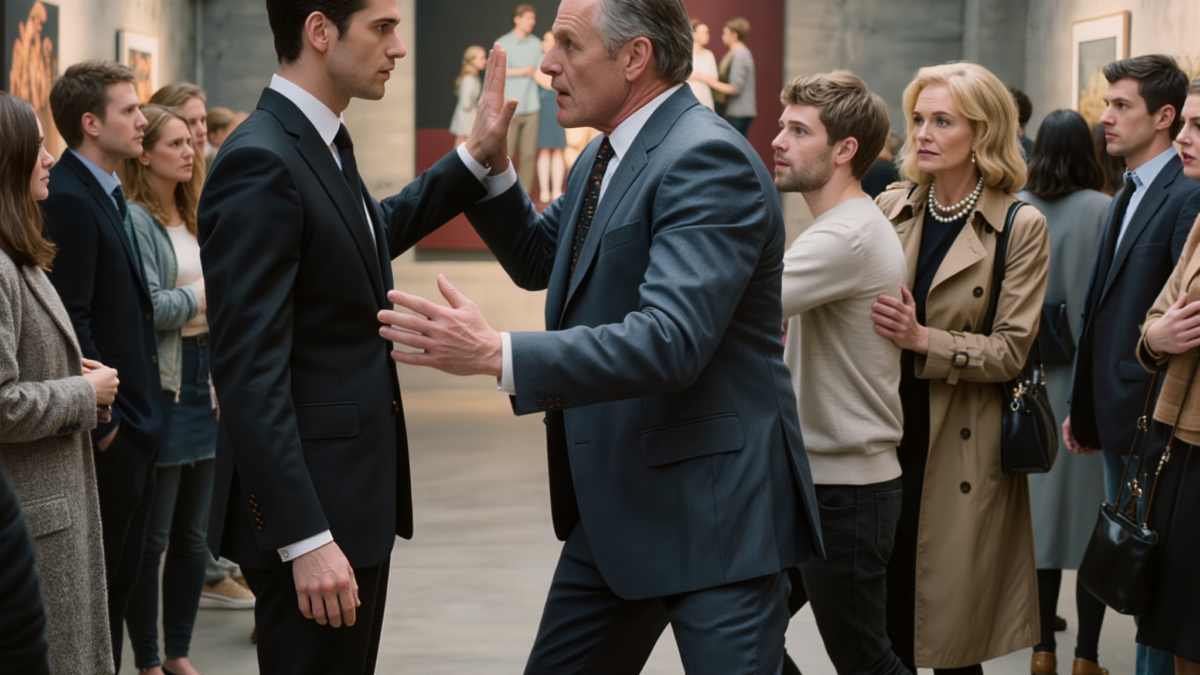
I was standing near the back with a cup of sparkling water when I saw Richard and Evelyn enter.
They had not been invited.
I had made sure of that.
But they had enough connections in New York to hear about the exhibition anyway.
Richard walked into the gallery in an expensive midnight-blue suit.
Evelyn followed in a designer coat, pearls at her throat.
Their expressions told me exactly why they were there.
They expected to see failure.
Then Evelyn noticed the wall containing my work.
Above it, in black letters, was the title.
The Cannibals.
She stopped walking.
Her hand moved instinctively toward her pearls.
Richard followed her gaze.
His posture changed.
For the first time in four years, I watched my parents realize that the version of me they had expected to find no longer existed.
I was twenty-two.
I was standing inside an exhibition with work people had come to see.
I was wearing a suit I had bought with money I earned myself.
I was not asking them for anything.
Richard crossed the room toward me.
People moved aside as he approached.
“What is this?”
“My senior thesis.”
“Take it down,” Evelyn said.
Her eyes moved across the people watching us.
“You’re embarrassing this family.”
“It’s my work.”
“You’re damaging our reputation.”
Richard stepped closer.
“You think this is art?”
“I do.”
He turned toward the first canvas.
For a moment, I thought he was going to pull it from the wall.
Connor moved between him and the painting.
“Don’t touch it,” I said.
Richard stopped.
“That piece is priced at $15,000,” I told him. “The full triptych is $45,000. If you damage it, you buy it.”
The money got his attention.
So did the audience.
People around us had stopped pretending not to listen.
I also referred to rumors about problems surrounding his investments, something that immediately made him more cautious in a room full of wealthy patrons and potential clients.
His hand lowered.
Then he looked at me.
“You think you can humiliate me?”
I held his gaze.
“You told me four years ago that I was dead to you.”
“You are.”
“You made that decision when you threw me out on my eighteenth birthday. You made it when my savings disappeared. You made it again when Brandon came to New York, learned where I worked, and I suddenly lost both jobs.”
A few people nearby began pulling out their phones.
Evelyn noticed.
“We’re leaving.”
Richard remained where he was for another second.
Then she took his arm.
As they turned toward the exit, a photographer from a New York arts publication captured them leaving with my paintings behind them.
By the next morning, the photograph had spread widely online.
An arts and culture article framed the confrontation as a wealthy family publicly clashing with their artist son at his senior exhibition.
People began looking into Richard’s business history.
Former employees, clients, and competitors posted their own complaints and allegations about the way he conducted business.
Some of those claims were impossible for me to verify personally.
What I could see was the effect.
The carefully controlled public image surrounding Foster Capital had begun to crack.
Then my phone rang.
Connor and I were in the studio drinking diner coffee when I answered.
The caller was Marcus Chandler, a prominent Manhattan art collector.
He had seen the coverage and the work.
He wanted the entire series.
All three paintings.
The listed price was $45,000.
He bought them.
When the money appeared in my account, I stared at the number for a long time.
Forty-five thousand dollars.
A few years earlier, I had slept outside with $42 in my pocket.
Connor leaned against the other side of the studio.
“How does it feel?”
I looked at the screen.
I expected triumph.
Instead, I felt tired.
“I can breathe,” I said.
He waited.
“But I don’t want this to be my entire career.”
“What?”
“I don’t want to spend the rest of my life being the angry kid who paints about hating his parents.”
Connor picked up a clean brush and tossed it toward me.
“Then paint something else.”
That sentence stayed with me.
The gallery confrontation had consequences far beyond my work.
Richard’s business depended heavily on trust, discretion, and reputation.
As the public attention increased, some clients reportedly began withdrawing money.
Lawsuits and financial pressure followed.
Evelyn lost her position on the board of a botanical garden charity. Publicly, the explanation was carefully worded. Privately, their social circle was already pulling away.
There were also rumors that she had consulted a divorce lawyer.
I watched from a distance.
Then I stopped watching for a while.
Connor and I moved to Paris for two years.
For the first time, I painted subjects that had nothing to do with Richard or Evelyn.
Landscapes.
Abstract work.
Faces of people I saw on the Metro.
I discovered that anger had opened a door for me, but it did not have to become the room I lived in forever.
My career continued growing.
I had solo exhibitions in Tokyo, London, and Berlin.
By twenty-five, I had made my first million dollars in liquid assets.
I also began investing in commercial real estate.
There was some irony in that.
My father had treated me as though I was too impractical to survive without him.
Eventually, I became successful in both the world he dismissed and one he respected.
By twenty-eight, I bought a penthouse in New York City with cash.
Connor remained one of the closest people in my life.
We spent holidays together.
The meals were noisy.
People laughed.
Nobody cared which fork belonged beside which plate.
It felt more like family than most of the dinners I remembered from childhood.
Still, I occasionally checked what was happening with the Fosters.
I had alerts set up for Richard Foster and Foster Capital.
The news grew worse over time.
Five years after the gallery confrontation, Richard was sued over allegations of corporate fraud and mismanagement.
According to the reports I read, he had made increasingly risky leveraged investments while trying to recover from earlier client losses.
Those investments failed.
By year seven, the Connecticut estate where I had grown up entered foreclosure.
The same property where I had stood beside two suitcases on my eighteenth birthday was seized and eventually sold at auction.
The new owner renovated the house.
Years of Foster family history disappeared room by room.
By year nine, Richard and Evelyn filed for Chapter 11 bankruptcy.
The wealth was gone.
The cars were gone.
The country club life was gone.
The circles of people who once seemed permanently attached to them disappeared too.
I had spent years imagining that watching them lose everything would feel satisfying.
It didn’t.
Mostly, I felt tired.
Sometimes I felt pity.
They had built their entire identities around money, control, and status.
Once those things were gone, there did not seem to be much left underneath.
Two years ago, an envelope arrived at my Chelsea gallery.
There was no return address.
I recognized the handwriting.
Brandon.
I nearly threw it away.
Then curiosity won.
I opened it in my kitchen.
The letter began:
Logan,
I don’t expect you to reply to this. I know I don’t deserve it.
Brandon wrote that he had seen our parents recently.
They were living in a run-down weekly motel off a highway in New Jersey.
Richard, he said, was showing serious signs of cognitive decline. He became confused and wandered through the motel parking lot talking about financial deals from decades earlier.
Evelyn had a heart condition and angina.
Brandon believed they were struggling to afford medication because they no longer had reliable income or insurance.
Then he wrote about himself.
His inheritance was gone.
He was deeply in debt.
He admitted that he had failed me.
I know they were unbelievably cruel to you, he wrote. I know I was a coward. I sold you out because I wanted Dad’s approval and what I thought I was going to inherit.
The final lines were simple.
They have nothing left. I thought you should know.
I stood at the kitchen counter with the letter in my hand.
Connor walked in and immediately noticed my expression.
He took the page and read it.
“What do you want to do?”
I looked through the window at New York below us.
For a moment, I could smell that concrete tunnel again.
Wet earth.
Cold air.
I could remember being eighteen and searching for food while Richard sat in a warm house waiting for me to surrender.
“Nothing.”
I crumpled the letter.
“They told me to sink or swim. I swam.”
I dropped it into the trash.
That night, I could not sleep.
I kept imagining Evelyn in a cheap motel room.
This woman who once wore pearls at breakfast.
This woman who cared so deeply about appearances.
Now she was sitting beside a husband who sometimes did not know where he was.
I did not forgive her.
But for the first time, anger was no longer the only thing I felt.
And that brings me back to my thirtieth birthday.
Back to the storm.
Back to the ninety-nine missed calls.
Back to Evelyn crying into the phone.
She told me Richard was in the hospital.
She said they needed $50,000.
Brandon was not answering.
His phone, she said, had been disconnected.
Their former friends would not help.
The people they once played golf with, entertained at Thanksgiving, and sat beside at charity dinners had vanished when the lawsuits and bankruptcy became public.
“You’re the only one left,” she said.
I walked toward the window.
Rain moved down the glass in long streaks.
“Why are you calling me, Evelyn?”
“Because I don’t know what else to do.”
I had stopped calling her Mom years earlier.
She heard it.
She started crying harder.
“Logan, please. Your father needs help.”
I looked down at the wet streets far below.
Twelve years earlier, I had been outside in weather like that searching for somewhere to sleep.
“Do you remember my eighteenth birthday?”
Silence.
“Evelyn?”
“Logan, please. Not right now.”
“No. Right now.”
I could hear the hospital in the background.
Voices.
Footsteps.
The regular sound of medical equipment.
“Do you remember the suitcases?”
Her breathing changed.
“Yes.”
“Do you remember taking my car keys?”
“Yes.”
“Do you remember the college fund?”
She didn’t answer.
“And my savings?”
“Logan.”
“Do you remember what you said when I walked out the door?”
For several seconds, she was completely quiet.
Then she whispered, “I remember.”
“You told me not to come crawling back.”
“I know.”
“You and Richard said I’d be on my knees within a month.”
Her voice cracked.
“I know.”
I waited.
Then I asked the question that had been sitting somewhere inside me for twelve years.
“Who is crawling now?”
I expected her to become defensive.
I expected an excuse.
Instead, she answered.
“We are.”
Her voice was barely above a whisper.
“We are, Logan.”
Then she said something I had never expected to hear.
“I’m on my knees in this waiting room.”
I closed my eyes.
“Please,” she said. “Help him.”
For a moment, I imagined simply ending the call.
I could block the number.
Go back to my painting.
Never hear from them again.
They had shown me no mercy when I was eighteen.
They had taken away every financial safety net they controlled.
When I found a way to survive, Richard had still tried to interfere with my work.
Brandon had helped him.
Nobody could reasonably claim I owed them another chance.
Then I turned toward the easel.
The painting I had been working on before the phone began ringing was a storm at sea.
Dark water.
Heavy clouds.
A small boat holding its course in the middle of it.
I looked at that boat for a long time.
The question changed.
It was no longer whether Richard deserved help.
It was whether refusing him was the person I wanted to be.
“Put the hospital administrator on the phone.”
Evelyn stopped crying for a second.
“What?”
“Put someone from billing or administration on the phone.”
I heard movement.
A muffled conversation.
Then another woman came on the line and identified herself as Mrs. Evans from hospital billing and administration.
“This is Logan Foster.”
“Yes, Mr. Foster.”
“I’m authorizing a payment of $200,000.”
There was a pause.
I told her I wanted Richard’s hospital expenses covered, including the bypass procedure and a private room during recovery.
Behind her, I heard Evelyn gasp.
“Oh, thank God. Logan, thank you.”
“I’m not finished.”
The room on the other end went quiet.
I told Mrs. Evans that I wanted a message delivered clearly to my parents.
I was paying the bill.
I was not coming to visit.
I did not want future phone calls, visits to my home, or attempts to use the payment as a way back into my life.
I told her I intended to speak with my lawyer the next morning about formal steps to keep that boundary in place.
Evelyn called out from somewhere behind her.
“Logan, please.”
I stared at my reflection in the dark window.
“Please let us see you,” she said. “Let us apologize.”
I thought about everything I once wanted from them.
An apology.
Recognition.
One moment when they admitted they had been wrong.
Twelve years earlier, I would have given anything to hear those words.
At thirty, I no longer needed them.
“You already gave me the answer I needed.”
“What do you mean?”
“You said you were crawling.”
She went quiet.
I ended the call.
For a long time, I stood alone in the apartment.
The storm continued outside.
The city below kept moving.
I had just committed $200,000 to help the two people who had once sent me into the cold with $42.
It was not forgiveness.
It did not restore a family.
It did not erase what happened in Connecticut, what happened in New York, or what Brandon had done.
I paid because I did not want their choices to dictate mine forever.
Richard and Evelyn had taught me that compassion was weakness.
For years, I had believed surviving them meant becoming harder than they were.
I no longer believed that.
I could help them and still refuse them access to my life.
I could prevent the worst outcome without pretending we were a family again.
I could set a boundary without needing them to suffer on the other side of it.
The silence in the penthouse felt different after the call.
Not empty.
Not heavy.
Just quiet.
I walked back to the easel.
The storm painting was still waiting.
I picked up my brush.
For most of my life, the darkest colors had been the easiest ones for me to reach.
That night, I loaded the brush with something brighter.
I looked at the small boat in the middle of the painted water.
Then I went back to work.
For the first time in years, I did not feel angry.
I did not feel victorious.
I did not feel like the eighteen-year-old standing outside a locked door.
I simply felt finished.








