My parents told me to forgive my brother after he betrayed me with my wife—and then asked me to help support them. I said nothing. Months later, his own email appeared on a courtroom screen. The smug look on his face vanished before my lawyer read the next line.
My name is Jason. I’m 34 years old, and my own parents once sat across from me and demanded that I forgive my younger brother for having an affair with my wife and getting her pregnant. Then they insisted I help support them.
The air in my parents’ living room was heavy with tension. It was the same room where I’d opened Christmas presents, the same room where my brother Leo and I had built forts out of couch cushions. But that day, it felt like a cage.
My father, Richard, sat in his worn leather armchair, his face set like stone. My mother, Carol, perched on the edge of the sofa, her hands clasped so tightly her knuckles were white.
And between them, like a prince holding court, sat my brother Leo.
Next to him, almost hiding behind his shoulder, was my wife, Chloe.
Her hand rested on her visibly pregnant belly.
The baby wasn’t mine.
No one spoke for a full minute. The only sound was the ticking of the grandfather clock in the corner, each tick pressing against the silence. I had been summoned there for a “family meeting,” a term that had always meant I was about to be told what to do.
Finally, my father cleared his throat.
“Jason,” he began, his voice leaving no room for argument. “We’re glad you came. This has been difficult for everyone.”
I just stared at him.
Difficult for everyone.
“Chloe and Leo have made a mistake,” my mother said, her voice smooth and practiced, as if she’d rehearsed it. “A terrible mistake, but what’s done is done. There’s a child on the way. An innocent baby.”
I felt a bitter laugh rising in my throat, but I held it back.
“This baby is family,” my father continued, leaning forward. “Leo—he’s not in a position to provide for them right now. You know he’s been struggling to find his footing.”
I knew.
I knew Leo had been struggling his entire life, a struggle cushioned by our parents’ money and endless excuses.
“You, on the other hand,” my father said, a flicker of something that might have been pride—but felt more like calculation—in his eyes, “you’ve done well. That MIT education, the big promotion at your tech firm—you’re stable.”
Then came the line that shattered what was left of my world.
“You’re the big brother,” he said, as if it were the simplest, most logical thing in the world. “It’s your responsibility to step up, help them out, support them until Leo gets on his feet.”
My gaze drifted from my father’s stern face to my mother’s pleading yet demanding stare, to Leo’s smug expression, and finally to Chloe.
She wouldn’t meet my eyes.
She just stared at her hands, cradling the life that had been built on the ruins of ours.
They weren’t just asking me to forgive.
They were demanding that I pay for the damage they had all helped cause.
I sat there silent, everything inside me in turmoil.
And in that silence, my mind went back.
To understand the depth of their betrayal, to understand the cold clarity settling over me in that suffocating room, you need to understand the last 34 years.
You need to see what I saw.
It started early.
So early that I don’t think I ever knew a time when it wasn’t my reality.
I was the firstborn, the responsible one. Leo was the surprise, the golden boy, eight years my junior.
From the moment he could walk, the entire family orbit shifted to revolve around him.
My achievements were milestones.
His were miracles.
I remember sixth grade vividly. I’d spent months on my science fair project, a ridiculously complex model of a volcanic eruption, complete with baking soda and vinegar that actually worked.
I was so proud.
I’d stayed up late, glued my fingers together twice, and read every book on geology the school library had.
I won first place, a big blue ribbon.
The principal shook my hand.
I ran home clutching that ribbon like it was an Olympic medal and burst through the door.
“I won. I got first place.”
My mom was in the kitchen. She glanced up from packing a cooler.
“Oh, that’s nice, honey,” she said, her focus already elsewhere. “Can you grab the folding chairs from the garage? We’re going to be late for Leo’s T-ball practice.”
They didn’t come to the awards ceremony that evening.
Leo had a practice.
Not a game.
A practice.
I stood on that stage while my name was called and looked out at the sea of smiling, proud parents, searching for two faces that weren’t there.
That night, I put the blue ribbon in a shoebox under my bed.
It was the first time I learned that my best would never be good enough to compete with his average.
Things only got worse as we got older.
When I turned 16, the conversation about a car came up.
My dad sat me down.
“Look, Jason,” he said, “a car is a big responsibility. If you want one, you need to earn it.”
So I did.
I got a job bagging groceries at the local supermarket. I worked weekends, holidays, and every summer vacation. I saved every penny, putting it into a savings account I labeled “college and car fund.”
It took me two years, but I finally bought a beat-up, 10-year-old Toyota.
I loved that car more than anything.
It was mine.
I had earned it.
The day Leo turned 16, I came home from my classes at the community college to find a brand-new Mustang in the driveway with a giant red bow on it.
Leo was tossing the keys in the air, a lazy grin on his face.
“Sweet, right?” he said. “Dad said a guy’s got to have a good car in high school.”
I looked at my parents.
My mother was beaming.
“He was so surprised,” she gushed.
My father simply clapped Leo on the back.
I felt that old familiar sting.
It wasn’t about the car.
It was about the principle.
My hard work was expected.
His wants were gifted.
The final straw of my childhood came on the day I got my acceptance letter from MIT.
It was my dream.
I’d applied on a long shot, never believing I’d actually get in. Not only did they accept me, but they offered me a partial scholarship.
It wasn’t a full ride, but it was a fighting chance.
I still needed to cover a huge chunk of tuition, but with my savings, student loans, and a willingness to work three jobs, I knew I could make it happen.
I ran into the living room waving the letter.
“I got in. I got into MIT.”
My father looked up from the television, where a baseball game was playing.
“MIT, huh? Good school. That’ll be expensive.”
There was no hug.
No “I’m so proud of you.”
Just a pragmatic, almost dismissive statement about the cost.
My mother was on the phone, but she covered the receiver.
“That’s wonderful, dear,” she said before turning back to her call. “Sorry, Linda, you were saying?”
Later that evening, I overheard them talking in the kitchen.
I was hoping—praying—they were discussing how they could help me, maybe with a small loan for books.
Instead, I heard my dad say, “Did you hear what the coach told me? He thinks Leo could be the starting pitcher next season. A real arm on that kid.”
I stood in the hallway, the acceptance letter feeling like ash in my hand.
They were planning my brother’s high school sports career while I was figuring out how to fund an MIT education on my own.
That was when I truly understood.
I wasn’t their son in the same way Leo was.
I was just the other one.
The one expected to figure it out on his own.
And so I did.
Move-in day at MIT was a blur of cardboard boxes, nervous energy, and other students surrounded by proud families.
Parents were hugging their sons and daughters, helping them make their beds, taking one last photo before saying goodbye.
My parents weren’t there.
Leo had a big baseball game that day, the season opener, and they couldn’t miss it.
I told them it was fine.
I was an adult.
I could handle it.
But as I lugged a heavy box of textbooks up three flights of stairs by myself, I couldn’t ignore the ache in my chest.
Eventually, that ache became fuel.
If they weren’t going to invest in me, I would invest in myself.
I threw myself into my studies.
I worked three part-time jobs: one in the university library, one waiting tables at a diner on weekends, and another doing freelance coding late at night.
Sleep became a luxury.
My social life was almost nonexistent.
But every time I aced an exam, every time I solved a complex problem that had stumped my classmates, I felt a surge of validation stronger than any parental praise I had ever craved.
Money was always tight, but my determination was limitless.
I graduated with honors in computer science.
I walked across that stage, shook the dean’s hand, and for one fleeting moment, scanned the crowd.
They weren’t there.
They were on a cruise to the Bahamas.
It was a graduation gift for Leo for finishing high school.
The real world was kinder.
My degree from MIT opened doors. I had five job offers before I even had my diploma in hand.
I could have gone anywhere.
Silicon Valley.
New York.
Austin.
But I chose a promising tech firm in Boston.
Part of the decision was practical. It was a great offer.
But a deeper, more naïve part of me still believed that if I stayed physically close to my parents, if they could see my success firsthand, maybe things would change.
I excelled at my job.
I poured the same relentless energy that had gotten me through college into my career and climbed the ladder quickly.
Within five years, I received a major promotion, becoming the youngest senior developer in the company’s history.
My salary was more than I had ever dreamed of.
I bought a nice condo in Cambridge.
I was independent, successful, and respected by my peers.
But with my family, I was still invisible.
When I told them about my promotion, my mom simply said, “Oh, that’s nice. Does that mean you get more vacation time?”
They didn’t understand what I did.
To them, “computer stuff” was a vague, uninteresting concept.
Their conversations were always dominated by Leo’s latest drama.
He had dropped out of college after changing his major three times.
Then he tried to become a personal trainer.
Then a real estate agent.
Then a day trader.
Each venture failed, and each time our parents were there to bail him out financially and emotionally.
I tried to bridge the gap.
I’d invite them out to nice dinners, hoping to share my world with them.
They’d spend the entire meal talking about how Leo was “finding himself.”
It was maddening.
Here I was, a living example of success built from sheer grit, and all they could see was the romantic notion of their struggling golden boy.
Eventually, I started to pull back.
Not out of anger anymore.
Out of self-preservation.
I was tired of knocking on a door that would never open.
I decided to focus on building a life and a family of my own.
A family that would choose me.
I thought I had found that with Chloe.
I met Chloe on a rainy Tuesday afternoon when I ducked into a small coffee shop near my Boston office to escape a sudden downpour.
She was the barista behind the counter.
She had a smile that could have parted the clouds and a deep, genuine laugh.
I was instantly captivated.
I ordered a black coffee and ended up staying for two hours, long after the rain had stopped.
We talked about everything.
I found myself telling her things I’d never told anyone, not even my closest friends.
I told her about my family.
About Leo.
About the constant feeling of being second best.
I expected the usual polite sympathy.
“Oh, that’s tough.”
Instead, Chloe listened with an intensity that made me feel like I was the only person in the world.
When I finished, she reached across the small table and put her hand over mine.
“They’re blind, Jason,” she said softly. “They have no idea what they missed out on.”
In that moment, I felt a crack in the wall I’d built around myself over the years.
For the first time, I felt seen.
Our first date lasted six hours.
Our second lasted the entire weekend.
Within a year, I knew she was the one.
I proposed during a trip to Vermont at the height of fall foliage.
I was a nervous wreck, but she said yes with tears of joy streaming down her face.
We had a small, perfect wedding.
My family was there, of course.
During the reception, I overheard my father telling one of my uncles, “It’s a nice wedding. You know, Leo is thinking about getting his contractor’s license. Big money in that.”
Even on my wedding day, I was the opening act for the Leo show.
But for the first time, it didn’t sting as much.
I had Chloe now.
She was my family.
The first three years of our marriage were the happiest of my life.
We bought that condo in Cambridge and turned it into a home.
We traveled.
We hosted dinner parties for friends.
Chloe was a teacher—patient, kind, and thoughtful.
She created a world of warmth and acceptance that was the complete opposite of the one I’d grown up in.
She encouraged me to mend fences with my parents and not give up on them.
She was my biggest champion.
We started talking about kids.
We were both excited.
We’d paint the spare room, buy a crib, and start our own family with our own traditions.
I felt like my life was finally complete.
I had the career.
The home.
And a loving wife who saw me for who I was.
The wounds of my past were finally starting to heal.
Then, one evening, the doorbell rang.
I opened it to find Leo standing on my doorstep with a suitcase at his feet.
He looked tired and defeated.
He’d just returned from California, where his latest get-rich-quick scheme had predictably fallen apart.
He looked at me with a humility I had never seen before.
“Can I stay for a few days, man?” he asked. “I’ve got nowhere else to go. I really messed up.”
Chloe stepped up behind me and placed a hand on my arm.
She gave me that compassionate look I knew so well.
“Of course you can stay, Leo,” she said warmly. “You’re family.”
And I, wanting to be the man she believed I was, agreed.
I let him in.
I let the problem into the home I had worked so hard to build.
At first, it was almost nice having Leo around.
He seemed different, humbled by his failures in California.
He praised my condo, asked questions about my job with what seemed like genuine interest, and even helped Chloe prepare dinner.
He talked a big game about turning his life around and finally growing up.
“He just needs a second chance,” Chloe would tell me in bed at night. “Everyone deserves that. He’s your brother, Jason.”
I wanted to believe her.
I really did.
A part of me—the part that had always yearned for a real connection with my brother—was hopeful.
So I let my guard down.
I gave Leo a key so he could come and go.
I lent him money to get back on his feet.
I even used my professional network to help him get several job interviews.
But slowly, subtly, things began to shift.
The interviews never panned out.
According to Leo, the jobs were always beneath him or the company culture “wasn’t a good fit.”
He spent his days on our couch watching our television.
When I’d come home after a 10-hour workday, I would often find him and Chloe laughing in the kitchen over a bottle of wine.
“Just keeping your wife company,” he’d say with a wink.
It started with small things.
Inside jokes I wasn’t part of.
The two of them finishing each other’s sentences.
I’d walk into a room and they’d suddenly go quiet.
When I asked about it, Chloe would wave it off.
“Oh, it was nothing. Just Leo being silly.”
I tried to ignore the feeling in my gut.
I told myself I was being paranoid, projecting my old insecurities about Leo onto my marriage.
Chloe was my rock.
She would never betray me.
I was just being the difficult, jealous older brother my parents had always accused me of being.
But the red flags kept piling up.
Leo started borrowing my things without asking—my clothes, my laptop.
Once, I came home early and found him wearing my favorite watch.
When I confronted him, he laughed.
“Relax, bro. I was just seeing how it felt to be a high roller like you.”
Chloe defended him.
“Don’t be so sensitive, Jason. He’s just trying to feel good about himself.”
The worst part was that I began feeling like a guest in my own home.
I’d come home and they would already be halfway through a movie I’d wanted to watch, or they would have eaten the dinner I’d been looking forward to.
They had developed their own rhythm, their own routine, while I was at work providing for all of us.
One night, I had to work late on a major project launch.
I called Chloe to tell her I wouldn’t be home until after midnight.
“Oh, okay,” she said, sounding slightly distant. “Don’t worry about us. Leo’s going to grill some steaks. You work hard. We’ll be fine.”
Something about the way she said us sent a chill through me.
When I finally got home, exhausted, the condo was dark except for the faint glow of the television.
The plates from their dinner were still sitting on the coffee table.
I walked down the hallway toward our bedroom.
The door was slightly ajar.
I could hear soft voices inside.
I pushed it open, expecting to find Chloe asleep.
Instead, my world seemed to stop.
Leo was in my room.
He was sitting on the edge of my bed, talking quietly to Chloe.
He wasn’t doing anything obviously inappropriate at that moment.
But the intimacy of the scene bothered me deeply.
My brother, in my bedroom, talking privately with my wife late at night.
They both looked up, startled.
Leo at least looked guilty.
Chloe looked annoyed.
“Jason, you scared me,” she said sharply. “What’s the big deal?”
I didn’t have an answer then.
But deep down, I knew something was terribly wrong.
That night, I slept on the couch.
I told myself it was because I didn’t want to wake her, but the truth was, I couldn’t bear to lie beside her.
The next few weeks were miserable—full of cold politeness and forced smiles.
The air in our condo was thick with things no one wanted to say.
I slept on the couch more often than not and buried myself in work to avoid being home.
I started questioning every small detail.
Every time Chloe’s phone buzzed, I felt a jolt of anxiety.
The breaking point came on a Saturday.
Chloe said she was meeting a friend from her old teaching college for lunch.
Leo was supposedly out looking for work.
I had the condo to myself for the first time in months, but I couldn’t relax.
That suspicion would not leave me alone.
I knew what I was considering was a violation of her privacy, something I never imagined I would do.
But I couldn’t stop myself.
Her laptop was sitting on the coffee table.
She was always logged into her social media accounts.
My hands were shaking as I opened it.
I told myself I would look for only a minute.
Just enough to put my mind at ease.
I went to her messages.
And there it was.
A conversation thread with Leo.
Not just from the past few weeks.
From months.
My stomach dropped as I scrolled upward, reading messages sent while I was in the next room, while I was at work, while I was sleeping on the couch.
They weren’t simply friendly.
They were intimate and flirtatious, full of secrets and shared moments.
Leo: “Can’t wait to see you later.”
Chloe: “He’s working late again tonight. The house is all ours.”
Leo: “You looked beautiful this morning.”
Chloe: “Stop. You’ll make me blush. He never says things like that anymore.”
Then I found it.
A message from Chloe to Leo sent about six weeks earlier.
My breath caught.
Chloe: “The test was positive. It’s yours. I don’t know what we’re going to do.”
For a moment, everything around me seemed to tilt.
Positive.
It’s yours.
Six weeks ago.
That was right around the time Chloe and I had supposedly started trying for a baby.
The conversations we’d had.
The plans we’d made.
It had all been a lie.
I wasn’t simply being cheated on.
I was being used as a cover story.
For a moment, I lost track of time.
Then I heard the key turn in the front door.
Chloe walked in carrying a shopping bag and humming to herself.
She stopped when she saw my face.
Then she saw the open laptop.
The color drained from her cheeks.
“Jason,” she whispered.
I couldn’t form a sentence.
I simply pointed at the screen.
She looked at it, and her expression changed.
It wasn’t the face of someone surprised by what she saw.
It was the face of someone who knew she had been caught.
“What is this?” I finally managed to say. “Chloe, what is this?”
She took a deep breath.
When she looked back at me, the fear was gone, replaced by a cold sort of defiance.
“It’s what it looks like,” she said.
“You’re pregnant with his baby.”
The words were almost impossible to say.
She lifted her chin and nodded.
“Yes.”
The confession was so blunt and so devoid of remorse that it left me speechless.
I waited for apologies.
For tears.
For explanations.
They never came.
Instead, she said words I would remember for years.
“I’m sorry it happened this way, Jason, but it did happen. We didn’t plan it. Leo and I, we just connect. He sees me. He understands me in a way you never did. With you, it was always about work, about providing. With him, I feel alive.”
Alive.
She felt alive while the life we had built was falling apart.
The betrayal was almost surreal.
My wife and my brother.
In my home.
Building a life behind my back.
In that moment, the love I had for her changed into something distant and unfamiliar.
The person who had walked into that room felt gone, replaced by someone quieter and far more guarded.
I don’t remember packing my bag.
I only remember the mechanical motion of pulling clothes from the closet and stuffing them into a duffel while my mind was nothing but static.
Chloe and Leo were in the living room, whispering urgently.
Neither tried to stop me.
I drove aimlessly for about an hour before ending up at a cheap hotel on the outskirts of Boston.
The floral bedspread smelled faintly of stale cigarettes.
I sat on the edge of the lumpy mattress and did the one thing I could think of.
The thing a son is supposed to do when his world falls apart.
I called my mother.
She answered on the second ring.
“Jason, is everything all right? It’s late.”
“Mom,” I said, my voice breaking. “It’s Chloe and Leo.”
I could barely get the words out.
“They’ve been… they’ve been having an affair. She’s pregnant, Mom. And it’s his.”
There was a long silence on the other end.
I expected shock.
I expected outrage on my behalf.
I waited for her to say, “I’m so sorry, honey. I’m on my way.”
Instead, I heard a deep, weary sigh.
“Oh, Jason,” she said.
Her tone wasn’t sympathetic.
It sounded disappointed.
Disappointed in me.
“We know,” she said quietly. “Leo told us a few weeks ago.”
I felt everything shift beneath me.
They knew.
For weeks, they had known.
They had looked me in the eye, eaten dinner with me, asked about my work, all while knowing this devastating secret.
“You knew,” I whispered.
“Listen to me,” she said, her voice shifting from weary to firm. “Your brother made a mistake. He feels terrible about it, but he’s trying to do the right thing now. He’s going to be a father. And Chloe… well, Jason, you have to admit you’ve been distant lately. You’re always at work. A woman needs attention.”
I was speechless.
She was blaming me.
My own mother was blaming me.
“What I need you to do now,” she continued, her voice suddenly all business, “is to be the bigger person.”
“You need to handle this like an adult. This family cannot fall apart over this. You need to forgive them.”
Forgive them.
I finally found my voice.
“He slept with my wife. She is pregnant with his child, and this happened under my own roof. And you want me to forgive them?”
“Don’t raise your voice at me,” she snapped.
“Think about the baby. Think about the family’s reputation. You’re the stable one, Jason. You’ve always been the strong one. We need you to be strong now.”
That was it.
That was the moment everything became clear.
I wasn’t their son in the same way Leo was.
I was their utility.
Their fixer.
The person expected to absorb the consequences of whatever their golden boy did.
A cold, steady calm settled over me.
“No,” I said.
“What did you say?”
“I said no. I’m done. I’m done being strong for all of you. I’m done cleaning up his messes.”
I took a deep breath.
“Tell Dad I’m calling a lawyer tomorrow morning. I’m filing for divorce.”
Before she could respond, before she could unleash the guilt and manipulation I knew was coming, I ended the call.
I blocked her number.
Then my father’s.
Then Leo’s.
I sat alone in that silent hotel room and felt the final tether to my family give way.
For the first time in my life, being alone felt almost like relief.
The legal fight had just begun, but I had finally chosen a side.
My own.
The next morning, I found one of the best divorce lawyers I could in Boston.
Her name was Mrs. Chun, a sharp, no-nonsense woman in her 40s with eyes that seemed to see straight through people.
I sat in her office with the Boston skyline visible behind her and told her the entire story.
I expected judgment.
Or at least surprise.
Instead, she nodded calmly and took notes.
“This is messy,” she said when I finished. “But it’s not unwinnable. They’ll try to make this your fault. Be prepared.”
She was right.
The divorce proceedings began, and almost immediately, things became ugly.
Chloe and Leo, with the full backing of my parents, launched a coordinated effort to discredit me.
Their legal filings portrayed me as a controlling, emotionally abusive husband obsessed with work and money.
They claimed my neglect had driven Chloe into Leo’s arms.
It was a complete fabrication, a twisted narrative designed to make her the victim and strengthen her claim to a significant portion of my assets, including spousal support.
The most painful part was my parents’ involvement.
They submitted sworn affidavits supporting Chloe’s claims.
They wrote that I had always been difficult.
That I was jealous of Leo’s carefree spirit.
That I was materialistic.
They twisted my hard work into a character flaw.
My ambition became greed.
Reading those words in documents formally filed with the court felt like one painful blow after another.
I was reeling, but Mrs. Chun became my anchor.
“These are standard tactics for this type of case, Jason,” she told me. “They’re trying to provoke you, to make you angry and irrational. We will not play their game. We will play ours.”
Her strategy was simple.
Meticulous documentation.
“From this moment on,” she instructed, “you will save every email, every text message. Record every phone call if it’s legal in your state. Keep a journal of every interaction. They have given us a narrative. We’ll answer it with a mountain of documentation.”
She was preparing me for a legal fight I hadn’t even realized was coming.
She had me install a security camera in my car and another outside my new apartment.
She told me to inform HR at work about the situation, just in case.
I felt like I was living through somebody else’s legal drama, but I did everything she said.
I trusted her.
She was the first person in months who was unequivocally on my side.
Meanwhile, the pressure from my family escalated.
With their numbers blocked, they began emailing me.
My mother sent long, rambling messages about forgiveness and family duty.
My father sent short, blunt ones demanding that I “stop this nonsense” and “take care of your responsibilities.”
Leo even sent me an ultrasound picture.
The subject line read: “Meet your nephew.”
I deleted it without opening the attachment.
They were trying to wear me down until I gave in.
But with every manipulative email they sent, something inside me became steadier.
The grief was still there.
But it was turning into resolve.
They thought I was still the quiet, accommodating Jason who would do almost anything for a scrap of their approval.
They didn’t understand that I had stopped responding the way they expected.
A few weeks into the legal battle, my family realized their emails and voicemails weren’t changing my mind.
My mother decided to take a more direct approach.
I was in the middle of a high-stakes meeting with my team and our CEO, Mr. Harrison, finalizing a major project launch when my assistant buzzed me on the intercom.
Her voice was strained.
“Jason, I’m so sorry to interrupt, but your mother is here in the lobby. She’s… she’s causing a bit of a scene.”
A cold dread moved through me.
I excused myself from the meeting and walked toward the front of our gleaming office building.
I could hear her before I could see her.
Her sharp, indignant voice echoed through the marble lobby.
She was standing in front of the reception desk, raising her voice at the young woman behind it.
Several of my colleagues were lingering nearby, trying not to stare.
“I am his mother. I have a right to see him. He can’t just ignore his family.”
When she saw me, all of her attention snapped in my direction.
“There you are!” she shouted, pointing at me. “How dare you? How dare you treat us like this after everything we’ve done for you?”
I kept my voice low and steady, just as Mrs. Chun had advised.
“Mom, this is my workplace. This is not the time or the place.”
“Oh, your precious workplace,” she said with open contempt. “The only thing you’ve ever cared about. Your brother is struggling. He’s about to be a father, and you’re in here playing with your computers, pretending we don’t exist.”
By then, our head of security, a calm, imposing man named Frank, had arrived.
Mr. Harrison had also followed me out and was watching from a distance, his expression unreadable.
“Ma’am,” Frank said politely but firmly. “I’m going to have to ask you to lower your voice.”
“Don’t you talk to me,” my mother snapped. “My son is abandoning his family. He’s trying to leave his brother and his pregnant sister-in-law with nothing.”
The accusation hung in the air, heavy and unmistakable.
It was a deliberate performance for my coworkers.
I could feel dozens of eyes on me.
The humiliation was immense.
But I remembered Mrs. Chun’s instructions.
Do not engage.
Do not react.
I looked at Frank and gave him a slight nod.
“Frank, please escort my mother out of the building.”
My mother’s face tightened with anger as Frank calmly guided her toward the exit.
She called one last thing over her shoulder.
“You’ll regret this, Jason. Family is forever.”
I stood there in the sudden silence of the lobby, her words hanging in the air.
I could feel my colleagues watching me.
Then I turned, held my head up, and walked back toward the conference room.
Later that day, Frank brought me a copy of the incident report and a link to the security footage.
“Just in case you need it,” he said sympathetically.
I forwarded everything to Mrs. Chun with a simple message.
More evidence.
Her reply came almost immediately.
“This is not evidence, Jason. This is a gift.”
I was beginning to understand that every desperate thing they did was becoming another piece of the record working against them.
The initial divorce settlement was contentious.
But it was nothing compared with what came next.
A few months after everything was finalized, I was served with new legal papers.
Leo and Chloe were suing me.
They were demanding a substantial increase in support.
Their petition claimed there had been a change in circumstances.
They alleged that I had used my influence in Boston’s tech community to blacklist Leo, making it impossible for him to find employment.
They also claimed Chloe was experiencing a high-risk pregnancy because of emotional stress they attributed to me, requiring expensive medical care.
Their petition contained claims that Mrs. Chun immediately began scrutinizing.
She read the documents, and a thin smile appeared on her face.
“This is good,” she said.
I stared at her.
“Good?”
“They’re overplaying their hand,” she replied. “They’re being greedy. We can use that.”
The court date arrived.
I walked into the courtroom feeling a strange sense of calm.
My parents were there, sitting directly behind Leo and Chloe, presenting a united front.
They all stared at me coldly.
Leo looked confident.
Chloe looked like a suffering victim.
My parents looked self-righteous.
They genuinely believed they were in the right.
Their lawyer, a polished man named Gable, was confident and theatrical.
He spent the first hour portraying me as a wealthy, vindictive man in the tech industry who was using his power and influence against his struggling family.
He talked about my salary.
My stock options.
My Cambridge condo.
He presented Leo as a talented young man whose career opportunities had mysteriously disappeared.
“Mr. Smith,” Gable said, gesturing dramatically toward me, “is a man who has forgotten where he came from. A man who would rather hoard his fortune than help his own family in their time of need. He is punishing his former wife and his own brother for a serious family mistake.”
Then he called my mother to the stand.
She cried as she testified.
She talked about how I had supposedly always been competitive with Leo.
How this was the ultimate expression of my jealousy.
She described the incident at my office as the desperate act of a heartbroken mother trying to reach her cold, distant son.
My father followed.
His testimony was gruff and accusatory, supporting the same narrative of me as the ungrateful, vengeful son.
Through it all, Mrs. Chun and I sat quietly.
We didn’t object much.
We let them talk.
We let them build their version of events piece by piece.
I watched the judge, a stern-looking woman in her late 50s, listening intently.
A few times, I saw a flicker of doubt in her expression when she looked at me.
My stomach tightened.
Their version was landing.
Finally, Gable rested his case.
He looked at us with a triumphant smirk.
The judge turned toward my lawyer.
“Mrs. Chun, your response.”
Mrs. Chun stood slowly, her movements deliberate.
She gave me a small, almost imperceptible nod.
“Your Honor,” she said clearly, “we would like to present some evidence to clarify the picture that has been painted here today.”
They had committed fully to their version of events.
Now Mrs. Chun was ready to answer it.
I took a deep breath.
Everything depended on what came next.
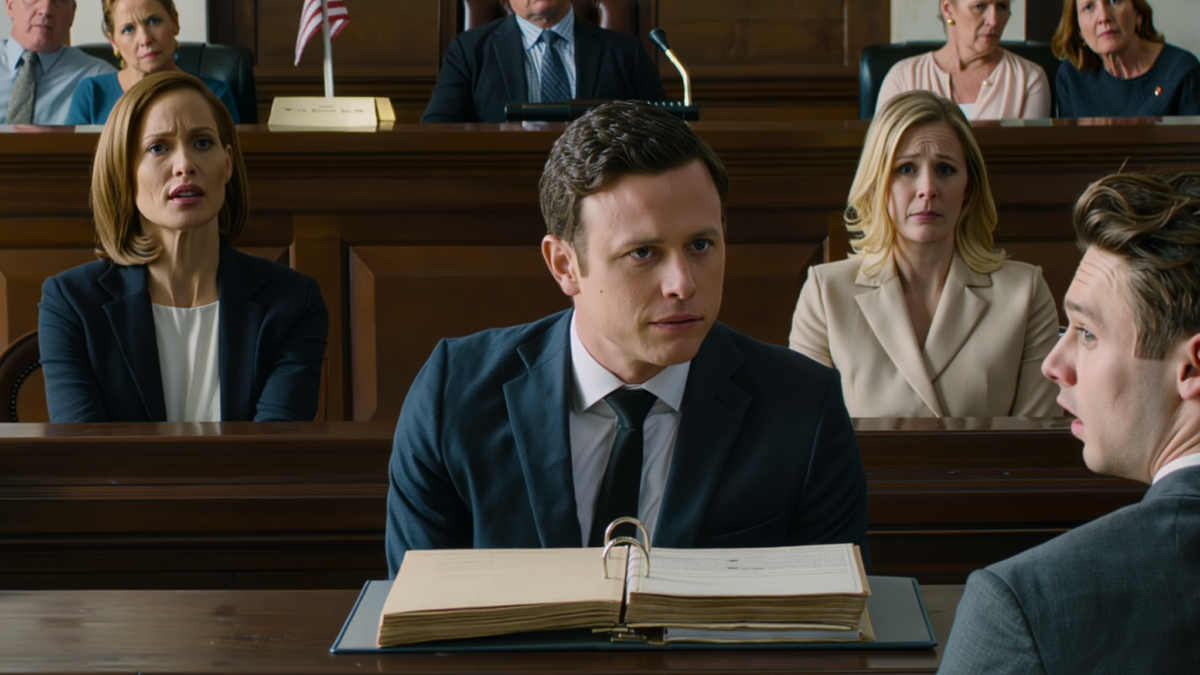
“First,” Mrs. Chun began, her voice carrying through the silent courtroom, “let’s address the claim that my client sabotaged Mr. Leo Smith’s career prospects.”
She placed a thick binder on the witness stand.
“This file contains printouts from Mr. Leo Smith’s email and social-media accounts obtained through legal discovery. In it, we have documented no fewer than six job offers he received in the last four months, all from reputable companies, all offering competitive salaries.”
She projected an email onto the large courtroom screen.
It was from Leo to a friend.
The text was difficult to explain away.
“Just got another offer, lol. $50,000 a year to be a project assistant. As if. Why would I work that hard for that when my brother’s loaded? This lawsuit is going to be my new salary.”
A murmur moved through the courtroom.
Leo’s face lost its color.
Mr. Gable jumped to his feet.
“Objection. Relevance.”
“It’s highly relevant, counsel,” the judge said, narrowing her eyes at Leo. “Please continue, Mrs. Chun.”
“Next,” Mrs. Chun said, moving on without missing a beat, “the claim of a high-risk pregnancy.”
She produced another set of documents.
“These are Miss Chloe Smith’s medical records, also obtained through the case. They show a healthy pregnancy. Her physician described it as progressing normally. There is no indication in these records of the extraordinary medical circumstances described in the petition.”
Chloe sank lower in her chair, avoiding my gaze.
My mother and father began whispering urgently to each other.
Their confidence was fading.
“And finally,” Mrs. Chun said, her voice dropping slightly, “let’s discuss the alleged harassment. The petitioner claims my client is the aggressor. We would argue the opposite.”
She played the security footage from my office lobby.
The courtroom watched in silence as my mother appeared on screen, raising her voice and accusing me of abandoning my family.
They saw security approach her professionally.
They saw me remain controlled.
The audio was clear.
“Is this simply the act of a concerned mother?” Mrs. Chun asked the room. “Or is it part of a pattern of pressure and public humiliation?”
She wasn’t finished.
She submitted the phone records.
Dozens of emails.
The security log from my apartment building showing my father arriving unannounced and refusing to leave.
Piece by piece, she built the record.
The final piece was a deposition from my CEO, Mr. Harrison.
He stated that he had never received any communication from me regarding Leo and that my conduct during my mother’s disruptive appearance at the office had been professional.
When Mrs. Chun finished, a heavy silence fell over the courtroom.
Mr. Gable had nothing to say.
My family looked stunned.
Their claims had been laid out in front of a judge and a room full of strangers.
The judge removed her glasses and rubbed her eyes.
She looked at Leo and Chloe.
Then at my parents.
Her expression showed deep disapproval.
Then she looked at me.
For the first time, I saw a glimmer of understanding.
Maybe even sympathy.
She cleared her throat.
“After reviewing the evidence presented,” she began, her voice firm, “this court finds the petition for increased support to be not only baseless, but frankly fraudulent.”
She wasn’t finished.
“Furthermore, it is clear to this court that Mr. Jason Smith has been the target of a deliberate pattern of harassment and attempted financial exploitation by his brother, his former wife, and his parents.”
She looked directly at them.
“I find your behavior deeply troubling.”
Then she delivered her ruling.
“The petition is dismissed, and based on the evidence of bad faith, I am reversing a portion of the original divorce settlement. The spousal support previously granted to Miss Smith will be reduced by 60 percent, effective immediately. This court is adjourned.”
The gavel came down with a sharp crack.
It was over.
The ruling had gone in my favor.
Relief washed over me so strongly that my knees almost felt weak.
I looked toward my family.
Their faces showed shock and disbelief.
They hadn’t simply lost a lawsuit.
They had lost their power over me.
The walk out of the courthouse felt surreal.
My family was huddled together while their lawyer tried to talk to them.
They weren’t listening.
They were staring at me.
For the first time, I didn’t feel anger.
I didn’t feel sadness.
I didn’t even feel satisfaction.
The emotional hold they had maintained over me for 34 years had finally ended in that courtroom.
I walked past them without saying a word and got into a cab.
On the ride back to my apartment, Mrs. Chun called.
“How are you feeling?” she asked.
“Empty,” I answered honestly. “But in a good way.”
“You did well, Jason. You held your nerve,” she said. “I’ve already filed the paperwork reflecting the reduced payments. The judge’s ruling was extremely strong.”
She paused.
“I also ran a preliminary check on your parents’ finances while we were evaluating whether additional protective steps might be necessary. It appears they took out a second mortgage on their house to pay Mr. Gable’s legal fees.”
The news landed without much impact.
It wasn’t my problem anymore.
Actions had consequences.
They had gambled everything on the belief that I would fold.
That I was still the same person they had always known.
They had made a bad bet.
A few days later, I heard through a mutual acquaintance that the fallout had been severe.
Leo and Chloe were fighting constantly, blaming each other for the failed case.
The reduced financial support meant they could no longer afford their apartment.
My parents were in a financial hole they might never climb out of.
The perfect family facade had fallen away, revealing the dysfunctional reality underneath.
My father called a week after the verdict.
I had unblocked their numbers—not because I wanted a relationship again, but because I wanted to be able to make my own choice if they called.
His voice was different.
The usual blustering authority was gone, replaced by a tired, hesitant rasp.
“Jason,” he said. “We… we need to talk.”
“There’s nothing to talk about,” I answered evenly.
“Your mother, she’s not doing well. This has been very hard on her.”
“The consequences of her own actions,” I replied. The words came easily now, free from the guilt that once would have stopped me. “She made a public spectacle. She lied under oath. What did she expect?”
“She’s still your mother,” he pleaded.
“And Leo is still your son,” I replied. “And he’s your problem now. You made your choice, all of you. Now you get to live with it.”
There was a long silence.
I could hear his breathing through the phone.
He was waiting for me to give in.
Waiting for me to offer a solution.
Waiting for me to fix things like I always had.
I didn’t.
“Goodbye, Dad.”
I ended the call.
I felt a profound sense of closure.
The power dynamic had shifted permanently.
They could no longer command.
They could only ask.
And I was no longer obligated to listen.
A month passed in silence.
Then my mother called.
Her voice sounded almost unrecognizable—small, fragile, stripped of its former authority.
She asked if I would meet her and my father for coffee.
She said they needed to apologize.
Part of me wanted to say no and never see them again.
But another part of me knew I wanted one final conversation so I could close the book for good.
I agreed.
But on my terms.
A public place.
A busy coffee shop downtown during the lunch rush.
No dramatic scenes.
No raised voices.
I saw them before they saw me.
They were sitting at a small table, looking older and more worn than I remembered.
The arrogance was gone.
In its place was deep weariness.
I sat down.
They both flinched slightly, as if they expected me to raise my voice.
I simply ordered coffee.
“Jason, thank you for coming,” my mother began, her hands trembling around her mug. “We… we are so sorry.”
“Sorry for what, specifically?” I asked.
I wasn’t going to make it easy for them.
They needed to say the words.
My father sighed.
“We were wrong,” he said. “We were wrong to defend Leo. We were wrong to pressure you. We were wrong to lie in court.”
It was the closest thing to a genuine admission of guilt I had ever heard from them.
“We were just so worried about Leo,” my mother added, a hint of the old excuse-making creeping back in. “And the baby. We just wanted to protect the family.”
“You didn’t protect the family,” I said calmly, looking directly at her. “You destroyed it. You chose one son over the other. You chose a lie over the truth. There’s no coming back from that.”
Tears gathered in her eyes.
“What can we do to fix this?” she whispered.
I took a sip of coffee.
I had thought about this moment before.
About what I would say if it ever came.
The answer turned out to be surprisingly simple.
“Nothing.”
They stared at me.
“You can’t fix it,” I continued. “What you can do is leave me alone. Let me live my life, and you live yours.”
I stood and placed a ten-dollar bill on the table for my coffee.
“I forgive you,” I said.
Both of them looked up.
For a second, hope returned to their faces.
But I wasn’t finished.
“I forgive you not because you deserve it, but because I deserve to be at peace. I’m letting go of all of it—the anger, the hurt, all of it. And I’m letting go of you.”
I turned and walked out of the coffee shop without looking back.
The sun was bright outside.
For the first time, I felt truly free.
The guilt and obligation that had bound me my entire life finally loosened their hold.
I was on my own.
And the future was a blank page.
The decision to leave Boston came easily.
The city was full of memories.
Every street corner seemed to hold one.
I was ready for a fresh start.
Mr. Harrison, my CEO, had been incredibly supportive after the incident with my mother at the office.
When I told him I was considering relocating, he understood immediately.
Then he made a call.
Our company had a larger office in Seattle, and a senior management position had just opened.
He gave me a glowing recommendation.
Two weeks later, I was packing my apartment.
My last day at the Boston office was surprisingly emotional.
My team, led by my good friend and colleague David, threw me a farewell party.
They knew the broad outlines of my family problems, but they didn’t need every detail to show their support.
They gave me a beautiful card signed by everyone in the department.
One message, written in large letters by David, stood out.
“Your value isn’t determined by those who can’t see it. Go be brilliant.”
I almost lost my composure right there.
These people—my work family—had shown me more loyalty and respect than my own relatives had.
Moving to Seattle felt like taking my first full breath in a long time.
The city was vibrant, surrounded by water and mountains.
It felt like a world away from everything I had left behind in Boston.
My new job was challenging and rewarding.
I was leading a talented team on an innovative project.
People respected me for my skills and leadership, not for who my brother was or what my family expected from me.
I made a conscious effort to build a new life.
I joined a hiking club and spent weekends exploring the trails of the Pacific Northwest.
I reconnected with an old friend from MIT named Maria, who also lived in Seattle.
We started meeting for dinner once a week.
It was refreshing to talk with someone who had known the “before” version of Jason but wasn’t tied to any of the family drama.
I was healing.
The anger faded and was replaced by quiet indifference.
The constant weight on my shoulders disappeared.
For the first time in more than a year, I was sleeping through the night.
I was discovering who Jason was when he wasn’t Richard and Carol’s son.
Or Leo’s older brother.
I was just Jason.
And I was beginning to like that guy.
One evening, I sat on the balcony of my new apartment looking out at the glittering city lights and the dark silhouette of the mountains beyond.
My phone buzzed.
It was a text from David.
He had sent a photo of himself and my old team out for drinks.
The caption read:
“Boston misses you, boss.”
I smiled.
That was when I realized I had finally found what I had been searching for my entire life.
A family.
Not one defined by blood or obligation.
One built on mutual respect, loyalty, and genuine care.
A chosen family.
The pain from the past hadn’t vanished entirely.
But it no longer defined me.
It was simply part of the map of where I had been.
I was the architect of my own life now.
And the view from Seattle was looking pretty good.
Just when I thought I had truly left the past behind, however, it sent one final echo across the country.
It was a Tuesday evening, about six months after I moved to Seattle.
An unknown Boston-area number appeared on my phone.
Against my better judgment, I answered.
“Jason, it’s your aunt Susan.”
My aunt Susan was my father’s sister.
She was the family’s usual peacemaker, a woman who specialized in smoothing over conflict with syrupy-sweet platitudes while quietly applying guilt.
“Hello, Susan,” I said, keeping my voice neutral.
“Oh, it’s so good to hear your voice, honey,” she replied. “We’ve all been so worried about you, all alone out there.”
I didn’t take the bait.
“I’m not alone, and I’m doing just fine. What can I do for you?”
Her tone became more somber.
“Jason, I’m calling about your father. His health isn’t good. The stress of all this. The house…”
Here it comes, I thought.
The guilt trip.
“They’re going to lose the house, Jason,” she said. “The second mortgage, the legal fees. They’re struggling. Your mother is a wreck. They’ve lost everything.”
I remained silent, letting her play her hand.
“And I know your marriage didn’t work out,” she continued, her voice coated in false sympathy. “And I know Chloe made a mistake, but you know, Jason, it takes two to tango. Maybe if you had been a bit more present in your marriage, a bit less focused on your career, none of this would have happened.”
And there it was.
The final attempt to shift the blame back onto me.
A year earlier, that comment would have devastated me.
It would have gone straight to my deepest insecurities.
Now it simply sounded familiar.
The same old narrative being revived one last time.
I let her finish.
Then I asked a simple question.
“Susan,” I said quietly, “how is Uncle Robert doing?”
“Robert? He’s fine. Why?”
“His law firm is still one of the most successful in the state, isn’t it?”
“Well, yes, but what does that have to do with anything?”
“And those three rental properties you own down on the Cape,” I continued. “They must bring in good income, especially during the summer.”
The line went silent.
She knew where this was going.
“You’re calling me,” I said, “from your comfortable home, using a phone paid for by your husband’s successful law firm, to ask me to bail out the parents you claim to be so worried about. You’re telling me about my responsibilities to family. So let me ask you something, Aunt Susan. You’re their sister. You have resources. Why haven’t you helped them?”
She had no answer.
I had dismantled her argument using the same logic she had tried to use against me.
“That… that’s different,” she finally stammered.
“No,” I said, my voice firm now. “It isn’t different. You want someone else to carry the burden, just like they always have. Well, I’m resigning from that position permanently. Do not call me again.”
I ended the call before she could respond.
Then I blocked her number.
And I knew that was the real ending.
Not the courtroom verdict.
Not the uncomfortable coffee-shop meeting.
This.
The moment I calmly dismantled the last tool my family had consistently used against me.
Guilt.
The echo finally faded.
There was only silence.
And for the first time, the silence felt peaceful.
Tonight, I’m sitting on that same balcony with a cup of coffee in my hands, watching ferries glide across Puget Sound.
It has been almost a year since that last call from my aunt.
There have been no more attempts at contact.
The silence has held.
For a long time, I wrestled with the word family.
It was a word that had brought me enormous pain.
A concept that had felt like a burden of obligations and unwritten rules I could never seem to follow correctly.
My whole life, I thought family was something you were simply born into.
An unbreakable bond you had to endure no matter how unhealthy the dynamic became.
I thought family meant sacrifice.
More specifically, my sacrifice for the good of everyone else.
I was wrong.
What I’ve learned out here on my own is that family isn’t simply about blood.
It’s about respect.
It’s about trust.
It’s about showing up for each other not only when things are easy, but when they’re difficult.
It’s about celebrating each other’s victories rather than resenting them.
It’s about holding each other accountable when mistakes are made instead of making excuses forever.
My family now is David, who still texts me pictures of my old office plant and jokes that he’s keeping it alive for me.
It’s Maria, who dragged me through a grueling 10-mile hike last weekend and shared her last granola bar with me at the summit.
It’s my team in Seattle, who rely on me and whom I rely on in return.
It’s a family I chose.
And one that chooses me back every day.
I don’t know exactly what happened to Leo and Chloe or their child.
I don’t know whether my parents ultimately lost their house.
And the truth is, I don’t want to know.
Their story is no longer my story.
I’ve turned the page and started a new chapter.
The scars are still there.
They probably always will be.
But they don’t hurt anymore.
They’re simply part of my map.
A reminder of the ground I had to cross to reach this quiet moment of peace in a city I now call home.
My journey began with leaving a family dynamic that had worn me down.
It ended with me finally understanding what the word family truly means.
It isn’t about who you share your past with.
It’s about who you want to share your future with.
And for the first time, my future looks bright.








