My family ignored me for years, so at Thanksgiving I calmly mentioned my $160 million fortune. My brother laughed and called me a liar, while my dad demanded proof—until I slid my phone across the table and watched him stare at the balance. For the first time, the entire room went silent, and I realized they were finally looking at me…
I am Owen, 28 years old. And for my entire life, I have been a ghost in my own house. But at this year’s Thanksgiving dinner, I dropped a bomb that didn’t just shatter the silence, it shattered my family.
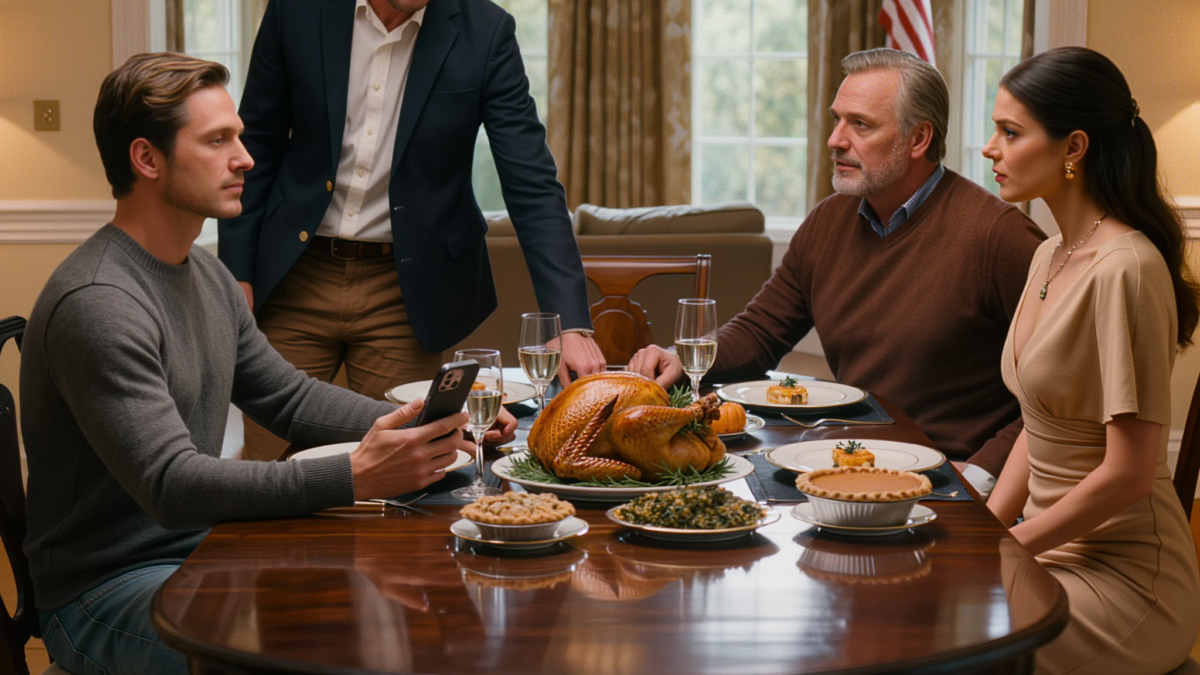
The air in the dining room was stifling, thick with the smell of roasted turkey and the heavier scent of expensive perfume. It was the same every year. My parents’ house in Connecticut was designed to impress, not to comfort. High ceilings echoed every scrape of silverware, stiff furniture made you sit up straight, and the temperature was always set a few degrees too cold, as if warmth were a luxury they couldn’t afford.
I sat at the far end of the table, the spot usually reserved for distant cousins or unexpected guests. But I wasn’t a guest. I was the second son, the spare, the placeholder.
The food on my plate tasted like cardboard. I was chewing, but I couldn’t feel the texture. My whole body was braced, a subconscious habit I had developed over two decades of these family gatherings.
My brother Leo sat at the center, right between Mom and Dad, holding court as always. He was 34, glowing with the kind of slick confidence that comes from never having been told no. Beside him was Isabelle, his fiancée, a woman who looked at price tags before she looked at faces. She radiated an aura of expensive, bored perfection.
“The wedding is going to be in the Hamptons,” Isabelle was saying, her voice a little too loud, designed to carry to the kitchen. She waved her hand, and the diamond on her finger, a rock the size of a small bird’s egg, caught the chandelier light and threw rainbows across the table.
“We’re looking at a budget of around 250,000. But honestly, you can’t put a price on perfection, and our friends expect a certain standard.”
My mother, a woman who usually guarded her emotions like state secrets, was beaming. Her face, normally a mask of polite tension, was soft with adoration. She reached out and squeezed Leo’s hand.
“It’s going to be the event of the season, darling. We are so proud. Finally, a celebration worthy of this family.”
Dad nodded, cutting into his turkey with surgical precision. He was a man of few words, but his approval was the sun that our family orbited.
“A4 million is a serious investment, son. But for you, it’s worth it. You’ve earned it with that promotion.”
“Vice President of Sales,” Leo corrected, though nobody had asked. “And the bonus structure is insane. We’re looking at a salary bump that puts us in the top tax bracket easily. Isabelle’s already talking to a decorator for the new house.”
“Incredible,” Mom sighed, her eyes glistening.
I took a bite of my stuffing. It was dry. Nobody looked at me. Nobody asked me how my drive was. Nobody asked me if I was seeing anyone. I was just furniture, a prop to fill the empty seat and make the table setting look symmetrical.
Then my aunt Carol spoke up. Carol was my mother’s sister, and she specialized in the art of the passive-aggressive insult, delivered with a syrupy smile. She swirled her wine glass, looking at me over the rim as if I were a curious specimen under a microscope.
“And what about you, Owen?” she asked.
The table went quiet. Not a respectful quiet, but the awkward silence of people remembering they forgot to feed the dog.
“Still doing that computer thing? Fixing laptops in that little apartment of yours?”
Leo chuckled. It was a low, wet sound full of condescension.
“He’s not fixing laptops, Aunt Carol. He’s coding, playing with video games in his apartment.”
He turned to me, a smirk playing on his lips that he didn’t bother to hide.
“How’s that going, buddy? You managed to pay rent this month without asking Dad for a loan?”
My father didn’t even look up from his plate.
“Owen knows the bank is closed, Leo. He needs to learn reality.”
My hand tightened around my fork. The metal dug into my palm. A small, sharp pain that grounded me.
I looked around the table. My mother was checking her reflection in a spoon. Isabelle was texting under the table, a bored expression on her face. Leo was grinning, waiting for me to shrink, to mumble something and look away like I always did.
They didn’t know.
They had no idea that the computer thing I was doing had just triggered a wire transfer that morning large enough to buy this entire street. They didn’t know that the Honda Civic parked outside, the one they openly mocked, was the only thing I hadn’t upgraded because it kept me humble.
I took a sip of water. The cold liquid was a shock to my system. I cleared my throat.
“Actually,” I said, my voice steady, surprising even myself, “I’m not fixing laptops anymore.”
“Oh?” Leo raised an eyebrow, his voice dripping with mock interest. “Get promoted to Geek Squad manager?”
“No,” I said, meeting his gaze. “I sold the company.”
They didn’t know it yet. But that sentence was the match that would burn this entire facade to the ground.
But to understand why this moment tasted so sweet and why it was so dangerous, you have to understand where I came from. You have to go back to the beginning, to the moment I realized I didn’t matter.
I was 9 years old when I realized I was invisible. It wasn’t a sudden epiphany. It was a slow, cold realization, like water seeping into a basement. A dampness you can’t get rid of.
It was my birthday. Tenth birthday, actually. Double digits. A big deal for a kid.
I had woken up early, vibrating with excitement, rushing downstairs, expecting pancakes, maybe a banner, the way they always did for Leo. The kitchen was empty, silent. My parents had already left for work. There was a $20 bill on the counter with a sticky note, the handwriting rushed.
“Order pizza. Happy Bday, Mom.”
My chest felt hollow.
That evening, when they came home, the house was buzzing. I thought for a fleeting, hopeful second that it was for me, but it wasn’t.
Leo, who was 16 then, had just been named captain of the varsity soccer team. My parents were popping champagne, not sparkling cider. Real, expensive champagne. They ordered steak from the best steakhouse in town.
“This is huge, Leo,” my dad boomed, slapping my brother on the back so hard it echoed. “Captain as a junior. That’s the ticket to the Ivy League right there. Leadership potential.”
I stood on the stairs, clutching the crumpled $20 bill in my sweaty hand. I walked into the kitchen, a small, hopeful voice in my head urging me to just say something.
“Mom?” I asked, my voice barely a whisper.
“Not now, Owen,” she said, rushing past me with a tray of wine glasses. “We’re celebrating your brother. This is a very important night for him. Go wash up for dinner.”
I went to my room and ate the cold pizza I had ordered for myself hours earlier.
I realized then that in the solar system of our family, Leo was the sun, blazing, central, everything orbiting him, and I was Pluto, cold, distant, and barely considered a planet.
The gap only widened as we got older.
When Leo turned 18, there was a brand-new BMW 3 Series, midnight blue, waiting in the driveway with a giant red bow on the hood. I remember watching from my bedroom window as he ran outside, screaming with joy, hugging my dad. I could smell the new-car leather from the porch.
“You need a reliable car for college,” Dad said, his voice thick with pride. “Success looks like something, Leo. You have to dress the part, drive the part. Project Confidence.”
When I turned 18, seven years later, I got a card. Inside was a $50 gas gift card.
“Gas is expensive,” my dad told me, not even making eye contact as he read the newspaper. “If you’re going to drive that rust bucket you bought, you’ll need it.”
The rust bucket was a 10-year-old Ford Escort I had bought with my own money, earned bagging groceries for two years. I had been so proud of it.
The education gap was even worse. Leo went to Westfield Academy, a private school with manicured lawns and a tuition that cost more than most people make in a year. I went to Franklin High, the local public school with leaking roofs and overcrowded classrooms.
I once gathered the courage to ask my mother why. We were in the car, just the two of us, a rare moment.
“Why does Leo get to go to the private school and I go to public?”
She didn’t even look away from the road.
“Leo, he needs more stimulation, honey. He has special talents that need nurturing. He’s sensitive.”
She paused, then added the line that would define my childhood.
“You—You’re very resilient, Owen. You do fine where you are. You’re a survivor.”
A survivor. That was code for we don’t need to worry about you, so we won’t. It meant I was tough enough to be neglected.
I wasn’t bitter at first. I honestly thought this was just how the world worked. Some people were chosen; others were ignored.
But that neglect gave me something Leo never had: solitude.
And in that solitude, I found my obsession. While Leo was out at parties or soccer practice, I was in my room, a fortress of solitude. I was dismantling old radios and putting them back together.
Then my dad threw away an old desktop computer because it was too slow for taxes. To me, it was a portal, a universe in a beige box. I dragged it to my room, wiped it, installed a free version of the Linux operating system, and taught myself to code from library books.
The screen’s blue light became my only real comfort. Code didn’t care if you were the favorite son. Code didn’t care if your dad ignored you. If the logic was sound, the code worked. It was the only fair, predictable thing in my life.
By the time I was a senior in high school, I was fluent in Python, Java, and C++. I applied to colleges without telling my parents. Why bother? It was my problem, not theirs.
When the acceptance letter came from the University of Connecticut with a full academic scholarship for their engineering program, I was ecstatic. I had done it all by myself.
I waited until dinner to share the news, a small, foolish part of me hoping this would be the thing that finally made them see me.
“I got into Yukon,” I said, placing the official letter on the table. “Full ride.”
My dad picked it up and glanced at it.
“Yukon, that’s a state school, right?”
“It’s a great engineering program,” I said, my voice defensive. “Top 50 in the country.”
“Well,” Mom said, buttering a dinner roll with meticulous care, “at least it’s free. That helps with the budget since we’re paying full tuition for Leo’s MBA at Yale. That program is incredibly expensive.”
“We should celebrate,” Dad said.
My heart lifted for a second.
This was it.
“Let’s go to Applebee’s. I have a coupon for a free dessert.”
Two years prior, when Leo got into Yale for his undergrad, they had rented out a ballroom at the local country club. There was a live band.
For me, it was a coupon for a chocolate lava cake.
But Yukon was my liberation. For the first time, I wasn’t Leo’s little brother. I was just Owen, a blank slate.
And in my sophomore year, in a shared elective class I took just to fill a credit, I met Marcus.
Marcus was everything I wasn’t. He was a mountain of a man, loud, charismatic, and perpetually optimistic. He was a business major who could sell ice to a polar bear and make the polar bear thank him for it.
We met because he saw me coding during a break, furiously trying to solve a problem.
“Dude,” he said, leaning over my shoulder, his shadow covering my laptop screen. “Is that an algorithm for supply chain optimization?”
I looked up, startled. No one had ever recognized my work before.
“Uh, yeah. Just messing around.”
“Messing around?” Marcus sat down, the chair groaning under his weight. “That’s brilliant. You know how messy logistics are right now? My uncle runs a trucking company. It’s a nightmare of spreadsheets and lost shipments. This could fix it.”
Marcus became my first believer.
He was the brother Leo never was. He dragged me out of my shell, made me explain my ideas in plain English, and challenged me. He didn’t see a quiet, invisible kid. He saw a brain that could change an industry.
“You have a gift, Owen,” Marcus told me one night over cheap beer in our dorm. “Stop acting like you’re apologizing for existing. Your brain is worth millions. Don’t ever let anyone, especially your family, tell you otherwise.”
Millions sounded like a joke, a number from a different reality. But Marcus wasn’t joking.
We started working. I handled the tech. Marcus handled the business plan. We called our fledgling project Loisync.
The idea was simple but revolutionary: create a platform that used AI to predict inventory shortages before they happened, seamlessly syncing suppliers with retailers in real time.
We worked out of our dorm room, which smelled perpetually of stale coffee and microwave popcorn. I slept four hours a night. My grades slipped slightly from A’s to B’s, but I didn’t care. I was building something real, something that was mine.
During Thanksgiving of my junior year, I made the colossal mistake of trying to share this part of my life with my family. I was buzzing with excitement. We had just landed our first small, unpaid beta test with Marcus’s uncle. I wanted to show them I was doing something real.
“I’m actually starting a business,” I said over pumpkin pie, my voice tight with nerves. “It’s a software platform for logistics.”
Leo, who was home from his high-flying marketing job in Manhattan, laughed. He actually wiped a tear from his eye. It was pure, unadulterated mockery.
“A business?” Leo scoffed, looking around the table as if to say, Can you believe this guy? “Owen, making a website in your bedroom isn’t a business. It’s a hobby. Like knitting, but for nerds.”
“It’s not just a website,” I tried to explain, my cheeks burning. “It’s an algorithmic solution for B2B supply chain management.”
“Whoa, whoa. Don’t bore us with the nerd talk,” Leo interrupted, holding up a hand. “Look, it’s cute. But don’t get distracted from your classes. You need that degree so you can get a real job. Maybe you can get into IT support at my firm. I could put in a good word, get you an interview. It’s stable work.”
The offer of a handout, the ultimate put-down.
I looked at my dad, my last hope.
“Dad, it’s actually showing promise. Marcus’s uncle is already using it.”
Dad sighed, a long, weary sound, as if my ambition was a burden to him personally. He looked tired.
“Owen, listen to your brother. He knows the corporate world. Stop playing these games and focus on reality. Dreamers starve. Doers like Leo, they eat. It’s a tough world, and you need a steady salary.”
That moment was the turning point.
I didn’t yell. I didn’t storm off. Something inside me just clicked off. The tiny flame of hope that I could one day earn their approval was extinguished. It was over.
I looked at Leo, at his smug, satisfied face, and I didn’t feel anger anymore. I felt a cold, clear resolve.
“Watch me.”
I went back to school that Sunday and made a decision. I deleted my parents’ contact info from my favorites list on my phone.
I told Marcus, “We’re not sleeping until this launches full-time.”
“What happened at home?” Marcus asked, seeing the new hard look in my eye.
“My family thinks it’s a game,” I said, opening my laptop. The blue light illuminated my face. “I’m going to show them how the game is played.”
That was the last time I ever asked my family for advice, for approval, or for anything at all. I built a wall, and behind that wall, I built an empire.
The next two years were a blur of caffeine, code, and rejection.
Marcus and I graduated, but we didn’t look for jobs. We moved into a cramped two-bedroom apartment in a questionable neighborhood in Queens. Our first office was the living room, filled with two desks, a whiteboard covered in frantic scribbles, and a coffee machine that was on 24/7. We ate ramen noodles so often that my sweat started smelling like sodium.
But the software was working. More than working, it was magic.
Our first real break came from a midsized regional grocery distributor. They were hemorrhaging money on expired dairy products. I spent a week integrating loy sink into their archaic systems.
In one month, we saved them $40,000.
Just like that, the CEO, a gruff guy named Mr. Henderson, who looked like he ate nails for breakfast, called us into his office. He looked at the report I had generated, then at the two of us, two kids barely out of college.
“I don’t understand how the hell this works,” Henderson said, tossing the papers on his desk. “It’s like voodoo, but the numbers don’t lie. I want an exclusive license for my region.”
“We don’t do exclusives,” Marcus said smoothly, kicking me under the table to keep my excited mouth shut. “Exclusivity would limit our growth potential. But what we can do is sign you up for a two-year enterprise contract. $50,000.”
My heart stopped.
$50,000. We were hoping for five, maybe ten.
Henderson grunted and chewed on an unlit cigar.
“Fine. You kids drive a hard bargain. Where do I sign?”
Walking out of that office building into the New York City sunlight with a check for 50 grand was the greatest high of my life.
It was more than money. It was validation. It was proof.
We went back to our crappy apartment, ordered the most expensive pizza on the menu, and popped a bottle of cheap champagne that fizzed over onto the stained carpet.
“To the game,” Marcus toasted, clinking his plastic cup against mine.
“To the game,” I replied, a real smile spreading across my face for the first time in what felt like years.
That $50,000 was just the spark. Henderson bragged about his secret weapon at a trade conference. The calls started coming in. First dozens, then hundreds.
Loisync wasn’t just a good idea. It was essential.
By the time I was 24, we had contracts with national retailers. We moved into a real office with a window. By 25, we had 47 employees, and our annual revenue was hitting $7 million.
My family knew none of this.
When I visited for Christmas that year, I parked my new Audi A8, a quiet celebration for myself, three blocks away and walked to the house so they wouldn’t see it. I wore simple clothes, an old sweater and jeans.
“Still driving that old Ford?” Dad asked as I walked in, not looking up from the football game on TV.
“It gets me from A to B,” I lied, the words tasting like ash.
“Well, Leo just got the new Tesla Model S,” Mom beamed from the kitchen. “It’s incredible. Silent, so luxurious. Maybe he can give you a ride sometime so you know what real quality feels like.”
“That would be nice,” I said, my voice flat.
I was living a double life: the invisible son at home and the tech CEO in the city.
But every empire faces a siege. Ours came not from a competitor, but from inside the walls.
As the company grew, I made a mistake. Classic one. I let sentimentality cloud my judgment.
My cousin Kyle, Aunt Carol’s son, reached out to me. He was struggling. He had flunked out of community college and couldn’t hold a job. Aunt Carol called me, her voice thick with fake tears, asking if I knew anyone who was hiring.
“Just something simple, Owen. Maybe helping you with your computer repairs. He’s good with his hands.”
She still thought I fixed laptops. The family narrative was set in stone.
Against my better judgment, against a screaming instinct in my gut, I hired Kyle. I gave him a job in data entry at Loisync. It was a simple, repetitive task, but I paid him a salary he wasn’t remotely qualified for: $60,000 a year plus full benefits.
I thought I was helping family. I thought I was being a good person.
“Thank you so much, Owen,” Khaled said on his first day, looking around our modern, bustling office with wide, envious eyes. “I won’t let you down. I swear.”
For six months, it was fine. He was mediocre at his job, but he showed up.
Then we started losing bids.
Specifically, we lost three major, game-changing contracts to a ruthless competitor, Supply Chain X, run by a Silicon Valley transplant named Derek.
Derek was a shark. He had been trying to crush us for a year. The weird part was that Dererick’s proposals were undercutting ours by razor-thin, exact margins. It was like he was sitting in our meetings. He knew our pricing strategy down to the cent.
There had to be a leak.
I started a quiet internal audit. I told no one but Marcus. I tracked login logs, email access, everything.
It was late on a Tuesday night. The office was empty. The only sound was the hum of the servers.
I was staring at the screen, my eyes burning, and my stomach dropped into a cold, hard knot.
Kyle’s account had been accessing our most confidential pricing files repeatedly, always after midnight.
I felt like I’d been punched in the gut. I didn’t want to believe it. It was too cliché, too ugly.
I pulled up the security camera footage from the server room corridor.
There he was, my cousin, sitting at his desk at 2:00 a.m., taking photos of the screen with his phone like a common thief.
I called Marcus. My voice was a croak.
“It’s Kyle.”
“I’m coming over right now,” Marcus said. No questions asked.
The confrontation the next morning was the ugliest moment of my professional life.
I called Kyle into my glass-walled office. Marcus stood by the door, his arms crossed, a silent, intimidating giant.
I turned my monitor around so Kyle could see the crystal-clear photos of himself, illuminated by the glow of the screen he was betraying.
“How much did Derek pay you?” I asked.
My voice was calm, dead calm. That’s what scared him. I wasn’t yelling.
Kyle’s face went pale, then a blotchy, defensive red. He didn’t apologize. He didn’t even look ashamed.
He got angry.
“You have everything,” K snapped, his voice cracking. “You walk around here like a king. You didn’t even tell the family you own this place. My mom thinks you’re a loser struggling to pay rent. And here you are sitting on millions. It’s not fair, Owen. You were supposed to be the loser in the family. I deserved a cut of this.”
“You had a salary,” I said, my voice still quiet. “You had health insurance. You had a chance to build something. I gave you that.”
“Derek gave me 10 grand per contract,” K spat. “30 grand, more than I’ve ever seen in my life.”
$30,000.
He sold out our future, our employees’ jobs, my trust for $30,000.
“Get out,” I said. “Now.”
I pushed a pre-written document across the table.
“This is an NDA and a termination agreement. You will sign it. And Kyle, if you ever breathe a word about this company to anyone in the family, I will bring the full force of my legal team down on you. I will sue you for corporate espionage, and I will personally fund it until you are old and gray. My lawyer will make sure of it.”
He signed, his hand shaking with rage, not remorse. He left.
That day, I learned a hard lesson. Shared blood doesn’t mean shared loyalty.
I fired my cousin, and I felt a piece of my heart turn to stone.
I was done playing the nice guy. I refocused with a vengeance.
We used the leak to our advantage. We fed Derek, source now cut off, bad information on our next bid. He went in low, and we came in just under him with a superior product, exposing him as a one-trick pony.
We crushed Supply Chain X in the next quarter. I drove him out of the market within a year.
By 28, Loisync wasn’t just a market leader. We were the market.
And then the sharks came feeding. But this time, they wanted to buy, not destroy.
The email came directly to my private inbox, bypassing all the gatekeepers I now employed.
The subject line was simple and terrifying.
“Acquisition inquiry, Inovix Technologies.”
Inavix was a giant, a tech titan, a Fortune 500 beast that ate companies like mine for breakfast. Their CEO was Evelyn Reed, a woman known as the Iron Lady of Tech, a legend who had shattered more glass ceilings than a hail storm.
I met her in a sterile conference room on the 80th floor of a skyscraper in Manhattan. The view of the city was dizzying.
Evelyn didn’t do small talk. She was in her 60s, with sharp eyes that seemed to see right through you.
“I’ve been watching you, Owen,” she said, her voice calm and authoritative. “You built a clean system. Elegant. It threatens my legacy logistics software, which is a billion-dollar-a-year division for me. I don’t like threats. I prefer to own them.”
“I’m not looking to sell,” I said, leaning back, trying to project a confidence I absolutely did not feel.
Marcus, sitting beside me, kicked me hard under the table, but I held my ground.
“Everyone is looking to sell.” Evelyn smiled, a thin, knowing smile. “It’s just a matter of the number.”
She slid a single piece of paper across the vast table. It wasn’t a complex proposal. It was just a number.
$120 million.
Marcus stopped breathing. I could literally hear the air catch in his throat.
I looked at the number. It was life-changing. It was never-work-again money. It was buy-a-small-country money. It was more money than anyone in my family had ever seen combined over generations.
But I looked at Evelyn. I thought about the Ramen Knights, the betrayal from Kyle, the all-nighters.
My internal projections, based on our current growth trajectory and market penetration, show we double our valuation in 18 months. This is a lowball offer, Evelyn. Respectfully.
She looked at me for a long moment, studying my face. Her expression didn’t change.
“You have guts. I like that. Most kids your age would have fainted or started crying. I’ve seen it happen.”
“I’m not a kid,” I said. “And this is my life’s work. It has a price.”
We negotiated for three brutal weeks. It was grueling. Fleets of lawyers, armies of accountants, digging through every line of code I had ever written. The pressure was immense.
In the middle of the most stressful week of my life, as we were hammering out the final details of the deal, my phone rang. The screen flashed: Mom.
I stared at it. My heart sank.
I was in a room with 10 lawyers discussing intellectual property rights and potential custody battles over code. I excused myself, stepping into the hallway overlooking the city.
“Hello, Owen, it’s Mom,” she said. Her voice was brisk, impatient.
“Listen, Leo’s engagement party is coming up. We’re doing a registry at William Sonoma. I was just looking at it online, and I noticed you haven’t sent a gift yet. The KitchenAid stand mixer is still available. It’s the silver one.”
I closed my eyes and rubbed my temples so hard I saw stars.
“Hi, Mom. I’ve been a little busy with work.”
“Busy with what? Fixing hard drives?” She sighed, the sound crackling with static and disappointment. “Look, just send a blender or something. Don’t embarrass us by showing up empty-handed. Oh, and for God’s sake, get a haircut before Thanksgiving. You looked like a vagrant last time we saw you. It reflects poorly on the family.”
She hung up.
No “How are you?” No “I love you.” Just a command and an insult.
I stood there in the hallway of a skyscraper, holding a phone that cost $1,000, wearing a suit that cost $5,000, in the middle of a deal that would make me a centimillionaire, and all she could see was a vagrant who was laid in buying her perfect brother a blender.
I walked back into the conference room.
All eyes were on me.
“Let’s finish this,” I told Evelyn, my voice cold and hard. “My final offer: 310 million, total buyout. I stay on as a consultant for one year to ensure a smooth transition. That’s the price for my life’s work.”
Evelyn paused. She tapped her pen on the table, a rhythmic, maddening sound.
“Done.”
The deal closed on a Tuesday, two weeks before Thanksgiving.
After taxes, legal fees, and paying out Marcus and our early investors, I walked away with a net personal fortune of $160,452,000.
I stared at my new private bank account on my laptop screen. The number was so long it had commas I didn’t know existed. It looked fake.
I sat in my penthouse in Brooklyn, which I had bought quietly under an LLC, and felt nothing. No confetti, no parade, just a profound, echoing silence.
I went to see my therapist, Dr. Evans, a kind woman who had helped me unpack years of emotional neglect.
“Why do you want to go back?” Dr. Evans asked, her voice gentle. “You have the money. You have the success. You don’t need their approval anymore. Why go to Thanksgiving?”
“Because,” I said, staring at the floor, the words coming out slowly, “I spent my whole life thinking that if I just achieved enough, if I just became successful enough, they would finally see me. Now I’ve achieved more than they ever could have dreamed of. I need to know.”
“Know what, Owen?”
“If it was ever about the success at all,” I said, looking up at her. “Or if they just didn’t like me. I need to close the book. I need to see their faces when they realize they backed the wrong horse.”
“And if you get the reaction you’re expecting,” Dr. Evans asked, “what then?”
“Then I can finally leave,” I said. “For good.”
I decided to go.
But I wasn’t going as the supplicant anymore. I wasn’t the little boy hoping for a pat on the head. I was going as a scientist conducting a final, brutal experiment.
I drove my old Honda Civic to Connecticut. I wore a plain sweater and jeans that I’d owned for years. I wanted them to treat me exactly as they always had. I wanted to give them one last chance to be decent people before I dropped the hammer, before I burned their world to the ground.
Back to the dinner table.
The expensive china, the gleaming silver, the turkey getting cold.
“I sold the company,” I had just said.
The silence that followed was thick with condescension. Leo was the first to break it.
He put down his wine glass with a dramatic thud, a smirk plastered on his face.
“You sold your little repair business?” Leo asked, looking around the table for validation from his audience. “What, did you sell your customer list to another Geek Squad guy? Make a couple of thousand bucks? Good for you, little brother. A little extra Christmas money.”
“That’s nice, Owen,” Mom said dismissively, not even looking at me.
She was focused entirely on Leo.
“Maybe now you can use that money to get a real certification. Leo, darling, tell us more about the honeymoon. Are you really flying first class?”
“Private suite, Mom,” Leo corrected, puffing his chest out. “Emirates. It’s the only way to travel. Champagne and caviar at 40,000 feet.”
“I didn’t sell a repair business,” I said a little louder this time, my voice cutting through their chatter. “I sold Logsync, my software company.”
Dad finally looked up from his plate. His brow furrowed in annoyance at the interruption.
“Loi, what? Never heard of it. Sounds like another one of your silly projects.”
“In Technologies has,” I said, letting the name hang in the air. “Evelyn Reed has.”
Isabelle, Leo’s fiancée, froze mid-sip of her wine. She worked in PR. She knew names. Her eyes widened slightly.
“Evelyn Reed? The CEO of Inovix? You met Evelyn Reed?”
Her tone had shifted from bored to intrigued.
“She bought the company,” I said calmly.
Leo laughed again, but this time it was strained, a little too loud.
“Okay. Okay. Funny joke, Owen. You’re a real comedian. You met a CEO. Sure. What did she buy it for? Did she pay for your lunch as part of the deal?”
I let the silence sit for a moment. I looked at each of them. My mother, my father, my aunt, my brother.
I took a slow, deliberate sip of water.
“She paid $310 million,” I said.
The room went dead silent.
You could hear the refrigerator humming in the kitchen. The ticking of the grandfather clock in the hall sounded like a drumbeat.
Leo blinked.
“What did you just say?”
“The acquisition price was 310 million,” I repeated, my voice even and clear. “I was the majority shareholder. I owned 51%. After taxes, legal fees, and paying out my business partner and my early investors…”
I paused. I let them hang there.
I looked at Aunt Carol, who was holding her wine glass halfway to her mouth, frozen like a statue. I looked at my mother, whose jaw had literally dropped, her mouth a perfect O of disbelief. I looked at my father, whose face was draining of all color, leaving it a pasty, sickly gray.
“I cleared $160 million,” I said. “The wire transfer hit my account yesterday morning.”
Leo spat. The word exploded out of him. He slammed his hand on the table, making the silverware jump.
“You’re lying. You’re a pathological liar. You live in a dump. You drive a Honda. You’re making this up to steal my thunder because you’re jealous of my success.”
“Leo, calm down,” Dad said.
But his voice was shaking. He looked at me, his eyes pleading.
“Owen, jokes like this about money, they aren’t funny. It’s in poor taste.”
“I’m not joking, Dad.”
“Show me,” Leo demanded.
He stood up, his face a blotchy, furious red.
“Prove it. Show me your bank account right now or get the hell out of my house.”
“It’s Mom and Dad’s house, Leo,” I said softly, the correction like a needle prick to his ego.
“Show him E!” he screamed, spittle flying from his mouth.
I reached slowly into my pocket. I pulled out my phone. The simple, deliberate movements seemed to suck all the air out of the room.
I opened my banking app. Face ID logged me in. I tapped on the summary screen showing my checking and savings accounts.
I slid the phone across the polished mahogany table. It spun slowly, a dark mirror reflecting the shocked faces above it, and came to a stop directly in front of my father.
Dad looked down. He squinted. He leaned in, pulling his reading glasses from his shirt pocket.
He didn’t move for what felt like an eternity. Ten seconds. Twenty.
“Oh my God,” he whispered.
The words were a prayer or a curse.
“What?” Mom asked, her voice a frantic whisper. “Richard, what is it?”
Dad looked up at me. His eyes were wide, filled with a terrifying mixture of shock, awe, and an emotion I had never seen directed at me before: fear.
“It’s $25,500,000 in the checking account.”
“That’s just the liquidity,” I said quietly, taking another sip of my water. “The rest is in a managed trust and a diversified investment portfolio. My financial advisers insisted on it.”
Isabelle snatched the phone from Dad’s unresisting hand. She stared at the screen, her professionally curated composure completely gone.
“This—this is real. This is the Chase Private Client interface.”
She looked at me, her eyes suddenly hungry, calculating.
“Owen, you—you did this?”
Leo ripped the phone from her hand. He stared at it, his own hands shaking so badly the screen blurred.
“No,” Leo muttered, shaking his head. “No, this is fake. You hacked it. You made a fake app. This isn’t real.”
“It’s real, Leo,” I said, my voice devoid of emotion. “Google ‘Innovix acquires Loi Sync.’ It hit the business newswire this morning.”
Isabelle, already one step ahead, had her own phone out. Her perfectly manicured fingers flew across the screen.
She gasped, a sharp, theatrical sound.
“It’s on Bloomberg and the Wall Street Journal. ‘Inix acquires logistics unicorn Loisync in a stunning $310 million deal. Founder Owen Reed to stay on as consultant.'”
She looked at me as if I had just grown a second head.
“You’re the founder. You are Owen Reed.”
“I’ve always been Owen Reed,” I said, my voice cold. “You just never bothered to look.”
The dam of denial broke, and a tidal wave of chaotic emotion flooded the room.
“Why didn’t you tell us?” Mom cried out.
Her voice was shrill, accusatory.
“Owen, we’re your family. How could you keep a secret like this from us?”
“Because,” I said, standing up, my chair scraping loudly against the floor, “if I had told you about my idea, you would have told me it was a mistake. You would have told me to quit and get a real job. Or worse, now that it’s a success, you would have tried to take credit for it.”
“We would have supported you!” Dad shouted, finally finding his voice. It boomed in the silent room.
“We are your parents. We always have your best interests at heart.”
“Supported me?” I laughed. It was a cold, sharp, ugly sound that had been buried inside me for 20 years.
“Dad, when I got a full scholarship to college, you took me to Applebee’s. When I tried to tell you about the business, you told me to get a job in IT support. When I walked in here tonight, Aunt Carol asked if I was still fixing laptops. You didn’t want to support me. You wanted me to stay small, to stay in my lane so Leo could shine. You didn’t want two suns in the sky.”
Leo looked like he was going to be sick. The entire foundation of his world, his effortless superiority, had just been pulverized.
The BMW, the promotion, the top tax bracket. It all looked like pocket change, like a child’s allowance compared to the number he had just seen on my phone. His entire life was a participation trophy.
“You did this on purpose,” Leo hissed, his voice trembling with a toxic mix of rage and humiliation. “You waited. You waited for today, for my engagement celebration. You came here to humiliate me, to ruin my life.”
“I didn’t come here to humiliate you, Leo,” I said, my voice dropping to a near whisper, but it cut through the room like a razor. “I came here to see if any of you could love me without the money, and you gave me my answer. The answer is no.”
I reached over and took my phone back.
“I don’t envy you, Leo,” I said, looking him dead in the eye. “I pity you. Everything you have, everything you are, was given to you. The car, the tuition, the down payment on your house that you’re expecting Dad to provide. You’ve never built a single thing in your life. You’re not a success. You’re a pet. A well-fed, well-groomed pet who was handed a blue ribbon.”
I paused.
“And the sad thing is, without Dad’s money, your future inheritance is now a fraction of what I made in a single transaction.”
“Get out,” Dad whispered, his voice hoarse.
“What?”
“Get out!” Dad roared, his face purple, a vein throbbing in his temple. “You come into my house. You disrespect your brother. You disrespect this family. Take your filthy money and get the hell out.”
“Gladly,” I said.
I walked to the door. My mother ran after me, her heels clacking on the hardwood floor.
“Oh, and wait.”
She grabbed my arm. Her grip was like a vise.
“Don’t be like this. Your father is just shocked. We can—we can talk about this. We need to discuss how to manage this wealth. You’re just a boy. You don’t know about taxes, about trusts. We’re your family.”
I looked down at her hand on my arm. The same hand that hadn’t baked me a cake for my 10th birthday. The same hand that had written the sticky note with a $20 bill.
“I have financial guidance, Mom,” I said, pulling my arm away from her grasp with a finality that made her flinch. “I have lawyers. I have accountants. I have a team. And I have a new life.”
“Oh, please,” she pleaded, desperation and greed warring in her eyes. “The wedding. Leo’s house. The business isn’t doing so well. We could really use…”
“Don’t.” I cut her off, my voice like ice. “Just don’t.”
I walked out the front door into the cold November air. I didn’t look back. I got into my old, reliable Honda Civic.
The engine cranked loudly, a defiant, unrefined sound in the quiet, wealthy neighborhood.
As I backed out of the driveway, I saw them standing in the large picture window, illuminated by the warm light of the house. A perfect family portrait now shattered into a million pieces.
They were watching me, a family of strangers, their faces a mixture of horror and desperate longing.
And for the first time in my life, I felt truly free.
I drove for an hour aimlessly before checking into a high-end hotel. I didn’t want to go back to my penthouse in the city yet. I needed a neutral space to decompress.
I ordered a ridiculously expensive steak from room service and sat in the silence, expecting to feel sad or angry or even triumphant.
But I didn’t. I felt light. It was as if I had been carrying a backpack full of bricks on my shoulders for 28 years, and I had finally, finally dropped it.
The weight of their expectations, their disappointment, their indifference, it was gone.
The silence didn’t last long.
By the next morning, my phone, a number they still had, was blowing up. Twenty missed calls from Mom, ten from Dad, a text from Leo that was just a string of expletives and insults, and then the most transparently pathetic text of all, from Isabelle.
“Hey Owen, I’d love to hear more about your company sometime. Maybe grab coffee. Leo is being such a jerk about this whole thing. I think we have more in common than you’d think.”
I laughed out loud and blocked her number immediately.
Then came the flying monkeys. The extended family members sent as emissaries.
Aunt Carol called, her voice dripping with concern.
“Oh, and dear, your mother is terribly upset. You know how your father gets. Maybe you should just call them.”
Cousins I hadn’t spoken to in a decade sent Facebook messages.
“Hey, long time no see. Heard you’re doing great. We should totally catch up.”
I changed my number that afternoon, but they weren’t done. They were like sharks that had smelled blood in the water.
A week later, a courier arrived at my new office at Underdog Ventures. He handed me a thick, menacing-looking envelope.
It was a letter from a law firm I recognized as one of the most aggressive in the state.
My parents were threatening legal action.
The letter was a masterpiece of legal fiction. It claimed that since I had lived under their roof while developing the initial concepts of my business, which was a blatant lie, I started it in my college dorm. They were entitled to a portion of the intellectual property as initial investors via their provision of room and board.
They were demanding $5 million as a settlement to cover the significant costs of upbringing, private education, and emotional investment.
Private education.
I went to a public school.
I laughed so hard I nearly choked on my coffee.
It was desperate. It was pathetic. It was the most predictable thing they could have possibly done.
I called my personal lawyer, a man named Mr. Sterling, who was known for being an absolute killer in a courtroom.
“This is a joke, right?” I asked, sending him a scan of the letter.
“It’s a shakedown, Owen,” Sterling said, his voice calm and bored. “A classic narcissistic maneuver. They have no legal case, not a leg to stand on. But they’re hoping you’ll pay them a go-away fee to avoid the bad press and the ugliness of a public family dispute, a potential divorce of family assets, so to speak.”
“I’m not paying them a single dime,” I said, my voice hard.
“Good,” Sterling said. “Because we’re not going to play defense, we’re going to play offense. Here’s what we do. We draft a response. We threaten a counter suit for decades of emotional distress, documented child neglect, and ongoing harassment. And then we add a little spice. We let them know that if they proceed, we will subpoena and audit every single tax return and business dealing of your father’s insurance agency for the last 20 years. If they want a war over a non-existent investment, we will bring a nuke to their financial front door.”
We sent the letter.
The response was immediate and absolute silence. They dropped the claim within 24 hours. They knew they couldn’t win.
They just wanted to see if I was still the weak little boy they could bully and intimidate.
I wasn’t.
That boy was gone forever.
A few days before Christmas, I got a call from an unknown number. I almost didn’t answer it. I was tired of the drama.
“Hello?” I said, my voice cautious.
“Owen?”
It was a man’s voice, rough, hesitant.
“It’s—it’s your uncle Ben.”
Uncle Ben was my dad’s younger brother, the quiet one. The one who usually drank a little too much at family gatherings and stayed in the corner, observing everything with sad eyes.
“Hi, Uncle Ben,” I said, guarding myself. “If this is about my parents, if you’re calling to ask for money—”
“No.” He interrupted quickly, his voice strained. “No money? God, no. I wouldn’t do that.”
He paused. I could hear him take a shaky breath.
“I just wanted to say I saw what happened,” Ben said. “At Thanksgiving. I heard about the letter from the lawyers, and I just—I wanted to apologize.”
“Apologize for what? You didn’t do anything.”
“Exactly,” Ben said, his voice cracking with an emotion I couldn’t place. “That’s the point. I didn’t do anything. For 20 years, I watched them treat you like you didn’t exist. I watched your dad push you aside every time you tried to show him something. I watched your mom dote on Leo and ignore you. And I never said a damn word because I was afraid of your dad. Afraid of rocking the boat. I was a coward, Owen. And I am so, so sorry.”
I felt a lump form in my throat.
It was the first time anyone in my family had acknowledged the reality of my childhood. The first time anyone had said, “I saw it, too. You weren’t crazy.”
“Thank you, Ben,” I whispered, my voice thick. “That means more than you know.”
“You did good, kid,” Ben said, his voice a little stronger now. “You did good. You don’t owe them a damn thing. Don’t let them make you feel guilty. Merry Christmas.”
“Merry Christmas, Uncle Ben.”
That 5-minute call gave me more closure than the $160 million ever could.
Time is a funny thing. Once you remove the toxic elements from your life, you realize how much energy you were wasting just trying to survive them.
With that energy freed up, you can actually start to live.
Two years passed in a flash.
I didn’t just consult for Inovix. I took my money and my experience and launched my own venture capital fund. I called it Underdog Ventures. We focused specifically on funding founders who came from non-traditional backgrounds.
Kids who went to state schools. Kids who didn’t have a rich uncle to give them their first check. Kids who were told their ideas were just silly projects.
I wasn’t just investing money. I was investing belief.
I met Khloe at a charity gala for a nonprofit that teaches coding to inner-city kids. I was a donor. She was the keynote speaker.
She was a brilliant architect who was passionate about building sustainable, affordable housing. She was funny, smart, and she didn’t know who I was.
When I introduced myself, she wasn’t impressed by my net worth. She was impressed that I had actually read her latest paper on urban design.
On our first date, she insisted on splitting the bill with me.
“I make my own money,” she told me with a grin that made my heart ache. “I just want to know if you’re a nice guy. The rest is just noise.”
I fell in love with her hard and fast.
She taught me that a home isn’t a place where you have to perform for affection. It’s a place where you can finally rest.
We bought a beautiful brownstone in the city. We adopted a rescue dog, a scruffy mut named Linux.
My life was full. It was quiet, but it was full.
As for my family, I heard whispers through the grapevine, mostly from Uncle Ben, who I now spoke to regularly.
Things weren’t going well.
Leo’s Grand Hampton’s wedding happened, but it was a severely scaled-back version. Apparently, without the rich brother bailout they were all banking on, the budget got uncomfortably tight.
Isabelle was reportedly furious. I wasn’t invited, a fact for which I was eternally grateful.
Then, about a year after the wedding, I heard Leo got laid off. His company downsized, and the vice president of sales with the inflated salary was one of the first to go.
He was struggling to find a new job that matched his title and his lifestyle.
The world, it turned out, wasn’t as impressed with Leo as our parents were.
I felt a brief, fleeting pang of sympathy, but I stayed away.
His problems were not my problems. His life was not my circus.
One crisp autumn afternoon, I was walking out of a coffee shop in Midtown, holding a tray with two lattes, when I nearly bumped into a woman on the sidewalk.
It was Aunt Carol.
She looked older, tired. The practiced, syrupy smile was gone, replaced by a permanent frown etched into her face.
“Owen,” she said, stopping in her tracks.
She looked me up and down, taking in my well-tailored coat, my confident posture.
“Carol.” I nodded politely, keeping my distance.
“You look good,” she said.
She glanced at Chloe, who was waiting for me by the curb, smiling.
“You look happy.”
“I am,” I said. It was the simple truth.
She hesitated, wringing her hands.
“Your father, he talks about you sometimes. He’s not doing well. The insurance agency is struggling with the new online competition. He had to let people go.”
I didn’t say anything. I just waited.
“You know,” Carol said, looking down at her hands as if she couldn’t meet my eyes, “he was always so hard on you, so dismissive. But do you know why?”
“Because he preferred Leo,” I said. The old words now tasting like a simple statement of fact, not a wound.
“No,” Carol said, and she looked up at me.
Her eyes were filled with a genuine, surprising sadness.
“It was more complicated than that. It was because he was terrified of you.”
I frowned. The words didn’t compute.
“Terrified? What are you talking about?”
“Before you were born,” Carol said, her voice lowering as if sharing a shameful secret, “your dad tried to start a company. It was a real estate firm. He was young, ambitious, just like you. He took a huge risk. He leveraged the house, cashed in his retirement, everything. And he failed spectacularly.
He lost almost everything. Your mom and dad had to move into my parents’ basement for 2 years while he paid off the debts. It almost led to their divorce.”
I stood there on the busy sidewalk, the sounds of the city fading into a dull roar. I had never, ever heard this story.
“He was humiliated,” Carol continued, her voice a near whisper. “Broken. He decided then and there that safety was the only thing that mattered. A steady paycheck, a corporate ladder.
He built his whole life, his whole identity around being the opposite of that failure.
Leo.
Leo was safe. Leo followed the rules. Leo did what he was told. He was the son who would never repeat his father’s mistake.”
She took a shaky breath.
“But you, you were different. You were a wildfire. You were taking risks, teaching yourself things he didn’t understand, building something from nothing in your room. You reminded him of his own failure, of the ambitious young man he used to be before the world broke him.
Every time he looked at you, he saw the ghost of the part of himself that crashed and burned. So he tried to push you down.
He tried to make you safe by making you small. He was trying to protect you in his own twisted, awful way from the same fate.”
It all clicked into place.
The obsession with reality, the hatred of my dreaming, the constant pushing of the safe corporate path for Leo, the dismissal of my passions. He wasn’t just favoring Leo. He was trying to kill the risk-taker in me because he couldn’t stand to look at the reflection of his own regret.
“It doesn’t make it right,” Carol said softly, tears welling in her eyes. “It was cruel, and it was wrong. But I thought you should know. He’s not a monster, Owen. He’s just a broken man who was scared.”
“Thank you for telling me,” I said, my voice.
“Are you going to call him?” she asked, a sliver of hope in her voice. “He’s lost so much.”
I looked over at Chloe. She was smiling, waving at me to hurry up, unaware of the tectonic plates of my past that were shifting under my feet.
She was my present. She was my future.
“No,” I said, the word solid, certain. “I’m not.”
I realized in that moment that understanding his pain didn’t obligate me to let him back into my life to cause me more.
I could forgive him from a distance. I could pity him, but I didn’t need him.
The book was finally, truly closed.
“Take care, Carol,” I said, and I walked away.
I walked over to Chloe. She took my hand, her warmth chasing away the last of the chill from my past.
“Everything okay?” she asked, her brow furrowed with concern.
“Yeah,” I said, squeezing her hand, a genuine smile returning to my face. “Everything is perfect.”
We walked down the street together, the late-afternoon sun shining through the canyons of skyscrapers, a golden, hopeful light.
I thought about the boy eating cold pizza on the stairs on his 10th birthday. I wanted to go back in time and sit next to him. I wanted to hug him and tell him,
“It’s okay. You don’t need them to see you. You see yourself. And one day, the world will see you, too. Their blindness is not a reflection of your worth.”
Success isn’t just the money. The $160 million is great. I won’t lie. It bought me freedom from worrying about rent, about bills, about the cost of things.
But the real success, the real wealth, was that moment at the Thanksgiving table when I stood up and refused to accept their narrative of me anymore.
The real success was trading their toxic approval for my own self-respect. The real success was building a life where I am loved for who I am, not for what I can provide or what title I hold.
It’s in the quiet moments with Chloe, the happy barks of our dog, the look in a young founder’s eyes when I tell them, “I believe in you.”
My family chose to ignore me. They chose to pour all their hopes and resources into the golden child and treat me like a shadow.
And in doing so, in leaving me so completely alone, they inadvertently gave me the greatest gift of all: the space and the solitude to become the very thing they admired most, but could no longer reach.
I have a new family now. It’s a family I chose.
I have Marcus, my brother in arms. I have Chloe, my partner in everything. I have Uncle Ben, a bridge to a past I no longer need to visit. I have the community of founders and dreamers I get to help every single day.
Blood makes you related. Loyalty, respect, and love, that’s what makes you family.








