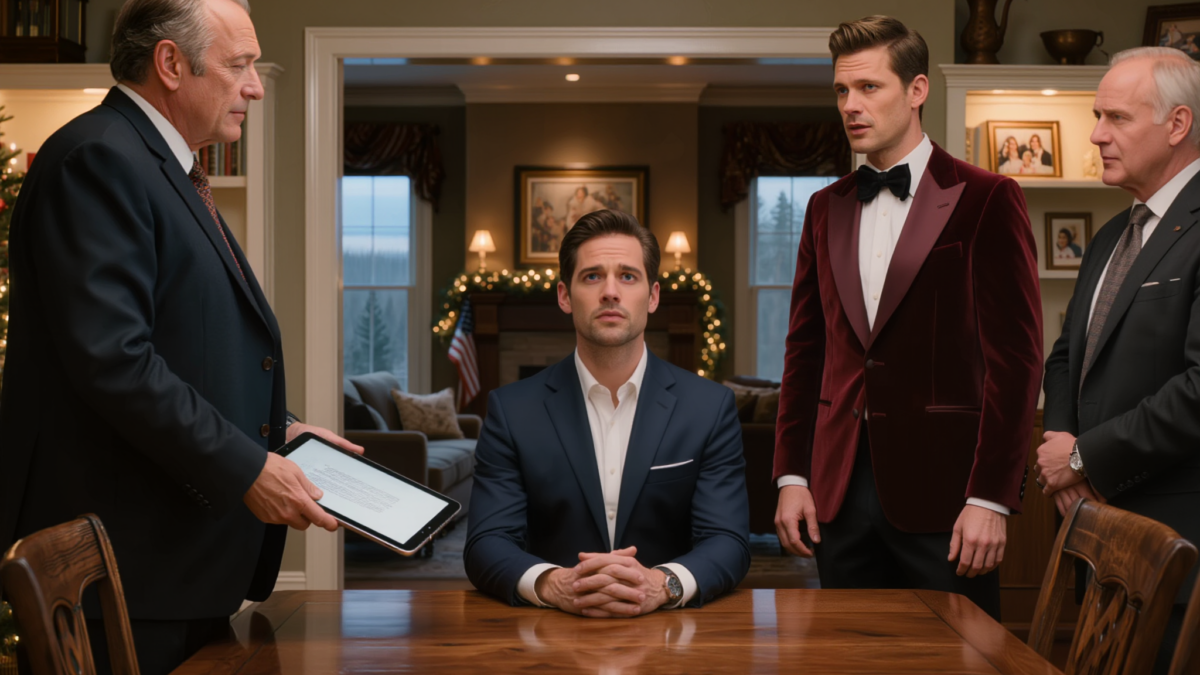
At Christmas dinner, my father called me a disgrace and praised my younger brother for carrying the company I’d kept afloat for years. I set down my fork and said nothing. Then our family lawyer opened her tablet and pulled up the courier receipt for CEO papers I’d supposedly refused to sign. My brother stopped smiling.
Chapter 1: The ultimate betrayal
I am Harrison Mercer, 34 years old.
Exactly nine weeks ago, my own family orchestrated the ultimate betrayal to strip me of my rightful promotion, steal my entire family inheritance, and destroy my professional reputation.
While I was out in the freezing cold, risking my life to save our family business from going up in dangerous flames, my father looked me dead in the eye at a packed family holiday dinner and told me I was a lazy, ungrateful parasite holding his company hostage.
He slammed his fist on the mahogany table and shouted that my little brother was exhausted from covering for my incompetence. He humiliated me in front of our entire extended family, treating me like the one at fault, as if I were trying to extort the very empire I had helped build.
But there was one massive, undeniable secret they didn’t know.
I had the legal documents, the digital footprint, and the family lawyer sitting right next to me, ready to expose the truth behind their entire fabricated reality.
And now the golden boy was bankrupt, facing a massive lawsuit, and my father was begging for my forgiveness while I held the keys to the kingdom.
Chapter 2: Dinner table confrontation
Now, let’s go back to the exact moment the nightmare truly began.
It was Christmas Eve, the kind of bitter, unforgiving Chicago night when snow comes down sideways and turns the roads into sheets of black ice. I was sitting at the far end of the dining table in my father’s sprawling 20-room estate in Lake Geneva, Wisconsin.
The tension in the room was so thick you could practically cut it with a steak knife. The dining room smelled of expensive roasted meats, pine needles, and the cloying scent of my stepmother’s designer perfume.
Aunt Rosalind, my father’s sister, sat across from me, whispering to my cousins and shooting me judgmental looks over the rim of her crystal wineglass. She had already made three passive-aggressive comments about my cheap suit compared with Julian’s custom Italian tailoring.
My stepmother, Beatrice, hovered over my father, pouring him another glass of vintage Bordeaux, her hand resting perfectly on his shoulder like that of a loving, devoted wife.
It was a picture-perfect scene of wealth and family, deeply fractured beneath the surface.
And then everything erupted.
My dad, Winston, who had been glaring at me all night, finally slammed his hand down on the table. The impact was so hard that the crystal goblets rattled and wine sloshed onto the pristine white tablecloth.
He pointed a shaking finger directly at me.
“You are an absolute disgrace to the Mercer name.”
He said Julian, my 28-year-old half-brother, was working himself into an early grave to keep our logistics company afloat while I sat around acting like a spoiled, entitled brat.
He said I was holding the entire corporate transition hostage because of my petty jealousy and that my refusal to sign the paperwork was a slap in the face to everything he had built.
I just stared at him.
The entire room went completely silent. You could hear the grandfather clock ticking in the hallway. The cousins stopped whispering. Aunt Rosalind froze with her glass halfway to her mouth.
I didn’t blink. I didn’t yell.
I slowly lowered my heavy silver fork onto my porcelain plate. It made a sharp metallic clink that echoed through the room.
I looked at my father and asked, very calmly, “Refuse what?”
Dad froze.
The veins in his neck stood out. His face flushed from anger and expensive wine.
“The CEO papers Julian gave you nine weeks ago. The promotion you threw back in his face because you wanted more money.”
I didn’t break eye contact with my father. I didn’t show an ounce of fear.
I simply shifted my gaze toward Julian.
He was suddenly gripping his linen napkin so tightly that his knuckles had turned white. His smug, arrogant expression disappeared, and the color drained from his face.
Chapter 3: The path to exploitation
But to truly understand how we reached that life-altering moment at the dinner table, you need to understand what my life had been like during the previous nine weeks.
You need to understand what happens when you give your youth, your energy, and nearly every waking hour to a family business, only to realize that the people who are supposed to value you see you as a disposable workhorse.
Let’s rewind the clock.
It was late October.
The wind coming off Lake Michigan at two in the morning cuts through a heavy winter jacket with a razor-cold edge. It doesn’t matter how many thermal layers you’re wearing. That damp Chicago cold settles into your bones and stays there.
I was standing on Dock 4 at the Port of Chicago.
My official job title was Vice President of Operations for Mercer Logistics. But at two in the morning on a freezing dock, fancy corporate titles don’t mean much.
I had a serious crisis on my hands.
Nearly $300,000 worth of imported, highly perishable seafood was sitting inside a shipping container, and the primary refrigeration generator was failing. The temperature gauge was moving fast in the wrong direction.
Hank, the local union representative, stood directly in front of me with his arms crossed, looking like a brick wall in a hard hat and high-visibility vest.
He flatly refused to authorize his crew to move the heavy container to a backup refrigeration unit.
Why?
A scheduling technicality.
His crew was on a mandatory union rest period until 3:00 a.m. If the seafood remained there another hour without reliable refrigeration, the shipment would be ruined.
We could lose a multimillion-dollar client, face a devastating commercial insurance claim, and take a serious hit to our reputation for reliability.
I needed authorization for emergency double-time pay to get Hank’s crew moving immediately.
The problem was my father.
Winston had semi-retired to Aspen to manage his blood pressure, play golf, and drive his pristine Rolls-Royce Phantom through the mountains.
He had left Julian back in Chicago as acting CEO.
Because of our corporate structure, I didn’t have the financial clearance necessary to override the union contract on my own.
I had to call my little brother.
I pulled out my phone with numb fingers. My breath plumed in the freezing air as I dialed Julian’s private number.
It rang.
And rang.
And rang.
On the fifth consecutive attempt, he finally answered.
I didn’t hear howling wind or idling diesel trucks on his end.
I heard the pounding bass of a high-end nightclub, expensive glasses clinking, and people laughing in the background.
“What?” Julian shouted into the phone.
He sounded annoyed, his words slightly slurred, as if I had committed some enormous offense by interrupting another round of VIP bottle service.
I raised my voice over the music and explained the failing generator, the union dispute, and the rapidly deteriorating situation with the cargo.
“I need your verbal authorization for emergency double-time. That’s it. Say yes so I can record the approval for payroll.”
Julian groaned.
“Harrison, seriously, I’m at the grand opening of the new club on State Street. You’re completely ruining my vibe right now. Can’t you just handle this? You’re operations. Operate something.”
He didn’t care about the logistics.
He didn’t care about the client.
He certainly didn’t care about the $300,000 sitting on the dock.
He just wanted me off the phone so he could return to his party.
I practically had to shout at him to give me the one-word approval I needed.
Finally, he grunted a reluctant yes and hung up.
I turned back to Hank, confirmed the authorized double-time pay, and spent the next three grueling hours physically helping the union crew transfer frozen pallets into the backup reefer unit to save time.
By the time I climbed back into my freezing SUV, the sun was beginning to rise behind the gray Chicago skyline.
My hands were blistered and raw. My clothes smelled like diesel fumes and spoiled seafood. I hadn’t slept.
And I had to be back at corporate headquarters in exactly three hours for a board meeting.
That was my daily reality.
That was my life.
I was the guy down in the trenches, sweating, freezing, and working myself raw to keep the family empire alive.
Meanwhile, Julian drove around Chicago in a company-leased Lamborghini Urus, collected an enormous executive salary, took long lunches, and enjoyed all the glory.
I foolishly believed my relentless hard work and loyalty would eventually speak for themselves.
I believed my father would eventually see past Julian’s charm and recognize who was actually keeping his legacy intact.
I was devastatingly wrong.
The very next afternoon, I was driving back to my cramped downtown apartment after another mind-numbing 14-hour shift.
The sky had that heavy purple-gray color you see during Chicago winters.
The Bluetooth system in my car beeped, and my father’s name appeared on the dashboard.
A random call from Winston Mercer was rarely a loving check-in.
It was usually a demand for a status report or criticism of my performance metrics.
I answered while rubbing my exhausted eyes.
“Hey, Dad.”
His voice boomed through the speakers, energetic and unusually proud.
“Harrison, I just got off the phone with your brother. Fantastic news about the Yamamoto seafood shipment last night. Truly fantastic work.”
I blinked, confused.
“Oh. Did Julian actually tell you about the generator failure at the dock at two in the morning?”
“He told me he made a rapid strategic decision to expedite the union arrangement and authorize emergency funds to save the cargo.”
The pride in my father’s voice made my stomach twist.
“That’s exactly what I’m talking about, Harrison. Decisiveness. Executive leadership. Julian said you were panicking on the dock, worried about the budget and overtime. But he stepped in, took control, and made the difficult executive call to save the client.”
I gripped the steering wheel.
Panicking?
I was the one standing on an ice-covered dock at two in the morning negotiating with Hank while Julian was drinking expensive tequila in a velvet-rope VIP booth.
I took a breath and kept my voice steady.
“Dad, that’s not exactly what happened. I was at the port handling the crisis. Julian was at a nightclub. I had to call him five times just to get the legal clearance.”
“Stop right there.”
The warmth disappeared from my father’s voice instantly.
“Why do you always have to do this, Harrison? Why can’t you just be a supportive older brother? Why can’t you be happy for your brother’s success? He steps up, handles a major corporate crisis, and the first thing you do is try to drag his name through the mud to make yourself look better. It’s pathetic. It’s unbecoming of a Mercer.”
A hot flash of anger went through me.
“I’m not dragging his name through the mud, Dad. I’m telling you exactly what happened.”
“The truth is that Julian is the acting CEO, and he got the job done while you hesitated.”
My father’s voice echoed through the car.
“Listen carefully. Big changes are coming to the company structure soon, Harrison. I need unity in the executive team. If you’re going to let sibling jealousy interfere with the business, maybe you need a mandatory leave of absence. You sound overwhelmed.”
Before I could respond, a second voice joined the call.
Beatrice.
My stepmother must have been sitting beside him in their Aspen chalet, listening on speakerphone the entire time.
Beatrice had always been an expert at appearing gentle while guiding a conversation exactly where she wanted it to go.
She entered my life shortly after my mother’s funeral, when I was still a kid, and quickly became the woman my grieving father trusted most.
“Winston, honey, please don’t be so harsh on him,” she said in a voice dripping with concern. “Harrison has been working such long hours lately. You know he gets confused and defensive when he’s exhausted. We just need to give him some grace. He doesn’t mean to attack Julian like this. It’s the stress and lack of sleep talking. Poor thing is burning himself out.”
That was her signature move.
She made me sound unstable while pretending to defend me.
With a few soft sentences, she turned my work ethic into evidence that I couldn’t trust my own judgment.
My father sighed.
“You’re right, Beatrice.”
Then his attention returned to me.
“Listen, Harrison. You’re a good worker. We need reliable workers. But Julian has vision. He has charisma. He knows how to lead. Try to learn from his leadership style. Stop fighting him. We’ll talk later.”
The call ended.
The silence in my car felt enormous.
Julian has vision.
The words echoed in my head like a cruel joke.
I had two advanced business degrees.
I had sacrificed my twenties to build our digital supply-chain tracking system from scratch, saving Mercer Logistics millions.
I knew the names, schedules, and family circumstances of managers across all four of our warehouses.
I had even missed my best friend’s wedding rehearsal because of a logistics emergency.
Julian couldn’t log into the main corporate server without calling IT.
Yet, in my father’s eyes, Julian was the heir apparent.
I was hired help who happened to share the family name.
What I didn’t know as I sat in my car that afternoon was that a physical piece of paper capable of changing the course of my life had just been delivered to our headquarters.
Chapter 4: The stolen future
I pieced this part together much later.
That same morning, while my father was belittling me over the phone, Penny, our loyal front-desk receptionist, received a rigid sealed envelope from a bonded courier.
It came from Clara, our longtime family attorney.
The heavy parchment envelope carried a clear confidential marking:
Urgent. Strictly confidential. For Harrison Mercer only.
Penny was reaching for the phone to call my extension when Julian walked into the lobby.
He was wearing designer sunglasses indoors and jingling the keys to his company-funded Lamborghini.
He saw the envelope on Penny’s desk and immediately picked it up.
Penny stood.
“Mr. Mercer, the courier instructions say this is for Harrison only.”
Julian smiled.
“I’m acting CEO, Penny. I handle executive-level legal correspondence for this family. I’ll take it up to my brother.”
He lowered his voice and gave her the same patronizing smile he used on employees he considered beneath him.
“Don’t worry about it.”
He didn’t bring it to me.
He took the private elevator to the executive corner office he had claimed as his own, locked the door, and opened the confidential envelope.
Inside was a fully drafted legal contract ready for my signature.
There was also a handwritten letter from my father.
Winston wrote that his time away in Aspen had given him room to think.
Stepping away from daily operations had finally forced him to recognize who had actually been holding Mercer Logistics together.
Me.
The enclosed papers would officially appoint me Chief Executive Officer, effective upon signing.
The package included a massive salary increase, full executive control, and a significant transfer of voting shares.
The letter also stated that Julian would transition into a non-executive board role.
In one envelope, Julian was staring at the end of his free ride.
No more limitless corporate cards funding his nightlife.
No more pretending to be a self-made business mogul for thousands of social-media followers.
No more acting CEO title.
No more unquestioned power.
He panicked.
And unfortunately for me, he wasn’t alone.
Beatrice had stopped by the office that morning for a lavish lunch with her son.
She was sitting on the leather sofa when Julian read the letter aloud.
When he asked her what he should do, she didn’t tell him to bring the papers to me.
She walked over, calmly took the documents from his trembling hands, and told him to hide them.
According to what I later learned, she said I was far too exhausted and overwhelmed to handle that kind of promotion.
Then she promised Julian she would handle Winston.
She would spend the next several weeks in Aspen slowly reshaping my father’s view of me.
She would convince him I was ungrateful.
Greedy.
Hostile.
Difficult.
By the time she finished, Winston would be so disappointed in me that he would rescind the promotion himself, never realizing I had never seen it.
Following his mother’s instructions, Julian walked to the wall safe hidden behind a large abstract painting.
He placed my contract, my promotion, and a piece of my future inside.
Then he spun the dial and locked the safe.
That was the moment they crossed from dysfunctional family behavior into something with serious legal consequences.
That was the breaking point.
My own brother had decided to steal my future before I even knew it had been offered.
Chapter 5: The systematic smear campaign
The fallout began subtly.
About a week after the envelope disappeared into the safe, I logged into my office computer to approve quarterly performance bonuses for our warehouse staff.
Many of those employees relied on the money for mortgages, college expenses, and holiday bills.
I clicked the executive payroll folder.
A red message appeared on my screen.
Access denied. Please contact system administrator.
I frowned and called IT.
The senior technician sounded nervous.
He told me a new high-level security directive had come directly from the acting CEO’s office.
My financial clearance had been revoked.
So had my payroll access and my ability to view company expenditures.
I was locked out of the company’s money.
I marched upstairs to the corner office and opened Julian’s door without knocking.
He was sitting behind the mahogany desk with his Italian leather shoes propped on it, lazily scrolling through TikTok.
“Why was my financial access removed?”
Julian barely looked up.
“Dad and I had a long talk about you, Harrison.”
He lowered his phone.
“We think you’re buckling under the pressure. You’re sending frantic emails at three in the morning. You look physically exhausted. We’re taking some of the heavy lifting off your plate.”
I stared at him.
“So you locked me out of payroll?”
“Focus on operations. Move the boxes. Don’t worry about the big-picture money stuff anymore. It’s too much for you.”
I stepped closer.
“I send emails at three in the morning because that’s when international freight arrives, Julian. Not because I’m falling apart.”
Talking to him was pointless.
Beatrice had given him a script, and he was sticking to it.
I spent the afternoon trying to call Dad.
Voicemail.
The next day?
Voicemail.
The day after that?
Voicemail again.
My own father was ghosting me.
Then came Thanksgiving.
The Mercer family traditionally gathered at the Lake Geneva estate for a huge catered dinner. We ate turkey, argued about politics, watched football, and pretended we were a happy American family.
Two days before the holiday, my phone buzzed with a group text from Beatrice.
“Hi, family. Winston and I have decided to stay in Aspen for a quiet Thanksgiving this year. Julian is flying out tomorrow to join us. Harrison, honey, we know you’re dealing with a lot of personal stress and fatigue right now. We thought it would be best for you to stay in Chicago, rest, and catch up on sleep instead of dealing with the stress of travel. Have a peaceful, healing weekend alone. Love you.”
I stared at the screen.
I had been politely uninvited from my own family’s Thanksgiving.
They didn’t even bother hiding the exclusion.
They simply disguised it as concern.
I spent Thanksgiving in the fluorescent-lit break room at corporate headquarters.
Most restaurants nearby were closed, and I couldn’t bring myself to sit alone in an empty diner.
So I bought a bag of stale pretzels and a diet soda from the vending machine.
That was my Thanksgiving dinner.
I sat at my desk in the enormous, nearly empty building monitoring holiday freight schedules so clients wouldn’t experience delays.
I was keeping the company running while the acting CEO vacationed in Aspen.
Then I made the mistake of opening Instagram.
The first post on my feed was Julian.
He and Dad stood on a balcony at an Aspen ski lodge, wearing expensive cashmere sweaters and holding mugs of hot cocoa.
Dad’s Rolls-Royce was parked in the snowy driveway behind them.
They looked completely relaxed.
Julian’s caption read:
“So incredibly thankful to be spending the holiday with my amazing father discussing the future of our family empire. Big things coming in the new year.”
Then came the word that stopped me.
Successor.
I stared at it until anger surged through me.
Still, I believed I had allies inside the company.
People who had worked beside me for years.
People whose jobs I had helped protect.
People who knew what I actually did.
That illusion disappeared the following Monday.
I went down to accounting to hand-deliver some truck-maintenance receipts because my digital financial access was still blocked.
The chief accountant was Gregory.
Gregory and I had gone to college together.
He was one of my oldest friends.
When he went through a brutal divorce two years earlier, I let him sleep on my couch.
I had personally convinced Dad to hire him at Mercer Logistics when he desperately needed stable income for his family.
I trusted him.
When I walked to his desk, Gregory didn’t look up.
He didn’t ask about Thanksgiving.
He took the receipts and dropped them into a tray.
“Rough weekend?” I asked.
He finally looked at me.
His expression was cold.
“You know, Harrison, the whole office is talking about you. And honestly, it’s pathetic.”
I stepped back.
“Talking about what?”
“Your little extortion scheme.”
My stomach tightened.
“What are you talking about, Greg?”
“Julian told the executive team everything during the morning briefing. He said Winston offered you a massive promotion weeks ago to reward your work, and you threw the contract in his face.”
I stared at him.
Gregory continued.
“He said you’re refusing to sign unless Winston guarantees you forty percent of the company and gets rid of Julian. You’re holding the corporate transition up before the holidays because you want more.”
My jaw nearly dropped.
“Gregory, that’s an outrageous lie. I haven’t seen any contract. I haven’t asked for a single share of equity. I haven’t even spoken to Dad in three weeks because he won’t answer my calls.”
Gregory shook his head and gave me a condescending smile.
“Save it, Harrison. Julian showed me the new organizational chart. And by the way, he promoted me to VP of Finance.”
There it was.
The price of his loyalty.
“He recognizes people who support the company,” Gregory said. “You’re putting everyone’s stability at risk just to feed your ego. People have mortgages. Kids. College bills. We don’t have time for your temper tantrum.”
I stared at the man I had considered a brother for more than a decade.
He had sold me out for a new title and a salary increase.
Julian hadn’t merely stolen my promotion.
He had launched a systematic campaign to destroy my reputation.
To Dad, I was jealous and unreliable.
To employees, I was a greedy executive holding their livelihoods hostage.
Julian and Beatrice had built a cage of lies around me.
I walked out of accounting without another word.
My heart was pounding.
I went straight to the men’s restroom, locked myself inside a stall, and gripped the cold metal safety railing.
For several minutes, I felt completely overwhelmed by what was happening.
Then the sadness began to disappear.
In its place came clarity.
Chapter 6: Warehouse disaster
Two weeks later, the disaster arrived.
Julian had been cutting critical maintenance and safety spending while approving luxury corporate expenses and expensive vehicle leases.
Eventually, something important failed.
It was a Tuesday afternoon.
I was sitting at my desk when the emergency alarm flashed across the corporate network.
A heavy-duty forklift battery charger in Warehouse B had short-circuited.
The sparks ignited nearby cardboard packing materials.
Within minutes, the west wing of the warehouse was burning.
I didn’t wait for Julian to assemble a committee.
I grabbed my keys and drove toward the industrial district.
When I arrived, the scene was chaos.
Thick black smoke rose into the freezing winter sky. Emergency vehicles surrounded the warehouse. Employees stood outside behind the safety perimeter.
Oscar, the veteran warehouse manager, was in the parking lot coughing, his face covered in soot.
I ran toward him.
“Oscar, is everyone out?”
“I think so,” he said, pointing toward the loading docks. “But Section 4 is the problem. If the fire reaches the industrial solvents behind that firewall, we’re going to have a major environmental incident.”
I knew exactly what he meant.
We were temporarily storing a large quantity of volatile chemical compounds for a manufacturing client.
If those materials were compromised, the company could face environmental shutdowns, lawsuits, and a long-term evacuation of the surrounding area.
I ran toward the mobile command vehicle and found Victor, the fire chief.
I had worked with him during safety drills, and he knew I understood the warehouse layout better than almost anyone.
“Victor, forget the west wing,” I said over the noise. “Protect the north wall of Section 4. That’s where the solvents are stored. If that firewall fails, the situation gets much worse.”
Victor immediately redirected resources toward the wall.
I spent the next six hours standing in freezing runoff and debris, coordinating with the fire department, local emergency officials, and environmental regulators.
I helped establish a medical area for workers affected by smoke.
I called dispatchers and rerouted twenty incoming freight trucks to alternate facilities so our entire supply chain wouldn’t collapse.
At one point, Victor handed me the preliminary fire-marshal report.
The suspected cause was a badly degraded electrical panel.
The same electrical panel that had failed an inspection three months earlier.
I froze.
I remembered that inspection.
I had personally submitted an emergency funding request to Julian’s office to replace the panel.
The request had been denied.
I pulled out my phone and accessed a secure inventory portal I had built years earlier, a deep-level system Julian didn’t even know existed.
I cross-referenced the denied maintenance request with recent executive expenditures.
Then I found something that changed everything.
The money hadn’t simply disappeared because the company was trying to save costs.
Funds equal to the repair budget, along with hundreds of thousands more, had been redirected through a corporate shell account.
I began tracing routing numbers.
The account appeared to be funding Julian’s private gambling debts and luxury real-estate rentals.
He had cut essential maintenance while company money was financing his lifestyle.
Nearly two hundred employees had been working in that facility.
By the time the fire was finally under control, my lungs burned from smoke and my clothes were ruined.
I drove back to headquarters smelling like burnt plastic and diesel.
When I walked through the lobby, I stopped.
The large television on the wall was tuned to a local news station.
Julian was on the screen.
He wore a pristine Italian suit and stood behind a company-branded press backdrop, speaking to reporters.
“We’re incredibly relieved to report zero casualties today,” he said smoothly. “Thanks to the rapid implementation of our emergency protocols and the leadership of our crisis-management team, a much larger disaster was avoided. The safety of our employees is always our highest priority.”
I stood in the lobby covered in soot, watching my brother take public credit for managing a crisis tied directly to maintenance spending he had denied.
Then I heard the click of heels behind me.
I turned.
Clara, our family attorney, was walking toward me carrying a leather briefcase.
She took one look at my soot-stained clothes.
“You look terrible, Harrison.”
“Long day.”
She lowered her voice.
“But I need to ask you something. Why are you dragging your feet on the paperwork? Winston is losing patience. If you don’t want to be CEO, just say so. Holding the company in legal limbo during a crisis isn’t helping anyone.”
I stared at her.
The final piece slid into place.
Clara wasn’t part of Julian’s scheme.
She genuinely believed I had received the contract.
She believed I was refusing to sign it.
I didn’t raise my voice.
A strange calm settled over me.
For the first time in weeks, I stopped feeling like the person being cornered.
I became the one in control.
I looked Clara directly in the eye.
“Clara, I need you to do exactly what I say. And I need you to tell absolutely no one.”
The uncertainty was over.
I finally knew where to look.
Chapter 7: Christmas Eve reckoning
The drive to Lake Geneva on Christmas Eve was brutal.
A massive winter storm was moving across the Midwest, turning the interstate into a sheet of black ice.
Wind pushed against my SUV while wet snow hammered the windshield.
Normally, I would have been worried about arriving late.
Worried Dad would lecture me about punctuality.
Worried I would say something wrong.
Not that night.
The anxiety that had controlled much of my adult life was gone.
In its place was focus.
As I drove through the whiteout, I thought about the previous seven years.
The missed birthdays.
Canceled vacations.
Relationships that fell apart because Mercer Logistics always came first.
I remembered missing my best friend’s wedding rehearsal because Julian forgot to file international customs paperwork for a major client in China.
I spent that night fixing his mistake so we wouldn’t lose a million-dollar account.
I had given everything to this company since my mother’s death when I was a teenager.
I treated the business like something I was responsible for protecting.
And in return, Dad believed I was lazy and greedy.
Beatrice painted me as unreliable.
Julian tried to steal my promotion and divert company money from essential maintenance.
The Mercer estate was only five miles away.
I wasn’t going there to beg.
I wasn’t going there to apologize or seek anyone’s conditional approval.
I was going there with facts.
The wrought-iron gates opened as my SUV approached.
The private driveway stretched more than a mile through snow-covered oak trees.
At the end of it, the enormous stone mansion glowed warmly against the storm.
Every window was illuminated.
From outside, it looked like the perfect American Christmas card.
I knew better.
I parked my salt-stained SUV between Julian’s immaculate Lamborghini Urus and Dad’s vintage Rolls-Royce.
The contrast almost made me laugh.
I turned off the engine and stepped into the cold.
I wore a tailored navy suit I had purchased specifically for that night.
Snow crunched beneath my dress shoes as I walked up the stone steps.
The door opened before I knocked.
Mrs. Higgins, the housekeeper who had known me since childhood, stared at the snow covering my shoulders.
“Harrison. Come inside.”
Warm air rushed over me, carrying the smell of prime rib, pine, wood smoke, and Beatrice’s perfume.
“They’re all in the library having cocktails,” Mrs. Higgins whispered. “Your father is in a terrible mood. He’s been drinking scotch since four. Please be careful.”
I gave her a tired smile.
“I’m done being careful, Mrs. Higgins. Tonight is about the truth.”
I walked down the portrait-lined hallway toward the library.
The double mahogany doors stood open.
Inside, about fifteen members of the extended family were gathered around the fireplace.
Aunt Rosalind was there.
Several cousins.
Even Gregory had somehow managed to secure an invitation.
And in the center of the room stood Winston, Beatrice, and Julian.
Julian looked relaxed.
He wore a maroon velvet dinner jacket and held a crystal tumbler of scotch while entertaining younger cousins with another self-aggrandizing story.
Dad sat in a high-backed leather chair, looking older but still commanding.
Beatrice stood behind him with her manicured hands resting on his shoulders.
The conversation stopped the moment I entered.
Fifteen pairs of eyes turned toward me.
“Harrison,” Dad said.
He didn’t smile or stand.
“You’re late. Dinner is almost served.”
“The roads are iced over, Dad. There’s a blizzard outside.”
“Julian made it here two hours ago without any issues,” Aunt Rosalind said from the corner, sipping her martini. “Priorities, dear. It all comes down to priorities and respect for the family.”
I looked at Julian.
He gave me a sympathetic smile so artificial it made my jaw tighten.
“I’m just glad you made it safely, Harrison,” he said. “We were worried you might boycott tonight, considering your recent moods. Grab a drink. Try to relax. You look tense.”
I didn’t take a drink.
I stood near the floor-to-ceiling bookshelves and watched the room.
Beatrice whispered into Dad’s ear.
Gregory avoided my eyes.
I felt like an outsider in my own family.
Twenty minutes later, Beatrice corralled everyone into the formal dining room.
The long table was set for sixteen people with crystal goblets, antique silverware, white linen, winter holly, and roses.
Dad sat at the head.
Julian sat immediately to his right, the traditional seat of the favored heir.
Beatrice sat on his left.
I had been deliberately placed at the far end near the kitchen doors.
The first course was lobster bisque.
For ten minutes, the only sound was silver spoons against porcelain.
Then Aunt Rosalind spoke.
“So, Harrison. I hear things have been complicated at the corporate office.”
I kept my eyes on the soup.
“Logistics is demanding work.”
“I just think it’s noble of Julian to step up the way he has. Most young men his age with his wealth would want to travel and enjoy themselves. But Julian is right there in the trenches every day.”
I almost laughed.
“Winston was just telling me how masterfully Julian handled that terrible warehouse fire last week,” she continued. “That takes leadership.”
I tightened my grip on the spoon.
Julian adjusted his tie.
“It was a team effort,” he said with rehearsed modesty. “I provided strategic direction. Harrison handled the groundwork. He’s very good at following instructions when he’s focused.”
“When he actually wants to be,” Dad added.
I looked up.
Dad was staring at me across the table.
“Excuse me?”
“I said you’re good at following instructions when you want to be. But lately, you seem to think you’re above the rules.”
Clara, seated farther down the table, shifted uncomfortably.
“Winston, let’s not do this now. We can discuss company matters in January.”
“No.”
Dad shook his head.
“I’m tired of the silence, Clara. I’m tired of walking on eggshells around my own son because he thinks he’s too good for the opportunity I offered him.”
The room became silent.
“I don’t think I’m too good for anything, Dad,” I said. “I’ve never refused an assignment in seven years. I’ve never refused a weekend shift, a late-night crisis call, or a holiday deployment.”
“Oh, please,” Julian laughed.
His laugh sounded brittle.
“Harrison, don’t do this here. Don’t play the victim. Just eat your soup.”
I turned toward him.
“Do what, Julian?”
“Act like a martyr. You walk around the office sulking. You ignore Dad’s emails. You deliberately hold up the corporate transition because you want attention and a bigger financial payout. I’m exhausted covering for your incompetence.”
“Covering for me?”
I stood slowly.
The wooden chair scraped across the hardwood.
“I worked ninety hours last week, Julian. I spent hours at a warehouse emergency while you gave a press conference in a custom suit. I saved the Yamamoto account at two in the morning while you were at a nightclub. When, exactly, have you covered for me?”
“Sit down, Harrison,” Dad shouted, striking the table with his palm.
He stood.
“How dare you come into my house and lie about your brother after everything he’s done to protect your job? He pleaded with me to give you another chance. He told me to be patient with your burnout.”
“Patient with what?”
My voice rose for the first time.
“What exactly are you waiting for me to do, Dad?”
Dad picked up his wineglass.
He looked around the table, then back at me.
“I built this logistics empire from scratch. I wanted to leave it in capable, loyal hands. I thought I had two sons who respected my legacy, but clearly I have only one.”
He raised his glass toward Julian.
“To Julian. The only one in this room who truly understands duty.”
He drank, then set the glass down hard enough that wine spilled across the white cloth in a spreading dark-red stain.
“Julian is exhausted running this company while you refuse to sign the paperwork,” he said. “You’ve held the entire business up for nine weeks. You refuse to finalize the documents because you think you deserve more money and forty percent of my company.”
I stared at him.
This was the moment.
The trap was complete.
Chapter 8: Exposing the truth
“I never asked for forty percent of this company,” I said quietly.
“Don’t lie to my face,” Dad snapped. “Julian told me everything. He said you threw the contract in the trash. He said the salary increase insulted you. He said you wouldn’t sign the CEO papers unless I gave you controlling interest and removed him.”
I stood perfectly still.
“The what?”
“The CEO papers,” Dad said. “The executive promotion. The legal package Julian handed to you personally nine weeks ago.”
I looked at Dad.
Then, slowly, I looked at Julian.
He wasn’t looking at me.
He was staring at his soup bowl.
His face had gone pale.
Beatrice gripped the edge of the table and glanced toward Clara.
I turned back to Dad.
“I have never seen any CEO papers.”
Dad waved his hand.
“That’s nonsense. Julian delivered the envelope personally. He told me you laughed at the terms.”
“No,” I said. “He didn’t.”
“He did.”
Dad pointed at Julian.
“Tell him. Tell Harrison you handed him the legal package.”
Julian finally looked up.
The confident golden-boy expression had disappeared.
“Dad, he’s just saying that,” Julian stammered. “He’s trying to save face in front of everyone.”
“I didn’t get the papers,” I said over him. “I didn’t know you promoted me. I thought you were preparing to remove me.”
Dad’s expression changed.
“Why would you think that?”
“Because for the last two months, Julian and Beatrice have repeatedly told me you think I’m burning out. They told me you wanted me to step away from operations. They locked me out of payroll and financial systems. They told me you were disappointed in my performance and thought I couldn’t be trusted.”
Dad looked at Beatrice.
Then Julian.
“Julian? You told me Harrison was aggressively holding out for equity. You told me he threatened the Yamamoto account if I didn’t meet his demands.”
“He was.”
Julian stood so quickly that his chair tipped backward onto the hardwood.
“He’s lying, Dad. He’s jealous that you picked me to lead the company. He’s trying to ruin Christmas.”
“Enough.”
One word from Clara stopped the room.
She stood.
Her expression was no longer uncomfortable.
It was firm.
“This ends now, Winston.”
She reached into her leather handbag and removed her tablet.
“I drafted the CEO contract exactly as you requested. I sent the final document by bonded courier on the morning of October 24. We required a physical package because the corporate transition needed a wet signature. The envelope was marked for Harrison’s eyes only.”
She tapped the screen.
“Here is the digital delivery confirmation and chain-of-custody report. The package was signed for at the corporate front desk at exactly 10:45 a.m. on October 24.”
She enlarged the signature field and held the screen toward Dad.
“That is not Harrison’s signature.”
Dad leaned forward.
Clara looked directly at Julian.
“That is Julian’s.”
Dad stared at the signature.
He had seen that handwriting countless times.
Julian was trembling now.
He took a step backward until his shoulder touched the wall.
“I-I meant to give it to him,” he said. “I really did. But he was so busy with warehouse schedules. I thought he wasn’t ready for the pressure of being CEO. Dad, you said you were worried about his stress. Mom and I were trying to protect him.”
“You told me he refused the promotion,” Dad said quietly.
His voice sounded completely different now.
“You told me he wanted forty percent of my company. You told me he was trying to hold my legacy hostage.”
“He’s ungrateful!” Beatrice said, standing so quickly that her wine tipped.
Her polished composure finally slipped.
“Look at him. He comes into this house with that attitude and tries to destroy our family on Christmas Eve. Julian is your real legacy, Winston. Not him.”
I ignored her.
“Where are the legal papers, Julian?”
“I don’t know. I lost them.”
“Liar.”
I reached inside my suit jacket and removed a thick manila folder.
“You didn’t lose them. You locked them inside the wall safe in the executive corner office because you knew the moment I signed them, your access to unlimited company money and authority would disappear.”
“Dad, please,” Julian said, grabbing Winston’s arm. “Don’t listen to him. He’s twisting everything. I’m your son. I’m the one who’s been beside you while he was hiding in warehouses.”
Dad looked down at Julian’s hand.
Then he slowly pulled his arm away.
“You lied to me.”
It wasn’t a question.
“For nine weeks, you let me believe your own brother was betraying me. You let me humiliate him in front of the entire family.”
Then Dad turned toward Beatrice.
“And you helped him.”
“Winston, darling, please. You have to understand—”
“Sit down.”
Beatrice lowered herself into the chair, covering part of her face with a napkin.
Julian stood against the wall, breathing rapidly.
“But I’m not done,” I said.
I placed the manila folder on the table in front of Dad.
It landed with a heavy thud.
“What is this?” he asked.
“The real reason Julian didn’t want me controlling company finances.”
Dad stared at me.
“The warehouse fire wasn’t simply an unavoidable accident. It was connected to a degraded electrical panel that had failed an inspection three months ago.”
I pointed toward the folder.
“I submitted an emergency funding request to replace that panel. Julian rejected it.”
I paused.
“Open the folder.”
Dad did.
“Look at the routing numbers. Look at the ledger. Look at the rejected repair request.”
His hands shook as he turned the pages.
“Julian diverted money from the emergency maintenance budget into a shell account. Nearly $400,000 went toward private gambling debts and luxury real-estate rentals.”
The room was silent.
“He put the future of this company and nearly two hundred employees at risk so he could maintain a lifestyle he couldn’t afford.”
Dad flipped through bank statements, denied maintenance forms carrying Julian’s signature, routing numbers, and account records.
The paper trail was impossible to ignore.
Aunt Rosalind looked stunned.
Gregory looked toward the door.
Dad closed the folder slowly.
For the first time in my life, the proud, commanding patriarch looked old.
He looked at me.
“Harrison, is it true? You really never saw the promotion offer?”
“Never.”
I felt no satisfaction saying it.
“I would’ve signed it immediately. I gave you seven years of my life. I saved this company again and again, and you trusted the word of a spoiled son over years of measurable work.”
Dad flinched.
“I know.”
He looked down.
“God help me, I know that now.”
He took a breath and turned to Clara.
“Do you have a secure backup of the original CEO contract?”
“I do.”
“Print it.”
“Dad, no,” Julian said.
He dropped toward his knees near Dad’s chair.
“You can’t do this tonight. I’ll pay the money back. I’ll get a loan. Please. It’s Christmas.”
Dad stepped away from him.
Then he looked at me.
“Are you ready to lead this company, Harrison? For real this time?”
I looked at him.
The anger was still there.
But underneath it was something different.
Power.
“I’ve been leading it for seven years, Dad. I’m just waiting for the legal title and salary to match the actual work.”
Dad nodded.
“Good. Go to the study with Clara. Sign the papers.”
Chapter 9: The CEO appointment
We moved from the dining room into Dad’s private study in a somber procession.
Clara led with her tablet tucked against her chest.
I followed.
Dad walked behind me, his steps slower than I remembered.
Julian trailed farther back, wiping tears from his face, unable to stop himself from witnessing the end of his unearned reign.
Beatrice remained at the dining table, realizing that the life she and Julian had carefully protected was suddenly uncertain.
Dad’s study smelled of old paper, cigars, and aged leather.
It was the room where he taught me chess when I was ten.
It was also the room where he once told me I had to start at the bottom of Mercer Logistics, loading freight trucks on graveyard shifts, while Julian received a comfortable six-figure marketing job because Beatrice asked for it.
Clara connected her tablet to the wireless printer.
The machine whirred to life.
Page one.
Page two.
Page three.
The contract that had been hidden in a wall safe for nine weeks was finally in front of me again.
Dad walked to the antique globe bar and poured two glasses of 20-year-old scotch.
He didn’t pour one for Julian.
He handed a glass to me.
“I need you to understand something, Harrison.”
I took the glass but didn’t drink.
“When Julian told me you refused the offer, it hurt my pride,” Dad said. “It made me feel like my legacy wasn’t good enough for you. I was blind. I let my ego blind me to what was actually happening.”
“You did fail me, Dad.”
He closed his eyes.
“You didn’t even call me and ask. You trusted Julian’s story over seven years of my work.”
“I know.”
His voice was quiet.
“I have to live with that.”
Clara interrupted us.
“The legal papers are ready for signing.”
She laid the thick stack on the oak desk.
The Chief Executive Officer appointment clause sat at the top.
I walked over.
Dad’s gold-plated fountain pen rested beside the documents.
I picked it up.
“Wait.”
Julian stood in the doorway.
I paused with the pen above the signature line.
He looked smaller now.
The velvet jacket that once made him look sophisticated suddenly looked like expensive clothing wrapped around a man who had no idea what came next.
“Harrison,” he said. “If you sign that, what happens to me? What about my salary? My company car? My life?”
I stared at him.
“I don’t know, Julian. What would you have done to me if Clara hadn’t kept the delivery record?”
He didn’t answer.
“You would’ve let Dad remove me in January while telling everyone I was unfit for the job. I would’ve lost my income, my health insurance, my 401(k) match, and my professional reputation.”
I stepped closer to the desk.
“You would’ve let me walk out of the company I helped build with nothing so you could keep pretending to be CEO and using company money.”
Julian swallowed.
“I would’ve given you a severance package eventually. I wouldn’t have let you end up with nothing.”
“Remarkably generous.”
I turned back to the contract.
Then I signed my name.
Harrison Mercer.
The ink settled across the signature line.
I dated it December 24.
Clara reviewed the pages and applied her notary seal.
“It’s official. Effective immediately, Harrison Mercer is Chief Executive Officer of Mercer Logistics, with full operational and financial authority under the agreement. Winston Mercer retains the honorary role of Chairman Emeritus.”
She looked toward Julian.
“And Julian Mercer is removed from the executive board. His employment is terminated for cause pending a full forensic financial audit.”
“Removed?”
Julian stared at her.
“But I have a mortgage on the downtown condo. The Lamborghini lease. Country-club dues. Expenses. You can’t just cut me off.”
Clara packed her tablet into her briefcase.
“You should have thought about your overhead before engaging in serious financial misconduct. Intercepting confidential legal documents carries serious legal consequences. So does taking corporate funds.”
She looked directly at him.
“You should be grateful Harrison isn’t asking for immediate formal action tonight.”
The drive home was the quietest of my life.
The storm had finally stopped.
Chicago and the surrounding suburbs were covered in fresh white snow beneath the streetlights.
I didn’t turn on the radio.
I listened to the hum of the SUV and the steady rhythm of my breathing.
I was CEO.
The title I had sacrificed much of my adult life for was finally mine.
But I didn’t feel triumphant.
I felt exhausted.
Cleanly, deeply exhausted.
My phone buzzed in the cup holder.
A text from Dad.
I’m so sorry. I love you. Sleep well, CEO.
I read it while stopped at a red light.
I didn’t reply.
I wasn’t ready to forgive him.
I wasn’t even sure I ever would.
Apologies are easy after the truth becomes impossible to ignore.
Trust takes years of actions to build and very little time to destroy.
Dad had a great deal of rebuilding to do.
And I wasn’t going to make it easy for him.
When I got back to my small apartment, I walked to the full-length hallway mirror.
I looked at the man in the navy suit staring back at me.
Dark circles beneath his eyes.
Jaw tight from weeks of stress.
“You survived,” I whispered.
Then I took a long shower and crawled into bed.
For the first time in nine exhausting weeks, I slept without dreaming about freezing docks, burning warehouses, or Julian’s smug face.
Chapter 10: A new corporate era
January 2 was the first day back after the holiday break.
Mercer Logistics headquarters buzzed with rumors.
Everyone knew something enormous had happened at the Mercer family Christmas dinner.
Almost nobody knew exactly what.
I arrived at 8:00 a.m.
I didn’t park in my usual spot near the overflow lot where Julian had always insisted I leave my SUV.
I drove directly to the front row and parked in the premium space marked:
Chief Executive Officer.
I walked through the glass lobby doors.
Penny looked up from her computer and stared.
I wasn’t wearing my usual gray blazer and scuffed work boots.
I wore a new charcoal suit and an expensive watch and carried coffee from a café down the street.
“Good morning, Penny.”
“G-good morning, Harrison.”
I stopped at her desk.
“Actually, it’s Mr. Mercer now. Please call a mandatory all-hands meeting in the main atrium for nine o’clock. I have some announcements.”
“Yes, sir.”
She reached for the intercom.
I took the private elevator upstairs.
The corner-office door was locked.
I pulled out the master key Clara had legally issued to me that morning.
The office still smelled like Julian’s overpowering cologne.
His golf clubs leaned in the corner.
Purchased leadership awards covered the walls.
I walked behind the mahogany desk and sat in the leather executive chair.
It felt right.
At 8:45, hurried footsteps approached from the hallway.
Julian burst through the door, out of breath.
He wore dark sunglasses indoors and carried a large iced coffee.
He stopped when he saw me sitting behind the desk.
“Get out of my chair.”
He quickly shut the door.
I continued typing.
“Excuse me?”
“I said get out. Dad might be angry with me, but I’m still acting CEO until the transition period is officially over. You can’t just walk in here and steal my office.”
I closed the laptop.
“There is no transition period, Julian.”
He stared at me.
“The contract I signed on Christmas Eve was effective immediately. Clara sent your termination notice to HR at seven this morning. Didn’t you check your company email?”
His face went pale.
He pulled out his phone.
His hands shook while he swiped through messages.
Then he froze.
“This says I’m terminated.”
“Terminated for cause.”
I stood.
“Corporate misconduct. Breach of fiduciary duty. Embezzlement. Attempted fraud. Should I continue?”
“You fired me?”
Tears appeared behind his sunglasses.
“Harrison, I’m your brother. You can’t do this to family. How am I supposed to pay for my life?”
“Being my brother is the only reason you’re being allowed to leave quietly instead of facing immediate formal action.”
His mouth opened, but nothing came out.
“You have one hour to pack your personal belongings. Corporate security will supervise. The company laptop, company phone, and corporate credit card stay here.”
I pointed toward the desk.
“The leasing company already recovered the Lamborghini from your condo this morning.”
Julian stared.
“If you remove company property from this building, Clara will handle it legally.”
He waited for me to soften.
He was waiting for the older brother who always cleaned up his messes to reappear.
That version of me was gone.
It had disappeared somewhere between the warehouse smoke, the Thanksgiving pretzels, Gregory’s betrayal, and the courier receipt.
Julian turned and left the office.
A few minutes later, two security guards arrived to supervise him.
Before the nine o’clock meeting, I made one more stop.
Accounting.
Gregory looked up from his desk when I approached.
His face went pale.
I didn’t say anything.
I placed a termination folder on his keyboard and pointed toward the exit.
He understood.
His divorce and custody problems were about to become much harder without his salary.
That was no longer my responsibility.
Loyalty went both ways.
At nine o’clock, two hundred employees filled the glass atrium.
Some looked worried about layoffs.
Others simply looked confused.
I stepped to the microphone.
“Good morning. As of today, I am the Chief Executive Officer of Mercer Logistics. Julian Mercer and our VP of Finance, Gregory, have been terminated for cause.”
Whispers rippled through the crowd.
“There are going to be immediate changes. First, we’re restoring the safety and maintenance budget to full capacity. Second, we’re paying the overtime owed to the dock crew from the Yamamoto shipment, with interest.”
I looked around the atrium.
“And we’re going to stop pretending that PR appearances and expensive suits matter more than measurable results on the warehouse floor.”
The room became still.
I looked at employees I had worked beside for seven years.
“I know what you do. I know how hard you work to provide for your families, pay mortgages, save for college, and keep this company moving, because I’ve been there with you.”
I paused.
“I’m not going to lead Mercer Logistics from a luxury ski resort in Aspen. I’m going to lead it from here.”
Then I stepped away from the microphone.
“Let’s get to work.”
The applause started slowly.
One person.
Then another.
Oscar from the warehouse began clapping.
Within seconds, the atrium was filled with applause, cheering, and whistles.
It wasn’t polished corporate applause.
It was genuine.
Six months passed.
Mercer Logistics posted its most profitable quarter in more than a decade.
We updated our aging trucking fleet.
We renegotiated union agreements fairly and transparently.
I hired a new VP of Operations named Marcus, a smart, ambitious guy who reminded me of my younger self.
Every day, I made a point of looking him in the eye and telling him when he had done good work.
Because I knew what it felt like to spend years starving for simple recognition.
Dad remained in Aspen.
We spoke maybe once a week.
The calls were polite.
Brief.
Mostly professional.
Then, during a routine forensic audit, I found something that proved I had been right to keep my guard up.
Winston had quietly been using a discretionary emergency fund to send money to Julian and Beatrice.
Julian was nearly broke.
He was deeply in debt and struggling to maintain the lifestyle he had built around company credit cards and executive privileges.
I didn’t call Dad to yell.
I didn’t argue.
I simply used my authority as CEO to freeze the discretionary fund and return the balance to the company’s general operating budget.
Two hours later, my phone rang.
Dad.
“Harrison, why did you freeze the board account?”
“Because Mercer Logistics isn’t a private support fund for people who misused company money.”
“Harrison, please.”
His voice cracked.
“He’s your brother. He’s about to lose his condo. Beatrice is threatening to leave me because the money is drying up. Family helps family.”
I said nothing.
“Can’t you find some small consultant role for him? Just a title so he gets a paycheck? Nobody even has to know.”
I let the silence hang between us.
Then I spoke.
“Dad, listen carefully. If Julian Mercer steps inside this corporate building again, or if I see one company dollar go into his personal bank account, I will resign as CEO.”
Dad stopped breathing for a moment.
“And after that, I will sell my controlling shares to Silus at Apex Logistics, our biggest competitor. Then you can watch someone outside this family decide what happens to the legacy you spent your life building.”
The line was silent.
“Do you understand me?”
For several seconds, Dad said nothing.
Then, very quietly:
“I understand.”
He hung up.
He never asked me for another dollar for Julian.
Sometimes, late at night, I sit in the leather chair in my corner office and look out across the lights of Chicago.
I think about the exhausted man who spent Thanksgiving eating stale pretzels in an empty break room, convinced that he had somehow failed everyone.
I wish I could go back and tell him he was going to be okay.
The truth does eventually matter.
Hard work does matter.
But only when you’re willing to stop letting other people define what your work is worth.
I don’t feel like a ghost in my own life anymore.
I feel solid.
I feel powerful.
I feel real.
And the best part is that the warehouse hasn’t had a single major safety incident since I took over.








