My brother recorded the moment our parents disowned me. Mom slid a signed letter across the table at a five-star Chicago restaurant while Dad waited for me to beg. I quietly folded it, slipped it into my jacket, and opened my black leather portfolio. Edward kept filming—until he saw what I placed in front of Dad.
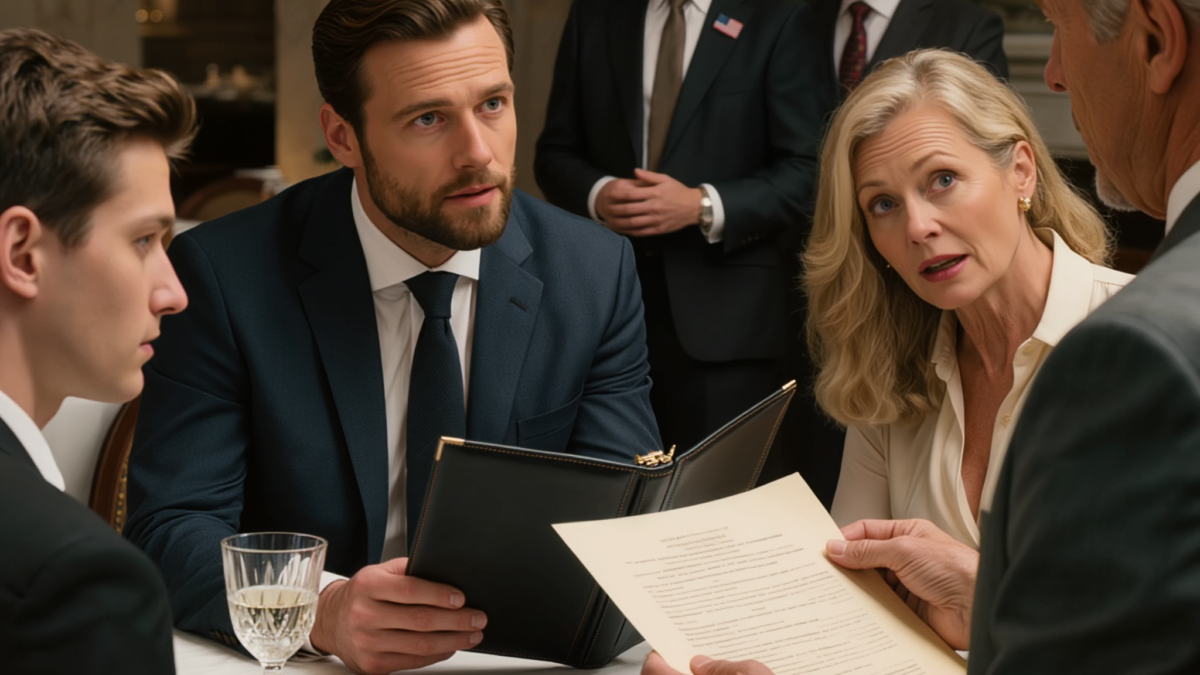
I am Arthur Sterling, 26 years old. Four years ago, my own parents handed me a formal disownment letter at a five-star restaurant, fully expecting me to break down, cry, and beg on my hands and knees for my inheritance. While I was sitting there trying to process the heartless betrayal by my own family, my mother leaned across the pristine white tablecloth and told me in a voice coated with rehearsed, fake concern that this was a clean break. My older brother Edward had his smartphone propped up against his crystal water glass.
The red recording light glowed ominously as he filmed my face. They wanted to capture my humiliation. They wanted to broadcast my destruction. They laughed at me in front of the entire elite dining room of Maison Lumiere, waiting for me to shatter into a million pieces.
But there was one thing they did not know.
Inside my tailored jacket pocket, resting right next to my pounding heart, was a newly signed legal contract for the acquisition of my tech company. It was worth over $7 million.
And now, years later, those exact same people were standing outside my corporate office building, begging for my help, drowning in debt, and facing a massive lawsuit.
Let me go back to the exact moment everything broke.
The air conditioning vent above our table blew directly onto my skin, raising goosebumps along my arms. But the chill I felt had nothing to do with the temperature of the room.
The French restaurant’s ambient noise, the clinking of silver forks, the soft jazz playing from hidden speakers, and the hushed conversations of Chicago’s elite faded to a distant, muffled hum as my pulse thudded in my ears.
The heavy cream-colored envelope cracked open between my fingers. The sound seemed sharp and final. I stared down at the thick legal paper. My father’s fountain pen signature stretched across the bottom of the page.
It was a harsh, authoritative stroke of black ink.
It was the exact same expensive limited-edition pen he had used to sign massive real estate contracts, authorize ruthless corporate takeovers, and sign my Harvard acceptance letter years ago.
The restaurant’s massive crystal chandelier caught the light of my mother’s diamond tennis bracelet as she leaned back in her plush chair, looking completely satisfied with her cruelty.
They had arranged this extravagant dinner under the guise of celebrating my college graduation, but it was nothing more than a meticulously planned public humiliation.
They wanted to cut me off, erase my name from the Sterling family legacy, and make sure I knew exactly how worthless they thought I was.
I watched my own hands. They were remarkably steady.
My fingers did not tremble as I carefully folded the heavy paper in half, then into precise quarters.
My father checked his limited-edition Patek Philippe watch with a heavy, dramatic sigh. It was the exact same dismissive, impatient gesture he used at every single parent-teacher conference he had ever bothered to attend during my childhood.
He looked at me with cold, calculating eyes, entirely devoid of paternal warmth, and asked if I had anything I wanted to say.
I did not scream. I did not flip the table. I did not give them the dramatic reaction they were so desperately waiting for.
I just looked at them.
The three people who were supposed to love me unconditionally, the people who were supposed to be my safety net, had turned my entire existence into a failed business transaction, and they had just unilaterally terminated my contract.
To truly understand how we ended up at that miserable, suffocating dinner table, you have to understand the deeply entrenched dynamics of the Sterling family.
We were not just wealthy. We were old money.
We were the kind of family that had massive hospital wings named after our ancestors. The kind of family that ruthlessly guarded our social standing at exclusive country clubs and high-stakes charity galas.
For three uninterrupted generations, the Sterling men were legendary investment bankers.
The path was set in stone before I was even born.
We went to elite, ridiculously expensive Ivy League prep schools, secured our degrees in finance or economics, and then took our designated leather-bound seats in the family boardroom to multiply the family fortune.
My older brother, Edward, was the quintessential golden child.
He played their twisted game perfectly. He wore the right tailored suits, dated the right women from equally prominent families, and repeated our father’s cutthroat corporate buzzwords like a well-trained parrot.
I was different.
I was supposed to follow the exact same tradition, get my undergraduate degree from Wharton, and march straight into the family firm.
But during my sophomore year of college, I found my true passion, and it had absolutely nothing to do with manipulating the stock market.
I developed an all-consuming obsession with algorithms, data structures, and efficiency metrics. I realized with absolute clarity that I did not want to spend the rest of my life trading stocks, breaking apart small companies for a quick profit, and living in the shadow of my father’s ruthless reputation.
I wanted to build things.
I wanted to solve actual, tangible, real-world problems.
So I made the single decision that ruined my standing in the family hierarchy forever.
I switched my major from finance to data science.
I remember the exact moment I told my father. It is burned into my memory.
I was standing in his massive, cavernous home office in our Chicago lakefront mansion. I was surrounded by dark mahogany wood paneling, expensive oil paintings, and leather-bound books that absolutely nobody ever read.
I tried to explain my vision to him calmly. I told him that numbers were numbers, and I was just using them differently to build something sustainable.
I genuinely thought he would respect the logic.
I naively thought he would see the massive potential and the future in what I was doing.
Instead, he stood up slowly, slammed both of his heavy hands onto his immaculate mahogany desk, and glared at me with a level of disgust I had never seen before.
He looked at me not as a son, but as a liability.
He told me, his voice dangerously low, that family tradition was not a math problem I could optimize.
He said I was throwing away my entire future, embarrassing the pristine Sterling name, and acting like an arrogant, ungrateful child who did not understand how the real world operated.
I tried to reason with him. I brought up the undeniable fact that technology was the future, that data science was fundamentally revolutionizing every major industry on the planet.
He did not care.
To Charles Sterling, anything outside of his narrow, profit-driven worldview was an immediate threat to his control.
That single explosive conversation fractured my family permanently.
The consequences were immediate, calculated, and brutal.
I walked out of that mahogany office thinking the worst of the fallout was over, thinking we just needed time to cool off.
I was so incredibly, tragically wrong.
The silent treatment began the very next morning, and it was carried out with astonishing precision. It was not a dramatic screaming confrontation, but rather a slow, methodical, and agonizing erasure of my entire existence from the family unit.
Their communication strategy shifted overnight.
Any questions about my classes, my well-being, or my life completely stopped.
Weekly family dinner invitations dwindled to absolutely nothing. Family photos for the annual, highly publicized holiday cards suddenly no longer required my presence.
I was effectively a ghost in my own family.
Then came the financial strike.
They did not even have the decency to call me.
I received a brief, legally sterile email from my father’s personal assistant informing me that my college fund was being permanently frozen. The generous monthly allowance I had received since high school was instantly revoked.
I was completely, utterly cut off.
I had to scramble, panicking in my dorm room, trying to figure out how to pay my skyrocketing tuition and keep a roof over my head.
My mother would occasionally send these passive-aggressive, deeply manipulative text messages saying they completely understood if I was too busy with my little computer projects to come home for Thanksgiving dinners.
It was calculated emotional pressure.
They wanted me to run out of options.
They wanted me to fail so miserably, so publicly, that I would come crawling back to their doorstep, begging for my old life, ready to wear the conservative suit and tie they had picked out for me.
They even used my absence at a distant relative’s funeral as proof to the rest of the extended family that I had lost my mind and abandoned my values.
My brother Edward gladly became their primary proxy.
He had just received a massive, highly publicized promotion at the family firm, and he absolutely loved to rub his exorbitant salary, his hefty corporate bonuses, and his pristine 401(k) matching benefits right in my face.
He would call me occasionally, his voice dripping with unbearable condescension.
He would report mundane family news, talk loudly about the new luxury sports cars he was test-driving, and constantly remind me of the massive expectations I was failing to meet.
He always made sure to casually mention that the junior analyst position was still open if I ever decided to stop playing around and get a real job like a grown man.
I told him, trying to keep my voice steady, that I was building something different.
Edward just laughed, a harsh, grating sound.
“Different is not always better, and sometimes different is just difficult.”
In his eyes, I was just a massive, pathetic disappointment.
I had to survive. I had no other choice.
I took a grueling job at a loud, chaotic, relentlessly busy coffee shop right near campus just to cover the rent for a tiny, run-down, freezing apartment I shared with two other struggling engineering students.
The constant deafening hiss of the espresso machine and the endless mindless chatter of rude customers became the new, exhausting soundtrack to my life.
It was a sharp, jarring, and incredibly humbling contrast to the cathedral-like silence of my family’s massive, pristine estate.
I worked brutal double shifts, dealing with entitled customers who complained over foam ratios, wiping down sticky tables, and literally counting out loose change just to buy cheap ramen noodles at Walmart.
My feet ached constantly. My back was always tight. I was exhausted right down to the marrow of my bones.
But I absolutely refused to quit.
I refused to give them the satisfaction of my failure.
Between my exhausting shifts, I sat at a wobbly, sticky corner table in the back of the shop, put my headphones on, and coded.
I poured every single ounce of my frustration, my simmering anger, and my desperate need for independence into my battered laptop.
I was building a complex system.
It started as a simple, standard class project, but as I poured my soul into it, it quickly evolved into something much larger and significantly more powerful.
I called it Root Logic.
It was an advanced, highly sophisticated algorithm designed to optimize coffee bean delivery schedules and supply chains for small businesses.
Coffee shop owners dealt with constant, massive headaches regarding small shipments, minimal storage space, and wildly unpredictable customer demand.
My software analyzed local events, complex weather patterns, and years of historical sales data to predict, down to the ounce, how much inventory was needed.
I finally convinced the incredibly skeptical owner of the coffee shop to let me run a live, real-world test on his inventory.
During the very first month alone, my automated solution reduced his product waste by a staggering 23%.
The owner was absolutely thrilled.
He actually hugged me in the cramped back kitchen, tears in his eyes because I had just saved his struggling business from going under.
For the first time in my entire life, I felt truly, deeply valued for something I created with my own two hands using my own intellect, completely separate from the Sterling family wealth.
My advanced analytics professor, Dr. Vance, noticed the project during my midterm reviews.
Initially, I thought he was going to be a mentor, someone who finally supported me.
He looked at my intricate data models, adjusted his glasses, and told me that supply chain optimization at this specific scale could completely transform small business logistics nationwide.
He said it had massive potential far beyond coffee beans.
I was ecstatic.
I thought I finally had a powerful ally in the academic world, but the corporate world is full of ruthless opportunists, and I quickly learned that academia is no different.
A week later, Dr. Vance called me into his quiet, secluded office.
He slid a thick stack of papers across his desk.
He handed me a fully drafted patent application for Root Logic.
I looked down at the legal paperwork and felt all the color drain rapidly from my face.
He had explicitly listed himself as the primary inventor and the 70% majority owner of the software.
He smiled, a sickening, condescending smile, and told me that without his university resources and his brilliant guidance, my little student project was essentially nothing.
He casually mentioned that if I dared to dispute his claim, he would make sure I failed his class, lost my remaining credits, and got permanently blacklisted from the university’s highly coveted tech incubator program.
He even threw around the word lawsuit, warning that he could tie me up in expensive legal battles for years until I was completely bankrupt.
I gripped the wooden arms of the chair until my knuckles turned white.
My own family had cruelly cast me out, left me to fend for myself, and now this arrogant man was trying to legally steal my only lifeline, my only chance at a future.
I stood up slowly, looked him directly in the eyes, and told him, my voice completely steady, that I would rather abandon the entire source code and start again than let him steal a single line of my work.
I walked right out of his office, immediately dropped his class, and took my project entirely independent.
I recruited two incredibly brilliant people from my dorm who believed in my vision.
Marcus, a genius UX designer who was just as hungry and broke as I was, and Chloe, a fierce, take-no-prisoners communications major who handled our client relations and aggressively protected us from toxic investors.
We officially formed our own family.
We worked entirely out of my cramped, freezing apartment, eating cheap food, wearing heavy coats indoors because we couldn’t afford the heating bill, and staying awake for 48 hours straight to refine the massive algorithm.
We bypassed the university system entirely and started pitching directly to local independent businesses.
We were gaining serious, undeniable traction.
By the time spring rolled around, we had real paying clients and hard data proving our system worked flawlessly under intense pressure.
We were actively preparing for our first major pitch to a high-tier venture capital firm.
We were finally going to get massive seed funding.
I truly thought the brutal struggle was finally paying off. I thought the worst of my nightmare was permanently behind me.
I was completely, horribly, and devastatingly wrong.
The week before our massive, life-changing pitch to the venture capital firm, absolute disaster struck.
I woke up on a gloomy Tuesday morning, made my incredibly cheap instant coffee, and opened my laptop to run a final routine diagnostic check on the Root Logic prototype.
The core directory folder was entirely empty.
I blinked hard, rubbing the exhaustion from my eyes, genuinely thinking it was just a simple cloud syncing error.
My heart started to beat a little faster.
I frantically dug through the secure cloud backups.
Empty.
I checked the local physical server drives we had set up in the closet.
They had been wiped completely clean.
Pure, unfiltered panic hit me. Three grueling years of relentless coding, thousands of sleepless nights, sacrificed relationships, and every single ounce of my sanity were just completely gone.
I frantically called Marcus, my hands shaking so badly I dropped my phone twice.
He rushed over in his pajamas, and we spent six agonizing, terrifying hours tracing the digital footprint of the wipe.
We finally found the breach in the system logs.
It was not a remote intrusion by a rival tech company.
Someone had manually connected to our main system, copied the master source code onto an external drive, and then deliberately erased our working files and backups.
And the access logs pointed directly, undeniably, to Greg.
Greg was my college roommate.
He was a guy I had shared countless meals with, a guy who knew exactly how much I was struggling just to keep the lights on and pay the rent.
I confronted him in the cramped kitchen.
I did not yell. I did not lose my temper.
I just slowly turned the laptop screen toward him and showed him the undeniable access logs.
He could not even look me in the eye.
He stared down at the scuffed linoleum floor, his face pale, and confessed to absolutely everything.
He told me, his voice trembling, that he was drowning in massive student loan debt and desperately needed cash to pay off some questionable creditors.
But the real agonizing betrayal came when he revealed exactly who had bought him out.
Greg admitted that a man in a tailored, ridiculously expensive Italian suit had approached him at a dive bar near campus.
The man knew my full name.
The man knew all about the Root Logic project.
The man offered Greg $50,000 in cash to hand over the drive and permanently erase my project files.
It was Edward.
My own brother.
Edward had used a tiny fraction of his enormous corporate salary to pay a desperate college student to destroy my life’s work.
I felt a cold, overwhelming anger wash over my entire body.
It was a betrayal so deep it actually made me physically nauseous.
I grabbed my phone, my fingers gripping the plastic case tightly, and dialed Edward’s personal number.
He answered on the second ring, sounding completely cheerful, almost giddy.
The background noise sounded like the gentle breeze and polite clapping of an incredibly expensive, exclusive golf course.
I asked him, my voice dangerously quiet, why he did it.
Edward just let out a dark, mocking, deeply arrogant laugh.
He told me he was actually doing me a massive favor.
He said it was high time for me to stop playing silly little computer games in a rundown apartment and come back to reality.
He casually mentioned that the family firm was expanding its tech division and they could always use a low-level IT guy to fix the jammed printers and fetch coffee.
He ended the call by saying, in a voice dripping with contempt, that the game was officially over and I had lost.
I dropped my phone onto the kitchen counter.
The silence in the apartment was deafening, suffocating.
My own family.
The people who shared my DNA had deliberately sabotaged my entire future just to prove a point and force my submission.
They wanted me destitute. They wanted me completely defeated. They wanted to strip away every ounce of my dignity until I begged them for a paycheck.
I looked over at Marcus and Chloe.
They were standing by the doorway looking absolutely defeated, their dreams shattered on the floor.
We had absolutely no product to show. We had no pitch for the investors.
We had roughly $5 in our collective bank accounts.
We were completely dead in the water.
Marcus, usually the optimist, quietly suggested we just give up and cut our losses.
Chloe started looking up entry-level, soul-crushing corporate jobs on her phone, tears silently streaming down her face.
I walked over to the kitchen sink, splashed freezing cold water on my face, and looked deeply into the cracked mirror.
I saw the dark, heavy circles under my eyes.
I saw the frayed, worn-out collar of my cheap thrift-store shirt, but I also saw a raging, unquenchable determination that Edward and my father, with all their millions, could never possibly understand or extinguish.
I turned back to my team.
I stood tall.
I told them we were absolutely not quitting.
I told them that Edward had stolen the old, outdated code, but the real algorithm was not on that physical hard drive.
It was locked safely inside my head.
And the old code was flawed anyway.
It was clunky. It had hidden security vulnerabilities.
I told them we were going to lock the apartment doors, turn off our phones, ignore the outside world, and rebuild the entire system from scratch.
We were going to build it faster, lighter, more intuitive, and far more secure than before.
For the next two solid months, we went into almost complete isolation.
We barely slept. We barely ate anything other than plain rice and beans.
I coded with a level of intensity, speed, and focus I did not even know I possessed.
We built a completely new, revolutionary architecture utilizing advanced machine learning models that the original stolen version completely lacked.
We made Root Logic practically untouchable.
If Edward tried to run the old code, it would quickly become obsolete compared to what we were building now.
And then a massive miracle happened.
Chloe, using her relentless networking skills, managed to secure a desperate last-minute, ten-minute meeting with Sarah, a legendary, notoriously tough angel investor known for exclusively backing highly disruptive tech startups.
We walked into her massive, intimidating glass office in downtown Chicago with absolutely nothing but a single laptop and a raw, functioning, lightning-fast prototype.
We did not have fancy, expensive slide decks or polished, empty corporate buzzwords.
I just opened the laptop and showed her the raw math.
I showed her the live, real-time data from our beta testers proving massive potential profit margins.
Sarah sat perfectly quietly for a long time, scrutinizing the complex numbers on the screen.
She looked deeply at me, saw the desperation, the exhaustion, and the unyielding determination in my eyes, and slowly closed the laptop.
She didn’t hesitate.
She offered us $2.4 million in seed funding right there on the spot.
When those funds officially hit our newly formed corporate bank account a week later, I did not celebrate with expensive champagne or a lavish dinner.
I walked out of the bank, stood on the loud, busy Chicago sidewalk, and pulled out my phone.
I opened my digital notepad where I kept my master target list of potential enterprise clients.
Right in the middle of the list, glaring at me, was the Sterling Financial Group.
I stared at the name of my family’s empire.
Then I highlighted the name, pressed delete, and permanently erased them from my future.
I was no longer seeking their approval.
I was no longer hoping they would finally see my value.
To me, they were no longer part of my life.
We moved into a real office space that very summer.
It was nothing fancy, just an open-concept loft with exposed brick walls and questionable heating in the winter, but it was ours.
The team rapidly expanded to twelve brilliant, dedicated people.
We were securing major contracts, rapidly expanding our reach across state lines, and fundamentally changing how major logistics companies operated.
I was finally truly building my own legacy, entirely free from the toxic Sterling name.
But the storm was not over.
In fact, the real, devastating trouble was just forming, and my family was entirely, blissfully unaware of how successful I had become in the business world.
The real turning point came when James Harrison officially reached out to my team.
Mr. Harrison was the fiercely respected CEO of Northstar Logistics, a massive multibillion-dollar enterprise that handled highly complex supply chains for Fortune 500 companies globally.
His company desperately needed exactly what we had built.
They were losing millions of dollars to operational inefficiencies and wasted resources every single quarter. Their legacy systems were failing.
They did not just want to become a high-paying client.
They wanted to own the technology outright.
They wanted to formally acquire us.
The initial opening offer came in at a staggering $5.8 million.
Chloe, Marcus, and I sat in our small, glass-walled conference room, staring in stunned silence at the number printed on the digital contract draft.
It was more money than any of us had ever seen in our entire lives.
It was life-changing, generational wealth, but I knew our true worth.
I knew exactly what my software could do for their bottom line over the next decade.
I pushed back hard.
I negotiated with the exact same ruthless, highly aggressive tactics I had watched my father use during his corporate takeovers when I was a child.
The massive difference was that I was defending something I actually created with my own brilliance, not tearing apart someone else’s livelihood.
After two agonizing, highly stressful weeks of intense legal discussions and aggressive financial negotiation, we finally settled on a final figure.
$7.2 million.
The deal also included guaranteed positions for my entire twelve-person team, comprehensive top-tier medical benefits, and a highly lucrative director of implementation strategy role specifically for me.
The final contracts were signed on a quiet, unremarkable Tuesday afternoon.
There was no grand parade down the street.
There were no flashing cameras or press tours, just the quiet, satisfying scratch of a pen on paper and the heavy, profound realization settling deep into my bones.
I was exactly 26 years old, completely self-made and a multimillionaire.
My uncle Henry, the family’s resident schemer, tried to snoop around that exact same week.
Henry was my father’s younger brother, a man who always played the role of the sympathetic, caring relative.
He would occasionally text me to ask how I was doing, pretending to genuinely care about my struggles.
But I knew the truth.
Henry was reporting every single detail of my misery back to my father, hoping to earn his approval and secure a larger, more lucrative slice of the family inheritance when my father eventually passed away.
He called me on a Wednesday, his voice overly cheerful, aggressively probing about my living situation and casually asking if I needed a small loan to keep my little computer club running.
He wanted to hear that I was failing.
I gave him absolutely nothing.
I kept my voice perfectly flat, devoid of any emotion, told him I was managing just fine, and hung up the phone without another word.
Then the official invitation arrived.
My mother sent a perfectly curated, sickeningly sweet text message dripping with manufactured warmth.
She suggested a highly formal family dinner at Maison Lumiere on Saturday evening to supposedly finally celebrate my graduation.
It was the exact exclusive restaurant where the Sterling family celebrated all significant major milestones.
I knew immediately, without a shadow of a doubt, that this was a carefully laid trap.
They had ignored my actual graduation ceremony entirely. They had ignored my existence for years, letting me struggle financially.
They were absolutely not taking me to a five-star French restaurant to buy me an expensive steak and tell me they were proud of my resilience.
They were setting a grand, theatrical stage for something unpleasant.
I replied with a simple, cold text.
“I will be there.”
The day before the dinner, I met with my highly skilled personal attorney, Mr. Miller.
I sat in his quiet, mahogany-paneled, leather-scented office, a stark contrast to my father’s, and meticulously reviewed a very specific, highly important set of legal documents.
I was officially initiating the complex legal process to permanently separate the Sterling name from my identity.
I was legally changing my last name.
I signed the paperwork, paid his substantial retainer fee without blinking, and walked out of the towering legal building feeling lighter, freer, and more powerful than I had in my entire life.
That night, I sat completely alone in my quiet, peaceful apartment.
I surrounded myself on the floor with the physical, undeniable proof of my existence and my triumph: the acquisition paperwork from Northstar Logistics, the glossy press releases scheduled to go public on Monday morning, and my framed university diploma.
I gathered all of it, every single sheet of paper, and slid the documents into a sleek, incredibly expensive black leather portfolio.
It was the exact type of pretentious, high-end corporate accessory my father would respect.
I arrived at Maison Lumiere precisely on time the next evening, dressed in a sharp, perfectly tailored suit that cost more than my first car.
The snooty maître d’ hesitated slightly when I gave him my name. He checked his glowing digital tablet, looking slightly confused and annoyed.
He informed me in a clipped tone that he had the Sterling family listed as four guests, but only three had arrived, heavily implying my name was not even officially on the VIP reservation list.
I was not an honored guest.
I was merely an item on their cruel agenda.
I maintained steady eye contact with the man, told him firmly that I was the fourth guest, and insisted that he lead me straight into the dining room.
I navigated smoothly through the dimly lit, opulent restaurant, walking past crowded tables of Chicago’s elite, who were discussing market trends, corporate mergers, and luxury real estate acquisitions.
I spotted them immediately.
My father, my mother, and Edward.
They were positioned strategically in the exact center of the room, ready for their grand public performance.
I took a deep, steadying breath, clutching the heavy leather portfolio tightly under my arm, and stepped directly into the lion’s den.
I truly thought the worst was over. I thought I was fully prepared for whatever petty insults they were going to throw at me.
I was wrong about exactly how far they were willing to go to humiliate me.
I walked into Maison Lumiere with the heavy black leather portfolio tucked firmly under my right arm.
The air inside the exclusive restaurant was thick with the rich scent of roasted truffles, expensive heavy cream, and the undeniable, suffocating perfume of sheer arrogance.
This was not a place people came to enjoy a simple meal.
This was a place where Chicago’s elite came to be seen, to orchestrate corporate mergers, and to flaunt their generational wealth.
The snooty maître d’, finally accepting that I was indeed part of the reservation, led me through the maze of white-clothed tables toward the center of the main dining floor.
My family had selected a table positioned with extraordinary precision.
It was central enough to be seen by all the important socialites, politicians, and corporate executives in the room, yet just private enough to conduct their family business without causing a loud public scene.
They wanted witnesses to their power, but they did not want anyone close enough to hear the actual cruelty of their words.
My mother, Victoria, had already arranged herself in her plush maroon velvet chair like she was posing for the front cover of a high-end luxury lifestyle magazine.
Her tailored silk blouse perfectly matched the cream-colored linen dinner napkins, and her posture was rigidly, unnaturally straight.
She wore a diamond tennis bracelet that caught the light of the massive crystal chandeliers above us, flashing brilliantly with every tiny movement of her wrist.
My father, Charles, was intensely studying the thick, leather-bound wine list with a completely unnecessary level of concentration, completely ignoring my approach.
It was a classic power move.
He wanted to establish immediately that I was not worth his attention.
And then there was Edward.
My older brother was angling his chair, subtly adjusting his expensive smartphone against his crystal water glass so the high-definition camera lens had a clear, unobstructed view of the empty chair waiting for me.
He was optimizing his angles for social media documentation.
He wanted to make sure the lighting was perfect when he captured my humiliation.
As I approached the table, my mother finally looked up.
She did not stand. She did not offer a genuine, warm smile.
She simply performed a highly theatrical air kiss a few inches away from both of my cheeks, making sure not to smudge her expensive makeup.
She announced to the table, in a tone dripping with mocking sarcasm, that the guest of honor had finally arrived.
I accepted the fake performance for exactly what it was.
I did not flinch. I did not show an ounce of the anxiety that used to paralyze me in their presence.
I pulled out my heavy oak chair and took my designated seat, placing my sleek leather portfolio gently on the table next to my polished silver forks.
Almost immediately, a young waiter dressed in a pristine, perfectly pressed white tuxedo jacket appeared at my shoulder, holding a chilled, condensation-covered bottle of vintage champagne.
He began pouring the sparkling liquid into four delicate crystal flutes with practiced, mechanical precision.
“To celebrate the graduate,” the waiter announced with a bright, entirely oblivious smile, completely unaware of the heavy, uncomfortable tension radiating from our table.
The poor guy had absolutely no idea he had just walked into a meticulously planned humiliation.
My father finally lowered the heavy wine list.
He reached out with his thick, gold-ringed fingers, picked up his crystal flute, and raised it into the air.
He did not look me in the eye.
He looked slightly past me toward the kitchen and simply offered a cold, generic, entirely emotionless toast to endings and beginnings.
We all took a sip in absolute silence.
The expensive champagne tasted like absolutely nothing to me. It might as well have been tap water.
The exact moment the waiter stepped away and disappeared back into the busy kitchen, the entire atmosphere at the table shifted.
The fake, camera-ready smiles instantly vanished from their faces. The theatrical, polite pleasantries were abruptly terminated.
We were officially down to business.
My mother reached down into her designer leather handbag resting by her feet on the plush carpet.
With agonizing, dramatic slowness, she withdrew a thick, heavyweight, cream-colored envelope.
She placed it deliberately and precisely beside my small porcelain bread plate.
I stared down at the paper.
I knew immediately what it was before I even touched it.
It was the exact type of heavy, expensive, textured paper my father’s corporate lawyers used for permanent financial records, company takeovers, and ironclad nondisclosure agreements.
It was the paper of finality.
My mother folded her perfectly manicured hands neatly on the table.
She looked at me with eyes that held absolutely zero maternal warmth, zero empathy, and zero regret.
She began speaking in a carefully modulated, practiced voice that hit the perfect note of compassionate detachment.
She told me that they had given this situation considerable thought over the past few years.
She said they had consulted heavily with their legal team and senior financial advisers, and then she delivered the final calculated blow.
She said they believed this unfortunate arrangement would benefit everyone moving forward.
“We think this is best for everyone,” she said smoothly, her voice betraying no emotion whatsoever.
“Clean break.”
Edward still did not say a single word, but I saw his hand subtly slide beneath the white tablecloth to tap the screen of his phone.
I caught the faint, glowing red recording light reflecting off his crystal water glass.
My own brother, the brother I grew up with, was actively recording this deeply private moment so he could rewatch my humiliation later.
He probably planned to share it in his private group chats with his wealthy, arrogant friends to show them how pathetic the black sheep of the Sterling family truly was.
They were all sitting there, their cold eyes completely fixed on my face, eagerly anticipating my reaction.
They fully expected tears.
They expected outrage.
They expected a desperate, emotional display of a broken son begging for his family’s love.
They desperately wanted one final dramatic performance from the family disappointment before they discarded me from their lives forever.
I absolutely refused to give them that satisfaction.
I reached out slowly and picked up the envelope.
The paper was incredibly thick, substantial, and heavy with legal warnings.
I broke the embossed wax seal with my thumb, and the envelope cracked open between my fingers.
The sound was sharp in my ears.
I slid the legal document out and unfolded it flat onto the table.
It was exactly what I thought it was: a formal disownment letter.
Legally speaking, the document was entirely unnecessary. I was a grown, 26-year-old man. I had absolutely zero financial ties to them anymore, and I had not taken a single dime of their money in over four years.
But symbolically, this piece of paper was everything to their massive, fragile egos.
It was the powerful Sterling family formally, aggressively, and publicly severing all possible ties with its wayward, disobedient son.
The legal jargon printed on the page was incredibly dense, undoubtedly drafted and heavily scrutinized for billable hours by my father’s team of lawyers.
The document explicitly acknowledged my choice to intentionally pursue alternative, unapproved career options entirely outside the designated family business.
It formally released me from all future obligations, societal expectations, and any future financial benefits or inheritance associated with the powerful Sterling name.
Translation: I was being completely erased from their history.
Beneath the cold, sterile formality of the printed text, three handwritten signatures formed a perfect, undeniable row at the bottom of the final page.
I saw my father Charles’s authoritative, heavy black ink strokes, my mother Victoria’s elegant, sweeping, practiced curves, and Edward’s hasty, aggressive scrawl.
They had all eagerly signed off on my exclusion without a second thought.
My mother continued her pre-rehearsed, nauseatingly polite speech about protecting family legacies, maintaining high social standards in the community, and understanding that some people simply choose different, lesser paths in life.
I ignored her voice entirely.
I blocked out the sound of her words and simply read every single line of the document carefully, letting the reality of their deep betrayal sink into my bones.
This was the family that was supposed to protect me from the world.
This was the father who was supposed to guide me, the mother who was supposed to comfort me, the older brother who was supposed to stand shoulder-to-shoulder with me.
And they had willingly reduced our lifelong relationship to a legally binding termination contract.
I felt the restaurant’s air conditioning vent blowing cold, harsh air directly onto the back of my neck, but a fierce heat rose through me.
However, my physical reaction was entirely under my control.
I watched my own hands, and they remained perfectly, remarkably steady.
I did not shake. I did not cry. I did not raise my voice or beg for my rightful inheritance.
I simply finished reading the final paragraph, looked down at the three signatures one last time, and slowly, deliberately folded the heavy paper precisely in half.
Then I folded it again into crisp, neat quarters.
I looked up from the table.
The sudden silence at our table was deafening.
My family was staring at me, their mouths slightly parted, utterly bewildered by my lack of reaction.
Their perfect dramatic narrative was completely derailing right in front of their eyes, and they had absolutely no idea how to process my silence.
My father leaned forward heavily in his chair, his thick brow furrowing in genuine, deeply unsettled confusion.
He checked his outrageously expensive Patek Philippe watch again, clearly annoyed that I was completely ruining the timeline of the script they had meticulously written for me.
He looked at me, his voice carrying that familiar, commanding boardroom tone that usually made grown men cower, and asked if there was absolutely anything I would like to say before we concluded this unpleasant business.
I looked him directly in the eye, refusing to blink.
I took the folded disownment letter and slipped it directly into the inside breast pocket of my tailored blazer, resting it right over my heart.
I kept my voice incredibly level, perfectly matching his cold, calculated, emotionless energy.
I refused to give him the power of my anger.
“Is that all you have for me?” I asked quietly.
My father’s thick eyebrows rose slightly in genuine surprise.
It was the most raw, unfiltered emotion I had seen him display in a public setting in over a decade.
He cleared his throat, adjusting his silk tie.
“You are taking this surprisingly well, Arthur,” he noted, sounding almost disappointed that I was not sobbing onto the tablecloth.
“What exactly did you expect, Charles?” I asked, intentionally dropping the title of Dad forever.
“Did you honestly expect tears? Did you expect a massive public scene that would embarrass you in front of your country club friends? Did you expect me to get on my knees and beg for a college fund you froze four years ago?”
I leaned back comfortably in my chair, radiating absolute, unshakable calm.
“I think everything here is perfectly clear to me.”
My mother shifted uncomfortably in her maroon velvet chair.
Her perfectly planned, heavily rehearsed script was falling apart rapidly. She offered a very nervous, strained, entirely fake smile, looking around the room to make sure nobody was watching us.
“We… we simply thought you might have some questions about the logistics of the legal separation,” she stammered, her voice losing its smooth polish.
“I have absolutely no questions for you,” I replied smoothly, my voice cutting through the tension. “But as it happens, I do have something for you as well.”
I paused.
“Consider it a final parting gift.”
I reached across the pristine white tablecloth and pulled my heavy black leather portfolio directly toward me.
I unzipped it incredibly slowly, letting the suspense hang in the air.
I reached inside the dark leather and withdrew a thick, substantial stack of pristine, newly printed legal documents.
I pulled out the final signed acquisition contracts from Northstar Logistics, the detailed, highly confidential financial slides from our final executive board presentation, and the glossy, finalized press release that was scheduled to hit every major financial news outlet and stock ticker on Monday morning.
I arranged the documents in a perfectly neat, overlapping row right on the table, placing them deliberately between the woven bread baskets and their crystal water glasses.
My father’s deeply ingrained corporate instincts kicked in instantly.
His attention sharpened immediately.
He could not help himself.
High-level financial documents triggered his professional interest despite his profound personal disdain for me.
“What exactly is this?” he demanded, his voice dropping into a low, serious tone.
“This is my alternative career option,” I stated plainly, using the exact insulting phrasing from his disownment letter.
I reached out and tapped my index finger directly and firmly on the Northstar Logistics corporate logo embossed proudly at the top of the first thick page.
“They officially acquired my tech company two days ago. The public announcement goes live to the entire market on Monday morning. I just thought you should hear it directly from me before you read about your massive failure in The Wall Street Journal.”
Edward actually laughed out loud.
It was a nervous, high-pitched, disbelieving sound that echoed slightly.
He lowered his phone, completely forgetting to record the moment as panic set in.
“Your company?” he sneered, trying desperately to regain his footing.
“You mean that little coffee bean tracker you were playing with in your filthy dorm room? The one I…”
He stopped himself abruptly, his face going pale as he realized he was about to publicly admit to corporate sabotage and bribery in a five-star restaurant.
“Root Logic,” I corrected him, my voice firm.
“The advanced supply chain optimization system I have been building entirely from scratch for the past three grueling years. The one you never bothered to ask about. The exact one you paid my roommate to try and destroy.”
I held Edward’s terrified gaze until he looked down at his lap.
Then I turned my full attention back to my father.
He had already picked up the executive summary document.
His eyes were darting rapidly across the page, his brilliant, calculating financial mind automatically evaluating the valuations, the stock options, and the acquisition terms.
I watched his face closer than I ever had in my life.
I saw the exact microsecond his eyes landed on the final buyout figure printed prominently in bold black ink at the bottom of the page.
$7.2 million.
The healthy color completely drained from his face in an instant.
The mighty, untouchable Charles Sterling looked as though the air had been knocked out of him.
He dropped the heavy paper back onto the table, his hands actually trembling slightly.
“This… this is legitimate?” he stammered, entirely unable to keep the shock out of his voice.
“Completely legitimate,” I replied, keeping my tone as light and conversational as though we were discussing the upcoming weekend weather forecast.
“I am officially joining their executive board as the director of implementation strategy next month with a substantial salary and full benefits. We have already secured multiyear contracts with three major Fortune 500 companies. The payout is fully guaranteed and sitting comfortably in a trust.”
My mother’s flawless, heavily manufactured composure finally cracked wide open.
Her mouth hung open slightly in pure shock.
She looked frantically back and forth between the multimillion-dollar documents and my calm face.
“Arthur,” she whispered, her voice trembling.
“Why on earth didn’t you tell us about this massive success?”
“Because you stopped asking,” I replied quietly, staring right into her eyes.
The simple, undeniable truth hung heavily in the air between us.
Edward desperately reached across the table and snatched the glossy press release.
He started skimming the content rapidly, his eyes wide with intense jealousy and rising panic.
“This document specifically mentions your development of the core algorithm while working as a barista,” he read aloud, his voice dripping with disbelief.
“Yes, Edward.”
I nodded slowly.
“The loud, dirty coffee shop right by the university campus. I worked there grinding beans, taking out the trash, and scrubbing toilets for three solid years just to pay my rent. After all of you cut me off and left me struggling to survive.”
My mother brought a shaking hand to her chest, trying instantly to play the innocent victim.
“We… we simply thought that job was just a…”
She trailed off, entirely unable to find the right words to excuse her parenting.
“Just a what, Victoria?” I pushed back, refusing to let her off the hook.
“A stupid hobby? A rebellious phase? A massive, embarrassing failure? You never actually asked how I was surviving. None of you did.”
I kept my voice perfectly level despite the immense heat rising in my chest.
My father was still desperately processing the financial documents on the table.
I could practically see the calculations running through his mind.
He had just fully realized exactly how much equity I held.
He realized with clarity that his discarded son was a self-made multimillionaire, entirely independent of his control, his money, and his influence.
He abruptly cleared his throat, sat up straight, completely shifted his posture, and activated his smooth, highly persuasive CEO voice.
“Arthur, my boy, this is quite an extraordinary accomplishment,” he said smoothly, trying desperately to sound paternal and proud.
“Perhaps, perhaps we have been entirely too hasty in our harsh assessment of your chosen path. We clearly misunderstood your grand vision.”
I almost laughed out loud at the transparency of his words.
One single multimillion-dollar exit, one substantial check, and suddenly I was entirely worthy of his love and consideration again.
Suddenly, I was a true Sterling.
“The disownment document is already signed,” I reminded him coldly, tapping the pocket of my blazer where the heavy letter rested.
“By every single one of you.”
“Legal documents can easily and quickly be amended, son,” he countered smoothly, offering a fake, highly reassuring smile.
“We can tear that terrible paper up right now. We can discuss integrating your new capital and your brilliant tech into the family firm’s investment portfolio.”
“Some things should never be amended,” I said firmly.
I reached across the table, quickly gathered my acquisition materials, and neatly, deliberately returned them to my leather portfolio.
“You have all made your position perfectly clear over the last four agonizing years, and I am simply respecting your final decision.”
“Arthur, please listen to us,” my mother pleaded.
She reached out and grabbed my hand tightly across the table.
Her diamond tennis bracelet caught the chandelier light, flashing brilliantly in my eyes.
“We are your family. You belong with us. We love you.”
“No, Victoria,” I said gently but firmly, pulling my hand away from her grasp.
“You are the Sterlings. I am just Arthur now. You made absolutely sure of that.”
I stood up slowly from the table, tucking the heavy portfolio securely under my arm.
Edward’s phone remained completely dark and useless in his shaking hand on the table.
The entire narrative had escaped their control, and the story was no longer following their expected script.
“Your arrangement, as you so elegantly called it, works perfectly for me,” I said, looking down at the three of them.
I reached up and straightened the lapels of my expensive blazer.
“You wanted a clean break. You’ve got one. Do not ever contact me again.”
I turned my back on them and walked purposefully through the crowded, buzzing restaurant.
I did not look back once.
Every single step I took toward the exit felt lighter than the last.
The massive, suffocating weight of their expectations that I had carried on my shoulders since I was a small child simply evaporated into the thin air.
I pushed through the heavy wooden front doors of Maison Lumiere and stepped out into the warm, vibrant evening air outside.
The Chicago summer evening completely embraced me like a warm hug.
The air was warm, filled with the loud sounds of blaring taxi horns, people laughing freely, and the distant rhythmic rumble of the elevated train.
It was real life.
It was messy, loud, and wonderfully, beautifully unpredictable.
As I stood on the sidewalk breathing in the freedom, my phone buzzed in my pocket.
It was a text message from Marcus.
“Team celebration at Murphy’s Pub in an hour. You coming?”
I smiled, a real, genuine smile, and typed back quickly.
“On my way.”
Six months later, I was sitting comfortably in my massive, sprawling, glass-walled corner office on the 32nd floor of the Northstar Logistics Corporate Tower, looking out over the breathtaking Chicago skyline.
My professional transition into the highly coveted director of implementation strategy role had been wonderfully seamless.
The Root Logic software was fully and successfully integrated into their global systems, actively saving the massive company tens of millions of dollars in waste.
And my dedicated twelve-person team was absolutely thriving in their new corporate environment.
I was finally truly living the peaceful, abundant life I had tirelessly built for myself from the ground up.
Meanwhile, just a few miles across town in the financial district, the legendary Sterling Financial Group was actively, spectacularly falling apart.
I didn’t even have to look hard to find the news.
It was splashed across the front page of every major financial publication, blog, and newspaper in the country.
Edward, the beloved golden child, the supposed financial prodigy who was destined to rule the empire, had grown dangerously arrogant, driven by a desperate need to prove he was vastly superior to the younger brother who had just publicly embarrassed him and secured a multimillion-dollar tech exit.
Edward had acted recklessly.
Without consulting the senior partners, he had funneled massive amounts of the firm’s liquid capital into a questionable series of incredibly volatile, untested tech startups and high-risk commercial real estate ventures.
He desperately wanted a quick, headline-grabbing return on investment to inflate his own fragile ego.
Instead, the unpredictable market corrected itself.
The fragile tech bubble burst, and the overinflated commercial real estate market declined dramatically.
Edward’s aggressive, foolish investments lost enormous value in a matter of days.
The massive family firm was suddenly facing catastrophic, unprecedented margin calls from its furious lenders.
They simply didn’t have the liquid cash on hand to cover their incredibly aggressive, foolish investments.
The resulting fallout was brutal and humiliatingly public.
Major long-term legacy clients began pulling their accounts.
As investors lost confidence and withdrew their money, a large group of wealthy, furious clients filed a multimillion-dollar class action lawsuit against my father and Edward, citing gross negligence, fraud, and a severe breach of fiduciary duty.
The pristine Sterling legacy, built carefully over three generations, was completely unraveling in a matter of a few short weeks.
The devastating final complication was the shocking revelation regarding my uncle Henry.
During the frantic internal financial audits conducted by outside accounting firms trying to determine exactly where all the money had gone, a dark secret was uncovered.
It was proven that Uncle Henry had been quietly, systematically, and deliberately diverting small but significant amounts of company funds for years.
The man who had happily acted as my father’s loyal informant.
The man who had pretended to care about my struggles while I was freezing in a cheap apartment.
He had been secretly trying to secure his own lavish retirement before the entire company fell apart.
My father, in a fit of blinding anger, fired his own brother on the spot and publicly announced that he would pursue legal action, completely fracturing whatever tiny fragments remained of their extended family.
I sat in my high-rise office and watched it all unfold in the daily news from a safe, comfortable distance, feeling nothing but a cold, clinical, highly satisfying sense of closure.
Then, on a dreary, rainy Tuesday afternoon, the receptionist buzzed my private office phone.
She sounded nervous and slightly confused.
She told me, her voice hushed, that three individuals were currently waiting in the high-security lobby downstairs, loudly demanding to see me immediately.
They claimed they were my immediate family.
I paused, looking at the blinking light on my phone.
I could have easily instructed security to turn them away without ever seeing their faces, but I didn’t.
I calmly authorized security to send them up the private elevator to my executive floor.
I needed to see this massive shift in power with my own two eyes.
When the polished silver elevator doors slid open, Charles, Victoria, and Edward stepped out hesitantly.
They looked remarkably different.
The arrogant, untouchable confidence they had displayed around Maison Lumiere was entirely gone.
My father looked as though he had aged ten years in six months.
His previously immaculate, expensive suit now hung loosely on his rapidly thinning frame.
Edward looked completely terrified, massive dark circles beneath his tired eyes, his hands visibly shaking as he clutched a leather briefcase.
My mother was still desperately clutching an expensive designer handbag like a shield, but her face was pale, drawn, and completely devoid of her usual flawless makeup.
They walked slowly, almost timidly, into my massive, beautifully decorated corner office.
I did not stand up to greet them.
I did not offer them a seat.
I simply leaned back comfortably in my expensive ergonomic chair, steepled my fingers under my chin, and waited in silence for them to speak first.
My father was the first to finally break the heavy silence.
His voice was raspy, entirely stripped of its usual booming, commanding boardroom authority.
“Arthur,” he started, his eyes darting nervously around at the expensive modern artwork and the sprawling million-dollar view of the city behind me.
“We… we desperately need to talk as a family.”
“We are absolutely not a family, Charles,” I corrected him immediately, my voice cold and unyielding.
“I have the legal paperwork safely locked in my desk drawer that explicitly proves it. You happily signed it yourself with your favorite fountain pen.”
Edward stepped forward, his enormous ego and pride completely shattered.
He dropped to his knees right there on the expensive plush carpet of my office.
It was a deeply uncomfortable sight.
“Arthur, please. I am begging you,” he pleaded, his voice cracking.
“I’m completely ruined. The lawsuit is going to destroy me. The bank is going to take my house. The courts are going to seize all my assets. The firm desperately needs a massive capital injection immediately, or we are officially filing for Chapter 11 bankruptcy by Friday afternoon.”
“And you want my money to save you?” I stated flatly.
It wasn’t a question.
It was a cold, hard fact.
“It’s not just about the money, Arthur,” my mother pleaded frantically, stepping forward and wiping a highly rehearsed tear from her eye.
“It’s about the family legacy. It’s our prestigious name. You have the capital from the Northstar acquisition. You can easily save the firm. You can save your only brother from prison.”
I looked at the three of them standing in my office, demanding my hard-earned resources.
I thought back to the agonizing, terrifying nights I spent shivering in my freezing apartment because I couldn’t afford the heating bill.
I thought about the days I went hungry because they had frozen my college fund to teach me a lesson.
I thought about Edward bribing my desperate roommate to destroy my life’s work.
I thought about the cruel, deeply arrogant, highly satisfied smiles on their faces at Maison Lumiere when they gleefully handed me that disownment letter.
“Edward,” I said, looking down at my kneeling, sobbing brother.
“Do you happen to remember exactly what Charles told me in his mahogany office four years ago when I simply asked him to emotionally support my career change?”
Edward looked up at me, completely confused and terrified.
He shook his head weakly.
I shifted my gaze directly to my father, staring right at him.
“You told me very clearly that family tradition is absolutely not a math problem you can optimize.”
I quoted his exact words perfectly.
“Well, Charles, family loyalty is absolutely not a corporate bailout you can demand when your reckless investments fail completely.”
I let the words settle.
“You are standing here asking me to optimize your massive financial losses. And the answer is absolutely, unequivocally, permanently no.”
My father’s pale face suddenly flushed with anger.
For a brief second, the old arrogance returned.
“You would just sit there in your fancy chair and let your own family face financial ruin?” he demanded, his voice rising.
“You did exactly that to me,” I replied calmly, not raising my voice a single decibel.
“The only difference is, I didn’t deserve it. You do.”
I reached over calmly and firmly pressed the glowing intercom button on my desk.
“Security, please come up to my office immediately. I have three unauthorized, highly disruptive individuals who need to be escorted off the premises and banned from the building.”
“Arthur, you can’t possibly do this to us!” my mother cried, losing her carefully maintained composure, her voice echoing off the glass walls.
“I already did,” I said.
I turned my expensive chair around to face the massive window, looking out over the beautiful city, dismissing their presence.
I sat perfectly still and listened to the footsteps of the security guards entering the room.
I listened to my family’s desperate, angry protests as they were escorted toward the elevators.
I didn’t turn around until the heavy glass doors clicked shut and the office was perfectly, beautifully silent once again.
Exactly two weeks after that confrontation in my office, I stood quietly in a solemn, wood-paneled courtroom in downtown Chicago.
There were no flashing press cameras, no grand audience of socialites, just a tired-looking municipal judge, my highly skilled personal lawyer, Mr. Miller, and the faint, steady hum of the courthouse ventilation system.
I raised my right hand, swore a solemn legal oath, signed a stack of documents, and officially changed my name forever.
I did not want a single lingering trace of the Sterling legacy attached to my bright future.
I legally changed my last name to Vance.
It was the maiden name of Marcus’s mother.
She was a wonderful, incredibly warm, hardworking woman who had fed me hot, home-cooked meals when I was struggling.
She had generously offered me a safe place to sleep on her living room couch during the lonely holidays when I had absolutely nowhere else to go.
She had treated me like a real, beloved son when my own biological mother had completely abandoned me.
I became Arthur Vance.
Walking out of that courtroom, it felt like a massive, cleansing breath of fresh air filling lungs that had been suffocating for decades.
When I walked down the courthouse steps holding the stamped, official legal decree in my hand, it honestly felt like attending a funeral.
But it wasn’t a sad, deeply tragic funeral.
It was a deeply necessary, incredibly beautiful farewell to the scared, desperate, anxious young man I used to be.
The confused boy who constantly craved the validation of a cruel, controlling father.
The anxious boy who wanted to force himself to fit into a rigid, soul-crushing mold that was slowly destroying his happiness.
That version of me was finally gone.
In his place stood a strong, capable man who had taken full legal and emotional responsibility for his own life.
That evening, I hosted a small, private dinner party at my beautiful new home.
I didn’t book a highly visible table at a pretentious five-star French restaurant to show off my wealth.
I cooked the warm, comforting food myself, standing in my own kitchen.
I invited Marcus, Chloe, Mr. Harrison from Northstar, Sarah the angel investor, and Marcus’s mother.
We all sat around a massive, rustic wooden dining table, eating great food, laughing loudly, and sharing wonderful stories.
There were absolutely no hidden agendas at that table.
There were no phones secretly recording our every move for future embarrassment.
There were absolutely no toxic expectations, only genuine human connection and mutual respect.
As I looked around that warm table, listening to the loud laughter filling the room, I finally realized what the word family actually meant.
My biological family, the Sterlings, eventually lost absolutely everything.
The massive, highly publicized class action lawsuit drained their remaining liquid assets and destroyed their credit.
The bank officially foreclosed on the sprawling historic lakefront mansion that had been in the family for generations.
I heard through the corporate grapevine that Edward was currently working a deeply miserable, high-stress, mid-level sales job in a completely different state, barely scraping by.
Charles and Victoria were forced to downsize to a small, modest condo on the outskirts of the city.
Their precious social standing was gone.
I didn’t feel a sense of joy at their suffering, but I didn’t feel a single shred of pity for them either.
They simply became distant strangers to me, irrelevant characters in a very old, dark chapter of a book I had long since finished reading and put away.
The heavy cream-colored letter they handed me that fateful night at Maison Lumiere still exists today.
I didn’t destroy it in a fit of anger.
I didn’t throw it away in the trash.
I actually took it to a gallery and had it professionally framed in thick black wood.
It hangs directly behind my desk in my quiet home office.
I keep it prominently displayed there, not out of lingering anger or resentment, but as a constant, powerful daily reminder.
A reminder that sometimes the worst thing someone can possibly do to you—rejecting you, casting you out, looking you in the eye, and telling you that you are entirely worthless—can become the greatest, most profound turning point of your life.
Because their rejection forced me to find my own deep inner strength.
Their calculated cruelty forced me to build my own highly successful empire from scratch.
They arrogantly thought they were writing the final, humiliating ending to my story.
They had absolutely no idea they were just handing me a blank page and a pen to write my own incredible, unstoppable beginning.
If you have ever been severely underestimated, deeply manipulated, or completely overlooked by the exact people who should have believed in you first, I want you to hear this loud and clear.
True success is absolutely not about desperately trying to prove those people wrong.
Do not waste your precious, limited energy trying to get revenge or trying to force them to finally see your worth.
Success is entirely about proving yourself right.
Your dignified silence, your boundaries, and your relentless dedication to your own personal growth can become your greatest strength.
When you put your head down, ignore the noise, and focus entirely on building something real—whether that is a thriving business, a loving, peaceful home, or simply a stable, happy life—your results will eventually speak for themselves.
You have the right to distance yourself from anyone who treats your very existence as a burden, regardless of whether or not they share your DNA.
You have the right to take full responsibility for your own future and your own happiness.
Remember, absolutely nobody else gets to hold the pen to your life story unless you willingly hand it to them.
Keep building.
Keep setting those boundaries.








