On my 18th birthday, my father slid an $800-a-month lease across the kitchen counter and told me to pay or leave. I packed two trash bags and walked into the Seattle rain. Years later, he showed up in my office asking for help—and I already had a red folder waiting.
I am Nathaniel. I am 31 years old, and 17 years ago, my parents made a cold, calculated decision that my childhood was officially over. On the exact morning of my 14th birthday, they placed a heavy brass padlock on our kitchen refrigerator and told me that if I wanted to eat, I had to buy my own food. I remember standing in the middle of our pristine marble-countered kitchen, staring at the thick metal chain wrapped tightly around the handle of the dry pantry.
My father, Richard, stood there wiping his hands with a linen dish towel, looking at me with eyes completely devoid of warmth, empathy, or basic paternal instinct. I was a child, but while I was going hungry, while I was scrubbing thick burnt grease off diner floors until midnight just to buy a single loaf of cheap bread and a jar of peanut butter, my parents were buying my younger brother imported out-of-season berries and funding a lavish, spoiled lifestyle. They told me I owed them for the roof over my head. They humiliated me relentlessly.
They mocked my thrift-store clothes in front of our affluent neighbors during neighborhood HOA meetings. They treated my very existence like a bad investment. And eventually, on the morning of my 18th birthday, my father handed me a typed eviction notice demanding $800 a month in rent for my childhood bedroom.
But there is one massive thing they did not know.
They did not know that the desperate teenager they threw out into the freezing Seattle rain would one day quietly buy the very debt they defaulted on. They did not know that 16 years later, when their golden child bankrupted them and they were facing total financial ruin, the mysterious real estate holding company they were begging for a lease extension from was actually owned by me.
And now they are the ones standing in my corporate lobby, desperately praying I show them the mercy they never once showed me.
The view from my penthouse office in downtown Seattle is nothing short of breathtaking. Through the floor-to-ceiling tempered glass, I can see massive cargo ships cutting across Puget Sound, the city skyline rising like a steel forest against the heavy gray clouds. I am the principal owner of a multimillion-dollar commercial architecture and development firm. I handle massive urban real estate developments. My personal salary and investment dividends are numbers I could not have comprehended two decades ago.
I have built a fortress of wealth and security around myself.
But every single time I pour a cup of black coffee in the morning, my mind immediately snaps back to a freezing Tuesday in October.
My 14th birthday.
I woke up that morning with the quiet, naive hope that every kid has. I didn’t expect a massive party or a mountain of expensive gifts. We were an affluent family living in a pristine, gated suburban neighborhood. My father was a senior corporate consultant pulling in a massive salary handling high-stakes corporate mergers and acquisitions. My mother, Beatrice, was a housewife who spent significantly more time organizing high-society charity galas, planning lavish Thanksgiving dinners for her friends, and attending tennis matches than raising her two sons.
I just expected a simple greeting. Maybe the smell of pancakes or bacon cooking on the stove. Just a sliver of acknowledgment that I existed and that my birth mattered.
I walked down the carpeted stairs. The house was completely silent. I turned the corner into the expansive kitchen, expecting to see a card on the island.
Instead, my mother was sitting at the breakfast bar, sipping an espresso and flipping through a glossy lifestyle magazine. My father was standing directly in front of our massive stainless-steel double-door refrigerator. He was holding a steel hasp, a power drill, and a heavy brass padlock.
I watched, frozen in absolute confusion.
As the drill whirred loudly, he drove thick metal screws directly into the expensive appliance, permanently damaging the metal casing just to secure the hasp. He threaded the heavy padlock through the metal loop, clicked it shut with a sharp, heavy snap that echoed through the large room, and slipped the silver key into the pocket of his tailored dress pants.
He turned to me.
He did not smile.
He did not say, “Happy birthday.”
“Fourteen is old enough to pull your own weight, Nathaniel,” he said plainly.
His voice was completely flat, entirely devoid of emotion, exactly like he was discussing a minor change in a corporate contract.
“Childhood is a privilege, not a lifetime guarantee. If you want groceries, clothes, or school supplies from this day forward, you buy them yourself.”
I stared at him, waiting for the punchline. I looked at my mother. I waited for her to step in, to scold him, to say this was a cruel, twisted joke.
Beatrice simply turned the page of her magazine, took a slow, deliberate sip of her coffee, and didn’t even bother to meet my eyes.
“Your father is right,” she murmured, her tone laced with casual annoyance. “It is time you learned the value of a dollar. We are not running a charity here.”
I thought they were trying to teach me a harsh temporary lesson. I thought maybe I had left the lights on too many times or forgotten my chores and they were proving a point for a day or two.
But the very next morning, I woke up to find heavy industrial-grade metal chains wrapped tightly around the wooden double doors of the dry pantry. The cabinets holding the snacks, cereal, bread, and pasta were all locked tight.
I went to high school that day with an empty stomach that growled so loudly during my morning classes that I had to excuse myself to the bathroom just to drink freezing water from the tap to feel somewhat full.
When I came home that afternoon, my 12-year-old brother, Julian, was sitting at the dining room table. Julian was the golden child, the heir apparent. He could absolutely do no wrong in their eyes.
He was eating a massive bowl of fresh out-of-season blackberries and a thick deli-meat sandwich on artisan bread. Beside his chair on the hardwood floor were brand-new designer sneakers and a newly released video game console my father had just brought home for him for absolutely no reason.
“Are you going to make your own dinner?” Julian asked, his mouth full of food.
A cruel, mocking smirk played on his lips.
I realized in that exact devastating moment that no one was coming to save me. My parents had made a conscious, deliberate choice.
Julian was their investment.
I was their burden, a financial liability they were entirely tired of funding.
If I wanted to survive, if I wanted to eat a single meal, I had to become a ghost in my own home. I had to become a machine.
And that is exactly what I did.
I just didn’t realize how much of my youth, my dignity, and my soul it would cost me in the process.
I thought the physical hunger was the absolute worst part of that first week.
I was so incredibly wrong.
The human body is remarkably resilient and adapts to hunger. But the human mind never forgets the deep, burning indignity of it.
From the day I turned 14 until the day I became a legal adult, my life devolved into a brutal, endless cycle of physical labor and severe exhaustion. While my high school peers were arguing with their parents about Friday-night curfews or begging for gas money to drive to the local mall, my entire existence was meticulously mapped out minute by minute just to secure my basic survival.
My alarm went off at exactly 4:30 a.m. every single morning, seven days a week.
Rain or shine, I layered on whatever thin, worn-out sweaters I had, pulled on my cheap sneakers, and got on my rusty secondhand bicycle.
I delivered heavy stacks of newspapers across our wealthy subdivision. The Seattle rain is relentless. It does not wash you clean. It seeps deep into your bones and freezes you from the inside out.
I clearly remember my fingers going completely numb, gripping the wet rubber handlebars, throwing thick plastic-wrapped papers onto the dry, sheltered porches of massive homes just like mine.
Homes where kids my exact age were sleeping soundly in warm, comfortable beds, knowing without a doubt that their parents loved them.
After completing the brutal morning route, I went directly to high school. I sat in AP Calculus, advanced literature, and chemistry classes, trying desperately to keep my heavy eyes open.
I refused to let my grades slip.
My grades were my only guaranteed ticket out of that house.
Lunchtime was an absolute nightmare. The school cafeteria smelled like warm pizza, baked fries, and toasted sandwiches. The smell alone made my stomach cramp painfully.
I would walk straight past the double doors, slip into the back rows of the school library where nobody went, and pull a crushed sleeve of dollar-store saltine crackers from my backpack.
I ate them incredibly slowly, washing them down with warm water from the fountain.
Sometimes, on a good day, when I had extra quarters, I had a tin of cheap generic tuna.
That was my fuel.
But the real grueling work began when the final school bell rang at 3:15 p.m.
I walked two miles in the rain to a local run-down diner on the industrial edge of town. The diner was managed by an older, gruff man named Samuel. Samuel was a retired Navy veteran who didn’t tolerate laziness, excuses, or complaints from anyone.
But he possessed a quiet, unspoken sense of deep honor.
I walked into his diner on a freezing Tuesday, soaked to the bone from the rain, and asked him for a job washing dishes.
He took one long look at my skinny, shivering frame, didn’t ask a single question about my age or my parents, and handed me a heavy industrial rubber apron.
For three brutal hours every single evening, I stood over a massive stainless-steel sink full of scalding, greasy water. I scrubbed baked-on eggs, charred burger grease, and burnt cheese off heavy iron skillets. My hands were constantly blistered, red, and painfully cracked.
The smell of old dish soap, bleach, and fried onions clung to my hair, my clothes, my skin. I could never wash it out entirely.
One evening, about six months into my employment there, Samuel walked into the back kitchen to check the inventory. He stood silently and watched me scrubbing a massive soup pot with desperate intensity.
He noticed a small, cheap yellow spiral notebook sitting next to my backpack on the dry shelf.
That notebook was my absolute lifeline.
In it, I meticulously recorded every single penny I earned and every single penny I spent. I tracked the cost of my notebook paper, the thrift-store winter coat I bought for myself because my old one had holes in it, the generic flu medicine I paid for at Walmart when I was sick.
I was tracking the literal cost of my own existence.
Samuel walked over and picked it up. He didn’t ask for permission. He just opened it and looked at the columns of neat, desperate handwriting.
“You pay for your own dental checkups?” Samuel asked, his voice low and raspy.
I stopped scrubbing and kept my eyes focused on the soapy water.
“Yes, sir.”
“Your folks. Where are they?”
“They’re at home, sir. They live on the West Hill.”
Samuel closed the notebook gently.
He didn’t offer pity. Pity is useless to a hungry kid.
But that night, when I clocked out and grabbed my backpack, there was a heavy foil-wrapped package sitting squarely on top of it.
It was a massive meatloaf sandwich and a huge slice of cherry pie.
“Leftovers,” Samuel grunted, wiping down the front counter with a rag. “Throw it away or eat it. I don’t care. Health inspector says I can’t keep it.”
He did that every single shift for three years.
He saved my life, and I made sure he knew it years later when I bought the commercial real estate building his diner was located in and handed him the deed for a single dollar.
Meanwhile, back at my house, the contrast was sickening.
I would walk through the front door at 9:00 p.m. My legs felt like lead weights. I smelled like industrial degreaser and old food.
My parents would be sitting in the living room watching television or sipping expensive wine. They never once asked how my day was. They never asked about my grades or if I was tired.
They just looked at me with mild distaste, wrinkling their noses as if the hired help had walked through the front door and tracked mud onto their expensive Persian rug.
Julian, on the other hand, was living a life of pure luxury.
When he turned 16, my father proudly marched him out to the driveway and handed him the keys to a brand-new jet-black Porsche.
I stood in the hallway wearing a pair of jeans I had bought at Goodwill and stitched up myself because they were tearing at the knee, watching my mother take photos of Julian leaning against the shiny hood of a car that cost more than I would make in a decade of washing dishes.
I overheard them talking in the kitchen one night during Thanksgiving week. I was standing perfectly still in the dark hallway listening.
“Julian’s college fund is looking incredibly healthy,” my father said, pouring a glass of expensive Cabernet. “We should look into private SAT tutors to get his scores up. The boy is brilliant. He just needs focus.”
“What about Nathaniel?” my mother asked.
Not out of maternal concern, but out of logistical annoyance, as if discussing a broken appliance that needed to be hauled away.
“Nathaniel is a survivor,” Richard replied coldly, taking a sip of wine. “He doesn’t need our money. Besides, building character builds success. He’ll figure it out, or he won’t. Either way, our financial priority is Julian.”
I didn’t storm in. I didn’t yell.
Anger is a luxury for people who have a safety net to fall back on.
I simply walked upstairs to my room, pulled the thick envelope of cash from inside a slit in my mattress, and counted it again.
Every dollar in that envelope was a brick in the massive wall I was building between myself and them.
I endured that psychological pressure for four years. I kept my head down. I maintained a flawless 4.0 GPA. I secured a full-ride academic scholarship to a prestigious university.
I thought the finish line was in sight.
I thought the day I turned 18, I would quietly pack my bags, move into a college dorm, and fade out of their miserable lives forever.
But my father wasn’t done with me.
It was the morning of my 18th birthday. It was also the exact day after my high school graduation.
I had graduated as valedictorian of my class. I gave a speech on stage. I didn’t invite my parents to the ceremony, and they certainly didn’t bother to ask where I was going that evening.
I stood on that stage alone, clutching a piece of paper that proved I was smarter and worked harder than every single kid in that room whose parents had paid for their tutors and college funds.
I walked downstairs into the kitchen the next morning. I had my heavy backpack slung over my shoulder, preparing for my morning shift at a local commercial construction site where I had taken a summer job pouring concrete before college started.
The house was quiet, much like it was four years earlier.
Richard was sitting at the granite island. He was dressed in a sharp tailored suit, sipping his morning coffee while reading the financial section of the newspaper.
Beatrice was arranging expensive imported flowers in a crystal vase by the large bay window.
“Morning,” I muttered, heading straight for the front door, not wanting to engage.
“Sit down, Nathaniel,” Richard commanded.
The tone of his voice made the hair on the back of my neck stand straight up. It was that same flat, authoritative corporate tone from four years ago.
I stopped dead in my tracks.
I turned around, walked slowly back to the kitchen, and stood directly across from him. I refused to pull out a stool.
I refused to sit.
Richard reached into his expensive leather briefcase resting on the stool next to him. He pulled out a crisp white typed document.
He placed it on the counter and slid it across the polished granite until the edge of the paper hit my fingertips.
I looked down at the top of the page.
In bold capitalized letters, it read:
MONTH-TO-MONTH RESIDENTIAL LEASE AGREEMENT.
“You are a legal adult today,” Richard said, folding his hands together, his eyes locked onto mine. “Starting tomorrow, rent for your bedroom is $800 a month. Utilities are not included in that figure. You will be responsible for precisely one-third of the water, electricity, and internet bills. Rent is due on the first of every month. No exceptions, no grace periods. Pay up or move out.”
I stared at the paper.
The font was perfectly aligned. He had actually taken the time to consult a lawyer or draft a legally binding lease agreement for his own son.
Eight hundred dollars a month.
I was making barely above minimum wage. I was saving every single dime just to pay for the expensive textbooks, lab fees, and meal plans my academic scholarship didn’t fully cover.
This wasn’t a lesson in responsibility.
This was an eviction notice masquerading as tough love.
This was his twisted way of ensuring I stayed impoverished, trapped under his thumb, serving as a financial supplement to Julian’s lavish lifestyle.
I looked over at my mother.
Beatrice was busy carefully clipping the thorns off the stems of roses. She didn’t even turn her head to acknowledge what was happening in her own kitchen.
“I am leaving for college in exactly two months,” I said, my voice steady, though my heart was hammering hard against my ribs.
“Then you owe $1,600 for those two months, plus your share of the utilities,” Richard replied smoothly, leaning back in his chair. “Welcome to the real world, son. Nothing is free. Sign the paper.”
I didn’t argue. I didn’t beg for mercy. I didn’t shed a single tear.
All the sadness I once carried for the parents I wished I had was gone.
It had been replaced by a cold, hard sheet of ice.
I looked my father directly in the eyes.
I didn’t blink.
I didn’t flinch.
“I’ll pack my things,” I said.
Richard’s smug, arrogant expression faltered for a fraction of a second.
He expected me to grovel. He expected me to break down and hand over the envelope of cash he knew I had been breaking my back for.
He wanted to break my spirit.
I turned around and walked upstairs.
I didn’t even own a suitcase.
I went to the hallway utility closet, pulled out two heavy-duty black plastic trash bags, and walked back up to my tiny bare room.
I packed my thrifted winter coat, my few pairs of worn-out jeans, my old work boots, and my high school textbooks. I took the envelope of cash from the mattress, counted it one last time, and shoved it deep into the inner pocket of my jacket.
Within 40 minutes, my entire childhood, my entire existence in that house, was reduced to two garbage bags.
I walked heavily down the stairs. The bags bumped against the wooden banister.
Julian was lounging on the living room sofa, playing a video game on the massive flat-screen TV. He didn’t pause the game. He didn’t even look up as I walked past him.
I walked to the front door.
I opened it.
Outside, the Seattle sky had completely opened up, pouring cold, heavy rain onto the paved driveway.
I didn’t look back.
I stepped out into the storm and pulled the heavy wooden door shut behind me.
The loud click of the latch sounded exactly like the click of the padlock four years earlier.
I walked three miles in the pouring rain. My work boots soaked through entirely. My hands were freezing, gripping the plastic bags.
I ended up at a modest, run-down apartment complex on the gritty edge of the city.
I knocked on a basement door.
Marcus answered.
Marcus was my only close friend in high school, a guy who understood exactly what it meant to have absolutely nothing. His family struggled just to keep the lights on.
He took one look at me, dripping wet, holding two trash bags, shivering in the cold.
“Move over,” Marcus said instantly, stepping aside and gesturing to the worn-out, stained pullout couch in his cramped living room. “I’ve got instant ramen on the stove.”
I slept on that lumpy sofa for two straight months until the university dorms opened.
I worked double shifts at the construction site, mixing heavy bags of concrete and hauling massive stacks of lumber, pouring every ounce of my anger, betrayal, and pain into the grueling physical labor.
Every time my muscles screamed in agony, I remembered Richard’s smug face sliding that lease agreement across the granite counter.
The day I walked out of that house, I made a silent, unbreakable vow to myself.
I would never, under any circumstances, allow another human being to hold power over my survival, my finances, or my dignity again.
I immediately changed my phone number. I deleted every social media account I had. I completely severed all contact with Richard, Beatrice, and Julian.
I became a ghost.
I was building a massive, impenetrable fortress, and I was going to build it entirely alone.
The next decade of my life was a blur of relentless, obsessive ambition.
College was not a time of frat parties, football games, and reckless mistakes for me. I lived and breathed in the university architecture drafting studios.
I survived on black coffee, cheap instant noodles, and punishing discipline.
While my peers were going out on Friday nights and sleeping in on weekends, I was working as a paid intern at a mid-tier commercial development firm downtown.
I wasn’t just there to fetch coffee.
I was learning the mechanics of urban real estate, complex zoning laws, and aggressive contract negotiations.
I didn’t just want to be an architect drawing pretty pictures.
I wanted to own the massive steel structures that shaped the city skyline. I wanted undeniable equity.
I wanted absolute power over my own destiny.
By the time I was 28 years old, I had successfully co-founded Brooks and Sterling Architecture.
My business partner and I started relatively small, renovating old industrial warehouses into sleek, modern tech offices for startups.
But my relentless drive and aggressive bidding pushed us rapidly into major commercial urban redevelopment.
We weren’t just designing buildings anymore. We were handling multimillion-dollar structural projects, dealing directly with major national banks, investment funds, and holding companies.
My true breakthrough came when I secured a high-stakes meeting with Harrison, the CEO of one of the largest real estate conglomerates in the Pacific Northwest.
Harrison was a shark, a man who respected nothing but hard results, brutal honesty, and leverage.
I walked into his massive boardroom on the 50th floor, laid out my detailed blueprints for a downtown commercial center, and pitched him a radical design that cut his projected construction costs by 15% while significantly increasing usable leasable square footage.
He tried to intimidate me.
He paced the room, tearing apart my projections, questioning my age and my experience.
But I had spent my entire teenage years surviving the pressure of my own father. A rich CEO in a custom Italian suit didn’t scare me in the slightest.
I stood my ground, countered every single argument with hard, undeniable data, and didn’t flinch once.
Harrison signed the contract that exact day.
That single deal catapulted my firm into the stratosphere.
My personal wealth skyrocketed.
I bought my own ultramodern home in the affluent hills outright in cash.
No mortgage.
No leverage.
Complete financial independence.
I had built the fortress.
But massive success paints a massive target on your back.
As the firm grew exponentially, we hired a team of senior designers and project managers. One of them was a guy named Gavin.
Gavin was smooth-talking, highly charismatic, and incredibly talented at drafting. I mentored him personally. I brought him into the inner circle.
I trusted him.
That was a colossal mistake.
We were in the final critical stages of bidding for a massive city contract, a lucrative public-private partnership to completely redesign the waterfront district.
It was a legacy project, the kind that cements a firm’s reputation for decades.
I had poured six grueling months of my life into perfecting the structural designs.
Two weeks before the bid was officially due, Brenda, my chief financial officer, walked into my office.
Brenda was a woman in her late 50s, sharp as a tack, who handled our firm’s massive cash flow and complex investments with an iron fist.
She closed my heavy office door and locked it behind her.
“Nathaniel,” Brenda said, her voice unusually tight and urgent. “We have a serious data breach. I was running a routine background audit on our encrypted servers. Someone transferred the entire Waterfront CAD file directory to an external IP address at 3:00 a.m. last night.”
I felt a cold, familiar spike of adrenaline hit my chest.
“Trace it.”
“I did,” she said, sliding a thick printed log onto my desk. “It’s Gavin’s administrative credentials, and the IP address ultimately routes back to a shell company registered to Victor.”
Victor was my biggest, most cutthroat rival in the city, a developer known for undercutting bids, cutting questionable deals, and stealing intellectual property.
Gavin was selling me out.
He was betraying the firm for a massive secret payout, aiming for a rapid promotion at the competition.
For a fraction of a second, the old panic flared up inside me—the visceral feeling of being betrayed by someone I trusted.
But the frightened, hungry 14-year-old boy was long gone.
I was a CEO now.
I didn’t get angry.
I got tactical.
I didn’t fire Gavin immediately. I didn’t confront him or tip my hand.
Instead, I spent the next 48 hours working entirely offline with my head engineer in a secure location. We completely overhauled the waterfront design, making subtle but critical changes to the load-bearing calculations, rendering Gavin’s stolen files obsolete.
We let Victor confidently submit the stolen bid to the city.
When the city council reviewed the proposals, Victor’s design failed the updated seismic zoning requirements—requirements I had anticipated and built exclusively into my new secure bid.
Victor was publicly disqualified and investigated for corporate misconduct.
I fired Gavin the next morning with our corporate legal team waiting in the lobby to collect company equipment and serve him with legal papers.
I handled the betrayal quickly and entirely through legal channels.
But it was during this exact period of heightened financial maneuvering, while Brenda and I were expanding our firm’s investment portfolio and managing cash reserves efficiently through legal tax planning, that a highly specific, unbelievable opportunity crossed my desk.
Brenda came into my office holding a thick red-tabbed folder.
“Nathaniel, First Regional Bank is liquidating a massive portfolio of delinquent commercial and residential debt,” she explained, dropping the file on my desk. “They’re selling it off at pennies on the dollar to clean up their books before the quarter ends and the auditors arrive. It’s a solid investment if we pursue the physical assets through proper foreclosure procedures. I want you to review the list of defaulted properties.”
I took the file.
I scanned the long list of addresses.
Commercial lots.
Abandoned strip malls.
Residential foreclosures.
And then my finger stopped dead on the page.
My breath caught sharply in my throat.
I stared at the address printed in bold black ink on page four.
It was an address in a pristine, gated suburban neighborhood.
An address I hadn’t seen or spoken in 16 years.
It was my parents’ house.
The massive house they had kicked me out of in the rain.
The driveway where they had bought Julian his Porsche.
It was listed as severely delinquent.
A massive second mortgage was in default.
Foreclosure proceedings were imminent.
It looked like Julian’s inheritance and their 401(k) had completely vanished.
I looked up at Brenda.
My heart was pounding like a sledgehammer, but my voice was ice cold.
“Brenda,” I said slowly, tapping the page. “I want this entire debt portfolio. I don’t care what the premium is. Overbid. If you have to buy it, buy it today, and make sure the deed transfer for this specific residential address is expedited directly to my holding company.”
Brenda nodded instantly, sensing the shift in the energy of the room.
“Consider it done, boss.”
I sat back in my heavy leather chair and looked out at the Seattle skyline.
I didn’t know exactly how my parents had lost their vast wealth.
I didn’t know what had happened to their precious golden child.
But I knew one thing for certain.
The universe had just handed me the keys to the kingdom, and I was about to lock the gates.
Two weeks later, the complex paperwork cleared.
I legally owned the debt.
I legally owned the house.
And three days after that, while I was reviewing complex blueprints with my lead engineer in the massive glass-walled lobby of my firm’s downtown headquarters, the polished elevator doors chimed open.
I heard a sharp, frantic, overly familiar voice cut through the quiet professional hum of my corporate office.
“Nathaniel. Nathaniel, look at you.”
I froze.
I turned around slowly.
Standing near my receptionist’s desk, looking old, desperate, and incredibly small in the massive space, were Richard and Beatrice.
I thought I had buried the past.
I was wrong.
The past had just walked right into my lobby, and they had absolutely no idea who they were dealing with.
Sixteen years is a massive, sprawling expanse of time. When you are living it day by day, working yourself to exhaustion just to secure your next meal, it feels like an eternity.
It is more than enough time to build a towering corporate empire from absolute scratch.
Piece by agonizing piece.
And as I was about to find out, it is certainly more than enough time to completely and irreversibly destroy one.
I stood in the exact center of my meticulously designed glass-walled corporate lobby on the 50th floor of the Brooks and Sterling Architecture headquarters.
The floors beneath my custom-made leather Oxfords were imported hand-cut Italian slate, a cool dark gray that absorbed the natural light pouring in from the massive skylights.
The ambient lighting was perfectly calibrated, casting a professional, intimidating glow designed to project an atmosphere of authority to any client who stepped off the elevators.
The faint, steady hum of the city’s traffic below provided a low, rhythmic heartbeat to the room.
Dominic, my lead structural engineer, was standing right next to me. He was a broad-shouldered man who commanded respect, and he was holding a heavy rolled-up set of sensitive commercial blueprints for a new multibillion-dollar tech campus we were developing on the east side of the city.
And there, standing just a few feet away near the polished white marble reception desk, were the two people who had once held total power over my existence.
Richard and Beatrice.
Sixteen years had not been kind to them.
The arrogant, untouchable, high-society aura they used to project so effortlessly to our wealthy suburban neighbors was completely gone, eroded by the harsh reality of their own disastrous choices.
My father, Richard, who used to wear custom-tailored Italian suits and exude an intimidating corporate presence that made junior executives tremble, was now a shell of his former self.
He was wearing a faded, off-the-rack gray sport coat that hung loosely on his aging frame. The fabric looked cheap. The collar was slightly frayed, and it clearly hadn’t been dry-cleaned in months.
His hair, once a distinguished thick silver that he spent a fortune styling, was now completely white, thin, and wispy.
His shoulders, which used to be thrown back in a posture of constant dominance, were severely slumped under the invisible weight of mounting debt, sleepless nights, and continuous failure.
My mother, Beatrice, wore an outdated floral-print dress that she likely bought on a clearance rack at a discount department store.
She was clutching an imitation designer purse with knuckles stark white from tension. The expertly applied makeup she wore could not hide the deep, exhausted lines carved into her face or the dark circles beneath her eyes.
She looked like a woman who had spent the last decade running from a tidal wave she knew she couldn’t outrun.
Maya, my highly trained corporate receptionist, who was used to dealing with Fortune 500 CEOs and aggressive city planners, looked mortified as my mother practically pushed past the mahogany security podium.
A heavily rehearsed, tearful smile was plastered across Beatrice’s aging face.
“Nathaniel. Oh, sweetheart. Look at you,” Beatrice gushed, her high-pitched voice echoing off the acoustic ceilings of the lobby.
Every employee in a 50-foot radius paused their conversations to look.
She stepped forward rapidly, opening her arms, attempting to pull me into a maternal hug.
I did not blink.
I did not flinch.
I did not offer a single micro-expression of warmth, hesitation, or surprise.
I simply took two slow, deliberate steps backward and crossed my arms firmly over my chest.
Her empty arms hung in the cool, air-conditioned air for an uncomfortable second before she slowly lowered them to her sides and cleared her throat.
“We saw your firm prominently featured in the regional commercial real estate journal last month,” Beatrice continued, desperately trying to keep the bubbly enthusiasm alive in her shaking voice, though panic was already creeping into her eyes. “Brooks and Sterling Architecture. We recognized the name instantly. We are just so incredibly proud of you, Nathaniel. We always knew our little boy had this kind of greatness inside him. I always told your father. I said, ‘That boy is going to move mountains one day.’”
The sheer audacity of her words almost made me laugh out loud.
It was a masterclass in toxic psychological manipulation.
She was actively attempting to rewrite 16 years of severe emotional neglect, calculated deprivation, and total parental abandonment into a heartwarming fictional narrative of maternal pride.
“What exactly are you doing here?” I asked.
My voice was calm, perfectly level, and devoid of warmth, familiarity, or hesitation. I spoke to them in the same cold, detached tone I would use to address a subcontractor who had wandered onto a restricted job site.
Richard stepped forward, attempting to puff out his hollow chest and summon the authoritative patriarchal posture he had relied on to intimidate me when I was a hungry, desperate 14-year-old child.
But it was a remarkably fragile illusion now.
I immediately noticed that his hands were trembling slightly at his sides, betraying his fear, and his once-expensive leather shoes were severely scuffed at the toes.
“We need to talk privately, Nathaniel,” Richard said, lowering his voice while anxiously glancing around the office at the sharply dressed architects and engineers walking past us. “Family sticks together in hard times. Things have become complicated lately with the changing economy and the fluctuating real estate market. We need a quiet room to discuss a mutually beneficial financial arrangement.”
I could have signaled my private security team to escort them out of the building right then and there.
I could have silently turned my back, walked into my private keycard-access elevator, and never looked at their desperate, aging faces again.
But I had spent a decade and a half building a massive, impenetrable fortress of wealth and power, and I needed them to see exactly how high the walls were—and exactly who was holding the keys to the gates.
“Dominic,” I said, not taking my eyes off Richard’s shifting gaze. “Put the commercial blueprints on my desk in the executive office. We will review the load-bearing calculations, the tensile-strength reports, and the seismic retrofitting plans in exactly 20 minutes.”
“Yes, sir,” Dominic replied sharply.
He gave my parents a suspicious look before turning on his heel and walking away down the long glass corridor.
I gestured toward the heavy frosted-glass double doors of my main executive boardroom, located just off the lobby.
“In there,” I said.
I led them into the room.
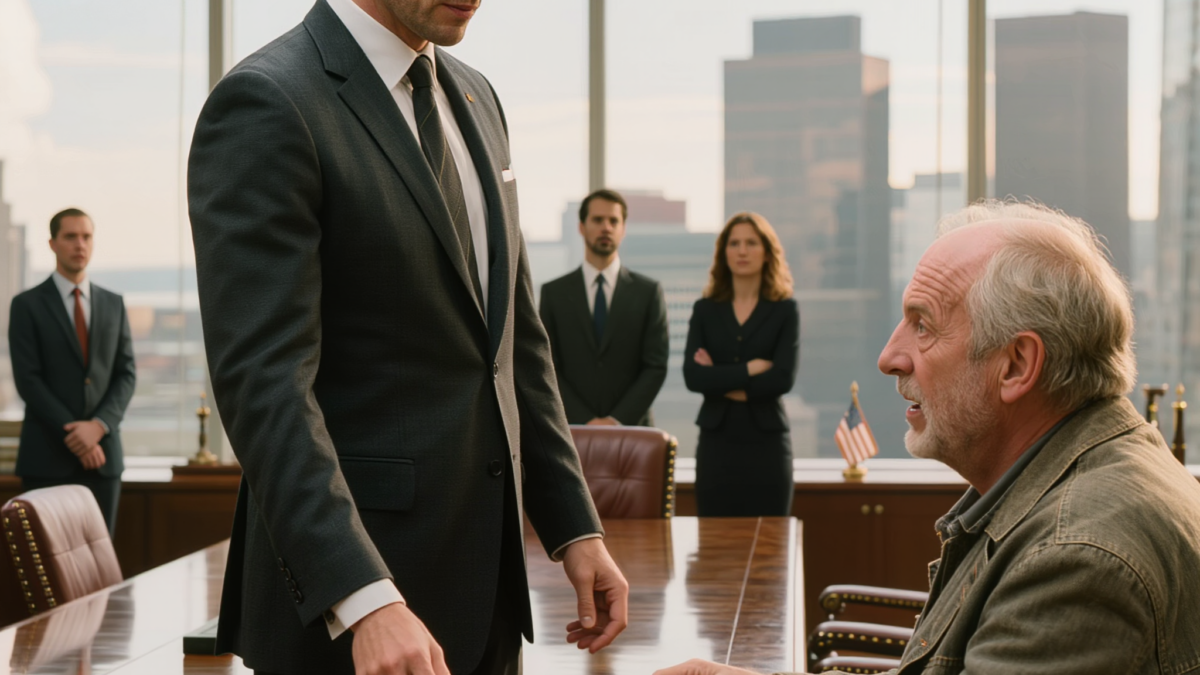
It was an intimidating space, specifically designed by me to project corporate power during high-stakes contract negotiations. It was dominated by a 20-foot custom-built polished mahogany conference table surrounded by 20 ergonomic black leather chairs.
Bright natural light poured through massive wraparound floor-to-ceiling windows.
The entire bustling city of Seattle was visible—a sprawling concrete testament to industry, ambition, and wealth.
Gray clouds hung low over the skyscrapers, mirroring the coldness in the room.
I walked directly to the head of the long table and stood firmly behind my chair, resting my hands flat on the polished wood.
I did not offer them a beverage.
I did not offer them a seat.
They nervously pulled out two chairs at the opposite end, shrinking into the expensive leather, looking incredibly small and entirely out of place.
“Speak,” I said, checking my watch.
My mother immediately pulled a crumpled tissue from her imitation designer bag and began dabbing the corners of her eyes, gearing up for a theatrical performance of maternal distress.
“Nathaniel, it is about Julian. Your younger brother is in terrible trouble, and by direct extension, your father and I are facing an absolute financial catastrophe.”
For the next 10 to 15 minutes, they sat in my boardroom and laid out a convoluted, embarrassing story of catastrophic financial ruin that was entirely self-inflicted.
While I had been washing greasy cast-iron pans until my hands ached, mixing heavy bags of concrete in the freezing rain, and sacrificing my youth just to survive, their precious golden boy had been completely ruined by their endless indulgence.
They had paid outright in cash for two different prestigious private colleges, both of which Julian promptly dropped out of during his freshman year because he claimed he found the academic workload creatively uninspiring and far too restrictive for his unique genius.
After that massive six-figure waste of money, they began bankrolling a rapid succession of disastrous, ill-conceived business ventures to feed his fragile ego.
“He really wanted to be a prominent entrepreneur just like you, Nathaniel,” Richard explained, rubbing his temples as if fighting off a pounding migraine. “He launched an upscale cocktail lounge in the downtown district. We fully funded the initial half-million in seed capital and foolishly signed as personal guarantors on the 10-year commercial lease. He bought custom Italian marble for the bar. He bought imported velvet seating.”
The business completely collapsed within six months due to severe mismanagement, employee theft, and a lawsuit from multiple unpaid wholesale liquor vendors.
Then, almost immediately after that failure, Julian started a luxury bespoke clothing brand.
He accumulated over $400,000 in supplier debt because he ordered massive amounts of expensive inventory he could not possibly sell.
Creditors came after him hard, freezing his accounts.
Instead of demanding basic accountability from their adult son, my parents doubled down to protect their favorite child from the real-world consequences of his incompetence.
Richard had taken out a massive, highly leveraged second mortgage on their pristine suburban home, gambling the equity they had built over 30 years.
Beatrice had drained her retirement 401(k), absorbing early-withdrawal penalties and tax hits, and cashed out her life-insurance policies to cover Julian’s accumulating legal settlements and maintain his lavish, unsustainable lifestyle in a rented downtown penthouse.
They firmly believed their coddled, entitled son was a brilliant, misunderstood visionary in the making.
They were completely blind to the reality that he had rapidly drained their life savings.
“When the regional property values dipped significantly last year, my independent corporate consulting contracts completely dried up,” Richard admitted, his voice cracking as he stared at the reflection of the Seattle skyline on the polished mahogany table. “We were trapped beneath compounding high-interest debt and soaring adjustable mortgage rates. We had to keep up appearances in the neighborhood. We couldn’t let anyone at the country club or the homeowners association know we were failing. It would have ruined our social standing. The shame would have been unbearable.”
“And where exactly is Julian right now?” I asked.
“He left,” Beatrice whispered, her voice breaking, finally looking genuinely devastated.
“When the bank sent the final certified foreclosure notices last month, he packed up his remaining expensive belongings in his car and drove down to Southern California in the middle of the night without even saying goodbye. We heard through a mutual family friend that he’s going through a messy divorce from a woman he met down there and a difficult custody dispute. He refuses to return our phone calls. He changed his cell phone number. He blocked our emails. He completely abandoned us.”
The golden child had taken the remaining money and run, leaving his aging parents holding the empty bag.
They had defaulted on multiple property loans.
They were sliding rapidly toward foreclosure.
“The bank is threatening to formally seize the family house by the end of this month,” Richard said, finally looking up at me.
Then his tone shifted.
The desperation hardened into the familiar entitlement I remembered from my childhood.
“Julian desperately needs seed capital to get back on his feet after his divorce. He needs a lawyer, and your mother and I need to clear this mortgage before they put our belongings on the lawn. As our eldest son, as a man of obvious wealth and corporate power, it is your duty to step up and fix this mess. Family is family, Nathaniel. You need to clear our mortgage debt, and you need to set up an irrevocable trust fund to buy your younger brother a decent home in California so he can secure joint custody of his kids. After everything we gave you, after the roof we put over your head for 18 years, you owe us this much. It is the least you can do for your family.”
I stared at him.
I let the heavy silence stretch across that massive room until the tension felt almost physical.
I looked at the rain hitting the glass windows.
They had left me hungry.
They had humiliated me.
They had evicted me into the freezing rain on my 18th birthday.
And now they honestly believed they could walk into my corporate empire and demand a six-figure financial bailout based on a biological obligation they had ignored when I was a child.
I didn’t yell.
I didn’t slam my fists on the table.
I didn’t lose my temper or raise my voice.
When you hold all of the winning cards in a high-stakes game of survival, you don’t need theatrical anger.
I calmly reached down to the reinforced leather briefcase resting on the carpeted floor beside my chair.
I clicked the brass combination locks open with a sharp snap that echoed through the quiet room.
I reached inside, pulled out a slender red-tabbed manila folder, and placed it squarely in the center of the polished mahogany table.
I placed my right hand flat on top of it and slowly slid it across the smooth wood until it stopped directly in front of Richard’s trembling hands.
“Open it,” I instructed.
Richard looked at the standard corporate folder with deep hesitation.
He swallowed hard.
Then he slowly opened the thick paper cover, peeling it back to reveal the contents.
I had meticulously prepared three specific documents for this exact long-awaited moment.
The first document was a high-quality full-color photocopy of a small, heavily yellowed spiral-bound notebook.
The exact notebook Samuel, the diner manager, had found on the dry shelf in the back kitchen so many years ago.
“That is a detailed, itemized financial ledger,” I explained, leaning forward slightly, watching confusion wash over their aging faces as they stared at the long columns of my teenage handwriting. “It records every dollar I earned washing grease-caked dishes until my hands ached and every dollar I was forced to spend on basic survival between the ages of 14 and 18. It lists the thrift-store winter coats I bought to keep warm on my paper route. It lists generic flu medication, discount loaves of bread, clearance-aisle school supplies, and dental copays you refused to cover.”
I paused.
“I had my accounting department calculate the final sum adjusted for inflation this morning. It totals precisely $32,412.16.”
Beatrice quickly covered her mouth with a trembling hand. A muffled sob escaped her lips.
Her eyes darted away from the printed paper, unable to face the physical record of her neglect.
“Turn the page,” I said.
Richard shakily flipped the document over.
His face instantly drained of color.
His eyes widened in recognition.
It was a perfectly preserved copy of the original eviction notice.
The typed, perfectly formatted MONTH-TO-MONTH RESIDENTIAL LEASE AGREEMENT he had proudly slid across the granite kitchen counter on the rainy morning of my 18th birthday.
It explicitly demanded $800 a month for a tiny bare childhood bedroom, excluding utilities.
“You sat in your comfortable kitchen,” I said, keeping my tone calm, “and looked directly at a teenager who had just graduated as high school valedictorian without a shred of parental support. You handed him a legally binding lease agreement.”
I held his gaze.
“You looked me in the eye and said, ‘Childhood is a privilege.’ You told me you owed me absolutely nothing. You forced a hungry, exhausted teenager to work late just to afford basic food and school supplies. And now you walk into my company and demand a six-figure handout for the brother who abandoned you.”
Richard’s face flushed crimson.
The shame was suffocating him, but the old need for control briefly returned to his eyes.
“That was tough love, Nathaniel,” he said defensively, setting his shaking hand firmly against the mahogany table. “You were incredibly stubborn. We had to teach you the harsh reality of the corporate world. And look at you now. Look at this building. Look at this successful firm. Our strict discipline, our refusal to coddle you—it made you into the wealthy success you are today. You should be thanking us for building your character and your work ethic.”
“No,” I replied instantly.
My voice dropped lower.
“My resilience made me a success. My discipline built this firm. My intelligence secured these contracts. Your cruelty was an unnecessary obstacle I had to survive. You do not get to take credit for the life I built simply because you made the road harder.”
I paused.
“You were not my teachers. You were the people who hurt me most.”
The silence in the room was absolute.
Then I gestured toward the open folder one final time.
“There is a third and final document in that folder. Richard, I suggest you pick it up and read it very carefully, because this is the part where your past catches up to your present.”
Richard’s hands were shaking so badly that the thick paper audibly rattled as he pulled out the final stack of stapled legal documents.
It bore the embossed gold-foil seal of First Regional Bank beside the black corporate header of Brooks and Sterling Holdings LLC.
“Exactly two weeks ago,” I said calmly, leaning back as his eyes scanned the page, “my commercial real estate development firm purchased a large delinquent commercial and residential debt portfolio from First Regional Bank. We bought it during their end-of-quarter liquidation sale. We own the paper. We own the debt.”
I steepled my fingers together.
“That portfolio included nonperforming assets, strip malls, abandoned warehouses, and defaulted mortgages. One of those assets was the severely delinquent mortgage on your suburban house on the West Hill. The exact house you currently live in.”
I held his gaze.
“The exact house you threw me out of into the rain.”
Beatrice let out a sharp gasp, clutching her chest with both hands.
“Oh my God,” she whispered. “No. No, Nathaniel. Please.”
Richard sat completely still, his mouth slightly open, his eyes locked onto the certified property documents listing my holding company as the owner of their debt.
“I don’t owe you a single thing, Richard,” I said.
“I don’t owe you forced family loyalty. I don’t owe you a trust fund for Julian’s kids, whom I’ve never even met. I don’t owe you a single dime of my hard-earned money. But you, as of this legal moment, owe my holding company precisely $460,000 in defaulted mortgage payments, accumulated late fees, and compounding legal penalties.”
The weight of the situation finally settled over them.
They were at my mercy.
The son they had treated like a financial burden was now holding the legal documents connected to their home.
There was nowhere left to run.
No bank left to negotiate an extension with.
The silence in the boardroom was total.
There were no more fake tears for Beatrice to use. There were no more corporate excuses for Richard to offer.
They were stripped of the arrogant power they had once held over a helpless 14-year-old boy.
“Here are my final terms,” I said, my voice strictly professional.
I reached into my tailored jacket pocket, pulled out a heavy silver fountain pen, and placed it beside a fresh typed legal document I had kept face down on my side of the table.
I picked it up and slid it deliberately across the polished wood toward them.
“I am not going to execute the formal foreclosure today. I am not going to put you out with your belongings in black plastic bags, even though that’s how I left this house at 18. I operate a legitimate, profitable real estate business, and I prefer steady residual income over an empty residential property that requires upkeep.”
Richard stared blankly at the new document.
At the top of the crisp white page, in bold capitalized letters, it read:
MONTH-TO-MONTH RESIDENTIAL LEASE AGREEMENT.
It was formatted exactly like the one he had proudly given me years ago.
Word for word.
Clause for clause.
“I will formally and legally lease the property back to you,” I explained, watching his eyes move across the strict legal terms. “You will be responsible for maintaining the landscaping to HOA standards. You will pay your own utilities, water, electricity, and high-speed internet.”
Then I gave him the number.
“The monthly rent is exactly $800, due on the first of every month by certified cashier’s check, delivered directly to my corporate accounting department on the fourth floor.”
I leaned forward, intentionally mirroring the posture he had used on my 18th birthday.
“No exceptions. No grace periods. Pay on the first or move out.”
Richard slowly reached for the heavy silver pen.
His aging fingers trembled so badly he could barely hold the barrel steady.
He looked up at me, a deeply defeated old man facing the consequences of his own greed, arrogance, and cruelty.
He didn’t say a word.
He signed his name on the dotted line, his signature jagged and barely legible.
Beatrice pulled the paper toward her and signed directly below him, quietly crying into her shaking hands, her imitation designer purse forgotten on the floor beside her scuffed shoes.
Richard slowly pushed the signed paperwork back across the long mahogany table.
“Get out of my building,” I said quietly, picking up the document and checking the signatures.
They stood slowly, looking physically drained and fragile.
They didn’t say goodbye.
They didn’t offer an apology for the years of mistreatment.
They simply turned around and walked out of my executive boardroom with their heads bowed.
Maya watched them silently shuffle toward the glass elevator, stripped of their upper-class arrogance.
The doors closed.
They were gone.
Later that evening, while I was reviewing architectural drafts in my quiet home office, my personal cell phone rang.
It was Aunt Clara.
Clara was my mother’s older sister, a bitter woman who had long served as the central hub for family gossip, drama, and manipulation.
She was the one who had been secretly tracking my corporate success through online business journals and property records. She was the one who had fed detailed information about my wealth back to Richard and Beatrice, hoping to benefit if they somehow persuaded me to open my bank accounts to the family.
“Nathaniel,” Clara said over the phone, her voice dripping with fake concern. “I heard about the terrible misunderstanding at your office today. Your poor parents called me. They are absolutely devastated. You have to understand, they only ever wanted the best for you. And poor Julian is struggling so much with his divorce. Surely a man in your successful position has enough to help his own family. It’s the decent thing to do, Nathaniel. You can’t just abandon them.”
“Clara,” I interrupted. “Listen to me very carefully. If you ever contact my private unlisted cell number again, or send my parents to my place of business again to disrupt my employees, my corporate legal team will take appropriate action. Do you understand me clearly?”
She stammered, entirely caught off guard, and quickly hung up without another word.
That was the final toxic string cut.
The network of enablers, gossip, and manipulation was finally severed.
As for Julian, the precious golden child never received a single dime of my hard-earned money once my parents’ financial safety net disappeared.
His life rapidly unraveled.
His divorce in California was finalized. Because he had no hidden assets, no steady verifiable income, and a documented history of severe financial negligence and unpaid debts, he lost primary custody of his young children.
Julian eventually moved into a tiny, run-down studio apartment and began working a minimum-wage retail job at a big-box store just to afford his court-mandated alimony and child-support payments.
He spent his days stocking shelves and dealing with angry customers.
For the first time in his life, he had to support himself without an endless financial cushion beneath him.
And my parents stayed exactly where they were, trapped in that massive aging house on the West Hill.
Every single month, on the first, a certified cashier’s check for exactly $800 arrived at my firm’s accounting department via registered mail.
They were living on a fixed Social Security income in a house they no longer legally owned.
They were terrified of missing a payment.
They finally learned what it felt like to pay their own way in the real world.
For the first time in 16 long years, as I watched the glass elevator doors close on Richard and Beatrice that afternoon, I felt a crushing physical weight lift from my shoulders.
For more than a decade, I had been running on adrenaline, old pain, and deeply rooted anger.
I had built a corporate real estate empire not just out of business ambition but out of a desperate need for a permanent shield.
I wanted to be financially secure, legally protected, and surrounded by contracts strong enough that no human being could ever put a brass padlock on my food supply again.
But standing alone in that quiet boardroom, looking out over Seattle and holding the signed lease agreement that effectively made me my parents’ landlord, I realized something profound.
Lasting justice didn’t come from screaming matches in a driveway or sinking to someone else’s harmful level.
It came from standing securely in my own truth.
I didn’t break my family.
I didn’t destroy them.
Their greed, entitlement, and lack of basic empathy had done that on their own.
I merely handed them a clean mirror and forced them to look at their own reflection.
Then I turned my back on their shadow for good.
I was finally free.
I returned to my work with a renewed sense of clarity and purpose.
Brooks and Sterling Architecture continued expanding across the Pacific Northwest, securing major contracts, designing sustainable urban centers, and redefining the commercial real estate landscape.
I wasn’t just building tall structures to protect my frightened inner teenager anymore.
I was building beautiful, functional spaces where other people could thrive, work, and grow their own businesses.
I was creating legacies.
Eventually, I purchased a vast, modern, secluded piece of property high in the mountains, surrounded by towering pine trees and overlooking the deep waters of Puget Sound.
I personally designed every square inch of the sprawling house.
It doesn’t have a single padlock in it.
My kitchen is filled with natural light from large skylights, and the pantry doors are made of open transparent glass.
It is a beautiful space built for peace, not desperate survival.
It is a home where nobody goes hungry and nobody is charged rent for simply existing.
When you grow up in a deeply toxic, harmful environment, the people around you can condition you to believe that you are the problem.
You can be taught that setting healthy boundaries makes you selfish or ungrateful.
My parents used the very concept of family to demand unquestioning submission and financial sacrifice while ignoring the basic duties of parental love, protection, and care.
They genuinely believed biology gave them a lifetime pass to take advantage of me.
They were wrong.
Biology simply makes you a genetic relative.
Respect, loyalty, and supportive love are what truly make a family.
Family can be the person who offers you a warm meal when you are going hungry, like Samuel at the diner.
Family can be the person who lets you sleep on a couch when you have nowhere else to go, like Marcus.
I learned the hard way that sometimes the best thing you can do for your mental health, financial stability, and survival is to step away completely.
You cannot heal in the same harmful environment that made you feel powerless in the first place.
Sometimes you have to walk out into the freezing rain, carry your own heavy garbage bags, and build your own shelter from the ground up.
It is difficult.
It is terrifying.
There were long, dark nights in that damp basement apartment where I broke down from sheer physical exhaustion and the hollow ache of feeling unloved and discarded by the people who brought me into this world.
But that pain was temporary.
The peace I have now is not.
The financial security is not.
The quiet, deeply rooted confidence of knowing I built my own salvation is not.
If there is one important thing I want you to take away from my story, it is this:
Do not let anyone, not even your own parents, convince you that calculated mistreatment is love.
Do not let cruelty, manipulation, or neglect be disguised as tough love or necessary character building.
You have the right to walk away from a table where basic respect is no longer being served.
You have the right to build your own fortress, close the gates, and choose exactly who gets to come inside.
You are not obligated to sacrifice your own well-being just to keep toxic people comfortable.








