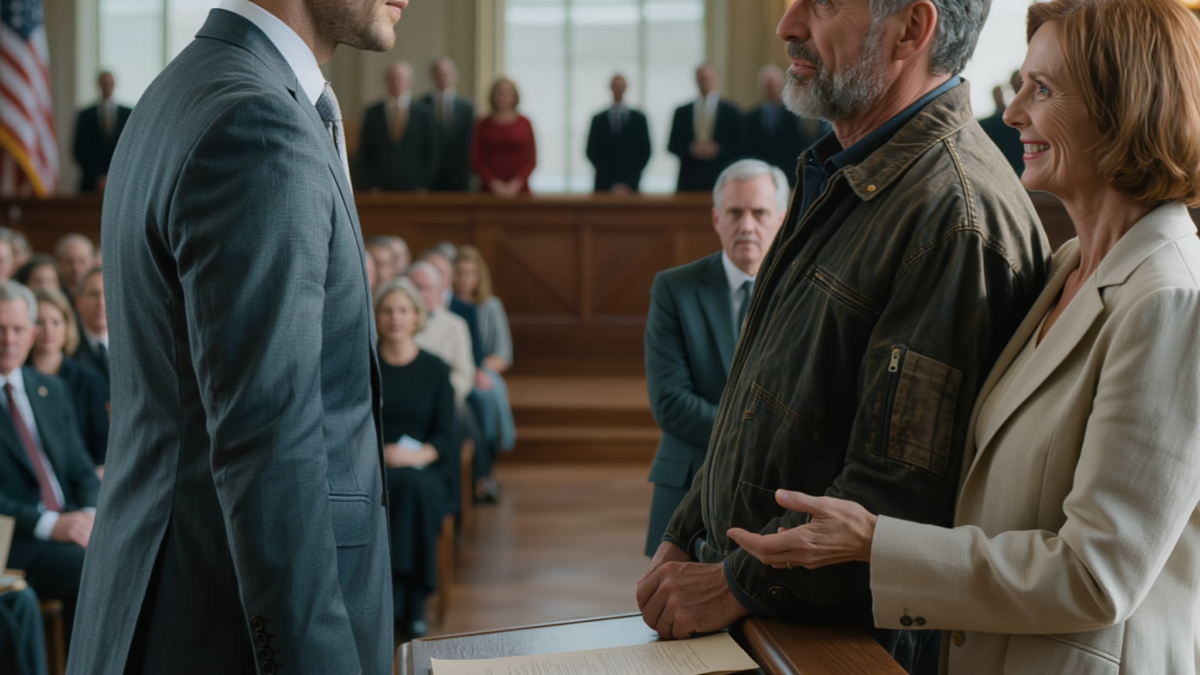
My father barged into my university honors ceremony and ordered me back to his construction site by 5 a.m. My mother called me selfish—until the dean announced my $100,000 award. Suddenly, she wanted to hug me. I stayed at the podium while my attorney unfolded a court document with both their names on it.
My name is Julian. I am 24 years old. For the last six agonizing weeks, I have consumed every single meal through a narrow plastic straw. My jaw had been fractured in several places and was now held together by titanium plates and medical-grade wire. This is exactly what happens when you stand in your own living room holding a letter of acceptance to a prestigious law school, and you tell your father that you are finally claiming your own future.
His immediate response was a hard blow to my face. While I lay injured on the cheap living room rug, struggling to remain conscious, I looked toward my mother. She did not scream for help. She did not reach for the phone to dial 911. She just stood in the doorway, looked down at me, and laughed.
It was a cold, hollow, deeply terrifying sound that I will never forget as long as I live. She looked at me with absolute, unmasked disgust and said,
“That is what you get for being a selfish burden.”
My father stood over me, his chest heaving, his knuckles rapidly swelling and turning a dark, bruised purple. He looked down at me like I was a piece of defective machinery on one of his job sites and snarled,
“Maybe now you will learn to keep that gutter mouth shut and get back to work.”
But there was one massive thing they did not know. Hidden inside the ripped lining of my beat-up canvas duffel bag in the hall closet was a small encrypted flash drive. That tiny piece of black plastic was loaded with three years of hidden security footage, undeniable tax fraud evidence, recorded confessions of financial abuse, and a direct link to the most ruthless defense lawyer in the entire state. And right now, as I sit here telling you the story, they are facing multiple felony charges, completely stripped of their wealth and begging me for mercy from a cold concrete holding cell.
To understand how this happened, I have to go back to where the nightmare really started. The physical pain of a broken jaw is not something you can easily put into words. It is not like a broken arm or a sprained ankle. It is a blinding, white-hot ache that radiates through your entire skull, making your ears ring and your vision swim with dark, heavy spots.
Every single heartbeat sends a massive shock wave of torture through your face. But as I lay on that floor staring at the ceiling fan spinning above me, the physical pain was secondary to the absolutely terrifying clarity I felt in my mind. There was a metallic taste in my mouth and a sharp pain along the inside of my cheek. And through my blurred vision, I saw the two people who brought me into this world.
They were not looking at a son in pain. They were looking at a financial asset that had dared to rebel against its owners. My father, Richard, was an imposing, massive man. He ran a local commercial construction company, a business built entirely on corners cut, cheap materials, ignored safety regulations, and backs broken, mostly mine.
He was the kind of man who wore his heavy mud-caked steel-toed boots in the house, tracking dirt across the pristine floor, demanding respect through sheer physical intimidation and volume. My mother, Diana, was his perfect enabler and a master psychological manipulator in her own right. She spent her days attending neighborhood HOA meetings, gossiping at the local country club, and presenting the flawless manicured façade of the perfect wealthy suburban family. She did all of this while hiding the impending financial ruin and the violent screaming matches behind our heavy oak doors.
That night, when the heavy envelope from the university arrived in the mail, I made the fatal, stupid mistake of letting a sliver of genuine hope show on my face. I foolishly thought for one split second that a full academic scholarship to law school might finally earn me a single nod of approval. I thought they might finally see me as a human being with a brain rather than just a pair of hands. Instead, it earned me a blow that left me barely able to stay conscious.
They did not see a young man trying to build a future and escape a life of manual labor. They saw their unpaid labor, their primary source of free income, walking out the front door and threatening their comfortable lifestyle. As I lay there in pain on the beige carpet, I did not cry. I did not shed a single tear.
I smiled. A strained, determined smile that made my mother take a step backward in genuine fear. I knew right then and there that I was going to burn their entire kingdom to the ground. I was going to take everything they valued, every dollar, every ounce of their reputation, and bring it all to an end.
The hospital emergency room was sterile, freezing cold, and smelled heavily of bleach, iodine, and antiseptic. The steady, rhythmic beeping of the heart monitor next to my bed was the only sound keeping me company in the dead of the night. My jaw had been surgically wired shut just hours prior in a grueling operation. The emergency room doctor, a kind, perceptive woman with dark, tired eyes, had tried her absolute best to ask me what really happened.
She looked closely at the fresh, dark bruising on my neck and the older, faded, defensive wounds on my forearms. She knew something was wrong. Medical professionals can recognize when a story does not add up, when the injuries do not match the explanation. But my father had been standing right behind her the entire time, his large frame blocking the doorway.
His heavy, calloused hand was resting on my shoulder in a grip so incredibly tight it was physically cutting off the circulation to my arm. A silent, agonizing warning. He looked the doctor dead in the eye and told her I took a bad fall off some loose, poorly secured scaffolding at the downtown commercial work site. He chuckled—a deep, fake, booming sound—calling it a clumsy mistake by a careless kid who was simply not paying attention to his footing.
I could not speak to correct him. My mouth was literally physically locked shut with wire. But even if I could have spoken, I would not have said a single word. I knew exactly how the legal system worked in our small corrupt town. I knew that without an ironclad case, without undeniable, hard recorded proof, my father would charm his way out of a lawsuit or a police investigation, just like he always did when his workers got hurt on the job.
He would pay a small, meaningless fine, come home, and finish the violent job he started. I needed to be smart. I needed to be utterly, coldly, clinically ruthless. Staring up at the water-stained acoustic tiles on the hospital ceiling, the heavy intravenous painkillers dulling the intense throbbing in my shattered face, I realized a harsh, world-shattering truth.
Family is often just a biological accident. Blood means absolutely nothing when it is used as a heavy steel chain to keep you tied to the floor and drained of your resources. I closed my eyes and let my mind drift back into the dark corners of my memory. I needed to remember every single injustice, every stolen dollar from my salary, every cruel word spoken over the last decade.
The deep rot in my family did not start with a broken jaw on a random Tuesday night. It started years ago with a toxic, insidious seed of favoritism that poisoned everything it touched. It started with my brother, the golden child, and the sickening, slow realization that my only purpose in their lives was to pave his road to luxury with my own blood, sweat, and stolen youth.
Growing up in our large, excessively decorated house meant understanding your assigned role and never, ever stepping out of line. There was my younger brother, Trevor, and then there was me. Trevor was 21 years old, three years younger than me, but he lived his life like a retired lottery winner who had already conquered the world. He was the undisputed untouchable golden child.
If Trevor so much as sneezed, my mother was ready to empty her savings account to buy him a warmer designer cashmere coat. If Trevor barely scraped by with a C-minus in high school, my dad bought him a brand new expensive video game console and a massive television to celebrate his supposed hard work and relentless dedication. Me, I was the workhorse. I was the invisible silent engine keeping the lights on and the creditors at bay.
When I turned 18, the exact same week, I graduated high school with top academic honors and a towering stack of prestigious college brochures on my desk. My father sat me down at the heavy oak kitchen table. He did not offer me a college fund. He did not discuss my 401k or my future.
He did not offer me congratulations or take me out to a celebratory dinner. He violently slapped a pair of heavy dirt stained leather construction work gloves on the table and told me that a real man earns his keep through hard labor. The family business was supposedly struggling, weighed down by terrible commercial real estate investments my father had arrogantly made years prior without consulting anyone. I was told I had to do my part.
I had to delay college for just one single year to help the family get back on its feet. It was framed as a noble temporary sacrifice. One year turned into two. Two turned into six long, agonizing, soul-crushing years.
By the time I was 24, my hands were permanently calloused and scarred. My lower back ached constantly from lifting heavy materials and pouring concrete, and my dreams were buried under miles of drywall dust. I was working 60 to 70 hours a week for my father’s construction company. My salary was completely, utterly nonexistent.
I was given a meager, humiliating allowance, just barely enough for cheap gas and fast food. Whenever I gathered the immense courage to ask for a proper paycheck, to ask for the money I had legally and rightfully earned through grueling physical labor, my father would launch into a terrifying screaming tirade. He would list the cost of the roof over my head, the food in my stomach, and scream about how ungrateful I was for the massive inheritance he was supposedly building for me.
He promised me a huge promotion to site manager, a promise dangled like a rotten carrot that never, ever materialized. But I knew exactly where the money from my grueling labor was actually going. It was going straight into Trevor’s pockets. Trevor, who dropped out of the local community college after exactly one semester because he claimed the professors were too mean and demanding.
Trevor spent his days sleeping until noon and his nights partying at expensive downtown clubs with money he never lifted a single finger to earn.
The absolute breaking point—the exact moment the blinders truly and finally fell from my eyes—arrived on a humid Tuesday evening in late July. I came home covered in itchy, painful fiberglass insulation and wet cement. Exhausted to my very bones, I walked up the long driveway to find Trevor leaning casually against a brand new gleaming Porsche Panamera. My mother was circling the expensive luxury car, taking hundreds of pictures of him for her social media accounts, beaming with absolute unadulterated pride.
I stopped dead in my tracks. My heavy work boots felt like they were made of solid lead. I walked up to my father who was standing on the porch smoking and asked him how we could possibly afford a luxury sports car when he had just told me that very morning we could not afford to buy new legally required safety harnesses for the roofing crew. My father did not even look at me.
He just lit his cheap cigar, puffed a thick, foul smelling cloud of smoke into the evening air and said,
“Your brother needs a reliable vehicle for networking, Julian. He has immense potential in the luxury real estate market. You just need to work a few extra weekend shifts to cover the massive monthly payments. It is what families do for each other.”
They expected me to sacrifice my youth, my physical health, and my entire future to pay the lease on a Porsche for a brother who could not even figure out how to wash his own laundry or boil an egg. I gripped the heavy nylon straps of my tool belt until my knuckles turned stark white. I realized then that they would gladly bleed me dry until there was nothing left but dust, and then they would complain to the neighbors that I did not leave a big enough corpse for them to step over.
But I was not entirely stupid and I was not completely broken. I had a survival instinct. For years, I had been quietly, methodically skimming a little bit of cash from side jobs I took on the weekends, fixing a neighbor’s broken plumbing, doing emergency roof repairs after a severe storm, clearing out heavy debris from foreclosed properties for the bank. I hoarded every single dollar I earned.
I kept the cash tightly rolled and stuffed inside a thick, hollowed-out medical dictionary hidden under a loose floorboard beneath my bed. It was my secret escape fund, my one-way ticket to a life where I was not a slave to my own toxic bloodline.
I had one person in my life I truly, deeply thought I could trust: Clara. We had dated briefly in our senior year of high school and had remained incredibly close friends ever since. We spent hours studying together at the quiet tables in the back of the local public library, poring over heavy, complicated LSAT prep books. I desperately wanted to be a lawyer.
I wanted to understand the rules, the loopholes, and the laws of the world so deeply that no one could ever exploit or abuse me again. I told Clara absolutely everything. I poured my heart and my trauma out to her. I told her about my secret cash savings, about my grand plan to apply to law school in a different state, and how I intended to vanish in the middle of the night once I had enough money to cover the first semester’s tuition and a security deposit on a cheap, safe apartment.
Clara would reach across the wooden library table, hold my calloused, rough hand in hers, look me deep in the eyes with what I thought was absolute sincerity, and tell me I was brilliant. She told me I deserved so much better than the miserable life I was living. She was my anchor.
Exactly one month before the fateful night my jaw was injured, I came home early from a job site because a sudden torrential downpour had washed out our massive concrete pour. The house was dead quiet. I walked upstairs, my heavy boots making absolutely no sound on the thick hallway carpet. As I passed the closed door of the guest bedroom, I heard my mother’s voice.
She was on her cell phone speaking in a hushed, conspiratorial tone.
“I know, Clara. I know. You have been such an incredibly good influence on Trevor. Yes, I found the book exactly where you said it would be, under the loose floorboard near the radiator in Julian’s room. Honestly, I do not know what Julian was thinking, hoarding family money like a common, deceitful thief. I have already transferred all of it into Trevor’s account to cover his premium car insurance and his country club fees for the year. I will make sure Trevor takes you out to that nice expensive steakhouse downtown this weekend to say thank you for your loyalty.”
My stomach dropped into a bottomless black pit of despair. I stood frozen in the hallway, the blood rushing in my ears like a massive freight train. Clara, the girl who smiled at me, who helped me study, who pretended to care about my pain and my future, had completely sold me out. She had traded my freedom, my hard-earned savings, for a fancy dinner date with the golden child, and a pathetic taste of my mother’s fake high society approval.
I walked slowly into my room, my legs feeling like jelly, and ripped up the floorboard. The heavy dictionary was there, but the hollowed-out center was completely, utterly empty. Five years of intense sweat, of skipping lunches, of working through blistering heat and freezing cold holidays, gone just like that, wiped out for a car insurance premium and a steak dinner. I did not scream.
I did not storm downstairs and confront my mother. I did not call Clara and curse her out for being a disgusting traitor. I carefully placed the floorboard back down, sat on the edge of my mattress, and stared at the blank wall for hours. That was the exact day the last remaining shred of my humanity and empathy toward these people completely evaporated.
I learned a very hard, agonizing lesson that day. Betrayal rarely comes from your sworn enemies. It comes from the people who sit at your dinner table, hold your hand, and smile right to your face while they hold the knife behind their back.
I thought the worst was over. I was so incredibly wrong. Losing the money was a devastating, crushing blow. But it did not kill my ambition. It only made me colder, sharper, and infinitely more dangerous. I realized that physical cash could be easily stolen, but knowledge, evidence, and legal leverage could not.
I stopped relying on physical money. I started relying entirely on my intellect and my ability to plan in total secrecy. With the quiet, unwavering help of Marcus, a grizzled 50-year-old foreman on the construction crew who had seen firsthand exactly how my father treated me, I managed to get a fee waiver for my law school applications. Marcus had gone through a brutal divorce and a vicious custody battle years ago.
He knew exactly what it was like to be legally trapped and financially drained by a toxic partner. He let me use his home computer after our grueling shifts and let me use his personal mailing address so that absolutely no correspondence from the universities would ever go to my parents’ house. For six grueling months, I worked like a mindless machine during the day, pouring concrete, hauling lumber, and taking the verbal abuse. And I studied like a madman at night.
I submitted my applications, completed my interviews in Marcus’ quiet living room via video call, and waited.
Then came the week of Thanksgiving. The house was chaotic because my aunt Beatrice was in town. Beatrice was my mother’s older sister. She was the woman who always bought me cheap, scratchy sweaters for Christmas and patted my cheek, telling me what a good, hardworking, loyal boy I was.
She played the role of the sympathetic, loving aunt perfectly. Whenever my dad yelled at me in public, she would pull me aside, hand me a crumpled $20 bill, and whisper,
“Just bear with them, Julian. They are under a lot of stress with the business and the real estate market.”
I had foolishly, stupidly left a printed copy of my law school acceptance email, a prestigious full-ride scholarship to the state’s top law program tucked inside a heavy textbook on my desk. I wanted to read it when I felt like giving up. I needed to physically see the words on paper to believe they were real, to remind myself that my brain was worth more than my back. During the massive Thanksgiving dinner preparations, while I was outside in the freezing cold, taking out the heavy trash bags and cleaning up the mess Trevor and his friends had made in the garage, Beatrice wandered into my room.
She was supposedly looking for a phone charger. She found the paper. I walked back into the dining room, wiping grease off my hands, to find an absolutely chilling silence. The massive roasted turkey sat half-eaten on the table. My father’s face was a dark, dangerous shade of purple.
The veins in his forehead were visibly throbbing. My mother was clutching her expensive wine glass so tightly her knuckles were stark white. And standing at the head of the table, holding my acceptance letter like it was a piece of filthy, offensive trash, was Aunt Beatrice. She looked at me with a sickeningly sweet smile, but her eyes were venomous and full of malicious glee.
“Julian,” Beatrice said, her voice dripping with fake theatrical concern.
“I found this in your room. Were you planning on abandoning your family? After everything your father has done to provide for you, I just couldn’t keep this from Diana. It breaks my heart to see you being so incredibly secretive and selfish.”
She did not care about me. She never did. She thrived on family drama, on feeling superior, and on watching others burn. She casually tossed the printed paper onto the gravy stained tablecloth. Pandora’s box was wide open, the locks were broken, and the monsters were pouring out.
The room erupted into absolutely terrifying chaos. My father stood up, his heavy oak chair scraping violently against the hardwood floor, leaving deep gouges. He lunged across the dining table, knocking over a crystal glass of expensive red wine, and grabbed the letter. He scanned the words, his breathing heavy and ragged like a cornered animal.
“A scholarship?” he spat, his voice shaking with absolute rage and disbelief.
“You applied to law school behind my back? You think you’re better than us? You think you can just walk away from the business after everything I’ve invested in you?”
“I earned it,” I said, keeping my voice remarkably steady, even though my heart was hammering against my ribs like a trapped bird.
“It is a full ride. It will not cost you a single dime. I am leaving in January.”
Trevor snorted loudly from the living room couch, not even bothering to look up from scrolling on his expensive phone.
“Good luck paying for rent and food, loser. Dad is not giving you a cent. You will be back begging on your knees in a week.”
“I do not want his money,” I fired back, finally letting years of suppressed rage, absolute exhaustion, and the bitter sting of stolen wages bleed into my tone.
“I just want out of this prison. I want to build a life where I am not breaking my back every single day just to pay for a Porsche that you do not even know how to parallel park.”
That was the trigger, the ultimate unforgivable sin in that house. I had directly insulted the golden child. My mother stepped forward, her face twisted in absolute, unmasked disgust.
“How dare you?” she hissed, her voice low and incredibly dangerous.
“You ungrateful, selfish little wretch. We put a roof over your head. Your brother has a brilliant future in real estate. He needs our financial support. You are nothing but a pair of hands. That is all you have ever been and all you will ever be.”
My father threw his heavy crystal whiskey glass directly at the wall behind me. It shattered into a hundred jagged pieces, raining glass down onto the expensive carpet. He marched toward me, his massive fists clenched. I did not back down. I did not cower.
I stood my ground and looked him dead in the eye. In that tense, terrifying silence, right before the confrontation turned physical, I heard my mother step up closely behind my father. She leaned in close to his ear. Her voice was a venomous whisper that she did not even care if I heard.
“Keep him here if you have to, Richard. He cannot leave. Trevor’s next car payment is due in exactly two weeks, and we need the cash flow. He stays in this house and he works.”
My own mother, the woman who gave birth to me, was urging my father to hurt me just to secure a car payment for her favorite son. Before I could even process the absolute chilling depravity of her words, my father swung. He did not slap me. He did not strike my stomach to wind me.
He threw a heavy right hook, fueled by years of unchecked rage, absolute entitlement, and cheap whiskey, directly into the side of my face. The impact was sharp and sudden. The force sent me backward into the edge of the coffee table. The pain was immediate and overwhelming.
I knew my jaw had been badly injured. I hit the floor hard, a metallic taste in my mouth, my vision swimming with black spots and flashes of bright light. And that is exactly when my mother laughed. That cold hollow sound echoing in the dining room.
“That’s what you get for being a selfish burden,” she said, stepping right past me to check if the expensive coffee table had been scratched by my fall. My father stood over me, his chest heaving, adjusting his cuffs.
“Maybe now you’ll learn to keep that gutter mouth shut and work.”
I looked up at them through the thick haze of absolute agony. I felt the sharp pain in my jaw and forced my mouth into the faintest smile, a dark, determined promise. They thought they had finally broken me into total submission. They had absolutely no idea they had just set in motion events that would change all of our lives.
The six weeks that followed my reconstructive surgery were a masterclass in psychological endurance, silent warfare, and meticulous planning. My jaw was wired tightly shut, my teeth clamped together by unyielding cold metal. I existed on a miserable, humiliating liquid diet of chalky protein shakes and watered down broth, sipping painfully through a straw while the injured bones slowly healed. The house was suffocatingly quiet.
My father paraded around the property like a victorious, arrogant general who had just crushed a minor rebellion. My mother ignored my existence entirely, except to bitterly complain about the annoying noise the blender made when I prepared my meager meals. Trevor just whined incessantly that I wasn’t at the job site doing his heavy lifting, forcing him to actually break a sweat for once in his pampered life. They thought the thick metal wires on my jaw meant my mind was silenced, too.
They were dead wrong. When the police had originally come to the hospital, called by a sharp triage nurse who immediately suspected domestic abuse, my father stood right next to my hospital bed. He gave me a cold, dead-eyed look that made it clear what would happen if I dared to speak up. So, I nodded along to his fabricated lie about the scaffolding collapsing.
I played the obedient, terrified, broken victim to absolute perfection. But the exact moment I was discharged and walked back into that toxic house, the real work began.
Mrs. Higgins, our elderly neighbor who lived next door, was a brilliant, sharp woman. She had heard the vicious shouting on Thanksgiving. She had seen the flashing lights of the ambulance arrive. One chilly morning, when my mother sent me outside to fetch the mail, Mrs. Higgins was watering her rose bushes near the property line.
She walked over to the wooden fence, looked deeply at my bruised, heavily swollen face, and quickly slipped a small piece of heavy card stock into my jacket pocket.
“Do not let them bury you, Julian,” she whispered fiercely, her eyes full of fierce determination and pity. Back in the safety of my room, I looked at the card. It was the business card of a man named Arthur Caldwell, one of the most ruthless, feared, and respected defense and civil litigation lawyers in the entire county. On the back, Mrs. Higgins had written a personal cell phone number and the name Sylvia, a senior coordinator at a local domestic violence advocacy center.
I could not speak a single word, but my fingers worked perfectly fine. Using the untraceable burner phone Marcus had sneaked to me at the hospital, I emailed Sylvia. I laid out absolutely everything in stark, clinical, undeniable detail: the years of financial abuse, the serious physical assault, the stolen wages, the tax evasion, the manipulated inheritance funds. Sylvia immediately connected me with Mr. Caldwell, who took one look at the mountain of evidence I described and took my case pro bono the second he read my email.
I became a silent, observing ghost in my own house. I set up my burner phone on a high bookshelf in the living room, hidden behind some framed family photos, recording hours of audio. I captured my father bragging loudly to his drinking buddies on the phone about how he had finally put the kid in his place. I captured my mother explicitly admitting she took my life savings and hid it in an offshore account to avoid paying taxes, laughing hysterically about how stupid and trusting I was.
I broke into my father’s home office at 3:00 a.m. and photographed years of fraudulent pay stubs, forging a massive, undeniable digital trail of stolen wages, tax evasion, and corporate fraud within my father’s business. I sent every single encrypted file directly to Caldwell’s secure legal server. I was building an extensive legal case, piece by piece, right in their own living room.
The glorious day finally came when the surgeon clipped the thick wires and removed them from my jaw. The doctor told me to take it easy. My face felt strange, weak, and incredibly stiff, but the bone was solid again. When I walked back into the house, rubbing my jawline, my parents were sitting in the living room watching television.
They did not ask how the medical appointment went. They didn’t ask if I was in pain. My father just slid a long, demanding list of heavy construction projects across the glass coffee table.
“You start tomorrow morning at 6:00 a.m. sharp,” he grunted, not taking his eyes off the screen.
“You owe me for six weeks of lost labor, and we have major deadlines to meet on the new real estate development.”
I looked at the printed list. I looked at the man who had shattered my face. I nodded submissively, keeping my eyes fixed firmly on the floor. I reached into my jacket pocket, pulled out a small paycheck I had gotten from a weekend side gig Marcus had secretly arranged for me, and handed it directly to my mother.
“For Trevor’s car insurance,” I said softly. My voice was raspy and weak from weeks of total disuse. My mother snatched the check from my hand, a smug, victorious smile spreading across her manicured face.
“See, I told you he would come to his senses eventually. Good boy, Julian. Now go wash up. You smell like a hospital.”
They were so incredibly arrogant, so deeply, blindly convinced of their own absolute superiority that they could not see the massive category 5 hurricane forming right off their coast.
That night at exactly 2:00 a.m., I packed everything that mattered into a single canvas duffel bag. I packed my laptop, my legal documents, a few changes of clothes, and the encrypted hard drive containing all the backups. I left the cheap, itchy sweaters Aunt Beatrice bought me. I left the heavy mud-caked steel-toed boots my father forced me to wear.
I stood in the doorway of my bedroom one last time, looking at the tiny room that had been my miserable prison cell for 24 years. I did not leave a dramatic note. Notes are for people who care, for people who want closure. I just walked out the front door, the lock clicking silently behind me, got into Marcus’ rusty pickup truck, waiting patiently at the end of the dark block, and drove away into the night.
Two days later, hiding out in a cheap, secure motel paid for by the advocacy center, I received an official email from Dean Montgomery of the law school. They were hosting a massive, highly publicized honors ceremony the following week for top scholarship recipients. I was invited to stand on stage and be recognized. I forwarded the formal invitation to my mother’s email address using a fake automated university system.
I knew exactly how her narcissistic mind worked. I knew she could not resist a public event filled with wealthy people. I knew she could not stand the idea of me succeeding publicly without her being there to take all the credit and smile for the cameras. Above all, I knew my father would come to physically drag me back by my collar in front of the whole world just to prove he still owned me.
I wanted them to come. The trap was perfectly set. The bait was taken. The heavy steel jaws of consequence were about to snap shut, and they were walking right into it, completely blind to the slaughter that awaited them.
The evening of the university honor ceremony was bitterly cold. It was the kind of biting, unforgiving Midwestern winter chill that bypasses your coat entirely and seeps straight into your bones. The wind was howling outside, rattling the heavy glass panes of the alumni center. But inside the grand ballroom, it was an entirely different universe.
It was incredibly warm, glowing with the soft, golden light of massive, multi-tiered crystal chandeliers. The vast room was filled with the quiet, confident, murmuring hum of wealthy university donors, prestigious academics, sitting judges, and the city’s absolute legal elite. I stood nervously yet resolutely near the edge of the heavy crimson velvet curtains backstage, looking out at the massive crowd of over 500 people. This was a world constructed of sharp custom-tailored Italian suits, expensive silk evening gowns, and quiet, refined generational power.
The air smelled of expensive, subtle perfumes, roasted prime rib from the catering staff and aged oak. It was a million miles away from the suffocating chalky drywall dust, the cheap, itchy yellow fiberglass insulation, and the grueling unpaid manual labor that had defined my entire existence up until a few short months ago. I looked down at myself. I was wearing a charcoal gray suit.
It was not a designer label, but it was tailored perfectly to my frame. It was the very first suit I had ever owned in my 24 years of life that was not bought hastily off a discount rack at Walmart for a distant forgotten relative’s funeral. It was paid for by a special emergency grant from the university’s displaced student fund, facilitated by Dean Montgomery himself. I adjusted my simple silk tie in the dim backstage light, my fingers subconsciously brushing against the still tender, hardened ridge of calcified bone along my lower jawline.
My heart was beating with a slow, heavy, incredibly steady rhythm. I was not nervous. I was not afraid. I was vibrating with a cold, calculated, almost predatory anticipation. For years, I had been the prey. I had been the punching bag. But tonight, the roles were permanently reversed.
I had meticulously cast the line. I had perfectly set the legal trap, and I knew exactly what kind of arrogant blind monsters were swimming up from the dark, murky depths to aggressively take the bait.
Dean Montgomery stepped up to the massive, polished wooden podium at the center of the stage. He was a tall, imposing man with thick silver hair, piercing blue eyes, and a fierce, well-documented reputation for being ruthlessly protective of his law students. He adjusted the microphone, tapping it once. The entire ballroom instantly fell into a heavy, respectful silence.
His deep, resonant voice carried effortlessly across the room, bouncing off the acoustic panels. He began speaking about the fundamental concept of human resilience. He spoke eloquently and passionately about the upcoming generation of brilliant legal minds. He talked about students who had overcome insurmountable, crushing, violent odds just to claim their rightful place in the highly competitive elite world of law.
He talked about justice not just being a concept in a textbook, but a living, breathing source of strength for those who had been stripped of their voices. He was just about to call my name. He was just about to invite me to the center of the stage to accept my scholarship plaque.
And right on cue, exactly as I had mathematically predicted, knowing my mother’s insatiable need for public attention and my father’s violent need for absolute control, the heavy solid oak double doors at the very back of the grand ballroom swung open with a violent, echoing, catastrophic crash. The heavy wooden doors slammed incredibly hard into the brass wall stops. The sound cut sharply through the quiet room. Several wealthy donors in the back row physically jumped out of their expensive cushioned seats in absolute unfiltered shock.
Wine spilled onto white tablecloths. Every single head in the massive room, hundreds of the most powerful people in the state turned in unison toward the grand entrance.
There they were, the Harper family, arriving in all their toxic, fiercely entitled, aggressively ignorant glory. They were ready to completely ruin a beautiful, prestigious moment just because they physically and psychologically could not stand the idea of me existing outside of their suffocating control. My father, Richard, led the aggressive charge. He was wearing his heavy mud-caked steel-toed work boots, completely and utterly disregarding the pristine imported Persian carpets of the alumni center.
He wore a thick, dirty, grease-stained Carhartt construction jacket over a faded flannel shirt. His large, fleshy face was already flushed with that familiar, terrifying, deep shade of purple rage that usually preceded a violent bloody outburst in our isolated living room. He was breathing heavily, his broad chest heaving. He looked exactly like a massive, angry bull charging into a porcelain shop.
Right behind his massive frame was my mother, Diana. She was wearing her absolute best, overly flashy country club dress, a forced, manic, completely unhinged smile plastered on her face. She was trying desperately to project a bizarre air of upper class superiority while actively trespassing on private university property. She was looking around, making eye contact with the donors, nodding as if she belonged there, completely ignoring the sheer horror on their faces.
Trailing lazily behind both of them, looking incredibly bored, chewing loudly on a piece of gum, and scrolling mindlessly on his expensive, latest-model smartphone, was Trevor, the golden child, the boy whose luxury car lease was paid for by my years of work. They marched straight down the center aisle, their heavy footsteps echoing. My father did not care about the hundreds of judgmental eyes burning into him. He did not care about the immense wealth, the prestige, or the academic status in the room.
In his narrow, arrogant, deeply narcissistic mind, he was the absolute king of his tiny suburban castle. And he had come to publicly drag his runaway, defective property back to the muddy construction fields. He genuinely believed his brute force and his loud intimidating voice gave him universal jurisdiction over the entire world.
I took a deep breath, stepped out from behind the heavy velvet curtain, and walked calmly, deliberately to the absolute center of the brightly lit stage. I stood right next to Dean Montgomery, placing my hands firmly on the wooden edges of the podium. I looked down at my family from the elevated platform. For the first time in 24 years of miserable existence, I did not shrink back into my own shoulders.
I did not immediately lower my eyes to the floor in submission. I did not apologize for breathing the same air as them. I stood perfectly straight, my shoulders squared, my posture impeccable in my new suit, and I looked directly, unflinchingly, into my father’s bloodshot, furious eyes.
“Julian,” my father bellowed, his rough, whiskey-soaked voice echoing violently off the high, ornately painted ceiling. He was standing about ten feet from the stage now.
“Get yourself down here right this second. You are making a massive, embarrassing scene, and you are coming home with us immediately. We have a major commercial real estate concrete pour tomorrow morning at exactly 5:00 a.m., and you are already a full week behind on your assigned shifts.”
A collective horrified gasp rippled through the audience. Wealthy alumni clutched their pearls. Esteemed law professors whispered frantically to each other in absolute, paralyzed shock. They had spent their careers studying civil rights and domestic disputes in textbooks, but they had never seen anything like this raw, unhinged display of blue-collar domestic tyranny play out in real life.
My mother quickly stepped in front of my father. With her keen, manipulative instincts telling her that the room was judging them incredibly harshly, she immediately started playing to the crowd, tapping into her years of neighborhood HOA manipulation. She clasped her hands tightly to her chest, putting on her best, most tragic Oscar-worthy theatrical face.
“Julian, honey, please,” she cried out, her voice dripping with fake, sickening, syrupy concern that made my stomach physically turn. She looked around at the front row of donors, trying to garner sympathy.
“You have been having one of your severe mental episodes again. Running away like this in the middle of the cold night, stealing family money from your poor brother’s college fund. You need to come home where it is safe, where we can get you medical help. We are so incredibly worried about you. Your brother needs you to help with the family business.”
Trevor finally looked up from his bright phone screen, shoving his hands into the pockets of his expensive designer jeans. He sneered up at me with absolute unfiltered contempt.
“Yeah, get down here, loser. You are embarrassing us in front of all these stuffy snobs. Dad is going to make you regret this when we get to the truck anyway. Might as well get it over with.”
My father pushed past my mother, taking another highly aggressive step toward the wooden stairs of the stage. He raised a thick, calloused, heavily scarred finger, pointing it directly at my face as though issuing an order.
“I am not going to ask you again, boy,” Richard snarled, the veins in his thick neck bulging against his flannel collar.
“You owe me a solid decade of your miserable life for the expensive roof I put over your head and the food you ungratefully shoved in your mouth. You belong to my company. You are going to walk down those stairs right now, get in the passenger seat of my work truck, and you are going to work off every single dime you owe me. Or I swear to God I will walk up there in front of all these fancy people and drag you out of this building myself.”
He thought he was completely invincible. He thought his brute force and his loud, intimidating voice could bend reality to his will just exactly like it did in our isolated, terrifying living room for over two decades. He genuinely deeply thought the heavy titanium plates and wires he had forced the surgeons to put in my jaw had permanently irrevocably silenced my ability to ever fight back. He was so deeply, blindly arrogant, so consumed by his own inflated sense of absolute power that he completely failed to notice his surroundings.
He failed to see the four uniformed city police officers quietly slipping through the side doors of the ballroom, moving perfectly and silently into tactical positions around the perimeter of the room. He completely failed to notice the tall, impeccably dressed, intimidating man in a custom Italian suit stepping out from the dark shadows of the backstage area carrying a thick, heavy leather legal briefcase. I looked down at the man who had terrorized me, beaten me, and stolen my youth.
I felt absolutely nothing, no fear, no lingering childhood obligation, no desperate desire for his paternal approval, just a cold, sterile, absolute emptiness. I leaned slightly into the microphone on the wooden podium, making sure my voice would carry to the very back row.
“I do not owe you a single breath,” I said, my voice ringing out crystal clear, deep, and completely unshakable across the silent, tense ballroom.
“And I am never, ever setting foot in your toxic house again.”
My father’s face contorted into pure, unadulterated, violent rage. He let out an animalistic grunt and lunged toward the short set of wooden stairs leading up to the stage. His heavy fists clenched tight, ready to shatter my jaw all over again. I thought the explosion was coming.
I had no idea just how massive and devastating the legal blast radius was actually going to be.
Before my father’s heavy mud-caked steel-toed boot could even touch the first wooden step of the stage, Dean Montgomery stepped forward with astonishing speed. The older man placed his own body firmly between me and the staircase, physically shielding me. The dean did not flinch. He did not back down.
He looked down at my raging father with the kind of icy absolute institutional authority that raw, unearned money and brute intimidation simply cannot buy or break.
“You will stay exactly where you are, Mr. Harper,” Dean Montgomery commanded, his voice carrying a heavy, undeniable, booming weight that stopped my father dead in his tracks.
“You are aggressively, illegally interrupting a private formal academic event on university property. But since you have so rudely invited yourself in, you will stand there in silence and listen to what I have to say about your son.”
My father sneered, his thick, calloused fists clenching and unclenching at his sides.
“You listen to me, you arrogant academic snob. That is my son up there on that stage. He is my legal employee. He is coming with me right now. This is private family business and you are entirely out of your jurisdiction. Step aside before you get hurt.”
“He is a 24-year-old legal adult, and he is a highly valued, fiercely protected member of this academic institution,” the dean fired back, his tone sharp as a razor blade, completely unbothered by the physical threat.
“In fact, I was just about to announce to this entire room of distinguished guests that Julian has not only secured our highest, most competitive full-ride merit scholarship, but he has just been awarded the prestigious National Legal Defense Grant. It is a $100,000 cash award given to the single most promising, resilient incoming law student in the entire country. Your son is exceptionally brilliant, Mr. Harper. He has achieved this massive, unprecedented success despite your heavily documented best efforts to stand in his way.”
My mother’s jaw practically unhinged. The fake, tragic, caring mother mask completely slipped from her face, instantly replaced by a look of sheer, naked, ravenous financial greed. $100,000. I could physically see the dark gears turning in her manipulative, toxic mind.
Her eyes darted back and forth, rapidly calculating exactly how she could twist this massive sum of money to her advantage. I knew she was already figuring out how she could forge my signature and funnel that grant money directly into Trevor’s bank account to pay for his lavish country club lifestyle.
“Well, that is just wonderful, wonderful news,” my mother lied smoothly, immediately changing her entire demeanor. She took a step forward, smoothing her expensive dress, and tried to flash a charming, sophisticated smile at the dean.
“We are so incredibly proud of him. Julian, honey, that money will really help the family construction business stay afloat this quarter. It will secure your brother’s future in the luxury real estate market. You always were such a good, loyal provider for us. Come on down here and give your mother a hug.”
That was the precise moment Arthur Caldwell stepped entirely out of the shadows and walked directly into the bright stage lights. Mr. Caldwell moved with the lethal, unhurried, terrifying grace of a great white shark circling its prey. He walked to the very edge of the stage standing next to the dean. He looked down at my parents with absolute professional, completely unmasked disgust.
He slowly, deliberately clicked open the brass locks of his heavy leather briefcase and pulled out a thick, intimidating stack of legal documents printed on heavy watermarked bond paper.
“Mrs. Harper, I can assure you with absolute, undeniable legal certainty that not a single solitary cent of that grant money will ever in your lifetime touch your bank accounts,” Caldwell said. His voice was smooth, calm, and utterly cold.
“My name is Arthur Caldwell. I am Julian’s retained legal counsel, and I am here tonight to inform you both that your long, dark days of treating your own son as an unpaid indentured servant, a financial punching bag, and a human shield are permanently, irrevocably over.”
My father scoffed loudly, puffing out his wide chest, trying desperately to maintain his fragile alpha male dominance in a room full of people smarter than him.
“A lawyer? You think some fancy suit and a shiny briefcase scares me? I run a multimillion-dollar commercial construction company. I pay off guys like you for breakfast. I will tear you apart in court. Julian is coming home with me right now, or I am calling the local police and reporting him for stealing company property.”
“Actually, Mr. Harper, he is not going anywhere with you today or ever again,” Caldwell replied effortlessly, completely unfazed. He held up the first thick legal document bearing the heavy red seal of the state court.
“I am officially serving you both right here and now with an emergency protective order. It was reviewed and signed by a superior court judge not two hours ago based on overwhelming physical and audio evidence of serious domestic abuse. You are legally forbidden from coming within 500 yards of Julian, his personal residence, his workplace, or any part of this university campus. If you take one single step further up these wooden stairs, you will be arrested on the spot for violating a direct active court order.”
My father froze completely. His heavy boots seemed glued to the carpet. For the very first time in my entire 24 years of life, I saw a genuine, undeniable flicker of deep uncertainty and raw fear in his aggressive eyes.
“Furthermore,” Caldwell continued, not missing a beat, his voice ringing loud and clear through the silent, captivated ballroom, ensuring every single wealthy donor and judge heard him clearly,
“I have officially filed a massive civil lawsuit against your commercial construction company for six years of stolen salary, severe state and federal labor violations, and intentional infliction of emotional distress. We have complete, authentic documentation. We have your fraudulent pay stubs, Mr. Harper. We have the hidden offshore accounts you set up in the Cayman Islands, Mrs. Harper. We have every financial record proving you actively and intentionally redirected Julian’s rightfully earned wages to fund a lavish suburban lifestyle you could not actually afford on your own merit.”
Trevor suddenly looked up from his smartphone, his mouth dropping open, his face draining of all color until he looked sick.
“Wait, what? Offshore accounts? What lawsuit? Mom, what is he talking about?”
Caldwell smiled a thin, terrifying, highly predatory smile directly down at my brother.
“Oh yes, the lawsuit includes the illegal reallocation of corporate funds used to secure the premium lease on a luxury Porsche Panamera. Speaking of which, Trevor, I believe the local county sheriff’s deputies are currently at your country club as we speak, impounding that exact vehicle as part of an active asset seizure related to suspected corporate wire fraud.”
Trevor let out a high-pitched, pathetic sound of pure, unadulterated panic. He dropped his phone on the floor.
“My car. You can’t take my car. I have a date tonight. Mom, do something. Tell them they can’t take it.”
“Julian, you absolutely cannot do this to us,” my mother cried, her voice cracking. All pretense of high society, all her carefully crafted country club etiquette was completely and permanently abandoned. She looked around frantically at the wealthy donors, realizing her precious, carefully curated reputation was being publicly, ruthlessly, and permanently butchered in real time.
“We are your parents. We gave you life. You owe us everything you have. Stop this immediately.”
“You gave me a broken jaw,” I said directly into the microphone, my voice echoing through the ballroom, cutting through her cries.
“You gave me years of unpaid labor, and you stood there and laughed while I lay injured on your carpet.”
I looked over at Arthur Caldwell and gave him a single definitive nod. The time for talking was over. Caldwell turned to the back of the massive room and gestured silently to the four uniformed police officers. They moved in perfect, highly trained unison, walking quickly and purposefully down the center aisle, their hands resting cautiously on their duty belts, unlatching their handcuffs.
“Richard Harper,” the lead officer said, his voice carrying undeniable legal authority.
“Turn around and place your hands firmly behind your back. I have a felony warrant for your arrest for aggravated domestic assault causing severe bodily injury. I also have a federal warrant for your arrest regarding multiple counts of corporate tax fraud, wire fraud, and employee embezzlement.”
My father’s face went completely sickly pale. A stark contrast to the purple rage from minutes before. The loud bluster, the violent rage, the physical intimidation. It all instantly totally evaporated when confronted with real systemic unyielding state power.
He tried to take a clumsy, heavy step back, but two officers immediately grabbed his thick arms, spinning him around effortlessly. The sharp metallic heavy click of cold steel handcuffs echoing loudly in the absolute silence of the ballroom was the single most beautiful satisfying sound I had ever heard in my entire life.
“Get your hands off me!” my father yelled, struggling against the officers, his voice losing all its bass.
“Julian, tell them to stop. Tell them it was an accident. I’m your father. You can’t do this to your own blood.”
I leaned into the microphone one last time, looking down at the broken, handcuffed man who broke my face.
“You told me to learn to keep my gutter mouth shut. Richard, I highly suggest you take your own advice right now. You have the right to remain silent. I strongly recommend you use it.”
My mother fell to her knees right there on the expensive imported carpet, screaming hysterically, tearing at her hair, her perfect, expensive makeup running down her face in dark, ugly streaks. Trevor just stood there completely frozen in shock, his mouth hanging open, watching his invincible, terrifying father being marched out of the room in tight handcuffs by armed police. The public humiliation was irreversible. The toxic abusive kingdom had officially spectacularly fallen.
The immediate, sprawling aftermath of the university honor ceremony was a swift, brutal, and completely absolute dismantling of everything my parents held dear. When you build an entire family structure and a business empire exclusively out of lies, stolen money, emotional manipulation, and violent physical intimidation, it does not just crack when the foundation shifts. It collapses violently, creating a massive sinkhole that drags everyone inside down into the dark with it.
My father was denied bail at his initial arraignment hearing the very next morning. The presiding judge, a stern woman who had zero tolerance for domestic abusers, considered him a severe flight risk and a violent danger to the community, citing his aggressive behavior at the university. During the preliminary hearing, Arthur Caldwell presented the audio recordings I had meticulously captured on my hidden burner phone. The entire courtroom sat in absolute chilling silence as my father’s own voice echoed through the speakers, openly, proudly bragging to his drinking buddies about shattering my jaw with a right hook just to put the ungrateful kid in his place.
Combined with the extensive, highly detailed hospital medical records, the X-rays documenting my injuries and the emergency room doctor’s powerful, damning testimony regarding the nature of my injuries, the felony assault charge was supported by substantial evidence. Richard Harper, the big, loud, intimidating boss who ruled his construction sites with an iron fist and terrorized his family for decades, was suddenly just another aging, defeated, pathetic inmate in a bright orange jumpsuit.
He was locked in a cold, crowded county cell, where his loud voice and physical size meant absolutely nothing, surrounded by men who did not care about his fake tough-guy persona. But the physical violence charges and the impending jail time were just the absolute beginning of the nightmare for them. Arthur Caldwell was a man who did not just want to win a simple court case. He was a legal architect of destruction.
He wanted to salt the earth of their lives so heavily that nothing toxic could ever grow there again. The intense microscopic financial audit into my father’s commercial construction company, spearheaded by aggressive forensic accountants, revealed a massive, incredibly tangled web of corporate fraud, severe tax evasion, and stolen wages spanning over several years. The civil lawsuit we filed for my back pay triggered a massive cascade of federal investigations. The IRS swooped in like hungry, relentless vultures, smelling blood in the water.
Within three short months, the entire business was completely seized by the federal government. The heavy Ford work trucks, the expensive diagnostic equipment, the heavy machinery I had broken my back operating for years under the scorching sun—all of it was auctioned off at pennies on the dollar to pay off the massive legal fines, the court-ordered victim restitution to me, and the millions they owed in back taxes.
My mother, Diana, the woman who cared far more about her elite country club status and her manicured lawns than her own flesh and blood, faced the most agonizing, humiliating, drawn out downfall of all. She narrowly avoided severe jail time for her role in the assault by instantly turning state’s evidence. Like a true coward, she blamed my father for absolutely everything, claiming she was just a terrified, abused wife. A classic, pathetic act of self-preservation.
But she absolutely could not escape the total financial ruin that Caldwell unleashed upon her because she had actively, willingly, and gleefully participated in the wire fraud to hide my stolen wages in offshore accounts to avoid taxes. All of her personal and marital assets were immediately frozen by the feds. The massive, excessively decorated suburban house, the one with the expensive Persian carpet where I had bled, the one she loved more than me, was quickly and ruthlessly foreclosed on by the bank.
The humiliation was public and complete. She was publicly, ceremoniously stripped of her title as the HOA president in a special emergency meeting. The wealthy suburban friends she had spent years desperately trying to impress—friends she had bought expensive gifts with my stolen money—abandoned her instantly. They treated her like a highly contagious disease, refusing to return her frantic phone calls.
She went from hosting lavish, expensive, catered Thanksgiving dinners to living in a cramped, moldy, incredibly depressing two-bedroom apartment on the bad, dangerous side of town. She was forced to swallow her immense pride and take a minimum wage job as a late-night grocery store cashier just to afford basic food.
And then there was Trevor, the ultimate golden child, the boy who was supposed to effortlessly conquer the luxury real estate market and carry the prestigious family legacy into the future. Trevor’s precious, highly customized Porsche Panamera was repossessed the very morning after the honors ceremony. He watched in absolute hysterical tears as the repo men hooked it up to a tow truck right out of the country club parking lot in front of his wealthy friends. Without my stolen labor to fund his lavish, lazy lifestyle, without my father’s business to give him a fake executive title, a fake office, and an unearned six-figure salary, Trevor was forced to face the harsh, unforgiving reality of the real world for the very first time in his pampered useless life.
He had no college degree, absolutely zero practical skills and a deeply ingrained, toxic attitude of pure unearned entitlement. That attitude got him swiftly fired from his first three entry-level jobs. Last I heard through the hometown grapevine, he was working the grueling, dangerous overnight shift at a local run-down gas station out by the highway. He was wearing a cheap, itchy polyester uniform and spending his night scraping dried gum off the pavement and cleaning public restrooms.
The golden boy had permanently lost his shine, reduced to the manual labor he used to mock me for doing.
Aunt Beatrice, the miserable, drama-loving woman who had smugly handed my father the law school acceptance letter just to start a massive fire, desperately tried to distance herself from the smoking wreckage of our family. But Caldwell is nothing if not incredibly terrifyingly thorough. During the legal discovery phase, he found a long, undeniable paper trail proving that Beatrice had been taking regular, massive cash gifts from my mother for years. That money was explicitly stolen directly from my hidden savings account.
She was hit with a massive IRS tax penalty for undeclared income and a devastating civil summons that completely, totally bankrupted her small, overpriced boutique business. She actually had the absolute audacity to call me once. She was sobbing hysterically into the phone, begging me to drop the civil suit, telling me that we were blood family and we needed to stick together in hard times. I did not say a single word in response.
I simply listened to her cry for 10 seconds, hung up the phone, blocked her number permanently, and felt a profound, overwhelming sense of absolute peace.
Even Clara, the girl who had ruthlessly sold out my secret escape fund for a steak dinner and a chance to hang out with Trevor, tried to crawl back when she realized the Harpers were completely broke and I was successful. She showed up at the university campus one rainy afternoon, waiting nervously by the entrance of the law library. She looked anxious, twisting her hands together, her hair wet from the rain. She tried to tell me that she was heavily psychologically manipulated by my mother, that she didn’t know they were actually going to take the money from me.
She reached out to hold my hand, putting on that same sincere, fake, wide-eyed, innocent face she used to wear when we studied together in high school. I looked down at her hand, refusing to touch her. And then I looked her dead in the eyes.
“You traded my freedom, my physical safety, and my hard-earned savings for a single fancy dinner with a boy who is currently cleaning public toilets for minimum wage,” I said. My voice was completely flat, cold, and devoid of any human emotion.
“You are not a victim here, Clara. You are just a terrible, short-sighted investment. Do not ever approach me again, or I will file for harassment.”
She turned stark pale, taking a heavy step back, realizing that the naive, desperate, trusting boy who used to buy her coffee and help her study was completely, permanently gone. I walked away into the library, and I never saw her again.
Three long, incredibly transformative years later, the spring sun was shining brightly, casting a warm glow across the perfectly manicured emerald green lawn of the university campus. I was wearing a heavy traditional black graduation gown holding a thick beautifully embossed leatherbound folder containing my official Juris Doctor degree. I had graduated at the absolute undisputed top of my class summa cum laude with multiple highly lucrative job offers from top-tier defense law firms across the entire country.
The journey to get to this stage had not been easy. You do not just walk away from 24 years of severe emotional manipulation, financial slavery, and brutal physical abuse without carrying massive, deep, invisible psychological scars. There were many terrifying nights during my first year of law school when I woke up in a freezing cold sweat, my heart racing, feeling the intense, sharp phantom pain in my jaw. I would lay there in the dark, fully expecting my father’s heavy mud-caked boots to kick my apartment door open and drag me back to the construction site.
There were long, difficult days when the sheer, overwhelming silence of my quiet, perfectly safe apartment felt absolutely deafening simply because my traumatized brain was so heavily conditioned to expect violent screaming and unpredictable chaos at any moment. But I did the hard, agonizing work. I spent countless, grueling hours in intense, specialized trauma therapy. I learned how to slowly, meticulously rewire my brain.
I learned how to deeply truly understand that the abuse I suffered was never, ever my fault and that my worth as a human being was not determined by my ability to generate free, grueling labor for toxic, broken people.
At my graduation ceremony, there was no massive, loud, obnoxious family section cheering for me. There were no proud parents taking hundreds of photos to post on social media for fake validation. But Marcus was there. The gruff, quiet construction foreman who had helped me apply to law school and driven my escape truck, was sitting proudly in the third row, wearing a slightly wrinkled suit, smiling widely and wiping a genuine tear from his eye.
Mrs. Higgins, my sharp, wonderful, elderly neighbor who had handed me the lawyer’s business card, had sent a beautiful, massive bouquet of expensive flowers to my apartment. The handwritten card simply read,
“I always knew you wouldn’t let them bury you, Julian. Go give them hell.”
Sylvia, the amazing coordinator from the domestic violence advocacy center who had handled my case, was there in the audience cheering loudly, and even Arthur Caldwell made an appearance. The ruthless lawyer shook my hand warmly after the ceremony and officially formally offered me a highly coveted, incredibly competitive junior associate position at his prestigious defense firm, which I gladly and immediately accepted. This was my real family, a chosen, curated family built entirely on mutual respect, fierce loyalty, shared survival, and genuine care, not biological obligation, guilt, or financial exploitation.
A few weeks after graduation, I was sitting in a quiet, independent local coffee shop downtown, reviewing complicated, dense case files for my very first major civil rights lawsuit representing a young victim of wage theft. The small brass bell above the glass door chimed loudly. I looked up casually from my legal pad and saw a young man walking in to pick up a mobile coffee order. He was wearing a dirty, heavily greased mechanic’s uniform, his hands black with motor oil.
It was Trevor. He looked incredibly deeply exhausted. His shoulders were slumped forward. His eyes carried heavy, dark circles. And the arrogant, entitled, punchable smirk that used to define his entire personality was completely, entirely gone. He looked 10 years older than he actually was.
He grabbed his cheap black coffee from the counter and turned toward the door. For a brief, fleeting, agonizing second, his tired, defeated eyes met mine across the crowded, noisy room. He froze completely in his tracks. He immediately recognized the expensive custom-tailored suit I was wearing.
He recognized the heavy high-end leather legal briefcase sitting on the table next to me, overflowing with important documents. A look of profound agonizing shame, deep regret, and overwhelming humiliation washed over his dirty face. He opened his mouth, taking a half-hesitant step toward my table. Maybe he wanted to say something profound.
Maybe he desperately wanted to ask for financial help or a legal favor. Or maybe he just wanted to finally, truly apologize for a lifetime of unearned cruelty and complicity in my abuse. I did not glare at him. I did not smile triumphantly to rub my massive success in his tired face.
I did not say a single word. I simply broke eye contact calmly, turned a page in my legal file, and took a slow, relaxed sip of my coffee, completely, utterly ignoring his entire existence. I felt absolutely nothing. No lingering burning anger, no sympathetic pity, no burning desire for petty revenge.
Just a calm, sweeping, beautiful, crystal clear wave of total indifference. That was the exact defining moment I knew I had truly, deeply, and permanently healed from the trauma of my past. The opposite of love is not hate. Hate requires massive amounts of emotional energy and attachment.
The opposite of love is complete absolute indifference. Trevor quickly lowered his head, his shoulders dropping even further toward the floor, and practically ran out of the coffee shop, disappearing forever into the busy, anonymous city street. When I got back to my secure, high-rise apartment that evening, there was a single letter waiting in my locked mailbox. It had a cheap, smudged, ink-stained postmark from a low-income women’s correctional halfway house located two towns over.
The messy, frantic handwritten return address belonged to Diana Harper, my mother. I stood in my modern, spotless kitchen, holding the thin, cheap paper envelope in my hand. Years ago, a letter from my mother would have sent my anxiety skyrocketing through the roof. I would have agonized over opening it, my hands shaking, desperate for a single word of genuine apology, desperate for her to finally love me the way a normal mother should love a son.
I held the envelope up to the bright, recessed kitchen light. Through the cheap, thin, transparent paper, I could clearly see the messy, frantic, desperate handwriting. I could make out the words need help, hard times, eviction, and medical bills. She was not writing to apologize for laughing while my jaw was shattered into pieces on her living room carpet.
She was not writing to express genuine deep regret for stealing my life savings or treating me like an indentured servant. She was writing simply because she had finally run out of vulnerable people to exploit. And she was desperately, pathetically hoping I was still the same broken, desperate, compliant, abused boy she had spent two decades training me to be. I did not even bother to open the envelope.
I did not care what lies were written inside. I walked calmly over to the stainless steel trash can, tore the unopened letter directly in half, and dropped it in with the wet used coffee grounds and the empty dinner takeout boxes. It was exactly where it belonged.
I walked into my bathroom, flipped on the bright lights, and looked at myself in the mirror. I reached up and slowly traced the faint, almost invisible surgical scar along my jawline. The trauma surgeons had told me years ago that when a bone breaks and heals properly, it heavily calcifies. New bone forms as the fracture heals, and over time the injured area can regain its strength.
Recovery takes patience, and it does not make anyone immune to being hurt again.
They tried to break me. They tried to completely crush my spirit, steal my future, exploit my labor, and permanently silence my voice with violence. But all they did was forge me into something absolutely terrifyingly unbreakable. I use my voice every single day now.
I stand in grand echoing courtrooms wearing a sharp suit. And I fight fiercely, relentlessly for people who are trapped in the same dark, suffocating, terrifying corners I used to live in. I fight for the invisible, exploited workers. I fight for the abused partners who have no money to escape.
I fight for the children who are treated as financial assets rather than human beings. I am the absolute unrelenting nightmare that violent, abusive men like my father wake up sweating about in the middle of the night.
If you are living in a toxic family system that demands your blood, your sanity, and your future as the price of admission, hear me now and hear me clearly. You do not owe them your life. Blood is not a binding legal contract for abuse. You have the absolute fundamental right to walk away.
You have the right to legally and physically protect yourself. And you absolutely have the right to be coldly, clinically ruthless in the pursuit of your own freedom and peace. It will be terrifying. It will be the hardest, most painful, lonely thing you ever do in your entire life.
But I promise you, with everything I have, the air on the other side of that door is so incredibly, unbelievably sweet. Stay strong. Protect your peace at all costs.








