My Parents Gave My Gifted Porsche To My Brother – Then Grandma Asked Why I Arrived In An Uber
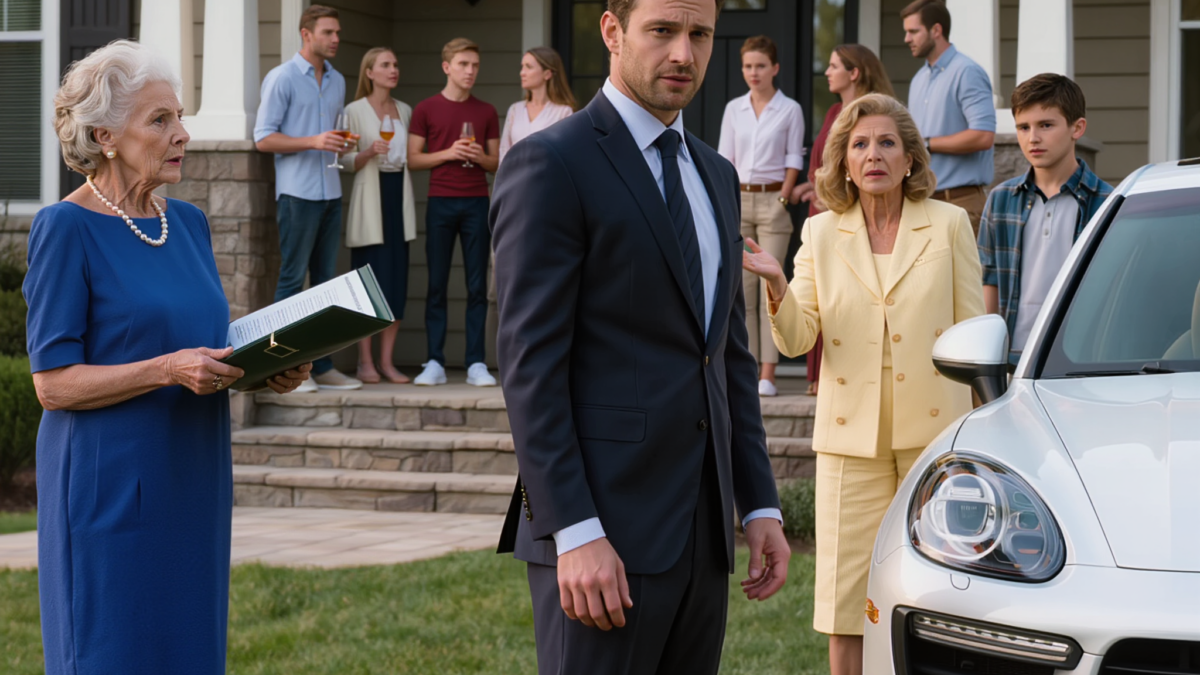
My name is Nathan, and I’m twenty-nine years old. For most of those twenty-nine years, I was my family’s invisible bank account, their silent emotional punching bag, and their fallback plan whenever something went wrong. I was the guy you called when the consequences of your own terrible decisions finally caught up with you. The moment that shattered that arrangement—the moment I stopped being their safety net—came exactly three weeks ago, on a bright, unforgiving Saturday afternoon.
I stepped out of a cheap-smelling rideshare in front of forty of my closest relatives. It was my grandmother’s seventy-sixth birthday party, a massive catered event on the sprawling front lawn of her estate. While I was standing there in the gravel driveway, the rocks crunching loudly under my dress shoes, my heart pounding against my ribs like a trapped bird, I was trying to process the absolute public humiliation of the moment.
My mother, Jordan, glanced at my grandmother and gave her the flawless, practiced smile she used as a real estate agent—the one she wore when convincing young couples that a house with cracks in the foundation was a wonderful investment. Then she said something I will never forget: “Nathan’s brother just needed it more. You know, Nathan, he is so fiercely independent. He does not have a real family yet anyway, so he hardly needs that kind of space.”
She said that right in front of the entire lawn of guests. Aunts, uncles, cousins, and family friends were all holding their iced teas, staring at me. My mother laughed it off, waving her manicured hand gracefully in the air, acting like secretly giving away my $90,000 Porsche Cayenne was just a quirky everyday family decision. She stood there in a pale-yellow designer suit, completely confident that I would just lower my head, swallow the abuse, and play my designated role as the compliant, silent son.
She expected me to nod and retreat. But there is one crucial thing my mother, my golden child brother Tyler, and the dealership service manager who helped them arrange the fraudulent transfer did not know. They had absolutely no idea that my grandmother, a 76-year-old retired school teacher who misses absolutely nothing, was standing right beside the porch columns holding a heavy green leather binder full of certified legal documents. And three weeks later, the very people who laughed at me on that lawn are facing a major legal investigation, sudden unemployment, and the collapse of their carefully curated perfect suburban reputation.
To explain how we got there, I have to go back to where the nightmare actually started.
I work as a senior cybersecurity architect in downtown Baltimore. My entire professional life revolves around looking at incredibly complex corporate networks, finding the hidden vulnerabilities, and building impenetrable firewalls to keep the bad actors out. I spend my days analyzing digital threats, writing exhaustive hundred-page incident reports, and proving to corporate executives that their convenient explanations are usually just flimsy cover-ups for massive data breaches. I am incredibly good at my job.
I possess a natural, deeply ingrained suspicion of systems that look too perfect. Because of my intense dedication, the countless late nights, and the weekend emergencies I have handled over the years, I earn a substantial six-figure salary. I live in a beautiful, modern condo overlooking Baltimore’s Inner Harbor, and I pay every single one of my own bills. I do not ask anyone for help.
I learned very early in life that asking for help in my family came with a heavy, unspoken invoice. If my mother did you a favor, you paid for it with your autonomy and absolute blind loyalty. If my father did you a favor, you paid for it by quietly keeping his secrets and pretending he was a strong, decisive man when he was actually a coward. So, I became a fortress.
I built my own life from the ground up, entirely separate from their constant, exhausting drama. But the bitter irony of my life is incredibly thick. For a guy who gets paid an excellent salary to spot manipulation and digital fraud from a mile away, I was completely blind to the threat actors sitting right across the Thanksgiving dinner table from me year after excruciating year.
Growing up in our affluent Maryland suburb, our house was meticulously managed by my mother as if she were running a cut-throat HOA meeting where any deviation from the rules meant immediate financial and social ruin. Everything in our lives was strictly about appearances. We had to have the greenest lawn in the entire neighborhood, even if it meant my father was out there at 6:00 in the morning on a Sunday spreading toxic fertilizer.
We had to have perfectly coordinated holiday photos where everyone wore matching ivory sweaters and smiled radiantly, looking like we did not just spend two agonizing hours screaming at each other in the living room over misplaced seating cards and burned side dishes. We had to have the absolute perfect narrative to sell to the neighbors, the church congregation, and her wealthy real estate clients. And that narrative was always without fail that my older brother Tyler was the undisputed star of the family.
Tyler was the handsome one. Tyler was the charismatic high school quarterback who could do no wrong in my mother’s eyes. Tyler was the one who married his high school sweetheart right out of college, immediately had two beautiful kids and gave my mother the picture perfect grandchildren she could aggressively parade around at her country club brunches.
But behind closed doors, Tyler was a disaster. When Tyler got into serious legal trouble as a teenager over a reckless-driving charge that involved property damage, my parents completely drained their emergency savings to hire a high-powered lawyer to help him navigate the case and contain the legal fallout. They told the entire extended family he was studying abroad for the summer when he was actually doing court-mandated community service.
When Tyler wanted to buy a house in a ridiculously overpriced school district that he could not afford, my mother miraculously found the money to help him close the real estate deal, secretly dipping into her own retirement funds and taking out a second mortgage on our family home.
I was just Nathan, the quiet kid, the reliable background character who never caused trouble and therefore never warranted any attention or resources. I was the son who did not require a college fund because I quietly worked two grueling jobs. I spent my night stocking heavy boxes at a Walmart until two in the morning and then poured coffee at a local cafe at dawn just to pay for my own degree in computer science. I ate cheap ramen noodles in my freezing dorm room for four years.
I never asked for a dime and therefore my mother assumed my value was measured by how little I seemed to need.
If you have ever been the reliable child in a highly dysfunctional family, you know exactly the agonizing dynamic I am talking about. They call you independent when what they really mean is that they do not want to spare the emotional energy or the financial resources to help you. They call you strong because it gives them the perfect guilt-free excuse to pile all of their heavy emotional and financial garbage onto your shoulders.
I was the guy they called when Tyler needed a massive down payment for his first piece of real estate because his own credit was completely trashed from maxed out credit cards and missed car payments. I was the one expected to quietly dip into my hard-earned salary when my mother decided she wanted to throw an extravagant catered baby shower for Tyler’s wife, aggressively framing it as my duty as a loving uncle to pitch in for the balloon arches and the custom cake. When Tyler went through a brief, dramatic separation, and the word divorce was thrown around.
I was the one expected to pay for his temporary apartment lease so he wouldn’t lose custody of his kids. I swallowed my pride and played my designated part for over two decades because I genuinely thought that was what family did.
I thought if I just gave enough money, compromised my own boundaries enough, and stayed quiet enough in the background, I would eventually earn my rightful seat at the table. I thought one day they would look at me, truly look at me, and realize I was a living, breathing person, not just a permanent, bottomless ATM.
I used to deeply believe all the convenient loving lies my family fed me. I believed the grand speeches about how we are all in this together. I believed them right up until the day my Porsche vanished into thin air. And I realized I was never a beloved son to them. I was simply an unlimited resource to be mined until nothing remained.
I thought the emotional neglect was the worst thing they could ever do to me. I was so incredibly wrong.
The Porsche was never just a vehicle to me. It wasn’t about the premium leather or the horsepower or the shiny status symbol on the hood. It was a literal lifeline from the only two people in the entire world who actually saw me for who I was, who saw past the quiet, compliant, invisible exterior I had built just to survive my mother’s suffocating household.
On the crisp autumn night of my 24th birthday, my grandparents, Walter and Cameron Bennett, took me out to a quiet, dimly lit old school steakhouse on the edge of town. My grandfather, Walter, was a practical, hardworking man with calloused hands. He was a retired contractor who had built a very comfortable fortune in commercial real estate entirely from the ground up, laying bricks and pouring concrete with his own two hands before he ever sat in an office. He did not speak much, preferring to observe the room.
But when he did open his mouth, you shut yours and listened. He commanded respect, not through fear or manipulation, but through absolute unshakable integrity. He was the kind of man who would look at a crumbling foundation and know exactly how to fix it from the inside out, which made him the exact opposite of my mother, who would just slap a fresh coat of cheap paint over the cracks and sell the house to an unsuspecting buyer.
After we finished our meal—massive, perfectly cooked ribeyes that Grandpa insisted on paying for with a crisp hundred-dollar bill—the waiter cleared our plates and Grandpa Walter meticulously wiped his mouth with a white linen napkin. He looked at me, his eyes sharp, clear, and focused entirely on me.
“Walk out to the parking lot with me, Nathan,” he said, his voice low and gravelly. The crisp autumn air hit my face, smelling like fallen leaves and distant wood smoke as we stepped out of the heavy wooden restaurant doors.
The parking lot was mostly empty, save for a few luxury cars belonging to the dinner crowd. Sitting right there, bathed directly under the buzzing yellow glow of a solitary street light was a pristine, brilliant white Porsche Cayenne. It had a ridiculously large red velvet bow fastened awkwardly to the hood, gleaming in the night air. I honestly thought it was a cruel joke.
I looked around waiting for a valet to come claim it and drive it away. At the time, I was driving a beat-up, rusted 2008 sedan with a driver’s side window that would not roll up, a trunk that collected mold every time it rained, and a transmission that slipped violently, jerking my neck every time I tried to merge onto the highway. I spent half my meager entry-level paycheck just keeping that old piece of junk running so I could commute to my tech job. But Grandpa Walter didn’t laugh.
He didn’t point to my rusty sedan. He reached into the pocket of his heavy wool coat and dropped a solid set of keys directly into my open palm. I remember their weight pulling my hand down. I remember the cold metal pressing sharply into my skin. He looked me dead in the eyes and delivered a speech I will carry with me to my grave.
He said, “You earned this, Nathan. The title is clean. I paid cash from my own accounts. There’s no loan, no bank involved, no dealership-financing trap. And there are absolutely no strings attached. But listen carefully, son. Don’t let anybody talk you out of what’s yours. Stand your ground. You’re a good man, but good men get eaten alive if they never learn to lock their doors against thieves. Even thieves who share your last name and sit at your dinner table.”
I cried in that parking lot. I am not ashamed to admit it. The tears came hot and fast, blurring the street lights into streaks of yellow. My grandmother Cameron stepped forward, wrapped her arms around my neck, hugged me tightly, and slipped a beautiful leather keychain with my initials, NP, engraved on it onto the silver ring.
For the first time in my entire life, someone had invested something massive in me without asking for an immediate, draining return on the investment. They didn’t want a piece of my future salary. They didn’t want bragging rights at the country club. They didn’t want me to owe them a favor. They just wanted me to be safe, comfortable, and recognized for the hard work I had put into surviving my own family.
But genuine peace does not last long in my family ecosystem. It is treated as an offensive anomaly that must be swiftly corrected by my mother.
Exactly one week later, we were all gathered at my parents’ house for a mandatory Sunday dinner. Tyler and his wife were there complaining loudly about their adjustable mortgage rates creeping up and how impossibly cramped their crossover SUV was with the new baby, the stroller, and all the gear. My mother was serving roast beef and asparagus, perfectly ignoring the heavy, jealous tension suffocating the dining room. Every time Tyler looked out the window at my gleaming white Porsche parked in the driveway, his jaw tightened.
After dinner, while my father was clearing the plates, my mother casually pulled me aside into the narrow hallway near the kitchen pantry. Away from the prying eyes of the rest of the family, she put her perfectly manicured hand on my arm, deploying that soft, melodic, deeply persuasive voice she uses when she is trying to close a difficult, high-stakes real estate deal with a hesitant buyer.
“Nathan, sweetheart,” she began, tilting her head with manufactured maternal concern.
“You know how unpredictable the world can be. The city can be dangerous. Break-ins happen, and you’re so young. Let me keep the original title to the Porsche in our family safe downstairs. If there’s an accident, or God forbid something happens to you, it’ll be much easier for the lawyers and the insurance companies if the family inheritance papers, life-insurance policies, and other important documents are kept together. It’s only paperwork, honey. It’s for your own protection. You know how disorganized your apartment can get.”
I should have firmly said no. Every single cybersecurity alarm bell in my head was ringing at maximum volume, screaming at me to walk away. My grandfather’s words echoed in my mind: Don’t let anybody talk you out of what’s yours. But I was only 24 years old. I was deeply conditioned by two decades of psychological training to comply with her demands to keep the fragile peace in the house.
If I said no, I knew exactly what would happen. I would face a brutal barrage of emotional warfare. The icy silent treatment for months, the passive-aggressive sighs every time I entered a room, the tearful insinuations that I didn’t trust my own mother who gave me life. I handed her the thick manila envelope bearing the state seal.
Without realizing it, I handed over my leverage. Two days later, she casually handed me back a flimsy, low-resolution black-and-white photocopy. I took the useless photocopy, felt a heavy knot form in my stomach, and put it in my desk drawer right next to my apartment lease and my 401(k) paperwork, and I forced myself not to look at it again. I wanted to believe her. For five years, I drove that car.
It was my absolute sanctuary. After a grueling 12-hour shift analyzing malware and writing threat reports, I would sink into the plush leather seats, close the heavy doors, and the chaotic world would go completely silent. I kept it immaculate. I recorded every single oil change, tire rotation, and fluid top-off in a small, detailed notebook in the glove box.
But the family dynamic never shifted in my favor. I kept securing massive promotions at work. My salary increased substantially and the financial demands from my family escalated in perfect parasitic parallel. When Tyler maxed out his credit cards trying to keep up with his wealthy neighbors by buying a boat he couldn’t afford to dock, my mom guilt-tripped me into covering his kids’ private preschool deposit.
When Tyler decided he wanted to start a risky, ill-conceived side business selling imported fitness equipment that inevitably failed, I was the one aggressively pressured into covering his property taxes so he would not lose his home to foreclosure. I was the permanent safety net. If I said no, I was subjected to weeks of agonizing guilt trips about how I was selfishly hoarding my wealth while my own flesh and blood suffered.
Then this past March, the trap finally snapped completely shut. I was in the middle of conducting a major high-stakes security audit for a major banking client. My brain was fried and I had been living on black coffee for three days. When my phone rang, I almost ignored it. It was my mother. She did not even bother to say hello or ask how I was doing.
She went straight into business mode.
“Nathan,” she said, “Tyler says there’s an urgent software recall for your Porsche’s infotainment system. They’re warning people about a possible fire hazard. The dealership he knows can take it tomorrow morning. Mason Harper, the service manager, owes Tyler a favor from an old real estate deal. He’ll get it sorted immediately, skip the waiting list, and give you a luxury loaner so you won’t be inconvenienced. Tyler will pick up your car tonight.” I was exhausted. I was incredibly overworked, staring at lines of code until my eyes literally blurred and watered.
I did not want to deal with the logistics of car maintenance, waiting in a lobby, or finding a safe dealership in the city.
“Fine,” I said, rubbing my pounding temples. I handed over the keys the very next morning to Tyler, genuinely thinking I was just being a cooperative son handling a routine manufacturer recall. I had absolutely no idea I was handing over my dignity.
I thought I was just getting a software update. I was about to get a brutal life-altering masterclass in family betrayal.
The loaner car Tyler brought me—a dented gray compact sedan that smelled vaguely of stale French fries and cheap pine air freshener—was supposed to be mine for exactly three days. Three days quickly turned into a full week. A week dragged endlessly into a month. Every single time I called my mother to ask about the status of my vehicle, she had a brand-new, detailed, technically plausible excuse ready to deploy.
First, it was the microchips. She claimed the specific microchips required for the recall were on indefinite backorder from a manufacturing factory in Germany. Then, the global supply chain was a complete disaster due to shipping strikes on the coast. When I asked for the service center’s direct phone number so I could yell at them myself, she deflected, saying Mason Harper was personally overseeing a complex electrical issue they found deep in the dashboard wiring, and he didn’t want to release the car until it was perfectly safe to drive.
Because I work downtown where parking is an absolute nightmare anyway, and I mostly work from my home office in my condo, I did not press the issue hard enough. I started taking rideshares to the grocery store. I rented a cheap compact sedan on the weekends if I absolutely needed to leave the city limits for a meeting or a date. My mother knew my schedule, my work habits, and my conflict-avoidant nature perfectly.
She built her elaborate lie right around my convenience, knowing I was too busy hunting down cybercriminals and writing compliance reports to drive thirty miles out to a suburban dealership and demand to see the car with my own two eyes.
Ten full weeks went by. Ten agonizing weeks of me paying out of pocket for expensive rideshares and weekend rental cars while my pristine $90,000 luxury vehicle sat in a phantom repair bay.
The illusion finally violently broke on a random Tuesday afternoon in early May. Tyler’s youngest son had a birthday coming up and because I was trying to be the good, reliable uncle I was programmed to be, I had purchased him an expensive heavy-duty remote-control truck. I decided to drive my rental car out to the suburbs to drop the gift off on my lunch break. I planned to leave it on the porch if no one was home.
I pulled up to Tyler’s immaculate, freshly manicured driveway, grabbed the wrapped box from the passenger seat, and walked toward the side door of his house. The garage door was wide open and parked right there, taking up the entire center bay of his oversized pristine garage, was my white Porsche Cayenne. I recognized my customized license plate and the tiny, unmistakable scratch on the lower-right corner of the rear bumper, left by a stray shopping cart at Whole Foods two years earlier. It was unequivocally, undeniably my car.
But the back windows now had cheap, cartoon sun shades aggressively suction-cupped to the tinted glass. Two massive, bulky toddler car seats were securely strapped into the premium leather interior, permanently denting the upholstery I had spent hours conditioning. A massive double stroller was jammed aggressively into the trunk space, scratching the interior plastic panels. There was a cheap plastic toy steering wheel attached to the back of the passenger seat.
There was a glittery keychain hanging from the rearview mirror.
My blood turned to absolute ice. The world around me seemed to stop spinning. The ordinary sounds of the neighborhood—the lawnmowers, the birds—faded beneath a high-pitched ringing in my ears. I literally could not draw a breath of air into my lungs. I stood there frozen on the concrete, staring at my own vehicle, watching how completely it had been consumed, digested, and repurposed by my brother’s life.
The sheer violation of it was staggering. It wasn’t just that he was driving it to work. He had moved his entire chaotic, messy life into it, claiming it as his own conquered territory.
Tyler walked out of the house carrying a heavy black trash bag, wearing athletic shorts and a T-shirt. He froze instantly when he saw me standing there. He did not drop the bag, but his face completely drained of color, turning a sickly shade of gray. He looked like a deer caught in the headlights of the very car he had taken from me.
“What is my car doing in your garage, Tyler?” My voice did not even sound like my own. It was a dead, flat, hollow whisper that cut through the quiet suburban air like a serrated knife. He shifted his weight nervously from foot to foot, trying to force a casual, brotherly laugh that sounded more like a panic choke.
“Oh, man. Uh, Mom didn’t tell you? We switched.”
“Switched what?” I asked, gripping the gift box so tightly the cardboard crumpled under my fingers.
I heard the plastic toy inside crack.
“The cars, Nathan. Come on, don’t be dramatic. Mom said you agreed to sign the paperwork over to me. You use rideshares in the city anyway. It makes no sense to leave a big SUV sitting in a parking garage. It’s totally legal. Mason handled the title transfer for us at the dealership. Come on, man. I needed something safe for the kids. The brakes on my old car were going out.” For a moment, anger surged through me so fiercely that I had to force my hands to relax. I could have made a scene in that driveway.
Instead, I let the toy truck fall from my hands. It hit the ground with a pathetic hollow thud. I turned around and walked methodically back to my rental car without saying another word.
I sat in the driver’s seat for 20 full minutes with the engine off, my hands shaking so violently I could not get the key into the ignition. My vision was literally blurring with angry tears. The sheer audacity of the betrayal was suffocating. My own mother and brother had conspired to steal a $90,000 vehicle from me, and they genuinely believed I would just accept it.
They thought I was so broken, so thoroughly trained to submit to their needs that I would just nod, smile, and walk away with absolutely nothing.
When I finally managed to drive back to my apartment, I threw my keys on the granite counter and called my mother. She answered on the second ring, sounding perfectly cheerful and completely unbothered, probably expecting me to ask what she was making for Sunday dinner.
“Why is Tyler driving my Porsche?” I asked, skipping any form of greeting. There was a long pause on the line.
Just a fraction of a second, but it was enough to confirm everything. She didn’t gasp. She didn’t act surprised. She didn’t ask what I was talking about. She knew.
“Nathan, lower your voice,” she snapped, switching to the wounded tone she used when she wanted me to look unreasonable.
“Tyler needed it more than you. He has the kids, and his old car was breaking down constantly. It was becoming a serious safety hazard for my grandchildren. You live alone in the city. You work from home in your pajamas. You don’t have a family to worry about.”
“That doesn’t give you the right to take my property,” I said, my voice shaking with anger I had suppressed for nearly three decades.
“What paperwork did Tyler process? You told me the Porsche was going in for a software recall.”
“It was an immediate-family transfer, Nathan. Everything was handled legally. I signed what needed to be signed as the keeper of the family documents. You agreed to it in spirit when we discussed your city lifestyle last Thanksgiving. Stop being so selfish. Tyler is trying to build a life, and you’re acting like a spoiled child over a piece of metal.”
She hung up on me. The dial tone echoed in my silent empty apartment. She genuinely thought I would just take it. She thought I would silently absorb the massive financial loss and the utter dehumanizing disrespect just to keep the peace exactly the way I always did when it came to Tyler. She forgot what I do for a living.
She forgot that I hunt down system vulnerabilities and ruthless digital thieves for sport. She thought I was just a victim. She was about to find out I was the architect of her absolute ruin.
The next morning, I walked into my corporate office looking like an absolute ghost. I hadn’t slept at all. My eyes were bloodshot, the dark circles under them looking like bruises, and my hands were still trembling with residual adrenaline. My coworker, Jason, a brilliant, deeply skeptical guy who used to work in strict corporate compliance and treats the law like an absolute religion, took one look at my face and immediately pulled me into an empty, soundproof glass conference room.
I told him everything. I didn’t hold back to protect my family’s precious image. I laid out the birthday gift, the manipulation over the family safe, the fake repair story, the car seats strapped into my leather interior. I laid out the entire timeline of the manipulation, starting from the day I handed over the keys all the way to the insane phone call with my mother, where she called me selfish for wanting my own car back.
Jason just leaned back in his ergonomic chair, tapped his expensive metal pen rhythmically on the glass table, and looked at me with cold, analytical eyes. He didn’t offer pity. He offered a strategy.
“Nathan, you’re a senior security architect,” Jason said, his voice level.
“Stop thinking like a hurt brother for a minute. Think like a forensic investigator. If a banking client told you their administrator account had been compromised and their money was gone, what’s the first thing you’d check?”
“The access logs,” I said, feeling a small spark of clarity return to my sleep-deprived brain.
“Exactly. Pull the logs on your own life. Treat this like a hostile network intrusion. Don’t react emotionally. Don’t text them. Don’t call them in tears. Document every footprint they left. Build a file.”
That very afternoon, I sat at my dual monitors, bypassed my usual workflow, and logged into the Maryland Motor Vehicle Administration online portal. I paid the $40 administrative fee with my personal credit card to run a full certified title history on my specific vehicle identification number. I entered the 17 digits carefully, my heart pounding painfully against my ribs.
When the PDF finally loaded on my screen, I felt a physical wave of nausea hit me so hard I had to grip the edge of my desk to keep from falling out of my chair. Current owner: Tyler Morgan. Transfer date: April 11. Transfer type: Immediate-family gift. Processing agent: Mason Harper. Dealership employee code: 492.
I stared at that specific date until the black numbers blurred into the stark white background.
I took the rest of the afternoon off. I grabbed my coat and drove my rental car straight to the local MVA branch office on the outskirts of the city. I pulled a paper ticket, sat in a hard plastic chair in the depressing fluorescent-lit room for over an hour alongside people renewing their licenses, and finally sat down in front of a tired clerk named Justin. I slid my state driver’s license across the scratched counter.
“I need the actual transfer document for this vehicle,” I said firmly.
“I believe someone submitted fraudulent paperwork involving my property. I need to see exactly what was filed.” Justin looked at me, looked at his computer screen, typed for a few agonizing minutes, and then printed a single sheet of paper from the massive machine behind him. He highlighted a specific box at the bottom in bright yellow marker before sliding it toward me.
There it was, my signature, or at least a pathetic, loopy, entirely insulting attempt at forging my signature. My real signature is sharp, jagged, and heavily slanted. This signature was rounded, soft, and careful, clearly written by my mother’s hand. Directly below the forged signature was a checked box, a box explicitly confirming that I, as the seller, had appeared in person at the dealership and presented a valid government ID to the processing agent, Mason Harper, on the exact date of April 11th.
I looked up at Justin and smiled. It was not a happy smile. It was the cold, terrifying, calculating smile of a man who had just found the one piece of evidence that could bring the whole scheme down.
Because on April 11th, at the exact time this fraudulent transfer document was supposedly signed in a suburban car dealership in Maryland, I was standing on a brightly lit stage in Atlanta, Georgia, giving a 90-minute keynote presentation on digital security to 500 industry professionals. I couldn’t have been in that dealership unless I had somehow learned to be in two states at once. I needed the definitive, undeniable proof in my hands. I did not want to alert my mother to my investigation.
So, I could not use the family travel agent to retrieve the records as she would immediately tip my mother off.
That night, I did something I had not done in years. I texted my father, William. My dad is a notoriously quiet man. He spent my entire life standing in the shadows, letting my mother run roughshod over everyone’s boundaries. He hated conflict far more than he loved justice. He was a man who survived his toxic marriage and the constant impending threat of divorce by simply agreeing with whatever narrative his wife spun.
He was a coward, but I needed to know if he was a completely complicit coward or just a broken man. I sent him a simple direct text message.
“Dad, I need the flight confirmation and hotel folio from my Atlanta conference in April. Please don’t tell Mom under any circumstances.” I sat in the dark of my living room for three agonizing hours. The silence in my condo felt incredibly heavy.
The city lights reflected off the water in the harbor outside my window. I thought he was going to betray me. I thought he was going to march straight into the master bedroom, wake my mother up, and tell her I was digging around, which would give her ample time to destroy the paper trail, hire a defense lawyer, or invent a new elaborate lie to protect Tyler.
But at exactly 1:15 a.m., my phone chimed on the coffee table. It was an email forward from my dad’s private encrypted email account. Attached were the Delta flight logs showing my boarding passes, the Marriott hotel receipts showing my room charges and check-in times, a clear official conference schedule detailing my panel times, and a single line of text in the body of the email.
“I am so sorry I let her do this to you. Do what you have to do.”
I had the flight logs. I had the hotel folio. I had a professional photograph of myself holding a microphone in Atlanta with a verifiable digital timestamp. And I had a certified state-government document proving beyond a shadow of a doubt that Mason Harper and my golden child brother had committed a carefully documented, potentially criminal act.
The confrontation was drawing closer. My toxic family had absolutely no idea they were standing directly in the path of total uncompromising destruction. I packed every single document into a reinforced manila envelope, locked it inside a heavy fireproof safe, and set my alarm for six the following morning. I was going to visit my grandmother, and I was bringing the logs.
I thought I knew exactly how bad the explosion would be. But looking back now, I had absolutely no idea just how scorched the earth would get.
The morning of my grandmother Cameron’s seventy-sixth birthday party, I woke up long before the sun even considered rising over the Baltimore Harbor. I had not slept a single wink. My mind was running endlessly through the access logs, the flight confirmations, and the state-government documents I had meticulously secured in my fireproof safe. I walked into my kitchen, the hardwood floor cold beneath my feet, and made a strong pot of black coffee.
I stood by my floor-to-ceiling windows, watching the city slowly wake up, watching the cargo ships drift through the gray morning fog. For the first time in my entire 29 years of existence, I was not anxious about seeing my family. I wasn’t feeling that familiar suffocating dread that usually accompanied a Sunday dinner or a holiday gathering. I was completely cold.
I felt like a system administrator who had finally located the malicious code in a network and was preparing to execute a hard, unforgiving reset on a deeply corrupted system.
The birthday party was scheduled for 4:00 in the afternoon at my grandmother’s sprawling estate in Upper Marlboro. It was the house she and Grandpa Walter had bought in the late 1980s: a large, imposing white Colonial with black shutters, a sweeping wraparound porch, and a long gravel driveway that curved elegantly through the manicured front lawn. Everyone who was anyone in our extended family would be there. Aunts, uncles, second cousins, and most importantly, my mother’s wealthy real estate clients whom she regularly invited to family functions just to show off her perfectly staged, completely fictional family life.
I knew my mother’s playbook inside and out. She would have a massive expensive white catering tent set up in the expansive backyard. She would have a buffet featuring expensive Maryland crab cakes and prime rib paid for out of the family trust that she managed. She would be wearing a pastel designer suit floating between tables, managing the optics of our family with the ruthless, calculating efficiency of a corporate CEO dealing with shareholders.
And I knew exactly where my older brother Tyler would be. He would be holding court on the front porch, drinking a craft beer, playing the role of the exhausted but heroic father of two, accepting endless compliments on his beautiful children and his seemingly successful suburban life.
At exactly noon, I grabbed the heavy manila envelope containing my evidence, got into my rental car, and drove up to Upper Marlboro. Arriving hours before the first guests were scheduled to show up, I did not go to the front door. I pulled around to the back alley access road, parked discreetly under a massive oak tree, and walked quietly through the rear garden gate.
My grandmother Cameron was sitting on the back patio. She wore a stunning royal-blue dress and a classic string of pearls, drinking iced tea, and looking out over her rose garden. She was a woman who never rushed, never panicked, and never missed a single detail. She watched me walk up the winding stone path, her sharp, intelligent eyes taking in my rigid posture, my unsmiling face, and the thick envelope tucked securely under my right arm.
“You look exactly like your grandfather did on the day he caught a general contractor stealing copper wiring from one of his commercial build sites,” she said, her voice steady, clear, and devoid of any grandmotherly coddling. I pulled out one of the heavy wrought-iron patio chairs and sat down across from her. I did not exchange pleasantries. I did not ask how she was doing.
I opened the manila envelope, laid the documents on the glass table between us, and lined them up with precision. I showed her the certified title history I had pulled from the state database. I showed her the glaringly obvious forged signature on the official transfer document. I pointed out the specific employee code belonging to Mason Harper, the service manager who had processed the transfer at the dealership.
And finally, I laid down the Delta flight logs, the Marriott hotel receipts, and the time-stamped photograph proving that I was standing on a brightly lit stage in Atlanta, Georgia at the exact moment I supposedly signed my $90,000 vehicle over to my brother in a Maryland dealership.
Grandma Cameron did not gasp. She did not cry. She did not act shocked. She calmly reached into her purse, put on her reading glasses, leaned forward, and read every single line of every single document. She read the dates. She scrutinized the forged signature. She examined the flight times. The silence on that back patio was so heavy, so dense, it felt like the barometric pressure was dropping right before a massive hurricane.
When she finally finished reading the flight logs, she took off her glasses, neatly stacked the papers back together, aligned the edges perfectly, and placed her hands flat on top of the pile. She looked up at me, and I saw a flash of anger in her eyes that was so cold, so ancient, it actually made me shiver in the warm afternoon air.
“Two months ago,” Grandma said quietly, “your mother asked over coffee whether Walter and I ever intended the Porsche to be a shared family asset. I told her absolutely not. It was a gift for you alone, a reward for your hard work and your integrity. She actually argued with me. She said Tyler was facing a possible divorce and messy custody issues. She claimed his finances were a disaster and that an ambitious real estate agent needed a reliable luxury vehicle to show properties to wealthy clients. I told her Tyler’s bad decisions weren’t yours to finance, and they certainly weren’t mine to subsidize.” I gripped the arms of my patio chair, my knuckles turning white.
“Did you know they actually took it?” I asked.
“I suspected it,” she replied, her tone sharpening with frustration at herself.
“Tyler brought the kids over last week. He parked the Porsche behind the detached garage, where he clearly thought I wouldn’t see it from the kitchen window. When I asked about it, he told me you’d generously loaned it to him for the summer while you traveled for work. But Tyler is a terrible, sloppy liar. Your mother is too arrogant to cover her tracks properly. She thinks she’s the smartest person in every room. I was waiting for you to figure it out, Nathan. I needed to know whether you would accept what they did or finally stand up for yourself, the way Walter taught you.”
“I’m locking the doors today,” I said, my voice barely above a whisper.
“I’m shutting the whole system down.”
Grandma Cameron nodded approvingly. It was the proudest she had ever looked at me. She took the manila envelope from the glass table and stood up, smoothing the front of her blue dress.
“Leave these documents with me. I have a green leather binder in my study where I keep the family trust records, inheritance arrangements, retirement-account distributions, and property deeds. These papers belong there. They’re part of the permanent family record now.”
“What’s the plan?” I asked, standing with her.
She looked down at me, adjusting her pearl necklace with absolute calm.
“You’re going back to the city. Put on your sharpest suit, and at exactly four-thirty, when the lawn is full of guests, arrive in a cheap rideshare. Walk up that gravel driveway with nothing in your hands. Not a single piece of paper. You come as my grandson. I’ll handle the paperwork.”
I left through the back gate, feeling lighter than I had in years. I drove back to Baltimore, took a long, scalding hot shower, and put on my tailored custom fit navy blue suit. I tied my tie perfectly. I checked my watch. I waited. The anticipation was vibrating in my bones, humming through my nervous system. I was not nervous. I was deeply ready for war.
At 3:30, I opened my phone and ordered a rideshare. The driver was an older man named Trevor in a battered, ten-year-old silver Honda Civic with a cracked windshield. He asked me if I was going to a fancy wedding given the suit. I told him I was going to a demolition site. He laughed thinking it was a dry corporate joke.
He had no idea.
We pulled onto the winding tree-lined country roads of Upper Marlboro right at 4:30. As we approached my grandmother’s sprawling property, the street was heavily lined with expensive sedans, Mercedes SUVs, and luxury cars belonging to the various guests. Trevor turned the rattling Honda carefully into the wide gravel driveway. The scene was exactly as I had predicted.
The massive white catering tent was set up in the lush backyard, billowing slightly in the breeze. Gold and royal blue balloons were tied to the porch railings. Forty people were mingling on the front lawn, holding clear plastic cups of lemonade and expensive catered cocktails. And parked right there, dead center in the circular driveway, exactly where every single arriving guest was forced to walk past it and admire it, was my white Porsche Cayenne. It was freshly washed.
The chrome wheels were shining brilliantly in the afternoon sun. The cartoon sun shades were still stuck to the back windows, a glaring insult. Tyler had parked it there intentionally as a massive status symbol. He wanted everyone to see it. He wanted the entire extended family to marvel at his incredible success and his beautiful life. Trevor stopped the Honda right behind the Porsche.
I tipped him fifty dollars through the app, opened the door, and stepped out onto the gravel. The sharp crunch of my dress shoes on the loose gravel carried across the lawn. Conversations on the lawn began to taper off instantly. Heads turned in my direction. My cousin Sarah pointed at the departing rideshare.
My aunt Vivien lowered her expensive sunglasses, peering at me over the rims. Tyler was standing on the top of the porch steps holding a frosted glass of imported beer, loudly laughing at a joke one of his buddies had just made. He saw me stepping out of the rideshare and his laughter died instantly in his throat. The color completely drained from his face, leaving him looking sickly and panicked.
My mother, Jordan, was standing near the massive oak front door, wearing the exact pale yellow designer suit I had pictured in my mind. She saw me stepping out of the battered Honda Civic. Her eyes darted frantically from me to the departing Uber to the gleaming Porsche and then back to me. She immediately plastered on her flawless, practiced, entirely fake smile and started marching down the wooden porch steps to intercept me before I could speak to anyone else.
She desperately wanted to control the narrative before I could even open my mouth and ruin her perfect afternoon. But Grandma Cameron was faster—much faster. The heavy oak front door opened wide. My grandmother stepped out onto the porch. She was not wearing her pleasant party smile. She was holding a thick green leather binder tightly under her left arm. She walked to the very edge of the porch, looking out over the crowd of forty people.
The lawn went terrifyingly silent. You could literally hear the ice clinking softly in people’s glasses. Grandma Cameron looked directly at me, standing alone next to the Porsche, and she projected her voice so every single person on that property could hear her clearly.
“Nathan, baby,” she called out with carefully staged confusion.
“Why on earth are you arriving in a rideshare? What happened to the $90,000 Porsche that Walter and I bought you for your twenty-fourth birthday? Where is your car?”
The silence that followed was absolute. It was a suffocating, incredibly heavy silence. Everyone froze in place. My mother stopped dead in her tracks halfway down the lawn. She spun around to face my grandmother, her eyes wide with forced innocence. She let out a high, artificial, incredibly grating laugh, waving her manicured hand dismissively at the crowd.
“Oh, Mama, please don’t make a fuss over nothing,” my mother said loudly, projecting her voice, making sure her wealthy real estate clients could hear how incredibly reasonable and maternal she was being.
“We handled this minor vehicle issue months ago. Tyler’s old car kept breaking down, and he needed something safe for the children. Nathan’s brother just needed it more. Nathan is so fiercely independent. He lives downtown and takes rideshares everywhere anyway. He doesn’t have a family of his own yet, so he hardly needs all that space. He was more than happy to help his older brother. It was a beautiful family decision.”
My mother turned back to the crowd, smiling broadly, inviting them to endorse her entirely fabricated narrative of the generous, independent bachelor uncle and the hard-working, deserving father. A few clueless people nodded awkwardly, murmuring their approval. Tyler took a deep, shaky sip of his beer, looking incredibly smug, his arrogant confidence returning now that our mother had provided the perfect bulletproof cover story. I just stood there in the gravel, my hands resting casually in my pockets.
I looked at my mother soaking in her delusion. I looked at Tyler soaking in his theft. And then I looked at my grandmother standing tall on the porch. The trap was perfectly set. The complacency of my abusers was absolute. They had walked straight into the situation Grandma had arranged, never imagining their version of events would be challenged.
Grandma Cameron did not smile back at my mother. She slowly, deliberately unclasped the heavy brass latch on the green leather binder. The metallic click echoed across the silent lawn.
“Is that the absolute truth, Nathan?” Grandma asked, her voice cutting through the humid afternoon air.
“Did you willingly give your $90,000 vehicle to your brother?” I took a slow, deliberate breath.
I locked eyes with my mother, watching the fake smile tremble on her lips.
“No, Grandma,” I said, clearly enough for everyone to hear.
“I did not.”
The smug, arrogant expression vanished from Tyler’s face instantly, replaced by sheer, unadulterated terror. My mother’s jaw tightened so hard I thought her teeth might crack. The muscles in her neck ticked visibly under her expensive makeup. She took a threatening step toward me, closing the distance, her voice dropping into a harsh, venomous warning hiss that was still loud enough for the first few rows of frozen guests to hear clearly.
“Nathan, stop this right now,” she commanded, her eyes flashing with a rage she usually reserved for closed doors.
“You’re embarrassing the entire family. We have important guests here. My clients are here. You agreed to the title transfer. Mason Harper handled the dealership paperwork as a professional favor. It was a perfectly legal family transfer. Don’t cause a scene over a car you hardly use and ruin your grandmother’s birthday.”
“A legal family transfer,” Grandma Cameron repeated from the porch, as though testing the words for their meaning. She opened the green binder and flipped past the first few tabs. Her movements calm and terrifyingly precise.
“Let’s talk about legal transfers, Jordan,” she said.
“Let’s talk about official paperwork.”
My father William, who had been hiding near the catered beverage station, hoping to avoid any interaction, slowly walked to the edge of the porch. He looked physically ill, his skin ashen. He kept his head down, absolutely refusing to make eye contact with my raging mother.
Grandma Cameron pulled a crisp, laminated purchase invoice from the binder and held it high enough for the crowd to see.
“This is the original invoice from five years ago. Buyers: Walter and Cameron Bennett. Gift recipient: Nathan Parker. Paid in full, in cash. No bank liens, no family-trust clauses. Individual ownership, free and clear.”
She carefully placed it back and pulled out a second sheet of paper.
“And this is the certified title history pulled from the Maryland Motor Vehicle Administration database yesterday afternoon. It shows an ownership transfer dated April 11 of this year. The new titled owner is Tyler Morgan. The processing agent is Mason Harper. Employee code 492.”
Tyler dropped his expensive imported beer. The glass shattered violently on the wooden porch planks. Amber foam and shards of glass scattered across the deck, but nobody looked down. Every single pair of eyes on that lawn was glued to the green binder in my grandmother’s hands.
“Tyler,” Grandma Cameron said, her voice carrying over the lawn, “did you process this paperwork?”
“Grandma, come on. Please,” Tyler stammered, raising his hands defensively and stepping away from the broken glass.
“It was just a family thing. Mom had the original title in the safe. She brought it to the dealership. She told Mason that Nathan said it was fine, that they’d talked about it. Mason pushed the paperwork through to save us the trouble of dragging Nathan down there. It’s no big deal. It stays in the family.”
“It is a very big deal, Tyler,” she replied coldly.
“The document states that Nathan appeared in person, signed it, and showed a government-issued ID to the processing agent. Mason certified that those things happened. If they didn’t, the filing is fraudulent, and the people involved could face serious charges.”
My mother marched aggressively up the porch steps. Her face flushed red with absolute fury. She tried to reach out and snatch the binder, but my grandmother stepped back smoothly, pulling it completely out of reach.
“Mama, give me those papers right now,” my mother hissed, abandoning her composed real estate persona.
“You’re making a spectacle out of a misunderstanding. I signed the transfer as the manager of the family assets. Nathan works all the time. He sits behind a computer twelve hours a day. I was saving him a trip to the suburbs. Yes, I signed his name, but he gave his spiritual consent. He knew about it. He wanted his nephews to be safe.”
“Spiritual consent,” I said, amazed she could speak those words with a straight face.
I walked up the porch steps until I was standing right next to my grandmother, looking down at my mother. I turned to face the crowd of staring relatives and shocked clients.
“That’s a fascinating legal term, Mom. Did Mason Harper also verify my spiritual ID when he checked the box confirming that I was standing in front of him on April 11?” My mother glared at me, her eyes burning with hatred.
“Nathan, shut your mouth. You travel constantly. You forget things. You agreed to this before one of your ridiculous tech trips. You’re just being spiteful because you want attention.”
I smiled. The digital kill switch was firmly in my hand. The code was written and I executed the command without a single second of hesitation.
“On April 11,” I announced, projecting my voice so everyone on the lawn could hear, “at the exact time Mason Harper supposedly verified my signature at a dealership in Laurel, Maryland, I was on a stage in Atlanta, Georgia, giving a ninety-minute keynote on network security architecture to five hundred corporate executives.”
The collective gasp from the crowd was audible. It rippled through the lawn like a wave. Aunt Vivien covered her mouth with both hands, her eyes wide. A client in a golf shirt slowly set his plate of crab cakes down on a table and took a massive step backward. My mother shook her head frantically, her perfect hair coming undone.
“That’s a lie! You’ve confused your dates. You travel too much. You signed it before you left. You’re making this up to humiliate me!” Grandma Cameron calmly pulled three more pieces of paper from the very back of the binder. She did not hold them up for the crowd to read. She held them directly in front of my mother’s face.
“These are Delta flight records,” Grandma said, her voice almost unnaturally calm.
“This is a Marriott hotel folio showing room charges and check-in times for April 11. And this is a time-stamped conference photograph of Nathan holding a microphone in Georgia that afternoon. He wasn’t in Maryland. He didn’t sign that paper. You signed your own son’s name, Jordan. And you involved Tyler and a dealership employee in a fraudulent transfer of a $90,000 vehicle.”
My mother stared blankly at the flight logs inches from her nose. The devastating reality of the trap finally closed tightly around her throat. She looked at me, her eyes wide with genuine, unadulterated panic for the first time in my life. She realized she couldn’t spin this. There was no PR move, no fake smile that could erase federal flight records.
“How did you get these?” she whispered, her voice trembling.
“You didn’t go through the family travel agent. They would have alerted me if you requested the records. I monitor your mail.” I looked at her, soaking in the absolute betrayal that she admitted to monitoring my life just to control me. And then I looked past her shoulder.
My father William stepped forward from the dark shadows of the porch awning. His hands were shaking violently by his sides, his face pale, but his jaw was set with a firmness I had never seen before.
“I sent them to him,” my father said, his voice surprisingly loud over the stunned crowd. My mother whipped around so fast she almost lost her balance on her heels.
She faced her husband of 35 years, looking like she had just been physically struck across the face with a baseball bat.
“William, you gave him the logs? You went behind my back. You betrayed your own family!”
“I stopped betraying my son,” my father replied, hot tears standing in his eyes, his voice cracking with decades of suppressed emotion.
“You told me Nathan agreed to the transfer. You looked me in the eyes in our kitchen and lied to me, Jordan. You used me to cover up the theft of our own son’s car. I’m done keeping your secrets.”
The porch descended into complete, utter chaos. Tyler was pacing frantically back and forth through the spilled beer and broken glass, dragging his hands roughly through his hair, muttering hysterically about how he was going to lose his house, how his wife was going to divorce him, how he was going to lose custody of his kids if he got a criminal fraud record.
My mother was hyperventilating, her chest heaving as she tried to grab my father’s arm, begging him to take it back, but he physically stepped away from her, pulling his arm out of her grasp, leaving her standing entirely alone in the dead center of the porch. I stood there feeling the heavy, suffocating weight of 29 years of emotional abuse, financial manipulation, and deep, aching invisibility lift entirely off my shoulders. I was not the invisible bank account anymore. I was not the fallback plan.
I was the absolute architect of their accountability and the structure I had built was flawless.
The fallout from the confrontation was immediate, brutal, and utterly devastating for my mother and brother. Grandma Cameron closed the green leather binder with a sharp, definitive echoing snap. The sound cut through my mother’s hysterical sobbing and Tyler’s frantic pacing. She looked down at my mother, who was now weeping genuine tears of absolute panic, her mascara running, completely stripped of her powerful real estate agent armor.
She looked small, pathetic, and deeply guilty.
“Yesterday morning,” my grandmother announced to the stunned crowd, her voice unwavering, “I met with my attorney, Arthur Coleman. We filed a detailed fraud complaint with the Maryland Motor Vehicle Administration concerning the title transfer. The title is under review while the state investigates. Arthur has also prepared a formal notice that will be mailed on Monday to the dealership’s corporate compliance office, outlining how Mason Harper used his employee credentials to verify a forged document.”
Tyler stopped pacing. He stood frozen amidst the broken glass of his dropped beer. He stared at our grandmother in absolute wide-eyed horror.
“Grandma, you can’t do that,” Tyler pleaded.
“You can’t involve lawyers. Mason will lose his job. He has a massive mortgage. I have a mortgage. They’ll press criminal charges. They’ll involve the police. You’re going to ruin my life over a car!”
“I’m not ruining your life, Tyler,” Grandma Cameron said evenly.
“You made your choices when you decided your younger brother’s property was yours to take. There are legal consequences. I won’t shield you from them, and I won’t pay a dime toward your defense.” She turned her sharp, unforgiving attention back to my mother, who was currently leaning heavily against the porch railing for physical support.
“Jordan, as of this morning, Arthur Coleman has completed the paperwork removing you as a secondary trustee of the family trust. You no longer control the inheritance accounts, the grandchildren’s college funds, or the commercial-property records Walter left behind. You will never manage another dollar of my money or Walter’s money again.”
My mother let out a guttural sob and collapsed into one of the heavy wooden patio chairs, burying her face in her trembling hands. The public humiliation was absolute and irreversible. Her wealthy clients, the people she spent years meticulously trying to impress and sell houses to, were quietly, awkwardly setting their drinks down on the catered tables and power walking toward their expensive cars, desperate to escape the blast radius of our massive family implosion. The whispers among the aunts and uncles were deafening.
Then cutting through the murmurs of the fleeing guests, the low, heavy, rumbling sound of a massive diesel engine echoed down the quiet suburban street. Everyone remaining on the lawn turned to look. A massive heavy-duty flatbed tow truck was backing slowly, methodically up the long gravel driveway. The flashing yellow strobe lights on the roof of the cab cast harsh rotating shadows across the manicured green grass and the white catering tent.
The tow truck driver, a massive bearded guy in a high-visibility safety vest, hopped out of the cab. He walked over to the Porsche, completely ignoring the stunned crowd. He looked at the customized license plate, checked a heavy metal clipboard in his hand, and then looked up at the crowd gathered on the porch.
“I have a court-approved recovery order arranged through Arthur Coleman’s office for a white Porsche Cayenne, license plate ending in 4492,” the driver announced, his voice booming over the diesel engine.
Grandma Cameron reached into the deep pocket of her blue dress, pulled out the heavy set of original keys, the spare set she had secretly kept since the exact day Grandpa Walter bought the car five years ago, and tossed them directly over the railing to the tow truck driver. He caught them easily with one hand.
“Load it up,” she instructed him.
Tyler let out a desperate animalistic sound. He ran recklessly down the porch steps, almost tripping over his own feet, and grabbed the tow truck driver’s thick arm.
“Wait! Stop! You can’t take it. My kids’ car seats are in there! My work files are in the trunk. My garage-door opener and my house keys are on the visor!” Grandma Cameron didn’t even blink. She looked over at Aunt Vivien, who had been watching the entire scene unfold with intense fascination.
“Vivien, please go stand with Tyler in the driveway while he removes his personal belongings from Nathan’s vehicle. Ensure he takes absolutely nothing else. If he tries to take the floor mats, call the police.”
Aunt Vivien, who had silently, bitterly hated my mother’s arrogance and Tyler’s entitlement for decades, marched down the wooden stairs with immense visible satisfaction. I stood firmly on the elevated porch and watched my golden child brother completely humiliate himself in broad daylight under the harsh flashing yellow lights of the tow truck. He had to open the back doors of my Porsche and frantically unbuckle the heavy, bulky toddler car seats, wrestling with the straps while his hands shook, he dragged the massive, dirty double stroller out of the pristine trunk, dumping it unceremoniously onto the sharp gravel driveway.
He pulled his sweaty gym bags, his cheap plastic toys, and his fast-food wrappers out of the premium leather interior. He had to pile all of his literal and metaphorical garbage onto the rocks while dozens of relatives watched him in deafening, judging silence. The tow truck driver calmly hooked the heavy steel winch to the front axle of the Porsche and slowly mechanically dragged it up the steep metal ramp of the flatbed. The thick chains rattled loudly, providing a harsh metallic soundtrack to the absolute end of my family’s toxic reign of manipulation.
My mother didn’t even look up from her hands. She just continued to sob into her palms. My father stood rigidly by the front door, looking at me with a complex mixture of profound sorrow for what our family had become and quiet, undeniable pride that I had finally stood up for myself. He had finally found his backbone, even if it had taken him thirty years to find it.
When the Porsche was securely strapped to the flatbed with heavy nylon ties, the driver climbed back into the cab, blew the air horn once, and drove away, the yellow lights flashing into the distance as the $90,000 stolen asset disappeared down the road. Grandma Cameron turned to the few remaining shell-shocked guests on the lawn.
“The catering is fully paid for,” Grandma announced.
“The bar is stocked and open. Please enjoy the food and the cake. But the entertainment portion of the afternoon is over. If anyone intends to discuss this incident with Jordan, you may leave now.”
Nobody stayed. Within 20 agonizing minutes, the massive front lawn was completely empty. The only thing left behind was the crushed plastic toy truck I had dropped in Tyler’s driveway earlier that week, which he had ironically tossed into the back of the Porsche and was now sitting abandoned, broken, and useless in the gravel.
Three very long, intensely transformative weeks have passed since the explosive birthday party in Upper Marlboro. The silence in my life has been almost deafening, and at the same time it has been the most beautiful, peaceful thing I can remember. Mason Harper, the service manager who had processed the transfer, was unceremoniously fired from the dealership just two days after Arthur Coleman sent the certified compliance letter outlining the felony fraud. The dealership’s corporate ownership, absolutely desperate to avoid a massive, highly publicized lawsuit and a criminal investigation regarding fraudulent title transfers, fully cooperated with the MVA.
The fraudulent transfer was immediately reversed. A brand-new, clean title was issued solely in my name, mailed directly to my secure condo address with absolutely no secondary contacts, family trusts, or safe-deposit boxes listed.
Tyler has been calling me relentlessly. He has left increasingly desperate, rambling voicemails at all hours of the night. His wife found out about the extent of the fraud and is currently threatening a messy divorce, explicitly citing his reckless legal behavior, his impending unemployment if the criminal charges stick, and his overall financial instability. He begged me to call Arthur Coleman and drop the MVA investigation, tearfully promising to pay me back for the rental cars, the Ubers, and the emotional distress.
I saved every single one of his voicemails in a secure digital folder on my encrypted hard drive, but I have not returned a single call. I refused to be his emotional or financial safety net ever again. He is learning for the absolute first time in his 32 years of entitled life that gravity actually applies to him and the ground hurts when you fall.
My mother, unable to accept her total loss of control, tried to stage a highly dramatic intervention. She showed up unannounced at my secure condo building last week, crying hysterically in the marble lobby, demanding the concierge let her up to my floor because it was a family emergency. I didn’t even go downstairs. I simply called the front desk and told building security to permanently ban her from the premises, threatening to call the police for trespassing if she didn’t leave immediately.
I spent that entire afternoon removing her name as my emergency contact at work, at my doctor’s office, and on my substantial life insurance policy. I officially replaced her name with Jason, my incredibly loyal coworker who helped me pull the logs and my grandmother.
My father and I had breakfast at a quiet, unassuming diner downtown last Sunday morning. He looked 10 years older, completely exhausted by the impending, highly contentious divorce proceedings my mother initiated in a fit of vindictive rage after losing total control of the family trust and her pristine reputation. We didn’t talk about the car. We didn’t talk about Tyler.
We talked about his deep regrets, his decades of cowardice, and his genuine desire to actually know the son he actively ignored for three decades in order to keep his angry wife happy. I told him very clearly that forgiveness is not a simple switch you flip. It is a long, difficult road built on consistent actions, not apologies. But I agreed to meet him for coffee once a month.
It is a strict boundary, but it is a start.
Yesterday afternoon, the weather was perfect, so I drove my rental car back out to Upper Marlboro one last time. The heavy, beautiful white Porsche was sitting gleaming inside my grandmother’s detached garage. The interior had been professionally detailed and sanitized. The heavy dents from the toddler car seats were expertly steamed out of the premium leather.
The lingering smell of cheap pine air freshener and stale French fries was completely gone, replaced by the rich, comforting scent of clean upholstery.
Grandma Cameron was waiting for me in the kitchen. She poured me a cup of strong black coffee and slid a small, heavy object across the smooth granite island. It was a brand-new keychain, solid, heavy brass, polished to a shine. I picked it up, feeling the weight of it. On one side, it had my initials, NP, deeply engraved, just like the leather one she gave me 5 years ago in that steakhouse parking lot.
I flipped it over. On the back, etched deeply into the cold metal, were two words: NOT AVAILABLE. I looked up at her, a genuine, unburdened smile breaking across my face for the first time in months.
“Is this a warning to the rest of the family?” I asked, tracing the letters with my thumb.
“It’s a permanent reminder for you, Nathan,” she said softly, her eyes full of fierce love.
“You spent your entire life being endlessly available for people who only ever wanted to empty your pockets and drain your spirit. You are a brilliant, highly successful, independent man. Do not ever let anyone use your strength as an excuse to hand you their heavy burdens. You keep your doors locked and you keep your engine running for yourself.”
I put the new brass keychain onto the silver ring, pocketed the heavy keys, and walked out to the garage. I sat in the driver’s seat of my car, gripped the leather steering wheel, and turned the key. The engine roared to life, a deep, powerful sound that vibrated through my chest and shook dust from the garage floor.
It sounded exactly like freedom. If you take absolutely anything away from my story, let it be this. Being the reliable, strong person in your family is not a badge of honor if it requires you to sacrifice your own future, your own hard-earned assets, and your own mental peace of mind. Check your documents, check your titles, check your credit reports, keep your original paperwork in a fireproof safe that only you have the combination to.
Never ever let someone protect a thing by removing it from your control. Lock your doors against thieves.








