At Christmas Dinner, My Dad Mocked My Empty Wallet — Then The Bank Announced My Billionaire Status.
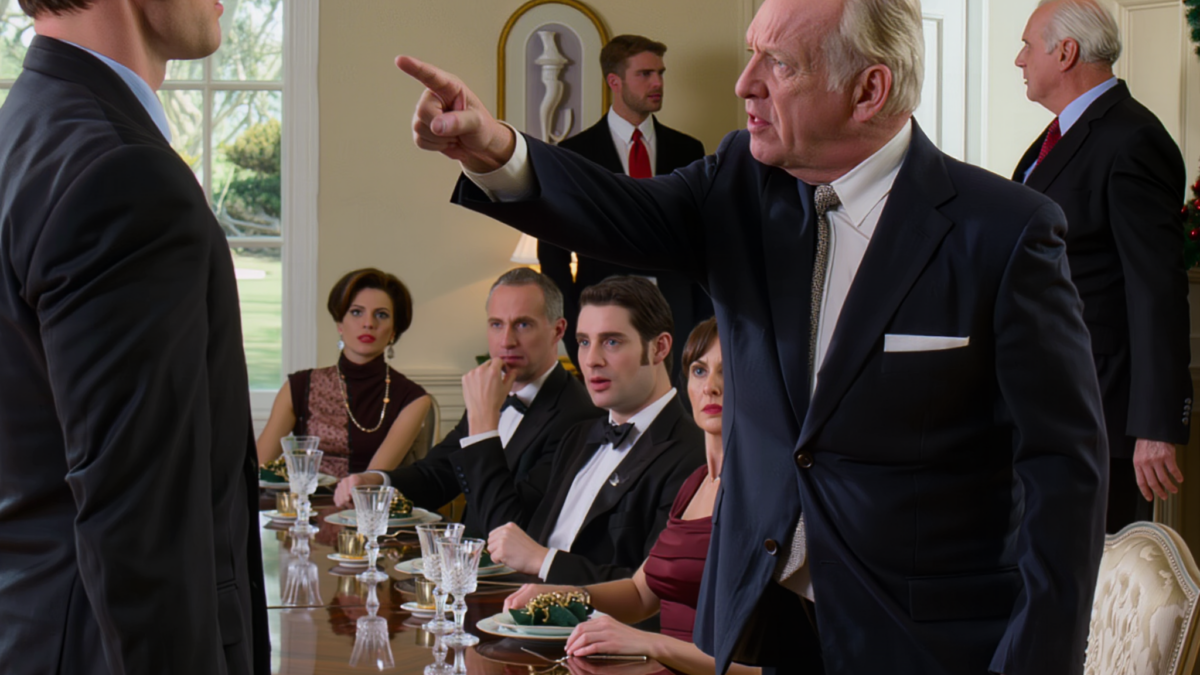
My name is Liam Holloway. I’m 32 years old, and seven years ago, my own father, a ruthless Wall Street CEO, threw me out of his mansion with absolutely nothing to my name.
I stood on his freezing driveway, wondering how I was going to survive the night. He looked me straight in the eye and told me my life was a complete waste and that I would never amount to anything.
He laughed alongside one of his executives as the heavy oak doors slammed in my face, cutting me off from my family.
But there was something he didn’t know.
The financial empire he had spent his entire life building was quietly crumbling. And the anonymous billionaire he was now begging to save him from financial ruin was me.
Tonight, he was going to find out.
I stood outside the Skyline Sovereign Club on Christmas Eve, watching my breath turn to frost in the bitter New York air. The wind coming off Central Park was brutal, cutting straight through my coat, but I barely felt it.
My blood was running hot with quiet, calculated anticipation.
It had been seven long years since I had set foot in a room with my family. Seven years since I had heard my mother’s voice in person. Seven years since my father told me that my existence was nothing but a disappointment.
And now, here I was.
I was wearing a simple, off-the-rack dark suit that I could have purchased at any midrange department store, like Macy’s. I carried an ordinary leather wallet that probably cost less than the imported caviar they were serving inside.
I had dressed this way entirely on purpose.
I wanted them to see exactly what they expected to see. I wanted to know whether anything had changed or whether they would still look at me the way they always had, as though I were a stain on their perfect family portrait.
The doorman, a towering man in a gold-trimmed uniform, nodded as I approached.
“Your name, sir?”
“Liam Holloway.”
His expression remained perfectly blank. He didn’t recognize me.
Why would he?
To Manhattan’s high society, Liam Holloway was a complete nobody. I was a ghost who had vanished from their gilded halls and never returned.
But I knew a secret that was about to shake everything they believed.
I pushed through the heavy glass doors and stepped into a lobby illuminated by crystal chandeliers, filled with the scents of expensive perfume and fresh pine.
A string quartet played holiday standards somewhere in the distance. Waiters in crisp white jackets carried silver trays of vintage champagne.
This was my father’s world.
It was the world of banking dynasties and corporate executives, where a person’s worth was measured by real estate portfolios, inheritances, and annual salaries.
The maître d’ led me through a maze of private dining rooms, his polished shoes making almost no noise against the thick carpeting.
We finally reached the enormous double doors reserved for the Holloway family Christmas dinner.
I paused at the entrance, steadying my breathing.
Through the frosted glass panels, I could see people moving around the room. I heard the low, commanding rumble of my father’s voice rising above the polite laughter.
Arthur Holloway.
CEO of Holloway Securities.
A man who had built an empire managing other people’s money and developed an unshakable belief that he was superior to everyone around him.
I opened the door.
The heavy wood groaned slightly.
Conversation stopped immediately.
Every head in the room turned toward me.
My mother, Margaret, sat frozen at the table, a crystal wineglass halfway to her lips. She looked older than I remembered, her face tense with years of suppressed anxiety.
My older brother, Julian, stood near a floor-to-ceiling window. His expression shifted from shock to guilt, followed by something that looked remarkably like panic.
His wife, Clara, pressed a hand against her chest as if she were watching an accident unfold in slow motion.
And there, sitting at the head of the long mahogany table, was my father.
He looked slightly older than I remembered.
The silver in his hair had spread, and deeper lines surrounded his mouth, but his eyes were exactly the same.
Cold. Calculating. Measuring everyone against standards only he understood.
“Liam.”
He said my name as though it were a bad investment he was legally required to acknowledge.
“You actually came.”
“You invited me,” I replied, keeping my voice level.
“I thought perhaps time had taught you something.”
He scoffed softly and gestured toward an empty chair at the far end of the table.
It was as far away from him as physically possible without placing me in the hallway.
“Sit. We were just discussing the new partnership with Reed Capital. Important business. Try to keep up.”
I took my seat without another word.
A waiter immediately appeared beside me, offering a flute of champagne.
I accepted it but didn’t take a sip. I needed my mind perfectly clear tonight.
The conversation quickly resumed, flowing around me as though I weren’t there.
My father spoke at length about his brilliant strategies, his inevitable success, and the grand legacy he intended to leave behind.
The other guests were business associates and family friends who had known me since childhood. They nodded along obediently.
Not a single person asked where I had been.
Not one asked how I was doing.
I might as well have been another piece of furniture.
Thirty minutes into the meal, the main course was cleared.
My father set down his knife and fork with deliberate precision. He dabbed his linen napkin against his lips and turned directly toward me.
“So, Liam.”
His voice carried across the room, silencing every other conversation.
“I have to ask. Are you still cleaning hotel bathrooms to pay your rent? Or have you finally found a real job?”
The question was carefully designed to humiliate me in front of his peers.
He knew exactly which memories would hurt.
“I’m doing fine, Arthur,” I replied quietly.
I deliberately refused to call him Dad.
“Fine?”
He repeated the word with a contemptuous smirk.
“Fine is what mediocre people say when they have absolutely nothing to show for themselves.”
He glanced around the table, making sure everyone was paying attention.
“Do you know what I was worth at your age, Liam? I’d already made my first ten million dollars. I was sitting on three corporate boards. I was building a legacy for this family.”
He leaned back.
“What do you have to show for 32 years of life? A rented apartment somewhere in the outer boroughs? A used car that barely starts in the morning?”
I felt the familiar heat rising in my chest.
The old anger. The suffocating shame.
For a moment, I was 25 years old again, standing in his study while he tore apart everything I had worked to achieve.
But I wasn’t 25 anymore.
And I knew something he didn’t.
“I have enough,” I said clearly.
My father laughed loudly, the unpleasant sound echoing off the high ceiling.
“Enough! Listen to him, everyone. He has enough!”
He looked around triumphantly.
“Do you know the difference between people who have enough and people who run the world? Drive. The willingness to push past whatever stands in your way. You never had it.”
“Arthur, please.”
My mother’s voice was barely a whisper from across the table.
“Perhaps this isn’t the time.”
“No, Margaret. This is exactly the time.”
He snapped the words at her before fixing his cold gaze on me.
“I invited you here tonight because I wanted to give you one more chance to look at this room, look at your empty wallet, and admit that I was right.”
He pointed toward Julian.
“You should have joined the company. You should have learned your place under your brother. Instead, you threw your inheritance away for some ridiculous dream about math and computers.”
The table fell completely silent.
I could feel their judgment. I could sense their quiet satisfaction as they watched Arthur Holloway put his estranged son back in his place.
I set down my napkin and met my father’s gaze.
I held his eyes without flinching.
Then I smiled.
It was a very small smile, but I saw genuine uncertainty flicker across his face.
He had expected me to crumble. He had expected an apology.
He had no idea that Richard Vance, the banking partner he was so desperate to impress, was sitting three seats away and knew exactly who I was.
He didn’t know that the extraordinary algorithmic trading fund he was begging for a financial lifeline belonged to me.
I lifted my glass.
Everything was in place.
But to understand how I reached that moment, you have to understand the life I had escaped and the years it took me to build something of my own.
I thought the worst was over when I left home.
I couldn’t have been more wrong.
I grew up in a house that looked like a museum and felt like a prison.
The Holloway estate occupied twelve manicured acres in Greenwich, Connecticut. It had 23 rooms, a large household staff, and enough antique furniture to furnish several museums.
From outside its wrought-iron gates, it looked like the pinnacle of the American dream.
Inside, it was a place where affection was treated as weakness.
My earliest memories were filled with crushing silence.
My mother, Margaret, moved through the enormous house like a beautifully dressed ghost.
She spent her days organizing charity galas and attending meetings for exclusive neighborhood associations. She never raised her voice. She rarely complained.
She existed at the edges of my father’s life, grateful for whatever little attention he gave her.
Long before I was born, she had traded her independence for financial security.
She had her credit cards, designer clothes, and carefully maintained reputation.
And she was terrified of losing them.
My older brother, Julian, was the golden child.
From the moment he was born, my father had decided his future.
Julian was the heir. Julian would carry the family name. Julian would become everything Arthur Holloway demanded.
And me?
I was the spare.
The backup plan nobody needed.
My father’s favoritism was never hidden. He demonstrated it constantly.
I remember my brother’s sixteenth birthday as though it happened yesterday.
When I walked outside to go to school, a brand-new silver Porsche 911 was parked in the circular driveway with an enormous red ribbon tied to the roof.
My father threw a catered party that weekend and invited half of Wall Street to celebrate his perfect son.
There was a jazz band on the lawn. There were elaborate ice sculptures and guests arriving in luxury cars.
When I turned sixteen three years later, my father completely forgot.
There was no party.
There was no car.
He flew to London on business and didn’t even call.
The only person who remembered was Thomas, our elderly butler.
After midnight, Thomas quietly brought a slice of chocolate cake from the kitchen to my room.
My mother handed me a birthday card the following morning before leaving for the country club.
There was a hundred-dollar bill inside.
She looked away, too ashamed to speak.
I learned to survive by becoming invisible.
I stayed in my room and buried myself in mathematics.
I became fascinated by patterns and the hidden logic governing everything from weather systems to the stock market.
While Julian spent his summers interning at Holloway Securities, being groomed for leadership and shaking hands with state senators, I was told to stay out of sight during family gatherings.
My presence was an inconvenience to my father’s carefully constructed image.
The breaking point came on a cold Tuesday in March, shortly after my twenty-fifth birthday.
I had just completed my master’s degree in computational mathematics at Stanford.
I graduated with top honors, and my thesis on predictive market modeling was being prepared for publication in three major academic journals.
For the first time in my life, I thought I had accomplished something even Arthur Holloway couldn’t dismiss.
Something undeniable.
Something that belonged entirely to me.
I flew back to Greenwich because my mother had called.
She told me my father wanted to discuss my future.
She made it sound as though he was finally ready to welcome me into the family business as an equal.
I entered his massive oak-paneled study with my head held high.
Julian was sitting in a leather armchair.
Nathaniel, my father’s perpetually condescending right-hand man, leaned casually against a bookshelf.
My mother sat nervously on a sofa near the window, clutching her purse.
Nobody stood to greet me.
“I have a proposal,” my father began.
He skipped any greeting or congratulations on my degree.
“Holloway Securities is expanding its digital infrastructure. We need someone with technical expertise to oversee the transition. Julian suggested you might be useful.”
I looked toward my brother.
Julian gave me a small, nervous nod but avoided meeting my eyes.
“The position reports directly to Julian,” my father continued, shuffling papers across his desk. “You’ll handle IT implementation, server maintenance, and whatever technical support the trading floor needs.”
He spoke as though he were offering me an extraordinary opportunity.
“It’s an entry-level salary, but you’ll have a job and a 401(k). You’ll learn the business from the ground up.”
I stared at him.
IT support.
“Dad, I just graduated from Stanford with a master’s degree in computational mathematics. My algorithms can predict market variance. I build predictive trading models.”
I struggled to keep my voice controlled.
“You want me fixing printers and running cables for Julian?”
Nathaniel laughed.
“Listen to the kid. He reads a few books on the West Coast and thinks he’s a portfolio manager.”
He shook his head.
“You should be grateful your father is offering you a paycheck, Liam. You have zero real-world experience.”
“I’m talking to my father, Nathaniel,” I snapped.
I turned back to Arthur.
“I have job offers from two major hedge funds in Manhattan. They want my predictive models. If I come work here, I want to build a quantitative division. I want to run my own algorithms.”
The atmosphere in the room changed immediately.
My father leaned forward, his eyes hardening.
“Julian earned his position. He understands loyalty. He didn’t run off to California chasing foolish dreams on my dime.”
He pointed at the paperwork.
“You’ll take the support role under your brother. You’ll do what you’re told, or you’ll get nothing.”
“Julian barely passed his undergraduate business classes,” I said.
Years of suppressed anger finally spilled over.
“The only reason he has a corner office is because his last name is Holloway.”
My voice grew stronger.
“You want me to serve your golden child so you can keep controlling both of us. You just want to keep me beneath him.”
Julian stood abruptly.
“Liam, don’t do this. Just take the job.”
“Stay out of it, Julian.”
My voice shook with adrenaline.
I looked directly at the man who had ignored me for more than two decades.
“You never wanted me. You just wanted an audience for your greatness. You wanted someone you could blame and belittle whenever you felt like it.”
I gestured toward the documents on his desk.
“Keep your entry-level salary. Keep your company. I don’t want a single penny of your money.”
My father stood slowly.
He walked around his massive mahogany desk until he was inches from my face.
The smell of expensive cigars clung to his clothes.
“You arrogant, ungrateful boy.”
His voice was dangerously quiet.
“You think your mathematical equations mean anything in the real world? You have no connections. You have no capital. You’re absolutely nothing without my name.”
He pointed rigidly toward the door.
“Get out of my house. You’re no son of mine.”
His eyes narrowed.
“Let’s see how far your precious algorithms carry you when you have no money and nowhere to go.”
I turned and walked out.
I didn’t pack a bag. I didn’t take any of the clothes he had bought me over the years.
I simply walked down the grand staircase, through the foyer, and out the front door into the freezing March wind.
I walked three miles along the dark, winding roads of Greenwich until I reached a brightly lit gas station.
I checked my phone.
I had exactly $84 in my checking account.
My college fund was controlled by a trust I couldn’t access.
I was completely cut off.
My phone buzzed.
It was my mother.
I answered, shivering uncontrollably in the cold night air.
“Liam.”
She was crying softly.
“Liam, please apologize to him. Just come back and say you’re sorry. He’ll calm down. He’ll forgive you.”
“Mom, I’m at the gas station on Route 1. It’s freezing out here.”
I looked at the illuminated convenience store behind me.
“Can you just drive down here and bring me my heavy winter coat? Or maybe a few hundred dollars so I can get a motel room for the night?”
The line went silent.
All I could hear was her uneven breathing.
“Mom?”
“If I leave the house, if I help you right now, he’ll cancel my credit cards.”
Her voice trembled.
“He told me that if I contact you, he’ll initiate a divorce tomorrow morning. He’ll hire the most aggressive lawyer in New York and make sure I’m left with nothing.”
She struggled to finish speaking.
“I’m sorry, Liam. I can’t do it.”
Then she hung up.
I gripped my phone until my knuckles turned white.
My own mother.
She had chosen the security of her comfortable life over helping her son through a freezing night.
She had chosen her country club lunches and financial allowance over my immediate safety.
Standing on that cold concrete, something inside me changed permanently.
I promised myself I wouldn’t merely survive.
I was going to build something so powerful that Arthur Holloway would never again be able to define my worth.
I thought the worst part of the nightmare was over.
I thought the betrayals were finished.
I was wrong.
The first year away from Greenwich was a special kind of misery.
I moved to New York City and slept on a lumpy, stained couch in a cramped Brooklyn apartment.
I shared one bathroom with three other men who worked in construction and retail.
I paid my modest share of the rent by working the early shift at a greasy diner in Midtown Manhattan.
Every morning at five, I poured cheap, burnt coffee for investment bankers who earned more in a morning than I would see in years.
I went home every day smelling of old cooking grease, bacon, and exhaustion.
At night, I worked a second job as a janitor at a high-end boutique hotel near Central Park.
I cleaned bathrooms used by wealthy guests. I vacuumed carpets and changed heavy linen sheets, sometimes dealing with messes I preferred not to think about afterward.
I swallowed my pride every single day because I had a goal.
I never stopped working on my algorithms.
I used a battered secondhand laptop that overheated every thirty minutes.
I sat at a tiny folding table in the kitchen of our shared apartment, trading sleep for hours of coding.
I was building a predictive financial model that integrated sentiment analysis, macroeconomic indicators, and real-time news feeds.
The mathematics was extraordinarily complex.
And to me, it was beautiful.
One night at the hotel, everything changed.
I was emptying the trash in a luxury business suite when I noticed a thick stack of research papers lying on the mahogany desk.
It was a highly technical paper on variance modeling in algorithmic trading.
I glanced at it while cleaning around the desk, and the equations caught my attention.
The mathematics was fundamentally flawed.
I could see the error in the core equation almost immediately.
Without thinking, I took a pen from my pocket and corrected the formula in the margin.
I wrote a brief explanation of why the model would fail during a period of extreme market volatility.
The next night, the man renting the suite was waiting for me.
His name was Victor.
He was a brilliant, eccentric data scientist who advised major technology funds and startups.
He looked at me, a young man wearing a blue janitor’s uniform and holding a plastic trash bag, and asked me to explain what I’d written.
I did.
I walked him through the entire predictive sequence.
Ten minutes later, Victor offered me a job as a junior data analyst at his firm.
The salary was modest, barely enough to cover my Brooklyn rent, but access to raw, real-time market data was exactly what I needed.
I accepted immediately.
I began testing my own predictive models on Victor’s servers during the evenings.
The results were astonishing.
My models were identifying market movements days before they occurred.
For the first time since leaving Greenwich, I felt as though I was finally building a real life.
Then my family found another way to hurt me.
My uncle Simon, my father’s younger brother, tracked me down.
He waited outside the diner one afternoon at the end of my shift.
Simon had always played the role of the friendly, easygoing uncle.
He was the one who bought us ice cream whenever Dad was yelling.
He took me to a nearby coffee shop.
He looked at my worn-out shoes, cheap jacket, and exhausted face with what seemed like genuine sympathy.
“Liam, this is ridiculous.”
He slid a thick white envelope across the table.
“There’s $500 in cash in there. Take it. Pay your rent. Get yourself a decent hot meal.”
He leaned forward.
“Your father is a stubborn old fool, but he’ll calm down eventually. Just survive until he does. Don’t let your pride ruin your future.”
I looked at the envelope.
I was so desperate, so tired of eating instant ramen and struggling through freezing nights, that tears stung my eyes.
I thought I finally had one member of my family who genuinely cared whether I was safe.
I thanked him repeatedly and slipped the envelope into the inside pocket of my jacket.
I walked out of the coffee shop feeling an unfamiliar sense of relief.
But half a block down the street, I realized I’d left my scarf draped over the back of my chair.
I turned around and went back inside.
Simon was still sitting at the corner table.
He had his phone pressed to his ear.
He was laughing.
“Arthur, you really should have seen him.”
Simon chuckled.
“He looks like he’s living on the street. He’s literally cleaning hotel bathrooms and pouring coffee for tips.”
I stopped in the doorway.
“He took the five hundred bucks like it was the last money in the world. It was pathetic.”
Simon laughed again.
“Give it another month. When winter really hits, he’ll come crawling back to Greenwich begging you for that IT job.”
I stood completely still.
The friendly uncle routine had been a trap.
Simon had been sent to collect information for my father’s amusement.
They were treating my poverty, my struggles, and my exhaustion like entertainment.
I walked directly to the table.
Simon looked up.
The smile disappeared from his face.
I pulled the envelope from my pocket and dropped it into his half-empty coffee mug.
The thick paper immediately absorbed the dark liquid.
“Tell Arthur he’s going to need that money a lot more than I do,” I said quietly.
Then I walked out.
I never looked back.
That betrayal changed the way I understood my family.
It was no longer simply about surviving.
It was no longer about proving that my father had been wrong.
I wanted to build a future in which he had absolutely no power over me.
I took my algorithms to Sophia.
Sophia was a former hedge fund manager who had been unfairly pushed out of her firm by executives who reminded me far too much of my father.
She was brilliant, determined, and looking for a fresh start.
She reviewed my code.
Then she subjected it to rigorous stress tests using data from the 2008 financial crisis.
When the simulation finished, her hands were shaking.
“Liam,” she whispered, staring at the screen. “This doesn’t just predict market movements. It identifies patterns in collective investor behavior before most of the market recognizes what’s happening.”
She turned toward me.
“If we launch this properly, we could outperform some of the biggest firms on Wall Street.”
We launched GH Venture quietly.
I deliberately kept my identity out of the public spotlight.
We established holding companies, legal trusts, and strict confidentiality agreements with the help of experienced corporate attorneys.
As far as the outside world was concerned, GH Venture was a mysterious investment operation backed by an international group of investors.
We started with $3 million in angel investment from people Sophia trusted.
Within eighteen months, our algorithm generated returns that attracted serious attention from Wall Street veterans.
While traditional funds struggled with global supply-chain disruptions and interest-rate increases, my model identified developing patterns well in advance.
We positioned our investments accordingly, including taking short positions in vulnerable sectors.
We didn’t merely outperform conventional strategies.
We began establishing a reputation that nobody could ignore.
By my thirtieth birthday, GH Venture had crossed $500 million in assets under management.
I moved out of Brooklyn and into a discreet, highly secure penthouse.
My personal wealth had grown beyond anything I had imagined while sleeping on that stained couch.
But I drove an ordinary car.
I wore ordinary clothes.
The wealth itself wasn’t the goal.
Independence was.
And then circumstances presented an opportunity I could never have predicted.
A financial storm was gathering around Arthur Holloway.
The call came on a dark, rainy Tuesday in November.
I was sitting in my office overlooking the Manhattan skyline when Sophia entered and closed the heavy glass door behind her.
She looked serious, but there was unmistakable excitement in her eyes.
“Richard Vance wants a meeting,” she said.
Richard Vance was the chairman of Reed Capital.
He was one of the most influential figures in institutional banking in New York.
If Reed Capital backed your fund, you gained access to an extraordinary network of institutional investors, including pension funds and sovereign wealth funds.
But Richard was also notoriously aggressive.
He had been investigating GH Venture for months, determined to identify the people behind our unusually strong performance.
“He found a paper trail,” Sophia explained, sitting across from my desk.
“He hired private investigators who traced a series of offshore transactions back to one of our primary holding companies.”
She paused.
“He knows you’re the architect, Liam. He’s requested a private meeting. Just the two of you. Today.”
I met Richard in a private, mahogany-paneled room at an exclusive members-only club in Tribeca.
He was tall and imposing, with silver hair and eyes that seemed to miss nothing.
He ordered a scotch and wasted no time on small talk.
“I’ve been in this business for forty years,” Richard began, swirling the amber liquid in his glass.
“I’ve seen extraordinary financial talent, and I’ve seen people promise miracles they couldn’t deliver. But your algorithms, Liam, are different from anything I’ve encountered.”
He set down his glass.
“Reed Capital wants to provide institutional backing for GH Venture. We want to help take your operations global.”
I studied him carefully.
“Why the sudden interest, Richard? We’re highly profitable without your distribution network.”
He leaned back against the leather chair.
A calculating smile crossed his weathered face.
“Because I have a high-profile client facing a serious financial crisis. He’s desperate for a technological solution, and you control the platform he believes can save him.”
I remained silent.
Richard continued.
“He’s running out of options. And the technology your company owns may be the only thing capable of stabilizing his business.”
“Who’s the client?” I asked.
Somewhere deep inside me, I already suspected the answer.
“Holloway Securities,” Richard replied.
For a moment, the room seemed to lose its air.
I kept my expression neutral.
I didn’t blink.
But my heart was pounding.
“Arthur Holloway overleveraged his firm during an ill-advised expansion into the London market,” Richard explained.
He had no idea the man he was discussing was my father.
“His traditional trading models are outdated. He’s losing millions every week. The losses are putting enormous pressure on his capital reserves.”
Richard leaned forward.
“His board of directors is threatening to remove him. Yesterday, he came to me requesting a substantial capital injection and a strategic partnership.”
He paused before delivering the most important detail.
“Specifically, he wants access to GH Venture’s technology. He believes it’s the only thing that can save his firm and protect what’s left of his legacy.”
The irony was almost impossible to comprehend.
My father, the man who dismissed my mathematics as a foolish dream, was now begging the financial world for access to the exact algorithms I had built in a cramped Brooklyn apartment.
The technology he needed came from the son he had discarded.
“Are you going to give it to him?” I asked quietly.
“That’s entirely up to you,” Richard replied.
“If Reed Capital partners with GH Venture, we can structure a licensing arrangement. We can make your platform available to Holloway Securities.”
He studied my face.
“But without an agreement, Holloway Securities could be insolvent by the end of the fiscal quarter.”
Richard let the implications settle.
“Arthur could lose control of the firm, his equity, his reputation, and much of his personal fortune.”
I looked down at the polished table.
The man who had told me I would never survive without him now needed my help to survive his own mistakes.
And he didn’t even know it.
Before I could finalize my decision, however, an unexpected threat emerged from inside my own company.
A week later, Elias, one of our earliest angel investors, stormed past my assistant and into my office.
Elias was a greedy, perpetually nervous man who had recently lost millions in a disastrous commercial real estate investment.
He slammed a manila folder onto my desk.
“I know exactly who you are, Liam,” he said, his face flushed with desperation and anger.
“I hired someone to dig into your background. You’re Arthur Holloway’s estranged son. The one he publicly disowned seven years ago.”
I stood slowly and buttoned my suit jacket.
“What do you want, Elias?”
“Fifty million dollars wired to my account by Friday.”
He pointed a finger at me.
“Or I call Arthur right now.”
He moved closer to my desk.
“I tell him his supposedly worthless son is the billionaire holding the keys to his company’s survival.”
I said nothing.
“Arthur is ruthless, Liam. If he finds out, he’ll send an army of lawyers after you.”
Elias gave a nervous, unpleasant smile.
“He’ll claim your original intellectual property was developed using his resources while you lived under his roof. He’ll challenge every ownership agreement he can find. He’ll do whatever it takes to gain control.”
He tapped the manila folder.
“Pay me, or your plans fall apart today.”
I didn’t respond immediately.
Instead, I picked up my phone and pressed a single speed-dial button.
“Richard,” I said calmly. “Elias is in my office. He’s threatening to expose my identity unless I pay him fifty million dollars.”
I put the call on speakerphone and placed the phone on my desk.
Richard Vance’s voice came through clearly.
“Elias.”
The single word was enough to make my investor stiffen.
“You’re currently carrying a substantial margin loan with Reed Capital against your commercial real estate investments.”
Elias glanced at the phone.
Richard continued.
“If you attempt to use confidential information to demand money from Liam, our legal department will review every obligation and remedy available under your loan agreements.”
His tone remained measured.
“We will also refer any evidence of attempted extortion to the appropriate authorities. And I can assure you that our attorneys are considerably better prepared for that dispute than you are.”
Elias went pale.
Richard wasn’t finished.
“Your financial position is already precarious. I strongly suggest you leave Liam’s office, speak with independent counsel, and reconsider what you’re doing.”
Elias backed away from my desk.
His hands were trembling.
He turned and hurried out without another word.
I picked up the phone.
“Thank you, Richard.”
“My pleasure,” he replied.
“Now, about Arthur Holloway. What are you planning?”
I walked toward the floor-to-ceiling windows of my office and looked over the sprawling Manhattan skyline.
The city below seemed to stretch endlessly in every direction.
“Arthur is hosting his annual Christmas dinner next week at the Skyline Sovereign Club.”
Richard listened.
“He uses it to impress his investors and remind everyone how powerful he thinks he is.”
I turned away from the window.
“Tell him Reed Capital is prepared to move forward with the partnership. Tell him you’re coming to dinner personally to announce it to his inner circle.”
“And the technology?” Richard asked.
“Tell him the founder of GH Venture will attend in person to discuss the licensing agreement.”
A cold smile spread across my face.
Everything was ready.
All I had to do was walk into that dining room, look my father in the eye, and allow the truth to emerge.
The atmosphere inside the Skyline Sovereign Club’s private dining room was thick with the scent of roasted duck, expensive truffles, and the self-assurance of Wall Street’s elite.
I sat at the far end of the long mahogany table, largely ignored by the people who shared my last name, and watched my father orchestrate his elaborate performance.
This wasn’t simply a family Christmas dinner.
It was a carefully staged event designed to preserve his professional reputation.
Arthur Holloway was using the holiday gathering to project financial strength to his most important investors, nervous board members, and wealthy friends.
He desperately needed them to believe Holloway Securities was stronger than ever.
He was concealing a very different reality.
The firm was struggling with losses from commercial real estate investments and an international expansion strategy that had gone badly wrong.
I took a slow sip of sparkling water, watching every movement around the room.
The waiters cleared our plates with practiced efficiency.
Conversation drifted between investment portfolios, upcoming vacations in Aspen, and recent luxury purchases.
Nobody mentioned the company’s looming financial crisis.
Nobody discussed potential shareholder litigation or declining returns.
The guests seemed captivated by the illusion Arthur had spent decades constructing.
My older brother, Julian, sat three seats away from our father.
He looked exhausted.
He was drinking his scotch far too quickly.
His wife, Clara, sat beside him with rigid posture, her eyes repeatedly moving toward the heavy wooden doors.
She looked as though she were calculating the best moment to leave.
I knew their marriage was deteriorating.
Julian had spent years carrying the burden of being the golden child, trying to sustain our father’s failing business while accepting blame for decisions he had never truly controlled.
Clara had already consulted a lawyer about a potential divorce and custody arrangements for their two children.
The strain between them was impossible to miss.
My mother sat quietly near Arthur.
She offered polite, empty smiles to the elegantly dressed wives of the executives.
She seemed terrified of making a wrong move or saying something that might upset her husband.
Her financial security and social identity were still tied to their marriage.
Then my father picked up a silver spoon and tapped his champagne flute.
The sharp ringing cut through the chatter.
The room fell silent.
Every eye turned toward Arthur.
He stood slowly, buttoning his tailored Italian suit jacket.
He looked like a confident executive preparing to announce the greatest deal of his career.
“Family, friends, and esteemed partners,” Arthur began.
His deep, commanding voice carried effortlessly across the dining room.
“I want to sincerely thank you all for gathering here tonight. Christmas is a time for reflection. It’s a time to appreciate the incredible legacy we’ve built together.”
He paused.
“And more importantly, it’s a time to look toward the future.”
He moved his gaze across the room.
“As many of you know, the market has been unpredictable this year. We’ve navigated difficult conditions. We’ve watched competitors struggle under pressure. We’ve watched weaker companies panic.”
He offered a confident chuckle.
Several executives laughed immediately, eager to please him.
“But Holloway Securities does not panic,” Arthur continued, leaning his hands against the polished table.
“We adapt. We overcome. And I am incredibly proud to announce that we’re entering a new era.”
He straightened.
“For the last few months, we’ve been quietly negotiating a monumental strategic partnership.”
A few guests leaned forward.
“By the end of this week, Holloway Securities expects to finalize an agreement with Reed Capital.”
A murmur of genuine admiration spread through the room.
Several people applauded politely.
A partnership with Reed Capital represented an extraordinary opportunity in New York’s financial world.
Arthur soaked up their approval, his chest swelling with pride.
“With Reed Capital’s institutional backing, we expect to secure exclusive licensing rights to some of the most advanced algorithmic trading technology available.”
His eyes gleamed.
“This technology will transform our quantitative division. It will help us identify market variance with unprecedented accuracy and position us ahead of our competitors.”
He paused dramatically.
“The future of this firm will be secured for generations to come.”
Then he smiled.
“My legacy will outlive us all.”
He raised his glass.
The rest of the room followed.
“To legacy. To strength. To the future.”
They drank.
I remained seated, watching him.
He was constructing a magnificent picture of success without realizing that the most important piece of the entire arrangement belonged to me.
As the applause faded and the guests returned to their seats, Arthur looked down the length of the table.
His eyes settled on me.
The warmth vanished from his face, replaced by the familiar expression of contempt.
He was enjoying the attention.
And apparently, that wasn’t enough.
He needed one more demonstration of his authority in front of his peers.
I was sitting quietly at the far end of the table in my inexpensive suit.
The perfect target.
“Of course,” Arthur said, his voice taking on a mocking edge, “not everyone understands what it takes to build a lasting legacy.”
The room grew uncomfortable.
“Not everyone has the discipline or intelligence required for this level of success.”
The executives shifted in their seats.
Julian stared down into his empty scotch glass.
My mother closed her eyes briefly, as though preparing herself for what was coming.
Arthur walked slowly toward me.
“Look at my youngest son, Liam.”
He gestured in my direction.
“I gave him every opportunity in the world. He grew up in a multimillion-dollar mansion. His college fund was fully funded. I even offered him a guaranteed salary and a secure position at my firm.”
He looked around at his guests.
“I handed him a career on a silver platter.”
His voice grew louder.
“But Liam thought he was smarter than all of us. He thought his little mathematical equations and computer programs were going to change the world without requiring the hard work that real business demands.”
He stopped a few feet from my chair.
“I told him seven years ago that dreams don’t pay the mortgage. I told him that arrogance without capital is foolishness.”
Arthur spread his hands.
“And what happened? He walked out. He threw away his family. He threw away a substantial inheritance because of his own pride.”
He looked at my inexpensive suit with obvious disdain.
“And now look at him. Thirty-two years old, sitting at the adults’ table, contributing absolutely nothing of consequence.”
He leaned toward me.
“Tell me, Liam. When you’re pouring coffee for your bosses, or whatever work you do to afford that cheap jacket, do you ever regret your choices?”
He tilted his head.
“Do you ever wish you’d swallowed your pride and listened to your father?”
I looked up at him.
His complete confidence in his own assumptions was almost difficult to believe.
He was so certain of my failure that he couldn’t imagine any other possibility.
“I don’t regret a single choice I made, Arthur,” I said.
My voice remained calm.
I didn’t raise it.
I didn’t allow the anger that once controlled me to take over.
“Every step I took after leaving your house was necessary. It brought me exactly where I needed to be.”
Arthur laughed sharply.
“Listen to that. The ridiculous pride of a complete failure. It’s almost tragic.”
He turned toward the room.
“You see, everyone, this is what happens when you refuse to respect the natural hierarchy of business. You end up with an empty wallet and a head full of useless pride.”
He turned his back on me and began walking toward the head of the table.
“But enough about past family disappointments.”
His voice filled the room.
“Tonight is about the future. Tonight is about brilliant minds who understand how to generate real wealth.”
At that exact moment, the heavy oak double doors swung open.
The maître d’ stepped aside.
Richard Vance entered.
He was accompanied by two senior members of his legal team.
Richard wore a custom-tailored charcoal-gray suit, his silver hair perfectly styled.
He carried himself with the quiet confidence of someone who never needed to announce his importance.
The entire room changed the moment he appeared.
My father’s arrogant posture immediately softened.
He hurried across the carpet to shake Richard’s hand.
“Richard, my good friend!”
Arthur beamed as he enthusiastically greeted the powerful banker.
“We were just talking about you. I was telling my partners and my family about the monumental deal we’re finalizing this week.”
He gestured toward the table.
“Please, come in. Have some champagne. The floor is yours.”
Richard didn’t smile.
He declined the champagne offered by a waiter.
He looked at Arthur with a carefully neutral expression.
“Arthur,” Richard began, his voice carrying clearly through the quiet room, “I apologize for interrupting your private family dinner.”
He paused.
“But there’s been a significant development regarding our proposed arrangement.”
Arthur’s smile faltered briefly.
He recovered almost immediately.
“A development? Well, whatever the legal teams need to finalize, I’m sure we can handle it tomorrow morning.”
He offered a reassuring smile.
“We’re fully committed to this partnership, Richard. We need that algorithm to move forward.”
“Yes,” Richard replied. “You do.”
He stepped farther into the room.
“Your firm is facing a serious liquidity crisis. Without substantial financial support and a workable restructuring plan, insolvency is a very real possibility within the next ninety days.”
The room became perfectly still.
Richard continued.
“You also have upcoming regulatory examinations and potential shareholder litigation to consider. I believe everyone involved should understand the stakes before discussing this transaction.”
A collective gasp moved through the room.
Executives exchanged alarmed glances.
Arthur had presented the company as financially secure.
Now the chairman of Reed Capital was openly describing its precarious position.
My father’s face lost its color.
“Richard, please.”
His voice had changed.
“This is a private family event. We can discuss the operational and financial details at the office tomorrow.”
“This isn’t simply an operational detail, Arthur,” Richard replied.
“It’s a question of ownership and authorization.”
He glanced around the room.
“Reed Capital doesn’t own the algorithm you’re hoping to acquire. We’re representing the fund that developed it.”
He paused deliberately.
“GH Venture.”
“Yes, yes, I know,” Arthur said quickly.
His voice was beginning to rise.
“And I have immense respect for the founder of GH Venture. Whoever he is, the man is a mathematical genius.”
Arthur nodded eagerly.
“His predictive models are extraordinary. I’m entirely willing to pay a premium to license the software. Tell me his price.”
He spread his hands.
“Tell me what he wants.”
Richard finally smiled.
It wasn’t a friendly smile.
“The founder of GH Venture doesn’t want your money, Arthur.”
My father blinked.
Richard continued.
“He already controls assets worth considerably more than your company at its current valuation.”
The room was silent.
“And he isn’t a nameless European investment syndicate.”
Arthur looked confused.
“The architect of the algorithm, the legal owner of the intellectual property you’re so desperate to license, is sitting right here in this room.”
My father froze.
His eyes moved rapidly around the table.
He looked at his wealthy friends, the executives, and the investors, searching for someone who might be the mysterious billionaire.
Richard slowly raised his hand.
Then he pointed directly toward me.
“Arthur Holloway, allow me to formally introduce the billionaire founder of GH Venture.”
His words rang through the dining room.
“Your son, Liam.”
The silence that followed was unlike anything I had experienced.
Every person at the long mahogany table seemed to stop moving.
Even the experienced waiters standing along the walls remained motionless.
My father stood in the middle of the room.
The color drained from his face.
His mouth opened slightly.
He looked at Richard, then slowly turned his head toward me.
His eyes widened with shock, disbelief, and the dawning realization that everything he thought he knew about me was wrong.
“No,” Arthur whispered.
The word barely escaped his lips.
“No. That’s impossible.”
He looked at Richard.
“This has to be some kind of elaborate joke. Liam has no capital. He has no connections in this industry.”
He shook his head.
“He works in a diner pouring coffee.”
“He worked in a diner seven years ago, Arthur,” Richard corrected him.
His tone was professional and completely devoid of sympathy.
“During that period, he developed the foundations of a predictive financial model that now supports a fund managing more than a billion dollars in global assets.”
Richard opened a leather document folder.
“I’ve personally reviewed the corporate records, intellectual property documentation, holding structures, and audited financial statements.”
He looked directly at Arthur.
“Liam Holloway is the principal architect and majority shareholder of GH Venture.”
Then he delivered the final sentence.
“He’s the man whose approval you need to save your company.”
I stood from my chair at the end of the table.
I buttoned my inexpensive dark suit jacket with deliberate care.
I didn’t hurry.
I had waited more than seven years for this confrontation.
I wanted to remember every second of it.
I walked slowly down the length of the table.
The executives who had laughed at me only minutes earlier now leaned back in their chairs.
Their expressions had changed from condescension to disbelief and nervous respect.
I was no longer the forgotten Holloway son.
I was the person controlling the opportunity their company desperately needed.
I stopped directly in front of my father.
He was trembling.
Arthur Holloway, the feared Wall Street executive who had ruled his family and employees through intimidation for decades, was visibly shaking.
“You told me my mathematics was useless,” I said.
My voice carried clearly through the silent room.
“You told me I was arrogant. You told me I’d have nothing without your name and your protection.”
Arthur opened his mouth.
No words came out.
He stared at me, searching desperately for some way to regain control.
“While you were making disastrous commercial real estate investments and concealing serious losses from your board of directors, I was developing technology that investors around the world now depend on.”
I made sure every executive could hear me.
“While you were placing your company under enormous debt to protect your reputation, I was building a business you never believed I was capable of creating.”
I took a breath.
“You wanted GH Venture’s technology to save your legacy.”
I held his gaze.
“That technology exists because I refused to give up after you threw me out of your house.”
My mother made a small, broken sound from her chair.
She covered her mouth with both hands.
Tears streamed down her face as she stared at me, almost as though she were seeing someone she had believed lost forever.
Julian stood near the floor-to-ceiling window.
His eyes were wide, his mouth slightly open.
“Liam.”
Arthur finally managed to speak.
His voice was raspy, stripped of its usual commanding authority.
He swallowed and attempted to produce a warm smile.
It looked painfully unnatural.
“Liam, my boy. My son.”
He hesitated.
“I always knew you had extraordinary potential.”
I stared at him.
“I pushed you hard because I knew you needed it to survive in this competitive world. It was tough love.”
He nodded eagerly, as though convincing himself.
“I wanted you to prove me wrong. I wanted you to fight for your future.”
Even now, with his company in crisis and his deception exposed, he was trying to claim credit for my success.
He was rewriting history in front of everyone.
I let out a short, disbelieving laugh.
“Tough love?”
I looked directly into his eyes.
“Is that what you’re calling it now?”
My voice remained steady.
“Was it tough love to leave your son on a freezing road with eighty-four dollars in his bank account?”
Arthur said nothing.
“Was it tough love to send Uncle Simon to spy on me while I was working nights cleaning hotel bathrooms, just so the two of you could laugh about how little money I had?”
Uncle Simon, who was sitting near the middle of the table, suddenly stiffened.
Several executives turned toward him with visible disapproval.
“You didn’t push me to succeed, Arthur.”
I stepped closer.
“You tried to make me fail.”
His eyes shifted away.
“You wanted me to return to Greenwich, desperate and apologetic, and beg for that entry-level IT job under Julian.”
I shook my head.
“You wanted to prove that I couldn’t survive without your permission.”
I turned toward the board members and senior executives sitting at the table.
They were listening intently.
“My father lied to you tonight,” I said clearly.
“He described this partnership with Reed Capital as a strategic victory.”
I paused.
“It isn’t. It’s a last-minute rescue arrangement.”
The silence deepened.
“Holloway Securities is facing a severe financial crisis. Its London expansion produced major losses. There are serious accounting questions, potential regulatory consequences, and shareholders who have every reason to demand answers.”
I looked around the room.
“Arthur came to Reed Capital because he needed emergency financial support.”
Then I turned back to my father.
He looked smaller than I had ever seen him.
For the first time in my life, the man who had intimidated me for two decades appeared to be nothing more than an aging executive who had exhausted his excuses.
“And here’s what you need to understand, Arthur.”
I lowered my voice.
“I own the technology. I control the licensing decisions.”
I paused.
“That means I’m the person who decides whether GH Venture will help Holloway Securities survive this crisis.”
Arthur’s knees seemed to weaken.
He reached for the edge of the dining table to steady himself.
“Liam, please.”
His voice was barely recognizable.
“I’m begging you. This is your family’s legacy. This is your grandfather’s firm.”
He swallowed.
“You can’t destroy it.”
“I’m not destroying it,” I replied.
I looked at him for a long moment.
“Your decisions put it in this position. I’m simply deciding whether there’s a future worth saving.”
Arthur looked wildly around the room.
For the first time, he seemed to understand that his wealthy friends, executives, and board members were watching his carefully protected reputation collapse.
He had spent his entire life making sure nobody saw him appear weak.
Now he was standing in front of the people whose admiration mattered most to him, asking the son he had rejected for help.
He tried one final tactic.
He reached for the authority he had always relied on.
“You listen to me right now, Liam.”
His face flushed with anger.
He straightened his posture, trying to recover the commanding presence everyone knew.
“I’m your father. I’m the CEO of this firm.”
He pointed toward Richard.
“You will sign over those licensing rights to Holloway Securities immediately, or I’ll take you to court.”
His voice rose.
“I’ll hire the best lawyers in Manhattan. I’ll argue that you developed those original algorithms using my resources while you lived under my roof.”
He stepped toward me.
“I’ll challenge your intellectual property rights, and I’ll fight you for as long as it takes.”
Before I could respond, another voice cut through the room.
“No, you won’t.”
Everyone turned.
It was Julian.
My older brother, the golden child, the perfect heir who had never openly defied our father during his thirty-five years of life, stepped away from the window.
He walked purposefully toward the table.
His hands were trembling, but his eyes were clear.
He looked like a man finally awakening from years of obedience.
“Julian, stay out of this,” Arthur snapped.
“This is between me and your brother.”
“I’m the chief operating officer of this firm, Dad,” Julian replied.
His voice grew stronger with every word.
“And I’m telling you right now, it’s over.”
Arthur stared at him.
“I’m done lying for you. I’m done hiding financial reports from the board. I’m done pretending that your London expansion wasn’t a disaster.”
Julian’s face tightened.
“You’ve driven this family and this company into the ground because you couldn’t admit you were wrong.”
“How dare you speak to me that way?”
Arthur slammed his fist against the mahogany table.
“I built your entire life. I gave you everything. You are nothing without me!”
“You gave me a cage!” Julian shouted.
His voice broke with years of suppressed exhaustion.
“You controlled my career. You tried to control my marriage. You made me watch you humiliate Liam for years, and you made me too afraid to defend him.”
He took a shaky breath.
“Clara has been talking to a divorce lawyer because she can’t stand watching me live as your obedient puppet anymore.”
He glanced toward his wife.
“She’s preparing to ask for primary custody of our children. I’ve spent so many years trying to be your perfect son that I almost lost my own family.”
Clara, who had been sitting frozen at the table, stood.
She walked quickly toward Julian and took his hand.
It was the first time in years I had seen them present a united front.
The possibility of losing their family had finally pushed them to confront the person who had dominated their lives.
Arthur looked at Julian, then Clara, then back at me.
His empire wasn’t simply crumbling financially.
His family was refusing to obey him.
Then my mother stood.
Her chair scraped loudly against the polished floor.
She was trembling, tears running down her face and smudging her carefully applied makeup.
She didn’t look toward Arthur.
Instead, she walked around the long table, ignoring the shocked expressions of the executives.
She came directly toward me and wrapped her arms around my shoulders.
She began crying.
I stood there, allowing her to hold me.
She felt fragile, like a woman who had spent far too many years afraid of her own choices.
“I have terms,” I said.
My voice rose above my mother’s quiet sobbing.
I looked directly into Arthur’s defeated eyes.
“Holloway Securities needs a substantial capital injection. GH Venture is prepared to provide the financing, subject to a formal agreement and approval from the appropriate parties.”
I continued.
“I’ll also authorize an exclusive licensing arrangement for my predictive algorithms.”
Several board members straightened in their chairs.
“But I have two nonnegotiable conditions.”
The room became silent.
“Condition one.”
I looked at Arthur.
“Arthur Holloway resigns as CEO, effective tomorrow morning at eight.”
His expression changed instantly.
“He steps down from the board of directors. He relinquishes operational control and agrees to the necessary corporate arrangements to end his influence over management.”
I paused.
“He retires permanently from the company.”
Arthur stared at me.
“You can’t do that.”
His voice shook.
“The board will never approve such a demand.”
“The board is prepared to consider it,” Richard Vance replied from the other side of the room.
He stepped forward.
“In fact, I’ve already discussed the company’s financial position with three of your largest shareholders this afternoon.”
Arthur turned toward him.
Richard continued calmly.
“They’re deeply concerned about the information that has come to light. They’re prepared to support a leadership change if it’s necessary to secure the financing.”
He looked Arthur directly in the eye.
“Your alternatives are limited. A negotiated resignation could spare the company a prolonged governance dispute and provide the board with a chance to stabilize operations.”
Arthur appeared physically ill.
“Condition two,” I continued.
I turned toward Julian.
“Julian Holloway becomes the next CEO, subject to board approval.”
My brother stared at me.
“But he doesn’t answer to Arthur anymore. He answers to the board of directors, and he makes decisions based on verified financial information.”
I glanced at Richard.
“I’ll personally oversee the quantitative technology transition on behalf of GH Venture.”
Julian looked stunned.
“Liam, you actually want me to run the company?”
I nodded.
“You care about the employees, Julian.”
He looked down.
“You’ve spent the last five years trying to clean up his mistakes behind the scenes. You understand how the company operates.”
I held my brother’s gaze.
“You just needed the chance to lead without someone controlling every decision you made.”
I offered him a small smile.
“Now you have that chance.”
I looked back at Arthur.
He was defeated.
The fight seemed to have left him entirely.
He lowered himself into the nearest empty chair and buried his face in his hands.
The once-powerful Wall Street executive was reduced to a man who had lost control of his business, his family, and the image he had spent his life protecting.
It had happened in less than half an hour.
“You have until tomorrow morning to sign the resignation agreement, Arthur,” I said.
“If you refuse, GH Venture withdraws its financing offer. Reed Capital will reassess its existing exposure under the applicable agreements, and the board will have to address the company’s financial crisis without our assistance.”
Arthur didn’t answer.
I gently stepped away from my mother’s embrace.
I looked around the room at the silent faces of Manhattan’s financial elite.
Then I adjusted my inexpensive suit jacket.
“Merry Christmas, everyone.”
I turned and walked out of the dining room.
I didn’t look back.
I passed through the chandelier-filled lobby, past the string quartet, and through the heavy glass doors into the freezing New York night.
The cold air struck my face.
And for the first time in seven years, I took a deep, untroubled breath.
I finally felt free.
Six months later, the chaos had settled.
Arthur signed the resignation documents the morning after the Christmas dinner.
He didn’t put up a fight.
He no longer had the influence, financial resources, or determination to wage a prolonged legal battle against Reed Capital and GH Venture.
He quietly packed his office and retreated to the Greenwich mansion.
The board formally accepted his departure and completed the necessary corporate changes to remove him from leadership.
His old friends on Wall Street stopped returning his phone calls.
Without his corporate influence, Arthur Holloway became an increasingly isolated man living in a house far larger than he needed.
Julian officially took over as CEO of Holloway Securities.
The transition was difficult at first.
But with GH Venture’s predictive algorithms supporting the quantitative trading division, the firm gradually stabilized.
Within four months, the company had returned to profitability.
More importantly, Julian changed the culture.
He dismissed Nathaniel and several executives who had helped maintain the old environment of intimidation and favoritism.
He introduced clearer accountability, more transparent reporting, and a leadership style that allowed employees to raise concerns without fearing retaliation.
He also began spending weekends with Clara and their children instead of working every available hour to please our father.
He was learning how to be a husband and father rather than simply Arthur Holloway’s heir.
Clara canceled her pending appointments with the divorce lawyer.
The divorce was no longer being pursued.
Their marriage still needed work, but they were making that effort together.
On a beautifully warm afternoon in June, I met my mother for lunch at a quiet café near Central Park.
She looked completely different.
She had filed for legal separation from Arthur.
She had moved out of the Greenwich estate and purchased a beautiful, sunlit condominium in Manhattan using her own inheritance.
The constant anxiety that once dictated her every movement seemed to have eased.
She looked ten years younger.
We ordered coffee.
Then she reached into her expensive designer purse.
She removed a small, yellowed envelope and slid it across the table.
“I desperately wanted to give this to you seven years ago,” she said.
Her voice trembled slightly.
“I kept it hidden in a lockbox.”
I opened the envelope.
Inside was a cashier’s check made out to me for $50,000.
It was dated the same week my father threw me out of the house.
I stared at it.
“I tried to find a secure way to get it to you,” Margaret explained, wiping a tear from her cheek.
“But Arthur had hired a private investigator to monitor my movements, and he was watching our financial accounts.”
She lowered her eyes.
“If he’d discovered I was helping you, I was terrified of what he would do. I thought he’d leave me with nothing.”
Her voice broke.
“I was a coward, Liam. I’m so deeply sorry.”
I looked down at the check.
Fifty thousand dollars.
Back then, that amount would have changed everything.
I wouldn’t have needed to work two exhausting jobs while sleeping on a couch.
I could have rented a small apartment, purchased reliable equipment, and concentrated on my research.
I could have eaten proper meals instead of surviving on whatever inexpensive food I could find.
But holding that check now, after building a successful investment firm, I realized something.
If I had received the money easily, my life might have followed a completely different path.
I might have accepted a comfortable job and settled into a quiet, ordinary existence.
I might never have met Victor.
I might never have developed GH Venture with Sophia.
The hardship had forced me to discover abilities and determination I hadn’t known I possessed.
That didn’t make what happened acceptable.
It didn’t justify my father’s cruelty or my mother’s failure to help me.
But I could finally recognize that my future had grown beyond the circumstances that once defined me.
“It’s okay, Mom,” I said gently.
I pushed the check back toward her.
“I don’t need it anymore. You keep it.”
She smiled.
It was a sad smile, but there was something relieved about it.
Then her expression changed.
“There’s something else you should know, Liam.”
I looked at her.
“Something about your father’s downfall. About the SEC investigation that put so much pressure on him before you arranged the rescue financing.”
I frowned.
“What do you mean?”
I had always understood that Arthur’s London expansion failed because of poor market data, excessive leverage, and terrible management.
“No,” Margaret said quietly.
She leaned forward, making sure nobody else could hear.
“His expansion failed because of bad decisions. But the reason the board finally learned the full extent of the problems was that someone anonymously sent the company’s internal accounting records to the Securities and Exchange Commission.”
I stared at her.
She continued.
“Someone also provided the board with documents showing financial discrepancies that had been concealed for years.”
My mind raced.
The allegations against Arthur had become much more serious after regulators and directors began examining those records.
Until that moment, I’d assumed the information had come from an employee or a concerned executive.
I looked across the table at my mother.
The quiet, passive woman I’d spent my entire life believing had surrendered every independent thought to my father.
“You?” I whispered.
She lifted her teacup and took a slow sip.
When she looked back at me, there was a strength in her eyes I’d never seen before.
“He threw my youngest son out into the freezing night.”
Her voice was quiet but firm.
“He thought I was foolish. He thought I never paid attention to the confidential documents he left on his desk at home.”
She placed the cup on its saucer.
“I couldn’t protect you that night, Liam. I didn’t have the courage.”
She paused.
“But I spent the next seven years paying attention. I copied records when I could. I kept track of transactions that didn’t make sense. I preserved evidence of the accounting practices he tried to conceal.”
I listened without moving.
“When I finally had enough documentation, I sent it to the people who needed to see it.”
Her eyes filled with tears again.
“I knew that once the board understood what he’d done, they couldn’t keep pretending everything was fine.”
A chill moved down my spine.
The information that had helped bring Arthur Holloway’s leadership to an end hadn’t come only from financial analysts, worried shareholders, or outside auditors.
It had come from the woman he had always assumed he could control.
My mother had spent years quietly gathering evidence while he believed she wasn’t paying attention.
In our own ways, we had both helped expose the truth about his empire.
I left the café that afternoon feeling something I hadn’t expected.
Closure.
I returned to my penthouse and stood beside the floor-to-ceiling windows, looking out over the beautiful sprawl of New York City.
For seven years, the desire to prove my father wrong had been the strongest motivation in my life.
It had kept me going through freezing nights, exhausting shifts, and long hours spent trying to make my algorithms work.
I had wanted to see Arthur lose the authority he used to belittle other people.
I had wanted him to understand what it felt like to have his future controlled by someone else.
And in many ways, I had gotten exactly what I wanted.
But standing there, watching the evening sunlight reflect off Manhattan’s glass towers, I finally understood something about revenge.
Watching Arthur Holloway lose his company hadn’t magically erased my painful memories.
It had been satisfying to see him held accountable.
But it hadn’t filled every empty place inside me.
What truly helped me heal was building my own sense of worth from nothing.
It was knowing that I could survive without my father’s wealth or approval.
It was seeing my older brother escape a destructive pattern and begin repairing his marriage.
It was watching my mother find the courage to create a life that belonged to her.
And it was realizing that my success no longer depended on Arthur Holloway’s opinion.
For years, I believed the greatest victory would be making my father regret what he had done.
Now I understood that the greater victory was reaching a point where his judgment no longer mattered.
He couldn’t decide what I was capable of.
He couldn’t control my ambitions.
He couldn’t take credit for the things I’d built.
And he couldn’t define the life I chose to live.
I hadn’t simply helped save the company my father had nearly ruined.
I’d reclaimed my independence, rebuilt my family relationships on different terms, and finally allowed myself to look toward the future without carrying the same anger into every decision.
I didn’t need Arthur Holloway to admit that he was wrong.
I already knew who I was.
For the first time in my life, that was enough.








