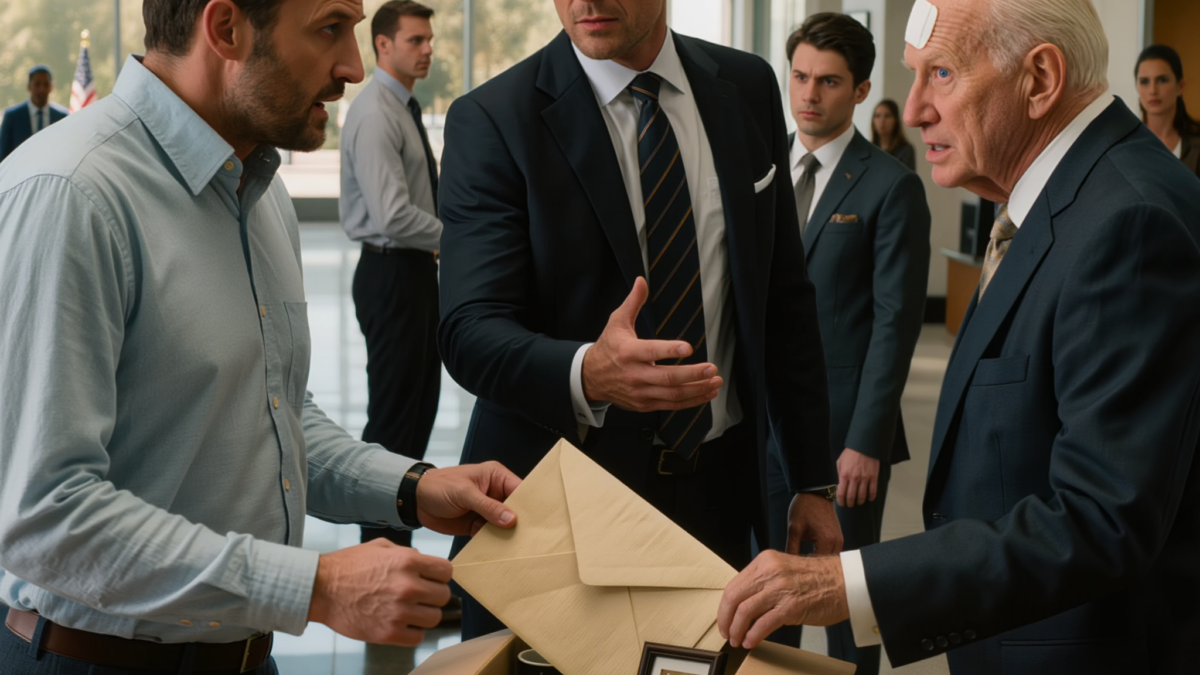
My CEO ordered me to pick up his son at JFK. I arrived 15 minutes late because I stopped to pull an elderly man from a smoking wreck. His son saw the blood on my shirt, called me incompetent, and demanded I be fired. My boss agreed—and put a career-ending misconduct charge in my file. Three days later, I was carrying a cardboard box out of my office when the billionaire buying our company stepped off the elevator with a bandage above his left eyebrow. He walked past my CEO’s outstretched hand and…
My name is Nathan Caldwell. I’m 36 years old, and three days ago, my boss fired me over a fifteen-minute delay. He didn’t just take away my job. He tried to destroy my professional reputation and make sure I could never find another executive position in the corporate world.
Until that morning, I had been the director of operations at a major technology company, responsible for much of the preparation behind a billion-dollar corporate acquisition. I had spent six years giving that company my nights, my weekends, and almost every ounce of energy I had.
And then everything fell apart because I stopped on the highway to save a stranger’s life.
When I arrived at JFK Airport, my white dress shirt was stained with another man’s blood. My hands were scraped, my knuckles were bruised, and I was still shaking from pulling an elderly driver out of a wrecked vehicle.
The CEO’s son took one look at me and pulled out his phone.
“Dad, fire him right now. He is making me wait like a commoner.”
He actually laughed at me in front of the travelers standing along the airport curb. He pointed at the stains on my sleeve and acted as though I were something disgusting that had wandered in off the street.
He didn’t ask whether I was hurt. He didn’t ask whether the driver had survived. All that mattered was that he had waited fifteen minutes longer than expected.
But there was something neither that young man nor his father understood.
The elderly man I had rescued wasn’t an ordinary stranger. He held the future of their company in his hands, including the acquisition they had been counting on to make themselves enormously wealthy.
Three days later, I would be standing in our executive lobby with a cardboard box containing everything I had left of six years of employment.
And that same elderly man would walk through the elevator doors.
To understand what happened next, I need to explain how I ended up on that highway in the first place.
For six years, I worked for Justin Harper, the CEO of a growing technology company.
Working for Justin was like living under a permanent threat disguised as an employment agreement. He could be charming in a board meeting and ruthless behind a closed office door. He demanded loyalty, but his idea of loyalty meant doing whatever he wanted, whenever he wanted, without questioning him.
My official title was director of operations. In practice, I spent much of my time fixing the consequences of Justin’s decisions.
I managed warehouse expansions, operational budgets, staffing coordination, and the financial preparations needed for major company projects. When something went wrong, I was the person expected to make it work.
Our company was preparing for the largest acquisition in its history. A powerful private equity firm was negotiating to purchase the business, and the potential payout for the shareholders and senior executives was enormous.
I was responsible for a substantial portion of the work behind that deal.
Some nights, I slept on the uncomfortable leather couch in my office. I spent endless hours reviewing financial audits, restructuring departments, and making sure the company’s records could withstand examination by the buyers’ accountants.
My direct manager, Cameron Hughes, often presented the results of my work during board meetings. He received the praise while I survived on stale coffee, cold Walmart sandwiches, and anxiety about the next deadline.
I missed Thanksgiving dinners. I missed school plays. I even missed my best friend’s funeral because Justin insisted that I present a financial model to shareholders that afternoon.
I stayed because I believed the sacrifice would eventually mean something.
Justin had been promising me a promotion to vice president. I had worked toward that position for years, and I needed the financial security it would provide.
Two years earlier, I had gone through a bitter divorce. The custody battle over my daughter had been exhausting, and the legal expenses were overwhelming. I was still trying to rebuild my finances while maintaining a stable home for her.
Justin knew every part of that situation.
Whenever he wanted me to accept another unreasonable assignment, he reminded me how important my salary was. He understood that losing my job could threaten everything I had been trying to rebuild.
I thought the sacrifices were temporary. I believed that once the acquisition closed, the promotion would finally arrive and I could begin making up for the years I had lost.
Then, two weeks before the airport incident, I discovered something troubling in the company’s financial records.
I was reviewing vendor payments and reconciling quarterly expenses in preparation for the acquisition audit.
One consulting company caught my attention.
Its name was Aqual Advisory, and it was supposedly based in London.
Over an eighteen-month period, the company had submitted invoices totaling nearly half a million dollars. The descriptions were vague, filled with phrases such as international market positioning and strategic synergy alignment.
Those terms sounded impressive until I tried to determine what we had actually received for the money.
I asked Nathaniel Cooper, one of our internal accountants, to produce the consulting firm’s deliverables.
Nathaniel was a nervous man who always seemed afraid that someone was about to fire him. When I mentioned the company, his expression became even more uncomfortable.
He eventually gave me a thin folder containing approximately fifty pages.
I opened it expecting detailed market research, financial projections, or strategic reports.
Instead, I found copied Wikipedia material, generic charts without reliable data sources, and pages of business terminology that communicated almost nothing.
I checked the documents again.
We had paid an enormous amount of money, but there was no meaningful evidence that the consulting firm had performed the work described in its invoices.
The possibility that we were dealing with a shell company immediately concerned me.
If the acquisition team’s forensic accountants discovered payments that couldn’t be justified, they could question the integrity of the company’s financial statements. The entire transaction might be placed at risk.
I took the folder directly to Justin Harper.
His corner office was enormous, with a polished mahogany desk and expensive leather furniture. I placed the documents in front of him and explained what I had found.
I told him the invoices represented a serious compliance concern. I explained that the missing deliverables could create legal problems during the buyer’s due diligence.
Justin barely looked at the documents.
He leaned back in his chair, folded his hands, and gave me the condescending smile I had learned to recognize.
He told me that executive consulting relationships were above my pay grade.
Then he dismissed the missing money as administrative noise.
He ordered me to stop investigating, focus on my department, and do my job.
I left his office knowing that something was wrong.
I couldn’t simply ignore hundreds of thousands of dollars in questionable payments. My responsibilities included managing the operational budget, and the financial records would eventually be examined by people outside our company.
So I returned to my office, closed the door, and prepared an independent risk memorandum.
I documented the suspicious invoices, missing deliverables, and wire transfers to London. I also traced the transactions through the company’s executive approval process.
When the memorandum was complete, I uploaded it to the board of directors’ secure encrypted portal.
I deliberately bypassed Justin.
I understood that he might retaliate if he discovered what I had done. But I was unwilling to let my professional reputation become attached to a potential fraud scandal simply because my CEO didn’t want the payments questioned.
At that point, I didn’t know who was receiving the money or why the invoices existed.
I only knew the records required investigation.
A few days later, Justin called my desk with an assignment that had nothing to do with the acquisition.
His son, Tyler Harper, was returning from London.
Tyler was the company’s golden child, the only son of the CEO. He had spent the previous two years supposedly studying abroad.
Within the company, people frequently talked about his expensive lifestyle, designer clothing, and nights spent at exclusive London clubs.
While employees worked exhausting schedules to keep the business operating, Tyler enjoyed privileges most of us could never imagine.
That afternoon, we were facing a difficult forty-eight-hour deadline for the acquisition paperwork.
I was reviewing employment information for approximately three hundred employees. The final compliance review was due in less than three hours.
My desk phone rang.
It was Justin.
Our corporate driver, Scott Bradley, had supposedly called in sick at the last minute. Justin wanted me to take the company Porsche from the executive garage and drive to JFK to collect Tyler.
For a moment, I thought I had misunderstood him.
I reminded him that I was the director of operations, not the company’s chauffeur. I had an MBA, and I was in the middle of completing documents necessary for the acquisition.
Justin didn’t care.
His voice became colder, and he told me that loyalty to his family was the only thing that guaranteed a future at his company.
He made the choice unmistakable.
Pick up his son or clear out my desk.
He also reminded me of my custody battle and the financial difficulties that had followed my divorce.
He didn’t have to threaten me directly. I understood what he meant.
My salary paid the mortgage, supported my daughter, and helped cover the legal bills I was still trying to settle.
I took the keys.
On my way out, I passed Cameron Hughes. I gestured toward the enormous stack of unfinished documents on my desk, hoping he might intervene.
Cameron looked down at his shoes and pretended to read something on his phone.
He had no intention of helping me.
I walked into the executive garage, climbed into the company Porsche, and headed for the airport.
The afternoon traffic was moving quickly. I kept calculating how long it would take to reach the terminal, load Tyler’s luggage, and return to the office before the compliance deadline.
I was angry about being treated like a personal driver. I was worried about the work waiting for me. And I knew Tyler was unlikely to make the assignment pleasant.
I thought dealing with his attitude would be the worst part of my afternoon.
I was wrong.
Several miles ahead, I saw a black luxury sedan suddenly lose control.
It spun across multiple lanes of traffic and slammed into a concrete barrier.
The impact was violent. The front of the car crumpled, safety glass shattered, and dark smoke began rising from the damaged engine compartment.
Drivers swerved around the wreck. Some slowed to look. Others continued past without stopping.
I saw no one running toward the vehicle.
I slammed on the brakes, pulled the Porsche onto the shoulder, and got out.
The driver’s door of the sedan was badly damaged. Through the window, I could see an elderly man slumped over the steering wheel.
He wasn’t moving.
I ran to the driver’s side and grabbed the door handle.
It wouldn’t open.
The frame had twisted around the latch, leaving the door jammed. I braced my foot against the damaged bodywork and pulled as hard as I could.
The metal finally gave way.
I reached inside and checked the driver’s pulse. It was weak and irregular.
He had a serious wound above his left eyebrow, and blood was soaking his shirt collar. His skin was pale and clammy.
There was smoke coming from the engine, and I could smell fuel.
I pulled out my phone and called 911.
Then I removed my suit jacket, folded it, and pressed it firmly against the wound to slow the bleeding.
After a moment, the man opened his eyes.
They were a striking blue, though he looked confused and frightened.
He glanced at my hands, then toward the traffic moving past the wreck.
He reached up and gripped my wrist.
“You stopped,” he said.
I tried to reassure him.
I told him anyone would have done the same thing. I told him help was coming and that he needed to stay awake.
He looked toward the passing cars again.
“No, they didn’t.”
I stayed beside him for twelve agonizing minutes.
I kept talking, asking questions about his day and his life, anything that might help him remain conscious.
He told me his name was Jason.
Just Jason.
Eventually, I heard sirens approaching.
The paramedics arrived, and Lucas Bennett, the lead EMT, took charge of the scene. He treated the man’s injury and helped secure him for transport.
As they prepared to load Jason into the ambulance, Lucas spoke to me.
He said the elderly driver appeared to have experienced a serious cardiac episode around the time of the crash. He also told me that my immediate assistance and the pressure I had maintained on the wound had likely prevented Jason from losing his life.
Lucas recorded my name and took my statement for the official report.
By the time I returned to the Porsche, my clothes were ruined.
There were stains across my shirt and sleeves. My hands were trembling, and the adrenaline from the rescue was beginning to wear off.
I checked my phone.
I was exactly fifteen minutes late.
I found a napkin in the glove compartment, cleaned my hands and face as well as I could, and continued toward JFK.
I genuinely believed Tyler would understand once I explained what had happened.
I had just helped save a human life.
Surely that mattered more than fifteen minutes.
The airport curb was crowded with taxis, travelers, families, and luggage carts.
Tyler Harper was easy to find.
He stood beside a towering pile of expensive luggage, tapping his loafers impatiently against the pavement.
I pulled up in the Porsche.
Before I had properly parked, Tyler opened the passenger door and began shouting.
“Are you absolutely kidding me? Do you have any idea who my father is?”
I raised my hands and tried to explain.
I told him there had been a serious accident on the highway. An elderly man had been trapped in a damaged car, and I had stopped to help him until the ambulance arrived.
Tyler stared at the stains on my shirt.
For a brief moment, I thought he might realize what had happened.
Instead, his expression turned to disgust.
He accused me of inventing a story about playing hero to cover up my incompetence.
He called me a failure and said I was a low-level corporate employee who couldn’t even handle a simple airport pickup.
I pulled out my phone.
I showed him the 911 call log and pointed to the timestamp.
Tyler slapped my hand away.
The phone landed on the passenger seat, cracking its screen protector.
He told me his time was worth more than a random stranger’s life on the highway.
Then he took out his own phone and called his father.
He put the conversation on speaker.
Standing beside his expensive luggage, Tyler told Justin that I had abandoned my assignment and left him waiting outside the terminal.
He described my appearance as disgraceful and claimed I was making ridiculous excuses.
Then he demanded that I be fired immediately.
He said he refused to ride in a car driven by someone who looked so unprofessional.
I listened, stunned.
I had worked for Justin Harper for six years. I had built much of the company’s operational framework and spent countless nights preparing for the acquisition that would make him wealthy.
Now his son was demanding my career end because I had arrived fifteen minutes late after responding to an emergency.
Justin didn’t ask to speak with me.
He told Tyler to order an Uber Black using the company card.
Then he said he would handle me personally when I returned to headquarters.
I drove back in silence.
The shock of the accident had faded, leaving a heavy feeling in my stomach.
I knew Justin’s personality. I also knew he had become increasingly irritated since I began asking questions about Aqual Advisory.
Tyler’s complaint had given him a convenient reason to remove me.
When I entered the headquarters lobby, Justin was waiting near the reception desk.
Cameron Hughes stood behind him, along with Marcus Warren, the company’s director of human resources.
My stained shirt drew uncomfortable looks from the receptionist and security personnel.
I approached them, preparing to explain the accident.
Justin raised his hand before I could begin.
“Hand over your key card, Nathan.”
His voice carried across the marble lobby.
“You abandoned a critical company assignment. You embarrassed my family. You are terminated effective immediately.”
I looked toward Cameron.
For two years, I had helped protect his reputation by fixing problems he should have handled himself. I had allowed him to receive credit for work that I performed.
Now I needed him to say something.
Cameron stared at the ceiling.
I turned toward Marcus.
He shifted his weight but remained silent.
I tried again to explain what had happened on the highway. I told Justin the paramedics could confirm my account and that there would be an official police report.
Justin stepped closer.
He told me he didn’t care if I had saved the president of the United States.
As far as he was concerned, I was a liability.
He was finished with me.
I handed over my badge.
A security guard escorted me upstairs to collect my personal keys and coat. I was informed that my final paycheck would be mailed.
When I walked out of the building, I felt as though six years of work had been erased in a single afternoon.
I was unemployed.
I still had a mortgage, custody-related expenses, and responsibilities to my daughter.
But I soon discovered that losing my job was only the beginning.
During the next two days, I sat alone in my apartment trying to understand what had happened.
The more I considered the speed of my dismissal, the more concerned I became.
Justin hadn’t followed the usual procedures. There had been no investigation, no formal review of my performance, and no opportunity for me to present the evidence of the accident.
He had terminated me immediately.
I began wondering what HR had recorded as the official reason.
I called William Carter, a senior engineer in our IT department.
Years earlier, William had been involved in a serious server failure that nearly cost him his job. I had helped him during that incident, and he had never forgotten it.
I asked whether he could check the internal records associated with my termination.
About an hour later, William called back.
He sounded deeply uncomfortable.
Justin hadn’t merely recorded that I had failed to complete an airport pickup on time.
He had personally authorized serious misconduct allegations in my employment file.
The record accused me of gross insubordination, corporate sabotage, and abandonment of fiduciary duty connected to the acquisition.
I felt sick.
Those allegations could become a major obstacle during background checks for future management positions. I feared that my executive career might be permanently damaged.
Then the larger implication became clear.
I had already submitted a risk memorandum describing questionable consulting payments.
If I later raised concerns about those transactions, Justin could point to the misconduct allegations and portray me as a bitter former employee attempting to damage the company.
He wasn’t simply trying to satisfy Tyler.
I believed he was trying to undermine my credibility before anyone took the financial concerns seriously.
I asked William for one more favor.
I needed a printed copy of the memorandum I had uploaded to the board’s secure portal, including the system timestamps proving when it had been submitted.
William hesitated.
Accessing those records could jeopardize his own employment.
But he agreed.
That evening, he met me at a diner and slid a thick manila envelope across the table.
Inside was the printed memorandum and the associated timestamps.
For the first time since my dismissal, I felt I had something concrete to defend myself with.
I contacted the company and arranged to return on the third day to collect the rest of my personal belongings under HR supervision.
I knew the acquisition buyers were scheduled to visit that morning.
I wanted to see Justin Harper one last time.
When I arrived, the executive floor felt unusually quiet.
Marcus Warren met me near the service elevator. He told me I had exactly ten minutes to pack my desk and leave.
I walked into my old office.
The desk had already been cleared. My plants were dying in the corner, and the framed photograph of my daughter had been pushed into a drawer.
I placed the photograph, my coffee mug, and a few reference books into a cardboard box.
Through the glass walls, I could see Justin pacing near the executive reception area.
Tyler stood beside him, wearing an expensive bespoke suit.
They were preparing to welcome the buyers.
Justin looked nervous but excited. The acquisition would secure an enormous financial payout for him, and he was only minutes away from the meeting he had spent months anticipating.
I placed the manila envelope containing the memorandum inside my box, close enough that I could retrieve it quickly.
Then I picked up the box and left my office.
Marcus accompanied me toward reception.
As we reached the center of the lobby, the main elevator doors opened.
An elderly man stepped out wearing an immaculate dark navy suit.
A thick white medical bandage covered the area above his left eyebrow.
I recognized him immediately.
It was Jason.
The man I had pulled from the damaged sedan three days earlier.
Justin straightened his jacket and hurried forward, extending his hand with an eager smile.
“Mr. Whitmore, it is a profound honor to welcome you to our headquarters. I am Justin Harper, CEO.”
Whitmore.
The name suddenly made sense.
Jason Whitmore was the founder and chairman of the private equity firm preparing to purchase our company.
He was a legendary billionaire, and the acquisition depended on his approval.
Justin stood there with his hand extended.
Jason didn’t take it.
Instead, he looked across the lobby and spotted me holding my cardboard box.
He walked past Justin.
He walked past Tyler.
Then he stopped directly in front of me.
The lobby became quiet.
Jason looked at my face, then at the box in my hands. He raised one hand and touched the bandage above his eyebrow.
“Nathan,” he said.
Justin turned sharply.
“You know him, Mr. Whitmore?”
Jason kept his attention on me.
“He saved my life three days ago on the interstate.”
He explained that the doctor had told him he might not have survived if I hadn’t forced open the damaged car door and helped control the bleeding before the ambulance arrived.
People near the reception desk reacted in disbelief.
Marcus Warren looked deeply uncomfortable.
Then Jason turned toward Justin.
“Why is the man who saved my life holding a packing box in your lobby?”
For the first time, Justin appeared unsure how to respond.
Tyler stepped forward.
“Mr. Whitmore, there is a misunderstanding. He was fired because he abandoned a critical assignment. He left me stranded at the airport.”
Jason looked Tyler over.
“So, you are the son?”
“Yes, sir. Tyler Harper, vice president of strategy.”
Jason asked whether I had been late because I stopped to help him.
Tyler insisted I had abandoned my responsibilities.
“We have standards here. We expect perfection.”
I finally spoke.
“I was exactly fifteen minutes late, Mr. Whitmore.”
Justin’s face reddened.
He told security to escort me out immediately, claiming I was trespassing.
Jason raised a finger.
The security guard stopped.
“No one is leaving.”
Jason turned back to Justin and questioned why an employee with six years of service had been dismissed because an adult son had waited fifteen minutes beside his luggage.
Justin immediately changed his explanation.
He claimed the dismissal wasn’t simply about the airport incident.
There had supposedly been serious performance problems and compliance violations.
He said the company had documentation.
That was the moment I understood why bringing the memorandum had mattered.
I put my cardboard box on the marble reception desk and removed the thick envelope.
“Documentation?” I asked.
I questioned whether Justin was referring to the misconduct allegations placed in my employment record, allegations that could damage my future background checks.
Jason turned toward Marcus.
“Is this true?”
Marcus swallowed.
Then he admitted that the CEO had instructed him to process my termination without the standard review.
Jason immediately told Justin to remove the notation.
Justin objected.
He pointed out that Jason’s company hadn’t completed the acquisition and that Jason didn’t yet have authority to dictate internal HR decisions.
Jason answered calmly.
“I do not. But your board of directors does. And I just had a very long, very enlightening breakfast with your chairman.”
Justin’s expression changed.
He understood that the situation was no longer a private dispute between a CEO and a former employee.
The man financing the acquisition was now questioning the integrity of his leadership.
Justin tried to recover.
He straightened his expensive jacket, adjusted his tie, and attempted to make the matter sound like an ordinary employment disagreement.
He assured Jason that the company took employee relations seriously.
He described me as an emotional former employee who was angry about being dismissed.
According to Justin, my firing had been a carefully considered executive decision supported by a long history of poor performance and insubordination.
He said the company required perfection during such an important acquisition and couldn’t tolerate disgruntled employees interfering with the process.
Jason listened without interrupting.
Then he turned toward Marcus Warren.
“A long history of performance issues. Is that an accurate statement, Mr. Warren?”
Marcus glanced at Justin.
Justin couldn’t help him.
After an uncomfortable pause, Marcus answered.
“Actually, sir, no.”
He admitted I had received the company’s highest performance rating for six consecutive years.
My personnel file had been spotless before the misconduct notation.
I had also been nominated for the company’s highest leadership award.
Marcus went further.
He explained that I had managed much of the operational integration and financial planning for the acquisition.
I was one of the company’s most important executives.
Justin became furious.
He ordered Marcus to stop discussing internal personnel matters in the reception area and demanded that everyone move into his office.
Jason refused.
The conversation would continue where it was.
Then he turned toward me.
“Nathan, tell me what exactly was your specific role in preparing the necessary documentation for my private equity firm to purchase this company?”
I explained my responsibilities.
I had designed the operating model intended to combine the businesses after closing.
I had audited operational expenses across the previous three fiscal years.
I had helped create the financial framework the buyers were using to evaluate the merger.
And I had performed that work while trying to ensure the company records were accurate.
Then I explained that my problems with Justin had begun when I noticed unusual payments in the acquisition expenses.
Tyler interrupted.
He accused me of being a disgruntled employee who couldn’t handle executive pressure.
He claimed I had abandoned him at JFK to play hero on the highway and was now trying to disrupt a billion-dollar transaction to obtain a larger severance package.
He even described my actions as corporate extortion.
I couldn’t believe what I was hearing.
He had been waiting beside six pieces of designer luggage, yet he continued talking as though I had abandoned a critical corporate operation.
I asked whether the valuable company assets he kept mentioning were his six Louis Vuitton bags.
I reminded him that he’d been using his father’s corporate credit card while supposedly studying in London.
Tyler became angry.
He told me I was a failure who no longer even had a job.
Jason raised a hand to silence him.
He told Tyler that treating someone who had saved a human life with contempt because of an unearned corporate title made him a liability.
“And I do not purchase liabilities.”
Justin grabbed Tyler’s arm.
He knew his son was making things worse.
Then he attempted another approach.
He began offering money.
He told Jason the company could resolve my dismissal quietly and professionally. He offered to review the termination, arrange a generous severance package, and potentially give me a lucrative consulting contract.
He suggested a substantial salary increase if that was necessary to protect the acquisition.
I listened as the man who had tried to destroy my career suddenly offered me the financial security I had spent years working toward.
He knew about my divorce.
He knew about the custody battle.
He knew how much money mattered to my daughter’s future.
He seemed to believe that I would accept enough money and disappear.
I looked at the envelope in my box.
“I do not want a single cent of your dirty money, Justin.”
Jason stepped closer.
“What exactly is in that package, Nathan?”
I explained that shortly before Justin ordered me to collect Tyler, I had submitted an independent risk memorandum to the board.
The document identified substantial, unusual payments to consulting vendors whose work I couldn’t verify.
I had confronted Justin with the concerns, but he dismissed the missing money as administrative noise and warned me not to investigate further.
Justin immediately reacted.
He accused me of taking confidential company property.
He demanded that security confiscate the envelope and detain me.
Two guards began moving toward the desk.
Jason stepped into their path.
Then he removed his phone and made a brief call.
“Bring her up to the main lobby.”
Two minutes later, the elevator doors opened again.
Evelyn Shaw stepped out.
She was the chairperson of our board of directors, a powerful executive known for her strict standards.
Two outside corporate lawyers accompanied her.
Evelyn carried a slim silver laptop.
Justin looked stunned when he saw them.
He asked why she was interrupting the meeting with Jason.
Evelyn ignored the question.
She greeted Jason, then turned toward me.
“Nathan.”
She explained that she had received an automated notification about my termination three days earlier.
The absence of the normal employment review process had concerned her.
Early that morning, Jason had contacted her about the circumstances of my dismissal.
She and the company’s legal team had spent the previous three hours reviewing the risk memorandum I had uploaded before my access was revoked.
Evelyn placed her laptop on the reception desk beside my cardboard box.
Then she turned toward Justin.
“Justin, we have a massive catastrophic problem, and it has absolutely nothing to do with Nathan’s time management at the airport.”
The employees nearby had stopped pretending they weren’t interested.
Everyone could hear the conversation.
Evelyn made no attempt to move it into a private conference room.
She opened the memorandum and began describing what the legal review had uncovered.
Three international consulting vendors had received payments without adequate documentation of the work supposedly performed.
All three were listed as boutique consulting firms based in London.
More importantly, the internal approval records showed that Justin had personally authorized the payments.
He had used an executive exception process to bypass the company’s normal procurement oversight.
Justin immediately protested.
He claimed the vendors were legitimate consultants helping prepare the company for European expansion after the acquisition.
He said the payments were ordinary business expenses and insisted that someone in my position wouldn’t understand high-level executive strategy.
I opened the manila envelope and removed the printed documents.
I placed them on the marble desk beside Evelyn’s laptop.
Then I pointed to a specific vendor.
Aquel Advisory had received nearly $200,000 over the previous eighteen months for services described as international market positioning.
I explained that I had checked the project’s internal repository before losing access.
There were no meaningful status reports, strategic deliverables, or market research corresponding to those payments.
The only materials I had been shown consisted largely of generic charts and copied reference material.
I told everyone I believed the invoices represented a fabrication.
Tyler interrupted again.
He accused me of being a glorified accountant who lacked the vision necessary to understand global expansion.
Jason turned toward him.
He asked Tyler to explain the supposedly sophisticated strategy, since Jason’s firm was preparing to fund the acquisition.
Tyler had no meaningful answer.
Evelyn continued.
She explained that outside legal counsel had performed a preliminary background check on Aqua Advisory that morning.
The company was registered in the United Kingdom.
Its legal owner was a twenty-four-year-old man named Zachary Dawson.
I noticed Tyler’s expression change.
Until that moment, he’d behaved as though the conversation was beneath him.
Now he appeared genuinely frightened.
Evelyn turned toward him.
“Tyler, do you happen to know a young man named Zachary Dawson?”
Tyler stepped backward.
He claimed he’d met many consultants and business owners while studying in London.
It was a large city, he said, and he knew plenty of people.
Evelyn wasn’t satisfied.
She explained that the company’s review of Tyler’s corporate email history had revealed something important.
Zachary Dawson had been his assigned university roommate.
And the private contact email listed in Aqual Advisory’s confidential vendor onboarding file was registered directly to Tyler.
The connection was no longer simply between questionable invoices and a London company.
There was a documented relationship between the consulting business and the CEO’s son.
People around the reception desk reacted in disbelief.
Justin grabbed Tyler by the shoulder.
“Tyler, look at me. What did you do? Tell me right now you didn’t steal from this company. Tell me you didn’t jeopardize this entire acquisition.”
Tyler looked terrified.
“Dad, stop. Don’t do this. Don’t put this all on me.”
Jason stepped into the conversation.
He asked whether Tyler had deliberately helped establish a fake consulting company with his former roommate to divert money from the business.
Tyler began shaking.
He looked around the lobby, but no one stepped forward to defend him.
His father appeared more concerned about protecting himself than protecting his son.
Then Tyler pointed at Justin.
“I didn’t keep the money,” he cried. “The extra money wasn’t for me. He made me do it. It was all his idea.”
Justin went pale.
“Tyler, shut your mouth right now. Do not say another word without a lawyer present.”
But Tyler refused to stop.
He claimed Justin had instructed him to use Zachary’s name when establishing the LLC.
According to Tyler, Justin had explained how to divide the invoices into smaller amounts so they wouldn’t trigger the automatic procurement audit.
He said his father had designed the arrangement from the beginning.
Evelyn demanded an explanation.
Tyler continued talking.
He claimed Aqual Advisory had been paid for fake research reports and that Zachary had then transferred most of the money to a private offshore account controlled by Justin.
The payments had supposedly been described as reimbursements for undocumented executive expenses.
Tyler said he had kept only a small percentage to help pay for his London apartment.
The rest, he insisted, had gone to his father.
The implications were enormous.
What had initially looked like a CEO ignoring his son’s suspicious business activities now appeared to involve the CEO himself.
Justin was being accused of directing the arrangement, using his son’s connections to move company money through a consulting business that provided little evidence of legitimate work.
The allegations also raised serious questions about the accuracy of the financial records supporting the acquisition.
I watched Justin struggle to respond.
This was the man who had dismissed me without listening to a single explanation.
He had approved allegations that could have destroyed my professional future.
Now his own son was publicly accusing him of orchestrating the financial misconduct.
“You set me up,” Justin whispered toward Tyler.
I looked at him.
“You set yourself up, Justin.”
I reminded him that I had written the risk memorandum because my job required me to protect the integrity of the company’s records.
I had stopped on the highway because another human being needed help.
Justin had chosen to retaliate against me rather than confront the concerns I raised.
He thought that destroying my professional credibility would make the memorandum easier to dismiss.
Instead, the memorandum was now being examined in front of the person whose firm intended to purchase the company.
Jason stepped forward.
He addressed Evelyn.
He explained that his firm’s acquisition offer depended on assumptions of stable leadership, competent operations, and financial integrity.
What he had witnessed had given him serious reasons to question those assumptions.
He demanded a comprehensive forensic audit of the corporate and personal accounts connected to Justin.
He also called for Justin’s assets to be frozen and for him to be removed from the premises if necessary.
The acquisition would not proceed to signing under those circumstances.
Evelyn immediately turned to the outside lawyers standing beside her.
One of them took out his phone and contacted the authorities to report the suspected corporate fraud and embezzlement.
Then Evelyn addressed Justin directly.
“Justin Harper, effective immediately, you are indefinitely suspended from your duties as chief executive officer of this company, pending a full exhaustive criminal investigation.”
She explained that his authority to make executive decisions was revoked.
He would no longer have access to company funds, systems, employees, vendors, or shareholders through his executive position.
His corporate access was terminated immediately.
Justin tried to argue.
He looked around the lobby, searching for someone willing to support him.
His eyes finally settled on Cameron Hughes.
Cameron looked down at the floor.
It was the same response he had given when Justin dismissed me three days earlier.
The man who had spent years benefiting from Justin’s authority now wanted no association with him.
Evelyn turned toward Tyler.
She informed him that his employment was also terminated.
He was ordered to surrender his corporate credit cards, company-issued phone, and security badge.
Tyler reached into his wallet with trembling hands.
He placed his corporate platinum card and key card on the reception desk.
He was crying openly.
The expensive suit, important title, and privileged lifestyle that had made him feel untouchable couldn’t protect him from what he had just admitted.
His confession had been made in front of numerous witnesses, and the legal consequences could be serious.
Then Evelyn instructed Marcus to contact building security.
Justin and Tyler were to be escorted to the service elevators and removed from the property.
They would not be permitted to return to their executive offices.
Their personal belongings would be packed by company employees and mailed to their homes.
I stood behind my cardboard box and watched.
Three days earlier, Justin had ordered almost exactly the same humiliating treatment for me.
Now the instructions were being applied to him and his son, in front of the employees who had watched my dismissal.
Two security guards approached.
They escorted Justin and Tyler toward the back elevators.
Before leaving, Justin stopped and looked over his shoulder at me.
His expression was filled with anger.
“You caused this,” he said. “You completely ruined my family. You destroyed my entire life, my legacy. Over a stupid fifteen-minute delay at the airport.”
I thought about the nights I’d spent worrying over legal bills.
I thought about my daughter and the possibility that losing my income could make our already difficult situation worse.
I thought about the false misconduct allegations that had been placed in my employment file.
Then I answered him.
“I didn’t cause anything, Justin. I wrote a risk memo because I did my job with integrity. I saved a man’s life on the highway because I have a functioning conscience. You destroyed your own family because you arrogantly thought the rules did not apply to you.”
Justin had no response.
The guards escorted him and Tyler toward the service elevators.
The doors closed behind them.
The Harper family’s control over the company had ended.
Evelyn closed her laptop and turned to Jason.
She apologized for the situation and acknowledged that the board had not understood the extent of the suspected misconduct.
She promised full cooperation with the authorities and unrestricted access for the forensic accountants reviewing the records.
Jason said he expected complete transparency.
He also warned that if the company failed to cooperate, he would consider having the business dismantled and its assets liquidated.
Then he looked toward me.
His expression softened.
“Nathan, I believe there is a massive unacceptable injustice sitting on your personnel file that needs to be corrected immediately.”
Evelyn turned to Marcus Warren.
She ordered him to remove the gross insubordination notation and clear the improper allegations connected with my dismissal.
Marcus agreed immediately.
He took out his tablet and hurried toward the HR offices.
I looked down at the cardboard box in front of me.
For three days, I had been terrified that Justin’s accusations would prevent me from finding another management job.
Now the chairperson of the board was ordering that record corrected.
My six years of strong performance could no longer be overshadowed by the unsupported misconduct notation Justin had forced into my file.
The weight that had been pressing against my chest finally began to lift.
I could breathe again.
The consequences of that morning continued long after Justin and Tyler left the building.
The board launched a major internal investigation as it tried to preserve the acquisition and determine how the questionable payments had been approved.
A week later, Cameron Hughes was fired.
According to the internal investigation, he had ignored my earlier verbal warnings about the consulting invoices because he wanted to protect his substantial year-end bonus.
Justin and Tyler Harper were eventually indicted by the federal government on multiple felony counts, including wire fraud, corporate espionage, and grand embezzlement.
I later heard through people in the industry that Justin’s wife had filed for divorce.
The separation reportedly created additional complications for the family’s remaining assets, many of which were already affected by the government’s actions.
Their luxury real estate holdings, including a large vacation property in Aspen, were being liquidated to help cover their growing legal expenses.
The comfortable future Justin had expected from the acquisition was gone.
A few days after the confrontation in the lobby, Evelyn Shaw asked me to return to headquarters for a meeting.
I took the elevator to the executive floor and walked into the same corner office Justin had occupied.
The room was familiar, but the circumstances were completely different.
Evelyn offered me my job back.
Then she explained that the board wanted to do more than restore my previous position.
They wanted to promote me to senior vice president of global operations.
She slid an offer letter across the desk.
The package included a substantial salary increase, a significant immediate retention bonus, and a corner office overlooking the city skyline.
She said the company needed someone with my operational experience and proven integrity to guide the business through the difficult acquisition transition.
I looked at the numbers.
They were extraordinary.
It was everything I had been working toward for six years.
The salary would allow me to pay my custody lawyer, rebuild my savings, strengthen my daughter’s college fund, and potentially move into a better home in a safer neighborhood.
For a few moments, I considered what accepting the offer would mean.
Then I thought about my former colleagues.
I remembered Cameron looking at the ceiling while Justin fired me.
I remembered Marcus standing silently beside him.
I remembered the employees who had watched without saying anything while my career was being destroyed.
Evelyn could correct my employment record.
She could restore my salary and give me the promotion Justin had promised.
But none of those things could restore my confidence in the workplace culture that had allowed the situation to happen.
I folded the contract carefully and slid it back across her desk.
I declined.
Evelyn looked genuinely surprised.
She offered to increase the base salary. She mentioned additional stock options and promised the resources I would need to succeed.
I thanked her.
Then I explained that my decision wasn’t about the size of the offer.
The false allegations had damaged my trust, and removing them from the personnel system did not erase what I had experienced.
I couldn’t return to a workplace where people who depended on my work had watched me be publicly humiliated and chosen not to intervene.
I needed a fresh start.
I also needed to establish boundaries that would prevent my career from consuming the rest of my life the way it had for the previous six years.
Evelyn listened.
After a long moment, she nodded.
She told me she respected my decision.
Then she offered to write me a strong letter of recommendation for my future career.
I accepted.
A few weeks later, another opportunity came along.
I was offered a senior vice president of operations position at a different, highly respected technology company in the city.
The base salary was significantly better than what I had previously earned.
The healthcare benefits for my daughter were excellent.
More importantly, the company’s board had a reputation for transparency and ethical business practices.
I accepted the position.
Later, I learned that Jason Whitmore had quietly contacted several people in his professional network on my behalf.
He had told them about my work, my integrity, and what had happened at the company.
Those conversations had helped open doors I might never have reached on my own.
For the first time in years, I could look ahead without feeling trapped by Justin Harper’s promises.
Before I officially left the city to begin my next chapter, Jason asked if we could meet for coffee.
We chose a quiet, upscale diner downtown.
When I arrived, he looked much healthier than he had in the corporate lobby.
The thick white bandage was gone. A small healing scar remained above his eyebrow.
He seemed relaxed, though I could still see the seriousness in his eyes.
We sat in a private corner booth and ordered black coffee.
I expected him to talk about the acquisition.
Perhaps he would discuss the federal investigation, the company’s future, or the board’s efforts to recover from the scandal.
Instead, he didn’t mention business at all.
He reached into the inside pocket of his jacket and removed a small sealed white envelope.
He handed it to me.
I opened it carefully.
Inside was a photocopy of the official ambulance report from the afternoon of the highway accident.
I recognized the details immediately.
Jason reached across the table and pointed toward the medical notes near the bottom of the page.
The entry had been written by Lucas Bennett, the lead paramedic who had treated him at the scene.
It described the immediate trauma assistance provided by a civilian bystander named Nathan Caldwell.
The report stated that my intervention had prevented fatal hemorrhagic shock before emergency medical personnel arrived.
It concluded that the patient owed his life to that intervention.
I read the words slowly.
For a moment, I was back on the highway.
I could remember the sound of the impact, the smoke rising from the damaged car, and the driver’s weak grip around my wrist.
I remembered watching the other vehicles continue past while I waited for the ambulance.
Jason looked at me across the table.
“You lost your job because you stopped that day,” he said quietly.
I looked down at the report again.
Then I turned toward the diner window.
Outside, traffic moved through the city. People hurried along the sidewalk, going about their ordinary lives.
I thought about everything that had happened since that afternoon.
The airport confrontation.
The termination.
The false allegations.
The manila envelope.
Jason stepping off the elevator.
The investigation.
The job offer I had declined.
And the new position that would allow me to build a different future for myself and my daughter.
I smiled.
It was the first genuinely peaceful smile I had felt in a long time.
“No, Jason,” I replied softly. “I didn’t lose anything of value. I discovered exactly what kind of toxic job it was. And more importantly, I discovered exactly what my own integrity was worth.”
Fifteen minutes.
That was all it had taken to change the direction of my life.
Being fifteen minutes late had cost me a position I once believed I desperately needed to survive the aftermath of my divorce.
But those same fifteen minutes had saved a man’s life, brought serious financial misconduct into the open, protected my professional reputation, and led me toward a future I had never considered possible.
For years, I had believed my security depended on pleasing a powerful employer.
I had accepted unreasonable demands, missed important moments with my daughter, and convinced myself that another promotion would eventually justify everything I had sacrificed.
What happened on that highway forced me to reconsider those choices.
I hadn’t stopped because I knew Jason was wealthy.
I hadn’t stopped because I expected a reward.
I didn’t even know his last name.
I stopped because there was a man trapped inside a damaged vehicle, and he needed help.
When I made that decision, I had no idea what it would cost me.
I also had no idea what it would reveal.
Sometimes life forces you to hit the brakes when you’re convinced you can’t afford to stop.
Sometimes the moment that appears to ruin everything is the moment that shows you what truly matters.
And sometimes being exactly fifteen minutes late puts you exactly where you belong in the end.
You just have to have the courage to step out of the wreckage, face the storm, and refuse to compromise your soul.








