At my brother Leo’s wedding, Dad praised his “real career” in front of 200 guests while I sat at table 9. Then Jessica, his bride, offered to find me a job sorting mail at Leo’s law firm. I had built a gaming company, but my family still called it a childish hobby. I didn’t argue. My phone buzzed with a message from my CFO: “It’s live. Forbes homepage.” And a woman in a business suit walked toward my table.
I’m Henry. I’m 28 years old. And at my own brother’s wedding, my family publicly declared me a failure in front of 200 guests.
Before I tell you about the moment that changed everything, the moment a single piece of news silenced the entire ballroom and turned their perfect celebration into the scene of their greatest humiliation, I need to explain how we got there.
The clinking of champagne glasses was the only sound I could focus on. It was a crisp, sharp, almost aggressive sound of wealth. Everything about my older brother Leo’s wedding was designed to scream success.
The venue was a historic manor with sprawling gardens. The floral arrangements probably cost more than my first car, and the guest list was a curated collection of my parents’ proudest connections.
It was a living monument to the life they had always championed. A life of prestige, predictability, and real careers. A life from which I was, and always had been, painfully excluded.
I was seated at table 9. The number itself felt like a label.
Not table one with the immediate family. Of course, that was reserved for the inner circle, the people who mattered. Table 9 was the designated outpost for the family’s loose ends.
My cousin, who was on her second messy divorce. A great-uncle who smelled faintly of mothballs and bad investments. And me, the tech guy, the one who plays games for a living.
My father, David Sterling, stood at the podium, basking in the spotlight. He was in his element, the proud patriarch presiding over his legacy.
“To my son, Leo,” he boomed, his voice amplified by the microphone, radiating satisfaction. “He graduated top of his class from law school, passed the bar on his first try, and has already landed a coveted position at Whitmore and Associates. That, my friends, is a real achievement. He is building a real future for himself and his beautiful bride, Jessica.”
Polite applause rippled through the room.
My father’s eyes scanned the crowd. And for a heart-stopping second, they locked onto mine. There was no warmth, no flicker of inclusion. Just a familiar, heavy glint of profound disappointment, as if my very presence were a stain on this perfect day.
“I just wish,” he continued, his voice dripping with carefully chosen meaning, “that both my children understood the value of hard work and legitimate careers.”
The air was sucked out of my lungs.
He didn’t use my name, but he didn’t have to. Every single person there knew who the unnamed, illegitimate child was.
The heat of shame crept up my neck, hot and suffocating. I stared down at the ridiculously expensive plate in front of me, tracing the gold-leaf pattern with my fork, trying to anchor myself to something solid.
Then a movement near the entrance caught my eye.
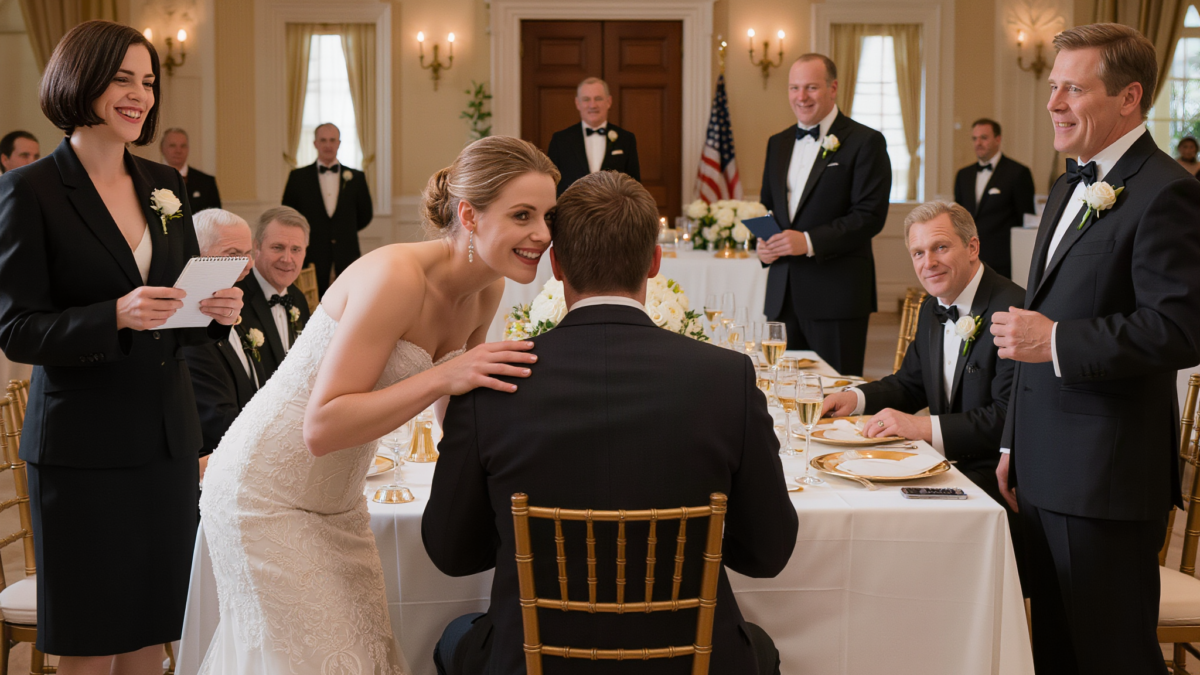
A woman with a sharp dark bob and an even sharper business suit was speaking to the wedding planner. She held a notepad and moved with an air of clinical purpose that was utterly out of place amid the flowing gowns and celebratory chaos.
My phone vibrated in my pocket. A low, urgent buzz.
A text from my CFO and best friend, Ben Carter.
“Forbes is on site. They’re running the story in 10 minutes. Are you ready for this?”
My heart kicked into a new gear, a frantic, hammering rhythm against my ribs.
I looked back at the woman. She was scanning the room, her eyes methodical, searching. It dawned on me with a jolt of adrenaline.
She was looking for me.
The band began a soft romantic tune as servers in crisp white jackets started clearing the salad plates. The wedding machine was moving forward, flawless and oblivious.
But I knew that before the cake was cut, before the first dance was over, the carefully constructed universe of the Sterling family was about to collide with actual reality.
And the impact was going to be biblical.
But first, I had to sit through one final excruciating toast, celebrating everything I wasn’t and everything they thought I’d never be.
The dynamic was set before I could even spell my own name.
Leo was the sun, the golden child, and I was the strange, quiet moon, forever caught in his gravitational pull. Our childhood home wasn’t a home. It was a shrine to Leo’s accomplishments.
His debate team trophies gleamed on the mantelpiece, casting long shadows across the living room. His framed honor-roll certificates marched up the staircase wall. His acceptance letter to a top-tier law school was treated with the reverence of a holy relic.
My territory was the other side of the bedroom we shared.
It was a chaotic landscape of dismantled computer towers, tangled nests of wires, and notebooks filled with sprawling diagrams and lines of what my parents called gobbledygook.
To them, it was a mess, a symptom of my failure to engage with the real world.
To me, it was a laboratory where I could build new ones.
“Henry, for God’s sake, clean this junk up,” my father would command.
His lip curled in distaste as he nudged a motherboard with the toe of his polished shoe.
“Why can’t you be more like your brother? He’s out there. He’s president of the student council. He’s preparing for his future.”
Their idea of a future was a single, brightly lit highway.
Good grades led to a good college, which led to a respectable degree—law, medicine, finance—which in turn led to a stable, high-paying job with a clear path for promotion.
My path wasn’t a highway. It was a dense, uncharted forest I was hacking my way through with a keyboard for a machete.
They didn’t understand the forest, so they feared it. And they dismissed what they feared.
The defining schism, the moment the cracks in our family turned into a canyon, was over my college fund.
They had been diligently saving since the day I was born, a substantial nest egg meant to pave my way down that brightly lit highway.
During my senior year of high school, I announced that I wasn’t going to a traditional university. Instead, I wanted to use a portion of that money as seed funding for a gaming company I had already started conceptualizing with my friend Ben.
The reaction was apocalyptic.
“Absolutely not!” my father roared, his face mottling with a familiar, terrifying shade of crimson.
The vein on his temple pulsed.
“That money has a purpose. It’s for your education, for a real degree. I will not stand by and watch you squander it on some childish, idiotic computer game fantasy.”
“It’s not a fantasy, Dad,” I pleaded, my voice cracking with the desperation of a teenager trying to explain a new world to people stuck in the old one. “It’s a business. I have a business plan. I have user engagement projections. I have a monetization strategy.”
“I don’t want to see your projections.”
He spat the word out like it was poison.
“You’re throwing your life away. Your brother is on track to become a lawyer. A man with a guaranteed salary. A man who will command respect. What will you be? A 30-year-old man-child living in my basement playing with digital toys?”
The words were like stones. Each one a direct hit.
But it was my mother’s reaction that truly shattered me.
She just stood there twisting her wedding ring, her eyes darting between my father’s furious face and the floor. She wouldn’t look at me.
Her silence was her verdict.
In her eyes, I had already been tried and convicted of the crime of being a disappointment.
I didn’t touch the college fund. I walked away from it, and in many ways, I walked away from them that day.
I moved into a rundown apartment with Ben and another friend. We lived on a diet of instant ramen and sheer stubborn willpower.
We worked 18-hour days fueled by cheap coffee and a burning desire to prove them wrong.
Every line of code I wrote was an act of defiance. Every small victory, every new user was a silent argument in a debate they didn’t even know we were having.
I was building my own world because it was painfully clear the one I was born into had no room for me.
In the first year of Quantum Realm Games, we were running on nothing but ambition.
Money wasn’t just tight. It was a ghost we talked about but never saw.
Our servers were a Frankenstein’s monster of secondhand computer parts that hummed ominously in the corner of our cramped living room, threatening to overheat at any moment.
We reached a critical point where we needed a small, crucial injection of cash. Just a few thousand dollars to secure legitimate server space and file the LLC paperwork.
It was the difference between being a real company and a glorified hobby.
Having been so thoroughly rejected by my parents, I exhausted every other option. Finally, with the bitter taste of shame in my mouth, I turned to my extended family.
I swallowed my pride and went to my uncle Richard, my mother’s brother.
He was a successful real estate agent, a man who always carried himself with an air of relaxed confidence. He wore expensive suits and had a handshake that felt both firm and reassuring.
He had always been the cool uncle, the one who would slip me a $20 bill at Christmas.
I met him at a Starbucks, my hands shaking as I laid out my business plan on the sticky table.
I spoke with the desperate, rapid-fire passion of a young founder who sees the finish line but is about to collapse from exhaustion.
I showed him the early designs for Ethereum, the user growth charts that looked like a hockey stick, and the vision for a new kind of mobile gaming experience.
He listened patiently, stirring his macchiato with a thoughtful expression.
“It sounds ambitious, kid,” he said finally, a small smile playing on his lips. “Very ambitious, but I like your hustle.”
He reached into the inner pocket of his blazer and pulled out a checkbook.
“Tell you what, I’ll give you $5,000.”
Tears welled in my eyes. I was so overwhelmed with gratitude that I could barely speak.
“Richard, I… I don’t know what to say. I’ll pay you back with interest. I swear.”
He held up a hand, stopping me.
“Don’t even think about it as a loan. Consider it a gift. A little something to help you get this dream off the ground. Go on. Get it out of your system.”
Get it out of your system.
The phrase should have been a red flag, but I was too blinded by relief to see it.
That $5,000 was a lifeline. It was more than just money. It was a symbol.
It was validation from a corner of the family I respected. It felt like a flicker of belief in the suffocating darkness of their doubt.
About a year later, the company was starting to find its footing.
We had secured our server space, hired our first two employees, and were gaining a reputation in the indie game community.
It was Thanksgiving, and the entire Sterling clan was gathered at my parents’ house.
The air was thick with the smell of roasting turkey and the sound of Leo holding court in the living room, recounting a story about a brilliant legal argument he’d made in a mock trial.
I stepped onto the cold back porch to escape the noise for a moment.
Through the sliding glass door, I could see my father and uncle Richard standing by the still-smoking grill, beers in hand. Their voices carried clearly in the crisp November air.
“So,” my father said with a gruff chuckle, “how’s that investment in Henry’s little computer game company going? Seen any of that tech money yet?”
Uncle Richard let out a sharp, dismissive laugh. It was a sound I had never heard from him before.
“David, please. You and I both know what that was. That was the cheapest five grand I ever spent.”
“What do you mean?” my father asked.
“I mean, it was a shutdown fee,” Richard said, taking a long sip of his beer. “It was cheaper than having to listen to him ramble on about his vision for the next 10 years. I gave him the money so he could go play business, fail, and get it over with. It’s better to let the boy learn his lesson the hard way. It’s a write-off for me and a life lesson for him.”
My father grunted in what sounded like agreement.
“Sometimes that’s the only way they learn.”
I stood frozen in the shadows, the cold of the concrete seeping through my shoes, but a much deeper chill was spreading through my chest.
The world seemed to tilt on its axis.
The gift, the validation, the handshake—it was all a lie. A carefully constructed piece of theater designed to placate the delusional nephew.
It wasn’t an investment in my success.
It was a bet on my failure.
That was the moment the last thread of hope I had for my family’s understanding snapped.
I was utterly, completely alone in this.
And in that cold, lonely moment on the back porch, a new resolve hardened inside me.
I would never ask them for anything again. I would build my world in silence.
And its success would be the only conversation I ever needed to have with them.
The years that followed the Thanksgiving betrayal were a brutal, exhilarating grind.
While Leo was climbing the predictable ladder of a law firm—summer associate, junior associate, a small promotion here, a salary bump there—I was navigating the volatile, high-stakes universe of a tech startup.
It was a world of 100-hour workweeks, of sleeping under my desk, of living and breathing code.
There were moments of sheer terror, like the time a server crash nearly wiped out our entire user database, or the gut-wrenching decision to turn down an early lowball acquisition offer that could have solved all our personal financial problems but would have killed the company’s soul.
But alongside the terror were moments of pure, crystalline triumph that I cherished in secret.
I’ll never forget the day we hired our 10th employee, a brilliant young artist named Sarah. She was the first person we brought on who wasn’t part of the original ramen-fueled founding team.
Seeing her at a real desk in a real office, even if it was a small rented space above a laundromat, sketching out the fantasy worlds that had only existed in my head made everything feel tangible.
We weren’t just three guys with a dream anymore.
We were a real company.
A few months after that, our flagship game, Ethereum, officially surpassed 1 million active users.
Ben and I were in the office late at night, watching the analytics dashboard on a giant monitor we had bought secondhand. The numbers were climbing so fast the display could barely keep up.
When the counter finally ticked over from 9999,999 to 1 million, a stunned silence fell over the room, followed by a whoop of pure joy from Ben that probably woke up the entire neighborhood.
A million people.
A million individual human beings were choosing to spend their time in a world we had built from scratch.
Riding that high, I made the mistake of trying to share the news with my mother.
I called her, my voice buzzing with an excitement I couldn’t contain.
“Mom, you won’t believe it. We hit a million users today. A million people are playing our game.”
There was a beat of silence on the other end of the line.
“Oh, that’s wonderful, dear,” she said.
Her tone was the exact same polite, placid tone she used when I told her I had remembered to get an oil change.
It was a verbal pat on the head.
“That’s so nice. Speaking of good news, did you hear your brother Leo just got a commendation from a senior partner? They’re already talking about his path to a promotion. He’ll have a much better salary next year. We’re so incredibly proud of him.”
The joy inside me deflated like a popped balloon, replaced by a familiar, heavy ache of resignation.
A million users, a milestone that would be the headline of any other startup story, was reduced to static, drowned out by the siren song of Leo’s corporate ascent.
I muttered a weak “That’s great for him” and ended the call.
I realized then that their language of success was one I would never speak.
They measured life in promotions, salaries, and job titles. I measured it in user engagement, server stability, and lines of code.
We were living in different realities, so I stopped trying to translate.
I never told them about the $50 million series, a funding round that put us on the map.
I never mentioned the articles in tech journals that called our game engine revolutionary. I never told them when we opened our first international office in Dublin, or when we acquired a smaller studio we had admired for years.
All of it happened in a parallel universe they couldn’t see.
They saw me get busier, saw me travel more, but in their minds, I was just a boy still tinkering with an increasingly elaborate and increasingly concerning hobby.
The disconnect became a cavern.
In their world, Leo was the conquering hero, returning home with the spoils of his corporate victories. In my world, I was quietly, secretly building an empire.
And now, standing here at Leo’s wedding, the two universes were finally on a collision course.
Just before the ceremony, a text had come through from Sarah, my 10th employee, who was now the vice president of design, managing a team of over 100 artists.
It was a picture of her team in our main conference room, all raising coffee mugs in a toast.
The caption read, “Good luck with the family. Your other family is here cheering you on. Go get M boss.”
I smiled. A real, genuine smile for the first time that day.
It was a powerful reminder. My worth wasn’t up for debate at table one. It had already been defined, built, and proven in a world they knew nothing about.
It was time for the walls between those worlds to come crashing down.
The ceremony was a blur of performative sentimentality. Now, at the reception, the real business of the Sterling family was underway, reinforcing the social hierarchy.
Leo and his new wife Jessica were the king and queen holding court on the dance floor.
I was the court jester relegated to the Siberia of table 9, a geographical representation of my status in the family.
My aunt Carol, a woman whose smile was as sweet and as toxic as saccharine, leaned in so close I could smell her cloying perfume.
“Henry, dear, it’s so wonderful to see you. How is… Well, how is everything?”
She waved a vague, dismissive hand, a gesture meant to encompass the entirety of my incomprehensible existence.
“Still keeping busy with your little computer business?”
The phrase “little computer business” was a dagger wrapped in silk.
“It’s going well, Aunt Carol,” I replied, my voice dangerously tight. “We’re in a growth phase.”
“Oh, lovely,” she chirped, her eyes gleaming with the predatory curiosity of someone waiting for bad news. “Expanding the garage, are you? Your father told us you’re still working from home. It must be so difficult to find the motivation without a proper office to go to, without a boss to keep you on track. I know I could never manage it. I need the structure.”
Every word was a perfectly calibrated insult delivered with the plausible deniability of concern.
She was painting me as a lazy, undisciplined child, incapable of functioning without adult supervision.
I forced a smile that felt like cracking plaster.
“You learn to be your own boss.”
Just then, Markhamm, one of Leo’s most insufferable friends from law school, swaggered over to our table.
He was loud, overly confident, and reeked of expensive whiskey and entitlement. He clapped me on the shoulder with enough force to make me flinch.
“Henry, the prodigal son returns!” he boomed, spraying a fine mist of alcohol-laced saliva. “Leo tells me you’re a big-shot game designer now. What’s the latest? Making the next Angry Birds?”
He and the other lawyer types at his table snickered.
“Something like that,” I said.
My patience stretched to a razor-thin thread.
“You know,” Markhamm continued, leaning in conspiratorially, “my nephew, he’s 10, he’s a little genius with these video games. Absolutely obsessed. Maybe I can hook you two up for a chat. You could, you know, exchange notes on level design.”
The condescension was so profound, so utterly staggering, it almost looped back around to being impressive.
He was, without a hint of irony, comparing me, the CEO of a multinational corporation on the verge of a 10 billion valuation, to his video game-obsessed 10-year-old nephew.
That was when I saw it with perfect, painful clarity.
It didn’t matter what I achieved. It didn’t matter if I had one employee or 1,000. In their world, I would forever be a boy playing with toys in the basement.
I wasn’t a peer. I wasn’t even an adult in their eyes.
I was a strange, amusing sideshow to the main event of their serious, important lives.
I deliberately pushed my chair back from the table, creating a small moat of personal space.
I was done.
I was done trying to explain. I was done defending my life’s work.
The time for words was over.
The time for consequences was about to begin.
Across the sprawling ballroom, I saw her again.
Catherine Vance, the journalist from Forbes.
She was speaking quietly with the maître d’, who then nodded and pointed a discreet white-gloved finger directly at me.
Her eyes met mine across the crowd, and she gave a single, almost imperceptible nod.
It was a signal.
The countdown had begun.
The band finished their set with a flourish. The DJ seamlessly took over, launching into a generic, upbeat pop song.
People were laughing, drinking, blissfully unaware.
They were all dancing on the deck of the Titanic, and I was the only one who could see the iceberg dead ahead.
As the DJ faded the music, a reverent hush fell over the room.
My father strode back to the podium, a look of immense satisfaction on his face.
This was his coronation as much as it was Leo’s wedding.
This was his moment to present his masterpiece, his successful lawyer son, to the world.
He tapped the microphone, the sound echoing through the cavernous ballroom.
“As a father,” he began, his voice thick with practiced emotion, “you have certain dreams for your children. You hope they find happiness. Of course, that’s a given. But you also hope they find respect. You hope they build a life for themselves that commands it. A life that doesn’t need explanation or apology.”
He paused for dramatic effect, letting the words sink in.
He turned his beaming gaze to Leo, who was sitting at the head table, looking every bit the triumphant prince.
“Leo, you have surpassed every dream a father could ever dare to have. You chose a noble path, a path of discipline, of intellect, of prestige. When you tell someone you are a lawyer, they understand what that means. It means you are a serious person. It means you are a pillar of the community, a man who upholds the very fabric of our society.”
The room was filled with murmurs of approval and appreciative nods.
I felt my stomach twist into a tight, cold knot. I knew exactly where this was going.
“It is a world away,” he continued, his gaze now sweeping contemptuously past my table, as if I were a particularly unappealing piece of furniture, “from the fleeting trends and digital distractions that occupy so many young people today. It’s about building something real, something tangible, something with legacy, something that lasts.”
It was a masterclass in public humiliation.
All delivered without ever saying my name.
He had just drawn a line in the sand. On one side was Leo, noble, serious, real. On the other side was me, frivolous, childish, a fleeting distraction.
The pitying glances I received from the surrounding tables were like tiny, sharp needles.
Then it was Leo’s turn.
He stood, kissed Jessica with a flourish, and confidently took the microphone from our father.
He had the easy charm of a man who had never known a day of self-doubt.
“Thank you, Dad,” he said, his voice as smooth as polished marble. “Thank you for always pushing me, for always showing me what a respectable career looks like. You and Mom taught me that true success isn’t about getting lucky or hitting some kind of digital lottery.”
He shot a quick, smug glance in my direction.
“It’s about dedication. It’s about earning your place through hard work and long hours. It’s about building a life that your family can be proud of, not one they have to constantly explain away to their friends.”
The small group of lawyers from his firm erupted in knowing laughter.
The message was as subtle as a punch to the jaw.
My life, my passion, my company—it was an embarrassment, a social inconvenience that had to be awkwardly explained and apologized for at dinner parties.
I sat there, my hands clenched into white-knuckled fists under the starched white tablecloth.
For years, I had absorbed their disapproval in private. I had swallowed their condescending remarks, their dismissive sighs, their endless, glowing comparisons to Leo.
I had told myself it didn’t matter. I had told myself my work would speak for itself.
But hearing it all laid bare like this, weaponized in front of 200 people, was different.
This wasn’t a family disagreement.
This was a public shaming.
They weren’t just dismissing my career choice. They were dismissing my very essence.
And as I sat there, a cold, quiet rage solidifying in my chest, I realized they had just made a catastrophic miscalculation.
They had decided to publicly execute my reputation at the exact moment the world was about to erect a statue in my honor.
The formal speeches may have ended, but the assault wasn’t over.
The air was still thick with the lingering poison of their words.
People were now consciously avoiding eye contact with me, as if my failure were an airborne virus.
It was in this atmosphere that Jessica, the bride, in her cloud of white tulle and lace, decided to deliver the coup de grâce.
She floated over to our table, an angel of condescension.
“Henry,” she cooed, placing a perfectly manicured hand on my shoulder.
Her touch felt like a brand.
“I’m so glad you could make it. I know days like this can be a little tough. All the talk about careers and the future.”
I just nodded.
My jaw clenched so tightly I thought my teeth might crack. My throat was a desert.
She leaned in, lowering her voice to a conspiratorial whisper that was nevertheless perfectly audible to everyone at our table.
“But don’t you worry about what your father and Leo said. Everyone finds their footing eventually. Not everyone can be a high-powered lawyer, after all.”
She gave my shoulder a patronizing squeeze.
“And hey, when you’re finally ready to, you know, grow up and get a real job, I’m absolutely sure Leo could find a spot for you in the firm’s mail room. It’s a start, right? You have to start somewhere.”
The mail room.
The words hung in the air. Obscene and absurd.
After bootstrapping a company from nothing, after securing millions in venture capital, after managing a global team of over a thousand brilliant minds, after creating a digital world inhabited by 85 million people, she was offering me a job sorting letters.
The sheer, breathtaking, galactic level of arrogance was a thing of wonder.
It wasn’t just an insult.
It was a complete and total erasure of my reality.
In her mind, the universe she and Leo occupied was so vastly superior to mine that offering me the most menial position within it was an act of charity.
And just like that, the rage vanished. The shame, the hurt, the years of accumulated frustration.
It all evaporated, replaced by a sudden, exhilarating calm.
It was the calm at the absolute center of a hurricane.
A strange, icy clarity washed over me.
I looked at her beatific, clueless smile. I saw my smug brother watching from the head table, a king on his throne. I saw my proud father accepting the congratulations of his peers.
And I didn’t see family.
I saw a cult, a tiny, self-referential cult of three who had built their entire belief system on the myth of my inferiority.
I didn’t need to fight them.
I didn’t need to argue or yell or defend myself.
Their entire world was a fragile house of cards built on a foundation of profound ignorance.
And a gale-force wind was just moments away.
My phone, lying face down on the table, vibrated.
A new text from Ben.
“It’s live. Forbes homepage. It’s done. The world knows now.”
I took a slow, deliberate breath.
I lifted my head and met Jessica’s condescending gaze.
I didn’t say a word. I just gave her a small, tight, unsmiling smile.
It was a smile that didn’t reach my eyes. It was a smile that said, “You have absolutely no idea what you’ve just done.”
Across the room, Catherine Vance, the journalist from Forbes, began to walk toward our table.
Her stride was purposeful, her expression neutral. Every click of her sensible heels on the polished marble floor was the tick of a clock, counting down the final seconds of their perfect, ignorant world.
Jessica’s angelic smile faltered, a flicker of confusion crossing her face at my strange, silent reaction.
She opened her mouth to say something else, probably another piece of well-meaning, soul-crushing advice about my future prospects in mail delivery.
But she never got the chance because, at that exact moment, Catherine Vance arrived at table 9.
And the storm at long last made landfall.
The arrival of Catherine Vance at table 9 was not a loud event, but it shifted the room’s center of gravity.
The ambient chatter around us didn’t stop, but it faltered like a record skipping. People who had been looking anywhere but at me were now casting intrigued sideways glances.
Catherine Vance carried with her an aura of quiet, serious importance that was utterly alien to the boisterous, celebratory atmosphere of the wedding. She was a black-and-white photograph in a Technicolor movie.
“Mr. Henry Sterling?” she asked.
Her voice was calm, clear, and professional. It wasn’t loud, but it cut through the background noise like a laser.
I pushed my chair back and stood, my movements feeling slow and deliberate.
“Yes, but please call me Henry.”
“Catherine Vance,” she said, extending a hand.
Her handshake was firm and brief.
“From Forbes magazine. It’s a pleasure to finally meet you in person. I’ve been following the story of your company for months now.”
The name Forbes dropped into the conversation at our table like a stone into a silent pond.
The ripples spread instantly.
I saw my aunt Carol’s jaw, which had been set in a permanent line of disapproval, go slack. Markham, Leo’s whiskey-fueled friend, actually choked for a second. His condescending smirk was wiped clean from his face.
The word Forbes was a powerful signifier.
It meant money. It meant power. It meant a world far removed from law firm partnerships and suburban prestige.
“Thank you for coming, Catherine,” I said, my voice remarkably steady.
The icy calm inside me had become a fortress. I felt a strange sense of detachment, as if I were watching a play I had written long ago, waiting for the actors to deliver their final climactic lines.
“I wouldn’t have missed it for the world,” she replied, a tiny, almost imperceptible smile touching her lips.
She understood the theater of the moment.
“The article just went live on our homepage a few minutes ago. It seems you’re the talk of the financial world tonight.”
This was the catalyst.
A subtle but seismic shift began.
The ripple of murmurs from our table spread outward. Phones, which had been tucked away, began to emerge from expensive pockets and designer purses.
A few discreet taps on glowing screens, a few swipes of a thumb, and then a new kind of silence began to fall.
It started at the tables closest to us and spread outward.
It wasn’t the polite, respectful hush from the speeches. It was a stunned, disbelieving quiet as screen after screen lit up with the same image.
My face under a bold headline.
My family at the head table, the epicenter of the old world order, remained blissfully ignorant for a few more seconds.
My father was locked in a hearty, back-slapping laugh with Jessica’s father. My mother was fussing over the floral centerpiece, a perfect portrait of domestic pride.
Leo was holding court, regaling his friends with a triumphant story, his hands gesturing expansively.
They were encased in a bubble of their own self-importance, so thick and resilient that they hadn’t noticed the pressure change in the room.
But others had.
I saw Mr. Henderson, an old business partner of my father’s and a savvy investor, staring at his phone, his eyes wide with shock.
He looked from his screen to me and back again, a look of dawning, incredulous comprehension on his face.
He had been at the next table. He had heard every single condescending word of my father’s and Leo’s speeches.
Catherine, a master of her craft, ignored the growing spectacle.
She spoke only to me, her voice pitched just loud enough to be clear and authoritative.
“We’re projecting Quantum Realm Games will have a valuation of 10 billion by the end of the next fiscal year. Your personal net worth, based on your equity and recent funding rounds, has just crossed the $2 billion mark. Congratulations, Henry. You are officially the youngest self-made billionaire in the history of the gaming industry.”
She delivered the lines with the flat, unemotional cadence of a news anchor reporting the stock market closing.
But each word was a tactical nuke, detonating in the silent ballroom.
10 billion.
2 billion.
Billionaire.
The words seemed to hang in the air, shimmering, impossible.
It was, ironically, my brother who finally broke the spell.
He had noticed the silence. He had noticed the sea of faces, hundreds of them, turned not toward his head table, but toward the back of the room.
Toward me.
He stood up, a look of pure annoyance on his face. This was his show, and someone had just stolen the spotlight.
“What’s going on?” he demanded, his voice echoing in the uncanny quiet. “Why has everyone stopped? What is all this?”
Jessica, his bride, frantically tugged at his sleeve.
Her face was as white as her dress, her eyes glued to her own phone. She whispered something to him, her voice a frantic, desperate hiss.
I watched as my brother’s face went through a rapid, brutal series of transformations.
From annoyance to confusion, from confusion to pure disbelief, and then finally to a dark, ugly, mottled flush of rage.
His eyes found mine across the room.
They weren’t just angry. They were filled with a sense of profound personal betrayal, as if my success, by its very existence, were a direct act of aggression against him.
The bubble had not just popped.
It had been vaporized.
The storm had arrived. And I just stood there calmly in the dead eye of it all, waiting for the thunder to roll.
“There has to be a mistake.”
Leo’s voice, stripped of its usual confident baritone, was now a strained, high-pitched proclamation of disbelief.
He started walking toward us, his expensive wedding suit suddenly looking like an ill-fitting costume.
He was no longer Leo Sterling, the ascendant lawyer. He was just a confused, angry older brother, his authority dissolving into thin air with every step he took.
He didn’t address me. He went straight for Catherine, the messenger he clearly intended to shoot.
“Who are you? What is this garbage? My brother does not have a company. He makes video games. He lives in a small apartment.”
The last sentence was a desperate grasp at the reality he had so carefully constructed.
Catherine Vance was unflappable.
She turned her cool, analytical gaze on him, the kind of look that could dissect a faulty balance sheet or a faltering CEO.
“I am Katherine Vance, a senior editor at Forbes magazine,” she stated, her voice calm and level. “And the only garbage, Mr. Sterling, is the fiction your family has been telling itself. The only mistake was your profound and consistent underestimation of your brother.”
She made a slight gesture with her head, encompassing the entire room, where dozens of guests were no longer trying to be discreet.
They were openly scrolling on their phones, their faces a gallery of shock, envy, and dawning respect.
“The nonsense, as you call it, is our digital cover story for this month. It details the meteoric rise of Quantum Realm Games, a company currently valued at $8.5 billion. It has,200 employees with offices in North America, Europe, and Asia, and a global user base of 85 million people. A company that was founded and is currently led by your brother Henry.”
My parents had finally made their way over, moving as if through water.
My mother, Eleanor, looked as if she had seen a ghost. Her hand was pressed to her chest, her breathing shallow.
My father, David, the great patriarch, just stared at me, his mouth hanging slightly open.
The man who had not 30 minutes ago publicly derided my life’s work as illegitimate now looked utterly lost, as if the fundamental laws of physics had just been repealed before his eyes.
“That’s… that’s not possible,” my father stammered, his voice a whisper.
He looked from me to Catherine and back again.
“The article says you have over a thousand employees. Henry, what is this? What is going on?”
The moment had come.
I finally spoke.
My voice was quiet, but in the tomb-like silence of the room, it carried to every corner.
“It’s the truth, Dad,” I said, my gaze level and unwavering. “It’s what I’ve been trying to tell you for the past 5 years. Every time you asked if I had a real job, yet this is what I was doing. Every holiday you spent praising Leo’s salary, my company was closing another round of funding. Every time you told me to grow up, I was managing a global team, negotiating international partnerships, and revolutionizing an entire industry.”
My words weren’t accusatory.
They were simply a statement of fact, a recitation from a history book they had refused to read.
Leo shook his head, a wild, cornered look in his eyes.
He was a lawyer, and his case was collapsing. He grasped for the only explanation his ego would allow.
“No. No, this is a joke. It has to be a prank. Henry, you paid her to do this, didn’t you? This is about you being jealous. You’re trying to ruin my wedding.”
The accusation was so ludicrous, so profoundly pathetic, that a few people in the crowd couldn’t help but let out a short, sharp bark of incredulous laughter.
Ruin his wedding.
He and my father had just used it as a public stage for my character assassination.
Catherine raised a single perfectly sculpted eyebrow.
“Mr. Sterling,” she said, addressing Leo directly, her voice now laced with an arctic chill. “Forbes magazine has a reputation spanning more than a century. We do not accept payment for our cover stories, and I can assure you, with the full weight of our legal and research departments behind me, an $8.5 billion valuation is no joke.”
The finality in her voice seemed to finally break through my mother’s denial.
She swayed on her feet, grabbing my father’s arm for support.
“David,” she whispered, her voice trembling and full of a dawning horror. “Oh, David, what have we done?”
My father didn’t answer her.
He just stared at me, his eyes a swirling vortex of emotions I had never seen directed at me before.
Confusion, regret, and something that looked terrifyingly like awe.
But beneath it all was fear.
He wasn’t afraid of me. He was afraid of the vast, yawning chasm of his own ignorance that had just opened up at his feet.
The perfect, orderly world he had built, the one where he was the wise king and Leo was his perfect heir apparent, had just been revealed as a fragile, pathetic illusion.
And I was the one holding the hammer that had just smashed it all to dust.
The stunned silence in the ballroom was now being replaced by a frantic, high-energy buzz.
The whispers were no longer tentative. They were excited, charged with the electricity of a massive scandal and an even bigger revelation.
“Quantum Realm Games. Of course, my son plays Ethereum constantly.”
“I read about their Dublin office in the journal.”
“An $8.5 billion company. My God, David Sterling’s son.”
The narrative of my life was being rewritten in real time in this very room.
I was no longer Henry, the family disappointment. I was Henry Sterling, the tech prodigy.
Leo, however, was still trapped in the wreckage of the old narrative, desperately trying to piece it back together.
His lawyer brain, trained to argue, was flailing.
“This is impossible,” he insisted, his voice cracking.
He pointed a shaking finger at me as if I were a hostile witness on the stand.
“You can’t build something like that in secret. We’re your family. We would have known.”
“You would have known if you had ever asked a single genuine question,” I said, my voice cutting through his frantic denial with cold precision. “You never once asked about the specifics of my work. You never asked to see my office, which, for the record, is a four-story converted warehouse in the tech district, not my apartment. You never asked to meet my team. You just assumed. You heard the word games and your brains slammed shut. You saw what you wanted to see, what you needed to see to maintain your perfect little worldview. A failure.”
I turned my attention back to Catherine, deliberately dismissing my brother.
“Catherine, your team’s research was impeccable. Thank you for your professionalism.”
“Our pleasure, Henry,” she said. “In fact, our due diligence uncovered something else that didn’t make it into the final article, but which you might find interesting. We were able to confirm with several high-level sources at Microsoft that last month, you personally attended a meeting with their head of acquisitions and turned down a formal all-cash offer to buy Quantum Realm Games.”
She paused for effect.
“The offer was for $3 billion.”
If the first announcement was a shock wave, this was the aftershock that leveled the entire city.
$3 billion.
It was a number so vast, so mythological, that it transcended all their metrics of success.
It was more money than anyone in that room, including my father and his wealthy friends, could truly comprehend.
It was a number that rendered Leo’s lawyer salary, my father’s insurance business, all of it, completely and utterly insignificant.
It was a figure that represented a different species of success, a different plane of existence.
Markham, Leo’s friend, who had wanted to introduce me to his 10-year-old nephew, looked like he was going to be physically ill.
My aunt Carol was fumbling in her purse for a nonexistent handkerchief, her face a mask of horrified disbelief.
And Uncle Richard, the man who had given me a shutdown fee of $5,000 to learn my lesson, had gone the color of spoiled milk.
I could practically see the gears in his head grinding, calculating the astronomical return he had smugly walked away from.
“You… you turned down $3 billion,” my father whispered, the words barely audible.
They seemed to catch in his throat, choked by the sheer weight of the number.
“It was never about the money, Dad,” I said, and for the first time, I felt a flicker of pity for him. “It was about the vision. It was about building something that lasts.”
I threw his own words from his speech back at him.
And I saw from the wounded flicker in his eyes that they had found their target.
Jessica, the bride, the perfect queen of this shattered fairy tale, finally found her voice.
But it wasn’t a voice of awe or apology or even confusion. It was a voice shrill with pure, unadulterated selfishness.
“You did this on purpose,” she hissed, fat tears of rage and self-pity finally spilling down her cheeks, ruining her perfect makeup. “You waited for my wedding day to pull this stunt. You’ve ruined everything.”
I looked at her, at my sputtering brother, at my shell-shocked parents, and I realized with profound clarity that they still didn’t get it.
They couldn’t.
They thought this was about them, a calculated act of revenge.
They were so trapped in their own solipsistic drama that they couldn’t comprehend that their wedding, their big day, was just a minor, insignificant event in the larger world.
It was simply the day a magazine decided to publish a story.
Nothing more, nothing less.
“I didn’t do anything,” I said, my voice completely devoid of emotion. “I just accepted an invitation to my brother’s wedding. The rest of the world did the rest.”
This was the moment.
The moment that changed everything, when I finally took back control of my own life.
The party was well and truly over.
The DJ, bless his heart, made a few pathetic attempts to restart the music, but the festive atmosphere had been sucked out of the room and replaced by a thick, buzzing tension.
The five-tier wedding cake, a monument to a celebration that was now dead, sat untouched and ignored. The dance floor was a vacant expanse of polished marble.
Leo and Jessica’s perfect day had been completely and irrevocably hijacked.
It would forever be known not as the day they started their life together, but as the day the Sterling family’s dirty laundry was aired and their forgotten son was revealed to be a king.
The social dynamics of the room had inverted.
Guests were no longer approaching my parents to offer congratulations. They were swarming me.
Men in expensive suits who had looked straight through me an hour ago were now pressing their business cards into my hand, their eyes gleaming with newfound respect and opportunism.
“Henry, we have to talk about synergy. My venture capital firm would love to get in on your next round.”
Mr. Henderson, my father’s old business partner, a man my father deeply respected, strode over and clapped me on the back with a booming laugh.
“Henry, I always told your father he didn’t know what he had with you. That boy’s got a different kind of mind. I said, ‘You have to tell me about this mobile gaming architecture you’ve pioneered.’ My grandkids would think I was a god.”
I was polite but detached, my mind operating on a different frequency.
My eyes kept drifting back to the small, miserable cluster that was my family.
They were huddled together near the head table, a tiny, isolated island in a sea of their own creation.
They were engaged in a frantic, whispered argument. Leo was gesturing wildly, his face contorted with a rage that bordered on hysteria. Jessica was openly sobbing, her dream day in ruins.
My mother was trying to placate them both, her face a wreck of confusion and regret.
And my father.
My father just stood there looking smaller than I had ever seen him, looking old and utterly defeated.
Finally, Leo could take it no more.
He broke away from the group and stormed toward me, shouldering people out of his way. His eyes were blazing with a toxic mix of envy and righteous fury.
“You couldn’t have picked any other day,” he spat, his voice a low, vicious growl. “You had 364 other days this year to pull this narcissistic stunt. And you chose my wedding day. You’ve always been jealous of me, haven’t you? You couldn’t stand seeing me have one thing, one single day that was just mine.”
The accusation was so profoundly warped, so fundamentally disconnected from reality, that all I could feel for him in that moment was a deep, sorrowful pity.
He still saw the world as a zero-sum game between us. For me to win, he had to lose. Even now, he thought this was about him.
“This was never about you, Leo,” I said, my voice weary. “This was about me living my life. You and Jessica just happened to schedule your party on a workday for me.”
“A workday?” he scoffed, his voice rising in disbelief. “You humiliated us. You made our entire family, our name, look like a pack of fools.”
“No,” I said.
My voice hardened, shedding the weariness and taking on the sharp edge of steel.
I took a deliberate step closer to him, and for the first time in our entire lives, he was the one who instinctively took a step back.
The power dynamic had been permanently, irrevocably altered.
“You did that all by yourselves. You spent years, decades, treating me like I was a stain on the family name. You used your own wedding as a public stage to shame me and my life’s work one final time. Your only mistake was not realizing the audience was bigger than you thought. You lit the match, Leo. You just didn’t realize you were standing in a room full of dynamite.”
My parents and Jessica had trailed behind him, a miserable procession.
My mother reached out a trembling hand toward my arm.
“Henry, please,” she begged, her eyes pleading. “We… We didn’t know. We swear we didn’t know.”
“That’s the entire point,” I said, my gaze sweeping over each of their stricken faces. “You didn’t know. And you didn’t know because you never cared enough to find out. You had your perfect little narrative, your tidy little story about the successful lawyer son and the failed dreamer son. And you were never going to let a single inconvenient fact get in the way of it.”
I glanced at my watch, a deliberate, dismissive gesture.
“I have an early flight to Seoul tomorrow for a meeting with our Asian market development team. I should get going.”
“Don’t you dare walk away from us,” my father said.
His voice was a pathetic echo of its former booming authority.
I turned to face him fully.
All the years of ingrained fear and intimidation I’d felt in his presence had simply vanished.
I wasn’t looking at a giant anymore. I was just looking at a man, a flawed and frightened man who had allowed his own history to poison his relationship with his son.
“I’m not walking away from you,” I said calmly, correcting him. “I’m just leaving. There’s a fundamental difference.”
I looked at my brother, at the ruins of his perfect day.
“Congratulations on your wedding, Leo.”
Then I turned my back on them and walked out of the ballroom.
I didn’t look back.
I could feel 200 pairs of eyes on me. But for the first time in my life, I didn’t care what a single one of them thought.
I was finally, blessedly free.
In the 6 months that followed what the tech blogs had dubbed the wedding crash, my life accelerated from a sprint into a warp-speed blur.
The Forbes article wasn’t just a match. It was a gallon of gasoline poured on a bonfire.
The story of the reclusive gaming genius who was publicly downed by his family on the same day he was outed as a billionaire was irresistible.
It had drama. It had conflict. It had a satisfying David and Goliath arc, even if David was a billionaire himself.
Quantum Realm Games was no longer just a successful company. We were a cultural phenomenon.
I found myself on the cover of Wired magazine, standing in our gleaming new R&D lab, a holographic model of a new game world floating between my hands.
The headline was simple and devastating.
“Henry Sterling didn’t just build a game, he built a new reality.”
The fame was an awkward, ill-fitting suit.
I was, at my core, an introvert, a builder. I was more comfortable with the clean logic of a line of code than the messy unpredictability of a television camera.
But Ben, my ever-practical CFO and the best friend a guy could ask for, insisted it was a necessary evil.
“You’re the story now, man,” he’d said, clapping me on the back after a particularly grueling photo shoot. “People aren’t just investing in the company, they’re investing in you. They connect with the story, so you have to own it.”
He was right.
I learned to navigate the world of interviews and keynote speeches. And inevitably, in every single one, the question of my family came up.
During a televised one-on-one with a sharp, well-respected tech journalist, she leaned forward with a look of practiced sympathy.
“The story of what happened at your brother’s wedding has become something of a legend in Silicon Valley,” she said. “It’s a powerful story about validation. I have to ask, how have things been with your family since that night?”
I had rehearsed the answer to this question a hundred times.
I could have been bitter. I could have been angry. I could have laid out the years of emotional neglect and casual cruelty for the world to see.
But what would that accomplish?
It would just make me a victim in a story where I had finally become the victor.
So I chose a different path.
“My family is like a lot of families,” I began, looking straight into the camera, imagining I was talking to one person, not millions. “They love me, but they had a very specific and rigid blueprint for what a successful life should look like. Their blueprint was based on what they knew, what they trusted: traditional, stable careers. I was working with a blueprint they had never seen before, written in a language they didn’t understand.”
The interviewer was good. She pressed gently.
“Have they come around? Are they learning the language?”
This was the tightrope.
“Understanding is a long and complicated process,” I said, choosing my words with care. “I believe that all meaningful relationships, whether they’re in business or in a family, have to be built on a non-negotiable foundation of mutual respect. Not just respect for the person, but respect for their choices, their path, their passion. We’re in the process of seeing if a new foundation can be built.”
It was the most honest answer I could give.
They had been trying to breach the wall I had built.
My mother had left a series of rambling, tearful voicemails, each one a chaotic mix of apology and confusion.
My father had sent several stiff, formal emails as if he were trying to negotiate a business deal.
“I believe it would be mutually beneficial for us to open a line of dialogue.”
Leo had even sent a single three-word text.
“We need to talk.”
But I hadn’t been ready.
An apology without understanding is just a tactic. Forgiveness without change is just a postponement of the next wound.
They understood now that I had money. They understood that I had power. They understood that the world saw me as a success.
But I wasn’t convinced they understood me.
The kid who found more solace in a circuit board than a football. The young man who poured his entire soul into a dream they had actively, consistently, and publicly ridiculed.
I ended the interview with a final thought, a piece of advice for anyone out there feeling unseen.
“Ultimately, you cannot wait for other people to validate your journey or approve your blueprint. You have to believe in it yourself, even when you’re the only one in the world who can see it. You have to be your own first investor.”
The line went viral.
It became a motivational poster, a graduation speech cliché. But for me, it wasn’t a cliché.
It was the simple, brutal truth I had been forced to learn.
My success was not for them. It was for me.
And any relationship we had going forward would have to begin with their unconditional acceptance of that fact.
After weeks of their relentless, clumsy attempts to reestablish contact, I finally agreed to see my parents.
The constant voicemails and emails were becoming a distraction, a background noise of guilt and obligation.
I needed silence, but I dictated the terms.
Not at their house, the museum of my failures. Not at my office, the monument to my success.
We met on neutral ground, a quiet, unassuming coffee shop in a neighborhood neither of us frequented.
They were already there when I walked in, sitting at a small table in the corner.
They looked diminished, smaller, older, and more ordinary than the towering figures of my memory.
The power they had once wielded over my emotional state had evaporated, leaving behind two nervous, anxious people who looked like they were about to have a very difficult conversation with their bank manager.
The first few minutes after we ordered our coffees were thick with an awkward, suffocating silence.
My mother kept shredding her paper napkin into a small, snowy pile. My father stared into his black coffee as if it held the secrets to the universe.
Finally, he spoke, his voice raspy and low, a stark contrast to his usual confident boom.
“Henry,” he began, still not looking at me. “We, your mother and I, we know we’ve made a terrible mistake.”
He shook his head.
“No, not a mistake. A mistake is something you do by accident. This was a failure. A catastrophic failure. We failed you as parents.”
My mother let out a small, choked sob.
I said nothing.
I just sat there, my hands wrapped around my warm mug, and I waited.
I had heard the word sorry in their voicemails. It was an empty word.
I needed to hear the why.
My father took a deep, shuddering breath, as if preparing to lift something immensely heavy.
“I’ve never told you this,” he said, his voice dropping even lower. “I’ve never told anyone, not even Leo. Before I started in the insurance business, before I met your mother, I had my own company, a small residential construction company. It was my dream. I started it with two of my best friends when I was 24.”
He paused, and for the first time, he looked up at me.
The pain in his eyes was so raw and ancient. It was like looking at an old battle wound.
“I put everything I had into it. Every penny of my savings. Every last bit of a small inheritance I’d gotten from my grandfather. I worked day and night. I loved it more than anything. I thought I was going to be a millionaire by the time I was 30.”
He looked back down at the table.
“And I lost everything. We took on a big project. The market turned. Our financing fell through. And I went bankrupt. I was 27 years old. I didn’t just lose the company. I lost my friends’ investments. They never spoke to me again. The woman I was engaged to at the time. She left me, said she couldn’t marry a failure. I was humiliated, a complete and utter failure. It was the defining moment of my life. It broke me.”
And just like that, decades of confusing, painful behavior snapped into crystal-clear focus.
The obsession with stability and safe careers. The visceral fear of risk. The relentless praise for Leo’s predictable, paved path. The angry dismissal of my own entrepreneurial dreams.
“When I saw you,” he continued, his voice thick with unshed tears, “so passionate, so brilliant, so obsessed with this. This thing I couldn’t understand. It terrified me. All I could see was myself at your age, full of fire and dreams, heading straight for a cliff. I thought, I honestly thought if I was hard on you, if I pushed you toward a safer path, a real job with a real salary, I could protect you from the soul-crushing pain I went through. I was trying to save you from my own history.”
He finally looked at me again, his eyes swimming with a lifetime of regret.
“But I was so blinded by my own fear, so haunted by my own ghost, that I couldn’t see you. I couldn’t see your talent. I couldn’t see your genius. I just saw my own failure about to happen all over again. My fear made me cruel, Henry. And I will regret that cruelty for every single day I have left on this earth. I am so, so sorry.”
It wasn’t an excuse.
It was a confession, a deeply human, flawed, and tragic reason for his behavior.
And in that moment, the anger I had carried like a shield for so many years didn’t vanish, but it softened.
It made way for a new, far more complicated emotion, a sad, aching empathy.
The chasm between us was still there, carved out by years of pain. But now, for the very first time, I could finally see the broken man standing on the other side.
I’m standing in my office.
It occupies the entire top floor of the Quantum Realm Games headquarters. The floor-to-ceiling windows wrap around the entire space, offering a breathtaking 360-degree view of the city.
A glittering, sprawling tapestry of lights, ambition, and endless possibilities.
It’s a universe away from the cramped, ramen-scented apartment where this all began.
The coffee shop confession wasn’t a magic wand.
It didn’t instantly heal years of wounds or perfectly mend the shattered fragments of our family, but it was something more valuable.
It was a beginning.
It was the first brick in a new foundation. One built not on fearful expectations or painful history, but on a raw, belated, and deeply painful truth.
We’re talking now.
Not just speaking, but actually talking.
They ask questions about my work. Questions filled with a clumsy but genuine curiosity.
My father, with a shy, newfound respect, asks me to explain the complexities of server load balancing and user engagement metrics.
He’s trying to learn the language of my world.
My mother, in a gesture that touched me more than she will ever know, sent me a screenshot of her tablet.
She had downloaded Ethereum and was stuck on the tutorial level. Her little wizard character was standing facing a wall.
“How do I make it move?” her text read.
It was a small thing, but it was everything.
Leo is a more complicated story.
The chasm between us remains wide and deep. His identity was so intrinsically linked to his role as the successful son that my success didn’t just challenge his worldview.
It shattered it.
We are civil during the holidays, but a cold distance remains.
Maybe one day he’ll be able to see me not as his rival, not as a walking, talking symbol of his own perceived inadequacies, but simply as his brother.
I genuinely hope so.
Sometimes I look out this window at the sprawling city below and think about the two worlds that so violently collided at that wedding.
The small, rigid world of my family’s expectations and the vast, dynamic world I built in the shadows.
For so long, I was convinced that I needed their world to approve of mine.
I thought their validation was the final boss I had to defeat to win the game of life.
But I was wrong.
The real victory wasn’t the spectacular, cinematic moment the world found out I was a billionaire.
That was just the outcome.
The true victory was forged in the thousands of quiet, unseen, unglamorous moments that came before it.
The gut-wrenching decision to walk away from my college fund. The exhilaration of hiring our first employee. The quiet pride of watching a stranger on the subway playing my game.
The victory was in the work.
It was always in the work.
My family’s validation was never the prize.
The prize was this.
The company, the culture of creativity we’ve fostered, the community of millions we’ve built, the life that is authentically and unapologetically mine.
I have learned that you cannot force people to see your vision.
You just have to build it.
Build it so brilliantly, so passionately, and so relentlessly that eventually they can no longer ignore it.
You have to build your own empire of self-worth.
One brick, one line of code, one quiet act of faith at a time.
And that is a reality, a kingdom that no one can ever take away from you.








