At my father’s retirement gala, my brother shoved a silver tray against my wine-stained suit and ordered me to clear tables in front of 200 guests. My assigned seat was table 19 by the kitchen doors, and the family photo display had replaced me with an olive tree. My mother texted, “Just play along.” I dropped the tray onto the marble floor, took out my phone, and sent one message to my lawyer.
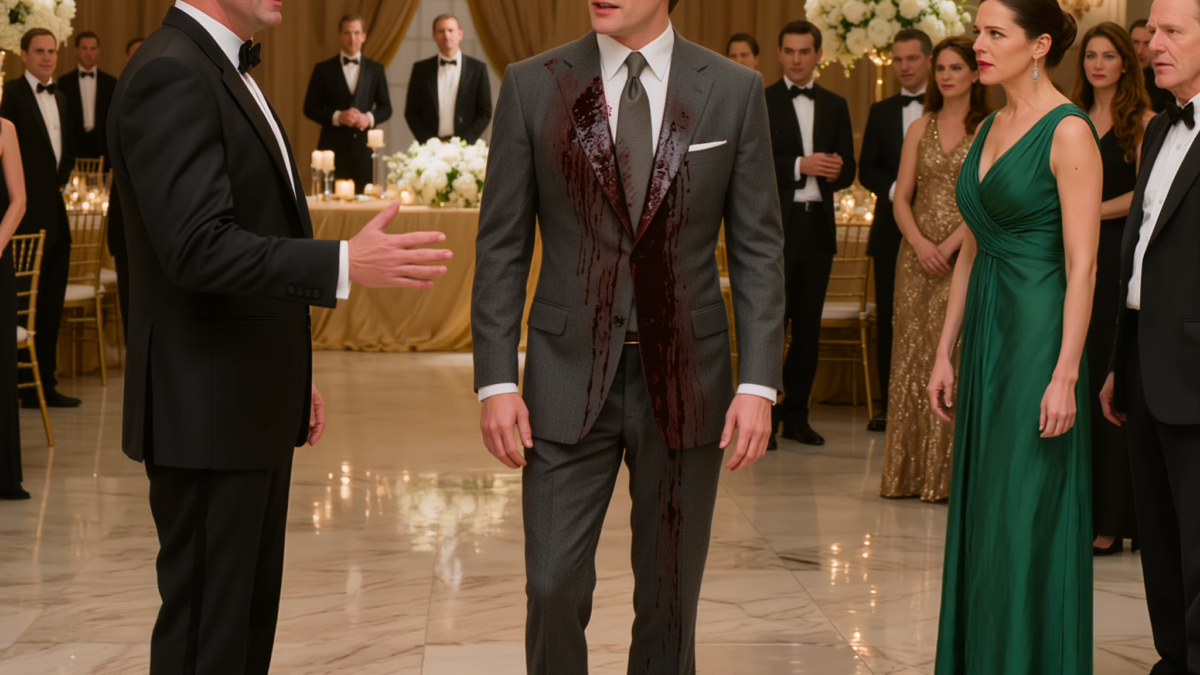
My name is Anthony Sterling. I was 34 years old when my older brother decided to turn our father’s retirement gala into a public demonstration of exactly how little he thought of me.
The Grand Hotel ballroom was filled with nearly 200 of the city’s most influential people. Crystal chandeliers shone over gold-draped tables, expensive floral arrangements, and guests dressed in evening gowns and tailored tuxedos. The air smelled of perfume, champagne, and the kind of wealth my family had spent decades trying to display.
I was standing near the service entrance, trying to disappear into the velvet curtains, when Isaac noticed me.
He wore an expensive tuxedo and the confident expression of a man who had never seriously questioned whether he deserved to be the center of attention. A cruel grin spread across his face as he approached, holding a half-empty glass of scotch.
With his free hand, he took a silver serving tray from a passing waiter.
“Anthony!” he called loudly enough to cut through the conversations around us. “Glad you made it. We were actually short a few hands tonight.”
Before I could respond, he shoved the tray against my chest.
The metal was cold through my shirt. I caught it instinctively before it could fall.
That was my first mistake. By holding it, I’d given him exactly the image he wanted.
“Start with table four,” Isaac announced. “They’ve got a pile of empties, and try not to drop anything this time, okay? We know how clumsy you get when you’re nervous.”
People nearby began laughing.
At the head table, my mother, Marlene Sterling, watched the scene unfold. I looked toward her, hoping she might say something.
Instead, she reached for her phone.
A second later, mine vibrated.
“Just play along. Don’t make a scene. It’s your father’s big night.”
I read the message twice.
I had spent most of my life being told to understand my brother, excuse my father, and avoid embarrassing the family. Apparently, even being publicly humiliated wasn’t enough to change those rules.
My fingers tightened around the tray.
I could have thrown it down. I could have shouted at Isaac in front of the board of directors and everyone else who had gathered to celebrate my father’s career.
But five years away from my family had taught me something valuable about reacting when someone wanted to provoke me.
Then I noticed a woman rising from the head table.
Sarah, Isaac’s fiancée, was walking directly toward us.
She wore an emerald-green evening dress, and her dark hair was pulled into an elegant bun. I knew she came from a powerful real estate family, and that her upcoming marriage to Isaac was as much a business arrangement as a romantic one.
Isaac saw her approaching and smiled even wider.
“Babe,” he said, gesturing toward me. “I was just showing Tony here where he belongs.”
Sarah didn’t smile.
She stopped in front of me, ignored Isaac’s invitation to laugh, and straightened her posture. Then she lowered her head in a gesture of unmistakable professional respect.
“Good evening, boss,” she said clearly. “I didn’t realize you were overseeing the merger personally.”
Isaac’s expression changed.
“Boss?” he managed. “Sarah, what are you doing? He’s the help.”
She turned toward him.
“No, Isaac. He’s the reason you still have a job.”
The laughter disappeared.
To understand why those words mattered, and how a family celebration reached that extraordinary moment, I have to go back two weeks.
It began with an envelope in my mailbox.
The stationery was heavy, cream-colored cardstock with gold lettering. It looked expensive, carefully chosen to communicate the kind of old-money status my father had always admired.
I found it between a utility bill and an advertisement for a pizza place.
At the time, I was living in a modest townhouse, far from the gated community where I’d grown up. It was quiet, comfortable, and anonymous.
I liked that nobody in the neighborhood cared about my last name. Nobody expected me to explain why I no longer worked at Sterling Dynamics.
I turned the envelope over and read the name.
“To Mr. Tony Sterling.”
I sighed.
My name is Anthony. It always has been.
When I was six, my father decided Anthony sounded too soft and started calling me Tony instead. He never asked whether I liked it.
Even now, on an invitation to his own retirement celebration, he couldn’t bring himself to use my actual name.
I carried the mail into the kitchen and made coffee.
The invitation was for a gala at the Grand Hotel, celebrating Robert Sterling’s 40 years as CEO of Sterling Dynamics.
My father had built the company through ambition, ruthless negotiations, and an extraordinary ability to make people believe that working for him was a privilege. He was charming to investors, demanding with employees, and particularly unforgiving toward anyone he believed was weak.
That included me.
We hadn’t spoken in three years.
Our last serious conversation happened when I refused a vice president position he’d created for me. The title sounded impressive, but the work was little more than administrative busywork. Isaac would make the important decisions while I remained safely under my father’s control.
I knew what the position represented.
It wasn’t an opportunity. It was a way to keep me close without ever letting me become independent.
When I refused, my father warned that I’d be crawling back within six months.
He said I lacked the killer instinct necessary to survive outside the family business.
Maybe he was right about that particular quality. I had no interest in becoming the kind of man he was.
But I’d spent the intervening years building something he knew nothing about.
I was about to throw the invitation away when my phone rang.
The number belonged to a landline I recognized immediately.
“Hello?”
“Master Anthony.”
Clara’s voice was fragile with age, but I would have recognized it anywhere.
She had worked as our housekeeper for 30 years. When I fell and scraped my knees as a child, Clara cleaned and bandaged them. When my father sent me to bed without dinner for talking back, she quietly brought me food.
She remembered my birthdays when my parents were away on business trips.
In many ways, she had raised me.
“Clara,” I said, leaning against the kitchen counter. “You don’t have to call me master. I’m just Anthony.”
“You got the invitation?”
“I did. I’m not going, Clara. You know I can’t.”
“Please,” she whispered. “He’s retiring. It’s the end of an era. And I miss you. It’s been so quiet here. Just ghosts in a big house. If you don’t come for him, come for me. Just for an hour.”
She knew exactly what she was asking.
I could refuse my father without hesitation. I could ignore my mother’s disappointment. I could stay away from Isaac for the rest of my life.
But saying no to Clara was different.
“Is he actually retiring?” I asked.
“Monday. Isaac takes over officially on Tuesday.”
My stomach tightened.
Isaac was two years older than me, the golden child who could do no wrong.
If he crashed a car, someone blamed the road. If he failed a class, the teacher was incompetent. Every accomplishment earned him praise, and every failure became someone else’s responsibility.
Now he was inheriting control of Sterling Dynamics.
“Okay, Clara,” I said. “I’ll be there. But only for an hour, and only for you.”
“Thank you. Wear something nice. Show them you’re doing well.”
After we ended the call, I stood beside the kitchen window and looked at my reflection.
Doing well was an understatement.
My family believed I was an unsuccessful independent consultant barely getting by. They assumed my modest home and ordinary car were evidence that leaving Sterling Dynamics had ruined my prospects.
They knew nothing about Aurora.
They didn’t know about the acquisitions I’d made or the financial positions I’d spent years developing. While Isaac enjoyed the advantages of his father’s company, I’d been building my own business.
I picked up the invitation again.
“All right, Dad,” I whispered. “I’ll come. But I’m not coming as Tony.”
Two weeks later, rain was pouring over New York when I pulled up to the Grand Hotel.
I handed my car over at the valet stand and stepped onto the red carpet.
Isaac loved expensive designer labels. I preferred clothing that didn’t announce its price. That evening, I wore a perfectly fitted charcoal-gray suit made by a tailor in London.
To most people, I probably looked like an ordinary corporate manager.
That suited me.
The entrance to the grand ballroom was crowded with guests, business partners, local politicians, and longtime friends of my father. Security personnel checked names against lists on their tablets.
I waited until it was my turn.
The young woman at the entrance looked at me, glanced briefly at my black Oxford shoes, and returned her attention to her screen.
“Name?”
“Anthony Sterling.”
She searched the list.
“I’m sorry. I don’t have an Anthony Sterling on the VIP list.”
“Try Tony.”
She checked again.
“No Tony either.”
A couple waiting behind me began showing signs of impatience.
“Is there a problem?” the man asked.
“Check general admission,” I suggested. “Or perhaps the staff list. My father has a sense of humor.”
The woman continued scrolling until she reached the bottom.
“Oh, yes. Here it is. Tony Sterling. You’re listed under supplemental guest list B.”
I knew what that meant.
List B was for distant relatives, former employees, and people invited out of obligation rather than affection. Those guests had no access to the private cocktail reception and no seats among the honored attendees.
The woman pointed toward a side entrance.
“That entrance is for list B.”
I started walking toward it.
A large security guard with a tired expression stepped into my path. He examined my invitation, then looked at my face more carefully.
“You’re Robert Sterling’s son, aren’t you?”
I nodded.
“Supposedly.”
“I used to work security at the plant,” he explained. “You were the only one who ever said good morning to the night shift.”
He reached over and unhooked the velvet rope.
“Go through the main door, Mr. Sterling. I’ll handle it.”
“Thank you.”
It was such a small kindness, but after years of dealing with my family, it meant more than he probably realized.
The ballroom was magnificent.
High ceilings, enormous arrangements of white lilies, my mother’s favorite flowers, and musicians playing softly beside the banquet tables.
As I entered, I recognized people I’d known for decades.
Uncle Ben was laughing near the bar. Linda, my mother’s closest friend, was inspecting one of the floral centerpieces.
Neither acknowledged me.
I wasn’t particularly surprised.
I’d learned long ago that people in my father’s circle paid attention according to status, and I’d been placed firmly at the bottom.
I took a glass of water from a passing waiter and walked toward an exhibition my mother had organized.
She called it the memory lane display.
The hallway was lined with enlarged photographs chronicling the rise of Sterling Dynamics and the family supposedly responsible for its success.
I wanted to see whether I’d been included.
The earliest pictures showed my parents in 1985, young and ambitious. There was Isaac as a baby in 1990, and me as a baby in 1992.
I continued walking.
There were pictures of Isaac winning a Little League trophy and shaking hands with the mayor.
I’d graduated as valedictorian of my high school class, but that moment was nowhere to be found.
Eventually, I reached a section labeled “The Golden Years.”
One photograph stopped me.
It had been taken during a family trip to Italy five years earlier. We were standing in front of the Colosseum.
I remembered that afternoon clearly. I wore a blue shirt and stood on the far left, beside my father.
But in the enlarged version displayed on the wall, I wasn’t there.
My father was there. My mother was there. Isaac was there.
Where I should have been standing, someone had inserted a potted olive tree.
I stared at it.
The editing was professional. Whoever altered the image hadn’t simply cropped off the edge. They’d removed me and reconstructed the space.
My family hadn’t forgotten to include my photograph.
They’d deliberately erased me from one.
I took out my phone and photographed the display. My hand trembled slightly.
“Nice tree,” someone said behind me.
I turned.
A woman in an emerald-green dress stood nearby, studying the photograph. Her dark hair was gathered into a sleek bun, and she held a champagne flute.
“It really ties the composition together,” I replied.
“I hear the photographer charged extra for the removal.”
She looked at me directly.
“It must be hard being replaced by shrubbery.”
“You know who I am?”
“I make it my business to know everyone in the room.”
She offered her hand.
“I’m Sarah. Isaac’s fiancée.”
I shook it.
“Anthony. The shrubbery.”
She studied me without laughing.
“Isaac told me you were difficult. He said you were a college dropout who lived off a trust fund and caused drama.”
“Is that what he said?”
“I did my due diligence,” she explained. “I don’t merge assets without checking the background.”
I told her I hadn’t taken money from my parents in five years and that I held two master’s degrees.
“I know,” she said.
She proceeded to identify my MBA from Wharton and my master’s degree in structural engineering from MIT.
She also knew I worked as an independent consultant.
“Though you’re remarkably hard to track for someone with those credentials,” she observed. “No LinkedIn, no website.”
“I value my privacy.”
“Or you value your anonymity.”
Her question was more perceptive than she probably realized.
“Why are you here, Anthony? If my family photoshopped me into a plant, I would have burned the venue down.”
“I’m here for the housekeeper,” I admitted. “She asked me to come.”
Her expression softened.
“Loyalty. That’s a rare currency in this room.”
Before I could answer, Isaac appeared at the end of the hallway.
“Sarah! There you are. I’ve been looking everywhere. The photographer is ready for the couple shots.”
He approached and placed a possessive hand on her lower back.
“Why are you talking to him? Don’t let him bore you with his sob stories.”
“We were discussing the decor,” Sarah replied, stepping away from his touch. “The photography is quite creative.”
Isaac laughed, completely missing her sarcasm.
“Yeah, Mom went all out.”
He started leading her away, then turned toward me.
“Oh, Tony, your table is number 19. It’s in the back. Try not to embarrass us, all right?”
Sarah glanced over her shoulder as they left.
I couldn’t tell whether the expression on her face was an apology or something more calculated.
I checked the seating chart and found table 19.
Then I began walking.
I passed the tables reserved for executives, investors, politicians, and wealthy family friends. Their tablecloths were gold, and elaborate orchid arrangements stood in the center.
My parents sat at table one.
My mother was adjusting her diamond necklace. My father was laughing at something the mayor had said.
I continued past table five, then table ten.
By the time I found table 19, I was standing beside the kitchen’s swinging doors.
The table had a plain white polyester cloth and a small, rather miserable-looking carnation in the center.
Every time a waiter passed through the doors, hot air and the smell of roasted beef and dish soap drifted into the room.
My companions were an unusual assortment.
Great-Aunt Miller, who was 90 and nearly deaf, sat beside my father’s former driver, Sam. Two teenagers I didn’t recognize were absorbed in their phones.
“Hey, Sam,” I said, pulling out a chair.
He looked up in surprise.
“Mr. Anthony, what are you doing back here?”
“Apparently, this is where I belong.”
Sam shook his head.
“This isn’t right. You’re the son. You should be up there.”
“It’s fine,” I told him.
It wasn’t.
From that corner, I could see Isaac leaning over to whisper something to our father.
They laughed together.
I poured myself some water from a spotted glass and reminded myself that I’d promised Clara only an hour.
I’d walked away from Sterling Dynamics because I wanted a life that didn’t require my father’s approval. I’d built that life, but sitting at table 19 brought back an uncomfortable feeling.
They still thought my independence was failure.
They saw my refusal to compete for their affection as evidence that I had nothing worth offering.
I looked again at the photograph on my phone.
The olive tree stared back.
I wasn’t just hurt anymore.
I was angry.
The lights dimmed, and the spotlight settled on the stage.
My father approached the podium to enthusiastic applause.
“Thank you,” he began. “Four years. It’s been a long road.”
He talked about sacrifice, hard work, family values, and building a legacy for his children.
Whenever he mentioned the future, he looked toward Isaac.
Never toward table 19.
Finally, he announced that he wanted to introduce the next generation of Sterling Dynamics leadership.
“My son, Isaac Sterling.”
Isaac bounded onto the stage, embraced our father, and waved as the applause grew louder.
I watched from beside the kitchen doors.
What most of those guests didn’t know was that Sterling Dynamics had serious financial problems.
I knew about the substantial loans taken out to cover mounting losses. I knew that the supposed transformation of its technology division was largely an illusion.
I also knew far more about the company’s debt than anyone in that ballroom would have guessed.
Isaac clearly enjoyed having an audience.
“Thank you, Dad,” he began, wiping away what looked like an artificial tear.
He talked about vision and about the responsibility of following a business legend.
Then he clicked a remote.
A presentation appeared on the enormous screen behind him.
“I want to share with you all the project that is going to save—I mean, launch this company into the next century. We call it Project Phoenix.”
My attention snapped toward the screen.
There were engineering diagrams, structural calculations, and an outline for modular housing built from recycled composite materials.
I knew those designs.
I’d drawn them.
Three years earlier, I’d spent four consecutive nights preparing the proposal. I’d called it Project Aegis.
When I presented it to my father and Isaac, my father dismissed it as idealistic nonsense and told me to return my attention to reducing shipping expenses.
Now Isaac had changed the name and added a new logo.
He was presenting my work as his own invention.
“This is sustainable,” he announced. “This is profitable. This is the genius of the new Sterling generation.”
Investors nodded approvingly.
They believed him.
Sam touched my arm.
“Mr. Anthony, you okay? You look like you’re going to snap that fork.”
I looked down.
The cheap fork in my hand had bent almost ninety degrees.
“I’m fine, Sam,” I said. “Just impressed by the creativity.”
But I needed to leave the room before my anger got the better of me.
I stood, slipped through the kitchen doors, and found a service corridor leading to the restrooms.
Inside the men’s room, I splashed cold water on my face.
Breathe, I told myself.
He can have the credit. You have the leverage.
Just wait.
The door opened behind me.
Isaac entered, flushed from the excitement of his speech and the scotch he’d been drinking.
When he noticed me, his public smile disappeared.
“What are you doing in here?” he demanded. “Hiding?”
“Just washing my hands. Isaac, great speech. The slides looked familiar.”
He laughed sharply and walked toward a urinal.
“Yeah, well, good ideas are wasted on bad employees. Dad and I polished that turd of yours into a diamond.”
“You mean you stole it?”
“I mean, I executed it. That’s the difference between us, Tony. You dream. I do. That’s why I’m up there and you’re back by the trash cans.”
He finished and approached without washing his hands.
“Look,” he said, poking a finger against my chest. “I know why you came. You think because Dad’s retiring, he’s going to get sentimental and cut you a check? Forget it. The will is locked. The trust is locked. You get nothing.”
“I don’t want your money, Isaac.”
“Good, because you’re not getting it.”
He leaned closer.
“And don’t talk to Sarah again. She’s way out of your league. She’s royalty. You’re, well, you’re the help. Act like it.”
He patted my cheek and walked out.
I remained beside the sink, staring at the closed door.
My brother genuinely believed he could decide what place I occupied in the world.
The thought that followed was unsettling but strangely clear.
If they wanted me to behave like a servant, perhaps it was time to show them what happened when the person they considered a servant held the keys to the entire business.
I wasn’t ready to return to the ballroom.
Instead, I found a side door opening onto a rain-slicked balcony.
The cold air felt good against my face. Below me, the traffic of New York moved through the wet streets, distant and almost peaceful.
“You really should have punched him.”
I recognized Sarah’s voice.
She stepped onto the balcony wearing a shawl over her dress and stood beside me.
“I don’t fight children,” I answered. “Even bearded ones.”
“Project Phoenix,” she said.
I turned toward her.
“I saw your face during the presentation. And I checked the metadata on the files Isaac sent me last week for review. The original author was A. Sterling, 2022. Isaac doesn’t know how to scrub file properties.”
For a moment, I said nothing.
Then I asked the question I’d been wondering about since meeting her.
“Why are you marrying him, Sarah? You’re clearly smarter than him. You’re definitely more successful. Why tie yourself to a sinking ship?”
She sighed.
“Mergers and acquisitions, Anthony. My father wants the Sterling distribution network. Isaac is the price of admission. It’s a business deal. We both know it.”
“The distribution network is leveraged to the hilt,” I replied. “The warehouses are mortgaged.”
She turned sharply.
“How do you know that?”
“Because I read.”
“You read private financial documents?”
“I read everything.”
She studied me differently.
“Who are you, Anthony? Really?”
“I’m the guy at table 19.”
“No. Table 19 doesn’t wear a bespoke Savile Row suit. Table 19 doesn’t know about mortgage leverage. You’re playing a game, and I want to know the rules.”
I considered the risk of telling her.
She was still engaged to Isaac, and whatever professional respect she’d shown me didn’t guarantee her loyalty.
But she’d noticed the stolen engineering work. She understood the condition of Sterling Dynamics, and she didn’t seem blind to Isaac’s faults.
I decided to trust her with part of the truth.
“Sarah, do you know who owns Aurora Holdings?”
Her expression changed.
Aurora Holdings was an investment firm that had spent two years acquiring debt across the manufacturing industry. Its ownership was deliberately difficult to trace.
The firm had become an important financial presence for both her father’s company and mine.
“Nobody knows,” she said. “It’s a shell company based in Singapore.”
“It’s not in Singapore. It’s in my living room.”
She stared at me.
Gradually, she began putting together what she’d observed: the suit, the unusual financial knowledge, the independence from my family’s money.
“You,” she whispered. “You own the debt. You own Isaac’s debt.”
“I own 40% of Sterling Dynamics’ liabilities. As of tomorrow morning, when the grace period on the bridge loan expires, I can call it in. I can bankrupt this company before the appetizers are served at the wedding.”
For several seconds, she simply looked at me.
Then she smiled.
“You’re going to kill the deal.”
“I’m going to free us both.”
“Why? Tell me.”
“Because you’re about to walk into a marriage with a man who thinks he’s a king but is actually a pauper. And because I think you’d look better on the winning side.”
She laughed.
“You’re dangerous, Anthony Sterling.”
“I’m just the help.”
Through the glass doors, we could see Isaac moving through the crowd, shaking hands and enjoying himself.
Sarah said he’d soon be looking for her because he expected her to make a toast.
She started toward the door, then stopped.
“Boss,” she said, testing the word. “If you own Aurora, that technically makes you the majority shareholder of the company I just applied to for CFO.”
“I saw your application. It was impressive. Much better than the current CFO.”
She grinned.
“I look forward to the interview.”
Then she went back inside.
I stayed outside another minute, letting my breathing settle.
Until that conversation, I’d been alone in what I was preparing to do.
Now someone else understood.
When I returned to the ballroom, the atmosphere had become louder and less restrained. Guests had been drinking for hours, and conversations carried across the room.
I headed toward the bar for another glass of water.
As I passed table two, I saw Isaac surrounded by a group of younger associates.
He was telling an elaborate story about a golf game, waving his arms as his audience listened.
Then he noticed me.
Without interrupting his story, he took a step backward into the path of a waiter carrying red wine.
I saw him check his position.
I saw him time the movement.
The waiter stumbled.
Three glasses of Cabernet tipped from the tray.
Isaac stepped neatly out of the way.
The wine landed across my chest instead.
It soaked my shirt, tie, and the lapel of my charcoal-gray suit.
Glass shattered near my shoes.
The music faltered as people turned toward the noise.
“Jesus, Tony!” Isaac shouted. “Watch where you’re going. You nearly knocked the poor kid over.”
The waiter was a terrified teenager.
“I’m so sorry, sir. I didn’t see—”
“It’s not your fault,” Isaac interrupted, patting the young man’s shoulder. “My brother here is a bit uncoordinated. Always has been.”
I stood there, feeling cold wine seep through my shirt.
At table one, my father looked over, frowned, and shook his head with unmistakable disgust.
My mother stood as though she might approach, then stopped when she noticed his expression.
She took out her phone.
Mine vibrated.
“Go to the bathroom and clean up. Don’t make a fuss.”
Isaac wiped a tiny drop of wine from his own sleeve.
Then he looked at the glass scattered across the floor and the waiter still standing nearby.
An idea seemed to occur to him.
“You know what? We’re short-staffed tonight, aren’t we?”
He took a fresh silver tray from a passing busboy and dumped the broken glass onto it.
Then he walked toward me.
“Here. Clean up. Don’t stand there looking like a drowned rat. Help the staff. It’s the least you can do to pay for the dry cleaning.”
“Isaac,” I said quietly. “Don’t do this.”
“Do what?”
He laughed and looked toward the people watching.
“I’m giving you a job, Tony, since you don’t have one. Go on, pass the champagne. Clear the tables. Make yourself useful for once in your life.”
Someone in his group called out, “Do it!”
Another shouted, “Waiter!”
More laughter followed.
I looked down at the tray, then at the wine dripping from my jacket.
Across the ballroom, my father had already turned back to his conversation.
He didn’t seem particularly interested in what his eldest son was doing to his youngest.
Something in me finally settled.
I took the tray.
Isaac smirked.
“Good boy. Now start with table four.”
I didn’t move toward table four.
I didn’t go toward the kitchen.
For a moment, I simply stood there holding the weight of the silver tray.
I remembered years of being told that my accomplishments weren’t enough, that Isaac mattered more, and that keeping peace in the family was somehow always my responsibility.
Then I opened my hands.
The tray struck the marble floor with a loud metallic clang.
Conversation stopped.
I looked directly at Isaac.
“No.”
He blinked.
“Excuse me?”
“Pick that up.”
“No.”
His face reddened.
I reached into my wet jacket, took out my phone, and tapped the screen.
“What are you doing?” he demanded. “Put the phone away and clean this mess up before I have security throw you out.”
“I’m sending a text.”
“To who? Mommy?”
“To my lawyer. I’m calling in the loan, Isaac.”
He scoffed.
“What loan? You don’t have any money.”
“Not me. Aurora.”
From the head table, my father reacted immediately.
He stood so quickly that his chair toppled backward.
“What did you say?”
“Aurora Holdings,” I answered. “The company that holds 40% of Sterling Dynamics’ debt. The company that owns the lien on the factory. The company that effectively owns this building we’re standing in.”
My father approached me rapidly.
“What do you know about Aurora?”
I met his eyes.
“I am Aurora.”
The silence was extraordinary.
Isaac looked at me as if I’d said something impossible.
“You’re lying. You live in a rental. You drive a Ford.”
“I live in a rental because I reinvest my dividends. I drive a Ford because I don’t need a Porsche to feel like a man.”
Before Isaac could respond, Sarah stepped into the center of the gathering.
She was holding a microphone she’d apparently taken from the stage.
“Sarah, tell him he’s crazy,” Isaac pleaded, reaching toward her arm.
She pulled away.
Then she stood facing me, her expression completely professional.
“Good evening, boss,” she said into the microphone. “The transfer is complete. The board has been notified.”
“Boss?” Isaac repeated.
Sarah turned toward the crowd.
“Ladies and gentlemen, I think there has been a misunderstanding. You believe you are here to celebrate the retirement of Robert Sterling and the ascension of Isaac Sterling?”
She paused.
“But actually, you are attending the acquisition party for Aurora Holdings.”
She gestured toward me.
“And this, the man in the wine-stained suit, is the chairman and new owner, Anthony Sterling.”
The ballroom erupted into confused conversations.
People turned to one another, asking questions. Others stared at my father, waiting for an explanation.
He looked furious.
“This is insane! You can’t own Aurora. Where did you get the capital?”
“I built it.”
I stepped forward.
While my father had been removing me from family pictures, I’d been developing algorithms for high-frequency trading.
While he promoted Isaac, I’d been acquiring businesses and financial interests of my own.
And while Sterling Dynamics borrowed heavily to conceal its losses, I’d been purchasing its debt.
My father had spent years assuming I was struggling.
He’d never thought to investigate whether that assumption was true.
I looked toward the back of the ballroom and made a small signal.
A man in a sharp blue suit stood up from table 19.
He’d been sitting near Sam throughout the evening.
He was my personal attorney.
He approached and handed me a leather folder.
I opened it.
“Here is the deed to the factory.”
I placed the document on the table beside Isaac.
“Here are the promissory notes.”
I removed another set of papers.
“And here is the termination of the CEO contract for Isaac Sterling, effective immediately. Cause: gross incompetence and embezzlement of company funds.”
“Embezzlement?” Isaac shouted. “You can’t prove that.”
“Page four.”
I indicated the relevant section.
“The consulting fees paid to shell companies registered in the Cayman Islands. Companies that list you as the beneficiary.”
I’d had forensic accountants examining his spending for six months.
“Isaac, you didn’t just steal my project. You stole $3 million from Dad’s company.”
My father turned toward Isaac.
“Is this true?”
For the first time that evening, my brother struggled to produce an answer.
“Dad, I… It was… I was going to pay it back. It was for the lifestyle. You said we had to look successful to be successful.”
My father seemed to shrink.
He’d trusted Isaac with the company because he considered him the only son capable of carrying on the family legacy.
Now he was hearing an explanation he clearly hadn’t expected.
The guests weren’t laughing anymore.
Some watched me with curiosity, others with unease. The people who had treated me as a joke suddenly understood that my presence in the room meant something very different.
“I tried to be a son,” I said. “I tried to be a brother. But you didn’t want a family member. You wanted a scapegoat. You wanted a servant.”
I looked at the silver tray still lying on the floor.
“I’m done cleaning up your messes.”
I closed the folder and handed it to Sarah.
“You’re hired as CFO. Clean house. Anyone who knew about the embezzlement goes. Anyone who treats the staff like garbage goes.”
“Understood, sir,” she replied.
I turned toward the exit.
Before I could leave, my mother caught my arm.
Tears filled her eyes.
“Anthony, please. We’re family. You can’t do this. Isaac, he’s your brother. Don’t ruin him.”
I looked at her hand.
Earlier that evening, she’d used the same hand to text me and ask that I tolerate being humiliated.
“I didn’t ruin him, Mom,” I said gently, removing her fingers from my sleeve. “I just turned on the lights. He ruined himself.”
“But what about us? What will people say?”
“They’ll say you raised two sons. One who built an empire and one who destroyed a legacy. You just bet on the wrong horse.”
Then I walked away.
People moved aside as I crossed the ballroom.
Nobody tried to stop me.
At the entrance, the security guard who’d helped me earlier held the door open.
“Good night, Mr. Sterling.”
“Good night, Mike,” I said after reading his name tag. “Expect a raise next week.”
Outside, the rain had stopped.
The city lights reflected off the wet streets.
My clothes were soaked with wine. I was exhausted, and I had no idea what my family would do when the consequences of that evening became clear.
But as I stood outside the Grand Hotel, I felt lighter than I had in years.
I’d spent so long trying to convince my parents that I deserved a place in their family.
That night, I finally understood I no longer needed their permission to have a life of my own.
The consequences began almost immediately.
Before I even started my car, my phone was filling with messages.
My father had called 20 times. My mother had called 12 times.
Isaac sent a stream of angry, increasingly incoherent texts.
I ignored them.
Instead of going straight home, I drove to a 24-hour diner.
I ordered a burger and fries and ate alone in my wine-stained suit.
It was one of the best meals I could remember.
By the following morning, the gala had become a public scandal.
Headlines described the collapse of the Sterling dynasty and the hostile takeover that had unfolded at Robert Sterling’s retirement celebration.
At exactly 9:00 a.m., I arrived at Sterling Dynamics headquarters.
Sarah was waiting in the lobby.
She looked composed, professional, and fully prepared for the work ahead.
“Security has already escorted Isaac out,” she reported. “He tried to take his company laptop. We confiscated it.”
“And my father?”
“He’s in his office. Refusing to leave.”
I took the elevator to the executive floor.
The atmosphere was strangely quiet.
Secretaries who had spent years overlooking me now seemed uncomfortable meeting my eyes.
I entered the CEO’s office.
My father sat behind his enormous mahogany desk, looking out the window.
He seemed older than he had the night before.
“You planned this,” he said without turning. “You planned this for years.”
“I planned to succeed, Dad. You planned to fail. Our paths just crossed.”
He turned toward me.
“I did what I thought was best. Isaac, he needed the help. You were always strong, Anthony. You didn’t need me.”
I laughed bitterly.
“That’s your excuse? Neglect is a form of compliment?”
“I can’t lose this company, Anthony. It’s my life.”
“You lost it three years ago when you stopped innovating.”
I told him I wasn’t planning to dissolve Sterling Dynamics.
The company employed approximately 3,000 people, people whose pensions and livelihoods had been exposed to the financial decisions he and Isaac made.
I wanted to save the business for them.
But I had no intention of restoring my father’s authority.
I placed a document on his desk.
“This is a retirement package. It’s generous. More generous than you deserve. Sign it. Take Mom and go to Florida. Play golf. Be retired. If you step foot in this building again, I’ll strip the package.”
He looked down at the paper.
For a long moment, neither of us moved.
Then he signed.
“You’re a cold man, Anthony,” he said.
“I learned from the best.”
Isaac was less willing to accept what had happened.
He attempted to sue me. He also pursued Sarah for breach of promise, and he took to social media to describe me as a cruel younger brother who’d stolen his birthright.
But Sarah’s forensic audit continued uncovering problems.
There were the consulting firms, the gambling debts, and corporate credit card expenses connected to luxury vacations.
The financial records supported the concerns we’d raised at the gala.
We didn’t press charges.
That was the one concession I chose to make. I didn’t want my mother visiting her son in prison.
But we made the financial consequences clear to Isaac.
He had to repay what he’d taken.
To settle his obligations, he sold his penthouse, sports cars, and watch collection.
The last time I saw him was at a lawyer’s office, where we completed the final settlement.
He looked tired and disheveled.
Most of the confidence he’d displayed at the gala was gone, replaced by resentment.
“You think you won,” he said. “But you’re alone. Mom and Dad won’t talk to you.”
“I’m okay with that.”
“Sarah never loved you, you know. She just went with the money.”
“Sarah and I are business partners, Isaac. We respect each other. That’s worth more than a love bought with a fake title.”
He signed the remaining papers.
Then he left carrying a suitcase and very little of the arrogance he’d once displayed.
Sarah entered a moment later and handed me a coffee.
“He’s gone.”
“He’s gone.”
“Good,” she said. “Now, about the Q3 projections. I think if we pivot the supply chain…”
I smiled.
We went back to work.
Six months later, Sterling Dynamics was no longer the failing business I’d inherited from my family’s disastrous leadership.
We had transformed it into Aurora Tech.
The balance sheet showed record-breaking profits. The stock price had tripled, and the company was operating with a sense of direction that had been missing for years.
But the financial numbers weren’t what pleased me most.
The atmosphere inside the company had changed.
Under my father, and especially during Isaac’s brief leadership, employees had treated the headquarters like a place where one wrong word could end a career.
People rarely made eye contact with senior executives. They moved carefully, spoke quietly, and avoided unnecessary attention.
One Tuesday morning in November, I walked into the lobby and found a very different environment.
“Morning, Anthony,” the receptionist called.
Not Mr. Sterling.
Not sir.
Just Anthony.
I’d insisted on it.
“Morning, Lisa. How’s the puppy?”
“Chewing everything in sight. But we love him,” she answered with a laugh.
I took the elevator upstairs.
I didn’t go to the penthouse office my father had once occupied. I’d converted that enormous executive suite into a gym and wellness center for employees.
My office was on the fourth floor, surrounded by the engineering department.
It had glass walls that remained transparent.
I sat down and opened the dashboard for Project Aegis.
The modular housing system Isaac had taken credit for was finally becoming what I’d intended it to be.
We’d just delivered the first 500 units to a region in the Midwest devastated by tornadoes.
A field manager had sent me a video.
I opened the file.
On the screen, a mother and her two young children entered their new Aegis home.
It was warm and safe, and it belonged to them.
The mother looked into the camera with tears on her face.
“Thank you,” she said.
I watched the recording for a long moment.
Nothing my father had achieved at a gala or country club had ever given me that same sense of purpose.
I’d grown up around people who measured their importance by how many others served them.
Now I understood success differently.
It mattered more to me how many people I could help.
My phone vibrated on the desk.
I glanced at the screen.
Mom.
It was the first time she’d called in two months.
For a moment, I considered answering.
The version of me who had sat at table 19 would have picked up immediately, hoping she might finally say that she loved me or that she’d been wrong about how she’d treated me.
But I also remembered the years of disappointment.
I remembered being asked to understand Isaac, make peace with my father, or provide whatever the family needed without expecting much in return.
I didn’t feel the anger I once would have felt.
I didn’t feel especially sad, either.
I simply knew that I’d built a life with enough genuine connections that I didn’t need another conversation in which my value depended on what I could do for someone else.
I let the call go to voicemail.
Then I got up and walked onto the engineering floor.
A group of young engineers were gathered around a schematic, arguing about the structural design of a building.
One of them, a young man named Leo, reminded me of myself at his age.
He was shy and clearly intelligent, wearing a suit slightly too large for him.
When he noticed me approaching, he stopped talking.
“Boss, I’m sorry, we’re being too loud,” he stammered.
I studied the drawing they’d been discussing.
The problem was immediately apparent.
“You’re not being loud enough,” I told him.
I took a marker and pointed to the schematic.
“The stress point isn’t here. It’s here. If you rotate the truss 45 degrees, you double the stability.”
I drew the adjustment.
Leo stared at it.
“Oh. That’s… that’s genius.”
“It’s not genius, Leo. It’s engineering.”
I clapped him on the shoulder.
“Good work. Keep arguing. Friction creates heat, and heat creates energy.”
When I walked away, the discussion started up again.
Back in my office, I poured coffee from the ordinary breakroom pot.
I preferred it to the expensive espresso machine.
Outside the window, the New York skyline stretched toward the horizon.
I was working harder than I ever had before. My days were busy, my schedule was full, and I often went home exhausted.
But I no longer woke up dreading what the day might bring.
I didn’t have to pretend to be someone else.
I didn’t have to apologize for being myself.
I was running a billion-dollar company, but the most valuable thing I’d gained was something no title could provide.
Freedom.
Later that evening, rain returned to the city.
Inside my home, everything was warm.
I hadn’t bought a penthouse or one of the enormous estates my brother had once considered essential symbols of success.
Instead, I’d purchased a renovated farmhouse outside the city limits.
The floorboards creaked, the kitchen was spacious with a copper island, and the garden was slowly recovering from years of neglect.
It was a home that needed attention.
I enjoyed giving it that attention.
That evening was Thanksgiving.
In my childhood home, Thanksgiving had always been a carefully managed performance.
There would be 20 guests, many of whom we barely knew, formal conversations about investments, and a catered meal my mother supervised as though the family’s reputation depended on perfect wine pairings.
I usually sat near the end of the table and waited until I was allowed to leave.
This Thanksgiving was different.
The farmhouse smelled of roasted turkey, sage stuffing, and caramelized sweet potatoes.
And the person preparing everything was Clara.
“Anthony, get out of my way!” she ordered, swatting my hand away from the tasting spoon.
She wore a floral apron over her Sunday clothes and looked ten years younger than she had at my father’s gala.
“The gravy needs to reduce. Patience is a virtue you still haven’t learned.”
“I own the house, Clara,” I teased, stealing a piece of carrot.
“You own the mortgage,” she replied, pointing her wooden spoon at me. “I own the kitchen. Now go pour drinks for your guests.”
I laughed and walked into the living room.
A fire burned in the stone fireplace.
Sarah was sitting on the rug playing Mario Kart with Mike’s seven-year-old daughter.
My brilliant CFO, a woman who could dismantle weak arguments in boardrooms without raising her voice, was losing badly to a second grader.
She was laughing so hard she could barely continue playing.
“You’re cheating,” Sarah accused the little girl.
“I’m optimizing,” the child replied.
From the sofa, Mike shook his head and laughed.
“She’s got you there, Sarah.”
Mike had become my head of security and one of my closest friends.
He was still the same man who’d quietly opened the main entrance for me at the Grand Hotel.
Now he was spending Thanksgiving in my living room with his daughter.
“Sam,” I called toward the kitchen. “You need a refill?”
“I’m good, boss,” my father’s former driver shouted. “Clara’s letting me test the pie filling. I might never leave.”
I stood for a moment and watched them.
None of us would have looked particularly impressive on one of my mother’s elaborate seating charts.
There was a son whose family had pushed him away, a woman who’d escaped a marriage arrangement she didn’t believe in, a longtime housekeeper who had been overlooked for decades, a driver, and a security guard.
Yet somehow, together, we fit.
“Dinner is served,” Clara announced.
She carried a platter so large it seemed almost too heavy for the table.
We gathered around and took our seats.
There were no name cards. No complicated arrangements about who deserved to sit closest to the host.
Most importantly, there was no table 19.
Everyone helped themselves to mashed potatoes, green beans with bacon, turkey, stuffing, and cranberry sauce that actually tasted like fruit.
Conversation moved easily from work to movies, Mike’s daughter’s school play, and Sarah’s new enthusiasm for pottery classes.
Nobody was trying to impress an investor.
Nobody had to prove that they deserved to be there.
Halfway through dinner, Sarah tapped her glass with a fork.
“Speech!” Mike’s daughter shouted.
Sarah stood.
Her cheeks were flushed from wine and happiness, and her voice sounded slightly unsteady.
“I just want to say…”
She looked around the table.
“Six months ago, I was ready to marry a man I didn’t respect because I thought that was what success looked like. I thought family was about bloodlines and mergers.”
She paused.
“Then a guy in a wine-stained suit taught me that family is actually about who shows up when the tray hits the floor. Thank you, Anthony, for dropping that tray. And thank you, everyone, for catching me.”
Sam raised his glass.
“To the tray.”
“To the tray!” everyone answered.
I turned toward Clara.
She was smiling at me with an expression I recognized from childhood.
Pride.
It was the kind of pride I’d searched for in my mother’s face and rarely found, even when I graduated at the top of my class.
Clara reached across the table and squeezed my hand.
“You did good, Anthony,” she whispered. “You broke the cycle.”
Her words stayed with me.
For years, I’d believed that escaping my family’s expectations would be enough.
Then I’d believed that proving my professional abilities would somehow settle everything.
But sitting around that Thanksgiving table, I understood that I’d accomplished something more important.
I’d created a home where nobody had to compete for the right to belong.
Later that night, after the guests had left and Clara had gone to sleep in her cottage, I sat on the porch with a cup of tea.
The rain had stopped.
The air was cool and clean.
I thought about Isaac.
I’d heard he was working as a mid-level sales representative in Ohio, trying to build a career without the advantages he’d once taken for granted.
I thought about my parents, retired in Florida and living in a large, quiet house.
I didn’t wish any of them harm.
I simply didn’t need them to approve of the life I’d created.
Across the property, I could see the dark outline of a tree I’d planted the previous week.
It was an oak.
I’d chosen it because I wanted something that would grow slowly, develop deep roots, and remain standing long after the people who planted it were gone.
I liked the thought of caring for something without expecting it to become impressive overnight.
I was no longer the spare son.
I wasn’t the help.
I was Anthony.
And for the first time, that was enough.
There is a photograph on my office desk now.
It isn’t the altered family picture from the gala.
I deleted that image months ago.
For a while, I’d kept it as evidence of what my parents had done. Eventually, I realized I no longer needed a reminder of how they’d tried to erase me.
The photograph on my desk came from Thanksgiving at the farmhouse.
Mike’s daughter took it.
It’s slightly blurry, and the lighting isn’t particularly good.
Sarah is laughing with her head thrown back. Clara is pointing a finger toward Sam and me.
And I’m sitting in the middle, looking at the people around me.
I’m smiling.
Not the polite smile I used to wear during formal family dinners, when I was trying to keep everyone comfortable.
A real smile.
I look at that photograph before I begin work because it reminds me what I was actually fighting for.
People sometimes ask how I went from being the unwanted son at table 19 to leading Aurora Tech.
They want to hear about the investment strategy, the algorithms, or the financial decisions that made the takeover possible.
Those things mattered.
But they weren’t the most important part of what happened.
The turning point was the moment I stopped cooperating with a role my family had assigned me.
For years, I’d accepted that keeping peace meant absorbing the insults, ignoring the favoritism, and allowing other people to define my worth.
Every time I did, I hoped that eventually someone would appreciate the effort.
That night at the Grand Hotel, I finally understood that I could spend the rest of my life waiting for that appreciation and never receive it.
The sound of the silver tray hitting the marble was loud.
People stared.
My brother was furious. My father was embarrassed. My mother was frightened of what others might say.
But none of those reactions mattered as much as the decision I’d made.
I didn’t have to keep cleaning up problems I hadn’t created.
I didn’t have to remain useful to people who treated me badly.
I could walk away and build something different.
Aurora Tech eventually became more than a profitable company.
We began funding scholarships for young people who had been told they weren’t leadership material.
We continued building housing for communities that needed safe places to live.
Inside the company, I worked to create an environment where an intern’s idea could matter as much as an executive’s.
And sometimes, when I attend an important meeting, I wear the same charcoal-gray suit I wore to my father’s retirement gala.
I had it professionally cleaned, but if you look carefully, a faint shadow of the wine stain remains on the lapel.
I could replace the suit.
I have more than enough money to do so.
But I keep it because it reminds me how far I’ve come.
I’m 35 now.
I have a family I chose, and they chose me in return.
I have work that gives me purpose, friends who care about me, a home that feels like home, and a life that doesn’t depend on my parents recognizing my value.
For so many years, I thought I needed a better seat at my father’s table.
Now I know I needed to stop waiting for an invitation.
I built my own house.
I filled it with people who wanted to be there.
And I discovered that the best revenge wasn’t watching my brother lose his status or my father surrender his company.
It was reaching a point where their opinions no longer determined whether I could be happy.
The life I built with my own two hands gave me something their money, titles, and carefully arranged family photographs never could.
A genuine sense of belonging.
And from where I stand today, the view is spectacular.








