My older brother pushed me out of a helicopter over Alaska and whispered, “Victoria says goodbye.” Our parents had excused Julian’s behavior for years, even after I paid nearly $80,000 of his debts. Now my wife was part of it, and I lay beneath the trees with a shattered leg. They expected the wilderness to finish what he started. I dug my fingers into the frozen ground and promised myself I would not die there.
The last thing I remember clearly before falling was the expression on my brother’s face.
Julian was looking straight at me. The helicopter rotors were roaring above us, the Alaskan wind was cutting through my winter clothes, and thousands of feet of open space lay beneath me. Yet none of that frightened me as much as the look in his eyes.
There was no panic. No regret. Not even a moment of hesitation.
He had already made his decision.
I had spent my entire childhood admiring this man. We had shared a bedroom, played together, fought over ordinary things, and grown up believing that being brothers meant we would always have each other’s backs.
Now he was watching me struggle to hold on to the freezing metal of a helicopter.
He pressed his heavy winter boot against my fingers.
And then there was nothing beneath me.
I was 32 years old. Julian was my older brother, the boy our parents had always favored, the man I had repeatedly helped when his life fell apart. Two years ago, he tried to end my life in the Alaskan wilderness.
My wife, Victoria, was part of the plan.
They expected my death to deliver a $5 million insurance payment and control of the company I had spent years building.
They also believed the wilderness would erase every trace of what had happened.
What they hadn’t accounted for was a hidden camera inside the helicopter’s cockpit. They hadn’t accounted for two hikers crossing a remote section of forest four days later. And they certainly hadn’t accounted for my determination to survive long enough to confront them.
Today, the people responsible are serving lengthy prison sentences.
But even now, after everything that happened, the most painful memory isn’t the fall itself.
It’s the realization that the people I had trusted most were willing to sacrifice me for what I could give them.
The Fall
People say your whole life flashes before your eyes when you believe you’re about to die.
That wasn’t my experience.
Time seemed to slow down instead.
The wind pulled violently at my jacket, making it almost impossible to breathe. Below me, jagged mountain slopes gave way to a vast forest of dark green evergreens. From that height, the trees looked like thousands of narrow points rising toward me.
The sky was a brilliant, cloudless blue.
I remember noticing how beautiful it was.
I also remember the overwhelming loneliness.
My mind kept trying to explain what had happened. Julian had pushed me. Victoria’s name had been part of his final message. Somehow, my brother and my wife had become the two people I most needed to fear.
Then I struck the upper branches of an enormous evergreen.
The limbs broke under my weight, slowing my descent while injuring my ribs and tearing through my winter clothing. I fell through the canopy and landed on the frozen forest floor.
The impact fractured my left femur and left me unable to move.
I lost consciousness.
When I eventually opened my eyes, the afternoon sky had darkened. The pain in my chest made breathing difficult, and every attempt to shift my injured leg sent another wave of agony through me.
I was alone in a remote forest, miles from anyone who knew where I was.
I stared up through the opening I had made in the branches.
That was when the emotional reality began to hurt even more than my injuries.
Julian had done this deliberately.
My brother, whose childhood scrapes I had bandaged, whose mistakes I had covered up, whose debts I had repeatedly paid, had looked directly at me and pushed.
And Victoria knew.
I couldn’t forget his words.
“Victoria says goodbye.”
Those three words changed the meaning of everything I thought I knew about my marriage.
Victoria had slept beside me every night. She had talked about children, our future, and growing old together in a house overlooking the ocean. She had been the person who reassured me that I deserved love without conditions.
Now I had to confront the possibility that her affection had been carefully calculated.
I thought about the company I had built, the home I had paid for, and the money they stood to receive if I never returned.
They needed me to disappear.
They would report a tragic accident, collect the insurance, and continue living the life I had financed.
I pressed my fingers into the frozen soil and made myself a promise.
“I will not die here.”
I didn’t know how I would reach safety.
I only knew that I wasn’t ready to let Julian and Victoria write the ending of my life.
The Brother Who Could Do No Wrong
To understand how Julian became capable of such betrayal, you have to understand the family we grew up in.
Our parents, Richard and Margaret, had two sons, but they never treated us the same.
Julian was three years older than me. He was handsome, athletic, outgoing, and naturally charming. In high school, he played quarterback and seemed to know exactly how to make people like him.
He could talk his way out of almost anything.
I was different.
I preferred computers to parties. While Julian spent weekends with friends, I often stayed in the garage taking apart old machines and teaching myself how to write code.
My parents considered Julian the remarkable one.
I was simply the child they expected to manage on his own.
I remember our high school graduations more clearly than almost any other family milestone.
When Julian graduated with a C average, our parents celebrated as though he had accomplished something extraordinary. They bought him a brand-new car and organized a catered backyard party for approximately 60 guests.
Two years later, I graduated as valedictorian with a full academic scholarship to a state university.
My parents gave me a brief hug and a greeting card containing $50.
I tried not to let the disappointment show.
Eventually, I asked my mother why Julian’s graduation had been treated so differently.
Margaret looked at me as though I was being unreasonable.
“Harrison, you are naturally smart,” she said. “It is easy for you. Julian has to work so much harder for his successes. He needs the encouragement. You do not need us to hold your hand.”
I was young enough to wonder whether she was right.
Maybe my achievements really were less meaningful because school came more easily to me.
Maybe Julian needed more support.
Maybe being a good son meant understanding that my brother deserved things I shouldn’t expect.
That explanation followed me into adulthood.
Whenever Julian needed help, my parents moved immediately to provide it.
When I needed something, they reminded me that I was capable of figuring things out.
They drained their savings and even withdrew money from their retirement account so Julian could attend an expensive private university out of state.
My father insisted that Julian was destined for greatness and needed access to the right people.
For me, they suggested community college and told me to work out my own financial arrangements.
I had earned a scholarship, but that didn’t eliminate the costs of everyday life.
I worked night shifts at a logistics warehouse to pay for rent, textbooks, and other expenses.
Those years were exhausting.
They also taught me something I hadn’t wanted to learn.
I couldn’t depend on my family to rescue me.
If I wanted stability, I would have to build it myself.
And eventually, I did.
Building a Life of My Own
Over the following decade, I devoted myself to software development and entrepreneurship.
I started a technology company and worked the kind of hours that left little room for anything else.
There were weeks when I barely left the office. Sometimes I slept beneath my desk rather than waste time commuting home.
I sacrificed weekends, relationships, and sleep because I believed in what I was building.
By the time I was 30, my company had reached a valuation of more than $15 million.
My annual income was in seven figures. I owned real estate, had financial security, and was respected by people in my industry.
For the first time, I could look at my life and know that I had created something substantial without the advantages Julian had received.
My parents still weren’t particularly interested.
Julian’s life, meanwhile, had taken a very different direction.
He had opened a luxury car detailing business, relying heavily on his personality and his ability to impress customers.
Within two years, it failed.
His spending habits were reckless, and his sports gambling had become a serious problem. He borrowed money, missed payments, and eventually became involved with creditors who were far less forgiving than ordinary banks.
Whenever another financial crisis appeared, he came to me.
I paid off his debts three separate times.
The total was nearly $80,000.
He never repaid it.
But every time I helped him, part of me hoped it would finally make a difference.
Maybe Julian would turn his life around. Maybe my parents would acknowledge that I was helping hold the family together.
Instead, they came to expect it.
Thanksgiving became the clearest example of that expectation.
I would arrive at my parents’ home carrying expensive wine and gifts. We would gather around their mahogany dining table, and the conversation would inevitably turn toward Julian.
My mother rarely asked about my company.
She wasn’t interested in business awards, new opportunities, or the challenges I was handling as CEO.
Julian, however, could spend the entire evening describing another business idea that supposedly had the potential to make millions.
The only problem was always the same.
He needed more money.
One Thanksgiving, my father followed me into the kitchen while Julian and my mother remained in the living room.
Richard leaned against the granite counter and looked at me with the familiar stern expression that had intimidated me since childhood.
“Harrison, your brother is going through a very rough patch right now,” he said. “You have more money than you know what to do with. You are sitting on millions. You need to write him a check and bail him out of his current debts.”
He paused before adding the line I had heard so often.
“It is what family does. We protect our own.”
I gripped the edge of the sink.
I had already given Julian nearly $80,000. He had refused a managerial position I had offered him at my company because he considered the working hours beneath him.
And now my father wanted another check.
I finally said no.
“I am not funding his underground gambling addiction, Dad. I offered him a managerial job at my firm last month. He turned it down because he said the hours were beneath him.”
Richard’s face flushed with anger.
He slammed his hand against the counter.
“You selfish, arrogant brat,” he said. “We raised you better than this. He is your own blood. You care more about your bank account than your brother’s life.”
I drove home in silence that night.
It didn’t matter how much I accomplished.
To my parents, Julian’s mistakes were emergencies that required compassion. My boundaries were acts of selfishness.
What I wanted wasn’t another compliment about my company.
I wanted someone to love me without making that love dependent on what I could provide.
That was the vulnerability Victoria encountered when she entered my life.
The Woman Who Seemed to Understand
I met Victoria at a high-profile charity gala I was sponsoring for local public schools.
She was an art curator at a private gallery in the city.
That evening, she wore an elegant black gown, with her dark hair swept up. She carried herself with a quiet confidence that made her stand out among the guests.
We started talking near a small cocktail table in the ballroom.
Four hours passed before I realized how long we’d been standing there.
I told her about my work, the pressure of running a growing company, and eventually the complicated relationship I had with my parents and brother.
She listened without interrupting.
I wasn’t used to that.
When I explained how my family repeatedly expected me to rescue Julian, she reached across the table and took my hand.
“You do not deserve to be treated like an ATM, Harrison,” she said. “Your family is taking advantage of your good heart. You deserve to be someone’s first priority. You deserve to be fiercely protected.”
Those were the words I had wanted someone to say for most of my life.
I fell in love quickly.
Within a year, we were married.
Our wedding cost approximately a quarter of a million dollars and took place at a botanical garden. The setting was beautiful, the guests were delighted, and Victoria looked radiant.
Julian served as my best man.
He smiled for the photographers and delivered a moving toast about brotherhood.
Our parents seemed unusually proud of me that day, although much of their enthusiasm appeared connected to the extravagant wedding they could describe to their country club friends.
I didn’t let that bother me.
I believed I had finally built a family of my own.
For a while, married life seemed to confirm it.
Victoria knew about my history with Julian, and she initially supported my decision to maintain stricter financial boundaries.
But after our honeymoon in the Maldes, things gradually began to change.
Victoria and Julian became increasingly close.
I would come home after a long day and find the two of them sitting together in our living room, drinking my imported scotch.
Their conversations often stopped the moment I entered.
At first, I tried not to read too much into it.
Victoria was naturally sociable, and Julian had always been good at charming people.
When I eventually asked her about their growing friendship, she stroked my hair and reassured me.
“I am just trying to keep the peace, honey,” she said. “You know how sensitive and erratic your brother is. He is struggling. I am just smoothing things over, listening to him vent so you do not have to deal with the stress. I am protecting you.”
The explanation sounded reasonable because it fit the woman I believed I had married.
I wanted her to be the person who protected me.
So I accepted it.
Then she introduced me to Derek.
The $5 Million Policy
Derek was an estate lawyer whom Victoria described as an old family friend.
He worked with high-net-worth clients and appeared knowledgeable about asset protection, inheritance planning, and the financial complexities of running a successful business.
We met him at his downtown office.
He served expensive coffee and placed a thick stack of legal documents on his polished desk.
Derek explained that because I owned a valuable company and hoped to have children with Victoria, I needed to think seriously about what would happen to my assets if I died unexpectedly.
He recommended a substantial life insurance policy.
“Just to protect the estate, Harrison,” he said. “To protect the college funds for your future children.”
He warned that without immediate funds, Victoria could face problems while the estate passed through probate.
“The board could push Victoria out,” he said. “She needs immediate liquid cash to maintain her lifestyle and protect your assets.”
The policy he recommended was worth $5 million.
Victoria appeared deeply uncomfortable discussing the possibility of losing me.
“I hate talking about this, Harrison,” she said. “It makes me physically sick to think about losing you. But Derek is right. We have to be responsible adults.”
I understood the practical argument.
I had spent years building a company, and I wanted Victoria to be financially secure.
I signed the documents.
Victoria became the sole primary beneficiary.
At Derek’s suggestion, Julian was named a secondary trustee who could help Victoria manage the estate.
The explanation was familiar.
Julian was my brother. He was family. Surely he would look after Victoria if something happened to me.
I still wanted to believe that.
A month later, Victoria suggested we take a trip to Alaska.
She knew how much I enjoyed being outdoors. Hiking and spending time away from technology helped me recover from the constant demands of running a business.
She presented the trip as a romantic opportunity for us to disconnect.
She arranged accommodations at a luxury wilderness lodge, private glacier tours, and an exclusive helicopter excursion over the remote mountain ranges.
Everything sounded wonderful.
Then, exactly two days before we were supposed to leave, Victoria became ill.
She stayed in bed with what she described as a severe case of the flu.
She coughed, complained of fever, and insisted she was too unwell to travel.
I assumed we would cancel the trip.
Instead, she urged me to take Julian.
“Take Julian,” she said from beneath the duvet. “You guys have been so distant lately. You need to bond. It will make your parents so happy to see you two getting along. Please, Harrison, do it for me. Enjoy the trip.”
I felt uneasy.
The suggestion didn’t fit the way she had previously described my brother or the need for boundaries.
But I also understood her explanation.
Perhaps she genuinely wanted us to repair our relationship.
Perhaps I was being unfair by questioning her intentions.
I kissed my wife goodbye, packed my winter clothes, and flew to Alaska with Julian.
I didn’t realize that the trip had been arranged for a reason very different from the one Victoria had given me.
The Helicopter Excursion
The air in Alaska was sharply cold when we arrived.
Snow-covered mountains rose above miles of pine forest. Blue ice and white ridges stretched across the landscape, and the sheer scale of the wilderness made everything else seem insignificant.
It was beautiful, but it was also isolated.
Cell service was unreliable or nonexistent in the most remote areas. A person in trouble couldn’t simply assume help would arrive quickly.
Julian and I reached the helipad early in the morning.
He seemed unusually restless.
He kept checking his watch, shifting his weight from one foot to the other, and looking around the landing area.
I assumed he was nervous about flying in a small aircraft.
Our pilot was a weather-beaten local man named Harris.
He smelled faintly of coffee and aviation fuel. After a brief safety demonstration, he handed us noise-cancelling headsets and helped us into the glass-sided helicopter.
The rotors started turning.
We lifted into the air and headed toward the mountains.
For approximately 20 minutes, I enjoyed the view.
The glaciers were extraordinary. Untouched snow covered the slopes, and the forest appeared to continue endlessly beneath us.
I remember looking toward Julian and hoping he might be enjoying the experience too.
For once, there was no discussion of business, money, or our parents.
It was simply the two of us in a remarkable place.
But Julian wasn’t looking at the landscape.
He was staring toward the back of Harris’s head.
His jaw was tightly clenched.
Then the pilot’s voice came through our headsets.
“Got a warning light flashing on the fuel pressure manifold, folks,” Harris announced. “Nothing major to panic about, but safety protocol says I need to set her down on that clear ridge up ahead and do a quick visual check of the external lines. Hang tight. Won’t take a minute.”
He turned the helicopter toward a narrow, snow-covered ridge overlooking a deep forested valley.
The landing was rough.
The rotors kept spinning, throwing icy wind and loose snow around the aircraft.
Harris opened his door and went toward the tail to inspect the helicopter.
Almost immediately, Julian unbuckled his safety harness.
“Let’s get a photo near the edge!” he shouted above the noise. “The view down into the valley is insane.”
He gestured toward the side door.
“Come on, Victoria would love a picture of us.”
Hearing my wife’s name made me smile.
I released my harness, opened the sliding door, and reached for my phone.
The wind struck my face as I leaned toward the opening.
Far beneath us, the treetops looked impossibly small.
“It’s a hell of a long way down!” I called over my shoulder.
Julian stepped closer behind me.
I thought he was preparing to put an arm around my shoulder for the photograph.
Instead, both of his hands pressed hard against my shoulder blades.
For an instant, I didn’t understand what was happening.
Then I turned my head and saw his face.
The familiar smile was gone.
There was no hint of the brother I had known.
“You have always been in the way, little brother,” he whispered.
Our headsets picked up every word.
“Victoria says goodbye.”
Then he shoved me.
I reached desperately for the doorframe, but my winter gloves slipped against the freezing metal.
Suddenly I was falling.
The last thing I saw was Julian reaching toward the helicopter door and sliding it shut.
He didn’t try to save me.
He turned away before I disappeared from sight.
Four Days in the Wilderness
The impact through the trees left me with several serious injuries, but surviving the fall was only the beginning.
I still had to survive the cold, the isolation, the lack of food and water, and an injured leg that made walking impossible.
On the first day, I tried to assess what I could do.
I had spent years dealing with emergencies in business, where the first rule was to identify the immediate danger and prioritize what mattered most.
This time, I had almost no resources.
I used a sturdy branch and my leather belt to make a crude splint for my leg.
Then I dragged myself beneath the overhang of a large fallen tree, hoping it would offer some protection from the wind.
Every movement was painful.
My ribs made breathing difficult, and the injury to my leg was so severe that even shifting my position required tremendous effort.
I knew I needed to remain as still as possible.
I also knew that staying where I was without water would eventually become impossible.
On the second day, thirst became overwhelming.
My cuts were becoming increasingly painful, and I suspected some were infected.
I could barely swallow.
I searched the surrounding rocks until I noticed a shallow depression where melted snow and rainwater had collected.
Reaching it required dragging myself across rough ground.
The water was muddy and bitterly cold.
I drank it anyway.
I knew untreated water could make me sick, but dehydration was already threatening my survival.
That night, I began hallucinating.
I imagined Victoria moving through our house in Seattle, wearing one of the silk dresses I had bought her.
Julian was beside her.
In my feverish thoughts, I saw them celebrating an insurance payment and laughing about what they had gained.
I couldn’t escape the same questions.
Why wasn’t my money enough?
Why had they decided that taking my life was easier than accepting the help I had already provided?
I thought of Victoria’s promises about our future.
I thought about Julian standing beside me on my wedding day.
I wondered how long their relationship had been going on and how much of my marriage had been a lie.
By the third day, the cold had become my greatest concern.
The Alaskan nights dropped well below freezing.
I covered myself with dead leaves, pine needles, and whatever material I could reach, desperately trying to conserve heat.
My thoughts became less focused.
Sometimes I imagined the legal consequences I wanted Julian and Victoria to face. Other times I thought about divorcing Victoria and recovering control of my life.
Anger wasn’t enough to repair my injuries or warm my body.
But it gave me a reason to remain conscious.
I refused to surrender the future I had worked so hard to create.
By the fourth day, I was exhausted.
My vision had started to blur. I was weak, thirsty, feverish, and increasingly uncertain that I could survive much longer.
I lay beneath the trees and looked up at the sky.
For the first time, I genuinely considered that Julian and Victoria might succeed.
Then I heard something.
Footsteps.
The sound was faint at first, but unmistakable.
Boots were moving through the forest, crushing small branches and dry vegetation.
I gathered what little strength remained and shouted.
The footsteps stopped.
“Did you hear that?” a woman called.
“Help!” I managed to answer.
I reached for a nearby rock and struck it against a fallen log to make more noise.
A short while later, two people appeared above the ridge.
They were Naomi and Felix, a young couple on a backcountry hiking trip.
Naomi stopped immediately when she saw me.
Felix rushed forward and took out a satellite phone.
“Hang on, man. Stay with us. We’re getting a medevac right now,” he said. “What the hell happened to you?”
I grabbed his jacket.
I didn’t know whether I would remain conscious long enough to explain everything, so I forced myself to say what mattered.
“My name is Harrison,” I gasped. “My brother pushed me from a helicopter four days ago. He and my wife are trying to kill me for the insurance money. Do not call the local police. Call the State Bureau. They lied.”
Those were the last words I remember saying before losing consciousness.
Naomi and Felix had found me.
A medical evacuation was on its way.
For the first time in four days, survival no longer depended entirely on me.
The Hospital in Anchorage
When I woke, I was lying in an intensive care unit in Anchorage.
Bright hospital lights illuminated the room. The smell of disinfectant filled the air.
My left leg was secured in a heavy cast and supported by a traction system. My chest was tightly wrapped, and intravenous lines delivered medication through my arms.
I tried to move and immediately understood how serious my injuries were.
A nurse noticed that I was awake and pressed the call button beside the bed.
A few moments later, the door opened.
I expected a physician.
Instead, a woman wearing a tailored gray suit entered, carrying a leather folder.
She showed me a badge.
“I am Detective Reed with the State Bureau of Investigation,” she said.
She pulled a chair close to my bed.
“The hikers who found you passed on a very interesting, very disturbing message.”
She explained that the hospital had registered me as John Doe, an unidentified hiker who had supposedly suffered a serious fall.
She had deliberately kept my real identity out of the records.
“If what you told those hikers is true, the people who did this to you cannot know you are alive. Not yet.”
I nodded.
“It is true. Every single word. My brother pushed me. My wife planned it.”
Detective Reed listened carefully.
Over the following three days, I underwent two surgeries to repair my fractured femur using titanium rods.
While I recovered, Reed and I began assembling everything that might explain what had happened.
I gave her access to my personal banking information, company email accounts, estate documents, and smart home security system in Seattle.
I had spent much of my life giving my family the benefit of the doubt.
That was over.
I wanted evidence, not excuses.
The first important discovery came from the official search and rescue reports.
Reed opened the documents on her tablet and explained what Julian had told the authorities.
“Your brother reported your fall to the authorities three hours after the helicopter landed,” she said.
According to Julian, I had been trying to take a photograph when I leaned too far from the aircraft, lost my balance, and slipped.
He described the incident as a terrible accident.
That version was consistent with the story the pilot had provided.
But there was a serious discrepancy.
“Here is the kicker, Harrison,” Reed said.
Julian had given rescuers GPS coordinates approximately 40 miles from the valley where I had actually landed.
For four days, search teams had been examining the wrong area.
They had faced difficult terrain and dangerous weather while I remained injured in an entirely different part of the wilderness.
An approaching blizzard had finally forced them to abandon the operation.
Officially, I was presumed dead.
I stared at the map.
The mistake was too significant for me to dismiss.
Julian hadn’t simply left me behind.
He had directed the people trying to find me away from the place where I was lying.
The truth was becoming clearer.
But Detective Reed had another discovery.
The Camera Victoria Didn’t Know About
Approximately a year earlier, Victoria and I had been remodeling our kitchen.
During the project, we suspected that a contractor was stealing expensive tools.
I installed a small hidden motion-activated camera to monitor the room.
The equipment was connected to cloud storage.
Eventually, the remodeling project ended, and I forgot the camera was still there.
I had never mentioned it to Victoria.
That overlooked device became one of the most important pieces of evidence in the investigation.
Reed’s technical team accessed the stored recordings.
She handed me her tablet and showed me footage captured two days earlier, the day after I was supposed to have died.
I recognized our kitchen immediately.
It was the custom space I had paid to create.
Victoria was standing near the counter, wearing the silk robe I had given her for our anniversary.
Julian walked to the wine refrigerator and removed a bottle of my expensive vintage champagne.
He poured two glasses.
Then they raised them together.
“To the grieving widow,” Julian said.
“To five million reasons to smile,” Victoria replied.
They were smiling.
They weren’t behaving like two people struggling to accept the loss of a husband and brother.
Then Victoria leaned toward Julian.
She took hold of his shirt and kissed him.
Not a comforting kiss between grieving relatives.
A familiar, intimate kiss that made their relationship unmistakable.
I watched my wife and brother together in the home I had built.
The sight was devastating.
The people who had claimed to love me were celebrating my disappearance.
And the evidence didn’t end there.
Victoria opened her laptop and began discussing the insurance claim.
“Derek says the insurance company will expedite the payout given the tragic circumstances,” she said.
She explained that the death certificate was supposedly being fast-tracked without a recovered body because Julian had witnessed the accident and the pilot had supported his account.
She also claimed that Derek had influence over the judge handling the paperwork.
“And my debt?” Julian asked.
His voice had changed.
The charming confidence was gone, replaced by obvious concern.
Victoria appeared irritated by the question.
“Relax,” she said. “I will wire the bookies their money the second the insurance clears. You’ll be clear of the mob, Julian. We just have to play the tragic, devastated family for a few more days.”
That conversation answered a question I had been asking since the fall.
Julian’s gambling debts were not a separate problem.
They were central to the plan.
Victoria expected the $5 million insurance payment to provide enough money to settle his obligations and give them access to the wealth I had accumulated.
The insurance policy Derek had recommended was no longer an innocent financial precaution.
The timing of Victoria’s illness, her growing closeness with Julian, and the insistence that I take him to Alaska all fit together.
Derek’s involvement was also becoming clearer.
The lawyer I had trusted to protect my family’s financial future was implicated in a plan to profit from my supposed death.
I handed the tablet back to Reed.
I was angry, but something else had changed.
For days, I’d been struggling with uncertainty.
I knew what Julian had done on the mountain. I believed Victoria had been involved. But I hadn’t understood the full motive or how carefully they had planned the outcome.
Now I had heard them discussing it in my own kitchen.
Reed closed her folder.
“We have them,” she said.
She explained that the evidence supported serious charges involving the attempted killing, conspiracy, and financial fraud.
Her team could move quickly.
“We can send a SWAT team to your house and arrest them right now.”
I thought about Victoria and Julian sitting comfortably in my home.
I thought about the story they were telling everyone.
I also thought about my parents.
Richard and Margaret had spent their entire lives protecting Julian from consequences.
If the arrests happened privately, I knew they would find another explanation that made him the victim.
I wanted the truth exposed in front of the people who had believed Julian’s account.
I wanted his reputation to be confronted with the evidence rather than protected by another family excuse.
Reed checked an alert on her phone.
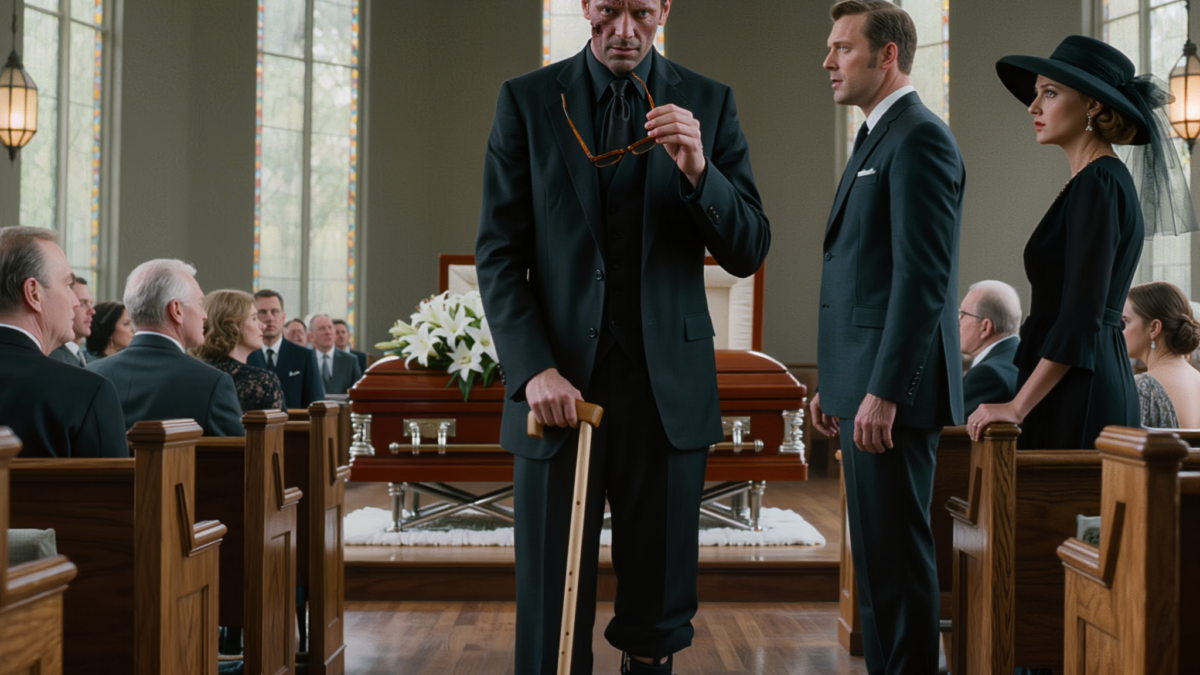
“They are holding a memorial service for you this Saturday,” she said. “An empty casket funeral, high society event. Your parents, the company board, the press. Everyone will be there.”
I looked at my injured leg.
Then I looked back at her.
“Detective,” I said, “I need you to help me get a tailored black suit and a very sturdy cane. I wouldn’t miss my own funeral for the world.”
Preparing to Return
The medical staff in Anchorage strongly opposed my plan to travel.
My femur had only recently been repaired. I was still recovering from multiple injuries, and the risks were serious.
The head orthopedic surgeon stood beside my bed and explained the possibility of blood clots, infection, and permanent nerve damage if I pushed myself too far.
I understood what he was saying.
I also knew that I could barely tolerate the thought of remaining in the hospital while Julian and Victoria carried out the final part of their plan.
I told the surgeon that if he refused to discharge me, I would remove the intravenous lines and try to leave on my own.
It was a reckless statement made by a deeply injured man.
But I was determined.
Detective Reed stood nearby.
She understood why the memorial service mattered so much to me.
My physical injuries would require time to heal.
The damage caused by my family’s betrayal was something I needed to confront directly.
Before leaving Anchorage, I made one important phone call.
I contacted Clara, my company’s chief operating officer.
Clara had worked closely with me for five years. She was exceptionally capable, practical, and one of the few people in my professional life whose loyalty I had never questioned.
When she answered, I could hear the grief in her voice.
She believed I was dead.
She seemed to assume the call concerned funeral arrangements or the handling of my remains.
I quietly told her who I was.
Then I told her I was alive.
For several seconds, she said nothing.
I heard her phone fall onto the floor.
When she picked it up again, she was crying.
I wanted to reassure her, but we had urgent work to do.
I explained that Victoria and Derek might attempt to access the company’s money, assets, or intellectual property using my presumed death as justification.
Clara needed to act before they could do so.
I asked her to secure the corporate accounts, freeze executive stock options, and strengthen controls around sensitive company resources.
She understood immediately.
Whatever Victoria believed she stood to inherit, she wasn’t going to walk into my company and take control while I was still alive.
Clara also used her professional contacts to arrange discreet private medical transportation back to Seattle for Reed and me.
By the time the memorial service approached, the pieces of our plan were in place.
I was exhausted and in considerable pain.
But I was going home.
The Morning of My Funeral
Seattle greeted us with dark clouds and the threat of rain.
The weather seemed almost perfectly suited to the service that was about to take place.
Detective Reed brought in a forensic makeup artist she trusted.
My face was still bruised and swollen from the fall, with visible stitches from the injuries I’d suffered in the trees.
The artist used makeup to alter my appearance slightly.
She darkened my hair, added the appearance of age to my features, and gave me a pair of thick, dark tortoiseshell glasses.
The result was convincing.
I wore a tailored black suit that hung loosely on my thinner frame.
A rigid brace supported my injured leg beneath wide-cut trousers.
I relied on a thick oak cane to walk.
With the glasses, makeup, and altered posture, I resembled an older relative attending a funeral rather than the man being mourned.
We arrived at the First Presbyterian Church in downtown Seattle approximately an hour before the service.
Reed and I remained inside an unmarked, armored police SUV parked across the street.
I held a cup of lukewarm gas station coffee and watched the guests arrive.
People I recognized from the technology industry stepped out of expensive cars.
Neighbors from my gated community came carrying black umbrellas.
Members of my parents’ country club arrived in formal mourning clothes.
These were people who believed they were gathering to say goodbye to a young entrepreneur who had suffered a tragic accident.
They had no idea he was watching them from across the street.
Then I saw my parents.
Richard and Margaret arrived in a black town car.
My mother wore an expensive designer mourning dress and held a delicate lace handkerchief.
She repeatedly lifted it to her eyes.
My father walked beside her with the restrained expression of a man determined to appear strong through a family tragedy.
Watching them was unexpectedly difficult.
Despite everything that had happened between us, they were still my parents.
I wondered whether they had truly mourned me.
I wondered whether my death had finally made them recognize how much I had wanted their love.
Then another car approached.
A new midnight-black Porsche Panamera pulled up near the church entrance.
Victoria stepped out.
She wore a fitted black dress, a wide-brimmed black hat, and a delicate veil.
She looked elegant, composed, and convincingly devastated.
Julian emerged from the passenger side.
I recognized his dark tailored suit.
I had paid for it three years earlier when he claimed he needed formal clothes for a job interview he never attended.
He walked around the car and positioned himself beside Victoria.
His hand rested protectively against her lower back.
She leaned toward him.
From the outside, they looked exactly like a grieving widow being comforted by her late husband’s devoted older brother.
I knew what the camera in my kitchen had shown.
I knew what they were discussing behind closed doors.
And now I was watching them present their relationship as innocent family loyalty.
Victoria had already purchased an expensive sports car before my body had even been recovered.
They were spending money and enjoying a future they believed my death would provide.
I tightened my grip on the cane.
“Look at them,” I said to Reed. “They honestly think they have just won the lottery.”
Reed checked the communications from her officers.
The church entrances were covered.
Investigators were positioned around the building, and an undercover officer was operating the audiovisual equipment inside.
An encrypted USB drive containing the recovered helicopter recording had been connected to the sound system.
Everything was ready.
Reed looked at me.
“We move the exact second you give the signal, Harrison.”
I nodded.
Then I opened the car door.
Walking into the Church
Each step across the pavement sent pain through my injured leg.
I used the cane carefully, allowing myself time to move without losing my balance.
Reed accompanied me through a discreet side entrance.
Inside, mournful organ music filled the church.
More than 300 people had gathered.
The sanctuary was crowded with mourners wearing dark clothes. The air carried the sweet scent of expensive white lilies.
At the front stood a polished mahogany casket, surrounded by elaborate floral arrangements.
It was empty.
I stared at it for several seconds.
The people who had tried to end my life had arranged an entire ceremony around a body they had never recovered.
I moved into the shadows beneath the balcony at the rear of the church.
From there, I could watch without being recognized.
Reed stood nearby, scanning the room.
The minister approached the pulpit and began speaking about the fragility of life.
He talked about how quickly a successful young person could be taken from those who loved him.
I listened to the words with a strange sense of distance.
He didn’t know me.
He was speaking from an account of my life that Victoria and Derek had helped prepare.
After the opening prayer, the minister invited family members to share their memories.
Victoria rose from the front pew.
Julian held her hand as she stood.
She walked slowly toward the pulpit, pausing as though her grief made each step difficult.
She adjusted the microphone and looked across the congregation.
Then she began.
“Harrison was my entire world,” she said.
Her voice trembled.
“When you find a love that incredibly deep, a love that completely anchors your soul, you never ever imagine you will have to let it go so soon.”
She continued describing our marriage.
“Harrison worked tirelessly to build a wonderful life for us. He sacrificed his time, his energy to ensure our family would always be safe, secure, and provided for.”
I stood at the back and listened.
To everyone else, she sounded like a woman struggling with the loss of her husband.
To me, every reference to my salary, business, and financial sacrifices carried a different meaning.
She was reminding the room that I had left behind considerable wealth.
She was positioning herself as the grieving wife who would inherit it.
“My only comfort in this dark, endless, terrible nightmare,” she continued, “is that my sweet Harrison did not die alone in the cold.”
She described my supposed final moments in nature.
“He was doing exactly what he loved, exploring the majestic beauty of nature, and he was with his brother, Julian. I know for a fact that Harrison looked up to Julian more than anyone else in the entire world.”
I felt my anger rising.
She had just used my supposed death to praise the man who pushed me.
Victoria stepped away from the microphone.
The congregation murmured sympathetically.
Then Julian approached the pulpit.
He rested his hands against the wooden stand and bowed his head.
For several moments, he remained silent.
Then he began his tribute.
“I lost my absolute best friend and my shadow on that mountain,” he said. “Harrison was my little brother. We shared a room. We shared our deepest dreams.”
I watched him carefully.
“When he slipped and fell from that icy ridge, a massive part of my soul fell right along with him.”
He paused.
“I tried to reach him. I swear to God Almighty. I tried to grab his hand, but the wind was just too strong.”
I remembered exactly where those hands had been.
They had been against my back.
“I will carry the heavy, crushing guilt of not being fast enough to save him for the rest of my natural life.”
Julian looked toward our parents.
Margaret was crying now, clutching her chest.
“But I promise you this, Harrison,” Julian continued. “I will take care of Victoria. I will fiercely protect your legacy. I will honor the incredible life you built. Rest in peace, little brother.”
He stepped away.
The room was quiet except for people crying softly.
Julian and Victoria had finished telling the story they wanted everyone to believe.
I decided it was time for them to hear mine.
A Man Walking Toward His Own Casket
I stepped out from the shadows at the back of the sanctuary.
My cane touched the stone floor.
The sound carried surprisingly far.
I took another step.
Then another.
A few mourners turned toward the interruption.
I continued down the center aisle.
The metal support beneath my trousers clicked faintly as I moved.
People in the back rows seemed irritated at first.
They assumed an unfamiliar older man was making unnecessary noise during a solemn ceremony.
I kept walking.
With my free hand, I removed the thick tortoiseshell glasses and placed them on an empty pew.
Without them, my face was easier to recognize.
More people turned.
Whispers moved through the rows.
I could see guests studying my features, trying to understand why the limping stranger looked familiar.
Then I noticed Clara.
She was sitting in the fourth row near the aisle.
She stood so suddenly that her chair scraped against the floor.
Her hand rose to her mouth.
Tears filled her eyes.
I gave her a small nod.
She slowly sat back down, smiling through her tears.
I continued forward.
The whispers were getting louder.
The minister stepped back from the pulpit, staring toward the aisle.
Julian was the first person at the front to turn fully around.
I will never forget his expression.
His face lost its color.
His mouth opened slightly, and the confidence he had displayed during the eulogy disappeared.
He stared at me as though he couldn’t comprehend what he was seeing.
Victoria turned next.
She stopped moving.
The black veil partly covered her face, but it couldn’t hide the fear in her eyes.
She gripped the back of the pew in front of her.
Neither of them spoke.
I stopped near the front of the sanctuary.
“Hello, Julian,” I said.
My voice was rough from the injuries and medical treatment, but it carried through the church.
“I am so incredibly sorry I am late. The traffic coming back from the Alaskan wilderness was absolutely brutal this time of year.”
The reaction was immediate.
My mother screamed.
My father sprang to his feet, pointing toward me with a trembling hand.
Dozens of guests stood.
People began calling out my name.
A few reporters at the back raised their cameras, and flashes briefly illuminated the room.
“Harrison?” someone shouted. “Is that really Harrison?”
I didn’t answer the crowd.
I kept looking at Julian and Victoria.
I had traveled from an intensive care unit to stand in front of the people who believed they had successfully arranged my death.
Now they had to explain why I was alive.
“This is some kind of trick,” Julian stammered. “This is some kind of sick, twisted joke. You fell. I saw you fall off that ridge.”
I looked straight at him.
“You did not see me fall, Julian,” I said. “You felt me fall. You felt the heavy weight of my body leave your hands when you violently shoved me out of that helicopter.”
People near the front recoiled.
The accusation was too serious to dismiss as a simple misunderstanding.
Victoria reacted quickly.
She stepped in front of Julian, opened her arms, and hurried toward me.
“Harrison! Oh my dear God, you are alive!” she cried. “It is an absolute miracle, my love.”
She reached toward me as though she intended to embrace me.
Then she began offering an explanation.
“You are severely traumatized. You hit your head on the rocks. You are hallucinating. Julian tried to grab you. He tried to save your life.”
I raised my cane between us.
“Do not touch me,” I said.
She stopped.
“Do not ever put your lying, filthy hands on me again.”
I lowered the cane and looked toward the front pew.
Derek was sitting there.
He was visibly sweating, repeatedly adjusting his expensive tie.
I raised my voice so the congregation could hear.
“And Derek, how is the probate paperwork coming along? Did you manage to bribe the judge and expedite the massive payout on the $5 million life insurance policy?”
I continued asking about the financial fraud investigation and the role he had played in the proposed insurance payout.
Derek stood quickly.
“Harrison, I assure you, I have absolutely no idea what you are talking about,” he said. “I was strictly acting on behalf of your grieving widow in a time of tragedy. My hands are clean.”
I looked at him.
“You were acting on behalf of a guaranteed 10% cut of my blood money,” I replied.
Then I looked toward the sound booth in the balcony.
I gave the officer there a deliberate nod.
The Recording
The church speakers crackled to life.
The sound of helicopter rotors filled the sanctuary.
It was loud, harsh, and unmistakable.
The officer had started playing audio recovered from the hidden dash cam inside Harris’s cockpit.
The congregation fell quiet.
Then Julian’s voice came through the speakers.
Clear and recognizable.
“You have always been in the way, little brother.”
A pause followed.
“Victoria says goodbye.”
The recording continued with the sounds from the helicopter as I fell and the door closed.
No one in the church moved.
Julian had spent his eulogy describing a desperate effort to save me.
Now everyone had heard the words he spoke immediately before my fall.
Victoria sank into the pew behind her.
She covered her face with her hands.
The composed grieving widow had vanished.
Julian looked around the sanctuary, searching for a way out.
Detective Reed stepped into the center aisle holding up her badge.
Uniformed officers emerged from the church entrances and side corridors.
Every exit was covered.
I moved closer to my brother.
“Julian,” I said, “you pushed me into a frozen forest to die. I survived on muddy water and pure, unadulterated hatred for four agonizing days with a shattered leg. You severely underestimated my will to live.”
Then I turned toward Victoria.
She looked up at me.
Her mascara had begun to run, leaving dark marks across her cheeks.
“I saw the kitchen security footage,” I told her.
I spoke loudly enough for my parents and the surrounding guests to hear.
“I watched you drink my expensive champagne and passionately kiss my brother 24 hours after you thought I was a frozen corpse.”
I explained what the recording had revealed about the insurance money and Julian’s gambling debts.
“You did not want a husband, Victoria. You wanted a human ATM. And when you finally maxed out your withdrawals, you tried to smash the machine.”
Reed stepped beside me.
She took out her handcuffs and addressed the three people involved.
“Victoria, Julian, Derek, you are all under arrest for conspiracy to commit murder, first-degree insurance fraud, and federal wire fraud. Put your hands behind your backs immediately.”
Officers approached them.
Julian tried to pull away.
He insisted that everything had been an accident.
He claimed the audio must have been manipulated using artificial intelligence and accused me of framing him.
The officers restrained him against the polished lid of the empty mahogany casket and placed him in handcuffs.
Victoria didn’t resist.
She cried as another officer secured her wrists.
Derek was read his rights near the church wall.
His confidence had disappeared entirely.
I stood with my cane and watched the three people involved in the plan being escorted down the aisle.
The church erupted into conversation.
Guests were shouting, crying, and recording the scene on their phones.
Outside, police vehicles were waiting.
Clara made her way through the crowd toward me, carrying a bottle of cold water.
For the first time since the helicopter incident, I thought the confrontation was finally over.
I was wrong.
My Parents’ Final Choice
I turned to leave the altar area.
My injured leg was throbbing, and the adrenaline that had carried me through the service was beginning to fade.
Then Richard and Margaret blocked my path.
Their faces were flushed with emotion.
For one brief moment, I expected something I had wanted from them my entire life.
I thought my mother might throw her arms around me.
I thought my father might ask how badly I had been injured.
I imagined them saying they were grateful I was alive.
Instead, Margaret grabbed the lapels of my suit jacket.
“Harrison, what in God’s name have you done?” she demanded.
I stared at her.
“Tell them it is a mistake. You have to tell the police to let him go right now.”
For a moment, I couldn’t understand what she meant.
Then I realized she was talking about Julian.
Not me.
Not the son who had survived four days in the wilderness with severe injuries.
She was worried about my brother.
“Mom, he just tried to murder me,” I said. “You literally just heard the tape of him saying goodbye before pushing me out of an aircraft.”
My father stepped closer.
“He was desperate!” Richard shouted.
His expression was the same one I remembered from years of arguments in my parents’ kitchen.
“He owes a massive amount of money to very dangerous people. Harrison, he was pushed into a corner.”
He continued.
“You have millions of dollars sitting in the bank. You could have just paid his debts when I asked you to. You forced him into this desperate situation.”
I couldn’t believe what I was hearing.
“If you press these criminal charges, he will go to federal prison for decades,” my father said. “You will completely ruin his life.”
I looked from him to my mother.
They were standing beside my empty casket.
They had just heard a recording of Julian’s words before he pushed me out of a helicopter.
They knew I had nearly died.
And their first concern was still protecting him.
For years, I had tried to earn their approval.
I had studied hard, worked hard, built a successful business, and helped my brother repeatedly.
I had believed that eventually they would recognize my efforts.
Now they were blaming me for the consequences of Julian’s choices.
It was as though every excuse they had made for him since childhood had led directly to this moment.
But something surprising happened.
The realization didn’t devastate me the way it might have before.
Instead, I felt an extraordinary sense of relief.
I finally understood that there was nothing left for me to prove.
No achievement would make my parents treat us equally.
No amount of money would satisfy their expectations.
No sacrifice would persuade them to hold Julian responsible for his actions.
The relationship I had spent my whole life trying to repair couldn’t be fixed by my effort alone.
I removed my mother’s hands from my jacket.
Then I looked directly at my father.
“My life was ruined the exact moment you taught him his horrific actions have no consequences,” I said.
I took a breath.
“Julian made his choice when he pushed me. Victoria made hers when she planned it. And you two are making yours right now.”
I told them that if they contacted me, approached my home, called my phone, or came near my company again, I would have my lawyers seek a restraining order.
Richard looked furious.
Margaret stood beside him.
I didn’t wait for another explanation.
I turned away and walked slowly toward the exit.
Clara came alongside me.
We left the church together.
I never spoke to Richard or Margaret again.
The Trial
The legal consequences unfolded over the following year.
The case attracted enormous attention in Seattle.
A wealthy technology executive had survived a fall from a helicopter, returned to his own memorial service, and exposed a conspiracy involving his wife, older brother, and estate lawyer.
The evidence made the case particularly difficult for the defense.
There was the recording from the helicopter.
There were the search reports showing the false location Julian had provided.
There was the security footage from my kitchen.
And there were financial records concerning the proposed insurance payments and transfers.
As the proceedings continued, the people involved began blaming one another.
Victoria hired an expensive defense attorney.
Her legal team tried to portray her as a frightened, manipulated wife who had been drawn into Julian’s dangerous financial problems.
She claimed she believed Julian intended only to stage a minor accident to frighten me into providing money.
According to her account, she had never expected him to actually try to end my life.
Julian’s public defender told a very different story.
He argued that Victoria had been the mastermind.
His defense claimed she had seduced Julian, exploited his gambling debts, and pressured him into following her plan.
He also claimed she had threatened to expose their affair and damage Julian’s reputation if he refused.
There were even arguments involving a supposed future child and money that had been discussed for college expenses.
Listening to their competing explanations was exhausting.
The people who had once celebrated together in my kitchen were now desperate to distance themselves from one another.
I attended the trial whenever the proceedings were held.
I sat in the front row of the gallery, wearing a suit, watching the evidence presented.
My physical recovery was ongoing, but I wanted to witness the legal process.
The prosecution relied heavily on the helicopter recording, the kitchen footage, and the financial transactions Derek had prepared.
The evidence gave the jury a clear picture of the planning and motives behind what happened.
The 12 jurors deliberated for less than three hours.
Then they returned with their verdict.
The judge imposed severe sentences.
Julian received 25 years in a maximum-security federal prison for first-degree attempted murder and conspiracy.
Victoria received 20 years for conspiracy and serious wire fraud offenses.
Derek had agreed to testify against them as part of a plea arrangement concerning the insurance fraud.
Despite that cooperation, he received a 15-year sentence.
He was also permanently disbarred from practicing law.
When Victoria was handcuffed in the courtroom, she looked nothing like the elegant woman I had married.
Her hair was untidy, her face exhausted, and her confidence gone.
As officers prepared to escort her away, she turned toward me.
She mouthed one word.
“Sorry.”
I didn’t respond.
I didn’t nod or offer reassurance.
I simply turned and walked out of the courtroom.
There was nothing she could say that would undo what had happened.
Learning to Live Again
I had survived a helicopter fall, four days in the wilderness, several surgeries, and a public confrontation with my family.
But surviving wasn’t the same as healing.
The physical injuries were difficult enough.
My leg required extensive recovery, and the effects of the fall remained with me long after the trial.
The emotional damage was harder to understand.
For a long time, I struggled to trust anyone.
Ordinary conversations could leave me wondering what the other person really wanted.
I questioned past interactions with Victoria, searching for signs I should have recognized.
I revisited childhood memories, trying to understand why my parents had always treated Julian differently.
Even after the criminal case ended, my mind continued returning to the moments before the fall.
I often woke at night in a panic.
In my dreams, I was falling through the mountain air again, waiting for the impact that never quite arrived.
I officially filed for divorce.
I sold the enormous house Victoria and I had shared.
It had once represented everything I thought I wanted: security, success, marriage, and the promise of a family.
After the betrayal, it felt empty.
I bought a smaller, minimalist penthouse downtown overlooking the water.
The new home was highly secure and easier for me to manage.
I also threw myself back into the company.
Work had always been the one part of my life I believed I could control.
During that period, I promoted Clara to co-CEO.
She had protected the business when I couldn’t do it myself.
She had believed me, supported me, and acted decisively when the company’s future was uncertain.
Her loyalty mattered more to me than any professional title or impressive presentation.
But even with my company’s continued success, I wasn’t doing well.
I was working too much.
I wasn’t sleeping.
And I was carrying emotional injuries that couldn’t be treated with surgery or medication alone.
Eventually, I began seeing a trauma specialist named Dr. Eris.
I attended sessions twice a week.
We talked about the helicopter incident, my marriage, and the years of favoritism that had shaped my relationship with my parents and brother.
The work was painful.
For much of my life, I had tried to understand what I could do differently to make other people treat me better.
I wondered whether I could have stopped Victoria’s betrayal by being a better husband.
I wondered whether I could have earned my parents’ affection by achieving something even greater.
During one particularly difficult session, Dr. Aerys addressed that pattern directly.
“You are trying to rationalize the completely irrational, Harrison,” he said.
He explained that I kept searching for the moment when I might have changed Victoria’s mind or finally secured my parents’ love.
“You cannot control the darkness in other people,” he told me. “No matter how much money you make or how kind you are, you can only control the impenetrable boundaries you build to keep that darkness out.”
I thought about that for a long time.
I had spent decades believing that if I worked hard enough, gave enough, and forgave enough, my family would eventually become the family I needed.
The truth was much simpler.
I couldn’t force them to love me properly.
I could only decide how much access they would have to my life.
The Business and Financial Aftermath
The insurance company investigated the circumstances surrounding my supposed death and the attempted claim.
Once the fraudulent plan was established, the $5 million policy was voided.
The payment Victoria and Julian had expected never materialized.
I also filed a civil lawsuit against Derek’s law firm, alleging serious malpractice, conspiracy, and breach of fiduciary duty.
The law firm had been connected to legal advice and planning that I had trusted to protect my assets.
Instead, that work had become part of the circumstances surrounding the attempt on my life.
The criminal consequences were already substantial.
The civil action addressed another aspect of the damage.
I wanted accountability from the professionals who had used their positions of trust against me.
As time passed, I became less focused on seeing my former family punished and more focused on rebuilding the parts of my life that mattered.
My company was still operating.
I had a home where I felt secure.
I had Clara, whose loyalty had been demonstrated through action rather than promises.
And I had begun to understand that my future didn’t have to be defined by what Julian and Victoria had done.
I couldn’t recover the years I had spent trying to earn my parents’ approval.
But I could stop spending the years ahead the same way.
Meeting Fiona
It was at a charity fundraiser for the foundation that I finally met Fiona.
She was an architect who had provided pro bono design work for our new outdoor training facility.
She was thoughtful, independent, and grounded.
There was something reassuring about her quiet confidence.
Unlike the intense beginning of my relationship with Victoria, I didn’t rush toward the promise of a new life.
I had learned that trust couldn’t be established through a few beautiful conversations or reassuring promises.
It required time and consistency.
From the beginning, I was open with Fiona about what had happened.
I told her about the helicopter, the injuries, the betrayal, and the emotional work I was still doing.
I also explained that I would no longer tolerate dishonesty or manipulation in my personal relationships.
I wasn’t looking for someone to rescue me.
I wasn’t looking for someone who would instantly fill the space my family had left.
I wanted a relationship built on mutual respect, independence, and genuine care.
For the first time, I understood that I could have those standards without apologizing for them.
The Life They Couldn’t Take
Sometimes I still think about Julian.
I picture him inside an eight-by-ten-foot prison cell, far removed from the comfortable life he once enjoyed.
His charm no longer protects him from consequences.
Our parents can’t buy his way out of the sentence.
And I am no longer available to rescue him.
I think about Victoria, too.
The elegant clothes, expensive homes, and financial comfort she expected to inherit disappeared when the plan was exposed.
She is serving a lengthy sentence, with none of the freedom or wealth she believed my death would bring her.
And I think about Richard and Margaret.
They remain in their quiet home, cut off from me.
The public disgrace surrounding Julian changed the way people viewed our family.
But the greater consequence is one they may never fully understand.
They lost their relationship with the son who had spent his entire life trying to make them proud.
They didn’t lose me because I became successful.
They didn’t lose me because I refused to pay another gambling debt.
They lost me because, when forced to choose between acknowledging what had happened to me and continuing to protect Julian, they chose Julian.
That was the last choice I needed to see.
For years, I had believed family loyalty meant accepting unfairness, making sacrifices, and forgiving behavior that continued to hurt me.
I know differently now.
Loyalty has to be supported by respect.
Love cannot require one person to surrender their dignity so that another person can avoid responsibility.
I still carry the physical scars from Alaska.
There are days when my leg reminds me how close I came to losing everything.
There are nights when memories of the fall return unexpectedly.
But those memories no longer determine every decision I make.
My company continues to be part of my life, but it no longer needs to consume every waking hour.
I have a home that feels like my own.
I have people around me whose actions match their words.
And I have learned that peace is not something I need to earn by endlessly pleasing people who refuse to treat me well.
Julian believed pushing me out of that helicopter would remove the last obstacle between him and the life he wanted.
Victoria believed my absence would give her financial freedom.
My parents believed I would always be the son who fixed Julian’s mistakes, no matter what they cost me.
All of them underestimated one thing.
I was capable of choosing a life without them.
I had spent four days on the forest floor believing that survival meant making it back to civilization.
But the more important part came afterward.
It was learning to live without the approval I had spent 32 years chasing.
I had not just survived the fall.
I had conquered the impact.
And the greatest victory wasn’t watching the people who betrayed me face consequences.
It was finally understanding that I didn’t have to sacrifice my peace to keep a place in a family that had never truly protected me.
You are absolutely not obligated to set yourself on fire just to keep toxic people warm, even if you share DNA with them.
Loyalty is earned through respect, not owed through blood.
Do not wait until you are pushed out of a helicopter, literal or metaphorical, to realize that your life is worth fighting for.
Build your boundaries, cut the dead weight out of your life, and never ever apologize for fiercely protecting your own peace.








