My parents abandoned me at four months old—then sued me for the $3.4 million my grandfather left me. In their lawyer’s office, my mother called it “just business” and demanded half. I refused. Weeks later, she took the stand and claimed Grandpa had kept her from me. Isabella opened one of Grandma Clara’s old journals, turned to my eighth birthday, and asked her one question.
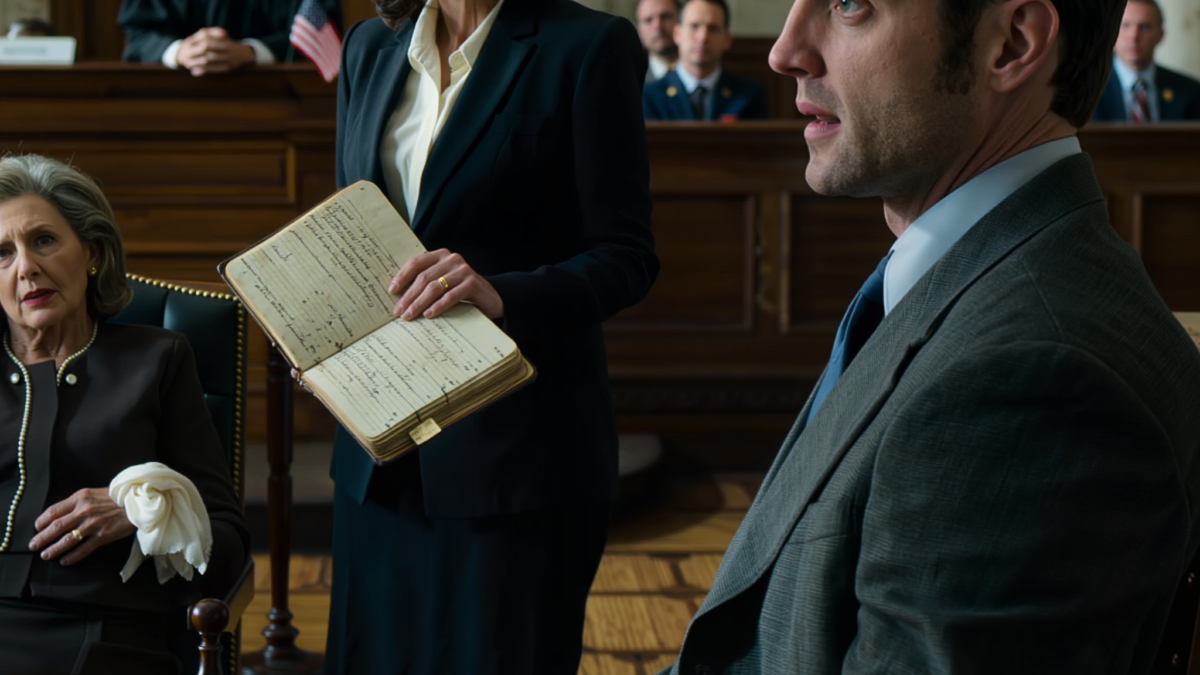
The courtroom was so quiet that every small sound seemed amplified. Papers shifting. Shoes moving against the floor. Someone clearing a throat three rows behind me.
Across the room sat Eleanor and Richard Wright, my biological parents.
I was 32 years old, and they had abandoned me when I was four months old. Now they were suing me over the $3.4 million estate my grandfather had left to me.
My mother sat straight-backed in a tailored blouse, a string of pearls at her neck. She studied her fingernails as though the hearing were an inconvenience she had been forced to squeeze into her schedule. When our eyes finally met, she showed no sign of regret or recognition. She simply rolled her eyes.
My father sat beside her in a suit that looked slightly too large for him, staring down at his hands.
My attorney, Isabella Rossi, leaned toward me.
“Deep breaths, Michael,” she whispered. “They have accusations. We have the truth.”
I nodded.
I was a prosecutor. Courtrooms were familiar territory to me. I knew how hearings sounded, how lawyers moved, how much weight could sit behind a judge’s smallest question.
But this time I was not standing there on behalf of the state.
I was the person being accused.
My parents were claiming that I had improperly influenced my grandfather and that he had lacked the mental capacity to decide what should happen to his own estate.
The bailiff called the court to order.
Judge Thompson entered and took his place behind the bench. He adjusted his glasses, looked down at the file, then lifted his eyes toward the two tables.
His gaze passed over my parents.
Then he looked at me.
For a moment, he stopped moving.
His eyes widened slightly. His mouth parted, almost imperceptibly. Something crossed his face that I could not identify.
Recognition, maybe.
Shock.
Then it was gone.
He cleared his throat and looked back down.
Isabella leaned closer.
“Did you see that?”
I nodded.
I had no idea what it meant.
But sitting there, surrounded by three decades of history that my parents were now trying to rewrite, I found myself thinking about the house where my real life had begun.
It had a wraparound porch, an old white fence, and a kitchen that always seemed to smell like something was baking.
My first clear memories were not of Eleanor or Richard.
They were of Judge Henry Cole and his wife, Clara.
My grandparents.
Grandpa Henry had large, calloused hands from his woodworking hobby and decades spent holding a judge’s gavel. Those hands could repair a clock, sand a piece of wood, or lift a frightened child with the same calm patience.
Grandma Clara was the warmth of the house. Her kitchen smelled of cinnamon, yeast, and lemon poppy seed cake. Her garden was filled with bright hibiscus flowers.
They had taken me in when I was four months old.
I remembered none of the apartment my parents had left me in and nothing about the social worker who brought me to my grandparents.
As far as I was concerned, life began in Henry and Clara’s home.
They were Mom and Dad in every way that mattered.
They never lied to me about where I came from.
When I was six or seven, I finally asked Grandma Clara why my family looked different from everyone else’s.
“Grandma, where are my real mom and dad?”
We were shelling peas on the porch swing.
She stopped what she was doing and looked at me.
“Oh, Michael, honey,” she said, pulling me close. “We are as real as it gets. But the people who made you were very young. They loved you. I’m sure they did, in their own way. Sometimes people just aren’t ready to be the parents a wonderful little boy like you deserves.”
For years, I tried to understand what “in their own way” meant.
Did it mean never calling on my birthday?
Did it mean missing school awards and Little League games?
Did it mean sending a gift weeks late and never asking what I liked?
Eventually, I learned not to ask too many questions because I could see what those questions did to Grandma’s face.
Grandpa did not criticize his daughter openly either.
But I saw things.
I saw his jaw tighten when he checked the mail and I asked whether anything had arrived for me.
I felt his hand settle more firmly on my shoulder when we passed fathers playing catch with their sons.
So he taught me the things a father might have taught me.
He taught me how to ride a bicycle on the cobblestone driveway. He taught me how to tie a Windsor knot for church. He let me sit on the floor of his study while he worked at his huge oak desk, surrounded by shelves of leather-bound legal books.
One afternoon, he looked up from a brief and gave me a lesson I would remember for the rest of my life.
“Justice, Michael, isn’t about winning or losing. It’s about doing what’s right, especially when it’s the hardest thing to do.”
Grandma gave me a different kind of education.
She taught me how to bake, how to wait patiently for dough to rise, how to tend the garden.
“Every living thing needs roots, Michael,” she told me one afternoon as we planted hibiscus. “A place to feel safe. A place to grow strong so the wind can’t blow you over.”
I had roots.
I just never stopped noticing the empty space where my parents should have been.
Every birthday and Christmas, part of me listened for an unfamiliar car on the driveway.
Sometimes Grandma would pass along another promise from Eleanor.
Your mother is going to try to come.
Your parents are very busy.
They’ll call later.
My tenth birthday was one of those days.
My grandparents made it special. There was a bouncy castle in the backyard, a three-layer chocolate cake, friends from school, and a new baseball glove from Grandpa.
Still, every time the doorbell rang, I looked toward it.
Eleanor had said she would try to come.
She did not.
A week later, a battered package arrived.
Inside was an action figure that seemed designed for a child much younger than I was. The card contained no personal message, only a generic printed greeting and “Mom and Dad” written at the bottom.
I remember staring at that toy and realizing that whoever had chosen it did not know me.
I carried it upstairs, pushed it into the back of my closet, and never played with it.
The years followed the same pattern.
A promise.
An absence.
Then some impersonal gesture meant to stand in for a relationship.
When I was 16, Grandma Clara died after a long battle with cancer.
The house changed afterward.
Grandpa and I were still together, but it felt as though someone had turned down the light in every room.
While helping him go through Grandma’s things, I found her journals.
There were dozens of simple cloth-bound notebooks filled with her looping handwriting.
I knew they were private.
I opened one anyway.
What I found was my childhood, recorded from the perspective of someone who had watched every disappointment I tried to hide.
October 5th. Michael’s eighth birthday.
Eleanor and Richard had promised to call.
Grandma wrote that I spent the afternoon pretending to read while glancing at the phone.
She had watched my shoulders slump as the day ended.
She wrote that Grandpa had called Eleanor later that night.
“He is your son, Eleanor,” Grandma had heard him say. “He is not an inconvenience you can reschedule.”
I turned another page.
May 12th. My first Little League home run.
Grandma had called Eleanor because she was excited for me.
Eleanor had been more interested in discussing a trip to Europe she and Richard were planning.
Another entry described a Christmas when the remote-controlled car they sent arrived broken.
I had spent an hour trying to repair it before giving up.
“It’s okay, Grandma,” twelve-year-old me had told her. “I have everything I need right here.”
Reading those journals changed something in me.
Until then, some stubborn part of me had continued believing there might be an explanation.
Afterward, I stopped waiting for one.
I packed the journals carefully into a box.
At the time, I saw them only as a painful record of what my grandparents had tried to protect me from.
I had no idea they would one day be introduced as evidence in court.
After Grandma died, Grandpa threw himself into helping me build my future.
I finished high school, went to college, then entered law school.
Every Sunday, I drove three hours back to his house for dinner.
We talked about my classes, his years on the bench, politics, football, whatever happened to be on our minds.
As he grew older, I began noticing small changes.
His hand sometimes trembled when he lifted his coffee.
Every now and then he paused while searching for a word.
The possibility of losing him became a quiet fear I carried everywhere.
During my final year of law school, while I was studying for the bar, Grandpa asked me to come into his study.
A fire burned in the hearth.
He sat behind the same oak desk where I had spent so many afternoons doing homework.
“Sit down, Michael,” he said. “There’s something important we need to discuss.”
He told me I was going to be a good lawyer.
Then his tone changed.
He opened a drawer and removed a thick cream-colored manila envelope sealed with wax.
He placed it on the desk but did not hand it to me.
“I’ve made some arrangements,” he said. “I’ve made sure everything is in order. I’ve spent the last decade making sure of it.”
I started to object.
“Grandpa, I don’t care about that. I’m fine.”
He raised one hand and stopped me.
“This isn’t just about money, Michael. It’s about legacy. It’s about protecting what Clara and I built. This house, this life, this family. It all belongs to the person who cherished it, not the person who threw it away.”
He did not say Eleanor’s name.
He did not need to.
Then he took an old gold pocket watch from his vest.
His father had given it to him when he graduated from law school. Grandpa had carried it for decades.
He pushed it across the desk to me.
“Your great-grandfather gave this to me the day I passed the bar,” he said. “It’s time it was yours.”
I picked it up.
“Time is the ultimate judge, Michael,” he continued. “It reveals all truths. It shows you who is loyal, who is honest, and who is truly worthy.”
I thought he was passing down a family heirloom.
Only later did I understand that he had been preparing me.
The call came on an ordinary Tuesday morning.
I was working at the district attorney’s office, preparing for an armed robbery trial, when my boss, Robert Langston, appeared in my doorway.
His face told me something was wrong before he spoke.
“Michael, it’s about your grandfather. There’s been a stroke. You need to get to the hospital now.”
I barely remember the drive.
I reached Grandpa’s bedside in time.
The stroke had taken away his ability to speak, but he recognized me.
He squeezed my hand.
Weakly, but deliberately.
That was our goodbye.
He died about an hour later.
His funeral was held a week afterward in an old stone church packed with judges, lawyers, politicians, and people from town whose lives he had touched.
While I stood at the pulpit giving the eulogy, I saw Eleanor and Richard.
They were sitting in the back row.
My mother wore a stylish black dress and the same kind of pearls she would later wear in court. She checked her watch during the service.
My father stared at the floor.
Neither of them approached me afterward.
Neither attended the burial.
They simply disappeared.
Two weeks later, I sat in the office of Grandpa’s estate lawyer, Mr. Abernathy.
He slid a thick document across his desk.
“Michael, this is your grandfather’s last will and testament. He came to see me and had it amended precisely ten years ago.”
I expected Grandpa might have left me the house.
I assumed Eleanor, his only child, would receive much of the rest.
Mr. Abernathy adjusted his glasses.
“He was very specific. He formally disinherited your mother, Eleanor Wright, entirely. He leaves his entire estate, the house, savings, investment portfolio, all of it, valued at approximately $3.4 million, to you.”
For a moment I simply stared at him.
“All of it?”
“All of it.”
Then he took out the sealed envelope I remembered from Grandpa’s desk.
“He also left this. His instructions were that it should be opened only by you or your legal counsel in the event the will is contested.”
The money itself was almost difficult to comprehend.
What affected me more was what the decision meant.
Grandpa had made his choice deliberately.
Three days later, my parents challenged it.
A formal letter arrived from a high-powered law firm representing Eleanor and Richard Wright.
They alleged undue influence and diminished mental capacity and sought to overturn the distribution of the estate.
I read the accusations several times.
They were saying Grandpa had not known what he was doing.
They were saying I had manipulated him.
The people who had barely been present in his life were asking a court to disregard his final decision.
That night my phone rang from an unknown number.
I answered.
“Michael.”
I knew the voice.
“Eleanor. What do you want?”
“I think you know what I want,” she said. “This has all been a terrible misunderstanding. My father was not in his right mind when he did that. Let’s not make this ugly. We need to talk about my inheritance.”
Her inheritance.
After 32 years, that was what brought her back.
“Now you want to talk?”
“Don’t be so dramatic,” she said. “It’s just business. Let’s be adults about this.”
Against my better judgment, I agreed to meet.
Part of me wanted to understand their legal position.
Another part of me wanted to look at them across a table and see whether there was anything left that resembled family.
We met in their lawyer’s office in a glass-and-steel downtown tower.
Jonathan Pierce was polished, expensive, and controlled.
Eleanor was already sitting on a white leather sofa in a navy business suit. Richard sat beside her, tugging at his collar.
No one asked how I was.
No one mentioned Grandpa except in connection with his money.
Eleanor went straight to the point.
“We’re prepared to be reasonable,” she said. “This whole mess with the inheritance is frankly embarrassing for the family name.”
She proposed a settlement.
Fifty-fifty.
Half the estate for them, half for me.
She called it generous.
I looked at Richard.
“Do you think this is fair?”
He stared at the carpet.
“Eleanor thinks it’s what’s best for everyone.”
I stood.
“Let me tell you what’s not fair. What’s not fair is a six-year-old boy waiting for a birthday call that never comes. What’s not fair is his grandparents having to raise their daughter’s child because she decided he was too much of an inconvenience for her new life.”
Eleanor scoffed.
“Oh, please spare us the violin music. This isn’t about feelings. This is about what I am owed. That is my father’s money. It is my birthright.”
I looked at her.
“You gave up your birthright the day you gave up your son.”
Then I gave them my answer.
“No. It’s not fifty-fifty. It’s not ninety-ten. You will not get one single red cent of his money. This isn’t just an estate. It’s his legacy of love and principle.”
As I reached the door, Eleanor spoke behind me.
“You were always a mistake. You never should have gotten a cent.”
I left.
Unknown to her, my friend Lucas had been waiting in the neighboring office for a delayed meeting and had heard the exchange.
Outside, I realized something had finally ended.
Some part of me had still been hoping that one day my parents would explain themselves.
That hope was gone.
I needed an attorney who understood estate litigation better than I did.
Grandpa had spoken many times about Isabella Rossi, a trial lawyer he respected deeply.
Her office occupied a restored brownstone filled with books. The place reminded me immediately of his study.
Isabella listened without interrupting while I told her everything.
The abandonment.
The missed birthdays.
Grandma’s journals.
The pocket watch.
Grandpa’s final conversation with me.
The lawsuit.
The settlement meeting.
When I finished, she sat quietly for a moment.
“They’re claiming diminished capacity and undue influence?”
“Yes.”
“Against Judge Henry Cole?”
She gave a short laugh.
“I knew Henry for thirty years. That man’s mind was a steel trap until the day he died.”
Then she looked at me.
“Your grandfather was my mentor when I was a young lawyer. He taught me that the law is supposed to be a shield for the innocent, not a weapon for the greedy.”
She agreed to take the case.
The next several weeks were filled with discovery requests, depositions, motions, records, and long nights in Isabella’s office.
We started with Grandma’s journals.
A handwriting expert authenticated them.
Then we examined Grandpa’s medical history.
Dr. Matthews, his physician of fifteen years, had administered cognitive tests showing that Grandpa remained lucid and mentally competent when the will was changed.
The financial records added another layer.
For 22 consecutive years, Grandpa had sent Eleanor money every month.
The amounts varied over time, but the memo line on the checks consistently said the same thing.
Monthly support.
A forensic accountant calculated the total.
$845,000.
The pattern mattered.
Eleanor’s case depended partly on the idea that Grandpa had suddenly and irrationally cut her off.
The records showed the opposite.
He had supported her for more than two decades.
Then, ten years before his death, the payments stopped.
That was also when he amended his will.
We spoke to people who had watched our family for years.
Beatatrice Miller had worked in Grandpa’s home for more than 25 years.
She remembered my Sunday dinners.
She remembered me driving three hours each way from college so I could spend Sunday evening with him.
She also remembered Eleanor.
According to Beatatrice, my mother rarely visited and generally appeared when she needed something, usually money.
Dr. Matthews supplied a sworn affidavit and medical records confirming that Grandpa’s body had weakened with age but his mind remained clear.
By then, Isabella believed we had assembled a strong case.
Grandma’s journals documented years of absence.
The financial records documented years of support.
The medical records challenged the claim that Grandpa could not make decisions.
And the sealed envelope still sat unopened.
Then the other side introduced Dr. Evans.
He was a neurologist prepared to testify that someone of Grandpa’s age and medical condition could have been susceptible to influence or undiagnosed cognitive decline.
Isabella read his report several times.
“Something about this feels off.”
She told her paralegal to investigate him.
Meanwhile, Eleanor’s sister, Caroline, called me.
She spoke as though she were trying to restore peace.
She said the dispute was tearing the family apart. She warned me about damaging Grandpa’s reputation by allowing private family matters into court. She suggested a quiet settlement would be better.
“The time for a quiet settlement is over, Caroline,” I said.
I ended the call.
When the trial began, Beatatrice testified first.
Isabella asked her to describe the relationship between Grandpa and me.
Beatatrice smiled.
“Relationship? Oh, honey, it was more than that. He wasn’t just his grandson. He was his son.”
She described the Sunday dinners, the yard work, the ordinary time we spent together.
Then Isabella asked how often Beatatrice had seen Eleanor at the house.
“Maybe a dozen times, if that,” she said. “She’d call when she needed something, money usually. She never stayed long.”
Her testimony required no complicated legal argument.
She had simply watched us for years.
Dr. Matthews testified next.
He explained the cognitive tests he had administered and told the jury that Grandpa, although physically frail near the end of his life, remained mentally competent to make decisions about his affairs.
Jonathan Pierce tried to undermine him during cross-examination.
Dr. Matthews did not change his opinion.
Then Pierce called Dr. Evans.
He was composed and authoritative.
He explained how age-related conditions and possible unrecorded medical events could affect judgment.
His testimony was theoretical, but it sounded convincing.
Then Isabella stood.
She carried a thin file.
“Dr. Evans,” she began, “you’ve built your testimony today on the premise that you are an impartial objective expert. Correct?”
“That is correct.”
“And your professional opinion is in no way influenced by any personal connections to the plaintiffs?”
“Of course not. I had never met them before being retained for this case.”
Isabella opened the file.
“So a woman named Caroline Brewster would be unfamiliar to you?”
Dr. Evans hesitated.
“The name is vaguely familiar. I might have met her socially.”
Isabella continued.
Caroline Brewster was Eleanor’s sister.
Caroline was married to Thomas Brewster.
Thomas Brewster’s mother had been an Evans.
She was Dr. Evans’s father’s older sister.
Thomas Brewster was his first cousin.
That made Dr. Evans family by marriage to the very people whose case he had been hired to support.
The courtroom reacted immediately.
Dr. Evans’s composure changed.
Then Isabella produced another public record.
It showed an IRS property lien against him for $217,000 in unpaid taxes.
She asked whether a generous expert-witness fee could be particularly useful to someone in that financial position.
Jonathan Pierce objected.
Judge Thompson overruled him.
Dr. Evans had presented himself as entirely impartial.
Now the jury knew there was more to the relationship than he had disclosed.
Isabella returned to our table.
For the first time, I could feel the case turning.
With Dr. Evans damaged as a witness, Pierce called Eleanor.
My mother walked to the stand and began telling a very different version of my childhood.
Her eyes filled with tears.
She said Grandpa had never forgiven her for marrying Richard.
She portrayed him as controlling and disapproving.
According to her, she had wanted a relationship with me.
She had called.
She had tried to visit.
Grandpa had supposedly told her I was busy with school or not feeling well.
“He built a wall around my son,” she said. “He shut me out of my own child’s life.”
For a moment, I watched several jurors listen with sympathy.
Then Isabella stood.
She did not carry a medical chart.
She did not carry a financial report.
She walked toward the witness stand holding one of Grandma Clara’s cloth-bound journals.
“Mrs. Wright, you claim you were denied access to your son.”
Eleanor looked at her.
“Let’s look at a specific date. October 5th, Michael’s eighth birthday. Do you recall your attempts to see him that day?”
My mother’s expression changed.
“I don’t remember the specifics. It was a very long time ago.”
“Allow me to refresh your memory.”
Isabella opened the journal.
She read Grandma’s entry.
Clara had called Eleanor that morning and asked whether she and Richard would come to my birthday, even if only for cake.
Eleanor had said they were too busy.
They had recently bought a new boat.
They were taking it out for its maiden voyage.
Isabella looked up.
“Mrs. Wright, does that sound like a father denying you access or a mother making a very clear choice?”
Eleanor said nothing.
Isabella turned to another entry.
May 12th.
My first home run in Little League.
Grandma had called Eleanor with the news.
According to the journal, Eleanor had quickly changed the subject to a European trip she and Richard were planning.
She had not even asked whether my team won.
“You weren’t shut out, Mrs. Wright,” Isabella said. “You just weren’t interested.”
One entry at a time, Grandma’s handwriting challenged the story Eleanor had just told the jury.
Then it was my turn to testify.
I took the stand.
Isabella asked me one question.
“Michael, why do you believe your grandfather, Judge Henry Cole, left his entire estate to you?”
I looked toward the jury.
Then toward the people who had given me life but had spent almost none of it with me.
“Because I stayed,” I said.
I told them about scraped knees, graduations, Sunday dinners, the years after Grandma died, and the time I spent with Grandpa as he grew older.
“When he got old and frail, I was the one who made sure he took his medicine. I was the one who sat with him. I stayed. They didn’t.”
Then I told Isabella it was time for the last thing Grandpa had left for exactly this situation.
The sealed envelope.
She approached the bench and asked that it be entered into evidence.
The wax seal was still intact.
Judge Thompson examined it and allowed her to proceed.
Isabella returned to the podium and broke the seal.
Then she began reading Grandpa’s words.
“To whom it may concern. I have left my estate to my grandson, Michael Cole Wright, not out of any malice toward my daughter, Eleanor, but out of a deep and abiding sense of justice. He has been the son to me that she never chose to be.”
The room was silent.
“I am not, however, leaving her penniless. I am not that cruel. In truth, she has already received her inheritance.”
A murmur moved through the courtroom.
Isabella continued.
“Over a period of 22 years, I provided my daughter and her husband with consistent financial support totaling $845,000.”
Grandpa had gone further.
He wrote that if the same amount had been invested over those years in a simple S&P 500 index fund with dividends reinvested, its value would have been roughly equivalent to the $3.4 million estate Eleanor was now seeking.
“She has already had her share,” Isabella read. “She and her husband simply squandered it. This will does not disinherit her. It merely prevents her from taking a second helping from a pot she refused to contribute to.”
No one spoke.
What Grandpa had left behind was more than a letter explaining his will.
It was the final argument of a judge who had spent years watching what each person in his family chose to do.
The lawsuit had been presented as a dispute over whether an elderly man had been manipulated into making an irrational decision.
His records told another story.
For 22 years, he had supported his daughter financially.
For years, he had watched his grandson remain present.
Ten years before his death, he had stopped the payments and changed his will.
Grandma’s journals preserved the history that Eleanor denied.
Dr. Matthews’s records documented Grandpa’s mental competence.
The financial records documented the support Eleanor had already received.
And Grandpa’s own letter explained why he had made the choice.
My mother’s expression changed as Isabella finished reading.
The practiced tears and confidence were gone.
Judge Thompson looked down from the bench, his face stern.
He had not yet announced a verdict.
But by then, he had heard the final, irrefutable truth Grandpa had spent years making sure would survive him.








