My mother laughed while I bled on the kitchen floor after my stepbrother drove a screwdriver into my shoulder. At the hospital, she told me to call it an accident and “think about Leo’s career.” I said I needed to rest, then called my agency’s legal counsel. Weeks later, my family sat in court calling me dramatic—until the judge broke the seal on a federal report.
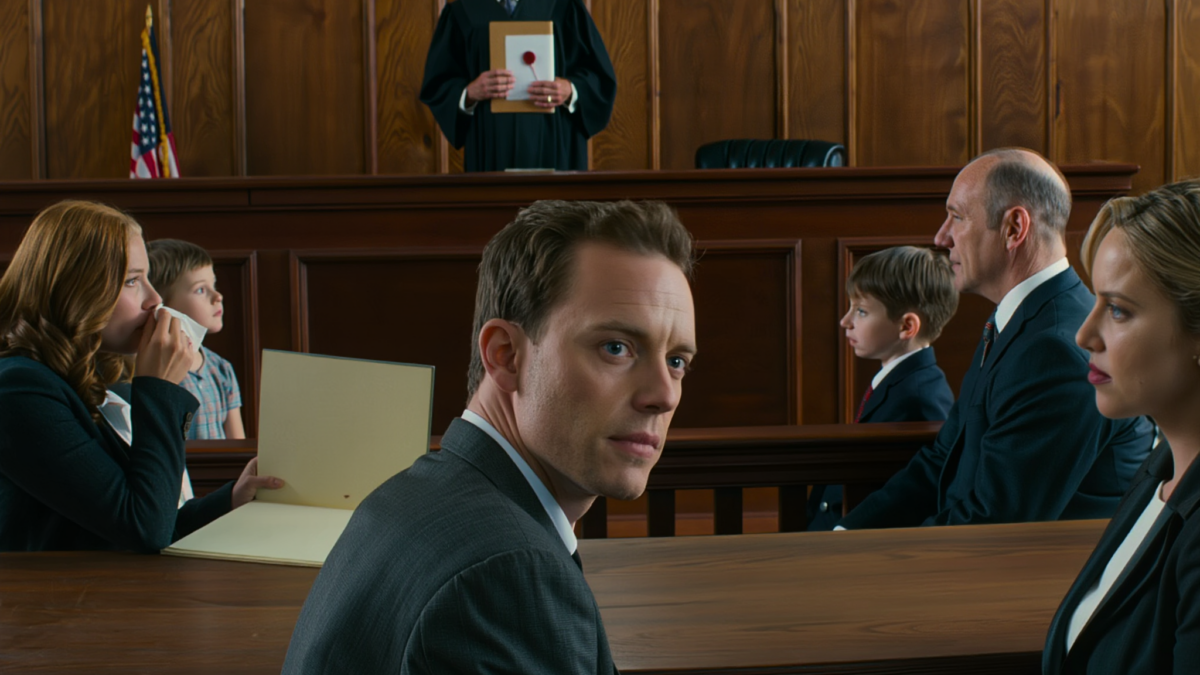
The silence in the courtroom felt heavier than noise.
I sat straight despite the ache still lingering in my shoulder and kept my eyes on Judge Thompson. In his hands was a thin manila folder with a government seal stamped across the front in red ink.
Across the aisle, my family sat together.
My mother, Eleanor, held a tissue to eyes that looked perfectly dry. Richard, my stepfather, had one arm around her and wore the expression of a disappointed parent who believed he had already been proven right. Between them sat Leo, my stepbrother.
The person who had attacked me.
Leo was not watching the judge. He was watching me.
There was a faint smirk on his face, the same expression I had seen from him for most of my life. It was the look of someone who had always been protected from consequences and had no reason to believe this time would be different.
Their attorney, Mr. Davies, had just finished describing me as unstable, jealous, overly sensitive, and desperate for attention. He had reduced everything that happened to a family argument that I had supposedly exaggerated because I resented Leo.
My family had nodded along.
Judge Thompson cleared his throat.
“I have here,” he began, “a report submitted by Mr. Jensen’s legal counsel, provided by his employer.”
He opened the folder.
Leo’s smirk widened slightly.
He thought he knew what was inside.
To understand why he was wrong, and why that folder mattered so much, you have to understand how long my family had been telling the same story about me.
It had started years before anyone entered a courtroom.
One ordinary evening, we were sitting around the heavy oak dining table Richard had bought after one of his early business successes. Leo was talking about a sales contract he had landed at the car dealership where he worked as an assistant sales manager.
The deal itself was not especially large, but Leo had a talent for making every achievement sound monumental.
“So I looked the guy dead in the eye,” he said, leaning forward. “I told him, ‘This is the best offer you’re going to get. Take it or leave it.’ And you know what? He folded.”
My mother’s face lit up.
“Oh, Leo, that’s wonderful. My boy, such a natural leader.”
Richard raised his glass.
“That’s the spirit, son. Aggressive. Decisive. That’s what gets you ahead.”
They toasted Leo’s latest “promotion.”
The strange part was that there had been no promotion. Leo had been an assistant sales manager for three years.
Nobody corrected him.
In our house, Leo’s version of events usually became the version everyone accepted.
After dessert, my mother finally turned toward me.
“And you, Jack? How was your week? Everything stable at that little government job of yours?”
By then, I had learned how to hear the condescension without reacting to it.
“It was good,” I told her. “My team just finished a major project. We helped decrypt some communications that prevented a serious security threat overseas.”
I could not tell them the details. My work involved long hours in secure rooms, threat assessments, code, and information I was not allowed to discuss outside the job.
Richard took a sip of wine.
“That’s nice, son. Sounds complicated. You stick with that. It’s a safe job. Good pension, I imagine.”
Safe.
That was the word they always used.
Safe. Stable. Boring.
My mother patted my hand.
“That’s lovely, dear. Just don’t get too wrapped up in all that drama. You know how you can get.”
Then she turned back to Leo and asked about the new commission structure at his dealership.
The conversation moved on as though I had not spoken.
It happened so often that eventually I stopped expecting anything else.
In their world, Leo’s victories were easy to understand. Cars. Sales. Commissions. Watches. Promotions, whether they existed or not.
My work was invisible.
So, increasingly, I was too.
Thanksgiving made the pattern harder to ignore.
The house was packed with relatives when my aunt Carol found me talking to a cousin. Carol was my mother’s younger sister and had a way of wrapping insults in concern.
“Jack, darling,” she said. “It’s so good to see you out of your shell. Your mother worries about you. She says you work so hard in that serious job.”
“The job’s demanding,” I said, “but I enjoy it.”
Carol looked across the room toward Leo, who was entertaining a group of relatives.
“Look at him. Leo is just the sunshine of this family, isn’t he? Such a gift with people. It’s a shame you two didn’t get more of the same genes.”
I smiled because responding would only have given them another example of me being “sensitive.”
Later, while getting water in the kitchen, I heard Carol talking to my mother.
“Are you sure Jack is all right?” she asked. “He seems so withdrawn. So tense. I hope all that government work isn’t making him paranoid.”
My mother sighed.
“Oh, you know Jack. He’s always been sensitive. He reads into everything. He takes things so seriously. I keep telling him to relax.”
Then she said Richard believed I hid behind my work because I was not as socially gifted as Leo.
I stood outside the kitchen doorway gripping an empty glass.
They were not describing a son who felt ignored.
They were describing the fact that he felt ignored as evidence that something was wrong with him.
Carol told my mother she was wonderful for trying.
“One is a soaring eagle,” she said of the two of us, “and the other is, well, a steady rock.”
I stepped away before they saw me.
By the following summer, the roles in our family felt permanent.
The Fourth of July barbecue was one of my mother’s favorite events. Relatives, neighbors, and Richard’s business associates filled the yard. Music played from speakers in the landscaping while Leo stood near the grill with a beer in one hand and tongs in the other.
He was telling people about his promotion again.
By then, the story included a larger salary and a corner office.
Richard kept clapping him on the back.
“That’s my boy.”
I was talking to one of Richard’s business partners, a man named George. He asked what I did, and for once I gave him more than my usual vague answer.
“I’m a senior analyst for a federal agency,” I said. “Mostly threat assessment.”
George looked genuinely interested.
“That sounds intense.”
“It can be. I recently received a commendation and a federal certification that only a small percentage of analysts manage to get.”
Before George could respond, my mother appeared carrying appetizers.
“Oh, Jack, don’t bore George with your complicated work stories,” she said with a light laugh. “It’s a party.”
Then she told George about Leo’s promotion.
“He’s practically running the whole sales division now,” she said proudly. “He’s a real people person, not stuck behind a desk all day.”
George looked uncomfortable.
I excused myself and walked toward the edge of the yard.
A few minutes later, Leo followed me.
He had already been drinking.
“What’s the matter?” he asked. “Can’t handle the spotlight being on someone else for a change?”
“It’s always on you, Leo.”
He laughed.
“That’s because I give them something to be proud of. A sales record. A promotion. What do you give them? Vague stories about saving the world that nobody understands.”
He lightly punched my arm.
“You’re such a drama queen, Jack. Mom’s right. You always have to make everything serious. Just be normal for once.”
He went back toward the party.
Then I heard my mother talking to Aunt Carol across the lawn.
“I just don’t know what to do with him sometimes,” she said. “My son just loves to make a scene.”
Something inside me shifted.
I understood that night that there was no achievement large enough to change the role they had assigned me.
Leo was the golden boy.
I was the problem.
I went to bed without knowing how quickly those roles would be tested.
At 4:02 the next morning, a crash from downstairs woke me.
I opened my bedroom door and saw light coming from the kitchen. Then I heard something metal hit the tile.
At first, I thought someone had broken into the house.
I went downstairs carefully.
When I looked into the kitchen, I saw Leo standing in front of the open refrigerator.
A glass had shattered at his feet. Whiskey was spreading across the floor.
He was drunk.
Not slightly drunk. He could barely stand straight.
“Leo,” I said. “What’s going on?”
He turned toward me.
“Well, well, well. Look who came down from his ivory tower.”
“I’m not judging you. I heard something break.”
“Oh, you’d like that, wouldn’t you? Something to report. Something to analyze. Something to make you feel important.”
I tried to calm him down.
“Let’s just get you to bed.”
His expression hardened.
“Don’t tell me what to do.”
Then he told me what he claimed our parents said when I was not around.
That I was a ghost in the house.
That I hid behind my job because nobody wanted me there.
That I was a burden.
I wanted to believe he was lying because he was drunk.
But the words sounded too much like everything I had already overheard.
Finally, I answered him.
“What about you, Leo? The golden boy with the big promotion that doesn’t exist? The one smashing up the kitchen at four in the morning?”
His face changed.
The drunken argument disappeared behind something colder.
“You shut your mouth.”
He pulled open a utensil drawer.
Then I saw the screwdriver.
It was a long Phillips-head screwdriver, held tightly in his hand.
My professional training took over enough for me to recognize the threat and try to keep my voice steady.
“Leo. Put it down.”
He laughed.
“Aren’t you trained for this stuff?”
Then he lunged.
I tried to move out of the way.
I was not fast enough.
Pain tore through my left shoulder and I stumbled backward into the counter before sliding onto the kitchen floor.
For a few seconds, I could barely understand what had happened.
Then I heard movement upstairs.
Richard called down.
“What in God’s name is going on?”
“Help,” I managed. “He hurt me.”
There was a pause.
Then I heard my mother.
“Oh, for heaven’s sake, Richard. It’s just the boys. Leo probably had a bit too much to drink.”
Leo stood nearby, staring at me.
Then came the sound I remembered more clearly than anything else.
My mother laughed.
“Listen to him,” she called down. “He probably slipped on the whiskey and landed on something. Jack, stop being so dramatic. You’re going to wake the whole neighborhood.”
They did not come downstairs.
They did not call for help.
My vision was beginning to blur.
I reached for my phone.
My fingers could still perform something my mind was struggling to think through. Federal employees in my position had a duress protocol. I entered the five-digit code and activated it.
An SOS.
The last thing I remember clearly was Leo moving away and my mother telling Richard to come back to bed.
When I woke, I was in a hospital room with my shoulder bandaged and an IV attached to my arm.
My parents came in soon afterward.
Their concern felt rehearsed.
My mother rushed toward me.
“Jack. Thank God you’re awake.”
I moved away when she tried to touch my face.
Richard stood at the foot of the bed.
“The doctor says you’ll be fine. Just a nasty puncture.”
I waited for one of them to say what Leo had done.
Neither did.
Instead, my mother pulled a chair closer.
“Now listen, Jack. There was a lot of confusion last night.”
“Leo attacked me.”
Richard sighed.
“Son, we need to be very clear about what happened. You were both drinking. Leo spilled a bottle. You slipped and fell onto the toolbox by the back door. You fell on a screwdriver. It was a terrible accident.”
I stared at him.
I had not been drinking.
And the toolbox was normally kept in the garage, roughly 100 feet from where I had been found.
“That isn’t what happened.”
My mother answered in the calm voice she used when she wanted me to question my own reaction.
“We heard a commotion. By the time we understood what was happening, you were on the floor. Leo feels awful.”
They had already built the story.
They had come to the hospital to make sure I repeated it.
“The police will want to talk to you,” Richard said. “We’ve already given them our statement. We just need you to confirm it for the family, Jack. We can’t have a scandal. Think about Leo’s career. Think about the family’s reputation.”
I turned toward the window.
For years, some part of me had kept hoping that eventually they would see me differently.
That hope disappeared in the hospital room.
“I need to rest,” I said.
My mother looked relieved.
“Of course. Just remember what we talked about. An accident.”
They left.
Once the door closed, I reached for my phone.
There was a missed call from an unlisted number related to the agency’s automated wellness check.
I opened my contacts instead.
Clara Vance.
She was legal counsel and a name I had only expected to use in a work emergency.
She answered quickly.
“This is Vance.”
“Clara, it’s Jack Jensen. I need your help. I’m invoking my right to agency counsel. I want to press charges against my family.”
Less than an hour later, Clara entered my hospital room carrying a thin leather briefcase.
She was as precise as I remembered from mandatory legal briefings.
“I got your message,” she said. “I also got the automated alert from your duress signal.”
She explained that the SOS had triggered a wellness check at my registered address. When I failed to answer the follow-up, local law enforcement and paramedics were dispatched.
They found me semi-conscious on the kitchen floor with an injury to my left shoulder.
Everything had been documented.
The relief I felt was immediate.
For the first time, this was no longer only my word against my family’s.
Clara had already read the preliminary police report.
“Eleanor and Richard Jensen say you slipped and fell on a toolbox,” she said. “Leo Jensen corroborates that account.”
“That’s not what happened. He grabbed the screwdriver from the drawer and attacked me.”
Clara made a note.
“The paramedics documented that there was no toolbox in the immediate area where you were found. They also noted the injury was more consistent with a direct thrust than a fall.”
Someone outside the family had finally looked at the details instead of my personality.
Clara told me I had options, including pursuing a restraining order and taking the matter further.
I thought about my mother laughing while I was on the kitchen floor.
“They laughed,” I said. “They were upstairs and they laughed.”
Clara was quiet for a moment.
“Then it seems you know what you want to do.”
She requested the relevant dispatch records and body-camera material and began taking steps to preserve and examine the screwdriver found at the scene. She also told me that Director Coleman had authorized the release of my service record to the court under seal.
My family believed they were dealing with the son they had spent years dismissing.
They had not understood how much independent documentation already existed.
In the weeks before the hearing, I stayed in a furnished apartment arranged through my agency while I recovered.
My family did not call.
The only person from my old life I reached out to was Ben, my friend since kindergarten.
He had seen years of family dinners. I thought he would understand.
We met for coffee.
I told him what had happened.
He listened, then said, “That’s messed up, Jack.”
“You believe me?”
“Of course.”
But he would not look at me.
Then he began talking about how difficult the legal fight would be for the family.
“My mom called you, didn’t she?”
He hesitated.
Then he admitted that Richard had offered to invest in his contracting business.
“He wants people around you who can talk some sense into you.”
I stared at him.
“He bought you.”
“It’s not like that.”
But it was enough.
I left ten dollars on the table and walked out.
The betrayal hurt, but it also removed the last illusion connecting me to my old life.
By the day of the hearing, I knew exactly where everyone stood.
My family arrived with Mr. Davies and looked composed.
My mother played the grieving parent. Richard looked stern and protective. Leo appeared almost bored.
Mr. Davies spoke first.
He described the situation as a family tragedy rather than an assault. He suggested that alcohol and heightened emotion had caused a misunderstanding.
Then he described us.
Leo was outgoing, successful, and promising.
I was “more complicated.”
According to him, I had always felt like an outsider and had a tendency to exaggerate slights.
He framed the entire conflict as sibling rivalry.
Then he called Ben.
Ben admitted we had known each other our entire lives.
When asked about my emotional stability, he said I could be intense and sometimes saw things negatively.
“He can blow things out of proportion.”
Clara did not cross-examine him.
When Mr. Davies finished, he asked Judge Thompson to dismiss my request for a restraining order and treat the situation as a family matter.
My mother cried.
Richard put an arm around Leo.
They thought they had succeeded.
Then Clara stood.
“Your Honor, the petitioner has no witnesses to call.”
Mr. Davies looked pleased.
Clara continued.
“We would like to submit one piece of evidence for the court’s consideration. A report from the petitioner’s employer submitted under federal seal.”
She placed the thin manila folder on the clerk’s desk.
Mr. Davies objected immediately.
Judge Thompson overruled him.
Then he broke the seal.
He read silently.
The confidence across the aisle began to disappear.
Finally, he removed his glasses and looked at my family.
He said Mr. Davies had described me as an unstable young man with a safe government job.
The report, he said, presented a different picture.
He read from the security and medical information generated during the early hours of July 5.
The report confirmed that paramedics had been dispatched following activation of a federal duress signal.
They had found me semi-conscious with an injury consistent with a Phillips-head screwdriver.
My mother reacted first.
Richard went pale.
The judge continued.
A screwdriver had been found wiped clean on the kitchen counter, while preliminary testing had detected blood residue in the sink trap.
The report also recorded Leo’s blood-alcohol level at 0.16.
The smirk disappeared from his face.
Then Judge Thompson moved to my service record.
He explained that I was a senior threat analyst and that my analysis had contributed on three occasions during the previous two years to preventing incidents that could have resulted in significant loss of life overseas.
He referenced a commendation for precision under extreme pressure.
The work my family had called boring was not insignificant.
The person they had spent years calling dramatic had been trusted precisely because he remained careful under pressure.
Judge Thompson looked toward my parents.
He observed that the same precision that had helped protect other people had helped me activate a distress signal while injured in my own home.
Then he granted the permanent restraining order.
He also referred the case to the district attorney for criminal prosecution on assault and obstruction charges.
Finally, he addressed Leo.
“I suggest you get a very, very good criminal lawyer.”
The gavel came down.
Two bailiffs moved toward Leo.
When the handcuffs appeared, his confidence vanished.
“Dad, do something.”
Richard seemed unable to respond.
My mother rushed forward and grabbed Leo’s arm.
“No. You can’t do this. He’s my son. It was an accident.”
A bailiff asked her to step back.
Then she looked at me.
“Jack, please. Tell them to stop. You can’t do this to him. He’s your brother.”
For years, those words might have worked.
Family had always been the argument used to make me tolerate things they would never have asked Leo to tolerate.
Now I heard the word differently.
I stood.
Clara touched my arm briefly.
Then I walked toward the courtroom doors.
My mother shouted after me.
“We’re a family.”
I did not turn around.
I passed Ben, who was staring at the floor.
I passed Aunt Carol, who looked horrified.
Then I stepped out of the courtroom and kept walking until I reached the courthouse steps.
For the first time, hearing my mother call my name did not make me stop.
A few days later, Clara told me the district attorney was pressing charges. Leo had been released on bail paid by Richard, but he was facing a serious felony case.
Then my mother came to my temporary apartment.
I saw her through the peephole.
I almost ignored the knock, but eventually opened the door and stepped into the hallway without inviting her inside.
She looked exhausted.
“What do you want, Eleanor?”
She flinched at hearing me use her first name.
“I want to talk. This has gone too far.”
She said she and Richard were willing to help me with therapy. They could even set up a trust fund and help me start somewhere else.
There was one condition.
I had to stop the case.
“A trust fund?” I said. “You want to pay me to pretend this never happened?”
She insisted it was about healing.
“Your brother could go to prison, Jack. His life will be ruined.”
I told her Leo had made his own decisions.
Then I reminded her of hers.
She had protected him.
She had dismissed me while I was injured.
She had come to the hospital and helped build a false story.
“I wasn’t laughing at you,” she said. “I was nervous. I thought you were being dramatic.”
There was that word again.
Dramatic.
“That’s the problem,” I said. “You never believed me. You never saw me. You only saw Leo’s brother. The weird one. The serious one. The dramatic one.”
I no longer needed her to understand my work.
I no longer needed her to be proud of me.
“I just needed you to be my mother. And when I needed you most, you failed.”
I told her I would not be dropping the charges.
Then I went back inside and locked the door.
About a year later, my life looked different.
Leo had been convicted of aggravated assault and sentenced to three years, though he could potentially be released on parole after eighteen months.
Director Coleman offered me a promotion leading my own threat-analysis team in another city.
I accepted.
My office had a window. My friends were people from work who respected me for what I did rather than for the role my family had assigned me.
For the first time, quiet did not feel like being ignored.
It felt like peace.
One Saturday morning, a letter arrived from my old neighborhood.
The sender was Martha Gable, the elderly woman who had lived next door to us.
Her handwriting was shaky.
She wrote that she had been awake the night I was injured because her husband was coughing and she had gone to get him water.
Her kitchen window faced ours.
She had heard the argument.
She had heard Leo saying cruel things.
Then she heard me cry out.
She admitted she had almost called the police.
But then she heard my parents.
She heard them tell me not to be dramatic.
She heard my mother laugh.
Mrs. Gable wrote that she had been afraid of getting involved because Richard was influential in the neighborhood.
So she did nothing.
Afterward, she read about the case and carried the shame of her silence.
She was not asking me to forgive her.
She only wanted me to know one thing.
I had not imagined it.
I had not exaggerated it.
Someone else had heard the truth.
I read her letter several times before folding it and placing it with my important documents.
I was no longer looking for revenge.
But the letter gave me something I had spent years being denied.
Confirmation.
Months passed.
One evening, while cleaning old files from a backup hard drive I had used in college, I opened a folder of old family material.
Most of it was meaningless.
Then I saw an email subject referring to disciplinary action involving Leo.
The email was ten years old.
I opened it.
The original message had come from the headmaster of a private boarding school Leo had attended for one semester when he was seventeen.
According to the message, Leo had assaulted another student in a dormitory, leaving the other boy with a broken wrist.
The school intended to expel him permanently.
The headmaster also wrote that, at Richard’s request, they had kept the matter internal rather than involving police.
Below that was a message Richard had sent to my mother.
He said he had handled the situation.
He had made a significant donation to the school’s athletic fund, and the school had agreed to change Leo’s record to indicate that he had withdrawn for personal reasons.
No permanent mark.
No public explanation.
Richard wrote that Leo was a good kid who simply had a temper and deserved a clean slate.
Then came a message from my mother to Aunt Carol.
She praised Richard for fixing everything.
She insisted the other student must have provoked Leo.
They had to protect him, she wrote, because he was destined for great things and one youthful mistake could not be allowed to derail his future.
I sat staring at the screen.
They had known.
For ten years, they had known Leo was capable of serious violence.
And they had not merely ignored the earlier incident.
They had helped bury it.
The pattern I had spent my life trying to understand suddenly became clear.
Their treatment of me had never really been about whether I was too sensitive, too serious, or too difficult.
It was about protecting the image they had created around Leo.
Whatever threatened that image became the problem.
Years earlier, it had been another student.
Then it had been me.
I deleted the old email file.
I did not need it in order to know what had happened.
By then, the past had stopped feeling like something I needed to win an argument against.
It was simply something I no longer wanted to live inside.
One morning, while sitting at my desk with coffee and looking out over the city, an email notification appeared.
The sender was Eleanor Jensen.
The subject line said:
I’m sorry.
There had been a time when seeing those words would have made my hands shake.
I would have opened the message immediately.
I would have searched every sentence for the mother I had wanted my entire life.
But I thought about the dinner table.
The Thanksgiving conversation.
The barbecue.
The laughter from upstairs.
The story they tried to force on me in the hospital.
The courtroom.
The old boarding-school emails.
An apology could not change the decisions that had been made over and over again.
I moved the cursor over the message.
I did not open it.
I did not delete it.
I archived it unread.
There was no anger in the decision.
That was what surprised me most.
Her words no longer determined whether I could heal.
Her approval no longer determined whether I had value.
I took another sip of coffee.
The sun had risen over the city, reflecting from the glass towers outside my window.
A life I had built for myself was waiting beyond the office door.
And I was ready to live it.








