My older brother fired me in front of 50 employees over the buttons on my blazer, just 20 minutes before our family’s $7 billion merger was supposed to be signed. I had kept that company alive for ten years while our parents handed him the executive vice president title. I closed my tablet, agreed to leave, and turned toward the elevators. Then the revolving doors opened, and the billionaire investor, Victor Thorne, walked in.
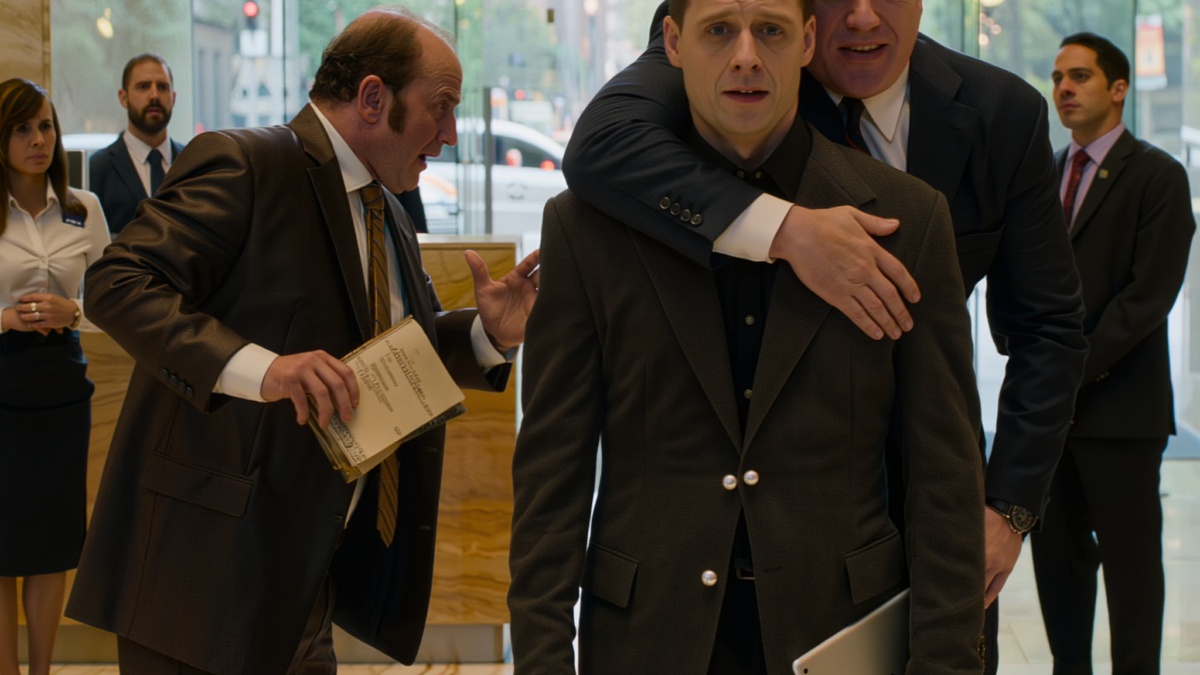
The first thing I noticed that morning was the sound of my older brother’s expensive Italian shoes clicking across the marble floor.
I was standing beside the towering indoor waterfall in our corporate headquarters, reviewing the final clauses of a $7 billion merger on my tablet. In less than twenty minutes, Victor Thorne, one of the most influential investors in commercial real estate, was expected to arrive.
I had spent nine months negotiating that agreement. More importantly, I had spent ten years keeping our family business alive long enough for a deal like this to become possible.
My name is Donovan. I was 32 years old, the chief strategy officer of our family’s commercial real estate company, and for most of my adult life, I had been the person responsible for fixing the problems everyone else created.
That morning, however, none of my experience seemed to matter.
My older brother, Preston, was approaching me with a thick, spiral-bound employee handbook in his hand.
He was 35, and it was his first official day as executive vice president.
Walking beside him were Sylvia, our HR director, and our uncle Gregory, who had spent years attaching himself to other people’s accomplishments.
The three of them moved through the lobby as though they were attending a ceremony in Preston’s honor.
Preston stopped directly in front of me and looked down at my charcoal blazer and slightly distressed leather briefcase.
“You are violating section four regarding appropriate client-facing attire,” he announced.
He held up the handbook so everyone nearby could see it.
“We don’t do distressed leather here, Donovan. We represent excellence, and those buttons on your blazer are non-standard. They are too flashy. Did you even bother to read the dress code before you came to work today?”
The handbook was an outdated relic from the late 1990s. We had transitioned to digital policies more than a decade earlier.
But Preston had apparently decided that an old rulebook would make an impressive accessory for his first demonstration of authority.
The receptionists stopped working. Several financial analysts waiting for the elevators turned around. Even the employees at the lobby cafe paused to watch.
Preston had made certain that his voice carried across the entire atrium.
I lowered my tablet and reminded him that Victor Thorne was arriving in twenty minutes to finalize the most important transaction in our company’s history.
I told him my briefcase was not the issue and that we needed to focus on the signing.
Preston’s face reddened.
He stepped closer and jabbed his finger against my chest.
“I am the executive vice president,” he shouted. “I am enforcing corporate standards. If you can’t follow the basic rules of this company, how can we possibly trust you with its financial future?”
Then he delivered the sentence he had apparently been waiting to say.
“Pack your things. Security will escort you out. You’re fired.”
The lobby went silent.
For a moment, I looked at the employees around us. Some of them had worked with me for years. They knew how many nights I had spent in that building, how many financial emergencies I had handled, and how much depended on the agreement displayed on my tablet.
Then something unexpected happened.
I felt relieved.
For ten years, I had been carrying responsibilities that never seemed to end. I had convinced myself that if I worked hard enough, my parents would eventually recognize what I contributed.
Standing in front of my brother, I finally understood that nothing I did would change the way they saw me.
I closed my tablet.
I told Preston that he was right about the importance of corporate standards and that I would pack my belongings without making a scene.
He looked genuinely confused.
He had expected an argument.
Instead, I turned toward the executive elevators.
That was when the heavy revolving doors began to move.
Victor Thorne entered the lobby, accompanied by two bodyguards.
He walked straight past Preston without acknowledging him.
Then he approached me with a broad smile and gave me a firm, respectful hug.
“Donovan,” he said, ready to sign the merger and make history.
I returned his greeting.
“Sorry, Victor. Preston here just fired me for a dress code violation. So, no deal.”
Victor stopped.
The smile disappeared from his face.
He slowly turned toward Preston, who was still clutching the employee handbook.
“You did what?”
For the first time that morning, my brother seemed to realize that the man he had just dismissed might have been more important than his new title suggested.
I walked away, leaving Preston to explain himself.
But what happened in that lobby was only the beginning.
To understand how my family reached that point, I have to go back ten years.
Our family owned a mid-sized commercial real estate firm. My parents, Richard and Victoria, had inherited a business with valuable properties and a respectable reputation, but they were far more interested in maintaining an expensive lifestyle than managing its finances.
They belonged to exclusive country clubs, traveled to the French Riviera, and hosted elaborate philanthropic galas because they loved seeing their names mentioned in society publications.
They treated the company treasury as though it were a personal checking account.
Over time, they drained their retirement savings and placed second mortgages on the family estate.
When the real estate market shifted, their financial decisions began catching up with them.
The company was carrying substantial debt. Several assets were underperforming, and the banks were growing increasingly concerned.
Foreclosure notices began arriving.
That was when my parents asked me to come home.
I had just graduated near the top of my college class and had received attractive opportunities from Wall Street investment firms.
My parents begged me to turn those offers down.
They said the family business needed me. They talked about protecting our legacy and preserving everything previous generations had built.
I believed them.
I loved my parents, and I thought helping them was simply what a son should do.
So I came home.
For the next five years, I worked relentlessly to stabilize the company.
I renegotiated problematic loans, replaced expensive vendors, and reviewed financial reports until my eyes blurred.
I spent countless nights in my office eating cold takeout and drinking stale coffee.
I missed Thanksgiving dinners. I missed weddings. I missed opportunities to build a life outside work.
My twenties passed while I was trying to prevent our family business from collapsing.
Eventually, those sacrifices began producing results.
Our debt became more manageable. Longstanding clients regained confidence. I built relationships with investors and financial institutions that trusted my judgment.
The company survived.
My parents enjoyed the benefits of that recovery.
My brother enjoyed them even more.
While I was working eighty-hour weeks, Preston was traveling through Europe, staying in five-star hotels and posting photographs from rented yachts.
He presented himself as an entrepreneur, although his businesses repeatedly failed.
More than once, I had to use company resources to resolve financial problems created by those ventures.
When Preston finally returned home, he demanded a large corner office and a salary comparable to mine.
My parents agreed.
They also purchased him a brand-new Lamborghini as a welcome-home present.
The car cost approximately $300,000, paid for through the company I had spent years rescuing.
At the time, I was still driving a reliable ten-year-old sedan with more than 100,000 miles on it.
I confronted my parents about the expense.
My mother smiled and explained that Preston needed to project success to attract wealthy clients.
She told me that I was the operations person, someone who worked behind the scenes.
Preston, she said, was the face of the family.
I remember how casually she delivered that distinction.
There was no acknowledgment that the company’s survival depended on the work I had done.
I was expected to understand my role and be grateful for it.
I swallowed my resentment and returned to work.
I told myself that results mattered more than recognition.
Then Victor Thorne entered our business discussions.
Victor controlled an enormous holding company and was searching for a commercial real estate portfolio to support a multibillion-dollar urban development project.
I recognized the opportunity immediately.
For nine months, I worked with his team to construct a transaction that would benefit both organizations.
I took overnight flights to meet attorneys, reviewed financial models, negotiated complicated contractual provisions, and worked through countless revisions.
The final valuation reached $7 billion.
For our family, it represented financial security on a scale we had never experienced.
For me, it represented ten years of work finally reaching a meaningful conclusion.
I genuinely believed my parents would recognize that.
At Thanksgiving, several weeks before the final signing, our extended family gathered at my parents’ estate.
The dining room looked exactly as it always did during important family occasions. The mahogany table was covered with polished silver, crystal glasses, and expensive wine.
During dinner, I announced that Victor had verbally agreed to our terms and that the final signing was approaching.
My father stood and raised his glass.
I felt a rush of pride.
For a moment, I thought he was going to thank me.
Instead, he announced that he and my mother had decided to appoint Preston as executive vice president.
He also revealed that Preston would lead the signing ceremony with Victor and supervise the integration of the two companies afterward.
Our relatives applauded.
Preston grinned across the table.
I sat motionless.
Nine months of negotiations were being handed to someone who barely understood the agreement.
I turned toward my mother and asked why Preston was receiving responsibility for work I had done.
Victoria adjusted her diamond necklace.
She explained that Victor needed to see a strong, traditional family hierarchy.
According to her, it would be inappropriate for the younger brother to outshine the eldest in a public corporate setting.
She told me to stop being selfish and remember my place.
That conversation hurt, but what I discovered three days later changed everything.
I was searching for an old tax document in my father’s home office when I found a thick, sealed manila envelope.
It had come from Benjamin, our family’s chief legal counsel.
The label read:
“Equity restructuring and wealth transfer.”
Inside were legal documents authorizing a transfer of 15% of the company’s voting stock into Preston’s name.
The shares were being taken from the executive reserve pool.
That was the same pool my employment agreement had identified as the source of my performance bonus for saving the business from bankruptcy.
My parents weren’t merely giving Preston a title.
They were transferring equity that had been contractually promised to me.
The value represented years of sacrifice and millions of dollars in potential compensation.
That evening, I confronted my mother in the kitchen.
I placed the documents on the marble counter and demanded an explanation.
I reminded her how much of my life I had dedicated to the company.
Victoria didn’t apologize.
She crossed her arms and looked at me without any visible concern.
“Your brother needs this equity for the board to respect him,” she said. “You are the younger sibling, Donovan. Taking a little financial loss for the sake of the family’s image is your duty.”
Then she added that if I couldn’t accept that responsibility, perhaps I didn’t belong in senior management.
I stood there looking at her.
For years, I had excused the difference in how my parents treated us.
I had told myself that Preston needed more attention, that my parents trusted me to be independent, and that someday my contributions would matter.
But those documents made the situation impossible to ignore.
My family wasn’t simply overlooking my work.
They were using it to build Preston’s position at my expense.
I collected the papers and left.
I drove to an empty parking lot overlooking the city.
For a long time, I sat gripping the steering wheel, thinking about the years I had spent protecting people who apparently regarded my sacrifices as an obligation.
Then I took out my phone.
I called Victor Thorne directly.
He answered on the second ring.
I told him about the leadership changes, the transfer of equity, the company’s financial vulnerabilities, and my parents’ intention to place Preston in charge of the merged organization.
Victor listened without interrupting.
When I finished, he asked what I wanted to do.
I told him I wanted to rebuild without my family.
He advised me to continue preparing for the signing and let my family proceed with its plans.
Then we discussed another strategy.
It would require patience, careful documentation, and allowing Preston to reveal exactly how much he understood about the business.
By the time I ended that conversation, I knew the coming week would be unlike anything I had experienced before.
The signing was scheduled for Tuesday.
I arrived at headquarters early that morning.
At approximately 8:30, Preston pulled his bright lime-green Lamborghini up to the entrance, parked in the fire lane, and handed his keys to the valet.
Sylvia and Uncle Gregory accompanied him inside.
Watching them from the second-floor mezzanine, I could tell that Preston wanted everyone to recognize his new authority.
He had never managed a transaction approaching this size.
But he wanted the company to understand that he was now the executive vice president.
I walked downstairs with my tablet.
That was when he confronted me about my blazer and briefcase.
That was when he fired me.
After Victor’s unexpected arrival exposed the importance of his decision, I still had personal belongings to collect.
As I headed toward the executive elevators, I caught the eye of Bennett, our head of security.
Bennett was a former Marine with a family, a mortgage, and a pension he needed to protect.
He had watched me work late for years.
During holidays, when my parents were vacationing in Aspen, I sometimes ordered pizza for his night crew.
That morning, he looked deeply uncomfortable.
His hands rested near his duty belt, and his expression was apologetic.
I gave him a reassuring nod.
I didn’t blame him for remaining silent.
He had a job and a family to support.
Upstairs, my assistant Clara was waiting in my office.
She stood beside my desk holding a stack of confidential files, tears running down her face.
“Donovan,” she whispered. “Did he actually do it? Did he fire you right now today?”
I confirmed that he had.
Then I took a cardboard box from the supply closet and began packing.
I collected a framed photograph of my dog and the crystal paperweight Victor had once given me.
Clara was visibly distressed.
She knew how much work had gone into the Thorne agreement. She also knew that Preston couldn’t simply step into the negotiations and understand every provision.
She was particularly worried about the Montana land addendums.
Those documents were among the most important parts of the transaction.
Decades earlier, my grandfather had purchased a large tract of land in Montana.
For years, the property had looked like a financial liability.
It generated property taxes but little practical value.
Over the previous two years, however, I had personally negotiated a complicated zoning change with the local government.
That change made the property extraordinarily valuable for commercial development.
The significance of the zoning approval wasn’t obvious from the company’s ordinary records.
Without the supporting documentation, the property could appear far less valuable than it actually was.
Victor’s acquisition analysis depended on those documents.
The encrypted records weren’t stored on the company’s main servers. The legally binding physical copies were secured in my personal fireproof safe at my apartment.
Clara understood that Preston had no idea how to navigate those provisions.
I told her I was sure someone with his impressive new title and expensive sports car would find a solution.
Then I logged into my computer and removed my personal cache, private communications, and local information from my work equipment.
I left company property intact.
The knowledge I had accumulated over years of negotiations remained mine.
I put on my coat, picked up the cardboard box, and left.
Before I reached the end of the block, my phone buzzed.
It was Clara.
“Donovan, I’m so sorry. Couldn’t stop it. Derek just gave Preston your master passwords.”
I stopped walking.
Derek was our chief financial officer.
Five years earlier, when I hired him, he had been dealing with serious personal debts, a difficult divorce, and a costly custody dispute.
I had mentored him, defended his work before the board, and supported his promotion and salary increase.
I trusted him.
Now Clara was telling me he had handed my administrative credentials to Preston.
A second message arrived.
She said they were trying to access my private server partitions and locate the Montana documents.
According to Clara, they also wanted to remove my name from the Genesis merger files so that Preston could claim responsibility for the transaction.
I understood why Derek might have chosen that side.
Under Preston’s leadership, the executive bonus pool was expected to favor those who supported him.
Still, knowing the financial incentive didn’t make the betrayal easier to accept.
I replied:
“Let them try. The files aren’t there.”
Then I turned off my phone.
I didn’t return to the building.
By ten o’clock, I could imagine the confusion unfolding upstairs.
Preston had dismissed the employee who understood the transaction and now needed access to information he didn’t know how to find.
Derek had apparently expected my passwords to solve that problem.
But the material they needed wasn’t available where they were looking.
I walked two blocks to a quiet cafe across from our headquarters.
I ordered black coffee and took a corner booth near the window.
From there, I could see the glass tower where I had spent most of my adult life.
Information began reaching my secondary encrypted phone through contacts who still worked with the company.
Sylvia and Gregory were apparently trying to explain my departure to the board.
They couldn’t easily admit that Preston had publicly fired the chief strategy officer over a dress-code disagreement on the morning of a $7 billion signing.
Instead, a confidential message circulated among senior partners and stakeholders.
It suggested that I had been removed because of serious financial irregularities and a possible breach of fiduciary duty.
The language implied that I had misused company funds.
I had spent a decade protecting that company from financial disaster, and now people inside it were suggesting I had been stealing from it.
The accusations reached the financial press.
Investors reacted to the uncertainty.
Within approximately thirty minutes, our company’s stock fell 5%.
Tens of millions of dollars in market value disappeared as the rumors spread.
I sat in the cafe, drinking my coffee and watching the office windows across the street.
The people who had wanted to remove me were discovering that their decision had consequences.
Then a black Rolls-Royce arrived outside.
The weather had turned rainy.
The car stopped beside the curb, and Naomi stepped out carrying a waterproof biometric briefcase.
Naomi was Victor Thorne’s chief of staff.
She had a reputation for handling difficult financial matters with extraordinary precision and discretion.
She entered the cafe and sat across from me.
Without wasting time on conversation, she opened the briefcase and placed a thick stack of documents on the table.
“Victor extends his warmest regards,” she said.
She explained that Victor had watched the situation unfold and was ready to proceed with the alternative strategy we had discussed.
The cover page carried the heading:
“Transfer of control and strategic acquisition mandate.”
I read the documents carefully.
Victor wasn’t offering me another executive job.
He was bringing me into a newly formed subsidiary of his holding company as an equity partner.
My initial stake was valued at more than three times the amount of equity my parents had tried to transfer away from me.
More significantly, the agreement would give me authority to manage a potential acquisition of my family’s business.
Instead of negotiating on behalf of Richard, Victoria, and Preston, I would now be representing Victor’s financial interests.
I told Naomi about the allegations being circulated and the attempts to access my records.
She explained that Victor’s team had already notified the Securities and Exchange Commission about the sudden executive leadership changes during the restricted period surrounding the transaction.
According to Naomi, the resulting scrutiny could severely limit the company’s access to operating capital.
“Victor Thorne does not stall,” she said. “He accelerates.”
I signed the documents.
For the first time in ten years, my future no longer depended on whether my parents approved of me.
I had my own position, my own equity, and the authority to act independently.
Before Naomi left, she asked whether we were ready for the next stage.
I looked through the cafe window toward the building across the street.
Preston was still trying to get Victor back to the negotiating table.
He didn’t understand that the original agreement was no longer the only option.
I told Naomi we would go to the boardroom the following morning.
The next day, I woke before my alarm.
For years, mornings had begun with anxiety about what financial emergency my father had created or which of Preston’s mistakes I would have to resolve.
That familiar weight was absent.
I opened my closet and passed over the conservative gray suits I usually wore.
Instead, I chose a sharply tailored navy-blue suit, a crisp white shirt, and a silk tie.
At approximately 8:45, I entered Thorn Strategic Acquisitions.
The building was very different from my family’s headquarters.
There was no extravagant indoor waterfall or elaborate display designed to impress visitors.
The lobby featured dark oak, brushed steel, and a quiet atmosphere of professional concentration.
Naomi was waiting near the private executive elevators with a leather folder containing the final documents.
We went up to Victor’s penthouse office.
He stood near the floor-to-ceiling windows with a cup of black espresso, looking out over the financial district.
The necessary paperwork had been prepared. The notifications had been filed.
Now the next decision belonged to my family’s board of directors.
Across town, an emergency meeting was already underway.
Through Clara and Bennett, I had been receiving updates about the situation inside our former headquarters.
Diana, the independent chair of the board, had flown in from Chicago after learning about the company’s falling stock price.
She was an experienced executive who had little tolerance for mistakes that threatened shareholder value.
A sudden 5% decline, rumors of financial misconduct, and the removal of a key negotiator immediately before a major transaction were more than enough to concern her.
She demanded an in-person meeting with the leadership team.
My parents attended, along with Preston and Derek.
Richard and Victoria were attempting to maintain the appearance of experienced corporate leadership.
But the company’s financial position was deteriorating.
Preston was struggling to explain what had happened to the Thorne deal.
Derek was still trying to locate the Montana zoning files.
And the board was growing increasingly impatient.
The banks were another serious concern.
Our commercial real estate loans contained strict debt covenants.
Without Victor’s original merger agreement, the company faced the possibility of those covenants being triggered, exposing it to severe financial consequences.
Some of the debt was connected to assets my parents had personally placed at risk.
They desperately needed the original transaction to proceed.
When Victor’s office contacted Richard that morning and indicated he was willing to attend one final discussion, my parents believed they had been given another chance.
They apparently convinced themselves that Preston had handled the crisis well.
According to Clara’s messages, Victoria praised him for managing his first major challenge.
Richard even poured himself an early glass of expensive scotch.
They were preparing to celebrate a deal that hadn’t been saved.
At exactly 9:30, the boardroom doors opened.
Victor entered first.
My father rose immediately from his chair and extended his hand.
“Victor, thank you so much for coming,” Richard said.
He tried to explain that the previous day had involved necessary personnel changes but assured Victor that Preston now had everything under control.
He said the company was ready to finalize the partnership.
Victor didn’t take his hand.
For several uncomfortable seconds, Richard stood with his arm extended.
Then Victor walked past him and sat at the opposite end of the long mahogany table.
“I didn’t come here alone, Richard,” he said.
That was my cue.
I walked into the room carrying a leather folder.
The reaction was immediate.
Preston stumbled backward until he reached the glass whiteboard.
Derek dropped his fountain pen.
My mother gripped the table and looked from me to Victor, struggling to understand why I was there.
But instead of asking, she tried to explain my presence away.
“Victor, I am so incredibly sorry you have to witness this disruption,” she began.
She described the situation as a private family matter.
She claimed I had been under tremendous stress and had suffered a mental break in the lobby the previous day.
She said the family was trying to arrange professional psychiatric help for me and that I shouldn’t be disrupting confidential business proceedings.
I listened without interrupting.
Preston seemed encouraged by her intervention.
He pointed toward me and repeated the accusations about financial irregularities.
He warned that he could have security remove me.
I walked to an empty executive chair and rested my hands on its back.
“Financial irregularities?” I asked.
Then I brought up something everyone in the room could understand.
Preston’s $300,000 Lamborghini.
I explained that the car had been purchased using money from the vendor surplus fund, a reserve I had spent three years building to protect the company from insolvency.
Preston became visibly upset.
He insisted I was a disgruntled former employee and begged Victor to ignore me.
Victor leaned forward.
“I think,” he said, “that you all have fundamentally and catastrophically misunderstood the absolute power dynamic currently operating in this room.”
Then he stood, walked around the table, and placed a hand on my shoulder.
He explained that he was not there to sign the original merger with the existing management team.
He was there because the managing director of his newest strategic acquisitions division had asked him to attend.
My father looked completely confused.
“Your managing director, Victor, what on earth are you talking about? Who is your managing director?”
I opened my folder.
I placed the executed documents on the table and slid them toward Diana and the independent directors.
“He’s talking about me, Dad,” I said.
I explained that the necessary paperwork had been filed that morning.
I was now a co-owner and managing director of Thorn Strategic Acquisitions.
And I wasn’t there to complete the original merger.
I was there to present a proposal for the acquisition of the company’s remaining viable assets.
My mother laughed nervously.
She insisted I couldn’t possibly have the capital required to partner with Victor.
She told me to apologize to Preston and stop embarrassing the family.
Victor interrupted her.
“It’s not a game, Victoria.”
He confirmed that I had full executive authority over the acquisition process and represented his financial interests.
He also pointed to the company’s falling stock price, heavy debt, and unstable leadership.
My mother stopped talking.
I turned toward Derek.
Of everyone in the room, his actions had been particularly difficult for me to accept.
I had hired him when he was struggling personally and financially. I had mentored him and defended him before the board.
Yet within hours of Preston receiving his new title, Derek had given him access to my administrative credentials.
I confronted him about the attempt to enter my private encrypted server partitions and remove my name from the Genesis merger documents.
He looked increasingly uncomfortable.
“Donovan, I… I didn’t have a choice,” he stammered.
He said he had been following orders from the executive leadership.
He reminded me about his expensive custody battle, his children, and his need to keep earning a salary.
He claimed Preston had threatened to fire him if he refused.
I remembered the nights I had spent helping him prepare for those custody hearings.
But I also understood what his decision meant for the company.
He had allowed someone without authorization to access restricted information.
And the board was entitled to know.
I turned to Diana and directed her to page four of the packet.
It contained electronically timestamped server logs documenting the attempted access and manipulation of company records.
I explained that the unredacted logs had already been forwarded to the SEC’s enforcement division.
Diana reviewed the documents.
As she read, her expression hardened.
She looked toward Preston.
“Is this true?” she demanded.
She questioned whether he had authorized access to encrypted corporate files, misrepresented the circumstances of my dismissal, and exposed the company to serious liability.
Preston immediately began defending himself.
“He was hoarding company property!” he shouted.
He accused me of hiding the Montana zoning addendums and deliberately trying to make him fail on his first day.
That accusation brought us to the most important part of the transaction.
The Montana documents.
I explained that the commercial zoning approvals, which were central to the property’s extraordinary development value, had been legally registered under my personal independent LLC rather than the family trust.
The room became quiet.
I had negotiated the zoning change using my own time, capital, and relationships developed over years.
The family company had treated the land as a costly burden.
I had recognized its potential and worked to secure the approvals that made it valuable.
Those records were an essential part of the financial assumptions supporting Victor’s proposed acquisition.
And Preston had fired the person who controlled them.
He had dismissed me over the pearl buttons on my vintage blazer without realizing how much the transaction depended on work and rights he had never bothered to understand.
My father gripped the table.
He accused me of hiding family assets and insisted that the Montana land belonged to our inheritance.
He said I had a moral obligation to the family.
That word stopped me.
Inheritance.
After everything my parents had done, Richard still wanted to discuss my duty to protect what belonged to the family.
I asked him whether he wanted to discuss the 15% voting equity he and Victoria had transferred to Preston.
Both of my parents went still.
They had believed I would never discover those documents.
I explained that the shares had been promised to me as compensation for saving the business years earlier.
Instead, my parents had authorized their transfer to Preston to strengthen his position with the board.
“You stole my equity,” I told them.
I reminded them that the shares represented work I had performed and years of opportunities I had sacrificed.
What had happened wasn’t simply a disagreement between brothers.
It involved promises made in employment documents, corporate governance, and the financial interests of the company’s shareholders.
I placed the final proposal before Diana.
Thorn Strategic Acquisitions was offering to purchase the company’s remaining viable assets at ten cents on the dollar.
The alternative was to face the company’s creditors without the original merger proceeds, amid a falling stock price and growing scrutiny.
I explained that if the board refused the offer and bankruptcy followed, Victor and I were prepared to pursue the remaining assets through that process.
The proposed purchase price was deliberately severe.
But the company’s deteriorating position had left the board with very few attractive options.
The room erupted into argument.
Richard tried to object.
Preston insisted the company belonged to him.
Derek sat almost motionless.
Diana brought the discussion under control.
She reminded Richard that the board had a responsibility to protect shareholder value.
Then she announced that Richard and Victoria were being removed from their executive positions and stripped of their executive voting rights pending the outcome of the SEC investigation.
She turned to Preston.
“Preston, you are fired.”
The termination was effective immediately and for cause.
There would be no severance payment.
Security would escort him out, and he was not to return to his computer or collect company materials.
Diana also suspended Derek without pay.
She stated that the board would retain outside counsel to pursue civil claims relating to his actions and the attempted access to restricted corporate information.
Preston reacted badly.
He shouted that he was executive vice president and the primary heir to the company.
Then he turned his anger toward me.
He accused me of planning everything because I was jealous.
He even claimed I had always resented him because our parents loved him more.
I listened.
For years, those words would have hurt deeply.
But I had finally stopped competing for a kind of approval that was never freely given.
The boardroom doors opened.
Two security guards entered.
They were men I recognized, employees whose jobs I had protected during earlier budget cuts and to whom I had given holiday bonuses.
They escorted Preston from the room as he continued protesting.
Before he left, I looked at him.
“I don’t hate you, Preston,” I said. “I just finally stopped protecting you from the consequences of your own actions.”
Then I reminded him that the company card had been declined and that he would need another way to pay the lease on his Lamborghini.
For the first time, my older brother was facing a financial problem I wasn’t going to solve for him.
After he was removed, my parents seemed to understand how serious their situation had become.
My mother stood and walked around the table.
Her hands were shaking.
She reached for my arm and began crying.
“Donovan, please,” she said.
She reminded me that I was her son, her flesh and blood.
She said that selling the company at such a low valuation would cost them their family estate and possibly their houses in Aspen and the Hamptons.
They would have little left for retirement.
She was also worried that her friends at the country club would laugh at her.
Then she began offering me everything she had refused to give me before.
My old salary.
A substantial raise.
A promotion.
Even the position of CEO.
She promised that we could repair our relationship if I withdrew the acquisition offer.
I looked at her hands gripping my sleeve.
For a moment, I searched for the affection that had kept me returning to this family for so many years.
But I couldn’t forget the documents in my father’s office.
I couldn’t forget Thanksgiving.
And I couldn’t forget the way my mother had stood by while Preston humiliated me in front of employees I had mentored.
I gently removed her hands from my arm.
I told her she hadn’t cared about my financial future when she transferred my promised equity to Preston.
She hadn’t cared about my dignity when he fired me in the lobby.
And she hadn’t cared about the years I spent working while he traveled and enjoyed the benefits of the company.
Now that the family’s financial security was in danger, she suddenly wanted to treat me as someone important.
“You made your choice, Victoria,” I told her. “You chose your golden boy. You chose appearances over loyalty.”
My father remained beside the table.
He looked exhausted.
“You’re really going to completely destroy your own family over money?” he asked quietly.
I looked at him.
“It was never ever about the money, Richard.”
I explained that I had wanted respect.
I had wanted my parents to acknowledge what I had contributed and treat me as a son rather than a resource they could continually use.
When they refused to do that, I finally chose to protect myself.
I turned toward Diana and the remaining independent directors.
They had until five o’clock that afternoon to accept the proposal.
If the agreement wasn’t signed by 5:01, Victor and I would withdraw the offer.
If bankruptcy followed, we were prepared to bid on the remaining assets at the bankruptcy auction, potentially for three cents on the dollar.
The decision was theirs.
I didn’t wait for my parents to respond.
I walked out of the boardroom with Victor.
As the private executive elevator doors closed behind us, I could still hear my mother crying.
I took a deep breath.
For the first time in a decade, the responsibility for my family’s decisions no longer rested on my shoulders.
Six months have passed since that meeting.
I now work from a corner office at Thorn Strategic Acquisitions, overlooking the city.
The view is impressive, but what matters most to me is the quiet.
I no longer spend my mornings worrying about which of Preston’s mistakes I will have to cover up.
I no longer receive constant demands from relatives who believe my professional responsibilities exist to support their lifestyle.
I work in an organization where performance and accountability matter.
One of my first decisions as managing director was to bring Clara into the company.
She became our director of corporate operations.
I doubled her previous salary, arranged comprehensive executive health benefits, and established a funded college trust for her two young children.
Clara had stood by me when many people chose to protect their own positions.
She had warned me about Derek, kept me informed, and never pretended that what happened in the lobby was acceptable.
She deserved to work somewhere her contribution was recognized.
She has become an outstanding leader in our new organization.
As for my family’s company, the independent board accepted our proposal at 4:55 that afternoon.
They signed just five minutes before the deadline.
Victor and I then began integrating the profitable assets into his larger real estate portfolio.
The Montana commercial development project became an important part of that process.
Departments that had been poorly managed or unnecessarily expensive were liquidated as the business was restructured.
My parents lost the enormous corporate salaries and unrestricted expense accounts that had supported their lifestyle.
Without those resources, their financial problems escalated quickly.
The banks eventually foreclosed on the family estate after they could no longer meet the mortgage obligations.
My parents were forced to auction their antique furniture, my mother’s valuable jewelry, and their country club memberships to address outstanding debts and legal expenses associated with the SEC investigation.
According to the last information I received, they moved into a modest two-bedroom condominium in a middle-class suburb outside the city.
My mother, who once spent her time organizing society events, is apparently now involved in an ongoing dispute with her homeowners association over the color of her front door.
The contrast is difficult to ignore.
But I don’t spend my days following their problems.
Preston’s situation deteriorated after he lost his salary and access to company funds.
The bank repossessed his lime-green Lamborghini exactly one week after his dismissal.
He tried to launch another technology company and approached former wealthy acquaintances for investment capital.
By then, word of his conduct and involvement in the company’s problems had spread through our professional circle.
He couldn’t attract the support he wanted.
He has been unable to establish another comparable corporate career.
My parents are now using much of their remaining retirement savings to help pay the rent on his apartment.
Derek faced consequences of his own.
The civil lawsuit brought by the board exhausted much of his personal savings.
He sold his house and ultimately lost his corporate accounting license.
The financial and legal difficulties also affected his custody dispute, which he eventually lost.
Of everyone involved, Derek’s situation still reminds me how costly a single decision can become.
He traded a professional relationship built over years for the possibility of a larger executive bonus.
He never received that bonus.
I haven’t spoken to my parents or Preston since the day I walked out of the boardroom.
After the buyout was finalized, I changed my personal phone number and blocked their email addresses.
I also instructed the security team at my new office not to admit them if they appeared unexpectedly.
Those decisions weren’t about prolonging the conflict.
They were about ending the expectation that I would always return to fix the consequences of someone else’s choices.
People often say that family should come before everything else.
For much of my life, I believed that too.
I believed that sharing the same name and history meant accepting responsibilities regardless of how little consideration I received in return.
I believed that if I made enough sacrifices, the people I loved would eventually recognize them.
But loyalty cannot survive when it moves in only one direction.
Being related to someone doesn’t entitle that person to your labor, your money, your future, or your unconditional forgiveness.
Respect has to be mutual.
For ten years, I was so focused on earning my parents’ approval that I barely noticed how much of my own life I was giving away.
I missed time with friends. I put aside opportunities. I accepted treatment I would never have advised anyone else to tolerate.
And all along, I told myself that one more achievement might finally be enough.
It wasn’t.
What changed my life wasn’t simply the new title, the equity, or the successful acquisition.
It was realizing that I no longer needed my family to tell me whether I had value.
I could recognize my own contributions.
I could decide where to devote my energy.
And I could build a future with people who respected me without demanding that I continually prove my worth.
Today, I have the career I worked for, the independence I needed, and a sense of peace I once thought was impossible.
Looking at the business I’m helping build and the people I now work alongside, I don’t regret the decision I made.
I would do it all over again in a heartbeat to secure the peace I have today.








