My parents left me at a Paris airport with a stolen passport in my bag, then boarded a flight home with my older brother. My grandmother’s $2.5 million trust was set to mature the next day, and they needed me unreachable. I sat in a French detention room counting the hours until I realized exactly why they wanted a 48-hour hold. Then a stranger walked in carrying a corporate contract.
I’m Ethan Miller, and I’m twenty-nine years old. Last month, my own family left me stranded at an airport in Paris, where I was detained by French officers after a stolen passport appeared in my bag. I stood surrounded by uniformed strangers issuing commands in a language I barely understood, looking toward the boarding gate for help that never came. My parents, Walter and Sylvia, and my older brother, Julian, didn’t even turn around. They continued down the jet bridge and boarded their flight to New York as though I were a stranger who had missed his connection.
They had planned it that way. They needed me out of reach long enough to take control of the $2.5 million my grandmother had left me. They assumed I would spend the next two days in a holding room, confused, frightened, and unable to contact anyone who could intervene. What they hadn’t anticipated was that a billionaire venture capitalist would walk into that same detention room with a private jet, a formidable legal team, and a business problem that only someone with my particular skills could solve. By the time my family understood what had happened, the investigation into their scheme was already moving toward consequences none of them had expected.
It started with what was supposed to be a happy family trip to Europe. My mother had suggested it, saying that we needed time together before my grandmother’s trust fund reached its distribution date. Looking back, I can see how carefully she laid the groundwork. My father, who rarely asked me anything about my work, suddenly wanted to hear about my clients and my plans for the future. Julian, who had spent most of his life being excused from any real responsibility, offered to carry my heavy bags through the cobblestone streets of Rome. I mistook their unusual kindness for an overdue change of heart.
Our return flight departed from Charles de Gaulle Airport in Paris. The international terminal was a confusion of rolling suitcases, overlapping announcements, impatient travelers, and long lines. I was checking the departure board when my mother stopped beside me, wearing the innocent expression she always used when she wanted me to lower my guard.
“Oh, honey, didn’t you check your bag?” she asked. Then, almost casually, she added, “You don’t have a ticket anymore.”
I stared at her, certain I had misheard. She offered no explanation. Instead, she turned toward the gate agent and presented three boarding passes: hers, my father’s, and Julian’s. Mine had vanished. I moved toward her, reaching for her arm so I could ask what was happening, but Julian stepped between us. He pushed me aside hard enough to throw me off balance. During that brief confusion, his hand moved toward my open tote bag. I didn’t understand what he had done until it was too late: he had slipped a black passport inside.
Seconds later, near the security checkpoint, an alarm sounded. French officers converged on me, speaking quickly and firmly. One held my arms behind my back while another examined the passport they had found. I tried to explain that it wasn’t mine. I tried to point toward my family, expecting that even now one of them would return and clear up the misunderstanding. But through the commotion, I could see Walter, Sylvia, and Julian continuing down the jet bridge. They showed no alarm, no hesitation, and no intention of coming back. I had been deliberately left behind to answer questions about a passport that didn’t belong to me.
The hour that followed passed in fragments: identification checks, a search of my belongings, cold restraints around my wrists, and repeated questions I struggled to follow. Eventually, I was placed in a glass-walled detention room smelling of industrial cleaner and old coffee. Fluorescent lights hummed overhead, casting a merciless glare across a metal table bolted to the floor. I could see an officer outside the door, but I couldn’t see a way to contact the people who had just abandoned me.
Someone else might have cried, demanded a lawyer, or pleaded for a phone call to the American embassy. I certainly wanted answers. But my profession had taught me to manage panic by separating what I knew from what I only suspected. I’m a forensic accountant. I make my living examining tangled financial records until a hidden story becomes visible. I’ve traced concealed assets during contentious divorces, reviewed complicated real estate portfolios, and uncovered transactions that were designed to escape scrutiny. Sitting in that airport room, I treated my predicament as though it were another set of suspicious accounts.
The first entry was my real passport. Sylvia had distracted me at the gate, and the document had disappeared. The second was Julian’s sudden push, followed almost immediately by the discovery of another person’s passport in my bag. The third was something I had overheard: an officer said the document had been reported missing the day before and that verifying my identity could take forty-eight hours.
Forty-eight hours. Why did that particular period matter?
Then I remembered my grandmother’s trust. The principal—$2,500,000—was due to become available at noon the following day. Buried in the legal paperwork was an obscure provision concerning an absent beneficiary. If I couldn’t be reached around the distribution date, temporary administrative authority could pass to my parents as the designated secondary guardians. I had once skimmed that clause and dismissed it as a technicality. Suddenly it explained the missing ticket, the planted passport, and my family’s astonishing willingness to leave me in another country.
They hadn’t merely ruined a vacation. They had arranged for me to be unavailable at precisely the moment I needed to assert my rights. And while I sat under those buzzing fluorescent lights, they were probably reclining in first class, ordering champagne, and congratulating themselves on how smoothly everything had gone. The unfairness of it all was almost too much to absorb.
The metal door buzzed. I looked up, expecting an investigator ready to ask more questions about the passport. Instead, a stranger walked in who carried himself as though the building belonged to him. His charcoal suit looked more expensive than my car, his shoes were immaculate, and his movements were controlled in the way I’d seen among very successful investment bankers. He didn’t sit. He stood near the doorway and studied me as if I were a financial statement containing a number he couldn’t reconcile.
“Ethan Miller,” he said in a low, even voice. “A reputation for exceptional forensic audits of distressed assets. You have a talent for finding money that doesn’t want to be found.”
I straightened in my chair. I had no intention of appearing defeated in front of another stranger. “Who are you?”
“Sebastian Vance. I run a venture capital firm in New York. And I believe we have a mutual problem.”
“My problem is a stolen passport and a family that arranged for me to be detained,” I replied. “What’s yours?”
“A major corporate merger closes in three days. One of my partners has been quietly diverting funds, and he’s very good at hiding the trail. My regular auditors haven’t been able to find it.”
He glanced at an elegant watch that probably cost more than most people’s retirement savings. “I need someone outside the official payroll. Someone capable of working quickly, discreetly, and under pressure.”
Sebastian set a thick file on the metal table. It wasn’t my detention record. It was a substantial corporate agreement accompanied by financial schedules. He had come prepared to negotiate.
“I have contacts who can help arrange the necessary consular and legal assistance,” he continued. “Once you’re cleared to leave, I can get you back to New York on my aircraft. You examine my records, identify the missing funds, and tell me how my partner concealed them.”
“And what do I get?” I asked, carefully keeping my voice steady.
“A way out of this situation, a chance to return before your grandmother’s trust deadline, and twenty thousand dollars for the assignment.”
I watched him for a moment. This wasn’t a sentimental rescue. Sebastian didn’t know me, and he had no reason to care about the breakdown of my family. He saw a specialist with a useful skill and an urgent need to get home. After years of dealing with relatives who called their demands acts of love, I found the terms unexpectedly refreshing. At least he was offering an honest exchange.
“Thirty thousand,” I said. “And you cover my legal fees if my family contests the trust or drags me into a lawsuit.”
A slight smile crossed his face, the expression of a man who appreciated a capable negotiator. “Done.”
With his attorneys coordinating the paperwork and the appropriate authorities reviewing my situation, arrangements were made for my release and departure. When I stood, I didn’t look back at the metal table or the glass walls that had seemed permanent an hour earlier. I left the room as someone with work to do and a real chance to protect his future. My family believed they had eliminated the one person who stood between them and a fortune. Instead, they had brought me into contact with someone operating on an entirely different scale.
For a few minutes, I believed the worst surprise was behind me. I was wrong. Sebastian’s private jet was quieter than a neighborhood library and colder than a morgue. Thousands of feet above the Atlantic, he sat across from me studying the merger documents while I opened a separate dossier his security team had assembled about my family. Their speed was remarkable. In less than an hour, they had gathered financial records, relevant correspondence, and the unredacted trust agreement that I had been too trusting to examine closely in the past.
I turned directly to page four. There it was: the absentee provision. The language described the transfer of temporary administrative power to secondary guardians if the principal beneficiary could not be located or was deemed unable to manage his affairs during the period preceding distribution. My parents weren’t simply hoping to cover a few overdue bills. They wanted authority over the whole sum, with as little oversight as possible. I read the passage several times, trying to make it mean something else, but the dates were too exact to ignore.
Through the small oval window, the Atlantic was an unbroken darkness. I should have been grieving the family I thought I knew. Part of me was. Yet the longer I stared at those clauses, the more clearly I remembered things I’d spent years excusing. The betrayal at the airport hadn’t appeared out of nowhere. It was the latest entry in a long, ugly ledger of what I had paid and what they had taken.
I was twenty-two when I managed to save enough from double shifts at a miserable retail job to buy a used Honda Civic. It wasn’t fashionable, but it was reliable, and I was proud of every dollar I’d earned. Owning a car meant I could apply for better work without spending two hours on a bus in freezing rain. It was the first practical freedom I’d ever purchased for myself.
Two days after I brought it home, Walter sat me down at our kitchen table. He wasn’t shouting or making demands. He was crying. He told me he owed thirty thousand dollars to a gambling creditor who was threatening serious consequences if he didn’t pay before the end of the week. He gripped my hands, his palms clammy, and looked at me with a desperation that made it hard to walk away.
“You’re the responsible one, Ethan,” he said. “You can fix this. You always fix this.”
I sold the Civic the next morning at a painful loss and sent the proceeds toward his debt. I told myself I was helping my father get out of a dangerous situation. He never thanked me properly. He never apologized for costing me the savings I’d struggled to accumulate. The following weekend, as though none of it had happened, he asked if I could drive him to the dog track. I didn’t even have a car anymore.
I sat with that memory while the jet engines murmured around me. Then I turned another page of Sebastian’s dossier, and an even more painful sacrifice came back into focus.
The next memory began with the acceptance letter that had once felt like my ticket out. I’d been offered an extraordinary scholarship opportunity at Wharton, the kind of chance a kid from my background could hardly believe was real. For weeks I kept the letter where I could see it. I imagined a university campus, classmates who cared about their futures, and a career built on something more substantial than cleaning up my family’s mistakes. Then Julian had a messy breakup, and Sylvia decided that his disappointment was an emergency the entire household had to solve.
My brother, the family’s untouchable golden child, apparently needed a year in Italy to recover, explore the world, and “find himself.” My parents couldn’t pay for the trip, at least not without taking resources away from me. As usual, they presented that as my problem rather than theirs. Sylvia sat across from me at the kitchen table, speaking in the calm, reasonable voice she used whenever she was about to ask for something unreasonable.
“Ethan, you can take out student loans,” she said, as casually as if she were asking me to pass the salt at Thanksgiving. “Julian is fragile right now. He needs this cultural experience. You’re strong. You can handle a little debt.”
Aunt Martha joined the conversation. At family gatherings, she liked to play the affectionate peacemaker, the woman who reminded everyone how important it was to remain close. That day, she made sure to remind me exactly which of us was expected to give things up.
“Family is everything, Ethan,” she said. “Your brother will pay you back when he finds his footing. Don’t be selfish with your college fund.”
I allowed myself to be persuaded. Instead of making full use of the Wharton opportunity, I redirected the money I’d set aside for school and took on a very different path through community college. I worked graveyard shifts at a local data center to cover my tuition while Julian spent his days eating expensive gelato in Florence. I told myself that was what love required. I believed being called “the strong one” was a compliment. It took years to understand that the phrase was less a compliment than an instruction: be capable enough to absorb whatever costs everyone else refused to carry.
Across the aisle of the private jet, Sebastian was watching me over the gold rim of his espresso cup. I hadn’t realized how long I’d been silent.
“You know what you are to them, don’t you?” he asked. His quiet voice carried clearly through the soft hum of the engines.
“Yes,” I said, looking down at the records of their endless debts. “I’m not a son. I’m an insurance policy.”
For twenty-nine years, my relatives had praised me for being practical, resourceful, patient, and reliable. They hadn’t encouraged those qualities because they wanted me to succeed on my own terms. They’d made sure I was always there to fix the damage left by their reckless choices. I was their emergency fund, their problem solver, and their excuse not to change. Now that a $2.5 million distribution was finally approaching, they were prepared to use my competence one last time and then push me aside.
They believed taking my passport and phone, leaving me stranded, and humiliating me in front of strangers would make me powerless. What they had forgotten was that those same years of managing their chaos had taught me how to function when almost everything was going wrong. They’d trained me to survive without the resources they took for granted. I no longer had to use that skill to protect them.
I pulled the laptop Sebastian had lent me from my bag and opened a secure document.
“What are you doing?” he asked, lifting one eyebrow.
“Drafting incorporation paperwork for a shell company.” My fingers moved quickly across the backlit keys. “They want a large payout immediately. I’m going to put an offer in front of them that’s almost impossible to refuse.”
“You’re setting a trap,” Sebastian said. It wasn’t really a question. He sounded as though he recognized the instincts behind my idea.
“They taught me to fix their messes,” I replied, watching the cursor blink on the bright screen. “Now I’m going to make sure they can’t use me that way again.”
I thought I finally understood how far my family would go. Then we reached New York, and I discovered what Julian had been doing online while I’d been detained in France.
The jet landed at Teterboro Airport as the early morning sun came up beyond the Manhattan skyline. Sebastian’s driver waited beside a polished black Rolls-Royce. His staff had already coordinated our arrival and the necessary formalities, sparing us the long delays that had become the defining experience of my previous day. I had always known money could buy expensive things. Seeing Sebastian’s operation up close reminded me that it could also buy extraordinary speed, access, and attention.
Thirty minutes later, I was inside the working office of his vast penthouse in Tribeca. Floor-to-ceiling glass overlooked the city, while steel fixtures and spotless furniture gave the place the atmosphere of a private command center. The calm precision of the space felt almost unreal after the noise and confusion of the airport. But I wasn’t there on vacation. Before I looked into my own family’s affairs, I had a promise to keep.
For the next two hours, I worked through Sebastian’s corporate accounts using specialized forensic software. I followed a complicated chain of dummy invoices, transfers through offshore entities, and carefully disguised payments. His business partner had been moving money in small enough amounts to hide among legitimate expenses. Once I compared the transactions across the underlying contracts, the pattern became clear. I prepared the supporting schedules and gave Sebastian proof of the diversion. The coffee someone had placed next to me was still barely cool. I’d fulfilled my part of our arrangement.
Sebastian slid a slim tablet across the polished mahogany table. “My security team has organized a complete review of your available cloud records and the documents your counsel can access,” he said. “You might want to prepare yourself.”
I tapped the screen. Physically, I was free, back in New York, and sitting in a billionaire’s penthouse. Online, however, my brother had already begun dismantling my reputation. The first item was an Instagram story he’d posted about six hours earlier. In the picture, Julian sat in a VIP airport lounge wearing an expression of carefully arranged grief. The next frame had a black background with white letters: “Please pray for my brother Ethan.”
Below it, he had written: “He had a serious personal crisis at the airport in Paris. We are doing everything we can to get him professional help. Please respect our privacy during this difficult time.”
I stared at the screen until my jaw began to ache. It was a polished attempt to turn their actions into a story about my supposed instability. Julian wasn’t simply giving friends and relatives a reason for my absence. He was planting a doubt that could follow me home. If I returned and accused them of taking my passport or manipulating the trust, he could shake his head with practiced sadness and suggest that I was confused, distressed, or imagining things. He had prepared his audience to distrust me before I could speak for myself.
The real damage was waiting in my email. Sylvia had written an urgent message to Chloe, the executive director responsible for handling the trust. I knew Chloe well enough to remember her embracing me at my grandmother’s funeral and promising that my inheritance would be protected. The subject line now read: “Emergency guardianship — disbursement of funds.” An official-looking scan was attached: a translated incident report from Charles de Gaulle Airport that alleged a security incident and troubling behavior. The presentation was designed to make an incomplete account of my detention look like a definitive professional assessment.
“As you can see from the attached documentation,” my mother wrote, “Ethan is currently in custody and is not in a position to manage his financial affairs. Under the absentee provision, we are invoking our rights as secondary guardians to safeguard the assets until the situation is resolved.”
I read the words again. She had put in writing exactly what I suspected. My relatives weren’t content to obtain my grandmother’s money; they were willing to damage the career I’d built to prevent me from objecting. I worked in forensic accounting, a field that depends on discretion, judgment, and trust. A public story that I had become unreliable, coupled with a purported foreign police report, could have serious consequences even if every claim was false. Julian and my mother were trying to make certain I came home without professional credibility, without a dependable income, and without anyone willing to listen.
A cold sensation moved down my back. It wasn’t quite fear anymore. It was the clarity that comes from finally understanding someone’s intentions. My parents must have pictured me sitting on the floor of a holding room in France, frightened and waiting for them to rescue me. They had no idea that I was in Tribeca reviewing their correspondence and tracing every step of their plan. Every document made their motives less ambiguous.
“They’ve been thorough,” Sebastian said, reading over my shoulder. “They’ve created enough confusion that a formal challenge could take a while. By the time a court reviews the transfer, the money might already be gone.”
“They don’t want a prolonged legal fight,” I replied. “They want a fast, quiet payment. They owe too much, and they can’t settle those debts in ordinary monthly installments.”
I rose and walked to the immense window. Far below us, yellow taxis moved along the gray pavement as Manhattan came to life. Somewhere in the city, Walter, Sylvia, and Julian were likely celebrating. I could imagine the expensive dinner, the excited discussion of what they would buy, and the confidence of people counting money that hadn’t reached their accounts. They still thought I was the only obstacle they needed to remove.
“They think the only route to the trust is through Chloe,” I said, turning toward Sebastian. “They’re thinking too small.”
He raised an interested eyebrow. “What are you proposing, Ethan?”
“I need access to proof of your firm’s capital reserves. I’m not asking to spend the money. I need documentation that a well-funded business is prepared to finance a transaction. They want immediate cash, and I intend to offer them what looks like the answer to every financial problem they have.”
I explained that their creditors were becoming increasingly impatient. If my assumptions about Walter’s gambling debts were right, some of those creditors were not the kind who sent friendly reminder letters. We would present an attractive option that offered immediate relief, but only after my parents formally documented the authority they claimed over my trust. They had used legal forms to make me disappear. I wanted their own paperwork to reveal exactly what they were doing.
Within an hour, with Sebastian’s corporate resources and lawyers supervising the setup, Atlas Holdings was taking shape as a boutique investment company specializing in distressed assets. It had a polished website, Delaware registration documents, and verifiable evidence of access to $50 million in liquid capital through Sebastian’s network. To a family staggering under debts, it would resemble an unexpected lifeline. Behind the professional presentation, we had designed a transaction that required my parents to state their position clearly and accept responsibility for it.
“My parents are drowning,” I said, pulling their credit report onto a large monitor. Red figures filled the screen. “They have three separate high-interest mortgages. Their credit cards are maxed out. And unless Walter has completely changed his gambling habits since I last helped him, he still owes money to people who expect prompt payment.”
“So we offer them a lifeline,” Sebastian said, beginning to understand. “A bridge loan.”
“A very expensive short-term bridge loan with an immediate payout,” I corrected. “Atlas offers to buy their distressed debt for less than its face value. In exchange, we demand substantial collateral: the trust.”
Sebastian leaned toward the screen. “And because the trust names you as the primary beneficiary, your parents can’t pledge it without establishing that they have lawful administrative authority.”
“Exactly. They have to make a formal statement about my supposed inability to manage it. They have to put their claims in writing, with signatures and witnesses.”
A faint smile appeared on his face. “And if those claims are knowingly false, the signed statement becomes evidence.”
“Of misrepresentation, a fraudulent financing attempt, and potentially far more,” I said. “They’ll have to choose between telling the truth and making the deal they desperately want.”
We didn’t telephone Walter ourselves. He knew my voice, and even a distorted connection might have made him suspicious. Sebastian called in Marcus Thorne, a corporate attorney known for handling difficult, high-stakes transactions and hostile takeovers. Marcus had a deep voice that managed to sound polished and intimidating at the same time. He carried himself like a man accustomed to being obeyed, and he understood the importance of making every condition of the proposed financing explicit.
We sat in the penthouse office with the speakerphone connected as Marcus called my father’s personal number. It rang twice.
“Hello?” Walter answered. His voice sounded strained. He may have been expecting another creditor, a debt collector, or even a neighbor complaining about the HOA fees he’d ignored.
“Mr. Miller, this is Marcus Thorne, legal counsel for Atlas Holdings,” Marcus said with effortless authority. “Our firm has recently acquired a portfolio of distressed liabilities that includes your outstanding promissory notes. We’re reviewing options to close these positions immediately.”
I watched the waveform on the conference monitor. Then it went flat. My father had stopped speaking.
“I—I don’t have enough liquid cash right now,” Walter finally managed. “We’re expecting a substantial family trust disbursement, but there have been unexpected administrative delays.”
“Delays make my partners nervous, Mr. Miller,” Marcus said, sounding professionally impatient. “However, Atlas sometimes consolidates debt of this kind into a single short-term bridge facility, secured against a verifiable asset. We could fund the transaction this afternoon and clear the liabilities we’ve discussed. The condition is that we close today.”
“Today?” My father’s voice cracked with an unmistakable mixture of fear and sudden hope. “Yes. Yes, we can do today.”
“Excellent. There is one compliance issue. Our due diligence shows the trust is registered in your son Ethan’s name. Before Atlas can consider it as collateral, we need proof that you possess legal authority to pledge the asset.”
I held the edge of the table so tightly that my knuckles went pale. This was the point at which Walter could choose to tell the truth.
“My son is unavailable,” he said without hesitation. “He had a serious episode abroad and is currently in police custody. My wife and I have full emergency authority over his estate.”
“I understand,” Marcus replied. “In that case, we’ll require a sworn, notarized affidavit of authority. You and your wife must confirm the basis for your son’s alleged incapacity and state that you have the exclusive right to pledge these funds. This is a legally significant representation. Do you understand the consequences of signing a statement you know to be untrue?”
“Yes,” Walter answered. He expressed no uncertainty, no concern for my safety, and not a trace of reluctance. “We can sign it immediately.”
“Very well. Come to our Midtown Manhattan satellite office in two hours. Bring the supporting paperwork. We’ll have the financing documents ready.”
The call ended. For a moment, nobody spoke. I stared at the red disconnect symbol on the screen. My father hadn’t merely admitted he needed money. He’d agreed to make a sworn claim about me that he knew was false, solely to gain control of my inheritance. Whether I was frightened, hurt, or in trouble somewhere abroad seemed irrelevant to him. All that mattered was whether the payment could be made that afternoon.
Sebastian pushed a dark folder toward me. “Marcus has prepared the affidavit carefully,” he said. “If they sign it, there won’t be any confusion about what they claimed or when they claimed it.”
I accepted the pen lying beside the folder. My hand was perfectly steady. “Then we’d better go,” I said quietly. “I don’t want to be late for the meeting where my family discovers I’m very much alive and capable of speaking for myself.”
The offer had been made. They had accepted it. Now we needed to see whether they would put those lies on paper.
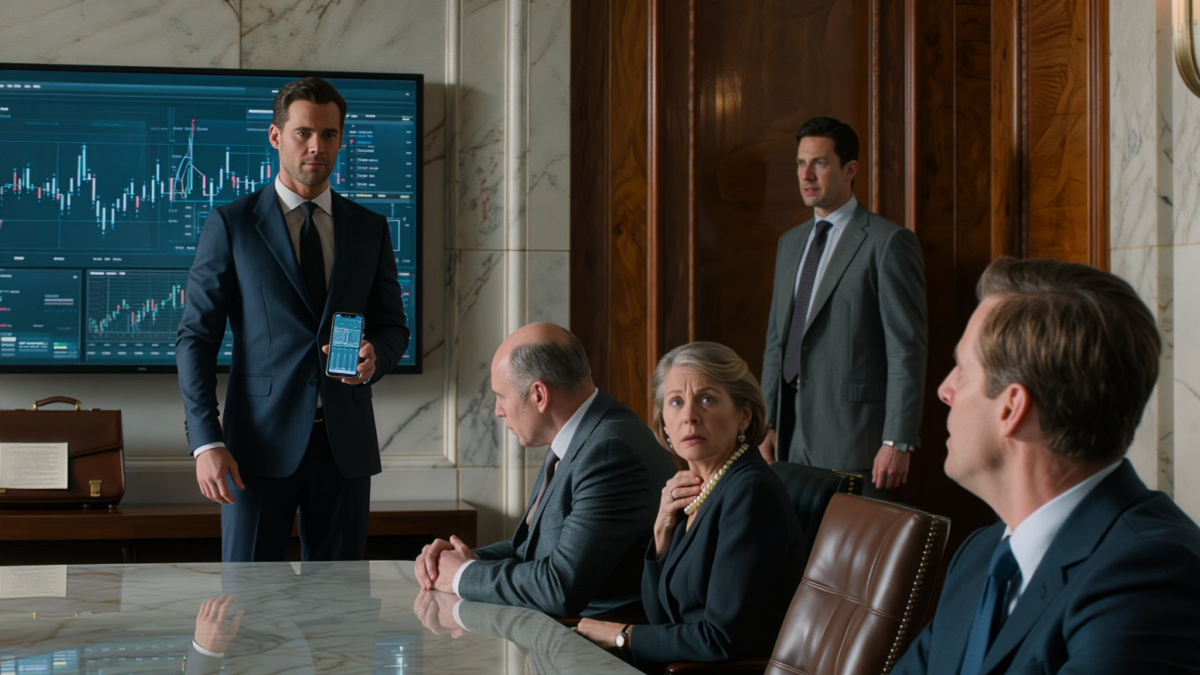
The Midtown Manhattan office of Atlas Holdings was more than a place to sign loan documents. Sebastian had arranged it to resemble the headquarters of a business whose decisions could reshape entire industries. He understood how people like Walter responded to visible wealth and authority. Every detail suggested that Atlas had more money than my parents could imagine and that its representatives were accustomed to setting the terms.
Dark imported oak covered the walls, absorbing the afternoon light and giving the room a solemn, almost private-club atmosphere. The carpet was so thick that footsteps disappeared into it. At the center stood a long conference table made from an immaculate slab of Italian marble, surrounded by deep leather chairs. Everything smelled faintly of expensive upholstery and freshly brewed dark-roast espresso. It was the sort of boardroom that made visitors lower their voices before anyone asked them to. I knew my parents would take one look at it and assume they were about to meet the powerful people who could make their financial troubles disappear.
I waited in an adjoining observation room behind a one-way glass panel. The space was dark except for the pale blue light of security monitors displaying several camera angles of the conference area. Standing there, separated from the place where my family would sit, I felt oddly detached. My heartbeat was steady. It was almost like watching a documentary about people I’d never met instead of preparing to confront the people who had raised me. I couldn’t stop thinking about the airport, the officers, the missing passport, and the look on Sylvia’s face when she turned away. This time I wasn’t the person being surprised.
At exactly two o’clock, the heavy oak doors opened. Marcus Thorne came in first, carrying his leather briefcase and wearing the cool, practiced expression of an attorney who handled enormous transactions every day. Walter and Sylvia followed close behind. Julian brought up the rear, already looking at his phone and typing with the distracted confidence of someone who thought the meeting’s outcome had been decided.
I moved closer to the glass. None of them looked like worried relatives who believed their youngest son was still being detained in France. They looked delighted, as though they’d come to collect a lottery prize. Sylvia wore an expensive new designer coat despite the debts piled onto her credit cards. Around her neck was my grandmother’s vintage pearl necklace, the same grandmother whose gift they were trying to turn into their own financial escape plan. Seeing those pearls against my mother’s coat made something tighten inside me. Even in that moment, she was willing to use a piece of my grandmother’s memory as decoration while attempting to disregard her wishes.
Walter entered with his shoulders back and an unfamiliar swagger, inspecting the luxurious office as if he were already imagining himself in a room like it. I could almost see him calculating the value of every object. The possibility of an immediate payout had apparently relieved, at least temporarily, the pressure of his mortgages and gambling debts. He looked more interested in the money represented by those surroundings than in any question about my safety.
Julian wore a sharply tailored suit, and I knew exactly where the money had come from. Two years earlier, he’d made purchases using a high-limit credit card issued in my name. I’d recognized the pattern on the bill and had been persuaded, once again, that raising the issue would only create needless family conflict. Now he stood a few feet from me, on the other side of the glass, admiring his reflection and taking a quick selfie. His smile was bright. He had no idea I was watching.
“Please have a seat,” Marcus said, gesturing toward the leather chairs. His voice traveled easily across the room, perfectly courteous and completely impersonal.
My parents sat down at once. Julian joined them, still holding his phone. Marcus opened his briefcase, removed a thick stack of legal papers, and placed it precisely at the center of the marble table. He took his time. He didn’t offer coffee, water, or a round of small talk. The silence and the formal documents did the work of establishing who controlled the meeting.
“Before we proceed with any transfer of funds this afternoon,” he began, folding his hands on the table, “we must confirm the legal status of the proposed collateral. Atlas Holdings is prepared to resolve the debt portfolio we’ve discussed, including your three defaulted mortgages, your outstanding high-interest personal loans, and the credit lines that have reached their limits. In exchange, we require a valid assignment of the Miller family trust as primary collateral.”
Walter nodded eagerly. He seemed barely able to conceal his excitement at the thought of having his debt erased without sacrificing any part of his lifestyle.
“Yes, of course,” he said. “The trust is worth two and a half million dollars. That’s more than enough to settle what we owe and leave plenty over.”
“Indeed,” Marcus replied. “But the trust is currently registered in Ethan Miller’s name. For Atlas to accept any interest in it, we need to establish that you have lawful authority to act for him.”
He drew one document from the stack and turned it so the signature page faced my father.
“This affidavit records your sworn representation that Ethan is presently unable to manage his own legal and financial affairs, that he is being held abroad, and that you have validly assumed the administrative rights necessary to pledge the trust. You will be signing under penalty of perjury. I want you to understand precisely what you’re affirming.”
Sylvia reached out and rested her fingertips on the paper as if it were a comforting letter rather than the statement that could expose her plan. Her voice softened into a tone I knew painfully well, the one she used when she wanted other people to believe that she was a worried and loving mother.
“He really is having a difficult time,” she said. “My poor sweet son suffered a serious personal crisis at the Paris airport. He was confused and behaving in ways that worried the authorities. They felt it was necessary to hold him until things could be sorted out. You can’t imagine what that does to a mother’s heart.”
She paused, giving the room time to absorb her supposed distress, then continued. “We only want to protect his finances until he can get the support he needs. We couldn’t bear to see him make decisions he might regret.”
I gripped the edge of the security console, fighting the urge to walk into the room immediately. Her account was carefully arranged to make me appear incapable of speaking for myself while making her actions sound selfless. I recognized the practiced cadence, the sorrowful pauses, and the way she used concern as a reason to take control. I imagined her rehearsing those sentences in front of a bathroom mirror that morning. Whether she had or not, every word sounded prepared.
“Verbal assurances aren’t sufficient, Mrs. Miller,” Marcus said. He slid a heavy silver Montblanc pen across the marble toward her. “Both you and your husband must sign this affidavit, and your signatures must be witnessed and notarized. The gentleman by the door will attend to the notarial formalities.”
The quiet man standing near the entrance inclined his head. My parents barely glanced at him. They were still watching the documents, and they were too focused on the promised payment to be curious about anyone who wasn’t offering it.
“Please listen carefully,” Marcus continued. “Atlas takes compliance seriously. Knowingly providing false statements to obtain financing can expose the signatories to significant legal consequences, including allegations of fraud and perjury. You have the opportunity to review the document with independent counsel before signing. Are you certain that the representations are accurate and that you wish to proceed?”
There it was. One final chance to stop. I stood behind the glass and hoped, against all the evidence, that something in either parent would make them pause. They could have asked for more time. They could have said that the situation in Paris was complicated, that they weren’t sure of the legal facts, or that they needed to speak to me before doing anything irreversible. They could have remembered that the person named in those papers was their son. Instead, Walter reached for the pen.
He didn’t consult my mother or turn to Julian. He pulled the document toward him, flipped past the warning language, and signed his name in a hurried, impatient scrawl. The movement was so quick that I almost missed the moment I’d been waiting for.
“There,” he said, pushing the pages toward Sylvia with a satisfied sigh. “Done. Now, about the transfer. How soon will the money show up in my checking account? I have obligations to certain people who aren’t patient about their deadlines.”
Sylvia picked up the Montblanc and signed with elegant, sweeping letters. She looked pleased with herself, as though she had just secured something wonderful for the whole family.
“We want to put this unpleasant chapter behind us and concentrate on healing,” she said. She handed the pen to Julian.
My brother wasn’t a legal trustee or guardian. Marcus had asked him to sign as a witness to their account of my supposed condition and the circumstances under which they were claiming authority. Julian accepted the role without hesitation. He wrote his name and leaned back with an air of superiority.
“Honestly, my little brother has always been a mess,” he said. “He falls apart under the smallest pressure. We’re doing this for his own good. He wouldn’t know how to manage real money anyway. He’d probably waste it.”
Walter laughed. Sylvia joined him. Julian grinned at the sound of their approval. Watching them sit around that marble table, joking about my judgment while signing paperwork designed to take away my inheritance, I felt as though the last uncertain part of my relationship with them had quietly ended. They weren’t being misled by one another. They were comfortable doing this together.
The notary came forward, confirmed the signatures, and applied the appropriate seal to the document. Marcus reviewed the pages carefully, checking the names, dates, and spaces filled in by hand. Then he returned them to the folder and closed it with a crisp snap. From the other side of the glass, I watched Walter relax. He believed the difficult part was over. For me, the signed paper was the proof that none of their earlier explanations could erase.
“Excellent,” Marcus said, rising to his full height. “The documents are in order. Before we complete the proposed disbursement, you should meet the principal director of Atlas Holdings.”
Walter frowned. “The principal director? I thought you were handling the transaction, Mr. Thorne. You said you had the authority.”
“I’m legal counsel for the firm,” Marcus replied, allowing the faintest smile onto his face. “The person providing the capital prefers to meet the parties directly before finalizing a transaction of this size.”
Marcus reached under the conference table and pressed a small signal button. That was my cue. I stepped away from the observation glass and turned toward the oak doors. The moment I’d been imagining since Charles de Gaulle Airport had finally arrived.
I was wearing a tailored navy suit Sebastian had provided, with polished shoes and a crisp white shirt. I checked my appearance once, not out of vanity but because I needed to remind myself of something. I wasn’t the exhausted young man who always stood at my parents’ kitchen counter working out how to settle another bill. I was a capable professional with a future of my own, and I no longer had to make myself smaller to keep my relatives comfortable. The weight I’d carried for most of my life was finally beginning to lift.
I pushed open the heavy doors and walked into the conference room. They closed behind me with a decisive click. For three full seconds, nobody moved. My family sat staring, unable to reconcile the person standing in front of them with the version of events they’d been telling everyone since Paris. Walter’s mouth fell open. The color vanished from his face. Sylvia reached toward the pearls at her throat, her eyes widening as though she were looking at someone she’d never expected to see again. Julian froze with his thumb suspended over his phone, halfway through composing what looked like another sympathetic post about his missing brother.
“Hello, Walter. Hello, Sylvia,” I said.
I made a point of using their first names. Calling them Mom and Dad would have felt dishonest after what they’d done. I had stopped recognizing them in those roles at the moment they left me at Charles de Gaulle with a stranger’s passport and no way home. I turned toward my brother, who was still holding the phone in one motionless hand.
“Julian, that’s an impressive new suit. I hope you kept the receipt. You may find there are more urgent expenses coming.”
“Ethan?” Sylvia finally managed. She pressed a hand against the edge of the marble table to steady herself. “How? What are you doing here? You’re supposed to be in Paris. We were told you were still getting help.”
“Actually,” I said, moving slowly toward the head of the table, “someone slipped a reported stolen passport into my bag just before airport security. It was an extraordinary coincidence, wasn’t it?”
Walter stood so abruptly that his chair scraped across the carpet. He was breathing quickly, and his eyes moved from me to Marcus and back again, searching for an explanation that would make the scene less threatening.
“This is a mistake, Mr. Thorne,” he said. “What is my son doing in your office? We came here in good faith to finalize a bridge loan with Atlas Holdings.”
Marcus leaned against the dark oak paneling and folded his arms. He looked entirely at ease.
“You did come here to discuss a loan, Mr. Miller. As I explained, the principal of Atlas Holdings wanted to look you in the eye before considering a transaction of this size. Allow me to introduce my client: Ethan Miller, the founder and controlling shareholder of Atlas Holdings.”
Sebastian’s resources had made the new business possible, but my name was on the ownership documents that had been prepared for the operation. For the first time, Walter and Sylvia were confronting the fact that I’d had an active role in building the very opportunity they had rushed to accept. Their gaze traveled between Marcus, the thick folder, and me, as if moving their eyes quickly enough would produce a different answer. They hadn’t arrived at the office of an unknown benefactor. They’d walked willingly into a room where every assertion they made could be examined.
“Have you signed the paperwork yet?” I asked, picking up the silver pen and rolling it between my fingers. “Oh, that’s right. You already have.”
I set the pen down, placed both hands on the marble, and looked directly at Walter.
“You just signed a sworn statement saying that I’m incapable of managing my affairs and that you have the legal right to pledge my $2.5 million trust. You know those claims aren’t true. You also know you made them because you want the money to cover your debts. You can dispute my interpretation, but you can’t dispute the signatures you put on those pages.”
I let the words settle before continuing. “Making knowingly false statements in a financing transaction can have serious consequences. You’ve placed yourselves at risk of federal fraud and perjury charges. I suggest you think very carefully before saying anything else.”
For once, Walter couldn’t find an answer. The man who had spent my childhood convincing me that his emergencies were mine to solve stood speechless in front of a document he’d signed for his own benefit.
Then Julian stepped away from his chair. He had always believed he was the most charming and clever person in any room, partly because Walter and Sylvia had spent years shielding him from the consequences of his choices. Even now, with the signed affidavit in Marcus’s folder, he looked convinced that he could talk his way into control again. A thin, desperate smile spread across his face. He lifted a black smartphone and held it where I could see it.
It was mine. He had taken it at the airport along with my real passport, leaving me without my usual way of contacting anyone.
“You think you’re smart, Ethan?” Julian said. “You think setting up this fancy office means you’ve beaten us?”
He took a step toward me, gripping the phone tightly. “While you were on that private jet pretending to be a corporate executive, I got access to your accounting firm’s secure systems using this. I copied sensitive files from some of your largest clients. Offshore accounts, confidential tax strategies, major real estate holdings—all of it.”
The threat made the room feel smaller. I knew what unauthorized access to client financial records could mean to a professional who had built a career on discretion and accuracy. Julian was aware of it too. That was why he seemed so pleased with himself.
“I’ve arranged for an email to go to the professional ethics board and your firm’s managing partners in ten minutes,” he continued. “Once those files are released, they’ll think you were responsible. You’ll lose your job. Your license will be in question, and clients will demand answers. You’ll be buried in lawsuits before you understand what happened.”
He tilted his head, borrowing a mannerism Sylvia used when she wanted to sound reasonable.
“So here’s the deal, little brother. Tear up that affidavit and give us access to the trust. Otherwise, I send the files, and your career is finished. Your choice.”
He truly believed he’d found the leverage that would put me back in my old role: the capable younger brother who accepted whatever terms the family imposed. I didn’t raise my voice. I didn’t reach for the phone in his hand. Instead, I took out my new phone and tapped the screen once. A large monitor on the conference room wall came to life, displaying detailed security records, login activity, geographic locations, network addresses, and timestamps.
“That passcode wasn’t the careless oversight you thought it was,” I told Julian. “I knew you’d try to use my phone or my accounts. It was a way to establish what happened next.”
I pointed toward the highlighted entries. “The passport investigation in France created an official record of my detention and the handling of my property. We have the translated documents and tracking information. The attempted access to my firm’s systems was also recorded, along with the network details associated with the download. Those records can be compared with where I was and where you were. They don’t tell the story you’re hoping they’ll tell.”
His expression changed. I could see him trying to work backward through what he’d just admitted.
“My firm’s security systems monitor confidential files closely,” I continued. “When someone attempted that unauthorized download, the activity triggered an immediate alert. Investigators have been given the access records and the location data associated with the attempt. You didn’t quietly obtain leverage over me, Julian. You documented an entirely separate act that you’ll have to explain.”
The man who had been standing near the door stepped forward. He had served as the notary when my parents signed the affidavit, and nobody had paid him much attention since. Now he reached inside his jacket and displayed his identification.
“Special Agent Harris,” he said, introducing himself as a federal investigator. “I have also been observing the execution of the sworn statements. The documents, the recorded representations, and the electronic evidence will be reviewed as part of the investigation. Knowingly submitting false information in a financial transaction is a serious matter.”
Sebastian entered through a side door, apparently having watched the exchange on the security feed. He checked his watch with the same unhurried movement he’d made in Paris. His calm seemed almost outrageous next to the alarm on my family’s faces.
“Investigators have been monitoring the meeting from the adjoining area,” he said. “They’ve heard the representations and can secure the relevant records. I believe the documentation speaks for itself.”
The conference room doors opened again. Two uniformed New York officers entered with two plainclothes investigators. Their manner was firm and controlled. Julian set my phone on the marble table and moved away from it, raising his hands. Walter sank into his leather chair, pressing a hand to his chest and breathing in short bursts. Sylvia began to cry, streaking the makeup she’d so carefully applied before the meeting. She looked from officer to officer, searching for someone whose sympathy might change the situation.
I approached Julian, but I stopped at a respectful distance. I no longer needed to confront him physically or match his anger.
“You wanted to take my grandmother’s inheritance,” I said quietly. “And when that didn’t work, you tried to take my career. Now both attempts are part of the record. Whatever happens from here is the result of your decisions.”
For a moment, the loudest sound in the room was the click of restraints being secured around Walter’s wrists. There was no fight, no shouting match, and no last-minute speech that made everything better. Officers began the ordinary process of taking statements, explaining rights, and escorting people out. After a lifetime of watching my family escape accountability, I found the simple, procedural quality of the moment almost impossible to believe. The consequences were no longer something they could redirect toward me.
The officers explained my family’s rights in calm, measured voices. “You have the right to remain silent. Anything you say can be used against you in court.” I’d heard variations of those words a hundred times on television, usually from the safety of a living room sofa. In the oak-paneled office, with the documents and the surveillance records still lying nearby, they sounded entirely different. Walter seemed to have trouble understanding that the conversation was no longer a negotiation. He kept looking toward Marcus as though the attorney might still produce the promised check and send everyone home.
Sylvia’s carefully maintained composure finally gave way. As an officer guided her toward the door, she turned and moved toward me. She dropped to her knees in front of my polished shoes and caught the fabric of my trousers with trembling hands. The new designer coat pooled around her, and my grandmother’s pearls moved against her throat as she looked up.
“Ethan, please,” she sobbed. “You can’t let this happen. We’re your parents. We gave you life. Your father has struggled with gambling for years. It’s a terrible problem, and he never meant to hurt you. Julian was under so much stress. He made a foolish mistake.”
She tightened her grip, still searching for the words that had worked on me all my life. “Tell them this is a family misunderstanding. Please. You know we love you. We’re family, Ethan. You’re the one who fixes things. Fix this.”
I looked at the woman who had walked away from me at the Paris airport while I begged for help. She was the same person who had sent Chloe a formal email questioning my ability to manage my own money, then had signed a statement intended to give herself control of my grandmother’s trust. Now that there were consequences she couldn’t talk her way around, she wanted me to become the reliable son again. Even her apology was another request for me to solve a problem of her own making.
I carefully lifted her hands from my trousers and stepped backward. The movement was small, but it felt like the most important boundary I’d ever drawn.
“You aren’t acting like my family,” I said evenly. “Sharing the same last name doesn’t give you the right to treat me this way. Family doesn’t leave someone stranded in another country and refuse to help. Family doesn’t try to ruin a career to pay debts that aren’t his. You made these decisions, Sylvia. I won’t take responsibility for them.”
The officer helped her stand and escorted her toward the hallway. She kept crying and looking back, as though I might call out and ask everyone to stop. I didn’t. I was surprised by how little guilt I felt. There was sadness somewhere beneath the exhaustion, but it was no longer strong enough to make me surrender my future. I had spent years trying to preserve a relationship in which love always seemed to require that I lose something. I couldn’t return to it.
Julian was escorted out next. He didn’t offer an apology. He didn’t ask whether I’d been frightened in Paris or acknowledge the confidential records he’d tried to use against me. He simply stared at me with open resentment. To him, accountability still seemed like something unfair that other people had arranged. For the first time in his protected life, Walter and Sylvia couldn’t step in and make the problem disappear. He seemed to resent me most for refusing to play the old role.
After the officers led them downstairs toward the waiting vehicles on the busy Manhattan street, the room settled into an uneasy quiet. Marcus gathered his papers, checking the signed affidavits one final time before placing the folder in his briefcase. He gave me a nod that conveyed professional respect without asking me to celebrate what had just happened.
Sebastian crossed to a cabinet concealed in the wall, poured two glasses of aged Scotch, and offered me one. He raised his crystal glass in a small toast.
“Well played, Ethan,” he said. “You stayed focused. You got the documentation. And you didn’t let them decide how the meeting would end.”
I took a slow sip, feeling the warmth of the drink as the adrenaline began to recede. “There are still things I need to settle,” I replied. “I can’t call this finished while the people who helped them are still in a position to do the same thing again.”
I put the glass down on the marble and dialed a number I knew by heart. It rang three times before a familiar voice answered.
“Hello, this is Chloe.”
She sounded as polished and pleasant as she had on the day of my grandmother’s funeral. For a moment I pictured her offering condolences and promising that the trust would be handled with care. The memory no longer reassured me.
“Hello, Chloe. It’s Ethan Miller.”
There was a sharp intake of breath. “Ethan! Oh, thank goodness. I’m so glad to hear from you. Your mother sent the most alarming reports from France. We’ve all been terribly concerned.”
“Please don’t pretend you don’t know what’s happened,” I said. “I’ve reviewed the records. You told Sylvia about the forty-eight-hour absentee clause. You explained how to prepare the emergency guardianship paperwork and move the disbursement forward before the normal checks were complete. And we’ve found communications indicating you expected compensation for helping the transfer go through.”
“Ethan, I—I don’t know what you mean,” she said. “I was following standard fiduciary procedures for an absent beneficiary.”
Her voice was less steady now. She knew I had seen the same correspondence she’d hoped would remain private. I kept my tone measured, letting the information do the work.
“Legal counsel has preserved the relevant emails and financial communications,” I told her. “Those records are being provided to the investigators and the appropriate professional oversight authorities. You were trusted to protect my interests, Chloe. You had an obligation to verify what you were told, not help other people use a clause against me. Whatever the inquiry concludes, you will have to answer for your part in this.”
She started speaking again, but I didn’t wait for another elaborate explanation. I wished her good evening and ended the call. It wasn’t my job to negotiate her way out of scrutiny. I’d done enough of that for other people.
Next, I called Martha. She was the aunt who had spent years speaking softly about sacrifice while encouraging me to give away money I’d worked hard to earn. She answered brightly, apparently unaware of what had occurred at the Midtown office.
“Ethan, sweetie! Where have you been? We’ve been so worried about you.”
“I’m in New York, Martha,” I said. I didn’t call her Aunt. “Walter, Sylvia, and Julian were taken into custody today in connection with the attempted trust transfer, false statements, and an unauthorized access investigation.”
Silence followed, then a sharp gasp. “Taken into custody? What? Ethan, what on earth did you do?”
There it was again. Even before she asked what had happened, she assumed that the consequences facing my relatives must be my doing.
“I didn’t make those decisions for them,” I replied. “But I do need you to know something. We have information that you introduced Walter to some of his gambling creditors. There are records suggesting you’ve been receiving a ten-percent fee from money that was taken from me over the years. You’re going to have to explain those payments.”
She didn’t answer. I could hear a faint movement on the other end of the line, but her cheerful voice was gone.
“When prosecutors review the financial dealings,” I continued, “Walter and Sylvia may decide that cooperating is their best option. If they do, they’re likely to tell investigators who introduced them to those lenders and who benefited from the payments. They have never hesitated to protect themselves at someone else’s expense. You know that as well as I do. I suggest you speak with a qualified attorney.”
I ended the call before she could turn the conversation into another argument about loyalty. Then I blocked her number. I went through my contacts, emails, and photographs, removing the reminders that served no purpose except to pull me back into the same cycle. Deleting a name from a phone doesn’t erase an entire childhood, and I knew healing wouldn’t be that simple. But I could decide who had access to me from that point forward.
Three months later, New York had settled into a bright, crisp autumn. I stood in a spacious corner office in the Financial District with a cup of carefully brewed coffee, looking out over the skyline. The view was different from Sebastian’s Tribeca penthouse, but the feeling was familiar now: quiet, order, and the ability to make decisions without waiting for a family emergency to interrupt them. Frosted glass on the mahogany office door read: “Ethan Miller, Senior Partner.”
Sebastian and I had ended our temporary consulting arrangement exactly as we’d agreed. Neither of us tried to turn a business agreement into an emotional obligation. He valued my work, I respected his honesty about what he needed, and we were both satisfied with what we’d accomplished. Soon afterward, he offered me a permanent executive-level role in his venture capital firm, overseeing complex risk reviews and forensic audits for some of its largest acquisitions. I accepted. My new compensation was more than three times the highest salary I’d earned before. More important, I was finally paying my own expenses, building my own future, and sleeping through the night without wondering which of my relatives would call at six in the morning asking me to rescue them from another crisis.
I stayed away from the early court hearings. I had spent enough time listening to Walter, Sylvia, and Julian explain why someone else should clean up their mistakes. I wasn’t willing to give them more of my peace simply because their explanations had moved into a courtroom. Marcus continued to handle the related civil action to recover my legal expenses, and he kept me informed as the financial investigation and criminal proceedings developed. His updates were factual, brief, and easier to absorb than the emotional performances I’d heard at family gatherings for years.
In the end, the family’s united front collapsed. When Julian confronted the possibility of a substantial sentence, he negotiated an agreement with prosecutors and agreed to testify. The adored older son, the one Walter and Sylvia had always protected, said under oath that our parents had devised the plan involving the passport and trust. He claimed they’d pressured him to help and that he had acted under duress. He portrayed himself as another victim of their controlling behavior, saying that he had felt he couldn’t refuse them.
I didn’t need to attend the hearing to imagine the effect. My parents had made countless sacrifices on Julian’s behalf, most of them at my expense. They had always believed that protecting him was the same as protecting the family. Now he was distancing himself from them because it benefited him. The penalties they faced were real, but I suspected the thing they found hardest to accept was hearing their favorite son describe them as the architects of the scheme. The loyalty they had demanded from me for years was something they had never succeeded in teaching him.
Walter and Sylvia eventually received seven-year federal sentences related to the conspiracy, fraudulent financial representations, and the attempted transfer. Julian negotiated a three-year term in a lower-security facility and was barred from taking on certain corporate fiduciary roles in the future. Chloe lost her professional position and faced substantial financial penalties after the investigation into her conduct. Martha came under scrutiny from tax authorities for years of undeclared income, opening a separate series of legal problems. Each development reached me through Marcus or the formal records. I didn’t celebrate the details. I was grateful that I no longer had to prevent their choices from catching up with them.
The day after the final sentencing, the $2.5 million trust was distributed into my secured accounts. The administrative disputes had been resolved, the claims of temporary guardianship had fallen away, and no one was waiting in the background to tell me I should surrender the money for the good of the family. I sat at my desk and signed the final papers acknowledging receipt. When the confirmed balance appeared on my computer screen, I looked at it for a long time.
It wasn’t simply a remarkable amount of money. It meant stability and the ability to make plans that couldn’t be overturned by Walter’s debts or Julian’s latest need. It was also a reminder of my grandmother’s intentions. She had known more about our family than she let on, and she’d tried to leave me something that was mine alone. The money was her last act of protection. For a moment I wished I could tell her that, despite everything, her gift had reached the person she intended.
I closed my laptop, packed my briefcase, and left work early. A black town car took me to John F. Kennedy International Airport, where I checked in for a first-class flight and settled into the lounge. When the time came to board, I presented my own valid passport and ticket. The simple act of handing over those two documents brought back everything that had happened at Charles de Gaulle. This time nobody was holding my papers for me, offering to manage my travel plans, or telling me that something essential had mysteriously disappeared.
I was going back to Paris. I wanted to finish the European trip that had ended so abruptly, but I also needed to stand in the place where I had felt completely abandoned and discover whether it still had the same hold over me. I didn’t expect the return to erase the memory. I just wanted that memory to stop deciding what I was capable of doing.
After the plane landed at Charles de Gaulle, I walked through the bustling terminal toward the same gate area. I found the place where Sylvia had turned her back and where Julian had pushed me aside to plant the passport. For a fleeting moment, I remembered the pressure of the restraints, the noise of the alarm, and the helpless feeling of trying to make myself understood. I was standing in the same building, but I was no longer the man who believed he had to wait for his family to come back and save him.
I drew a slow breath, adjusted the strap of my carry-on, and continued toward the exit. Outside, the air was cool and fresh. I hailed a taxi and gave the driver an address in the historic center of Paris. As the car pulled away from the airport, I felt a kind of lightness I hadn’t known before. I still had the same past, and I couldn’t change what my relatives had done. But I could decide how much of the future they were allowed to occupy.
For most of my life, I’d been told that family was everything. I’d come to understand that the word meant very little without care, honesty, and respect behind it. Family wasn’t simply a matter of shared biology. It was the people who took your well-being seriously, protected your peace when they could, and celebrated your progress without seeing your success as something they were entitled to take.
Sometimes the most necessary thing you can do is stop trying to repair people who refuse to take responsibility for themselves. I had spent years believing that walking away would make me selfish, disloyal, or weak. As the taxi carried me into Paris, I understood the opposite. Refusing to live inside someone else’s endless crisis was not failure. It was the beginning of a life I could finally call my own. I didn’t need to apologize for protecting that life, and I had no intention of giving it up again.








