At my brother Leo’s wedding, his bride offered me a job in the law firm’s mail room after he and our father mocked my career in front of 200 guests. I was still sitting at table 9 when my CFO texted, “It’s live. Forbes homepage.” I didn’t answer her. Across the ballroom, the woman in the sharp business suit I’d noticed earlier was walking straight toward our table.
The clinking of champagne glasses was the only sound I could focus on.
It was crisp, sharp, almost aggressive. The sound of wealth, of polished appearances, of people who had never questioned whether they belonged in a room like this.
I’m Henry Sterling. I’m 28 years old. And at my older brother Leo’s wedding, my family had apparently decided that humiliating me in front of 200 guests was an acceptable part of the celebration.
Everything about the wedding was designed to announce success.
The venue was a historic manor with sprawling gardens. The floral arrangements probably cost more than my first car. The guest list was a carefully selected collection of my parents’ most impressive connections, people whose careers, titles, and social standing made them worthy of an invitation.
It was a living monument to the life my parents had always championed.
Prestige. Predictability. Respectable professions.
Everything I had supposedly failed to achieve.
I was seated at table 9.
That detail might sound insignificant, but in the Sterling family, seating arrangements were practically a statement of social rank.
Table one belonged to the immediate family, the people who mattered. Table 9 was where the family’s loose ends had been placed.
There was my cousin, who was going through her second messy divorce. There was a great-uncle who smelled faintly of mothballs and bad investments.
And there was me.
The tech guy.
The son who played games for a living.
Across the ballroom, my father, David Sterling, stood at the podium, enjoying the attention as if the entire wedding had been arranged to celebrate his parenting.
He looked completely at home beneath the lights.
“To my son, Leo,” he announced, his voice booming through the microphone.
He described Leo’s achievements with the precision of someone reading a list he had memorized years earlier.
Graduating at the top of his law school class. Passing the bar examination on his first attempt. Securing a coveted position at Whitmore and Associates.
“That, my friends, is a real achievement,” my father declared. “He is building a real future for himself and his beautiful bride, Jessica.”
The guests applauded.
Then my father’s eyes found mine.
For a brief moment, I thought he might acknowledge me as his other son.
Instead, he continued.
“I just wish that both my children understood the value of hard work and legitimate careers.”
He didn’t mention my name.
He didn’t need to.
People at the surrounding tables glanced toward me. A few quickly looked away.
I lowered my eyes to the expensive plate in front of me and traced the gold leaf pattern with my fork.
I had spent years learning how to survive moments like that.
But this was different.
My father had just made our family’s private judgment of me public, in a room filled with people whose approval mattered enormously to him.
Then something near the entrance caught my attention.
A woman with a sharp dark bob and an even sharper business suit was speaking with the wedding planner. She held a notepad and carried herself with the quiet purpose of someone who wasn’t there for the celebration.
She looked completely out of place among the flowing gowns and formal evening clothes.
My phone vibrated.
It was a message from Ben Carter, my best friend and the chief financial officer of my company.
“Forbes is on site. They’re running the story in 10 minutes. Are you ready for this?”
I looked up again.
The woman was scanning the ballroom.
She was looking for me.
The band began another romantic song. Servers collected salad plates. Guests resumed their conversations, unaware that something entirely separate from Leo’s wedding was about to happen.
I knew what was coming.
But before the two worlds of my life collided, I had to sit through one more round of my family’s favorite tradition.
Celebrating everything Leo was while reminding everyone of everything they believed I wasn’t.
***
The dynamic between Leo and me had been established long before either of us understood it.
Leo was the golden child.
I was the strange, quiet younger brother who couldn’t seem to follow the family blueprint.
Our childhood home was almost a museum dedicated to Leo’s accomplishments.
His debate trophies stood proudly on the mantel. His honor roll certificates lined the staircase. His acceptance letter to a prestigious law school was treated like a family treasure.
My achievements looked different.
On my side of the bedroom we shared, dismantled computers covered the furniture. Wires lay tangled across my desk. Notebooks filled with diagrams and code were stacked wherever I could find space.
To my parents, it was a mess.
To me, it was a laboratory.
I loved understanding how computers worked. I loved taking things apart, discovering why they failed, and figuring out how to make them do something new.
My father saw none of that.
“Henry, for God’s sake, clean this junk up,” he would command, sometimes nudging a motherboard with the toe of his polished shoe.
“Why can’t you be more like your brother? He’s president of the student council. He’s preparing for his future.”
My parents had a very specific definition of a successful future.
You earned good grades. You attended a respected university. You pursued law, medicine, or finance. Then you found a stable job with a predictable salary and a clear path to promotion.
That was the road they understood.
My interests led somewhere else entirely.
I wanted to build things that didn’t exist yet.
I wanted to create digital worlds people could explore, enjoy, and share.
My parents couldn’t understand why anyone would consider that a legitimate career.
The disagreement became a permanent division during my senior year of high school.
My parents had been saving for my college education since I was born. It was a substantial fund, intended to cover the beginning of the respectable life they had planned for me.
But I had another idea.
Ben and I were already developing plans for a gaming company. We had concepts, projections, and a strategy for turning our ideas into a real business.
I wanted to use a portion of my college fund as seed money rather than enroll in a traditional university.
When I explained this at home, my father exploded.
“Absolutely not!”
His face turned red.
“That money has a purpose. It’s for your education, for a real degree. I will not stand by and watch you squander it on some childish, idiotic computer game fantasy.”
“It’s not a fantasy, Dad,” I pleaded. “It’s a business. I have a business plan. I have user engagement projections. I have a monetization strategy.”
“I don’t want to see your projections.”
He said the word as if the idea itself offended him.
“You’re throwing your life away. Your brother is on track to become a lawyer. A man with a guaranteed salary. A man who will command respect.”
Then he asked the question that stayed with me for years.
“What will you be? A 30-year-old man-child living in my basement playing with digital toys?”
I expected my mother to say something.
She stood nearby, twisting her wedding ring, looking from my father’s angry face to the floor.
She wouldn’t meet my eyes.
Her silence hurt more than I wanted to admit.
I could argue with my father’s anger.
I couldn’t argue with my mother’s refusal to defend me.
I never touched the college fund.
Instead, I moved into a run-down apartment with Ben and another friend.
We lived on instant ramen, cheap coffee, and stubborn determination.
Our days stretched into 18-hour work sessions. We wrote code, tested ideas, fixed problems, and tried to keep our equipment running.
Every new user felt like proof that our efforts meant something.
Every small improvement reminded me why I had chosen this path.
We called our company Quantum Realm Games.
During that first year, money was almost nonexistent.
Our servers were assembled from secondhand computer parts and operated in the corner of our cramped living room. They made noises that constantly reminded us how close we were to losing everything if the equipment failed.
Eventually, we reached a point where we needed a few thousand dollars.
Not for anything extravagant.
We needed reliable server space and enough money to file the paperwork for our LLC.
Without that, we risked remaining three young men with an ambitious hobby instead of becoming a real company.
After exhausting my other options, I approached my uncle Richard.
He was my mother’s brother, a successful real estate agent who always seemed relaxed and confident.
Richard wore expensive suits, gave firm handshakes, and had always been the uncle who slipped me a $20 bill at Christmas.
I thought he might understand.
We met at a Starbucks.
I spread my business plan across the sticky table and explained everything.
The early designs for Ethereum, our flagship game. The user growth projections. The vision for a mobile gaming experience that could reach people far beyond our apartment.
Richard listened while stirring his macchiato.
“It sounds ambitious, kid,” he said eventually. “Very ambitious, but I like your hustle.”
Then he pulled out his checkbook.
“Tell you what, I’ll give you $5,000.”
For a moment, I couldn’t speak.
“Richard, I… I don’t know what to say. I’ll pay you back with interest. I swear.”
He raised a hand.
“Don’t even think about it as a loan. Consider it a gift. A little something to help you get this dream off the ground.”
Then he added something I barely noticed at the time.
“Go on. Get it out of your system.”
I was too relieved to question those words.
That $5,000 was a lifeline.
More importantly, I thought it meant someone in my family finally believed in me.
We secured proper server space, hired our first two employees, and began developing a reputation in the independent gaming community.
About a year later, I attended Thanksgiving at my parents’ house.
The family was gathered around the usual holiday activities. Turkey was roasting. Leo was entertaining relatives with a story about a brilliant legal argument he had made during a mock trial.
I stepped onto the cold back porch for a little quiet.
Through the sliding glass door, I could see my father and Uncle Richard standing near the still-smoking grill, each holding a beer.
Their voices carried through the November air.
“So,” my father said with a chuckle, “how’s that investment in Henry’s little computer game company going? Seen any of that tech money yet?”
Richard laughed.
It wasn’t his usual friendly laugh.
“David, please. You and I both know what that was. That was the cheapest 5 grand I ever spent.”
“What do you mean?” my father asked.
“I mean, it was a shutdown fee,” Richard replied. “It was cheaper than having to listen to him ramble on about his vision for the next 10 years. I gave him the money so he could go play business, fail, and get it over with.”
He took another drink.
“It’s better to let the boy learn his lesson the hard way. It’s a write-off for me and a life lesson for him.”
My father grunted in agreement.
“Sometimes that’s the only way they learn.”
I stood completely still.
The concrete beneath my shoes was cold, but that barely registered.
I had believed Richard’s gift was an investment in my future.
Instead, he had been paying to watch me fail.
He hadn’t supported my dream.
He had expected me to abandon it.
The man I thought believed in me had been sharing the same judgment as my parents all along.
Something changed inside me that night.
I stopped waiting for my family to understand.
I stopped hoping my next achievement would finally be enough.
I decided I would build my company without asking them for anything else.
If the business succeeded, that success would speak for itself.
***
The next several years were exhausting.
While Leo progressed through the predictable stages of his legal career, from summer associate to junior associate and eventually toward better positions and salaries, I was living in a world where nothing was guaranteed.
There were weeks when work seemed endless.
There were nights when I slept beneath my desk because going home would have meant losing time we didn’t have.
A server crash nearly destroyed our user database.
At another point, we received an acquisition offer that could have solved our personal financial problems but would have meant giving up the future we wanted for the company.
We turned it down.
There were also moments that made everything worthwhile.
I still remember hiring our 10th employee.
Her name was Sarah, a talented young artist. She was the first person to join us who wasn’t part of our original ramen-fueled founding team.
Our office was a small rented space above a laundromat.
It wasn’t impressive by any conventional standard.
But seeing Sarah sitting at a real desk, drawing the fantasy worlds we had imagined for so long, made the company feel tangible in a way it never had before.
We were building something that existed beyond our own determination.
A few months later, Ethereum passed 1 million active users.
Ben and I were working late, watching the analytics dashboard on a large secondhand monitor.
The counter kept climbing.
When it finally passed 999,999 and reached 1 million, we stared at the screen in disbelief.
Then Ben let out a shout of joy that probably woke the entire neighborhood.
A million people.
A million separate human beings had chosen to spend time inside something we created.
I was overwhelmed.
And against my better judgment, I wanted to share the moment with my mother.
I called her.
“Mom, you won’t believe it. We hit a million users today. A million people are playing our game.”
There was a brief silence.
“Oh, that’s wonderful, dear,” she replied.
Her tone was polite, almost distracted.
“That’s so nice. Speaking of good news, did you hear your brother Leo just got a commendation from a senior partner? They’re already talking about his path to a promotion. He’ll have a much better salary next year. We’re so incredibly proud of him.”
The excitement drained out of me.
I had just reached a milestone that felt almost impossible when Ben and I started.
My mother treated it as a passing detail before returning to Leo’s salary.
I managed to tell her that was great for him.
Then I ended the call.
That conversation taught me something I had resisted accepting.
My parents and I measured success in completely different ways.
They understood salaries, promotions, professional titles, and recognizable employers.
I understood user engagement, software performance, creative teams, and products that millions of people wanted to use.
I stopped trying to translate my world into theirs.
I didn’t tell them about the $50 million funding round that brought enormous attention to our company.
I didn’t mention the technology publications describing our game engine as revolutionary.
I didn’t tell them when we opened our first international office in Dublin.
I didn’t explain the acquisition of a smaller studio we had admired for years.
They knew I was increasingly busy.
They noticed that I traveled more.
But in their minds, I was still experimenting with a computer hobby that had somehow continued longer than expected.
Meanwhile, Quantum Realm Games was growing into a multinational business.
The scale of our work had become almost impossible to reconcile with the apartment where we started.
By the time Leo’s wedding arrived, I was leading a company whose reach extended across continents.
Yet to my family, nothing had changed.
I was still Henry.
The disappointing son.
The brother who had never found a real career.
Just before the wedding ceremony, Sarah sent me a message.
She had become our vice president of design and was managing more than 100 artists.
The message included a photograph of her team in our main conference room, raising coffee mugs in a toast.
The caption read:
“Good luck with the family. Your other family is here cheering you on. Go get ’em, boss.”
I smiled when I saw it.
For the first time that day, the expression came naturally.
Those people knew me.
They knew what I had built, how hard I worked, and how much the company meant to me.
Whatever happened at Leo’s wedding, I wasn’t the failure my parents described.
I had simply stopped trying to convince them otherwise.
***
The wedding ceremony itself passed in a blur.
By the time the reception began, Leo and Jessica were enjoying their place at the center of the celebration.
I remained at table 9.
My aunt Carol approached me during the reception.
Her perfume reached me before she did.
“Henry, dear, it’s so wonderful to see you. How is… well, how is everything?”
She waved a hand vaguely.
“Still keeping busy with your little computer business?”
“It’s going well, Aunt Carol,” I answered. “We’re in a growth phase.”
“Oh, lovely,” she replied.
Then came the familiar condescension.
“Expanding the garage, are you? Your father told us you’re still working from home. It must be so difficult to find the motivation without a proper office to go to, without a boss to keep you on track.”
She continued talking about how much she needed structure in her own working life.
I forced myself to remain polite.
“You learn to be your own boss.”
Then Markham, one of Leo’s friends from law school, approached.
He smelled of expensive whiskey and had the easy confidence of someone accustomed to being treated as important.
He clapped me on the shoulder.
“Henry, the prodigal son returns,” he announced. “Leo tells me you’re a big-shot game designer now. What’s the latest? Making the next Angry Birds?”
Some of the lawyers nearby laughed.
“Something like that,” I replied.
Markham leaned closer.
“You know, my nephew, he’s 10, he’s a little genius with these video games. Absolutely obsessed. Maybe I can hook you two up for a chat. You could, you know, exchange notes on level design.”
I looked at him.
He was comparing my work running a multinational gaming company to the interests of his 10-year-old nephew.
And he genuinely seemed to believe he was offering me something useful.
For a moment, the absurdity almost made me laugh.
But I was tired.
Tired of having to explain myself.
Tired of watching people accept Leo’s achievements without question while treating mine as evidence that I hadn’t grown up.
I pushed my chair back slightly, creating some space.
Across the ballroom, I noticed the woman in the dark business suit again.
She was speaking with the maître d’, who pointed discreetly toward my table.
Her eyes found mine.
She gave a small nod.
Catherine Vance.
The Forbes journalist.
The countdown had begun.
A short time later, my father returned to the podium.
The band finished playing, and the DJ lowered the music.
My father tapped the microphone.
“As a father,” he began, “you have certain dreams for your children. You hope they find happiness. Of course, that’s a given.”
He paused.
“But you also hope they find respect. You hope they build a life for themselves that commands it. A life that doesn’t need explanation or apology.”
He turned toward Leo.
“Leo, you have surpassed every dream a father could ever dare to have. You chose a noble path, a path of discipline, of intellect, of prestige.”
Then he explained that when someone said they were a lawyer, people immediately understood what that meant.
It meant they were serious.
It meant they contributed to their community.
My father continued.
“It is a world away from the fleeting trends and digital distractions that occupy so many young people today.”
His gaze passed my table.
“It’s about building something real, something tangible, something with legacy, something that lasts.”
The message was unmistakable.
Leo was building something real.
I wasn’t.
The people around me understood exactly who my father was talking about.
I could feel their glances without looking up.
Then Leo stood.
He kissed Jessica and took the microphone from our father.
“Thank you, Dad,” he began. “Thank you for always pushing me, for always showing me what a respectable career looks like.”
He smiled toward the head table.
“You and Mom taught me that true success isn’t about getting lucky or hitting some kind of digital lottery.”
Then he looked toward me.
“It’s about dedication. It’s about earning your place through hard work and long hours. It’s about building a life that your family can be proud of, not one they have to constantly explain away to their friends.”
The lawyers at his table laughed.
I kept my hands beneath the tablecloth.
For years, I had endured comments like those during private family gatherings.
But hearing my father and brother publicly describe my work as an embarrassment was different.
They were using Leo’s wedding to reinforce a story about me that had never been true.
They had no idea how much the business had grown.
And they had never cared enough to find out.
When the speeches ended, I hoped I might finally be left alone.
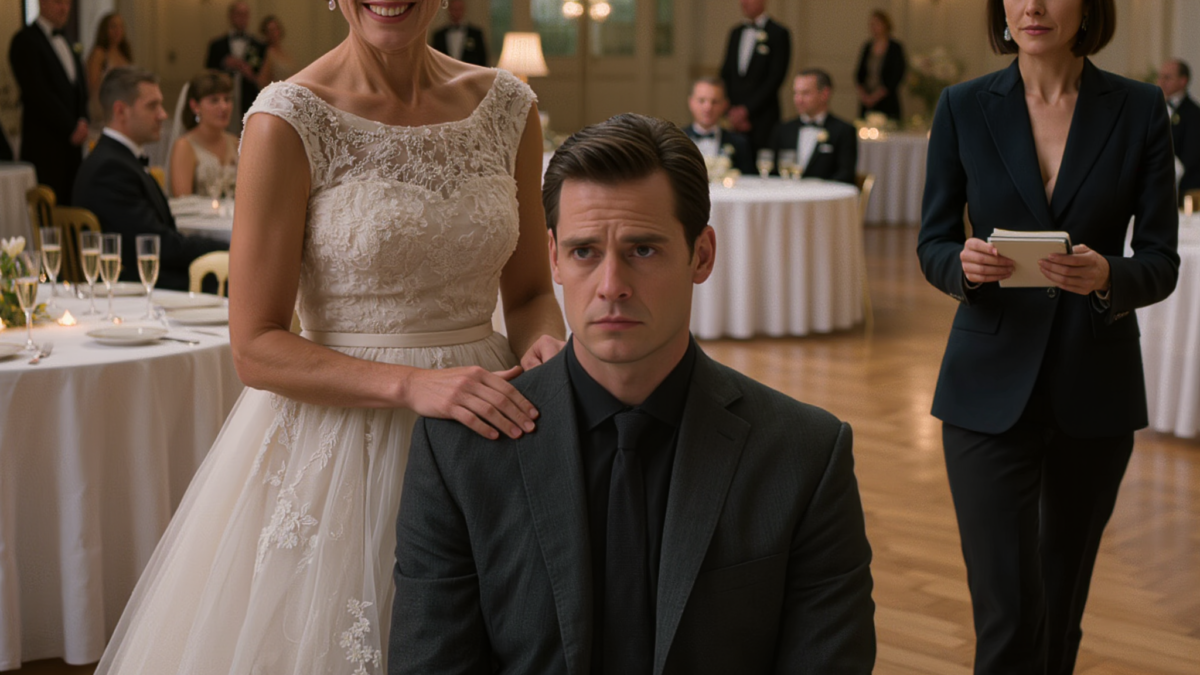
Instead, Jessica approached table 9.
She looked beautiful in her white gown, surrounded by layers of lace and tulle.
“Henry,” she said sweetly, placing a manicured hand on my shoulder. “I’m so glad you could make it. I know days like this can be a little tough. All the talk about careers and the future.”
I nodded.
She leaned closer, lowering her voice just enough to make the conversation seem private, though everyone nearby could hear.
“But don’t you worry about what your father and Leo said. Everyone finds their footing eventually. Not everyone can be a high-powered lawyer, after all.”
She squeezed my shoulder.
“And hey, when you’re finally ready to, you know, grow up and get a real job, I’m absolutely sure Leo could find a spot for you in the firm’s mail room. It’s a start, right? You have to start somewhere.”
The mail room.
For a moment, I could barely process what she had said.
I had spent years building Quantum Realm Games from nothing.
We had secured major funding, expanded internationally, hired talented people, and created a product used by millions.
And Jessica was offering me a job sorting letters.
She seemed to believe she was doing me a favor.
Something inside me went quiet.
I no longer wanted to correct her.
I didn’t want another argument about what counted as a respectable job.
I looked toward Leo, still enjoying the congratulations of his friends, and toward my father, standing proudly among the guests.
Their opinion of me had become so fixed that my actual life might as well have existed on another planet.
Then my phone vibrated against the tablecloth.
Another message from Ben.
“It’s live. Forbes homepage. It’s done. The world knows now.”
I took a slow breath.
Jessica was still standing beside me.
I looked up and gave her a small, restrained smile.
She seemed confused by my silence.
Across the ballroom, Catherine Vance started walking directly toward our table.
Her expression was professional and composed.
Jessica noticed her approaching and appeared ready to say something else to me.
But Catherine arrived before she had the chance.
“Mr. Henry Sterling?” she asked.
I stood.
“Yes, but please call me Henry.”
“Catherine Vance,” she said, extending her hand. “From Forbes magazine. It’s a pleasure to finally meet you in person. I’ve been following the story of your company for months now.”
The name Forbes immediately caught the attention of the people around us.
My aunt Carol stopped looking disapproving.
Markham’s amused expression disappeared.
“Thank you for coming, Catherine,” I replied.
“I wouldn’t have missed it for the world,” she said.
Then she delivered the sentence that began changing the atmosphere of the entire room.
“The article just went live on our homepage a few minutes ago. It seems you’re the talk of the financial world tonight.”
People started reaching for their phones.
First a few guests at the nearest tables.
Then more.
Screens lit up across the ballroom.
I watched as people searched for the article and found the same image.
My face.
Beneath a Forbes headline.
The conversations nearest us began to fade.
Guests looked from their phones to me and back again.
Farther across the ballroom, my father remained deep in conversation with Jessica’s father.
My mother was adjusting a floral centerpiece.
Leo was still talking with his friends.
For a few moments, none of them seemed to realize what was happening.
Mr. Henderson, an old business partner of my father’s and a respected investor, was seated nearby.
I saw him staring at his phone.
He looked up at me, then returned to the screen, trying to reconcile what he was reading with everything my family had just said about me.
Catherine continued speaking.
“We’re projecting Quantum Realm Games will have a valuation of 10 billion by the end of the next fiscal year.”
The room had become unusually quiet.
“Your personal net worth, based on your equity and recent funding rounds, has just crossed the $2 billion mark.”
She paused only briefly.
“Congratulations, Henry. You are officially the youngest self-made billionaire in the history of the gaming industry.”
I had known the article was coming.
I understood the numbers.
But hearing them spoken aloud in that ballroom was still an extraordinary experience.
Only minutes earlier, my father had publicly questioned whether I understood the value of legitimate work.
Jessica had offered me a mail room position.
Now the people who heard those insults were reading about my company for themselves.
No argument from me had been necessary.
Leo finally noticed that the guests were no longer paying attention to him.
He stood.
“What’s going on?” he demanded. “Why has everyone stopped? What is all this?”
Jessica looked at her phone and hurried toward him.
She whispered something.
I watched Leo’s expression change as he listened.
Confusion gave way to disbelief.
Then anger.
He began walking toward table 9.
“There has to be a mistake,” he insisted.
His voice had lost the easy confidence it carried during his wedding toast.
He stopped in front of Catherine.
“Who are you? What is this garbage? My brother does not have a company. He makes video games. He lives in a small apartment.”
Catherine remained composed.
“I am Catherine Vance, a senior editor at Forbes magazine,” she replied.
She explained that the article was the magazine’s digital cover story and that the company’s success had been thoroughly researched.
Quantum Realm Games was currently valued at $8.5 billion.
It employed more than a thousand people, with operations across North America, Europe, and Asia.
Its games reached a worldwide audience of 85 million users.
And I was the person who had founded the company and continued to lead it.
Leo stared at her.
His version of reality was collapsing in front of everyone.
By then, my parents had reached our table.
My mother, Eleanor, looked shaken. Her hand was pressed against her chest.
My father stared at me as though he were seeing someone entirely unfamiliar.
“That’s… that’s not possible,” he whispered.
He looked toward Catherine and then back at me.
“The article says you have over a thousand employees. Henry, what is this? What is going on?”
I finally answered.
“It’s the truth, Dad.”
My voice was quiet, but the room had become still enough for people nearby to hear.
“It’s what I’ve been trying to tell you for the past 5 years. Every time you asked if I had a real job, this is what I was doing.”
I thought of the conversations we had repeated for years.
“Every holiday you spent praising Leo’s salary, my company was closing another round of funding. Every time you told me to grow up, I was managing a global team, negotiating international partnerships, and revolutionizing an entire industry.”
I wasn’t trying to insult him.
I was describing the life he had never bothered to understand.
Leo shook his head.
“No. No, this is a joke. It has to be a prank.”
He looked at me.
“Henry, you paid her to do this, didn’t you? This is about you being jealous. You’re trying to ruin my wedding.”
A few guests reacted with disbelieving laughter.
I could hardly understand the accusation.
My father and Leo had just used the wedding speeches to humiliate me.
Yet Leo believed that an article about my company could only exist because I wanted revenge against him.
Catherine addressed him directly.
She explained that Forbes did not accept payment for its cover stories and that its reporting was supported by research and legal review.
She made it clear that the $8.5 billion valuation was not a prank.
My mother reached for my father’s arm.
“David,” she whispered, “oh, David, what have we done?”
He didn’t answer.
For the first time, I saw genuine uncertainty in his expression.
He had spent my entire life believing he knew what was best for me.
He had never seriously considered that he might be wrong.
Around us, the conversations began again.
But now they were entirely different.
“Quantum Realm Games.”
“Of course, my son plays Ethereum constantly.”
“I read about their Dublin office.”
“An $8.5 billion company.”
“My God, David Sterling’s son.”
People who had barely acknowledged me earlier were suddenly interested in every detail of my career.
I could see my father’s discomfort growing as the attention moved away from him.
Leo was still struggling to accept the news.
“This is impossible,” he insisted. “You can’t build something like that in secret. We’re your family. We would have known.”
I looked directly at him.
“You would have known if you had ever asked a single genuine question.”
He opened his mouth, but I continued.
“You never once asked about the specifics of my work. You never asked to see my office, which, for the record, is a four-story converted warehouse in the tech district, not my apartment. You never asked to meet my team.”
All those years of assumptions seemed to hang between us.
“You just assumed. You heard the word games and your brains slammed shut. You saw what you wanted to see, what you needed to see to maintain your perfect little worldview. A failure.”
I turned away from him and thanked Catherine for her professionalism.
“Our pleasure, Henry,” she replied.
Then she mentioned something else.
“In fact, our due diligence uncovered something else that didn’t make it into the final article, but which you might find interesting.”
I waited.
She explained that Forbes had confirmed with several high-level sources at Microsoft that I had attended a meeting with its head of acquisitions the previous month.
During that meeting, I had turned down a formal all-cash offer to purchase Quantum Realm Games.
“The offer was for $3 billion.”
The reaction was immediate.
My father’s face changed again.
Markham, who had offered to introduce me to his 10-year-old nephew, looked deeply uncomfortable.
Aunt Carol searched through her purse as though she suddenly needed something to occupy her hands.
Uncle Richard went pale.
I thought about the $5,000 he had given me years earlier.
The money he had described to my father as a fee to let me fail.
Now he was hearing about the success of the business he had expected to disappear.
My father finally spoke.
“You… you turned down $3 billion?”
His voice was barely audible.
I looked at him and felt something I hadn’t expected.
Pity.
“It was never about the money, Dad,” I said. “It was about the vision. It was about building something that lasts.”
They were his own words from the wedding speech.
This time, he seemed to hear them differently.
Jessica, however, was not ready to accept what had happened.
“You did this on purpose,” she accused, tears spilling down her cheeks. “You waited for my wedding day to pull this stunt. You’ve ruined everything.”
I looked at her, then at Leo, then at my parents.
They still believed the entire situation revolved around them.
They couldn’t understand that the magazine’s decision to publish its article was not a plot against their celebration.
Their wedding happened to be taking place on the same day.
Nothing more.
“I didn’t do anything,” I told her. “I just accepted an invitation to my brother’s wedding. The rest of the world did the rest.”
The reception never recovered its earlier atmosphere.
The DJ tried to restart the music, but the room was filled with conversations about Quantum Realm Games and the article.
The five-tier wedding cake remained untouched.
The dance floor was almost empty.
Guests who had been approaching my parents to congratulate them were now approaching me.
Some wanted to know more about the company.
Others wanted to discuss business opportunities.
Men who had ignored me earlier were handing me their business cards.
One spoke enthusiastically about investment opportunities for a future funding round.
Mr. Henderson approached with a booming laugh.
“Henry, I always told your father he didn’t know what he had with you. That boy’s got a different kind of mind.”
He wanted to hear about our mobile gaming architecture.
He joked that his grandchildren would think he was extraordinary if he could tell them about it.
I answered politely.
But my attention kept returning to my family.
They were standing together near the head table.
Leo was speaking angrily.
Jessica was crying.
My mother appeared overwhelmed, trying to calm them both.
My father stood silently.
For the first time I could remember, he looked old and defeated.
Then Leo broke away from the group and came toward me.
His expression was furious.
“You couldn’t have picked any other day,” he said. “You had 364 other days this year to pull this narcissistic stunt. And you chose my wedding day.”
He was almost shaking with anger.
“You’ve always been jealous of me, haven’t you? You couldn’t stand seeing me have one thing, one single day that was just mine.”
I felt more sadness than anger.
He still viewed our lives as a competition.
He couldn’t imagine my success existing independently of his.
“This was never about you, Leo,” I replied. “This was about me living my life. You and Jessica just happened to schedule your party on a workday for me.”
“A workday?” he scoffed.
His voice rose.
“You humiliated us. You made our entire family, our name, look like a pack of fools.”
“No,” I said.
I stepped closer.
He instinctively stepped back.
“You did that all by yourselves. You spent years, decades, treating me like I was a stain on the family name. You used your own wedding as a public stage to shame me and my life’s work one final time.”
I looked at him steadily.
“Your only mistake was not realizing the audience was bigger than you thought.”
I reminded him that his actions had created the situation he was so angry about.
My parents and Jessica had followed him.
My mother reached toward me.
“Henry, please,” she begged. “We… we didn’t know. We swear we didn’t know.”
“That’s the entire point,” I answered.
I looked at each of them.
“You didn’t know. And you didn’t know because you never cared enough to find out.”
I reminded them of the story they had told themselves for years.
Leo, the successful lawyer.
Henry, the failed dreamer.
They had accepted that version so completely that no evidence could challenge it.
I glanced at my watch.
“I have an early flight to Seoul tomorrow for a meeting with our Asian market development team. I should get going.”
My father straightened.
“Don’t you dare walk away from us.”
His voice no longer carried the authority it once had.
I turned to face him.
For much of my life, I had been frightened of disappointing him.
I had allowed his judgment to define how I felt about myself.
But standing there, I realized that fear had disappeared.
He was no longer the enormous figure from my childhood.
He was a man who had made serious mistakes.
“I’m not walking away from you,” I told him calmly. “I’m just leaving. There’s a fundamental difference.”
Then I looked at Leo.
“Congratulations on your wedding, Leo.”
I turned around and walked out of the ballroom.
I didn’t look back.
There were 200 guests behind me.
For the first time in my life, I genuinely didn’t care what any of them thought.
***
Over the next six months, my life became even busier.
Technology publications began referring to what happened at the wedding as the “wedding crash.”
The Forbes article had already generated enormous attention, but the story surrounding its publication made it even more widely discussed.
People were fascinated by the idea of a successful gaming entrepreneur being publicly dismissed by his family on the very day his achievements became international news.
Quantum Realm Games received more attention than ever.
I appeared on the cover of Wired magazine.
The photograph showed me standing inside our new research and development laboratory, with a holographic model of a game world floating between my hands.
The headline read:
“Henry Sterling didn’t just build a game, he built a new reality.”
I found the attention uncomfortable.
I had always been more interested in building products than discussing myself.
A line of code made sense to me.
A room full of television cameras didn’t.
But Ben insisted that public attention had become part of my responsibilities.
“You’re the story now, man,” he told me after a particularly exhausting photo shoot.
“People aren’t just investing in the company, they’re investing in you. They connect with the story, so you have to own it.”
He was right.
I gradually became more comfortable with interviews and keynote speeches.
But almost every interviewer wanted to discuss my family.
During one televised conversation, a technology journalist asked about the wedding.
“The story of what happened at your brother’s wedding has become something of a legend in Silicon Valley,” she said.
She described it as a story about validation.
Then she asked how things had been between my family and me since that evening.
I had anticipated the question.
I could have told the audience everything.
I could have repeated the insults, explained the years of favoritism, and described how painful it had been to grow up constantly compared with Leo.
But I didn’t want to spend the rest of my life being defined by what my family had done.
“My family is like a lot of families,” I began.
I looked into the camera.
“They love me, but they had a very specific and rigid blueprint for what a successful life should look like. Their blueprint was based on what they knew, what they trusted, traditional, stable careers.”
I thought about my father.
“I was working with a blueprint they had never seen before, written in a language they didn’t understand.”
The interviewer leaned forward.
“Have they come around? Are they learning the language?”
I considered my answer carefully.
“Understanding is a long and complicated process,” I said.
“I believe that all meaningful relationships, whether they’re in business or in a family, have to be built on a non-negotiable foundation of mutual respect. Not just respect for the person, but respect for their choices, their path, their passion.”
I paused.
“We’re in the process of seeing if a new foundation can be built.”
That was the truth.
Since the wedding, my family had tried repeatedly to contact me.
My mother had left several tearful voicemails.
She apologized, asked questions, and sometimes seemed unable to explain what she wanted from me.
My father had sent formal emails that sounded more like business correspondence than messages to his son.
One began with the suggestion that it would be mutually beneficial to open a line of dialogue.
Leo had sent a single text.
“We need to talk.”
I hadn’t responded immediately.
The apologies were difficult to evaluate.
My family now understood that I was wealthy.
They understood that I led a major company.
They understood that people outside the family respected my accomplishments.
But I wasn’t certain they understood who I was.
I was still the same person who had spent his childhood dismantling computers and dreaming about what he could build.
The same teenager who had walked away from his college fund.
The same young man who had worked exhausting hours in an apartment full of unreliable equipment.
My success hadn’t changed those experiences.
It had only changed how other people looked at them.
I had learned that an apology without understanding could become another empty gesture.
And forgiveness without meaningful change might simply lead to the same pain again.
Near the end of the interview, I offered a thought that had become important to me.
“Ultimately, you cannot wait for other people to validate your journey or approve your blueprint. You have to believe in it yourself, even when you’re the only one in the world who can see it. You have to be your own first investor.”
The line spread widely.
People repeated it in speeches and turned it into motivational messages.
I understood why.
But for me, it wasn’t a clever phrase.
It was something I had learned through years of disappointment and work.
My success wasn’t supposed to be a gift to my family.
It belonged to the life I had chosen.
Any relationship we built afterward would have to begin with that understanding.
***
Eventually, after weeks of calls and emails, I agreed to meet my parents.
I chose the location carefully.
Not their house, where so many painful memories were attached to every room.
Not my office, where the scale of my achievements might distract from what actually mattered.
We met at a quiet coffee shop in a neighborhood none of us regularly visited.
When I arrived, my parents were already sitting at a small table in the corner.
I was surprised by how different they looked.
They seemed older and smaller than I remembered.
For years, I had viewed them as enormous figures whose approval could determine whether I felt successful or inadequate.
Now they looked like two nervous people preparing for a conversation they had been avoiding for a long time.
We ordered coffee.
For several minutes, nobody said much.
My mother kept tearing small pieces from her paper napkin.
My father stared into his black coffee.
Finally, he spoke.
“Henry,” he began quietly. “We, your mother and I, we know we’ve made a terrible mistake.”
He shook his head.
“No, not a mistake. A mistake is something you do by accident. This was a failure. A catastrophic failure. We failed you as parents.”
My mother began crying softly.
I remained silent.
I had already heard apologies in their messages.
This time, I needed to understand what had happened.
My father took a deep breath.
“I’ve never told you this,” he said. “I’ve never told anyone, not even Leo.”
He looked down at the table.
“Before I started in the insurance business, before I met your mother, I had my own company, a small residential construction company. It was my dream. I started it with two of my best friends when I was 24.”
I had never heard this story.
My father had always seemed like someone who believed deeply in predictable careers and financial security.
I couldn’t imagine him taking a risk like that.
“I put everything I had into it,” he continued. “Every penny of my savings. Every last bit of a small inheritance I’d gotten from my grandfather. I worked day and night. I loved it more than anything.”
His voice became quieter.
“I thought I was going to be a millionaire by the time I was 30.”
Then he described what happened.
The company took on a large project.
The market changed.
Their financing collapsed.
And the business failed.
“I went bankrupt,” he said. “I was 27 years old.”
He had lost more than the company.
His friends had invested money in the business.
When it collapsed, their relationships collapsed with it.
They never spoke to him again.
The woman he had been engaged to at the time left him.
She told him she couldn’t marry a failure.
My father paused.
“I was humiliated, a complete and utter failure. It was the defining moment of my life. It broke me.”
I stared at him.
For the first time, I began to understand something about our family that had never made sense.
His obsession with secure careers.
His distrust of entrepreneurship.
His insistence that Leo’s path was the only respectable one.
The anger he showed whenever I talked about building a company.
None of it had begun with me.
“When I saw you,” he continued, “so passionate, so brilliant, so obsessed with this thing I couldn’t understand, it terrified me.”
He looked directly at me.
“All I could see was myself at your age, full of fire and dreams, heading straight for a cliff.”
His eyes were wet.
“I thought, I honestly thought if I was hard on you, if I pushed you towards a safer path, a real job with a real salary, I could protect you from the soul-crushing pain I went through.”
He swallowed.
“I was trying to save you from my own history.”
For years, I had believed my father simply couldn’t respect me.
Now I was hearing that he had been frightened by the parts of me that reminded him of himself.
“But I was so blinded by my own fear,” he continued, “so haunted by my own ghost that I couldn’t see you. I couldn’t see your talent. I couldn’t see your genius.”
He shook his head.
“I just saw my own failure about to happen all over again.”
Then he said something I had waited most of my life to hear.
“My fear made me cruel, Henry. And I will regret that cruelty for every single day I have left on this earth. I am so, so sorry.”
I sat quietly.
His explanation didn’t erase anything.
It didn’t undo the years of criticism.
It didn’t change what he and Leo had said at the wedding.
And it didn’t excuse my mother’s silence.
But for the first time, I understood the fear behind his behavior.
He had once dreamed of building something himself.
When that dream failed, the experience had wounded him so deeply that he spent the rest of his life trying to keep his children from following the same path.
He had convinced himself that controlling my choices was a form of protection.
And in doing so, he had made me feel as though there was something fundamentally wrong with who I was.
I still felt hurt.
I still remembered those years.
But alongside the hurt, I felt empathy.
The distance between us hadn’t disappeared.
It was too deep for one conversation to repair.
Yet I could finally see my father as a flawed human being rather than an impossible authority.
For the first time, I believed there might be a way forward.
***
Today, I’m standing in my office on the top floor of Quantum Realm Games headquarters.
Floor-to-ceiling windows wrap around the space, offering a panoramic view of the city.
Beyond the glass are buildings, roads, and thousands of lights stretching into the distance.
It’s difficult to imagine a greater contrast with the cramped apartment where Ben and I started.
Back then, we struggled to keep our equipment operating.
Now we lead teams across the world.
And yet, the change I’m most aware of isn’t financial.
It’s the way I understand myself and my family.
The conversation with my parents didn’t magically repair our relationship.
Years of painful memories don’t disappear because someone finally explains why they behaved badly.
But the conversation created a beginning.
We’re talking now.
Not exchanging polite remarks or repeating familiar arguments.
Actually talking.
My parents ask about my work.
Sometimes their questions are basic. Sometimes they’re awkward.
But they’re genuine.
My father has even asked me to explain server load balancing and user engagement metrics.
He doesn’t understand everything.
That’s no longer the point.
He’s trying.
He’s making an effort to learn about a world he spent years dismissing.
My mother recently sent me a screenshot from her tablet.
She had downloaded Ethereum.
Her little wizard character was standing directly in front of a wall, and she couldn’t figure out how to move it.
Her message asked:
“How do I make it move?”
I stared at the screenshot for a long time.
It was such a small thing.
My mother was trying to play the game I had spent years building.
The same game she once treated as an insignificant hobby.
For reasons I couldn’t fully explain, that simple message meant more to me than many of the public congratulations I had received.
Leo is different.
Our relationship remains difficult.
For so much of our lives, his identity was built around being the successful son.
He was the example I was supposed to follow.
My accomplishments didn’t merely surprise him.
They challenged the entire way he understood our relationship.
We’re civil when we see each other during the holidays.
But there is still a distance between us.
I don’t know whether that will ever completely disappear.
I hope someday he’ll stop seeing me as a rival.
I hope he’ll be able to look at me without comparing our careers, our income, or our achievements.
I hope he’ll simply see his brother.
Sometimes, standing in my office and looking out over the city, I think about the two worlds that collided at his wedding.
There was the narrow world of my family’s expectations, where everything had to fit an established definition of success.
And there was the world I had spent years building, filled with uncertainty, creativity, and possibilities my parents couldn’t imagine.
For a long time, I believed those worlds needed to agree with each other.
I thought my father’s approval would finally prove I had made the right choices.
I thought my brother’s respect would settle the competition I had never wanted.
I believed that if I built something impressive enough, my family would eventually tell me I was worthy.
But I was wrong about what mattered.
The real victory wasn’t the Forbes announcement.
It wasn’t the moment my family discovered my net worth.
It wasn’t the shocked reactions of 200 wedding guests.
Those were consequences of choices I had made years earlier.
The real victory happened in moments nobody outside our company ever saw.
It happened when I walked away from my college fund because I believed in the business we wanted to create.
It happened during the long nights when our servers barely worked and our future was uncertain.
It happened when we hired our first employees and began trusting other people with the worlds we had imagined.
It happened when I watched our game reach a million users.
It happened when I saw a stranger on the subway playing something we had built.
The victory was in the work.
It had always been in the work.
For years, I had treated my family’s approval as the prize waiting at the end of my journey.
Now I understand that it was never the prize.
The prize was the company we created, the people who helped build it, the culture of creativity we established, and the millions of people who found something meaningful in our work.
Most importantly, it was the freedom to live a life that genuinely belonged to me.
I’ve learned that you cannot force other people to understand your vision.
You cannot make them believe in something simply because you believe in it.
Sometimes, all you can do is keep building.
One decision at a time.
One line of code at a time.
One difficult day after another.
You have to trust the work even when nobody close to you understands why it matters.
You have to build your own sense of worth without waiting for someone else to hand it to you.
Because the most important thing I gained from everything that happened wasn’t a company valuation or a place on a magazine cover.
It was the knowledge that my life had value long before anyone in that ballroom recognized it.
And that is something no one can ever take away from me.








