My father wished for a highway accident before I reached my brother’s barbecue. I was already in the kitchen, beside the brisket I’d brought for the family, hoping to share news of my promotion. My mother laughed with the relatives on the patio. I left the food on the counter and walked away. Later, I sat across from my best friend, a former ER nurse, and told her, “I need your ER voice.”
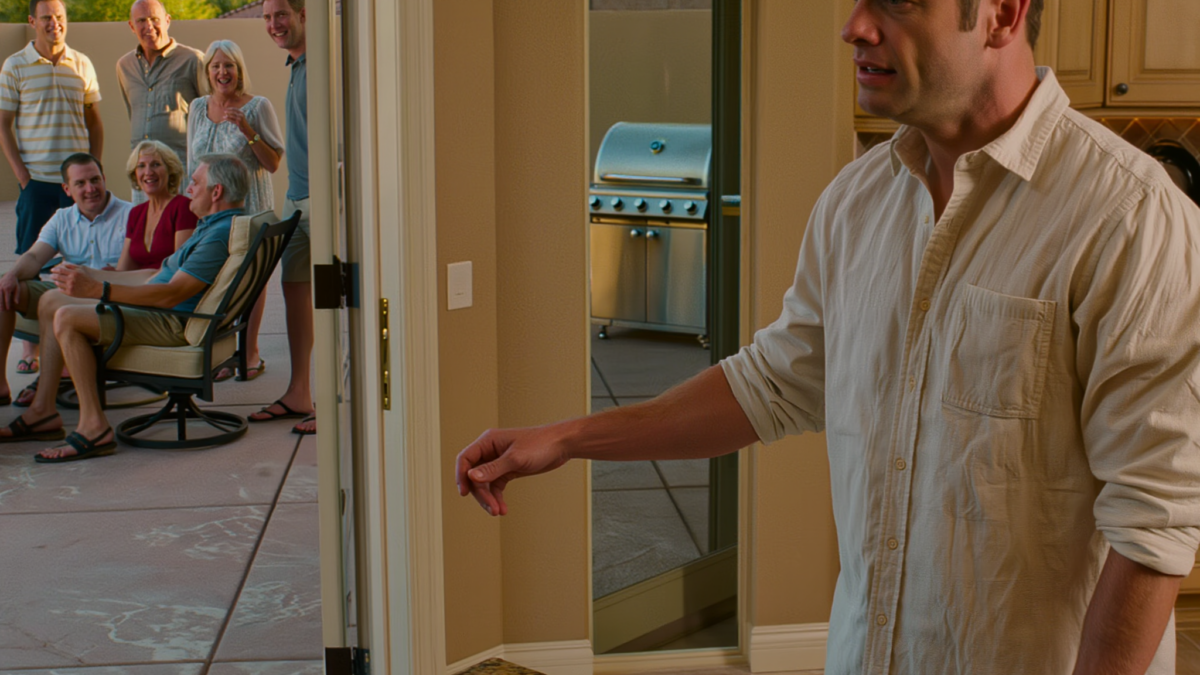
I was thirty-two years old when I heard my own father casually suggest that it would be nice if I had an accident on the highway and never arrived at my brother’s barbecue.
He didn’t sound angry. He didn’t sound frustrated. He said it as casually as someone discussing the weather.
Then my family laughed.
Not one uncomfortable chuckle or an awkward attempt to change the subject. I heard genuine laughter from people who had known me my entire life, including my mother.
I was standing in the kitchen of my older brother Marcus’s expensive Phoenix home. Just a few feet away, on the granite island, sat the tray of brisket I had spent hours preparing because I knew my father loved it.
I’d come early because I had wonderful news to share.
After years of working my way through the marketing industry, I had finally been offered a director-level position at a major hospitality company. I genuinely believed the promotion might change the way my family saw me.
Instead, I was listening to them joke about how much better their afternoon would be if I never arrived.
I didn’t walk onto the patio. I didn’t confront anyone.
I left the brisket on the counter, slipped out the front door, and walked away.
What happened afterward began with a phone call that none of them expected. But to understand why I made that decision, you have to understand what it meant to grow up in my family.
The Saturday That Changed Everything
It was a beautiful Saturday afternoon in Phoenix, the kind of clear, sunny day that seemed perfect for a family barbecue.
My brother Marcus lived at the end of a quiet, wealthy cul-de-sac. His house was a sprawling custom-built estate with a manicured lawn, an enormous backyard, and the kind of polished interior that made visitors immediately aware of his financial success.
Marcus was four years older than me. He had built an impressive career in commercial real estate development, and he rarely missed an opportunity to remind everyone how successful he had become.
Normally, I arrived at family gatherings exactly when expected. I would smile, endure the inevitable comparisons and little insults, and leave as soon as politeness allowed.
That afternoon was different.
Three weeks earlier, Sunset Hospitality Group had offered me the position of director of marketing. It was a tremendous opportunity: a six-figure salary, excellent benefits, a substantial marketing budget, and twenty employees reporting directly to me.
For the first time in years, I had news that I thought even my father might respect.
I had spent three days thinking about how I would tell everyone. I bought a new shirt and prepared brisket because I knew it was one of my father’s favorites.
At 4:25 p.m., I pulled my sedan into Marcus’s circular driveway.
Several luxury vehicles were already parked outside, including my cousin Lucas’s new truck and Aunt Vivien’s crossover.
I carried the large tray of brisket up the stone walkway and entered through the unlocked front door.
The foyer was quiet, but I could hear voices drifting in from the backyard.
I went into the kitchen and placed the food on the granite island beside the other dishes. The window overlooking the patio was wide open, and I could hear the family gathering outside.
I had my hand near the screen door when Marcus mentioned my name.
“Ethan should be here soon,” he said. “He texted that he was coming early to help.”
I stopped.
There was something unpleasantly familiar about his tone.
“Oh, fantastic,” Aunt Vivien replied. “I absolutely cannot wait to hear all about his glamorous new life.”
Several people laughed.
Marcus continued.
“You know he’s only coming to brag about his new job. Director of marketing at some hotel chain. He probably expects us all to roll out the red carpet, bow down, and worship his unbelievable success.”
More laughter followed.
Then Aunt Vivien reminded everyone of the years I’d spent working at a coffee shop.
She suggested that my new job had convinced me I was better than the rest of the family. She even brought up the art projects I used to make as a child.
My excitement disappeared.
I recognized the voices outside: my father Richard, my mother Eleanor, Marcus, Lucas, Aunt Vivien, and Uncle Henry.
They were enjoying themselves at my expense.
Then my father spoke.
“Honestly, it would be nice if there was an accident on the highway and he never showed up.”
For a moment, there was silence.
Then everyone laughed.
The sound of my mother’s nervous giggle was unmistakable.
She didn’t object. She didn’t tell him he’d gone too far. She joined them.
I stood motionless in that beautiful kitchen, feeling like the same unwanted little boy I had been for most of my childhood.
I Had Spent My Life Trying to Make Him Proud
Growing up, my brother Marcus was the golden child.
He was the star quarterback, the straight-A student, and eventually the successful businessman who followed a path my father understood and admired.
Richard was an old-school mechanical engineer. He respected money, real estate, logic, and anything he considered practical.
I was different.
I loved creative writing, graphic design, and marketing. Those interests made me a disappointment in his eyes long before I had any opportunity to prove what I could accomplish.
When I was sixteen, I won a statewide creative writing competition.
I brought the certificate home and placed it on the dining room table while my father was reading The Wall Street Journal.
He glanced at it briefly.
“Writing?” he scoffed. “What’s the salary on a poem, Ethan? Are you going to pay a mortgage with metaphors? Look at your brother. He just landed an internship at a commercial real estate firm. That’s a real future. This is just a distraction.”
He returned to his newspaper.
My mother was standing at the kitchen sink. She gave me a weak shrug and continued washing a pot.
That was how she handled conflict in our family.
She rarely initiated the insults, but she never stopped them either.
When Marcus went to college, my parents used a substantial portion of their investments to pay his tuition.
When it was my turn, my father handed me student loan applications.
“I’m not wasting the college fund on an arts degree,” he told me. “If you want to study marketing and drawing, you can finance it yourself. Consider it a lesson in the real world.”
So I did.
I worked mornings at a coffee shop that opened at 4:30 a.m. and late nights in a retail stockroom. I paid for my textbooks, meals, tuition, and other expenses while trying to keep up with my coursework.
When I finally graduated, I invited my entire family to the ceremony.
Nobody came.
I sat in the auditorium surrounded by cheering families, looking toward seats that remained empty.
Later, I discovered why.
Marcus had just completed his first major commercial real estate deal. My father had taken the family to a luxury car dealership to help him lease his first Porsche.
My graduation mattered less than my brother’s new car.
And the comparisons never stopped.
Every Thanksgiving, Christmas, and Fourth of July, Aunt Vivien found another opportunity to embarrass me.
She was my father’s older sister, a wealthy widow who seemed to enjoy reminding everyone where they stood in the family’s hierarchy.
“Still living in that tiny apartment, Ethan?” she would ask loudly. “Marcus just bought a five-bedroom house. But I suppose you don’t need much space for your little projects.”
If I objected, I became the problem.
My mother would accuse me of being too sensitive. My father would tell me to toughen up. Marcus would act as though I couldn’t understand a joke.
For years, I believed them.
I accepted poor treatment in relationships because I thought that was what I deserved. I settled for jobs that paid less than my abilities were worth because I doubted myself.
Eventually, things began to change.
At a mid-level advertising firm, I met a mentor named David.
He looked at my portfolio and saw potential instead of disappointment.
Under his guidance, I learned market analytics, digital strategy, and consumer psychology. I worked relentlessly and gradually advanced in my career.
Then Sunset Hospitality Group called.
I completed five demanding interviews with its CEO, Catherine, a formidable executive known for expecting results.
At the final interview, she handed me an offer letter.
When I saw the salary and responsibilities, I excused myself, went into the restroom, locked myself in a stall, and cried.
I had achieved something I once thought was beyond my reach.
And despite everything, the first thing I wanted to do was tell my family.
That was the hope I carried into Marcus’s kitchen.
Leaving Without a Word
After hearing my father’s remark, I couldn’t bring myself to open the screen door.
I backed away from the window and moved quietly across the kitchen.
The brisket remained on the counter.
I walked out of the house, passed my parked car, and continued down the suburban street.
My chest felt tight. My vision blurred with tears I refused to let fall.
Two blocks away, my phone vibrated.
Marcus had sent a message.
“Where are you? Thought you were coming early to be useful for once.”
I stared at it.
He had just mocked me in front of our relatives. Now he was pretending nothing had happened while criticizing me for not being there to help.
I didn’t respond.
Instead, I called Sarah.
Sarah had been my best friend since college. She was a former emergency room nurse, fiercely loyal, and one of the few people who understood how deeply my family’s behavior had affected me.
She answered cheerfully and joked about whether I was getting roasted at the barbecue.
“Sarah,” I said, “I need your help, and I need you to trust me. We are going to teach them a lesson they will never, ever forget.”
We met at a quiet coffee shop a short distance from the barbecue.
When Sarah sat across from me, she immediately noticed something was wrong.
“Ethan, you look like a ghost. What happened? You said it was an emergency.”
I told her everything.
I described Marcus mocking my promotion, Vivien laughing about my childhood interests, and the exact words my father had said.
I told her how my mother had laughed along with everyone else.
Sarah was furious.
She wanted to drive straight to Marcus’s house, confront the family, and tell them exactly what she thought of their behavior.
I stopped her.
“No,” I said. “Screaming at them won’t do anything. They’ll just call me dramatic. They’ll tell you you’re crazy. They will spin the narrative like they always do.”
She asked whether I planned to cut them off.
I told her I did.
But before disappearing from their lives, I wanted them to experience the possibility they had found so amusing.
“They wanted a tragedy,” I said. “They wanted to imagine what it would be like if I never showed up. We are going to show them. And Sarah, I need your ER voice.”
She looked at me for a long moment.
“You want me to fake a hospital call?”
I nodded.
She understood the seriousness of what I was proposing.
“Ethan, that is nuclear. If we do this, there is no going back, ever.”
“I don’t want to go back,” I told her.
I was thirty-two years old. I’d spent most of those years chasing the approval of people who treated my pain as entertainment.
I wanted them to understand what their words meant.
Sarah knew how much I’d suffered. She’d helped me through panic attacks during college. She had even helped me write emails to my parents after they forgot my birthday three consecutive years.
Eventually, she agreed.
The Call That Sent Everyone Running
Sarah and I decided she would call my mother.
Marcus would probably ask too many questions. My father might simply dismiss the situation. Eleanor, however, was deeply concerned with public appearances and likely to panic in front of the whole family.
Sarah planned to use a private caller ID.
While she prepared, another message appeared on my phone.
It was from Lucas.
“Hey man, where are you? Uncle Richard is getting grumpy. You know how he hates when people are late. Just wanted to give you a heads up.”
Lucas had been present when my father made his remark.
He’d heard the laughter.
Yet he was still treating me as the problem.
I showed Sarah the screen.
“He’s a coward,” I muttered. “They’re all cowards.”
At exactly 5:10 p.m., Sarah placed the call.
She used the authoritative, professional voice I’d heard her use during her nursing career.
My mother answered.
“Hello, is this Eleanor?” Sarah asked.
“Yes, this is she. Who is calling?”
“Eleanor, my name is Jessica. I am a charge nurse calling from the emergency department at Phoenix General Hospital. I am trying to reach the emergency contact for an Ethan.”
The country music in the background seemed to grow quieter.
“Ethan? Yes, I’m his mother. What’s going on? Is he all right?”
Sarah told her that I had supposedly been brought in by ambulance after a serious multi-vehicle collision on Interstate 10.
She described my condition as critical and said emergency treatment was underway.
My mother’s voice began shaking.
“Oh my God. What? What do you mean?”
Then I heard Marcus in the background.
“Mom, Mom, what’s wrong?”
My mother shouted for Richard.
A glass fell and shattered against the patio.
The easy laughter from earlier had disappeared.
My mother demanded to know where I was.
Sarah directed her to Phoenix General and told her to ask for trauma bay three.
“We’re coming,” Eleanor said. “We’re coming right now.”
Sarah ended the call.
For several seconds, we simply stared at the phone.
“It’s done,” she whispered. “Ethan, they bought it. They bought it completely.”
I thought I would feel guilty.
Part of me expected the familiar urge to apologize, explain myself, and protect my parents from discomfort.
Instead, I felt an unsettling emptiness.
“They asked for an accident,” I said quietly. “Now they get to live it.”
Sarah asked what came next.
I told her I wanted to see the family arrive at the hospital.
I wanted to see what my father’s concern looked like when he believed the terrible possibility he’d joked about had become real.
Watching From Across the Street
We left the coffee shop in Sarah’s car, leaving my sedan parked near a strip mall.
Phoenix General Hospital was roughly ten minutes from Marcus’s neighborhood.
Sarah drove past the emergency department and entered the multilevel parking garage across the street.
We parked on the third floor, facing the hospital.
From there, we could see the sliding doors, the ambulance bay, and the patient drop-off area.
It was 5:25 p.m.
My phone began vibrating almost continuously.
Missed calls from my father.
Repeated calls from Marcus.
Messages from Aunt Vivien and Lucas.
“Ethan, please God tell me you are okay. We are on our way to the hospital,” Vivien wrote.
Lucas sent another message.
“Dude, we are freaking out. Please answer your phone.”
I placed the phone on the dashboard without responding.
Then Marcus’s black Porsche SUV came around the corner of the hospital complex.
He stopped abruptly in the emergency drop-off zone.
My father was the first person out.
I had never seen Richard run before. He was normally a man of deliberate, controlled movements, someone who expected everyone else to adjust to him.
But now he was sprinting toward the emergency department.
Eleanor climbed out looking overwhelmed, with Marcus helping her toward the entrance.
More cars arrived.
Aunt Vivien, Uncle Henry, Lucas, and Chloe, Marcus’s wife, hurried inside.
I watched them disappear through the doors.
For a moment, I thought seeing their panic would satisfy me.
Instead, sadness settled over me.
This was what it took.
My father hadn’t attended my graduation. He hadn’t celebrated my achievements. He’d dismissed my work and ignored my feelings for decades.
But when he believed I might be seriously hurt, he ran.
The contrast was almost unbearable.
The Message I Had Waited Thirty-Two Years to Receive
As we waited, my phone continued lighting up.
At 5:35 p.m., my mother called three times in succession.
At 5:40 p.m., a message arrived from Richard.
“Ethan, if you’re reading this, hold on. We are here. Dad is here.”
I read it aloud.
Dad is here.
I thought about the empty seats at graduation, the ignored writing certificate, and the countless times I’d wanted him to show even a little interest in my life.
Now he was telling me he was there.
Only because he thought I might not be able to hear him.
Sarah told me that his reaction proved he was capable of caring, but had chosen not to show that care in ordinary circumstances.
It was a painful thought.
At 5:45 p.m., Lucas appeared outside the emergency department with his phone pressed to his ear.
He paced the sidewalk, gesturing with his free hand.
My phone rang.
I watched him finish the unanswered call and return inside.
The hospital staff were apparently unable to find any record of my admission.
The family’s panic was turning into confusion.
I looked through the windshield and thought about the decision I was preparing to make.
For years, I’d treated family as an obligation I could never escape.
But sitting in that parking garage, I understood that being related to someone didn’t require me to accept endless humiliation.
At 5:55 p.m., the emergency doors opened again.
Marcus emerged first.
He looked furious.
My father followed, appearing disoriented. My mother leaned against Vivien, dabbing her face with a tissue.
Marcus marched toward his Porsche with his phone in his hand.
Then my phone rang.
His photograph appeared on the screen, an old picture of us together from five years earlier.
I let the call go to voicemail.
He immediately called again.
This time, I answered.
The Conversation That Ended My Old Life
“Ethan! Where the hell are you? Are you alive?”
Marcus was shouting so loudly I had to move the phone away from my ear.
He said the hospital had no record of me and that there hadn’t been a multi-car accident on Interstate 10.
“I’m perfectly fine, Marcus,” I replied.
He sounded stunned.
He reminded me that our mother had received a call from a trauma nurse who said I was in critical condition.
“Did they?” I asked. “That is incredibly strange.”
He demanded to know whether I’d been transferred to another hospital.
“No, Marcus. I’m not at a hospital. I haven’t been in an accident.”
“Then where the hell are you?”
I looked down through the windshield.
Marcus stood beside his Porsche. Richard was nearby, leaning toward him to hear the conversation.
“I’m sitting in the third-floor parking garage directly across the street from you,” I said. “I’ve been sitting here for the last 45 minutes, watching you all run around like lab rats in a maze.”
Marcus stopped moving.
He pulled the phone away from his ear and looked toward the parking structure.
“You did this on purpose,” he said.
His fear turned into anger.
“You made us think you were dying. You sick, twisted piece of work. Do you have any idea what you just put Mom through?”
“I know exactly what I put her through,” I replied. “I gave her exactly 45 minutes of terror, which is interesting, Marcus, considering you and Dad were just joking about how convenient my death would be. I figured I would do the family a favor and let you test-drive the experience.”
There was a scuffle on the other end of the call.
Then my father’s voice took over.
“Ethan, what the hell is wrong with you?”
He ordered me to come downstairs, apologize to my mother, and apologize to the hospital staff for the disruption.
A year earlier, that voice would have sent me into a panic.
But looking down at him from the garage, I no longer saw the all-powerful figure who had dominated my childhood.
I saw an angry man who couldn’t control me anymore.
“I am not apologizing for anything, Richard.”
It was the first time I’d ever addressed my father by his first name.
He was stunned.
I told him I’d arrived at the house at 4:25, walked into the kitchen, and placed my brisket on the island.
Then I repeated what I’d heard through the open window.
Marcus mocking my career.
Aunt Vivien ridiculing my childhood interests.
Richard saying it would be nice if an accident kept me away.
And everyone laughing.
“We were joking!” Richard shouted.
He accused me of being too sensitive and taking family banter personally.
“Family banter doesn’t involve wishing death upon your own son,” I replied.
I told him I was tired of being treated as a failure so Marcus could feel superior.
I was tired of chasing approval from people determined not to give it.
My mother tried to intervene.
She suggested we return to the house and talk like adults.
She even accused me of ruining the family gathering.
“I’m not ruining anything, Mom. I’m leaving it.”
I told them I was done trying to earn a place at a table where I received nothing but disrespect.
Then Marcus tried speaking again.
I interrupted him.
“There is a tray of marinated brisket on your kitchen counter. Took me 12 hours to prep. Consider it my parting gift. Eat it, throw it away, I don’t care.”
I told them not to call or text me again.
I warned that if they came to my apartment, I would contact the police.
Then I ended the call.
I switched off my phone, removed the SIM card, snapped it in half, and threw the pieces out the car window.
Sarah drove us out of the parking garage.
We remained quiet for a long time.
I was exhausted, but beneath that exhaustion was a feeling I hadn’t experienced in years.
Freedom.
My First Day Without Their Approval
The following Monday marked my first official day as director of marketing at Sunset Hospitality Group.
I walked into the company’s glass-and-steel headquarters in downtown Phoenix wearing a navy suit I’d bought for the occasion.
For once, I wasn’t checking my phone for criticism from my father.
I wasn’t worrying about the family group chat.
My attention belonged to me.
My new assistant, Tyler, greeted me with my schedule and a cup of black coffee.
My office had floor-to-ceiling windows overlooking the Phoenix skyline.
At 2:00 that afternoon, I delivered my first major presentation to Catherine and the executive team.
I’d prepared a data-driven strategy to restructure the company’s loyalty program.
I presented it confidently, answering questions and explaining the reasoning behind my recommendations.
When I finished, Catherine studied me for a long moment.
“Ethan, that was exceptional,” she said. “The demographic targeting in the second phase is exactly the kind of aggressive restructuring this company has been lacking. You have full approval on the budget. Execute it.”
I had spent years wanting a powerful person to recognize my abilities.
Now someone had done exactly that.
Not because of my last name or family position, but because of my work.
After the meeting, Catherine asked me to stay behind.
She said she’d noticed something different about me compared with the man she’d interviewed.
“When I interviewed you, I saw someone hungry. But today I saw someone lethal. Whatever shifted in your life over the weekend, keep it. It suits you.”
I thanked her and returned to my office.
I thought the difficult part of leaving my family was over.
I was wrong.
My Mother Came to My Office
On Tuesday, I bought a new phone and number.
I shared it only with Sarah, David, and my employer.
By Thursday, my family had found another way to reach me.
I was reviewing a campaign budget when Tyler knocked on my office door.
He looked uncomfortable.
“Hey, Ethan. There is a woman down in the main lobby asking for you. She says she’s your mother. Security won’t let her up without your authorization, but she is causing a bit of a scene. She’s crying near the reception desk.”
I felt my stomach tighten.
Eleanor had never visited me at any of my previous jobs.
The coffee shop had been beneath her socially. The advertising agency had supposedly been too inconvenient to reach.
But now she had come downtown to find me.
I told Tyler to let her upstairs, with her visitor access restricted to our floor.
I also asked him to remain nearby in case I needed her escorted out.
Five minutes later, my mother entered.
She wore her Sunday church clothes and held her designer handbag against her chest.
Her eyes were red, and she looked exhausted.
She glanced around my office, taking in the mahogany desk, leather chairs, and panoramic windows.
For a moment, genuine surprise crossed her face.
“Ethan,” she said.
“Have a seat, Eleanor.”
I remained behind my desk.
She sat down and immediately complained that I’d changed my number.
She said the family had been worried sick.
According to her, Richard hadn’t slept in days, and Marcus was a wreck.
I asked why she had come.
“I came to ask you to stop this nonsense,” she replied.
She said I’d proved my point, frightened everyone, and gotten my revenge.
Now, she insisted, it was time to come home.
Then she said something that revealed exactly why she was there.
“Your father is furious, and the longer you drag this out, the harder it will be for him to forgive you.”
I stared at her.
“Forgive me?”
She began crying.
She said I’d humiliated Richard in front of Vivien, Henry, and Lucas.
She reminded me that he was my father and insisted that I needed to apologize for the hospital incident so the family could put everything behind them.
“Please, Ethan, you are breaking your father’s heart.”
For years, I’d told myself my mother was simply another victim of my father’s domineering personality.
But she was sitting in my office demanding that I make him comfortable, even after hearing what he’d said about me.
I finally understood her role.
She hadn’t merely avoided conflict. She had helped preserve a family arrangement that required me to accept mistreatment.
“No,” I said.
She asked me to be reasonable.
“I said no. I am not apologizing to a man who wished for my death. I am not sweeping anything under the rug.”
I told her that without me around to absorb Richard’s anger, he had probably begun directing it toward her and Marcus.
“You don’t miss me, Mom. You miss your human shield.”
She gasped and asked how I could speak to my own mother that way.
“Because it is the truth. And the truth is no longer banned in my life.”
Then I stood.
“Tyler.”
My assistant appeared immediately.
I asked him to escort my mother to the elevators.
Eleanor looked embarrassed and angry, but she finally left.
I thought that encounter might convince the rest of the family to respect my decision.
It didn’t.
The Forty-Million-Dollar Deal
Two weeks later, an email arrived at my work address.
It was from Marcus.
Unlike his usual messages, it contained no insults or demands.
Only a request.
“I need to see you. Please meet me at the Oak Room downtown at 6 p.m. I’m begging you.”
The Oak Room was an upscale whiskey bar frequented by executives and real estate developers.
It was one of Marcus’s favorite places.
I considered ignoring him, but curiosity won.
When I arrived, I barely recognized my brother.
He sat in a dark leather booth wearing a wrinkled button-down shirt instead of his usual tailored Armani suit.
He looked as though he hadn’t shaved in days.
A glass of whiskey stood in front of him, and his hands were shaking.
I sat opposite him.
“You ruined me,” he whispered.
“I haven’t spoken to you in three weeks, Marcus. I haven’t done anything to you.”
“The Harrison contract,” he replied.
He was referring to a $40 million commercial development project in Scottsdale.
Marcus had spent eight months working on it. It was supposed to be one of the most important deals in his firm’s history.
They’d expected to sign the final paperwork that Monday.
Instead, the primary investor, Evelyn Harrison, had withdrawn.
She’d informed the firm’s managing partner that she refused to do business with the company as long as Marcus remained attached to the project.
I asked what any of that had to do with me.
Marcus gave a miserable laugh and slid his phone across the table.
“Evelyn Harrison. She’s best friends with Catherine, your CEO.”
I looked at him.
He explained that Evelyn and Catherine regularly played golf together at the Builtmore Country Club.
The Sunday after our barbecue, Catherine had been talking about her new marketing director.
She mentioned my name.
Evelyn recognized our last name because she was involved in a large real estate deal with Marcus’s firm.
That alone didn’t explain why the investment had collapsed.
Then Marcus told me what Evelyn had overheard.
A Conversation at the Country Club
Aunt Vivien and my mother regularly went to the Builtmore for Sunday brunch.
On one of those visits, Evelyn Harrison had been seated on the patio beside them.
They were discussing the hospital incident.
Vivien was complaining about how I’d humiliated the family.
She repeated my father’s remark about an accident on the highway.
She described Marcus’s comments about my career.
She even bragged about the way they had put me in my place.
Evelyn had heard the conversation.
Every word.
When she later discussed me with Catherine, she contacted her to confirm the connection.
Marcus looked devastated as he explained what happened afterward.
Evelyn had told his managing partner that she couldn’t trust someone who enjoyed humiliating his own brother to responsibly handle a $40 million investment.
She withdrew from the deal.
Now Marcus’s firm was furious.
He had been placed on administrative leave pending an ethics review.
“My career is completely over,” he said.
I sat across from him, absorbing everything.
For years, Marcus had treated my career as a joke.
Now his own professional reputation was suffering because of the way he and our family had behaved.
And I hadn’t contacted Evelyn.
I hadn’t asked Catherine to interfere.
I hadn’t even known the two women were connected.
The consequences had come from a conversation Aunt Vivien chose to have in public.
I stood.
“I didn’t ruin you, Marcus. You ruined yourself. Aunt Vivien just handed Evelyn the microphone.”
Then I walked out of the Oak Room, leaving him alone in the booth.
My Father’s Final Confrontation
Two days later, I was leaving my apartment building for work when a figure stepped from behind a parked SUV.
It was Richard.
Aunt Vivien stood behind him, clutching her expensive silk scarf.
My father looked furious.
“You vindictive little bastard,” he shouted. “Are you happy now? Are you satisfied? You destroyed your brother’s life.”
A woman walking her dog across the street stopped to stare.
I stood still and faced him.
“Marcus lost his contract because he lacks character, Richard.”
I explained that Evelyn had heard Vivien bragging about the family’s behavior in a public country club.
I hadn’t arranged the conversation.
I hadn’t encouraged my father to make his remark.
And I hadn’t told Evelyn to withdraw.
“Actions have consequences. Welcome to the real world.”
Vivien stepped forward.
She accused me of manipulating Catherine and poisoning Evelyn against Marcus.
I laughed.
“I didn’t say a word to my CEO. I didn’t have to. Your own arrogance did the work for me.”
I told Vivien I was tired of the way she’d encouraged my parents to treat me.
Richard suddenly moved toward me with his hand raised.
I didn’t know whether he intended to grab me or strike me.
I stepped closer and made my boundary clear.
I told him that if he touched me, I would report the assault and seek a restraining order.
He stopped.
For a moment, he stood with his hand suspended in the air.
Then he lowered it.
“You are no son of mine,” he said.
“That is the best thing you have ever said to me.”
Before he could respond, another voice interrupted.
“Richard, stop it. Just stop it.”
It was Chloe.
Chloe Finally Spoke
Marcus’s wife stepped out of the SUV.
I hadn’t realized she was there.
Chloe had always remained quiet during family gatherings. She rarely participated in the cruelty directed at me, but she had never intervened either.
Now she looked determined.
“Marcus is at home having a complete mental breakdown,” she told Richard and Vivien. “And instead of helping him, you two drove down here to harass Ethan. It’s sick. Evelyn Harrison was right. This family is sick.”
Vivien ordered her to stay out of it.
Chloe refused.
She said she’d sat through countless family dinners watching the way they treated me.
She admitted she had remained silent because Marcus had told her to.
But she wouldn’t continue doing so.
“Ethan didn’t ruin Marcus’s career. You did. You raised Marcus to be an arrogant, cruel bully, just like you, Richard.”
Then she turned toward me.
“Ethan, I am so sorry. I am sorry I never defended you. You were the only decent person in this entire bloodline.”
She turned back to Richard.
Chloe announced that if Marcus didn’t begin intensive psychiatric therapy by the end of the week, she would file for divorce and seek full custody of their sons.
She said she wouldn’t allow the family to turn her children into the kind of people she had watched mistreat me.
Then she returned to the SUV and closed the door.
Richard stood motionless.
Marcus was facing an ethics review and serious problems in his marriage.
Chloe had finally challenged the family.
And I was no longer willing to accept the role they’d assigned me.
I looked at Richard and Vivien one last time.
“Don’t ever come near my home or my office again.”
Then I walked to my car and drove away.
In the rearview mirror, I saw them standing on the sidewalk.
For the first time, I didn’t feel the need to turn around.
One Year Later
Healing didn’t happen immediately.
For a long time, I had to remind myself that my worth wasn’t determined by whether my father approved of my choices.
But without the constant criticism and family drama, my life became calmer.
A full year passed.
No hostile family group chats.
No uncomfortable Thanksgiving dinners.
No more worrying about what Marcus had accomplished compared with me.
By the following Thanksgiving, I was thirty-three years old and living in a beautiful mid-century modern home I’d bought in a quiet Scottsdale neighborhood.
On Thanksgiving Day, the kitchen smelled of roasted turkey, rosemary, and apple pie.
Instead of hearing criticism from my relatives, I heard laughter coming from the living room.
Sarah was sitting on the couch, laughing at a story Tyler was telling.
My assistant had become a close friend.
David, my old mentor, was sitting near the fireplace, pouring wine for Catherine, who had accepted my invitation to dinner.
These were the people who celebrated my accomplishments instead of resenting them.
They respected my boundaries.
They didn’t make me compete for affection.
I had finally created a family of my own choosing.
But earlier that morning, something unexpected had arrived in the mail.
The Letter From Richard
Among the catalogs and bills was a thick envelope.
I recognized the handwriting immediately.
It was my father’s.
Rigid, precise, almost architectural.
I took the envelope into my home office and sat down to open it.
A year earlier, seeing his handwriting might have made my heart race.
This time, I felt calm.
Inside was a handwritten letter on heavy paper.
“Ethan,
I know you don’t want to hear from me, and I will respect your boundaries. I am not writing this to ask for an invitation or to demand that we speak. I am writing this because I have spent the last year in a quiet house watching everything I built fall apart. And I finally realize why.
Marcus is in intensive therapy. Chloe stayed with him, but it is a difficult road. He is learning how to be a man without using someone else as a stepping stone. And I am trying to learn how to be a father.
I failed you completely and utterly. I let my own insecurities, my own rigid view of the world, blind me to the incredible man you became. I listened to Vivien instead of listening to my own heart. I have cut Vivien out of our lives. It was the hardest but most necessary thing I have ever done.
I don’t expect your forgiveness. I don’t deserve it. But before I leave this earth, I needed to put these words on paper so you have them forever.
You are a brilliant, strong, and successful man.
I am incredibly proud of you, Ethan, and I am so profoundly sorry.
Dad.”
I read the letter twice.
Then I ran my fingertip over the sentence I’d spent my entire childhood longing to hear.
“I am incredibly proud of you, Ethan.”
There it was.
The approval I’d chased through school, college, and every milestone of my career.
For years, I had imagined hearing those words would change everything.
But now that I finally had them, I understood something.
They couldn’t erase the past.
They couldn’t bring my family to my graduation or undo the afternoons I’d spent wondering why my achievements were never enough.
But they could provide some closure.
I folded the letter carefully and placed it in the bottom drawer of my desk.
I didn’t throw it away.
I didn’t frame it either.
I accepted his apology privately.
I chose to forgive him, not because the past no longer mattered, but because I no longer wanted resentment to shape my life.
Still, forgiveness didn’t mean reconciliation.
I didn’t call him.
I didn’t invite him to Thanksgiving.
I maintained the boundaries I’d worked so hard to establish.
Perhaps one day, years from now, we might sit down for a cup of coffee.
But I wasn’t ready to risk the peace I’d finally found.
A Different Kind of Thanksgiving
I returned to the living room, leaving my father’s letter in the desk drawer.
Sarah looked up from the couch and smiled.
She raised her wineglass.
“To Ethan,” she said. “The man of the hour, and to the best damn Thanksgiving this house has ever seen.”
Everyone raised their glasses.
“To Ethan,” they echoed.
I lifted mine and took a sip of red wine.
Around me were people who had helped me build a life I once believed I didn’t deserve.
David had seen talent in me when my father saw failure.
Sarah had stood beside me when I felt completely alone.
Catherine had recognized my abilities without caring about my place in the family hierarchy.
Tyler had become more than a colleague.
None of them shared my last name.
But they had shown me more genuine support than I’d experienced through much of my childhood.
I looked through the large windows as the Arizona sun sank toward the horizon, filling the sky with orange and purple.
I’d spent thirty-two years trying to convince people to love me.
At thirty-three, I finally understood that love wasn’t something I had to earn by accepting humiliation.
My father’s letter remained in the drawer.
My boundaries remained intact.
And the people I wanted beside me were already there.
I had survived the worst chapter of my life and built something better from what remained.
I was successful.
I was loved.
And most importantly, I was free.








