My dad uninvited me from Christmas while I was buying the $300 groceries he demanded. For ten years, he’d treated my paycheck like family property, and my older brother was already counting on the $31,000 I inherited from my grandfather for his new house. I didn’t argue. I paid for the groceries and drove to the community center my grandfather loved. By 7:15 the next morning, my brother was pounding on my door with his phone.
My name is Logan Parker. I’m 32 years old, and two days before Christmas, my father told me I wasn’t welcome at our family dinner anymore.
He didn’t say it during an argument. He didn’t sit me down to explain why. He told me over the phone while I was standing in a crowded grocery store, holding the expensive food he’d personally asked me to buy.
For ten years, I’d been paying bills, covering emergencies, and making life easier for my father and older brother. I kept believing that if I did enough for them, they’d eventually treat me like I belonged.
That afternoon, I learned how little any of it meant to them.
What I didn’t know yet was that my father and brother had already used my personal financial information in a real estate transaction. They were counting on money that legally belonged to me, and they had taken steps to make a lender believe I had agreed to give it away.
By the following morning, both men would be standing on my porch, desperate to undo a decision I’d made with my own money.
But the real trouble had started long before that Christmas.
On the afternoon of December 21st, the grocery store was absolute chaos.
Shopping carts collided in narrow aisles. Exhausted parents tried to keep their children moving. Somewhere near the bakery, a child was crying over a dropped cookie. The speakers played an endless rotation of cheerful Christmas music that seemed completely disconnected from the stress on everyone’s faces.
I was standing in the produce section, examining bunches of fresh thyme for the turkey roast.
My cart was already overflowing.
For the previous three days, my father, William, and my older brother, Travis, had been sending me additions to the holiday grocery list. Every time I thought I’d finished shopping, another request appeared.
I had three jars of imported cranberry sauce because Travis’s wife, Clara, insisted on that particular kind. There was a bag of organic clementines for their daughter, Lily, who loved eating them by the handful.
My father wanted expensive stone-ground French mustard for his glazed ham. He claimed regular yellow mustard gave him heartburn.
I’d also picked up a custom pecan pie from a local bakery. It sat carefully in the child’s seat of the shopping cart beside two bottles of highly rated Cabernet Sauvignon.
None of those choices had been mine.
I was simply the person expected to buy everything.
I pulled out my phone and called my father to ask whether I should pick up another bottle of white wine. Clara sometimes preferred Pinot Grigio, and I wanted to make sure there was something everyone would enjoy.
He answered on the second ring.
“What is it, Logan?”
There was no greeting, no warmth. His voice carried the familiar irritation he seemed to reserve specifically for me.
“Hey, Dad. I’m at the store getting the last of the groceries for dinner. The cart is packed. Should I bring the pie or grab some extra white wine, too? I know Clara sometimes prefers a Pinot Grigio.”
He didn’t answer immediately.
In the background, I could hear Travis laughing.
Then my father cleared his throat.
“Actually, Logan, don’t bother bringing anything. We’re spending the holidays with Travis and Clara this year at their place. You don’t need to come.”
For a moment, I couldn’t respond.
My hand tightened around the shopping cart handle.
“What do you mean? We’ve planned this dinner at my house for a month. I just spent $300 on groceries you explicitly asked for.”
“Plans change, Logan.”
He sounded as though he were canceling an ordinary appointment.
“Travis has a lot going on with his new house hunt right now. He’s stressed. Clara is stressed. We just want a quiet, intimate, stress-free holiday.”
Then he added the part that stayed with me.
“To be perfectly honest, your presence complicates things. You always bring this heavy energy. We just don’t need you there. Enjoy your time off. Have a good Christmas.”
The call ended.
He hadn’t apologized or offered an alternative. He hadn’t even given me a chance to respond.
I stood motionless in the produce aisle while shoppers moved around me, trying to get home to their families.
Then I looked down into my cart.
The imported cranberry sauce. The mustard. The clementines. The carefully boxed pecan pie.
Every item had been chosen to make somebody else happy.
I had spent money I’d earned, taken time out of my day, and followed every request. Yet somehow, I was the one person who didn’t deserve a seat at the table.
I’d spent ten years helping my family financially, but I was finally beginning to understand that they didn’t see those payments as gifts.
They saw them as obligations.
I didn’t call my father back. I didn’t ask Travis to intervene. I didn’t beg for an invitation.
“All right,” I said quietly to the disconnected phone.
Then I pushed my cart toward the self-checkout.
I scanned each item, paid with my credit card, and carefully packed the groceries into bags.
Outside, the December wind cut across the parking lot. I loaded everything into the trunk and sat behind the wheel with the engine running and the heater on.
Through the windshield, I watched families loading their own groceries. Some laughed. Others argued playfully about forgotten ingredients.
I had everything necessary for a beautiful Christmas dinner.
Except a family that wanted me there.
The following morning, at exactly 7:15, I was standing in my kitchen wearing old gray sweatpants and a worn T-shirt.
I had a cup of strong black coffee in my hand.
For the first time in a long while, the house was peaceful. There were no urgent requests for money, no complaints, and no messages telling me what I needed to do for someone else.
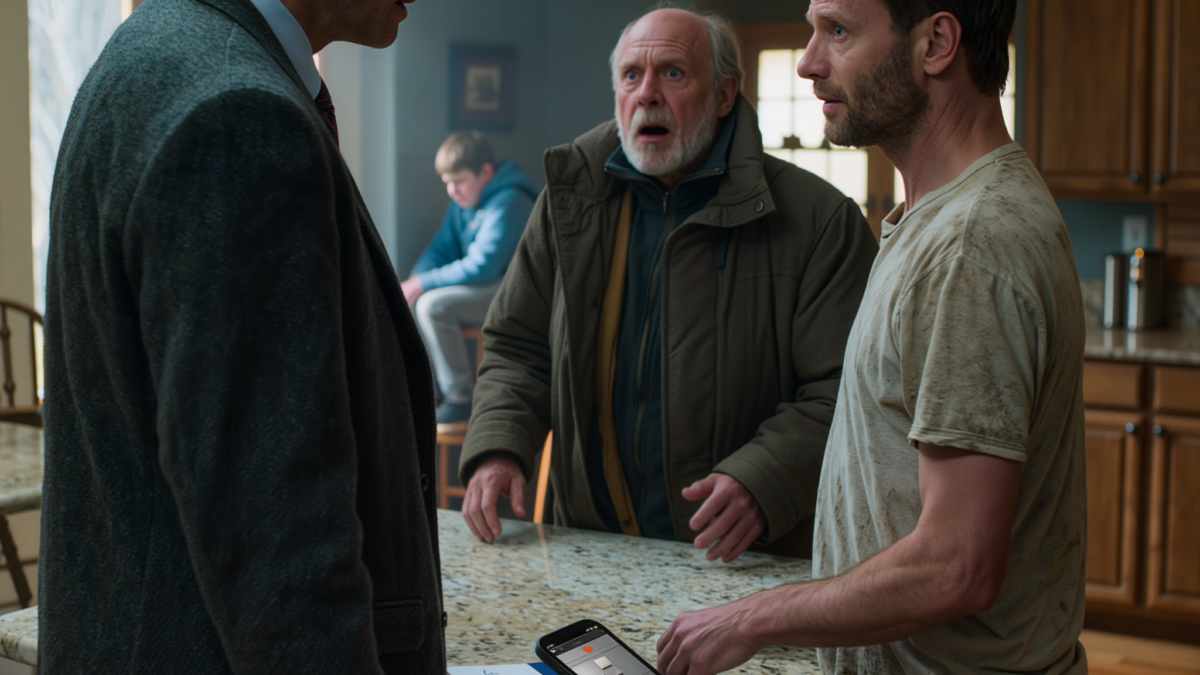
Then someone started pounding on my front door.
It wasn’t an ordinary knock. The heavy blows rattled the door in its frame.
“Logan! Open the damn door! I know you’re in there!”
I recognized Travis immediately.
I set my coffee on the granite counter and walked to the entryway.
Through the peephole, I saw my older brother standing on the porch in a thin blue fleece jacket, shivering in the freezing air.
My father stood behind him in a heavy winter coat. His face was bright red with anger.
Travis held his phone toward the frosted glass beside the door, as though he wanted me to see the screen before I even opened it.
I slid the security chain into place, unlocked the deadbolt, and opened the door a few inches.
“What do you want, Travis?”
He pushed his phone toward the narrow opening.
“You gave it away!” he shouted. “You gave away $31,000!”
On the screen was a Facebook photograph.
I was standing beside the director of a local community center, holding an oversized ceremonial check.
The amount printed on it was $31,000.
Travis looked frightened and furious at the same time.
“Good morning to you, too, Travis,” I said.
To understand why my brother was so upset about a decision involving my personal savings, you need to understand what my family had become.
For ten years, I’d been working in the technology industry, earning a good salary and living independently.
I was single, had no children, and owned my home.
To my father and brother, those facts meant one thing: I had money they could use.
They never announced that arrangement. It simply became the expectation.
At first, helping seemed normal.
Three winters earlier, Travis had damaged his SUV while driving recklessly on icy roads. His insurance didn’t cover the entire repair bill.
My father called.
He didn’t ask whether I could afford to help.
“Family helps family, Logan. Travis has a mortgage and a kid. You have disposable income. Do the right thing.”
I paid the mechanic $4,000.
Travis never even sent me a thank-you message.
Two springs ago, my father’s roof started leaking. He complained that he didn’t want to withdraw money from his retirement account or take out a loan.
I paid the roofing contractor $8,500.
Then there was Lily.
When Travis and Clara had their daughter, I opened a college savings account for her. Every month, I deposited $500 because Travis insisted his own salary was too tight to put anything aside.
I loved my niece. I wanted her to have opportunities when she grew older.
But underneath those generous decisions was something I rarely admitted.
I wanted my father to love me the way he loved Travis.
Our mother had passed away after a sudden illness when I was a junior in high school.
After her funeral, our family never really recovered.
Travis looked like our mother, and my father seemed to pour almost all his remaining affection into him.
Travis’s achievements mattered. His disappointments mattered. His financial problems became emergencies everyone else was expected to solve.
I became the dependable younger son who handled practical matters and paid bills.
I kept telling myself that my father would eventually notice everything I did.
Instead, the more I gave, the more everyone expected.
But the $31,000 Travis was shouting about on my porch wasn’t ordinary savings from my salary.
It came from my grandfather Nathaniel.
Nathaniel was my mother’s father. He had passed away a little over fourteen months earlier, and he was one of the few people in my family who had always made me feel valued.
He wasn’t impressed by expensive possessions, promotions, or the kinds of accomplishments my father liked discussing.
He cared about people.
For thirty years, Nathaniel had collected vintage baseball memorabilia.
His collection wasn’t made up of expensive modern collectibles. He loved old game programs, black-and-white photographs, and pieces of baseball history found at estate sales and small-town flea markets.
One of his favorite items was a pair of worn leather cleats that had belonged to a minor league player in the 1950s.
When his will was read in a lawyer’s office downtown, the collection was left entirely to me.
Not to my father.
Not to Travis.
To me.
My father was furious.
He argued that the collection should have been divided equally, but the documents clearly established Nathaniel’s wishes.
For about a year, I kept the boxes in my spare bedroom.
The smell of old paper and leather reminded me of my grandfather, and I wasn’t ready to part with those memories.
Eventually, an auction house in Chicago contacted me through a mutual acquaintance.
The collection was professionally evaluated over several months, and the final sale closed six weeks before that Christmas.
After fees and taxes, the amount deposited into my account was exactly $31,000.
I transferred it into a high-yield savings account and left it untouched.
That money represented the last tangible gift Nathaniel had given me. I didn’t intend to waste it, and I certainly didn’t intend to hand it over to my father or Travis.
Unfortunately, privacy had never been respected in my family.
People examined mail, listened to conversations that didn’t concern them, and passed along financial information.
An aunt eventually told Travis about the sale.
At the time, Travis and Clara were desperately trying to buy a house.
The housing market was competitive. Properties were selling above asking price, buyers were waiving inspections, and Travis had lost several bidding wars.
He wanted a house on Maple Street.
As his frustration grew, so did the hints about my savings.
At Thanksgiving, while I was carving the turkey, Travis put down his fork and complained about needing more liquid cash for a stronger down payment.
“If we just had an extra twenty or thirty grand to throw at the sellers, we could secure the house on Maple Street.”
He looked directly at me.
My father joined in.
“It’s an absolute crying shame that large sums of money are just sitting in bank accounts doing absolutely nothing, gathering dust when this family has a real tangible need right now.”
Then he reminded me that a good brother would want his niece to have a safe backyard.
Neither of them directly requested the money.
That would have meant acknowledging that I had the right to refuse.
Instead, they behaved as if I would eventually transfer it because that’s what I’d always done.
When my father excluded me from Christmas, something finally became clear.
I’d spent years paying for the privilege of being tolerated.
That realization changed what I did with the groceries, and eventually, what I did with Nathaniel’s inheritance.
After leaving the supermarket, I didn’t go straight home.
I drove across town to the Westdale Community Center.
Nathaniel had volunteered there almost every weekend during his retirement. He helped low-income families prepare tax documents, complete housing forms, and work through difficult financial circumstances.
The center was housed in an old brick building.
When I arrived, the parking lot was icy, and the brickwork showed years of weathering. But inside, the building was warm and busy with people preparing for the holiday.
I found David, the center’s director.
He had known Nathaniel well.
“Logan,” he said, looking up from a stack of clipboards. “It’s really good to see you. What brings you by so close to the holidays? Is everything all right?”
I explained that I had a trunk full of expensive groceries and that my family’s plans had changed.
“I’d like to donate it all for the community dinner you host on Christmas Eve.”
David didn’t press for an explanation.
He called over two teenage volunteers, and within ten minutes, the groceries were unloaded.
The food I’d purchased for people who didn’t want me around would now help feed people who actually needed it.
I should have felt satisfied enough to leave.
But as I crossed the lobby, I noticed a small bronze memorial plaque bearing Nathaniel’s name.
I stopped in front of it.
For years, I’d treated my earnings like a tool for keeping my family comfortable. Yet the one person who had never demanded money from me had spent much of his retirement helping strangers.
Standing in that lobby, I made a decision.
I returned to David’s office and sat across from his desk.
“David, what is the absolute largest single financial donation this community center has ever received?”
He thought for a moment.
“Maybe ten or twelve thousand. A local credit union gave us a grant a few years back specifically for the emergency housing fund. We stretched that money for a year. Why do you ask?”
I reached into my coat and took out my checkbook.
“Because I’d like to formally donate $31,000.”
David dropped his pen.
I explained that the donation would be made in Nathaniel’s name. Half would support the holiday meal program, and half would go into the housing stability fund.
I wanted the housing money used for first and last month’s rent deposits for families facing eviction.
David stared at me.
“Logan, are you serious? That is a massive life-changing amount of money for this center. Are you absolutely sure about this? You don’t want to take a few days to think it over? You don’t need to consult your father?”
“My father has absolutely nothing to do with this,” I told him. “And I’ve never been more sure of anything in my entire life.”
I wrote the amount carefully.
$31,000.
Then I signed the check and slid it across his desk.
There was one condition.
I wanted the donation made public.
I asked David to photograph it and publish the amount on the center’s official Facebook page, along with my name and Nathaniel’s. I wanted people to know exactly what the money would support.
David agreed.
He said the photograph would be posted that evening.
When I left the center, I felt lighter than I had in years.
I’d made a decision without asking whether my father would approve. I hadn’t needed Travis’s permission. The money was mine, and I had chosen to use it in a way that honored someone I loved.
I drove home, ordered a large pepperoni pizza, silenced my phone, and watched an action movie.
While I was eating my second slice, events were already unfolding elsewhere.
I learned the details later.
At 9:30 that evening, the community center published its Facebook post.
The message thanked me for the $31,000 donation in Nathaniel’s memory and explained how it would provide holiday meals and housing assistance for local families.
Both our names appeared prominently.
Around 10 p.m., a family friend named Cameron saw it.
Cameron knew Travis had been bragging about buying an expensive house. When he recognized the amount in the post, he took a screenshot and sent it to my brother.
“Bro, isn’t this the cash you said you were using for your closing costs?”
According to Clara, Travis was watching television in his rented living room when the message arrived.
He looked at the screen, went pale, and dropped his phone onto the coffee table.
Then he picked it up and called our father.
“Dad. He gave it away. Logan gave the money to charity.”
William was annoyed at being disturbed.
“What the hell are you talking about, Travis? Have you been drinking?”
“The thirty-one grand. The bank account. It’s gone. He wrote a massive check to the community center. Cameron just sent me the post.”
Then Travis explained why he was panicking.
The mortgage underwriter was scheduled to perform final asset verification on Monday morning. Closing was planned for Wednesday.
If the money wasn’t available, the loan could fall apart.
Travis had already put down a $30,000 earnest money deposit.
He feared losing the deposit, losing the house, and facing a lawsuit from the sellers.
This was the part I hadn’t known.
My father and brother hadn’t merely hoped I would offer them financial assistance.
They had already built their mortgage application around my money.
About a month earlier, William had come to my house on a Saturday afternoon, supposedly to help repair a leaking pipe under my kitchen sink.
While we were working, I discovered that I needed replacement PVC parts.
I drove to the hardware store.
My father stayed behind.
But instead of remaining in the kitchen, he entered my home office.
He opened my locked filing cabinet and searched through my financial documents.
Then he took an official paper bank statement showing the $31,000 balance in my savings account.
Travis and his real estate agent, Scott, had submitted an aggressive offer on the property on Maple Street.
To win the bidding war against four other buyers, they waived both financing and inspection contingencies.
But the lender required proof that Travis had enough financial reserves to complete the purchase.
He didn’t.
So my father gave him my bank statement.
The documents later presented to me showed that a formal gift letter had also been submitted, claiming that I had agreed to give Travis the entire $31,000 without expecting repayment.
My signature appeared on that document.
I hadn’t signed it.
They were counting on my history of paying their expenses. Apparently, they believed they could tell me about the arrangement at the last minute, present it as a family emergency, and pressure me into transferring the funds.
They expected me to protect Travis from the consequences of a contract he’d signed using money he didn’t have.
But I’d already donated the inheritance.
That was why they appeared at my door at 7:15 the following morning.
After seeing Travis’s phone through the narrow opening, I removed the security chain and opened the door.
He pushed inside without removing his wet boots, tracking dirty snow across my hardwood floor.
William followed and shut the door hard behind him.
“Are you completely insane?” my father demanded.
He pulled off his gloves and threw them onto the console table.
“Do you have any idea what you just did?”
I took another sip of coffee.
“I donated my grandfather’s money to a place he loved. In his memory, it’s a fantastic tax write-off for the year. I’m feeling very festive. You should be proud of my philanthropy.”
Travis began pacing in front of the television.
He demanded that I call the center and recover the money immediately.
He even suggested I tell David the donation had been a mistake or that I hadn’t been thinking clearly.
“It’s a cleared cashier’s check, Travis,” I told him. “It’s already gone. The funds are allocated. Housed families and hot meals for the homeless. Happy holidays.”
My father moved closer.
For years, he had relied on his height, his voice, and his authority as a parent to make me back down.
“We deeply needed that money, Logan,” he said. “Travis is under strict contract. He waived the financing contingency to win the bid. The sellers accepted. We close in exactly five days. We are short on cash and you knew that. You did this deliberately to ruin your brother.”
I looked at him.
“I knew you wanted a massive handout. I didn’t know you were stupid enough to sign a legally binding real estate contract using money that did not belong to you and money you never explicitly asked me for.”
Travis stopped pacing.
“You’re doing this to punish me because of the stupid Christmas dinner. Look, Logan, the Christmas thing was Dad’s idea.”
William shot him a warning look.
But Travis kept talking.
He said our father had thought I was depressing to be around.
Then he brought Lily into it.
According to Travis, his six-year-old daughter was frightened of me. He claimed she didn’t like how I behaved and hadn’t wanted me at Christmas dinner.
That accusation hurt more than the financial demands.
I loved Lily. I’d been saving for her education since she was born.
The idea that she might be uncomfortable around me made me question what I’d been told about my own place in the family.
Instead of arguing, I reached for my phone.
“What are you doing?” my father asked.
“I’m calling Lily.”
Travis objected immediately. He didn’t want his daughter involved.
But I had no intention of arguing with a child or discussing the mortgage.
I simply wanted to hear her voice.
I called Clara.
She sounded tired when she answered, but she passed the phone to Lily after I asked whether my niece was awake.
“Uncle Logan!”
Her familiar, cheerful voice came through the speaker.
“Hey, sweetie. I just wanted to call and say hi. Are you excited for Santa to come?”
“Yeah, I asked for a big dollhouse.”
Then she asked something I hadn’t expected.
“Are you still coming to dinner at our house? Grandpa William said you didn’t want to come anymore.”
I looked at my father.
“What exactly did Grandpa say to you, Lily?”
She explained that William had told her I thought their new house was too small and didn’t want to eat with them.
Then she added that she’d offered to make room for me on the couch so I wouldn’t feel crowded.
I thanked her, told her I’d get her present to her soon, and let her return to her morning cartoons.
After the call ended, I looked directly at William.
He had told me I wasn’t welcome.
Then he’d told a six-year-old girl that I had chosen not to come.
“You lied to my face and you actively manipulated your own granddaughter just so you wouldn’t have to look at the guy you were actively trying to steal from.”
My father lowered his gaze.
“I was just trying to keep the peace, Logan.”
But I wasn’t finished.
I told him that excluding me was one thing. Making Lily believe I’d rejected her was something else entirely.
Travis was becoming increasingly agitated.
He tried again to explain why the money was so important.
He mentioned the mortgage broker and the bank, then stopped mid-sentence.
My father shook his head sharply, signaling that he should be quiet.
That was when I realized the problem might be bigger than losing a deposit.
“What about the mortgage broker, Travis? What exactly did you submit to the federal underwriters to get approved for a house you clearly cannot afford?”
Travis opened his mouth.
Before he could answer, the doorbell rang.
Through the front window, I saw a black SUV parked at the curb.
A stern-looking man in a gray suit and dark overcoat stood on the porch, carrying a thick leather briefcase.
The effect on my family was immediate.
Travis looked terrified.
My father’s expression changed completely.
I opened the door wider.
The visitor was tall, professionally dressed, and composed. His charcoal-gray suit and dark wool coat looked unusually formal against the backdrop of my quiet suburban neighborhood.
“Good morning,” he said. “I am looking for a Mr. Logan Parker. Is he present at this residence?”
“I am Logan Parker. How can I help you this morning?”
He took out a wallet containing a badge and federal identification.
“My name is Richard Preston. I am a senior fraud investigator operating with the Federal Housing Finance Agency, currently working in direct conjunction with First National Bank’s mortgage underwriting division. I am here regarding a highly irregular flagged transaction on a pending real estate closing for a Mr. Travis Parker.”
Travis sank onto the living room sofa, struggling to control his breathing.
William immediately tried to take charge.
He introduced himself and insisted that everything was a misunderstanding.
According to him, the bank had made a simple clerical error, and our family was already resolving it.
Preston remained unmoved.
“Mr. Parker, I am not here to discuss clerical errors with you. I am here to speak directly to Logan Parker regarding a sworn financial document submitted under penalty of perjury to a federally backed lending institution.”
My father turned toward me.
“Why don’t you invite the nice man inside? Offer him a cup of coffee. Tell him everything is perfectly fine. Tell him all about the generous financial gift you are giving your older brother for his beautiful new home.”
I looked from William to Travis, then back to Preston.
“Please come inside, Mr. Preston. I’ll make a fresh pot of coffee. We clearly have plenty of important things to talk about today.”
Preston entered the kitchen and set his briefcase on the granite island.
William followed him closely, still trying to control the conversation.
He claimed I’d been experiencing emotional difficulties and that the stress of the holidays had caused me to act impulsively.
He suggested the charitable donation was an unauthorized transfer that our family intended to reverse.
Then he assured Preston that the money for Travis’s purchase was secure.
Preston opened his briefcase.
He removed a thick manila folder and laid three documents on the counter.
He told me that two weeks earlier, Travis had submitted a proof-of-funds packet in support of a large mortgage application.
One document was an official paper bank statement from my personal high-yield savings account.
It showed a balance of exactly $31,000.
I recognized the account immediately.
“That money was my direct inheritance from my late grandfather. I just finalized the legal sale of his estate through an auction house.”
Preston pointed to the next document.
It was a formal gift letter.
He explained that the lender had received it as confirmation that I had willingly agreed to provide the full $31,000 for Travis’s purchase on Maple Street.
The document stated that the money was a gift, not a loan, and that I expected no repayment.
It also carried my name and signature.
My father leaned forward.
“Exactly. See, he signed it.”
He pointed to the signature and insisted that I was simply having second thoughts because of the Christmas argument.
He tried to make the situation sound like a disagreement between brothers rather than a question about whether the bank had received valid documents.
Travis finally stood up from the sofa and moved into the kitchen.
He leaned against the doorway, looking exhausted and frightened.
“Logan, please. Just tell him you signed the letter. Just tell him it’s fine. I am begging you.”
He explained that the sellers could sue him for breach of contract and that he might lose the entire $30,000 earnest money deposit.
He feared losing his savings to legal fees.
I looked down at the document.
The signature was remarkably convincing.
My first and last name were written in dark blue ink, with the same sharp L and looping P I used when signing checks.
Someone had made an effort to reproduce my handwriting.
Preston looked at me.
“Did you physically sign this document?”
He explained that if I had signed the letter and later withdrawn the promised funds, the lender would treat that very seriously.
My father watched me closely.
For most of my life, this was the point where I would have given in.
I would have worried about his anger. I would have wanted to save Travis. I would have tried to make everyone happy even if it meant sacrificing something important to me.
But I remembered the supermarket.
I remembered standing beside a cart filled with food I wasn’t welcome to serve.
I remembered the $4,000 repair bill, the $8,500 roof, and every month I’d put money into Lily’s future.
And I remembered Nathaniel.
“I have never seen this document in my entire life,” I said. “I did not sign it. That signature is a complete forgery.”
My father exploded.
He called me a liar and accused me of trying to ruin Travis because I was jealous of him.
He moved toward me angrily, raising his hand as if he intended to strike me.
Preston intervened before the situation escalated.
He firmly instructed my father to lower his hand and move away, warning that he would contact the local police if necessary.
William stopped.
Then he returned to insisting that the signature was genuine.
I turned back to Preston.
I repeated that I had never agreed to give Travis any part of Nathaniel’s inheritance, either verbally or in writing.
Until that morning, I hadn’t even known my personal bank statement was included in the mortgage application.
Preston wrote down my explanation.
Then he asked how Travis had obtained the document.
It wasn’t a digital printout.
It was an original paper bank statement mailed to my address.
“Because my father stole it from my home office,” I said.
William immediately denied it.
He accused me of making a defamatory allegation and demanded proof.
I reached into my pocket and took out my smartphone.
“Actually, Dad, I do have proof. Concrete proof.”
I opened the smart home security application.
I explained to Preston that I worked as a senior systems engineer in the technology industry.
A few months earlier, our neighborhood had experienced a series of break-ins involving stolen packages and garages.
Because of that, I’d installed discreet motion-activated Wise cameras inside my house.
One camera pointed directly at the filing cabinet in my home office, where I kept tax records, my passport, and financial documents.
William’s expression changed as soon as he understood what I was saying.
I navigated to a recording saved from Saturday, November 12th.
That was the day he’d come over to help fix the leaking pipe.
I’d gone to Home Depot to buy a replacement valve and had been away for exactly twenty-two minutes.
I placed my phone flat on the granite counter beside the gift letter and started the recording.
The video was clear, captured in 1080p with audio.
It showed my father walking into the empty office and looking around.
Then he took a small metal tool from his pocket and opened the filing cabinet lock.
He searched through the folders until he found the blue-banded envelope containing my bank statements.
The camera captured him taking the envelope, folding it, and putting it inside his coat.
He closed the drawer and left the office.
Preston leaned over the counter to watch.
Nobody spoke while the recording played.
When it ended, the kitchen was quiet except for the faint ticking of the wall clock.
“I can email that MP4 file directly to your secure office server right now, Mr. Preston,” I offered.
Preston handed me a business card with an encrypted email address.
“That would be extremely helpful, Logan. Please send it to the encrypted email address listed there.”
Travis stood up so abruptly that his bar stool fell backward.
“Logan, please. Please don’t do this to me.”
He was crying.
He said Clara would leave him if she discovered what had happened. He was terrified of losing custody of Lily and facing criminal charges.
“Think of Lily’s college fund,” he pleaded.
I looked at him.
“You should have thought about your wife, your child, and your custody arrangement before you sat down and forged my signature on a federal banking document. You chose this.”
Then my father changed his approach.
His anger gave way to apologies and pleading.
“Logan, son, please listen to me.”
He explained that Travis had been under enormous pressure because of the housing market. He claimed they hadn’t meant to take my inheritance permanently.
According to William, they only needed the documentation to get through underwriting and secure the property before another buyer took it.
He said they had planned to ask me properly on Christmas Day.
“We weren’t stealing your inheritance. We were just borrowing the proof of funds temporarily.”
I reminded him of exactly what he’d done.
He had entered my locked filing cabinet.
He had taken my private bank statement.
He had helped create a situation where a lender believed I had agreed to give my brother money.
And after all of that, he had excluded me from Christmas because I was supposedly too unpleasant to be around.
“You didn’t love me,” I told him. “You never loved me. You only loved my credit score and my salary.”
Then I turned to Preston.
“Mr. Preston, what exactly happens now?”
He gathered the documents and put them back into his folder.
He explained that the mortgage application would be flagged for fraudulent activity and that the pending loan was being denied.
He said the sellers and their real estate representative would be notified that the buyer had failed to secure financing because of forged documentation.
He also explained that the file, including the security footage, would be forwarded to the district attorney’s office for review.
Travis was devastated.
Preston closed his briefcase, nodded to me, and left.
After the front door shut behind him, I looked at my father and brother.
The two men who had treated my earnings like a family resource had just watched a financial decision of mine expose the documents they had submitted without my consent.
“You have exactly thirty seconds to get yourselves out of my house,” I told them.
My father stared at me.
“You are no son of mine,” he said.
“I know,” I replied. “And you have twenty seconds left.”
They left.
Once the door closed, I leaned against the hallway wall and took a long breath.
I expected guilt.
After so many years of giving in, I thought I’d feel responsible for whatever happened to Travis and William next.
But I didn’t.
For the first time in my adult life, I felt that their decisions were no longer mine to fix.
I went straight to my home office.
First, I called an emergency locksmith.
I paid the weekend premium to have someone come out within the hour and replace the locks on my front door, back patio door, and interior garage door.
My father had previously held a spare key, and I no longer wanted him to have access to my home.
Next, I opened my Verizon family plan.
For six years, I’d been paying the cell phone bills for William, Travis, and Clara, including data overages and phone upgrades.
I suspended their lines.
Then I logged into my Geico insurance account.
I’d been the primary policyholder for my father’s truck because he’d complained about the cost of insurance after receiving a reckless driving ticket.
I removed his vehicle from my policy.
I also changed the passwords for Netflix, Hulu, and Amazon Prime and logged out the devices using my accounts.
Finally, I opened the financial portal for Lily’s 529 college savings plan.
I didn’t withdraw anything.
That money belonged to her future, and I had no intention of punishing her for what her father and grandfather had done.
But I revoked Travis’s viewing and management access.
He could no longer see the balance or attempt to use the account to solve his own financial problems.
Every change represented another financial obligation I was choosing to end.
The following weeks were difficult for Travis and William.
Because I’d suspended their phone service, they began calling my office and leaving angry voicemails.
I didn’t return those calls.
Instead, I saved the recordings in an encrypted folder for the lawyer I’d retained in case the harassment continued.
Meanwhile, Travis’s real estate transaction collapsed.
The waived financing contingency became a serious problem.
Because he’d submitted an offer without that protection, the loss of financing didn’t automatically release him from his contractual obligations.
The sellers kept his $30,000 earnest money deposit.
They also hired a real estate litigation attorney and filed a civil lawsuit seeking damages for breach of contract.
They argued that Travis had kept their property off the market during an important selling period.
His financial position deteriorated rapidly.
The damaged credit and potential legal expenses placed enormous pressure on a household that had already struggled to afford the purchase.
But the worst development for Travis was what happened with Clara.
When she learned why the house purchase had failed, she discovered that her husband and father-in-law had used my private financial information and a forged signature in the mortgage application.
According to the family members who later passed along the details, Clara was furious.
She packed her bags three days before Christmas, took Lily, and moved into her parents’ home.
Then she hired a divorce attorney.
She filed for sole physical and legal custody, citing Travis’s financial instability, dishonesty, and potential criminal consequences.
I heard much of this through an aunt who suddenly wanted to be close to me after years of showing little interest.
William tried desperately to help Travis.
He withdrew money from his retirement account, accepting substantial early-withdrawal tax penalties to cover criminal defense retainers and efforts to resolve the civil lawsuit.
The same man who had once refused to use his retirement savings to repair his own roof was now spending those savings to address the consequences of Travis’s real estate decisions.
His financial security began to disappear.
Neither man was enjoying the Christmas they’d excluded me from.
But I was doing something different.
On Christmas morning, I woke up at exactly 7 a.m. feeling genuinely rested.
There was no rush to buy groceries for someone else’s preferences.
No need to prepare for passive-aggressive comments about my career or personal life.
No obligation to sit at a table where I was treated like an inconvenience.
I put on a warm sweater and drove to the community center.
I spent eight hours helping serve hot turkey, mashed potatoes, and pecan pie to hundreds of people.
I worked alongside Marcus, the director, and the volunteers who had organized the holiday meal.
The dining hall was busy and noisy. People moved between tables carrying food, and families gathered together out of the cold.
They thanked us as we served them.
At one point, a young mother approached me in the kitchen.
She had received help with her first month’s rent through the housing fund established with Nathaniel’s donation.
She hugged me tightly and cried as she thanked me for helping her family avoid sleeping in their car that winter.
I had spent years trying to make people appreciate me by paying their bills.
That morning, I felt appreciated for something entirely different.
For once, I felt I belonged.
As winter gave way to spring, life began changing in ways I hadn’t expected.
Without the constant financial demands and family conflicts, I had more energy for my work.
By mid-April, I had completed a major software integration proposal that I’d struggled to focus on previously.
I presented it to the executive board at my company.
They liked the initiative.
I received a promotion to senior director, along with a corner office overlooking the skyline and a substantial salary increase.
The raise more than covered the $31,000 I’d donated to the center.
I also began taking better care of myself.
I returned to the gym regularly and lost some of the weight I’d gained during years of stress.
I started dating again and meeting people who seemed interested in me as a person rather than in what I could pay for.
Eventually, I adopted a golden retriever mix named Buster.
Every evening, he greeted me enthusiastically at the front door.
It was a simple kind of companionship, but it made coming home feel different.
Six months passed without a conversation with my father or Travis.
The criminal investigation continued. Neither had been officially indicted at that point, but both were still dealing with legal expenses.
William eventually sold his truck.
He also left his comfortable house for a smaller apartment on the edge of town because he needed money to keep paying the lawyers and supporting Travis.
I learned these details from relatives, not from either of them directly.
I had chosen to stay away.
Then, on a warm Tuesday afternoon in late June, I was volunteering at the community center.
I’d continued helping there twice a week. That day, Marcus and the volunteers were organizing donated supplies for the summer food pantry.
I was carrying a heavy cardboard box of canned soup toward the back storage room when I stopped.
Travis was standing near the metal shelves.
He wore a bright orange volunteer safety vest and looked exhausted.
He had lost a noticeable amount of weight. His clothes and scuffed sneakers were ordinary, and the confidence I’d always associated with him was gone.
He looked older.
When he saw me, he froze.
A can of sweet corn slipped from his hand and struck the concrete floor.
“Logan,” he said quietly.
I set my box on a folding table.
I wasn’t frightened of him anymore.
I wasn’t especially angry, either.
Mostly, I felt sad looking at how much his life had changed.
“What exactly are you doing here, Travis?” I asked. “Did the federal court officially order you to do community service as part of a plea deal?”
He shook his head.
“No, not yet.”
Then he explained that his defense lawyer believed he might eventually receive extended probation through a plea agreement because it was a first offense and the loan had never actually funded.
He said our father had accepted much of the blame for taking the bank statement.
William had told the lawyers it was his idea.
Travis took a breath.
Then he explained why he was volunteering.
Clara wouldn’t allow him to see Lily unless he demonstrated meaningful changes in his behavior.
She had described him as selfish, entitled, and unwilling to take responsibility for his actions.
Travis admitted that she was right.
“I came to this specific center because I knew this is where you found peace. I wanted to see what it looked like to do something for someone else.”
I crossed my arms and leaned against a pallet of bottled water.
“And what have you learned?”
His eyes filled with tears.
“I’m sorry,” he said.
This time, he wasn’t shouting or demanding money.
He looked exhausted by everything that had happened.
“Logan, I am so incredibly sorry for the house, for the fraud, for ten years of treating you like absolute dirt.”
He told me our father had always encouraged him to see my earnings as something the family could rely on.
William had claimed that I enjoyed being needed financially because I was lonely.
Travis admitted he’d believed it because it benefited him.
“I lost my wife. I rarely see my daughter. I ruined my entire life because I thought I was automatically entitled to yours.”
I listened.
I had imagined an apology from my brother many times over the years.
When it finally came, it didn’t erase anything.
But I could hear that he understood more about what he’d done than he had six months earlier.
We stood in silence for a while.
Then I said, “I forgive you, Travis.”
He looked up immediately.
For a moment, he seemed hopeful.
“Really, Logan? Thank you. Thank you so much. Maybe we could get a cup of coffee sometime. Maybe you could come see Lily this weekend. She really misses you.”
He took a small step toward me.
I raised my hand to stop him.
“I forgive you,” I repeated.
Then I explained what I meant.
I didn’t want to spend the rest of my life carrying anger toward him. I didn’t want his actions to keep affecting my peace, my relationships, or the way I saw myself.
Forgiveness was something I was choosing for my own sake.
But it didn’t mean our relationship could return to what it had been.
“Forgiveness does not equal access.”
The hope disappeared from his expression.
I told him he had crossed a line that couldn’t simply be erased with an apology.
He had participated in using my financial information without permission. He had tried to claim my grandfather’s inheritance. He had allowed our father to lie to Lily about why I wasn’t at Christmas dinner.
Those choices had consequences.
I genuinely hoped Travis continued making changes and became a better father to Lily.
I hoped he found stability and learned to treat people differently.
But I wasn’t willing to resume the relationship that had hurt me for most of my adult life.
“I am not your financial safety net. I am not your punching bag. We are done.”
He didn’t try to stop me.
I picked up an empty cardboard box from the table and walked out of the storage room into the main hall.
I never looked back.
For most of my life, I’d believed that being related to someone meant I had to keep making sacrifices, regardless of how I was treated.
I no longer believe that.
Blood relationships can be important, but they don’t automatically create respect, trust, or love.
The people who deserve a place in your life are the ones who respect your boundaries, celebrate your accomplishments, and care about you without expecting payment in return.
Nathaniel understood that long before I did.
His final gift gave me the chance to learn it for myself.
It took me 32 years of pain and $31,000 to learn that lesson.
And I wouldn’t trade that money back for the world.








