Dad ordered me to drink the wine he’d poured at Thanksgiving while my brother smirked across the table. “To the family fortune,” he whispered. It was Grandpa’s 1985 Cabernet—but there was white powder at the bottom of my glass. I let my silver fork fall. When they looked away, I switched our glasses. Fourteen minutes later, Dad stopped in the middle of a threat.
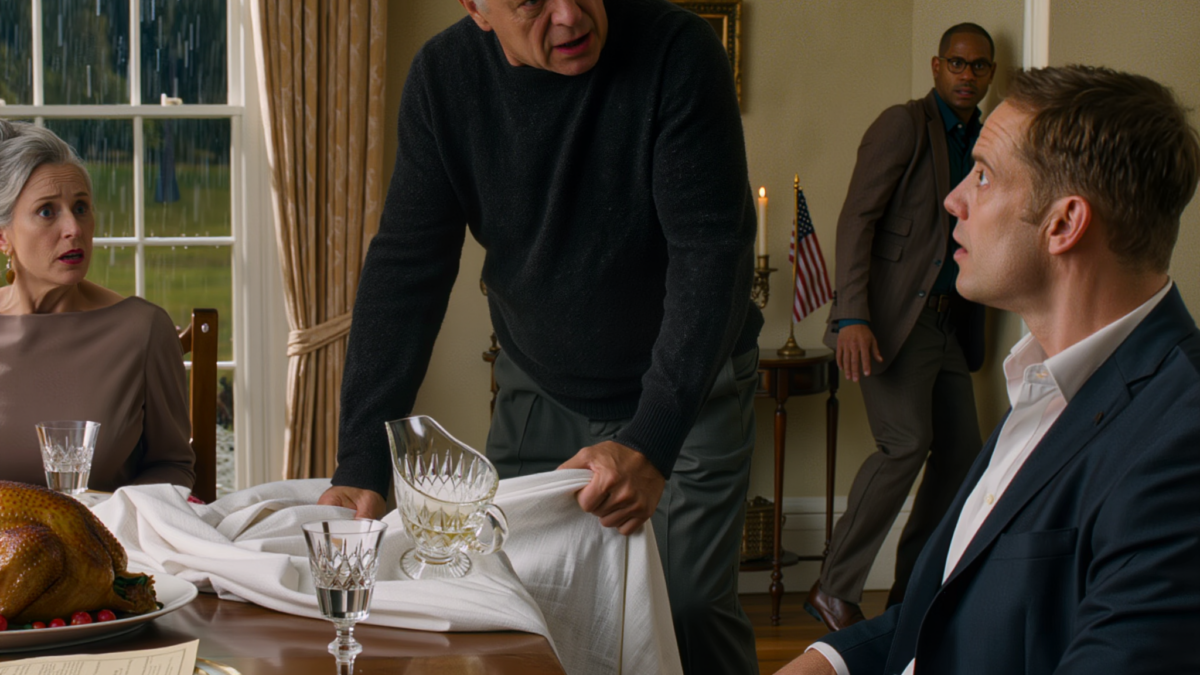
My name is Callum, and I’m thirty-six years old. Three months ago, I sat at a beautifully decorated Thanksgiving table while my father and older brother smiled at me over a glass of poisoned wine.
My father pushed the heavy crystal goblet toward my plate. He looked directly into my eyes, keeping his voice low enough to make the words sound almost affectionate.
“To the family fortune, son.”
Across the table, my brother, Tristan, smirked. He was already thinking about the inheritance he expected to collect. They were prepared to eat their turkey and watch me collapse on the Persian rug beneath our feet.
To them, I was an obstacle between the family and millions of dollars. But before I arrived that evening, I had spoken to the housekeeper and hired a private investigator. I knew why there was white powder at the bottom of my glass.
One of those men is now in a maximum-security prison, begging for a pardon he will never receive. Văn bản đã dán (1)
The dining room smelled of roasted sage and beeswax candles. Outside, a November storm battered the Northern California coast. Rain struck the Victorian windows, and each flash of lightning stretched the shadows across the polished mahogany table.
I sat in my usual place, to the right of my father, Vance. My mother, Hadley, was directly across from me. Her face was pale, and her hands trembled so badly that she kept them beneath the linen tablecloth. She stared at her empty porcelain plate rather than look at any of us.
Tristan sat at the far end of the table, swirling his water glass. He was trying to look bored, but his leather shoe tapped steadily against the hardwood floor. Every few seconds, his attention returned to Dad.
Vance stood, smoothed the front of his cashmere sweater, and walked to the antique sideboard. A decanter of dark red wine waited there, a 1985 Cabernet from my late grandfather Thaddius’s private reserve.
He picked up two identical crystal goblets and turned his back to the room. His shoulders blocked my view of his hands. My heart was pounding, but I kept my expression still. I had prepared for this moment, although preparing for it had not made it easier to sit through.
When he turned around, he carried a glass in each hand. He walked toward me slowly, the wine almost black in the candlelight. He set one goblet in front of me, aligning it with my silver knife, and placed the other at his own setting.
Lightning briefly illuminated the room. In that instant, I saw a pale swirl at the bottom of my glass, powder that had not completely dissolved. I knew it was not sediment from an old bottle.
Vance settled into his captain’s chair without touching his food. He watched me, while Tristan leaned forward slightly at the other end of the table.
“Drink up, Callum,” Dad said. “It’s a celebration of our family’s future.”
I reached for the stem. The crystal was cold against my fingers, and my mind ran through everything that could happen if I refused.
They would know I suspected them. Vance was desperate, and Tristan was reckless. We were miles from the nearest police station, with the storm making the house feel even more isolated. I feared that if their plan failed, they might try to hurt me another way.
I wanted evidence they could not explain away. I also wanted to leave that house alive.
I raised the wine halfway to my mouth, then stopped.
“Wait. I think I forgot Mom’s Thanksgiving gift in the car.”
“Sit down,” Vance barked.
Even Tristan looked startled by the force of it. Dad had abandoned the pleasant tone he used when he wanted other people to believe we were a close family.
“It can wait until after dinner. Drink the wine, Callum.”
“Right. Sorry. Just nerves.”
I gave him an embarrassed smile and lowered the glass. As I set it down, I swept my left arm across the edge of the table and knocked my silver fork onto the floor. It clattered against the hardwood and slid beneath my chair.
“For God’s sake, Callum, you’re completely uncoordinated.”
Vance slapped his hand against the table and rolled his eyes at Tristan. My brother looked back at him with the familiar expression they shared whenever I gave them another reason to feel superior.
I bent down for the fork, keeping my right hand above the table. The glasses were only six inches apart. I slid the one meant for me onto Dad’s placemat and moved his to mine.
The exchange took less than three seconds.
I sat up with the fork in my hand and forced a small, embarrassed laugh. The goblets looked identical. Dad turned back toward me, still irritated, but he had not seen what I had done.
“Stop acting like a child and drink.”
He picked up the glass in front of him. I picked up the one now in front of me.
“To the family fortune,” he whispered.
“To the family fortune,” I repeated.
We drank.
I watched him swallow, then set his half-empty glass on the table with a satisfied sigh. The room seemed to slow around me. I was sitting beside the man who had raised me, knowing that I had just let him drink what he had prepared for his own son. Văn bản đã dán (1)
From the outside, my life looked secure. I was a senior architect in San Francisco, specializing in sustainable, high-end urban spaces. I earned a substantial salary, lived in a penthouse overlooking the bay, and drove a black Porsche 911 that I had bought in cash.
My work depended on understanding what held a structure together. I knew how to evaluate foundations, distribute weight, and recognize weaknesses before they became failures. None of that expertise had taught me how to manage the family I came from.
Tristan was forty, unemployed, and dependent on our parents. While I spent my twenties working through architecture school, borrowing money for tuition, and taking night shifts to cover groceries, he had been given a large college fund. He spent it on parties and businesses that never went anywhere.
Dad treated those failures as temporary setbacks. My decision to become an architect instead of joining his law firm was, in his eyes, a permanent betrayal.
Tristan was the son whose mistakes could always be explained. I was the one expected to justify every choice, every achievement, and every hour I spent away from the family.
The first attempt had happened three months before Thanksgiving. Until then, I believed distance was enough to protect me.
I skipped family vacations and stayed away from country club galas. I limited contact to short, polite phone calls. My career was approaching a major turning point, and for the first time, I felt that the life I had built belonged entirely to me.
Then my mother called.
It was a Tuesday afternoon in late August. I was standing in my glass-walled office in downtown San Francisco, checking the final blueprints for a large commercial real estate project. The project could lead to a partner-level promotion, and I needed to get every detail right.
My door opened without a knock. Silas, another architect at the firm, leaned against the frame with a grin.
He spent more time cultivating the partners and collecting office gossip than working on designs. He also wanted the promotion, and he rarely passed up an opportunity to suggest that I was struggling.
“Rough day, Callum? I heard the client is pushing back on the budget. Need me to step in and save your sinking ship? I know you struggle with the financial side of these larger builds.”
“The project is fine, Silas. Close the door on your way out.”
I kept my red pen moving across the drawings. Before he could answer, my cell phone rang. The screen displayed a name I rarely saw during the workday: Mother.
Silas noticed the change in my expression.
“Mommy calling? Better take that, Callum. Wouldn’t want to get grounded and lose your allowance.”
He left the door partly open when he walked away. I took a breath and answered.
“Hello, Mom.”
“Callum. You haven’t forgotten, have you?”
“Forgotten what?”
“Your father’s birthday dinner this weekend. He’s expecting you.”
My grip tightened around the phone. Going back to the Blackwood estate in Napa Valley meant returning to a house where every conversation could become a test I had already failed.
Vance almost never made these calls himself. He sent my mother because he knew I would listen to her longer than I would listen to him.
“I’m busy, Mom. I have a major presentation next week. I can’t drive two hours north just to get insulted by Vance and watch Tristan act like he owns the place.”
“Please, Callum.”
Her voice broke, and I stopped looking at the blueprints.
“Things have been difficult lately. Tristan is struggling with his new business, and your father is under a lot of stress. The estate needs repairs. The vineyard yields are down. I just need you here. I need one normal family dinner.”
That was what usually brought me back: not Dad’s demands, but the strain in her voice.
Hadley had spent thirty years making herself smaller around my father. She had defended him, excused him, and remained silent through some of his worst behavior. But I also knew how frightened she was of him.
The thought of leaving her alone in that house with Vance and Tristan made it difficult to maintain the boundaries I had set.
“Fine. I’ll be there Saturday. But I’m not staying the night. I’m driving back to the city after dessert.”
“Thank you, Callum. Drive safely.”
She ended the call before I could reconsider. Through my office window, summer fog obscured the Golden Gate Bridge.
I had paid for my education by working overnight shifts at Walmart. I had built my career without Dad’s help and bought my own home and car. I did not want the family’s money, and I wanted even less to be indebted to Vance.
Still, when Saturday arrived, I went.
A heavy heat wave had settled over the valley. As I drove up the winding gravel driveway, I noticed how tired the estate looked. The gray paint was peeling around the gables, and the lawns had gone brown.
The house had always been part of Dad’s authority. Its size, its age, and its appearance helped him convince other people that the Blackwoods were secure and untouchable. Now the neglect was visible before I even reached the front door.
Inside, the air smelled of old paper, lemon polish, and stale cognac. Mom met me in the foyer. Her silk dress hung loosely from her shoulders, and the pearl necklace at her throat seemed too heavy for her.
“He’s in the dining room with Tristan,” she whispered, taking the small gift box from my hand. “Please keep the peace today, Callum. Don’t engage with them.”
Dad sat at the head of the table with a glass of scotch. Tristan lounged beside him, looking at his phone. Both looked up when I entered.
“Ah, the prodigal architect graces us with his presence,” Vance said. “Did you park that flashy German toy around back? We wouldn’t want the neighbors thinking we associate with new money.”
“Happy birthday, Vance.”
I sat opposite Tristan and let the comment pass.
Over the appetizer, my brother talked about a cryptocurrency investment he had found online. It sounded like another scheme to me, but Dad nodded as though he were listening to an experienced financier. He praised Tristan’s entrepreneurial instincts and willingness to take risks.
Then he turned to me.
He questioned my career, my refusal to join the family’s social clubs, and the fact that I was not married. He mentioned a family friend’s divorce only so he could point out that I had not managed to get married in the first place, much less face a custody dispute or alimony.
I ate my salad without arguing. Experience had taught me that a defense only gave him more material. He did not ask questions because he wanted to understand my life.
After the main course was cleared, Dad stood and walked to a dusty bottle on the sideboard.
“I decided to open something special tonight. This is from your grandfather Thaddius’s private cellar. He saved it for a momentous occasion.”
That surprised me. Vance rarely shared the good wine with me.
He poured two glasses and brought one to my place. He did not offer any to Mom or Tristan.
“To family.”
I touched my glass to his and took a drink. The wine was full-bodied, but its finish was bitter and metallic. I frowned at the liquid.
“It’s a bit tart, isn’t it?”
Dad did not hesitate.
“It’s a complex vintage, Callum. It requires a refined palate to appreciate the oxidation. Drink it. It’s disrespectful to waste your grandfather’s legacy.”
I wanted dinner to be over. Instead of questioning him again, I took another swallow, leaving about half the wine in the glass.
“Good boy,” he said.
He returned to his chair.
Exactly twenty minutes later, I was answering Mom’s question about the HOA meetings at my apartment when the room seemed to tilt. I grabbed the edge of the table to steady myself.
“Callum, are you all right?”
Her voice sounded distant. Heat rushed up my neck, and sweat broke across my forehead. My heart began racing, then seemed to flutter out of rhythm.
I tried to stand, but my legs would not hold me. My chair scraped backward, and I knocked over my water glass. It shattered on the floor.
“Look at him,” Vance said.
I turned toward his voice. He was not getting up. He sat cutting a piece of cheese while I struggled beside the table.
“One glass of wine, and he’s stumbling around like a drunk. Pathetic.”
“I can’t breathe.”
Tristan laughed.
“Can’t handle your liquor, little brother? Better go sleep it off in your fancy car.”
My vision narrowed. The last thing I saw was Mom rushing toward me, her face frightened. Behind her, Dad took another bite of food.
When I opened my eyes, sunlight was coming through the window of my childhood bedroom. My head throbbed, and there was a bitter taste in my mouth. Mom sat near the door, twisting a handkerchief in her hands.
“Mom?”
She stood and hurried to the bed.
“Oh, thank God, Callum. You terrified me.”
“What happened?”
I tried to sit up, but the room moved again.
“You passed out at dinner.” She glanced at the closed door. “Your father said you drank too much on an empty stomach. He and Tristan carried you upstairs.”
“I wasn’t drunk. I had half a glass of wine. That’s it.”
She looked away and pressed her lips together. Her hands started shaking.
“It was terrifying, Callum. The way you collapsed. The sweating, the way you were holding your chest.”
She paused, struggling to continue.
“You looked exactly like your grandfather.”
“What do you mean?”
“The night Thaddius died. Three years ago, your father poured him a glass of that same reserve wine before bed. He stood, held his chest, and collapsed. The paramedics said it was a heart attack. But you looked exactly like him.”
I remembered how quickly Grandpa’s funeral had been arranged. There had been no autopsy, only a burial followed by the reading of the will.
I got dressed, took my jacket, and walked past Dad and Tristan in the living room. They were watching television. I did not stop to speak to either of them.
I drove back to San Francisco with one thought repeating itself: I needed a doctor who would listen.
As soon as I reached the city, I went to a private clinic run by an old college friend, Dr. Ezra. I bypassed my regular physician and paid in cash because I wanted the visit kept separate from my usual insurance records.
At that point, I still feared I might be imagining the worst. But if I was right, I wanted to understand what had happened before my family knew I was asking questions.
Ezra drew blood and ordered tests. I waited in his office for three hours, staring at a framed anatomy poster and replaying the dinner.
The taste of the wine would not leave my mind. Neither would Tristan’s laughter or the fact that Dad had continued eating while I struggled to stand.
When Ezra came in, he was holding a tablet.
“Your heart rhythm has stabilized, Callum. Physically, you’re going to be all right. But your blood work concerns me. Your liver enzymes are severely elevated.”
“Could it be food poisoning?”
He sat at his desk.
“This looks different. The results suggest your liver was dealing with a serious chemical exposure. Did you take any unregulated supplements? Heavy sedatives or barbiturates?”
“Nothing. Just half a glass of red wine.”
Ezra removed his glasses.
“Half a glass of ordinary wine shouldn’t produce these results in a healthy thirty-six-year-old. Whatever was in that drink appears to have been concentrated. Finishing it could have been much worse.”
I thanked him and went back to the parking garage. For twenty minutes, I sat in my car without starting the engine.
I could no longer dismiss what had happened as an unpleasant family dinner or a bad reaction to an old bottle. I believed my father had poisoned me while my brother watched.
The question was why.
Vance had always resented my independence, but resentment alone did not explain this. There had to be something he expected to gain. With him, there was usually a financial reason beneath the personal grievance.
I called Dexter, a private investigator whose number I kept for difficult real estate matters.
He had worked in military intelligence before moving into background investigations for corporate mergers and high-stakes divorces. He was expensive, discreet, and particularly good at following money through accounts people did not want connected.
We met two hours later in a worn diner in the Mission District. I slid an envelope of cash across the sticky table.
“I need a complete financial investigation of my family. My father, Vance Blackwood, my brother, Tristan, and the entire estate. Every account, every shell company, every debt, every trust.”
Dexter checked the envelope, then looked at me.
“Digging into the family finances usually gets ugly, Callum. Are we looking for hidden assets in a lawsuit, or something worse?”
“Follow the money. And do it quickly.”
Six days later, he came to my office after everyone else had left. The city lights shone through the floor-to-ceiling windows as he placed a thick, red-tabbed binder on my desk.
“You might want a drink before you read this,” he said, taking a chair. “Though after what you told me, I’d stick to bottled water.”
I opened the binder to a summary sheet. The negative balances were printed in red.
“The Blackwood estate is an illusion,” Dexter said. “The vineyards haven’t made a profit in four years. Your father has taken out three mortgages on the house. He’s functionally bankrupt, and the bank is preparing to seize the property.”
“How much does he owe?”
“Five million dollars. But your father didn’t lose all of it himself. He kept signing for someone else’s losses.”
Dexter turned to pages of wire transfers and offshore account records.
“Tristan has a serious gambling problem. He’s involved with sports-betting operations tied to Las Vegas. He owes more than three million dollars to people who are not going to settle for sending collection letters. Vance emptied the estate’s legitimate accounts trying to cover his debts. It wasn’t enough.”
I gripped the edge of the desk.
Dad had praised Tristan’s business instincts while draining the family’s money to keep him out of trouble. He had continued treating my brother as the responsible son even as they put the house and vineyards at risk.
“So they’re broke,” I said. “Why does that involve me? They know I’m not going to give them the money.”
“You don’t have to give it to them.”
Dexter turned to the last section of the binder. It contained a copy of Grandpa’s will.
“I checked the probate records from Thaddius’s death three years ago. Did you know he bypassed your father?”
“No. Vance told me Grandpa left the estate to him.”
“Vance lied. The house went to your mother. The liquid assets were placed in a trust for you. That trust is worth more than eight million dollars.”
I read the page again, searching for something I had misunderstood.
“Thaddius arranged for you to gain full control at forty,” Dexter continued. “But there’s another clause you need to see.”
He pointed to a section highlighted in yellow.
“Spencer helped your father draft this provision before Thaddius died. If you die without a spouse or children, the trust passes to your father.”
For a moment, I could not speak.
The money was not merely an inheritance waiting for me. It was the answer to the financial disaster Dad had created while protecting Tristan.
If I died, he could pay the gambling debts, hold on to the estate, and continue presenting himself as the head of a successful family. He would not have to admit what had happened to the money. Văn bản đã dán (1)
“They were testing it at my mother’s birthday,” I said. “They wanted to see how I’d react. Whether it would look like a heart attack.”
“And if they think it didn’t work, they may try again,” Dexter said. “You need to go to the police, Callum. Now.”
I closed the binder.
“If I go now, they’ll say the wine was spoiled. Spencer will keep them tangled in explanations and paperwork. I need evidence of what they’re doing. I need to catch them in the act.”
Dexter watched me for a long moment.
“You’re playing with fire.”
“No, Dexter,” I said, looking out at the city. “I’m designing a demolition.”
By November, the weather had turned cold and gray. I buried myself in work, secured the promotion Silas had been trying to take, and prepared for the legal confrontation I expected with my family.
I barely slept. When I closed my eyes, I saw Dad continuing to eat while I struggled on the dining room floor.
Two weeks before Thanksgiving, Vance called.
“Callum. How have you been, my boy?”
His warmth sounded rehearsed. I started recording the call.
“Busy. What do you want?”
“I know things have been tense between us. I’ve been thinking since your mother’s birthday. About family. About what we leave behind.”
He sighed.
“I realize I’ve been too hard on you. You’ve built a wonderful life.”
“Get to the point.”
“I want to make things right. Come home for Thanksgiving. Just the four of us, and Spencer. I want to discuss signing the estate and some family accounts over to you early. I’m getting older, Callum. It’s time to pass the torch.”
Ten years earlier, those words would have meant everything to me. I had wanted him to recognize that I was capable, that choosing a different career did not make me a failure.
Now I had Dexter’s binder on my desk. The invitation sounded less like reconciliation than preparation.
“That’s a big step, Vance.”
“It’s time. Please, son. Let us be a family. I have a special vintage I’d like to open to celebrate the paperwork.”
Another special bottle.
He was using the same approach he had used at the birthday dinner. He still expected the promise of his approval to stop me from questioning him.
“All right. I’ll be there.”
“Thursday at seven. Don’t be late.”
After he ended the call, I drove to Napa Valley. I parked three blocks from the house and waited until I saw Dad and Tristan leave in Vance’s SUV.
Then I walked to the back door.
Rowan, the housekeeper who had practically raised me, opened it. As soon as she saw me, she started crying and pulled me inside.
“You cannot come back here, Callum. It isn’t safe.”
She took me into the pantry, away from the windows. I held her shoulders while she tried to steady herself.
“I know about the money and the trust. But I need to know what they’re planning. What did Dad put in my drink at the birthday dinner?”
“I didn’t see what went into your glass that night.”
She shook her head, then lowered her voice.
“But I saw what Tristan did before your grandfather died.”
“Tell me.”
“The day before Thaddius passed, I found Tristan in the garage. He was crushing white pills with a hammer and putting the powder into a small vial. When he saw me, he said he would have Vance fire me and have my husband deported if I told anyone.”
She was trembling again.
“The next night, Thaddius drank the wine and collapsed. They’re going to do it to you, Callum. I heard Vance tell Tristan they needed more this time.”
Until then, the records had explained the motive, and my illness had given me reason to suspect the method. Rowan was describing something she had actually seen and a conversation she had overheard.
I took an envelope of cash from my pocket.
“Take this. Spend the holiday with your sister in Sacramento. Don’t come to work on Thanksgiving. I’m going to deal with this, but I need you away from the house.”
She accepted the envelope and nodded through her tears.
Thanksgiving arrived with heavy rain and strong winds off the Pacific. My windshield wipers struggled to clear the water as I drove north.
On the passenger seat were a charged digital recorder, my phone, and the small sterile vial I had bought to preserve a sample if I could obtain one. I was going to dinner knowing that everything ordinary about it would be a performance.
The house stood dark against the storm when I pulled into the driveway. I took a breath, stepped into the freezing rain, and went to the front door.
Inside, the air was warm and smelled of turkey and cinnamon.
“Callum, you made it through the storm.”
Vance came into the foyer wearing his cashmere sweater. He smiled, but his eyes were restless, and there was sweat on his forehead.
“Wouldn’t miss it.”
I removed my wet coat and followed him into the living room.
Mom sat rigidly beside the fireplace. She looked at me with an expression I understood immediately, but neither of us spoke about it.
Tristan leaned against the mantel with a beer in his hand. Spencer sat in a corner chair, arranging documents inside a leather briefcase.
“Glad you could make it, Callum,” the lawyer said. “We have some important trust documents to review after dessert.”
“I’m looking forward to it.”
We moved into the dining room. The china was laid out, the candles were lit, and the storm rattled the window frames.
I took my usual seat. Vance went to the sideboard and reached for Grandpa’s 1985 Cabernet.
That was how we arrived at the two identical glasses, the dropped fork, and the toast.
After we drank, Vance wiped his mouth with a monogrammed linen napkin. He looked satisfied, as though the difficult part of the evening were already behind him.
I returned my glass to the placemat and picked up my fork. My hand appeared steady, although I could feel my pulse in my ears.
I cut into the turkey. I needed to look like a son having dinner, not a man trying to calculate what would happen next.
“Now that we’ve toasted the family legacy, let’s get down to business,” Vance said.
He turned toward Spencer.
“Bring the paperwork to the table. We should finish the trust transfer before the storm knocks out the power.”
Spencer opened his briefcase and arranged the documents on the mahogany. I recognized the dense formatting and the kind of clauses that required careful reading. I handled substantial contracts at work, and these did not look like the straightforward transfer Dad had described.
They were designed to give away control, not hand it to me.
“Your father has decided to restructure the family’s financial portfolio to reflect the current economic climate,” Spencer explained.
He adjusted his glasses and tapped a gold pen against the top page.
“Given the volatility in commercial real estate, and to protect your salary and personal assets from potential liability, Vance is proposing a consolidation of your grandfather’s trust. We need your signature on these three pages to authorize him as the primary managing executive in the event of your unforeseen incapacitation.”
Unforeseen incapacitation.
I looked at the pen, then at the man who had placed it beside my hand. They expected me to sign documents that would make what happened afterward easier for them.
“I see.”
I took another bite, though I could barely taste the food.
“And what happens to the eight million dollars if I sign, Spencer? Does it pay Tristan’s gambling debts to the Las Vegas syndicates? Or does it cover the three mortgages Vance took out on this house?”
Dad dropped his fork. It struck the china sharply.
Tristan’s hands tightened around the edge of the table. His eyes moved from me to Dad, then to Spencer. The lawyer’s practiced smile disappeared.
For a moment, no one spoke. Rain struck the windows, and thunder moved through the room.
“What are you talking about, Callum?” Vance demanded. “Who have you been speaking to? What lies have you been reading?”
“I’m a senior architect. I manage multimillion-dollar construction budgets for clients in Silicon Valley. Did you think I wouldn’t investigate the finances before signing documents about an inheritance?”
I leaned back and folded my arms.
“I know about the bookies, Vance. I know about the mortgages. I know you’re bankrupt.”
Tristan stood so abruptly that his chair scraped across the floor. He pointed at me, his hand shaking.
“You owe this family. You owe us for everything you have. We raised you. We fed you. Now you sit there judging us from your penthouse.”
“Sit down, Tristan.”
My voice was sharper than I intended, and he flinched.
“You spent your college fund on parties and failed investments, then gambled away what was left. Your ex-wife has full custody of your children because you wouldn’t stay away from the poker tables. You’re forty years old, and Dad is still paying for your decisions.”
I looked directly at him.
“I owe you absolutely nothing.”
“Enough!”
Vance stood and slammed both hands onto the table. The silverware rattled, and water trembled in the glasses.
“You will sign these papers right now, Callum. Pick up the pen and do your duty to this family. Or so help me, I will—”
He stopped.
Vance blinked several times and shook his head. He raised a hand to his left temple, pressing two fingers against it. Sweat gathered on his forehead as he shifted his weight.
“Is it hot in here?”
He pulled at his sweater collar. His words had become slurred, and the authority in his voice was gone.
“It’s hot.”
I glanced at my watch. Fourteen minutes had passed since the toast.
“The temperature is fine, Vance.”
I looked back at him.
“Are you feeling all right? You look pale. Perhaps you drank your wine too quickly.”
He pushed his chair backward and tried to step away from the table. His knees gave way.
Vance caught the edge of the tablecloth, pulling it toward him as he struggled to remain standing. The gravy boat tipped, and brown liquid spread across the white linen before dripping onto the floor.
“Vance!”
Mom rose so quickly that her chair fell backward.
“What’s happening to you?”
“Dad? What’s wrong?”
Tristan backed toward the wall. He looked frightened now, not merely angry that I had mentioned his debts.
Dad remained braced against the table. He looked around the room, disoriented, until his gaze settled on me.
I was still seated. I was breathing normally. Nothing about me matched what he had expected to happen after the toast.
His eyes moved to the goblet beside his setting, now lying on its side. Then he looked at mine, where the dark red wine remained.
I watched him understand.
His mouth opened, but no clear accusation came out. He tried to speak again, then pressed a hand against his chest.
“Heart,” he managed.
He fell forward, struck the edge of the table, and dropped to the floor.
“Call 911,” Spencer shouted, pulling out his phone. “Get an ambulance.”
Mom knelt beside Dad.
“Vance, look at me. Please. Somebody help him.”
Tristan remained against the wall. The man who had spent dinner telling me what I owed the family did not move toward his father.
I stood, straightened my jacket, and walked around the table. Dad’s eyes briefly focused on me. I could not separate the fear in his face from the knowledge of what he had intended for me.
Spencer was giving our location to the dispatcher. Mom was trying to help Vance breathe.
I took a clean linen napkin from my pocket and crouched beside the table. A little wine remained in the fallen goblet, the one Dad had originally placed in front of me.
I dipped a corner of the napkin into it, folded the cloth into the sterile vial, and sealed it.
Then I leaned close to my father.
“Checkmate, Dad,” I whispered. “I hope you enjoy the inheritance.”
Those words would stay with me long after the rest of the evening stopped feeling immediate.
The paramedics arrived through the storm. They placed Vance on a gurney, treated him in the driveway, and used the defibrillator twice before taking him away in the ambulance.
At Napa Valley Medical Center, fluorescent lights made everything look stark. The air smelled of disinfectant, and monitors sounded behind the emergency department doors.
I sat in a hard plastic chair, shivering in my wet clothes. Mom was beside me, wrapped in a thin hospital blanket. She stared at a muted infomercial on the television without appearing to see it.
Tristan paced the corridor, biting his nails and refusing to meet my eyes.
Near the vending machines, Spencer whispered into his phone. I watched him for a while, wondering how much of his attention was on my father and how much was on the documents still waiting at the house.
Finally, I stood and approached him.
“Calling your senior partners, Spencer?”
He ended the call and tried to restore the calm expression he used in front of clients.
“Callum, this is a terrible tragedy. We’re all hoping for the best. But I have to ensure the legal continuity of the estate during this crisis. The risk of litigation from the bank is considerable.”
“There’s a crime scene, Spencer. If you file anything involving my trust, my inheritance, or the deed to that house, I’ll make sure your role is investigated.”
He gave a short, nervous laugh.
“You’re distraught. Your father suffered a heart attack. There’s a family history. Your grandfather died the same way. It’s tragic, but it’s medical.”
“I know what happened to Thaddius.”
I stepped closer, and Spencer backed against the vending machine.
“I know what was in the wine. You helped create the financial arrangement they stood to benefit from. You supplied the loophole, and you were in the room.”
Before he answered, the automatic doors opened.
Dexter entered wearing a soaked trench coat. He scanned the waiting area until he saw me.
I left Spencer where he stood and met Dexter in the corridor. Taking the sealed vial from my pocket, I pressed it into his hand.
“This is wine from his glass. I need a toxicology analysis. Call your contacts at the private lab. Pay them triple if that’s what it takes. I need the chemical breakdown and an official report by morning.”
Dexter put the vial away.
“You did it. You switched the glasses.”
“I survived,” I said. “Get the results.”
He nodded and went back into the rain.
Three hours later, an exhausted doctor came into the waiting room.
“Family of Vance Blackwood?”
Mom stood, letting the blanket slip from her shoulders. Tristan hurried to her side. I stayed where I was.
“We stabilized his heart rhythm,” the doctor said. “But he suffered a severe stroke after a prolonged period without enough oxygen. We suspect a toxic reaction, and we’re running further tests.”
He paused before continuing.
“The damage is extensive. He’s paralyzed on his left side and has lost the ability to speak or swallow. If he survives the night, he’ll need continuous care. I don’t want to give you false expectations about his recovery.”
Mom listened without interrupting. Tristan covered his face and began to sob.
I watched my brother, unable to trust the display. Dad had always been the person who rescued him, found the money, and made the consequences disappear. Now Tristan was facing the debts without the man who had kept protecting him.
I approached the doctor and asked him to test for the combination of substances I suspected.
He looked at me carefully.
“Why would you suggest that particular combination?”
“Please run the test.”
I turned away before the conversation went further.
The next morning, pale sunlight finally broke through the storm clouds. Dexter called as the household we had known began to come apart.
“The lab worked through the night,” he said. “The sample contained a lethal mixture. The report supports deliberate contamination, not spoiled wine.”
I closed my eyes and let out a breath I had been holding for hours. The napkin had preserved what my father could no longer explain away. Văn bản đã dán (1)
I drove Mom back to the estate to collect her clothes. She said the hospital smell was making her ill, and she did not want to remain in the waiting room any longer.
In daylight, the house looked different. Without Dad directing every movement inside it, the rooms felt empty rather than imposing. I could hear our footsteps and the spaces between them.
I still needed to understand what had happened to Grandpa.
In the kitchen, I searched the junk drawer and found the brass key ring for the attic. I climbed the narrow wooden stairs into air that was warm and thick with dust.
The attic held old furniture, cardboard boxes, and the belongings of people whose names appeared throughout the family’s history. In the far corner sat a heavy, ironbound leather trunk labeled “Thaddius’s effects.”
I found a hammer on a nearby workbench and broke the rusted lock.
Inside were wool suits, a gold pocket watch, and a stack of leatherbound journals. The clothes smelled of mothballs. The journals had been kept with the care Grandpa gave everything he considered important.
Thaddius recorded crop yields, weather, investments, and his private thoughts. I chose the final journal, dated three years earlier, and turned to the last entries.
October 12.
“Vance is pushing me for complete power of attorney again. He says I’m becoming forgetful, that I’m losing my edge. I’m not forgetful. I’m tired of his greed. He’s ruining the vineyards.”
I turned the page.
October 20.
“Vance and Tristan have been making me a special nightcap every evening. They say it’s an herbal tonic for my arthritis, but it makes me dizzy and disoriented. My heart races. I woke on the bathroom floor this morning and couldn’t remember how I got there.”
The final entry was dated November 1.
“I found the hidden bank statements in the study while Vance was out. He’s forging my signature and mortgaging the estate to pay for Tristan’s failures. I confronted him tonight. He denied everything, called me senile, and threatened to put me in a state-run nursing home.”
The entry continued.
“I’m calling a lawyer tomorrow, not Spencer, but an outside firm. I’m changing my will. I’m cutting him out completely. I’ll leave it all to Callum.”
Grandpa had died on Sunday night, before he could make that call.
I sat with the journal open in my hands. Dad had not only tried to remove me because of the gambling debts. The pages described the same pressure, the same financial desperation, and the same use of a drink as a gesture of care.
He had killed his own father to stop him from changing his plans, and he had been willing to do the same to his son.
Footsteps sounded behind me.
Mom stood at the top of the stairs, holding a small leather notebook against her chest. Its cover was worn and deeply creased.
“You found his decoy journal?”
I looked up.
“Decoy?”
She came toward me and held out the notebook.
“Thaddius knew Vance was searching his room. He knew he was reading the journals. He wrote those entries where Vance would find them and think he had until Monday.”
She waited while I took the smaller book.
“This was his real diary. He hid it beneath the mattress. He gave it to me Sunday morning, before he died, and asked me to keep it safe. He said to give it to you if anything happened.”
The handwriting inside was hurried and uneven.
“They’re trying to kill me. Tristan bought the pills. I saw him crushing them in the garage with a hammer. Vance is making him do it, telling him what to do. If I die suddenly, demand an autopsy. Investigate the wine. Protect Callum.”
I read the final words twice.
Then I looked at my mother.
“You knew? You knew they murdered your father, and you said nothing for three years?”
She dropped to her knees on the dusty floor and covered her face.
“I was terrified, Callum. Vance said he would frame me if I went to the police. He said he controlled the judges and the police chief. He said he would destroy your career and ruin your life.”
She struggled to speak through her crying.
“I thought keeping quiet would protect you. I thought if I did what he wanted, we would be safe. But last night, when I saw him give you that glass, when I saw the powder, I understood that he would never stop.”
I knelt beside her and put my arms around her shoulders.
For years, I had seen her silence as weakness, and sometimes as a choice she made against me. Sitting beside her in the attic, I could see how thoroughly fear had shaped that silence.
It did not erase the years she had waited. But she was there now, handing me the notebook she had kept hidden, finally telling me what Dad had demanded she conceal.
“We’re going to stop him, Mom. We have the report and the journals. We’re going to the police today.”
I held both books as she leaned against me. Văn bản đã dán (1)
The trial of Vance and Tristan Blackwood drew attention throughout Northern California. Local coverage called the case the vineyard murders. Reporters and camera crews gathered outside the county courthouse for weeks.
People who had once admired the estate now wanted to know what had happened inside it. The house, the wine, and the family name became details repeated in coverage of the case.
Vance survived the stroke. He attended court in a motorized wheelchair, unable to speak and with limited movement on his right side.
His suit hung loosely from his frame. The physical changes were severe, but what struck me most was the difference in the room around him. Nobody waited for his permission to speak. Nobody treated his anger as the final word.
The defense attorneys were paid with the estate’s remaining liquidated funds. They argued that he had been experiencing early-onset dementia and did not understand what he was doing. They also suggested the wine could have been contaminated accidentally through the housekeeper’s use of cleaning products.
Dexter testified about the finances.
He explained the five million dollars in debt, the shell companies, the forged mortgage signatures, and the transfers connected to Tristan’s gambling. He showed how the inheritance would relieve the pressure on Vance and why my death would give him access to it.
The laboratory technician testified about the sample from the napkin. The report identified the contamination and supported the prosecution’s argument that the wine had been deliberately prepared.
Then Tristan agreed to testify against Dad.
Faced with the possibility of life in prison, he accepted a plea agreement in exchange for his cooperation. The son Vance had spent years protecting was willing to explain the entire plan to reduce his own sentence.
I watched from the front row as Tristan took the stand.
He was pale and sweating. His hands shook around the microphone. Without Dad beside him to redirect the conversation, he looked less like the man who had mocked me at dinner and more like someone who finally understood that an explanation would not make this go away.
Under oath, he admitted obtaining the pills through gambling contacts. He admitted preparing them in the garage.
He said Vance had planned Thaddius’s death to prevent the will from being changed. He also admitted that Dad had planned to poison me at Thanksgiving so he could gain access to the eight-million-dollar trust.
Vance stared at him from the defense table. He made sounds of protest and moved so forcefully in his chair that the bailiffs had to intervene.
For most of my life, I had watched those two exchange looks across tables, silently confirming that whatever they decided about me was true. In court, Tristan would not look back at him.
On the third day, Mom was called to testify.
She entered in a tailored black dress. Her posture was straight, and she walked to the stand without looking toward Dad for reassurance or permission.
The prosecutor approached her gently.
“Mrs. Blackwood, did you ever suspect your husband of wrongdoing in your father’s death?”
Mom looked directly at Vance.
“I didn’t only suspect him. I knew.”
Her voice carried through the room without wavering.
“But I was afraid. He controlled my finances, my home, my relationships, and the way I thought about myself. He told me I was confused and worthless until I began to believe him.”
She kept looking at Dad as she continued.
“At Thanksgiving, I watched him slide that glass toward my youngest son. He knew what he was doing. He had taken my father from me, and he was trying to take my son.”
The jury deliberated for less than three hours.
When the foreman stood, everyone in the courtroom went still.
“Guilty of first-degree murder in the death of Thaddius Blackwood. Guilty of attempted murder in the poisoning of Callum Blackwood.”
The judge sentenced Vance to life in a federal penitentiary without the possibility of parole. Tristan received twenty-five years for his role as an accessory and co-conspirator.
As the bailiffs wheeled Dad toward the doors, he did not look at me. His right hand gripped the armrest, and he stared straight ahead.
I put an arm around Mom. She was shaking, but she was no longer trying to hide it from him.
“It’s finally over,” she whispered.
“It’s done.”
I kissed the top of her head. Văn bản đã dán (1)
Six months after the trial ended, the bank foreclosed on the Blackwood estate. The house and vineyards were auctioned to satisfy the debts.
A young tech billionaire from Silicon Valley bought the property for a fraction of its former appraised value. He had no interest in preserving the house.
He hired my architectural firm to design a modern, environmentally efficient glass-and-steel home on the land.
I drove to Napa Valley one last time to watch the demolition. Standing beside my Porsche on the gravel driveway, I watched the yellow machines pull down the walls.
Dust rose through the remains of the rooms I knew. The dining room disappeared with the rest of the house. The place where Dad had sat at the head of the table, where Mom had hidden her shaking hands, and where I had dropped my fork became rubble.
I expected the sight to hurt more than it did.
Instead, I felt relief. The property would no longer hold the same rooms in the same arrangement, waiting for me to return and behave as I always had.
It has been exactly one year since the trial ended.
I’m in my penthouse in San Francisco, looking through the windows at the city lights reflected on the bay. My career has continued to grow. The senior partner promotion became official, and my salary has more than doubled.
I also gained access to the eight-million-dollar trust Grandpa left me.
I used a substantial portion of it to establish an independent architectural foundation. We build sustainable, affordable housing for low-income communities across California.
For so long, that money had represented the reason my family was willing to lose me. Now it pays for places where other people can live safely.
The work matters to me. It also does not erase what happened.
In my kitchen, I take a clean glass from the cabinet and fill it with filtered water. Before drinking, I hold it beneath the overhead light and inspect the bottom.
I look for sediment, for something pale moving through the water, for anything that should not be there.
I know where the glass came from. I filled it myself. I know my father is in prison, hundreds of miles away, and cannot walk into my kitchen.
My hand still trembles.
My therapist calls it hypervigilance. I keep looking for danger even when I know, rationally, that the immediate threat is gone.
At work, I can make decisions about budgets and buildings without hesitation. Alone in my kitchen, I sometimes need another moment before I can take a drink.
There are other things I have not been able to put away.
I tell myself that I did not buy the pills or prepare the wine. I did not invite my father to dinner intending to poison him. I moved a glass because I believed my life was in danger.
From a legal standpoint, I have considered myself innocent. But that has never made the moral question simple.
Late at night, I remember watching him raise the glass. I knew what it contained. I had enough time to say something, and I did not.
I let him drink it.
I remember the words I whispered beside him, too. They were not necessary to preserve the sample. They were not necessary to call for help. They came from anger that had built over years, and I cannot pretend otherwise.
Sometimes I wonder whether surviving him required becoming more like him than I wanted to admit.
I have spent sleepless hours considering that question. I do not believe the answer is to return to the version of family loyalty he taught us, where forgiveness meant silence and love meant allowing the same harm again.
I needed a boundary that he could not argue past. Mom needed a life that did not depend on reading his mood.
Whatever I still have to understand about that night, I know we could not keep living inside his choices.
I used another part of my inheritance to buy Mom a small, renovated cottage in Carmel-by-the-Sea. It is near the coast, far from the vineyards and the house where she had spent so many years afraid to speak.
Last Sunday, I drove down to visit.
We sat on her stone patio beside a garden of purple lavender and red roses. The ocean air moved through the flowers, and she looked more at ease than I remembered seeing her in the estate.
She had gained some weight. The strain around her eyes had softened. When I made a joke, she laughed without stopping to see who else had heard it.
She volunteers at an animal rescue shelter now. She has friends who know her through that work and through the life she is building there, not through Vance.
“How is the foundation doing, Callum?”
She poured Earl Grey from a porcelain teapot. I watched the steam rise from my cup.
“It’s thriving, Mom. We broke ground on a new community center in Oakland. We’re building something that will last and help people.”
I took a sip.
She reached across the small wrought-iron table and squeezed my hand. Her grip was steady.
“You always were a brilliant builder, Callum. Even when everything around us was breaking apart, you found a way out of the wreckage.”
I looked toward the Pacific as the sun lowered over the water. Orange and purple spread across the sky, and for once, I was not thinking about the next warning I might have missed.
I was sitting with my mother, drinking tea she had made, in a home where neither of us was waiting for my father to arrive.
For the first time in my thirty-six years, I felt free. I had put a boundary between my life and the family’s past, and I had found work worth carrying into the future.








