My stepmother called me “hired help” on the vineyard my father built, while her son drove a Lamborghini paid for with company money. I worked 80-hour weeks fixing old tractors because they said we couldn’t afford replacement parts. Then our accountant showed me a second mortgage on the east field my father cleared by hand. With the winter gala only three days away, I placed my final paycheck over a sealed manila folder on her mahogany desk.
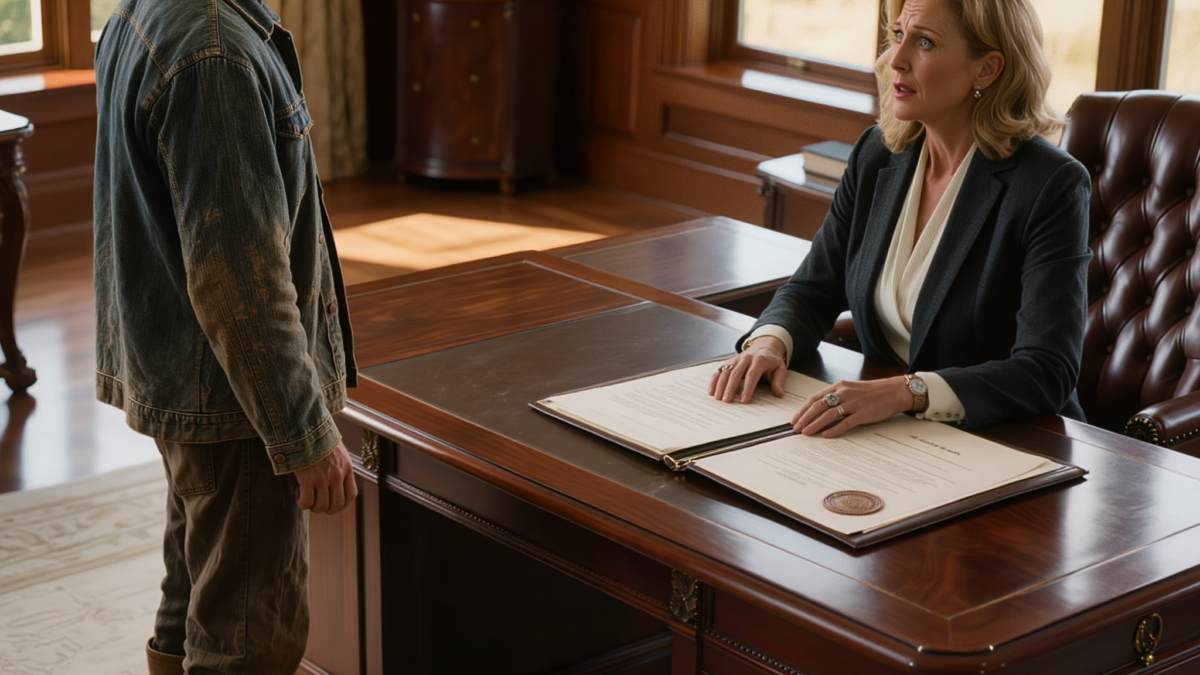
The first thing my stepmother noticed was the mud on my boots.
The second was the paycheck I placed on her expensive mahogany desk.
The third was the thick manila folder underneath it.
By the time she opened that folder, the woman who had spent eighteen years treating me like hired help could barely hold the papers in her hands.
My name is Caleb Anderson. I’m 29 years old, and until recently, I spent almost every waking hour keeping my late father’s vineyard alive.
Anderson Hollow was a forty-acre family vineyard in Oregon’s Willamette Valley. My father built it from the ground up, planting the first row of vines the year I was born.
But when I walked into that executive office, my father’s name was about the only thing that still belonged to him.
My stepmother, Jordan Matthews, had become CEO. Her husband, Richard, managed the agricultural operations. Her son, Tyler, enjoyed a luxurious lifestyle funded by the company.
I was the director of operations.
In practice, I was the person who fixed the tractors, managed the harvest, repaired the irrigation systems, and worked eighty-hour weeks while everyone else enjoyed the benefits.
A month earlier, Jordan and Richard had humiliated me in front of the harvest crew.
“You are just the hired help, Caleb. Tyler is the future of this company and you need to learn your place.”
They laughed.
I stood there surrounded by people who had watched me work through freezing nights and blistering summers, on land my father had cleared with his own hands.
I didn’t argue with them.
What they didn’t know was that I had already begun uncovering something far more serious than workplace favoritism.
And the documents I had brought into Jordan’s office were about to stop a transaction she thought nobody could challenge.
Jordan sat behind a custom-made imported mahogany desk that cost more than my annual salary.
She wore a tailored designer suit and large diamond rings. In front of her were glossy brochures for a real estate expansion she had been planning.
She looked at the paycheck, then slowly raised her eyes toward me.
“What is this?”
“My resignation,” I answered. “Effective today.”
She gave a short, disbelieving laugh.
“Why are you quitting, Caleb? We have the winter gala in three days. You can’t just throw a childish tantrum and walk out because you’re tired of the harvest.”
She reminded me that we had discussed my promotion and that management would reconsider it next quarter when the budget improved.
I listened without interrupting.
Then her attention shifted to the folder beneath the check.
She reached across the desk, opened it, and began reading.
At first, I saw confusion.
Then her eyes widened.
She flipped to the second page and then the third.
The color disappeared from her face.
Her fingers trembled against the heavy legal papers, making them rustle across the polished wood.
She didn’t ask me another question.
Instead, she reached for her desk phone and dialed an internal extension.
“Nathan, I need you in my office now.”
Nathan Brooks was our head of human resources.
Jordan had called him to deal with what she probably assumed was a difficult employee.
But this was no longer an employment dispute.
To understand why, I have to go back to the vineyard where I grew up.
My father, David Anderson, wasn’t a wealthy businessman who inherited an established estate.
He built Anderson Hollow himself.
He bought forty acres of beautiful hillside property in the Willamette Valley and planted the first vines when I was born.
His hands were almost always stained with soil, grape juice, or motor oil.
When I was little, he used to carry me on his shoulders through the rows.
He pointed out the different grape varieties and explained how much patience it took to grow anything worthwhile.
He told me that the soil was stubborn but honest.
“The earth never lies to you, Caleb. You put in the honest work, it gives you life right back.”
I didn’t fully understand those words as a child.
I would spend most of my adult life learning what they meant.
My mother died from a serious illness when I was very young.
A few years later, when I was eleven, my father died suddenly in a car accident.
I remember his funeral with painful clarity.
It was raining heavily. My suit was too big, and I stood shivering while they lowered his casket into the ground.
I felt completely alone.
That was when Jordan became the central figure in my life.
She was my father’s second wife. They had been married for only two years before his death.
She had a son from an earlier marriage named Tyler, who was one year younger than me.
After the funeral, Jordan took charge of nearly everything.
She met with lawyers, spoke to local officials, and assumed responsibility for the vineyard’s business operations.
She told people she was determined to protect my father’s dream.
Not long afterward, she married Richard, an experienced manager from a neighboring corporate farm.
He joined Anderson Hollow to oversee its agricultural operations.
At eleven years old, I understood nothing about corporate ownership, trusts, or estate planning.
I knew only that my father was gone and that Jordan had promised to look after me.
I believed her.
When I was in high school, she sometimes sat beside me at the kitchen table and helped with my biology homework.
She talked about the vineyard’s future.
She told me that one day, when I was older and ready, I would take the reins of the family business.
Richard was friendly and quick with a joke.
I tried to be a good older brother to Tyler, even when he acted as though the world owed him special treatment.
I thought we were a family.
More importantly, I thought we were preserving the only substantial thing my father had left behind.
By the time I turned twenty-four, the vineyard had consumed almost every part of my life.
I was responsible for harvest schedules, soil management, equipment maintenance, inventory, and frost protection.
During the busiest seasons, I worked eighty hours a week.
I was in the fields before sunrise during summer.
In colder months, I stayed awake protecting the vines from damaging temperatures.
When equipment broke, I repaired it myself whenever possible.
Sometimes I spent an entire day working outside and continued into the night checking barrels in the warehouse.
My salary was modest.
It barely covered my living expenses, groceries, and fuel for my fifteen-year-old Ford truck.
Whenever I suggested replacing outdated equipment or increasing staff pay, Richard told me the budget couldn’t support it.
Jordan gave similar explanations.
The company needed to conserve cash. We had to reinvest everything we could. Growth required sacrifice.
I accepted it.
I believed every dollar I gave up was helping protect the vineyard.
Tyler’s experience was completely different.
He hated farm work.
He disliked the dirt, the machinery, and the smell of the fermentation tanks.
When he turned eighteen, Jordan arranged a substantial college fund for him using money from the vineyard’s emergency reserves.
He enrolled at an expensive private university in Southern California.
Within three semesters, he had spent the money on fraternity expenses, luxury housing, and trips.
Then he dropped out.
He told everyone he needed to find his entrepreneurial calling.
Jordan welcomed him home and immediately created an executive position for him.
Vice president of public relations.
He received a spacious corner office in the newly renovated administrative building.
The office had modern furnishings and air-conditioning.
I wasn’t even allowed into that building if my boots were muddy.
Tyler visited his office perhaps twice a week, usually arriving around noon in designer sunglasses.
He rarely seemed interested in the actual work involved in producing wine.
Yet Jordan insisted he was essential to the company’s future.
The clearest example arrived one afternoon in July.
I was lying on my back beneath our oldest tractor, trying to repair a broken hydraulic pump.
The gravel was hot.
My hands were covered in grease.
Richard had told me repeatedly that we couldn’t afford new parts.
Then I heard the unmistakable sound of an expensive sports car coming up the driveway.
A brand-new slate-gray Porsche 911 appeared through a cloud of dust.
Tyler stepped out wearing an Italian linen suit.
He tossed the key fob into the air and caught it while looking down at me beneath the tractor.
He smirked.
I got up, wiped my hands, and walked directly to the farmhouse.
Jordan was in the kitchen looking at fabric samples and drinking sparkling water.
I asked how a struggling vineyard could afford a $100,000 sports car when we supposedly couldn’t afford to fix essential machinery.
She didn’t look surprised.
“Caleb, sweetheart,” she said, “you need to calm down and look at the bigger picture.”
According to Jordan, the Porsche was a company vehicle.
She described it as a strategic tax write-off.
She explained that Tyler needed to develop relationships with wealthy investors, restaurant owners, and important wine distributors.
To do that, he needed to project success.
Then she told me something I would remember for years.
“You are so incredibly wonderful with the farming, Caleb. You really are the backbone here, but you just don’t understand modern corporate networking.”
She wanted Tyler to handle the relationships while I continued working with the soil.
I hated the unfairness.
But I convinced myself that she might understand the financial side of the business better than I did.
As long as the vineyard survived, I could tolerate Tyler’s lifestyle.
A year later, the Porsche was traded in for a customized Lamborghini Urus.
Once again, it was categorized as a business expense.
Tyler began taking month-long trips to Europe, supposedly to study international wine trends.
I continued repairing old machinery and covering work that should have been shared.
I told myself that someone had to keep the farm running.
Then, shortly before my twenty-ninth birthday, everything I believed about our finances began to fall apart.
Evan Carter was our head accountant.
He was a quiet man in his late fifties who had worked for my father long before Jordan joined the family.
He wasn’t someone who enjoyed conflict.
He had spent years keeping his head down, worried about his pension and health insurance.
One evening in late October, I was locking the warehouse when Evan approached me in the dark parking lot.
He was carrying his briefcase tightly against his chest.
He kept looking around as though he was afraid someone might see us talking.
He asked me to come to his office immediately.
He also asked me to make sure nobody followed me.
I entered the administrative building through the back service door.
Evan locked his office and lowered the window blinds.
He turned on a small desk lamp, opened his briefcase, and removed a thick leather-bound ledger.
His hands were shaking.
“I can’t stay quiet anymore, Caleb,” he whispered. “I just can’t watch them do this to you anymore.”
He pushed the ledger toward me.
He said I needed to examine the real master budget, not the simplified reports presented during quarterly meetings.
I sat down and began reading.
I’m not a certified public accountant.
But I didn’t need professional qualifications to recognize that something was terribly wrong.
Hundreds of thousands of dollars had been leaving Anderson Hollow’s operating accounts through a series of transactions.
The payments were labeled as marketing consulting expenses.
Evan pointed out the companies receiving the money.
They were LLCs registered in Delaware under Tyler’s name.
Jordan had been personally approving large invoices for brand management and digital strategy for three years.
According to Evan, the money was eventually reaching Tyler’s accounts and financing his expensive lifestyle.
The cars.
The apartment.
The vacations.
The same expenses Jordan had repeatedly described as necessary for business growth.
“How much, Evan? Exactly how much have they taken?”
He looked down at the desk.
“Over $2.4 million.”
I stared at him.
That money represented the reserves we should have been using to maintain equipment, prepare for emergencies, and compensate employees.
The previous year, Jordan had canceled our workers’ bonuses because she claimed there wasn’t enough money.
I had believed her.
Now I was looking at records suggesting that the money had been deliberately diverted elsewhere.
Evan turned another page.
He pointed to a large entry connected to a national bank.
“Caleb,” he said, “they took out a second mortgage. Six months ago.”
I leaned forward and examined the paperwork.
The mortgage wasn’t secured against the tasting room or an administrative building.
It was secured against the east field.
That was the section of Anderson Hollow my father had cleared by hand.
The land where he had spent years working the soil.
Jordan and Richard had used it as collateral while Tyler drove luxury vehicles and the family enjoyed expensive trips, shopping, and country club memberships.
I didn’t know what to say.
I closed the ledger, left Evan’s office, and climbed into my old Ford truck.
I drove along the uneven dirt road and parked near the east field.
The air was cold.
Across the property, the farmhouse was brightly illuminated.
Tyler was hosting another party.
I could see people drinking our expensive reserve wine and laughing on the cedar deck.
Music echoed through the night.
I sat gripping the steering wheel.
I thought about my father carrying me through those same fields.
I thought about Jordan telling me that the vineyard would someday be mine.
I thought about every piece of machinery I had repaired because management insisted we couldn’t afford replacements.
The vineyard wasn’t simply struggling.
Money that should have supported its operations had apparently been diverted for years.
And the land itself was now at risk.
Three days later, I received a phone call that made the situation even worse.
I was working in the upper vineyard, repairing a badly leaking irrigation line.
My hands were covered in mud and PVC primer.
When my phone rang, I noticed the number was from out of state.
I answered.
“Caleb. It’s Alexander Vaughn.”
Alexander was an old college friend of my father’s.
He owned 20% of Anderson Hollow’s original shares and lived in New York City, where he managed a major hedge fund.
He almost never called me directly.
That day, he sounded furious.
He wanted to know why I had approved a major restructuring without speaking to him first.
I told him I didn’t understand.
He explained that he had received paperwork for a proposed sale of a controlling 55% stake in Anderson Hollow to a conglomerate owned by Marcus Warren.
The documents had been delivered for review before the transaction closed.
At the bottom was a signature presented as mine.
According to Alexander, the signature authorized the deal and waived my trust rights.
I felt sick.
Marcus Warren had a reputation throughout the West Coast wine industry.
His company acquired struggling family vineyards and converted them into large industrial operations.
Historic vines were removed, local employees lost








