My brother drenched my white shirt in red wine at Thanksgiving and shouted, “You have until sunrise to get out of my house!” I’d spent nine years keeping our family’s almond farm afloat. My parents applauded him anyway. I smiled, pulled a heavy brass key from my pocket, and dropped it beside the gravy boat. “Then you have exactly 60 seconds…”
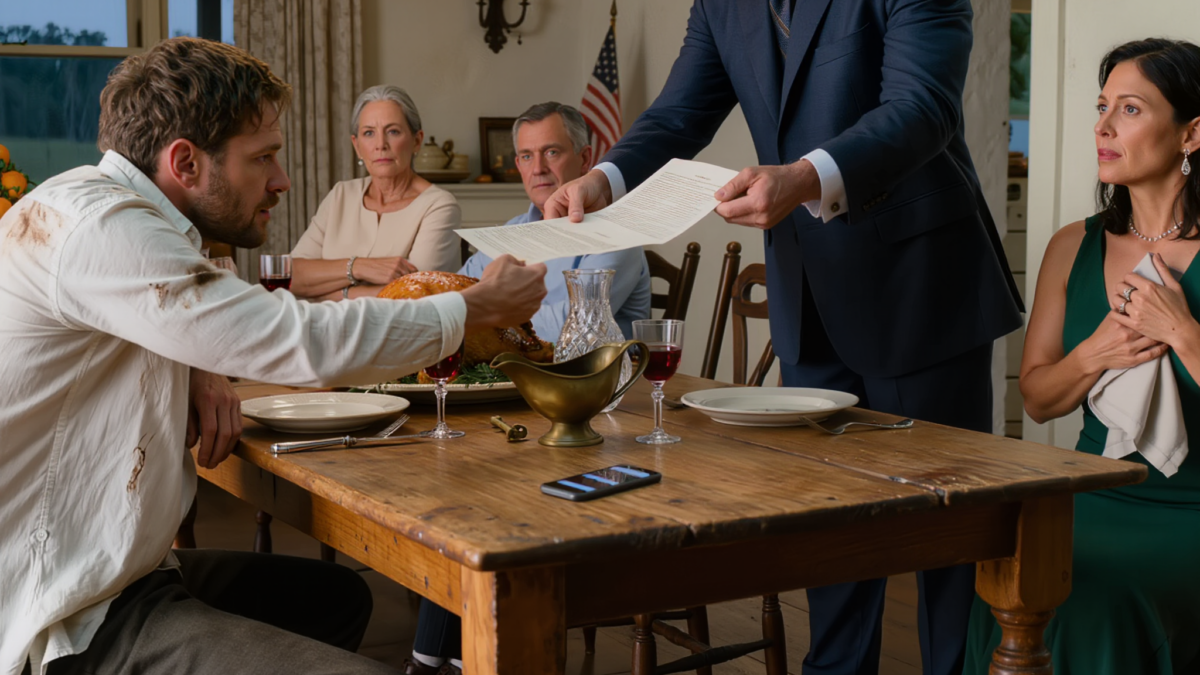
My name is Rowan, and I’m thirty-four years old. For nine years, I put my savings, my work, and nearly every plan I had for my future into keeping my family’s historic almond farm from going bankrupt. At our last Thanksgiving dinner, my brother thanked me by throwing red wine across my white shirt and telling me I had until sunrise to leave.
My parents sat there and applauded. My mother smiled and said it was about time someone put me in my place.
They humiliated me in the house I had spent years restoring. What they didn’t realize was that I had found the documents my grandfather had left for me in an old trunk. Those papers established that I wasn’t a tenant living on the family’s generosity. I was the sole legal owner of the entire estate.
Now the family that laughed at me is dealing with fraud charges, debts, and requests for a place to stay. But six months ago, when we sat down to that Thanksgiving dinner, they still believed they could tell me to leave my own home.
The dining room smelled of roasted turkey, sage stuffing, and brown gravy. We were gathered around the worn oak table my grandfather had built fifty years earlier, surrounded by the stucco walls and antique windows I had worked so hard to preserve.
My older brother, Vance, sat directly across from me. At thirty-seven, he remained our parents’ unquestioned favorite. He had arrived an hour earlier in a new jet-black Porsche 911, a car I knew he had heavily financed to support an image of wealth he didn’t actually possess.
His wife, Parker, sat beside him wearing diamond jewelry and complaining about the farmhouse. She disliked the dust, the drafts from the old windows, and most of the features I considered worth saving. Every time she found another fault, Vance looked pleased with himself for having moved beyond the place.
Our parents, Gideon and Hadley, sat at the head of the table. They listened eagerly when Vance talked, laughed at his jokes, and asked about his golf handicap. When they looked toward me, their expressions changed. I was useful around the property, but usefulness had never earned me the sort of attention my brother received simply by walking through the door.
“You know, Rowan,” Vance began, swirling his glass of expensive Cabernet, “it really is a shame you never did anything with that architectural design degree.”
I had paid for that wine out of the farm’s maintenance budget. He held it between two fingers while explaining why I had failed to make anything of myself.
“All that potential,” he continued. “All that tuition money, and you ended up fixing leaky pipes and digging in the dirt like a hired hand. You could have been somebody, little brother. Instead, you’re just here.”
Parker laughed into her linen napkin. Dad made a low sound of agreement without looking up from his mashed potatoes.
“He lacks ambition, Vance. Always has. Some men are leaders. Some men are meant to turn a wrench.”
I kept my palms flat against the cool oak. I took a slow sip of ice water and waited until I trusted my voice.
“Someone has to keep the roots of this place alive, Vance,” I said. “Branches can’t survive on their own when the storm hits. You might be out there trying to touch the sun, but without the roots doing the dirty work in the dark, you’d blow away.”
His expression changed immediately. He had always disliked being reminded that the farm, which gave our family so much of its supposed old-money prestige, required actual work. He liked it even less when the reminder came from me.
He stood so quickly that his heavy chair tipped backward and struck the floor. Before I could move, he threw the contents of his glass across the table.
The wine hit my chest and spread through my white shirt. Cold liquid reached my skin, splashed my face, and ran down my chin. I looked at the stain while he leaned over the table.
“You have until sunrise to get out of my house!” he shouted. “Pack your garbage and get off my property. I’m sick of looking at your pathetic face.”
For a moment, nobody spoke. The grandfather clock ticked in the hallway, and wine dripped from the edge of the table onto the floor around my boots.
Then Mom began to clap.
“Well done, sweetie,” she said, looking at Vance with unmistakable approval.
Dad chuckled.
“About time someone finally put him in his place. He’s been acting too big for his boots for years. Let him find out how hard the real world is.”
They expected the response they had trained me to give. I would apologize, lower my head, or leave before anyone had to consider whether they had gone too far. For most of my life, keeping the peace had meant accepting whatever they decided I deserved.
But I had spent years covering their emergencies, paying their expenses, and making myself smaller whenever my needs inconvenienced them. Something about seeing my mother applaud finally made that old response feel impossible.
I looked down at my shirt, then back at their faces. A slow smile crossed my mouth. I didn’t reach for a napkin or try to argue about what had just happened.
Instead, I reached into my pocket and took out a heavy, tarnished brass key. Its edges were rough with age. I dropped it onto the table, where it landed with a firm click.
“Then you have exactly sixty seconds,” I said.
They looked at the key and then at me. Vance’s expression held more confusion than concern. My parents still believed they understood my place in the family, and nothing in their experience had prepared them for the possibility that I might refuse it.
To understand why I had stayed so long, I have to go back nine years.
I was twenty-five when I finished my architectural design degree. Friends from school were heading to San Francisco and New York, looking for positions at firms where they could work on glass buildings and earn salaries I had only imagined.
I wanted something different. I wanted to preserve the ranch, its almond grove, and the old buildings my grandfather had spent his life maintaining. I could see possibilities in the crumbling adobes and worn wood that my parents dismissed as problems.
Grandpa Leopold understood that. He was the only person in the family who seemed interested in the things I noticed and the work I wanted to do.
His hands showed the years he had spent repairing irrigation pipes, working on diesel engines, and tending the trees. I learned beside him during long summers, carrying tools, helping with water pumps, and discovering how much attention a piece of land required if you intended to keep it alive.
In the evenings, we sometimes sat on the wraparound porch with glasses of sweet iced tea. The heat lingered after the day’s work, and the cicadas filled the silence between our conversations.
“Roots are so much deeper than branches, Rowan,” he would tell me, pointing toward the orchard. “The branches reach for the sun. They show off their blossoms for everyone to admire. But when the storms come, and they always come, it’s the roots holding the whole thing together in the dark. Don’t ever be ashamed of being the roots.”
I knew who he was thinking about.
Vance was three years older than me, charming when it suited him, and comfortable being the center of every room. Our parents loved to describe his entrepreneurial career to their country club friends. They talked about his clothes, his business ventures, and the people he met at conferences. They did not talk about the credit card debt behind the clothes or how often those ventures needed family money.
My architectural sketches and interest in historical preservation were treated as a hobby. While I worked beside Grandpa, Vance attended marketing conferences at expensive hotels and lived on money our parents supplied.
When Grandpa died suddenly of a heart attack, I moved back to the farmhouse full-time. I wanted to keep the grove from falling into disrepair. I assumed my parents would manage the business while I handled the land and buildings.
That assumption shaped the next nine years of my life.
A few months after I had unpacked in my childhood bedroom, Mom called with what she described as a small favor.
“Rowan, honey, Vance is in a little bit of a tight spot with a new business venture. Nothing serious. Just a cash flow problem.”
Her tone was light, almost cheerful. She sounded as though the solution should be obvious.
“We need a small loan from you. Three thousand dollars to cover a shipment from overseas. The business is about to take off. I swear.”
I sat at the kitchen table in my work clothes and opened my banking app. Three thousand dollars represented almost everything I had saved from internships and side jobs during college. It was supposed to help me start my own design firm.
Before I could explain, Dad picked up the extension in the den.
“Don’t be difficult, Rowan. It’s for your brother. Family helps family. You don’t have rent or real expenses out there, since you live under our roof. Do the right thing. Stop being selfish.”
I knew what refusing would mean. There would be accusations, cold silences, and another round of reminders about everything they claimed to have done for me. Agreeing was expensive, but at the time it seemed less painful than saying no.
I transferred the money.
That night, I sat alone in my bedroom while the wind pressed against the windows. I opened my laptop and created an Excel spreadsheet. I named it the family ledger.
It felt dramatic at first, perhaps even petty. Then I entered the date and the amount, and the simple act of writing down what had happened gave me a sense of clarity I had not felt during the phone call.
The first entry read: October 12th. Extorted loan for Vance’s business. Three thousand dollars. Emotional blackmail from Mom and Dad. Unpaid.
The ledger wasn’t just about getting money back. It was a private record of what my life actually cost, rather than the version my parents repeated whenever they called me fortunate.
Over the following years, the rows multiplied.
There was the $1,500 emergency repair to the main water pump after Dad spent the maintenance budget on a golf trip to Pebble Beach. There were the additional $100 monthly property-tax payments Mom insisted they could no longer afford, even while she continued buying designer handbags.
Then came another $5,000 for Vance, another assurance that this would be the last time, and another vendor threatening a lawsuit over the way he had conducted business.
I entered each amount. Money I had intended for my firm or a down payment on a modest home went toward keeping the ranch functioning and helping my brother avoid the consequences of his choices.
The ledger could show the transfers. It could not show everything I lost by making them.
His name was Oliver.
We met while working on a small historical restoration project in a neighboring county. He was a landscape architect, thoughtful and intelligent, and he wanted to hear what I had to say. We could spend hours discussing soil composition, architectural history, and the details that made an old property worth preserving.
He saw a designer when he looked at me. My family saw someone who could repair a tractor or find money when a bill came due.
We had been dating for eight months when he planned a weekend trip to Mterrey for my thirtieth birthday. It would have been my first vacation in five years. Our bags were packed and waiting by the front door.
At two in the morning, my phone began vibrating on the nightstand.
Mom was crying. Vance had been arrested after crashing his leased luxury car into a storefront following a night of drinking. There were charges involving impaired driving, reckless driving, and significant property damage.
She needed me to drive three hours to the city and post his $10,000 bail. Dad’s blood pressure couldn’t handle the situation, she said. Parker was too embarrassed to be seen at a police station.
“I can’t, Mom,” I whispered.
Oliver was asleep beside me. I looked at him while trying to find a way to explain that, for once, I had made a commitment to someone else.
“I have plans. I have a trip. Tomorrow is my birthday.”
The crying stopped.
“Plans? What could be more important than your brother sitting in a jail cell? Your father and I are counting on you. Vance is counting on you. If you don’t go, he could lose his job. How can you be so selfish after everything we’ve done for you? We let you live on our farm.”
I looked from Oliver to the travel guide resting on his canvas duffel bag. I understood what choosing my brother would say to him. I also understood how thoroughly my parents had trained me to believe that their emergencies mattered more than anything I wanted.
I left a hurried, tear-stained note on the kitchen counter and drove to the city.
When I came home two days later, exhausted and with my savings depleted, Oliver was gone. His note lay beside the one I had left.
“I love you, Rowan. But I can’t compete with your family. They will drain you until there is absolutely nothing left. And I refuse to stick around and watch you let them do it to you. I don’t think anyone can save you but yourself.”
I sat down on the kitchen floor and cried.
He was right, and knowing that didn’t make the empty house easier to bear. I had spent years telling myself that the farm was the reason I stayed. By then, it had become difficult to separate my love for the place from the guilt that kept me there.
That was the year I stopped making plans for a different future. I concentrated on the next repair, the next bill, and the next problem someone expected me to solve.
Then, on a hundred-degree afternoon in August, I found the chest.
I was working in the old barn at the edge of the property, a large wooden building Grandpa had used for his tools, farming journals, and personal belongings. Its roof had developed a serious leak after the winter storms. Before I could repair it, I needed to clear the loft and see how far the damage had spread.
The heat was stifling. Dust clung to my skin as I moved old canvases, rusted tractor parts, and deteriorating bales of hay from the back corner. When I pushed aside a broken iron plow, my steel-toed boot struck something solid.
A wooden chest sat beneath a tarp, tucked behind the debris. Its iron latch was rusted shut, and cobwebs covered the corners. I had never seen it before.
I worked a crowbar beneath the latch and leaned my weight against it. The metal gave way, and I lifted the lid.
The chest smelled of cedar. Inside were black-and-white photographs of the farm in the 1950s, Grandpa’s leather-bound journals, and his old pocket watch. There was also an almond blossom he had dried and pressed between two pieces of glass.
Beneath those belongings lay a thick manila envelope sealed with dark red wax. On the front, in his handwriting, were two words.
For Rowan.
My hands shook as I broke the seal. I pulled out a stack of legal documents and held them in the light coming through the barn slats.
The first packet was a grant deed.
I read past the formal language and notarized markings to the date. It had been executed a full calendar year before Grandpa died. The property description covered the farmhouse, barns, outbuildings, equipment, and every acre of the almond grove.
Then I found the line identifying the grantee.
Rowan Thomas Miller.
I read my name more than once. The papers described me as the sole owner of the estate.
At the back of the packet was a handwritten letter on yellow lined notebook paper.
My boy Rowan,
If you are reading this, it means I have moved on and you finally found what I hid away for you. I am old, but I am not blind. I see how your parents and your brother rely on your strength while giving you scraps and insults in return. I see how Vance takes and takes, and how Gideon and Hadley enable him because they are desperate for his version of success.
This farm is your heritage, Rowan. It is the work of your heart, your hands, and your sweat. It is not an ATM for them to fund their vanities and debts. The roots must be protected. I had my lawyer, Thaddius, transfer the deed entirely into your name.
Your parents know about this. I sat them down in my study and made them promise to hand this envelope to you the day after my funeral. But as I write this, I fear their weakness and pride will win out over their love for you. I fear they will hide it to keep you under their thumb.
This land is your anchor. Do not ever let those people make you feel like a guest in your own home. Protect the roots. Make me proud. You are the only true Miller left.
Love, Grandpa Leopold.
I sat on the dusty floorboards with the letter in one hand and the deed in the other. For a while, all I could think about was Grandpa. He had noticed. He had understood more than I knew, and he had tried to give me a way out.
Then I thought about my parents.
For nine years, they had told me I lived under their roof. They had watched me pay taxes, repair buildings, and give up my savings while reminding me that I should be grateful for a bedroom. They had allowed Vance to treat the farm as his future inheritance.
Every time they had said those things, they had known the property was mine.
The next morning, I drove into town and went to Thaddius’s office. He had been Grandpa’s estate lawyer, an old-fashioned man with a mahogany-paneled office and little patience for unnecessary conversation.
I put the envelope on his desk.
He looked through the papers, removed his reading glasses, and sighed.
“Rowan, I’ve been waiting for you to walk through that door for almost a decade.”
He confirmed that the deed was valid and registered with the county. The arrangement had been made to transfer the property without putting it through a public probate proceeding. My parents had no ownership interest to give away or withhold.
Then he told me about the meeting he had held with them three days after Grandpa’s funeral.
“I advised them to tell you immediately, as Leopold instructed,” he said. “Your mother cried. Your father assured me they would handle it privately, as a family, so they wouldn’t overwhelm you.”
He rubbed his temples before continuing.
“When I pressed them, they threatened to report me to the State Bar Association for professional misconduct if I contacted you directly. They cited family privacy and what they called your fragile emotional state. My hands were legally tied, Rowan. I’m sorry.”
I listened to his explanation without interrupting. Whatever reasons he gave for remaining silent, the result was sitting on the desk between us. My parents had known, and I had spent almost a decade believing something entirely different.
I thanked him and returned to my truck. For an hour, I sat in the hot parking lot with my hands resting against the steering wheel.
I didn’t want another argument in which they called me ungrateful and I tried to explain myself. I needed to understand what they were doing with the property and how much of my life they had been managing through that lie.
Two weeks later, I learned there was more.
I had hired Silas, a contractor I had known since high school, to help repair the barn roof. He was often short of money, but I trusted him. I had lent him money before without expecting it back.
One afternoon, I returned from town earlier than planned to collect a specialized drill from the shed. As I approached the house along the gravel path, I heard him talking on the back porch.
He was on the phone with Vance.
“I’m telling you, you’re sitting on a gold mine out here,” Silas said. “I was drinking with a buddy who handles commercial zoning for the county. The tech developers from Silicon Valley are moving this way. They want large, flat properties for data centers and corporate retreats.”
I stopped behind the corner of the house.
“Your family’s farm is perfectly zoned. Sell now, and you’re looking at eight figures minimum.”
He paused to listen, then laughed.
“Exactly. Don’t tell Rowan anything. He’ll want to talk about the trees and historical preservation. Get your old man to sign the papers, sell it, and cut me my ten percent finder’s fee like we agreed. Miles already has a buyer willing to bypass inspections.”
Miles was Vance’s business partner. He made his living buying and reselling distressed properties through shell companies, and I had never been comfortable with the way he talked about other people’s financial difficulties.
I backed away into the orchard before Silas knew I was there.
A friend I trusted was helping my brother arrange the sale of my land. Vance, meanwhile, was acting on the assumption that our parents had the authority to sell it. He knew they hadn’t told me about the deal, but he apparently didn’t know what they had kept from him, either.
I wanted to walk onto the porch and confront Silas. Instead, I called Elias.
We had gone to college together. While I studied architectural design, he studied contract law, real estate, and corporate disputes. He had since become a successful real estate attorney.
We met at a quiet diner on the edge of town, far from the places where my family usually went. I brought the deed, Grandpa’s letter, and my laptop with the family ledger.
Elias read everything. He sat with a plastic stir stick between his fingers, moving from the legal documents to the spreadsheet and back again.
“They didn’t just mislead you to get free labor,” he said finally. “This was sustained financial deception.”
He tapped the deed.
“We can go to county court tomorrow, send a cease-and-desist, and have the sheriff remove them by Friday afternoon.”
“No,” I said.
He looked up from the papers.
“A letter from a lawyer would let them treat this as another family disagreement,” I told him. “Kicking them out doesn’t account for what they’ve done. I want them to feel the financial uncertainty they kept handing to me. I want a record they can’t explain away.”
Elias understood what I was asking. Over three cups of coffee, we worked through how the confrontation would happen and what I would need to put in front of them.
I also wanted a clear record of what my parents were still claiming.
The next day, I found Mom in the sunroom, looking through a magazine of expensive homes. She was considering the vacation house she intended to buy with the proceeds from the farm.
I leaned against the doorframe and let her see how tired I was. My phone was in my shirt pocket with the recorder running.
“Hey, Mom. I was looking at the county tax assessments. The property taxes on the grove are going up again next quarter. I don’t know how you and Dad keep affording the mortgage and the taxes. The repairs are already taking everything I make.”
She didn’t look up. She waved a hand, and her diamond rings caught the sunlight.
“Oh, don’t worry your little head about it, Rowan. Your father and I manage. It’s our home, after all. We own it. We protect it. And we make the decisions.”
She turned her attention back to the magazine.
“We do absolutely anything to keep it in our name. You keep focusing on that broken tractor and let the adults handle the finances.”
The recording was clear. I had her voice claiming ownership of a property she knew belonged to me.
Two days before Thanksgiving, our accountant called.
Desmond had worked for the family for twenty years. He was a nervous man who generally preferred not to question the people paying him. This time, however, he wanted to see me privately.
We met in the back of his office. He was sweating through his suit and having trouble keeping his hands steady as he poured water.
“Rowan, I shouldn’t be telling you this, but I can’t go to federal prison for your brother.”
I waited.
“Vance and Miles brought me paperwork yesterday to notarize and process. They found a buyer for the farm. A tech developer named Barnaby. He’s a billionaire who wants to build a server farm.”
“And?”
Desmond swallowed.
“Vance drafted a preliminary agreement of sale. He forged your father’s signature as the owner. He presented it to Barnaby’s corporate lawyers as a guarantee that the land would be taken off the market while they finished the eight-figure buyout.”
He leaned across the desk and lowered his voice.
“Vance accepted a twenty-thousand-dollar deposit. The money was wired into his offshore LLC.”
I kept my face still.
“He accepted money to sell an asset he doesn’t own, using an interstate bank transfer,” I said. “That’s wire fraud.”
“It’s a federal felony,” Desmond said. “When Barnaby learns your parents don’t hold the deed, he’ll bring in his lawyers. I can’t be attached to this.”
I thanked him and promised to keep his name out of the confrontation if he remained quiet for another forty-eight hours.
Outside, the autumn air felt cool after the close office. For the first time, I knew the situation was no longer limited to the way my family treated me. Vance had accepted money from someone outside the family on the strength of property he had no authority to sell.
My parents were still allowing him to proceed. They knew the deed was in my name, yet they were preparing for a Thanksgiving dinner at which everyone would act as though the farm’s future had already been decided without me.
I drove home, ironed a white button-down shirt, and put the old brass key to the barn in my pocket.
By the time I sat down at the table, I knew what I needed to say. I didn’t know my brother would throw the wine.
Now the grandfather clock ticked in the hallway, the key rested beside the gravy boat, and my shirt was soaked against my chest.
“Then you have exactly sixty seconds,” I repeated.
Vance gave a short laugh. He stood across from me in a three-thousand-dollar suit, looking at the key as though I had brought the wrong tool to a job.
“Sixty seconds to what, Rowan? What happens in sixty seconds? Are you going to fix another pipe? Go outside and cry over your almond trees?”
He adjusted his tie.
“You don’t make the rules in this house. You don’t pay the mortgage. You don’t earn a real salary. You live here because our parents allow it, and your free ride is over. Get out before I come around this table and throw you out.”
Mom folded her arms, her diamond tennis bracelet catching the chandelier light.
“Listen to your brother. Don’t make this any uglier or more embarrassing than it already is. You brought it on yourself with your jealousy and lack of ambition.”
I took my phone from my pocket, opened the app, and propped it against the crystal water pitcher. I positioned the screen so Vance and my parents could see it, then started the call Elias and I had arranged.
His face appeared on the screen. He was in his office, wearing a navy suit, with shelves of law books behind him.
“Good evening,” he said. “My name is Elias Vance. I represent Mr. Rowan Thomas Miller. I need to inform everyone present that this conversation is being recorded for future litigation and evidentiary purposes.”
Vance stopped adjusting his tie.
Parker straightened in her chair and held her napkin against her chest. Dad lowered his fork to his plate.
“You can’t record us in our own home without our consent,” Dad said.
He struck the table with his fist, rattling the silverware.
“Turn that off, Rowan. I’ll call the sheriff and have you arrested for trespassing and wiretapping.”
“This is not your home,” I said. “It hasn’t been your home for nine years.”
I reached beneath my chair for my briefcase and took out Grandpa’s envelope. Bits of the red wax still clung to the flap. I broke away what remained and removed the document packet.
I put it on the table and pushed it toward Vance. It stopped in front of his plate.
“Read it out loud for the family,” I told him. “You’re the businessman. You should be able to understand a basic property document.”
He snatched it up with a scoff. Then he saw the heading.
Grant deed.
His hands stopped moving.
I watched him read the property description, the boundaries, and the notarized details. When he reached my name, he went back over the page.
“What is this?” he asked.
The papers trembled slightly in his hands.
“This is a joke. It’s fake. It’s a forged document. Mom? Dad? What is this?”
Elias answered from the phone.
“That is a county-registered grant deed, executed and filed a full calendar year before your grandfather died. It transfers the estate, its buildings, physical assets, and mineral rights to Rowan. He is the sole owner.”
Vance looked from the page to the screen.
“Your parents have no ownership claim to the property,” Elias continued. “They have known that for nine years.”
Mom opened her mouth, but nothing came out. Dad held the edge of the table with both hands.
Vance turned toward them.
“You knew?”
Neither answered.
“You told me this place was your retirement. You told me it was my inheritance. I built my financial plans around the equity in this land.”
The conversation had finally stopped being about my supposed lack of ambition. My brother was looking at our parents as though he had encountered a version of them he didn’t recognize.
“There’s more,” I said. “A few months ago, I started wondering why you had become so interested in a farm you usually dismissed. Then I learned about your arrangement with Silas and Miles.”
He looked back at me.
“And Barnaby.”
Vance stepped backward. His legs caught in the chair, knocking it over, and Parker put her hands over her mouth.
“You don’t know what you’re talking about,” he said. “You’re out of your mind.”
I minimized the video call, opened the audio file labeled sunroom confession, and turned up the volume.
Mom’s voice filled the dining room.
“Oh, don’t worry your little head about it, Rowan. Your father and I manage. It’s our home, after all. We own it. We protect it. And we make the decisions. We do absolutely anything to keep it in our name. You keep focusing on that broken tractor and let the adults handle the finances.”
Elias spoke when the recording ended.
“That records your mother asserting ownership she knew she did not have. But the immediate issue goes beyond your parents’ financial dealings with Rowan. It is the twenty-thousand-dollar deposit Vance accepted to take this land off the market.”
I looked at my brother.
“You drafted the agreement. You forged Dad’s signature. Then you accepted a wire transfer into your offshore company for property that belongs to me.”
He was no longer holding the papers as though he intended to dismiss them.
“You took a developer’s money on the promise that you could deliver my farm,” I continued. “Do you understand what that means? Those lawyers are going to pursue you for a transaction you had no right to offer.”
Vance leaned across the table, reaching for the deed. His footing slipped in the spilled wine, and he knocked over the crystal water pitcher. It broke on the hardwood, scattering water and glass beneath the table.
He called me a liar and a thief. The accusations came quickly, but none answered what was written on the page.
Parker began crying. She caught his jacket and demanded to know what he had signed, what he had done with their money, and what would happen to their mortgage and the children’s college funds. She struck the front of his jacket with her fists while he tried to pull away.
Our parents stayed in their chairs. Mom stared at the table. Dad’s hands remained fixed against its edge.
“We have to leave,” Vance told Parker. “We need a defense lawyer. Get your coat. We’re leaving.”
He took her arm and pulled her from the dining room.
The front door opened and slammed hard enough to knock a framed family photograph from the hallway wall. I heard the glass break, then the Porsche starting outside. A few seconds later, gravel scattered beneath the tires as Vance drove away.
I stayed at the table.
The turkey, stuffing, and serving dishes were still there. Wine ran toward the edge of the oak, and broken crystal lay on the floor. My parents sat on the other side of the meal they had expected me to endure quietly.
When I looked at Mom, she was crying into her napkin. Her makeup had begun to run. Dad stared at his cold turkey, gripping his fork without taking another bite.
I didn’t ask them to apologize. I had spent too much time reviewing the dates and transfers to believe that an apology would explain nine years of decisions.
I stood, stepped past the broken glass, and went into the living room. I took my laptop from my bag and connected it to the seventy-inch television above the stone fireplace.
Then I returned to the dining-room archway and motioned for them to follow.
They moved slowly to the leather sofa, another purchase made with money that should have gone toward the farm’s maintenance. They sat beside each other without looking at me.
I opened the family ledger.
The spreadsheet filled the television screen. Dates, amounts, and notes appeared in rows across the wall while I scrolled.
“I call this the family ledger,” I said.
The early entries were there, including the money I had given Vance when I still believed it would be repaid. Then came the repairs and other emergencies.
“Twenty-two hundred dollars for a septic pump,” I read. “The old one failed while you were on a cruise to the Bahamas.”
I moved down the sheet.
“Eighteen hundred for emergency tree removal after the winter storm. You said your backs were too bad to help, then played tennis the next day.”
Neither of them spoke.
“Ten thousand for Vance’s bail and legal fees. Five thousand for Mom’s emergency medical bills, which turned out to be a cosmetic procedure. A hundred dollars every month for nine years in property-tax payments you demanded while pretending the land belonged to you.”
At the bottom of the ledger was the total.
$42,750.
Dad kept his eyes on his shoes.
“We put a roof over your head,” he said.
I waited.
“We fed you. We provided for you when you were a boy. We were protecting you from the burden of owning a property this size. You couldn’t have handled that at twenty-five.”
“You didn’t have to protect me, Gideon.”
Using his name instead of Dad made the distance between us plain.
“All you had to do was tell me you were broke and let the farm begin falling apart. You knew I wouldn’t stand by and watch Grandpa’s work disappear. You watched me spend my savings, put off my career, and lose a relationship while working on a place you knew was already mine.”
Mom pressed her napkin against her face.
“You hid the ownership from me so I would keep acting like I owed you a home,” I said. “You had a handyman and someone to pay the bills, and you kept reminding him he was lucky to be allowed to stay.”
“We were going to tell you,” Mom said.
She reached toward me, her rings catching the light.
“I swear we were. The timing was never right. You were always working, and Vance was struggling to get established.”
“The timing was right to let him sell it.”
She lowered her hand.
“The timing was right for him to accept money for my property. And tonight, the timing was right for both of you to applaud while he threw wine at me and told me to get out.”
There was no explanation after that.
The ledger remained on the screen behind me. They had dismissed individual payments as favors, family obligations, or expenses I should be grateful to cover. Seeing them together made those explanations harder to repeat.
I took two legal envelopes from my jacket and gave one to each of them.
“These are formal notices to leave the property,” I said. “You have thirty days.”
They looked up.
“During that time, you will not alter or remove fixtures, farm equipment, or furniture that belonged to Grandpa. You will pack your personal belongings, your clothes, your jewelry, and your golf clubs. If you take property that isn’t yours, I will involve the sheriff.”
They studied me as though they were waiting for the familiar retreat. I had spent years softening my refusals until they became agreements. This time, there was nothing else I intended to offer.
The next thirty days were difficult.
We were still living in the same house, and my parents challenged the notices. They hired a local lawyer to contest the deed, arguing that Grandpa had not been of sound mind when it was executed.
The medical records and Thaddius’s paperwork did not support that claim. The judge dismissed their challenge in less than ten minutes and ordered them to pay my legal fees.
On the day they moved out, the sky was clear and blue.
I stood on the wraparound porch with Wyatt, the farm foreman who had worked for Grandpa for forty years. His hands were weathered from the same kind of work my family had spent years looking down on. He held a ring of new brass keys.
We watched Mom and Dad load their last suitcases and cardboard boxes into a rented U-Haul. They looked older than they had at Thanksgiving, and neither seemed interested in explaining the situation to us.
There were no hugs or promises to start over. They finished loading, pulled down the truck’s rolling door, and left.
Wyatt went to the front door with a screwdriver. He removed the old lock cylinder and installed the new deadbolt. When he tested it, the lock settled into place with a clean click.
“Farm is secure, boss,” he said.
He tipped his worn cowboy hat, the way he used to acknowledge Grandpa.
“Thank you, Wyatt.”
I took a deep breath of the valley air. For the first time in years, standing on that porch did not come with the feeling that I had to earn permission to remain there.
The consequences for Vance had already begun before my parents finished moving.
Barnaby’s corporate lawyers discovered that the man who had accepted the $20,000 deposit did not own the property. Barnaby did not simply abandon the deal and ask to forget the matter.
His firm filed a multimillion-dollar civil lawsuit alleging fraudulent misrepresentation, breach of contract, and conduct involving the wire transfer. Once the dispute entered the public record, Vance’s other financial problems became harder to conceal.
Creditors began looking more closely at the assets he had used to project success. Much of what he presented as wealth was financed or otherwise committed.
Within three weeks of Thanksgiving, the Porsche was repossessed.
I wasn’t there. Elias told me what he had learned through the associates monitoring the financial proceedings. Vance had come outside in his bathrobe and argued on the lawn while two men attached his car to a tow truck and took it away.
A court order froze his bank accounts. Business partners began distancing themselves from him, unwilling to be drawn into the dispute.
Miles was among the first.
He turned over messages, emails, and forged documents to federal authorities. According to what I learned, he cooperated to obtain immunity for himself.
Vance faced the possibility of prison. Whatever he had expected to gain from the farm sale was now being consumed by the effort to protect himself from the transaction.
His marriage fell apart as well.
Parker filed for divorce, citing irreconcilable differences and financial infidelity. She changed the locks at their house and sought full physical custody of their two children, along with child support.
The arguments that began at our Thanksgiving table continued through a custody dispute. She wanted to know where the money had gone and what resources remained for the children. Vance, meanwhile, had used money from their college funds to pay a criminal defense attorney to negotiate a plea arrangement that might keep him out of prison.
Our parents had always described those college accounts as evidence of his responsibility. Now the money was going toward the consequences of a deal he should never have made.
Eventually, he was living in an extended-stay motel on the outskirts of the city. The cars, memberships, and expensive appearance were gone. He was eating inexpensive meals and avoiding process servers while his legal problems continued.
Mom and Dad had fewer resources than they had led people to believe.
Once they left the farm, they had to find housing they could actually afford. Years of spending to maintain appearances had left them with little available cash. They moved into a small two-bedroom apartment near a busy freeway.
Without access to the farm and without Vance’s supposed success to discuss, their social lives changed. People in their country club circle knew about the fraud allegations and about the fact that their younger son had removed them from property they did not own.
Their old explanations no longer worked as easily outside the family.
I still had the ledger, and I was not prepared to treat the money as an informal gift.
Elias and I brought a civil small-claims case against my parents. I sat in the courtroom wearing a charcoal suit and looked across at them. They did not have an expensive lawyer with them. By then, they could not afford one.
The judge reviewed the transfer receipts, the tax-payment records, and the other documentation. She also heard the recording of Mom claiming ownership of the farm.
The decision went in my favor. I was awarded the $42,750 I had requested, along with legal fees.
To pay the judgment, my parents liquidated part of their remaining retirement savings. The withdrawals brought additional penalties, another cost they had not planned for.
Three weeks later, the payment arrived as a cashier’s check.
I didn’t use it to buy a car or take an expensive vacation. I brought the money to the bank and placed it in a high-yield trust fund established for the farm’s maintenance, irrigation improvements, and historical preservation.
For years, those payments had represented things I postponed. Putting the recovered money toward the property was different. I was making the decision with full knowledge of what belonged to me, and the money would go toward the work it had so often been diverted from.
I thought that would be the end of it.
A few months after the court case, I was on the porch sanding the old railing in preparation for varnish when a dusty sedan came up the driveway.
My uncle Jasper stepped out.
He was Dad’s younger brother, a quiet man who generally kept to the edges of family disagreements. He had spent years avoiding direct conflict with Gideon, neither joining the arguments nor doing much to stop them.
He climbed the steps with his baseball cap in his hands.
“Rowan,” he said, “your dad sent me.”
I put down the sanding block.
“He won’t admit how difficult things are. His pride won’t let him. But he’s struggling, and Hadley is depressed. She hardly leaves the apartment.”
Jasper turned the cap between his hands.
“They want to know whether there’s any path to forgiveness. Whether they could come back, even for holidays. They say they miss you.”
I wiped the wood dust from my hands with a rag.
“There isn’t a path back, Jasper.”
He looked down.
“But since you’re here, I need to ask you something. Why did they treat me that way? Why did they let Vance do it while I worked to keep a roof over their heads?”
The question was harder to say aloud than anything I had said at Thanksgiving.
“Was I that difficult to love? Was I really such a disappointment?”
Jasper sighed and looked at his boots. When he met my eyes again, his expression held a sadness I hadn’t seen from him before.
“It wasn’t about your worth, Rowan. It was about Leopold.”
“Grandpa?”
“Gideon hated your grandfather.”
He spoke quietly, glancing around the porch even though nobody else was there.
“Leopold worked hard, and he knew Gideon wanted the easy version of things. The appearances, the clubs, the life without the work. When he bypassed Gideon and left the farm to you, it confirmed everything your father feared about how Leopold saw him.”
I leaned against the porch pillar.
“Your dad saw it as proof that his own father thought he was a failure,” Jasper continued. “He couldn’t stand that a twenty-five-year-old had been trusted with the family legacy when he hadn’t.”
Jasper paused, then went on.
“They didn’t just want the money from selling to a developer. Gideon wanted the trees gone and the house torn down. He wanted to erase the place because it represented everything about his father that made him feel inadequate.”
I listened without interrupting.
“You were the reminder,” he said. “He looked at you and saw what his father had chosen instead of him.”
That explanation did not excuse anything. It did, however, answer a question I had been carrying since childhood.
I had believed there was some flaw in me that I could correct through enough work, enough money, or enough willingness to help. I had spent years trying to become someone my parents would treat differently.
Standing on the porch, I began to understand how little control I had ever had over the thing I was trying to fix.
I wasn’t responsible for my father’s disappointment in his relationship with Grandpa. I wasn’t responsible for proving that he deserved a legacy he had chosen not to maintain. And I did not have to give up the farm to make those feelings easier for him.
“Tell Gideon he can keep his jealousy,” I said. “I’m keeping the farm. Don’t come back here again, Jasper. Have a good life.”
He nodded. He understood that I wasn’t asking him to negotiate another visit or carry another explanation between us.
He went back to his car and drove away.
That afternoon, I walked down the driveway to the entrance beside the county road. I carried an oak sign I had spent the previous three weeks carving in the barn.
I fastened it to the stone pillars with iron bolts.
The sign no longer called the place the Miller Family Farm.
It said Leopold’s Root.
In the months that followed, I put my energy into work I had postponed for years. I converted the barn where I had found the deed into a design studio filled with natural light.
From there, I launched Valley Roots Design.
The firm focused on restoring historic homes and agricultural properties across the county. The projects drew on the skills I had developed while keeping the farm standing, the same skills my family had treated as evidence that I had failed to use my education.
Word spread about the care I took with old buildings and authentic materials. I began building a reputation for the work itself rather than explaining why I had stayed on the farm.
For the first time in years, I was planning beyond the next emergency.
Two months ago, I was consulting on a large estate restoration near the coast in Mterrey. The client had hired a landscape architect to handle the botanical gardens.
I entered the planning meeting with my blueprints and stopped.
Oliver was sitting across the glass conference table.
He looked up, surprised. Then his expression softened into a smile.
We went for coffee after the meeting and talked for four hours. We discussed what had happened, what had changed, and the work that had brought us into the same room again.
He noticed the difference in me. I no longer carried myself as though I might have to leave at any moment because someone in my family had decided their needs came first.
We are taking things slowly.
There is trust to rebuild, and neither of us is pretending the time apart didn’t matter. But this time, my decisions are not being made under the constant threat of losing a home or failing a family that never seemed satisfied.
Some evenings, I sit on Grandpa’s porch with a glass of tea and look over the almond trees. Their branches stretch toward the California sun, heavy with white blossoms, and the house behind me is quiet.
I still care about the work. I still repair what needs repairing and plan for what the property will require next. The difference is that I no longer confuse caring for the farm with surrendering my life to the people who used it to control me.
My parents continue trying to reach me. Text messages arrive from blocked numbers, asking for another chance or reminding me that family loyalty should come before everything else. They still use the same phrase about blood being thicker than water.
After the lies, the fraud, and nine years of being told I should be grateful for a home that was already mine, I still wonder whether I am wrong to want the heavy iron gate to stay locked forever.








