My parents demanded I sign over my $500,000 home to my brother for $1. When I refused at his wedding, my dad struck me with a brass centerpiece. My mother said, “You completely ruined the imported linen tablecloth.” Then the bride took the microphone in front of 200 guests. A forensic accountant had just emailed her a report—and she was about to explain why my parents needed that deed on Monday.
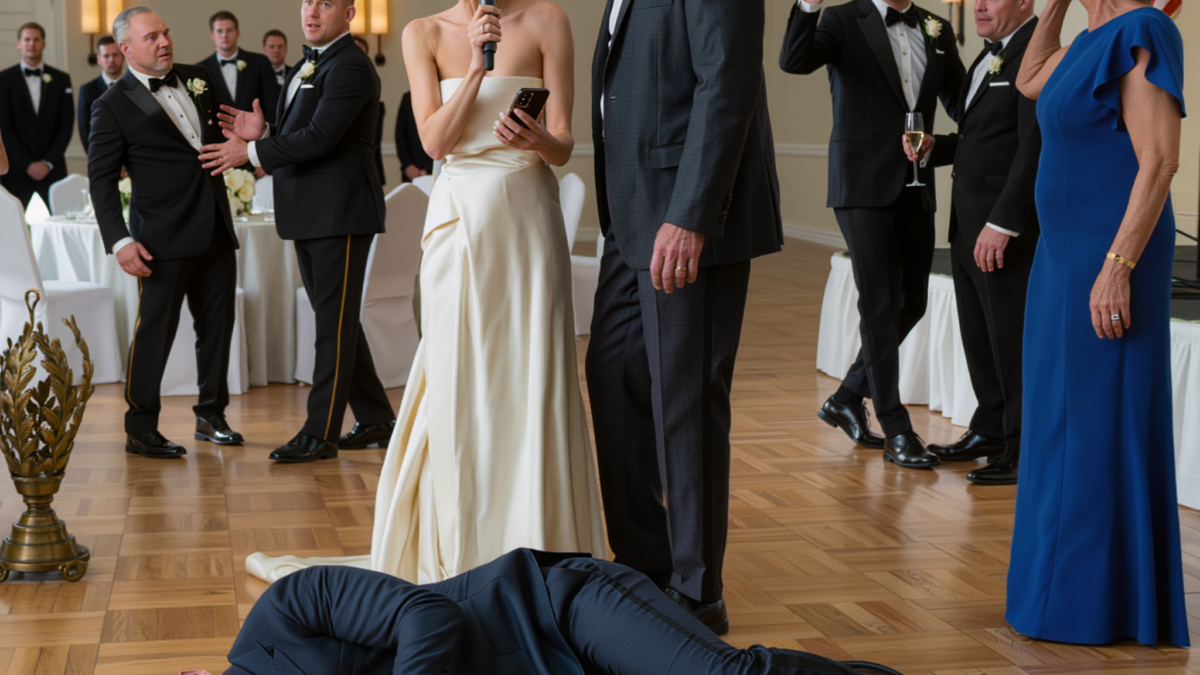
My name is Rowan. I’m twenty-nine, and I’m a builder. Exactly three years ago, on what should have been the happiest night of my younger brother’s life, I was lying on the polished parquet floor of a five-star hotel ballroom, unable to make my body respond.
My father stood over me with a fifteen-pound brass centerpiece in his hand. He was the person who had put me on the floor. While I struggled to stay conscious and understand what had happened, my mother looked down at me.
She didn’t kneel beside me. She didn’t call for a doctor or reach into her designer clutch to dial 911. Her attention went to the collar of my navy dress shirt and then to the table beside us.
Her face, carefully maintained with expensive cosmetic treatments, tightened with disgust. She bent close enough that I could smell her floral perfume. Then she spoke through clenched teeth.
“Get up, Rowan. You are making a massive scene. You are embarrassing us in front of Preston’s family. And look what you’ve done. You completely ruined the imported linen tablecloth.”
For years, they had mocked the work that supported me. My calloused hands, my cheap boots, the hours I spent on construction sites: all of it was evidence, in their minds, that I had failed to become someone worth respecting.
Yet the moment that work produced something valuable, they considered it theirs. My time, my labor, and the property I had built were resources they believed they could redirect whenever the family needed money.
Across the ballroom, my brother’s bride was getting to her feet.
Riley wore a $10,000 custom silk gown. She held her smartphone so tightly that her knuckles had gone pale. On the screen was an email from a forensic accountant she had hired weeks earlier.
She was about to take the band’s microphone and discuss that report in front of two hundred guests. Among them were the wealthy people my parents had spent years trying to impress.
The Rolls-Royce, the Porsche, the country club memberships, and the carefully managed smiles had made my parents look secure. Riley had information that contradicted the picture they presented.
Today, my parents live in a cramped, moldy rental in a neighborhood they once would have looked down on. They are bankrupt, and they send me desperate letters asking for financial forgiveness.
But the events of that night began with a demand they expected me to accept.
I had been at table 12, beside the swinging kitchen doors, when I finally told them no. It was the table reserved for relatives who had to be invited but weren’t important enough to sit near the wedding party.
I turned away from my parents, intending to leave. Before I could register the movement behind me, the brass centerpiece struck me.
I went down without time to brace myself. My dining chair slid backward and collided with a waiter carrying a silver tray of champagne flutes. Glass shattered as my right shoulder hit the floor, and pain traveled down my arm.
My head struck the hardwood. For a moment, the chandeliers seemed to move overhead, and I couldn’t bring the room into focus.
The jazz band stopped in the middle of a song. The silence that followed was unlike any silence I had heard in a room full of people. Beneath it, I heard a relentless ringing that seemed to come from inside my head.
I raised a trembling hand toward my temple. When I lowered it, I understood that I was hurt more seriously than I had first realized. My vision narrowed, and the light above me blurred.
I expected panic from my parents. I expected someone to call for help, or for my mother to reach for a napkin and press it against my head.
Instead, Hadley bent over me in her sapphire-blue evening gown. It probably cost more than my pickup truck. She grabbed my uninjured shoulder and shook me as though I were a child refusing to behave in public.
Her eyes kept moving around the room. She was looking at the socialites, developers, and corporate lawyers whose approval mattered so much to her. That was when she complained about the tablecloth.
My father, Vance, moved into view. He was breathing hard beneath a tuxedo jacket that strained across his chest. The brass vine sculpture was still in his hand.
He pointed it toward me while talking about respect. He said I owed him everything. He said I would sign my property over to my brother on Monday morning, and he threatened to hurt me again if I refused.
Then the microphone shrieked.
The sound carried across the ballroom, breaking through the confusion. People turned toward the stage, and I forced my head in the same direction.
Riley stood behind the microphone stand, gripping it with both hands. She stared at my parents with an expression I hadn’t seen on her before. There was anger in it, but none of the uncertainty my family usually counted on when someone challenged them.
Outside, I could hear sirens approaching. Hotel security had called for help. Inside, Riley was preparing to speak while I was still on the floor.
The house they wanted had begun with my grandmother.
Grandma Betty was independent, practical, and difficult to impress. She had lived through the Great Depression and worked on a dairy farm for thirty years, getting up before dawn whether she felt like it or not.
She drove a twenty-year-old sedan and wore shoes she could work in. She judged people by whether they kept their promises and whether their hands showed they knew how to do something useful.
My parents’ interest in expensive appearances never made sense to her. They spent so much time comparing themselves with other people that they rarely seemed to notice what they already had.
When she died three years ago at eighty-nine, we gathered in her attorney’s stuffy, mahogany-paneled office for the reading of her will.
Vance, Hadley, and my younger brother, Carter, sat together on one side of the conference table. They smelled of department-store cologne and looked ready to receive good news.
Carter was the family’s golden child. His hands were smooth, his clothes were expensive, and he had never needed to hold a job that left him physically tired at the end of the day.
My parents had sent him to an expensive private university out of state. They paid for it with savings and second mortgages, treating every expense as an investment in his future.
I had been pushed out at eighteen. I went to a local trade school and paid my own way by framing houses, including through winters when my hands were so cold that turning the pages of a textbook hurt.
The attorney adjusted his wire-rimmed glasses and began reading.
Grandma left her primary estate to my parents: a large historic house on valuable suburban land, her blue-chip stocks, her 401(k) rollovers, and her bank accounts. Together, the assets were worth more than a million dollars.
Carter received a substantial fund for further education, intended for a master’s degree. He also received our grandfather’s valuable collection of vintage watches.
Then the attorney paused and looked at me.
“To my eldest grandson, Rowan,” he read, “I leave the two acres of undeveloped, rugged land on the eastern ridge. I leave him this specific parcel because he is the only one in this entire family who knows which end of a hammer to hold. He is the only one who truly understands the value of a hard day’s work. And I trust him to build something real, something lasting on it.”
For about three seconds, nobody spoke. Then my father laughed.
“Good luck with that useless dirt patch, kid,” Vance said. “The grading, the tree clearing, and the excavation alone will bankrupt a guy making a blue-collar foreman’s salary. You should sign the deed over to me right now.”
He shook his head as though Grandma had left me a problem instead of an opportunity.
“I’ll sell it to a commercial developer for a finder’s fee. Maybe I’ll give you a few grand for a down payment on a used Honda.”
I didn’t argue with him. I took the folder containing the deed, stood up, pushed in my chair, and left the office.
Within a month, my parents had liquidated Grandma’s stock portfolio. They didn’t put the money into another investment or set it aside for retirement. They went shopping.
Vance bought a customized Rolls-Royce Ghost. He said a real estate broker needed to project success if he wanted high-end clients to trust him. Hadley chose a black Porsche SUV.
They upgraded their country club memberships and began eating at Michelin-star restaurants on weekends. Meanwhile, the property taxes on the house they had inherited continued to rise.
I went to Home Depot.
I bought a heavy-duty shovel, a wheelbarrow, a thick canvas tent, and a generator. Then I loaded my supplies into my beat-up 2015 Ford F-150 and drove out to the ridge.
I didn’t have a trust fund or enough money to hire a framing crew. Renting excavators and bulldozers for days at a time was beyond what I could afford.
I was already working sixty-hour weeks as a construction foreman, managing crews on commercial projects in the city. That job paid my living expenses. Everything I could save went toward the house.
After work, I drove to the property. On weekends, I stayed from early morning until the light was too poor to keep working safely. Progress was slow enough that some days I had to look carefully to see what I had accomplished.
I dug the foundation trench with a pickaxe and shovel. During a freezing November rainstorm, I poured the concrete footings while trying to keep my hands protected with silver duct tape.
My fingers were numb, the concrete needed attention, and stopping wasn’t a simple option. There was no crew waiting to take over when I got tired.
At the time, I lived in a cramped, moldy studio apartment that smelled of boiled cabbage and wet dog. I ate ramen, peanut butter sandwiches, and whatever else let me keep my grocery bill low.
Every overtime payment had a purpose. Lumber came first, then insulation, drywall, copper pipe, and the next item I couldn’t proceed without. I measured progress in materials I could finally afford.
During those first difficult months, I met Elias.
He was seventy, a retired master carpenter who lived in a neatly maintained log cabin down the dirt road. One ninety-five-degree July afternoon, he found me trying to remove a deeply rooted oak stump with a chain and a steel pry bar.
He brought a battered thermos of ice water and two folding chairs. He didn’t tell me that building the house myself was foolish. He sat in the shade, watched me work for about ten minutes, and shook his head at the way I was standing.
Then he showed me how to use leverage.
It was a practical lesson, delivered without making me feel stupid. He explained how to work against the stump without putting all the strain on my lower back.
After that, Elias kept coming over. He became the kind of father figure I had spent years hoping my own father would decide to be.
He taught me the careful, older methods he had used throughout his career. He showed me how to read complicated plans, cut clean joints, and avoid relying on cheap brackets where sound carpentry would serve me better.
He helped me understand electrical work well enough to prepare for the county’s inspections. He talked about structural strength, about building a framework intended to withstand a Category 5 hurricane, and about the problems people created when they treated hidden work as unimportant.
One evening, we sat on overturned joint-compound buckets inside the newly framed living room. We drank cheap beer and watched the light fade beyond the unfinished walls.
“You build a house the way you build a man’s character, Rowan,” he told me. “You lay a solid foundation, and you don’t take shortcuts. Not when you’re exhausted. Not when nobody is looking.”
He looked around at the framing.
“Eventually, the storms come. Whatever is cheap, hidden, or rotten gets tested. You don’t want to find out what you ignored after the whole thing starts coming apart.”
I listened. I wanted the house to be sound in the places nobody would ever see as much as in the places they would.
About a year into the build, the framing was up, the roof trusses were secured, and I was trying to get everything weatherproofed before winter. That was when the building inspector started arriving without warning.
His name was Mason. He carried a clipboard, wore a cheap suit, and seemed to enjoy finding reasons to stop my work.
At first, I assumed I had missed something. Inspections were part of the process, and I was prepared to correct legitimate mistakes.
But Mason’s objections became harder to understand. He ordered me to tear down a retaining wall because he said the drainage grade was off by half a degree. He delayed plumbing and electrical permits for weeks.
Every delay cost money. Reinspection fees accumulated while materials sat unused and weather moved closer.
I was sleeping about three hours a night. My bank account was in the red, and the house that had once given me hope was beginning to feel like a project I might never be allowed to finish.
One rainy Tuesday, I went to the county planning office to appeal another stop-work order. I walked down a fluorescent-lit hallway and saw that Mason’s office door was open about an inch.
I was about to knock when I heard him laughing.
He was on speakerphone. The voice coming from the phone belonged to my father.
“Yeah, Vance. I stalled the kid again,” Mason said.
I stopped beside the doorway. Inside, he leaned back in his chair with his feet up.
“He’s running out of cash. You should see him. Give it another three or four weeks, and he’ll be begging you to buy that land for pennies on the dollar just to cover his debts.”
Then he added, “Your wire transfer cleared this morning, by the way. Pleasure doing business with you.”
I gripped the metal doorframe. For a moment, I couldn’t seem to take a full breath.
My father hadn’t merely doubted me. He was paying someone to make sure I failed.
He wanted me desperate enough to sell the land cheaply. After that, he could resell it and keep the profit, just as he had suggested in the attorney’s office.
I didn’t enter the room. I didn’t shout at Mason or give either of them a warning.
I walked out, got into my truck, and sat in the parking lot for an hour. My hands shook while I tried to understand how my own father could listen to someone describe my exhaustion and consider it progress.
Eventually, I went back to work.
I took double shifts at my day job, sometimes working eighty-hour weeks. At the same time, I began documenting the problems with Mason’s inspections.
I kept photographs and conflicting reports. I obtained date-stamped structural analyses from independent engineers. Instead of confronting Mason with what I had heard, I assembled evidence of what he had done.
I reported him anonymously to the state ethics board and the regional zoning commission.
Within a month, he was investigated, stripped of his authority, and reassigned to another county while a fraud review continued. My permits began moving again without the obstacles he had insisted were unavoidable.
I finished the drywall and worked over every seam until it was smooth. I installed reclaimed oak flooring, sanding it on my hands and knees for weeks. I laid subway tile in the kitchen.
After three years, two months, and fourteen days, the house was finished.
It was solid. It was beautiful to me. Most important, it was mine.
Doing the labor myself had saved an enormous amount in contractor fees. During those same years, property values in the area had risen sharply.
While arranging my homeowner’s insurance, I had the house appraised. I wanted its value documented and the work protected.
The appraiser spent four hours walking through it. He studied the custom crown molding, the plumbing fixtures I had bought on clearance and restored, the energy-efficient windows, and the foundation.
A week later, the official paperwork arrived in the mail. I opened the envelope on the front porch and sat looking at the number.
$500,000.
Half a million dollars in unencumbered equity, built on land my father had dismissed as a dirt patch.
I had not reached that number through a quick sale or an investment I barely understood. I knew what lay inside the walls. I knew the work under the floors and how many evenings had gone into the kitchen.
The appraisal attached a dollar amount to something I had already learned to value differently.
News traveled quickly in our town. People discussed houses, sales, taxes, and one another’s finances with remarkable enthusiasm.
The county records were updated online, and my family learned what the property was worth. I hadn’t spoken to my parents in more than eight months, but suddenly my phone was busy again.
The first call came from my uncle Lincoln.
Lincoln presented himself as the family peacemaker. He sounded neutral and concerned, but his attempts at reconciliation usually ended with me being asked to do what my parents wanted.
He called late on a Tuesday while I was eating dinner.
“Rowan, my boy, I heard the news down at the Rotary Club today. Half a million dollars. We’re all so proud of you.”
“Thanks, Lincoln.”
I kept my answer brief. His warmth made me more cautious, not less.
“Listen,” he said, lowering his voice. “Your brother’s wedding is this weekend. He’s marrying Riley, Preston’s daughter. You know Preston, the commercial developer? That’s established money. A whole different world.”
He paused before reaching the purpose of the call.
“Carter needs to show he’s bringing something substantial to the marriage. You don’t want her family looking at him as a gold digger.”
I listened without answering.
“Family is family, Rowan. Blood is thicker than water. You have a chance to help secure this family’s future. Just keep an open mind when your parents talk to you at the reception. Don’t be stubborn, and don’t ruin this for him.”
By the time I hung up, I could no longer enjoy my dinner.
They wanted something. That part was familiar. What I couldn’t yet imagine was how much they believed they were entitled to take.
On Saturday evening, I put on my only tailored suit, a navy one I had bought off the rack at a discount store for my high school graduation. Then I drove my F-150 to the Vanderbilt Plaza.
It was the kind of hotel my parents liked to mention by name. Everything about the entrance suggested that arriving there was supposed to prove something about you.
The valet looked at my truck, the rusty ladder rack, and the sawdust in the bed. He made little effort to hide his reaction before taking my keys.
I let it go. My money was in a house made of oak, concrete, and years of work. I didn’t need the truck to make a different argument.
Inside, chandeliers hung beneath a vaulted, hand-painted ceiling. White orchids filled the tables and doorways. The scale of the arrangements made it clear that nobody had been asked to economize.
Preston was paying for the wedding. My family was enjoying the appearance of belonging comfortably in the middle of it.
Carter stood near an ice sculpture of two swans. He wore a custom tuxedo and held a glass of vintage champagne while laughing with his groomsmen.
I passed the head table and looked for my assigned seat.
Table 12 was in the far corner, beside the kitchen doors. Every few moments, a server hurried through them with another tray.
I was seated with distant elderly cousins I hadn’t seen in years and a woman who immediately began complaining about the room’s temperature. The distance from the wedding party made my position in the family clear enough.
My best friend was at the table, too.
Finn and I had played varsity baseball together in high school. He had helped me move out when things became unbearable at home. He was one of the people I had trusted without feeling the need to inspect the reasons for his kindness.
He clapped me on the shoulder as I sat down.
“Man, you clean up decent for a guy who smells like sawdust all week,” he said, lifting his scotch. “This place is insane. Must have cost a quarter million just for the flowers.”
“It’s something,” I said.
I took a sip of water and watched the room.
Dinner arrived, and the wine kept coming. The chicken was expensive enough to be disappointing when it turned out rubbery.
As the evening went on, Finn leaned closer. I could smell the liquor on his breath, but something else about his manner made me pay attention. He seemed nervous.
“So, big moves, huh? Half a million in equity. That’s life-changing money, Rowan.”
He traced the rim of his glass instead of meeting my eyes.
“It’s a roof over my head,” I said. “I’m not selling it. I’m not borrowing against it, so the number doesn’t really matter.”
“Right. Right. But between you and me, Carter’s having a hard time keeping up with Riley’s family. It’s costing him.”
I continued cutting my food.
“Your dad mentioned they have a plan to help him. It involves you and the property. You should hear them out. It could be good for everybody.”
Then he added, “Don’t be greedy when you have so much.”
I stopped chewing and put my fork down. The small sound against the plate seemed much louder than it should have.
This was the person who had helped me carry lumber. He knew the house hadn’t appeared because I was lucky enough to have a large number printed on a piece of paper.
“Did my dad pay you to sit here and soften me up, Finn?”
His reaction answered before his words did. He flinched, looked down, and shifted in his chair.
“Things are tight for me right now,” he said. “My rent went up. My car needs work.”
I waited.
“Vance offered to help me with a down payment on a place of my own if I could smooth things over with you tonight. It’s ten grand, Rowan. Ten thousand dollars. I need the money.”
He still wasn’t looking at me.
“And honestly, you owe your family. They raised you. They fed you. Just listen to them.”
My appetite disappeared.
He hadn’t been invited to support me through an uncomfortable family event. My father had promised to pay him to make an unreasonable demand sound like something a decent brother ought to accept.
I pushed my plate away. The person I had expected to be on my side was waiting for me to cooperate so his own life could improve.
By eight, the catering staff were clearing plates. The band moved into a slower song, and couples began filling the dance floor.
I had a headache from the tension and was preparing to leave. I had attended the wedding, eaten dinner, and fulfilled whatever obligation my family could reasonably claim.
Then Vance and Hadley came toward table 12.
My father’s tuxedo strained at his waist. His face was flushed from the bar and from whatever anger he had brought with him.
My mother’s hair and makeup were immaculate. Her smile stayed fixed as they passed the other tables, but it disappeared when they stopped behind my chair.
They stood between me and the route to the main doors.
“Rowan,” Hadley said, putting a heavily ringed hand on my shoulder. “We need to have a serious conversation.”
Her fingernails pressed through the fabric of my jacket.
“At the wedding?” I asked. “Can’t it wait until Monday? I was about to leave and let everyone celebrate.”
“No, it cannot wait,” Vance said.
He leaned over the table with both hands planted on the linen. I could smell cigars and whiskey as he moved into my space.
“Carter is starting his life with a family of substantial means. He needs stability. He needs assets in his own name so Preston knows he’s an equal partner in this marriage, not somebody looking for a free ride.”
“I’m happy for him,” I said. “What does that have to do with me?”
Hadley leaned closer and lowered her voice.
“Carter and Riley need a house. A real home where they can start a family. We’ve spoken to our real estate lawyer, and the paperwork is already prepared.”
I looked up at her.
“We want you to sign over the deed to your property on Monday morning. You’ll transfer it to Carter for one dollar.”
She spoke as though she were describing an arrangement everyone had agreed to except for a final scheduling detail.
“It’s the most tax-efficient way to handle it without triggering a massive gift tax,” she claimed. “He can use the equity for a business loan, and he and Riley will live there. It solves everything.”
For a moment, I couldn’t think of an answer.
I searched her face for any indication that I had misunderstood. There wasn’t one. She meant exactly what she had said.
“Let me make sure I understand,” I said. “You want me to give Carter my house. The one I spent three years building, on the land Grandma specifically left to me.”
“Oh, don’t be dramatic,” Vance said.
He waved a hand as though I were complaining about a minor inconvenience.
“You’re single. You work all the time. You don’t need three bedrooms and two acres. Your brother has a future to think about, and this family has a reputation.”
He continued before I could respond.
“We’ve already found a nice, affordable apartment near the industrial park. I’ll cover your first month’s rent and hire movers. You can be out by next weekend.”
They had chosen where I would go after they took my home.
My savings were in those walls. So were my weekends, my winter evenings, and the years I had spent putting work ahead of comfort.
To them, none of that made me the owner. It made me the person who could be expected to produce another house after this one was reassigned.
Finn leaned forward.
“Come on, Rowan. Be a team player for once. You’re a builder. You can always build another one in a few years.”
I looked at him, then at my mother, and finally at my father.
I thought about Mason’s office and the wire transfer. I thought about Vance laughing at the will reading. I thought about Finn explaining that ten thousand dollars was enough to make my father’s case for him.
For the first time in my twenty-nine years, disappointing my parents didn’t seem like the worst thing that could happen.
“No,” I said.
Vance blinked. His expression changed as though he was waiting for me to correct myself.
“What did you just say?”
I pushed my chair back and stood. I’m six foot two, with shoulders built by years of carrying lumber and framing houses.
Standing in front of him, I realized how much of his size in my mind had come from being afraid of him. I was taller than he was. I no longer needed to sit while he leaned over me.
“I said no. I built that house. You called the land a dirt patch. Then you paid Mason to keep me from finishing it.”
People at nearby tables turned toward us.
“You tried to make me go broke, and now you want what I built to make Carter look successful. Tell him to get a job. Tell him to build his own foundation. I’m not giving up everything I have to keep this family comfortable.”
“Lower your voice,” Hadley said sharply.
She looked across the room, worried that Preston would notice.
“People are looking. You’re embarrassing us. Stop making a scene.”
“Let them look,” I said. “The house is mine. My name is on the deed. The locks are changed, and none of you are coming inside. Not you, not Carter, and not Finn.”
My father stepped toward me. His voice shook with anger.
“You ungrateful son. Sign that house over on Monday, or you’re out of this family. Do you hear me? You’ll be dead to us.”
I held his gaze.
“I was dead to you the day Grandma gave me something you couldn’t control. I choose the house. I’d rather have a roof of my own than spend the rest of my life giving in to you.”
Then I turned toward the double doors.
For a few steps, I felt relief so strong it almost distracted me from where I was going. I believed walking away meant the argument was over.
Behind me, a waiter and a guest drew sharp breaths. I heard movement through the air.
Vance had reached for the brass centerpiece on table 12.
The impact came from behind. My legs gave way, and I fell before I could put my hands out.
My knees hit first, then my chest. The breath left me, and my face struck the parquet.
There was a flash of light behind my eyes, followed by darkness and a spinning sensation that made it impossible to understand which way the room was moving.
I remained conscious, but my body wouldn’t follow instructions. I tried to press my palms against the floor and lift myself. My arms felt disconnected from what I was asking them to do.
Pain spread from the back of my neck into my head. I knew I needed help, but I couldn’t manage anything like a clear request.
Around me, the room erupted.
The drummer dropped his sticks. Guests cried out and pushed back their chairs. People moved away from table 12, knocking into one another as they tried to create distance from what had happened.
I managed to turn slightly onto my side.
The chandeliers blurred into streaks of light. Through them, I could make out my father’s polished shoes near my face.
He hadn’t dropped the centerpiece. He wasn’t looking at me as though he had suddenly understood the seriousness of what he had done.
He stood over me, breathing hard, still angry that I had walked away.
“You do not turn your back on me,” he shouted. “I am your father. I brought you into this world. You owe me your life. You owe me that property.”
He pointed the brass sculpture toward me.
“You will sign that deed on Monday.”
He threatened to hurt me again if I didn’t.
My mother was only a couple of feet away. Her eyes followed the damage to the table linen rather than checking my face.
She didn’t ask whether I could hear her. She didn’t ask whether I was breathing properly. She looked as though I had made an expensive evening unnecessarily difficult.
Before Vance could raise the centerpiece again, Preston stepped between us.
Riley’s father had paid for the wedding. He was a commercial developer accustomed to being listened to, and he didn’t waste time trying to make my father understand how unreasonable he was being.
He moved over me and put his body between us. Then he pushed Vance squarely in the chest.
My father stumbled over a fallen chair and struck the neighboring table. Plates and silverware scattered, and the brass centerpiece fell from his hand.
“Don’t you ever raise a hand to another person in my presence again,” Preston said.
His voice was low, but people nearby heard every word.
“Security. Get him away from this young man. Don’t let him move.”
Three hotel security guards came across the ballroom. They restrained Vance on the floor with his arms behind his back while he shouted at them.
“Get your hands off me. Do you know who I am? I’m a respected real estate broker.”
He struggled against their hold.
“He is my son. This is private family business.”
Preston turned to a waiter who was already dialing 911.
“Call the police. Get an ambulance for this young man.”
I tried to thank him. All I managed was a weak cough.
The edges of my vision were darkening again when someone pressed a folded cloth napkin against the back of my head. I felt the pressure, and I tried to stay still.
There were radios, crying guests, and security guards giving instructions. Through it all came the sharp squeal of the microphone.
I turned enough to see the stage.
Riley had left the head table and walked past Carter. He was standing with a half-empty champagne glass, making no effort to reach me.
Her silk dress caught the stage lighting. Her face had lost its color, but she stood steadily.
She held her phone in her left hand and the microphone in her right. People began to quiet down as they saw her.
Even Vance stopped struggling long enough to look up.
Until then, the worst thing I had understood about the evening was that my father had seriously hurt me because I wouldn’t give away my house. Riley was about to explain the financial situation behind that demand.
“Nobody move,” she said. “Stay where you are and listen to me.”
Carter finally took a step toward the stage.
He raised his hands in a calming gesture and put on the smile I had watched him use since childhood whenever he needed someone to stop asking questions.
“Riley, sweetheart, put the microphone down. My dad had too much scotch. Things got out of hand with Rowan.”
He glanced around before looking back at her.
“It’s family drama. We can talk about it in the bridal suite. Don’t ruin our night.”
“Do not take another step toward me, Carter.”
Her voice carried through the speakers. He stopped, and the smile left his face.
Riley looked across the guests until she found her father beside me. Then she turned her attention to Vance and Hadley.
My mother was smoothing her hair while asking a security guard to release her husband. Even then, that was the problem she was trying to solve.
“I want everyone here to understand what you witnessed,” Riley said. “This wasn’t an overworked father losing his temper during an ordinary family disagreement.”
She held the phone up.
“You watched a desperate man hurt his own son because there is a financial fraud he needs that son’s property to cover.”
A murmur went through the crowd.
Hadley stopped touching her hair. She looked toward the stage, her hands hovering near her face.
“What are you talking about?” Carter asked. “Riley, you aren’t making sense. You’re hysterical.”
“I’m making perfect sense,” she said. “Three weeks ago, I noticed discrepancies in our new joint checking accounts. Then late notices started arriving at the apartment with your name on them.”
Carter said nothing.
“My father taught me to protect my assets and not ignore things that don’t add up. I didn’t ask you to explain them. I hired an independent forensic accountant.”
She glanced at the phone.
“He emailed the final report twenty minutes ago, while we were smiling and cutting the cake.”
Carter stepped backward.
“The man who just promised to love, honor, and protect me has fifty-eight thousand dollars in high-interest credit card debt,” Riley said. “He concealed accounts he opened using an altered version of his Social Security number to get around my credit checks.”
She described trips to Cabo, designer clothes, and expensive dinners that had been paid for with borrowed money.
“He has been spending money he doesn’t have while letting me believe something else about his finances.”
The room was quiet enough that I could hear movements at the nearest tables. I stayed on my side, fighting nausea and trying to follow her words.
“But that’s just the appetizer,” she said.
Carter looked around for someone willing to interrupt her. Nobody stepped forward.
“Three months ago, Carter hit a parked car in a downtown parking lot. He had been drinking, and he left instead of taking responsibility.”
Riley said the owner had identified him through security footage. Rather than involve the police, insurance companies, and courts, Carter had paid the owner $12,000.
She called it hush money.
“Would you like to know where he got it?”
Then she looked at her father.
Preston’s expression changed. He was still close to me, but his attention was fixed on his daughter.
“Where did he get it, Riley?”
“He took it from your commercial development firm, Dad.”
She spoke slowly enough that there was no mistaking the accusation.
“He used his position as a junior project manager to submit false invoices from a fake landscaping company. The money went into his private offshore account, and he used it to pay for the incident with the car.”
Guests began whispering again.
Preston clenched his hands. He had paid for the wedding, hired Carter, and welcomed him into his family. Riley was telling him that Carter had used that access to take company money.
“But there’s more,” she said.
She pointed toward my parents.
“Vance and Hadley weren’t asking Rowan to help Carter start a business. That isn’t why they needed him to sign over the house.”
Hadley made a small sound and covered her face.
“The accountant looked into the finances of my new in-laws, too,” Riley continued. “Vance and Hadley Cordderero are legally bankrupt.”
My father was still on the floor, held by security. For once, he had nothing loud to say.
“The Rolls-Royce outside? The Porsche? They haven’t made a payment on either one in more than five months. Both vehicles are already out for repossession.”
She let the room absorb that before continuing.
“They took out three separate high-interest second mortgages against their house to finance the way they’ve been living. The bank began foreclosure proceedings last Tuesday.”
I looked toward my mother. The apartment near the industrial park, the movers, the Monday deadline: details that had sounded like an entitled family’s plan began to fit a different explanation.
“They needed Rowan’s debt-free property,” Riley said. “Once Carter had the deed, they intended to have him take out a large line of credit against the equity.”
She looked directly at Vance.
“The money would pay the foreclosure on their house. Carter would be responsible to the bank, and Rowan would lose the home he built.”
They had presented it as a generous brother helping newlyweds. They had spoken about stability, family reputation, and giving Carter a respectable start.
Riley was describing an attempt to make my work cover the consequences of their spending.
My mother had selected an apartment for me before asking whether I was willing to give up the house. My father had offered moving expenses as though that made the exchange fair.
All of it had been arranged around a problem they did not intend to tell me about.
Riley reached behind her neck and undid the clasp of the heavy ten-karat diamond necklace Carter had supposedly bought for her.
Watching her, I wondered whether that, too, had been paid for with money that wasn’t his.
She let it fall onto the wooden stage.
“The wedding is over,” she said. “Carter, you’ll hear from my divorce lawyer Monday morning. I’m seeking an annulment based on financial fraud.”
She turned to Preston.
“Dad, call the corporate lawyers. The money he took from the company needs to be dealt with.”
Then she looked at Vance.
“As for you, enjoy state prison.”
She dropped the microphone. It landed with a dull thud that sounded through the speakers.
Riley gathered the skirt of her gown and walked off the stage. The guests moved aside for her, and she left without looking back at Carter.
The next four hours came to me in disconnected pieces.
I remember red and blue lights reflecting against the hotel windows. I remember the smell of hospital antiseptic and the discomfort of having my injuries treated. I remember trying to follow questions when my head hurt too much to keep them straight.
The paramedics put me on a gurney in the ballroom. As they wheeled me toward the exit, I saw my father being escorted toward the service elevator in handcuffs.
His tuxedo was torn at one shoulder. He looked pale and sweaty, and he was no longer shouting about his professional reputation.
Hadley sat alone on a velvet chair, crying into her hands. The people she had been so anxious to impress were keeping their distance.
They whispered to one another and watched her from across the room. Nobody sat beside her.
At County General, the trauma doctor diagnosed a severe grade-three concussion, a dislocated right shoulder, and a head injury that required fourteen staples.
They put my shoulder back in place. I remember biting down on a leather strap while they worked and wishing I could concentrate on anything other than what was happening.
By around three in the morning, I was in a quiet hospital room, medicated and staring at the acoustic ceiling tiles. When the door opened, I startled badly enough that the monitor registered it.
I expected my mother.
I imagined her coming in with tears and an explanation of why I needed to keep my father out of trouble. I expected another conversation about protecting the family name.
Instead, Elias entered.
He wore his faded flannel shirt, work boots, and a battered baseball cap. There was sawdust on his clothes. He carried a plastic grocery bag and his steel coffee thermos.
He pulled a plastic chair beside the bed and sat down.
For a few seconds, he looked at the bandage around my head without speaking. His jaw tightened.
“Hey, kid.”
“Hey, Elias.”
My throat was dry, and my voice sounded strange to me.
He opened the grocery bag and took out a soft cotton T-shirt, comfortable sweatpants, and a bottle of blue Gatorade. It was my favorite.
“Figured you wouldn’t want to ride home in that stiff dress shirt,” he said. “The police called me about an hour ago. Said I was listed as your emergency contact.”
I had put down his name instead of my parents’.
I looked at the clean clothes, and the tears I had been holding back finally came. They ran toward the bandage while I tried to keep my breathing steady.
“They’re not my folks anymore,” I said. “Not after tonight. Maybe they never really were.”
“I know.”
Elias rested a rough hand on my uninjured shoulder.
“Listen to me, Rowan. Being related tells you where you came from. It doesn’t tell you who will protect you when you need help.”
He kept his hand there.
“Loyalty matters. Respect matters. Telling the truth when it’s difficult matters. You’re allowed to choose the people you call family.”
I looked at him.
“You built yourself a good home,” he said. “Don’t let the people who tried to take it decide who belongs inside.”
The next morning, before I was discharged, my phone rang on the rolling tray beside the bed.
The number was local, but I didn’t recognize it. I answered while trying to sit comfortably around my shoulder.
“Mr. Rowan, good morning,” a polished voice said. “My name is Thaddius Thorne. I am the senior defense attorney formerly representing your father, Vance.”
I knew the name. Thorne had a reputation for representing wealthy clients and putting pressure on the people whose testimony might hurt them.
“What do you want?”
“Rowan, this is a terrible family tragedy.”
His voice settled into a practiced expression of sympathy.
“A disagreement escalated under the stress of a wedding and too much alcohol. Your father is deeply remorseful. He’s a broken man today.”
I waited for the part he had called to discuss.
“He will cover your medical bills in full. Every cent. He’s also willing to provide ten thousand dollars for your pain, suffering, and inconvenience.”
There was the number again.
“In exchange, we need a sworn affidavit explaining that you slipped on champagne, fell backward, and hit your head on the table. An unfortunate accident. No foul play.”
He said it smoothly, as though the account required nothing more from me than remembering it in the right order.
“If you agree, the police drop it, and everyone goes home.”
Anger cut through the fog of the medication.
My father had tried to take the house, hurt me when I refused, and then sent a lawyer to assign a price to my account of what happened.
“He swung a fifteen-pound brass centerpiece at the back of my head while I was walking away,” I said. “He tried to end my life over a piece of real estate. That wasn’t a disagreement.”
Thorne’s tone changed.
“Listen carefully. If you insist on a public trial, things could become unpleasant for you. Your medical history will be examined. Your conduct will be examined.”
The warmth was gone.
“We will show the jury a hostile, unstable son provoking a stressed father. You need to think about whether you want your private life discussed in open court.”
I looked around the room. My clean clothes were there because Elias had brought them. My house was waiting because I had refused to sign it away.
The people telling me to cooperate had never offered help without expecting something in return.
“Mr. Thorne, there were two hundred witnesses in that ballroom. There’s hotel security footage, and I have fourteen staples in my head.”
I tightened my grip on the phone.
“You can say what you want about me. I know what happened. I know why I was walking toward the door, and I’m not signing a statement that says something else.”
He didn’t interrupt.
“I’ll see my father in court.”
I ended the call and blocked the number.
Four months later, the trial took place in the middle of a bitter winter.
The courtroom smelled of old paper and floor wax. It was cold enough that sitting still made me aware of it.
Vance sat at the defense table in an ill-fitting suit. His assets had been frozen by the bankruptcy court, and the expensive appearance he had once maintained was gone.
He looked smaller than he had at the wedding. He also looked older.
Hadley sat alone in the gallery, wearing large dark sunglasses indoors. Carter didn’t come.
Thorne tried to frame the incident as the response of a loving, overworked father pushed beyond his limits. He talked about stress, family responsibilities, and a son who had refused to consider anyone else.
Then the prosecutor called the wedding videographer.
The videographer explained that he had not been recording only the bride and groom. A second camera had been mounted on a tripod to capture additional footage of the reception.
That camera had recorded table 12 in high-definition 4K video, with clear audio.
The prosecutor played the recording.
The jury saw me standing with empty hands. They heard the argument, watched me turn away, and saw my father reach for the centerpiece.
They saw that I was walking toward the exit when he struck me.
There was no need for the prosecutor to describe the sequence while it played. The camera showed it.
Several jurors reacted visibly. An older woman covered her mouth.
At the defense table, Thorne closed his binder and pressed his fingers against the bridge of his nose. The account he had offered could not be reconciled with what the jury had watched.
They deliberated for less than forty-five minutes.
Vance was found guilty of felony aggravated assault with a deadly weapon.
At sentencing, the judge looked down at him from the bench.
“Mr. Cordio, you treated your son as a financial asset rather than a person,” she said. “When he refused to give up his property, you responded with violence.”
My father sat without speaking.
“You attempted to make him bear the consequences of your own financial failures. You have shown no genuine remorse for the harm you caused.”
She sentenced him to five years in state prison, with no possibility of early parole during the first three years. She also ordered restitution for my medical bills and legal fees.
Following the conviction, his real estate broker’s license was immediately and permanently revoked.
The profession he had invoked while hotel security restrained him was no longer available to him. Neither was the freedom he had assumed his family name and lawyer would protect.
The financial problems Riley had described continued through the months that followed.
Without Vance’s income, and with legal defense bills adding to the existing debts, my parents could not keep the house. The bank completed the foreclosure within sixty days.
Hadley packed her designer clothes into black garbage bags and moved before the sheriff came to evict her.
The Rolls-Royce and Porsche were repossessed in the middle of the night.
She now lives in a small one-bedroom apartment over a twenty-four-hour laundromat. The noise is constant, and the social circle she once worked so hard to maintain has disappeared.
The embezzlement scandal reached the local news. The country club friends stopped calling.
Riley followed through on seeking an immediate annulment. Her brief marriage to Carter ended, and Preston pursued the company’s embezzlement allegations.
Carter declared bankruptcy while trying to avoid serious federal prison time and the civil claims against him. He now works in a shipping warehouse, loading boxes onto trucks for minimum wage while paying court-ordered restitution to Preston’s company.
For the first time, his financial responsibilities required the kind of exhausting manual work he had always treated as beneath his future. He did not adjust easily.
I watched those developments from a distance. There were legal proceedings to get through and a life of my own to return to.
Then, about six months after the trial ended, I found something under the house.
I was in the crawl space doing maintenance on the HVAC ductwork before the summer heat arrived. Moving carefully around the concrete footings, I directed my flashlight toward the main steel support beam.
Something inside a hollow cinder block caught the light.
I reached into the opening and found a heavy, waterproof, vacuum-sealed plastic bag. Inside were a handwritten letter and a certified cashier’s check.
I sat back in the cool dirt and opened the seal.
The letter was from Grandma Betty. It was dated one week before her death.
“My dearest Rowan,” she had written.
Her handwriting was familiar: clear, firm cursive that looked like it belonged to someone who had never needed to make her meaning uncertain.
“If you are reading this, it means you successfully built the house. It means you dug deep, kept working, and didn’t give up when it became difficult. You proved them wrong.”
I held the paper closer to the flashlight.
“I knew Vance would try to take the land from you. I knew they would want your work to support the lives they were trying to show everyone else. But I also knew you were stronger than they understood.”
The check was for $20,000.
“Inside this envelope is a cashier’s check for twenty thousand dollars. It is a secret emergency trust fund I arranged outside the main will and kept from the lawyers.”
I continued reading.
“I hid it here on the property before I became too sick. I knew you would be the one willing to dig deeply enough to find it.”
Her instructions were practical, just as her help had always been.
“Use the money to pay any debts they force on you, or to hire a good lawyer if they try to take what belongs to you. Stay strong. Build a good, honest life, and don’t let them take your home.”
At the bottom, she had written, “I am so proud of you. Love always, Grandma.”
I sat beneath the house and cried.
The money mattered. It paid the material loans and medical bills I still had remaining.
But I kept looking back at the letter. Grandma had understood the people I had spent years trying to please. She had understood why the land mattered to me before there was a house on it.
I had wanted someone in my family to recognize the work without immediately calculating what they could take from it.
There, in her handwriting, was that recognition.
It is now exactly one year after the wedding. It’s a warm August evening, and I’m sitting on the cedar deck I built behind the house.
The wood still holds some of the day’s warmth. String lights glow overhead, and crickets sound from the grass beyond the yard.
Two acres stretch around the home I spent years building. The deed is still in my name.
Elias sits across from me in an Adirondack chair. A cooler of beer rests between us.
He runs a hand along the railing.
“You did good work here, Rowan. Tight joints. Smooth finish. This ought to last a century.”
“Thanks,” I say. “I had a good teacher.”
I take a drink and settle back into the chair.
My phone vibrates on the table.
The number is unfamiliar, but I recognize the message almost immediately. Hadley has found another way to contact me.
“Rowan, please. I am so depressed. The apartment roof keeps leaking. Carter is angry and barely speaks to me. Vance is struggling in prison, and we don’t have enough for groceries this week.”
I continue reading.
“You have so much equity in that house. Please don’t let your stubborn pride keep you warm at night. We are still your family. We need you. Please call me.”
I look at the screen for a while.
The anger I once expected to feel isn’t there. Neither is the reflex to explain myself until she agrees that I’m allowed to say no.
I look toward the stone fire pit in the yard. Flames move above the logs, and the house stands behind me, finished and quiet.
“Hey, Elias,” I say. “Do you think pride keeps a man warm at night?”
He looks at me, then at the phone. He doesn’t need to read the message to understand the question.
He gives a low chuckle.
“Pride? No, kid. Pride is cheap.”
He takes a sip of beer and looks out across the property.
“But good fiberglass insulation, a solid waterproof roof, and some self-respect? Those will keep you plenty warm.”
I pick up the phone. I don’t write an angry response or explain the house to my mother again.
I delete the message, block the number, and set the phone back on the table.
Then I take a breath of the warm night air and watch the fireflies move over the land my grandmother left to the grandson who knew how to build something real.








