My brother watched his wife frame our 72-year-old father for an attack he never committed. At 2:27 a.m., Dad called me from the police station, begging for help. I thought I was there to clear his name—until I helped him stand and his sweater sleeve slipped back. At the hospital, the doctor found injuries that were days old. Then Dad whispered, “They wanted me to sign papers I could not read.”
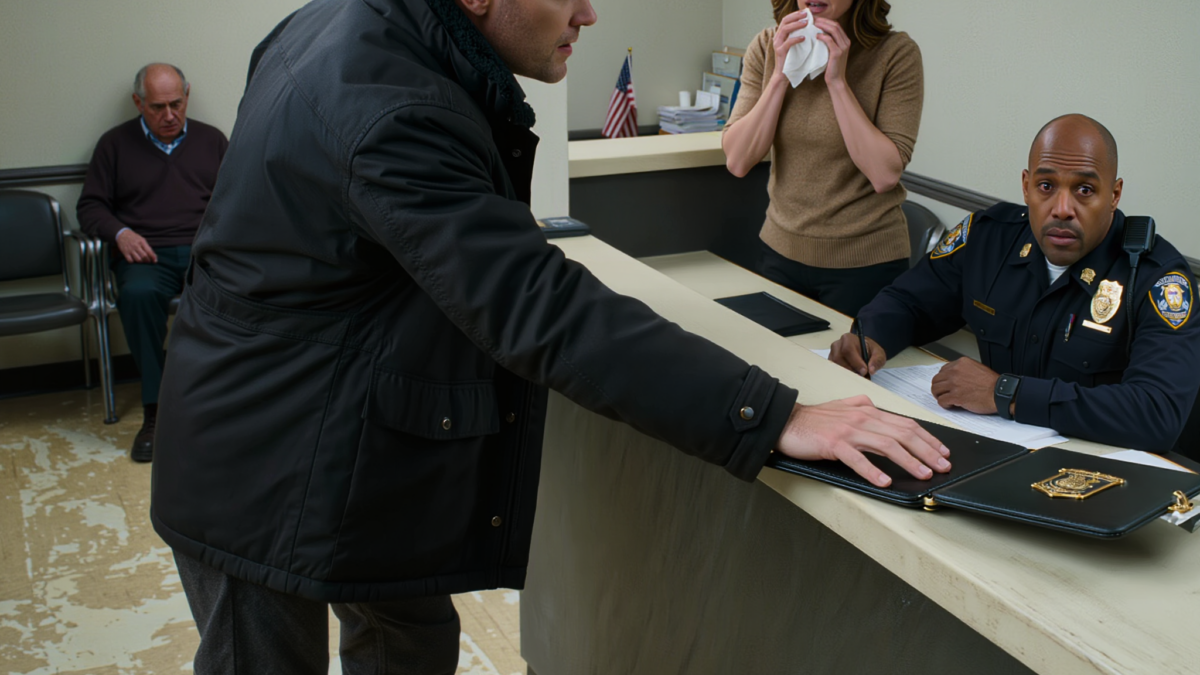
My name is Gabriel Thorne, and I’m thirty years old. For the better part of a decade, I’ve worked as a federal agent, tracking organized criminals and investigating fraud. At 2:27 a.m. on a freezing Tuesday morning, a case more personal than anything I had ever handled began with a call from my father.
Dad was seventy-two. He had spent forty years working in an auto parts factory to give us a decent life, and now he was calling from a holding cell at the Maran County Police Station. I could barely understand him through his sobs.
He told me that my sister-in-law, Vanessa, had attacked him with an aluminum baseball bat, then called the police and accused him of being the aggressor. She was telling officers that his mind was failing, that he was dangerous, and that he needed to be placed in a secure psychiatric facility.
My older brother, Raymond, had been there. According to Dad, he had stood against the kitchen counter and watched without saying a word.
What I would uncover went beyond a false accusation. Raymond and Vanessa were trying to have Dad declared mentally incompetent so they could take control of his house, bank accounts, retirement funds, and inheritance. The people who had moved in to care for him were preparing to take away his independence.
They knew what I did for a living. They knew I investigated financial records and followed evidence that other people hoped would remain buried. What they had apparently dismissed was the possibility that I would turn that attention toward our own family.
Raymond and Vanessa are now facing long prison sentences and asking for forgiveness I cannot give them. But that morning, before the records, the warrants, and the courtroom, all I knew was that my father was frightened and asking me to come.
The phone had pulled me out of a deep sleep in my downtown apartment. In federal law enforcement, a call at two in the morning rarely means anything good. It can mean an operation has gone wrong, a fugitive has crossed state lines, or a colleague has been lost.
I pushed aside the winter comforter and reached across the wooden nightstand. The room was cold enough to make me hesitate before sitting up. Then I saw the name on the screen.
Dad.
He lived by a routine. Every night, he watched the evening news and went to bed at nine. For him to call at that hour, something had to be seriously wrong.
“Dad,” I answered, still trying to clear the sleep from my voice. “Dad, is everything okay?”
“Son. Gabe, help me.”
His voice was thin and unsteady. He sounded as though he couldn’t get enough air. I sat up, put my feet on the cold hardwood floor, and listened.
“Dad, take a deep breath and tell me exactly where you are,” I said. “What’s going on?”
“I’m at the police station. Marian County.”
Behind him, I could hear radios, doors closing, and voices carrying through a busy precinct. The sounds made the situation real in a way his first words hadn’t.
“Vanessa is framing me,” he said. “She told the police I attacked her with a baseball bat in the kitchen. She hit herself, Gabe. She took the bat. She smashed it against the granite counter, and she hit her own shoulder. She did it to herself.”
I gripped the phone until the casing creaked. For a moment, I closed my eyes, trying to make sense of what he was telling me.
“Where’s Raymond? Is Raymond there?”
“He just stood there watching.”
Dad began crying again. I had heard him upset before, but never like this.
“He leaned against the wall. He didn’t say a word to stop her. Gabe, they’re telling the police I’m crazy. They’re telling them I have severe dementia and that I belong in a locked facility.”
I couldn’t establish what had happened over the phone, but I knew he needed someone there who would listen to him. Whatever the officers had been told, Dad was too frightened to protect himself from questions or paperwork he didn’t understand.
“Dad, listen to me carefully,” I said. “Don’t speak to any officers. Don’t answer their questions, even if they seem friendly. Don’t sign any documents. If someone hands you a piece of paper, don’t sign it. I’m leaving right now. I’m coming to get you.”
I pulled on my tactical trousers and heavy boots, grabbed my winter coat, credentials, and keys, and left the apartment. Within minutes, I was driving through the empty, rain-slicked streets of Indianapolis.
Streetlights reflected across the pavement. I kept both hands tight on the wheel while I worked through what Dad had said. Raymond hadn’t tried to stop Vanessa. He hadn’t called me for help. He had let our father make that call from a police station.
I had seen people use confusion and family loyalty to conceal financial wrongdoing. But knowing that such things happened was different from imagining my own brother participating in them.
At the precinct, I pulled into the parking lot, left the car unlocked, and went through the glass entrance doors. Fluorescent lights shone across a scuffed linoleum floor. I found Dad almost immediately.
He was sitting in a plastic chair in the far corner of the waiting area, wearing a thin wool sweater. His shoulders were rounded, and his eyes were fixed on the floor. He looked twenty years older than he had the last time I saw him.
Vanessa stood at the front counter a few feet away. She held a crumpled tissue against her face and kept pointing to a faint red mark on her right shoulder. Behind the counter, duty officer Dennis Miller was writing on a clipboard.
“You don’t understand, Officer,” she said. “He just snapped. He came out of his room and completely lost his mind. He’s out of control. You have to write up a psychiatric hold and send him to a secure facility tonight before he hurts someone else.”
She pressed the tissue against her face again.
“We’ve been trying to manage his decline, but we can’t do it anymore.”
I walked to the counter and placed myself between her and Miller. I didn’t argue with her. I addressed the officer.
“I need to speak with that man in a private room immediately,” I said. “I’m also requesting the duty lawyer before any further statements are taken from him, and I want a copy of the report you’re drafting.”
Miller looked up with the tired irritation of someone who didn’t want another interruption. He leaned back in his chair and gestured toward the waiting area with his pen.
“Take a seat, buddy. Wait your turn like everybody else. We’re handling a domestic dispute here. We don’t need outside interference, and I’m not logging your requests until I finish this incident report for the victim.”
He had already decided which person at the counter was the victim. My father was still sitting alone across the room.
I took my credential case from my coat and opened it on the counter. The gold shield caught the fluorescent light.
“I’m not making a suggestion, Miller,” I said. “Preserve the evidence and secure the scene at the house. Stop this questioning and provide my father with a private room. Otherwise, we’re going to have a serious conversation about obstruction.”
Miller’s eyes settled on my credentials. He sat upright, cleared his throat, and closed the report he had been preparing for Vanessa. Then he picked up his radio.
Vanessa stopped crying. Her tissue dropped away from her face, and she stared at me with her mouth slightly open. For the first time since I had entered, she wasn’t talking.
I went to Dad and put a hand against his back. With my other arm around him, I helped him rise from the chair so we could move somewhere private.
His legs gave way.
He stumbled to the left, and I caught his forearm before he fell. The movement pushed his sweater cuff toward his elbow. I looked down and saw dark marks encircling his wrist.
There were similar marks on the other one.
Until that moment, I had thought the immediate problem was a false accusation. Now I was looking at something that couldn’t be explained by a disagreement at a kitchen counter.
I abandoned the idea of taking him to my apartment. Whatever answers we needed from the police could wait until a doctor examined him. I took him straight to the hospital.
During the drive, the history of our family kept returning to me in pieces. Things I had accepted, things I had resented, and things I had never imagined could lead us here.
Raymond had always been the golden child of the Thorn family. When we were teenagers, he received a new car for his birthday. I worked night shifts at Walmart to buy an old car that would get me to school.
Our mother, who had died five years earlier, always had an explanation for him. When he spent his college fund on parties, vacations, and unsuccessful investments, our parents dipped into their retirement savings to help him recover.
When I entered the federal academy, I paid my own way. I didn’t ask for money, and I didn’t expect it. Still, I became the distant son, the one accused of caring more about work and promotions than family.
Aunt Beatatrice and Uncle Richard reinforced that distinction. At Thanksgiving, they praised Raymond’s business ventures and talked about the future he was building. My job was usually mentioned in connection with the gatherings I had missed.
To them, Raymond was the charming son who would carry on the family’s success. I was the difficult one, too rigid and too absorbed in work.
Vanessa came into the picture two years earlier. She knew how to present herself as attentive and affectionate, particularly around Dad. After Mom’s funeral, he had been lonely and vulnerable, with a paid-off house, a substantial 401(k), and money inherited from my grandfather.
Raymond and Vanessa moved in under the explanation that they would keep him company and help with his affairs. On the surface, it was an arrangement the rest of the family welcomed.
At first, the changes were easy to explain away. I would call on a Sunday afternoon, and Vanessa would say Dad was asleep. Another time, he was confused and needed quiet. Then he had supposedly taken a minor fall and needed uninterrupted rest.
The explanations kept changing, but the result stayed the same. I didn’t get to speak to him.
They stopped inviting me to Sunday dinners. When I arrived without calling, Raymond met me on the porch and blocked the doorway. He told me that seeing me upset Dad and made his condition worse.
I suspected they were keeping me away. I thought they wanted control of the household and the money. I hadn’t imagined what might be happening to Dad inside it.
My phone vibrated in the cup holder while we were on the way to the hospital. Aunt Beatatrice was calling. I answered on speaker without taking my eyes off the road.
“Gabriel, what on earth is happening?” she demanded. “Raymond just called us in a panic. He said your father had a violent episode and attacked poor Vanessa. We all knew his dementia was getting worse, but you never want to face reality.”
Raymond was already calling the family. Dad was beside me, frightened and unwell, while my brother was making sure everyone heard his version first.
“You always think you know better than everyone else,” Beatatrice added.
“Dementia doesn’t explain what I’m looking at right now,” I said.
“You’re not a doctor, Gabriel. Stop trying to play the hero and let your brother handle this. It’s a family matter, not a police matter. Don’t you dare bring a lawsuit into this family. Raymond is trying to protect his wife.”
I ended the call. Arguing with her would not get Dad the care he needed, and she had already decided whose account she believed.
At the emergency room, the intake nurse looked at his pale face, shallow breathing, and trembling hands and took him past the waiting area. He was placed in a high-priority treatment bay.
Dr. Julian Hayes, the senior attending physician, began examining him. I stood in the corner with my arms folded tightly across my chest, listening to the monitors and watching every movement around the bed.
The initial report was troubling. Dad was severely dehydrated and malnourished, and his heart rate was unstable. The blood work showed no trace of his prescribed heart medication. He had gone without it for at least three days.
Dr. Hayes gently raised the sleeves of Dad’s sweater and examined his wrists with a penlight. He looked at the marks for several moments before turning toward me.
“These bruises aren’t from a struggle that happened an hour ago in a kitchen,” he said. “The patterns and discoloration indicate injuries that are four to seven days old. These are restraint marks, Agent Thorn. They’re consistent with heavy-duty plastic zip ties.”
I tightened my jaw and kept looking at Dad’s arms. My brother and his wife had done more than keep me from visiting. The marks suggested they had physically restrained him.
I stepped into the hallway to make a call. I needed to be able to speak without Dad hearing every word.
“Miller,” the officer answered.
“The hospital has found evidence that my father was restrained for days,” I said. “He’s also been deprived of his heart medication. You were preparing a report against him without addressing evidence that he had been mistreated.”
Miller began defending what he had done. I interrupted him.
“Listen carefully. This needs to be documented as suspected elder abuse. Send officers to preserve the evidence at that house and update the incident report. If you don’t, I’ll take this to internal affairs, the district attorney’s office, and federal oversight by sunrise.”
There was a pause on the line. The medical findings were no longer something he could dismiss as one relative disagreeing with another.
“Your conduct, your position, and your professional liability are now part of this,” I said. “Do you understand?”
“I’ll update the report, Agent Thorne,” he answered. “I’ll dispatch Sergeant Dominic Ross to secure the premises and document the evidence.”
When I returned to the treatment bay, an IV was running beside Dad’s bed. He looked more alert, but the fear hadn’t left his face.
He reached for my hand and pulled me closer.
“Do not take me back to that house, Gabe,” he whispered. “They locked me in that room for days. They wanted me to sign papers I could not read. They said if I did not sign, I would not eat. I was so thirsty, Gabe.”
I held his hand while he spoke. There was nothing abstract about the evidence now. He had been pressured to sign documents while the people controlling his food and medication waited for him to give in.
I promised him he would never return to that house as their victim. But I knew I had to go back myself. Whatever papers they had put in front of him might still be there.
An hour later, I pulled into Dad’s driveway. The sky over Indianapolis was still dark and gray. His lawn was neatly maintained under the neighborhood’s strict HOA rules, and the porch light gave the entrance the same welcoming appearance it had always had.
We had celebrated holidays in that house. Mom had baked pies there, and Dad had repainted the shutters every spring. From the street, there was no sign of what he had described at the hospital.
I used the spare key he had slipped into my hand. The front door opened onto stale air and a hallway I knew well.
I passed the living room and went toward the primary bedroom. I had expected signs of a struggle, perhaps broken furniture or overturned belongings. Instead, I found something more deliberate.
A commercial-grade deadbolt had been installed on the outside of Dad’s bedroom door.
I crouched to inspect it. The screws were bright, and the brass finish was still unmarked. It appeared to have been installed within the last two weeks. Its position made its purpose clear: whoever was inside the room couldn’t use it to let himself out.
“What the hell are you doing in this house?”
Raymond stood at the end of the hallway in an expensive robe, holding a cup of coffee. He looked irritated rather than concerned. He apparently hadn’t expected me to have a key or to leave the hospital long enough to come over.
“This is Dad’s house,” I said. “I have his key and his permission to be here. You don’t get to keep me out.”
“You have no business poking around in the middle of the night,” he snapped, moving closer. “Vanessa and I are taking care of Dad’s affairs. You’re overstepping, Gabe. Dad is sick. He’s dangerous. He attacked my wife, and my lawyer is already preparing the paperwork to have him committed.”
“I’m securing this property as a crime scene.”
I moved past him instead of arguing about the explanation he kept repeating.
“Stay out of my way, Raymond.”
In the kitchen, food wrappers, dirty plates, and empty prescription bottles covered the granite counters. None of the bottles belonged to Dad’s prescribed heart regimen. The room looked as though no one had made an effort to clean it for days.
I went to the stainless steel trash bin beneath the sink. It was full. Wearing gloves, I pulled out the liner and transferred the contents into a fresh bag, looking through the discarded wrappers, plates, wine bottles, and coffee grounds.
Near the bottom, I found a stack of shredded paper.
I gathered the pieces and spread them across a clear section of the kitchen island. For the next twenty minutes, I fitted the strips together while Raymond stood in the doorway.
The document was a copy of Dad’s original will, the one he had kept in a safety deposit box for twenty years. It divided his estate equally. Whoever had shredded it had cut through the signature line and the distribution clauses.
Then I found a second document beneath the pieces. It was crumpled and stapled, but largely intact.
A general power of attorney.
I flattened it on the island and studied the signature. The handwriting was uneven and unfamiliar, a poor attempt at Dad’s usual signature. On the second page, an embossed notary seal was smudged, but the name and commission number remained readable.
Gwen Prescott.
I checked the public state database for commissioned notaries. In less than fifteen seconds, I found the record. Prescott’s commission had expired three years earlier.
When I looked up, Raymond was gripping the doorframe. His knuckles were white, and the confidence he had shown in the hallway was gone.
The papers did not stand alone. There was the lock outside Dad’s bedroom, the condition in which he had arrived at the hospital, and his account of being pressured to sign. Together, those details described something very different from relatives trying to manage an older man’s health.
I collected the shredded will and the power of attorney in an evidence bag. I didn’t argue with Raymond on my way out. I had documents to examine and financial records to obtain.
At that point, I thought I understood how serious the situation was. I still didn’t know how much money had already moved or how close they were to selling the house.
The next morning, I went to the federal field office without having slept. In the digital forensic lab, I placed the evidence bag on the desk in front of My Lin, our lead specialist.
Maya adjusted her glasses and examined the power of attorney. She knew Dad. A few years earlier, she had joined us for Thanksgiving at his house.
She checked the notary details against the state’s records, then turned her monitor toward me.
“The credentials listed here are invalid,” she said. “Gwen Prescott’s commission expired three years ago. There are also two pending civil complaints involving fraudulent stamping. This seal is fabricated, Gabe.”
It confirmed that the document required far more than a family explanation. I needed to know whether it had already been used to gain access to Dad’s accounts.
“Prepare the paperwork for a federal subpoena,” I said. “I need the complete history for his savings, checking, and retirement accounts. Go back six months. I want to see every transaction.”
The request cited suspected elder financial exploitation and forgery. The bank’s compliance division expedited its response, and two hours later, the records arrived in an encrypted file.
For the first few months, the activity looked ordinary. Groceries, utilities, pharmacy co-pays. The small, familiar payments of a retired man keeping his household running.
Then, fourteen days earlier, the pattern changed.
“Look here, Gabe,” Maya said.
She highlighted a cluster of transactions. A single transfer had removed $250,000 from Dad’s funds.
The money hadn’t gone directly to Raymond’s personal account. It had passed through a newly registered shell company before being broken into smaller transfers and sent to three offshore gambling platforms. The amounts had been kept below $10,000 in an apparent effort to avoid scrutiny.
“They routed it through an intermediary account,” Maya said, bringing up the movement of funds on a second monitor. “The LLC is registered to Vanessa. This wasn’t just money for credit cards or household expenses. They were moving his savings through the company and into gambling accounts.”
I studied the transactions. Dad had spent fifty years on a factory floor, wearing down his back and knees so he could retire with some security. In two weeks, a quarter of a million dollars had been moved out of that security and into online gambling.
“Run a complete background check on Vanessa,” I said. “Civil court records, DMV records, out-of-state warrants, divorce decrees. I want to know whether this has happened before.”
Maya expanded the search, cross-referencing Vanessa’s Social Security number and maiden name. Records appeared from Arizona, Nevada, and Florida.
Over the previous decade, Vanessa had used three aliases. The files contained civil disputes over property, allegations involving false domestic complaints, and accounts that had been emptied after she gained access to them.
The people described in those cases were older and vulnerable. Some had married her. Others had allowed her to move in as a caregiver.
“She’s a professional predator, Gabe,” Maya said, reading a deposition from a divorce case in Phoenix. “She gains access to their assets, creates a conflict that can get them removed from the home, and leaves when there’s nothing left.”
Those records were separate from what had happened to Dad, but the similarities were difficult to ignore. Raymond had brought Vanessa into his home, and the documents in front of us showed that my brother wasn’t simply unaware of what she was doing.
“There’s one more thing,” I said. “Check the multiple listing service. Search Dad’s address in Indianapolis.”
Maya entered the address. A listing appeared.
Dad’s house was on the market as a for-sale-by-owner property. The asking price was $50,000 below market value, low enough to encourage a fast cash sale. The listing was less than forty-eight hours old.
It had gone up the same day they locked the deadbolt on his bedroom door.
We opened the authorization attached to the listing. It carried the same uneven attempt at Dad’s signature that I had seen on the power of attorney.
They weren’t only taking money from his accounts. They were trying to sell the home he owned while telling everyone he could no longer make decisions for himself.
I printed the records. The bank activity, the property listing, the power of attorney, and the medical findings now belonged in front of a prosecutor.
The folder I carried out of the lab was thick. Inside it were the expired notary credentials, the transfers linking Dad’s money to Vanessa’s company, and the authorization for the house sale. The medical reports documented the condition in which I had brought him to the hospital.
Each part answered a different question. Together, they showed why isolating Dad had been so important to Raymond and Vanessa.
I hadn’t gone home, showered, or stopped for breakfast. I drove through the morning traffic to the Maran County Courthouse, showed my credentials at security, and went to District Attorney Evelyn Monroe’s office.
Evelyn had prosecuted corruption, financial crimes, and serious domestic cases. She was direct, exacting, and not inclined to be persuaded by emotion alone. I needed her to see what the records supported.
I went past her assistant and placed the folder on her desk. She opened it without asking me for a long explanation.
For twenty minutes, she read.
She compared the notary information with the state record. She followed the money from Dad’s accounts through Vanessa’s company. She studied the property authorization and the hospital findings.
I stood on the other side of the desk and waited. There was nothing useful I could add while she was establishing the sequence for herself.
Finally, she closed the folder and looked up.
“The financial fraud is well documented, Agent Thorne,” she said. “Your brother and his wife have carried out a coordinated scheme involving elder financial exploitation, assault, and forgery. They were trying to take control of his assets and sell his home.”
She tapped her pen against the file.
“I’m taking this to the duty judge myself. We’ll seek a no-knock search and seizure warrant for your brother’s office, vehicles, and residence. We’re also going to freeze their accounts and credit lines before any more money can be moved.”
Within two hours, a superior court judge had signed the warrant.
I assembled a state police financial crimes task force. After my experience with Miller, I didn’t want the local precinct handling the operation. I wanted a team that would treat the evidence independently of the account Vanessa had given the night before.
We coordinated in the courthouse parking lot, put on protective vests, and left in unmarked SUVs for Raymond’s office downtown.
His property management business occupied a modern glass-fronted building in the financial district. It projected exactly the kind of success he liked the family to see.
The business had begun with money our parents had made available to him after his college fund was drained. Over time, he had sustained it with money taken from clients and family members who trusted him.
At Thanksgiving, Raymond talked about his salary, his cars, and his country club memberships. The office helped support that image. Nothing about its polished entrance suggested how much of it depended on other people’s money.
We arrived during the lunch rush, with employees and clients in the building.
I carried the warrant through the revolving doors while the officers spread across the lobby. They secured the exits and elevators and moved to prevent the destruction of records or electronic files.
The receptionist dropped her phone when she saw us. We continued down the corridor toward Raymond’s office.
I didn’t knock. I forced open the frosted-glass door.
Raymond was behind a large oak desk in a tailored three-piece suit. Property transfer documents filled his two monitors. He was working on the discounted sale of Dad’s house, with his hands poised over the keyboard.
When he saw me and the four state officers approaching his desk, he stopped moving.
“Clear the floor,” I told the lead sergeant. “Secure every computer, laptop, phone, and file box. Nobody touches a keyboard or makes a call.”
“Gabe, what is this?” Raymond asked.
He tried to stand, but a trooper placed a hand on his shoulder and kept him seated.
“You can’t barge in here like this. I have clients waiting. I run a legitimate business. I’m calling my lawyer, and I’m going to have your badge for this.”
“Call whoever you need to call, Raymond,” I said, placing the warrant on his keyboard. “You’re going to need a defense attorney. We’re seizing the operation as part of an investigation into wire fraud, forgery, and elder exploitation.”
He looked down at the warrant. Outside his office, employees could see officers collecting records and securing equipment.
As the computers were disconnected and tagged, the adjoining conference room opened. Vanessa came out in a designer dress, her hair styled and her makeup intact. She looked very different from the distressed woman I had seen at the police counter.
She surveyed the officers and the boxes being filled with files, then looked at me. Instead of appearing frightened, she folded her arms and leaned against Raymond’s desk.
“You’re wasting your time, Gabriel.”
Her confidence was almost harder to watch than the performance at the station. She still seemed certain that the evidence would support whatever explanation she chose to give.
“You’re upset because your father is finally going to be placed in a secure facility,” she said. “But you won’t find proof that I laid a finger on him. The home security cameras have been broken for a week. A power surge fried the hard drives.”
She glanced toward the equipment being collected.
“Take the computers. You’ll find legitimate real estate contracts.”
I signaled for the technicians to collect the mobile devices and the router blinking in the corner.
“I’m not only looking for local hard drives, Vanessa,” I said. “I’m looking for network activity and the digital records you didn’t account for.”
Her smile disappeared. She dropped her arms and looked toward the equipment.
A damaged recorder didn’t answer every question about data that might already have been uploaded elsewhere. My team was examining upload times, network records, and the traces left by devices connected to the accounts involved.
The officers continued cataloging computers, laptops, and phones. Devices were placed in shielded evidence bags to protect them from remote interference while they were transported.
I checked the property listing on a tablet as the office network was secured. The listing for Dad’s house disappeared. The emergency freeze order had blocked the unauthorized sale.
Raymond bent forward and put his head in his hands.
For him, the office had always been proof of authority. Now his employees were watching officers take possession of the files and equipment that could explain how he had financed it.
The financial operation had been stopped. His devices and records were no longer available for him to alter or discard.
But there was still a separate question. We had to establish what had happened in the kitchen and whether Vanessa’s accusation against Dad was false.
An hour later, the seized equipment arrived at the forensic lab. My Lin took charge of the devices, opening the transport bags, cataloging the contents, and setting up the hardware at her workstation.
The room was cool and windowless, filled with the steady sound of server equipment. Maya began examining the network records from the router recovered at Raymond’s office, looking for activity connected to Dad’s home.
She worked through the data, separating ordinary device traffic from the uploads she wanted to identify. There were connections involving televisions, appliances, and phones, but she was looking for a recording device that might have remained active after the main system was damaged.
Then she found a substantial upload to a separate endpoint.
She studied the information, stopped typing, and turned toward me.
“Gabe, look at this.”
I leaned over her shoulder.
“The home network had an active connection to another device,” she said. “It was sending encrypted data. It’s a Nest security unit.”
“Vanessa told the officers the main system was damaged by a power surge,” I said. “She destroyed the DVR in the utility closet with a hammer. We verified the broken equipment at the house. That system wasn’t operating.”
“She destroyed the main system,” Maya said. “This is separate. It’s a standalone wireless unit, registered under a generic factory name. They may not have recognized it when they checked the network.”
She opened the device specifications on a second screen. It wasn’t an obvious camera mounted on a wall.
It was a camera built into a decorative digital picture frame.
“My father bought that,” I said.
I remembered it on the bookshelf in the living room, facing the open kitchen. He had purchased it more than a year earlier to display photographs of Mom after her funeral.
“He thought it was just a digital frame,” I said. “He wanted something that would cycle through her pictures. He never knew it had a camera.”
Raymond and Vanessa had concentrated on the main recording system and the large drives in the utility closet. The frame had remained on the shelf, displaying photographs of the woman whose home they were preparing to sell.
The camera inside it had continued recording and sending its files to off-site storage, independently of the damaged DVR.
“It’s set to back up automatically,” Maya said.
She prepared the request to the hosting company’s legal compliance department. The device records showed an upload during the hour of the incident.
“They apparently didn’t know it was operating,” she said. “There’s a video file from this morning.”
A progress bar appeared on the monitor as the file downloaded. I watched it without speaking.
Until then, every part of the case had required piecing things together: a medical finding, a document, a bank transfer, an explanation that didn’t fit. Now there might be a direct record of the event that had put Dad in a police station.
“The file is ready,” Maya said. “It’s decrypted and ready to play.”
I moved closer and placed both hands on the edge of the desk.
“Open it and zoom in on the kitchen,” I said. “I need to see every movement from the moment Dad entered the room. Don’t skip anything.”
The image appeared in black and white. The living room and open kitchen were clearly visible. In the lower corner, the timestamp read 2:18 a.m.
Dad sat on a wooden stool at the granite island in his flannel pajamas. His head was in his hands. After days of being isolated and deprived of proper care, he looked exhausted.
Vanessa entered carrying the aluminum bat.
She approached him, leaned close, and said something the microphone didn’t clearly capture. Then she stepped back.
What happened next was visible without any need for interpretation. She struck the edge of the counter with the bat, creating a loud impact. Then she deliberately hit her own shoulder.
Dad had not moved toward her.
Vanessa dropped the bat, lowered herself to the floor, and began shouting for help. She acted as though Dad had attacked her while he remained on the stool, bewildered.
Movement appeared in the background. Raymond came out of the hallway, fully dressed, and leaned against the kitchen doorway.
He folded his arms and watched.
He didn’t look surprised. He didn’t move to protect his wife or ask Dad what had happened. There was a small, satisfied smile on his face while Vanessa continued her performance.
Dad raised his hands in fear and confusion.
I tightened my grip on the desk. Seeing Raymond there was different from hearing Dad describe it. There was no hesitation to explain away and no sign that my brother had been caught off guard.
“She created the injury herself,” I said.
I pointed toward Raymond’s image on the screen.
“You stood there and watched her do this to Dad. You planned it together so you could have him placed in a facility and take his money. You sold your own father for casino money.”
Maya kept the recording running. The video gave us the evidence we needed to challenge Vanessa’s accusation directly.
Together with the forged documents, the bank records, and the medical findings, it established a connected case. Dad’s isolation, the effort to declare him incompetent, and the movement of his assets were no longer separate incidents.
The footage became the final major piece supporting federal and state charges involving elder abuse, false police reports, and financial conspiracy. The investigation had reached the point where the evidence could be put before a court.
The video was saved on a secure federal server with multiple backups. It was no longer dependent on a device inside Dad’s house or on anything Raymond and Vanessa could reach.
District Attorney Monroe moved ahead with the financial records and footage. She declined to discuss a plea agreement when Raymond’s defense attorney called about a possible settlement.
The arrest warrants were executed before sunset.
I went to the holding cell where Raymond had been placed after the office search. He sat on a metal bench, looking at the floor. He still seemed to believe there might be an explanation that would make the evidence disappear.
I held up a tablet and played the recording.
He watched himself standing in the doorway while Vanessa staged the incident. Then he slid from the bench to the floor and began crying.
He moved toward me, begging me to remember that we were brothers. He brought up Mom and said she would never have wanted her eldest son in prison.
Then he blamed Vanessa.
He said she had manipulated him. He said he had been caught in her plans and had become a victim himself.
I looked at him and thought about Dad’s hands gripping mine in the hospital. Raymond was asking me to consider what he would lose, after helping deprive our father of food, medication, and freedom inside his own home.
I told him he had lost the right to appeal to me as his brother when he helped restrain Dad and left him without food for three days. He had also lost the right to use our mother’s name to ask me to excuse it.
I left the cell while he was still pleading. The steel door closed behind me.
Six months later, the Maran County courthouse was crowded for the trial. News crews waited outside. The case had become a public story about a successful-looking real estate businessman accused of exploiting and mistreating his own father.
I sat in the front row of the gallery and held Dad’s hand.
Raymond’s defense attorney tried to describe what had happened as a series of family misunderstandings made worse by a mental health crisis. The defense continued to characterize Dad as confused and dangerous, and Vanessa as someone trying to protect herself.
We had heard those claims before, first at the police station and then from relatives who had never asked Dad for his account. In court, the claims had to stand beside the evidence.
The prosecution presented the financial records and the documents recovered from the house. Then the recording was played on the courtroom screens.
The jurors watched Vanessa create the appearance of an attack. They watched Raymond stand nearby without intervening. They watched Dad remain on the stool.
Several jurors gasped. The room became quiet while the footage continued.
The defense could question memories and offer explanations for paperwork. It could not make the recording show something different.
The judge watched the defendants with visible disapproval. The defense attorney’s argument lost its force once the footage had been played.
The defense rested without calling a witness. The jury deliberated for less than three hours before returning guilty verdicts on every count for both Raymond and Vanessa.
The sentencing hearing followed a week later.
Vanessa stood before the bench in an orange jumpsuit, her wrists secured at her waist. She no longer had the assurance she had displayed in Raymond’s office.
The prosecution introduced evidence of her history of elder financial disputes and fraudulent claims in other states to establish a pattern of behavior. The judge considered that history alongside what she had done to Dad.
She received consecutive sentences totaling eighteen years in state prison for financial exploitation of an older adult, forgery, and physical mistreatment.
The judge made clear that this was not a situation in which responsibility could be dismissed as a misunderstanding or shifted entirely to someone else. Vanessa would spend many years away from the life she had been trying to finance.
Raymond received eight years in a medium-security facility.
He had spent much of the trial looking at the floor and avoiding my eyes. The court held him accountable for his role in the financial scheme and for his active participation in what had happened to a vulnerable man living under the same roof.
He was also ordered to pay full restitution for the $250,000 taken from Dad’s accounts. The judgment would follow his future earnings and remain part of his financial obligations.
When he left the courtroom in handcuffs, the business reputation he had spent years cultivating no longer protected him.
The consequences extended beyond Raymond and Vanessa. Officer Dennis Miller’s handling of the original complaint became the subject of an internal affairs investigation.
Investigators reviewed the precinct recordings and examined his response to the warning that Dad might have been mistreated. They considered the way he had accepted Vanessa’s account while dismissing requests for Dad to be heard and examined.
Miller was suspended and ultimately dismissed from the department. He lost his position, his salary, and his city pension.
The records from that night showed more than a difference of opinion between officers. They showed how close Dad had come to being treated solely as the person accused, without an adequate examination of what had happened to him.
After the criminal proceedings, there was still extensive work to do. The court declared the fraudulent property transfer documents Raymond had filed with the county clerk null and void.
The supposed authority behind them did not survive review. Dad remained the owner of his property.
Under an order from the federal judge, the bank reversed the illicit transfers and worked to recover funds from the offshore companies and gambling platforms. The money was returned to Dad’s retirement account.
The college fund Raymond had squandered, the inheritance he had tried to take, and the assets he had attempted to control were taken out of his hands and secured in a trust I managed.
Those changes mattered. Dad’s savings and ownership were protected again. But restoring an account balance could not make the house feel the way it had before.
The place with the carefully maintained lawn and freshly painted shutters had become a reminder of what his son had allowed to happen there. Dad saw the damaged bedroom doorframe whenever he walked down the hall.
The kitchen island brought back the night Vanessa accused him. He struggled with panic in a room where our family had once gathered without thinking twice.
He remembered the isolation and the uncertainty about whether anyone would come. A court judgment could establish what had happened, but it could not make him forget waiting in that bedroom.
Within days of the sentencing, Dad made his decision. He wanted to sell the house and leave Indianapolis.
We listed it with a legitimate real estate broker. The market in the neighborhood was strong, and a young family bought it for more than the asking price within a week.
This time, the sale was his decision. He wanted the value of the property available to him rather than tied to a place he no longer wanted to live.
I handled the legal work and hired an estate lawyer to revise his will and establish a living trust. Raymond was removed from inheritance provisions, medical directives, powers of attorney, and future claims to Dad’s estate.
Dad did not want him making decisions on his behalf again. Nor did he want another opportunity for Raymond to use the family connection to gain access to his property.
The documents were designed to make that intention clear and leave as little room as possible for a challenge. Raymond would not receive money, possessions, or even a photograph through Dad’s estate.
On moving day, the air was bitterly cold, but the sky was clear. We packed clothes, photographs of Mom, Dad’s favorite recliner, and a few small pieces of antique furniture that still meant something to him.
The rest could be sold or donated.
I helped Dad into the passenger seat of my SUV. He looked less burdened than he had in months. The decision to leave had given him something the investigation alone could not: a choice about what came next.
I had requested a permanent transfer to a field office on the East Coast and secured a promotion. I bought a house with an in-law suite so Dad would have a place of his own close to me.
We left Indianapolis and joined the interstate.
As we crossed the state line and put the Midwest behind us, my phone began vibrating in the cup holder. Aunt Beatatric was calling. A long message from Uncle Richard followed.
The trial had been covered across the state. Relatives who had defended Raymond and demanded that I stop embarrassing the family now knew what the evidence showed.
They wanted to apologize. They wanted to make amends and invite us to Thanksgiving. They wanted to return to the idea that we were still a close family who could move past an unpleasant disagreement.
But this had not been a disagreement.
Dad had asked for help, and they had accepted the explanation that made it easiest not to listen. When I tried to intervene, they had pressured me to leave him with the people who were taking his money and controlling his life.
I didn’t answer Beatatric’s call or finish Richard’s message. I blocked both numbers.
Then I blocked the other relatives who had insisted I was overreacting, defended Raymond’s entitlement, or treated Dad’s situation as something to hide for the sake of appearances.
I wasn’t prepared to give them another opportunity to make his safety secondary to the family’s reputation. He had earned the right to live without that pressure.
The distance between us and those relatives was not something I intended to repair simply because the evidence had become public. Loyalty should not have required a courtroom screen before anyone was willing to question Raymond.
Dad and I were starting again. His money was protected, his decisions were his own, and the people who had used their access to him no longer had it.
Looking back, the most difficult thing to accept was how ordinary the beginning had looked. No stranger had broken into Dad’s home. The people who harmed him had keys.
They sat at the Thanksgiving table. They asked for the gravy and talked about family while preparing to take control of his life.
We are often taught that being related creates an obligation to forgive, regardless of what happened. In our family, that expectation had become another way to pressure the person who objected instead of confronting the people responsible.
Sharing a last name did not give Raymond a right to Dad’s savings. It did not give Vanessa a right to isolate him. And it did not obligate either of us to restore relationships with people who had defended them without listening.
The boundaries we set were not about continuing the conflict. They were about making sure it could not happen to Dad again.
I had to become the villain in my extended family’s eyes to become the protector my father needed. I would make that choice again a thousand times without hesitation.








