At my sister’s wedding, my father threatened to cut off my final college tuition payment unless I smiled and played the grateful son. He’d spent four years reminding me that he paid for my education. I arrived at Oakwood Manor in my old navy suit and handed him a white envelope. Inside was a cashier’s check for exactly $12,350. When he saw whose name was on it, his face went pale…
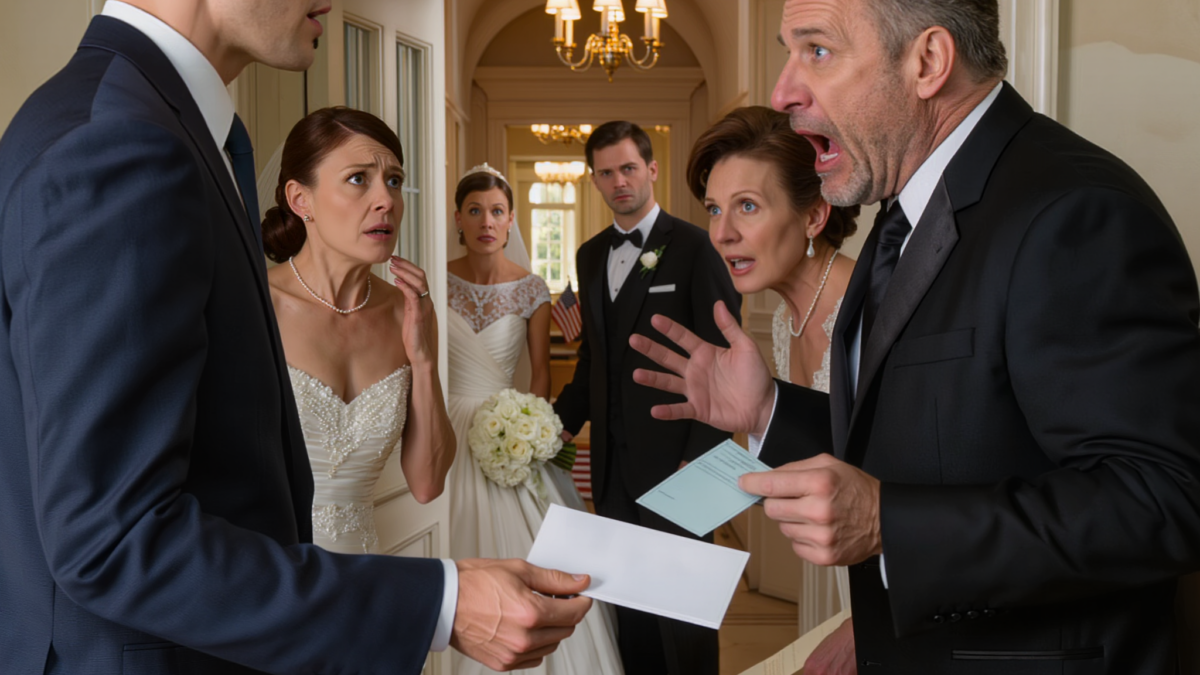
My name is Ethan Miller. I’m 22 years old, and my own father tried to leverage my entire future, my education, and everything I’d worked for just to make sure I was a smiling prop at my sister’s wedding.
It was the last move in a chess game he didn’t even know he was losing.
The place was called Oakwood Manor, and it was as pretentious as it sounds. The Grand Hall was a cathedral of wealth. Sunlight streamed through two-story windows, glinting off crystal chandeliers that looked like frozen waterfalls. The air was thick with the scent of thousands of white lilies and the faint, sharp tang of expensive champagne.
Every surface was polished to a mirror shine: the marble floors, the dark mahogany bar, even the silverware being laid out by staff in crisp black uniforms.
I did a quick, bitter calculation in my head. The flower arrangements alone probably cost more than my last two semesters of tuition. The real tuition, the one I had actually paid for.
I stood near the arched entrance in a navy blue suit, watching the guests arrive. They were my father’s people: business associates, country club members, and neighbors from the wealthy side of town. They moved with easy confidence, their laughter a little too loud and their handshakes a little too firm.
They were all playing a part in the grand production of the Miller family’s success story.
Then I saw the director of that production: my father, Richard.
He was a force of nature in a custom-tailored tuxedo. He moved through the crowd like a king surveying his domain, offering a booming laugh here and a firm clap on the back there. His smile was brilliant, all teeth and no warmth.
When his eyes finally landed on me, that smile faltered.
He broke away from a conversation and strode toward me, his patent leather shoes clicking against the marble. I knew that sound. It was the sound of an impending lecture.
“Ethan, you made it,” he said, his voice low and laced with menace. “For a minute there, I thought you were going to choose to be stupid.”
I kept my hands in my pockets to stop them from shaking.
“You made your terms perfectly clear, Dad.”
“Good.”
His eyes swept critically over my appearance. He frowned at my suit.
“Is that the best you could do? You look like you’re here for an internship interview. Now, for God’s sake, try to look like you belong here. Mingle. Your mother is already on edge. The last thing she needs is you moping in a corner, embarrassing us.”
He reached out to adjust my tie. It was a gesture of ownership, not affection.
I took half a step back, and his hand fell away.
“Don’t.”
His eyes narrowed. The mask of the charming host slipped, revealing the controlling man underneath.
“What did you just say to me?”
“I said don’t.”
My voice was quiet, but it didn’t waver. I reached into the inner pocket of my suit jacket, my fingers closing around the crisp, cool rectangle of an envelope.
It felt like a shield.
“There’s something else I need to do first. I think you should see this before the ceremony.”
I held it out.
He stared at the envelope, then at my face, suspicion competing with irritation. Finally, he snatched it from my hand.
“What in God’s name is this? A last-minute wedding card with five bucks in it? A bill for the gas it took you to get here?”
He started tearing it open.
My heart was pounding, but I forced my expression to remain calm. I had imagined this moment a thousand times, usually during the dark hours before my coffee shop shift.
I watched his eyes scan the contents.
I saw the exact instant his certainty began to crumble.
His brow furrowed. His gaze flickered from the paper to my face and back again. The angry flush in his cheeks faded, leaving his skin pale. His mouth fell open, and he made a small choking sound.
For the first time in my 22 years, I saw my father look completely lost.
He looked at me as if I were a stranger.
But to understand what I had just handed him, you need to understand the four years that led to that moment.
It began with a phone call.
A few weeks before the wedding, my world was a small, cluttered apartment that smelled of stale coffee and microwave ramen. It wasn’t much, but it was my refuge.
My desk was covered with papers, thermodynamic charts, structural analysis equations, and drafts for my final thesis on sustainable urban water systems. I was in the home stretch of a four-year marathon.
My phone buzzed against a half-empty mug.
The screen displayed two words that always sent anxiety through me.
Dad calling.
I stared at it, letting it vibrate. Every call from him was a strategic maneuver, a demand disguised as a conversation.
I took a deep breath and answered.
“Hello?”
“Ethan.”
His voice was a cannon blast. No greeting. No asking how I was doing.
“Your mother is planning the seating chart for the wedding, and she tells me you still haven’t RSVP’d. What’s the problem?”
I leaned back in my creaky desk chair.
“I’ve been buried in work, Dad. Final projects, my thesis.”
It was a partial lie.
I had already defended my thesis. I had already accepted a job offer. But in my parents’ world, I was still the struggling student, a dependent, and it was a useful cover.
“Don’t give me that buried-in-work garbage,” he snapped. “I worked sixty hours a week when I was your age, and I still made time for family obligations. This is your only sister’s wedding. It’s a major event. I have clients flying in from Chicago. Your mother’s cousin is coming all the way from Florida.”
He barely paused.
“This is about family, about our reputation. You will be there. It’s not optional.”
The familiar knot of resentment tightened in my stomach.
“I don’t know if I can make it,” I said. “It’s a long drive, and I have shifts at the coffee shop. I can’t afford to miss them.”
He laughed.
“The coffee shop? Ethan, don’t be pathetic. Your tips for a weekend couldn’t even cover the valet parking at the venue. You will take the time off.”
“I can’t,” I repeated, gripping the phone.
That’s when he reached for his favorite weapon, the one he’d been using for four years.
“You can’t afford not to,” he said, his voice dropping. “Let’s have a little reminder about that fancy engineering degree you’re getting. That very generous college fund I set up for you.”
He paused.
“The final tuition payment for your last semester is due soon. It would be a catastrophic shame if, due to some unforeseen family discord, that payment just happened to get lost in the mail.”
The threat was so blatant that it almost took my breath away.
He had used it before. He’d used it to make me come home for Christmas when I could have earned double-time pay. He’d used it to pressure me into dinner with a client’s daughter. He’d even used it to demand a more respectable haircut.
That college fund was his set of puppet strings, and I was expected to dance whenever he pulled them.
I wanted to unload four years of truth in one furious argument.
But not yet.
An engineer doesn’t act on impulse. An engineer waits for the right moment, the point of maximum leverage.
The silence stretched between us. As always, he mistook my silence for surrender.
“Good,” he said. “I’ll tell your mother you’ve seen the light. The ceremony is at 4:00 p.m. Be there by 3:30. And for the love of God, wear a real suit, not that thing you wore to your grandfather’s funeral.”
He hung up.
He always hung up first.
I slammed my phone onto the desk, sending thesis papers fluttering to the floor.
His comment about my grandfather’s funeral was a deliberate jab. But the memory that came back first was from when I was fifteen.
I’d built a multistage filtration system for gray-water reclamation in our garage. I’d spent weeks soldering pipes and testing substrate levels.
It worked.
I won first place at the state science fair.
My teacher, Mr. Albright, shook my hand and told me I had a real gift. I practically floated home carrying an oversized blue ribbon.
I found my parents in the kitchen, getting ready to go out.
“I won!” I announced, holding up the ribbon.
My father glanced up from tying his shoe.
“Won what?”
“The science fair. First place in the state.”
“Ha. Good job, son.”
His attention was already back on his shoe.
My mother was applying lipstick using the reflection in the microwave door.
“That’s wonderful, dear. Don’t forget to take out the trash before you go to bed. We’re going to be late for Chloe’s dance recital.”
They left.
I stood in the silent kitchen holding a ribbon that suddenly felt like a cheap piece of plastic.
My achievement had been a minor detail before the main event.
And the main event was always Chloe.
The biggest lie my father ever told wasn’t that he was proud of me.
It was that he was paying for my education.
The so-called college fund was a masterpiece of financial fiction.
My parents paid for my first semester.
That was it.
One payment of $12,350.
I knew the number by heart because it was the price of the leash they held over me.
When the bill for my second semester arrived, I brought it to Dad. He was in his home office, a grand room with leather chairs and dark wood shelves, looking over stock reports.
He didn’t even look up when I placed the paper on his desk.
“What’s this?”
“The tuition bill for the spring semester. It’s due in three weeks.”
He finally looked up, visibly annoyed.
“Right. Okay, I’ll take care of it.”
But he didn’t.
A week passed. Then another. The deadline approached, bringing the threat of late fees and deregistration.
I went to him again.
This time, he sighed, took off his reading glasses, and adopted the serious tone he used before delivering a lecture.
“Ethan, look. Your sister’s sorority fees were astronomical this year, and we had that unexpected plumbing issue. Things are a bit tight. I need you to be a team player here.”
Then he offered his solution.
“Can’t you get one of those student loans? It’s good for you. Builds character. We’ll help you pay it back after you graduate.”
Of course.
So I went to the financial aid office.
I still remember sitting in that little cubicle, filling out forms that exposed my family’s supposed inability to help me. I felt ashamed, as if I had somehow failed.
I took out federal loans. I applied for every grant and scholarship I could find.
Eventually, I won a merit scholarship from the engineering department that covered a third of my tuition each year.
I never told my parents.
That scholarship was the first piece of my life that felt truly mine, unburdened by their supposed generosity.
And I worked.
My life became a color-coded schedule of overlapping obligations.
My alarm went off at 4:30 a.m.
From 5:00 to 9:00, I worked at the campus coffee shop. I learned to hate the smell of coffee. I learned to recognize the decaf drinkers and the extra-shot regulars. I learned to smile while my feet ached and a customer complained that his soy latte wasn’t hot enough.
From 9:00 a.m. to 3:00 p.m., I attended classes. I’d rush from the shop, splash water on my face in a bathroom, and try to transform from an exhausted barista into a student capable of understanding complex engineering equations.
From 3:00 to 5:00, I worked in the library, shelving books in the quiet, dusty stacks. It was monotonous, but it was another paycheck and a chance to eat a sandwich while reviewing my notes.
From 6:00 to 10:00, I tutored freshmen struggling with physics and calculus. It was my best-paying job, the one that covered my food and rent.
I’d stumble back to my apartment after ten, my brain buzzing with caffeine and differential equations.
Then I’d study until my vision blurred, sleep four or five hours, and begin again.
One night, my old car’s transmission failed in the middle of a busy intersection. There was a terrible grinding noise, followed by silence.
The repair cost $700.
That was practically every penny I’d saved for food and books for the next month.
I didn’t call my father. I couldn’t bear another lecture about buying a used car.
I paid for the repair myself.
For three weeks, I lived on ramen noodles and peanut butter. I walked an extra two miles to my tutoring job.
I told almost nobody.
The exception was my roommate, Liam.
Liam was a history major who treated my engineering textbooks as though they were ancient scripture. He was also the one person who saw what my life actually looked like.
He’d seen me come home pale with exhaustion. He’d overheard the demanding phone calls from my parents.
After Dad’s ultimatum about the wedding, Liam sat on our lumpy couch with a Civil War textbook open on his lap.
“This is insane, you know that?” he said. “It’s not just that they’re not helping you. They’re actively using the help they’re not giving as a weapon against you.”
He shook his head.
“It’s twisted, man. It’s like something out of a Dickens novel.”
“It’s just the way they are,” I mumbled.
It was the same weak defense I’d used my entire life.
“No,” Liam said, closing his book. “It’s not just the way they are. It’s wrong.”
He looked me straight in the eye.
“And you’re graduating. You have that job offer. You don’t have to play their game anymore. You hold all the cards now, Ethan. You just have to decide when to play them.”
He was right.
The game was over.
It was time to flip the table.
The days after that phone call felt different. The resentment and anxiety that usually followed me had begun to clear.
My father thought he’d delivered checkmate, but he’d actually exposed how little control he had left.
My plan hadn’t come from a sudden flash of inspiration. It had formed slowly through four years of quiet calculation.
I wasn’t going to have a screaming match. That was my family’s style, not mine.
I wasn’t going to write a bitter, multipage letter listing every injustice. They would dismiss it as youthful drama.
My response needed to be cold, hard, and undeniable.
It had to be a transaction.
The next morning, I walked to the university credit union.
It was a modest, friendly place, nothing like the marble-floored bank where my father kept his accounts and charmed the managers.
I knew the tellers by name. I was a regular, depositing the crumpled cash I earned from tutoring every Friday.
Standing in line, I felt a flicker of doubt.
What if I was making a terrible mistake?
What if I was destroying my family for good?
It was the voice of the boy who still wanted his father to be proud of him.
Then I remembered my grandfather’s funeral two years earlier.
Dad had insisted I drive three hours home from school in the middle of midterms to be a pallbearer.
I’d done it.
I’d worn my only suit, the inexpensive one I’d bought for scholarship interviews.
At the reception, Dad pulled me aside, not to thank me, but to criticize my clothes.
“That suit is an embarrassment, Ethan,” he’d hissed. “You look like you’re applying for a job at a gas station. You’re representing this family. Have some respect.”
Remembering that moment settled my doubts.
This wasn’t just about money.
It was about respect.
When my turn came, I walked up to Brenda, a teller with kind eyes and a warm smile.
“Morning, Ethan. Another deposit?”
“Something different today, Brenda. I need a cashier’s check.”
“Sure thing. Who is it for?”
I took a breath.
“Richard Miller.”
Saying his full name felt formal and distant.
“And the amount?”
“$12,350.”
Brenda’s eyebrows rose slightly. It was a lot of money for a college student to be moving around, but she simply nodded.
“All right, let me get that processed for you.”
While I waited, I looked at my account balance on the small screen.
Thanks to the signing bonus from Thornberry Systems and months of aggressive saving, the balance was solid.
It was my foundation, my escape route, my future.
Brenda returned with the check.
It was a crisp, light-blue piece of paper covered in official-looking text. It felt heavier than it should have.
Back at my apartment, I cleared a space on my desk and took out a sheet of heavyweight cream-colored paper from a box I’d bought for cover letters and résumés.
I uncapped my best pen, the one I reserved for important documents.
I didn’t pour out my heart.
I stated facts.
I wrote that I had enclosed a cashier’s check for $12,350, the exact amount my father had paid for my first semester of tuition in the fall of 2021.
I explained that for the subsequent four years, he’d repeatedly used that payment as a tool of coercion.
He’d threatened my college fund to force my compliance in matters both large and small.
Then I wrote:
“Consider this notice that your leverage is gone. This debt is repaid in full. Any perceived emotional or familial interest on this loan is hereby canceled by years of your own neglect.”
I continued:
“My education, my degree, and my future are my own. I earned them. I paid for them through scholarships, loans, and three part-time jobs. You have no claim on them, and you have no more power over me.”
I ended with one final sentence.
“This is the last transaction we will ever have.”
I signed my name.
Ethan.
I read the letter again.
It was cold. It was brutal. It was exactly what I needed it to be.
I folded it carefully, slipped it and the cashier’s check into a white envelope, and sealed the flap.
Then I placed it in the top drawer of my desk.
It would remain there for the next four weeks, waiting for the wedding.
If my father was the hammer, my mother was the velvet glove.
A few days after his call, she launched her own effort to make sure I attended.
Her name appeared on my phone while I was preparing a sad dinner of scrambled eggs.
I let it ring for a moment, steadied myself, and answered.
“Hey, Mom.”
“Ethan, darling








