At my daughter’s 10th birthday party, my older brother shoved her face into the fairy-tale cake I’d spent three nights making. She screamed as broken sugar decorations scratched her cheek, but my parents rushed to defend him. “Get on your knees and apologize to your brother,” Dad ordered. I picked up my crying daughter and walked out. Then my brother sent a message threatening to take away my inheritance…
My parents threw me out the night I lost my biggest contract because my brother needed my bedroom to store his wedding gifts. After 15 years of paying their bills, I took Grandma’s rusty sewing tin, walked into the freezing rain, and canceled every automatic payment—including his Porsche. Two days later, the car was repossessed. Then I found something in my company’s rental bookings that made me stop cold.
PAGE SIMP | STORY [CHƯA CHỈ ĐỊNH] — WEBSITE STORY
My name is Silus. I’m 35 years old, and for fifteen exhausting years, I was the financial safety net for my entire family.
I paid their bills, solved their problems, and stepped in whenever another emergency threatened to overwhelm them. I did it so consistently that eventually they stopped treating my help as generosity. They treated it as something they were entitled to.
That arrangement ended on a freezing Tuesday evening, the same day I lost the biggest commercial real estate contract of my career.
My father threw me out of my childhood home because my younger brother needed my bedroom to store his wedding gifts.
I had just driven three hours through a coastal storm. My work clothes were soaked, my back ached, and I was terrified about making payroll for my twelve employees by Friday.
All I wanted was a hot meal and someone to ask how my day had gone.
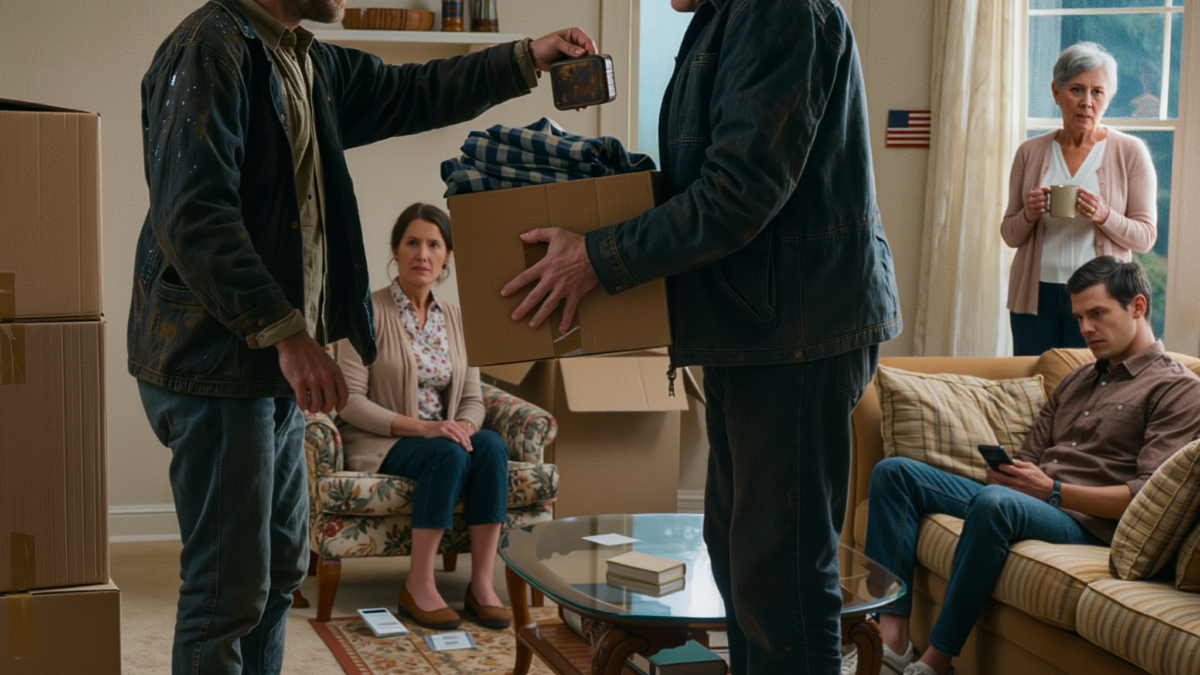
Instead, my father was packing my belongings into cardboard boxes.
My brother Preston sat on the couch, complaining about who would make the payments on his Porsche now that my business was struggling.
And my mother, Beatatrice, assured him that I would figure something out.
I always did.
That was the problem.
They had spent so many years depending on me that they no longer seemed to recognize me as a person.
But there was something they didn’t know.
I owned a valuable coastal property that my mother would soon rent for a family celebration. She had no idea that the house belonged to the son she had just thrown out.
And that discovery was only one part of what would eventually tear apart the comfortable life my family had built around my money.
The drive from Mara Bay to Mil Haven usually took three hours. That night, a coastal storm had turned the highway into a dangerous stretch of standing water and poor visibility.
I gripped the steering wheel of my heavy-duty Ford work truck, trying to ignore the pain in my lower back.
My company, Titeline Property Restoration, had suffered a devastating setback.
For six months, we’d prepared for a multimillion-dollar resort restoration contract. We’d purchased materials, hired additional workers, and declined smaller projects so we could devote our resources to the resort.
That morning, the primary investor withdrew and filed for corporate bankruptcy.
The contract disappeared.
It represented roughly a quarter of our annual revenue.
I knew the next several days would determine whether we could keep everyone employed.
I wasn’t driving home to ask my parents for financial assistance. They had never been in a position to offer much of that.
I simply wanted to sit at the kitchen table, eat something warm, and feel like I belonged somewhere.
Unfortunately, privacy had never existed in my family.
Sierra, Preston’s fiancée, had a cousin working at the main lumber supply yard in Mara Bay. By the time I reached my parents’ driveway, news of the failed contract had already reached the house.
When I opened the front door, nobody greeted me.
Preston, 27, was sprawled across the good sofa. His designer sneakers rested on the glass coffee table beside a stack of unpaid utility bills.
He was scrolling through the smartphone whose unlimited data plan I paid for every month.
My mother sat in her favorite floral armchair, sipping iced tea.
Dad was moving through the hallway with cardboard boxes.
And Mrs. Higgins, our neighbor from two houses down, was sitting near the front window with a ceramic coffee mug.
She pretended to be interested in the rain.
Everyone knew why she was really there.
Mom set down her glass and looked at my muddy work boots.
She didn’t ask whether I was hurt, exhausted, or frightened about the future of my company.
Instead, she asked how I intended to maintain Preston’s car payments now that I’d apparently messed up my business.
For a moment, I couldn’t answer.
Then I explained that the commercial client had gone bankrupt and that I needed to restructure the company quickly to protect my employees.
A luxury car payment, I told her, was the least of my concerns.
Preston slammed his phone onto the coffee table.
He complained that his credit utilization would suffer if the Porsche was repossessed.
He and Sierra were planning to look at mortgage rates the following month. According to him, allowing his credit score to drop would deliberately damage his future.
I stared at him.
My company was fighting for survival, and he was worried about the image of his luxury car.
Then Dad walked out of my bedroom.
He was carrying a box filled with my flannel shirts, work boots, and favorite books.
That bedroom was the same one I’d moved into eighteen months earlier after Dad suffered a major heart attack.
I’d spent countless nights sorting his medical bills, dealing with insurance problems, and organizing his medication while the rest of the household slept.
Now he was packing my belongings without looking me in the eye.
He explained that Preston and Sierra needed a proper room to plan their wedding and store their registry gifts.
Since I was going to be struggling financially, Dad said, it made sense for them to have the space.
Mom immediately agreed.
She told me Preston needed stability.
I was strong. I was independent. I always landed on my feet.
She seemed to believe those words justified whatever she wanted to take from me.
I looked at Dad, the man who had taught me to swing a hammer when I was ten years old.
I looked at Mom, who had spent years expecting me to sacrifice my own needs for the household.
And I looked at Preston, who had never been expected to carry the responsibilities I had accepted before I was old enough to understand them.
Mrs. Higgins watched from the window, absorbing every detail.
I didn’t argue.
I didn’t demand repayment for the years of expenses I’d covered.
I walked toward the box Dad was holding.
On top of my folded clothes sat a rusty vintage sewing tin that had belonged to my grandmother Hattie.
I picked it up and held it against my chest.
Then I reached into my jacket pocket and felt the familiar weight of a key ring I’d never explained to anyone in that house.
I told my parents they weren’t simply throwing me out.
I was choosing to leave.
And once I walked through that door, they shouldn’t expect it to open for them again.
Mom rolled her eyes and told me not to be dramatic.
Dad went back to taping the box.
I stepped into the rain.
By the time I merged onto the coastal highway toward Mara Bay, I wasn’t crying.
I was thinking about every payment I had made for them.
And for the first time, I was seriously considering what would happen if I stopped.
To understand why that decision mattered, you have to understand what fifteen years of supporting my family had looked like.
I was the eldest son.
Before Preston was born, my mother had suffered two devastating late-term miscarriages.
When Preston finally arrived, premature but alive, she became intensely protective of him.
He was her miracle.
Every inconvenience was treated as a threat to his well-being. Every disappointment required someone else to intervene.
Somewhere along the way, Mom decided that I was different.
I was the strong one.
I didn’t need the same attention, comfort, or financial support.
That belief followed us into adulthood.
Preston never really needed a college fund because he had access to my savings.
I remember Thanksgiving when I was 22.
I’d recently secured my first serious commercial contracting job and was proud of the salary.
Mom barely acknowledged my achievement.
Instead, she announced that Preston would attend an expensive private university out of state.
The tuition for a single semester exceeded what Dad earned in a year.
When I asked how they intended to pay for it, Mom looked at me across the dinner table and reminded me that family helped family.
She asked whether I wanted my little brother to begin adulthood buried in debt.
For three days, she cried and refused to eat.
Eventually, I went to the bank and transferred my savings to cover his first year.
Preston dropped out three semesters later, saying the classes were too stressful.
I was left paying the student loans.
He spent his mornings sleeping.
I spent mine working.
During the following decade, I built Titeline Property Restoration from almost nothing.
I started with a rusty pickup truck, a cracked windshield, and a borrowed nail gun.
I took difficult storm-damaged coastal properties that established contractors didn’t want.
Some weeks I worked ninety hours.
My hands were blistered, my lungs were full of drywall dust, and weekends rarely existed.
Eventually, the business grew.
We acquired trucks, hired a dedicated crew, and secured major commercial contracts.
But my family still saw me as a struggling construction worker.
I allowed them to believe that because every sign of financial success seemed to produce another emergency.
Preston needed an expensive laptop for his marketing job.
Mom needed a kitchen remodel because the old countertops made her miserable.
Dad had another bill that couldn’t wait.
If they had known my actual financial position, I believed they would have expected even more.
The situation became worse eighteen months before the eviction.
Dad collapsed in the driveway with a serious heart attack.
I received the call while working high above the ground at a commercial job site.
I dropped everything and drove inland.
When I arrived, I discovered that the household finances were in worse condition than I’d realized.
Property taxes were overdue.
There were serious gaps in the homeowner’s insurance.
Dad’s gambling habits had contributed to the problems.
Mom didn’t work, saying her nerves couldn’t handle employment.
Preston spent his modest salary on designer clothing, craft beer, and expensive dinners with Sierra.
So I moved into my childhood bedroom and assumed responsibility for the bills.
I also made one of the worst financial decisions of my life.
I co-signed Preston’s Porsche lease.
I still remember the dealership.
Mom cried in front of the salesman, insisting that Preston needed a reliable vehicle for his professional future.
She argued that driving an ordinary used sedan would damage his confidence and image.
I knew the risk.
If Preston stopped paying, my own credit could suffer.
My business depended on that credit to obtain commercial bonds.
I signed anyway.
I told myself it was temporary.
That was the excuse I’d been making for years.
I kept stepping under collapsing roofs, even when the people inside were the ones damaging the foundation.
I reached the Titeline office well after midnight.
The rain had stopped, leaving a heavy fog over Mara Bay.
My business partner, Declan, was still at his desk, studying financial projections on two monitors.
He was trying to figure out how we could protect payroll after losing the resort contract.
Declan was a large, bearded man who rarely softened his opinions.
He took one look at my wet jacket, exhausted face, and rusty sewing tin.
He knew something had happened.
For years, he’d warned me that my family was draining the resources I needed for my own life.
“You finally walked away from the parasite tank,” he said.
“They threw me out, Dec.”
I lowered myself into the chair opposite him.
“They needed the room for Preston’s wedding registry gifts. They boxed up my things while I was standing there.”
Declan looked at the sewing tin on the desk.
“So what are we doing about it?”
I didn’t answer immediately.
I opened the tin.
Inside were faded Polaroid photographs of a beautiful white coastal house.
The property had a wraparound porch overlooking the Atlantic Ocean.
It had once belonged to Nana Hattie and my grandfather.
They’d purchased it the year they married.
Decades earlier, during a severe economic recession, Dad made disastrous investments and turned to them for financial help.
Eventually, they lost the house to foreclosure.
It devastated my grandmother.
At eighty, she was living in a cramped back room of my parents’ house, with little more than a recliner and a window facing a brick wall.
Nana Hattie had always been different from the rest of my family.
When I was younger, she’d sometimes slip a crumpled twenty-dollar bill into my pocket.
She told me I wasn’t strong because I never needed help.
I was simply the person who kept showing up.
Three years earlier, I’d discovered that her old coastal property was coming up at a county tax auction.
The house was in terrible condition.
The roof was failing, and the porch was dangerously deteriorated.
City inspectors had condemned it.
I emptied my personal savings and outbid a corporate developer by a few thousand dollars.
I bought the property in cash.
For three years, I spent weekends restoring it.
I replaced rotten joists, installed new subfloors, updated the plumbing, and rebuilt the porch.
I wanted to return something precious to the only person in my family who had never measured my worth in dollars.
Nobody at home knew.
They assumed my weekends were spent working additional construction jobs.
In reality, I owned a valuable piece of coastal real estate with a clear deed and no mortgage.
I closed the tin and opened my laptop.
My banking portal displayed the automatic payments I’d established for my family.
Property taxes.
Homeowner’s insurance.
Preston’s Porsche.
I canceled the tax payment.
Then the insurance payment.
Then the automatic transfer to the luxury auto lender.
I wasn’t going to keep financing the household that had just discarded me.
I sent a group message to Mom, Dad, and Preston.
It informed them that the automatic payments for the property taxes, homeowner’s insurance, and Porsche lease had been permanently terminated.
I included the customer service numbers for the relevant institutions.
I told them the accounts were now their responsibility and that they shouldn’t contact me about them.
Then I switched off my phone and put it in my desk drawer.
I slept on the small cot in the back of the office.
For the first time in years, I slept well.
The consequences arrived faster than I expected.
I’d canceled Preston’s Porsche payment just two days before the end of its final grace period.
For three months, I’d quietly been keeping that account current because Preston was always short on cash.
The lender acted quickly.
Two days later, a repossession truck arrived at my parents’ driveway.
I know what happened because Mrs. Higgins left me an exceptionally detailed voicemail.
According to her, the workers arrived in broad daylight with their equipment and paperwork.
Preston ran out wearing a silk bathrobe.
He shouted at the driver and tried to block the truck.
Sierra stood on the porch, furious that the entire neighborhood could see what was happening.
She threatened to cancel the wedding and have her parents demand the catering deposit back.
The Porsche was taken away.
When I switched on my phone that evening, I had fourteen missed calls from Preston.
Mom had sent eight frantic messages demanding that I fix the situation.
Sierra left a voicemail threatening to sue me for the embarrassment.
I deleted the messages.
I had more important problems.
Our company was still recovering from the failed resort contract, and I needed every available hour to keep my employees working.
But the most serious discovery was still ahead.
On a dreary Thursday morning, my older cousin Julian called the office.
Julian managed the local post office branch in Mil Haven and usually avoided family conflicts.
This time, he sounded frightened.
“Silus, you need to listen carefully.”
He explained that a large stack of certified mail addressed to Aunt Beatatrice had passed through the sorting facility.
The letters came from Vanguard National Bank.
One envelope had been damaged by the sorting equipment, exposing part of its contents.
Julian had seen the heading.
It was a final default notice concerning a substantial home equity line of credit, accompanied by a pre-foreclosure warning.
I frowned.
That didn’t make sense.
I’d been paying the primary mortgage on my parents’ house directly from my business account for more than a year.
I knew Dad’s credit had been damaged by gambling debts.
Mom hadn’t had a verifiable income in decades.
I couldn’t understand how either of them could have qualified for a major equity loan.
Julian became quiet.
Then he said something that made me grip the edge of my desk.
“The primary borrower isn’t Aunt Beatatrice.”
He paused.
“It’s you.”
For several seconds, I couldn’t process the words.
I asked him to repeat them.
He did.
My name was listed on a defaulted loan connected to the house my family had just thrown me out of.
Then I began remembering things.
Two years earlier, Preston had suddenly found enough money to launch an artisanal brewery.
The business failed within six months.
Mom had organized an extravagant engagement party for Preston and Sierra at an exclusive country club.
I’d assumed Sierra’s wealthy parents had paid for it.
Expensive stainless-steel appliances had appeared in my parents’ kitchen while I was away working.
And two years earlier, Mom had asked me to leave a box of old financial documents in the family safe.
The box contained tax returns, an expired passport, and other records.
She said she wanted to keep them secure while I moved between apartments.
Now I wondered whether those documents had been used to obtain the loan.
I remembered how easily she’d gained access to my Social Security number and financial history.
The possibility was horrifying.
My parents hadn’t merely depended on my income.
Someone appeared to have used my identity to borrow money without my permission.
I thanked Julian and ended the call.
Then I contacted a corporate fraud attorney.
The next forty-eight hours were exhausting.
I met with Mr. Henderson, a senior investigator in the bank’s regional fraud department.
I also spoke with Detective Rollins at the county police precinct.
We obtained the original digitized loan documents.
When Henderson turned his monitor toward me, I immediately recognized the problem.
The signature looked like a poor imitation of mine.
The loops were shaky.
The pen pressure was wrong.
Even the date appeared in a distinctive cursive style I associated with my mother.
It looked as though someone had traced my signature from an old birthday card I’d given her five years earlier.
I signed a formal identity theft affidavit.
Then I filed a police report alleging grand larceny, identity theft, and fraud, naming Beatatrice Sims and Roland Sims as suspects.
My attorney, Sarah, charged $500 an hour.
She was direct about the situation.
The bank would investigate the suspected forgery, and the disputed asset would be frozen.
If the handwriting analysis confirmed what the documents appeared to show, my liability could be removed.
But my parents could face substantial civil and criminal consequences.
“Are you prepared for that?” she asked.
I thought about Dad packing my clothes.
“File it.”
I wasn’t interested in another conversation about family loyalty while a loan I hadn’t








