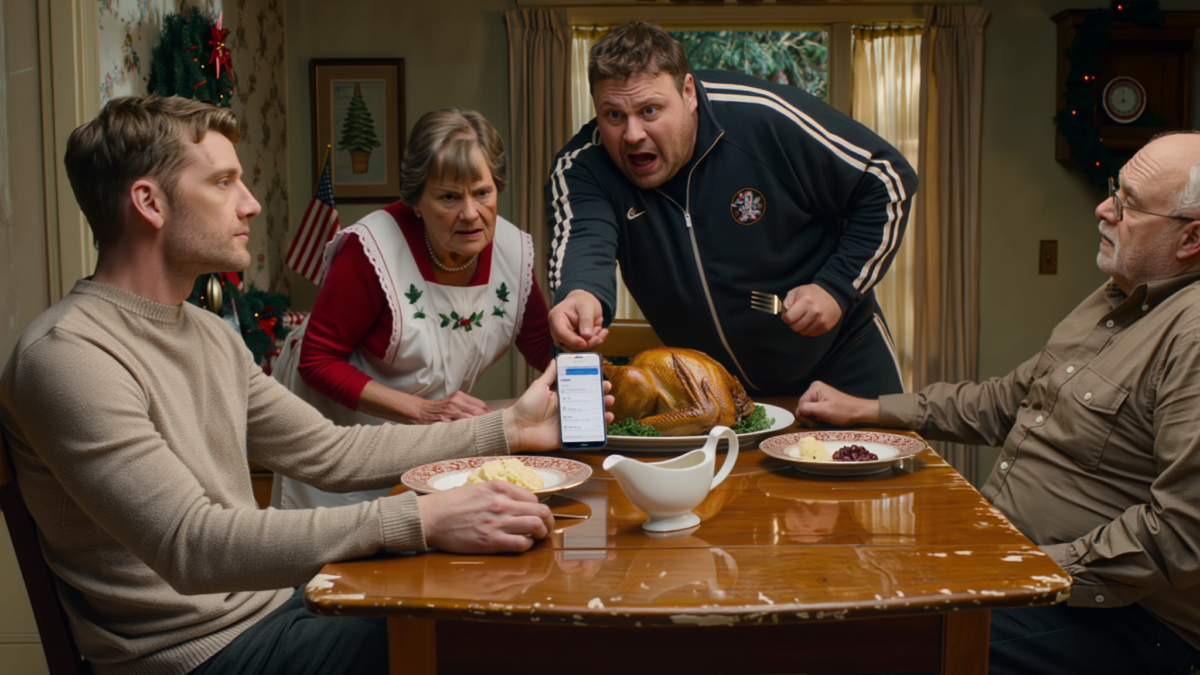
At Christmas dinner, my older brother called the app I’d spent years building “worthless” while our mother demanded I borrow $10,000 to save his failing business. They still thought I was a broke IT worker who fixed computers for a living. I calmly told him I’d sold the app, pulled out my phone, and opened my banking account. Then I slid it across the table, right beside the gravy boat…
My name is Caleb Anderson. I was 26 years old when I returned to my parents’ house in Seattle for Christmas, and I already knew the evening would be difficult.
What I didn’t know was how quickly my family would prove that twenty years of distance, disappointment, and quiet resentment had changed absolutely nothing.
The dining room smelled of roasted turkey, artificial pine candles, and cheap wine. My older brother, Tyler, sat at the table in an expensive designer tracksuit, chewing loudly and acting as though everyone had gathered to celebrate him.
Tyler was 31. He hadn’t held a steady job in years, but that had never stopped our parents from treating him like the most promising person in the family.
My mother, Margaret, was busy putting another generous serving of mashed potatoes onto his plate. My father, Arthur, stared into his water glass, maintaining the same careful silence he’d practiced throughout my childhood.
Aunt Helen sat across from me, whispering something to her husband about my faded sweater.
Tyler wiped his mouth with a linen napkin and turned toward me.
“So, Caleb. Mom says you’re still doing the IT thing down in the city. Fix enough printers this month to afford the gas to get here?”
He smirked.
“Or did Mom have to slip you twenty bucks so you wouldn’t starve?”
Mom smiled at him. Dad kept looking at his glass.
I set my fork down.
“Actually, Tyler, I don’t work at the repair shop anymore.”
He raised his eyebrows.
“And I’m not doing the app thing anymore, either. I sold it.”
Tyler laughed.
“You sold it? For what, pocket change? Enough to pay off your community college loans? Maybe buy a used Honda?”
I reached into my jeans pocket and took out my phone.
I had made the banking application’s display large enough that the numbers would be impossible to overlook. I opened the account, turned the screen toward him, and slid the phone across the table past the gravy boat.
“I sold it for $180 million cash.”
The room went silent.
Mom dropped her fork. Tyler stared at the screen, his expression changing as he tried to understand what he was seeing.
But that moment hadn’t begun at Christmas dinner. It had begun years earlier, in the same house, when I first learned how little my needs mattered compared with my brother’s.
The birthday party I never forgot
I was eight years old when Tyler celebrated his thirteenth birthday.
It was a gloomy Seattle afternoon, but our backyard looked like a neighborhood carnival. My parents had arranged a catered barbecue, an enormous inflatable obstacle course, and a party attended by about thirty children.
We weren’t a wealthy family. Dad complained constantly about the mortgage, homeowners association fees, and his retirement savings.
Yet whenever Tyler wanted something, money somehow appeared.
My birthday had been two weeks earlier. I’d received a cheap action figure from Walmart and a generic greeting card.
Tyler’s main present was a green-and-black motocross dirt bike.
Dad wheeled it into the backyard, and Tyler immediately climbed aboard, revving the engine while the other children watched.
“Look at him, Arthur,” Mom whispered. “He’s just so gifted. He has no fear. He’s going to be a champion.”
About ten minutes later, Tyler attempted a wheelie, lost his balance, and tipped the bike onto the wet grass.
He scraped his knee.
It wasn’t a serious injury, but he began crying loudly enough to stop the party. Mom rushed across the yard, demanding ice. Dad abandoned the barbecue to examine him.
While everyone surrounded Tyler, I wandered toward the old swing set near the concrete patio.
I wanted to swing high enough to see over the wooden fence.
My hands slipped from the cold chains, and I fell backward onto the concrete. Pain shot through my left arm. I had injured it badly, and my elbow was bleeding.
I managed to get up and walk toward the adults.
“Mom,” I said, tugging at her sleeve. “My arm. I think it’s broken. I’m bleeding.”
She brushed my hand away without properly looking at me.
“Not now, Caleb. Can’t you see your brother is in severe shock? Stop trying to steal his thunder.”
She told me to go inside and wash it off.
I stood there, watching her comfort Tyler over his scraped knee.
Then I went into the empty house, wrapped my arm in a bathroom towel, and waited.
Three hours passed before Dad noticed the swelling and took me to an urgent care clinic.
That afternoon taught me something I would spend years trying to forget: Tyler’s smallest problems could stop the entire household, while my actual injuries were treated as interruptions.
Unfortunately, it wasn’t the last time.
The afternoon a stranger saved my life
When I was sixteen, I woke up one freezing November morning with pain near my belly button.
I tried to ignore it and went to school. By the time I was sitting through an advanced history exam, the pain had moved to my lower right side.
I could barely concentrate.
After school, I walked two miles home, stopping repeatedly because the pain had become so severe.
When I entered the house, everyone was preparing for Tyler’s recreational soccer league final.
Tyler was twenty-one, living at home after dropping out of his second state college. My parents treated his amateur soccer games as major sporting events.
I leaned against the kitchen island.
“Mom, something is horribly wrong inside me. I can’t stand up. I need a hospital.”
Margaret continued packing sports drinks and snacks into a cooler.
“Take an aspirin, Caleb. We have to leave in five minutes to get good bleacher seats.”
I sank to the kitchen floor.
“Please help me.”
Tyler walked in wearing his soccer uniform. He looked down at me and accused me of pretending to be sick because I’d failed my history exam.
Dad checked his watch.
“We don’t have time for a detour to a clinic. Go to your room and sleep it off.”
Then they left.
Mom stepped over me on her way to the pantry before the front door closed.
I was frightened, but I didn’t call an ambulance. Dad had repeatedly warned me about the cost of emergency transportation and the consequences if I created an expensive medical bill.
Instead, I dragged myself toward the landline telephone and called a taxi company.
I managed to reach the driveway, where I waited on the cold concrete.
The driver who arrived was named Samuel Porter.
He was an older man, and the moment he saw me, he got out of his cab and rushed over. He helped me into the back seat and drove me to the nearest emergency room.
Samuel stayed at the hospital for three hours, leaving only after a nurse confirmed that I was in surgery.
The surgeon later explained that my appendix had ruptured and that the infection was spreading. Another hour’s delay could have cost me my life.
I woke the following morning in a hospital room without a single family member beside me.
My parents arrived two days later.
Mom carried a partly deflated balloon that said “Go Team,” apparently left over from Tyler’s soccer game.
“You really know how to ruin a perfectly good weekend, Caleb,” she said.
She complained that the medical expenses would interfere with Tyler’s college fund.
“I almost died,” I told her.
Dad stood near the doorway.
“People get their appendix taken out every day. You’re fine.”
I looked at the ceiling and stopped trying to explain.
They were my parents, but I understood that I couldn’t rely on them when I needed protection.
From that point forward, I began planning a life that wouldn’t depend on their approval or their money.
Building something of my own
During my remaining high school years, I worked night shifts sorting boxes at a shipping warehouse.
I saved cash inside hollowed-out biology textbooks in my closet and studied hard enough to earn admission to a demanding computer science program at a state university.
When it was time to leave, my parents were busy financing Tyler’s six-month trip to Europe. They had taken out a second mortgage to help him find direction in life.
I packed my belongings into two black trash bags, left my house key on the kitchen counter, and moved away.
Mom didn’t call until three days later.
She wanted to know where I’d put the television remote.
College was difficult. I shared a poorly heated apartment with three other students and worked tech support at an outsourced call center from late afternoon until midnight.
After work, when the apartment was finally quiet, I wrote code.
That was how I met Ethan Parker.
He was another exhausted computer science student who spent late nights in the university lab. We bonded over our limited finances, our demanding schedules, and our fascination with software.
At the time, I was developing a program to monitor my own health.
Stress had been causing migraines and insomnia, and I couldn’t afford regular medical appointments. I began tracking my heart rate, sleep cycles, and possible stress triggers.
One night, Ethan looked over my shoulder at the program.
“Caleb, this isn’t just a digital diary. This is a predictive algorithm.”
He believed that by connecting the system to wearable technology, we could identify physiological patterns associated with medical episodes before they occurred.
That conversation became the beginning of Vital Pulse.
We turned my freezing bedroom into our first workspace and spent long days coding, testing, and improving the application.
Eventually, the beta version began attracting users.
When we reached our first 10,000 active users, a local angel investor became interested.
For the first time, the project felt like something that might become a real business.
Then I discovered that someone living in our apartment was trying to steal it.
The roommate who tried to sell our work
Justin Harper was one of my roommates.
He was a business major who liked talking about entrepreneurship, networking, and wealthy investors. He didn’t share Ethan’s or my enthusiasm for the actual work involved.
One Tuesday afternoon, my call center shift was canceled, so I returned home earlier than usual.
The front door was slightly open.
As I walked down the hallway, I heard Justin talking on his phone inside his bedroom.
“Yeah, the meeting is set,” he said.
He claimed to have our core logic files and said he could send the entire backend repository to someone in exchange for $50,000 in cryptocurrency.
He described Ethan and me as inexperienced programmers who wouldn’t discover what had happened until a competing application appeared.
I stood outside his room, listening.
Justin was attempting to sell the technology we’d spent months developing.
I wanted to confront him immediately, but I knew that doing so without securing our work could make the situation worse.
I returned quietly to my room and began protecting the company’s systems.
I changed administrative passwords and revoked Justin’s access to our network. I also placed a deceptive file in the shared folder he’d been accessing.
Later that night, when Justin attempted to copy it, the file triggered a destructive process on his personal computer. His coursework and business portfolio were erased.
Justin moved out the following morning, shouting threats as he carried his belongings downstairs.
The experience left me more cautious about whom I trusted.
I had already learned that people close to me could disregard my well-being. Now I understood that someone who shared my apartment could also try to profit from my work.
Vital Pulse continued growing, but I became increasingly protective of both the technology and my privacy.
My brother’s wedding
Not long afterward, Tyler announced that he was getting married.
He’d met a woman named Khloe at a downtown bar, and they became engaged within four months.
My parents planned an extravagant wedding at a country club.
At the same time, Ethan and I were navigating an important funding period for Vital Pulse. I needed to be available for investors and the software launch.
Mom called repeatedly during a board meeting until I finally stepped into the hallway.
“Caleb, you need to be here on Thursday.”
I explained that I couldn’t easily abandon work and fly to Seattle.
She wasn’t interested.
The wedding’s floral arrangements had gone over budget, she explained, so they couldn’t afford the photography package they wanted.
She expected me to bring my camera and photograph the reception.
She also wanted me to drive the rental van transporting the groomsmen.
“Family is family, Caleb. Don’t be a selfish brat.”
I eventually bought an expensive last-minute flight and returned home.
Tyler wore a $3,000 custom tuxedo. I spent much of the celebration in an uncomfortable suit, carrying camera equipment and driving relatives between their hotels and the venue.
During dinner, Dad stood to give a speech.
“To my eldest son, Tyler. You have always been the absolute pride of this family, the brightest light in our lives.”
Mom followed with her own tribute.
She called Tyler the kindest and most hardworking person she knew.
Then Tyler thanked our parents for being the only people who had ever supported him.
I was standing in a corner holding a heavy camera.
Nobody mentioned me.
Aunt Helen leaned toward me.
“You should really take notes, Caleb. Maybe one day you’ll figure your life out and make your parents proud like Tyler does.”
I looked around the decorated banquet hall and realized that my family had invited me because they needed someone to work, not because they wanted me to share the celebration.
I put the camera on a cocktail table, walked out, and drove to the airport.
On the flight back to Texas, I blocked their numbers.
For a while, the distance helped.
The company they never bothered to understand
Over the following two and a half years, Vital Pulse grew rapidly.
We moved from a cramped basement office into a glass-walled suite in a downtown Austin high-rise.
I hired eighty engineers. We worked with investors, expanded our infrastructure, and developed a business that attracted serious attention in the healthcare technology market.
My circumstances changed dramatically.
I could afford things that had once seemed unimaginable, but I deliberately kept my public identity relatively private.
Someone searching casually for Vital Pulse would find its CEO listed as C. Anderson.
My family had never shown much interest in the company, so they had no reason to connect that name with me.
To them, I remained Caleb, the younger son who worked at a little computer repair shop.
Eventually, Mom found a way around my blocked number.
I was reviewing a contract in my Austin office when her call came through.
“Where on earth have you been?” she demanded.
Tyler had lost his job at an electronics store. Mom insisted that his manager had been intimidated by his leadership skills.
She wanted me to persuade my boss to hire Tyler for a management position.
“With his brain, he could probably be running the entire place in a year.”
I was running a company with millions of dollars in payroll, but she still believed I was an ordinary employee who could ask a supervisor for favors.
“Mom, my company isn’t hiring right now.”
She accused me of lying.
“You’re just jealous. You’ve always been so intensely jealous of his potential.”
Then she told me that if I wouldn’t help Tyler, I was selfish and dead to her.
“Understood. Goodbye, Mom.”
I ended the call.
I didn’t feel particularly triumphant. I felt tired of the same conversation.
For years, I’d wondered whether explaining my accomplishments might change how my parents treated me.
Now I was beginning to question whether I wanted their approval at all.
The offer I refused
About a month later, executives from a large technology company called Omni Cororp visited our offices.
Their representative, Marcus Warren, placed a black folder on my desk.
Inside was an offer for $50 million.
It was more money than I had ever imagined earning, but the proposed acquisition came with conditions.
The company wanted to change Vital Pulse’s privacy protections so that sensitive health information could be shared with pharmaceutical companies and insurance brokers.
Marcus described how information about users’ stress levels might be used for targeted advertising.
He saw it as an opportunity to generate revenue.
I thought about why I’d built the original application.
I’d been a frightened sixteen-year-old who couldn’t afford proper medical attention. Vital Pulse had grown from the idea that technology might help vulnerable people recognize health problems earlier.
I couldn’t reconcile that purpose with the proposed business model.
“No,” I told Marcus, closing the folder.
He warned me that rejecting $50 million was a dangerous decision.
“My integrity is not for sale.”
After the executives left, Ethan and I continued operating the company.
That evening, Dad called.
Tyler had been arrested for driving under the influence after hitting a parked car outside a bar. Dad said they needed $200 toward his lawyer’s retainer.
I told him I didn’t have the money.
He suggested I work harder and ask for a promotion.
“Family helps family,” he said.
The contrast stayed with me.
Earlier that day, I’d turned down $50 million because I believed our customers deserved better protection.
That night, my father was lecturing me about financial responsibility because I wouldn’t help pay for another one of Tyler’s mistakes.
Six months later, a different opportunity arrived.
The $180 million acquisition
Richard Preston, the CEO of a nationwide healthcare conglomerate, approached us about integrating Vital Pulse into his organization’s hospitals.
Unlike the previous bidder, Richard’s company wanted to maintain strong protections around patient information.
The negotiations lasted ninety days.
Our intellectual property was examined, our finances were audited, and the legal teams reviewed the terms repeatedly.
On a rainy Tuesday afternoon, I signed the final acquisition documents.
The agreed purchase price was $180 million.
When the wire transfer arrived, I didn’t celebrate.
I went to see my therapist, Dr. Evelyn.
I told her that despite the financial security I’d achieved, I still felt strangely empty.
“Because you’re still waiting for them to applaud you,” she said.
She believed my family had spent years valuing me according to what they could obtain from me.
When I mentioned their Christmas invitation, she suggested that I go.
“Don’t go as a traumatized son seeking love. Go as a scientist.”
She wanted me to observe how they behaved when they believed I had nothing, then compare that with how they behaved after discovering my circumstances.
I thought about her advice for a long time.
Eventually, I packed a small bag and booked a flight to Seattle.
I decided not to arrive in a luxury vehicle or reveal anything about the acquisition.
I wanted to see my family as they were, without the influence of money.
Christmas at the Anderson house
The flight from Austin to Seattle was uncomfortable despite my first-class seat.
I watched the clouds through the window and thought about the house I was returning to.
A sudden patch of turbulence brought back memories of my childhood, particularly the afternoon I’d fallen from the swing.
I had spent years building a life far away from that house, yet the thought of walking through its front door still made me anxious.
At Seattle-Tacoma International Airport, I rented an ordinary silver sedan.
As I drove through my old neighborhood, I noticed how much it had changed.
The houses looked older. Sidewalks were cracked, lawns were neglected, and familiar streets brought back memories of walking home alone in the rain.








