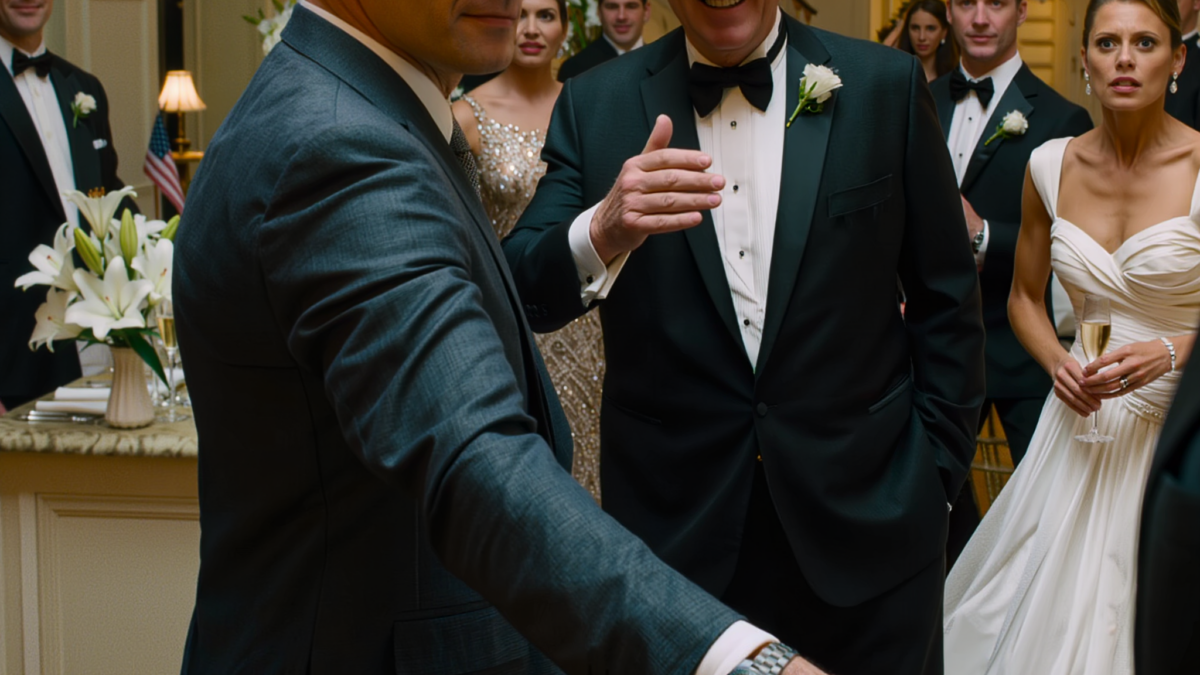
At my brother’s wedding, he introduced me to his CEO as the family failure who ran a “little consulting shop.” Mom had seated me at table 19, near the kitchen, so I wouldn’t embarrass anyone. I didn’t argue. But when David Sterling approached our table and finally looked at my face, he pulled away from my brother, went pale, and extended his hand toward me…
My name is Joseph Mitchell. I’m 35, and a few years ago, I stood in a corner at my own brother’s wedding while he publicly mocked my life’s work in front of everyone we knew.
The air inside the ballroom at Ashworth Manor was thick with the scent of lilies and money. Crystal chandeliers hung from the ceiling like frozen waterfalls, casting bright light over a sea of elegantly dressed guests. Everything about the place was designed to impress.
This wasn’t simply a wedding. It was a statement about the Mitchell family’s success, carefully arranged around its favorite son, my older brother, Leo.
I felt like a smudge on an otherwise perfect painting.
My navy suit was custom-tailored and probably the most expensive piece of clothing I owned. It was understated, designed for a boardroom rather than a ballroom. In that room, however, understated might as well have meant invisible.
My mother, Eleanor, spotted me near the ornate bar within five minutes of my arrival.
Her beaded dress shimmered beneath the chandeliers as she approached. She wore the tight, practiced smile I’d known my entire life.
“Joseph,” she said, looking me over. “You look tired. Are you feeling all right?”
“I’m fine, Mom. Just taking it all in.”
“It’s a lot, I know.”
She patted my arm.
“But you must try to mingle. It looks so strange, you standing alone in a corner. People will talk.”
“Let them talk,” I replied, more sharply than I’d intended.
Her smile faltered.
“Don’t be difficult. It’s Leo’s big day. Just try to look like you’re having a good time.”
She turned away before I could answer, greeting the wife of a senior partner with a dazzling smile.
I remained beside the bar, feeling the familiar knot tighten in my stomach. It was the feeling of never quite fitting the picture my family had created.
Across the ballroom, Leo and his new bride, Clare, were accepting congratulations. They looked like royalty receiving visitors, laughing and glowing beneath the chandeliers.
I knew it wouldn’t be long before Leo found me.
He approached with Clare and several friends, then threw a heavy arm around my shoulder.
“There he is, the mysterious tech mogul,” he announced.
His friends looked at me.
Clare laughed lightly.
“Leo, be nice. Joseph runs his own little consulting firm. It’s very brave.”
The way she said “brave” made it sound like another word for hopeless.
“Poor little brother,” Leo continued, loud enough for everyone nearby to hear. “Still hiding in corners at parties. Some things never change.”
His friends laughed.
I clenched my jaw.
“It keeps me busy,” I said.
“Busy doesn’t pay for a wedding like this, does it?”
He gestured toward the chandeliers and elaborate decorations.
“Still stuck at that tiny firm while the rest of us are building real careers.”
I took a slow breath and looked at him.
Leo believed he’d earned everything he had. He never seemed to notice how much of his success had been arranged, financed, and celebrated by the people around him.
His bride’s family name had become one of the most valuable assets in his professional life.
And in approximately twenty minutes, his CEO, David Sterling, was scheduled to arrive.
I knew his arrival would change the evening.
To understand why, I have to go back ten years.
I was 25 when I developed an idea that kept me awake at night, not because I was worried, but because I couldn’t stop thinking about what it could become.
I’d designed a software architecture that could transform supply chain management for large retail businesses. It used predictive technology to improve efficiency, and I believed it had enormous commercial potential.
For six months, I worked in my cramped third-floor walk-up apartment, turning that concept into a business plan.
I lived on ramen noodles and lukewarm coffee. I studied market opportunities, developed five-year projections, calculated staffing requirements, and mapped out how the company could grow.
Eventually, I had a forty-page document in a simple blue binder.
I took it to my parents’ house one evening, believing I was about to have the most important conversation of my life.
We sat around the polished mahogany dining table where so many of Leo’s accomplishments had been celebrated.
My father, Richard, sat at the head of the table. He was a man who preferred clear answers, established institutions, and predictable careers.
My mother fidgeted with her napkin.
Leo lounged in the doorway, watching with a smug expression.
I explained the software, the market, the potential clients, and the numbers.
Then I made my request.
I wasn’t asking for a gift. I wanted a $20,000 loan to build a prototype and secure my first customer.
When I finished, nobody spoke.
Finally, my father cleared his throat.
“Joseph, it’s an interesting concept for a school project, perhaps. But the real world doesn’t run on these faddish ideas.”
“Dad, this isn’t a fad. The tech sector is booming. This is the future.”
“The future is unstable,” he replied. “The future is a gamble. Your brother, now he’s in the real world.”
He began talking about Sterling and Company, the financial firm where Leo worked.
“Sterling and Company has been a pillar of the financial community for a century. It’s tangible. It’s secure. That’s a career. What you have is a lottery ticket.”
My mother sighed.
“Honey, we just worry. We’ve invested so much in your education. For you to throw it away on some computer game seems like such a waste.”
Then came the question I’d heard throughout my childhood.
“Why can’t you be more like Leo?”
I looked down at the binder.
“So, is that a no?”
My father stood.
“That’s a ‘be realistic, son.'”
The meeting was over.
Two weeks later, I was scrolling through social media when I saw photographs of Leo on a first-class flight to Italy.
My mother had posted them with a proud caption about her son broadening his horizons before conquering the world.
The trip cost more than $30,000.
My parents hadn’t been willing to lend me $20,000 to start a business, but they’d found more than $30,000 to finance Leo’s vacation.
I closed my laptop.
The blue binder was sitting on my desk. I picked it up, opened a drawer, and put it away.
That night, I understood something about my family.
They trusted the future they already recognized. Leo’s path looked familiar, so they supported it. Mine frightened them, so they dismissed it.
I decided I would build the company without their help.
The next few years were exhausting.
I worked a regular nine-to-five job as a junior developer at a technology company. My parents approved because it provided a steady paycheck.
But my real work began around eight every evening and often continued until three in the morning.
I sat in front of my computer, writing code and developing the business I’d described in that blue binder.
I sacrificed sleep, friendships, and nearly everything resembling a social life.
Every spare dollar went into savings.
Meanwhile, Leo continued climbing the corporate ladder at Sterling. He became engaged to Clare, received more responsibility, and spoke constantly about his professional future.
Then my mother called.
“Joseph, honey, how have you been? You sound tired.”
“I’m okay, Mom. Just busy.”
“Well, I’m glad I caught you. I have some wonderful news. Leo is on the short list for a vice president position. Can you believe it? The youngest VP in Sterling’s history.”
“That’s great, Mom.”
“It is, but there’s a small catch.”
She explained that Sterling’s partners had strongly recommended Leo earn an MBA from a top-tier school. The degree was practically a requirement for the promotion.
“That sounds expensive,” I said.
“It is. Terribly. Your father and I are stretching everything to help, of course. But with the club membership and property taxes, things are tight.”
She paused.
“And then I thought of you, Joseph.”
I already knew where the conversation was going.
“You’ve always been so good with money, so frugal. I imagine you must have a nice little nest egg saved up.”
She was talking about the $50,000 I’d spent years saving.
That money was my launch capital. It represented late nights, missed opportunities, and years of work.
“Mom, that’s for my company. That’s everything I have.”
“Oh, I know, honey. I know. But think of this as an investment in your brother, in the family.”
She told me Leo’s promotion was a sure thing. His new salary would be enormous, and he would repay the money quickly, with interest.
Then she asked whether I really wanted to be the reason he missed such an important opportunity.
“We’re family. We have to support each other.”
I knew what refusing would mean.
There would be accusations that I was selfish, that I didn’t care about Leo, that I was holding the family back.
Against my better judgment, I agreed.
I met Leo at a coffee shop and gave him the check.
He arrived late, talking loudly on his phone about a stock tip.
“Hey, man, thanks for this,” he said, glancing at the amount. “You’re a lifesaver. I’ll get this back to you. Promise.”
He folded the check and slipped it into his pocket.
Then he spent twenty minutes complaining about the cost of his wedding planner.
He never asked about my business.
He never asked what giving him that money would cost me.
Leo got his MBA. He received the vice president promotion and the six-figure salary that followed.
The loan was never mentioned again.
I had emptied my savings to help finance the career my family already valued more than mine.
There was one person in the Mitchell family who had never treated me that way.
My grandfather, Thomas.
He was a carpenter. While my father had built his career in operating rooms, my grandfather built things with his hands.
His workshop smelled of cedar and varnish. It was the one place where I could sit for hours without feeling that I needed to explain myself.
He wasn’t a man who offered long speeches. He observed people and listened.
Sometimes he watched me sketch circuit diagrams on pieces of scrap wood.
He didn’t understand the technical details, but he understood the desire to create something.
One afternoon, I struggled to explain my software idea in terms he might recognize.
He stopped me and placed a calloused hand on my shoulder.
“Joey, don’t worry about me getting it. I can see it in your eyes. It’s the same look I get when I’ve got a tricky piece of wood, and I can see the chair inside it, just waiting to be let out.”
He looked at my sketches.
“You see the shape of the thing. Don’t let anyone who can’t see it tell you it’s not there.”
Before he died, he gave me his old wristwatch.
It was a battered Timex with a scratched crystal and a faded leather strap repaired with electrical tape.
“This old thing has seen me through thirty years of work,” he said as he fastened it around my wrist. “It’s not fancy, but it’s honest. It does the work.”
Then he looked at me.
“Be like this watch, Joey. Be honest. Do the work. The rest is just noise.”
His funeral was quiet and somber.
My father delivered a kind eulogy, although I could hear a trace of pity when he described my grandfather’s simple life.
Dad had worked hard to escape the financial struggles of his childhood. He wanted his sons to have the security he’d fought to obtain.
I began to understand that his fear of my career choice was about more than money.
It was about status, class, and the possibility of falling backward.
After the funeral, my grandmother gave me a worn, leather-bound book from my grandfather’s workshop.
Inside was a folded, yellowed note.
“Joey, a man’s worth isn’t what he has in the bank. It’s what he builds. Go build something great. I believe in you.”
After giving Leo my $50,000, I had almost nothing left in savings.
But I still had the watch and that note.
I taped the note above my desk and wore the watch every day.
Then I started again.
I accepted every freelance coding job I could find. I worked long hours and slowly rebuilt my savings.
This time, I didn’t present another business plan to my parents. I didn’t ask for another loan.
I built quietly.
That company became Apex Innovations.
By the time Leo’s wedding approached, Apex had offices in three cities, a valuation approaching nine figures, and a strong reputation in the technology and logistics industry.
My work involved international travel, major negotiations, and decisions that affected large organizations.
To my family, however, I was still Joseph, the younger brother with the little computer business.
The weeks before the wedding made that painfully clear.
My mother called about the seating arrangements.
“Joseph, darling, I’ve put you at table 19. It’ll be lovely. It’s with your cousin Mark. You remember him? He’s in insurance now. And some of Clare’s younger cousins.”
She sounded delighted with herself.
“I thought you’d be more comfortable there. Away from all the stuffy business talk.”
Table 19 was in the far corner of the ballroom, practically beside the kitchen doors.
“Sounds great, Mom,” I said.
“Wonderful. And Joseph, do try to look the part. Leo’s boss, the CEO of Sterling, is going to be there. We need to make a good impression.”
I noticed how easily she included herself and Leo in that “we.”
A few days later, Leo called from his office.
“Hey, little brother. You ready for the big day?”
“Wouldn’t miss it.”
“Good, good. Hey, listen. Just a little friendly advice. When you’re talking to people, maybe don’t get too deep into your computer stuff. It can come off a little desperate.”
He suggested I talk about sports instead.
He was trying to prevent me from embarrassing him.
Then my aunt Carol called.
She talked enthusiastically about the flowers, the cost of the wedding, Leo’s promotion, and his impressive salary.
“It must be so hard for you, seeing his success while you’re still trying to get your little venture off the ground. But don’t you worry. Your time will come.”
I listened.
Years earlier, those comments would have kept me awake at night.
Now they mostly reminded me how little my relatives knew about my life.
I was also preparing for something none of them understood.
Apex had been working for months on a possible acquisition of Sterling and Company.
Internally, we called it Project Nightingale.
Sterling was struggling financially. Its executive structure was expensive, some divisions were performing poorly, and its leadership had resisted necessary changes.
Our team had been quietly acquiring shares and building shareholder support for a hostile takeover.
The final offer was scheduled for the Monday after the wedding.
Late one Tuesday night, I was reviewing Project Nightingale’s financial documents in the Apex boardroom when my private phone rang.
The number was unlisted.
“Joseph Mitchell.”
A gruff voice answered.
“Mr. Mitchell. Arthur Thompson here.”
I stopped what I was doing.
Arthur Thompson was Clare’s father, a senior member of Sterling’s board and a formidable businessman.
I assumed he was calling to oppose the acquisition.
“Mr. Thompson. This is a surprise.”
“Cut the crap, son. I’ve been on boards longer than you’ve been alive. I know an executioner’s song when I hear it.”
He told me he’d seen the Project Nightingale proposal.
“It’s bold. It’s aggressive. And it’s going to work.”
I waited.
He explained that Sterling’s old leadership would resist the deal because of pride and sentiment.
He, however, was interested in protecting the company’s financial future.
Then he surprised me.
He described Leo as a charismatic man who’d been promoted beyond his competence. He believed Clare was marrying someone whose professional reputation was stronger than his actual abilities.
Arthur also had significant family wealth tied to Sterling stock.
He feared the company’s continued decline.
“I’ve seen the reports on Leo,” he said. “The kid’s a liability.”
He explained that Clare and Leo had a prenuptial agreement, but he still wanted to avoid a messy collapse of Leo’s career after the wedding.
“What do you want, Arthur?” I asked.
“I want you to push this deal through, and I want you to do it fast.”
He suggested that the wedding might be an ideal opportunity for Sterling’s senior executives to discover who was behind the acquisition proposal.
He wanted them to understand the seriousness of the situation before Monday.
When the call ended, I sat back and considered what I’d learned.
Arthur wasn’t an opponent.
He was willing to support the deal.
The following morning, I called my chief operating officer, Sarah Chun, into my office.
Sarah had been with me since Apex was operating out of two desks in a rented garage. She’d watched the company nearly collapse twice and helped me rebuild it.
She also knew the history between my family and me.
“Nightingale is a go for the Monday after the wedding,” I told her. “The final offer is locked in. The lawyers are ready.”
Sarah studied me.
“And the wedding? You’re still going?”
“I have to. It’s part of the plan now.”
She was quiet for a moment.
“Joseph, I’ve known you for almost a decade. I know what they’re like. Are you sure you’re ready to walk into that ambush?”
I went to my desk and picked up a framed photograph of my grandfather and me.
“For years, all I wanted was for them to see me. To see what I’ve built and say, ‘Wow, Joseph, you did it. We were wrong.'”
I set the photograph down.
“But I’m done asking for their approval.”
I touched the old watch on my wrist.
I knew the wedding could be unpleasant. I also knew I was no longer the man my family thought they could dismiss.
Sarah listened, then gave me a small smile.
“In that case, I’ve taken the liberty of clearing your schedule for all of Tuesday. I have a feeling you’re going to want the day off to deal with the fallout.”
On the morning of the wedding, I prepared carefully.
I laid out a bespoke charcoal suit made from heavy English wool. It wasn’t flashy, but it was appropriate for the kind of meetings I normally attended.
While getting ready, I reviewed the key details of Sterling’s financial condition.
Revenue had declined over the previous three fiscal years. Executive compensation was excessive, and the division Leo managed was performing badly.
Before leaving, I opened a file on my computer.
It contained a record of the $50,000 loan I’d given Leo.
I had never made my mother sign a formal loan agreement, but I’d documented the arrangement in an email.
She had replied, “Thank you, honey. You’re a lifesaver.”
I saved a copy to my phone.
Then I fastened my grandfather’s watch around








