At the entrance of a five-star mountain resort, my older brother laughed at my Porsche 911 and accused me of draining my bank account just to look successful. Our father told me to stop embarrassing the family. I didn’t argue. I simply handed my keys to the valet. Then the resort’s general manager hurried outside, walked straight past my father and brother, and stopped in front of me…
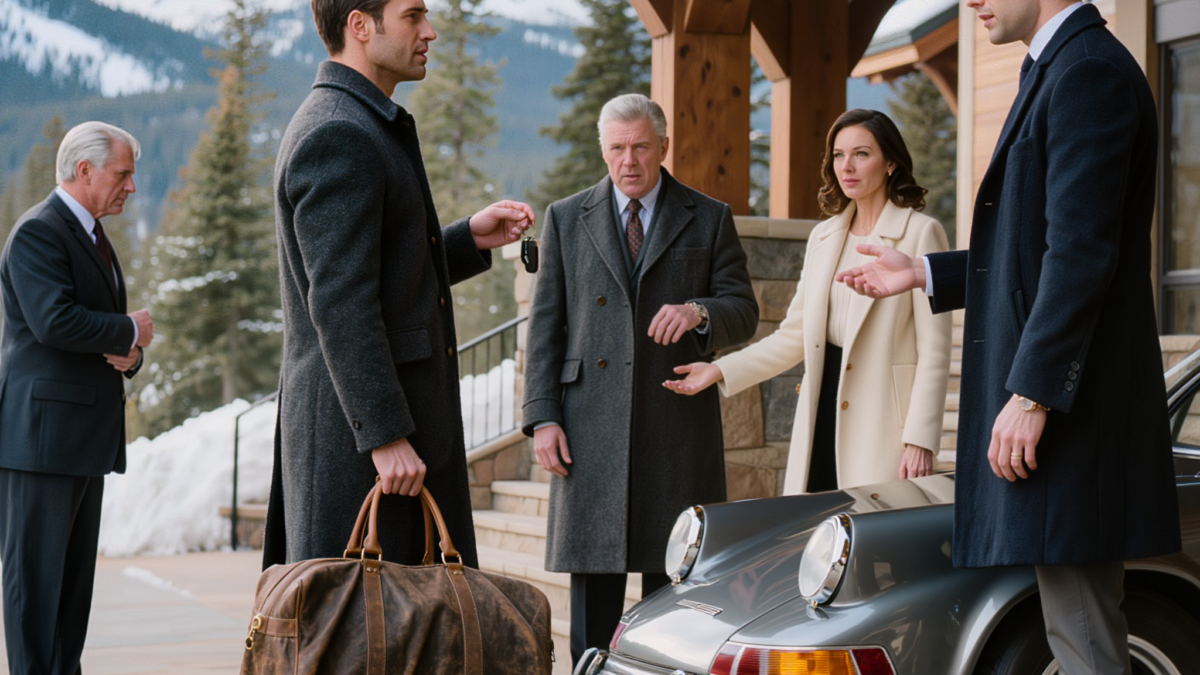
My name is Julian Hayes. I’m 32 years old, and two years ago, I stood in the freezing, marble-paved driveway of a five-star mountain resort while my older brother humiliated me in front of our father.
He mocked my bank account, my career, and practically everything about my life. I’d come to the resort hoping to extend an olive branch and spend a weekend with my family. Instead, my parents stood there smiling while my brother laughed at me in front of wealthy guests and resort employees.
What they didn’t know was that I wasn’t struggling to maintain some imaginary lifestyle. My proprietary technology was already operating the infrastructure of that luxury estate.
I also had legal documents in my leather briefcase that could expose the truth about my brother’s corporate ambitions and potentially lead to a substantial lawsuit.
Two years later, my family would be leaving desperate voicemails, asking for forgiveness, and struggling to accept what had happened to their favored son.
But it began on a cold Friday afternoon in the mountains.
The air was sharp enough to sting my cheeks as I pulled my fully restored vintage Porsche 911 up to the sweeping entrance of Silver Pines Resort.
The place was extraordinary. Dark timber framed enormous floor-to-ceiling glass windows that reflected the snow-covered peaks surrounding the valley. Everything about the property suggested exclusive memberships, generational wealth, and people who never needed to ask how much anything cost.
It was exactly the kind of place my family loved.
My father, Arthur Hayes, had reserved an exclusive wing for what he called the Hayes Family Legacy Retreat.
Arthur was the founder and CEO of Hayes Consulting. He viewed his children less as individuals than as investments in the family name. In his mind, one child could be an appreciating asset while the other was a disappointment that needed constant correction.
For most of my life, I had been the disappointment.
I parked the Porsche, turned off the engine, and handed the keys to the young valet who hurried toward me.
That was when I heard someone clapping.
Slow, deliberate, sarcastic applause echoed down the stone steps.
I turned and saw my older brother, Tristan, approaching with our father beside him. Tristan was 34, wearing a tailored navy cashmere overcoat that probably cost more than the valet earned in a month.
His wife, Vanessa, held his arm. She wore the polished smile I recognized from years of family gatherings, the one that usually appeared just before she delivered an insult disguised as a compliment.
Tristan stopped several feet away and looked over my car.
Then he examined my simple, unbranded wool coat.
He laughed loudly enough for arriving guests to hear.
“Well, well, well. I didn’t know they let rental cars onto the property, Julian. Did you have to drain your checking account and max out your credit cards just to look presentable for the weekend? You know, there’s no shame in taking the bus.”
My father didn’t intervene.
Instead, he adjusted his expensive watch, sighed, and shook his head.
“Julian, why do you always have to be so flashy with things you clearly cannot afford? This weekend is about serious business and family legacy, not your little pretending games.”
Tristan stepped closer, bringing with him the overpowering scent of expensive cologne.
He pointed a manicured finger toward my chest.
“You can’t possibly afford this lifestyle, little brother. Playing pretend and trying to act like you belong in our tax bracket is just embarrassing the family name. We all know you’re scraping by.”
I looked directly at him.
I didn’t raise my voice or argue. I stood there in the cold, remembering how many times I’d heard some variation of the same speech.
Before I could respond, the heavy oak doors of the main lobby opened.
Mr. Vance, the resort’s general manager, stepped outside.
He was a distinguished silver-haired man accustomed to dealing with wealthy executives, investors, and influential guests.
He walked past Arthur.
He walked past Tristan and Vanessa.
Then he stopped directly in front of me, straightened his shoulders, and bowed respectfully.
“Welcome back, Mr. Hayes. It is an absolute honor to have you with us again. Your private VVIP suite is ready, and we have configured the climate, lighting, and security exactly to your personal system preferences. Shall I have your usual vintage Bordeaux sent up?”
Nobody spoke.
Tristan’s smile disappeared. Vanessa looked between my worn boots and the impeccably dressed manager.
My father stared at Mr. Vance as if he had suddenly lost control of a situation he’d expected to dominate.
I nodded.
“Thank you, Mr. Vance. I appreciate the attention to detail. Please send the wine up. I’ll be heading to my suite shortly.”
Then I collected my worn leather overnight bag from the valet and walked past my family without another word.
When I entered my penthouse suite overlooking the pine valley, I didn’t celebrate.
The suite was enormous, with several rooms and expansive mountain views. But I wasn’t interested in the furnishings or the expensive wine.
I walked to the mahogany desk, opened my bag, and removed a thick manila folder.
Inside were international patent documents and materials relating to a potential corporate lawsuit that could destroy Tristan’s carefully constructed career.
I poured a glass of ice water and looked out at the mountains.
Ten years earlier, none of this would have seemed possible.
I had been 22, newly graduated from college, burdened with student debt, and sitting nervously in my father’s home office.
The room smelled of imported cigars and old leather. I wore a cheap graduation suit and carried the plans for a smart-home integration system I’d spent my senior year developing.
The prototype wasn’t polished, but its core code worked.
I believed AI-driven building infrastructure could transform commercial real estate. With a modest seed loan, I thought I could turn the prototype into a viable business.
I wasn’t asking for anything close to the amount Arthur had given Tristan two years earlier for a restaurant venture.
That restaurant had failed, leaving unpaid vendors and lawyers arguing over outstanding bills.
Still, I believed my father would at least consider my proposal.
I spread the schematics across his mahogany desk and explained how automated infrastructure could improve energy management, security, and climate control.
Arthur barely glanced at the papers.
He leaned back in his leather chair and sighed.
“Julian, you lack vision. You’re a tinkerer. Hayes Consulting was built on solid traditional business relationships, face-to-face negotiations, and real estate acquisition, not flashy, unstable tech gimmicks that will be obsolete in a year. You’re wasting your degree, and frankly, you’re embarrassing my work ethic with these little garage projects.”
Then he offered me what he apparently considered a generous alternative.
“If you want to be part of this family’s legacy, you need to earn your keep. Tristan has just been handed a massive promotion to vice president of acquisitions. I want you to start at the bottom of his division. You’ll be his data entry clerk. You’ll manage his spreadsheets, organize his files, and learn how a real business operates under his guidance.”
My father wanted me working beneath the brother who had once paid other students to complete his high school assignments because he was too busy partying.
I looked down at the plans I’d spent so many sleepless nights creating.
Then I gathered them into my folder and declined.
I told Arthur I believed in my product and wanted to build it myself.
His response was immediate.
That weekend, my mother, Eleanor, invited me to brunch at her country club.
I hoped she might offer encouragement, perhaps even help me find a way forward.
Instead, she reached across the white tablecloth and patted my hand while we sat over plates of eggs Benedict.
“Julian, darling, you need to stop this pathetic competition with Tristan. It’s embarrassing for all of us. Tristan is the face of the family. He has the charisma, the looks, the pedigree. He is meant to lead. Your little rebellions are just a distraction. You need to learn to accept your place in the background.”
She reminded me how much my parents had spent on my education and accused me of refusing to support my own family.
I listened beneath the dining room’s crystal chandeliers, surrounded by people who never seemed concerned about paying their bills.
My parents earned millions, contributed generously to their retirement accounts, and discussed buying summer property in Europe.
Yet Eleanor spoke as though my decision to pursue an independent career threatened their financial security.
That afternoon, I understood something I’d resisted for years.
They didn’t want two successful sons.
They wanted Tristan to lead and me to support him.
When I refused that arrangement, they began excluding me.
Thanksgiving invitations stopped arriving. I was left out of family group conversations about my grandmother’s funeral until the last minute.
Eventually, I stopped expecting them to include me.
I rented a cramped apartment above a 24-hour diner in a rough part of town.
The walls shook whenever the industrial exhaust fan started. The smell of stale grease and burnt coffee drifted through the building at every hour.
But the rent was affordable, and I had enough space for my servers.
For the next five years, I worked exhausting weeks, often approaching a hundred hours.
I took freelance programming jobs, building back-end systems for local dentists and mechanics. Those projects paid the rent and kept the electricity running.
Every spare dollar went into my software.
Some nights I fell asleep on the hard wooden floor because I was too exhausted to move to my mattress.
During those early years, I brought in Greg, a developer I’d known in college.
Greg was talented at front-end design. He could make almost any interface look polished and professional.
But we disagreed about the company’s future.
He wanted to sell our unfinished, unpatented software to the first buyer willing to offer quick money.
I wanted to finish the system, protect the intellectual property, and build a lasting company.
When I refused to sell, Greg became furious.
He packed his equipment, called me a delusional loser, and walked out.
He told me I’d end up broke and alone in that apartment.
Meanwhile, Tristan’s life unfolded across my mother’s social media accounts.
There were photographs of him and Vanessa aboard chartered yachts, smiling at charity galas, and posing beside private jets they didn’t own.
Tristan played the part of a visionary executive, supported by Arthur’s money, professional connections, and legal resources.
I kept working.
By my late twenties, I had finalized the core patent for an adaptive AI system capable of managing energy, security, and climate control across large commercial buildings.
The technology could reduce utility overhead by approximately 30%.
Instead of seeking my father’s approval, I took the product to Europe.
My first major contracts came from Zurich, Berlin, and Geneva.
The licensing revenue grew rapidly.
I hired a brilliant lead engineer named Elena and established a secure corporate headquarters downtown.
I also kept my identity largely out of the press, operating through a holding company.
I wanted clients to evaluate the technology without attaching it to the Hayes family name.
Then the invitation to the family retreat arrived.
It was printed on heavy cardstock.
On the back, Eleanor had written a note expressing her hope that I could afford to take a few days away from my little computer hobbies to celebrate Tristan’s achievements.
I understood the purpose of the gathering.
Arthur was preparing to step down and formally hand the family business, inheritance, and real estate portfolio to Tristan.
It was a celebration of the future they’d chosen.
I looked at the invitation, then at the legal team working beyond the glass walls of my office.
I decided to attend.
That decision brought me to Silver Pines Resort, where Tristan mocked my Porsche and Mr. Vance welcomed me as a returning VVIP guest.
But the driveway confrontation was only the beginning.
That evening, the resort’s private dining room looked magnificent.
Crystal chandeliers hung above a polished mahogany table. Waiters wearing white gloves poured vintage French wine.
Arthur, Eleanor, Tristan, and Vanessa were seated with two important guests.
The first was my aunt Clara, Arthur’s younger sister.
Clara was fiercely independent and one of the few relatives who had never accepted Tristan’s polished image at face value.
The second was Mr. Sterling, a senior board member and majority stakeholder in Hayes Consulting.
He was a wealthy, experienced businessman whose decisions carried considerable weight in the company’s future.
Toward the end of dinner, Arthur tapped a silver knife against his wineglass.
He stood and delivered a long speech about commercial real estate, global markets, and the importance of preserving the Hayes family legacy.
Then he raised his glass toward Tristan.
He announced that my brother had secured the largest consulting contract in Hayes Consulting’s 30-year history.
It was a five-year systems overhaul for Apex Corporation.
Arthur praised Tristan as a visionary and declared that the company’s future was secure under his leadership.
Everyone applauded.
Vanessa rested her manicured hand on Tristan’s arm, smiling proudly.
Tristan enjoyed every moment.
Then he turned his attention toward me.
He asked how my little light-bulb-fixing business was doing.
He described me as someone who played with wires in the dark without understanding how real businesses operated.
With exaggerated sympathy, he offered to arrange a small subcontracting job on the Apex project if I needed help paying rent or settling credit card debt.
I slowly placed my fork on the table.
Then I looked toward Mr. Sterling.
I explained that accepting a five-year contract with Apex Corporation could be financially disastrous.
The conversation stopped.
Arthur demanded to know why I was trying to spoil Tristan’s achievement.
I told the table that Apex had developed a troubling reputation in the European market.
The company would engage consulting firms for expensive initial projects, consume their resources, then break the contracts during the second year.
The resulting legal disputes could drag on long enough to bankrupt the contractors.
Six months earlier, Apex’s purchasing director, Mr. Roth, had flown privately to my corporate office in Zurich.
He wanted to license my automated infrastructure software.
“And what did you do, Julian?” Aunt Clara asked.
“I turned him down flat,” I replied.
I explained that my financial analysts had investigated Apex and found that its reported credit rating was fabricated.
According to their findings, the company was insolvent.
Tristan slammed his hands onto the table.
He accused me of lying and insisted that an international executive like Mr. Roth would never visit whatever basement business he imagined I operated.
He claimed I was jealous of his promotion and probably drowning in debt while pretending to own a Porsche.
“You are a fraud, Julian. You can’t possibly afford this lifestyle. Your entire existence is a pathetic lie designed to make you feel better about being a failure.”
I didn’t shout back.
I reached into my blazer and removed a thick cream-colored envelope bearing the wax seal of a major Swiss investment bank.
I placed it on the table and slid it toward Arthur.
“You don’t have to take my word for it. You’re welcome to open it, Arthur.”
He frowned, broke the seal, and removed the documents.
As he read, his posture changed.
Inside was a formal letter of intent from the Geneva Fund offering $48 million in cash to acquire my holding company.
It wasn’t money I’d already received. It was a legally binding offer to buy the business I’d built.
Arthur read the amount aloud.
“$48 million.”
Tristan stopped moving.
Vanessa’s expression changed completely.
Mr. Sterling leaned forward, suddenly paying close attention.
Clara took a slow sip of wine.
I looked toward Tristan.
“I’m not going to take the offer, obviously. My analysts project my company will double that valuation by the next fiscal quarter once our Singapore division opens.”
Then I reminded him to have his lawyers examine the Apex contract before it bankrupted Hayes Consulting and destroyed the inheritance he expected to receive.
I excused myself and left the dining room.
The following afternoon was supposed to be the centerpiece of the retreat.
Hayes Consulting had organized a family vision presentation in the resort’s Summit Room, a modern conference space with enormous windows overlooking the valley.
Board members and senior partners were seated throughout the room.
My family occupied the front row.
Tristan stood at the podium.
After what had happened at dinner, he was determined to recover his authority.
He clicked through a polished presentation filled with corporate language about expansion, market dominance, and future opportunities.
Then he paused.
He told the audience that transparency and honesty were the foundation of Hayes Consulting.
He said it was painful to question his own brother, but he had a responsibility to protect the board from fabricated wealth and misleading claims.
He pressed the presentation remote.
A website appeared on the enormous screen.
I recognized it immediately.
It was the clumsy landing page Greg and I had built seven years earlier while working from the apartment above the diner.
The logo was pixelated. Several HTML links were broken. The listed services were basic IT work rather than the commercial infrastructure systems my company now developed.
Tristan presented the old website as the true state of my business.
He suggested I was suffering from delusions about my success and claimed the Swiss investment document must have been a forgery purchased online.
Vanessa took a tissue from her purse and dabbed at her eyes as though she were deeply concerned about me.
The presentation wasn’t a business analysis.
It was an attempt to discredit me before the board.
But Tristan had made a serious mistake.
He’d relied on Greg, a former partner who hadn’t spoken to me in seven years.
I stood from my seat near the back of the room.
Mr. Sterling turned to watch.
I walked down the center aisle toward the podium.
Tristan moved as though he intended to block me, but I went directly to the equipment.
I disconnected the HDMI cable from his laptop and connected it to my encrypted tablet.
Then I faced the senior partners.
“My brother is absolutely right about one thing. Transparency is paramount.”
I tapped the screen.
My company’s live corporate dashboard appeared.
It displayed real-time operational metrics from servers across three continents.
I opened certified international banking audit reports, active multimillion-dollar licensing agreements with major European commercial real estate developers, and the official patent registry.
My name and holding company’s details were clearly recorded.
I explained that the website Tristan had displayed was a defunct domain from seven years earlier.
Greg had sold him the old material for a few thousand dollars.
Tristan began sweating. His hands shook.
“Real businessmen do not need to dig through the trash to prove their worth,” I told the room. “And they certainly don’t lie to their board of directors.”
The senior partners began taking notes.
Vanessa stopped pretending to cry.
Arthur remained seated, staring at the evidence on the screen.
I disconnected my tablet, returned to my seat, packed my bag, and left the conference room.
Later that evening, I was back in my suite when my encrypted phone rang.
It was Elena.
For two weeks, she’d been investigating anonymous emails sent to our European business partners.
The messages falsely accused me of stealing intellectual property and attempted to damage my company’s reputation.
Elena had traced the routing metadata and IP addresses.
The results pointed directly to Tristan and Vanessa’s private home network.
According to the evidence








