I refused to give my brother my $850,000 Victorian home as a wedding gift. I’d spent five years restoring it myself. Mom threatened to sue me, but my attorney laughed when he read their letter. At the family dinner where Dad expected me to sign over the deed, my attorney set a small speaker beside the salt shaker. Then my father’s own voice filled the room.
My name is Carter, and I’m thirty years old. Exactly two years ago, my family demanded the deed to the house I had restored with my own hands. We were in a crowded, expensive steakhouse, surrounded by relatives and wealthy friends, and my father announced that my home and the savings I had put into it would be my brother’s wedding gift. I was sitting there in worn work clothes, drinking tap water, while they treated the decision as settled. Văn bản đã dán (1)
When I refused, they laughed. My mother threatened to bury me in a lawsuit in front of fifty wealthy patrons. What I would eventually learn was that the demand had nothing to do with helping a young couple get started. My brother had debts, and my parents had been hiding a much older betrayal. An audio recording and an attorney’s examination of my grandmother’s trust would finally bring both into the open. Now the people who tried to take my home were asking me for somewhere to live.
That evening began with the sharp ring of a silver fork against a crystal champagne glass. It cut through the low conversation at the steakhouse, a place where the menus had no prices and the waiters wore white gloves. The lighting was dim, and everything about the room suggested that uncomfortable things happened somewhere else.
I sat at the far end of a long table, keeping my hands beneath the thick white linen. Dark walnut stain had settled into my knuckles despite repeated scrubbing, and a chisel had left a fresh cut on my left thumb that morning. Around me were tailored Italian suits, diamond necklaces, and hands that looked as though they had never needed more than a manicure. I could not stop thinking about how conspicuous mine would look beside the silverware.
Outside, my paint-splattered 2015 Ford work truck was parked between a black Rolls-Royce and a red Ferrari. The truck was dented and full of sawdust and power tools, but it was familiar. I knew its rattles, its weight, and every job it had carried me through. More than anything, I wanted to be sitting in that cab instead of at the table.
My father, Warren, stood at the head. A retired corporate executive, he had never stopped treating the family as something he managed. He liked an audience, especially one that already expected him to be successful, generous, and in charge. He swirled his $300 Cabernet and cleared his throat in the same expansive voice he used at board meetings.
He announced that the evening was about more than my older brother Asher’s engagement to Riley. It was about family legacy and giving the next generation a secure financial foundation. His chest lifted as he spoke, and the people around him settled into the attentive silence he enjoyed. I had heard variations of that speech before, usually just before someone explained what Asher needed.
Asher leaned back in his leather chair beside him, smiling. His tailored suit was immaculate, and his watch cost more than I earned in a year as an independent carpenter. He always looked expensive. What I had not understood then was how much other people were paying for that appearance.
Riley sat beside him with her hand on his forearm. She looked genuinely happy, and I could not see any reason to believe she understood what my family was preparing to do. She came from a good family and seemed to think she was joining another one. Asher let her rest her hand there while he waited for Dad to finish.
Warren’s eyes moved past my aunts and uncles and finally settled on me. He smiled and told the room that, to help the couple begin their life together, his youngest son had graciously agreed to transfer the deed to his Victorian house. He presented it as a wedding gift from one brother to another. There was no question in his voice and no invitation for me to answer.
For a moment, I could not get enough air into my lungs. I had worked fourteen hours at the shop and wondered whether exhaustion had made me misunderstand him. I looked across the table at my mother, Hadley. She kept cutting her filet mignon, her eyes lowered and a tight smile on her face.
Her expression told me this was not a spontaneous announcement. She knew what he was going to say and had decided to let him say it. I asked what he was talking about, but my voice came out rough and quiet. In the sudden stillness, it was loud enough for everyone at our table to hear.
Asher leaned forward with his glass of scotch and thanked me loudly. He told the guests we had been discussing the arrangement for weeks. We had never discussed it at all. He continued as though my confusion were simply embarrassment at being praised in public.
He said the location was excellent, even if the house itself was dusty and outdated by his standards. Then he explained that he and Riley planned to remove the garden I had restored and put in a custom heated swimming pool. Riley liked to swim in the mornings, he said. He was already describing what he intended to tear out of a home I had never offered him.
The mahogany walls seemed to close around the table. My family was not asking for help or proposing an arrangement I could consider. They had made a decision about my property and expected me to accept it because they had announced it in front of people. Everything depended on my being too uncomfortable to contradict them.
I looked directly at Warren and told him I had not agreed to any of it. The house was not a gift. His smile stayed in place, but his eyes hardened. He told me not to be dramatic or spoil the evening, then called the house a family asset.
He explained that Asher needed a primary residence with enough equity to secure bank financing for a new business venture. Once I signed the paperwork, he said, I could move my belongings into the guest cottage behind my parents’ house. The cottage was small, uninsulated, and falling apart. Warren considered it more than adequate for a single man with what he described as limited ambition and prospects.
I could feel heat rising into my face, but I kept speaking. I told him I had bought the house with my own money and spent five years restoring it from a condemned shell while he played golf and enjoyed his retirement. It was not an asset he could distribute. The house belonged to me, and mine was the only name on the mortgage.
Under the table, my mother’s pointed heel struck my shin hard enough to make me tense. She leaned close, bringing the heavy scent of her floral perfume with her, and spoke through her teeth. She told me to stop making a scene and embarrassing the family. According to her, I was spoiling my brother’s special night because I was bitter and jealous of his success.
I pushed my oak chair back. Its legs scraped across the hardwood, drawing looks from nearby tables and members of the waitstaff. I stood and told her I was not ruining anything, but I would not hand over the deed to my house. My shin throbbed, and I refused to let that become another reason to sit quietly.
Warren ordered me to sit down. It was the voice I remembered from childhood, the one that had once made me retreat and apologize before I understood what I had supposedly done wrong. This time, I met his eyes.
“No.”
Asher chuckled and looked around the table as though everyone should share his amusement. He said the house was too large and too complicated for me anyway. Why would a single carpenter need four bedrooms? He wondered whether I intended to give each of my hammers a room of its own.
A few guests gave small, uncomfortable laughs. I did not shout or knock anything over. I took the white napkin from my lap and laid it in the middle of my empty plate. Then I looked at Riley, whose expression had changed from happiness to confusion and alarm.
I congratulated her on the engagement, and I meant that she deserved to be happy. Then I told her to leave while she still had the chance, before they took everything from her, too. I turned away from the table and walked toward the heavy brass doors. My work boots sounded loud against the floorboards.
As I reached the lobby, I could hear Warren trying to repair the evening. He told the guests that I was emotional and eccentric. He said I would come around eventually because I always did. Even after I had left the table, he was explaining my answer as though it were his to revise.
The valet brought my Ford to the curb with an expression I read as pity. Exhaust drifted into the cool night air, and the engine settled into its familiar rattle. When I was younger, that sound embarrassed me, especially near my parents’ gated neighborhood. That night, with leased luxury cars waiting nearby, I found it reassuring.
I climbed into the driver’s seat, felt the worn springs shift beneath me, and slammed the door. My hands shook so badly that I struggled to put the key into the ignition. I gripped the steering wheel until my knuckles went pale. Inside the truck, at least, I did not have to make my face acceptable to anyone.
“He will come around. He always does.”
The words stayed with me as I drove through downtown traffic toward the city limits. That expectation had shaped nearly every difficult conversation in our family. Asher’s wants became urgent problems everyone had to solve, while my needs could wait. He was the promising son, the future executive, and I was the person expected to clean up whatever he left behind.
As the lights of the city thinned along the highway, I thought about all the times that arrangement had seemed ordinary. The demand for my house was larger than anything they had asked before, but it was not a new kind of demand. They had spent years teaching me that refusing Asher meant failing the family. I had spent years proving I was useful enough to keep around.
When I was sixteen, I came home tired from football practice and tried to study for a chemistry exam. Asher was nineteen and home from his expensive private college for the summer. He was supposed to be networking, though most of his time went toward parties funded by Warren. Our parents were away on a two-week vacation in Cabo San Lucas, leaving us in their large suburban house.
Asher decided to host a party despite the rules. By midnight, more than a hundred people were there, and the house smelled of spilled beer and smoke. He got into a drunken argument with a fraternity friend over a girl and put his fist through the living-room drywall. The hole was beside the custom stone fireplace, in a place no one could overlook.
The last people left around three in the morning. By then, Asher was sitting on the hardwood floor crying, certain our father would cut off his allowance and take away his car. He came over and grabbed my shirt, begging me to repair the damage. He reminded me that I was good with my hands and with art projects, as though that made the responsibility mine.
I was a kid with an exam to study for, but I was afraid of Warren’s reaction, too. So I spent the next two days watching drywall-repair tutorials on a slow internet connection. I rode my bicycle three miles to Home Depot in the summer heat. With money I had earned cutting grass, I bought joint compound, fiberglass mesh tape, primer, and the right shade of eggshell paint.
I sanded for twelve hours until my arms cramped and fine white dust covered my clothes and hair. Then I worked at matching the texture and feathering the paint into the surrounding wall. By the time I finished, the repair was almost impossible to find. I had put more care into hiding his mistake than he had put into avoiding it.
Warren and Hadley returned from Cabo relaxed and tan. They never noticed the wall. Asher kept his allowance and his car, and my reward was being allowed to drive that car to the gas station to fill his tank. I paid for the gas, too.
That was how the arrangement worked. If I solved the problem, the problem disappeared, and so did my part in solving it. There was no need to thank me for something everyone had decided I owed. If I was not fixing one of Asher’s mistakes, I went unnoticed.
I drove toward the older historic district, where large oaks shaded cracked streets and the streetlights stood farther apart. Thinking about the wall brought me back to Nana Rose. She was independent, outspoken, and the only person in our family who consistently treated me as though I mattered apart from what I could do for someone else. She died when I was eighteen, as I was finishing high school.
People in the family said she had left a substantial trust for her two grandsons. It was supposed to help with college, starting a business, or a down payment on a home. Three weeks after her funeral, Warren called me into his office. The room smelled of cigars and leather, and he sat behind the mahogany desk wearing an expression of practiced regret.
He told me the stock market had been cruel to Nana Rose. According to him, declining judgment in her final years had led her into terrible investments, and the trust had been wiped out. Anything remaining had gone toward her debts. There was nothing left, he said, except a wooden box of tarnished costume jewelry that Hadley had already claimed for sentimental reasons.
He patted my shoulder and told me it was probably for the best. Easy money damaged a man’s character, he said, and an inheritance encouraged laziness. I would have to learn the value of work and support myself. He made the loss sound like a difficult lesson he was generously helping me understand.
Less than a month later, a new black Porsche arrived in our driveway with a large red bow on the hood. It was a graduation present for Asher. When I asked how we could afford a luxury sports car after losing so much money, Hadley snapped that they had arranged a special loan. Asher needed reliable transportation for his future corporate internships.
I accepted that explanation because I did not know how to challenge it. There was no college fund for me and no car waiting in the driveway. I took my grief over Nana Rose and my anger at the difference between my brother’s life and mine and put them into work. Wood, plaster, and stone responded to effort in a way my parents never had.
I stocked heavy boxes at a big-box retailer starting at four in the morning. During the day, I worked with a commercial construction crew, and in the evenings I took custom carpentry jobs for clients who could afford more than they wanted to pay. I saved what I could from every shift and every project. There were no vacations, expensive clothes, or purchases made simply because I wanted them.
For six years, I lived in a small apartment with roaches and ate cheap ramen. Five years ago, the saving finally led me to the Victorian. Most people in the neighborhood saw only an eyesore. The city had condemned it, the slate roof was failing, termites had eaten through the wraparound porch, and raccoons had moved into the gutted kitchen.
I bought it for $150,000 in cash, using every cent I had. When I showed my parents the deed, I still hoped they might recognize what it had taken to get there. Instead, Warren laughed and called it a hazardous money pit that would leave me bankrupt within a year. Hadley covered her nose and said I was throwing my life away to live in a dump.
They saw decay and a bad decision. I saw old-growth timber and a structure worth saving. There were serious problems, but they were problems I understood: wood that needed replacing, a roof that needed attention, and years of neglect that could be worked through. I did not need the house to look impressive before I could see value in it.
Back on my street after the dinner, gravel crunched under the truck’s tires as I pulled into my driveway. I parked and sat in the dark cab, looking at the warm porch light against the navy-blue siding. I had painted that siding myself, balancing on a forty-foot extension ladder in the heat of July. Every stretch of it reminded me of work my family had never seen.
I had spent months finding reclaimed oak appropriate to the house’s period and rebuilding the grand staircase spindle by spindle. I had worked on my hands and knees to remove six layers of glued-down linoleum and uncover the original heart-pine floors. The place had gone from a condemned property to a featured historic landmark. Its current appraised value was $850,000.
My parents had laughed when it was worth little more than the work it required. Now that the work was done, they saw money they could use. They were looking at the same staircase, floors, and porch I had spent years restoring and treating them as a source of cash for Asher. I remained in the truck longer than I meant to, unable to separate their demand from the sight of the house.
My phone buzzed in the cup holder. The message was from Finn, a real estate broker I had known since high school and occasionally met for a beer. The previous month, I had invited him through the house for an informal, off-the-record estimate. I had been curious about how much value the renovation had created and, for once, proud enough to ask.
“Hey, Carter, man, I’m really sorry. Your dad called me yesterday asking about property values in your zip code. He kept pressing me, and I slipped up and mentioned your informal appraisal. I swear to God, I didn’t know he was going to come after it. He said he was just proud of your investment. Please don’t be mad.”
I read the message with a cold feeling in my stomach. Finn knew enough about my father to understand why I might not want him discussing my finances. Yet Warren had said he was proud, and Finn had given him the number. A conversation I thought belonged to me had become the information my family used to decide what they could take.
Before I could put the phone down, a message from Warren appeared.
“I am coming to your wood shop tomorrow morning at 9:00 a.m. sharp. We are finishing this paperwork. Stop acting like a dramatic child and do what is right for this family.”
I locked the screen and climbed the porch steps. Running my hand along the oak railing, I could feel how smooth I had sanded it. Avoiding the argument would not protect this place. My father had made that clear enough: he was bringing the argument to my work, and he expected another refusal to mean no more than the first.
The next morning, the shop smelled of sawdust, mineral spirits, and walnut. I was sanding a large live-edge dining table for a client, grateful for the noise of the belt sander. I had barely slept, and black coffee had done little to settle the thoughts moving through my head. At least while the motor ran, I did not have to listen to them quite so clearly.
A shadow crossed the workbench and blocked the light coming through the open bay doors. I switched off the sander and waited for its motor to wind down. Dust drifted in the shaft of sunlight while the shop settled into silence. I wiped my safety goggles, took them off, and turned around.
Warren stood among the industrial tools and stacks of rough-cut lumber in a pink polo shirt and crisp khaki shorts. He looked as though he had stopped on his way to the golf course. His nose wrinkled at an open container of polyurethane. He did not say hello or ask about the table I was working on.
Instead, he demanded to know why I had ignored six calls the night before. I took off my leather apron, dropped it on a stool, and crossed my arms. I told him I was working to pay my bills and asked what he wanted. He stepped farther into the shop, carefully avoiding the dust with his leather loafers.
He said his lawyers were preparing the property-transfer documents. He needed my signature on the quitclaim deed by Friday afternoon so they could process Asher’s loans before the weekend. There was no acknowledgment of the argument at the restaurant. He spoke as though we were discussing a delayed delivery, not the ownership of my home.
I gave a short, disbelieving laugh and reminded him that my answer had not changed. I would not sign. The deed was in my name, as was the thirty-year mortgage. I paid the property taxes, utilities, and insurance with money I earned in that shop and on job sites.
Warren closed his eyes and pinched the bridge of his nose. Then he leaned against a stack of cherry wood, marking his clean golf shirt, and lowered his voice. He told me I misunderstood the real world. He and Hadley had been patient with what he called my fixer-upper hobby, but it was time to stop pretending I was a real estate investor.
He asked where a carpenter with a high school education had found $150,000 in cash for a down payment. I told him I had saved it by working three jobs for six years. He shook his head, smiled, and wagged a finger at me. According to the version he was now offering, the money had come from the family trust as an undocumented loan.
My heart started beating harder. I told him he was lying and reminded him of the apartment with no reliable heat, the meals I had skipped, and the money I had kept in a fireproof lockbox and a basic checking account. He had refused to help me with any of it. Now he stood in my shop claiming the savings had been his all along.
He asked whether I could prove every cash tip I had earned waiting tables. Did I have receipts for every drywall repair and cash carpentry job from my early twenties? If my records were incomplete, he warned, his would not be. He said he, Hadley, and Aunt Rowan were prepared to sign sworn affidavits stating that we had entered into a verbal loan agreement.
They would testify to it in court, he said, and the family was calling the loan due. He spoke without hesitation about turning years of my labor into evidence against me. I stood there trying to absorb that my own father was offering a choice between surrendering my home and defending myself against a story he had just invented. He expected the cost of fighting him to make the choice for me.
I stepped back and slipped my hand into the front pocket of my work jeans. Without taking out my phone, I pressed the volume button three times. Years earlier, I had set up that shortcut to start a voice recording when my hands were full and I needed to save a client’s measurements. The phone gave a faint vibration against my leg.
I lowered my shoulders, looked at the sawdust-covered floor, and let my voice shake. I wanted him to say plainly what he had been circling around.
“So, just to be perfectly clear, Dad, if I don’t sign my house over to Asher so he can use the equity, you are going to lie to a judge and officially say I embezzled and stole family trust money to buy it?”
Warren laughed and stepped close. He seemed to hear fear rather than a question he should consider carefully. Looking down at me, he answered without lowering his voice.
“It is not a lie if we win the lawsuit, Carter. It’s just business. You will go bankrupt just trying to pay the attorney fees to fight my lawyers in court. Asher needs this real estate to secure his commercial loans because his credit is tied up. Don’t be the villain of the family. Sign the paper. I’ll even give you 10 grand for your trouble. You have until Friday.”
He turned and walked out to his Mercedes. I remained in the shop until he was gone, then took the phone from my pocket and stopped the recording. I backed up the audio file to three separate secure cloud accounts. My hands were shaking again, but I had something this time besides my memory of what he had said.
The calls and messages increased over the next forty-eight hours. Aunt Rowan, who always presented herself as the family’s neutral peacemaker, called six times. She left long, tearful messages about Hadley’s health and how much distress I was causing her. She said I was being greedy by keeping a house I did not need while my brother required help.
On Thursday afternoon, I was on the porch repairing a loose spindle with a nail gun when a black SUV with dark windows stopped illegally at the curb. Two men got out. I recognized Declan, a heavily tanned real estate agent who played golf with Warren. The other man wore an ill-fitting gray suit and carried a clipboard.
Declan came up the brick walkway as though he had an appointment. He introduced the stranger as Miles, a court-appointed appraiser, and pushed an official-looking paper toward my face. They were there on Warren’s behalf, he said, to value the property for the constructive trust lawsuit my father planned to file on Monday. He wanted immediate access to the interior so they could document the fixtures.
He pointed at my chest and warned that refusing them could lead to an obstruction charge. If I did not step aside, he said, they would call the police. It was the kind of demand designed to make a person obey before asking questions. Years earlier, I might have opened the door simply to stop the confrontation.
This time, I noticed what was missing. There was no signed, stamped order from a judge, just a man who knew my father and a nervous stranger arriving in his personal SUV. I reached for the framing hammer on my belt and held it at my side. I did not lift it or swing it.
I told Declan he had five seconds to get himself and his appraiser off my property before I called the police about trespassing and attempted real estate fraud. Miles dropped his pen and hurried back to the SUV. Declan’s confidence slipped long enough for me to see it. Then he spat onto my newly painted steps and told me I was making the most expensive mistake of my life.
Their tires squealed as they pulled away. I went inside, locked the oak door, and slid the deadbolt into place. For a while, I stood with my back against the wood, my heart pounding. Warren was not content to threaten me over the phone; he was sending people to my home to make the threat feel official.
I could work harder, keep better records, and refuse to open the door, but none of that would answer the legal pressure on its own. I opened my laptop on the kitchen island and searched for attorneys who handled inheritance fraud and property disputes. I was not looking for someone who would tell me to compromise for the sake of family peace. I wanted someone prepared to challenge the claim directly.
Harrow, Ali, and Stein occupied the fortieth floor of a glass tower in the financial district. When the elevator doors opened, I stepped into a waiting room that smelled of leather and fresh lilies. The furniture looked expensive without trying to attract attention. It was a different kind of wealth from the cars and country-club displays my father relied on, and it made me just as conscious of my work clothes.
I sat in a leather chair that I suspected cost more than my first three vehicles combined. In my hands was a yellow manila folder containing the deed, seven years of bank statements, and a printed transcript of the recording. My boots were scuffed, my jeans faded, and my flannel shirt heavier than anything the people around me were wearing. I picked at a wood splinter in my palm and wondered whether I would be dismissed before anyone read the papers.
A man called my name from the doorway of a corner office. Gideon was in his late fifties, with slicked-back silver hair and a charcoal three-piece suit. His dark eyes were attentive without being welcoming. On the deep-web legal forums I had searched the night before, former clients and opposing attorneys referred to him as the Shredder.
He motioned me inside. The windows offered a panoramic view of the city, but he did not give me time to admire it. He went behind his mahogany desk, sat down, and folded his hands. There was no offer of coffee or question about the drive. He told me to explain the case in under three minutes or the meeting was over.
I placed Warren’s letter on the desk. It threatened a constructive trust lawsuit and accompanied the demand that I transfer my house to my brother. I explained that my family was claiming I had taken money from a trust and would bankrupt me with litigation if I did not sign by Friday. I told him about the conversation in the shop and the transcript in my folder.
Gideon put on thin-rimmed reading glasses and began reading. The quiet hum of the climate-control system seemed unusually loud while I waited. I was afraid he would tell me that Warren’s money and connections mattered more than my records. I had come there hoping to defend my home, but part of me still expected to be told that giving it up was the sensible choice.
He read the first page, turned to the second, and stopped. Then he laughed. It was not a polite chuckle or a sound of disbelief, but a full laugh that startled me in the quiet office. He set his glasses down and wiped at one eye while I sat there trying to decide whether I should be offended.
I asked what he found funny about my family trying to take my home. He leaned forward and told me the letter was almost endearing in its attempt to sound intimidating. In his assessment, a claim based on an alleged verbal agreement more than five years old, without a bank transfer showing my parents had supplied the money, was not the threat Warren wanted me to believe. The wording was meant to frighten me into signing before I sought advice.
He lifted the letter with two fingers and dropped it in the stainless-steel wastebasket. He called it a bluff from a strip-mall real estate attorney who, in his opinion, had not handled serious courtroom litigation in twenty years. He was not laughing at the possibility of my losing the house. He was laughing at the letter that had made me believe that possibility was inevitable.
Relief came so suddenly that I felt it in my knees. For the first time in weeks, I took a breath without immediately thinking about how much defending myself might cost. I asked whether that meant I was safe and the problem was over. Gideon stopped laughing.
He said the lawsuit did not worry him, but my father’s behavior did. Defeating this particular threat would not necessarily stop Warren from finding another way to apply pressure. Gideon looked at my hands, the fatigue on my face, and the way I still sat as though I might need to defend my reason for being there. Then he asked the question that made me consider what I wanted beyond surviving the week.
“Do you want them to just go away for a few months, Carter, or do you want to make absolutely legally sure they can never ever afford to look in your direction again?”
I thought about Asher driving his Porsche while I walked to work in the rain. I thought about my mother’s heel under the restaurant table and the two men who had tried to talk their way through my front door. Most of all, I thought about the recording in my pocket. My father had said what he was willing to do, and I no longer wanted to pretend that another family conversation would change it.
I told Gideon I wanted to sever that connection so completely they could not use it against me again. He smiled and made it clear that he was prepared to take the fight on. I had come asking how to keep a house. We were now going to examine why my father thought he could claim it in the first place.
For the next week, I worked with the shop doors bolted and spent my evenings at Gideon’s office. During the day, messages from Hadley arrived between jobs, and Asher left slurred, angry voicemails demanding that I answer him. At night, I ate stale takeout in a brightly lit conference room while we worked through my family’s financial history. The ordinary rhythm of making furniture continued alongside records that were changing my understanding of my childhood.
Gideon explained that Warren’s claim about the family trust gave him a basis to pursue the trust’s banking records. His firm subpoenaed the records for the account Nana Rose had established. Warren had intended the words “family trust” to make me doubt my ownership. Instead, they gave Gideon a specific account and a specific history to investigate.
On a rainy Tuesday evening, Gideon called me into the conference room. An older man in thick glasses and an inexpensive suit sat beside him, holding a leather-bound ledger. Gideon introduced him as Tucker, my parents’ former private accountant. Years earlier, Tucker and Warren had fallen out over unpaid invoices and accounting requests Tucker considered improper.
Tucker looked deeply uncomfortable. Gideon projected an Excel spreadsheet onto the wall and asked me to confirm what I had been told about Nana Rose’s money. I repeated the story about bad investments and a trust that had been emptied by losses and debts. It was the explanation Warren had given the family for a decade.
Gideon used a red laser pointer to indicate a highlighted line. At the time of Nana Rose’s death, the account had an audited cash balance of $400,000. He moved the pointer to a withdrawal farther down the page. Three days after my eighteenth birthday, the full amount had left the account in one wire transfer.
I stepped toward the screen. At eighteen, I had been stocking shelves at night and worrying about replacing my work boots. I had never received that money, never gone into a bank to request it, and never authorized a withdrawal. I said that aloud because the figures on the wall were so large and so definite that I needed to put my own memory beside them.
Gideon clicked to another document. A scanned bank authorization filled the screen, with my printed name at the bottom. Above it was a signature made in elegant, looping strokes. It was nothing like my own blocky, uneven handwriting, shaped by years of holding work pencils and tools.
I stared until my eyes filled. The loops were familiar in a way the document itself was not. I had seen them on birthday cards, grocery lists, and school permission slips. The signature had been written in my mother’s hand.
Hadley had signed my name. While I was being told to learn the value of work and accept the loss of Nana Rose’s money, my mother had authorized the withdrawal that took it away. I could recognize the writing without anyone needing to explain its shape to me. The part I could not immediately understand was how she had continued looking me in the face afterward.
Gideon described what he believed the records showed: identity theft, forgery, and grand larceny. He also raised federal tax evasion because, he said, the money had not been reported to the IRS as income. The terms were his legal assessment, delivered in the same measured voice he had used to ask about my bank statements. I was still looking at the signature.
Tucker opened the ledger and took out canceled checks. He said the records showed where my inheritance had gone, and it was not into the stock market. A $90,000 payment went to a luxury European car dealership for Asher’s Porsche. Another $50,000 went toward the contractor who remodeled Hadley’s kitchen with imported marble.
Then Tucker showed us transfers totaling $200,000, sent in increments to an offshore casino holding company. The payments had cleared gambling debts in Asher’s name. I gripped the conference table while Tucker explained the entries. The car, the kitchen, and the family’s insistence that I learn to survive without help were now connected by the same account.
My parents had not lost my inheritance through bad luck. They had taken it and spent it while letting me believe there was nothing left for anyone. For the next ten years, they had treated my financial struggles as evidence that I lacked ambition or ability. The more I understood, the harder it became to remember their lectures without hearing the calculation behind them.
And now they wanted the house. I suspected Asher had gone through whatever money remained and exhausted his credit again. My parents were trying to claim the one thing I had built without them after taking the help Nana Rose had intended to leave. The demand at the restaurant no longer looked like an isolated act of favoritism; it looked like another attempt to cover the same kind of loss.
While I stood beside the table, my phone signaled an email from an unfamiliar encrypted address. The subject line was “Save yourself.” I opened it with fingers that still felt unsteady. The message was from Riley.
She had attached dozens of screenshots: financial statements, maxed-out credit cards, and threatening messages from private lenders demanding payment. Asher was more than half a million dollars in debt. The new business venture Warren had described at the steakhouse was a cover story. They wanted to borrow against my house to pay the people pressing Asher for money.
Riley wrote that she was frightened for her safety. She was secretly calling off the wedding and leaving for her parents’ house, and she wanted me to know what was happening before I signed away my home. Her message did not ask me to rescue Asher or protect his reputation. It gave me the information everyone else had been withholding.
I handed the phone to Gideon. He read the email carefully, then closed his laptop. He said we had the reason for the demand, the bank records, the forged authorization, and the recording of Warren’s threat. He wanted our response prepared before Friday, when my father expected his pressure to produce a signature.
Throughout Wednesday and Thursday, I followed Gideon’s advice and stopped responding. Warren’s increasingly hostile calls went to voicemail. Aunt Rowan’s emails about family loyalty, Thanksgiving, and my mother’s distress stayed unanswered. I kept working while the messages arrived, sending them to Gideon instead of arguing with the people who had written them.
Late Thursday night, Asher came to the house and pounded on the front door. He shouted that he was the eldest son and the rightful heir, and that he deserved the equity more than an uneducated carpenter. I did not unlock the door. His voice carried through the oak while I remained on the other side of it.
Every threatening voicemail and insulting text went into an encrypted evidence folder on Gideon’s server. I had once tried to explain myself until my family ran out of reasons to object. Now I was keeping what they said instead of trying to make them take it back. Their calls still upset me, but I did not have to answer them to make that feeling stop.
Friday arrived with a cold wind. At eight that morning, while I was sanding reclaimed lumber, Gideon called. I wiped my hands on a rag and answered. Warren’s real estate attorney had contacted the firm, accusing me of being hostile and uncooperative over the alleged family trust.
They wanted a final settlement meeting before filing the constructive trust lawsuit on Monday morning. Their proposed setting was my parents’ house, over a traditional family dinner that very evening. I leaned against the workbench and gripped its edge. I could already picture the table and where everyone would sit.
They wanted me in the room where Warren had always been in charge, surrounded by relatives prepared to support his version. I could feel how easily the setting might bring back the sixteen-year-old who repaired the wall because he was frightened of what would happen otherwise. A legal document would sit in front of me, and the people around it would insist that signing was the only way to be a good son. I did not want to spend another evening trying to breathe at that table.
Through the shop window, sunlight reached the roof of my Victorian. I told Gideon I did not want to set foot in my parents’ house again. Why not file the fraud countersuit immediately? Why not send the records to the federal authorities and the IRS and keep the confrontation at a distance?
Gideon said litigation could take months or years. There would be depositions, delays, mediation sessions, and legal expenses, all of it hanging over my work. He believed that showing my parents the evidence in person could persuade them to settle that night. He wanted them to understand the claim against them before they committed themselves to a drawn-out fight over the house.
He was not offering me a pleasant dinner. He was asking me to attend one difficult meeting with someone beside me who understood the records and could handle the legal argument. I took a breath, let the familiar smell of sawdust settle me, and agreed. The thought of going back still frightened me, but I would not be going alone.
I spent the afternoon getting ready. I left the flannel and steel-toed boots behind, took a long, hot shower, and scrubbed the dust and grime from my hands. Then I put on the black suit I had bought years earlier for a wealthy client’s funeral. I wore a starched white shirt and polished black shoes and combed my hair back.
For ten minutes, I stood in front of the bathroom mirror. I still looked tired, but I did not look like a child waiting to be told what he deserved. I had purchased a house, restored it, and built a business around work I knew how to do. None of that would disappear because my father raised his voice across a dinner table.
I parked my dented Ford outside their house at exactly seven. The lawns in the neighborhood were immaculate, maintained under rules strict enough to produce fines over the height of the grass or a commercial vehicle in a driveway. The house looked as it always had: large, carefully kept, and secure. From the curb, there was no sign of the records in Gideon’s briefcase.
He waited at the end of the brick walkway beside a black town car with tinted windows. He looked at my suit, gave a brief approving nod, and gestured toward the door. We walked up the path together. Before I could reach for the brass knocker, Hadley opened the double doors.
She had clearly been watching from the window. She wore cashmere, tailored slacks, and her familiar heavy pearls, and for a moment her face held the welcoming smile she reserved for appearances. Then she saw Gideon. Her hand went to her chest, and the smile disappeared.
She asked who he was and reminded me that Warren had specified family only. I did not stop to defend my decision on the doorstep. I walked past her into the foyer and continued toward the dining room. She stepped back to let me through, and Gideon came in beside me.
The dining room was arranged to look like an ordinary family gathering, but I recognized what each seat meant. The chandelier was dimmed over the long mahogany table. Warren sat at the head with a heavy crystal glass of aged bourbon, looking comfortable and certain of himself. He had chosen familiar ground and expected it to do some of the work for him.
Asher sat to his right, and he no longer looked like the man who had joked about my bedrooms at the steakhouse. Sweat showed through his designer shirt, his leg moved restlessly beneath the table, and he checked his phone every few seconds. Riley sat beside him, pale and quiet, looking down at her empty porcelain plate. Aunt Rowan waited in an upholstered chair in the corner with a large glass of red wine, ready to serve as both family peacemaker and witness.
Warren stiffened when he saw Gideon. He put his bourbon down hard enough to spill it over the rim and onto the white lace runner. He demanded to know what was happening and reminded me that he had called a private family meeting. In his account, we were there to clear up a simple misunderstanding about a deed.
I pulled out a chair, sat, and buttoned my jacket. Then I introduced Gideon of Harrow, Ali, and Stein as my attorney. Warren had threatened a lawsuit involving my house, alleged embezzlement, and the family trust. I told him that since he had brought legal threats into my shop, I had brought legal counsel to his table to review them.
His face reddened. He pushed his chair back, stood, and pointed at Gideon, apparently preparing to order him out. Gideon placed both hands flat on the table and leaned forward. Without raising his voice, he told Warren to sit before making the most serious financial and legal mistake of his life.
Warren hesitated, then sat. He had not expected anyone to speak to him that way in his own dining room, but he was not ready to give up control. He reached into the leather folder beside his plate and pushed a document toward me. He told me to stop the childish games and explained that it was the quitclaim deed for my Victorian.
If I signed with Aunt Rowan as a witness, he said, we could forget the entire episode. He presented the next part as an act of generosity: the family would not pursue criminal allegations over the trust money he claimed I had used to buy the house five years earlier. I could keep arguing and face the consequences, or I could accept what he was calling mercy. The paper waited between us while he spoke.
Rowan gasped from her chair and clutched her pearls. She told me to be grateful to my father and reminded me that family came before everything else. She spoke about blood being thicker than water and said I owed my parents for the roof they had provided when I was a child. The fact that Warren was asking for the roof I had provided for myself did not seem to trouble her.
I looked at the deed. It was a generic document, but signing it would surrender five years of labor and the home I had built around that work. Across the table, Hadley kept looking from Gideon’s briefcase toward the front door. Whatever she had expected from the evening, his presence had made her less certain of it.
I told them I had not stolen a dime. I had bought a condemned house with money I earned and restored it with my own hands. Hadley struck the table with her palm, her rings cracking against the wood. Then she began listing everything she believed should make that ownership irrelevant.
They had raised me, she said. They had given me a privileged childhood, fed me, and clothed me. Now I was repaying them by taking family money and refusing to save my brother from financial ruin. She said the equity in my house was being wasted on a single man when Asher needed it so badly.
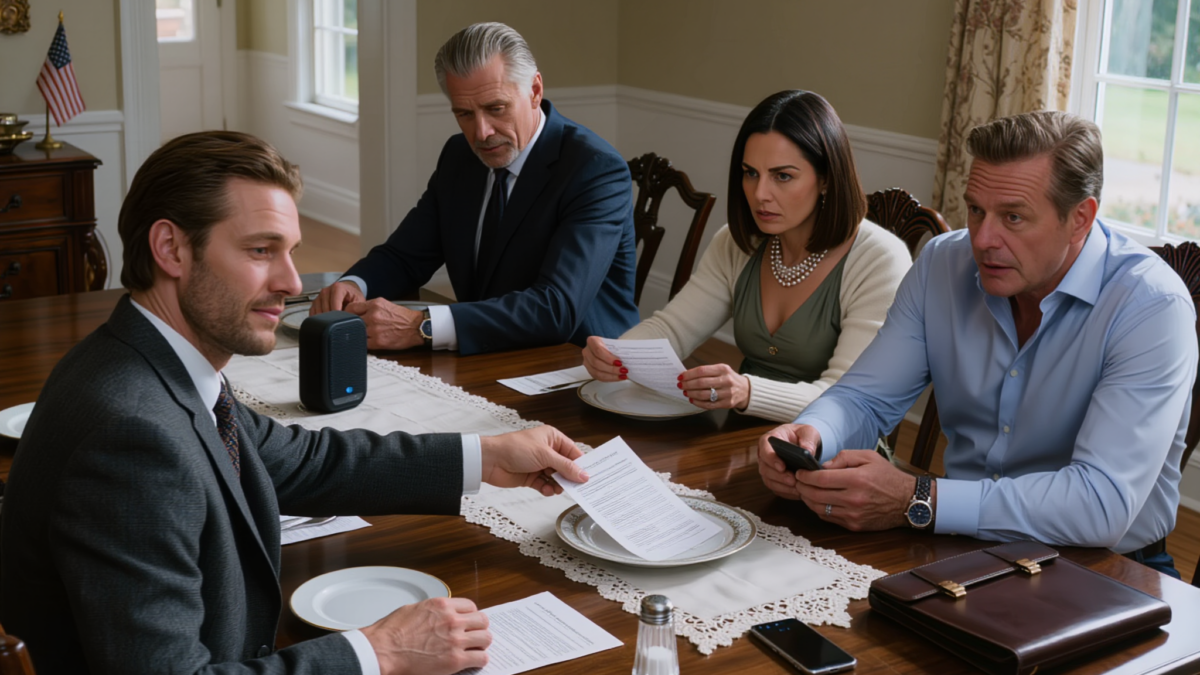
Gideon did not interrupt or answer her accusations. He opened the brass locks on his briefcase and took out a small Bluetooth speaker. He set it beside the crystal salt shaker in the center of the table. Asher wiped his forehead with a napkin and dismissed the gesture as an amateur attempt at intimidation.
Gideon connected his smartphone and pressed play. Warren’s voice came through the speaker clearly, the recording enhanced enough that every word was easy to hear. It was the voice he had used in my workshop when he believed fear would keep me obedient.
“It is not a lie if we win the lawsuit, Carter. It’s just business. You will go bankrupt just trying to pay the attorney fees to fight my lawyers in court. Asher needs this real estate to secure his commercial loans. Don’t be the villain of the family. Sign the paper. I’ll even give you 10 grand for your trouble. You have until Friday.”
The recording stopped with a click. For several seconds, Warren did not move. His face lost its color, his mouth opened, and he stared at the little speaker beside the salt shaker. The people he had assembled to support his version had just heard him explain why the truth did not matter to him.
When he finally spoke, he said the recording was illegal because the conversation had been private. He threatened to sue Gideon and the firm for violating state privacy laws. The words sounded familiar, but his delivery did not. He was trying to make another legal threat while still looking at the device that had exposed the first one.
Gideon calmly told him we lived in a one-party-consent state. He said the recording was admissible in state or federal civil court and could be used as evidence of extortion, blackmail, and malicious prosecution. He did not argue about Warren’s intentions or ask anyone to believe my version of the conversation. The recording had already provided the words.
Warren sank back into his chair. The man who had been preparing to throw my attorney out of the house was suddenly waiting to see what my attorney would do next. Gideon reached into his briefcase again and removed a thick, tabbed stack of financial documents, certified bank statements, and notarized affidavits. He set them on the table with a weighty thud.
Hadley flinched. Rowan spilled a little wine on her dress. Gideon looked at my mother and explained that, since my parents were so concerned about missing family money, we had examined Nana Rose’s trust. His voice remained level, but he made no effort to soften the name of the account or the reason we had looked into it.
Hadley gripped the edge of the table until her knuckles whitened. Her carefully arranged expression went still. She had argued loudly about what I owed the family, but she did not ask which trust he meant. Her hands stayed fixed against the mahogany while he moved the first packet of records across the table.
It stopped in front of Riley’s empty plate. Gideon told her she should read it carefully before tying her future and her credit to the family through marriage. He explained that the packet contained the audited trail of Nana Rose’s account from the time of her death. Riley picked up the top sheet with trembling fingers and studied the highlighted dates, account numbers, and withdrawals.
Gideon stood and pointed toward Hadley. He described the allegations supported by the records: felony forgery, grand larceny, aggravated wire fraud, and federal tax evasion. Then he gave the date of the withdrawal. Three days after my eighteenth birthday, while I was working a grocery-store night shift, my mother had signed my name to the bank authorization.
He said she had bypassed the designated trust executive and taken $400,000 of the inheritance intended for me. His explanation left no room for Warren’s story about the stock market. There was a cash balance, a withdrawal, and an authorization bearing handwriting I recognized. Riley held the records while the rest of the table listened.
Rowan dropped her glass. It broke on the hardwood, and red wine spread around her shoes. No one moved to clean it up. She stared at Hadley, her sister, with none of the confidence she had shown while telling me to accept my father’s offer.
Hadley cried out that it was not true. She called Gideon a liar and accused me of manufacturing the documents because I was jealous and wanted to hurt her. Her eyes moved around the room while she spoke, looking for someone willing to support the accusation. The broken glass remained on the floor beside Rowan’s chair.
I leaned forward and rested my forearms on the table. This was my mother, and I knew the handwriting on those documents as well as I knew her face. I told her we had certified copies from the bank, not papers I had made at home. Tucker had also provided a sworn, notarized affidavit and the ledgers he had kept to protect himself.
I told her a completed report was waiting in Gideon’s office, ready to be sent to the IRS Criminal Investigation division by nine on Monday morning. I did not raise my voice. I had spent years trying to make her understand how much I worked and how little I asked from her. This time, I only needed to tell her what the records contained and where they would go.
Gideon laid out the canceled checks. He read the $90,000 payment to the European car dealership that had supplied Asher’s Porsche. He followed it with the $50,000 paid to the contractor responsible for the imported marble in Hadley’s kitchen. Then he described the $200,000 sent in increments to a holding company in the Cayman Islands to cover Asher’s illegal sports-gambling debts.
Asher put his face in his hands and began to cry. At the steakhouse, he had been comfortable explaining how he would replace my garden and use my house. Now he could not look up while Gideon described what had been bought and paid for before I ever received a cent of Nana Rose’s money. The business success my parents kept praising had depended on losses they expected someone else to cover.
Riley stood abruptly, pushing her chair back so hard it nearly tipped. She looked down at Asher, then reached for her left hand. Her fingers shook as she worked the three-carat engagement ring free. I wondered whether that, too, had been purchased on a credit card with a balance he could not pay.
She held the ring for a moment and dropped it into his half-finished scotch. It struck the bottom of the glass with a dull clink. Then she looked across at me and gave a small, sober nod. When she turned back to Asher, her expression had settled into something more definite than shock.
She told him she was going to her mother’s house that night. If he or anyone in his family tried to contact or approach her again, she said, she would seek a restraining order and give the police everything she knew. She picked up her purse from the floor and left. The front door closed hard enough to rattle the stained glass in the foyer.
Asher called after her, saying he could explain and begging her to come back. He remained in his chair. There was nothing in the room he could point to that would make the records disappear, and Riley had stopped waiting for his version. I heard him crying while Gideon opened another section of the briefcase.
He placed a final document in front of Warren. It was thick, bound in a blue legal cover, and it was not a deed to my house. It was a settlement agreement addressing the money my parents owed me. Gideon explained the terms while Warren looked at the first page.
Under the agreement, Warren and Hadley would formally acknowledge the debt arising from the inheritance. A lien would be placed on their current house, requiring them to liquidate assets to repay the $400,000 plus ten years of compound interest. The agreement also waived any future claim to my Victorian. Their attempt to call my home a family asset would end in writing, not another promise across a table.
Asher looked up with a tear-streaked face and pleaded with Warren not to sign. He said it would bankrupt them. Then he admitted that he needed my house because he owed money to dangerous people who were running out of patience. These were not debts he expected to settle through an ordinary discussion with a bank.
I looked at my older brother and tried to find something beyond the exhaustion I felt. He had spent years expecting me to repair his mistakes and had mocked the very work he now needed to profit from. In that moment, I felt no anger, pity, or urge to bargain. I answered him plainly.
“That is not my problem.”
Warren looked from the settlement to Gideon, searching for room to negotiate. Gideon checked his watch and gave him two minutes to sign. If Warren refused, delayed, or tried to reopen the terms, Gideon said he would take the fraud report to the district attorney and deliver the tax records to the IRS field office on Monday. He made clear that he was prepared to proceed, not simply making a threat to obtain a reaction.
Leaning over the table, Gideon described the consequences he believed my parents faced: federal prison, civil forfeiture, and the loss of their remaining assets. He told them not to imagine that their social standing would produce an easy sentence or a comfortable place to serve it. These were his warnings, delivered without the dramatic gestures Warren used when he wanted to frighten someone. My father listened without interrupting.
The grandfather clock ticked in the hallway. Hadley was crying into her hands, and Warren looked at her before turning back to the agreement. Less than an hour earlier, the room had been arranged around their certainty that I would sign away my home. Now the only unsigned paper anyone was watching sat in front of him.
He looked at me again, searching for the son he had spent thirty years directing. I did not tell him it would be all right or offer to make the decision easier. I had already made my decision when I refused to give away the house. What happened next depended on whether he would acknowledge what he and my mother had taken.
Warren reached for the brass pen. His hand shook so badly that he struggled to hold it steady. He lowered the point to the paper, took a breath, and signed. The scratch of the pen was a small sound compared with everything that had been said at that table, but it was the sound I had been waiting to hear.
Gideon summoned his assistant, who had been waiting in the town car. Once the signature was complete, the assistant applied the notary stamp to the agreement. We gathered our papers and closed the briefcases. I stood, buttoned my jacket, and looked around the room one last time.
There was spilled wine on the floor and bourbon on the runner. Hadley and Asher were crying, and Warren sat in front of the document he had signed. I did not give a speech or ask anyone to apologize. Gideon and I walked through the foyer and out the front doors.
Around two that morning, a crash in the front yard woke me. I got out of bed, grabbed a heavy flashlight, and looked through the wooden blinds of my second-floor bedroom. Headlights shone into the house from a car where no car should have been. Asher had come over the curb and into my hydrangeas in a friend’s leased BMW that he had taken without permission.
Apparently, Riley had taken her own car. Asher had driven the BMW into the bushes and destroyed the wooden trellis I had built the previous spring. He climbed out unsteadily, leaving the engine running and the driver’s door open. The headlights stayed trained on my living room as he made his way toward the steps.
He was plainly drunk. He kicked at the woodwork and shouted loudly enough to wake the neighborhood, insisting the house belonged to him. He was the eldest son, he said, and he should have inherited everything. He blamed me for Riley’s departure, his debts, and our parents’ financial situation, as though all three had begun when I stopped agreeing with him.
Watching from upstairs, I could still remember him leaning back in his chair at the steakhouse. His suit, watch, and easy laugh had made him look untouchable. Now he was struggling to stay upright in my front yard while insisting that I owed him another way out. Without my parents’ money and everyone else’s willingness to help, there was very little holding him up.
I did not open the door or go outside to confront him. I called 911 and reported an intoxicated, aggressive driver who had crashed onto my property and was disturbing the peace. Then I recorded him through the window with my phone. I stayed inside while he continued shouting at the house he had already decided should be his.
I realized that I was no longer frightened of him in the way I once had been. I had spent years mistaking his expensive clothes, loud voice, and college education for authority. From the bedroom window, I could see how much of that authority depended on other people making his problems disappear. I did not have to go downstairs and become one of them again.
Two police cruisers arrived about ten minutes later, their red and blue lights moving across the front yard. When the officers approached, Asher resisted and threw an unsteady punch. They restrained him on the damp grass, put him in handcuffs, and placed him in a patrol car. He was charged with driving under the influence, destruction of private property, public intoxication, and resisting arrest.
I returned to bed after they took him away. The damaged garden would still be there in the morning, but Asher was no longer outside demanding entry. I slept more deeply than I had in twenty years. There was no phone call I needed to make on his behalf and no explanation I had to prepare for our parents.
Over the following months, Warren and Hadley’s finances and social life unraveled. They had signed the agreement to repay the trust money rather than have Gideon submit the reports he had described at dinner. But the tax issue did not disappear with the settlement. Gideon had not allowed the matter to end with the signature alone.
Through anonymous channels, a detailed tip reached an IRS field investigator. It included the audited ledgers, account numbers, and forged documents, without identifying Gideon’s firm. My parents were subjected to a federal tax audit. Their standing at the country club did not make the records or the unreported money any easier to explain.
Between the court-enforced repayment of the inheritance with ten years of compound interest and six-figure fines, penalties, and back taxes, they could not maintain their old life. They had to sell the house at a substantial loss to obtain the cash they needed. The property where Warren had expected to pressure me into giving up my home became the asset they had to liquidate. Its size and appearance could not protect them from what they owed.
Their country-club memberships were revoked after they failed to pay the dues. Friends who had enjoyed their dinners and respected Warren’s business reputation stopped answering calls. No one wanted to be associated with the fraud and tax problems. The people who had once helped make my parents seem unassailable were suddenly unavailable.
Warren and Hadley packed the furniture they could keep and moved into a small two-bedroom condo in a cheaper, neglected part of town. It was near a highway overpass, where traffic brought constant noise and exhaust. The space was a long way from their large dining room and its carefully chosen furniture. They had spent years telling me what kind of home was enough for a person; now they were living within what they could afford.
Asher lost the support he had relied on just as quickly. With our parents unable to cover his expenses, there was no money waiting whenever he needed another rescue. Riley blocked his number, cut off contact, and moved out of state to live with relatives. She did not return to hear the explanation he had called after her at the dinner.
He also lost the well-paid corporate job he had obtained through family connections. His DUI arrest became public, and his financial problems reached his employer’s human resources department. Through people who still heard from him, I learned that he was working overnight at a budget car-rental agency at the airport. He was staying on friends’ couches, wearing out their patience in the process.
A month ago, he sent me a message asking for a $10,000 loan. He said he needed it because of the people pursuing his debts and the threats they were making. I did not respond. I blocked the number rather than begin another conversation in which his emergency became my obligation.
Six months later, I sat on the back porch with a cup of strong black coffee. The air was cool and smelled of jasmine and fresh lumber. Under my feet were boards I had fitted, fastened, and sealed myself. For once, I could sit there without expecting a demand to interrupt the morning.
The hydrangeas were growing again. I had spent weekends pruning broken branches, tending the roots, and working fresh soil into the damaged beds. The plants had survived more than I expected, and their new blooms were thick and bright. Repairing the garden had been ordinary work, the kind that left me tired for a reason I understood.
Those six months had been quiet. The settlement check from the sale of my parents’ house had cleared my account weeks earlier, returning the money taken from Nana Rose’s trust. I had not bought a sports car or used it for a luxury trip to Europe. I put it into the home and business I already had.
I paid down the remaining mortgage on the Victorian and used the rest for heavy-duty commercial woodworking machinery. The equipment allowed me to invest in the work that had supported me before any of the trust money returned. I did not need to turn the settlement into proof that I was richer than my brother. I needed it to make what I had built more secure.
Business had improved considerably. A few weeks earlier, a client named Desmond arrived at the shop in a chauffeur-driven Rolls-Royce. He had toured my house with the historical society and seen the period-appropriate restoration of the oak staircase. He wanted to speak to the person who had done the work.
Desmond had recently purchased a historic luxury hotel downtown. He hired me to restore its interior woodwork and signed a substantial, multiyear commercial contract. He had seen the staircase and recognized the time and skill it represented. For the first time, the work my family had dismissed was bringing both meaningful compensation and respect from people willing to pay for it.
I ran my hand along the porch railing. It was solid beneath my palm and held my weight easily. I had built it to last a hundred years, well beyond my own time in the house. There was comfort in knowing exactly what made it strong and remembering the work that had gone into each joint.
Still, the peace had not arrived without questions. During the first weeks after the dinner, I sometimes lay awake wondering whether I had been too harsh. Warren and Hadley were my parents, whatever they had done. I had watched the life they knew fall apart and had not offered to save it.
Yesterday afternoon, I found a letter in my mailbox. There was no return address, but the handwriting made one unnecessary. I recognized the loops before I opened it. Hadley had written on inexpensive notebook paper, and the pages were marked with tears.
I suspected she could no longer afford the phone plan she used to have, though I had blocked her number regardless. The letter was long and familiar in its approach. She described the condo as cramped, noisy, and depressing. She wrote about her health, her depression, and how much Warren was drinking.
At the end, she asked whether I had a spare room. My house was so large, she pointed out, that there must be space for my own mother when she needed help. She was still counting the rooms in my home and deciding that having them meant I should give them to someone else. Nothing in the request acknowledged why I no longer wanted her there.
I did not write back or call to argue. I went into the living room, struck a long wooden match, and put the letter into the fireplace. The paper curled, darkened, and caught, its edges turning orange in the flames. I stood nearby and watched until the handwriting disappeared into ash.
The heat reached my face, and the words that usually sent me searching for an acceptable answer were gone. I wondered whether that made me cold in someone else’s eyes. Out on the porch, watching smoke rise above the house into the blue sky, I did not feel cold. I felt warmer and lighter than I had while holding the letter.
I could not keep building my life around a family arrangement that required me to give up what I earned. I had spent enough years trying to repair problems the people responsible refused to stop creating. The house had taught me to recognize damage beneath an attractive surface and to deal with it before trying to build anything lasting. This time, I had finally applied that understanding to my own life.
I took another sip of black coffee. It tasted like freedom.








