My parents bought 48 Christmas gifts for my brother’s family—and none for my seven-year-old son. He waited in his clip-on tie for the telescope Grandma had promised. Back home, I found the gift purchases on my emergency credit card. I canceled their cards. The next morning, Dad demanded $7,500 for a truck repair. Then my assistant sent me a screenshot of the “repair shop.”
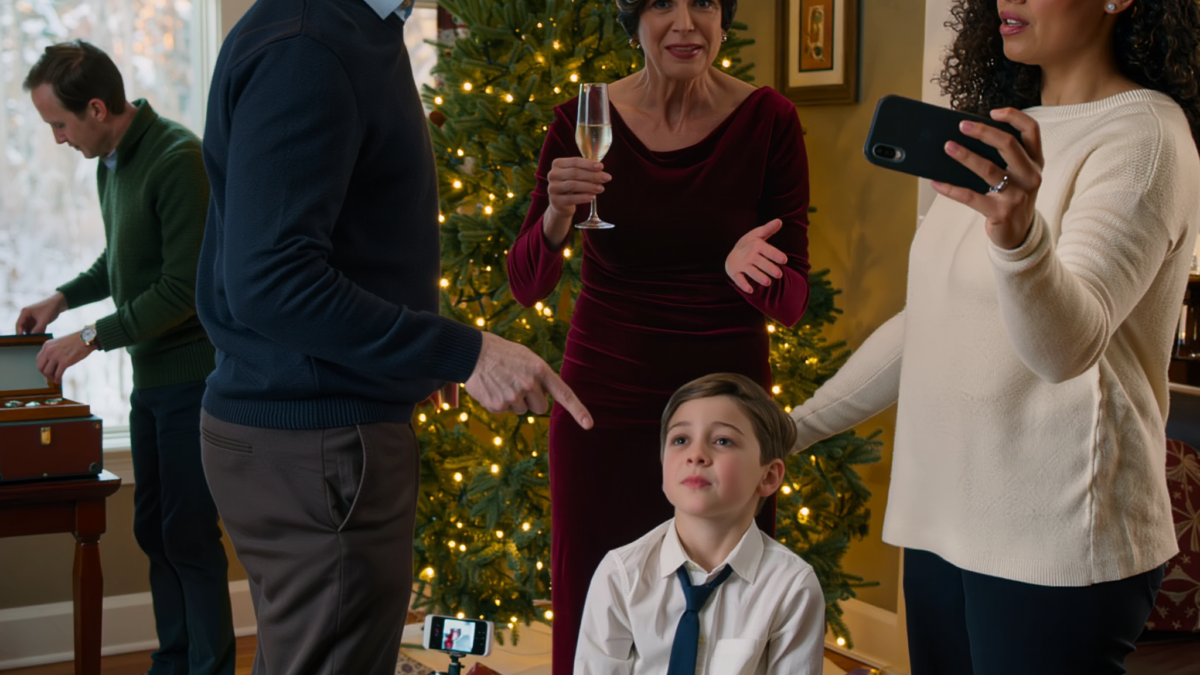
My name is Everett. I was thirty-five when I stood in my parents’ living room on Christmas morning and watched them hand out forty-eight expensive gifts to my younger brother’s family while my seven-year-old son, Wyatt, received nothing.
Not a wrapped box. Not a stocking. Not even a passing acknowledgment that he was still waiting.
While I tried to hold myself together for him, my mother looked directly at me.
“He’s just too solitary, Everett. He doesn’t need toys like the other boys.”
My son sat in a corner with his hands folded, surrounded by wrapping paper, expensive electronics, and people who were supposed to love him. He kept waiting for someone to call his name.
They never did.
The gifts had cost about $5,000. What I discovered afterward was that my parents had charged those purchases to my emergency credit card, the one I had trusted them to use for medical crises.
They also believed they would remain trustees and secondary beneficiaries of the estate arrangements I had made for Wyatt, including a $1.2 million trust. Before the snow on my driveway had melted, I began removing their access.
By then, they were calling repeatedly, asking me to pay their bills and undo the changes. But the moment that stayed with me wasn’t one of their calls. It was the walk from their front door to my car.
The winter air caught me in the face as I opened the heavy oak door. Wyatt gripped my hand so tightly that his knuckles had gone pale. He didn’t cry, protest, or ask why we were leaving. He walked beside me with his head lowered, watching the gray slush on the driveway.
I opened the SUV’s rear door and lifted him into his booster seat. My hands were shaking. It took three tries to fasten the seat belt.
When I climbed behind the wheel and shut my door, the Christmas music from the house finally disappeared. I looked at Wyatt in the rearview mirror.
He had dressed himself that morning. He had chosen his favorite button-down shirt and a clip-on tie because he wanted to look professional when he accepted the gift his grandmother had promised him. Now his collar sat crooked, and his expression was so confused that I had to look away before I could start the engine.
I backed out without looking at the house. I didn’t look at the inflatable snowmen or the wreaths my mother had hung in every window. She had spent thousands on decorations to impress neighbors she barely liked.
I didn’t care about the holiday dinner I had paid for. I didn’t care about the high-end drill bits I had carefully chosen for my father or the $300 cashmere scarf I had wrapped in silver paper for my mother. I left everything on the kitchen counter.
All I wanted was to get my son home.
We drove through the quiet, snow-covered neighborhood without speaking. Then my phone began ringing through the car’s Bluetooth connection.
My father’s name appeared on the dashboard: Warren.
I ignored it. The ringing stopped and immediately started again. This time it was my mother, Rowan. Then my younger brother, Spencer.
They had realized I was actually leaving.
I disconnected the Bluetooth and put the phone on the passenger seat. It kept vibrating against the leather for the rest of the drive.
Forty minutes later, when we pulled into our driveway, I had sixty-three missed calls.
The messages weren’t apologies. They wanted me to turn around. The catering staff were arriving to serve brunch, and they expected me to pay.
Not one voicemail contained an apology to Wyatt. They were upset because the person who had covered their expenses for most of a decade had walked out with his wallet.
I was the chief financial officer of a midsize technology firm. I spent my days dealing with complex budgets, risk assessments, and long-term investments. I earned a healthy six-figure salary, contributed the maximum to my 401(k), and had built a solid real estate portfolio.
None of it had come easily. I had worked for every promotion, every bonus, and every property.
But I had a blind spot when it came to my family.
Somewhere along the way, I had learned to treat love as something I could earn by being useful. If I paid for enough broken appliances, covered enough emergencies, or funded enough vacations, perhaps my parents would finally look at me with affection that had nothing to do with what I could provide.
More importantly, perhaps they would look at Wyatt that way.
I thought I could make room for us by making their lives easier. Instead, I had become the person they called when a bill came due.
When our front door closed behind us, the realization settled in with an awful clarity. I had been financing people who were teaching my son that he mattered less than everyone else.
Wyatt walked to his bedroom and shut the door. I stood in the living room listening to the latch click, knowing I could no longer pretend that keeping the family together was the same thing as protecting him.
I needed to look at my family with the same honesty I brought to every other part of my life.
The pattern hadn’t begun that Christmas.
I was the older brother, and the expectations had been clear since childhood. I was supposed to be responsible, quiet, and able to handle my own problems. I was expected to support everyone else without needing much attention myself.
Spencer was thirty and had never held a paying job for more than six consecutive months. He called himself an entrepreneur. In practice, his businesses repeatedly became emergencies someone else had to finance.
His wife, Riley, expected the same kind of help. Their boys, Mason and Hunter, were loud, demanding, and accustomed to being the center of every family gathering.
My parents loved that. Spencer’s family filled the room, posed for photographs, and gave my mother plenty to post on Facebook.
Wyatt was different. He didn’t compete for attention. He trusted people to remember him.
Two weeks before Christmas, I had been sitting at the mahogany desk in my home office, reviewing my personal finances. It was around eleven at night. A glass of red wine sat on a coaster beside my laptop.
I kept my expenses in color-coded spreadsheets. I scrolled past the mortgage, Wyatt’s college fund, and the utility bills until I reached a row labeled “Family support.”
I expanded the total and stared at the number.
$15,450.
That was how much I had spent on my parents and Spencer during the previous twelve months.
It hadn’t been one enormous request. It was a series of smaller ones, each presented as something temporary and unavoidable.
In February, my parents needed a new water heater. Dad said he was a little short that month.
In June, Spencer needed an emergency rent payment. His latest business, selling custom shoelaces online, had failed, and Riley was threatening to take the boys to her mother’s house.
In September, I paid the catering bill for my parents’ fortieth-anniversary party at a country club they couldn’t afford.
I never asked for repayment. I never drew up a schedule or put anything in writing. I paid because I hoped it would buy peace, and because some part of me still believed generosity would eventually make me feel like a valued son.
While I stared at the spreadsheet, my office door creaked open.
Wyatt came in wearing oversized pajamas covered with little planets. He had a crumpled astronomy-store brochure in his hands.
He wasn’t interested in football or the latest video games. He loved space. He could talk about Jupiter’s moons and explain a light-year with an earnest precision that always made me smile.
That night, he laid the brochure on my desk and pointed to a beginner’s telescope. The price was $200.
“Dad, do you think Grandma Rowan remembers?”
I pulled him onto my lap.
“Remembers what, buddy?”
“She promised. She said if I got straight A’s on my report card this semester, she would get me this telescope for Christmas. I got the A’s, Dad. I showed her the paper on FaceTime last week. She said she was so proud.”
My mother had made the promise. I remembered it.
I also knew how easily she made grand gestures in conversation and forgot them afterward, particularly when Wyatt was involved. His quiet interests didn’t hold her attention the way his cousins’ demands did.
To Wyatt, however, a promise meant something firm. He had done what she asked. He believed she would do the same.
I brushed his hair back.
“Honey, Grandma gets very busy during the holidays. She has a lot of people to shop for. Maybe I should just buy it for you, and we can say it’s from—”
“No.”
He looked genuinely upset by the suggestion.
“That is cheating, Dad. Grandma promised. She said, ‘A promise is a bond.’”
I couldn’t tell him that I was afraid she had forgotten the conversation as soon as it ended. I couldn’t look at that hopeful face and explain why I didn’t trust my own mother to keep her word.
Instead, I did what I had done for years. I tried to handle the problem quietly.
I sent her a text.
“Hey, Mom. Just checking in on the Christmas list. Did you manage to order that telescope Wyatt wanted, the sky watcher one? If not, please let me know and I can pick it up tomorrow and slip it to you to give to him. I just really don’t want him disappointed on Christmas morning.”
The typing dots appeared, then vanished.
An hour passed. Then another.
Three hours later, she replied.
“Stop micromanaging me, Everett. I am the grandmother. I know exactly how to spoil my grandkids. I have been planning this Christmas for months. Everything is handled perfectly. You just worry about making sure you pay for the catering for the brunch.”
I read the message several times.
Everything is handled perfectly.
I wanted to believe her. I wanted to believe that, for once, my son would get something from his grandmother that hadn’t required me to arrange it behind the scenes.
On Christmas Eve, I was in the kitchen making the gluten-free, sugar-free cookies my father insisted were the only ones that didn’t upset his stomach. Flour covered my hands when Spencer called.
I wiped them on a towel and answered on speakerphone.
“Hey, Spence. Merry Christmas Eve.”
“Merry Christmas, bro. Listen, man, are you bringing the big SUV tomorrow?”
I paused with a cookie cutter in my hand.
“Yeah. Why?”
“Riley and I went a little overboard with the boys’ presents.”
He laughed, pleased with himself.
“And Mom said she has a mountain of stuff for them, too. We’re definitely going to need help hauling everything back to our place. My car is full of my golf clubs and Riley’s gym equipment.”
“I’m bringing Wyatt, Spencer. And all the food. The car’s going to be pretty full.”
“Oh, come on, Everett. Just fold the back seats down. Wyatt doesn’t take up that much space. He’s tiny. Just make it work, okay?”
Before I could answer, he continued.
“Oh, and Mom wanted me to remind you that you’re covering the $600 catering bill for tomorrow’s brunch, right? The restaurant called her to confirm payment, and she told them to call you.”
I stood still, holding the cookie cutter.
Wyatt doesn’t take up that much space.
Spencer had been talking about the car, but the words described far more than seating arrangements. My son asked for little. He didn’t interrupt or make demands. My family had apparently decided that meant he needed little from them, too.
“Fine,” I said. “I’ll pay it.”
“You’re the best. See you tomorrow.”
He hung up without asking about either of us.
I looked down and realized I had been pressing the cookie cutter into the counter hard enough to make my knuckles ache.
When I went into the living room, Wyatt was sitting beside the bay window, looking at the stars.
“Dad?”
“Yeah, buddy?”
“Do you think Santa knows I’m at Grandma’s house tomorrow morning?”
“Yes,” I said. “He knows.”
“And Grandma, she promised, right? A promise is a bond.”
I knelt beside him and kissed the top of his head. His hair smelled like baby shampoo.
“Yes, buddy. A promise is a bond.”
I looked through the window and hoped my mother would keep hers. I also knew that if she didn’t, I couldn’t keep covering for her.
Christmas morning was cold and overcast. The sky was slate gray, and snow threatened as we loaded the SUV with a baked ham, the cookies, and the presents I had bought for everyone.
Wyatt sat upright through the entire forty-minute drive. He had combed his hair carefully and insisted on wearing his clip-on tie.
My parents’ house looked ready for a holiday movie. Every window and stretch of lawn had been decorated. From the street, it looked like the home of a prosperous, happy family.
I took a breath, picked up the heavy tray of food, and followed Wyatt inside.
Mason and Hunter raced down the hallway with plastic swords. They bumped into my legs and kept going without saying hello.
My mother came out of the kitchen wearing a tailored velvet dress and a full face of makeup. Her phone was already held out in front of her. She was livestreaming.
“And here is the rich uncle,” she announced, turning the camera toward me. “Everett, smile. You look so exhausted, honey. Try to look happy. It’s Christmas.”
She didn’t put the phone down to hug me. She didn’t greet Wyatt. She simply tilted the lens toward him.
“And there’s little Wyatt. Say hi to the camera, Wyatt. Watch my dress, sweetie. You have snow on your boots. Go sit in the living room. We’re starting presents in five minutes.”
Then she turned toward Riley, who was posing beside the staircase.
Wyatt’s shoulders dropped. I looked at his boots.
They weren’t even wet.
I guided him into the living room. Dad was in his leather recliner with a glass of bourbon, watching television at ten in the morning. He acknowledged us with a grunt.
The Christmas tree was almost hidden behind gifts.
Glossy boxes stretched six feet into the room. I had never seen so many presents under one tree.
Wyatt stared.
“Whoa,” he whispered. “That must be a lot of telescopes, Dad.”
I led him to a small ottoman in the corner.
“You sit right here, buddy. I’m going to put the food in the kitchen.”
When I returned, Mom was clapping for everyone’s attention.
“All right. Spencer, Riley, get in here. It is time.”
She set her phone on a tripod facing the tree. Every present would be recorded for the people watching her page.
I sat on the arm of the chair beside Wyatt. He slipped his hand into mine.
I took out my phone and opened the notes app. Watching the mountain of boxes, I decided to keep track.
Mom picked up a large gold-wrapped package.
“For my beautiful Riley.”
Riley tore off the paper and lifted out a Gucci handbag worth about $2,000.
Next came a brand-new iPad Pro for ten-year-old Mason, complete with a pencil and keyboard case. Another $1,200.
Hunter received a high-end, LED-lit hoverboard worth about $300.
Wyatt sat very still. Each time a cousin opened a present, he smiled politely and clapped. He was waiting his turn.
Spencer received a collection of watches in a leather display case.
I entered the count in my phone.
Spencer: one. Riley: one. Mason: one. Hunter: one. Wyatt: zero.
The presents kept coming.
Mason opened a camera-equipped drone. Hunter unwrapped a motorized Jeep. Riley received a voucher for a luxury spa weekend, and Spencer got custom golf clubs.
Dad opened the drill bits I had bought him and gave me a brief nod. Then he opened a large flat-screen television from Mom.
Twenty gifts became thirty. Thirty became forty.
Torn paper piled up around Spencer’s boys. I watched the remaining boxes, searching for the shape of a telescope package.
Then I stopped looking for a telescope. I looked for a book, a sweater, a pair of socks. Anything with Wyatt’s name on it.
Forty-five. Forty-six. Forty-seven.
Wyatt leaned against my arm.
“Dad, is she saving the big ones for last?”
“Yes, buddy,” I said. “Usually the best gifts are saved for the very end.”
I hated the lie even as I said it. I still wanted there to be an explanation.
Mom reached for the last box. It was a small velvet square.
Wyatt straightened. His breath caught. Perhaps it held a gift card for the astronomy store. Perhaps it was a lens.
Mom smiled at the camera.
“And this final gift is for Riley.”
Riley opened it and held up diamond stud earrings.
“And that’s it,” Mom announced. “Merry Christmas, everyone. Now, who’s ready to eat the brunch Everett bought?”
Spencer’s boys started arguing over the drone. Riley took photographs of her earrings.
Wyatt looked at the empty carpet where the presents had been. Then he looked down at his hands.
His chin trembled once. He pressed his lips together, trying to stop it.
When he looked up at me, he mouthed “Dad,” but no sound came out.
I checked the tally on my phone.
Spencer’s family: forty-eight gifts. Estimated value: more than $5,000.
Wyatt: zero gifts. Value: zero.
I stood.
“Mom.”
My voice was quiet, but she turned.
“What, honey? Didn’t I do a great job? I know I went a little overboard.”
“You forgot someone.”
She frowned.
“Who? I got Spencer. I got Riley. I got your father.”
“You got Wyatt nothing,” I said, pointing toward my son. “Not one single thing.”
Spencer stopped opening his watches. Riley stopped taking selfies.
Mom gave a short laugh and waved a hand.
“Oh, Everett, stop being so dramatic and ruining the mood. I didn’t get him nothing.”
“There is nothing there, Mom. You promised him a telescope if he got straight A’s. He did the work. You broke your word.”
Her expression hardened.
“Oh, that. I went online to order it, and honestly, I just got so overwhelmed with everything Spencer’s boys wanted. Their lists were so demanding. It must have slipped my mind.”
I stared at her.
She had remembered forty-eight things for one part of the family. She had forgotten the single promise she had made to my son.
“It’s fine,” she continued, turning to pour more champagne. “I’ll dig a $20 bill out of my purse later and give it to him. He’s a smart kid. He understands. He’s just too solitary, Everett. He doesn’t need toys like the other boys do. He just sits there.”
Solitary.
She made his quietness sound like a reason he didn’t deserve consideration.
Spencer chuckled without looking at Wyatt.
“Tough luck, kid. Life ain’t fair. Better learn that lesson now.”
Riley looked annoyed with me.
“Seriously, Everett, don’t ruin the vibe. Mom worked really hard on this morning. You’re the rich CFO. You can buy him the stupid telescope yourself.”
I looked down at Wyatt. He was pulling inward, trying to occupy less room on the ottoman.
I knelt in front of him.
“Wyatt, look at me.”
He lifted his eyes.
“You are not invisible,” I whispered. “And you are not forgotten. Not by me. Never, ever by me.”
Then I stood and picked up his winter coat.
“Put your arms in, buddy. We’re leaving.”
“What?” Mom demanded. “You can’t leave. We haven’t even eaten the food yet. You paid for the catering.”
I zipped Wyatt’s coat to his chin.
“I don’t care about the food, Mom.”
Dad finally got out of his recliner.
“Everett, sit down right now. You’re acting like a child. It’s Christmas. Don’t you dare punish this family because your mother made a tiny mistake.”
“A mistake is forgetting milk at the grocery store, Dad. Buying forty-eight expensive gifts for one family and none for my son isn’t a mistake. It’s a choice.”
I took Wyatt’s hand and headed for the door.
Mom followed us, her heels clicking against the hardwood.
“If you walk out that door, Everett, don’t you ever come back. You’re ruining Christmas for everyone. Look at Mason. He’s upset because you’re yelling.”
I stopped and turned.
Mason wasn’t crying. He was playing on his new iPad, paying no attention to us.
“I’m not ruining Christmas,” I told her. “You did that the second you decided my son didn’t matter. And don’t worry. We won’t be coming back.”
I opened the door and took Wyatt outside.
When we reached home, he went straight to his bedroom. I didn’t make lunch or putter around the kitchen. I went into my office, closed the door, and opened my laptop.
For years, I had kept my professional judgment separate from my family obligations. That afternoon, I couldn’t do it anymore.
First, I ordered the exact telescope Wyatt wanted from Amazon and paid for overnight priority delivery.
Then I opened my credit-card account.
Five years earlier, I had given my parents authorized-user cards linked to my American Express Platinum account. We had agreed that the cards would stay in a drawer unless there was a medical emergency or an urgent house repair and they couldn’t reach me.
I opened the unbilled December transactions.
On December 23, there was a $1,200 purchase at Best Buy.
On December 24, there was a $2,000 purchase at a luxury boutique and another $1,500 at an electronics outlet.
I sat back, staring at the screen.
They hadn’t simply forgotten Wyatt. They had used my money to buy the presents he had watched everyone else open.
The emergency cards had paid for the celebration that excluded him.
I selected “Manage cards,” chose Warren’s card, and canceled it. Then I canceled Rowan’s.
Next, I opened my estate-planning portal.
As a single father, I had a comprehensive life insurance policy and a trust valued at $1.2 million. Because Wyatt was a minor, I had named my parents and Spencer as primary trustees and secondary beneficiaries in the arrangements intended to protect him if something happened to me.
Until that afternoon, I had told myself they would care for him if they had to.
I selected the beneficiary information and removed Warren’s name. Then Rowan’s. Then Spencer’s.
I wrote an urgent email to my estate lawyer, Dominic.
The subject was “Urgent update to trust and power of attorney.”
“Effective immediately, remove my parents and brother from all medical directives, power of attorney, and estate plans. They are to have zero access to my assets or my son under any circumstances. Draft the paperwork for my signature tomorrow morning.”
I sent it and sat quietly at my desk.
It hurt to make those changes. I had spent years believing that my parents belonged in those roles simply because they were my parents. But leaving Wyatt dependent on their goodwill was no longer something I could justify.
For the first time all day, I felt a little of the pressure in my chest ease.
The next morning was Monday, December 26. Most people were still enjoying the holiday, but the banking systems were operating.
At 9:15, Dad called.
I had unblocked his number because I expected him to discover that the card no longer worked. I answered on speakerphone in my office.
“Hello, Dad.”
“Everett. Why haven’t you been answering? We called you sixty times yesterday.”
“I was busy. What do you want?”
“Drop the attitude. I have a major situation here. I’m standing at Caleb’s auto shop. The truck started making a terrible grinding noise on the way to get groceries. The transmission is completely shot.”
I took a sip of coffee.
“Okay. What does that have to do with me?”
“The repair bill is $7,500. I tried to use the MX card you gave us for the deposit, and the guy said it was declined. Do you know how embarrassing that is? You need to call the bank and clear the fraud alert, or wire the cash directly into my checking account.”
Less than a day earlier, he had watched Wyatt sit through Christmas without a gift. Now he was demanding another $7,500 as if nothing had happened.
“No,” I said.
For several seconds, he didn’t answer.
“What did you just say?”
“I said no. The card isn’t flagged for fraud. I canceled your cards yesterday afternoon. Your access is revoked.”
“You canceled them? Because of that tantrum you threw over a toy? You’re going to leave your own father stranded at a mechanic shop in the freezing cold because of a toy?”
“It wasn’t about a toy, Dad. It was about my son. And it wasn’t a tantrum. It was a realization.”
He called me vindictive and ungrateful. While he talked, I texted my assistant, Declan.
“Look up an auto shop owned by a guy named Caleb in my dad’s ZIP code.”
Within a minute, Declan sent a screenshot of a business listing.
I looked at it.
Caleb’s business wasn’t an auto repair shop. It was a high-end used-car dealership specializing in luxury European imports.
I interrupted Dad.
“Let me ask you something specific. Are you absolutely sure that the $7,500 is for a broken transmission on your Ford truck?”
“Yes. Of course it is. What is wrong with you?”
I looked at the listing again.
“Dad, I know where you’re standing. You’re at Caleb’s dealership. You aren’t fixing a truck. That $7,500 is the down payment on the used Porsche 911 Spencer has been posting about for the last three weeks.”
This time, the silence lasted.
They had presented another luxury purchase as an emergency. My father had called me from a dealership and expected me to pay for my brother’s sports car.
“The ATM is out of order, Dad,” I said. “You spent $5,000 of my money on Spencer’s family yesterday. Ask him to pay for the Porsche. Figure it out.”
I ended the call and blocked his number.
Once my parents could no longer reach me directly, messages began arriving from relatives.
Aunt Joyce told me to apologize because my mother was crying and suffering severe stress over a misunderstanding.
Cousin Mark reminded me that family was everything and that people didn’t cut off their parents over money.
Riley sent a Facebook message calling me bitter and lonely. She said Spencer was twice the man I would ever be.
I didn’t argue with any of them. I didn’t write a lengthy defense or try to answer every accusation.
I used the ten-second video I had recorded in the living room on Christmas morning.
It showed the gifts around Spencer’s children. Then it moved to Wyatt on the ottoman, alone, empty-handed, trying not to cry.
I sent it to the extended-family group chat with a caption.
“Forty-eight gifts for Spencer’s family. Zero gifts for Wyatt. Total cost: $5,000, charged to my emergency credit card by Warren and Rowan without my permission. I’m not destroying this family. I’m the one who finally stopped paying for the way you treat us.”
Then I left the chat.
The weeks afterward were quiet.
January was cold, but our home felt safe in a way I hadn’t understood we were missing. Wyatt and I spent time together without an interruption from someone demanding money or insisting we attend an event.
His telescope arrived. It didn’t erase what had happened, but I saw some of his excitement return when he used it.
One Saturday, he looked up at his plain white bedroom ceiling and said it seemed too empty.
We went to the hardware store and bought midnight-blue paint and glow-in-the-dark constellation stencils. We spent the weekend on ladders, listening to eighties rock while we turned his ceiling into a night sky.
When I finished the last star, I looked down at Wyatt. He had blue paint on him and was smiling.
“You’re the brightest star in my universe,” I told him. “You don’t need anyone else’s permission to shine.”
I thought setting a firm financial boundary would make my parents stop. Without my cards or my willingness to pay, I assumed they would eventually leave us alone.
I was wrong.
Three weeks later, on a Thursday afternoon in February, the doorbell rang.
A man in a wrinkled suit stood on the porch.
“Everit?”
“Yes.”
He handed me a thick manila envelope.
“You’ve been served.”
Then he walked away.
I opened the envelope in the hallway. Inside was a petition filed in the Superior Family Court.
Warren and Rowan were the petitioners. I was the respondent.
My parents were suing me.
They had hired an aggressive family-law attorney named Dominic. I later learned that my uncle Wesley was funding them. He had always been willing to involve himself in family conflict from a distance.
The petition sought grandparents’ rights. My parents wanted court-ordered custody and visitation every other weekend and two weeks during the summer.
They claimed I had deliberately separated Wyatt from grandparents with whom he had a deep, continuous bond.
I stood in the hallway reading that sentence.
They had ignored his birthdays. They had forgotten a promise he had worked an entire semester to earn. They had told him he didn’t need a present because he was quiet.
Now they were claiming he couldn’t do without them.
I believed the lawsuit was an attempt to force me back into negotiations over money and the trust. They were bringing my son into a legal dispute after I had refused to keep paying their expenses.
I gripped the pages until they bent in my hands.
Christmas had shown me how little consideration they gave Wyatt. The petition showed me that walking away would not be enough.
I needed help protecting the boundary I had set.
The next morning, I hired Robert Henderson.
He was an experienced family-law attorney with a reputation for being thorough, expensive, and difficult to intimidate. His downtown office had floor-to-ceiling windows overlooking the city, and he wore a custom-tailored Italian suit.
I handed him the envelope.
He adjusted his wire-rimmed glasses, read the petition, and leaned back in his chair. A gold pen rested between his fingers.
“Everett, a grandparents’ rights case is difficult to win in this state,” he said. “The threshold is high because the court has to respect the decisions of a fit parent.”
He explained what he expected my parents to be required to establish.
They would have to demonstrate a meaningful, ongoing relationship with Wyatt. They would have to show that maintaining it served his best interests. And they would have to support their claim that ending contact would cause him significant psychological harm.
“Robert, they forgot him on Christmas morning. I have video. They spent $5,000 on forty-eight gifts for his cousins and didn’t get him one thing. My mother said he was too solitary to need a toy. What relationship are they talking about?”
“We know what happened,” he said. “But the court needs evidence, not assumptions. They have submitted a sworn statement accusing you of keeping them away. We have to answer it with records.”
He asked for the texts, emails, bank statements, voicemails, and photographs I had accumulated over the previous seven years.
“I want the whole history,” he said. “Not just Christmas. We need to show what the relationship actually looked like.”
For the next three months, I worked at my regular job during the day and went through old records at night. From eight until two in the morning, I searched messages and sorted files.
It was exhausting in a way my professional work had never been. Every unanswered invitation brought back the moment when I had excused it. Every request for money reminded me of how quickly I had responded.
I printed hundreds of pages.
One spreadsheet was labeled “Exhibit A: Birthday invitations.” It covered five consecutive years of messages asking my parents to attend Wyatt’s parties.
For his third birthday, Mom had replied that she and Dad had already booked a weekend at the casino. She promised to send a card.
The card never arrived.
For his fourth birthday, they couldn’t come because Spencer needed them to watch his boys while he attended an important business meeting.
The meeting had been a charity golf tournament.
For his fifth birthday, they said the weekend traffic made the drive too difficult. They asked me to give him a hug for them.
The invitation to his sixth birthday had been read at 4:12 p.m. There was no response.
The seventh had been ignored entirely.
I made another spreadsheet called “Exhibit B: The ask versus the give.”
In one column, I counted the times my mother had initiated a message asking about Wyatt’s health, grades, or general well-being.
Fourteen times in seven years.
In the next column, I counted requests for money, complaints about bills, and demands that I finance family events.
Sixty-three.
The numbers were painful to see together. I had remembered each request as a separate obligation. On the page, they formed a pattern I could no longer explain away.
Then Uncle Graham came to see me.
Graham was Dad’s older brother. He had always been quieter than most of the family and had never been impressed by my parents’ public image.
He was upset when he heard about the lawsuit. One rainy Tuesday evening, he brought me a printed Facebook message thread between my mother and another aunt.
It was dated three weeks before Christmas.
“I don’t know why Everett is always pushing us to spend time with Wyatt,” Mom had written. “Wyatt is a weird kid. He’s incredibly boring to be around. He just talks about space and science and never wants to play normal games. I much prefer spending my time and money on Spencer’s boys. They actually appreciate it and know how to have fun and take good pictures for my page. Wyatt just stares at you with those big sad eyes. It’s honestly creepy.”
I read it more than once.
My mother had taken the very things I loved about my son, his curiosity, his thoughtfulness, his quiet attention, and treated them as reasons not to spend time with him.
It hurt more than a missed invitation. Those words made clear that the distance wasn’t an accident.
I gave the thread to Robert. It directly contradicted the close relationship my parents were now describing in sworn statements.
The deposition took place in late May.
We sat in a cold conference room in a downtown high-rise. I kept my hands folded on the polished table while my parents arrived with Dominic.
They seemed nervous, but neither looked at me.
Mom wore a plain dark-gray cardigan. She had chosen a very different appearance from the velvet dress and bright presentation of Christmas morning.
The stenographer prepared her machine, and we went on the record.
Robert began with ordinary questions about their address, work history, and retirement plans. My parents answered those easily.
Then he opened a file.
“Mrs. Moore, you state in your affidavit that you have a profound, daily bond with Wyatt. Is that correct?”
“Yes.”
Mom dabbed at her eyes with a tissue.
“I love him dearly. I practically helped raise him when Everett was working late all those years.”
I wrote “Lie” on my legal pad and underlined it.
Robert kept his voice even.
“Then you should be able to help us with a few basic questions. Can you tell me Wyatt’s middle name?”
Mom blinked.
The air conditioner hummed above the table. She looked at Dad, then at Dominic.
“It’s Warren, isn’t it? We named him after his grandfather.”
“His middle name is James,” Robert said. “He was named after Everett’s late mentor. Can you tell me the name of his pediatrician?”
She didn’t answer.
“The doctor who has seen him for his checkups and illnesses over the last seven years,” Robert continued.
Dad shifted in his chair and crossed his arms.
Robert moved on.
“What is Wyatt’s favorite subject in school? What does he want to be when he grows up?”
“He wants to be a doctor,” Dad interrupted. “Smart kids want to be doctors. He’s a smart kid. That’s a trick question.”
“He wants to be an astronomer,” Robert replied. “He has wanted that for three years. He belongs to an astronomy club that meets every Thursday.”
My parents sat across from records showing how little they knew about the child they said they had helped raise.
Over the next four hours, Robert asked about birthdays, visits, and messages. He presented the invitations and the financial records.
They struggled to explain the gaps. Their answers contradicted one another. Each time they described an ongoing relationship, he asked for the details that should have supported it.
They didn’t have them.
Afterward, while Robert spoke to the stenographer, Dad approached me near the elevators. His face was flushed, and his finger shook as he pointed at me.
“You are cold-hearted, Everett. You’re destroying this family over nothing. Over a stupid toy.”
I looked at him.
“I didn’t destroy anything, Dad. I stopped paying for the version of this family you keep pretending exists. I’ll see you in court.”
I thought the deposition had settled the central issue. My parents’ own answers showed the relationship wasn’t what they claimed.
But as the trial approached, Robert called me into his office for a late-night meeting.
He had found something in the financial discovery records. It explained why the lawsuit had followed so quickly after I changed the estate arrangements.
The hearing took place in August.
The heat outside the Superior Family Court was heavy and humid. Inside, the air-conditioning made the courtroom feel cold enough that I noticed it through my clothes.
The room had polished wood paneling and bright fluorescent lights. Judge Walker sat behind the bench.
She had a reputation for taking unsupported claims and wasted court time seriously. I watched her review the papers while my parents settled into their seats across the aisle.
When opening statements began, Dominic described two loving grandparents who had been cut off by a wealthy and vindictive son.
He called Wyatt their beloved only grandson. He spoke repeatedly about my salary and real estate holdings, suggesting that I was using financial power to punish elderly parents over a minor disagreement about Christmas presents.
Then my mother took the stand.
She swore to tell the truth and began describing afternoons she had supposedly spent baking cookies with Wyatt. She talked about bedtime stories and years of helping raise him.
None of those memories had happened.
She cried as she spoke. She told Judge Walker that being kept away from Wyatt was causing her heart problems and anxiety. She characterized my decision as elder abuse.
I sat still and listened.
When she finished, Robert stood.
He didn’t raise his voice or make an elaborate speech. He referred the judge to the evidence we had submitted.
“Your Honor, there are more than five hundred pages of messages, financial records, and sworn statements documenting the history of this relationship. Before we discuss them, I’d like the court to view a ten-second video.”
He positioned a monitor where the judge could see it and pressed play.
The living room appeared on the screen.
There were the presents. There were Spencer’s boys, surrounded by electronics, clothes, and wrapping paper.
Then the camera moved toward the ottoman.
Wyatt sat with his hands in his lap. Everyone around him had something to open. He had nothing.
My voice came through the speakers.
“You got Wyatt nothing.”
Then my mother’s answer.
“He’s just too solitary. He doesn’t need toys like the other boys.”
Judge Walker watched without interrupting. Her expression changed only slightly, a tightening around the jaw.
She asked to see it again.
Robert then presented the record of fourteen inquiries about Wyatt over seven years, compared with sixty-three requests for money. He submitted the Facebook thread Graham had brought me.
Dominic objected. He said the messages were private and had been taken out of context.
Judge Walker brought down her gavel and directed him to stop interrupting.
Robert waited, then continued.
“Your Honor, the evidence also shows that this petition was not filed simply because the grandparents wanted contact with Wyatt. It followed their discovery that they had been removed from my client’s estate arrangements.”
Dad went pale.
Mom stopped crying.
Robert took a bound stack of emails from his briefcase.
“Three weeks before this lawsuit was filed, my client, Evermore, dismissed his personal accountant, Oliver,” he said. “We had concerns about the handling of corporate funds. During discovery, we obtained Oliver’s communications and found an email exchange with Warren Moore.”
He held up the records.
“Oliver disclosed private details of my client’s estate planning. He told Warren about the life insurance policy and liquid trust fund totaling $1.2 million. He also told him that Everett had removed his parents as primary trustees and secondary beneficiaries.”
I looked at my parents.
Dad’s hands were shaking. Mom stared at the floor.
“Two days after receiving that information, Warren and Rowan retained counsel and filed this petition,” Robert continued. “Their emails explain what they hoped to accomplish.”
He referred the judge to the highlighted passages.
Warren had written that he believed a partial-custody order would allow them to petition for reinstatement as trustees under the stated purpose of securing Wyatt’s financial future.
The records described an attempt to regain control of the money, pay their credit-card debts, and continue supporting Spencer’s lifestyle.
Robert laid out the sequence without adding anything to it. The disclosure came first. The petition followed two days later.
The emails gave a documented explanation for what I had suspected when I opened the envelope in my hallway.
Judge Walker removed her glasses and read the highlighted exchanges.
No one spoke while she worked through them.
Finally, she looked at my parents.
“Mr. and Mrs. Moore, in twenty-two years on this bench, I have seen bitter family disputes and relatives fighting over money. This record shows a deeply troubling disregard for a child, coupled with an attempt to gain financial control through these proceedings.”
Dominic began to stand.
“Sit down, counselor,” she said. “I have serious concerns about this petition and the use of the court’s time.”
She turned back to my parents.
“You do not have a relationship with this child. You have a relationship with the idea of being wealthy. You treated your son like an ATM, and when he ended that arrangement, you attempted to use this court to regain access to his child’s inheritance.”
Her gavel struck the bench.
“This petition is dismissed with extreme prejudice. You cannot refile it in my jurisdiction.”
She continued with the order.
“Based on the documented emotional harm and predatory financial behavior presented here, I am granting Mr. Everett Moore a binding restraining order. You are prohibited from contacting Everett or Wyatt Moore in any capacity until the child turns eighteen. You are not to come within five hundred feet of them, call them, or send them messages. Violating this order will subject you to arrest and jail.”
“Thank you, Your Honor,” I said.
My voice was less steady than I had expected.
Mom folded forward in her chair and began crying. Dad covered his face with his hands.
I didn’t stop to speak with them. I followed Robert out of the courtroom and stepped into the August sunlight.
For months, I had been waiting for another letter, another demand, another attempt to bring Wyatt back into the conflict. Walking down those steps, I finally felt that our boundary had something behind it besides my willingness to keep saying no.
I drove to Wyatt’s school and checked him out early.
We went to the hardware store for more glow-in-the-dark paint. At home, we painted a shooting star across his bedroom wall.
Three years passed.
Wyatt turned ten. He joined a competitive robotics club at his middle school and made friends who enjoyed the things he enjoyed. His quiet concentration was valued rather than treated as a problem.
He laughed more easily. He stood a little straighter.
The old question, “Am I invisible, Dad?” disappeared from our conversations.
He knew I saw him.
My career improved, too. Without the constant financial requests and family emergencies, I could give my attention to my work and my son.
I was promoted to senior vice president of finance, with a substantial salary increase. I bought two additional rental properties and secured Wyatt’s college fund in a high-yield account.
Our life wasn’t loud. It was full.
I didn’t speak to my parents or Spencer during those three years. The restraining order remained in place.
Occasionally, Graham met me for coffee. Through him, I learned what happened after my financial support ended.
Dad’s actual truck transmission eventually failed. Unable to afford the repair, he sold the truck to a scrapyard and began taking the bus.
Mom stopped her weekly salon appointments and shopping trips to expensive boutiques. She clipped coupons and complained that I had abandoned her.
Spencer’s lifestyle changed more dramatically.
His shoelace business didn’t support the four-bedroom house or the spending he had become accustomed to. Without me covering missed rent payments and other expenses, the gaps in his finances could no longer be hidden.
Dad had eventually put money down on the used Porsche. After Spencer missed four consecutive lease payments, it was repossessed from his driveway in the middle of the night.
Riley filed for divorce. She took Mason and Hunter across the state to live with her mother and sought child support.
Spencer had no savings, little stable work experience, and substantial credit-card debt. He packed his belongings in black garbage bags and moved into my parents’ unfinished basement.
At thirty-three, he was again living entirely under their roof.
Graham said they were struggling to stretch their Social Security checks. Arguments were frequent. There were shouting matches, broken plates, and years of resentment coming out over daily expenses.
My parents had spent years protecting Spencer from the consequences of his choices. Without my money, they were living with those consequences themselves.
One cold afternoon in late November, I found a handwritten envelope among the bills in my mailbox.
I recognized Dad’s handwriting immediately. It was shakier than it used to be.
The restraining order prohibited contact, but I didn’t call the police as soon as I saw it. I took the letter inside and opened it in the kitchen with a cup of coffee in my hand.
“Everett,
“I am writing because your mother is not doing well. Her blood pressure is dangerously high. She can barely get out of bed, and my arthritis is getting worse. We are getting old, son. We don’t have much time left.
“We have thought about it a lot, and we have decided to forgive you for what happened in the courtroom. We are willing to put the past behind us and be a family again.
“We want to see Wyatt. He must be so big now. Please call us.
“Also, we desperately need help with the heating bill this winter. It’s going to be a cold one. Spencer can’t find work.
“Love, Dad.”
I stood beside the stainless-steel sink and read the middle paragraph again.
We have decided to forgive you.
There was no acknowledgment of Christmas. No apology for the lawsuit. No mention of the emails or the attempt to recover access to Wyatt’s money.
They were offering forgiveness for my decision to protect him.
And then, at the end, came the request for help with a bill.
Before I had finished thinking about the letter, Graham called.
His voice was urgent.
“Everett, listen carefully. I just left your parents’ house. You need to lock down Wyatt’s credit.”
“What? Graham, he’s ten. He doesn’t have a credit score.”
“Rowan tried to open a large line of credit at a luxury department store. She used Wyatt’s Social Security number as a cosigner. She found it on an old tax document you left at their house years ago.”
I put my coffee down.
“The store flagged the application because of his birth year,” Graham continued. “But she’s desperate. Spencer is draining what they have, and she’s trying to use Wyatt’s information to deal with her shopping debts.”
I listened until he finished.
Then I ended the call and looked again at Dad’s letter.
I took a lighter from the drawer, held the flame to one corner, and let the paper burn over the sink. The words “Love, Dad” darkened and curled.
When the paper had fallen into ash, I turned on the water.
Then I called my financial security firm and arranged a freeze on credit associated with Wyatt’s Social Security number. I sent Graham’s account to my lawyer for a formal police report concerning the attempted fraud.
Their ages didn’t change what had happened. Neither did the heating bill.
I had spent years trying to protect my son from their indifference. I now had to protect his financial identity as well.
Two years later, when Wyatt was twelve, Spencer called.
I was in my office reviewing quarterly earnings when an unfamiliar number appeared on my phone. I usually ignored unknown calls, but I answered that one.
“Hello?”
“She’s gone, Everett.”
It was the first time I had heard my brother’s voice in five years. He sounded tired and angry.
“Mom had a massive heart attack in the kitchen last night. She’s dead. Are you happy now? The stress of missing you and Wyatt, and the police investigating her over that credit-card thing. It killed her.”
I held the phone slightly away from my ear.
I didn’t feel relief or happiness. I didn’t feel the grief I might once have expected, either. What I felt was a heavy finality.
“Spencer,” I said, “she ate fried food every day, refused to take her prescribed blood-pressure medication, and spent years consumed by anger. Do not put her death on me.”
“You have to come to the funeral.”
His voice rose.
“And you have to pay for it. She wanted a big service. Hundreds of white lilies, a mahogany casket, a reception at the country club for her friends. It’s going to cost at least ten thousand dollars. Maybe fifteen. You have the money. You owe her that as her son.”
I looked through my office window.
The sky was clear blue. People were continuing with their day while I sat holding the phone.
“No,” I said.
“What do you mean, no? She’s your mother. What am I supposed to tell people when her oldest son doesn’t show up? What do I tell her friends when I can’t afford the casket she wanted?”
I took a breath.
For thirty-five years, I had accepted the idea that being a good son meant paying whatever was placed in front of me. Even after everything that had happened, Spencer was using the same argument.
“Tell them the truth,” I said. “Tell them she invested all her love and all my money in the wrong child. You’ll have to figure it out yourself.”
I ended the call and blocked the number.
I didn’t attend the funeral. I didn’t send a check or a twenty-dollar bouquet.
Spencer asked relatives to help pay for a basic casket and service. On the day of the funeral, I took Wyatt on a road trip.
We drove three hours north to a certified dark-sky astronomy park, away from the city’s noise and light.
That night, we stood on a hill in our winter jackets. Wind moved around us, and the sky was filled with stars.
Wyatt stepped up to the large telescope on the observatory deck. He adjusted it with practiced hands, concentrating on the eyepiece.
“I see it, Dad.”
His voice carried across the quiet deck.
“I see Saturn. I can actually see the rings. Look. It’s perfect.”
I took his place and looked.
He was right. The planet was clear in the eyepiece, its rings distinct.
When I stepped back, Wyatt was looking at the sky without the telescope. The observatory’s soft red light caught his face.
He was taller now. His shoulders had broadened, and the uncertainty I remembered from the ottoman was gone. He still loved the same things. He simply no longer seemed to be waiting for permission to love them.
“You know, Dad,” he said, “I used to wonder if Grandma was watching me from somewhere out there. If she finally realized she made a mistake and was sorry.”
I put a hand on his shoulder.
“What do you think now?”
He looked at me and smiled.
“Now I think the stars are too busy burning brightly to worry about people who never knew how to look up in the first place.”
I hugged him.
“You’re wise, Wyatt. Thanks for choosing me.”
He held on to my coat.
“Dad, I know it was hard. I know you lost your whole family because you protected me.”
I drew back enough to look at him.
“Listen to me. I didn’t lose anything more important than you. I let go of people who were hurting us. You were always the person I needed to protect. Choosing you was the easiest, best decision I ever made.”
We stayed until midnight, drinking hot chocolate from a thermos and taking turns looking through the telescope.
I thought about my mother and the attention she had spent so much money trying to earn. Then I looked at my son, who was happy to stand beside me in the cold and show me what he had found in the sky.
People say blood is thicker than water. I had come to find more meaning in another version: “The blood of the covenant is thicker than the water of the womb.”
For me, family had become less about the relationship I was born into and more about the one I chose to protect.
I chose my son, and I would do it again a million times over in a heartbeat.








