17. Nobody showed up to my graduation. Days later, Mom texted: “Need $2,100 for your sister’s sweet 16.” I sent $1 with “Congrats.” Then changed the locks. Then the cops came.
Chapter 1: The Birthday Demand
My name is Connor Reed. I’m 28 years old, and my own mother called the police to perform a wellness check on me because I refused to give her $2,100 for my sister’s birthday party.
The party was scheduled only days after my mother, father, and sister failed to show up for my master’s degree graduation.
The beginning of the end came in the form of a text message—a simple blue bubble on my phone screen that erased the last flicker of hope I had for my family.
Three days earlier, I had sat in a sea of black robes and cardboard caps, waiting to hear my name.
“Connor Reed, Master of Data Analytics.”
I walked across the stage, shook a stranger’s hand, and accepted a rolled-up piece of paper that had cost me thousands of dollars and countless sleepless nights.
As I returned to my seat, I couldn’t stop myself from scanning the audience. My eyes went directly to the place where my family was supposed to be.
Section 2B. Row five. Seats one through four.
All four chairs were empty.
They looked like a black hole in a galaxy of cheering parents, crying grandparents, and proud siblings.
I had mailed the invitations two months in advance. I had called to make sure they received them. I had even offered to pay for a hotel room.
“It’s only a two-hour drive, Mom.”
The excuses had been flimsy.
My father’s back had been acting up. Ava had an important test to study for. They would have to see what was happening with her schedule.
The usual explanations.
After the ceremony, while everyone else posed for photographs with their families, I stood alone beside a brick wall and pretended to be deeply interested in an email on my phone.
I was trying to look busy.
More than anything, I was trying to look like I wasn’t completely and utterly alone.
Three days later, my phone buzzed.
It was my mother, Eleanor.
My heart made one stupid little jump. For a second, I thought this might be the apology. Maybe she was finally sending the message I had waited my entire life to receive.
We’re so proud of you, son.
I opened the text.
“Need $2,100 for your sister’s sweet 16. Her party is next week.”
There was no hello.
No “How are you?”
No congratulations on earning my master’s degree.
It wasn’t even phrased as a question. It was a demand. A bill.
I stared at the screen, and something inside me didn’t merely break. It seemed to vaporize.
All those years of trying, sending money home, and believing one more achievement might finally make me worthy of their attention disappeared in an instant.
I opened my banking app.
I had a little more than $3,000 to my name.
That was my entire life savings—the cushion I needed while searching for a real job, and perhaps enough to begin saving for a dependable car.
My mother wanted two-thirds of it for a party.
I opened Venmo and typed her name into the recipient field.
For the amount, I entered one dollar.
In the memo line, I wrote a single word.
“Congrats.”
Then I pressed send.
Afterward, I blocked my mother’s number. I blocked my father’s number. Then I blocked Ava’s.
An hour later, a locksmith stood outside my apartment, replacing the lock on the door for which my mother still had a spare key.
As the old brass lock fell into his hand, I felt an unfamiliar sense of peace.
It lasted exactly two hours.
Then someone knocked on my door.
It wasn’t a neighbor’s casual tap. The knock was sharp, impatient, and authoritative.
I looked through the peephole.
Two police officers were standing in the hallway.
My blood ran cold.
Chapter 2: A History of Empty Chairs
To understand the sheer audacity of my mother calling the police, you have to understand that the empty chairs at my master’s graduation were not an isolated incident.
They were a tradition—a cruel, recurring theme in the story of my life.
Ten years earlier, I had been eighteen years old, sweating beneath a polyester gown at my high school graduation.
I was the salutatorian. I had a speech to give.
It was a big deal, or at least it was to me.
I had practiced the speech in front of my bedroom mirror for weeks, trying to find the right balance of hope, humor, and gratitude.
I thanked my teachers and my friends. I even thanked my family.
Writing that part had felt like swallowing sand, but I included it anyway.
From the stage, I could see almost the entire crowd. I saw my best friend Leo’s family, with his father holding up an enormous camcorder as though it were still 1995. I saw my girlfriend’s parents waving frantically.
Then I looked toward the section where my family should have been sitting.
All three seats were empty.
I gave the speech anyway. My voice barely trembled.
I spoke about the future, seizing opportunities, and the strong foundations we had built during our years at school.
Inside, I felt like a fraud—a kid praising strong foundations while his own had been built on quicksand.
My phone rang after the ceremony.
It was my mother.
“Oh, honey, I am so, so sorry,” she said, her voice coated in the syrupy, artificial regret I would eventually learn to recognize. “Ava came down with a terrible fever this morning. We just couldn’t leave her.”
Later that day, I saw photographs on Ava’s Facebook page.
She was at the mall with her friends.
She did not look remotely sick.
The timestamps showed that the photographs had been taken in the middle of my speech.
When I quietly mentioned the pictures a few weeks later, my mother dismissed me with a wave of her hand.
“Oh, she felt better in the afternoon. You know how kids are. Don’t be so dramatic, Connor.”
Four years later, I graduated from college with a bachelor’s degree in economics and honors.
This time, my family’s excuse was a last-minute, nonrefundable weekend trip.
“The deal was just too good to pass up, son,” my father explained over the phone, his voice weak and apologetic as usual. “We’ll celebrate when we get back. I promise.”
They never did.
There was no dinner, cake, or celebration.
A week later, a greeting card arrived with a twenty-dollar bill inside.
Each missed milestone felt like a small death—a fresh confirmation of a truth I refused to accept.
In the Reed family, there were two classes of children.
There was Ava, the golden child, whose every wish became a family emergency.
Then there was me: the support system, the financial bedrock, and the one expected to understand, sacrifice, and behave like the mature adult.
My achievements were never milestones to celebrate.
They were expected outcomes.
They were items on a checklist proving that I was self-sufficient and therefore capable of giving the family even more.
So when I saw those empty chairs at my master’s graduation, I wasn’t surprised.
Disappointed? Yes.
Heartbroken? Absolutely.
But not surprised.
It was simply the final and most expensive confirmation of my place in the family.
I was the provider, not the son.
I was the investment, not the child.
And I was beginning to understand that some investments were not worth the cost—especially when the only returns were empty chairs and a bill for someone else’s party.
Chapter 3: The Human ATM
The demand for $2,100 was not the beginning of the financial exploitation.
It was the grand finale of a sixteen-year performance.
The role my family assigned me—the human ATM—began when I was sixteen and got my first real job working the morning shift at Starbucks before school.
The smell of burnt coffee and steamed milk still takes me back there.
I was incredibly proud of my first paycheck.
It was $184.32.
I felt like a millionaire.
I planned to save for a car, or perhaps begin building a college fund because I already knew my parents were not putting anything aside for me.
That dream lasted about a week.
My mother’s requests began small.
“Hey, sweetie, can you pick up some milk on the way home? I’m a little short.”
I did it, of course.
Then the requests became larger.
“Ava needs new cleats for soccer. They’re $150. Can you help us? I’ll pay you back Friday.”
Friday came and went.
The money never did.
Eventually, even the pretense that she would repay me disappeared. The requests became commands.
Ava’s friends were going to a concert, and her ticket cost eighty dollars.
The school trip to the science museum was fifty.
Her phone screen had cracked again, so she needed two hundred dollars.
I was working twenty hours a week, yet my bank balance was always close to zero.
My grades began slipping. I was perpetually exhausted.
Meanwhile, Ava, who was four years younger than I was, wore the newest clothes, carried the latest phone, and never had to work a day in her life.
Her childhood was funded by my four-in-the-morning alarms and weekends spent dealing with angry customers who complained about the amount of foam in their lattes.
Once, I tried to say no.
I was seventeen and saving for a new laptop for college. The computer I had was ancient and could barely run Microsoft Word.
My mother asked me for three hundred dollars so Ava could attend a weekend cheerleading camp.
“I can’t, Mom,” I said, my voice shaking slightly. “I’m saving for a computer for school.”
The silence on the other end of the call turned icy.
Then came the guilt, sharpened to a razor’s edge by years of practice.
“Oh,” she said, disappointment dripping from every word. “I see. So your sister’s happiness doesn’t matter to you. She’ll be the only girl on the squad who can’t go. She’ll be devastated. But I suppose your little laptop is more important than your sister’s heart.”
I gave her the money.
Of course I did.
During my first semester of college, I took notes by hand and wrote papers in the crowded campus library because my old laptop finally stopped working.
That became the pattern of my life.
Every success I achieved gave my family a new reason to demand more.
I received a scholarship to college.
“Wonderful. Now you can use the money you saved to help us with the property taxes.”
I landed a paid internship.
“Perfect. The transmission in the car needs to be repaired.”
I continued playing my assigned role because I was a child who desperately wanted his parents’ love.
I believed that if I gave enough and solved enough of their problems, they would eventually look at me and say the words I had been waiting to hear.
Thank you, Connor.
We’re proud of you.
We love you.
I was buying into a fantasy.
I was feeding coins into a machine that was never going to pay out.
I financed their household and Ava’s idealized childhood, and in return, they gave me nothing.
Not their time.
Not their respect.
Certainly not their unconditional love.
To them, I was only a number in a bank account.
On the day I earned my master’s degree—the day they should have celebrated me—they were already calculating their next withdrawal.
Chapter 4: The Graduation I Thought Would Change Everything
Earning my master’s degree was supposed to be my trump card.
In my mind, it was the final, undeniable piece of evidence I could present to the jury of my family to prove that I had value.
It was my closing argument.
The program had been brutal.
I wasn’t a recent college graduate whose parents were paying the tuition. I worked a full-time, dead-end data-entry job during the day and attended classes at night.
My life became an endless cycle of Excel spreadsheets, academic papers, lines of code, and cheap microwave dinners.
I had almost no social life.
While other men my age went to bars, dated, and spent weekends with friends, I sat in the library with my eyes burning from staring at a computer screen.
The job paid just enough to cover my tuition and rent, along with the steady stream of financial emergencies that continued arriving from home.
The water heater had broken.
My father needed new glasses.
The car insurance was due.
I kept sending money, though I had managed to reduce the flow after moving into my own apartment.
I told myself the degree was the finish line.
Once I possessed that piece of paper, everything would change.
A master’s degree in data analytics from a good university was more than an academic achievement to me. It symbolized a respected career, a higher salary, and a life in which I would no longer be dismissed as Connor, the kid who was good with computers.
I would be Connor Reed, M.S.
When I first told my mother that I had been accepted into the program, I imagined she would be overwhelmed with pride.
Her first question was, “Is this going to affect how much you can contribute toward Ava’s car insurance?”
Even then, I held on to the fantasy.
I pictured my graduation day.
I imagined Eleanor dabbing a genuine tear from her eye. I saw my father, Richard, giving me a firm, proud handshake. I even imagined Ava looking at me with something other than her usual indifference.
I wanted them to finally see me.
Not the ATM.
Not the reliable backup plan.
Me—their son and brother.
That fantasy kept me going through the all-night study sessions, crushing workload, and profound loneliness.
Their imagined pride was the carrot at the end of an impossibly long stick.
When I mailed the graduation invitations two months before the ceremony, it felt like I was sending tickets to my own coronation.
It was a formal request for them to finally show up and acknowledge everything I had sacrificed.
I called a week later to confirm that the invitations had arrived.
“Oh, yes, we received them, honey,” Eleanor said, sounding distracted. “They’re on the refrigerator. It’s on a Saturday, right? We’ll have to see what’s happening with Ava’s schedule.”
Even after that casual dismissal, I continued hoping.
This was a master’s degree.
They couldn’t miss this one.
It represented the culmination of everything I had worked for and everything that was supposed to make them proud.
It was my final gamble.
I pushed all my chips into the middle of the table and bet on the slim possibility that, for once, they would choose me.
Like any desperate gambler, I ignored every sign that the deck had been stacked against me from the beginning.
Chapter 5: The Wellness Check
The officers outside my apartment looked impassive, their hands resting near their belts.
My mind raced.
Had someone complained about the locksmith? Was there a noise complaint? Had something happened to my family?
I opened the door, my heart hammering against my ribs.
“Can I help you, officers?”
The older officer had tired eyes and a salt-and-pepper mustache.
“Are you Connor Reed?”
“Yes,” I said, barely above a whisper.
“Sir, we received a request for a wellness check. Your mother, Eleanor Reed, called us. She said you were behaving erratically and refusing to answer your phone. She was concerned that you might be a danger to yourself.”
A danger to myself.
The words hung in the air, so absurd and poisonous that I almost laughed.
It was the most brilliantly twisted move my mother could have made.
Because I refused to give her money, I was supposedly suicidal.
Because I established a boundary, I was mentally unstable.
She had transformed my independence into a psychological emergency and weaponized the system to portray me as the problem.
She had not merely become angry.
She had attempted to use men with badges to declare me irrational for defying her.
“Officers,” I said, drawing a slow breath and forcing my voice to remain steady, “I assure you that I’m perfectly fine. My mother is upset because we had a financial disagreement.”
The younger officer was a Black man whose name tag read Davis.
He looked past me into the apartment.
He saw neatly stacked books, a clean kitchen counter, a half-finished cup of coffee, and the graduation program resting on my table.
He saw order, not chaos.
“A financial disagreement?” Officer Davis asked, his expression softening.
“Yes. She asked me for a significant amount of money, and I said no for the first time in my life. I changed the locks because she has a history of letting herself into my apartment without permission. I didn’t answer her calls because I knew they would become verbally abusive. I’m not a danger to myself. I’m simply done.”
The older officer still appeared skeptical, but Davis nodded.
He looked directly at me, and I felt as though he saw the entire sixteen-year history in a single glance.
Then he turned to his partner.
“He seems fine, Mark. This looks like a family issue.”
Mark grunted but did not object.
Davis turned back toward me.
“Sir, we have to ask for the report. Do you have any intention of harming yourself?”
“Absolutely not. The only things I intend to do are find a job and begin my own life.”
Davis gave me a small, wry smile and lowered his voice.
“Listen, son. Sometimes when people finally begin standing up for themselves, the people around them panic. It happens more often than you would think. Take care of yourself.”
Then they left.
I closed the door and slid down it until I was sitting on the floor.
My entire body was shaking.
Not from fear.
From a cold, clarifying rage.
My mother had not merely attempted to guilt or manipulate me. She had tried to portray me as legally and mentally incapable of making my own decisions simply because I refused her.
The line had been crossed.
This was no longer only about money or missed graduations.
It was about my sanity, reputation, and freedom.
Officer Davis’s words echoed through my mind.
Sometimes when people start standing up for themselves, others panic.
My mother had panicked.
In doing so, she had unknowingly given me the motivation I needed to examine everything.
After the police left, the rage slowly hardened into something more focused.
Purpose.
I was a data analyst.
My entire skill set was based on discovering patterns inside chaos and extracting truth from mountains of noise.
It was time to apply those skills to my own life.
Chapter 6: The Fraud
I spent the rest of that day in a state of hyperfocus.
I cleaned my apartment. I organized my files. I felt a desperate need to create order after the psychological chaos my mother had attempted to inflict.
That evening, while sorting through emails, banking records, and other parts of my digital life, a message from my bank appeared.
The subject line was unremarkable.
An Update to Your Account.
I nearly deleted it, assuming it was another marketing email, but something made me stop.
I opened it.
“Dear Connor Reed, thank you for recently opening a new Capital One Quicksilver credit card account with us.”
I froze.
I had not opened a new credit card.
I had not applied for anything.
My heart began pounding in a familiar, panicked rhythm as I logged into my online banking portal.
The account was there, listed beneath my checking and savings accounts.
It had been opened two weeks earlier.
The balance was $1,874.32.
My blood turned to ice.
I opened the transaction history.
There was a $1,200 payment to Ava’s Enchanted Sweet 16, a catering company. Another $450 had gone to Party Palace Rentals. There was also a charge from a bakery for a custom cake.
The entire party had been funded with a credit card opened fraudulently in my name.
Then it became worse.
At the top of the screen, I noticed a small tab labeled “View Linked Accounts.”
I clicked it.
A second credit card appeared, this one from Chase Sapphire. It had been opened a month earlier and carried a balance of approximately six hundred dollars.
The charges were from department stores—Macy’s, Nordstrom, clothes, shoes, and what was probably a new dress for the party.
The calculation behind the betrayal left me breathless.
This had not been a desperate, impulsive decision.
It had been planned.
My mother had stolen my identity to finance Ava’s extravagant party. Then, when she needed money for the remaining deposits or credit-card payments, she had demanded $2,100 from me.
She was attempting to make me repay the debt created by her own fraud.
My hands shook as I dialed the number on the back of my debit card.
Eventually, I was transferred to the fraud department.
A calm, professional woman named Evelyn Hayes answered.
“Mr. Reed, can you confirm that you did not authorize these accounts?”
“No, I did not. I believe my mother opened them.”
“I see,” she said.
There was a trace of weariness in her voice that suggested this was not the first time she had heard such a story.
“I’m reviewing the application now. It was submitted online. The co-signer is listed as Eleanor M. Reed. Is that your mother?”
“Yes,” I breathed.
She had not even attempted to conceal what she had done.
She had placed her own name on the application, apparently believing that being listed as a co-signer gave her permission to use the account.
“Mr. Reed,” Evelyn said, her voice becoming more serious, “this is identity theft. It is a felony. I can begin closing the accounts and disputing the charges, but you will need to file a police report. We would also advise you to speak with an attorney.”
A police report against my own mother.
The thought made me sick.
But what choice had she left me?
She had already sent the police to my door.
She had escalated the situation far beyond anything I could have imagined, while leaving a digital trail that led directly back to her.
Now I intended to follow it.
Before going to the police, however, I wanted one more thing.
I needed something undeniable—something she could not erase with tears, excuses, or another rewritten version of reality.
I needed to hear her admit it in her own words.
Chapter 7: The Confession
Evelyn had mentioned that any additional documentation could help with the fraud investigation.
That gave me an idea.
I downloaded a call-recording application onto my phone.
The act felt sleazy and manipulative, like something my mother might do. The irony was not lost on me.
But this was no longer about playing fair.
It was about protecting myself.
I unblocked her number and called.
She answered on the first ring.
“Connor,” she said, her voice blending relief with accusation. “Oh, thank God. I was so worried. The police told me you were okay, but I needed to hear it from you. Why would you frighten me like that?”
I took a slow breath and focused on keeping my voice emotionless.
“I’m fine, Mom. I’m calling about something else.”
“Oh?”
“I was reviewing my credit report. It says I have two new credit cards—a Capital One card and a Chase card.”
There was a brief pause.
A tiny crack appeared in her performance.
“Oh, that,” she said, sounding much too casual. “I was going to tell you.”
“You were?”
“I was helping you,” she replied as confidence returned to her voice.
She slipped into her familiar role: the selfless mother who did everything for her ungrateful children.
“You’re young. You need to establish a credit history. A good credit score is very important for your future.”
I almost choked.
“You believe that opening two cards and nearly maxing them out on party expenses is building my credit?”
“Don’t be so dramatic, Connor,” she scoffed. “It’s for your sister. It’s for the family. You should be grateful that you’re in a position to help pay for Ava’s sweet sixteen. We’re a family. It’s family money. What’s yours is ours.”
There it was.
The central principle behind everything she had done to me.
What’s yours is ours.
My voice came out colder than I expected.
“No, Mom. What’s mine is mine. And what’s yours is currently under criminal investigation.”
The silence that followed was one of the most satisfying sounds I had ever heard.
It was complete, heavy, and filled with the dawning horror of her realization.
“What?” she stammered. “What did you just say?”
“I said I’m speaking with the bank’s fraud department, and they take this seriously. Identity theft is a felony.”
She began sputtering.
The confident family matriarch disappeared, replaced by a panicked woman who had suddenly realized there might be consequences.
“You wouldn’t. You would not do this to your own mother. You’re destroying this family over a misunderstanding.”
“No,” I said as an unfamiliar calm settled over me. “You destroyed it when you decided my name was worth more to you than your son.”
I ended the call.
A small red indicator on the screen showed that the conversation had been recorded.
I saved the file and named it “Evidence.”
For the first time in years, I felt as though I had regained a small measure of power.
She had handed me the weapon herself.
Now I had to decide when to use it.
The next twenty-four hours passed in a blur of calculated decisions.
I was no longer behaving like the wounded son who wanted an apology.
I had become a strategist.
My apartment turned into a war room.
The objective was no longer mere survival.
It was accountability.
First, I went to the police station and filed a formal report for identity theft.
I provided the names associated with the accounts, printed transaction histories, and Evelyn Hayes’s contact information at the bank.
I did not provide the recording immediately.
That was my final piece of leverage, and I did not intend to reveal it until the stakes were highest.
Next, I called my father.
His number was still blocked, so I used a friend’s phone.
He sounded exhausted when he answered.
“Dad,” I said, skipping the greetings, “I need to speak with you, Mom, and Ava in person.”
“Connor, your mother is a wreck,” he sighed. “She says you’re accusing her of terrible things.”
“I’m not accusing her of anything she didn’t do. I have proof. We can discuss this together first, or we can allow the police and the banks to handle everything from this point forward. That is your choice.”
The threat worked.
He agreed immediately.
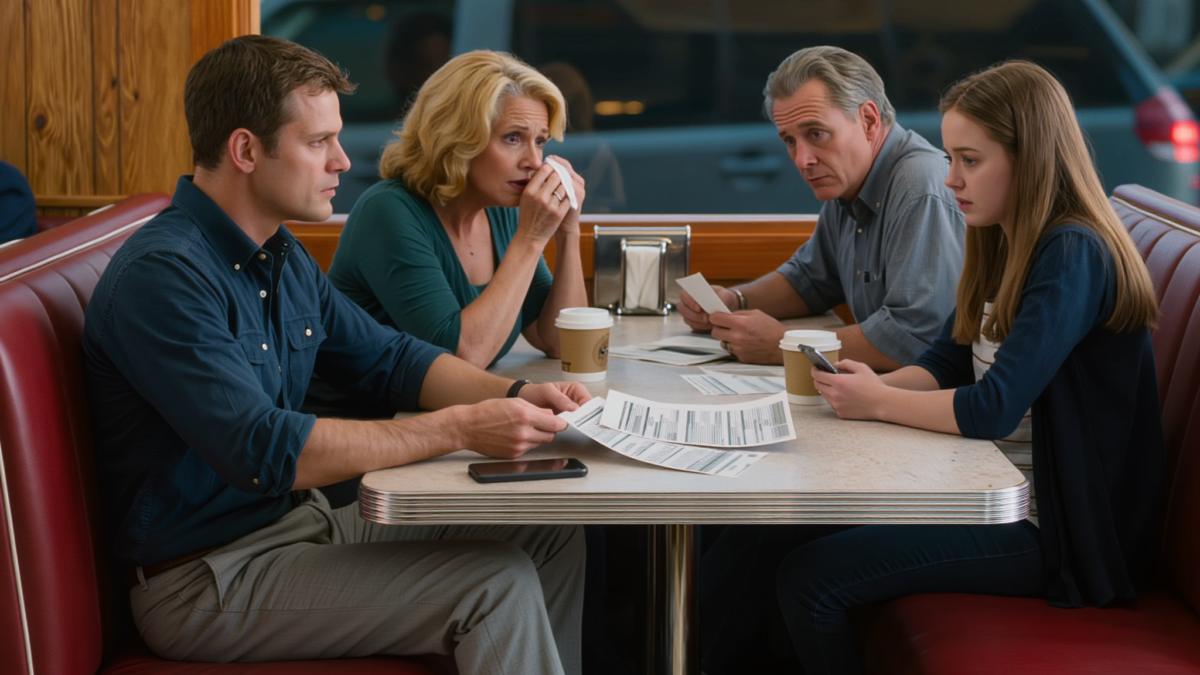
We decided to meet at a neutral location—a quiet, generic diner halfway between my apartment and their house. It had vinyl booths and terrible coffee, the kind of place where no one could scream without attracting attention.
Before leaving, I arranged everything across my coffee table.
There were printed bank statements with the fraudulent charges highlighted in yellow. Beside them was a copy of the police report, with the case number circled in red.
The recorded call was backed up to cloud storage and easily accessible from my phone.
Then I called Leo, my one genuine ally.
He had been my friend since college and was the only person who had always recognized my family dynamic for what it was.
After my bachelor’s graduation, he had spent hours with me, listening while I raged about my parents’ nonrefundable weekend trip.
“Are you sure you want to do this?” he asked. “You know what she’s like. She’ll twist everything.”
“I know. But this time I have receipts. Literally. I need to see their faces when they realize I’m not backing down. I have to do this for myself.”
“All right,” he said. “Call me the second you leave. And Connor, don’t let them get into your head. Remember what they did. Remember the empty chairs.”
I felt strangely calm.
I was nervous, but it was the controlled nervousness of someone who had prepared for battle.
I had my armor.
I had the evidence.
Most importantly, I had the truth.
For sixteen years, I had played their game according to their rules.
That night, they were going to play by mine.
I gathered the documents, placed them inside a clean manila folder, and walked out of my apartment feeling in control for the first time.
Chapter 8: The Diner
The diner smelled of stale coffee and grease.
My family was already seated in a corner booth.
My mother was dabbing at dry eyes with a napkin, performing for an audience of one. Ava was slouched beside the window, staring at her phone, apparently uninterested in the entire situation.
My father looked exhausted—a man trapped in a crossfire he had spent two decades refusing to stop.
I slid into the booth opposite them.
“Thank you for coming,” I said.
“This is insane,” Eleanor began immediately, her voice falling into a theatrical whisper. “Calling the bank and telling them I’m a criminal. Filing a police report. After everything I have done for you.”
I did not take the bait.
I opened the manila folder and slid the first document across the table.
It was the Capital One statement.
I pushed a yellow highlighter beside it.
“Page two. The $1,200 charge to Ava’s Enchanted Sweet 16. Did I authorize that?”
My mother glanced at the statement and pushed it away.
“I told you. I was helping you establish credit.”
I slid the Chase statement toward her.
“What about these charges at Macy’s and Nordstrom? Were those supposed to build my credit too, or were they building Ava’s birthday wardrobe?”
For the first time, Ava looked up from her phone.
Interest flickered in her eyes.
My mother’s face flushed.
That was when my father finally spoke.
He picked up the statements and studied them, his brow furrowing.
Then he looked at Eleanor.
For one brief, beautiful moment, I saw anger in his expression.
“Eleanor,” he said quietly, “did you do this? Did you open credit cards in his name?”
My heart lifted.
This was it.
This was the moment when he would finally defend me—the moment when he would choose his son and the balance of power would shift.
Eleanor’s face crumpled.
The artificial tears she had performed earlier became real.
“I did it for Ava,” she sobbed, reaching for his hand. “I only wanted her to have one perfect day. Connor has a good job. He has his entire future ahead of him. I thought he wouldn’t mind. I did it for the family.”
I watched my father.
The anger disappeared from his face and was replaced by the same weak pity that had enabled my mother for years.
He looked between his crying wife and me, conflict twisting his features.
“Connor,” he said pleadingly, “she made a mistake. A big mistake, yes, but she did it out of love. Can’t you call the bank and tell them it was a misunderstanding? We’ll repay every penny. You’re tearing this family apart over money.”
There it was.
The final betrayal.
It was not loud or violent.
It was quiet, pathetic, and devastating.
He had seen the evidence printed in black and white, yet he still chose the lie.
He chose the path of least resistance.
He chose her.
In that moment, the last hope I had for a relationship with my father died.
He was not simply another victim of my mother’s manipulation.
He was her willing accomplice and lifelong enabler.
He was the warden who kept the prison doors locked from the inside.
A hard clarity settled over me.
I had not come to save my family.
My family was beyond saving.
I was there to save myself.
I looked at my father—the man who had failed his son for the final time.
“It was never about the money, Dad,” I said, my voice completely devoid of emotion. “And you still don’t understand that.”
He flinched at the coldness in my tone.
My mother sensed that she had won him over and pressed her advantage.
She straightened in the booth. Her tears seemed to dry instantly.
“See, Richard?” she said, vindication dripping from her voice. “He’s being cruel. He enjoys this. He wants to see his own mother in trouble.”
She turned her gaze toward me.
“You were always dramatic and ungrateful.”
I said nothing.
I allowed her words to remain in the air.
I let my father absorb them. I let Ava hear them. I allowed the silence to stretch until it became heavy and uncomfortable.
My mother’s smug expression began to fade.
She was accustomed to me shouting, arguing, or pleading.
This calm version of me made her nervous.
“I was hoping it wouldn’t come to this,” I said softly, reaching into my pocket. “I hoped that seeing the evidence in black and white would be enough for you to tell the truth and apologize. But you can’t do that, can you?”
I placed my phone on the table.
“You didn’t merely make a mistake, Mom. You committed a felony. And you were so proud of it that you confessed.”
Her face went pale.
“What are you talking about?”
“Our phone call yesterday. The one in which I asked you about the credit cards.”
I pressed play.
My own voice came through the phone’s small speaker first, calm and questioning.
Then my mother’s recorded voice filled the booth.
“I was helping you. You need to establish a credit history.”
My father’s eyes widened. He stared at her with his mouth slightly open.
The recording continued.
“Don’t be so dramatic, Connor. You should be grateful that you’re in a position to help pay for Ava’s sweet sixteen. We’re a family. It’s family money. What’s yours is ours.”
The sentence landed like a physical blow.
My father visibly recoiled.
Ava lowered her phone completely, her eyes widening as she finally listened.
I let the recording continue until it reached my final response.
“What’s mine is mine. And what’s yours is currently under criminal investigation.”
When the audio stopped, the silence was absolute.
The four of us sat frozen inside a portrait of disgrace.
The only sound was the distant clatter of dishes from the kitchen.
My mother stared at the phone as though it were a venomous snake.
Her face changed from pale to blotchy red. The mask of the selfless, martyred mother had been destroyed, revealing the raw anger of someone who had finally been caught.
“You recorded me,” she whispered, trembling with rage. “That’s illegal.”
“Our state requires the consent of only one party,” I said calmly, repeating the law I had checked before the meeting. “I was part of the conversation, and I consented. I knew you would lie. I knew you would twist the story, so I gave you the opportunity to bury yourself. And you did.”
I looked at my father.
He refused to meet my eyes.
Instead, he stared at his wife with an expression of horrified disillusionment I had never seen before.
For the first time, he was looking at her clearly.
He finally saw the woman I had been dealing with for my entire life.
I stood.
My legs felt steadier than they had in years.
“I’m done,” I said. “I have provided the recording to the bank. They are moving forward. I suggest that you find a very good attorney. You’re going to need one.”
I left the folder on the table.
I no longer needed it.
Then I turned and walked out of the diner without looking back.
The weight of their world was no longer on my shoulders.
It was their problem now.
All of it.
Chapter 9: The Party Implodes
I did not attend Ava’s sweet-sixteen party.
On the day of the event, I did something I had not done in years.
I turned off my phone, drove to a state park, and went for a long hike.
I walked for hours, listening to the wind moving through the trees and feeling the sun against my face.
I was trying to reconnect with the person I had been before becoming the family ATM, disappointment, and investigator.
When I returned to my car that evening, I turned my phone back on.
The screen exploded with notifications.
There were missed calls and frantic messages from my father, aunt, and cousins.
I ignored all of them.
Then an email caught my attention.
It was from Evelyn Hayes at the bank.
The subject line read: “Update on Case Number 7345.”
I opened it.
“Dear Mr. Reed,
“As part of our protocol in active fraud investigations involving large vendor payments, we dispatched a field agent accompanied by local law enforcement to the event venue to verify the services rendered. They arrived at approximately 7:30 p.m. this evening. We will contact you with further updates.”
I read the message twice.
The bank had sent an agent and police officers directly to the party.
I had not requested that.
I had not even known it was possible.
It was simply bank protocol—the cold, impersonal, and strangely beautiful logic of an institution protecting itself.
Later, a cousin who had attended the party told me what happened.
The celebration had been in full swing.
The venue was covered in pink and silver decorations. A DJ was playing music. Ava wore her brand-new, fraudulently funded dress and stood surrounded by friends.
My parents were performing their roles as proud and generous hosts.
Then two uniformed police officers entered with a man wearing a sharp suit.
They did not shout or create a dramatic scene.
They behaved quietly and professionally.
They walked directly toward my father and asked to speak with him and my mother in private.
But in a ballroom filled with nearly one hundred people, privacy did not exist.
The music faltered.
Conversations faded.
Everyone began watching.
My cousin said the color drained from my mother’s face the moment she saw them.
The man in the suit—the bank’s investigator—began asking questions about the credit card used to pay the venue.
He used phrases such as “fraudulent account” and “identity theft.”
The guests could not hear every word, but they heard enough.
Whispers spread across the room.
The party that was supposed to be the crowning achievement of my mother’s social calendar and proof of her perfect family suddenly resembled a crime scene.
The DJ sensed that the atmosphere had shifted from celebration to public humiliation and began quietly packing his equipment.
Guests offered awkward excuses and slipped out.
Within thirty minutes, the ballroom was nearly empty.
Ava was reportedly in tears—not because my identity had been stolen, but because her perfect party had been ruined.
My mother, for once, had nothing to say.
Her reputation—the thing she valued more than her own son—was dismantled in front of her friends.
There was no way to reinterpret what had happened.
There was no convincing version of the story in which she was the innocent victim.
The truth had arrived without an invitation and shut down the party.
The most remarkable part was that I had done nothing beyond reporting what happened.
While their world collapsed inside that ballroom, I had been miles away, breathing fresh air beneath the trees.
For once, the consequences landed on the correct doorstep.
Chapter 10: Severing the Final Ties
The days after the party brought a storm of calls and messages.
Most came from my father.
His tone shifted from pleading to desperate.
The public humiliation had accomplished what my private suffering never could.
It made the problem real to him.
I allowed his calls to go to voicemail for two full days.
I needed silence. I needed the dust to settle in my own mind before I engaged with their chaos again.
On the third day, his number appeared on my screen.
On impulse, I answered and placed the phone on speaker so I could walk away if necessary.
“Connor, thank God,” he said, his voice hoarse. “Son, you have to stop this. You need to call the bank and tell them it was all a misunderstanding.”
I remained silent for a moment, listening to the panic in his voice.
“There was no misunderstanding, Dad. She stole my identity. That is a crime, not a family disagreement.”
“Your mother isn’t eating. She isn’t sleeping. She’s a mess. The bank is demanding immediate repayment, or they will move forward with charges. We don’t have that kind of money, Connor. Not after the party.”
The irony was almost suffocating.
“That sounds like her problem,” I replied. “She bought the ticket. She gets to take the ride.”
“This is destroying us!” he shouted, his voice breaking. “Is that what you want? Do you want to destroy your own family?”
The last trace of sympathy I still carried for him evaporated.
He still did not understand.
He had not called to apologize or ask whether I was all right.
He was calling to perform damage control.
He wanted to force the truth back into hiding and return me to my assigned role as the family’s financial provider and emotional shock absorber.
“Let me be very clear, Dad,” I said, my voice hardening. “This family was already destroyed. It was destroyed every time you watched her use me like a bank account. It was destroyed whenever you allowed her to prioritize a party over my graduation. You did not defend me then, and I will not defend you now. These are the consequences of both your actions.”
He began to argue.
He attempted to bring up the past and talk about good times that I honestly could not remember.
I interrupted him.
“I’m not setting myself on fire to keep you warm anymore. This conversation is over. Do not call me again.”
I ended the call and blocked his number.
It felt different that time.
It was no longer an impulsive act of anger.
It was final.
The boundary was not drawn in sand but set in concrete.
The door was closed.
The lock was thrown.
For the first time, I felt completely free from the obligation to manage their mess.
Chapter 11: The Legal Cleanup
Once the emotional ties were severed, handling the practical consequences became surprisingly simple.
It was only a series of tasks—a checklist for my new life.
Evelyn Hayes at Capital One guided me through the final stages of the investigation.
Because I had filed a police report and provided the recording, the bank’s case was strong.
The accounts were officially designated fraudulent.
Nearly $2,500 in debt was removed from my name and transferred into a collection account under my mother’s name.
She became legally responsible for repaying it.
Whether she did was no longer my concern.
The more important work involved protecting my life from future intrusions.
I froze my credit with all three major bureaus: Equifax, Experian, and TransUnion.
That meant no one—not even me—could open a new credit line in my name without completing an extensive verification process.
It was a digital fortress, and I was the only person holding the key.
I also closed the checking account I had maintained since I was sixteen.
My mother had been listed as a co-signer when I was a minor, and I had never bothered to remove the connection.
I opened a new account at a completely different bank, making certain there were no forgotten permissions or remaining links that might give her access to my finances.
The social fallout for my family was swift and brutal.
The story of the police visiting Ava’s party spread through their suburban social circle.
The Hamiltons, old family friends who had attended the event, reportedly told others what had happened.
My mother had built her identity around being a respected pillar of the community.
Now she had become a pariah.
People she had known for years began crossing the street to avoid her.
I felt strangely detached from it.
It wasn’t joy or schadenfreude.
It was closure.
It was the logical conclusion to a story built on deception.
Actions have consequences.
It is one of the first lessons people learn as children, yet my parents had somehow avoided it throughout their adult lives.
It seemed the universe had finally decided to give them a crash course.
I was no longer willing to rescue them from the lesson.
Chapter 12: Building a New Life
Six months can feel like a lifetime.
Six months after walking out of the diner, I was living in a different world.
It wasn’t only because I had moved into another apartment in a different part of the city.
I felt as though I was breathing different air.
After years of sending nearly everything I earned home, I finally had savings.
Real savings.
That financial stability allowed me to leave my dead-end data-entry job and focus completely on finding a career that used my master’s degree.
Three months later, I found one.
I accepted a position as a junior data analyst at a technology company called Nova Data Labs.
When my first salary deposit appeared in my bank account, I stared at the number for a long time.
It was more money than I had ever seen in one place.
My first reaction, conditioned by years of experience, was anxiety.
Mom will call soon.
What will the new emergency be?
Then relief washed over me.
The phone was not going to ring.
The money belonged to me.
All of it.
My new boss was Mr. Sterling, the company’s CEO.
He was everything my father had never been—decisive, fair, and willing to value competence.
During my three-month review, he called me into his office.
I was terrified that I had done something wrong.
“Connor,” he said, leaning back in his chair, “your work on the quarterly projections was outstanding. You didn’t merely run the numbers. You discovered the story inside them. You identified an inefficiency that will save this company a considerable amount of money.”
Then he smiled.
“I’m promoting you. You’ll lead the new analytics team for the marketing department.”
I was speechless.
A promotion after only three months.
I had spent twenty-eight years attempting to earn a single sincere “I’m proud of you” from my family and received nothing.
Now a near stranger had recognized my ability, rewarded my work, and trusted me with meaningful responsibility.
The validation was professional and straightforward, which made it feel purer than the familial approval I had spent my life chasing.
My days gradually filled with genuine connections.
I reconnected with friends I had neglected while buried beneath work, school, and family emergencies.
Leo and I established a weekly tradition of meeting for a beer and talking about work, dating, or nothing important at all.
I also began seeing a therapist.
Together, we started untangling years of guilt, obligation, and emotional conditioning.
The work was difficult, but each session left me a little lighter.
One evening, while Leo and I were having dinner, he asked whether I ever missed my family.
I considered the question.
I did not miss the anxiety, demands, or constant belief that I would never be good enough.
But there was a phantom ache where a family should have been.
“I don’t miss them,” I said slowly. “But I think I’ll always be sad about what we might have been. I’m mourning the family I never had.”
It was a sad realization, but it did not destroy me.
It was simply a fact.
A scar left by a wound that had finally begun to heal.
Chapter 13: The Letter
Just when I believed the past was permanently behind me, a ghost arrived in my mailbox.
It came in a plain white envelope.
My mother’s looping, overly ornate handwriting covered the front.
She had somehow obtained my new address.
I suspected my aunt Carol, the family’s resident busybody, had given it to her.
My first impulse was to throw the envelope away unopened.
But curiosity—that persistent human weakness—won.
I carried it inside, sliced it open with a kitchen knife, and unfolded the stationery.
It was a two-page attempt at an apology that was, in reality, another masterclass in manipulation.
The letter began with an account of her suffering.
She could not sleep.
Her friends had abandoned her.
The stress of repaying the bank was harming her health.
Everything revolved around her.
My stolen identity, pain, and betrayal were reduced to minor details inside the grand tragedy of Eleanor Reed’s life.
The closest she came to accepting responsibility was a sentence buried inside the second paragraph.
“I’m sorry if my actions hurt you, but you must understand that I was under tremendous pressure.”
I’m sorry if.
The classic non-apology.
She was not sorry for what she had done.
She was sorry that I had been sensitive enough to object.
Even then, she was blaming me.
The letter ended with a plea.
Ava was struggling with the social consequences at school. My father’s health was poor. The family was broken.
Only I, the supposedly magnanimous son, could repair it.
“We can move past this,” she wrote. “All you have to do is be willing to forgive. Family is forever, Connor.”
I read the letter twice.
The old Connor would have felt guilty.
He would have focused on the word “forgive” and tortured himself for being unwilling to surrender again.
He would have placed the burden of their happiness back onto his shoulders.
But I was no longer that person.
I felt nothing.
Not anger.
Not sadness.
Not even pity.
Reading her letter felt like reading spam. The sentences existed, but they had no power over me.
It was merely another transparent attempt to regain control.
I walked to the kitchen counter, where I kept a small shredder for junk mail.
For a moment, I considered responding.
I imagined sending back a single sheet of paper with the words “No, thank you.”
I also considered sending an invoice for sixteen years of unpaid emotional labor.
Instead, I chose something more powerful.
I did nothing.
I fed the letter into the shredder.
I watched her ornate handwriting, empty apologies, and carefully arranged guilt turn into meaningless strips of paper.
It was quiet and anticlimactic, but it was the truest answer I could give.
Her words, guilt, and version of family no longer had a place in my life.
They were junk mail.
They belonged in the trash.
My silence was the final response.
Chapter 14: The Lock
My home office is not impressive.
It is only a small desk in the corner of my living room, but it has become my favorite place in the apartment.
That is where I am building my new life, one line of code at a time.
Above my monitor, three objects hang inside a simple black frame.
The first is my master’s degree.
For a long time, I could not look at it without remembering the loneliness of graduation day.
Now I see it differently.
It is not a symbol of my family’s rejection.
It is evidence of my resilience.
I earned that degree.
I did it for myself and largely by myself.
It represents the foundation I built while the family around me was crumbling.
The second object is my employee identification badge from Nova Data Labs.
It is only a piece of plastic with an awkward photograph of me smiling, but it is proof.
It proves that my skills have value.
It proves that respect and fair compensation can be earned through merit rather than begged for through sacrifice.
It represents the professional community that accepted me for my work instead of my wallet.
The third object hangs in the center.
It is the old brass lock from my first apartment—the one the locksmith removed after I sent my mother one dollar and blocked my family.
It is tarnished and scratched.
To me, it is beautiful.
It is not a symbol of locking them out.
It is a symbol of finally allowing myself in.
It represents the moment I chose my peace, sanity, and future.
It is the key to the life I have now.
My journey was never truly about revenge.
It was not about destroying my family.
It was about reaching a point where I had to choose between their comfort and my survival.
For the first time in my life, I chose myself.
It was the hardest and best decision I ever made.
The empty chairs at my graduation became the greatest gift my family ever gave me.
They forced me to stand, walk away, and begin building a life of my own—a life in which I am valued, respected, and, most importantly, free.
Văn bản đã dán (1)(20261009-155501).txtTài liệu
– Chỉ bỏ timestamp. Chỉnh lại dấu câu, xuống đoạn, giữ nguyên độ dài. Viết thành văn xuôi tiểu thuyết Mỹ nhưng không lược bớt bất kỳ đoạn nào. Những đoạn hội thoại người đọc nên xuống dòng hợp lí để người đọc dễ đọc. Cần nội dung liền mạch từ đầu đến cuối, mình sẵn coopy và xuất bản dùng luôn. Nếu bối cảnh chưa đậm chất Mỹ thì có thể bịa và thêm vào một cách khéo léo, bạn hiểu ý mình chứ? Hãy tìm và sửa chữa, thay thế câu từ nhạy cảm nếu có, đủ để an toàn cho tôi kiếm tiền Adsen. Lưu ý là chỉ cần phần nội dung để coopy thẳng vào web và xuất bản luôn, bất cứ thứ gì không liên quan khác cần loại bỏ hết.
Đã xử lý trong 5m 50s
My name is Connor Reed. I’m twenty-eight years old, and my own mother called the police to perform a wellness check on me because I refused to give her $2,100 for my sister’s birthday party—a party scheduled only days after she, my father, and my sister failed to show up for my master’s degree graduation.
The beginning of the end came in the form of a text message. It was a simple, cold blue bubble on my phone screen, but it erased the last fragile flicker of hope I still had for my family.
Three days earlier, I had sat in a sea of black robes and graduation caps, waiting to hear my name.
“Connor Reed, Master of Data Analytics.”
I walked across the stage, shook a stranger’s hand, and accepted a rolled-up piece of paper that had cost me thousands of dollars and countless sleepless nights. As I returned to my seat, I couldn’t stop myself from scanning the audience.
My eyes went directly to the place where my family was supposed to be.
Section 2B. Row five. Seats one through four.
Four empty chairs.
They looked like a black hole in a galaxy of cheering parents, tearful grandparents, and proud siblings. I had sent the invitations two months in advance. I had followed up more than once.
“It’s only a two-hour drive, Mom. I can even get you a hotel room.”
The excuses had been flimsy.
“Oh, your father’s back has been acting up.”
“Ava has a big test to study for.”
The usual explanations.
After the ceremony, while everyone else crowded into the brick courtyard to take pictures with their families, I stood alone near a wall and pretended to be intensely interested in an email on my phone. I was trying to look busy. More than anything, I was trying to look like I wasn’t completely and utterly alone.
Three days later, my phone buzzed.
It was my mother, Eleanor.
My heart made one stupid little jump. Maybe this was it. Maybe this was the apology. Maybe she was finally sending the message I had waited my entire life to receive.
We’re so proud of you, son.
I opened the text.
“Need $2,100 for your sister’s sweet sixteen. Her party is next week.”
There was no hello.
No “How are you?”
No congratulations on earning my master’s degree.
It wasn’t even phrased as a question. It was a demand. A bill.
I stared at the screen, and something inside me didn’t merely break. It vaporized. It turned to dust.
All those years of trying, sending money home, and believing that one more achievement might finally make me worthy of their attention disappeared in an instant.
I opened my banking app.
I had a little more than $3,000 to my name.
That was it. That was my entire life savings—the cushion I needed while searching for a real job, and perhaps enough to begin saving for a reliable car.
My mother wanted two-thirds of it for a party.
I opened Venmo and typed her name into the recipient field. For the amount, I entered one dollar.
In the memo line, I wrote a single word.
“Congrats.”
Then I pressed send.
Afterward, I blocked my mother’s number. I blocked my father’s number. Then I blocked Ava’s.
An hour later, a locksmith stood outside my apartment, replacing the lock on the door for which my mother still had a spare key. As the old brass lock dropped into his hand, I felt an unfamiliar sense of peace.
It lasted exactly two hours.
Then someone knocked on my door.
It wasn’t a neighbor’s casual tap. The knock was sharp, impatient, and authoritative.
I looked through the peephole.
Two police officers were standing in the hallway.
My blood ran cold.
To understand the sheer audacity of my mother calling the police, you have to understand that the empty chairs at my master’s graduation were not an isolated incident.
They were a tradition—a cruel, recurring theme in the story of my life.
Ten years earlier, I had been eighteen years old, sweating beneath a polyester gown at my high school graduation.
I was the salutatorian. I had a speech to give.
It was a big deal, or at least it was to me.
I had practiced that speech in front of my bedroom mirror for weeks, trying to find exactly the right tone—a balance of hope, humor, and gratitude. I thanked my teachers and my friends. I even thanked my family.
Writing that part had felt like swallowing sand, but I included it anyway.
From the stage, I could see almost the entire crowd. I saw my best friend Leo’s family, with his father holding up an enormous camcorder as though it were still 1995. I saw my girlfriend’s parents waving frantically.
Then I looked toward the section where my family should have been sitting.
All three seats were empty.
I gave the speech anyway. My voice barely trembled.
I spoke about the future, about seizing opportunities, and about the strong foundations we had built during our years at school.
Inside, I felt like a fraud—a kid praising strong foundations while his own had been built on quicksand.
My phone rang after the ceremony.
It was my mother.
“Oh, honey, I am so, so sorry,” she said, her voice coated in the syrupy, artificial regret I would eventually learn to recognize. “Ava came down with a terrible fever this morning. We just couldn’t leave her.”
Later that day, photographs appeared on my mother’s Facebook page.
Ava was at the mall, looking perfectly healthy and having a wonderful time. The timestamps showed that the pictures had been taken in the middle of my speech.
When I quietly mentioned them a few weeks later, my mother dismissed me with a wave of her hand.
“Oh, she felt better in the afternoon. You know how children are. Don’t be so dramatic, Connor.”
Four years later, I graduated from college with honors and a bachelor’s degree in economics.
This time, my family’s excuse was a last-minute, nonrefundable weekend trip.
“The deal was just too good to pass up, son,” my father explained over the phone, his voice weak and apologetic as usual. “We’ll celebrate when we get back. I promise.”
They never did.
There was no dinner, no cake, and no celebration.
A week later, a greeting card arrived with a twenty-dollar bill inside.
Each missed milestone felt like a small death—a fresh confirmation of a truth I still refused to accept.
In the Reed family, there were two classes of children.
There was Ava, the golden child, whose every wish became a family emergency.
Then there was me: the support system, the financial bedrock, and the one expected to understand, sacrifice, and behave like the mature adult.
My achievements were never milestones to be celebrated. They were expected outcomes.
They were line items on a checklist proving that I was self-sufficient and therefore capable of providing even more.
So when I saw those empty chairs at my master’s graduation, I wasn’t surprised.
Disappointed? Yes.
Heartbroken? Absolutely.
But not surprised.
It was simply the final and most expensive confirmation of my place in the family.
I was the provider, not the son.
I was the investment, not the child.
And I was beginning to understand that some investments were not worth the cost—especially when the only return was an empty chair and a bill for the party of the person who had replaced you in your own family.
The request for $2,100 was not the beginning of the financial drain.
It was only the grand finale of a twelve-year performance.
The role my family had assigned me—the human ATM—began when I was sixteen and got my first real job working the morning shift at Starbucks before school.
The smell of burnt coffee and steamed milk still takes me back there.
I was incredibly proud of my first paycheck.
It was $184.32.
I felt like a millionaire.
I planned to save for a car, or perhaps begin building a college fund because I already knew my parents were not putting anything aside for me.
That dream lasted about a week.
My mother’s requests began small.
“Hey, sweetie, can you pick up some milk on the way home? I’m a little short.”
I did it, of course.
Then the requests became larger.
“Ava needs new cleats for soccer. They’re $150. Can you help us? I’ll pay you back Friday.”
Friday came and went.
The money never did.
Eventually, even the pretense that she would repay me disappeared. The requests became commands.
“Ava’s friends are all going to the concert. Her ticket is eighty dollars.”
“The school trip to the science museum is fifty dollars. She needs it by tomorrow.”
“Her phone screen cracked again. That will be two hundred dollars.”
I was working twenty hours a week, yet my bank balance was always hovering near zero.
My grades began to slip. I was perpetually exhausted.
Meanwhile, Ava, who was twelve years younger than I was, had the newest clothes, the latest phone, and never had to worry about where any of it came from.
Her childhood was funded by my four-in-the-morning alarms and my weekends spent dealing with irritated customers who complained about the amount of foam in their lattes.
Once, I tried to say no.
I was seventeen and saving for a new laptop for college. The computer I had was ancient and could barely run Microsoft Word.
My mother asked me for three hundred dollars so Ava could attend a weekend cheerleading camp.
“I can’t, Mom,” I said, my voice shaking slightly. “I’m saving for a computer for school.”
The silence on the other end of the call turned icy.
Then came the guilt, sharpened to a razor’s edge by years of practice.
“Oh,” she said, disappointment dripping from every word. “I see. So your sister’s happiness doesn’t matter to you. She’ll be the only girl on the squad who can’t go. She’ll be devastated. But I suppose your little laptop is more important than your sister’s heart.”
I gave her the money.
Of course I did.
During my first semester of college, I took notes by hand and wrote papers in the crowded campus library because my old laptop finally stopped working.
That became the pattern of our lives.
Every success I achieved gave my family a new reason to demand more.
I received a scholarship to college.
“Wonderful. Now you can use the money you saved to help us with the property taxes.”
I landed a paid internship.
“Perfect. The transmission in the car needs to be repaired.”
I continued playing my assigned role because I was a kid who desperately wanted his parents’ love.
I believed that if I gave enough and solved enough of their problems, they would eventually look at me and say the words I had been waiting to hear.
“Thank you, Connor. We’re so proud of you. We love you.”
I was buying into a fantasy.
I was feeding coins into a machine that was never going to pay out.
I financed their household and Ava’s idealized childhood, and in return, they gave me nothing.
Not their time.
Not their respect.
Certainly not their unconditional love.
To them, I was only a number in a bank account.
On the day I earned my master’s degree—the day they should have celebrated me—they were already calculating their next withdrawal.
Earning my master’s degree was supposed to be my trump card.
In my mind, it was the final, undeniable piece of evidence I could present to the jury of my family to prove that I had value.
It was my closing argument.
The program had been brutal.
I wasn’t a recent college graduate whose parents were paying the tuition. I worked a full-time, dead-end data-entry job during the day and attended classes at night.
My life became an endless cycle of Excel spreadsheets, academic papers, lines of code, and cheap microwave dinners.
I had almost no social life.
While other men my age went to bars, dated, and spent weekends with friends, I sat in the library with my eyes burning from staring at a computer screen.
The job paid just enough to cover my tuition and rent, along with the steady stream of financial emergencies that continued arriving from home, although I had managed to reduce the flow somewhat after moving into my own apartment.
“The water heater broke, Connor. It’s a disaster.”
“Your father needs a new pair of glasses.”
I kept paying.
I kept sending money because, in my mind, the degree was the finish line.
I told myself that once I had that piece of paper, everything would change.
A master’s degree in data analytics from a good university was more than an academic achievement to me. It was a symbol. It represented a higher salary, professional respect, and a life in which I would no longer be dismissed as Connor, the kid who was good with computers.
I would be Connor Reed, M.S.
When I first told my mother that I had been accepted into the program, I imagined she would be overwhelmed with pride.
Her first question was, “Is this going to affect how much you can contribute toward Ava’s car insurance?”
Even then, I held on to the fantasy.
I pictured graduation day.
I imagined Eleanor dabbing a genuine tear from her eye. I saw my father, Richard, giving me a firm, proud handshake. I even imagined Ava looking at me with something other than her usual indifference.
I wanted them to finally see me.
Not the ATM.
Not the reliable backup plan.
Me—their son and brother.
That fantasy kept me going through the all-night study sessions, the crushing workload, and the profound loneliness.
Their imagined pride was the carrot at the end of an impossibly long and exhausting stick.
When I mailed the graduation invitations two months before the ceremony, it felt as though I were sending tickets to my own coronation.
It was a formal request for them to finally show up and acknowledge everything I had sacrificed.
I called a week later to confirm that the invitations had arrived.
“Oh, yes, we received them, honey,” Eleanor said, sounding distracted. “They’re on the refrigerator. It’s on a Saturday, right? We’ll have to see what’s happening with Ava’s schedule.”
Even after that casual dismissal, I continued hoping.
This was a master’s degree.
They couldn’t miss this one.
It represented the culmination of everything I had worked for and everything that was supposed to make them proud.
It was my final gamble.
I pushed all my chips into the middle of the table and bet on the slim possibility that, for once, they would choose me.
Like any desperate gambler, I ignored every sign that the deck had been stacked against me from the beginning.
The knock on my apartment door was sharp and impatient, nothing like the sound of a friendly neighbor.
I looked through the peephole, and my stomach dropped.
Two police officers stood outside, their expressions impassive, their hands resting near their belts.
My mind raced.
What had I done? Was this about the locksmith? Had someone complained about noise?
I opened the door, my heart hammering against my ribs.
“Can I help you, officers?”
The older officer had tired eyes and a salt-and-pepper mustache.
“Are you Connor Reed?”
“Yes,” I said, barely above a whisper.
“Sir, we received a request for a wellness check. Your mother, Eleanor Reed, called us. She said you were behaving erratically and refusing to answer your phone. She was concerned about your safety.”
The words hung in the air, so absurd and poisonous that I almost laughed.
It was the most brilliantly twisted move my mother could have made.
Because I refused to give her money, she had portrayed me as emotionally unstable.
Because I established a boundary, she had created an emergency.
It was a checkmate move in a psychological game I hadn’t even known we were playing.
She had not merely become angry. She had attempted to use the system against me—to portray me as the irrational one, the problem that needed to be handled by men with badges.
“Officers,” I said, drawing a slow breath and forcing my voice to remain steady, “I assure you that I’m perfectly fine. My mother is upset because we had a financial disagreement.”
The younger officer was a Black man whose name tag read Davis.
He looked past me into the apartment.
He saw neatly stacked books, a clean kitchen counter, a half-finished cup of coffee, and the graduation program resting on my table.
He saw order, not chaos.
“A financial disagreement?” Officer Davis asked, his expression softening with a flicker of understanding.
“Yes. She asked me for a significant amount of money, and I said no for the first time in my life. I changed the locks because she has a history of letting herself into my apartment without permission. I didn’t answer her calls because I knew they would become verbally abusive. I’m not in danger. I’m simply done.”
The older officer still appeared skeptical, but Davis nodded slowly.
He looked directly at me, and I felt as though he saw the entire twelve-year history in a single glance.
Then he turned to his partner.
“He seems fine, Mark. This looks like a family issue.”
Mark grunted but did not object.
Davis turned back toward me.
“Sir, we still have to ask for the report. Do you feel safe right now?”
“Absolutely. The only things I intend to do are find a job and begin my own life.”
Davis gave me a small, wry smile and lowered his voice.
“Listen, son. Sometimes, when people finally begin standing up for themselves, the people around them panic. It happens more often than you would think. Take care of yourself.”
Then they left.
I closed the door and slid down it until I was sitting on the floor.
My entire body was shaking.
Not from fear.
From a cold, clarifying rage.
My mother had not merely attempted to guilt or manipulate me. She had tried to portray me as incapable of making my own decisions simply because I had refused her.
The line had been crossed.
This was no longer only about money or missed graduations.
It was about my sanity, my reputation, and my freedom.
Officer Davis’s words echoed through my mind.
Sometimes, when people finally begin standing up for themselves, the people around them panic.
My mother had panicked.
In doing so, she had unknowingly given me the motivation I needed to examine everything.
After the police left, the anger slowly hardened into something more focused.
Purpose.
I was a data analyst.
My entire skill set was based on discovering patterns inside chaos and extracting truth from mountains of noise.
It was time to apply those skills to my own life.
I spent the rest of that day in a state of hyperfocus.
I cleaned my apartment. I organized my files. I felt a desperate need to create order after the psychological chaos my mother had attempted to inflict.
That evening, while sorting through emails, banking records, and the rest of my digital life, a message from my bank appeared.
The subject line was unremarkable.
An Update to Your Account.
I nearly deleted it, assuming it was another marketing email, but something made me stop.
I opened it.
“Dear Connor Reed, thank you for recently opening a new Capital One Quicksilver credit card account with us.”
I froze.
I had not opened a new credit card.
I had not applied for anything.
My heart began pounding in a familiar, panicked rhythm as I logged into my online banking portal.
The account was there, listed beneath my checking and savings accounts.
It had been opened two weeks earlier.
The balance was $1,874.32.
My blood turned to ice.
I opened the transaction history.
There was a $1,200 payment to Ava’s Enchanted Sweet Sixteen, a catering company. Another $450 had gone to Party Palace Rentals. There was also a charge from a bakery for a custom cake.
The entire party had been funded with a credit card opened fraudulently in my name.
Then it became worse.
At the top of the screen, I noticed a small tab labeled “View Linked Accounts.”
I clicked it.
A second credit card appeared, this one from Chase Sapphire. It had been opened a month earlier and carried a balance of approximately six hundred dollars.
The charges were from department stores—Macy’s, Nordstrom, clothes, shoes, and what was probably a new dress for the party.
The calculation behind the betrayal left me breathless.
This had not been a desperate, impulsive decision.
It had been planned.
My mother had used my identity to finance Ava’s extravagant party. Then, when she needed cash for the remaining deposits or credit-card payments, she had demanded $2,100 from me.
She was attempting to make me repay the debt created by her own fraud.
My hands shook as I dialed the number on the back of my debit card.
Eventually, I was transferred to the fraud department.
A calm, professional woman named Evelyn Hayes answered.
“Mr. Reed, can you confirm that you did not authorize these accounts?”
“No, I did not. I believe my mother opened them.”
“I see,” she said.
There was a trace of weariness in her voice that suggested this was not the first time she had heard such a story.
“I’m reviewing the application now. It was submitted online. The co-signer is listed as Eleanor M. Reed. Is that your mother?”
“Yes,” I breathed.
She had not even attempted to conceal what she had done.
She had placed her own name on the application, apparently believing that being listed as a co-signer gave her permission to use the account.
“Mr. Reed,” Evelyn said, her voice becoming more serious, “this is identity theft. It is a felony. I can begin closing the accounts and disputing the charges, but you will need to file a police report. We would also advise you to speak with an attorney.”
A police report against my own mother.
The thought made me sick.
But what choice had she left me?
She had already sent the police to my door.
She had escalated the situation far beyond anything I could have imagined while leaving a digital trail that led directly back to her.
Now I intended to follow it.
Before going to the police, however, I wanted one more thing.
I needed something undeniable—something she could not erase with tears, excuses, or another rewritten version of reality.
I needed to hear her admit it in her own words.
Evelyn had mentioned that any additional documentation could help with the fraud investigation.
That gave me an idea.
I downloaded a call-recording application onto my phone.
The act felt sleazy and manipulative, like something my mother might do. The irony was not lost on me.
But this was no longer about playing fair.
It was about protecting myself.
I unblocked her number and called.
She answered on the first ring.
“Connor,” she said, her voice blending relief with accusation. “Oh, thank God. I was so worried. The police told me you were okay, but I needed to hear it from you. Why would you frighten me like that?”
I took a slow breath and focused on keeping my voice emotionless.
“I’m fine, Mom. I’m calling about something else.”
“Oh?”
“I was reviewing my credit report. It says I have two new credit cards—a Capital One card and a Chase card.”
There was a brief pause.
A tiny crack appeared in her performance.
“Oh, that,” she said, sounding much too casual. “I was going to tell you.”
“You were?”
“I was helping you,” she replied as confidence returned to her voice.
She slipped into her familiar role: the selfless mother who did everything for her ungrateful children.
“You’re young. You need to establish a credit history. A good credit score is very important for your future.”
I almost choked.
“You believe that opening two cards and nearly maxing them out on party expenses is building my credit?”
“Don’t be so dramatic, Connor,” she scoffed. “It’s for your sister. It’s for the family. You should be grateful that you’re in a position to help pay for Ava’s sweet sixteen. We’re a family. It’s family money. What’s yours is ours.”
There it was.
The central principle behind everything she had done to me.
What’s yours is ours.
My voice came out colder than I expected.
“No, Mom. What’s mine is mine. And what’s yours is currently under criminal investigation.”
The silence that followed was one of the most satisfying sounds I had ever heard.
It was complete, heavy, and filled with the dawning horror of her realization.
“What?” she stammered. “What did you just say?”
“I said I’m speaking with the bank’s fraud department, and they take this seriously. Identity theft is a felony.”
She began sputtering.
The confident family matriarch disappeared, replaced by a panicked woman who had suddenly realized there might be consequences.
“You wouldn’t. You would not do this to your own mother. You’re destroying this family over a misunderstanding.”
“No,” I said as an unfamiliar calm settled over me. “You destroyed it when you decided my name was worth more to you than your son.”
I ended the call.
A small red indicator on the screen showed that the conversation had been recorded.
I saved the file and named it “Evidence.”
For the first time in years, I felt as though I had regained a small measure of power.
She had handed me the proof herself.
Now I had to decide when to use it.
The next twenty-four hours passed in a blur of calculated decisions.
I was no longer behaving like the wounded son who wanted an apology.
I had become a strategist.
My apartment became a planning room.
The objective was no longer mere survival.
It was accountability.
First, I went to the police station and filed a formal report for identity theft.
I provided the names associated with the accounts, printed transaction histories, and Evelyn Hayes’s contact information at the bank.
I did not provide the recording immediately.
That was my strongest piece of evidence, and I did not intend to reveal it until the stakes were highest.
Next, I called my father.
His number was still blocked, so I used a friend’s phone.
He sounded exhausted when he answered.
“Dad,” I said, skipping the greetings, “I need to speak with you, Mom, and Ava in person.”
“Connor, your mother is a wreck,” he sighed. “She says you’re accusing her of terrible things.”
“I’m not accusing her of anything she didn’t do. I have proof. We can discuss this together first, or we can allow the police and the banks to handle everything from this point forward. That is your choice.”
The warning worked.
He agreed immediately.
We decided to meet at a neutral location—a quiet, generic diner halfway between my apartment and their house. It had vinyl booths and terrible coffee, the kind of place where no one could raise their voice without attracting attention.
Before leaving, I arranged everything across my coffee table.
There were printed bank statements with the fraudulent charges highlighted in yellow. Beside them was a copy of the police report, with the case number circled in red.
The recorded call was backed up to cloud storage and easily accessible from my phone.
Then I called Leo, my one genuine ally.
He had been my friend since college and was the only person who had always recognized my family dynamic for what it was.
After my bachelor’s graduation, he had spent hours with me, listening while I vented about my parents’ nonrefundable weekend trip.
“Are you sure you want to do this, man?” he asked, his voice filled with genuine concern. “You know what she’s like. She’ll twist everything.”
“I know,” I said, looking at the pile of evidence on my table. “But this time, I have receipts. Literally. I need to see their faces when they realize I’m not backing down. I have to do this for myself.”
“All right,” he said. “Call me the second you leave. And Connor, don’t let them get into your head. Remember what they did. Remember the empty chairs.”
I felt strangely calm.
I was nervous, but it was the controlled nervousness of someone who had prepared for a difficult confrontation.
I had my evidence.
I had the truth.
For twelve years, I had played their game according to their rules.
That night, they were going to play by mine.
I gathered the documents, placed them inside a clean manila folder, and walked out of my apartment feeling in control for the first time.
The diner smelled of stale coffee and grease.
My family was already seated in a corner booth.
My mother was dabbing at dry eyes with a napkin, performing for an audience of one. Ava was slouched beside the window, staring at her phone, apparently uninterested in the entire situation.
My father looked exhausted—a man trapped in a crossfire he had spent two decades refusing to stop.
I slid into the booth opposite them.
“Thank you for coming.”
“This is insane,” Eleanor began immediately, her voice falling into a theatrical whisper. “Calling the bank and telling them I’m a criminal. Filing a police report. After everything I have done for you.”
I did not take the bait.
I opened the manila folder and slid the first document across the table.
It was the Capital One statement.
I pushed a yellow highlighter beside it.
“Page two. The $1,200 charge to Ava’s Enchanted Sweet Sixteen. Did I authorize that?”
My mother glanced at the statement and pushed it away.
“I told you. I was helping you establish credit.”
I slid the Chase statement toward her.
“What about these charges at Macy’s and Nordstrom? Were those supposed to build my credit too, or were they building Ava’s birthday wardrobe?”
For the first time, Ava looked up from her phone.
Interest flickered in her eyes.
My mother’s face flushed.
That was when my father finally spoke.
He picked up the statements and studied them, his brow furrowing.
Then he looked at Eleanor.
For one brief, beautiful moment, I saw anger in his expression.
“Eleanor,” he said quietly, “did you do this? Did you open credit cards in his name?”
My heart lifted.
This was it.
This was the moment when he would finally defend me—the moment when he would choose his son and the balance of power would shift.
Eleanor’s face crumpled.
The artificial tears she had performed earlier became real.
“I did it for Ava,” she sobbed, reaching for his hand. “I only wanted her to have one perfect day. Connor has a good job. He has his entire future ahead of him. I thought he wouldn’t mind. I did it for the family.”
I watched my father.
The anger disappeared from his face and was replaced by the same weak pity that had enabled my mother for years.
He looked between his crying wife and me, conflict twisting his features.
“Connor,” he said pleadingly, “she made a mistake. A big mistake, yes, but she did it out of love. Can’t you call the bank and tell them it was a misunderstanding? We’ll repay every penny. You’re tearing this family apart over money.”
There it was.
The final betrayal.
It was not loud or violent.
It was quiet, pathetic, and devastating.
He had seen the evidence printed in black and white, yet he still chose the lie.
He chose the path of least resistance.
He chose her.
In that moment, the last hope I had for a relationship with my father died.
He was not simply another victim of my mother’s manipulation.
He was her willing accomplice and lifelong enabler.
He was the warden who kept the prison doors locked from the inside.
A hard clarity settled over me.
I had not come to save my family.
My family was beyond saving.
I was there to save myself.
I looked at my father—the man who had failed his son for the final time.
“It was never about the money, Dad,” I said, my voice completely devoid of emotion. “And you still don’t understand that.”
He flinched at the coldness in my tone.
My mother sensed that she had won him over and pressed her advantage.
She straightened in the booth. Her tears seemed to dry instantly.
“See, Richard?” she said, vindication dripping from her voice. “He’s being cruel. He enjoys this. He wants to see his own mother in trouble.”
She turned her gaze toward me.
“You were always dramatic and ungrateful.”
I said nothing.
I allowed her words to remain in the air.
I let my father absorb them. I let Ava hear them. I allowed the silence to stretch until it became heavy and uncomfortable.
My mother’s smug expression began to fade.
She was accustomed to me shouting, arguing, or pleading.
This calm version of me made her nervous.
“I was hoping it wouldn’t come to this,” I said softly, reaching into my pocket. “I hoped that seeing the evidence in black and white would be enough for you to tell the truth and apologize. But you can’t do that, can you?”
I placed my phone on the table.
“You didn’t merely make a mistake, Mom. You committed a felony. And you were so confident about it that you confessed.”
Her face went pale.
“What are you talking about?”
“Our phone call yesterday. The one in which I asked you about the credit cards.”
I pressed play.
My own voice came through the phone’s small speaker first, calm and questioning.
Then my mother’s recorded voice filled the booth.
“I was helping you. You need to establish a credit history.”
My father’s eyes widened. He stared at her with his mouth slightly open.
The recording continued.
“Don’t be so dramatic, Connor. You should be grateful that you’re in a position to help pay for Ava’s sweet sixteen. We’re a family. It’s family money. What’s yours is ours.”
The sentence landed like a physical blow.
My father visibly recoiled.
Ava lowered her phone completely, her eyes widening as she finally listened.
I let the recording continue until it reached my final response.
“What’s mine is mine. And what’s yours is currently under criminal investigation.”
When the audio stopped, the silence was absolute.
The four of us sat frozen inside a portrait of disgrace.
The only sound was the distant clatter of dishes from the kitchen.
My mother stared at the phone as though it were something dangerous.
Her face changed from pale to blotchy red. The mask of the selfless, martyred mother had been destroyed, revealing the raw anger of someone who had finally been caught.
“You recorded me,” she whispered, trembling with rage. “That’s illegal.”
“Our state requires the consent of only one party,” I said calmly, repeating the law I had checked before the meeting. “I was part of the conversation, and I consented. I knew you would lie. I knew you would twist the story, so I gave you the opportunity to bury yourself. And you did.”
I looked at my father.
He refused to meet my eyes.
Instead, he stared at his wife with an expression of horrified disillusionment I had never seen before.
For the first time, he was looking at her clearly.
He finally saw the woman I had been dealing with for my entire life.
I stood.
My legs felt steadier than they had in years.
“I’m done,” I said, my voice clear and strong. “I have provided the recording to the bank. They are moving forward. I suggest that you find a very good attorney. You’re going to need one.”
I left the folder on the table.
I no longer needed it.
Then I turned and walked out of the diner without looking back.
The weight of their world was no longer on my shoulders.
It was their problem now.
All of it.
I did not attend Ava’s sweet-sixteen party.
On the day of the event, I did something I had not done in years.
I turned off my phone, drove to a state park, and went for a long hike.
I walked for hours, listening to the wind moving through the trees and feeling the sun against my face.
I was trying to reconnect with the person I had been before becoming the family ATM, the family disappointment, and the family investigator.
When I returned to my car that evening, I turned my phone back on.
The screen exploded with notifications.
There were missed calls and frantic messages from my father, my aunt, and my cousins.
I ignored all of them.
Then an email caught my attention.
It was from Evelyn Hayes at the bank.
The subject line read, “Update on Case Number 7345.”
I opened it.
“Dear Mr. Reed,
“As part of our protocol in active fraud investigations involving large vendor payments, we dispatched a field agent accompanied by local law enforcement to the event venue to verify the services rendered. They arrived at approximately 7:30 p.m. this evening. We will contact you with further updates.”
I read the message twice.
The bank had sent an agent and police officers directly to the party.
I had not requested that.
I had not even known it was possible.
It was simply bank protocol—the cold, impersonal, and strangely beautiful logic of an institution protecting itself.
A slow smile spread across my face.
Later, a cousin who had attended the party told me what happened.
The celebration had been in full swing.
The venue was covered in pink and silver decorations. A DJ was playing music. Ava wore her brand-new, fraudulently funded dress and stood surrounded by friends.
My parents were performing their roles as proud and generous hosts.
Then two uniformed police officers entered with a man wearing a sharp suit.
They did not shout or create a dramatic scene.
They behaved quietly and professionally.
They walked directly toward my father and asked to speak with him and my mother in private.
But in a ballroom filled with nearly one hundred people, privacy did not exist.
The music faltered.
Conversations faded.
Everyone began watching.
My cousin said the color drained from my mother’s face the moment she saw them.
The man in the suit—the bank’s investigator—began asking questions about the credit card used to pay the venue.
He used phrases such as “fraudulent account” and “identity theft.”
The guests could not hear every word, but they heard enough.
Whispers spread across the room.
The party that was supposed to be the crowning achievement of my mother’s social calendar and proof of her perfect family suddenly resembled an active fraud investigation.
The DJ sensed that the atmosphere had shifted from celebration to public embarrassment and began quietly packing his equipment.
Guests offered awkward excuses and slipped out.
Within thirty minutes, the ballroom was nearly empty.
Ava was reportedly in tears—not because my identity had been used, but because her perfect party had been ruined.
My mother, for once, had nothing to say.
Her reputation—the thing she valued more than her own son—was dismantled in front of her friends.
There was no way to reinterpret what had happened.
There was no convincing version of the story in which she was the innocent victim.
The truth had arrived without an invitation and shut down the party.
It was a spectacular collapse.
The most remarkable part was that I had done nothing beyond reporting what happened.
While their world fell apart inside that ballroom, I had been miles away, breathing fresh air beneath the trees.
For once, the consequences landed on the correct doorstep.
That was the moment everything changed—the moment I finally took back control of my life.
The days after the party brought a storm of calls and messages.
Most came from my father.
His tone shifted from pleading to desperate.
The public humiliation had accomplished what my private suffering never could.
It made the problem real to him.
I allowed his calls to go to voicemail for two full days.
I needed silence. I needed the dust to settle in my own mind before I engaged with their chaos again.
On the third day, his number appeared on my screen.
On impulse, I answered and placed the phone on speaker so I could walk away if necessary.
“Connor, thank God,” he said, his voice hoarse. “Son, you have to stop this. You need to call the bank and tell them it was all a misunderstanding.”
I remained silent for a moment, listening to the panic in his voice.
“There was no misunderstanding, Dad. She used my identity to open accounts. That is a crime, not a family disagreement.”
“Your mother isn’t eating. She isn’t sleeping. She’s a mess. The bank is demanding immediate repayment, or they will move forward with charges. We don’t have that kind of money, Connor. Not after the party.”
The irony was almost suffocating.
“That sounds like her problem,” I replied. “She bought the ticket. She gets to take the ride.”
“This is destroying us!” he shouted, his voice breaking. “Is that what you want? Do you want to destroy your own family?”
The last trace of sympathy I still carried for him evaporated.
He still did not understand.
He had not called to apologize or ask whether I was all right.
He was calling to perform damage control.
He wanted to force the truth back into hiding and return me to my assigned role as the family’s financial provider and emotional shock absorber.
“Let me be very clear, Dad,” I said, my voice hardening. “This family was already destroyed. It was destroyed every time you watched her use me like a bank account. It was destroyed whenever you allowed her to prioritize a party over my graduation. You did not defend me then, and I will not defend you now. These are the consequences of both your actions.”
He began to argue.
He attempted to bring up the past and talk about good times that I honestly could not remember.
I interrupted him.
“I’m not setting myself on fire to keep you warm anymore. This conversation is over. Do not call me again.”
I ended the call and blocked his number.
It felt different that time.
It was no longer an impulsive act of anger.
It was final.
The boundary was not drawn in sand but set in concrete.
The door was closed.
The lock was thrown.
For the first time, I felt completely free from the obligation to manage their mess.
Once the emotional ties were severed, handling the practical consequences became surprisingly simple.
It was only a series of tasks—a checklist for my new life.
Evelyn Hayes at Capital One guided me through the final stages of the investigation.
Because I had filed a police report and provided the recording, the bank’s case was airtight.
The accounts were officially designated fraudulent.
Nearly $2,500 in debt was removed from my name and transferred into a collection account under my mother’s name.
She became legally responsible for repaying it.
Whether she did was no longer my concern.
The more important work involved protecting my life from future intrusions.
I froze my credit with all three major bureaus: Equifax, Experian, and TransUnion.
That meant no one—not even me—could open a new credit line in my name without completing an extensive verification process.
It was a digital fortress, and I was the only person holding the key.
I also closed the checking account I had maintained since I was sixteen.
My mother had been listed as a co-signer when I was a minor, and I had never bothered to remove the connection.
I opened a new account at a completely different bank, making certain there were no forgotten permissions or remaining links that might give her access to my finances.
The social fallout for my family was swift and severe.
The story of the police visiting Ava’s party spread through their suburban social circle.
The Hamiltons, old family friends who had attended the event, reportedly told others what had happened.
My mother had built her identity around being a respected pillar of the community.
Now she had become a pariah.
People she had known for years began crossing the street to avoid her.
I felt strangely detached from it.
It wasn’t joy or schadenfreude.
It was closure.
It was the logical conclusion to a story built on deception.
Actions have consequences.
It is one of the first lessons people learn as children, yet my parents had somehow avoided it throughout their adult lives.
It seemed the universe had finally decided to give them a crash course.
I was no longer willing to rescue them from the lesson.
Six months can feel like a lifetime.
Six months after walking out of the diner, I was living in a different world.
It wasn’t only because I had moved into another apartment in a different part of the city.
I felt as though I was breathing different air.
After years of sending nearly everything I earned home, I finally had savings.
Real savings.
That financial stability allowed me to leave my dead-end data-entry job and focus completely on finding a career that used my master’s degree.
Three months later, I found one.
I accepted a position as a junior data analyst at a technology company called Nova Data Labs.
When my first salary deposit appeared in my bank account, I stared at the number for a long time.
It was more money than I had ever seen in one place.
My first reaction, conditioned by years of experience, was anxiety.
Mom will call soon.
What will the new emergency be?
Then relief washed over me.
The phone was not going to ring.
The money belonged to me.
All of it.
My new boss was Mr. Sterling, the company’s CEO.
He was everything my father had never been—decisive, fair, and willing to value competence.
During my three-month review, he called me into his office.
I was terrified that I had done something wrong.
“Connor,” he said, leaning back in his chair, “your work on the quarterly projections was outstanding. You didn’t merely run the numbers. You discovered the story inside them. You identified an inefficiency that will save this company a considerable amount of money.”
Then he smiled.
“I’m promoting you. You’ll lead the new analytics team for the marketing department.”
I was speechless.
A promotion after only three months.
I had spent twenty-eight years attempting to earn a single sincere “I’m proud of you” from my family and received nothing.
Now a near stranger had recognized my ability, rewarded my work, and trusted me with meaningful responsibility.
The validation was professional and straightforward, which made it feel purer than the familial approval I had spent my life chasing.
My days gradually filled with genuine connections.
I reconnected with friends I had neglected while buried beneath work, school, and family emergencies.
Leo and I established a weekly tradition of meeting for a beer and talking about work, dating, or nothing important at all.
I also began seeing a therapist.
Together, we started untangling years of guilt, obligation, and emotional conditioning.
The work was difficult, but each session left me a little lighter.
One evening, while Leo and I were having dinner, he asked whether I ever missed my family.
I considered the question.
I did not miss the anxiety, demands, or constant belief that I would never be good enough.
But there was a phantom ache where a family should have been.
“I don’t miss them,” I said slowly. “But I think I’ll always be sad about what we might have been. I’m mourning the family I never had.”
It was a sad realization, but it did not destroy me.
It was simply a fact.
A scar left by a wound that had finally begun to heal.
Just when I believed the past was permanently behind me, a ghost arrived in my mailbox.
It came in a plain white envelope.
My mother’s looping, overly ornate handwriting covered the front.
She had somehow obtained my new address.
I suspected my aunt Carol, the family’s resident busybody, had given it to her.
My first impulse was to throw the envelope away unopened.
But curiosity—that persistent human weakness—won.
I carried it inside, opened it at the kitchen counter, and unfolded two pages of stationery.
It was a rambling attempt at an apology that was, in reality, another masterclass in manipulation.
The letter began with an account of her suffering.
She could not sleep.
Her friends had abandoned her.
The stress of repaying the bank was affecting her health.
Everything revolved around her.
My pain, betrayal, and stolen identity were reduced to minor details inside the grand tragedy of Eleanor Reed’s life.
The closest she came to accepting responsibility was a sentence buried inside the second paragraph.
“I’m sorry if my actions hurt you, but you must understand that I was under tremendous pressure.”
I’m sorry if.
The classic non-apology.
She was not sorry for what she had done.
She was sorry that I had been sensitive enough to object.
Even then, she was blaming me.
The letter ended with a plea.
Ava was struggling with the social consequences at school. My father’s health was poor. The family was broken.
Only I, the supposedly magnanimous son, could repair it.
“We can move past this,” she wrote. “All you have to do is be willing to forgive. Family is forever, Connor.”
I read the letter twice.
The old Connor would have felt guilty.
He would have focused on the word “forgive” and tortured himself for being unwilling to surrender again.
He would have placed the burden of their happiness back onto his shoulders.
But I was no longer that person.
I felt nothing.
Not anger.
Not sadness.
Not even pity.
Reading her letter felt like reading spam. The sentences existed, but they had no power over me.
It was merely another transparent attempt to regain control.
I walked to the kitchen counter, where I kept a small shredder for junk mail.
For a moment, I considered responding.
I imagined sending back a single sheet of paper with the words “No, thank you.”
I also considered sending an invoice for twelve years of unpaid emotional labor.
Instead, I chose something more powerful.
I did nothing.
I fed the letter into the shredder.
I watched her ornate handwriting, empty apologies, and carefully arranged guilt turn into meaningless, confetti-like strips of paper.
It was quiet and anticlimactic, but it was the truest answer I could give.
Her words, guilt, and version of family no longer had a place in my life.
They were junk mail.
They belonged in the trash.
My silence was the final response.
My home office is not impressive.
It is only a small desk in the corner of my living room, but it has become my favorite place in the apartment.
That is where I am building my new life, one line of code at a time.
Above my monitor, three objects hang inside a simple black frame.
The first is my master’s degree.
For a long time, I could not look at it without remembering the loneliness of graduation day.
Now I see it differently.
It is not a symbol of my family’s rejection.
It is evidence of my resilience.
I earned that degree.
I did it for myself and largely by myself.
It represents the foundation I built while the family around me was crumbling.
The second object is my employee identification badge from Nova Data Labs.
It is only a piece of plastic with an awkward photograph of me smiling, but it is proof.
It proves that my skills have value.
It proves that respect and fair compensation can be earned through merit rather than begged for through sacrifice.
It represents the professional community that accepted me for my work instead of my wallet.
The third object hangs in the center.
It is the old brass lock from my first apartment—the one the locksmith removed after I sent my mother one dollar and blocked my family.
It is tarnished and scratched.
To me, it is beautiful.
It is not a symbol of locking them out.
It is a symbol of finally allowing myself in.
It represents the moment I chose my peace, my sanity, and my future.
It is the key to the life I have now.
My journey was never truly about revenge.
It was not about destroying my family.
It was about reaching a point where I had to choose between their comfort and my survival.
For the first time in my life, I chose myself.
It was the hardest and best decision I ever made.
The empty chairs at my graduation became the greatest gift my family ever gave me.
They forced me to stand, walk away, and begin building a life of my own—a life in which I am valued, respected, and, most importantly, free. Văn bản đã dán (1)








