“You need to move out,” my mom said at Christmas dinner. I replied, “But I pay for everything.” The next morning, I left and never looked back.
I’m Christopher Miller. I’m 30 years old, and my own mother kicked me out of the house on Christmas Day, moments after I served her a turkey I had paid for in a home whose mortgage I was also paying.
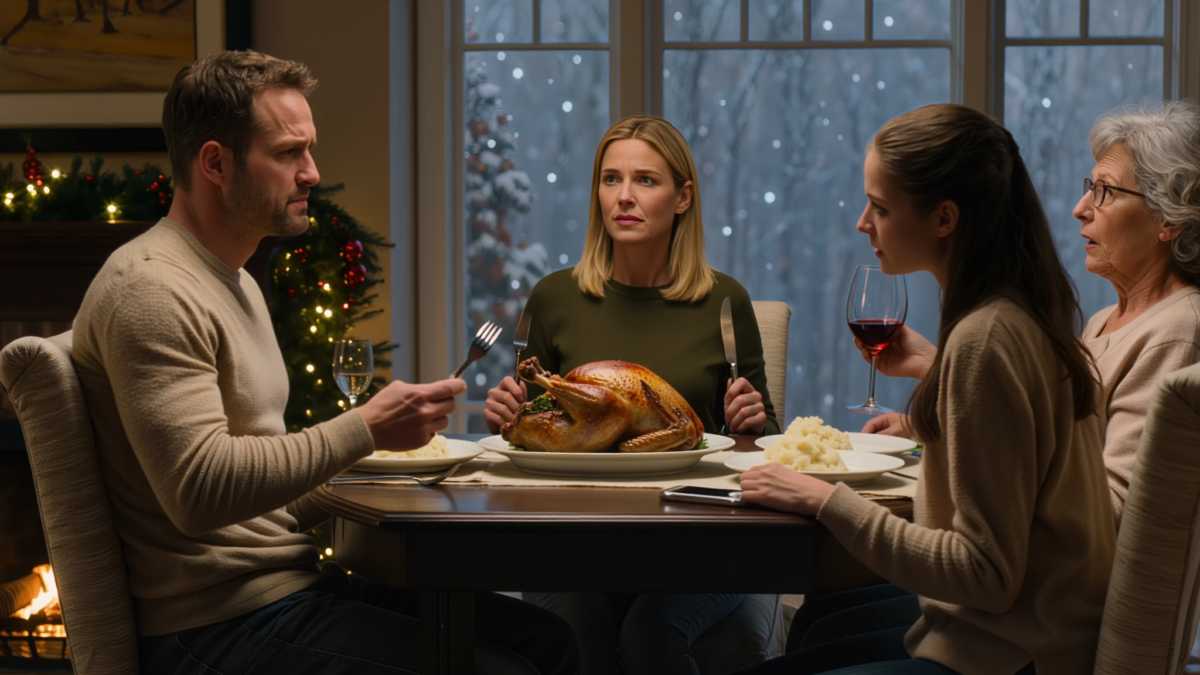
Snow was falling outside the dining-room window in big, gentle flakes that seemed to muffle the sounds of the world. It looked like a postcard. Inside, the house smelled of roasted turkey, cinnamon, and pine from the Christmas tree in the living room.
Everything was perfect—or at least I had engineered it to look that way. I wanted us to feel like a normal, happy family for one day.
I set the platter of golden-brown turkey on the table. My mother, Janet, was seated at the head. My younger sister, Laura, was scrolling through her phone, and my aunt Carol was nursing a glass of wine.
“Looks wonderful, Chris,” Aunt Carol said, offering a weak smile.
I nodded, feeling a small flicker of pride.
“Thanks. I hope everyone’s hungry.”
I sat down, picked up my fork, and was about to take my first bite when my mother cleared her throat. She didn’t look at me. She stared at a spot on the wall just over my shoulder.
“Christopher,” she began, her voice calm, almost casual. “I think it’s time you found your own place. You need to move out.”
The fork in my hand stopped halfway to my mouth.
The clinking of silverware around the table ceased. The only sound was the soft crackle of the fire in the hearth.
I slowly lowered my fork, making sure the movement was deliberate and controlled. I wouldn’t give her the satisfaction of an emotional reaction.
“Really?” I asked, keeping the chaos in my chest out of my voice. “Why is that?”
She finally met my gaze, her expression unreadable.
“It’s just time. You’re 30 years old. Laura needs her space. I need my space.”
I took a slow breath.
“I see. Well, just to be clear, I pay the mortgage. I pay the electricity, the gas, the internet, and the family phone plan. I also buy the groceries, including this entire meal.”
My voice was steady, like a reporter stating facts.
My mother’s jaw tightened, but she didn’t respond. She picked up her knife and fork and cut a piece of turkey as though I had commented on the weather.
Aunt Carol froze, her wineglass hovering near her lips, her eyes wide.
Laura, the golden child, refused to look up from her plate. She suddenly found her mashed potatoes incredibly fascinating.
Her silence was louder than my mother’s words. It was an endorsement.
I looked around at the scene I had so carefully constructed—the warm lights, the festive decorations, and the abundant food. It all felt like a sham, a stage built for a play in which I hadn’t realized I was the villain.
I stood slowly. My chair made a quiet scraping sound against the hardwood floor.
“Excuse me.”
No one replied.
That was the final straw, but to understand why the cup was already filled to the brim, I have to go back one year—to the phone call that changed everything.
A year before that Christmas dinner, my life was my own.
I had a good apartment on the 12th floor of a downtown building. It wasn’t fancy, but the floor-to-ceiling windows gave me a sprawling view of the city skyline that made me feel as though I were on top of the world.
My routine was simple. I woke up, used the gym in the building, bought coffee from the shop downstairs, and walked to work. I had my friends, my space, and my peace. It was a life I had built for myself, brick by brick, with every long hour I put in at the office.
I was a software engineer, and I was good at my job. For the first time in my life, I felt truly independent.
My father had passed away five years earlier. His death left a void nothing could fill. He had been my rock and my moral compass.
The house where Laura and I grew up wasn’t just a building. It was a monument to his hard work. I remembered him standing on ladders during the summer, painting the trim, or kneeling in the garden to plant the rosebushes my mother loved.
“This house is our foundation, Chris,” he once told me, wiping sweat from his brow. “It’s more than wood and nails. It’s where we’re safe. Always protect it.”
Those words had been etched into my soul.
After he died, my mother assured me that she had everything under control. I offered to help with the bills, but she waved me off.
“Don’t be silly, honey. I have your father’s life insurance. I’ll be fine. You go build your own life.”
So I did, believing her.
Then, on a gray Tuesday afternoon, my phone buzzed and the word Mom appeared on the screen.
I answered with a smile.
“Hey, Mom. What’s up?”
Her voice came back as a choked, desperate whisper.
“Chris. Oh, Chris.”
My smile disappeared. My heart leaped into my throat.
“Mom, what’s wrong? Are you okay?”
“The house,” she sobbed. “The bank sent another letter. The final one. They’re going to take the house.”
The world seemed to tilt on its axis.
“What are you talking about? I thought you were making the mortgage payments. You said you were fine.”
“I tried,” she wailed, her voice rising into a full cry. “I really did, but my part-time job cut my hours, and the insurance money ran out so fast. I didn’t want to worry you. I was ashamed.”
Foreclosure.
The word felt like a punch to the stomach. All I could see was my father’s face and the proud smile he wore while standing on his freshly mowed lawn.
Always protect it.
His words echoed in my mind like a solemn command. Losing that house felt like failing him in the most fundamental way.
“How much do you need, Mom? How far behind are you?”
My mind had already become a frantic calculator, numbers and budgets spinning through it.
“They said I’m three months behind,” she said with a sniffle. “It’s thousands of dollars, Chris. I don’t have it. I have nothing left.”
There was no decision to make. It felt like instinct, duty, and my father’s final command.
“Don’t worry, Mom,” I said, forcing confidence into my voice. “I’ll handle it. We’re not losing the house.”
The relief in her voice was palpable.
“Oh, Chris. Thank you. Thank you.”
That weekend, I packed my life into cardboard boxes. I paid a $2,000 penalty to break my lease.
As the movers carried the last box out of my apartment, I stood at the window and took one final look at the skyline that had been the backdrop to my freedom.
I told myself the move was temporary. It was a noble sacrifice.
When I arrived at my childhood home, my mother threw her arms around me and hugged me with desperate strength.
“Oh, Chris,” she whispered into my shoulder, her voice thick with emotion. “You’re saving me. You’re my hero.”
I hugged her back, smelling the familiar scent of her perfume, and felt a swell of pride. I was doing the right thing. I was being a good son. I was honoring my father.
I had no idea that I wasn’t merely saving the house.
I was signing away my life.
The first month was a whirlwind of financial damage control. I wrote a check to the bank that made my hand shake, catching up on the three missed mortgage payments. Then I arranged an automatic transfer for the $1,200 monthly payment.
That alone was more than the rent on my old apartment.
Then came the utilities: $1,150 for electricity and gas. The internet cost $80. The family phone plan, which my mother had placed in my name years earlier and conveniently forgotten about, was another $120.
Then there were the groceries.
My mother, it turned out, had developed a taste for organic everything. The weekly shopping bill was never less than $200.
I remember standing in the grocery store one evening after an exhausting ten-hour workday. I had a ribeye steak in my hand, a small treat for myself, when I looked at the shopping list my mother had texted me.
Organic kale. Gluten-free bread. Imported olive oil.
I did the math in my head, put the steak back, and bought the kale.
More than half my salary disappeared before I could even consider my own needs. My student-loan payments felt like a lead weight. My car insurance, my own phone bill, and my desire to put anything into savings became distant dreams.
My best friend, Mark, saw the disaster coming long before I did.
We met for a beer one evening, the first time I had seen him in a month.
“You look like hell, man,” he said bluntly before taking a sip.
I shrugged, too tired to argue.
“It’s been a lot.”
“I’m serious.” He leaned forward. “How’s it really going over there?”
“It’s fine,” I answered too quickly. “I’m getting things under control. It’s temporary.”
Mark gave me a look that said he didn’t believe a word of it.
“Chris, we’ve been friends since freshman year. I know your mom. Remember when your dad was sick and she bought a brand-new SUV because she deserved something nice to help her through the stress? Remember when Laura wanted to go on that school trip to Europe, and your mom convinced you to cash out the savings bonds your grandparents gave you? She promised to pay you back.”
I winced. He was right. I had forgotten about that—or rather, I had chosen to forget.
She had never paid me back.
“This is different,” I insisted, although my voice lacked conviction. “This is the house. Dad’s house. I can’t let her lose it.”
“And she knows that,” Mark said. “That’s the button she’s pushing. It’s the biggest, shiniest button she has, and she’s leaning on it with all her weight.”
He lowered his voice.
“I’m only telling you to be careful. Don’t set yourself on fire to keep them warm. They’ll watch you burn and complain that the light is flickering.”
His words stayed with me like a splinter in my mind, but I pushed them away.
He didn’t understand. This was my family. This was my duty.
The burden was invisible to my mother and sister. They saw the lights stay on, the refrigerator remain full, and the Wi-Fi work without interruption.
They didn’t see the credit-card debt accumulating as I covered the gaps. They didn’t see me eating ramen at my desk to save money. They didn’t see the invitations from friends that I constantly declined.
“Sorry, guys. I can’t make it this weekend. I’m swamped.”
It was a lie. I wasn’t swamped.
I was broke.
The isolation was the worst part. I lived in a house with two other people, yet I felt completely alone. I was a ghost in my own life, silently financing a world in which I no longer felt included.
The gratitude from my first day back disappeared. In its place grew a quiet, heavy, soul-crushing expectation.
The transition from grateful recipient to entitled queen was so gradual that I barely noticed it happening. My mother’s talk about finding a job vanished after the first month. It was replaced by a list of excuses.
“I looked online today, Chris,” she would announce with a theatrical sigh. “There’s nothing for a woman my age with my skill set.”
As far as I could tell, her skill set involved watching daytime television and managing her book club’s social calendar.
Once she began treating my support as permanent, the demands followed. They started small and were usually disguised as suggestions.
“You know, Chris, I saw an advertisement for this wonderful face cream. It’s supposed to take ten years off your skin. We should get some.”
We was a pronoun she often used when she meant you.
The biggest shift came in her social life. With the threat of foreclosure removed, she was eager to reclaim her status among her friends.
That culminated in her announcement that she was hosting her book club.
“It’ll be lovely,” she said, beaming. “Just a few ladies over for wine and cheese. A little normalcy.”
I came home from work that Friday to find the house full of her friends. Music played while wine flowed. My mother was holding court in the living room.
When I entered, exhausted and disheveled, she gestured toward me.
“Oh, everyone, this is my wonderful son, Christopher. He’s been such a help around the house.”
I felt like hired help.
I gave them a tight smile, muttered a greeting, and escaped to my room.
An hour later, my mother knocked.
“Chris, honey, could you be a dear and run to the store? We’re out of Chardonnay.”
She was already holding out a $20 bill. It was barely enough for one bottle, and they had already emptied three.
I took the money, drove to the store, and paid for two more bottles with my own debit card.
When I returned, she didn’t thank me.
“Oh, good. You’re back.”
She took the bag and immediately turned to her friends.
I spent the rest of the night in my room, listening to their laughter while resentment hardened into a bitter knot in my stomach.
The next morning, I cleaned the wineglasses and cheese plates they had scattered around the house.
Laura, meanwhile, lived in a blissful bubble, completely insulated from financial reality. To her, money was an abstract concept that appeared whenever she needed it.
A new phone. Concert tickets. A weekend trip with her friends.
She asked Mom, and Mom came to me.
The final crack in that phase of my disillusionment appeared during a work-from-home day.
I was on a conference call with my team, discussing a critical software bug, when my mother chose that exact moment to start vacuuming outside my bedroom door.
I muted my microphone, opened the door, and whispered urgently.
“Mom, please. I’m on a really important call for work.”
She switched off the vacuum with an irritated huff.
“Well, excuse me for trying to keep a clean house. Some of us don’t get to sit in a chair all day talking.”
Later, I tried to explain the situation calmly.
“Mom, that job—the one you think is just me sitting and talking—is paying the mortgage on this house.”
Her expression changed from annoyed to furious in an instant. Her voice dropped into a low, venomous hiss.
“Don’t you dare throw that in my face. I am your mother. This is my house. You are living here under my roof.”
The audacity left me speechless.
She had completely rewritten reality. In her mind, she was the benevolent landlord, and I was an ungrateful tenant who should have considered himself fortunate to be there.
I stared into her cold, defiant eyes and realized that the woman I thought I was saving was gone.
In her place stood a stranger.
And I was trapped with her.
As the cold war at home escalated, my job became my only refuge. The office was a place of logic and reason, where effort was rewarded and competence was valued. It was everything my home was not.
My boss, Mr. Henderson, was in his late 50s. He was sharp, demanding, and ultimately fair. He didn’t care about personal drama. He cared about results, and I was delivering them.
One Monday morning, he called me into his glass-walled office. The view of the city from his window was even better than the one from my old apartment.
“Chris, sit down,” he said, gesturing toward the chair across from his large mahogany desk. “I’ve been reviewing the quarterly performance reports.”
My stomach tightened.
“Your work on the Peterson account was exceptional. You basically saved that contract, and your team lead can’t stop praising you.”
“Thank you, sir,” I said, feeling a rush of genuine pride. “I had a great team.”
“Don’t be modest.” A slight smile crossed his face. “I know who does the heavy lifting, which brings me to my next point.”
He leaned back.
“We’re launching a new initiative, code-named Project Nightingale. It’s our bid for the big leagues—a multimillion-dollar software suite for the healthcare industry. The stakes are high, the pressure will be intense, and the deadlines will be brutal.”
He paused and leaned forward, fixing his eyes on me.
“I’m putting together a new leadership team to spearhead it. I want you on that team—not as a junior member, but as deputy lead.”
The air seemed to leave my lungs.
This wasn’t a small step forward. It was a leap—the kind of career-defining opportunity that could change everything. It meant a new title, new responsibilities, and, most importantly, a significant promotion with the salary to match.
It felt like a lifeline.
“Of course,” Mr. Henderson continued, “it will mean war-room hours, late nights, working weekends, and total commitment. There’s no room for error. But if we land this, you’ll be writing your own ticket in this company. What do you say?”
“I’m in,” I said with more conviction than I had felt in months. “One hundred percent. Thank you, Mr. Henderson. I won’t let you down.”
I walked out of his office feeling ten feet tall.
The suffocating weight of my home life lifted, replaced by adrenaline and hope. This was my way out. This was my future.
I was so excited that I broke my own rule and shared the news at dinner that night.
“It’s a huge opportunity,” I explained, trying to breathe enthusiasm into the lifeless room. “The promotion would come with a significant salary increase. It would make things much easier around here.”
Laura grunted without looking up from her phone.
“So you’ll be working even more? Great.”
My mother placed her fork down with a delicate, deliberate movement.
“That’s nice, dear,” she said, her tone dripping with condescension. “But what about the house? The gutters are clogged, and the downstairs bathroom has a leaky faucet. I can’t be expected to handle all these household repairs myself.”
My brief moment of joy evaporated.
“Mom, those are minor problems. I can call a handyman. This is my career we’re talking about. This is what allows me to pay for this house and any repairs it needs.”
“There’s no need to get defensive,” she replied, dabbing her lips with a napkin. “It just seems that your priorities are off. A man is supposed to take care of his home. Your father always took care of the home.”
The comparison to my father was a low blow, and she knew it. It was designed to hurt and put me back in my place.
She wasn’t proud of my success. She was threatened by it.
A promotion meant I was becoming more powerful and independent. It meant the balance between us was shifting, and she couldn’t tolerate that.
My success wasn’t a resource for the family.
To her, it was a betrayal of her control.
The crack between us widened into a deep, seemingly impassable canyon.
After the argument over my promotion, the atmosphere in the house became frigid. I threw myself into Project Nightingale, using the punishing hours as an excuse to remain anywhere but home.
The house was no longer a place of open conflict. It was filled with silent, simmering hostility. We became roommates who despised one another.
I started paying every bill online from my office, meticulously saving each confirmation email. I wanted a digital paper trail—irrefutable proof of what I contributed, even if it was only for my own peace of mind.
One Saturday, while my mother and sister were out shopping with a credit card I had recently learned existed, I decided to tackle the mountain of junk mail piled on the entryway table.
I sorted it into two stacks: shred and recycle.
Then I saw the envelope.
It was thin and wedged between a furniture catalog and a takeout menu. It came from a major national bank, different from the credit-card company whose statement I had previously discovered.
It was addressed to my mother and bore the same ominous red stamp.
ACCOUNT PAST DUE.
My heart began pounding in a heavy rhythm against my ribs. I thought I understood the scope of her deception, but this was something new.
With trembling hands, I tore open the envelope.
It wasn’t a statement for luxury purchases. It was a cash-advance loan. My mother had taken out $5,000 against the card two months earlier. The interest rate was predatory—more than 25%—and she hadn’t made a single payment.
But it was the memo beside the transaction that made me feel physically ill.
L. Miller University Tuition.
Laura.
My mother had taken a high-interest cash advance to pay my sister’s college tuition, but that should have been impossible.
I had personally established a college fund for Laura using inheritance money our grandparents left me. I had made monthly contributions to it for years, and I had given my mother the account information so she could pay Laura’s tuition directly.
The fund had contained more than enough to cover the semester.
I stumbled backward and leaned against the wall for support as the implications crashed over me.
They hadn’t used the college fund.
They had spent it.
They had drained the money my grandparents left for Laura’s education. Then my mother took out a loan with an outrageous interest rate to conceal what they had done, allowing it to sit unpaid and accumulate crippling interest.
When they returned home carrying shopping bags, I was waiting in the living room.
I didn’t yell. My voice was eerily calm as I held up the statement.
“Explain this.”
My mother’s face turned white.
“I—I don’t know what that is.”
“Don’t lie to me.” My voice was like ice. “I know about Laura’s college fund. I know it’s empty. Where did the money go, Mom?”
Laura looked between us, her eyes wide with fear.
My mother began to cry.
“We had expenses. The car needed repairs. The roof was leaking.”
Every word was a lie.
I had paid for the car repairs. The roof was fine.
Then Laura delivered the final, devastating blow.
She started sobbing.
“I’m so sorry, Chris. I told her we should ask you for the money, but she said you were already stressed about the mortgage. She didn’t want to bother you. She said you’d be angry if you knew the fund was empty.”
Her words were presented as a confession, but to me they represented a betrayal beyond measure.
She knew.
Laura knew the college fund was gone. She knew about the secret loan. She had willingly participated in the cover-up.
My own sister had watched me work myself into the ground. She knew they had stolen from her future and were now stealing from mine, yet she hadn’t said a word.
She had been complicit in every lie.
The last shred of brotherly affection I felt for her died in that moment.
Something inside me broke permanently.
The anger and hurt remained, but they became encased in a thick layer of cold, hard resolve. My emotional connection to my mother and sister was severed.
I no longer saw them as family members who had made mistakes.
I saw them as adversaries.
The silence in the house became absolute. We moved through the shared rooms like strangers in a morgue. The air was heavy with accusations that went unspoken and betrayals for which no one apologized.
They knew I understood everything, and they knew there was nothing they could say.
So they said nothing.
My life became divided into two separate worlds.
At work, I was a leader. I was decisive, respected, and in control. I poured myself into Project Nightingale, welcoming the long hours and complicated problems as an anesthetic for the pain waiting at home.
I was building something new—something that belonged to me—and it became my only salvation.
At home, I was a ghost. I entered through the garage, went directly to my room, and emerged late at night for a bowl of cereal after I knew they were asleep.
I continued documenting everything, but now I had a purpose.
The records were no longer only for my sanity.
They were for my defense.
I compiled a complete financial dossier of the previous year: every bill I paid, every grocery receipt, every bank statement, and every deceptive credit-card account I discovered.
I stored everything on a secure cloud server—a digital arsenal waiting for a war I now knew was inevitable.
As the holidays approached, the tension became almost unbearable.
Christmas had once been my favorite time of year. Now it loomed like a threat.
The logical part of me screamed that I should leave immediately. I should pack a bag, disappear, and let them face the consequences of their choices.
But another part of me—the part that still carried the memory of my father—resisted.
I couldn’t stop picturing him hanging lights on the house or smelling his famous Christmas roast beef filling the kitchen.
Leaving before Christmas felt like conceding defeat. It felt like allowing them to erase his memory and everything he had represented.
So I made one final, fateful decision.
I would give them one last Christmas, but it would be on my terms.
It wouldn’t truly be a celebration. It would be a test—a final, silent judgment.
I would do everything.
I would buy the tree, decorate the house, and prepare a feast fit for a king. I would create a perfect, shimmering illusion of a happy family Christmas. I would hold that beautiful, fragile thing out to them as an offering made from my own labor and pain.
Then I would watch with cold, clinical detachment as they inevitably smashed it.
I knew they would.
Their entitlement had become a black hole that consumed everything without leaving a trace of gratitude.
But I needed to see it happen. I needed final, undeniable proof that there was nothing left to save.
In the weeks leading up to December 25, I became a whirlwind of festive activity.
I bought the largest tree on the lot. I strung lights until the house glowed. I planned a multicourse menu.
My mother and sister watched with a mixture of confusion and weariness. They didn’t understand what I was doing, but they didn’t offer to help.
They observed me like vultures circling, waiting to see what would happen.
They had no idea they weren’t watching me prepare for a holiday.
They were watching me prepare for an execution.
Christmas Eve felt like the final scene of a play. The stage was set, the actors were in position, and the air was thick with unspoken lines.
I spent the entire day cooking. The kitchen filled with the rich aromas of turkey brining and pies baking. The house looked as though it belonged in a magazine. The tree was a cascade of blinking lights and shining ornaments, and I lit a fire in the fireplace.
Its warm glow stood in sharp contrast to the icy atmosphere between us.
That evening, we gathered in the living room for the perfunctory opening of presents.
In what I can only describe as a masochistic habit, I had bought gifts for both of them.
For my mother, I bought the expensive cashmere sweater she had discussed for months. For Laura, I bought the new flagship smartphone she had repeatedly hinted that she wanted.
I placed both purchases on my credit card, adding to the mountain of debt I was already carrying for them.
It was a final, bitter piece of irony.
They opened the gifts with practiced, hollow enthusiasm.
“Oh, Chris, it’s beautiful,” my mother said, holding up the sweater without meeting my eyes.
Laura was already setting up her new phone.
“Thanks,” she muttered.
There was nothing for me under the tree.
Not a card. Not a pair of socks. Not a chocolate bar.
Nothing.
I had expected it, but the stark reality still struck me like a punch.
It was an unmistakable declaration: You give. We take.
That was the entirety of our relationship.
Later that night, I went into the kitchen to pour myself a glass of water. As I crossed the hallway, I heard my mother speaking in hushed tones in the living room.
She was on the phone with her sister, my aunt Carol.
I stopped in the dark hallway and listened.
“I just don’t know what to do, Carol,” my mother said in a theatrical whisper of supposed despair. “He’s been acting so strange. All this decorating and cooking—it’s like he’s trying to prove something. He walks around with a dark cloud over his head, judging us.”
There was a pause while Aunt Carol spoke.
“I know,” my mother continued, lowering her voice. “You’re right. He’s 30 years old, living in my house and acting like he’s the king. He needs a dose of reality. You said it yourself last week. Sometimes you have to be cruel to be kind.”
She paused again.
“It’s time he learned what the real world is like without me to fall back on. He needs a good, hard push.”
The delusion was so absolute that it was almost a work of art.
In her version of reality, she was the safety net, not the anchor pulling me toward the bottom.
And Aunt Carol—my seemingly sweet, supportive aunt—had been whispering poison in her ear, giving her the justification she needed for what she intended to do.
A good, hard push.
It was a declaration of war.
I silently backed away, the glass of water forgotten in my hand. The last flicker of doubt in my mind went out.
This wasn’t a spontaneous moment of frustration.
They had discussed it. They had planned it.
The Christmas dinner the following day wasn’t merely a meal.
It was an ambush.
I went upstairs and sat on the edge of my bed in the darkness.
I no longer felt sad. The pain had burned away, leaving cold certainty behind.
For the first time, I saw them exactly as they were: my mother, a master manipulator crippled by her entitlement, and Aunt Carol, a jealous enabler hiding behind a mask of family concern.
I remained awake for hours, not in turmoil but in quiet contemplation.
I thought about my father—his strength and integrity. I knew what he would want me to do. He would want me to fight for myself and honor the life he had worked so hard to give me.
In the silence of Christmas Eve, I finalized my own plan.
It was no longer just about leaving.
It was about reclaiming the narrative.
They were preparing to push me, but they had no idea I was about to push back with the full, undeniable weight of the truth.
The following evening, after my mother told me to move out and I walked away from the Christmas dinner table, I closed my bedroom door.
It felt as though a switch had flipped.
The anger, hurt, and shock receded, replaced by singular, focused clarity.
There would be no more arguments. No more pleading. No more attempts to make them understand reason.
Words were useless.
Only action mattered.
I didn’t slam the door. I closed it softly.
The click of the latch sounded like a final period at the end of a long, painful chapter of my life.
For several minutes, I stood in the dark and breathed slowly. My heart beat like a steady drum rather than a frantic hummingbird.
The adrenaline disappeared, replaced by ice-cold purpose.
Then I turned on my desk lamp and began working.
My movements were methodical, almost robotic. I pulled my two largest suitcases from the back of the closet, where they had remained since I left my first apartment.
They were dusty ghosts from my old life.
I wiped them down and opened them on the bed.
I packed the documents first: my work laptop, external hard drives containing my digital life, passport, birth certificate, Social Security card, and the folder containing the title to my car.
Those items proved that I existed as an individual separate from my family.
They went into my backpack, the most important bag.
Then I opened my drawers and closet and began a ruthless triage.
My work suits, dress shirts, and the expensive shoes I had bought for a friend’s wedding went into one suitcase. They represented the man I was in the outside world—the competent professional.
Next came my casual clothes: jeans, sweaters, and workout gear.
I paused when my hand touched an old, faded university sweatshirt. It had been my favorite for years. I remembered wearing it while studying for final exams, celebrating with friends, and watching movies with my father.
I held it for a moment, then folded it and returned it to the drawer.
I was taking no ghosts with me.
I packed my toiletries, phone charger, and several books I was reading.
Every item became a conscious decision.
This is essential.
This is baggage.
The process became a strange and powerful form of therapy, a physical act of severing ties. I was shedding a skin and abandoning the version of myself that had tolerated the intolerable for too long.
The entire process took less than an hour.
My two suitcases and backpack stood beside the door like silent soldiers awaiting deployment.
I sat at my computer, opened the browser, and logged into my secret bank account—my escape fund.
The balance was healthier than I expected. The long nights spent working on Project Nightingale and taking freelance assignments had paid off.
It wasn’t enough to make me comfortable, but it was enough to make me free.
I booked a room for one week at an extended-stay motel on the other side of town. It was clean and anonymous, with a small kitchenette.
It was my first act of true independence in more than a year.
At two in the morning, the house was silent.
I took one final look at the bedroom where I had grown up. Pencil marks remained on the doorframe where my father had recorded my height. A poster from a band I loved in high school was still attached to the wall.
It was only a room—a collection of objects and memories—and it now felt as though it belonged to somebody else.
I picked up my bags.
Their weight was substantial, but it felt grounding and satisfying. I was carrying my entire life, and it felt right.
I crept downstairs, each step a silent declaration of departure.
I kept my eyes fixed on the front door and refused to look into the living room, where the Christmas-tree lights continued blinking merrily. They had become a monument to a fantasy that had finally shattered.
I turned the deadbolt as slowly as possible. The soft click of the mechanism sounded like a gunshot in the silent house.
Then I stepped into the bitter cold.
Snow continued to fall, covering the world in a fresh layer of white. It looked like a clean slate.
I didn’t look back.
I placed my bags in the trunk, got into the car, and drove away without turning on the radio.
The only sound was the crunch of my tires against the snow.
It was the sound of my escape.
For the first several days, my entire world consisted of the four walls of my motel room.
The silence from my family was absolute—a black hole where communication should have been.
I worked remotely. My laptop became a portal to a world where I was still a valued professional. I ordered food, watched television, and tried not to think.
But their silence carried its own message.
It wasn’t the silence of worry or concern.
It was the silence of erasure.
I had been neatly and efficiently removed from their lives, and apparently, I had left no void behind.
It was a chilling confirmation of how disposable I had always been to them.
On the eighth day, the silence ended and the war began.
It started with one text message from Laura.
How could you do that to Mom? She’s a complete wreck because of you. I hope you’re happy.
I stared at the message as a bitter laugh escaped me.
A wreck?
My mother was many things, but fragile wasn’t one of them.
Before I could decide whether to respond, my phone buzzed again.
It was an email from my aunt Lisa, my mother’s older sister. The subject line contained a single word:
Disgusted.
The message was a masterpiece of secondhand hysteria.
Christopher, your mother called me in tears. I have never heard her so distraught. She told me everything—how you flew into a rage on Christmas, screaming and yelling; how you threw your plate against the wall like a child and stormed out, abandoning her to face foreclosure and a mountain of bills. After she took you in, after everything she has done for you, your father would be ashamed.
The lies were so audacious and specific that I almost admired their construction.
Throwing a plate against the wall was the perfect theatrical detail. It painted me as irrational and unhinged.
Then the calls began.
My cousin Caleb called, sounding uncomfortable and disappointed. My grandmother spoke with trembling indignation, telling me I had broken my mother’s heart.
My mother hadn’t merely kicked me out.
She had launched a coordinated, scorched-earth campaign to destroy my character.
She was salting the ground, ensuring I would have no allies, no family support, and no one to turn to.
She wanted to isolate me completely.
I sat on the edge of the stiff motel bed while my phone vibrated with yet another call from an angry relative.
The last traces of pain and sadness burned away, replaced by white-hot, clarifying rage.
The passive victim I had been for the previous year was gone.
She wanted a villain.
Fine.
But I wouldn’t play the villain in her story.
I would become the hero of my own, and the hero’s weapon would be the truth.
I opened my laptop and began typing.
I didn’t write an emotional appeal. I didn’t engage in an argument about who said what.
I composed my statement with the cold precision of a legal document.
I opened the social-media account I rarely used and created a public post. I tagged every family member connected to me: my mother, my sister, my aunts, my uncles, and my cousins.
The title was simple:
The Truth About Christmas and the Past Year.
I began calmly.
To my family and friends: Many of you have heard a story about why I left my mother’s home on Christmas. The story you heard is a work of fiction. Here are the facts.
Then I released the arsenal I had spent months assembling.
First, I uploaded the spreadsheet containing an itemized record of every bill I had paid after moving back home.
Mortgage: $1,200 per month.
Utilities: $1,150 per month.
Groceries: $1,800 per month.
The numbers were stark and undeniable.
Next, I uploaded a PDF portfolio of the most important bank statements. I highlighted my salary deposits and the withdrawals corresponding to each bill, proving that the money came from me and me alone.
Finally—and most devastatingly—I uploaded scanned copies of my mother’s credit-card statements.
There was the $10,000 department-store balance, the luxury purchases, and the secret cash-advance loan. I included the statement from Laura’s college fund, showing its healthy balance before I moved home and a zero balance six months later.
Then I wrote:
I did not abandon my mother with a mountain of bills. I was the only person paying them. I did not leave because of a tantrum. I left because I was told to leave and because I was no longer willing to finance a lifestyle of deceit and luxury while sacrificing my own financial future. The evidence is all here. I am not asking you to take my side. I am asking you to look at the truth.
I took a deep breath, my finger hovering over the button.
This was the point of no return.
I clicked Post.
The digital bomb dropped.
That was the moment everything changed—the moment I finally reclaimed control of my life and my own story.
The immediate aftermath was a deafening silence.
The barrage of angry messages and calls stopped as though someone had flipped a switch.
For approximately three hours, there was nothing.
I could picture phones buzzing across the family network. I imagined relatives opening the documents and experiencing the slow horror of realization as they scrolled through the evidence.
The story my mother had so carefully constructed was being systematically dismantled—not by my anger, but by her own receipts.
I switched off my phone because I couldn’t face the inevitable second wave, whatever form it took.
I walked to a nearby diner, ordered a black coffee and a burger, and sat in a booth watching traffic pass outside.
I felt strangely calm.
The truth was free now. It was like a wild animal, and I had no control over what it would do.
But at least it was free.
And so was I.
When I returned to the motel that evening, I turned my phone back on.
It was flooded with notifications, but their tone had changed.
The anger was gone. In its place were shock, confusion, and, from a few people, profound apologies.
The first message came from Caleb.
Chris, oh my God. I just read everything. I feel like such an idiot. My mom, Aunt Lisa, is in complete shock. She’s been on the phone with my dad for an hour. We had no idea. I am so, so sorry for the message I sent. I should have known better. I should have trusted you.
Then I saw the voicemail from Aunt Mary, my father’s sister.
Her voice, usually warm and cheerful, was filled with cold fury.
“Christopher, it’s your Aunt Mary. I just got off the phone with your grandmother. I read her every line from those credit-card statements. The silence on the other end was something to behold.”
She drew a slow breath.
“I want to tell you something my brother—your father—said to me shortly before he died. He told me, ‘Mary, I love Janet, but her wants have a way of becoming needs, and other people’s needs have a way of becoming her problem.’ He worried about this. He worried she would lean on you too hard.”
Tears filled my eyes.
It felt like a message from the past—a validation from the one person whose opinion had always mattered most.
My father had seen it.
He had known.
“He would be so damn proud of you right now, kiddo,” Aunt Mary continued, her voice softening. “Proud of your hard work, proud of your strength, and proud that you stood up for the truth. You did the right thing. Don’t let anyone—and I mean anyone—tell you otherwise. Call me when you’re ready. We’ll get you through this.”
The family civil war had begun.
Caleb later told me that Aunt Lisa had engaged in a screaming argument with my mother over the phone, accusing her of lying and using her.
My mother doubled down and claimed I had forged the documents.
It was too late.
The evidence was overwhelming. No one believed her.
The most satisfying news came several days later in another message from Caleb.
“You’re not going to believe this,” he wrote. “Aunt Carol called your mom and tried to smooth things over. Your mom told her she knew Carol had been encouraging the whole thing and said Carol was just as responsible. Then she hung up on her. I don’t think they’ll speak again for a very long time.”
Justice wasn’t loud or dramatic.
It was the quiet, satisfying click of broken alliances and exposed lies.
My mother and Aunt Carol had tried to isolate me, but they succeeded only in isolating themselves.
They were adrift on a lifeboat of their own construction, and no one was coming to rescue them.
Six months can feel like a lifetime.
The man who fled his childhood home into the snowy night felt entirely different from the man standing in his own apartment, watching the morning sunlight glint from the skyscrapers.
The extended-stay motel eventually gave way to a bright, modern one-bedroom apartment. It was smaller than my first place, but it felt infinitely larger.
It contained my belongings, my choices, and my peace.
There were no ghosts.
Project Nightingale had become a monumental success, exceeding every expectation.
As Mr. Henderson promised, I was promoted to senior project lead. The position came with a corner office—a small one, but it had a window—and a salary that finally allowed me to breathe.
I paid off the credit-card debt I had accumulated during my year of servitude. I began rebuilding my savings.
I was rebuilding my life.
I hadn’t spoken a word to my mother since Christmas. I blocked her number and Aunt Carol’s.
News still traveled through the family grapevine.
My mother had been forced to sell the house.
My father’s house—the foundation I had nearly destroyed myself to protect—was gone.
She and Laura moved into a small, cramped apartment across town. I later learned that the proceeds from the sale barely covered the remaining mortgage, secret loans, and credit-card debt.
They had nothing left.
A small, lingering part of me felt sad about losing the house, but the emotion passed quickly. It was replaced by overwhelming relief that the chains attached to it were no longer wrapped around my neck.
One sunny Saturday, I received a text message from an unknown number.
Chris, it’s Laura. Can we please meet? Just for coffee. I’ll pay.
The final two words convinced me.
They were a small but significant admission of a new reality.
I agreed to meet her at a neutral coffee shop.
The change in her was startling.
The entitled, carefree college student was gone. In her place sat a young woman who looked exhausted and worn down. Her designer clothes had disappeared, replaced by an ordinary sweater.
“Thanks for meeting me,” she said quietly, unable to meet my eyes.
“What’s on your mind, Laura?”
I kept my voice neutral. I hadn’t come to fight, but I also hadn’t come to offer automatic absolution.
“It’s been hard,” she stammered, stirring her latte with a plastic stick. “The new apartment is awful. Mom is impossible to live with now that you’re not there to be her target.”
She swallowed.
“Everything is my fault. The lack of money is my fault. Having to sell the house is my fault. The fact that her life isn’t perfect is my fault.”
She finally looked at me. Her eyes shone with unshed tears.
“She blames me for you leaving.”
I listened and slowly sipped my coffee.
I didn’t say, “I told you so.”
I didn’t say, “Welcome to my world.”
“I was so stupid, Chris,” she whispered as a tear slipped down her cheek. “I went along with everything because it was easier, because I was getting what I wanted. I never stopped to think about what it was costing you.”
She wiped her cheek.
“I see it now. I see everything, and I am so, so sorry.”
It was an apology I had never expected.
And it was genuine.
I could see that in her eyes.
“I know,” I said softly.
Then I offered her the only thing I could.
“You’ll know when you’ve had enough, Laura. You’ll reach a point where the fear of leaving becomes smaller than the pain of staying. When that day comes, call me. I’ll help you get on your feet, but you have to be the one who walks through the door.”
She nodded.
Something flickered in her expression.
Hope, perhaps.
It wasn’t forgiveness—not yet—but it was a bridge. A small, fragile bridge spanning a canyon of betrayal.
A few weeks after that meeting, on a quiet Tuesday evening, someone knocked sharply and insistently on my apartment door.
I wasn’t expecting anyone.
I looked through the peephole and felt a jolt pass through me.
It was my mother.
She stood in the hallway looking smaller and older than I remembered. In her hands was an apple pie from a grocery store, sealed inside a cheap plastic container.
The absurdity of the gesture almost made me laugh.
A five-dollar pie, offered to heal a wound a mile deep.
I took a breath, composed myself, and opened the door.
I didn’t step aside.
I didn’t smile.
I simply stood there, forming a human barrier between her and the life I had built.
“Christopher,” she said, forcing a bright, motherly smile that looked grotesque on her strained face. “I was in the neighborhood. I brought you a pie.”
“What do you want, Mom?”
My voice was cold and flat. It left no space for negotiation.
Her smile faltered.
“I just thought we could talk. It’s been so long. A mother should be able to see her son.”
“A son should be able to trust his mother.”
The mask slipped.
For one fleeting second, I saw pure fury flash through her eyes—the same fury I had seen when I questioned her behavior in the house.
It was the rage of a queen whose authority had been challenged.
She quickly suppressed it, replacing it with theatrical sorrow.
“Look,” she said in a wounded, weary tone, “I know things got out of hand, but let’s be fair. We both made mistakes, Chris. We both said and did things we regret.”
There it was.
The non-apology.
It was a master manipulator’s final attempt to equate her deliberate, year-long campaign of financial and emotional exploitation with my act of self-preservation.
In her mind, her actions and my reaction were equal offenses.
She wasn’t sorry for what she had done.
She was sorry about the consequences she now faced.
I looked at her carefully arranged sadness, the cheap pie, and the desperate attempt to regain a foothold in my life.
The final trace of emotional attachment I had to her turned to dust.
There was nothing left.
No anger. No hatred. No love.
Only emptiness.
I didn’t argue. I didn’t recite her offenses. I didn’t give her the satisfaction of a fight.
I looked directly into her eyes and held her gaze for a long moment.
Then I slowly and silently closed the door in her face.
The soft click of the latch was the loudest sound I had ever heard.
It was the sound of a cage door locking from the outside.
It was the sound of a final, irrevocable ending.
Later that night, unable to sleep, I went through an old box of my father’s belongings that Aunt Mary had sent me. It contained mostly photographs, tax records, and small keepsakes.
At the bottom, beneath a stack of old returns, I discovered a thick, sealed envelope.
My name was written across it in my father’s familiar, strong handwriting.
Christopher.
My hands trembled as I opened it.
The letter was dated only a few months before he died.
My dearest Chris,
If you are reading this, it means I am gone. I’m writing because a father needs to tell his son things he can’t always say out loud.
I love your mother with all my heart, but my love for her does not make me blind. She has a fear inside her—a fear of not having enough that makes her grasping. Her love can sometimes feel like a cage, even when she means it to be a fortress.
I have spent much of my energy over the years acting as a buffer, trying to protect you and Laura from the sharp edges of her insecurities.
That job is not yours, son.
Your job is to build your own life.
Do not ever allow her to make you believe that her happiness is your responsibility. It is not.
Do not sacrifice your future on the altar of her fears.
The house is only wood, nails, and memories.
Your life, your integrity, and your happiness—that is my real legacy.
Go and build it.
And know that wherever I am, I will be prouder of you than you can ever imagine.
I sat in the quiet of my new apartment and wept.
I didn’t cry for the family I had lost.
I cried for the father who had known me—truly known me—and had given me his blessing to be free years before I understood that I needed it.
I’m sitting beside my window now. The city outside is a tapestry of blinking lights, each representing a life and a story.
My apartment is quiet.
It is a clean, peaceful quiet—the kind that allows me to hear my own thoughts.
It is a silence I earned.
It took a long time and a great deal of therapy to unpack what happened during that year.
The real betrayal, I eventually understood, was never about the money. The money was only a symptom.
The real betrayal was the slow, creeping realization that I wasn’t seen as a son.
I was seen as a resource. A utility.
And when that utility was no longer convenient, it could be discarded.
There is a particular kind of wound created when you look into your own mother’s eyes and see not love, but a cost-benefit calculation. It leaves a scar in a place no one else can see.
For years, I was obsessed with protecting my father’s legacy. I believed that legacy was a physical place—a house on a quiet suburban street.
I nearly made myself a martyr for that house.
I sacrificed my finances, friendships, and mental health to protect wood, nails, and a fading collection of memories.
His letter finally taught me the truth.
His legacy wasn’t the house.
It was the lesson he had tried to teach me throughout his life: that a man’s worth is measured by his integrity, his ability to stand on his own feet, and his strength to walk away from something that is breaking him—regardless of how deeply he once loved it.
I still see Aunt Mary, and we speak on the phone every Sunday. She has become the matriarch I always needed.
I still speak with Laura, too.
She moved out of my mother’s apartment several months ago. She now works two jobs and lives in a tiny studio apartment. For the first time in her life, she is proud of herself.
Our relationship remains fragile, but it is real.
I don’t know what the future holds.
I’m reconnecting with old friends. I’m thinking about dating again. I’m building a life that is quiet, peaceful, and completely my own.
And I know, with a certainty that fills my entire soul, that my father would be proud.








